A Daily History of Holes, Dots, Lines, Science, History, Math, Physics, Art, the Unintentional Absurd, Architecture, Maps, Data Visualization, Blank and Missing Things, and so on. |1.6 million words, 7500 images, 4.9 million hits| Press & appearances in The Times, Le Figaro, Mensa, The Economist, The Guardian, Discovery News, Slate, Le Monde, Sci American Blogs, Le Pont, and many other places… 5000+ total posts since 2008.

Category: Militaria

  • War After the Peace: American, Philippine and Japanese Guerrillas, September 1945

    JF Ptak Science Books     Post 566

    Several years ago I purchased part of an archive of David Katcher*, who was the founding editor of the journal Physics Today. Before that, several years before that, in 1945, David Katcher was Lt. Katcher, serving as a correspondent/writer in the public relations office of the U.S. Army Headquarters of the Western Pacific (GHQ USAFPAC). There’s a 6-inch stack of paper here with what seems to be his (and associated) mimeographed offprints of the daily grind of running the PR department of the Army in the Philippines, which, taken as a whole, is pretty interesting, showing the concerns and trials of the Army in reestablishing the government and infrastructure of the country.  Some of the individual reports/publications are stand-alone, straight-up fabulously interesting things, and so far as I can determine, have not been published anywhere else.  These two examples are both related to the subduing of the last remnants of the Japanese Army still fighting in the dense nether lands of northern Luzon, the Philippines, fighting after the surrender had been made (14 August 1945) and  signed (formally, on the USS Missouri, 2 September) , fighting after the war had ended. 

    There’s much more than can be written about fighting after  peace treaties ending wars–I know that the Germans were running around in Africa following WWI–but that’s a very big story, and not for here.


    DOCUMENT 1      (Issued 28 September 1945)

    The first document relates the extraordinary story of Col. Russell W. Volckmann who from 1942 led a force of thousands of guerrillas against the Japanese and who, by September 1945, led a force of 20,000 in routing the last elements of the Japanese army.    (The entire text of his memoir written in 1954 as We Remained Behind: Three Years Behind the Enemy Lines in the Philippines  can be found here.)                                                                                                 
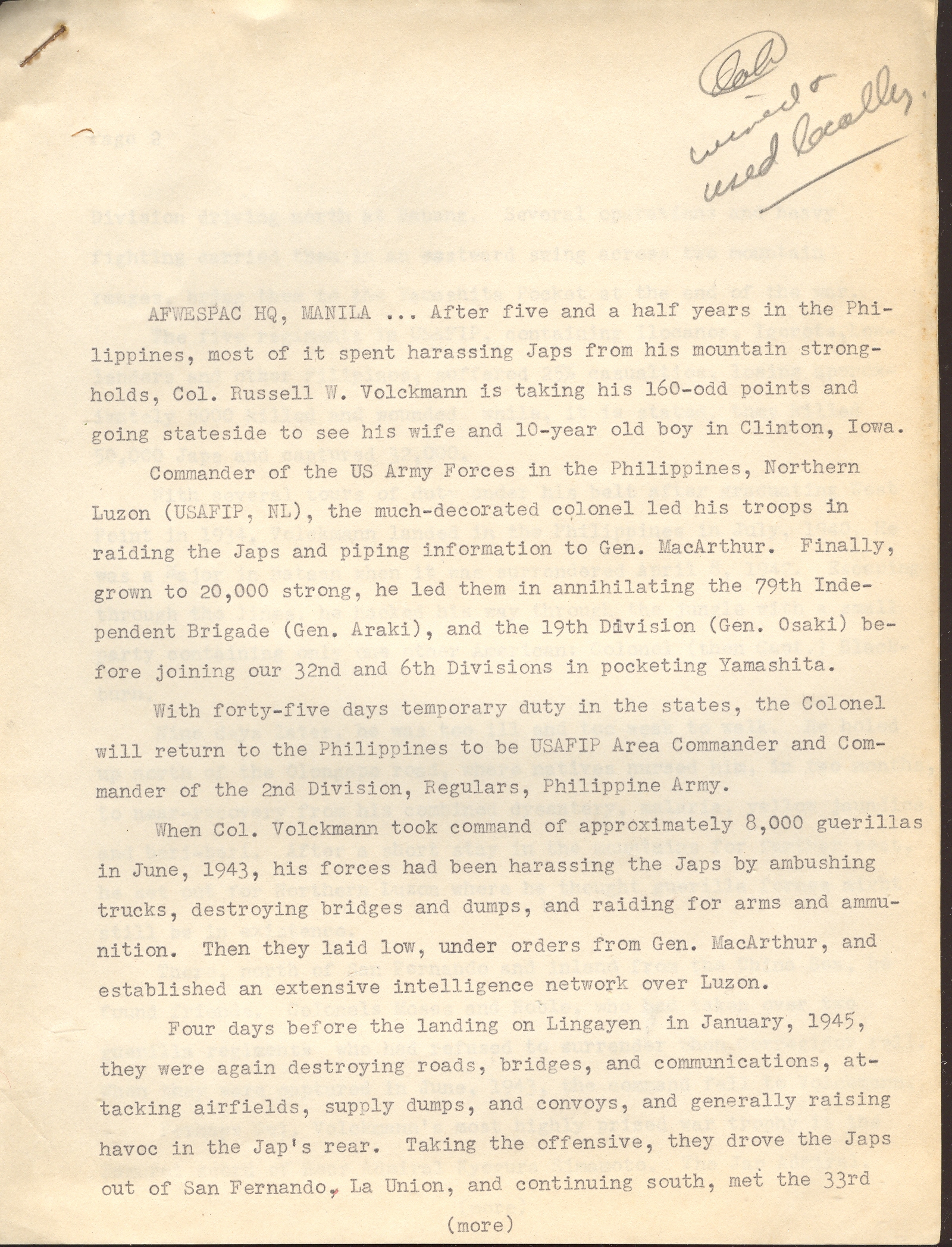
    Volckmann1

    (see Continued Reading section, below, for the rest of this document)

    DOCUMENT 2  (Issued 25 September 1945)

    This short document relates the story of the capture of the last of the Japanese forces in Luzon, including the capture of some 40,000 troops, including General Yamashita (“The Tiger of Malaya”) and soon-to-be-executed war criminal and beast of Manila.

    I’ll let the documents speak for themselves.
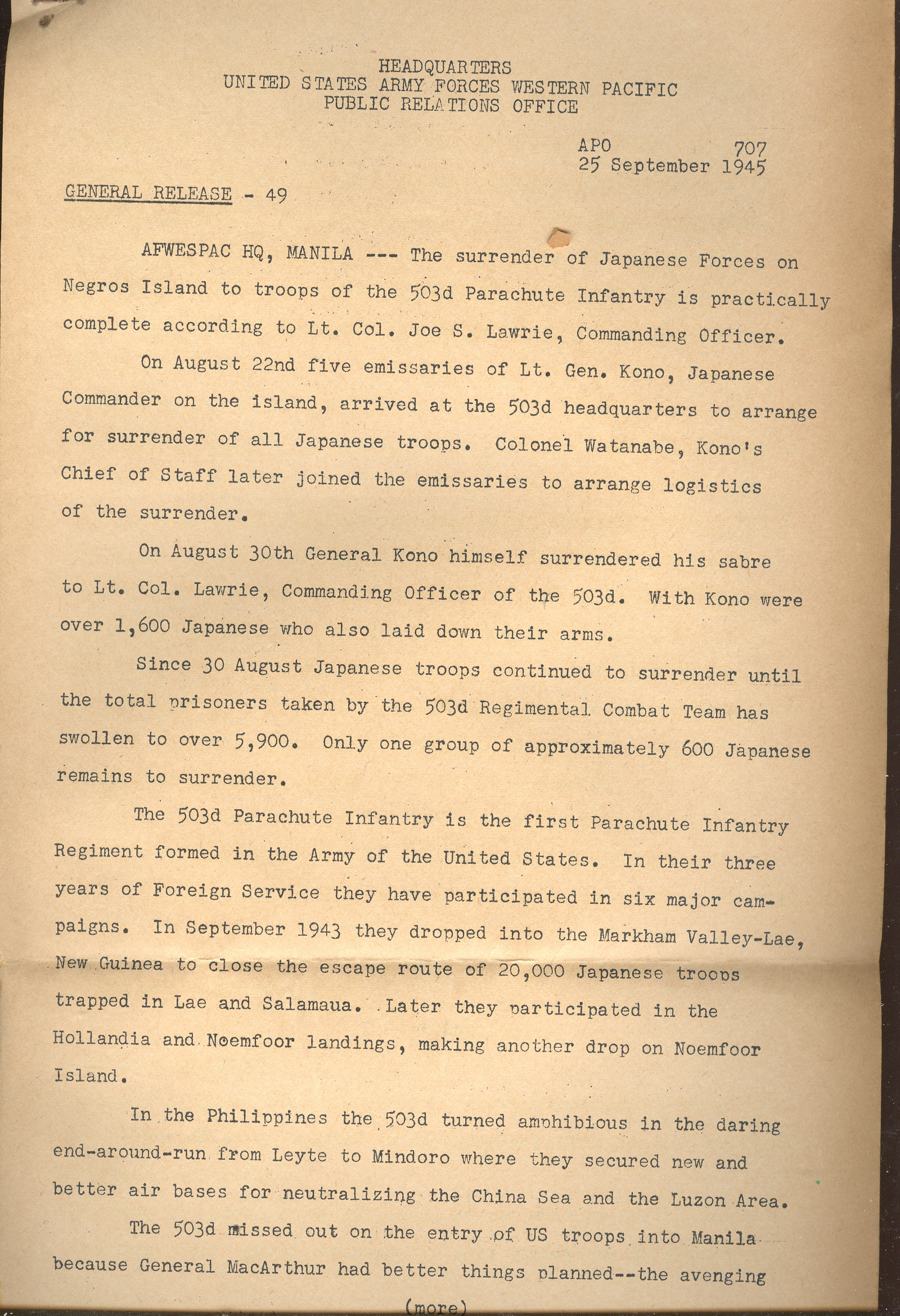
    Volckmann4

    (Read more, below)

    *from the Washington Post, 2 June 2002, the following obituary of David Katcher:

    “David Katcher, 87, who retired in 1979 as special assistant in science and technology to the undersecretary of state for security assistance, science and technology, died of cancer May 31 at his Chevy Chase home.

    Mr. Katcher was also senior policy analyst in the White House Office of Science and Technology policy during the Carter administration. He was the 1947 founding editor of Physics Today monthly magazine, published by the American Physics Association, and he edited the journal for four years.

    He had been an editor at the Naval Ordnance Laboratory before World War II and later executive secretary of a theoretical physics division of the Institute for Defense Analysis.”

    ·Posted by :

    ·in:


  • Some Vintage, Interesting, Declassified CIA Reports–Nuclear War and the Coming of the Communists

    JF Ptak Science Books LLC

    Following up on a few posts over the last two days on some striking CIA reports on such topics as the tactical employment of nuclear weapons in Vietnam are the following (the links taking you to the full documents), all taken from the CIA-Freedom of Information Act website of declassified reports:

    Cia-seal
    Soviet Capabilities for Attack on the U.S. through mid-1955  

    The Strategic Value of the U.S.S.R.  the Conquest of Western Europe and theNear East
    (to Cairo) 

    1948 

    Probable developments in China,. 
    1949 

    Probable Effects Soviet Union Atomic Bomb on the Security of the United States,
    1950

    Prospects for the Defense of Indochina
    against a Chinese Communist Attack
    ,
    1950

    Prospects for Survival of the Republic of Korea,
    1948


  • Things That Weren’t Department: the Stalinist Take on WWII and How Nobody but the Soviets Mattered

    JF Ptak Science Books LLC  Post 494

    Sometimes things that people deem to be necessary to be just aren’t, no matter how much they are needed:  WMD, attacks in the Gulf of Tonkin, the Lone Sniper, the Protocols of the Elders of Zion, Heaven, racially-based inequalities, Virgin births, free will, intelligent design, and so on. 

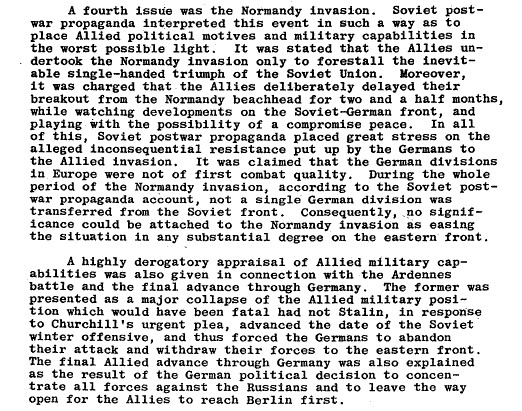
    This is part of a recently declassified CIA briefing on a 1959 Soviet history of World War II, told in only the way that a ruthlessly dogmatic entity could tell it, all found on the CIA site, with the full 61-page text Current Intelligence Staff Study; the Soviet History of World War II, (Reference Title: Caesar X-59),   here.

    There is a lot in this thinking that is entirely new to me, stuff that I’ve never thought of before, all brought about by a structured and corrupted historiographic establishment bent on controlling the past.  The CIA report discusses the ways in which the Soviet history excised the importance of all non-Soviet intervention of any kind; and, basically, that the actions of the non-Soviet Allied forces throughout the course of the war merely served to forestall the inevitable, single-handed dominance of the Soviet Union in winning World War II.  The breadth and depth of this incoherent and savagely twisted history is staggering.  For example, D-Day, the Normandy Invasion, the Invasion of Europe, did absolutely nothing, had no significant effect whatsoever on the outcome of the war–it, again, served only to lengthen the time of the war so that the Soviet Army could eventually finish it.  The Battle of the Bulge meant nothing.  The dropping of the two atomic bombs on Japan meant nothing.  The two years’ worth of supplies sent by the United States to the struggling soviet Union in 1941 and 1942 meant nothing.  Early Soviet defeats in ’41-’42 meant nothing.  The inability of the Soviet Union to determine the coming attacks from Germany in Operation Barbarossa meant nothing.  If the effect was extra-Soviet, then there was no cause–in this line of reasoning, the storytelling was so devastated that in the end, not even nothing was nothing. 

    Yes it is true that the Soviet end of the war is undertold and that the Soviet Union suffered tens of millions of soldiers and civilians killed, but their response to telling the story of the war is so far beyond wrong that it isn’t even that.  It is nothing, except of course that there are millions of people who believe it.  And in the wars of propaganda, that is a victory, and that is when nothing becomes something.

    • (Excerpt from page 11 of the CIA report)

    Soviet propaganda WWII history

    ·Posted by :

    ·in:

    —

  • Portraits within Portraits: Found sub-Images in WWI Photography

    JF Ptak Science Books LLC

    0 blog jan 12baker374

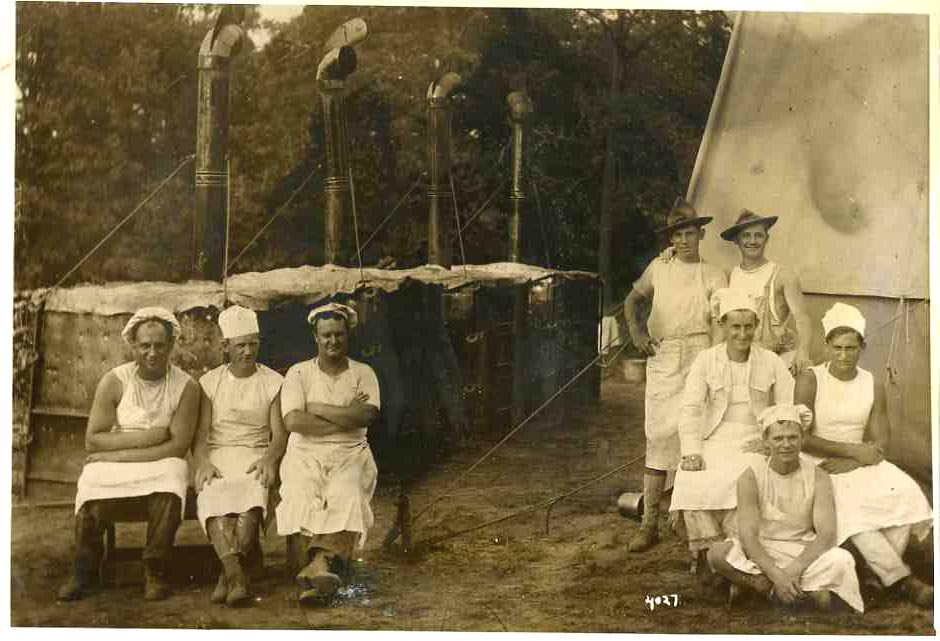
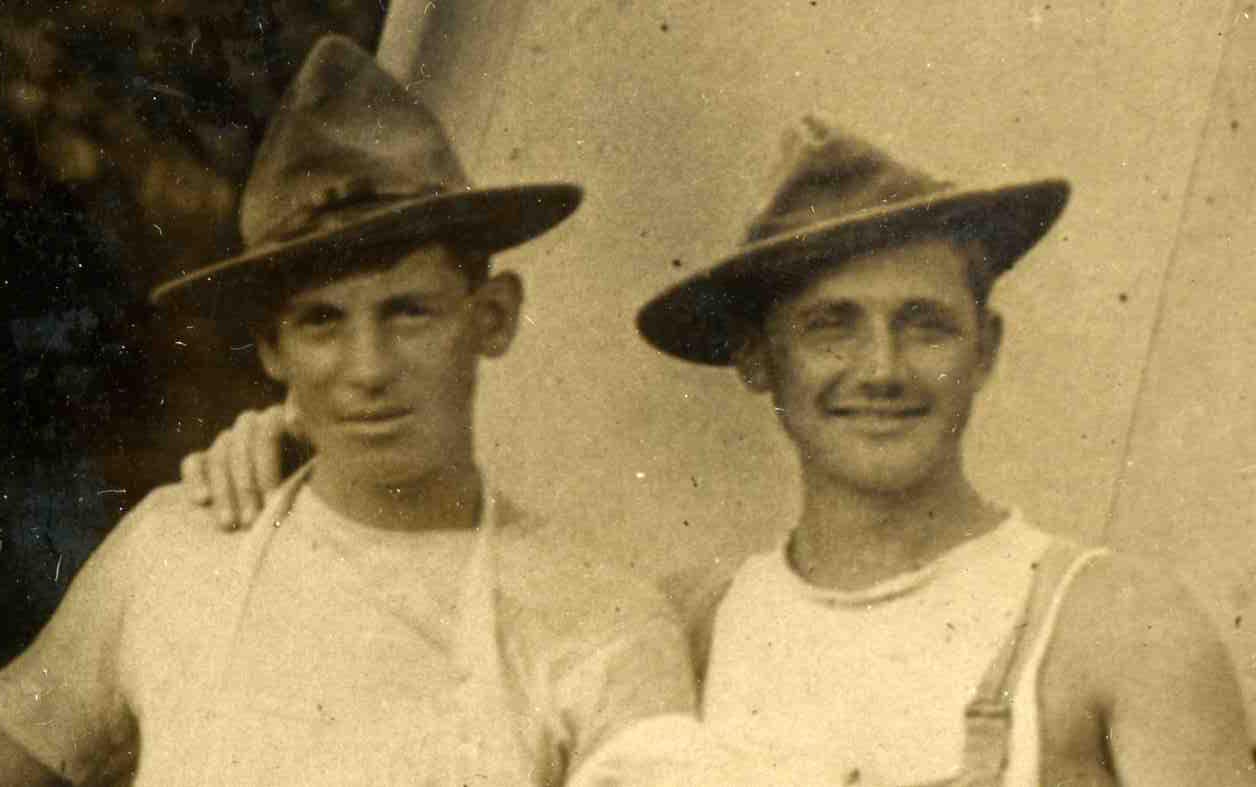
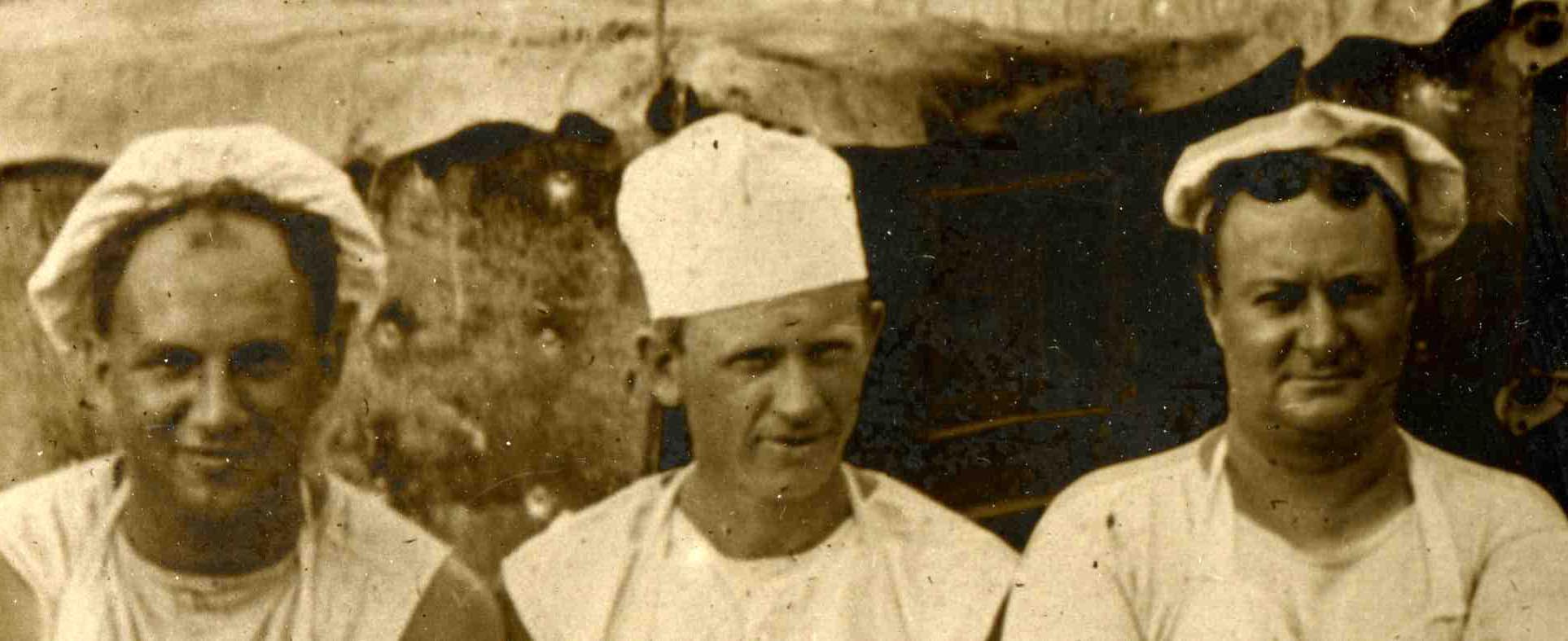
    In my collection of WWI News Photo Service Agency photographs I would say that half or so of them show  scenes like this–semi-informal group portraits of military support groups.  500 portraits like this seem to be a lot, and I’m not sure why these images are so well represented. Except of course that there weren’t that many images (overall) of active-battle scenes. 

    These bakers, working at a front-line support station, from my read were probably taking a break, and the photographer took the opportunity to draw them together for the portrait.  I don’t know why they’re separated so, but they do look as though they have a real camaraderie–it is just a wonderful picture, full of friendship and loyalty, and I’m sure it has never been published before.  

    0 blog jan 12baker375

    0 blog jan 12baker376


  • Things that Are Just Simply Wrong: War Gases and Babies; Protective Suits for Children and Babies, 1943

    JF Ptak Science Books LLC  Post 466

    0 blog jan 12 baby gas380

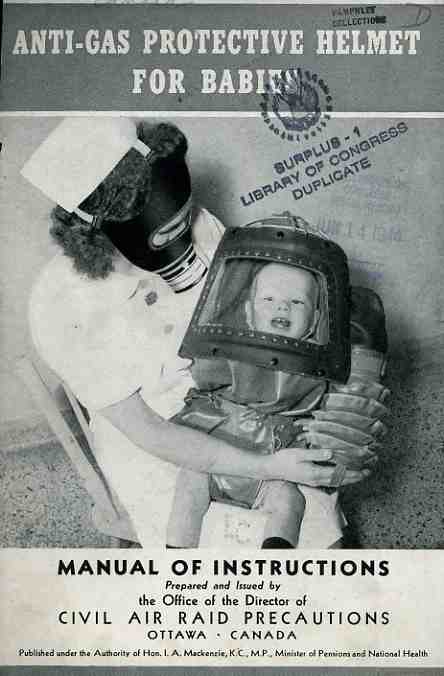
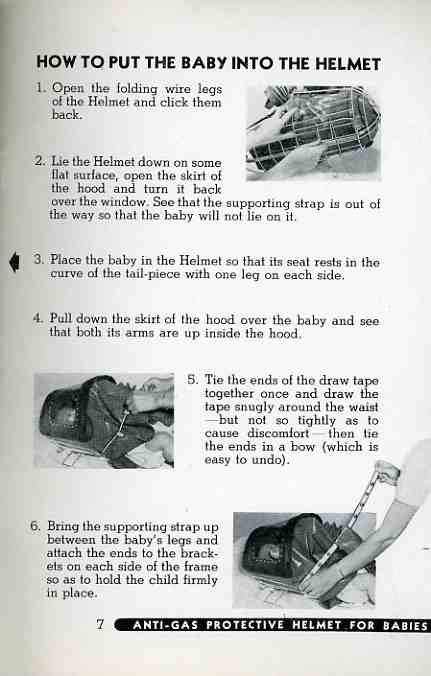
    There’s nothing that shouts “WRONG” with greater voice than images like this.  Like pornography and art, things that are just plain wrong are instantly recognizable.  And this, my dear reader, is a fine example of that thinking. Anti-Gas Protective Helmet for Babies, Manual of Instructions was prepared for the Office of the Director of Civil Air Raid Precautions of Ottawa, Canada, and published in 1943.  I’m not sure that the image of the nurse in the gas mask isn’t as disturbing, but the two of them together is just too much.  

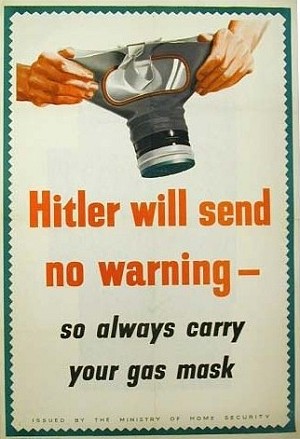
    I wasn’t aware of the gas attack preparations in Canada–the situation was entirely different in Britain, where everyone was required to own one, and by 1940 more than 38 million had been distributed to the population.  But the planning was underway in Ottawa in ’43 for the worst, as removed and distant from the war as just about any other place on earth–but the Air Raid Precautions people pulled no punches in their hearts and minds campaign, and I’m sure that it was very effective.  This little pamphlet certainly caught my attention.

    0 blog jan 12 baby gas381

    Blog gas poster

    ·Posted by :

    ·in:

    —

  • Women in the War Effort: London, 1918

    JF Ptak Science Books LLC  Post 465
    0 blog jan 10 brit women strt371

    In England,
    women were welcomed to the (paid) workforce during the years of the First World
    War (1914-1918)—their employment in traditionally male positions enabled those
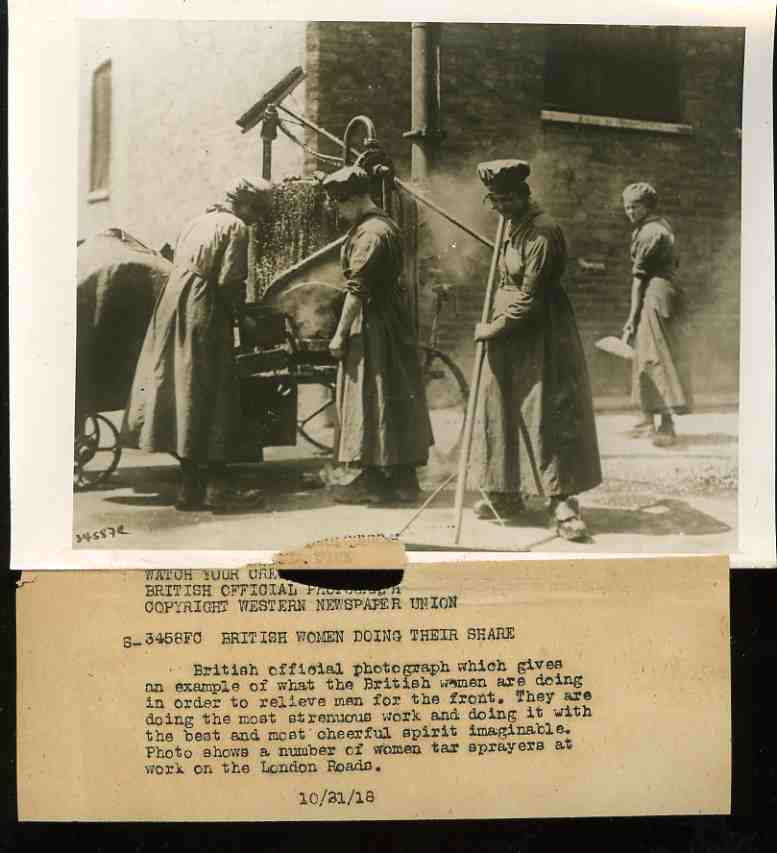
    they replaced to go out to the front and die for their country.  Thus the women seen here in the News Photo
    Service Agency photograph (taken in 1918), working at spraying tar in the
    streets of London,
    were appreciated, and tolerated.  For
    women in England the War
    blasted away the contrivances of formally scheduled employment:  something like 12% of fall women in England were
    working as servants and house cleaners.  
    Come the War, women were offered jobs of revolutionary stature in a wide
    range and variety of work.  The Civil
    Service employment for women went from 33,000 in 1911 to 102,000 in 1921, and trade
    union membership rose 160% (357,000 in 1914 to 1,000,000 in 1918 (with men
    showing a 44% increase at the same time); for the most part, though, employers
    took advantage of the situation, and the women still generally earned less than
    half of the salary as comparable male workers did (or the men they
    replaced). 

    0 blog jan 10 brit women strt372

    When the end of the War came,
    so did the appreciation for the women replacement workers—there was bitter feelings
    in the post-war period because of the weak British economy and a scarcity of
    jobs.  So the women who took the jobs of men
    to help the country’s war effort and free up hundreds of thousands of men for
    war service became an atavistic action, “taking” the jobs of men who had gone
    out to fight for their country. This of course cost many women their jobs, but
    the damage had already been deeply done to the pre-1914 British world of the
    sexual politics of business-being-done, though it would take World war Ii to
    really ingrain the appearance of women in the workforce into the national
    psyche.

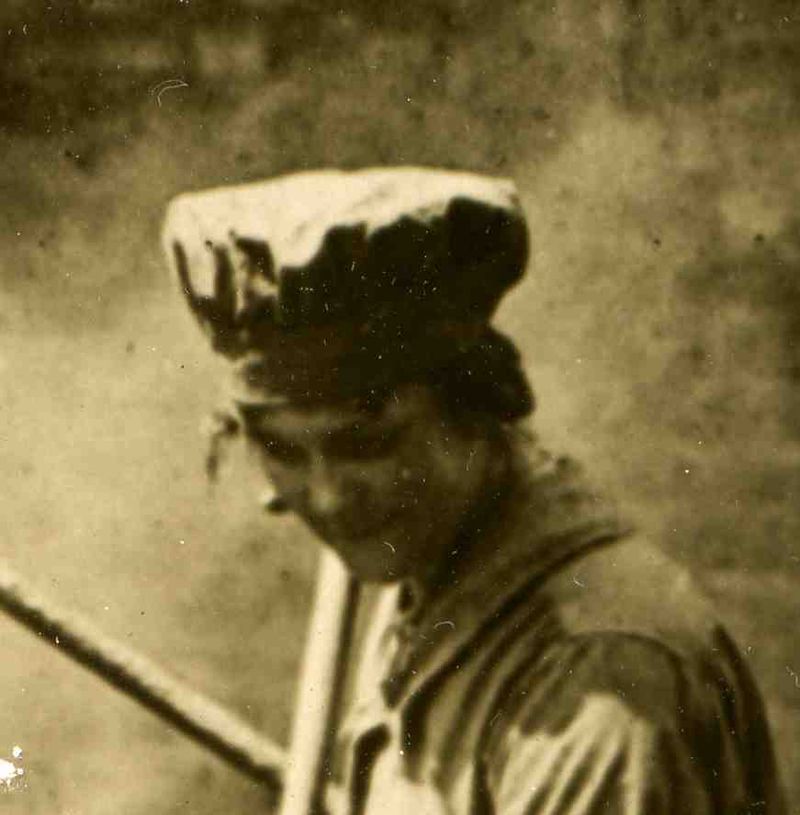
    (Madonna of the tars, right)

    0 blog jan 10 brit women strt373


  • Ethnic Cleansing, the Philippines and Singapore and General Yamashita, 1942-1945

    JF Ptak Science Books LLC  Post 455

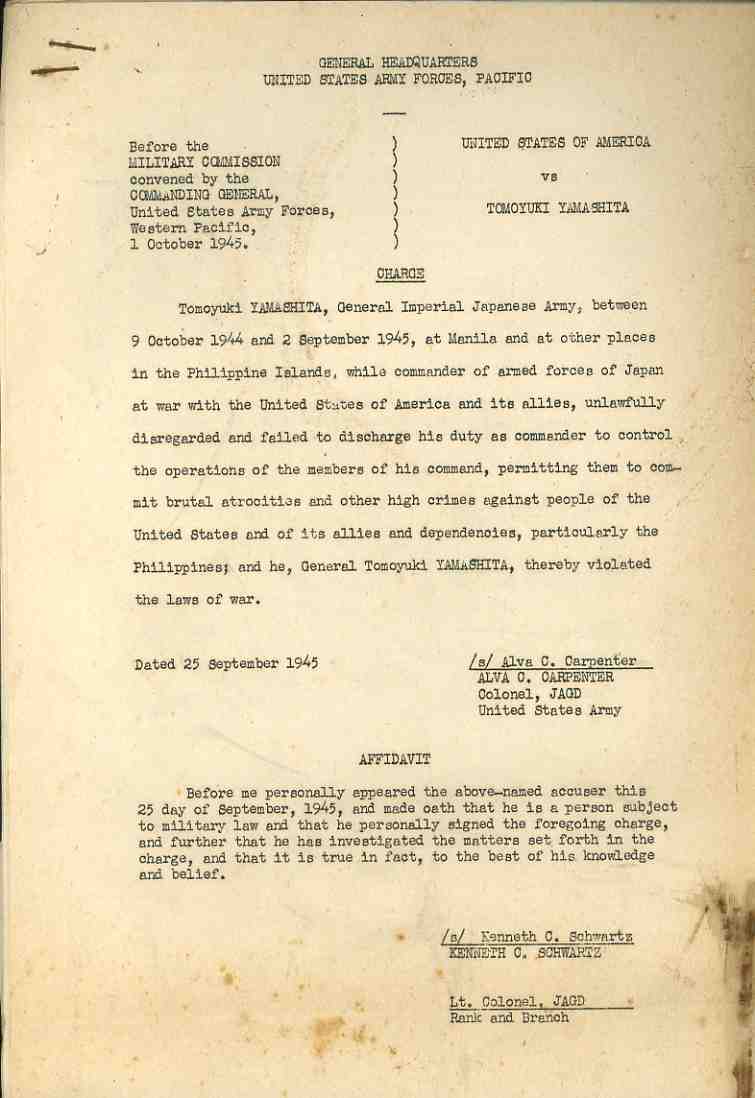
    0 blog jan 03 JAPP345 This is a rare offset printing of the statement of charges
    and “outline of particulars” against the Japanese Imperial Army General Tomoyuki
    Yamashita (1885-1946), a man accused of war crimes against humanity.  After he was captured 2 September 1945,
    General Yamashita was arraigned principally for failing to control his troops,
    segments of which had acted brutally in their treatment of residents of
    captured Singapore and
    against British Empire soldiers. He was
    charged with “unlawfully disregarding and failing to discharge his duty as a
    commander to control the acts of members of his command by permitting them to
    commit war crimes.”  This was in
    direct violation the doctrine of “command responsibility” which was established
    by the Hague Conventions IV (1907) and X
    (1907)
    ,
    and—after in re
    Yamashita
    —would also become known as the “Yamashita standard”, in which courts
    clearly accepted that “a commander’s actual knowledge of unlawful actions is
    sufficient to impose individual criminal responsibility”. Yamashita would be
    found guilty by the U.S. Military Tribunal and was sentenced to death, for “vengeful
    actions are widespread offences and there is no effective attempt by a
    commander to discover and control the criminal acts, such a commander may be
    held responsible, even criminally liable.” 
    It was a death sentence for a crime of omission. (As early as the 6thcentury BCE, Sun Tzu,
    in his Art of War, stipulated that it was a commander’s duty to ensure that his
    subordinates conducted themselves in a civilized manner during an armed
    conflict.)

    Getting back to the war: 
    after Yamashita captured Singapore in February 1942, accepting the
    surrender of General Arthur Percival and 100,000+ British Army soldiers, a
    steel wind policy was instituted, with thousands of people—soldiers and
    civilians—finding their end at the point of Japanese soldiers’ bayonets. 

    Chief among the atrocities was the Sook Ching movement, a
    concerted, pervasive and prolonged ethnic cleansing of Singapore of
    anti-Japanese “undesirable” elements. 
    Among these groups were included (and this list is taken from a rather
    good contribution to the dubious Wikipedia):

    In short, it didn’t take all that much to be considered for
    elimination, and a long and frozen fear and ruthless hearts-and-minds- campaign
    was instituted which lasted until the Philippines were finally liberated.  And it was for the Japanese actions in the Philippines, and then principally in Manila, that General Yamashita was tried, despite the effects
    of his long and terrible reach across South East Asia

    Most
    of the British and Australian prisoners incarcerated in Singapore’s Changi Prison would never
    make it out.  Other segments of the POWs
    would be transported on hell ships for forced slave labor throughout the
    Japanese Empire.  The Siam-Burma death
    railroad (surfaced in the Pierre Boullee novel The Bridge on the River Kwai) received other portions of these
    POWs; on that 258-mile railroad upwards of 180,000 Asian slave laborers and
    60,000 Allied POWs were put to work in horrific and desperate conditions—90,000
    of the Asian and 16,000 of the Allied would be killed during the construction
    (though many estimates are markedly higher than this).  The Sandakan
    airstrip in North Borneo was another death receptacle
    of these POWs:  3,600 Indonesian slave
    laborers and 2,300 Allied POWs were set to work here—only 6 Allied POWs
    (Australian escapees) survived. 

    In re Yamashita focused
    on the Philippines and the battleground that it was turned into by Yamashita, costing the civilian
    population more than 100,000 lives. Tomoyuki Yamashita was hanged on 23
    February 1946 at Los Banos Prison Camp, 30 miles south of the city in which he
    caused so much misery. 

    ·Posted by :

    ·in:


  • The Air Bridge to Nowhere: the Friendly Skies, Chicago to Moscow, 1944

    JF Ptak Science Books LLC  Post 449

    0 blog dec 29missing men327
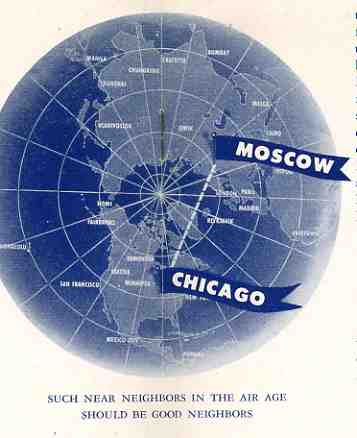
    This hopeful and terrifically unbalanced homage to wistful loveliness of the Soviet Union, The Businessman’s Stake in American-Soviet Friendship,
    by Harland Allen, was published in Chicago in 1944, and seems to me a
    small prayer for what the post-war world might bring about.  Allen
    forced the then-popular economic thought that the people dangling from
    the visor of Uncle Joe Stalin’s cap were money angels rather than
    Russian corpses, and that the air lane shown in the trans-polar map at
    right would soon be filled with American exports headed to Moscow.
    (Little did he know that in  a decade this line would be the distance
    traveled by ICBMs, or close enough to it.)  At least that seems to be
    the hope here, Stalin forcibly melted into the Big Board, the Soviet
    Union trading on the DOW as CCCP (Inc.).

    The small pamphlet
    received some spirited review support from the Northwestern University
    School of Law, the Des Moines Register and Tribune,the Society for the
    Advancement of Management, the Meadville Theological School, and Laird
    Dell Attorney at Law. And that’s about it. But these were ripe times
    for this sort of pro-Soviet thought:  after all, dozens of millions of
    Russians had been killed in the fight in the East against their former
    Nazi allies, and without all of that blood sacrifice I have no doubt
    that the war would’ve lasted for some years to come.*  The U.S. had a
    powerful ally in the Soviet Union regardless of what had happened there
    in the 1930’s and regardless of their attack on Finland and regardless
    of their Pact with Hitler–from 1942 onward they would hinder and halt
    the Nazi army and nearly ground the whole thing down to a nub, crushing
    the German capacity to fight in the west. The atomic bomb was to be
    untried until July 1945, and the outcome of the war was not yet known. 
    Love for the Soviet Union was high in the sky at this point, FDR making
    many airy and superior statements about our new ally, while the rest of
    the propaganda machine was lubed and oiled for the coming fight.  LIFE
    magazine went so far as to pronounce Lenin as “perhaps the greatest man
    of modern times” and that the NKVD was analogous to the FBI.  Even old
    anti-Soviet hawks like MacArthur publicly pronounced their admiration
    for the new regime.  (George Patton famously did not.)

    Back to
    our pamphlet: aside from some romantic vision of the Soviet Union,
    Allen maintained that the U.S. needed to deal with the CCCP because of
    its enormous army (which he did not want to annoy and fight) and its
    impending “mastery o the air”–it would be better to trade and make
    money than it would be to make war.  Allen pointed out that some of the
    problems of Americans dealing with the political system in the Soviet
    Union were inadequate reports on what he described as the country’s
    economic “principle of national planning“. .(I hardly know what
    George Orwell might’ve said about the supremely understated summation
    of the Soviet system as “national planning” and the fruitless and
    embarrassingly weak attempt at  controlling language to describe the
    monstrously repressive regime.)  He continues:  “Journalists have been
    positively fearful of open-minded reporting in Russia lest they get
    tagged–or tarred–with the familiar epithet “communist”, and then goes
    on to describe the similarities of the “two great peace-loving
    peoples”. 

    And so it goes, on and on in this pamphlet–it just
    isn’t worth going into any further than this.  The euphoric sheen of
    pro-Soviet sentiment and appreciation wore thinner as the war
    progressed, truer feelings becoming more exposed as the German army
    retreated westward, reproducing the famous Minard chart of Napoleon’s
    disappeared army in a war 130 years earlier.  The endgame for European
    real estate, fumbled badly by the dying FDR at Yalta, brought out the
    cardboard smiles between the US and the Soviet Union, relations
    strained to the point that the military employment of the atomic bomb
    was in some not-minor sense made to bridle Soviet intentions.

    But that was still two years hence for Mr. Allen, who I guess couldn’t see into the future that far, even if his work was heralded by the Des Moines Register.  He just didn’t do a very good job of withstanding the test of time, even though that test ended in 1946.


  • “The Fall of the Bolshevik Regime”, Kereneky in Petrograd 1918

    JF Ptak Science Books   Post 435

    0 blog kerens=ky 18 dec285

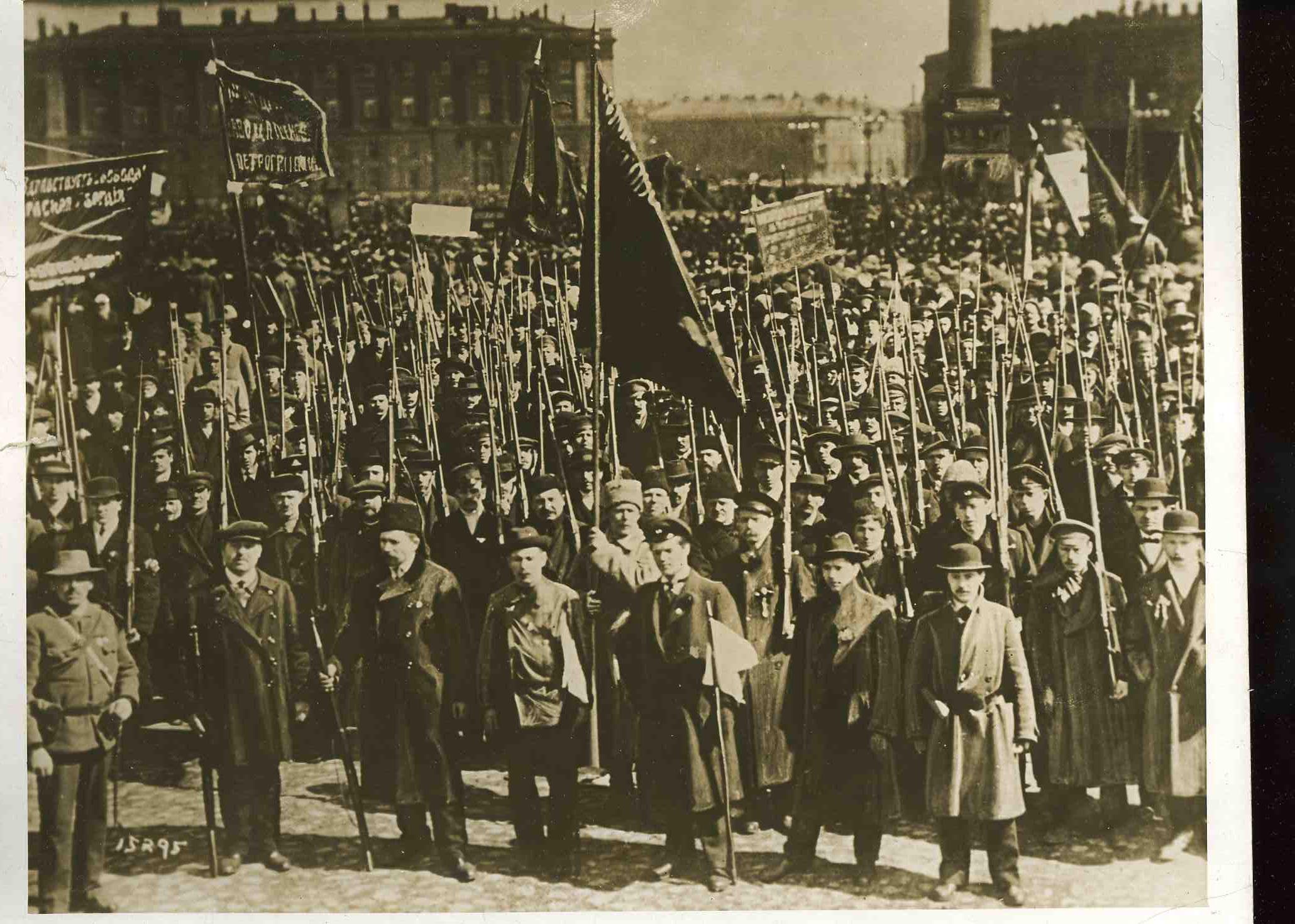
    This photograph–a picture of hope soon dissipated–shows the 1918 portion of the Russian Revolutions of 1917 at just about the time of its, well, “completion”, beginning the period of the Russian Civil War, which would last until the creation of the USSR in 1922.  (The photo is also part of a News Photo Service archive I purchased some years ago in, and was originally released by the Western Newspaper Union.) Alexander Kerensky, who according to the stamped caption of this photograph, was leading an army of “200,000 marching on Petrograd” in order to overthrow “Lenine [sic] and Trotsky” and the “Bolsheiki Revolution”.  Kerensky (1881-1970) was elected second Prime Minister of the Russian Provisional Government under Lenin following the February (1917) Revolution.  A complex of war (WWI) and domestic/social/political directed chaos led Kerensky and Lenin to opposing paths, and, following the October 1917 revolution, the winner was clear.  Kerensky, according to the data on the photo, was a “David” leading an army in opposition deposed to toppling  the Bolsheviks “next week”.  Things did not go as planned, or almost nothing did, and Kerensky’s army drifted, walked and ran, via indifference, fear and belief to the side of the Bolsheviks.  About the only soldiers who stayed loyal to Kerensky was the 1st Petrograd Women’s Battalion, a unit of the 1st Russian Women’s Battalion of Death. (This was the first all-female combat unit in Russia, and although starting out with about a force of 2,000, quickly wasted away under the rigorous and harsh command of its commander, Maria Bochkareva*, down to about a fighting group of 300.)  Kerensky fled the country and began a long series of travels, though ultimately settling in the United States, dying in NYC in 1970 (making him one of the longest surviving principal participants of the Revolutions).

    St. Petersburg/Petrograd has a long and important history in the formation of the Russian nation—established in 1703 as the capital of the Russian Empire and remaining so for more than 200 years, it was also the seat of the 1905 Revolution as well as the February and October revolutions of 1917.  Another bit of full-circle was that Kerensky and Vladimir Ilyich Ulyanov (Lenin) were both born in the not-large town of Simbirsk (now called Ulyanovsk).  Kerensky’s father, as it turned out, taught Lenin at the Kazan State University, a great institution of higher learning featuring non-other than the principal founder of non-Euclidean geometry, Nikolai Lobachevsky, as its rector for almost twenty years (1827-1846). 


    0 blog kerens=ky 18 dec286

    *This interesting, severe, passionate woman through intrigue and loss wound up fleeing the Soviet Union in 1918, winding up in NYC and ultimately meeting with Woodrow Wilson, appealing for American support and intervention to halt the Bolsheviks.  She made the same appeal directly to George V, before winding up back in the Soviet Union, where, in 1918, she was captured.  She was ultimately tried and convicted of being an enemy of the people, sentence to death, and then killed by the precursor to the KGB, the Chaka. 

    0 blog kerens=ky 18 dec287


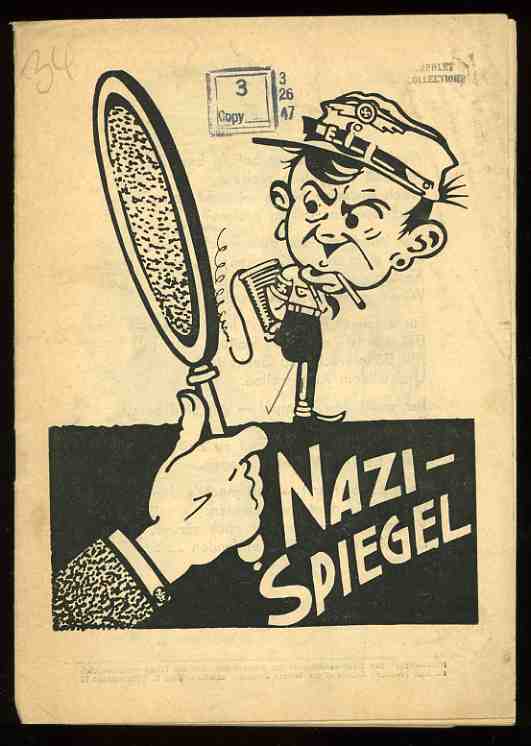
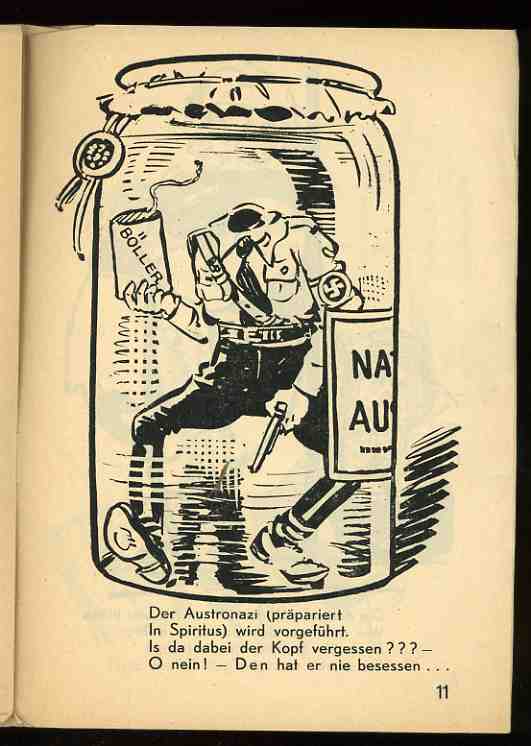
  • An Early and Vicious anti-Austrian-Nazi Graphic Political Pamphlet, 1934

    0 ebay 15 nazi275

    JF Ptak Science Books LLC  Post 432

    This  rare pamphlet–located in only two collections worldwide–was published in Vienna in 1934 and takes accurate and vicious aim at Austrian Nazis.  The Austrian Nazis were busy fighting amongst themselves, the factions breaking down into pro-Italian fascists and pro-German Nazis.  Or at least that is what this seems to me to be for a one-line summary of a complex four-year struggle, The Nazi party existed in Austria well before the Anschluss of 1938 (when the Nazis swept into the country and took geo-political-military control), and attempted to seize power in the country from the very their  outset.  The pamphlet  also seems to have been printed after the 1934 attempted coup (July Putsch) and successful assassination (by a group of eight German Nazi agents) of the Austrian leader turned dictator Engelbert Dollfuss, who was replaced by another fascist dictator, Kurt Schuschnigg.  (The OCLC lists 1934 as the year of publication; there does seem to be a caricature of Schushnigg being pummeled by an Austrian Nazi on page three, making this pamphlet a product of the second half of 1934.)  Schuschnigg was another  dictator replacing a dictator and the leader of the Austrofascist party, who in turn was thrown away in the Anschluss and sent to Dachau and Sachsenhausen.  He survived and wound up teaching polysci at Saint Louis U from 1948 to 1967.

    The pamphlet was a real display of courage at a very difficult time.  I hope that this frivolous treatment of a complex story wasn’t too far off the mark. 

    0 ebay 15 nazi276