A Daily History of Holes, Dots, Lines, Science, History, Math, Physics, Art, the Unintentional Absurd, Architecture, Maps, Data Visualization, Blank and Missing Things, and so on. |1.6 million words, 7500 images, 4.9 million hits| Press & appearances in The Times, Le Figaro, Mensa, The Economist, The Guardian, Discovery News, Slate, Le Monde, Sci American Blogs, Le Pont, and many other places… 5000+ total posts since 2008.

Category: Militaria

  • Growing a Junk Yard: Salvaging Fat, Bikes and Stockings for Guns and Tanks, 1943

    JF Ptak Science Books LLC Post 379

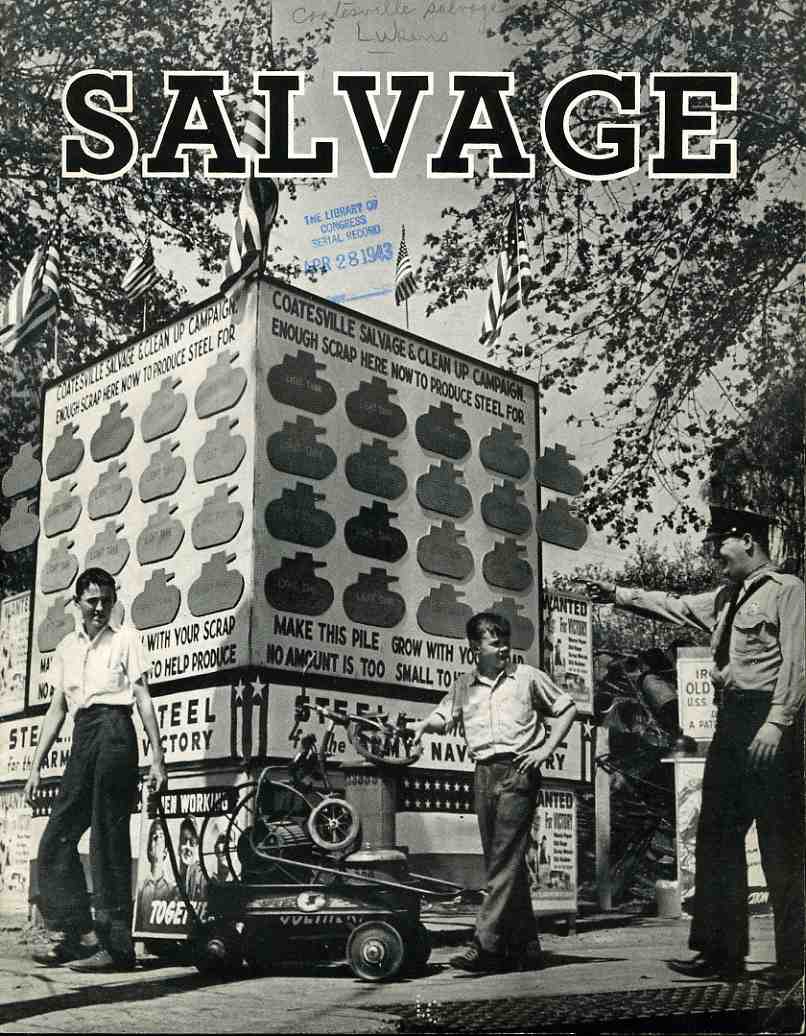
    00-blog-Oct 25 salvage922 Salvage (1943) is just simply brilliant!  It is a superb design, getting its inelegant point elegantly across to the reader, making the collecting of junk  a bona fide war effort, triumphant, superior; it delivers the message gorgeously.  Who wouldn’t want to rush out and look for some metal scrap and bits and grow a neighborhood junk yard so that the community could build a tank?  Certainly these two boys–under the watchful guidance of a smiling cop in a black tie–couldn’t resist, and from the looks of the progress billboard behind them, nor could anybody else in the neighborhood, as the community collected enough metal junk for 14 tanks.  (Or at least pieces and chunks for fourteen tanks.)

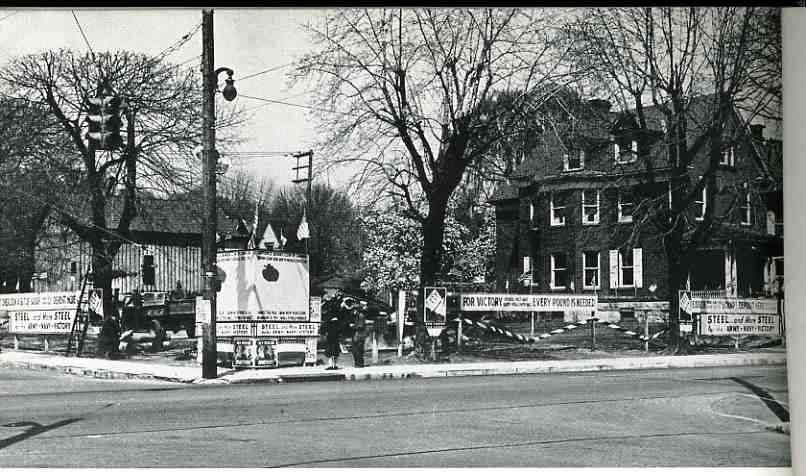
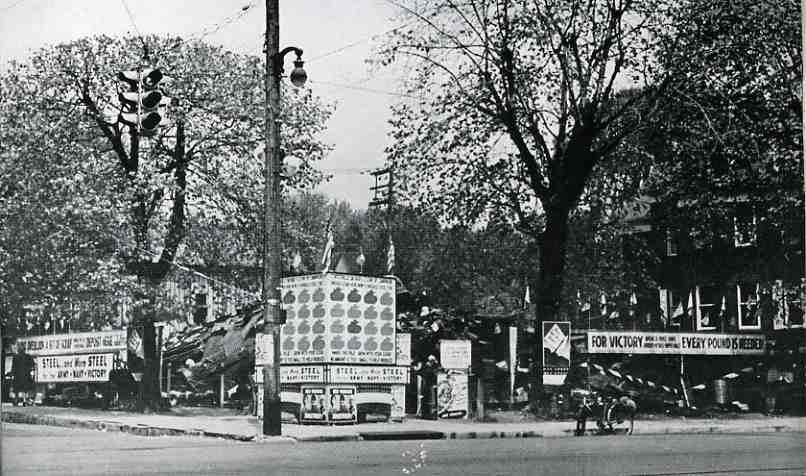
    The community was Coatesville, Pennsylvania, and they certainly did their collecting-best.  The two photos below show (top) the scrap yard after two days of collecting, and (bottom) the end of the campaign two months latter.

    “One pound of fat contained enough glycerin to make a pound of black powder, enough for six 75-mm shells. Twenty three hundred old nylon stockings contained enough nylon to make one parachute.
    Thirty thousand razor blades contained enough steel to make fifty 30-caliber machine guns.”   (Lingeman, Richard R. Don t You Know There Is a War On? The American Home Front, 1941-1945. New York: G.P. Putnam’s Sons 1970, 254-55).  When you have an entire town doing this, you can build tanks; when you have millions of people throwing together to collect this “junk”, then you get part of a war effort.  It is also part of a giant propaganda hearts/minds machine, especially for the U.S., which was (and I use this word with some hesitation) cushioned from the effects of the war by two oceans–it reminded people who hadn’t contributed a life to the war that there was actually something tangible going on, and that they could do something to help.  It kept peoples’ minds in the game.  Rubber was another big concern, as was silk (the controlling exporter of both coming largely from overseas, and in the case of silk, the exporter was Japan.)  Of course there was the introduction of synthetics for both silk and rubber, but the point in fact was that there was indeed a shortage, and the donated and salvaged stuff was necessary. 

    Here’s a beginning picture for the burgeoning community scrapyard:                                                                                                                                              00-blog-Oct 25 salvage before923

    Some interesting works relating to salvage drives:

    Barringer, Edwin C. The Story of Scrap. Washington D.C:Institute of Scrap Iron & Steel Inc., revised edition, 1954.

    Cohen, Stan. V for Victory: America’s Home Front During World War II. Missoula Montana: Pictorial Histories Publishing Co., Inc., 1991.

    And afterwards:

    00-blog-Oct 25 salvage after924

    Hoopes, Roy. Americans Remember the Home Front: An Oral Narrative. New York: Hawthorn Books, 1977.

    Lingeman, Richard R. Don t You Know There Is a War On? The American Home Front, 1941-1945. New York: G.P. Putnam’s Sons, 1970.

    O’Neill, William L. A Democracy at War: America’s Fight at Home and Abroad in World War II. New York: The Free Press, 1993.

    And here’s one I’d like to see (the cover of):

    Wolf, Howard. The Story of Scrap Rubber. Akron, Ohio: A.
    Schulman, Inc., 1943.

    ·Posted by :

    ·in:

    —

  • Blank and Empty History: Disappeared Legions of The Wrong

    JF Ptak Science Books LLC  Post 375

    0-blog---Nov 13 doriot070

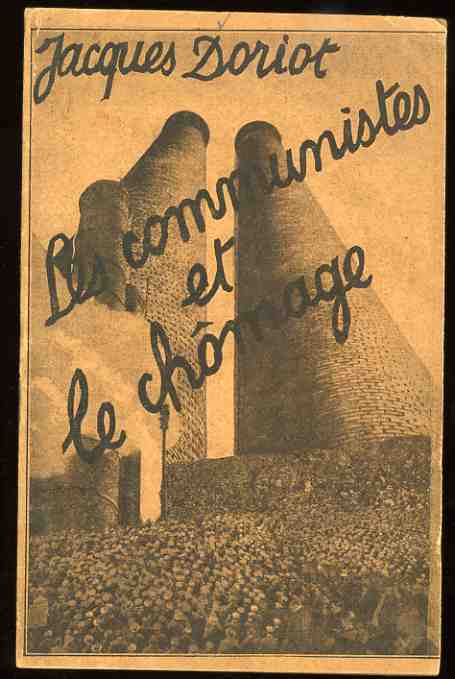
    Continuing my series of posts on The History of Blank and Empty (and Missing) Things, I come to this beautifully designed French  pamphlet of 1931.  The design is of less interest than what happened to its author, the exceptionally problematic and traitorous Jacques Doriot.  Now Doriot (1898-1945) started off liberally enough, shooting out soon thereafter to explore the very furthest reaches of The Deep Left, and then, when that didn’t quite work out for him, blasting off to the nether regions of the wincingly bad singularities of The Deep Right.  He scratched at the edges of political extreme idealisms, waiting for something to happen, something that would get him greater fame or more-reaching political power, but his fate would intercede. 

    Doriot began his career as a Communist and would do fairly  well, politically speaking.  A member of the Communist Party since 1902, he would become Mayor of St. Denis (near Paris) and a member of the Chamber of Deputies.  A difficulty would arise and he quit the party, becoming a Fascist over the next few years.  On the invasion of France, Doriot became a Nazi firebrand, committing himself to the cause, and living in  lickspittle Vichy France. 

    Like another fellow ex-pat (Ezra Pound), Doriot made vicious anti-French/communist and pro-Nazi radio broadcasts from Paris in 1940 and 1941.  In that year Doriot would take an uncommon step, a step towards disappearing, when he and Marcel Deat founded the Legion des Volontaires Francais (contre le Bolshevisme) (LVF)), which was a combat unit of French Nazi sympathizers that fought with the Wehrmacht.(Over time and the wear of war it was also known as The 33. Waffen-Grenadier-Division der SS Charlemagne (französische Nr. 1) and Charlemagne Regiment, as new elements were formed to replace the lost.)  I could imagine that no one saw them as anything but pathetic, even their Nazi commanders, who would put them into the meatginder on the Eastern Front.  The LVF was decimated and all but gone by the end of the war, though Doriot, somehow, survived it (with an Iron Cross awarded him in 1943), until he was killed by a strafing plane on 22 February 1945.  The survivors of these groups met bad ends at the hands of the French (and the Soviets of course); some were imprisoned and sentenced to hard labor; many were summarily executed. 

    Groups like the LVF take their members and spin off towards oblivion, much like the Spanish pro-Franco troops that went to fight for the Nazis and were disappeared, or the poor black slaves of the (Western Band of) Cherokees who were made to fight with their Indian masters for the Confederacy, a deeper, darker place I could not well imagine. 

    (A  detail of the crowd scene of the pamphlet on Communism and Unemployment.)0-blog---Nov 13 doriot071


  • Inglorious Glory of the Atomic Bomb: National Geographic Society’s Mistaken Salute to Admiral William Blandy

    JF Ptak Science Books LLC  Post 369

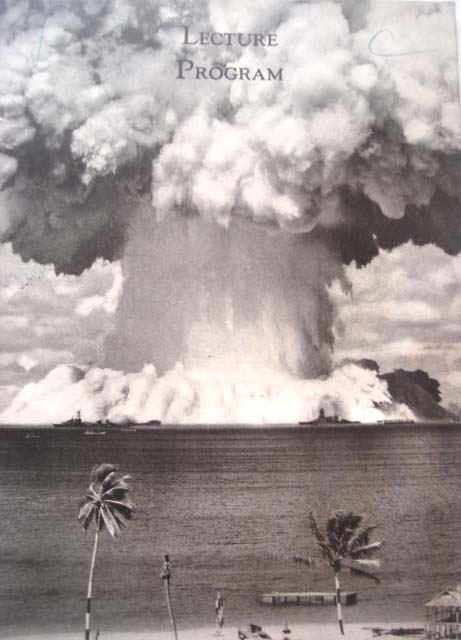
    Ballistics 132This odd graphic appeared as the entire front cover of the National Geographic Society’s Lecture Program pamphlet for 1946.  It is strange to me, the use of the photo and its cropping, its brightness–weirdly, the image seems to me to be almost “happy”.  The lead lecture for the series was Admiral William P. Blandy, who was one of the only leading military men (along with Dwight Eisenhower) to voice disapproval on the military use of the atomic bomb.  Blandy (28 June 1890 – 12 January 1954, first in his class at USNA, Chief of the Bureau of Ordnance from 1941 to 1943; then Commander, Group 1, Amphibious Force, Pacific Fleet.) went on after the war to become the Deputy Chief of Naval Operations for Special Weapons, most notably in the early periods at Operation Crossroads.  

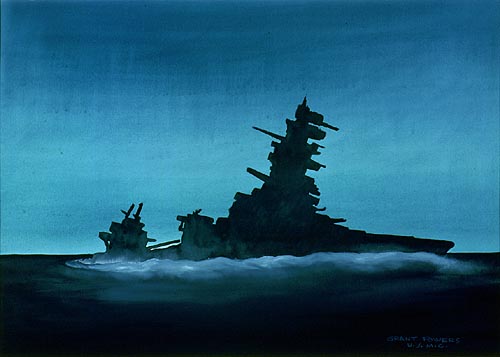
    Crossroads was the nuclear weapons tests conducted during the summer of 1946 at the Marshall Islands, and included the fourth and fifth (Able and Baker) tests of atomic bombs (the first being at Trinity, the other two at Hiroshima and Nagasaki). The picture on the front cover of the NGS pamphlet is for Test Able—the Japanese battleship Nagato (shown in the painting below, listing, 1946), the ship in command of the Japanese forces for the attack on Pearl Harbor, was one of the ships used in this blast for test purposes.  It was not sunk in the explosion, nor was it sunk immediately afterwards when charges were detonated on her sides.  The ship did eventually list and sink.

    The choice of this image for Bandy’s lecture bothers me.  He never liked the bomb, being more dissatisfied with “the breath of death” from the weapon—its radioactivity—than its immediate destructive power.  He referred to it as “a form of poison warfare”.

    Blog--bikini

    I don’t think he was much satisfied with his position.  Of his work there in the Marshalls he said:
    “The bomb will not start a chain-reaction in the water converting it all to gas and letting the ships on all the oceans drop down to the bottom. It will not blow out the bottom of the sea and let all the water run down the hole. It will not destroy gravity. I am not an atomic playboy, as one of my critics labeled me, exploding these bombs to satisfy my personal whim.”

    Just so there is no confusion:

    Ballistics 133


  • Armistice Day: 11th Hour, 11th Day, 11th Month, 1918.


    JF Ptak Science Books LLC     Post 366                                                                                       

    000-ebay--Nov 8 santa tank024

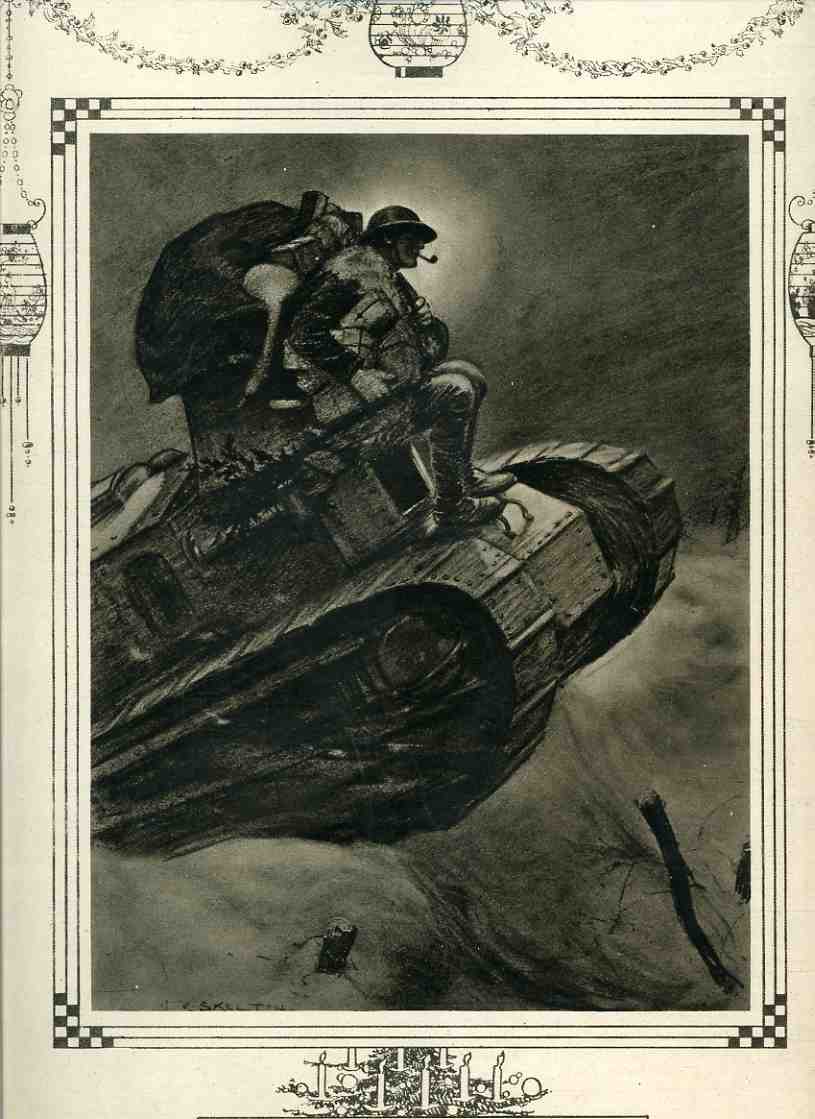
    November 11, 1918 marked the end of World War I.  There were approximately 40 million casualties, including 20 million deaths and 21 million wounded, half of the deaths being civilians.  The dead and wounded were about equally distributed to the Allied and Central powers, 6 million dead and wound for Germany and 5 million for France.  The U.S., coming late into the war, lost about 170,000 killed and wounded.  There was plenty to go around. 

    There were numerous and major battles  fought right to the end by the exhausted combatants: St Mihiel (September, 1918), Meuse-Argonne (September – November, 1918), Canal du Nord (September, 1918) Vittorio Veneto (October, 1918), Second Battle of the Marne (July–August), and the  British offensive in Palestine (September 1918) to name a few.

    The end finally did come, the peace signed between Germany and the Allies at Compiegne, France, at the eleventh hour of the eleventh day of the eleventh month of 1918.  Or at least the end came to the Western Front—fighting continued across the Russian Empire and also in parts of the Ottoman Empire. 

    This image of a British Tommy on a tank–in the form of Father Christmas, racing across the cold, backlit by a cold Moon—seems particularly ambidextrous to me.  Hopeful, celebratory, and mindful too of all those men who would not be returning, mindful of those who would; a curious display of what the coming holiday could mean to a hundred million people, joyful and crushing.  The tank’s canon, I see, has been removed.

    The poet Laurence Binyon (who seems to have done everything and been everywhere) wrote one of the most often quoted poems for the remembrance of the dead of WWI:

    They shall grow not old, as we that are left grow old:
    Age shall not weary them, nor the years condemn.
    At the going down of the sun and in the morning
    We will remember them. We will remember them.

    –from “The Fallen” published with “The Fourth of August” and “To Women” collectively as “The Winnowing Fan”.  These works were set to music by Edward Elgar as The spirit of England: op. 80, for tenor or soprano solo, chorus and orchestra (1917).

    I remember driving past the organization for the WWI veterans, on Duke Street, in Alexandria, Virginia,  and watching its building, and sign, get smaller and smaller over the years, until one day, the building was vacant, an old coat of paint being the outline of the organization’s removed sign.  Armistice Day had disappeared in the U.S., morphed into a general day of observation for all war veterans, in 1954, and called Memorial Day.  Honestly, I think that Veterans in general should have their own day, but a different one, and leave 11 November to commemorate the lost of WWI.


  • The Face of War: the Child-Soldier, 1918

    JF Ptak Science Books LLC  Post 361

    000-ebay--Nov 7war trench013
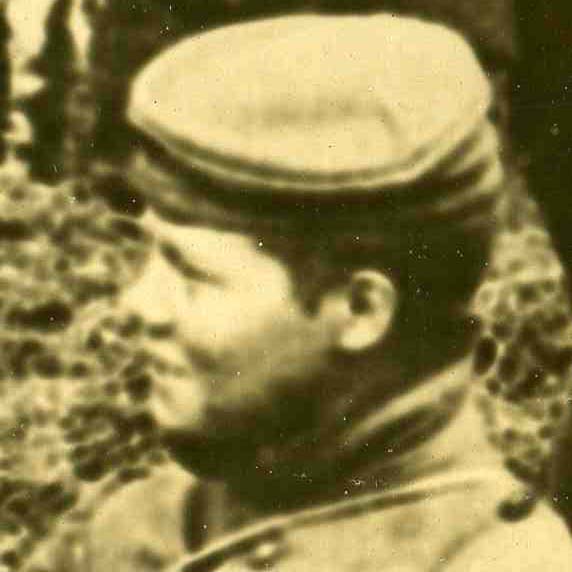
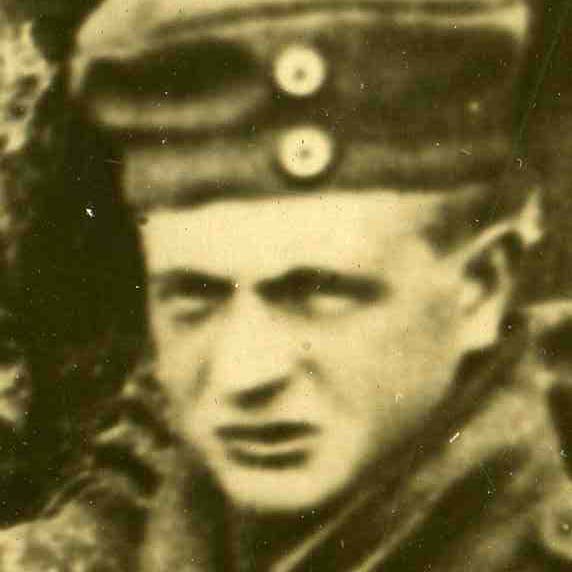
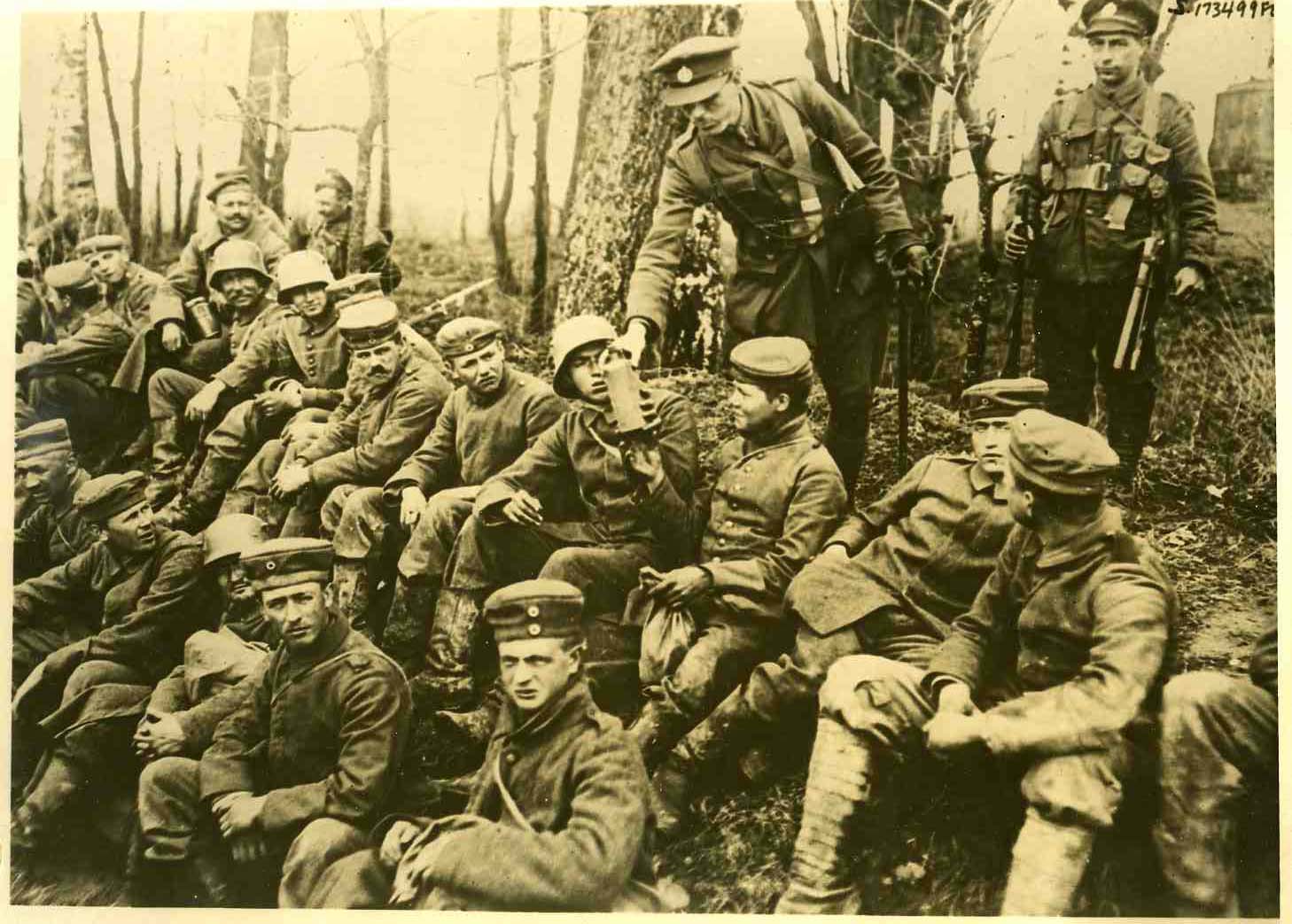
    This is a picture of a captured German soldier, somewhere in France in the middle of 1918, months away from the finale in November.  His tunic is still clean, his buttons as shiny as his baby-fat face, happy to be receiving something–a canteen?–from the British officer, an object of strict attention.  Except that the more our dour soldier to his right has his fingers around the thing and will probably take it from the boy, who looks not only young, but small.  As a matter of fact, most of these soldiers look very young, too young:  sopranos. 

    As the soon-to-be-defeated experience in every war, as the ranks of suitable, able-aged soldiers slim and shrink, the military hand grabs up whatever is available, or left.  I guess this makes sense as most folks in the industrial world didn’t debate child labor laws–with energy, anyway–until the 1920’s.  If you an work in a cotton mill at 8 or 10 or 12 years of age, why not get these workers to carry guns?  The answer is that they’re not capable, for the overwhelming majority, and would make a

    000-ebay--Nov 7war trench014
    000-ebay--Nov 7war trench012 poor soldier, possibly costing more effort and life on his own side
    than on the enemy’s.  But at the tail end of a brutal conflict like
    WWI, the grim matter is that general conscript had been gobbled up and
    fed into the grist mill that had already cost millions of lives. This
    phenomenon is not just a WWI problem, and not an old problem, either: 
    you could construct an alphabet of abusers, and apply it by century: 
    Burundi, Chad, Ivory Coats, Rwanda, Somalia, Sudan, Burma, China, Sri 
    Lanka, Columbia, the Soviet Union, the United States, all pressing
    children into the front line, or as drummer boys, powder boys, cannon
    fodder, mine-clearers, and on and on. Run out of men, and the
    13-year-old boy was next in line, the face filling out any sort of
    uniform at any point in time.


  • The Detail in the Detail: 20,000 Soldiers & 1 Mule, 1918

    JF Ptak Science Books  Post 358

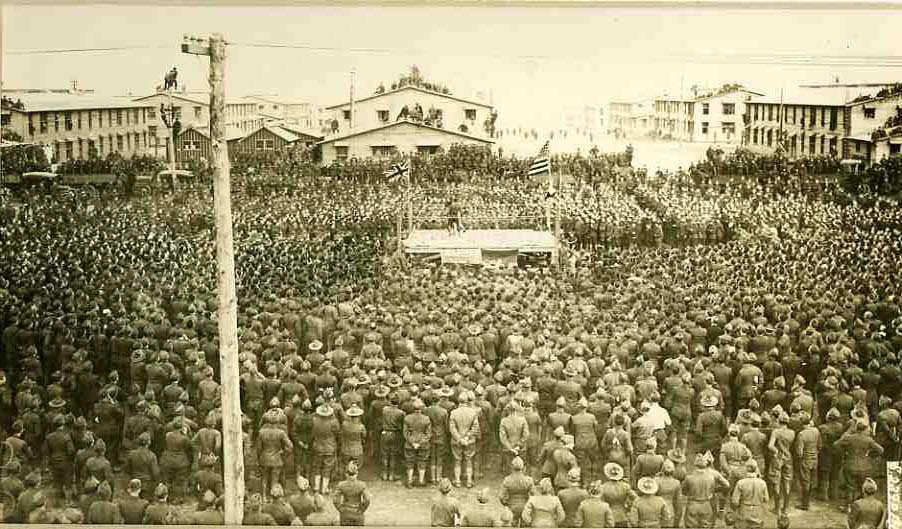
    I’ve made several posts on images of large crowds (most recently on the incredible aerial photograph of the crowd of 100,000 spectators at the Dempsey-Carpentier fight), sometimes using the crowds to put a fleshy face on an otherwise forensic statistic, and sometimes because, well, the photograph is simply beautiful or extraordinary (or both). The later is the case here with this news service photo from Underwood & Underwood (NYC), titled “Boxing Contest Viewed by Twenty Thousand Soldiers”, and published in the middle of 1918.  It depicts a fight between featherweights Hank Schroeder and Jimmy Smith, with the referee being the legendary fighter, Benny Leonard.  (The way that the news photo service worked was that if a newspaper needed a picture, say, of 

    000-ebay--Nov6 boxing crowd997


    American soldiers watching a boxing match to illustrate a story they would have contracted with a company like Underwood and Underwood who would supply the photo and the caption.)  It looks as though Schroeder (who must’ve had a hard time during the war with his name) fought and was defeated by Johnny “The Kid” Troy for the American Expeditionary Force featherweight title–which means that Schroeder may have been the champion, or perhaps not, if the title was vacant).  I couldn’t find anything out about Jimmy Smith, though I did uncover many other Smiths who were boxers in the ‘teens and ‘twenties, including Cyclone Cy, Sgt. Ray, Willie, Petey, Frankie and Buggy. 

    The text that accompanies the image states that “this was one of the most picturesque boxing tournaments ever held”, and I don’t doubt it, as the composition of the crowd, the closeness of the soldiers, and the numbers contained in such a small area, are all pretty singular factors making this an extraordinary photograph.  The fight took place at Camp Upton, ( Suffolk County, Long Island, and named for the great American western explorer and Civil War general), which at the time was still processing troops for the fight overseas. (Camp Upton would be laid to rest after the war until it was reactivated for training for WWII, eventually winding up as part of the Brookhaven National Lab grounds.)

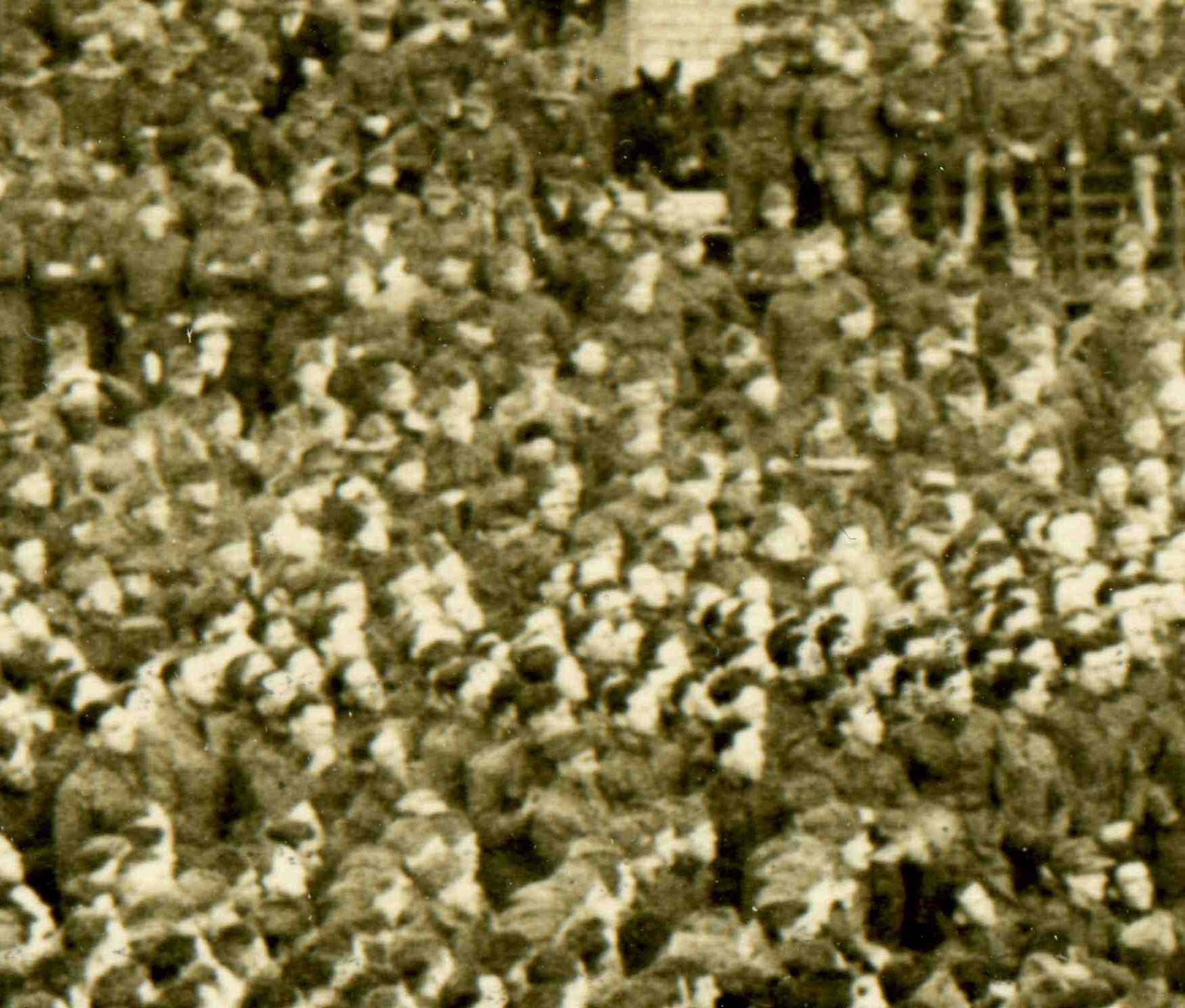
    This detail is from a 5% portion or so of the image from the middle-upper-left, and, I see, happily, includes a mule with the rest of the soldiers.
    000-ebay--Nov6 boxing crowd999

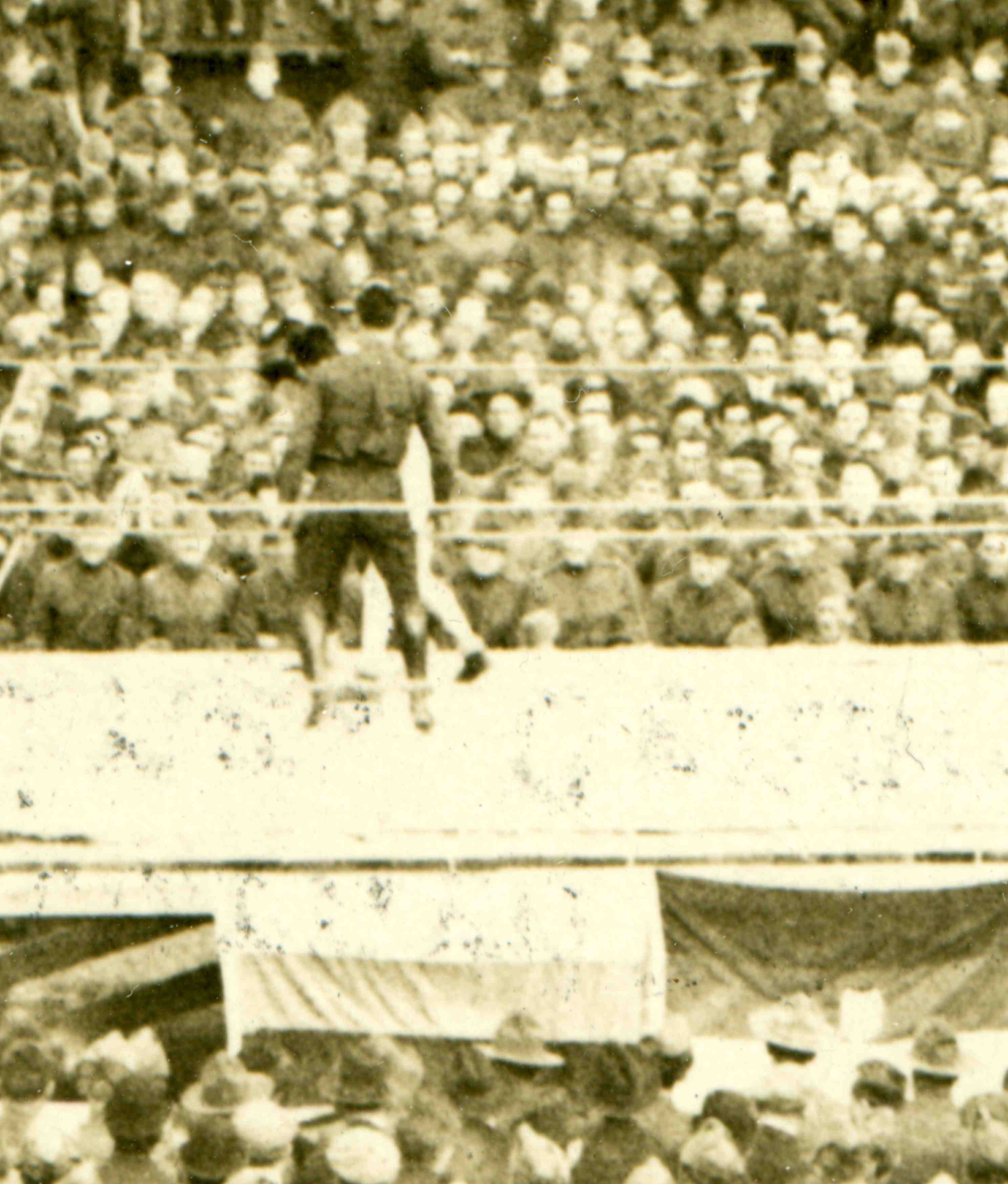
    This is a close-up of the ring itself, where we see Bennt Leonard as the ref with his back to the camera, with the two fighters mixing it up in a tight little one-man ball. I reckon that there must be 300 soldiers in the background of this tight view. 

    000-ebay--Nov6 boxing crowdXYZ002

     000-ebay--Nov6 boxing crowd999XX


  • UPDATE: Dropping Boxes Filled With Soldiers: a Bad Technical Idea but a Great Strategic One, 1950

    JF Ptak Science Books LLC  (added content to Post for 15 September)

    00-blog--Oct 29 dropping soldiers954
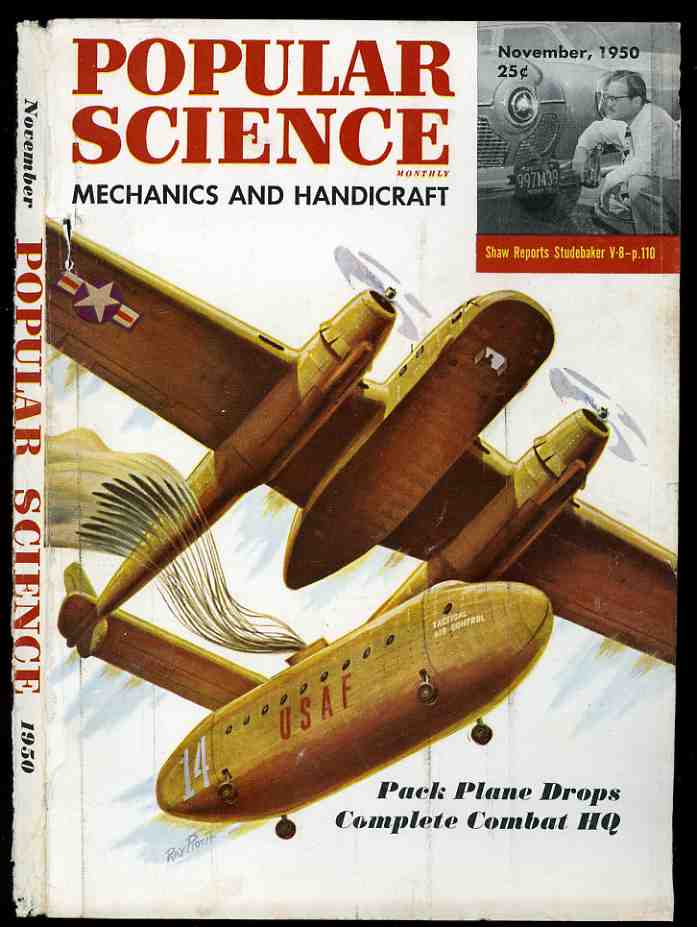
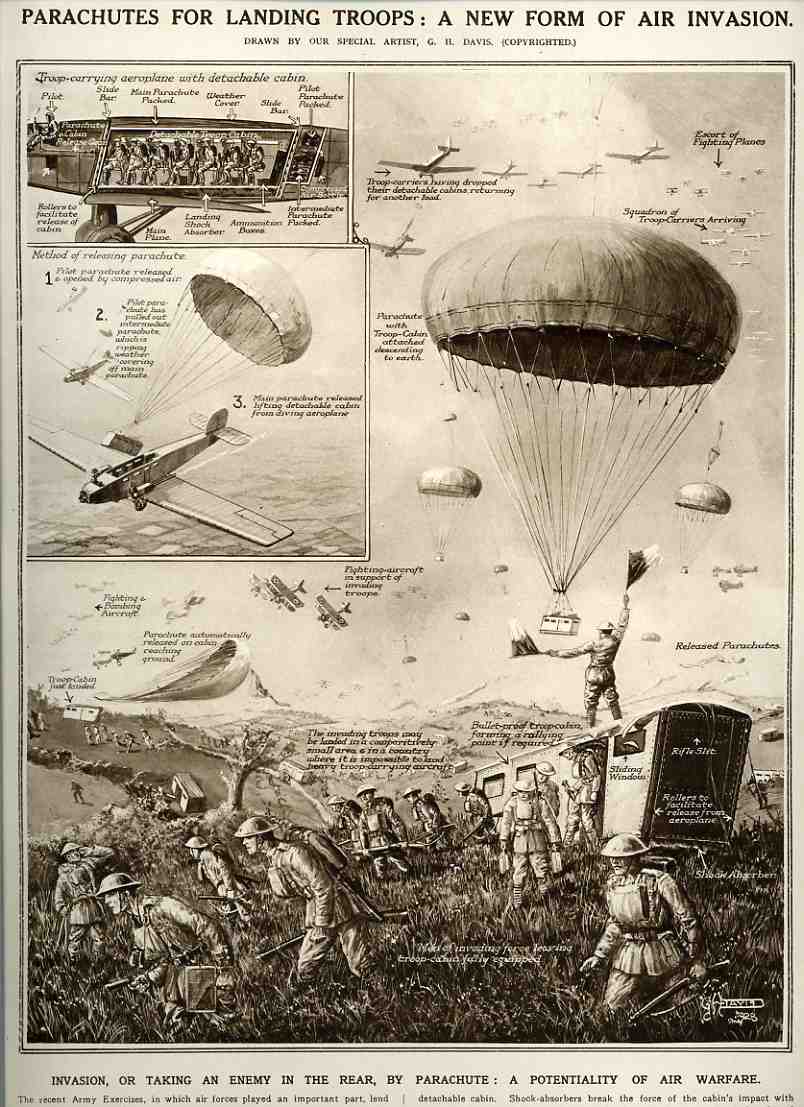
    I happened on this image from the front cover of Popular Science for November 1950 and recognized the idea instantly.  I posted on an earlier version of this idea from 1928 and placed it firmly in the BAD IDEAS Department of this blog.  The update from 1950 is a little improved, but, well, not by that much.  At least this canister leaves the clutches of the plane safely, though from the look of things it seems as though it might not want to land very nicely. 

    Blog-1-sept 15paratrooper553

    ·Posted by :

    ·in:

    — —

  • Vegetius and the 4th Century Underwater Attack

    JF Ptak Science Books LLC  Post 342

    Blog--vegetius
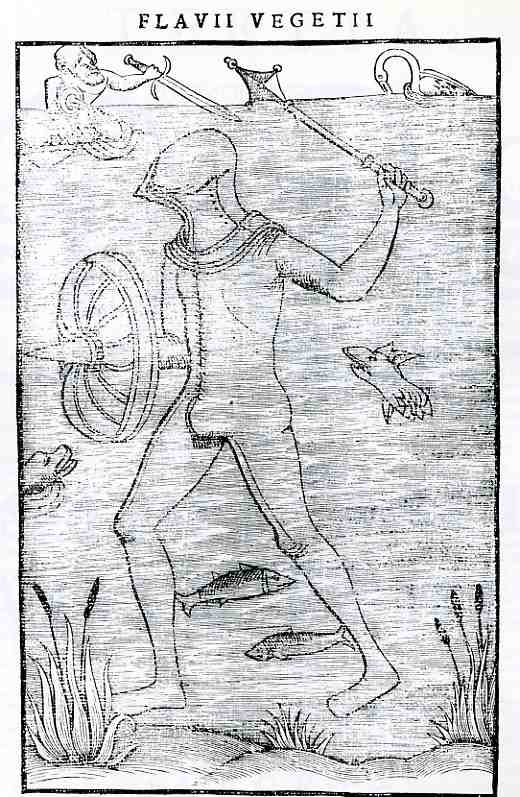
    The name of Flavius Vegetius is not so much popularly known today, though his influence is felt through the hands of other, more famous, writers and thinkers.  He was seen as the most adept writer on the Roman mind in warfare, and his De re militari libri quator… was his masterpiece.  It was reprinted in 1532 by Christian Wechel from sources reaching back to the original, which was written around 390 ACE, and found a wide readership not only for its authority on all things military/Roman but also for his iconic insights and aphorisms on warfare in general.  It was Machiavelli who came under his spell and who adopted some of Vegetius, who became further disseminated through the military followers of Machiavelli, and so on.

    I came to this work much more simply than all of this – I liked this image of the underwater warrior, who was somehow able to breathe while submerged.  I get the importance of this sort of undercover, guerilla maneuver, but what I really like was the rarity of seeing a Renaissance illustration of human submarine life, which is pretty uncommon.  Also, the use of the lines to represent the underwater quality of the image—giving the woodcut an overall grey tone—is also very scarce in the history of illustration, at least before 1600.  And very neat!  One of the hallmarks of this printing of Vegetius was the liberal use of white space in many of the (119) woodcut illustrations, though it is clearly not on display in the woodcut that I’m sharing here.
    00-blog-Oct 28 vegetius939

    Of further interest are the following excerpts of Vegetius from the 1767 English translation found at the Digital Attic website. I’ve selected four interesting bits on the selection of recruits, their initial training, the size of recruits and the need of the new soldiers to learn how to swim.  I find them a fascinating insight into the appreciation of the raw military recruit from 1600 years ago. 

    The Military Institutions of the Romans (De Re Militari)

    By Flavius Vegetius Renatus

    INITIAL TRAINING

    The first thing the soldiers are to be taught is the military step, which can only be acquired by constant practice of marching quick and together. Nor is anything of more consequence either on the march or in the line than that they should keep their ranks with the greatest exactness. For troops who march in an irregular and disorderly manner are always in great danger of being defeated. They should march with the common military step twenty miles in five summer-hours, and with the full step, which is quicker, twenty-four miles in the same number of hours. If they exceed this pace, they no longer march but run, and no certain rate can be assigned.
    But the young recruits in particular must be exercised in running, in order to charge the enemy with great vigor; occupy, on occasion, an advantageous post with greater expedition, and prevent the enemy in their designs upon the same; that they may, when sent to reconnoiter, advance with speed, return with greater celerity and more easily come up with the enemy in a pursuit.


  • Blank and Disappeared Things Department: Confederate Oath of Allegiance and Loyalty

    JF Ptak Science Books LLC Post 338
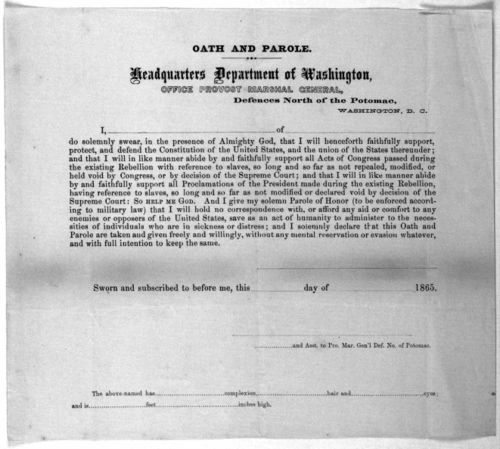
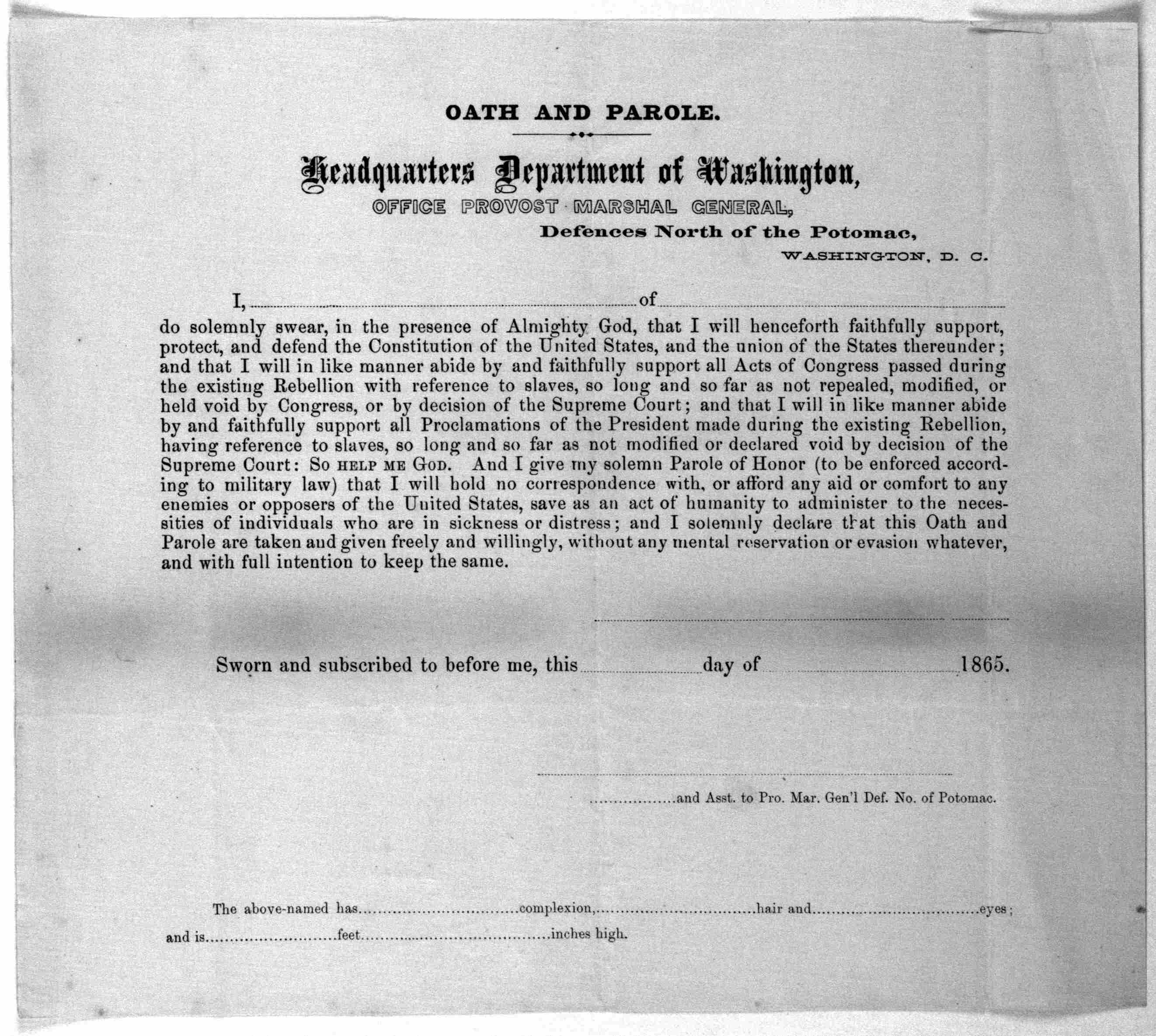
    Blog--blank--confeder oath
    The hundreds of thousands of soldiers who found themselves in Confederate homespun after years of fighting against “those people” of General Lee were offered a clemency at the end of the war by Abraham Lincoln.  Or rather it was the idea of Lincoln’s that survived the war as Lincoln didn’t.  

    Actually the idea of amnesty was granted as a presidential power via the Confiscation Act of 1862, which authorized the president of the United States to pardon anyone involved in the rebellion. This was done at a time when the outcome of the war was still nebulous and far from being decided, as Lincoln was suffering a crisis in his cabinet as well as on battlefields throughout the run of the nation.  This act was followed by the Amnesty Proclamation of 8 December 1863, which basically extended a pardon to anyone who was not a war criminal, was an officer, and who would sign an oath of allegiance.  This was followed by another proclamation in 1864 extending the privilege to Southern civilians as well.  And the sentiments were extended past Lincoln’s murder via the otherwise occupied third-worst president, resulting on 25 December 1865 with the unconditional pardon to all Civil War vets except for the high-ranking and monied officers—this is something that Johnson got absolutely right, and so right, as a matter of fact that even more liberally-minded northerners thought he was giving away the store.  Johnson didn’t follow his own deepest thoughts and dark angels on this issue, either:  right after becoming president (the first VP to ascend to the office during an active administration) in April, 1865 he was noted telling an Indiana delegation that, “Treason must be made odious… traitors must be punished and impoverished … their social power must be destroyed.”

    Within weeks his policy line had softened if not his reasoning than at least his rhetoric and action:  “I say, as to the leaders, punishment. I also say leniency, reconciliation and amnesty to the thousands whom they have misled and deceived.  These actions alienated many on all sides, but it was probably the highlight of his troubled four years or so in office, and more than likely was the only thing he got right in the Reconstruction policies through 1869. (I’d say that his allowance of the creation of Black Codes and the codification of sub-citizenship to the newly-freed slaves that created a still subjugated interior-nation for black people created more havoc and pain and discord than anything else anyone did in government in the immediate post-war period.)

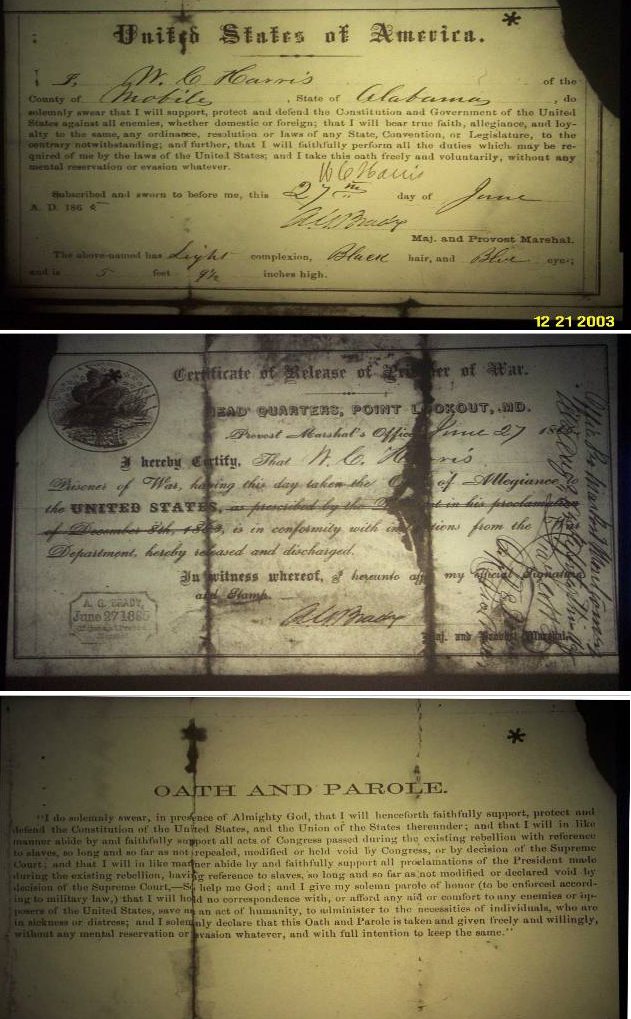
    So as part of the series of blank and empty things I’d like to include this unused oath of allegiance certificate.  There were perhaps hundreds of thousands of these sorts of bills-of-freedom distributed to Confederate veterans, who–whether they agreed or not, believed or not–filled them up with their information and pledged to be true to the Union, if for no other reason than to put the war as much behind them as possible and return to what might have been their lives.  I’ve also included three examples (relating to the same person) of filled-out pledges (at bottom).

    NOTES:

    The following first section is an appraisal and summation of the amnesty program appearing in Harper’s Weekly for May 15 1865:

    PRESIDENT LINCOLN’S AMNESTY.
    By his proclamation of the 8th of December, 1863, President LINCOLN granted a full pardon —with certain exceptions which we will presently state—to all who had been in rebellion, with a full restoration of all rights of property except in slaves and in cases where the rights of third parties had intervened, and upon condition of taking and subscribing and keeping in-violate an oath to support and defend the Constitution and the Union under it, and to abide faithfully by all the laws of Congress, and by the proclamations of the President in regard to slaves, so far as they are not repealed or declared void by the Supreme Court.
    The persons excepted from this amnesty were all who are or have been civil or diplomatic officers and agents of the rebel Government—all who have left judicial stations under the United States to aid the rebellion—all who are or have been military and naval officers above the rank of colonel in the army or lieutenant in the navy —all who left seats in the United States Congress, or resigned commissions in its army or navy, and afterward aided the rebellion—and all who have treated colored or white soldiers and sailors of the United States otherwise than as prisoners of war.

    On the 26th of March, 1864, President LINCOLN by proclamation defined that the amnesty was limited to those who were not prisoners of war, but who, being free from any arrest, voluntarily took the oath.
    On the 6th of December, 1864, in his last annual Message to Congress, the President said that when he issued the amnesty he stated that the excepted classes might still be within special clemency. ” During the year,” he continued, “many availed themselves of the general provision, and many more would, only that the signs of bad faith in some” led to precautions. Special pardons had also been granted to persons of the excepted classes. ” The door has been for a full year open to all.” But he adds, ” The time may come, probably will come, when public duty shall demand that it be closed, and that, in lieu, more rigorous measures than heretofore shall be adopted

    NOTES, Part II:
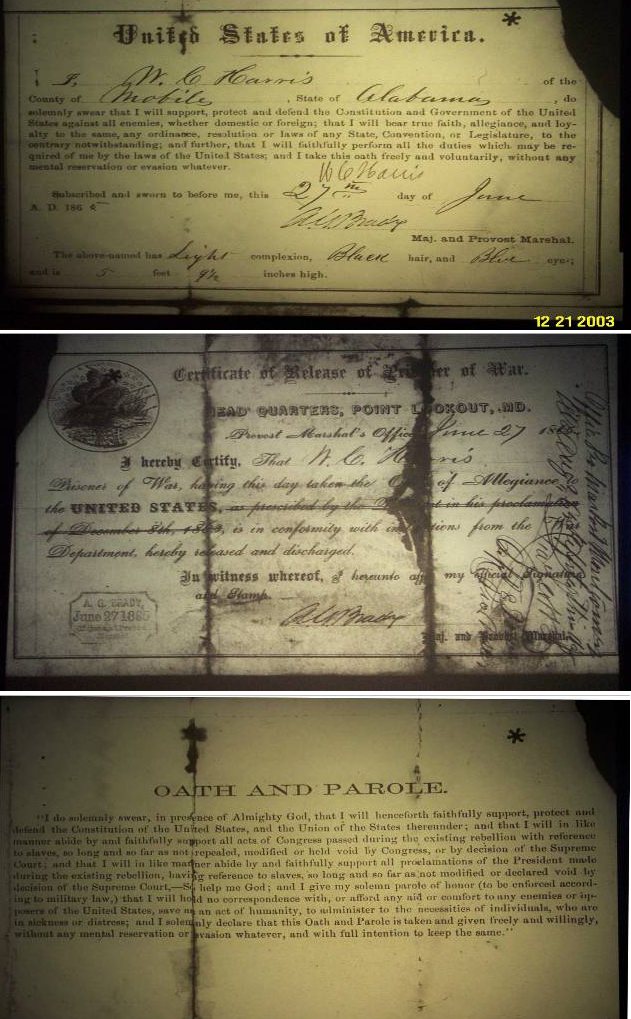
    Blog--empty--oath filled out

    Image 1
    UNITED STATES OF AMERICA

    I, W.C. Harris of the County of Mobile, State of Alabama, do solemnly swear
    that I will protect and defend the Constitution and Government of the United
    States against all enemies, whether domestic or foreign; that I will bear
    true faith, allegiance, and loyalty to the same, any ordinance, resolution
    or laws of any State, Convention, or Legislature, to the contrary
    notwithstanding; and further, that I will faithfully perform all the duties
    which may be required of me by the laws of the United States; and I take
    this oath freely and voluntarily, without any mental reservation or evasion
    whatever.

    W.C.Harris

    Sunscribed and sworn to before me, this 27th day of June A.D. 1865
    A.G. Brady
    Maj. and Provost Marshall
    The above-named has light complexion, Black hair, and Blue eyes; and is 5
    feet 9 1/2 inches high.

    Image 2
    CERIFICATE OF RELEASE OF PRISONER OF WAR
    Head Quarters, Point Lookout, Md.
    Provost Marshal’s Office  June 27, 1865

    I hereby certify, that W.C. Harris , prisoner of war, having this day taken
    the Oath of Allegiance to the United States is in conformity with the
    instructions from the War Department, hereby released and discharged.

    In Witness whereof, I hereunto affix my official signature and stamp.

    A.G.Brady,
    Maj. and Provost Marshal

    Image 3
    OATH AND PAROLE

    I do solemnly swear, in presence of Almight God, that I will henceforth
    faithfully support, protect and defend the Constitution of the United
    States, and the Union of the States thereunder; and that I will in like
    manner abide by and faithfully support all acts of the Congress passed
    during the existing rebellion with reference to slaves, so long and so far
    as not repealed, modified or held void by Congress, or by decision of the
    Supreme Court; and that I will in like manner abide by and faithfully
    support all proclaimations of the President made during the existing
    rebellion, having reference to slaves, so long and so far as not modified or
    declared void by decision of the Supreme Court,— So help me God; and I
    give my solemn parole of honor (to be enforced according to military law,)
    that I will hold no correspondence with, or afford any aid or comfort to any
    enemies or opposers of the United States, save as an act of humanity, to
    administer to the necessities of individuals, who are in sickness or
    distress; and I solemnly declare that this Oath and Parole is taken and
    given freely and willingly, without any mental reservation or evasion
    whatever, and with full intention to keep the same.

  • Duelling a Female Privateer at the Battle of the Mixed Yellow Mustard; Yazoo Pass, 1863

    JF Ptak Science Books LLC Post 331

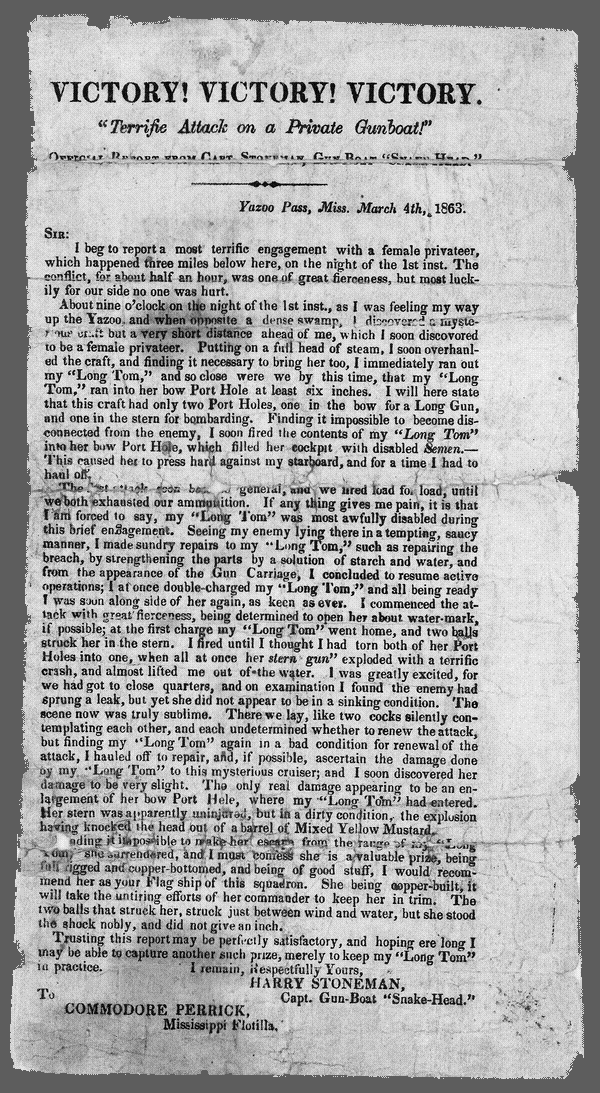
    Harry Stoneman, the commander of the U.S. naval vessel, the Gun Boat  Snake-Head, reported a battle in this broadside (found in the collection of the Library of Congress) fought between himself and a “female privateer” at the foggy Yazoo Pass in 1863.

    Blog--Snake HEad female pirate det

    I have little doubt that the battle was probably ferocious, but I do have some lingering doubt that it was more ferocious than the reporting of it.  There is much in Stoneman’s prose to suggest whistling canon balls and smoke and boardings and sinkings and such, but I have a feeling there was much fumbling between the wo ships, and that in the end, the “female privateer” surrendered.  Stoneman overtook the vessel and got so close to it that he rammed it somewhat, somehow getting  the end of his “Long Tom” into the forward port hole of the privateer.  After he repaired whatever he did to his canon (the “Long Tom” being in general the largest gun on the ship or boat, and probably mounted on a swivel or pivot, forward) fired it into the privateer, “filling up her cockpit with disabled Semen [sic]”.  There was an explosion of some sort with the privateers can–it either was fired or exploded–with the only resulting injury being to some (mixed) yellow mustard.

    Blog--Snake HEad female pirate det yellow

    But in the end all went well for the sweatty Harry Stoneman, taking the copper-bottomed enemy ship as a prize, and hustling back to whatever writing surface he had to record his victory and present it as a prize to the commodore Perrick  of the Mississippi floatilla.  Unfortunately I cannot find anything at all on the Snake-Head or Stoneman or for that matter Commodore Perrick (which is odd).  But most of all a quick search isn’t revealing anything on the most beguiling aspect of this whole story, the “female privateer”. 

    You can click on the image for a more readable version of the broadside; also, the full text of the broadside is provided below, thanks again to a terribly industrious library employee.)

    Blog--Snake HEad female pirate

    VICTORY! VICTORY! VICTORY.

    “Terrific Attack on a Private Gunboat!“

    Official Report from Capt. Stoneman, Gun-Boat “Snake-Head.”

    Yazoo Pass, Miss. March 4th, 1863.

    Sir:

    I beg to report a most terrific engagement with a female privateer,
    which happened three miles below here, on the night of the 1st inst.
    The conflict, for about half an hour, was one of great fierceness, but
    most luckily for our side no one was hurt.

    About nine o’clock on the night of the 1st inst., as I was feeling
    my way up the Yazoo, and when opposite a dense swamp, I discovered a
    mysterious craft but a very short distance ahead of me, which I soon
    discovered to be a female privateer. Putting on a full head of steam, I
    soon overhauled the craft, and finding it necessary to bring her too, I
    immediately ran out my “Long Tom,” and so close were we by this time,
    that my “Long Tom,” ran into her bow Port Hole at least six inches. I
    will here state that this craft had only two Port Holes, one in the bow
    for a Long Gun, and one in the stern for bombarding. Finding it
    impossible to become disconnected from the enemy, I soon fired the
    contents of my “Long Tom” into her bow Port Hole, which filled her cockpit with disabled Semen.— This caused her to press hard against my starboard, and for a time I had to haul off.

    The last attack soon became general, and we fired load for load,
    until we both exhausted our ammunition. If any thing gives me pain, it
    is that I am forced to say, my “Long Tom” was most awfully disabled
    during this brief engagement. Seeing my enemy lying there in a
    tempting, saucy manner, I made sundry repairs to my “Long Tom,” such as
    repairing the breach, by strengthening the parts by a solution of
    starch and water, and from the appearance of the Gun Carriage, I
    concluded to resume active operations; I at once double-charged my
    “Long Tom,” and all being ready I was soon along side of her again, as
    keen as ever. I commenced the attack with great fierceness, being
    determined to open her about water-mark, if possible; at the first
    charge my “Long Tom” went home, and two balls struck her in the stern.
    I fired until I thought I had torn both of her Port Holes into one,
    when all at once her stern gun” exploded with a terrific crash,
    and almost lifted me out of the water. I was greatly excited, for we
    had got to close quarters, and on examination I found the enemy had
    sprung a leak, but yet she did not appear to be in a sinking condition.
    The scene now was truly sublime. There we lay, like two cocks silently
    contemplating each other, and each undetermined whether to renew the
    attack, but finding my “Long Tom” again in a bad condition for renewal
    of the attack, I hauled off to repair, and, if possible, ascertain the
    damage done by my “Long Tom” to this mysterious cruiser; and I soon
    discovered her damage to be very slight. The only real damage appearing
    to be an enlargement of her bow Port Hele, where my “Long Tom” had
    entered. Her stern was apparently uninjured, but in a dirty condition,
    the explosion having knocked the head out of a barrel of Mixed Yellow
    Mustard.

    Finding it impossible to make her escape from the range of my “Long
    Tom,” she surrendered, and I must confess she is a valuable prize,
    being full rigged and copper-bottomed, and being of good stuff, I would
    recommend her as your Flag ship of this squadron. She being
    copper-built, it will take the untiring efforts of her commander to
    keep her in trim. The two balls that struck her, struck just between
    wind and water, but she stood the shock nobly, and did not give an inch.

    Trusting this report may be perfectly satisfactory, and hoping ere
    long I may be able to capture another such prize, merely to keep my
    “Long Tom” in practice.

    I remain, Respectfully Yours,

    HARRY STONEMAN,

    Capt. Gun-Boat “Snake-Head.”

    To

    COMMODORE PERRICK,

    Mississippi Flotilla

    ·Posted by :

    ·in: