A Daily History of Holes, Dots, Lines, Science, History, Math, Physics, Art, the Unintentional Absurd, Architecture, Maps, Data Visualization, Blank and Missing Things, and so on. |1.6 million words, 7500 images, 4.9 million hits| Press & appearances in The Times, Le Figaro, Mensa, The Economist, The Guardian, Discovery News, Slate, Le Monde, Sci American Blogs, Le Pont, and many other places… 5000+ total posts since 2008.

Category: Militaria

  • Blank and Disappeared Things Department: Confederate Oath of Allegiance and Loyalty

    JF Ptak Science Books LLC Post 338
    Blog--blank--confeder oath
    The hundreds of thousands of soldiers who found themselves in Confederate homespun after years of fighting against “those people” of General Lee were offered a clemency at the end of the war by Abraham Lincoln.  Or rather it was the idea of Lincoln’s that survived the war as Lincoln didn’t.  

    Actually the idea of amnesty was granted as a presidential power via the Confiscation Act of 1862, which authorized the president of the United States to pardon anyone involved in the rebellion. This was done at a time when the outcome of the war was still nebulous and far from being decided, as Lincoln was suffering a crisis in his cabinet as well as on battlefields throughout the run of the nation.  This act was followed by the Amnesty Proclamation of 8 December 1863, which basically extended a pardon to anyone who was not a war criminal, was an officer, and who would sign an oath of allegiance.  This was followed by another proclamation in 1864 extending the privilege to Southern civilians as well.  And the sentiments were extended past Lincoln’s murder via the otherwise occupied third-worst president, resulting on 25 December 1865 with the unconditional pardon to all Civil War vets except for the high-ranking and monied officers—this is something that Johnson got absolutely right, and so right, as a matter of fact that even more liberally-minded northerners thought he was giving away the store.  Johnson didn’t follow his own deepest thoughts and dark angels on this issue, either:  right after becoming president (the first VP to ascend to the office during an active administration) in April, 1865 he was noted telling an Indiana delegation that, “Treason must be made odious… traitors must be punished and impoverished … their social power must be destroyed.”

    Within weeks his policy line had softened if not his reasoning than at least his rhetoric and action:  “I say, as to the leaders, punishment. I also say leniency, reconciliation and amnesty to the thousands whom they have misled and deceived.  These actions alienated many on all sides, but it was probably the highlight of his troubled four years or so in office, and more than likely was the only thing he got right in the Reconstruction policies through 1869. (I’d say that his allowance of the creation of Black Codes and the codification of sub-citizenship to the newly-freed slaves that created a still subjugated interior-nation for black people created more havoc and pain and discord than anything else anyone did in government in the immediate post-war period.)

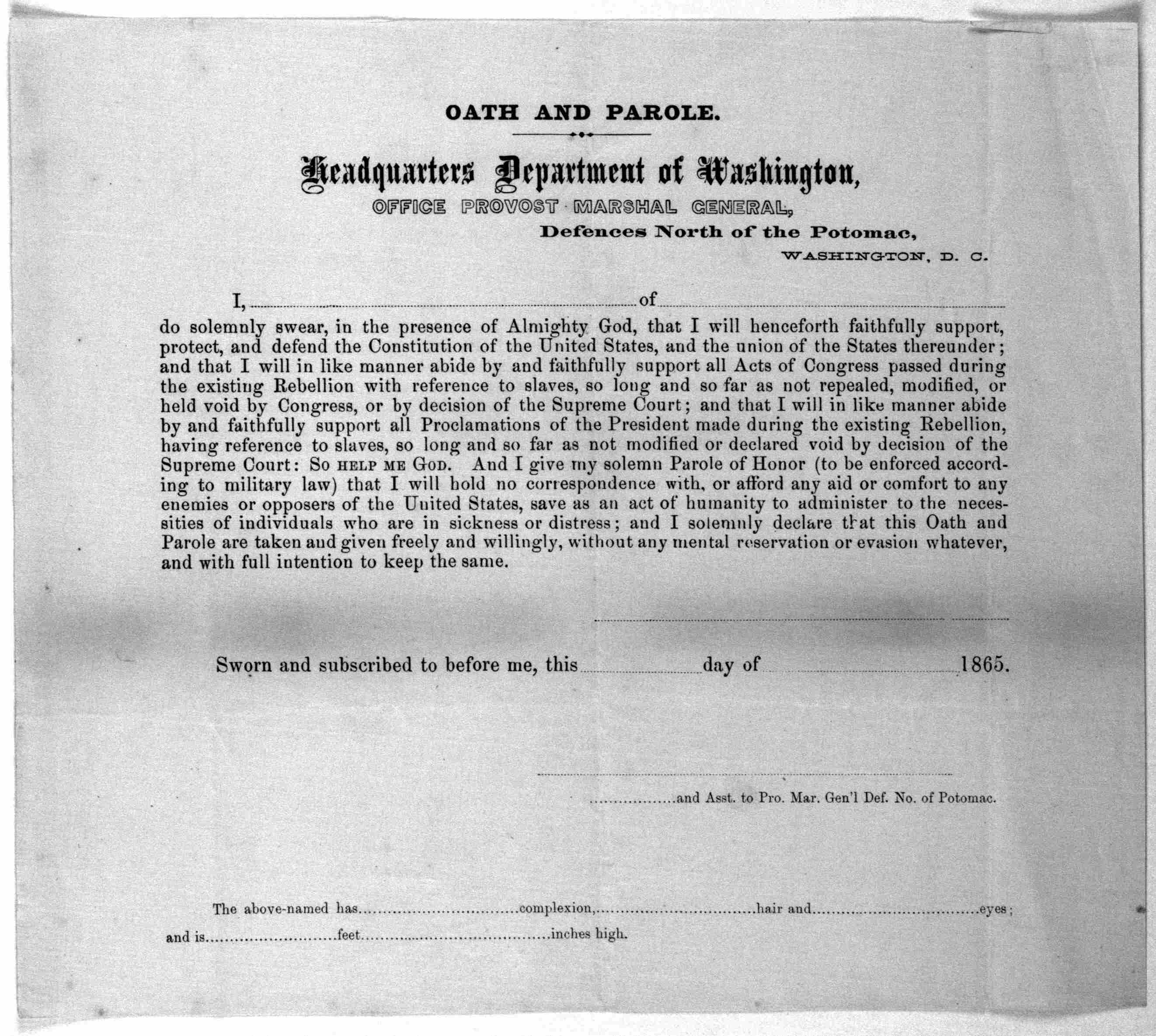
    So as part of the series of blank and empty things I’d like to include this unused oath of allegiance certificate.  There were perhaps hundreds of thousands of these sorts of bills-of-freedom distributed to Confederate veterans, who–whether they agreed or not, believed or not–filled them up with their information and pledged to be true to the Union, if for no other reason than to put the war as much behind them as possible and return to what might have been their lives.  I’ve also included three examples (relating to the same person) of filled-out pledges (at bottom).

    NOTES:

    The following first section is an appraisal and summation of the amnesty program appearing in Harper’s Weekly for May 15 1865:

    PRESIDENT LINCOLN’S AMNESTY.
    By his proclamation of the 8th of December, 1863, President LINCOLN granted a full pardon —with certain exceptions which we will presently state—to all who had been in rebellion, with a full restoration of all rights of property except in slaves and in cases where the rights of third parties had intervened, and upon condition of taking and subscribing and keeping in-violate an oath to support and defend the Constitution and the Union under it, and to abide faithfully by all the laws of Congress, and by the proclamations of the President in regard to slaves, so far as they are not repealed or declared void by the Supreme Court.
    The persons excepted from this amnesty were all who are or have been civil or diplomatic officers and agents of the rebel Government—all who have left judicial stations under the United States to aid the rebellion—all who are or have been military and naval officers above the rank of colonel in the army or lieutenant in the navy —all who left seats in the United States Congress, or resigned commissions in its army or navy, and afterward aided the rebellion—and all who have treated colored or white soldiers and sailors of the United States otherwise than as prisoners of war.

    On the 26th of March, 1864, President LINCOLN by proclamation defined that the amnesty was limited to those who were not prisoners of war, but who, being free from any arrest, voluntarily took the oath.
    On the 6th of December, 1864, in his last annual Message to Congress, the President said that when he issued the amnesty he stated that the excepted classes might still be within special clemency. ” During the year,” he continued, “many availed themselves of the general provision, and many more would, only that the signs of bad faith in some” led to precautions. Special pardons had also been granted to persons of the excepted classes. ” The door has been for a full year open to all.” But he adds, ” The time may come, probably will come, when public duty shall demand that it be closed, and that, in lieu, more rigorous measures than heretofore shall be adopted

    NOTES, Part II:
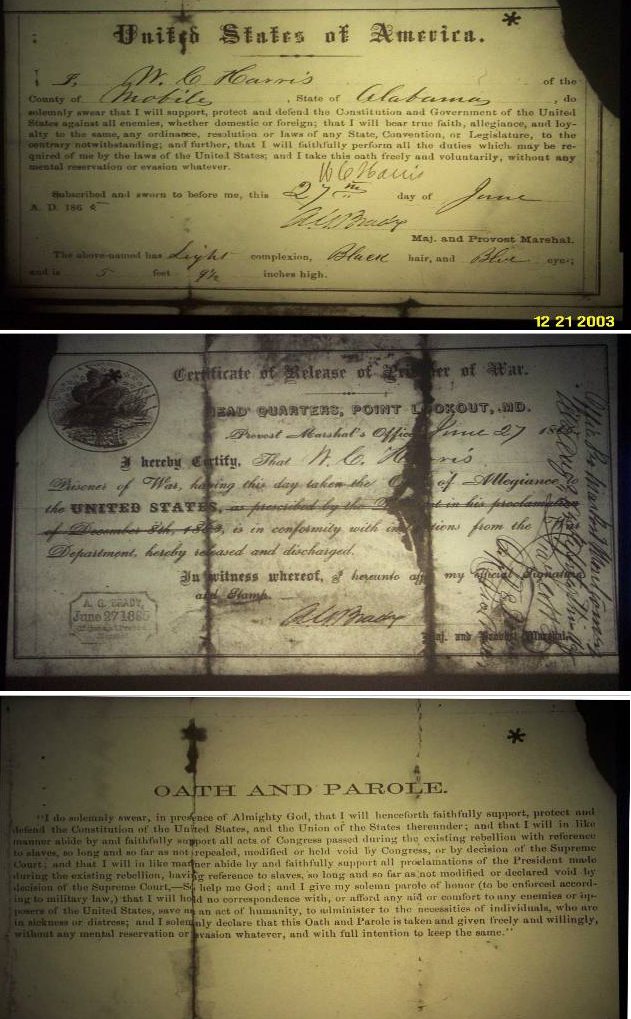
    Blog--empty--oath filled out

    Image 1
    UNITED STATES OF AMERICA

    I, W.C. Harris of the County of Mobile, State of Alabama, do solemnly swear
    that I will protect and defend the Constitution and Government of the United
    States against all enemies, whether domestic or foreign; that I will bear
    true faith, allegiance, and loyalty to the same, any ordinance, resolution
    or laws of any State, Convention, or Legislature, to the contrary
    notwithstanding; and further, that I will faithfully perform all the duties
    which may be required of me by the laws of the United States; and I take
    this oath freely and voluntarily, without any mental reservation or evasion
    whatever.

    W.C.Harris

    Sunscribed and sworn to before me, this 27th day of June A.D. 1865
    A.G. Brady
    Maj. and Provost Marshall
    The above-named has light complexion, Black hair, and Blue eyes; and is 5
    feet 9 1/2 inches high.

    Image 2
    CERIFICATE OF RELEASE OF PRISONER OF WAR
    Head Quarters, Point Lookout, Md.
    Provost Marshal’s Office  June 27, 1865

    I hereby certify, that W.C. Harris , prisoner of war, having this day taken
    the Oath of Allegiance to the United States is in conformity with the
    instructions from the War Department, hereby released and discharged.

    In Witness whereof, I hereunto affix my official signature and stamp.

    A.G.Brady,
    Maj. and Provost Marshal

    Image 3
    OATH AND PAROLE

    I do solemnly swear, in presence of Almight God, that I will henceforth
    faithfully support, protect and defend the Constitution of the United
    States, and the Union of the States thereunder; and that I will in like
    manner abide by and faithfully support all acts of the Congress passed
    during the existing rebellion with reference to slaves, so long and so far
    as not repealed, modified or held void by Congress, or by decision of the
    Supreme Court; and that I will in like manner abide by and faithfully
    support all proclaimations of the President made during the existing
    rebellion, having reference to slaves, so long and so far as not modified or
    declared void by decision of the Supreme Court,— So help me God; and I
    give my solemn parole of honor (to be enforced according to military law,)
    that I will hold no correspondence with, or afford any aid or comfort to any
    enemies or opposers of the United States, save as an act of humanity, to
    administer to the necessities of individuals, who are in sickness or
    distress; and I solemnly declare that this Oath and Parole is taken and
    given freely and willingly, without any mental reservation or evasion
    whatever, and with full intention to keep the same.


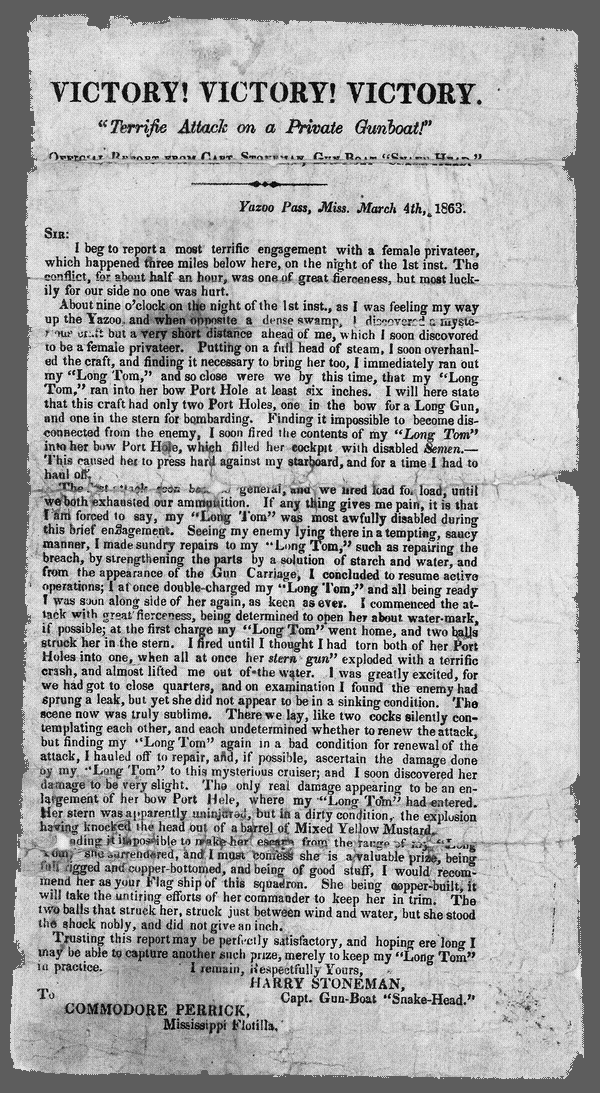
  • Duelling a Female Privateer at the Battle of the Mixed Yellow Mustard; Yazoo Pass, 1863

    JF Ptak Science Books LLC Post 331

    Harry Stoneman, the commander of the U.S. naval vessel, the Gun Boat  Snake-Head, reported a battle in this broadside (found in the collection of the Library of Congress) fought between himself and a “female privateer” at the foggy Yazoo Pass in 1863.

    Blog--Snake HEad female pirate det

    I have little doubt that the battle was probably ferocious, but I do have some lingering doubt that it was more ferocious than the reporting of it.  There is much in Stoneman’s prose to suggest whistling canon balls and smoke and boardings and sinkings and such, but I have a feeling there was much fumbling between the wo ships, and that in the end, the “female privateer” surrendered.  Stoneman overtook the vessel and got so close to it that he rammed it somewhat, somehow getting  the end of his “Long Tom” into the forward port hole of the privateer.  After he repaired whatever he did to his canon (the “Long Tom” being in general the largest gun on the ship or boat, and probably mounted on a swivel or pivot, forward) fired it into the privateer, “filling up her cockpit with disabled Semen [sic]”.  There was an explosion of some sort with the privateers can–it either was fired or exploded–with the only resulting injury being to some (mixed) yellow mustard.

    Blog--Snake HEad female pirate det yellow

    But in the end all went well for the sweatty Harry Stoneman, taking the copper-bottomed enemy ship as a prize, and hustling back to whatever writing surface he had to record his victory and present it as a prize to the commodore Perrick  of the Mississippi floatilla.  Unfortunately I cannot find anything at all on the Snake-Head or Stoneman or for that matter Commodore Perrick (which is odd).  But most of all a quick search isn’t revealing anything on the most beguiling aspect of this whole story, the “female privateer”. 

    You can click on the image for a more readable version of the broadside; also, the full text of the broadside is provided below, thanks again to a terribly industrious library employee.)

    Blog--Snake HEad female pirate

    VICTORY! VICTORY! VICTORY.

    “Terrific Attack on a Private Gunboat!“

    Official Report from Capt. Stoneman, Gun-Boat “Snake-Head.”

    Yazoo Pass, Miss. March 4th, 1863.

    Sir:

    I beg to report a most terrific engagement with a female privateer,
    which happened three miles below here, on the night of the 1st inst.
    The conflict, for about half an hour, was one of great fierceness, but
    most luckily for our side no one was hurt.

    About nine o’clock on the night of the 1st inst., as I was feeling
    my way up the Yazoo, and when opposite a dense swamp, I discovered a
    mysterious craft but a very short distance ahead of me, which I soon
    discovered to be a female privateer. Putting on a full head of steam, I
    soon overhauled the craft, and finding it necessary to bring her too, I
    immediately ran out my “Long Tom,” and so close were we by this time,
    that my “Long Tom,” ran into her bow Port Hole at least six inches. I
    will here state that this craft had only two Port Holes, one in the bow
    for a Long Gun, and one in the stern for bombarding. Finding it
    impossible to become disconnected from the enemy, I soon fired the
    contents of my “Long Tom” into her bow Port Hole, which filled her cockpit with disabled Semen.— This caused her to press hard against my starboard, and for a time I had to haul off.

    The last attack soon became general, and we fired load for load,
    until we both exhausted our ammunition. If any thing gives me pain, it
    is that I am forced to say, my “Long Tom” was most awfully disabled
    during this brief engagement. Seeing my enemy lying there in a
    tempting, saucy manner, I made sundry repairs to my “Long Tom,” such as
    repairing the breach, by strengthening the parts by a solution of
    starch and water, and from the appearance of the Gun Carriage, I
    concluded to resume active operations; I at once double-charged my
    “Long Tom,” and all being ready I was soon along side of her again, as
    keen as ever. I commenced the attack with great fierceness, being
    determined to open her about water-mark, if possible; at the first
    charge my “Long Tom” went home, and two balls struck her in the stern.
    I fired until I thought I had torn both of her Port Holes into one,
    when all at once her stern gun” exploded with a terrific crash,
    and almost lifted me out of the water. I was greatly excited, for we
    had got to close quarters, and on examination I found the enemy had
    sprung a leak, but yet she did not appear to be in a sinking condition.
    The scene now was truly sublime. There we lay, like two cocks silently
    contemplating each other, and each undetermined whether to renew the
    attack, but finding my “Long Tom” again in a bad condition for renewal
    of the attack, I hauled off to repair, and, if possible, ascertain the
    damage done by my “Long Tom” to this mysterious cruiser; and I soon
    discovered her damage to be very slight. The only real damage appearing
    to be an enlargement of her bow Port Hele, where my “Long Tom” had
    entered. Her stern was apparently uninjured, but in a dirty condition,
    the explosion having knocked the head out of a barrel of Mixed Yellow
    Mustard.

    Finding it impossible to make her escape from the range of my “Long
    Tom,” she surrendered, and I must confess she is a valuable prize,
    being full rigged and copper-bottomed, and being of good stuff, I would
    recommend her as your Flag ship of this squadron. She being
    copper-built, it will take the untiring efforts of her commander to
    keep her in trim. The two balls that struck her, struck just between
    wind and water, but she stood the shock nobly, and did not give an inch.

    Trusting this report may be perfectly satisfactory, and hoping ere
    long I may be able to capture another such prize, merely to keep my
    “Long Tom” in practice.

    I remain, Respectfully Yours,

    HARRY STONEMAN,

    Capt. Gun-Boat “Snake-Head.”

    To

    COMMODORE PERRICK,

    Mississippi Flotilla

    ·Posted by :

    ·in:


  • The Department of What Things Look Like: the Casualties of the Somme, Visualized

    JF Ptak Science Books LLC  Post 323

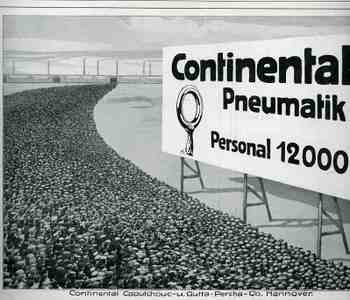
    00blogoct_16crowds865_2I wanted to return to a post for a few days ago on what victory looks
    like in relation to the sub-war/Battle of the Somme in 1916,tying to
    relate the staggering proportions of the 1.5 million casualties from
    that action to a photograph of a group of people.  This is not terribly
    easy to do, especially without using images that are iconic standards
    of “large crowds”, or even images that can be image-googled. I have
    found two interesting images, though—one real, and the other, well, the
    other one I made.  (This is the only image of the 1200 images that I
    have posted to this site that I have altered or created, just for the
    record,)

    The first image comes from the Illustrierte Zeitung (Leipzig),
    for October 1910.  It presumably shows the 12,000 employees emerging
    from the factory of Continental Pneumatic Tires, only I make the crowd
    out to be more like 40-50,000  That means that the casualties of the
    Somme would be thirty (30) of these crowd scenes, end-to-end.  30.

    00blogoct_16crowds866

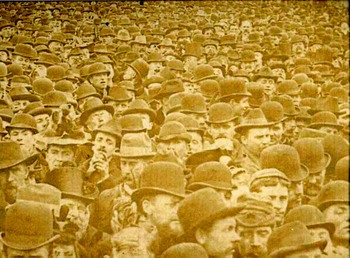
    The next image is a montaged photo, a photo of hats, taken about 12
    feet off the ground or so, but a sea of hats that attaches faces to the
    hats, unlike the sea of hats in the image above it.  This is a sea of
    faces, giving a better sense of humanity to the sea of bodies.  There
    are perhaps 500 people in this photo, meaning you’d need 300 of them to
    illustrate the Somme casualties.

    It all still pales in comparison to the actual numbers.  Victory still looks not so victorious.


  • The History of Images of Aerial Bombing–First Images

    JF Ptak Science Books  Post 322

    I had written out a good, chunky post on the history of the images of aerial bombing; wrote it all down in my little notebook down at Tybee Island, and then promptly hopped into the hot tub fully clothed (for the benefit of our five-year old Tessie) and stayed there for a half-hour, with my notebook still in my pocket.  Of course once the thing sort of dried out all of the notes were just one blue stain, an Andy Warhol post.  I just can’t do the whole thing over again, but I can post about the one odd bit that was in there.  And it is this (very) minor bit that escaped Sven Lindqvist’s attention in his glorious A History of Bombing (printed in 2000 by The New Press), a book that is a chrono-intellectual historico-philosophical treatment of aerial bombing in general.

    1blog_oc_t11_robur810

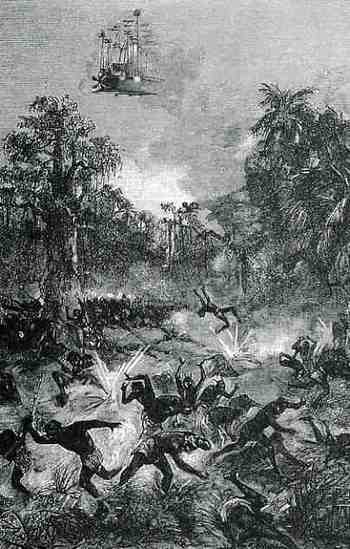
    One of the earliest illustrations of bombing from an airship (at left) occurs in the incomparable Jules Verne’s Roburs the Conquerer (also known as The Flight of Engineer Roburs) in 1886.  It turns out that this floating monstrosity (the Goahead) made its way slowly over Paris, illuminating the city with powerful lights, in a helpful, positive way; on the other hand, it confronts “dark criminals” with bullets, mowing them down.  Oddly enough, the book’s opening two words are “Bang Bang”.

    1blog_oc_t11_anti_ac813

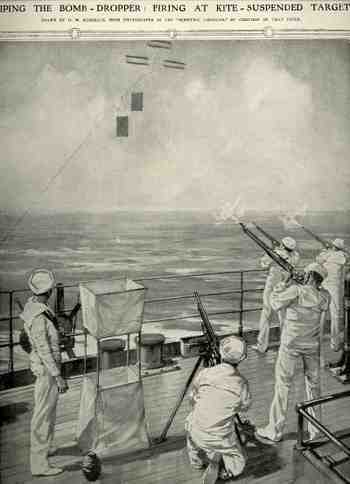
    This may well be the first anti-aircraft (and anti-bomber) image ever printed  in England–it comes from The Illustrated London News for 16 December 1911, just six weeks after this same magazine printed the first image of an aircraft dropping a bomb on a military target. (And it seems originally to have been first published weeks earlier in the U.S in the Scientific American.)  “Airman-shooting with Springfield Rifle; Aerial Gun Practice on a United States Battle-Ship” is the sub title to “Sniping the Bomb-Dropper:  Firing at Kite-Suspended Targets” .  The kites carried the targets up to a height of about 300 feet, and the navy let loose with “one-pounders and three-pounders” as well as rifles (?!) The text to the print continues the story: “The Springfield rifle…will afford no inconsiderable defense against any aeroplane that might attempt to execute feats of ‘bomb-dropping’.” I don’t know about that, though it may have been true that this 30-caliber weapon with a muzzle velocity of 2700’/sec might’ve done some damage to a 1911 aircraft….I guess they could have tracked it too, what with the plane moving 75 miles an hour or so.

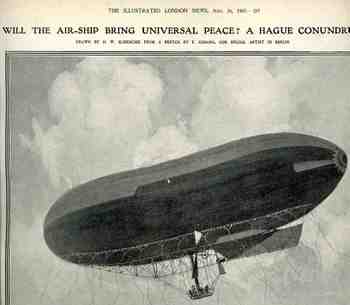
    It was just a few years earlier that in this same journal (for 4 August 1907) that the possibility of the air-ship being an instrument of peace was discussed.  It seems that this “peace” would come about in a sort-of MAD (mutually assured destruction) kind of way, stumbling its way to peace because of the difficulty in defining the terms of war–rather than obtaining a stalemate by the endgame of obliteration via inconceivable amounts of instantaneously-released energy, these folks thought that peace/stasis might come about simply because they weren’t able to fully outlaw reckless bombing because they couldn’t come to terms with what an “airship” actually *was*.    Bombing by airship was outlawed at the Hague Conference of 1899, and in 1907 it was argued that a five-year extension of that treaty should be enacted–again, mainly due to the ungentlemanly ungainliness of what it meant exactly to drop bombs from the air and what aspects of that action were illegitimate. 

    All sides would get over the definition issues pretty quickly, as 1912 comes up just a little short of the guns of November two years hence.  After all, we can’t have ill-defined terms in communication, can we?

    1blog_oct_13marconi_at_sea818


  • What Victory Looks Like: the Battle of the Somme and the Thin Line Between Winning and Losing

    JF Ptak Science Books  Post 317

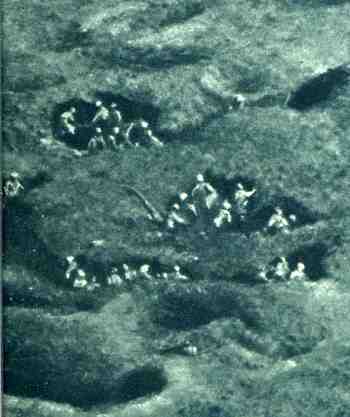
    In a play on the concept of the Powers of Ten, I had a look at a photograph depicting the French victory at the Somme; or was it a British victory?  Or German, via the lure of the others to a semi-victory?  Its hard to say who won, or if there really was a winner.  The Battle, which looks to me to be a sub-war within the war, occurred over the period of July through November 1916.  When the smoke settled, there were some 1.5 million casualties on both sides.It has long been held that the battle really was won by someone, the British, the French; but there was so little that was accomplished by the action that there probably wasn’t a winner, just losers. 

    00blogoct_14somme850_2

    And big losers, at that: Great Britain, Canada, Australia, New Zealand, Ireland, South Africa and Newfoundland lost 419,654 casualties, with 95,000 killed; the French lost 204,000 casualties and 50,000 killed.  That made a total of 623,000 casualties and 146,000 killed for the allies; Germany lost 465,000 casualties and 164,000 dead.  The advances made along the battle front went a few miles one way and then the other along a 12-mile stretch of battlefield, which four lives were traded for every inch gained along that porous front.

    The first image here (above)  is a very sharp detail from the overall picture published in The Illustrated London News for 6 January 1917, representing about 1% of the entire photo

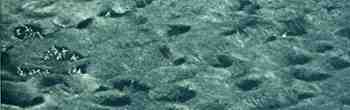
    The next image places the micro-detail in more context; this detail is itself about 5% of the main image, which is found just below this one.

    00blogoct_14somme849_2

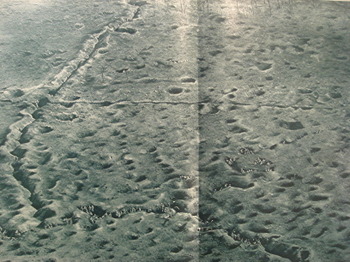
    The overall image from which these two details are removed is below. In turn, this large image is but a small detail of the greater overview of the battlefield, making up perhaps a few percent of the field of operations. 

    I’m trying to get a feel for the enormity of the battle, but I really can’t, not even via powers of ten, manipulating the idea of orders of magnitude.

    In one last try, I hypothesize that the 1.5 million casualties could not be displayed in 10 of these large images.  .

    That wouldn’t look like victory at all. 


    Ballistics_123


  • Deep Discrimination in a Classic of Anti-Discrimination: Japanese Americans and World War II

    JF Ptak Science Books LLC  Post 299

    1ebay_oct_4_these_are_americans744
    For another project of mine I’ve been reading about the
    Japanese internment camps (posting an earlier post here), and just started to
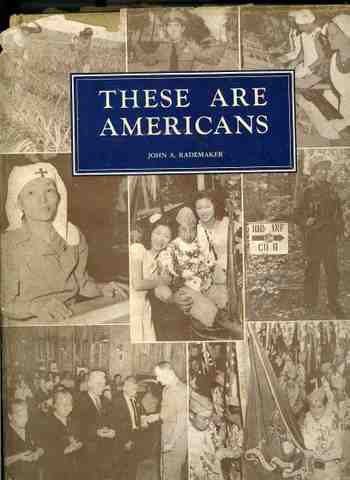
    read some post war material on the interpretation of those actions. The first book I turned to is regarded as a
    liberal (in the classic sense of the word) regard and homage to the Japanese in
    the Hawaiian Islands by John Adrian Rademaker, (a Professor of Sociology at the University of Hawaii 1944-1947), who in 1951
    published These Are Americans: The Japanese Americans in Hawaii During
    World War II
    . It documents the
    contributions made to the war effort by of people of Japanese ancestry living
    in Hawaii, including the Varsity
    Victory Volunteers, the 100th Infantry Battalion, and the 442nd RCT, and so far
    as I can determine is one of the earliest pioneering works to attempt to right
    the significant wrong done to these people.

    In the past I always thought of it as a photographic essay,
    and I’m sure that I never actually read the thing., But this time I, I did, and I was stopped
    almost immediately, half-way through the first sentence.

    It reads:

    “During World War II, I was one of a considerable number of
    persons who were directly concerned with the care and re-establishment of the Japanese Americans in the continental
    United States.”

     To be honest about it, I’m not sure what this means or where it came from.   The rest of the sentences in the 277 pages of
    this book are laudatory and informative and attempt to right the public opinion
    wrongs of the wartime Japanese-American persona. But “care and re-establishment” is awful and
    weird, and stupid—so much so I wonder if the phraselet was stuck in there by
    some zealot editor. Removing 110,000
    Americans from their lives and residences and families and communities and
    businesses, stripping them ¾ of whom
    were American citizens) of their rights, forcing them to sell whatever they
    couldn’t carry at fire sale prices, and then sticking them all in horse stalls
    or deeply removed and very difficult locations for three years is disgustingly-not
    “care and re-establishment”.

    Unless of course the author believed it, and if such is the
    case then he really didn’t understand what happened to those 110,000 people, sociologist
    or not; or at least didn’t get it in 1951.

    He did make a strong case overall for the American Japanese
    in Hawaii being loyal
    citizens/ Rademaker points out that 1,440
    Americans of Japanese Ancestry (AJA) who were detained by local authorities (excluding
    Federal efforts) out of a population of over 150,000 AJA in Hawaii. They were nearly all Issei (first generation immigrants)
    and Nisei (born in the USA)

    From December 7, 1941till the end of the war, some 1,440 AJAs were
    picked up by the authorities. This constituted nine-tenths of one percent of
    the AJAs in Hawaii. 879 of those were Japanese Issei, first-generation immigrants. 534 were
    Nisei. Nearly half of this number were
    released after preliminary hearings, with the rest being “kept” for other
    reasons, though they were simply community leaders (doctors, nurses, school teachers,
    benign) and that sort of thing. He
    states that no AJA in Hawaii was ever convicted or found to have committed any treasonable offense or
    committed any sabotage whatsoever.

    I’m just pointing out how odd this
    first sentence is in the face of the rest of the book. Was it meant to diminish the American government’s
    actions in rounding up and removing these people? (The government has had a very long history
    of doing exactly this, and doing it deathly well—just look at the hundreds of Indian “removals”, the entire
    institution of slavery, and many, many others, up to and including to a lesser
    degree the displacement of Katrina refugees.) Arrest and disappearing people is
    not “care and re-establishment”, period.

    For the record, another truly
    measurable aspect of AJA fortitude is their military participation during WWII
    which stands as follows (presenting the 100 Battalion of the 442 and then the
    442 as a unit):

    The 100th Battalion and 442nd Combat
    team:

    Killed in action  569.
    Died of wounds 81.
    Missing in action 67.
    Wounded in action 3,506.
    Injured in action  177.
    Total casualties  4,120.

    The 100th Battalion and the 442nd
    Combat Team won the following decorations:

    1 Medal of Honor

    1 Medal of Honor
    47 Distinguished Service Cross
    1 Distinguished Service Medal
    12 Oak Leaf Cluster to Silver Star
    350 Silver Star
    18 Legion of Merit
    16 Soldier’s Medal
    41 Oak Leaf Cluster-to Bronze Star Medal
    823 Bronze Star Medal
    1 Air Medal
    500 Oak Leaf Cluster to Purple Heart Medal
    3600 Purple Heart Medal
    2 Army Commendation Ribbon
    40 Army Commendation
    87 Division Commendation
    1 brigade Commendation
    12 Croix De Guerre (French)
    2 Palm to Croix De Guerre (French)
    2 Croce Al Merito Di Guerra (Italilan)
    2 Medaglia De Bronzo Al Valor Militare (Italian)

    Overall the 442—composed entirely of Japanese Americans, emerged
    as the most decorated combat unit of its size in the history of the United
    States Army —suffered an “unprecedented casualty rate of 314 percent and
    received over 18,000 individual decorations. Many were awarded after their
    deaths for bravery and courage in the field of battle. Among the decorations
    received by the 100th/442nd soldiers were one Medal of Honor, 52
    Distinguished Service Crosses, 560 Silver Stars, 28 Oak Leaf Clusters to the
    Silver Star, 4,000 Bronze Stars and 1,200 Oak Leaf Clusters to the Bronze Star
    and, perhaps most telling of the sacrifices made by these gallant soldiers,
    9,486 Purple Hearts.” The 442nd Combat
    Infantry group emerged as the most decorated combat unit of its size in the
    history of the United States Army.

    ·Posted by :

    ·in:

    — — —

  • Empty Memory: Telephone Number 20080 (Warsaw), Nazi Occupied Poland and the Holocaust, 1941

    JF Ptak Science Books  Post 296

    Empty diary150
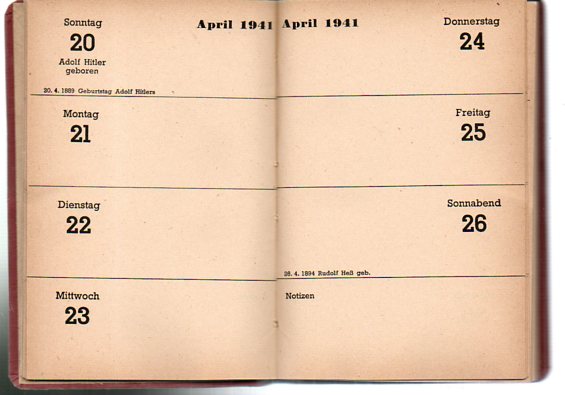
     I’ve felt that a great history lesson for school kids would be to make them keep a diary for some other kid from some other time, introduce them to the minutiae of life from another time and perhaps another place.  With some guidance they could make interesting entries in their diary for, say, 15 June 1897, writing about chores, the daily schedule, what they studied in school, how they were dressed, how they got food on the table and kept the house clean, how they would spend 25 cents, what they would see from some given vantage point, and on and on.  This could take place in their very own home town; it could be multi-generational, requiring them to talk to the scary white hairs, or it could reach far back into history and be of an entirely different place altogether.  After they were assigned a particular place in time and space, you could give the kid subtle hints, like this one (below), asking them what they thought it might mean by dialing the phone number 200 80 in Warsaw in 1941.  And what did that pair of lightning bolts mean, anyway?  I think that once they were made to figure it out for themselves, as though they might’ve been there, and then could record their feelings and observations in a diary might actually bring history to life (especially once they had their “holy crap” (and probably worse) moment at what these numbers implied). 

    1ebay_oct_3_1941_diary739_2

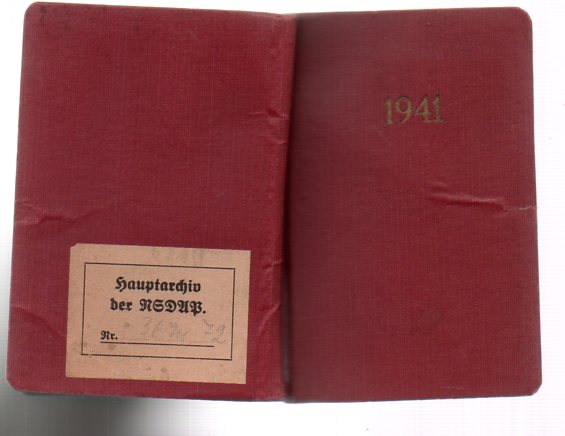
    This is one of the ideas that came home again uncovering this odd booklet, which is a Nazi diary for those stationed in the Generalgouvernment (Tascehnjahrbuch 1941 fuer den Deutschen im Generalgouvernement) ,  for the year 1941. The General Government (or more fully the Generalgouvernement für die besetzten polnischen Gebiete) was one administrative section of occupied Poland, the country being divided in 1939 after the German invasion of 3 September 1939, with the western section being retained by the Germans and the Eastern given over to occupation by the Soviets via the Non-Aggression pact between the USSR and Germany.   

    Empty diary149
    This looks like an every day diary for the period, except for the Nazi (or NSDAP) regalia and German imprint of Generalgouvernment in Krakau.  And, all of the annotated highpoints of the year for the most overly voracious parts of German militarism as well as for the hotpoints of Nazi history.  Hitler, (above) Goering, Goebbels and other leaders’ birthdays are highlighted, not to mention seminal points in the development of the Nazi party and party-adoptees (Richard Wagner has a number of entries for suggested celebrations). 

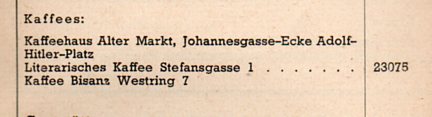
    There are also helpful directories in the back pointing to any number of cafes located in a growing number of “Adolf Hilter Platz’s” throughout Poland (including three in Radom), as well as fares for the use of the railway and postal system. 

    We also see the following telephone number:  23075.  That’s for the Literarische Kaffee Stefansgasse I, Krakau. This is the location that the Reichsminister and administrator Hans Frank (about whom we’ll read inb a moment) decided to hold a chess tournament in 1941, to satisfy his own need for chess while freshly in the pursuit of the murder of millions of people.

    Empty diary cafe151
    ‘Frank was extremely interested in chess. He not only possessed an extensive library of chess literature but was also a good player, and he even “received” the Ukrainian chess master Bogoljubow at the castle. On 3 November 1940 he organized a chess congress in Cracow. Six months later he announced the setting-up of a chess school under Bogoljubow and the chess master Dr Alexander Alexandrovich Alekhine, and he visited a chess tournament in October 1942 at the “Literary Café” in Cracow.”–Hans Frank (subtitle: Hitlers Kronjurist und Generalgouverneur) by Dieter Schenk (Frankfurt am Main, 2006) “and quotes a reference to chess on page 177 (given below in our translation)…”[Source: Chesshistory.com., here.]

    File:Generalgouvernement fur die besetzten polnischen gebiete.png

    For the record, the Generalgouvernement was proclaimed in October 1939 just after the invasion of Poland and included most of what was left of Poland, which was gone again, barely 20 years after it returned to the map following WW1.  In March 1941 Hitler made a decision to “turn this region into a purely German area within 15-20 years”. He also explained that “Where 12 million Poles now live, is to be populated by 4 to 5 million Germans. The Generalgouvernement must become as German as Rhineland”.  Following the Wannsee conference of 20 January 1942, the Secretary of State of the Generalgouvernment, Dr. Josef Buhler (Warsaw # 222 05, a listed number in this book) began implementation if the Final Solution in Poland; by the time the Soviets entered and took control in late  1944, more than 4 million people—most of them Jewish—had been killed. 

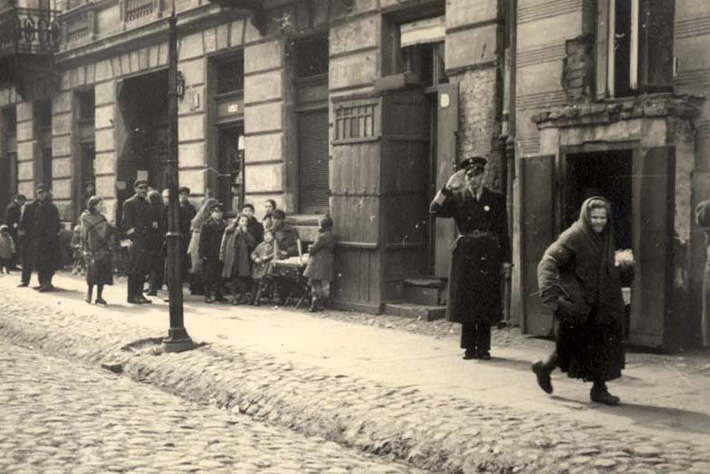
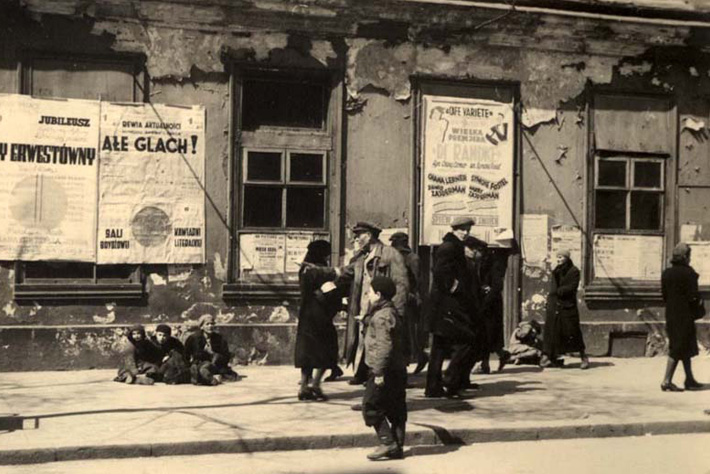
    Warsaw ghetto jewish policeman
    [Photograph of a Jewish policeman, from the Jost collection.1]

    The man in charge of it all here in Poland, Hans Frank, has his photographic portrait as the frontispiece, and his number is listed, too. He was an horrendous butcher who was tried and convicted and executed for his crimes against humanity (at Nuremberg on 16 October 1946, aged 46–the decision of the court read, in part, that Frank was “…a willing and knowing participant in both the use of terrorism in Poland, as in the economic exploitation of Poland in a way that led to the starvation of a large number of people, also in the deportation of more than one million Poles as slave laborers to Germany and in execution of a program that had the murder of at least three million Jews. “).  In a speech December 16, 1941, Hans Frank said:”We cannot shoot these 3.5 million Jews [in Poland], we cannot poison them, but we will take measures that will somehow lead to successful destruction; and this in connection with large-scale procedures which are to be discussed in the Reich, the Government-General must become as free of Jews as the Reich …..We must destroy the Jews wherever we find them and wherever it is at all possible, in order to maintain the whole structure of the Reich…” Frank did his share of annihilation of Polish Jews and Polish citizens–almost as much as any other Nazi official, government or military leader–over the six years (1939-1945) that he ruled over this territory.

    Warsaw ghetto children
    [Another image from the Jost collection.]

    Josef Buhler, by the way, was tried after the war by the Supreme National Tribunal of Poland for crimes against humanity, condemned to death on July 10, 1948, and executed in Kraków.

    This is really a fetid little booklet, its empty pages waiting for some sort of horror, all of which was actually taking place in real life, escaping  their record.

    Distribution of food in General Government as of December, 1941
    Nationality Daily calorie intake
    Germans 2310
    Foreigners 1790
    Ukrainians 930
    Poles 654
    Jews 184

    I wonder where all of those conversations went, exactly, after they were ended.  Did they sink into the copper wire like auditory signals (very very slightly trapped) in clay pots?  I think not of course. But all of those phone numbers in this book to all of the special police and propaganda police and racial police and SS and on and on, all of those calls and conversations about this horrific undertaking, just seem to me as though they should’ve gone somewhere, caught in the myth of the machine, somewhere in the electromagnetic world, like a primitive internet.

    I really can’t stand what those simple phone numbers meant.

    Footnotes:

    1.  The Generalgouvernement was the central part of three general districts of the divided Poland, and it proved to be the terminal for millions of people deemed as undesirable or threatening.  It was particuarly impossible for Jews, the Generalgouvernement proving to be the place where they were collected in ghettos and housed under mniserable and starvation conditions until they began to be shipped out to concentration camps in early 1942.  By 1944 all of the ghettos had been liquidated, and with them, their inhabitants.  The Soviets did finally liberate the Generalgouvernement (from the Nazis) under delayed conditions in the winter of 1945, initiating Pogroms against the Jews by summertime.

    Notes:

    The Wannsee conference (I will not use a capital “C) was a meeting of leading  Nazi officials and treacle who formed the decision to implement the Final Solution t the “Jewish problem” in Germany— it was the real beginning of the Holocaust.

    The men who made this determination to begin with the wholesale destruction of human beings included:

    SS-Obergruppenführer Reinhard Heydrich (Chief of the RSHA and Reichsprotektor of Bohemia-Moravia), presiding
    Dr Josef Bühler (Government of the General Government)
    Dr Roland Freisler (Reich Ministry of Justice)
    SS-Gruppenführer Otto Hofmann (Race and Resettlement Main Office, RuSHA)
    SA-Oberführer Dr Gerhard Klopfer (NSDAP Chancellery)
    Ministerialdirektor Friedrich Wilhelm Kritzinger (Reich Chancellery)
    SS-Sturmbannführer Dr Rudolf Lange (Commander of the SD for Latvia)
    Reichsamtleiter Dr Georg Leibbrandt (Reich Ministry for the Occupied Eastern Territories)
    Martin Luther (Foreign Office)
    Gauleiter Dr Alfred Meyer (Reich Ministry for the Occupied Eastern Territories)
    SS-Gruppenführer Heinrich Müller (Chief of Amt IV (Gestapo), Reich Security Main Office (RSHA))
    Erich Neumann (Director, Office of the Four Year Plan)
    SS-Oberführer Dr Karl Eberhard Schöngarth (SD, assigned to the General Government)
    Dr Wilhelm Stuckart (Reich Ministry for the Interior)
    SS-Obersturmbannführer Adolf Eichmann (Head of Referat IV B4 of the Gestapo), minutes secretary

    1. “German soldier Heinz Jost strolled through the Warsaw Ghetto taking illegal pictures. Almost 50 years later, they resurface in a disturbing exhibition.”

    “An enfeebled urchin lies clutching the sidewalk like a breast. Three people pass by behind it; only one of them, a malnourished woman, looks down at the child. In a second or two, they will be gone and the child will be alone again, even more helpless, if that is possible. Did such dying children (there were thousands of them in the Warsaw Ghetto in 1941) know that something was horribly wrong with the world? Or did they think that squalid suffering is all that this disappointing life has to offer? wrote children, Mary Berg wrote in her diary of the ghetto, “no longer have a human appearance and are more like monkeys than children. They no longer beg for bread, but for death.” Terribly, the child on the sidewalk cocks its eye at the camera, unable to ward off the final cruelty of being photographed by a German soldier.

    “Eerie approximation: Heinz Jost, a small-town hotelkeeper serving in the German Army, had the day off on Sept. 19, 1941. It was also his birthday. For reasons lost to history, Jost decided to spend the day inside the walls of the Warsaw Ghetto. He carried a camera and, contrary to regulations, took 129 photographs of the ghetto and its doomed inhabitants. The pictures lay unseen in a dresser drawer for four decades before Jost rediscovered them. He gave them to the German magazine Stern, which donated them in 1987 to the Yad Vashem Archives in Jerusalem.

    “What Jost found in this neighborhood consecrated to death was an eerie approximation of normal daily life that only gradually (especially as the exhibition is arranged) reveals its ghastliness. At first, street life seems no more deprived than that in lower Manhattan earlier in the century. And the jackbooted soldiers relaxing in a touring car appear more arrogant than evil. But surely they must have known, as Chaim Kaplan recorded in his Warsaw diary, that “Anywhere a tree has been planted, or a bench has been placed, Jewish children are forbidden to derive enjoyment.” Elsewhere, peddlers hawk bread, grubby vegetables and coal by the individual lump, one woman sells Star of David armbands in varieties from printed paper to embroidered linen. “These armbands are very much in demand in the ghetto because the Germans arevery `sensitive’ on this score, and when they notice a Jew wearing a crumpled or dirty armband, they beat him at once,” Mary Berg observed. After these images, the pictures of gaunt bodies on morbid rickshaws, the merciless common graves and the catatonic attendants are but numbing epilogue.

    “There are those who say that to measure any other barbarism against the Holocaust is to trivialize the unequaled tragedy that befell the Jews. Looking at these pictures, however, it is hard not to be struck by resemblances that suggest that the horror of the Holocaust has not been obliterated, but simply broken up, crushed into powder and raked into the soil of contemporary life. Even in our very rich country, the number of tattered beggars, slumped in despair on city streets, grows steadily greater. The bearded, skull-like heads of the Warsaw Ghetto’s interned are remindful of AIDS victims in the last stages of the plague. And it is almost impossible not to realize that we have seen, and still see, pictures of bodies of innocents lying dead under perversely meaningless advertising signs, at the feet of blase soldiers who think they’re just doing their jobs.”

    And another, shorter review:

    Heinrich Jöst’s Photographs. In the Ghetto of Warsaw: Heinrich Jost’s Photographs, edited by Gunther Scharberg,  published by  Scalo, distributed  by D.A.P. 2001.

    “Among the many books released on the Holocaust, the complete set of Jöst’s photographs of the Warsaw Ghetto is a valuable resource for scholars. Jöst, a hotel owner and sergeant in the Wehrmacht, took photographs of the Warsaw Ghetto in late 1941, which he shared with the journalist Schwarberg in 1982. Originally exhibited at Yad Vashem in Jerusalem, these photographs are now available, along with Jöst’s recollections, to a wide audience (Jöst died in 1983). Although the graphic nature of the pictures is disturbing they show, for instance, starving children dying in the streets they provide a record of the Warsaw Ghetto separate from official Nazi propaganda and as such are extremely valuable. Recommended for all libraries.”
    –By Frederic Krome, Jacob Rader Marcus Ctr. of the American Jewish Archives, Cincinnati.


  • A River of Men: French Prisoners in Laon, May, 1918

    JF Ptak Science Books  LLC  Post 292

    1ebay_oct_2_prisoners_det_3731
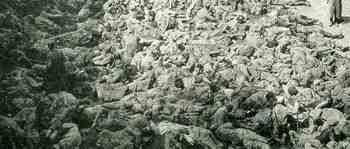
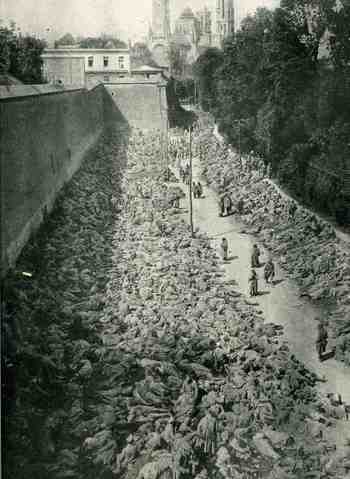
    I came across this impossible  image in the 6 June 1918 issue of Illustrierte Zeitung (Leipzig)  It is almost unbelievable that the bumps and twists and angles of this mass were humans, though at least they were alive. The original was taken on 21 March and shows part of the  210,000  prisoners that were being held in Laon–they seem, at least by their helmets, to be French soldiers.  (The 210,000 figure is German and wartime and intended for German readership; it seems that the real figure was 85,000–still massive.)

    1ebay_oct_2_prisoners728

    Laon is a French Medieval city of magnificent architecture–its cathedral can be seen in the background, in stark contrast to this human blanket. Looking at this image with a magnifying glass, I can see virtually no open ground space in the mass of men.  I estimate that in this photo are 7500 men:  I also figure that the area that we see here (to the left of the open path)  is approximately 400 feet long and 40 feet wide, or roughly a third of an acre.  I’m not sure what was going on here, though it looks like they might be on the move, with the men in the right-hand part of the image stretching off into the distance.  What is also troubling is that so many of these men seem to be asleep, and judging from the way the shadows have fallen it seems to be mid-morning (not early).  Perhaps they’ve just been marched in from battle and are totally exhausted.  I just don’t know–they just don’t look like people.


  • Food Bomb, 1942

    JF Ptak Science Books  Post 285

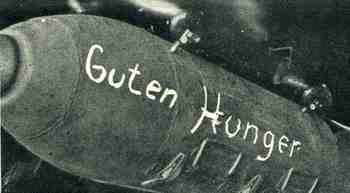
    1ebay_sept_30food_bomb694 In an earlier post (The Most LIterary Fireworks Catalog Ever Published?  The Naming of Explosions) I wrote a little bit about names found on shells and the naming of explosions.  The chances for adding to this category are slim, given the ephemeral nature of the item of discussion–I did however stumble upon this Food Bomb, found in the 25 April 1942 issue of The Illustrated London News.  “Guten Hunger”, the inscription on this “bomb”  (basically “good appetite” or “eat well” or “down the hatch”) was actually “not a weapon of destruction, but an enormous food container” that was going to be dropped on the German soldiers on some slender part of the Eastern Front.  In April the situation was turning now away for the Germans with the Soviet counter offensive, and it was still cold. Something like 3 million German soldiers would be awarded the service medal for the Winterschlacht im Osten 1941/42–not many of them would get to look at it after 1945.   The campaign in the east against their former allies started on 7 June 1941 (and named variously die Ostfront 1941-1945, der Rußlandfeldzug 1941-1945 (Russian campaign) or der Ostfeldzug 1941-1945 (Eastern Campaign)) and lasted to mid-May, 1945, when the campaign line shrunk from as far away as Moscow back down to east Berlin. 

    ·Posted by :

    ·in:

    —

  • The Propaganda of Restricting Infomration: Dorothea Lange’s Photos at the Japanese “Relocation” Camp, Manzanar, 1942

    JF Ptak Science Books Post 283

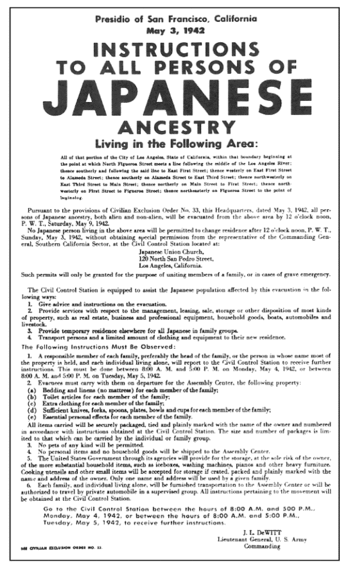
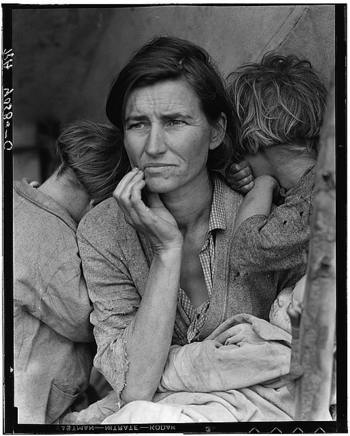
    Takenjap_poster After having written a number of pots dealing with overt propaganda issues—surrender leaflets, Nazi pamphlets on the impending invasion of Germany by Poland and Czechoslovakia, American reassurances about how to survive the coming nuclear holocaust by covering yourself with table linen, British home hearts and minds campaign about how well your loved one POWs are being treated by the Germans—I thought to write a little something on the other side of propaganda, which is simply to not publish information.  One case is that of the great social photographer and one of the dozen or so mainstays of perhaps the greatest American photographic collaborative ever—Historical Section of the Farm Security administrations*–Dorothea Lange.  Lange worked for the FSA—which had begun life as the ominously-named  Resettlement Administration, the photographic section of which was to document the good that the government was doing helping the drought and depression refugees find new life and hope elsewhere in the country outside of their own money-ravaged areas—taking mostly landscape and architectural pictures through the height of the Depression.  The time that she broke character (so to speak) and made portraits produced some of the most memorable or at least famous images from this period o American history, the most outstanding of which is the five-photo series of a female bean picker and her three children who were living out of the back of their wheel-less car in a potato-less potato field in California known as the Migrant Mother.  (The making of these extraordinary images is another story for another post—suffice to say that the narrative of the history of that photograph is exceptional.)  I’ve always felt that the Roosevelt administration viewed this image as being just a little too much reality than it wanted to exhibit.
    Blogmigrant_mother


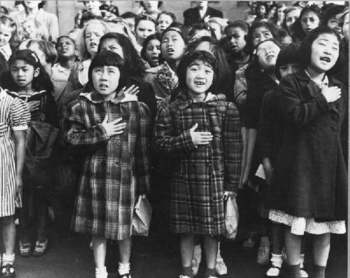
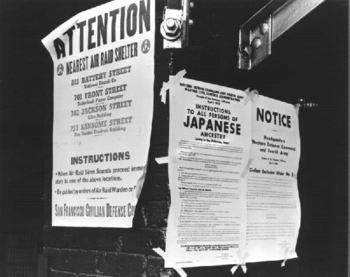
    This was positively the case with Lange’s photographs of the Japanese at the Manzanar concentration camp (relocation camp) in   where more than 10,000 American citizens of Japanese heritage were forced to live between 1942 and 1945.  This was one of  camps that were established by virtue  Franklin Roosevelt’s  February 1942 Executive Order 9066** to imprison more than 100,000 American (70,000 of whom were U.S. citizens, including children) for the duration of the war (compared to a  few camps that were designated to hold white American citizen of the other countries that were fighting, mainly of German and Italian descent, 1,500 and 300 of whom were actually imprisoned, respectively). It was a grave, undistinguished, embarrassing  move brought on by the hyper hysteria in the months following Pearl Harbor.

     
    The Japanese at the Manzanar concentration camp were from the west coast who were bused away from their homes and lives and businesses with extremely limited notice, and who were forced to sell nearly all possessions (including lands and businesses) at what were less than fire sale prices.  They were made to board buses and trains and were shipped to locations (mainly in California) where they were processed and sent further and deeper into the trying hinterlands of the west for their final destinations until the war was won.  (One of the processing centers was the Santa Anita racetrack, where thousands of Japanese were sent to live for periods in converted, just-painted horse stalls.)  Manzanar itself is well enough out there—removed, trying, desolate, difficult.  Beautiful, too , if you weren’t in prison there.  It was a high desert plateau with the snow-capped sierras, ringing the place; no grass, barely a tree, with extreme temperatures and a tough wind that was freezing in the winter and blew hot in the summer…tough enough to make it hard to keep the tar paper on the roof and sides of the thinly constructed barracks that held these people.  While every other relocation camp had barbed wire and guard towers, Manzanar had none—its location was so remote and difficult that it made the construction of these inferior barriers unnecessary. 

    ManzanarlangeslauteManzanarlangeposter

    As difficult was life was at Manzanar, and having being completely torn off of the American map and their way of life, the Japanese at the camp established irrigation systems and gardens, made their own furniture from bits and scraps, established a newspaper, created a government,  schools, police, and so on, making their life as orderly and hospitable as possible.  Dorothea Lange was allowed, after repeated requests to the US Army, to enter the facility and make a photographic record of what she saw.  And what she saw and photographed was the courage and dignity of the people that she find there in the mists of deprivation and devastation—her photos were remarkable for their sincerity and insight.

    And it was for precisely this reason that almost know of them were ever seen.  Bits and piece emerged here and there—four in Survey Graphic in 1942 (Vol. 31, No. 9, Sept. 1942), two others here, two others there—but they were almost entirely restricted.  As a matter of fact they were stamped “Impounded”, and relegated to the future.

    The FSA became the Office of War Information in 1942 as well, which might explain why this propagandistic move dismissing their existence for want of fairer reception of the American war effort at home..  It wasn’t until 1972 that 27 more of them were released and received a public showing at the Whitney in NYC in a show called Executive Order 9066, and which were reviewed in the NY Times by A.D. Coleman as  “documents of such a high order that they convey the feelings of the victims as well as the facts of the crime.”

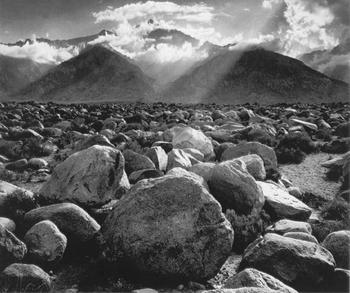
    Lange wasn’t the only big-name photographer zipping around Manzanar–Ansel Adams was there, too, as a friend of the camp administrator.  Adams had free access to the camp, and could basically come and go as he pleased, which didn’t sit well with Lange, who had a hard go of her permissions with the Army.  It was also something that she never let go of, either, as the Adams photos really didn’t get into the Being of the place like Lange’s did.  Actually, one of the great, iconic images made by Adams comes from this period, and as it turns out, its one of those odd sorts of photos that turns in the opposite direction of what the photographer was there “for”.  Mount Williamson is just a drop-dead shot to be sure.  It is also an image of what the Japanese in the concentration camp were looking out at.  Adams turns his camera around, around from the disgrace, and takes one of his greatest images. (I’ve listened to my wife Patti Digh, who is an (excellent) photographer, talk about photographers “making” photographs; I’m sure that before her I used “taking” and “making” photographs interchangeably.  But “making” it should be, as you’re not owning or lifting the image away.)   In this case, however, as monumental as Adams was or is, he definitely “took” this one.  Stole it. 

     An excellent book on these photos is found in Linda Gordon and Gary Okihiro, Impounded, Dorothea Lange and the Censored Images of Japanese American Internment (W.W. Norton, 2006). 

     Blogadams_manzanar


    *This incredible group included: Arthur Rothstein, Carl Mydans (up to the summer of 1936), Walker Evans (up to September 1937) Ben Shahn, Dorothea Lange (with interruptions up to 1942). Russell Lee, Marion Post Wolcott, John Vachon, Jack Delano, John Collier. This group produced upwards of 270,000 negatives, with 77,000 or so prints available at the Prints and Photographs room of the Library of Congress in a row of double-backed file cabinets.  Many thousands are available online at loc.gov  I am told by a reliable historian that I am wrong in thinking that Lange was fired because of her too-intolerably human photos, but for budgetary problems. 
    .
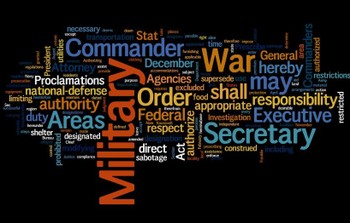
    **The following is the text of 9066, which basically authorized a 60-mile swath of the Pacific Coast as a military zone subject to national defense requirements, the principal object of which was to remove all Japanese residents from the area for fear of them being enemy agents and saboteurs.  To accompany this I mad a WORDLE text map of the document, just to see what popped up. 

    Wordleexecutive_9066 Executive Order No. 9066
    The President, Executive Order
    Authorizing the Secretary of War to Prescribe Military Areas

    Whereas the successful prosecution of the war requires every possible protection against espionage and against sabotage to national-defense material, national-defense premises, and national-defense utilities as defined in Section 4, Act of April 20, 1918, 40 Stat. 533, as amended by the Act of November 30, 1940, 54 Stat. 1220, and the Act of August 21, 1941, 55 Stat. 655 (U.S.C., Title 50, Sec. 104);

    Now, therefore, by virtue of the authority vested in me as President of the United States, and Commander in Chief of the Army and Navy, I hereby authorize and direct the Secretary of War, and the Military Commanders whom he may from time to time designate, whenever he or any designated Commander deems such action necessary or desirable, to prescribe military areas in such places and of such extent as he or the appropriate Military Commander may determine, from which any or all persons may be excluded, and with respect to which, the right of any person to enter, remain in, or leave shall be subject to whatever restrictions the Secretary of War or the appropriate Military Commander may impose in his discretion. The Secretary of War is hereby authorized to provide for residents of any such area who are excluded there from, such transportation, food, shelter, and other accommodations as may be necessary, in the judgment of the Secretary of War or the said Military Commander, and until other arrangements are made, to accomplish the purpose of this order. The designation of military areas in any region or locality shall supersede designations of prohibited and restricted areas by the Attorney General under the Proclamations of December 7 and 8, 1941, and shall supersede the responsibility and authority of the Attorney General under the said Proclamations in respect of such prohibited and restricted areas.

    I hereby further authorize and direct the Secretary of War and the said Military Commanders to take such other steps as he or the appropriate Military Commander may deem advisable to enforce compliance with the restrictions applicable to each Military area hereinabove authorized to be designated, including the use of Federal troops and other Federal Agencies, with authority to accept assistance of state and local agencies.
    I hereby further authorize and direct all Executive Departments, independent establishments and other Federal Agencies, to assist the Secretary of War or the said Military Commanders in carrying out this Executive Order, including the furnishing of medical aid, hospitalization, food, clothing, transportation, use of land, shelter, and other supplies, equipment, utilities, facilities, and services.

    This order shall not be construed as modifying or limiting in any way the authority heretofore granted under Executive Order No. 8972, dated December 12, 1941, nor shall it be construed as limiting or modifying the duty and responsibility of the Federal Bureau of Investigation, with respect to the investigation of alleged acts of sabotage or the duty and responsibility of the Attorney General and the Department of Justice under the Proclamations of December 7 and 8, 1941, prescribing regulations for the conduct and control of alien enemies, except as such duty and responsibility is superseded by the designation of military areas hereunder.

    Franklin D. Roosevelt
    The White House,
    February 19, 1942.

    ·Posted by :

    ·in:

    —