A Daily History of Holes, Dots, Lines, Science, History, Math, Physics, Art, the Unintentional Absurd, Architecture, Maps, Data Visualization, Blank and Missing Things, and so on. |1.6 million words, 7500 images, 4.9 million hits| Press & appearances in The Times, Le Figaro, Mensa, The Economist, The Guardian, Discovery News, Slate, Le Monde, Sci American Blogs, Le Pont, and many other places… 5000+ total posts since 2008.

Category: History of the Future

  • The Rot of Modern Art–1910

    JF Ptak Science Books   Post 1765

    “Suddenly I had entered a new world, a universe of ugliness”.–Gelett Burgess, on entering the Salon des Independents Exhibition, 1910

    One of the earliest recognitions of the great early masterpiece of Cubism, Picasso’s Les Demoisselles d’Avignon, makes its appearance in the Architectural Record1, and by a most-unanticipated critic:  Gelett Burgess (1866-1951).  Burgess glides through an unexpectedly wide terrain of The Modern, and has quite a lot of interesting observations, including George Braque and Czobel, Friesz, Harbin, Metzinger, Derain, Chibaud, Matisse  and–perhaps most significantly–Pablo Picasso.  Burgess found his way to Les Demoisselles, and presents a photograph of what would become perhaps the great masterpiece of Cubism, the caption announcing it as a “study” rather than with any real title for the work.  As is well known Picasso worked for some years on the painting (generally the work is assigned a date of 1907 though he worked on it for some years afterwards), spending time alternatively in great loneliness and also in the midst of crowds of the interested/supporters/friends/the curious, sometimes hoping for feedback of his major work from the visitors, sometimes not. 

    Burgess was known as an accomplished illustrator with a distinctive and distinguished style, as well as a humorist-poet, a poet whose best-remembered (and longest-surviving) lines run as follows:

    “I never saw a Purple Cow,
    I never hope to see one,
    But I can tell you, anyhow,
    I’d rather see than be one!”

    And I think that it is in this style that Burgess concedes his opinion of Picasso’s work, complete with a short bit of a poem at the end:

    “And now for Picasso, of whom, here and there, one has heard so much. Picasso will not exhibit his paintings. He is too proud and too scornful of the opinions of the canaille. But he sells his work, nevertheless. That’s the astonishing thing about all of them. Who buys? God knows! Germans, I suppose.”


    ·Posted by :

    ·in:

    — —

  • Strange Things in the Sky Department: the Exploding Moon.

    JF Ptak Science Books    Post 1763   [Part of the Strange Things in the Sky Department.]

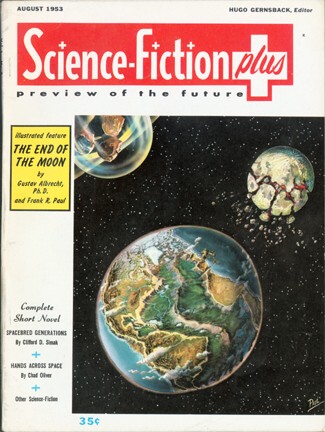
    Moon exploded[Cover art by the great Frank R. Paul for the August 1953 issue of Science Fiction Plus.]

    In my experience of Strange-Things-in-the-Sky Department,the idea of the exploding Earth is far more popular and more illustrated than that of the Exploding Moon.  So far as I can recall Moon doesn’t explode in most cases of early sci fi, including the earliest case of Lucian’s Icaromenippus and his great True History (a satire on outer space travel and interplanetary warfare between the kings of the Moon and the Sun over possession of the Morning Sat (Venus).  Nor does the Moon explode in the other very early efforts of de Bergerac (1657), Francis Godwin (Man in the Moone, 1632, where Our Hero gets to the Moon on a goose-powered aerial something), Johnannes Kepler (Somnium, 1634) and others.  The Moon gets into trouble enough, but not so much trouble to lead it to blow up. 

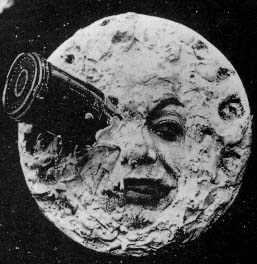
    File:Le Voyage dans la lune.jpg

    (I can’t leave this without mention of Robert Heinlein, who wrote many short stories addressing the Moon, many with fantastic titles and even better story lines:   “Columbus Was a Dope”,  1947;  “Gentlemen, Be Seated!”, 1948, about a lunar tunnel;  a Boy Scouts on the Moon, “The Black Pits of Luna”, 1948;  “The Man Who Sold the Moon”, a 1949    “Nothing Ever Happens on the Moon”, 1949 (future Boy Scouts on the Moon);     “The Menace From Earth”, 1957, (Lunar teenager angst and a muscle-powered space ship); “The Moon Is a Harsh Mistress” (1966), (and a Lunar penal colony)–lovely titles for some superior writing.

    The Moon certainly takes abuse here and there, ranging from cloud attack (in Lucian) to colonization to this very memorable (and frightening/disturbing, as I found as a child)  as in the case of the Man in the Moon being shot in the eye with a space ship (George Melies, Le Voyage dans la lune (A Trip to the Moon) (1902)). 

    Frank Rudolph PaulAnd of course there’s always the runaway Moon and the havoc that it would soon cause to the Earth, though then again this is not an exploding Moon, except it seems as though it might soon be so. 

    And so in a bit of rambling about the Moon that has gone on in this blog, there are no other mentions of the Moon exploding, though there are some other strange things going on there.  Just not “exploding” strangenesses.

    And especially not Laurie Anderson’s “The Exploding Moon“.


  • The Atomic Crossbow of Leonardo da Vinci

    JF Ptak Science Books   Post 1753

    Leonardo understood “big”, especially when it came to weapons, and he understood what the concept of ‘big” meant to adversaries and enemies of the folks with the “big” weapon—a bit of psych-ops in the mid-Renaissance by the High Renaissance man. 

    Giant crossbow

    Leonardo’s crossbow (drawn around 1486) should have worked. He certainly understood the idea of stored power in his many drawings–bent and twisted and torqued wooden arms and such–and the concepts of enormous potential is certainly reeking through-and-through this fantastic weapon.  The bow itself seems certainly like a laminated object, adding to its strength via flexibility, the giant bow-string drawn back by a very considerable worm and gear, the whole of which is set to give flight to a large stone more so than an arrow. And that stone was supposed to be able to be delivered to its target over and over again, with minor adjustments, which would have placed it head-and shoulders above cannons, whose recoil made it really quit impossible to re-aim the instrument with any accuracy at the same target over and over again.  The main compliment of the crossbow, then, was reproducible accuracies. (In this vein it is interesting to recall “Operation Crossbow”, a Combined Bombing Operations during WWII that took place in 1943 and 1944 against the Nazi installations for the V-2 and V-3 weapons–a directed effort to remove a threat which was even more “precise” (if by “precision” we mean marginally guided weapons loaded with high explosives).)

    The “atomic” part of the title of this post is I know far from the mark of being metaphorically correct–the scale isn’t anywhere near being accurate.  Offhand to have an “atomic” crossbow in relation to a nominally normal crossbow in similar scale of the Fat Man weapon in scale with an “average” 500-pound bomb (40 million pounds in relation to 500 pounds) the atomic crossbow would need to be miles wide. 


  • The Computer (mostly Ads) on TV, 1955-1986

    JF Ptak Science Books, Quick Post

    Here’s a selection of nine early television spots for computers and computing…and calculating.  The piece on the coming Internet (1969) to me is the most interesting:

    Mid-1950’s and how engineers build computers:


  • On Bombing the Sky with Bone (1914) and Making the Sky Bomb Us (1967)

    JF Ptak Science Books   Post 1774  [Part of the Strange Things in the Sky department]

    I’m not at all sure when the first stories were told on the implosion of the sky, or when the sky was peeled away like a layer of mica, or when an expanding hole was punched into the blue, or when the sky dissolved, or when it simply fell to the ground, or when it was simply exploded, any of which would leave a shambles of broken stars and a boring nothingness.

    Visions of the coming of hell or the apocalypse or the end of existence or the exaltation of duration were certainly depicted in art at least during the high Medieval period and the Renaissance, though I am uncertain of ever having noticed the sky on fire or facing obliteration. Perhaps the implications of its destruction would be clear in the symbolic representation of The End, the evidence of a smoking atmosphere in an infinite hole was just implied, Dr. Pangloss at play with Mr. Leibniz over paint and canvas.

    Heaven opened and stars fell in various texts, not the least of which is the Book of Revelation (6:14, KJV, “And the heaven departed as a scroll when it is rolled together; and every mountain and island were moved out of their places”). Imaging this part though was another story, especially when considering that destroying the sky was a secular event, and not driven by the great deities.

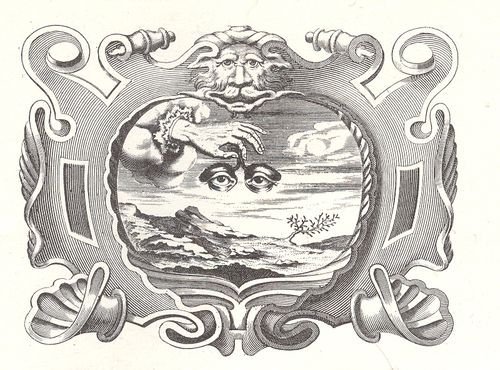
    Now holes do appear in the sky in Renaissance images, but they open to allow the hand of the creator to reach through it from the nether world, or heaven, or the infinite.  In the many examples of these holes that I have seen the background within the hole is entirely blank–plain white, no detail, no peek into heaven.  Then again, these are holes, and not a wholesale destruction of the sky.
    ++ Nov 26 eyes in sky

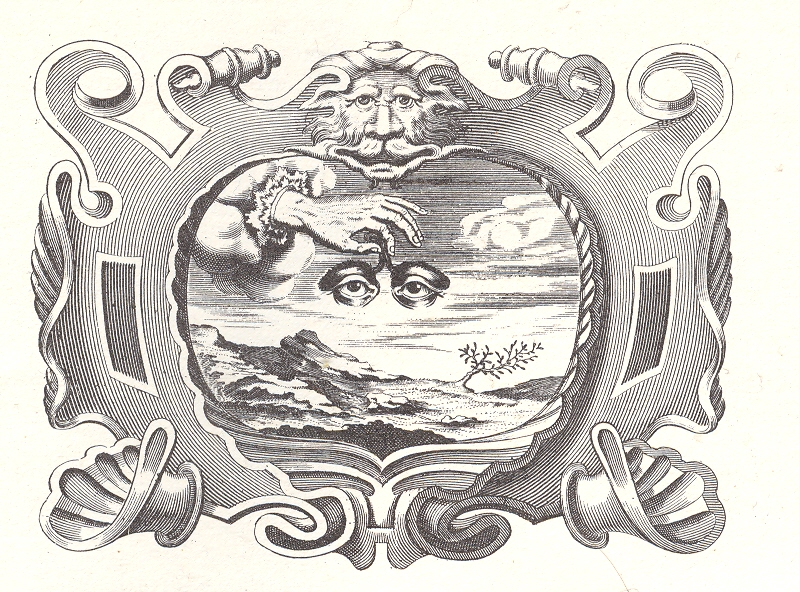
    As an example I’d like to point out the work by the Jesuit Franciscus Nerrincq (1638-1712), De goddelycke voorsienigheydt, in which there are several odd eyes that burn their way through the atmosphere.   Eyes/eye of the creator occur frequently in religious presentations and emblems, but not so very often as hands holding a pair of eyes.  I know all of this is very heavy stuff in the history of Christian iconography and the progression of emblemata, but I’d rather deal with the images out of context here and have them stand on their own without interpretation. 

     Of course the answer for the modern equivalents of this blowing-up-the-sky adventure must have deep and varied roots in the sci-fi canon, though presently they remain a mystery to me.  It is interesting to note that at one point in June 1945 in the Jornada del Muerto/the Dead Man’s Walk, at the Trinity site in the desert near Alamogordo, a group of scientists were placing bets as to whether or not the test explosion of the world’s first atomic weapon would set fire to the atmosphere. 

    In a way Tycho Brahe brought down the sky with his (naked eye) observation of a super nova on 11 November 1572. With the exception of comets and eclipses the sky had remained immutable, a perfect score of the creator’s creation, until Tycho Brahe noticed something new in Cassiopeia, something that was not a comet—a “something” that was a star. This was momentous because the night sky had been seen for centuries as being complete—a new star, the Nova of Brahe, contradicted this high belief, offering the possibilities of newness where there had not been one previously.  And so too with Kepler’s new star of 1602. This wasn’t perhaps a tearing-away of the old sky, but it certainly questioned the sky that was seen. 

    I should also point out that perhaps a reverse of the destruction of the celestial ceiling came about when Galileo turned his telescope to the sky and found to the astonishment of nearly everyone that there was an order of magnitude more stars in the heavens than anyone had ever experienced before. This in a way collapsed the old sky with its perfect and unchanging number of stars, showing that the creator of the universe had indeed provided more stars than anyone had ever imagined, though for reasons not yet known had kept that knowledge from humanity.  By 1610 Galileo had produced his fifth and most powerful telescope, allowing things to be seen one thousand times closer, using it to make enormous discoveries–discoveries so big in fact that their towering significance is a but hard to understand today in the context of early 17th century knowledge. It was all published in his fantastic Sidereus Nuncius on March 4, 1610—the extraordinary title page1 of the book proclaiming some of the great discoveries of Galileo’s adventure. One of the things that Galileo brought to the world was this entirely new sky, revealed to him through his telescope—so many stars that he could only guess (though he reckoned that there was an order of magnitude more stars than previously known “stars in myriads, which had never been seen before…and which surpasses the old, previously known, stars by ten times”). In a way Galileo introduced the sky-above-the-sky, available only to people with a special instrument to see it–the new reality.

     This is what I had in my mind when I saw this unusual patent application (above and below). Just weeks before the beginning of WWI, two weeks before the assassination of Archduke Ferdinand, followed quickly by a cascade of war declarations a few days after that, came this rather footloose idea for bombing the atmosphere

    J.M. Cordray came up with and patented this notion–a barrage of balloons, heavily armed balloons, sent aloft with dangerous cargo to be exploded in the atmosphere, which was supposed to initiate a chain-reaction of some sort which would end in supplying rain for the rest of us. Theoretically, anyway. The unspecified number of balloons would be sent aloft, laden with large amounts of crushed bone and concentrated sulfuric acid (to be combined to produce nitrogen), potash, water, and large amounts of crude oil for the fire’s fuel.  And a candle to light it all.

    It seems that the attempt to blow up a part of the sky with bone and sulphuric acid to make rain just didn’t work, though I cannot (easily) find a record of the experiment being attempted. 

    Mr. Cordray presented himself at the top of his patent as “J.M. Cordray/Rain Maker”.

    The one thing that is for certain is that Cordray’s attempt at weather modification was quite early–it would be another three decades before pioneering work of Kurt Vonnegut’s brother, Bernard, was published (beginning in 1947, finding the ice-nucleating properties of silver iodide, AgI),  which established the very real possibilities of altering the weather.  This practice was employed in the U.S. military’s Operation Popeye, which used cloud seeding to prolong the rainy seasons along the areas covered by the Ho Chi Minh Trail in Vietnam from March 1967 to July 1972.  This sort of weather warfare is now prohibited by international convention.

    And so in a way by employing weather modification as a tool of war we’ve been able to turn the sky into a weapon, which means that this post has followed the bombing of the sky to the sky bombing us. 


    See an interesting article at Paleofuture on the Cold War weather modification attempts here.

    Notes

    1. The title page in full reads:  Great and very wonderful spectacles, and offering them to the consideration of every one, but especially of philosophers and astronomers; which have been observed by Galileo Galilei … by the assistance of a perspective glass lately invented by him; namely, in the face of the moon, in innumerable fixed stars in the milky-way, in nebulous stars, but especially in four planets which revolve round Jupiter at different intervals and periods with a wonderful celerity.
  • Anti-Prediction: On Being Horribly Wrong in Predicting Next Year’s Future (1938)

    JF Ptak Science Books   Post 1773 [Part of the History of the Future series.]

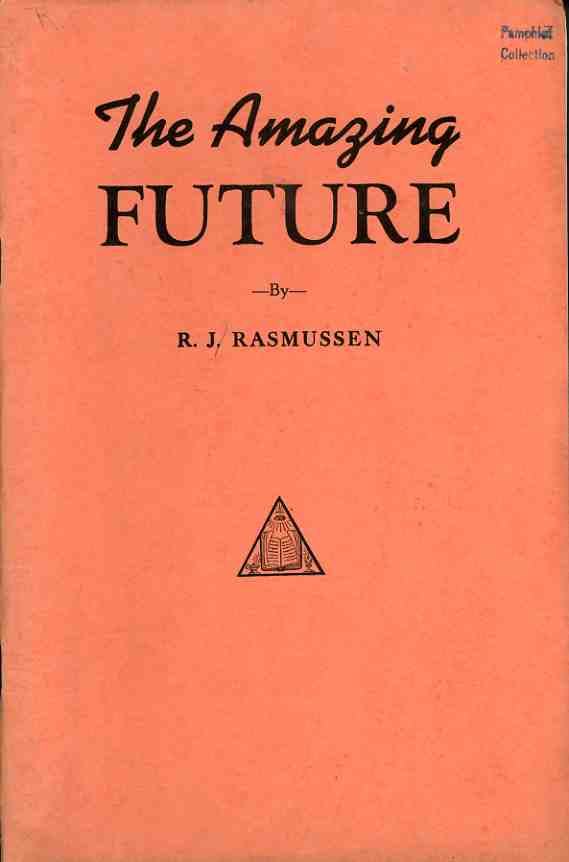
    Sometimes as the saying goes a bad answer isn’t right; and sometimes it isn’t right so much that it isn’t even wrong.  Here we have a collection of not-even-wrongs, tidily collected in one pamphlet.  It is a booklet of “predictions” that are so deeply off the mark that I suspect the author would not even be able to make post facto predictions. 

    0 blog jan 16 future388Had  author R.J. Rasmussen (The Amazing Future, 1938) real powers of diving the future he should’ve been able to see that choosing to be so dreadfully wrong about the events of 1939 was a truly bad thing to do–of course, if there was some sort of unknown and spectacular power in his brain to see what was coming, the least he could’ve been was right.  But he wasn’t, and he wasn’t right very widely, and very widely not right almost all of the time.  To give the devil his due, Rasmussen did get some broad images correct–like in 1939 a world leader will get sick and die.  (Actually, the world leaders dying in 1939 weren’t current leaders, but that is a particular that escapes detail when thinking about stuff that will come to pass.) And then there’s the bold “a high ranking officer in the U.S. army will pass away”. But those broad brushes are about as close as it gets to “prediction”.  He was right that there would be a year 1939.

    The rest is “anti-prediction”:  “I want to advise all pilots and their aides in the United States…to use utmost good judgment in flying your planes”.  And “again I say that no war will be declared on or with Germany”, cancer will be cured on or before August 26, 1939, and there will be an increase in textile production in the U.S.  The Japanese war against China “will be over by August 21, 1941”, though the cost will be monumental to the Japanese, somehow; Germany “will continue to forge ahead” (?),  the map of Africa “will be completely and totally changed” by 1942, and “during this period there will be increased interest shown in higher lines of thought”. And so on, on and on–by the hundreds.

    Finally, among everything else that the author didn’t see was the following:  “the persecution of the Jewish people in Germany will gradually grow less and less that they have ever know in the past thirty years, and before the year 1939 has passed it will have practically ceased in Germany”.  I must say that of all the minor pamphlets like this that I have seen Mr. Rasmussen made the most detailed and incorrect predictions of anyone that I have ever seen–the only further step backward he might’ve been able to make was to have written this book in 1941 and gotten all of the history wrong. 


  • Modest Expectations–Engineers Stand in the Shallow End of the Future Pool

    JF Ptak Science Books   Post 1769

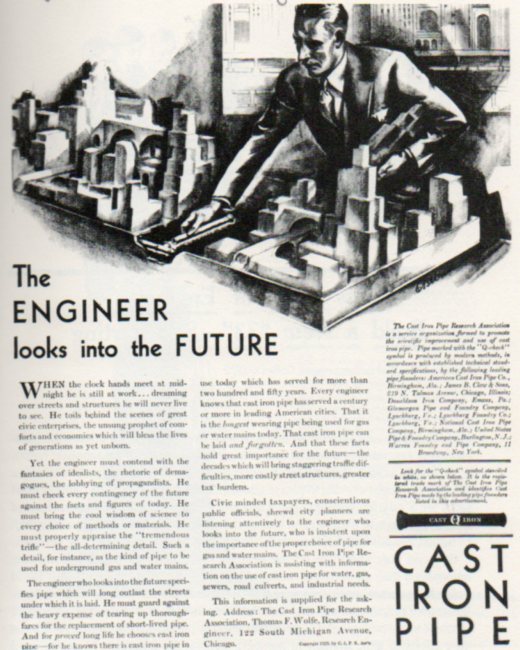
    The novel underneath its title can be good or bad in spite of it, independent of the flag under which it flies. Its just helpful, usually, if the title is as good as the book—better even, because, after all, Modest Expectations isn’t quite as good as the real thing. But “Modest Expectations” seems as thought hat would be the title of future vision in this advertisement that appeared in 1929. It is an advertisement in Collier’s magazine by an engineering company during the time in which The Engineer and the possibilities of engineering were running full-blaze in the United States. There was a belief in the idea of engineering as a cure-all to present and future problems, and the word was as prevalent in the sphere of social interaction as the prefix “e-” was in the early days on internet business and communication in the 1990’s.

    Engineer future410
    It seems as though there were few occupations immune from the “-engineer” suffix, whether they had anything specifically to do with engineering, or not. The “control safety engineer” described a crossing guard; “sanitary engineer” referred to what was known as a garbage man; “nutrition control engineer” was a food server, and so on, position names changed by the hundreds if not more, elevating the status of a profession by simply applying the meme’s suffix to the job title. IF you judged the overuse of the term by the actual accomplishments and achievements of engineering of the times, it was probably justified, give the enormous progress of engineering. In just the first decade of the 20th century enormous change were made in the way life was/would be lived with the introduction of the steam turbine generator, the internal combustion engine, heavier-than-air powered aircraft, the audion, the vacuum diode, the thermionic valve, Bakelite, and so on, all of which would soon bring technological change to create revolutionary changes in the way life was structured in the U.S. And worldwide.

    But given the gigantic changes in the first 30 years of the 20th century, what was it that the engineer was seeing in this advertisement, “The Engineer Looks into the Future”? What was it in the hand of the engineer in the illustration, what was he placing down in the city of tomorrow, today? A faster train, or space ship or part of a vacuum tube people-mover, or what?

    Engineer future411It turns out that this engineer didn’t have such lofty future-vision plans—in fact, the vision was subterranean, and the thing in the engineer’s hands was cast iron pipe. Yes, the future was in materials, and that material manifested itself in cast iron pipe, courtesy of the Cast Iron Pipe Association.

    Now cast iron had been around for a long time before 1929—even used as pipe the idea goes back into the 16th century. There were bridges made of cast iron in the 18th century, and the movement towards the modern skyscraper maybe traced back to cast iron facades and construction in the 1850’s. I’m not so sure why cast iron pipe was so significant in 1929—perhaps it wasn’t so very widely used. But I must admit to having a “moment of discovery” while I tried to reason why the future of engineering looked into a hole in the ground filled with cast iron pipe.

    Engineer future409
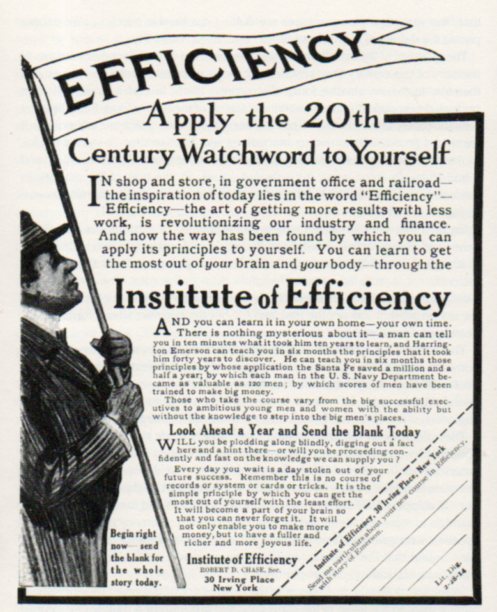
    Engineer future412Another interesting image that comes a little earlier on is this advertisement for the “Institute of Efficiency” (in 1917), which in effect takes the running-rampant ideas of engineering and applies it to the ways in which people ran their personal lives. Efficiency was as much a catch-word as “engineering”, and it was in this decade that saw the appearance of Scientific Management (Fred. Winslow Taylor) and its numerous offshoots. What bothered me about this ad marshaling the positive factors of the study-at-home courses in efficiency was its inefficient use use of space and communication of the idea. Not the least of which was the very odd bit in the bottom right corner, which the reader was supposed to fill in and clip off and send to the Efficiency people. There’s really no room to write, and you can’t actually mail the thing—and, if I was trying to get someone to purchase something about improving their efficiency I might have wanted to make it much easier for them to send me something with their name on it.  The whole effort just seems not very efficient.


  • A Peek into the Future of Modernist Painting–1863

    JF Ptak Science Books   Quick Post   [Part of the History of the Future series.]

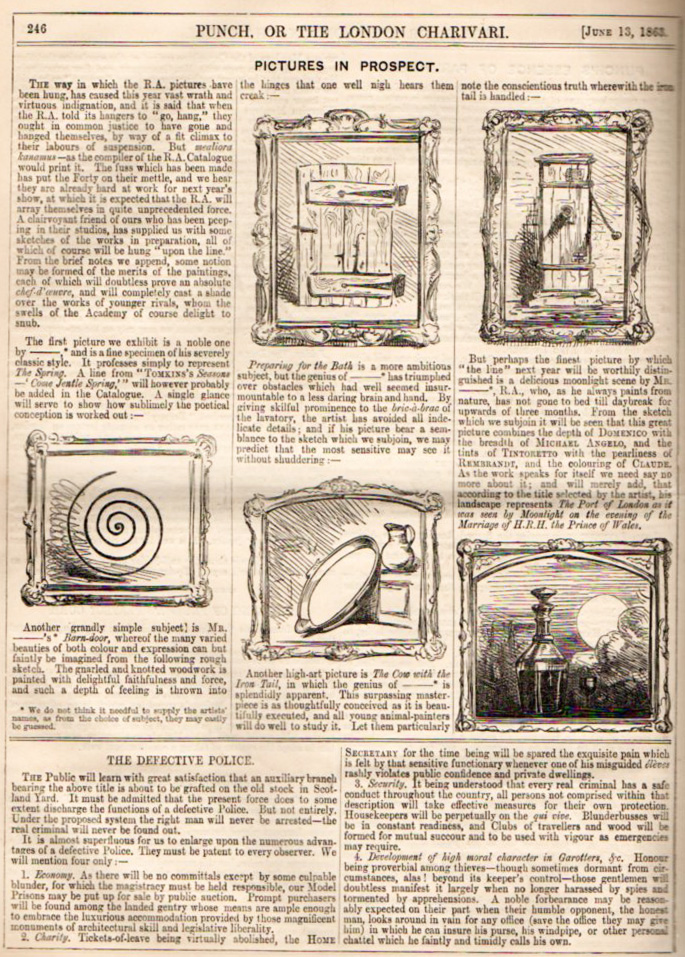
    I’ve written on this blog on a number of occasions about the coming of The Modern, about the coming of many modernisms that came to life in the extraordinary period of 1885-1925 (which could even be shaved perhaps to  1895-1920), when nearly all things “modern” in nearly all fields came to be.  Sometimes though one can see a hint of the future, even though it might not necessarily be recognized at the time.

    Punch modern231_edited-1
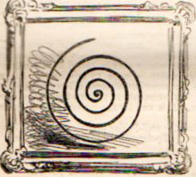
    Such is the whisper of the future in this humorous, somewhat mocking piece on art in the 13 June 1863 issue of Punch, or the London Charivari.  Overall its pretty funny in a 19th century fashion, but what I am taken with most of course is the first piece, the framed non-representational artwork, a taste of the future that wouldn’t arrive for another 50 years with Wassily Kandinsky.  But here it is, or here is something, presented as art, in 1863, and with no discernible, naturalistic subject matter. 

    Punch modern231
    Even in satire, seeing such a picture give sone pause–if for no other reason, that even here in the early stretch of Impressionism, that such an image would appear in a very popular journal and have (a) no impact  and (b) not an ounce of staying power. 


  • A Note on the Future of Computer Demand, 1957

    Computer survey227JF Ptak Science Books  Post 1723

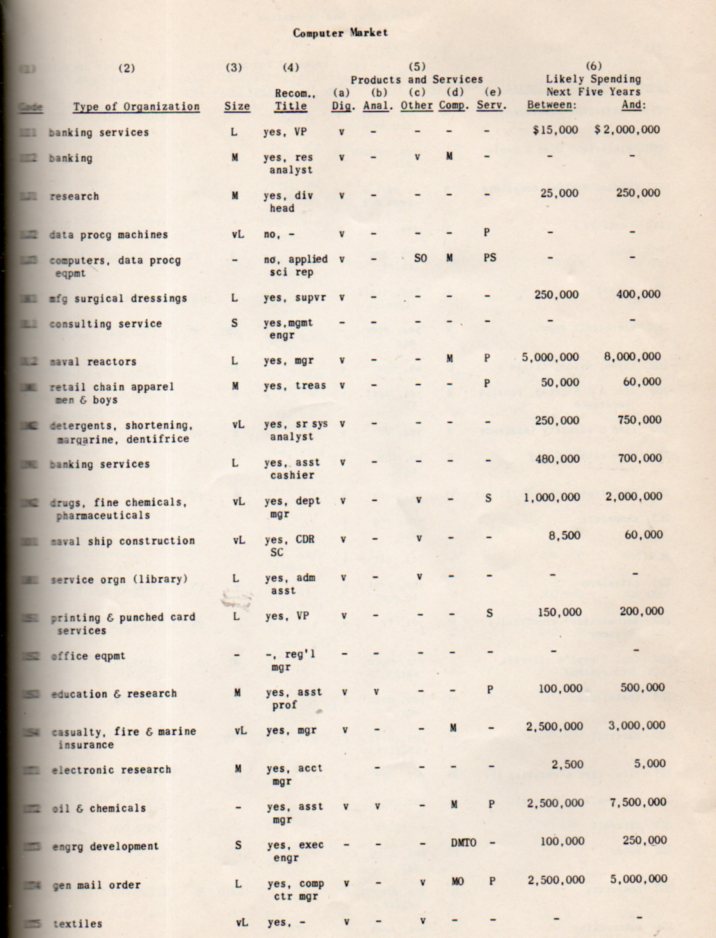
     This computer market survey (“Computer Market Survey—Report No. 1”), authored by the editor of the journal in which it appears—Computers and Automation, May 1957—is one of the earliest of its type. It takes a peek into the future demands on the computer industry, looking at different industries, their growth potential their products and support, and the amount of money that they might be spending (“on products and services in the computer field in the next five years”).  And what Edmund Berkeley saw in the next five years or so was–according to his survey–about $400,000,000 to $750,000,000 worth of computer sales. 

    The numbers come from a survey mailed to the subscribers of Computers and Automation: about 2200 were mailed out, and about 200 forms, or 9%, were returned. “The replies contain interesting, important and extraordinary information, showing the nature and size of the current market for computing and data processing machinery”, and it is upon these replies that the iterations of the report were established.

    The categories that I’m interested in here are the types of organization, its size, and the possibility and computer/data processing purchases.

    Some of the largest customers  in the future for computers and data processing were reckoned to be:

    Air transportation, ($2-4 million); electrical machinery ($1-6 million); “chemicals” ($10-15 million), “electrical apparatus and equipment” ($25-35 million); “gen(eral) mail order”, $2.5-5 million); “naval reactors”, ($5-8 million); “oil and chemicals”, ($2.5-7 million); “maps”, ($3-10 million); “petroleum, ($2-4 million); “research and atomic energy”, ($5-7 million); “airplanes, missiles, reactors”, ($35-50 million); logistics, ($4-6 million); “airplanes”, ($7-10 million); “core memories, matrices, buffers, data processing”, ($10-25 million); “airplanes, ($5-10 million); “computers”, ($15-30 million)

    The elephant in the small pink room stood to be “business machines”, which came in at a whopping $100-200 million), which was about a quarter of the entire plausible expenses in the coming five years. 

    And some of the smallest:

    “Naval ship construction”, ($8,500-60,000); “rubber, plastics, etc.”, ($100-200,000); “energy consulting services”, ($80,000-120,000); “retail chain apparel, mens & boys”, ($50-60,000); “basic agricultural) and industrial chemicals”, ($180,000-200,000); “research & development”, ($25-50,000); “data processing”, ($100-300,000); “research & development” ($25-50,000); “aircraft components”, ($10-40,000)

    And “electronic research”, ($2,500-$5,000)

    Somewhere in the middle, but not yet discernible needs fell to: 

    “banking services”, ($15,000-$2 million); “research”, $25,000-$250,000); “custom design processes and systems”, $1,000-500,000; life insurance, ($600-700,000); “department store”, ($17,500-225,000)

    And of course, “banking”, ($15,000-$2 million).

    This was all in 1957, fifty-five years ago.  Perhaps a “computer year” is equal to something along the lines of a “dog year”, like a 7:1 ratio, so perhaps when folks were trying to see ahead in 1957 in reference to the computer and computing needs it was sort of like trying to make a political prognostications for 2012 in the year 1662.  It was just too much. 

    And that $450,000,000-$750,000,000 figure would be worth about seven times that, around $3-5 billion.  Still a small figure, especially when you compare it to the defense budget for 1957, which was about $45 billion, which would make that figure just a few percent of the money spent on defense, and nowhere near what the amount would become.  Still of course Berkeley was on the right path, its just that the potential for the use of the computer hadn’t yet come to be realized. 


  • The Invasion of America (Part III)

    JF Ptak Science Books   Post 1688

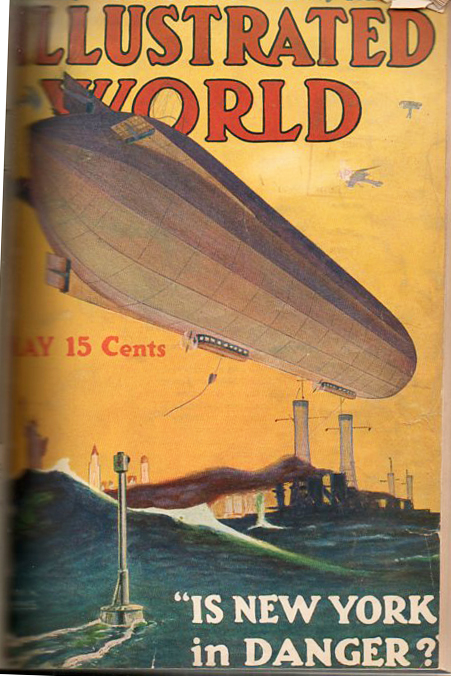
    The New York City harbor looks pretty rough in this picture, tall whitecaps with surprising little reflected in what should be pretty choppy water, meaning that light should be reflecting everywhere, a difficult collection of reflected reflections. 

    America invaded086[Image source:  May 1917 issue of the uncommon magazine, Illustrated World.]

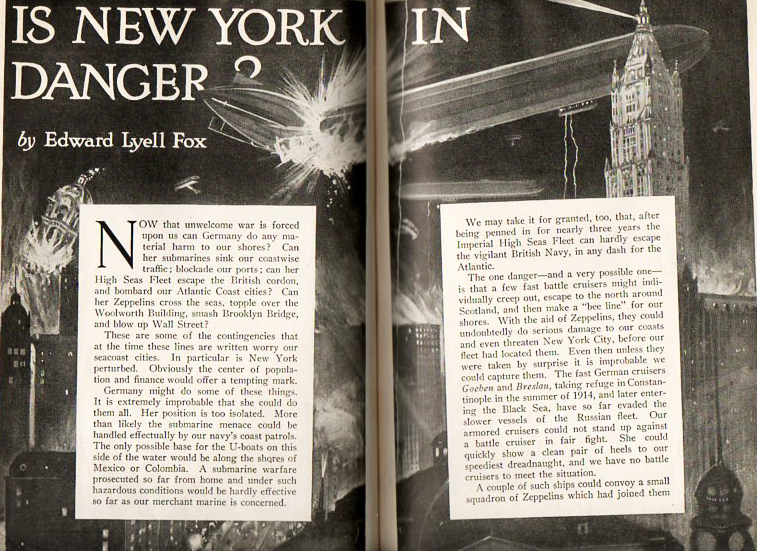
     The submarine, battleship  and zeppelin menaces were real, at least in Europe or in the Atlantic–the aeroplanes far less so1.  But the applications of these fears directly to American shores were still very distant things, particularly when it came to an attack on New York City–except of course that the U.S. had just declared war against Germany, finally, just a few weeks before this issue was published.

    America invaded b088
    The war began for real in Europe in August, 1914, so the fighting had been going on there in fratricidal earnestness for two and half years, costing millions and millions their lives and limbs.  America had been isolationist and non-interventionist up until this point, remaining sweatily on the sidelines, until the capture of the infamous Zimmerman telegram2, which was a coded message sent from Germany (the German Empire) to Mexico (and taken by the Brits as it was sent, the crypto-boys of Room 40 breaking the thing) suggesting that Mexico join in a war against the U.S.  It hit the American press on 1 March, and the story exploded–literally. This is what the beginning of war looks like, sometimes:

    File:Zimmermann Telegram.jpeg

    So perhaps there was some amount of yellow journalism involved here, and some inflationary propaganda as well, and some good-old profit-taking on a half-sci-fi story–on the other hand, the German Empire did just sink 800,000 gross tons of shipping during the 30 days of April (1917), so sub fears were in general real and palpable.  The issue of them sighting the Staten Island Ferry though was quite another matter. 

    The first American soldiers would arrive for fighting in June.  The whole thing would be over in 17 months, which is well less than half of the time that the U.S. spent in WWII. 

    The United States would suffer 116,000 military deaths during its part of the war–a small fraction of the overall military deaths (9 million) and a smaller part still of overall deaths including civilians (totaling 16 million).  There would be 205,000 American wounded in this conflict, a little less than 1% of all war military casualties. 

    It would be interesting to see the coverage in England of the American invasion fears.

    Notes:

    1.  This was not so much a war of bombing than it was for air-to-air combat; bombing became more of a realm of aircraft in the suppression of indigenous populations by occupying powers in the 1920’s, and then in Fascist Spain in the mid-1930’s, and then graduating as it were in WWII. 

    2..  The telegram was named for the Foreign Secretary of the German Empire, Arthur Zimmermann,, who sent the thing out on January 16, 1917.  President Wilson delivered his war address to Congress on 2 April 1917. 

    A military death pie chart for the Entente Powers [source, Wiki]:

    File:WorldWarI-MilitaryDeaths-EntentePowers-Piechart.png