A Daily History of Holes, Dots, Lines, Science, History, Math, Physics, Art, the Unintentional Absurd, Architecture, Maps, Data Visualization, Blank and Missing Things, and so on. |1.6 million words, 7500 images, 4.9 million hits| Press & appearances in The Times, Le Figaro, Mensa, The Economist, The Guardian, Discovery News, Slate, Le Monde, Sci American Blogs, Le Pont, and many other places… 5000+ total posts since 2008.

Category: History of the Future

  • Thomas Aquinas and the Inability of God to Change the Future, and All That

    JF Ptak Sciene Books   Post 1860      (A Thinking-out-Loud Note)                                         Part of the series The History of the Future

    “It seems to me, then , that time is merely an extension, though of what it is an extension I do not know. I begin to wonder whether it is an extension of the mind itself.” St. Augustine, Confessions, (26:33)

    In Paul Nahin’sTime Machines, Time Travel in Physics, Metaphysics, and Science Fiction (Springer Verlag, 1999), the author Paul Nahin makes a good case for St. Thomas Aquinas (1225-1275 or so) being a very early questioner of the concept of time travel (on pages 161-162).  In the Summa Theologica it does seem to me that Aquinas does indeed talk this way, if relating his comments to the ability of God to make changes in the past, present and future.

    Hence all things that are in time are present to God from eternity, not only because He has the types of things present within Him, as some say; but because His glance is carried from eternity over all things as they are in their presentiality. Hence it is manifest that contingent things are infallibly known by God, inasmuch as they are subject to the divine sight in their presentiality; yet they are future contingent things in relation to their own causes.1 Summa Theologia, reference below, source here.

    It seems as though it is possible for God to make changes in the past and present, but the future is another matter, and an area in which even the creator cannot bring about change.  He seems to say that God can cause things to exist or not in the present and the past, but not in the future:

    Whereas when we say he will be, we do not as yet suppose anything. Hence, since the existence and non-existence of an angel considered absolutely is subject to the divine power, God can make the existence of an angel not future; but He cannot cause him not to be while he is, or not to have been, after he has been.2

    I honestly do not know without doing some research how this sort of thought would have been received by other theologians, where the practices of God are omnipotent and unrestricted. For God not to be able to alter the future limits the logic of God’s actions, and seems to establish a limit in general to a limitless idea. 

    Perhaps Aquinas is a very early version on the assault of the completeness of the perfect creation of God’s universe, something that would be put to the test in the scientific discoveries of the coming centuries.  For example, with Galileo discovering that the night sky was hardly complete and perfect as had been thought, viewing nearly an order of magnitude more stars with his telescope than had (of course) never been seen before. Suddenly, the unchanging sky of the great creation was hardly so, and that it was far more vast than had ever been shown.  Same too with the creation of a vacuum by  Otto von Guericke with his experiment’s results published in his  Experiemnta nova (ut vocantur) Magdeburgica de vacuo spatio (Amsterdam, 1672, and which I wrote about here), something that assaulted the speculation that God could not create nothing, that the existence of a perfect nothingness was not possible. 

     Notes below:

  • Daily Dose of Dr. Odd: The Future-Punk of Astoundingly Big Things

    JF Ptak Science Books   Quick Post

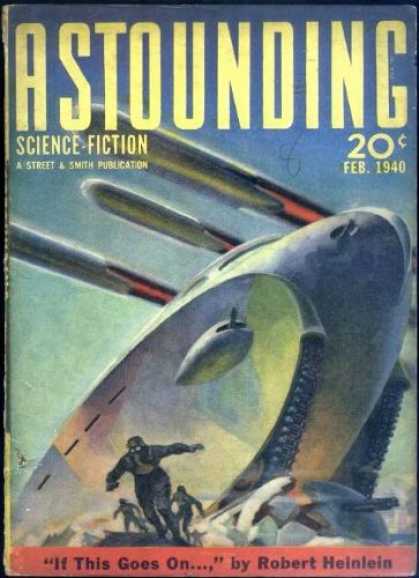
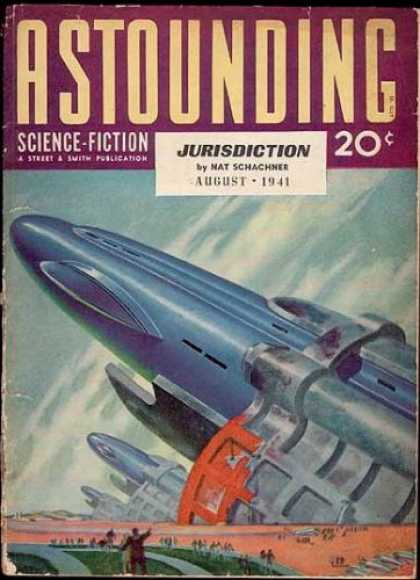
    There’s the Big Bang, Big Ten, big fall, big dream, Big Band, big shot, Big Apple, big picture, Big Bird, Big Brother (and Sister), Big Lebowski, Big Sur, big year, Big East, Big Kahuna, big ego, (really) big show, big money, Big Shot and big deal, and many others, all sorts of “big” things.  And then there are the Really Big things, like these astoundingly big things from the pulpy covers of Astounding Science Fiction magazine, from the 1940’s to 1971.  [The source for all of this artwork is at Coverbrowser.com, here.]

    Astounding Stories 129 - Jurisdiction - Nat Schachner - Science Fiction - Future - August 1941


    Gigant things astounding tank


  • A Note on Music of the Future and Wagner’s Trashbin Philosophy, 1879

    JF Ptak Science Books  Quick Post

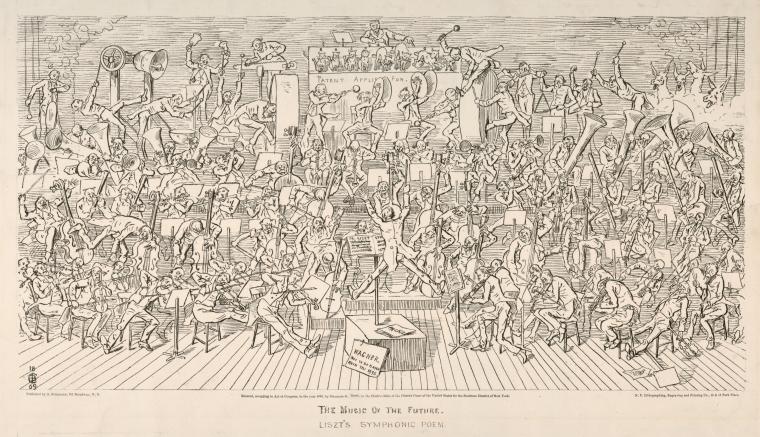
    This cartoon appears in Punch in 1879, and it clearly show’s the bitey Mr. Punch’s proclivities towards the rise of the “music of the future”.  Over the years Punch had seen little value in the new music possibilities, the form and function of which is on display in this kinetic appreciation of a hyper-functioning orchestra.  There is a considerable stab made at Richard Wagner (as we can see in the scores on the floor), the composer who perhaps (along with his considerable supporter, Franz Liszt) was at the deepest heart of the publishing end of the “music of the future”.

    The Music of the Future. Liszt's Symphonic Poem.
    Wagner published his views on the development of music and art in general for the future in Das Kunstwerke der Zukunfts (1849), and then more specifcally to music in Zukunfstmusik (“La Musique de l’Avenir”) in  1850.  But little of that feels like very much to me at all, given the other work he was completing in 1850–Das Judenthum in der Musik.  In some circles the work is translated as “Jewishness in Music” and also “Judaism in Music”, but this is far too polite–what Wagner was talking about was “Jews in Music” or “The Jew in Music”, as it was a savage attack on the place of Jewish people in music and of Judaism as a whole.  It is a virulent and nasty work, first published anonymously to protect Wagner’s “freedom” (as he called it) and then again–unable to leave it alone–in 1869, proudly under his own name.  The work is widely seen as a hallmark of German antisemitism and an embarrassment to Wagnerians, and in some editions of Wagner’s complete collected works, it is forgotten.  On the other hand, it wasn’t just here that Wagner’s antisemitic views are made known–he was a prolific writer, and his work against the Jews appeared numerous times in newspapers and other periodicals, playing the same tune.
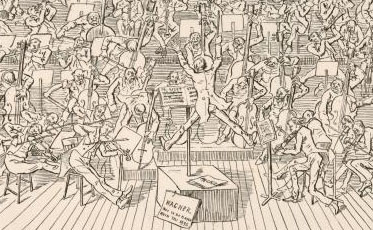
    I’m okay with the man’s name on the floor. 
    Dailydose--music of future
    Daily dose--music future 2


  • A Prehistoric Rayograph–a Proto-Example of Man Ray from 1810

    JF Ptak Science Books   Post 1843

    “I have never painted a recent picture.” Man Ray, 1966

    “Unconcerned but Not Indifferent”—1976, Man Ray’s epitaph.

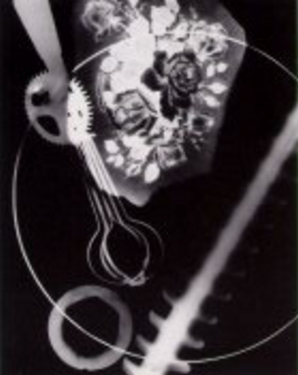
    Emmanuel Radnitzky (1890 –1976) removed the “Emm_uel”  and the “__dnitzk” from his names to become Man Ray, a South Philly-born, Brooklyn- and Manhattan-bred Parisian ex-Pat artist became (by the early 1920’s) perhaps the most influential of the Dadaist/modernist photographers. No offense to his given name, but “Man Ray” is superior.

    0 blog jan 27 man rayograph 1943 0 blog jan 27 man ray


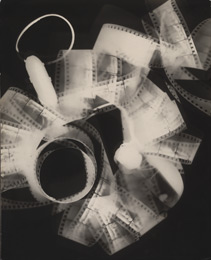
    And Man Ray was far more than a photographer, as he worked across many different art forms, not the least of which was motion pictures.  But what comes to my mind first with his name is his self-titled “rayograph”, a photographic process which was actually a photogram, which was the direct exposure of an object placed upon a photosensitive paper.  This is also the earliest form of photography, something employed by Fox Talbot who called it “photogenic drawing”) as early as 1834.  (I wrote a little bit about this process in a post “Things That Almost Were But Weren’t”.) But Man Ray’s rayographs stand clear and distinct to me, different even from his contemporaries’ works (including Susan Derges, Max Ernst, Raoul Hausmann, Laszlo Moholy-Nagy and Alexander Rodchenko).  

    0 blog jan 27 man rayograph 2

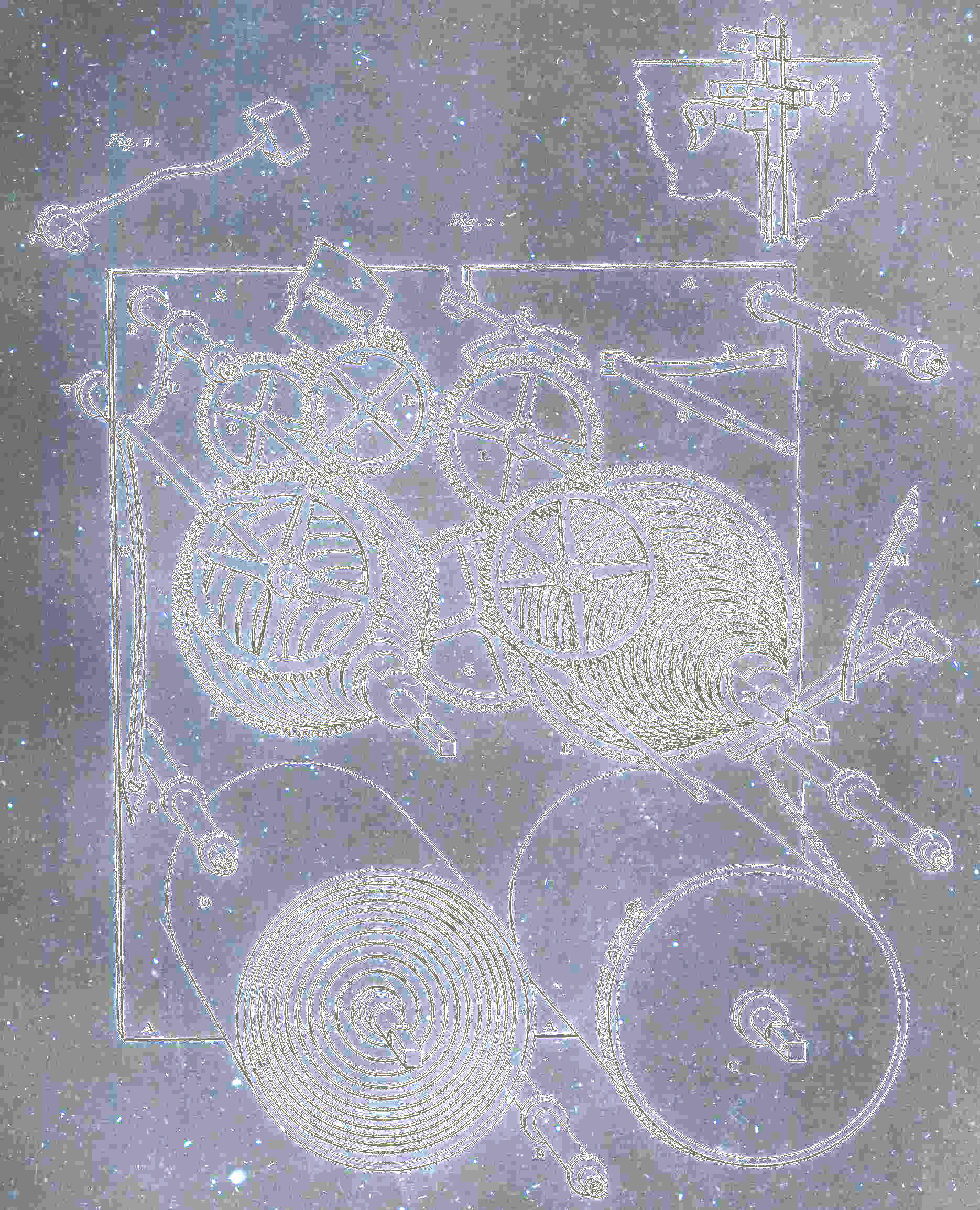
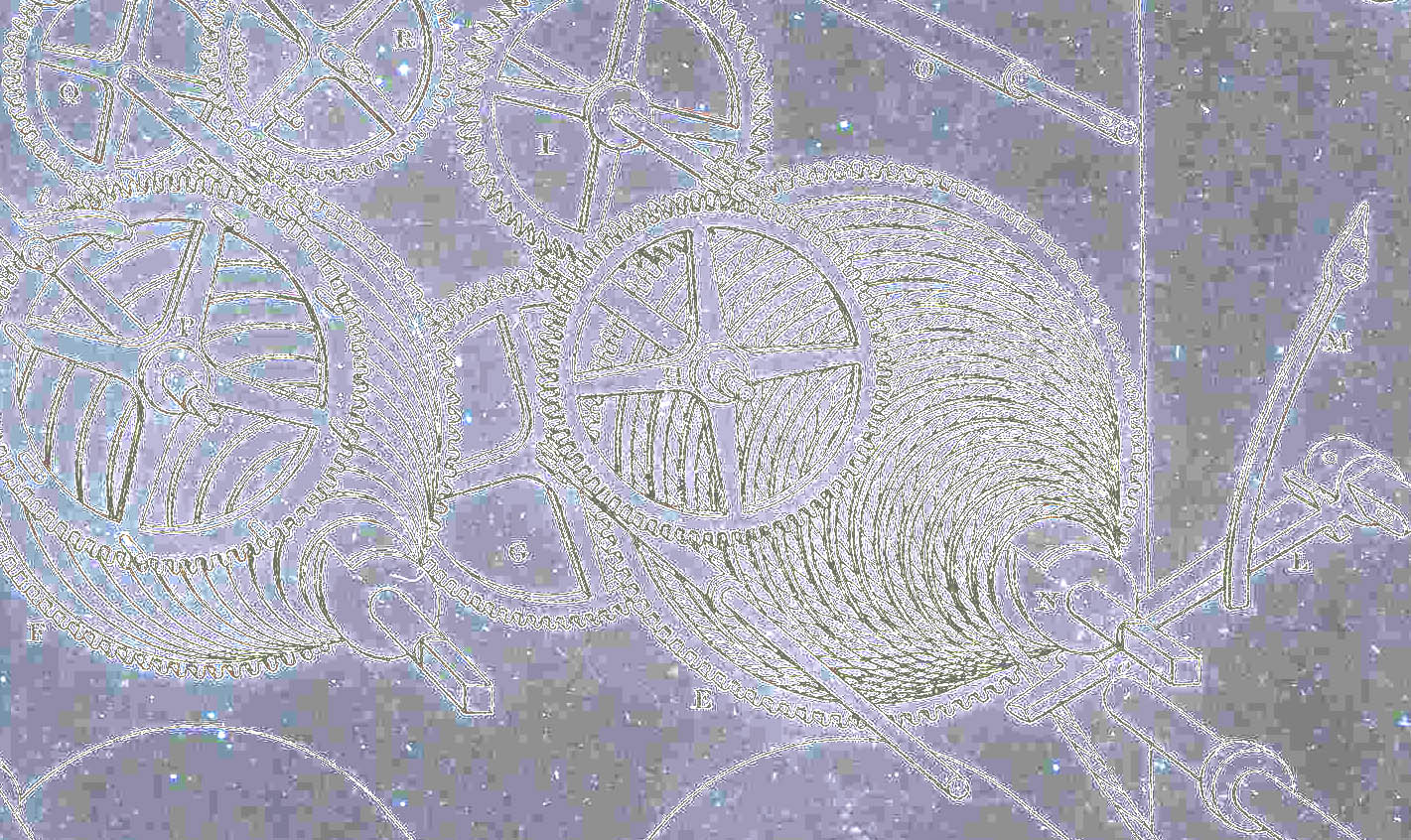
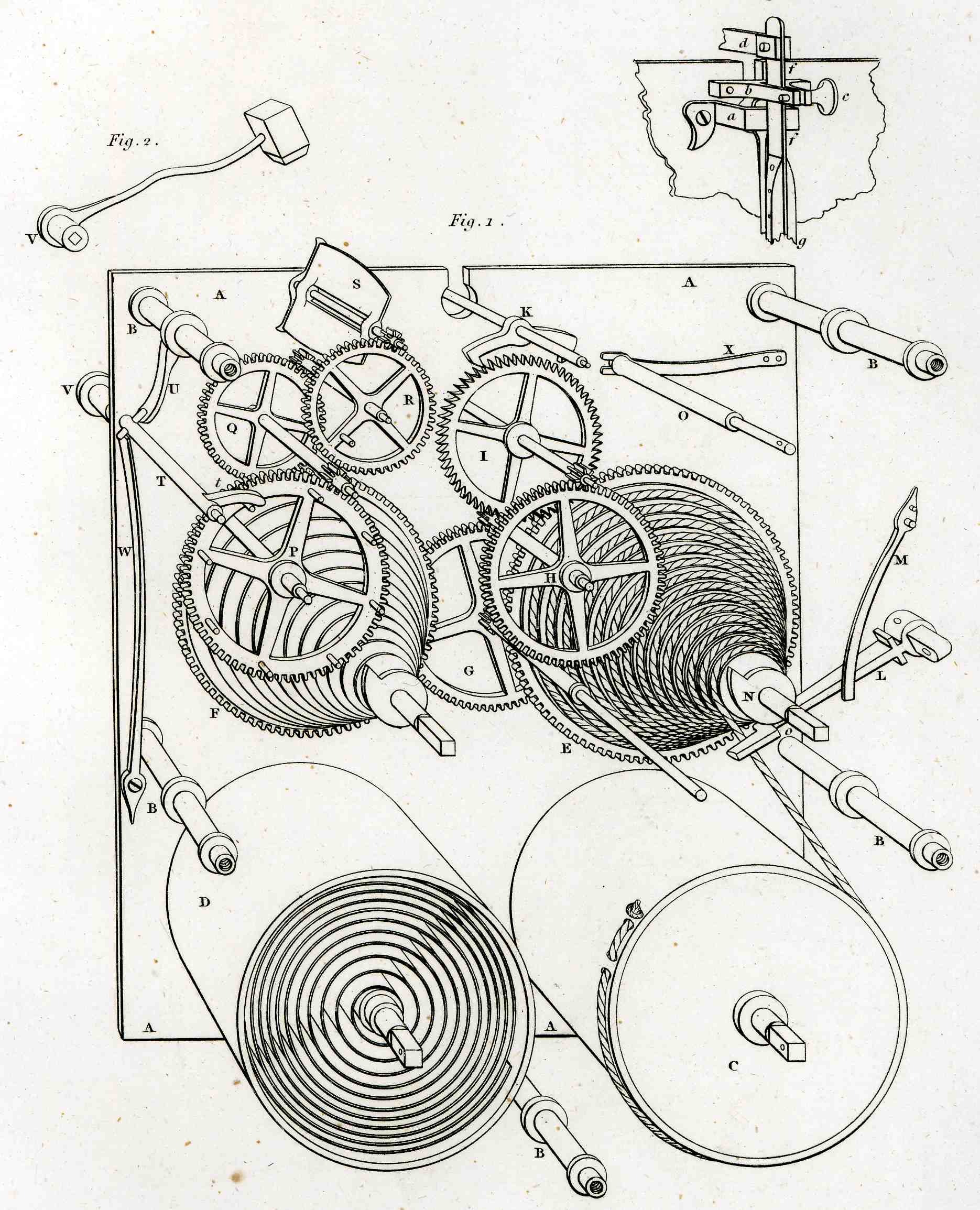
     Of course my antiquarian pretender (the image on the above right) to the rayograph isn’t one—it just had the look and feel of one, contained that shock of recognition that I had seen it before, and the palce where I would’ve seen it was with Man Ray.  All I did with this engraving—an image of clockworks published in Abraham Rhee’s Encyclopedia of 1810–was to solarize it.  So it isn’t even a rayograph, but just looks like one, though Man Ray did work quite a bit with the solarized image.  I just like it. 

    0 blog jan 27 man ray 2

    This is the engraving in its “before” (and superior) state:

    0 blog jan 27durer459  


  • Daily Dose of Dr. Odd: the Future at the End of Burning Ash (Cigarette Card Visions)

    JF Ptak Science Books   Quick Post

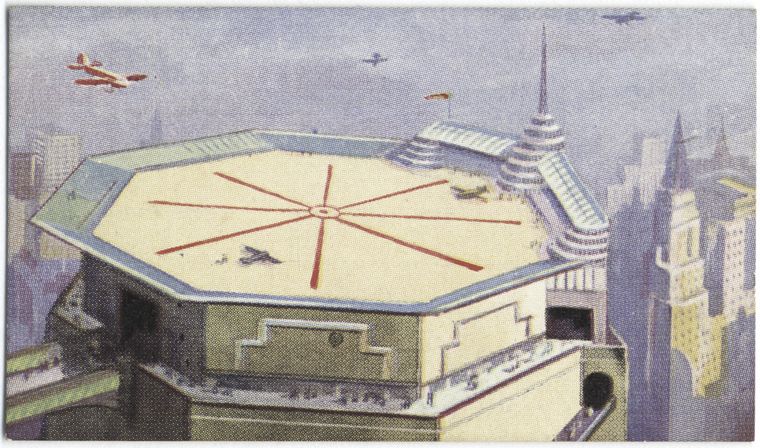
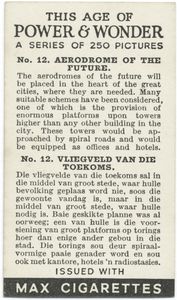
    Three wonderful images of the future, brought to the viewer via the tobacco trading cards interests in the 1920’s–a future that could very well have been denied by the user of the product that advertised it. 
    Source: New York Public LIbrary Digital Collections, here.

    Aerodrome of the future.
    Aerodrome of the future.

  • The Future of Building in Manhattan, 1875

    JF Ptak Science Books   Post 1828

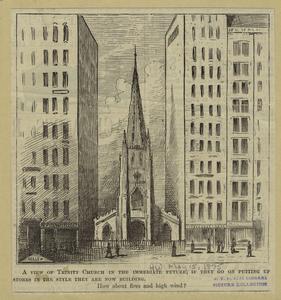
    This is an interesting and somewhat reserve view of the future of Manhattan, as seen from the pre-Centenniel eye of 1875, showing Trinity Church bookended by high-rise structures:

    A view of Trinity Church in the immediate future, if they go on putting up stores in the style the are now building.[Source: Harper’s Weekly, via the New York Public Library Digital Collection, here.]

    It would have been difficult to imagine structures of any greater height here in pre-elevator (and pre-elevator/Westinghouse brakes)  and early post-iron-structure days than the spire of Trinity Church. This Trinity (the third and current occupiers of an old spot at 79 Broadway, the first of the Trinitys going up in 1698 with the help of he block and tackle of Capt. William Kidd, privateer/probably-not-pirate) was the tallest building in Manhattan when it was built in 1846 (at 281′ to the tip of the spire), and remained so the tallest until the construction of the New York World  Building (305′) in 1890. (The World building was torn down in 1955 to make room for another on-ramp for the Brooklyn Bridge.)  So when this image was published it was still another 15 years away from anything being taller than the Trinity tower, which meant it was a pretty fair leap of faith to assume department stores crowding out the church’s airspace back in 1875.

    It is a pretty good approximation of what actually happened, though the canyonesque feel for development is more on Wall Street than it was here contiguous to the church grounds, though almost no one could imagine the dense high-rise growth that is there today:
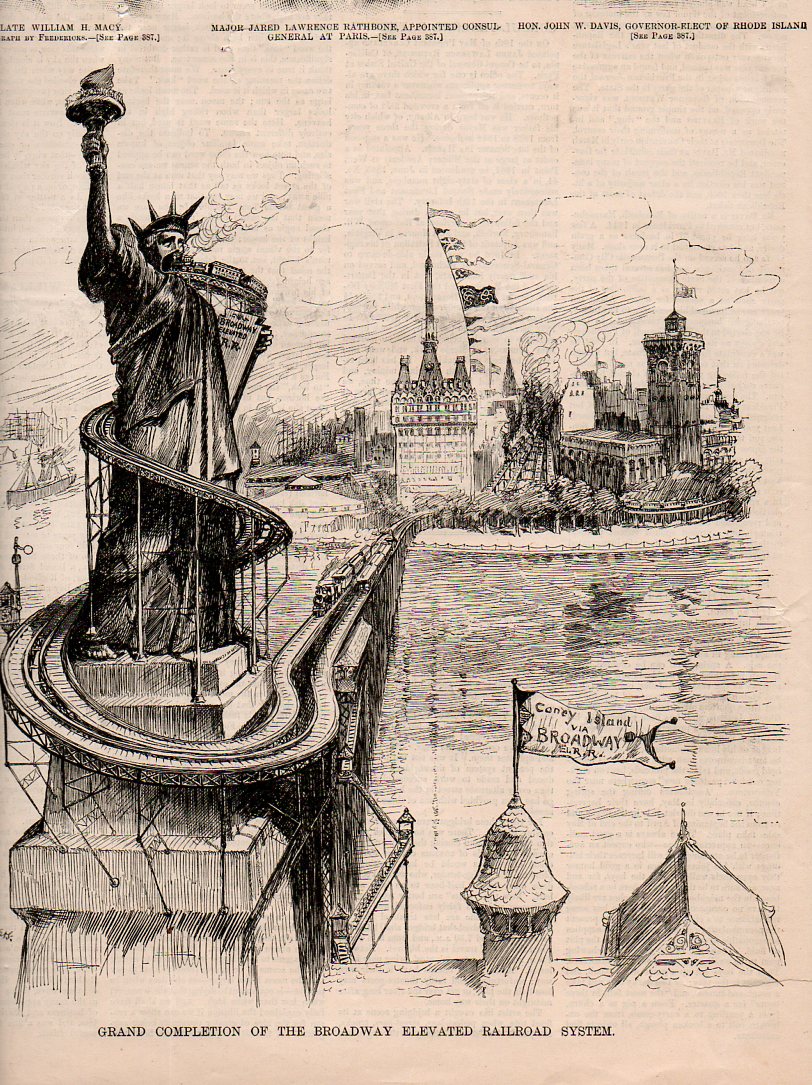
    There are many more colorful approximations of what might happen in Manhattan, one of which I’ve included below, showing the full and complete development of downtown, with trains leading away from the city right through the Statue of Liberty. This peep into a possible future appeared in Harper’s Weekly on 18 May 1887.  It is the work of artist W.A. Rogers and depicts a filling-up lower Manhattan, complete with broad avenues lined by elevated trains whose reach evidently knows no bounds. The new elevated subway winds its way across the harbor to Liberty Island, where it wraps itself around the feet and up the body of the newly–dedicated Statue of Liberty (opened in October of the previous year).  In the foreground is the cupola of a transit station with a fluttering flag advertising “Coney Island via Broadway”–I’m not sure what this is all about, as the placement of the island has nothing to do with anything except making a point in the cartoon.
    https://historyofideasblog.com/a/6a00d83542d51e69e2014e87fca7be970d-pi
    It is interesting to see though that the Trinity spire is still very visible.

  • Daily Dose of Dr. Odd–Future of Air Travel, ca. 1900

    JF Ptak Science Books     Daily Dose of Dr. Odd 2

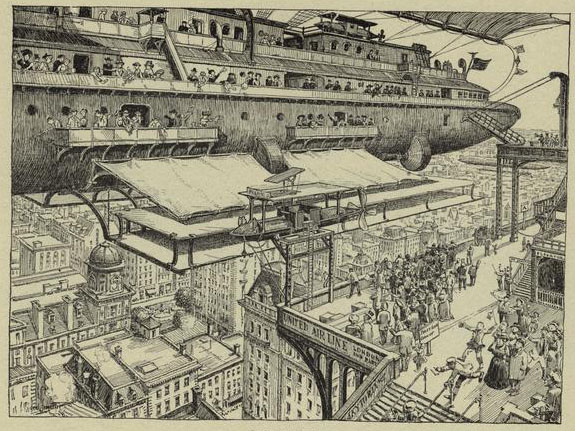
    In today’s quick dose from Dr. Odd we find the “United Air Line” (so close to the name that actually came into being), ca. 1900, featuring an enormous and extraordinarily heavily-bodied airship of a construction of pure speculation.  It is gigantic and weighty, and it seems as though the thing is powered by pulsating awning-like wings and a series of covered propellers, all under what seems to be sail. 

    The crowds bustling beneath the behemoth seem as any other crowd waiting for the subway, or third class, or, well, whatever sort of mass transport would await and was taken for granted.  There are no bands, no fireworks, no fanfare, just the arrival/departure of yet another airship leaving for London from New York City, as much a cause for attention as any airliner traveling overhead.

    Dailydose airship

    Source:  New York Public Library Digital Collections, here.

    Source:  New York City Digital Collection, here.


  • Daily Dose from Dr. Odd–Future of NYC Underground

    JF Ptak Science Books        Daily Dosage from Dr. Odd 1

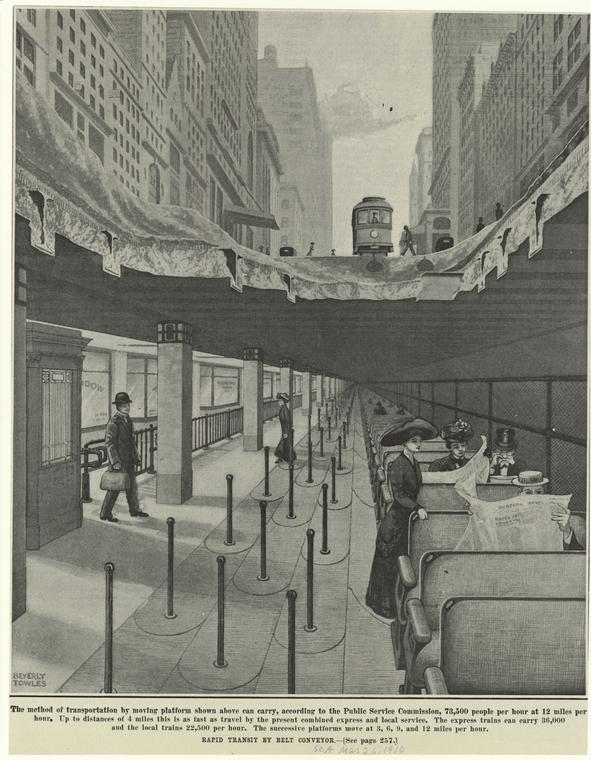
    Rapid transit by belt conveyor.
    This remarkable cutaway (1910) shows what might have been considered a possible future for the future of possible New York Citys .  This one features a very highly respectful continuous conveyor belt of humanity coursing through the Great Underneath, replacing the ideas of subway transport.  A seat would always be available if it was so, just a=one giant beltwork of seat stretching from SOuth Ferry to Uptown and to Brooklyn and so on.  But since it was always moving it would have to move a little slowly for people to hop on and off, so a trip to the then-Uptown might take some time. 
    Source:  New York Public Library Digital Collection, here.
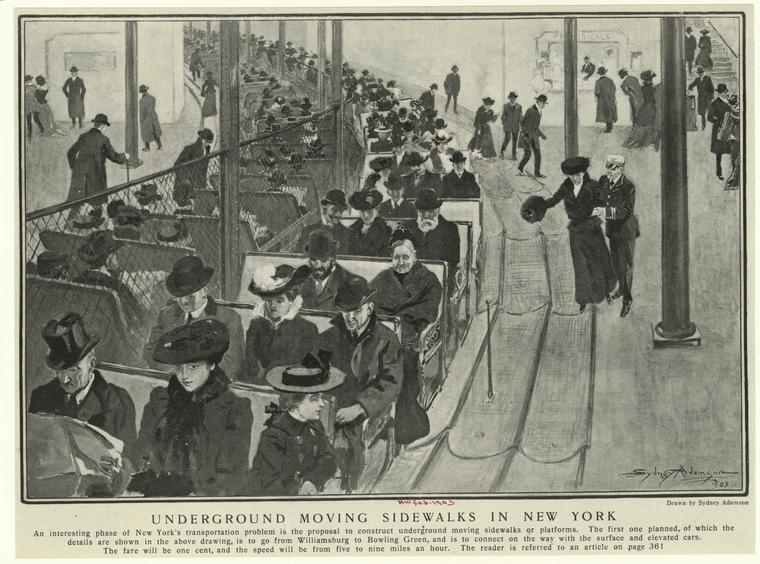
    Not to be out-belted, there was also an image of moving sidewalks (1903):
    Underground moving sidewalks in New York.
    Source:  New York Public Library Digital Collection, here.

  • What a Biologically-Downloaded Intelligencer Virus Might Look Like in 2112.

    JF Ptak Science Books   Quick Books

    Somehow, in some way that is difficult for us to imagine in 2012, these ads were attractive enough in the mid-last-century.  Of course we have our own examples of this behavior, only more-so, I expect, given the vast multiples of advertising we undertake today.  Somehow it feels as though there just isn’t enough space in our own year for the sheer weight and smell of ads, and that some of them must be occupying and stealing oxygen from our time in the future.  Then again, in the future maybe we will all be paying for quiet in our brains so as to not be subjected to nothing but constant streams of commercialism, perhaps inherent in our neurons, ads becoming a part of the very part of the thought process, commercials interrupting our creative process, and popping up at appropriate times in the process of recollection. (Happy thought, that). 

    And so this might look to be an unbelievable, incoherent way of attracting someone to eat pork bellies and eyelids–but at least it appeared in a print ad in 1948 (or whatever), and that was the end of it.  In the future if this was seen once it might be possible for the thing to be incorporated in a memory process that had anything to do with the letters “p” “o” “r” “k” when put together in a row, frontwards or backwards. That’ll be when we have to pay for our memories to be cleaned of commercial sponsors.  

    I can see a short story developing from this, of a person in the year 2112 (on 11 November) having a problem with the artificial memory intelligencer–the things that would make us “smart” in the future–where the biologically-downloaded data contained a virus (literal or figurative) that caused the man to think about this image every time a thought was thunk.  And there was nothing that could be done for him, short of him raising twice the labor exchange units that he had access to in order for this image to be expunged.  No ransom payment meant seeing this pig a thousand times a day.  And so a new crime is born. 


  • Telling the Future with Urine and Bones: the Lyricism of Urine Wheels

    JF Ptak Science Books   Post 1820

    For many centuries people have been trying to control the future, seeing into future’s past, using tea leaves, foreheads, palm prints, brain bumps, nose angles, the position of the stars, rolled animal bones and printed interpretations of the creator of the universe.  Some of these have faded into embarrassed obscurity, but only some; some methods are present today, stronger than ever. 

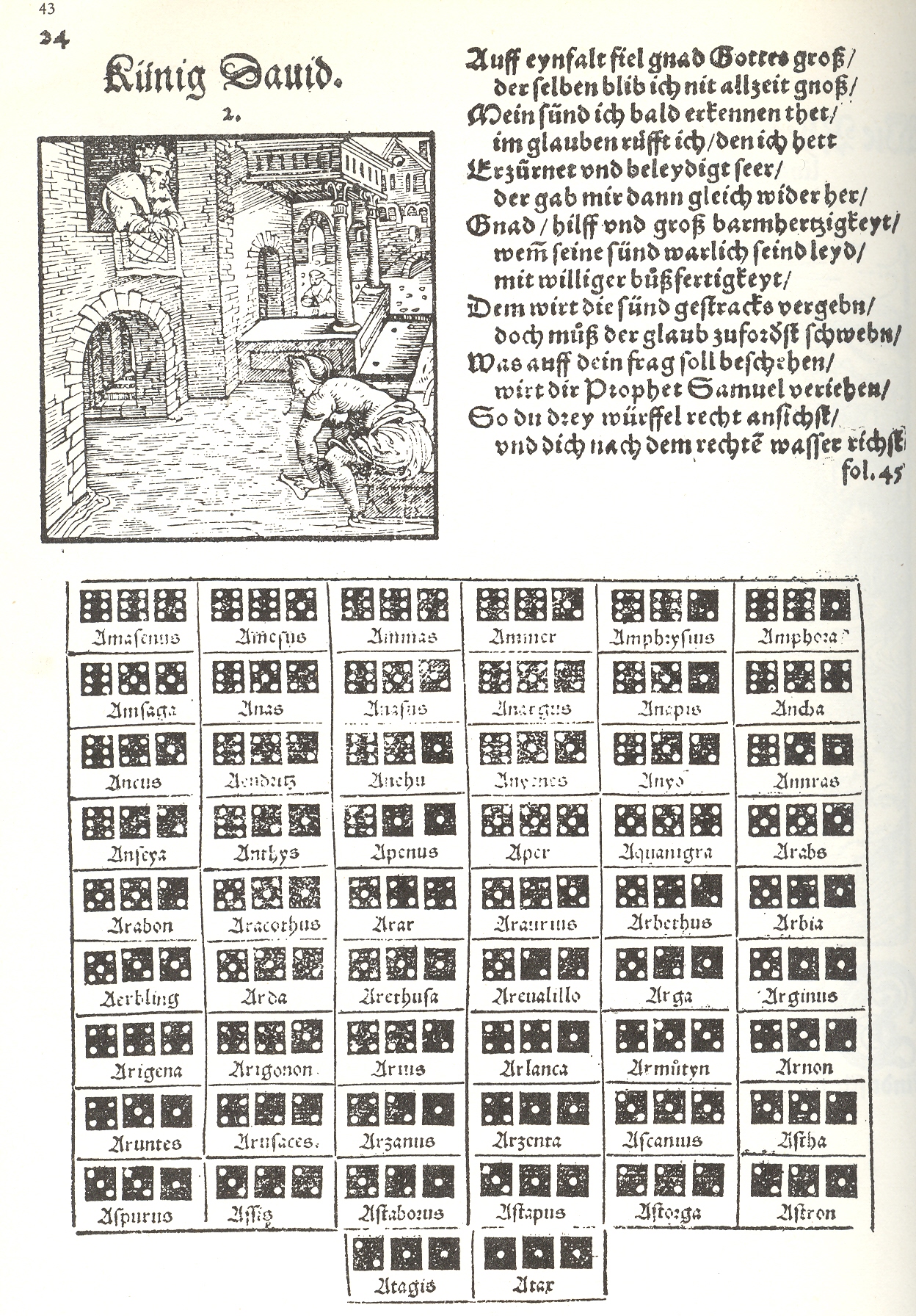
    + blog dice The rolled bones part of this makes the prettiest pictures, I think: for example, this image from Paul Pambst1 (published in 1546) shows some of the dice combinations and what they would correspond to in the revolving paper disks and columns of interpretations in the body of the book, a simple throwing of shaped animal residue somehow laying claim to predictive power.  Not that it is much different from any of the other divination methods. 

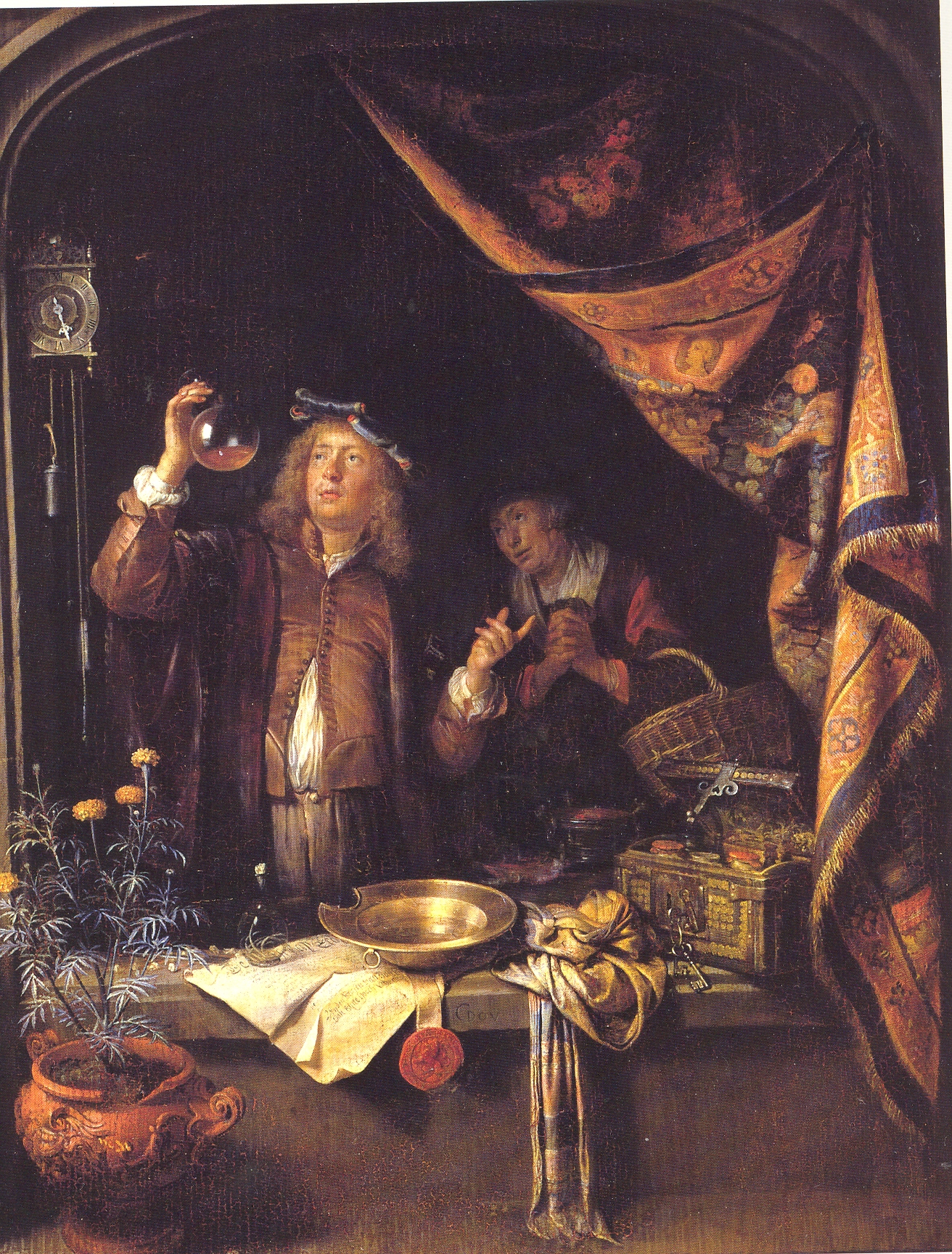
    One such method that had been in strong and continued use for thousands of years and is now mostly relegated to dust is the heated up and swirling inspection of urine.  It was thought for millenia that pee held secrets to what was going on inside the body, and that was mostly true, except that given the state of medical knowledge the only thing that the practioner could do with the sample was hold it up to the light and make good solid guesses on how color/consistency corresponded to the patient.  A reddish tint (as we see here in this painting by Gerrit Dou (1613-1675, and who made an appearance in yesterday’s post) might suggest that the (female) subject was suffering from morbens virginus (uterine hysteria, “a signifying of too much concoction in the body”), which, when the imaginary disease/unease was diagnosed would’ve led to lead consumption and a good bleeding.

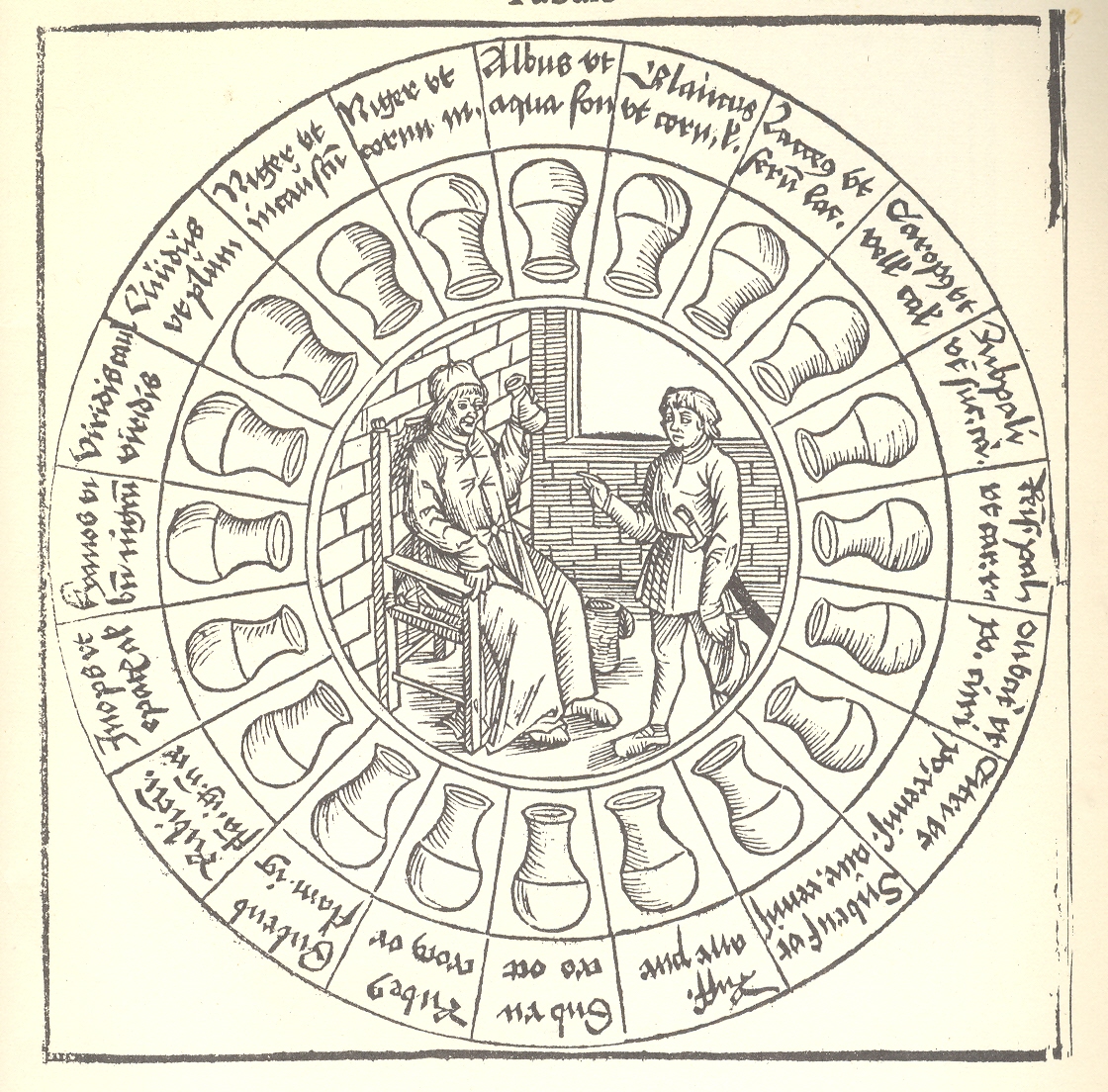
    + blog dou urine  Moving slightly up the alpha from Pambst is Udalr Pinder, whose Epiphanie Medicorum…2 (published in Nurnberg in 1506) is a state-of-the-art disposition on urine inspection, complete with this pee color wheel.  This idea is as interesting as it is entertaining, because at its base is a scientific aspect of trying to establish a common (color) base for discussion of specimens.  The color descriptions (taken in translation from Kirsten Jungersen’s  (MA, classical philologist, visiting scholar, Medical Museion, University of Copenhagen) “The relation between text and colours in medieval urine wheels” (here) are poetic, lyrical. They are also a small insight into common things of the 15th century, the author selecting colors from things that were ubiquitous and known to everyone, and so in this way could be used as a basis for the common understanding of a given color.  + blog pee

    And so here are the glorious colors (complete in “extended reading” below with the Latin above), most of which I’ve never heard as descriptors…and would love to see as an adopted sub-there by Crayola (“Crayola Urine Wheel Colors”):

    “Bluish-grey as camel skin; White as wellwater; Light blue/green/grey as lucid horn; Milky as whey of milk; Slightly pale as a not reduced juice of Meat; Pale yellow as of a not reduced lemon; Wine-red as of animal liver; Black as very dark horn; Ruddy as pure intense gold; Green as green cabbage.”  And of course:

    “Slightly red as a lowered flame of fire”

    and

    “Red as a flame of fire not lowered”

     They’re lovely!

    But of course none of this was actually going to help anyone very much, especially when you moved from uroscopy into urinomancy (not a word one gets to use very often), where instead of trying to diagnose dis-ease the urinomancer would try to diagnose the future.  Often heat was applied to the jar (matula) of urine, which would do, well, I don’t know what.  It certainly looks dramatic, and makes for some excellent opportunities for artists to discern candle-lit color and wonderful reflections (as in Dou). + blog dou urine det Actually, it was in this way that the golden color of urine was determined (poor alchemists!) not to come from gold at all—urine was finally boiled away until its component urea was discovered (in 1773)3. So heat did have a real and important function, but it took hundreds of years to get there properly.

    And so it goes that predicting the future with urine was swept into histories dark places, though somehow bone throwers and astrologers managed to escape this fate. 

    Notes:
      1. Paul Pambst. Loozbuch zu ehren der Roemischen…published in Strassburg in 1546.  The Robert Sabuda website for popup books ahs a very good short essay on this book, here.

    2. Epiphanie Medicorum. Speculum videndi urinas hominum. Clavis aperiendi portas pulsuum. Berillus discernendi causas & differentias febrium.

    3.  H.M. Rouelle first discovered and isolated  1773, and then synthesized by Friedrich Woehler in 1828. This was big and important stuff.
     

    Color Wheel Colors, continued below: