A Daily History of Holes, Dots, Lines, Science, History, Math, Physics, Art, the Unintentional Absurd, Architecture, Maps, Data Visualization, Blank and Missing Things, and so on. |1.6 million words, 7500 images, 4.9 million hits| Press & appearances in The Times, Le Figaro, Mensa, The Economist, The Guardian, Discovery News, Slate, Le Monde, Sci American Blogs, Le Pont, and many other places… 5000+ total posts since 2008.

Category: History of the Future

  • Some Very Big, Sky-High Airborne Thinking, pre-WWII.

    JF Ptak Science Books  Post 1807   [Part of the History of the Future series]

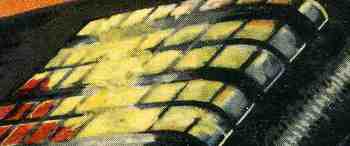
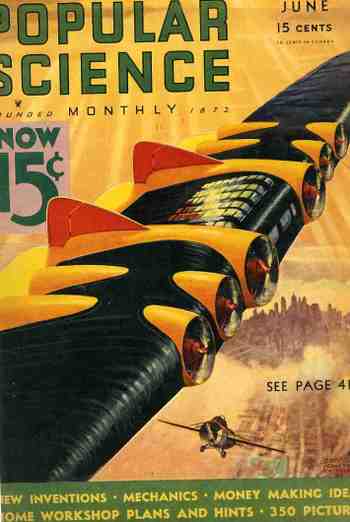
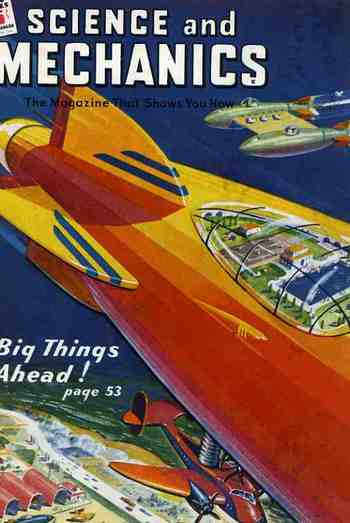
    Blogaugust_16bigflying_wing_detail3Once upon a time, engineers could do anything, especially in the first third or so of the 20th (American) century. The hopes for technological superstar were often on display in popular and illustrated magazines, though much of the times the dreams were more dreamy than they were engineering possibilities.   Some of my favorites among these hopeful projections of the future involve Big Thinking, and floating above these images of great possibilities and reluctant possibilities are thoughts on flight and of luxurious flight, or perhaps even continuous-flight-living. These three images were covers on some of the most popular of the popular sci-tech mags for this period:    Science and Mechanics, Popular Mechanics, and Popular Science Monthly. 

    Blogaugust_16bigflying_wing395

    All three of these examples show (in insets) some sort of large, encapsulated, living section that exists somewhere in the superstructure of the aircraft. The first example comes from Popular Science (15 June 1937), and depicts what I think is a large living area under a grid of 54 large glassy roofs—it is not possible for me to estimate the proportions of the craft, though I think it pales in comparison to the next two examples.

    Blogaugust_16bigflying_dirigible399

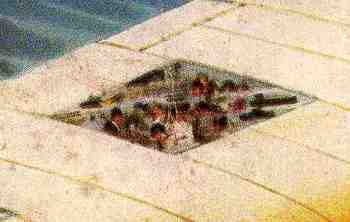
    In both instances the encapsulated areas have trees and roads. In the case of the Science and Mechanics contribution there seems to be six (?) of these large enclosures, the detail of which shows a large swimming pool, a club house, two tennis courts, and some other sporting area, all of which are surrounded by trees. Multiply this structure by six and what you’ve got is one really really big aircraft, which is somehow jet/atomic powered–in any event it is a gigantic craft and it is somehow staying aloft.

    Blogaugust_16bigflying_wing_wite_de


  • The NCC-1701, 1930: the pre-Starship Enterprise

    JF Ptak Science Books   Quick Post

    Uture plane519

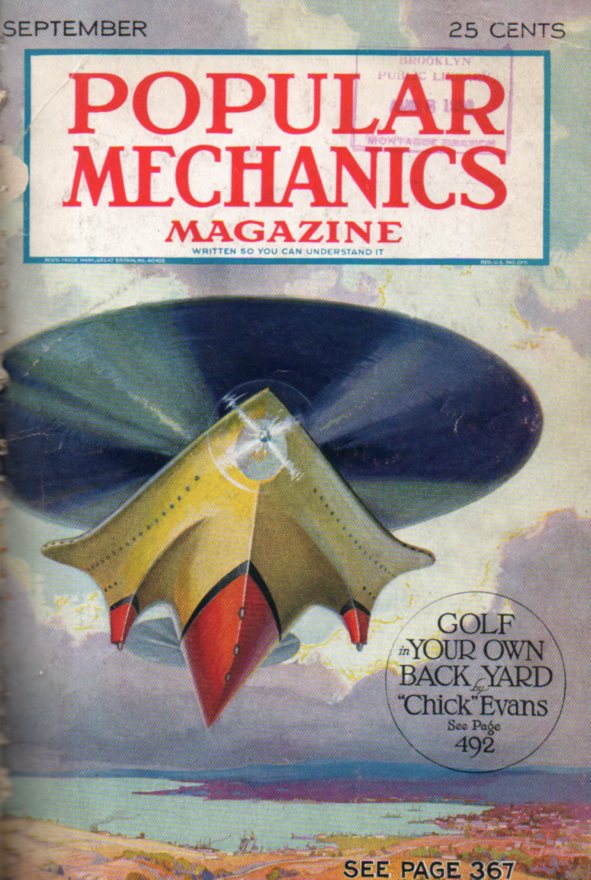
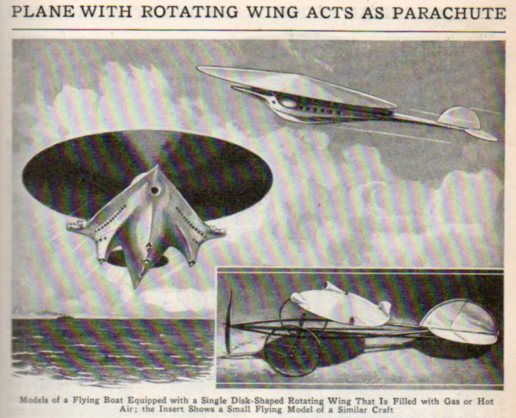
    Well, what is really was, or what this was intended to be in this memory of a possible aviation future–or naval future, as this airship was really a flying boat, an “amphibian, a dirigible, a gyrocopter ….an airplane”.   A ship, really, trying to judge the size of the thing by the position of the portholes/windows–the thing was big, and the “single wing, rotating disk-shaped affair filled with gas or hot air” was even bigger.   We read here that the disk was “turned by a gasoline engine” which was located in the center of the ship, leaving still plenty of room for “quarters” for the crew and passengers, making for what the inventor thought was an easy ascent and then, using the lifting device as a parachute, and then having a parachute-y descent, soft and simple.

    Its hard to judge the size of the machine, but it looks like there are 40-50 portholes or windows running the length of the ship, and so I’d guess that the fuselage of the craft was 150 feet long, which was about half of its overall length, making it about 300 feet overall.  The disk then could be 150-200 feet in diameter, giving it an area of close to one acre.  Big. 

    And so:

    Uture plane520


  • The Rolling Houses and Glass Homes of Futurlandia

    JF Ptak Science Books   Post 1806  [Part of a series on the History of the Future]

    The rolling house of the future (offered in the September, 1934 issue of Everyday Science and Mechanics) promised at least one thing–the ability to be towed by a tractor.  (And seeing that the thing is being pulled along by chains, let’s make sure that there’s no downhill towing, yes?) Rolling_house_large


    The spherical houses seemed to come with their own railroad tracks for easier motion–a continuously self-laying track, which would make the new American suburbs a Suburbia Mobilia.  Cheap cars, cheap houses, and a Great Depression might have made for a picture of the future that was very self-sustaining.  On the other hand, the one thing that would not have been in the gunsights of the American manufacturing center is the size of the houses, which seem to me to be on the order of 500 square feet or so, which does not make for a lot of room to store all of the consumables that were waiting just around the next decade or so, waiting for the first real generation with a large amount of disposable income to loosen on all manner of never-to-be-purchased-before-by-the-working-classes consumers.  In this respect I am sure that these small buckets for human life would seem unacceptable, leaving little room for purchases. 

    ++00++ 9.25 ochiltree, texas

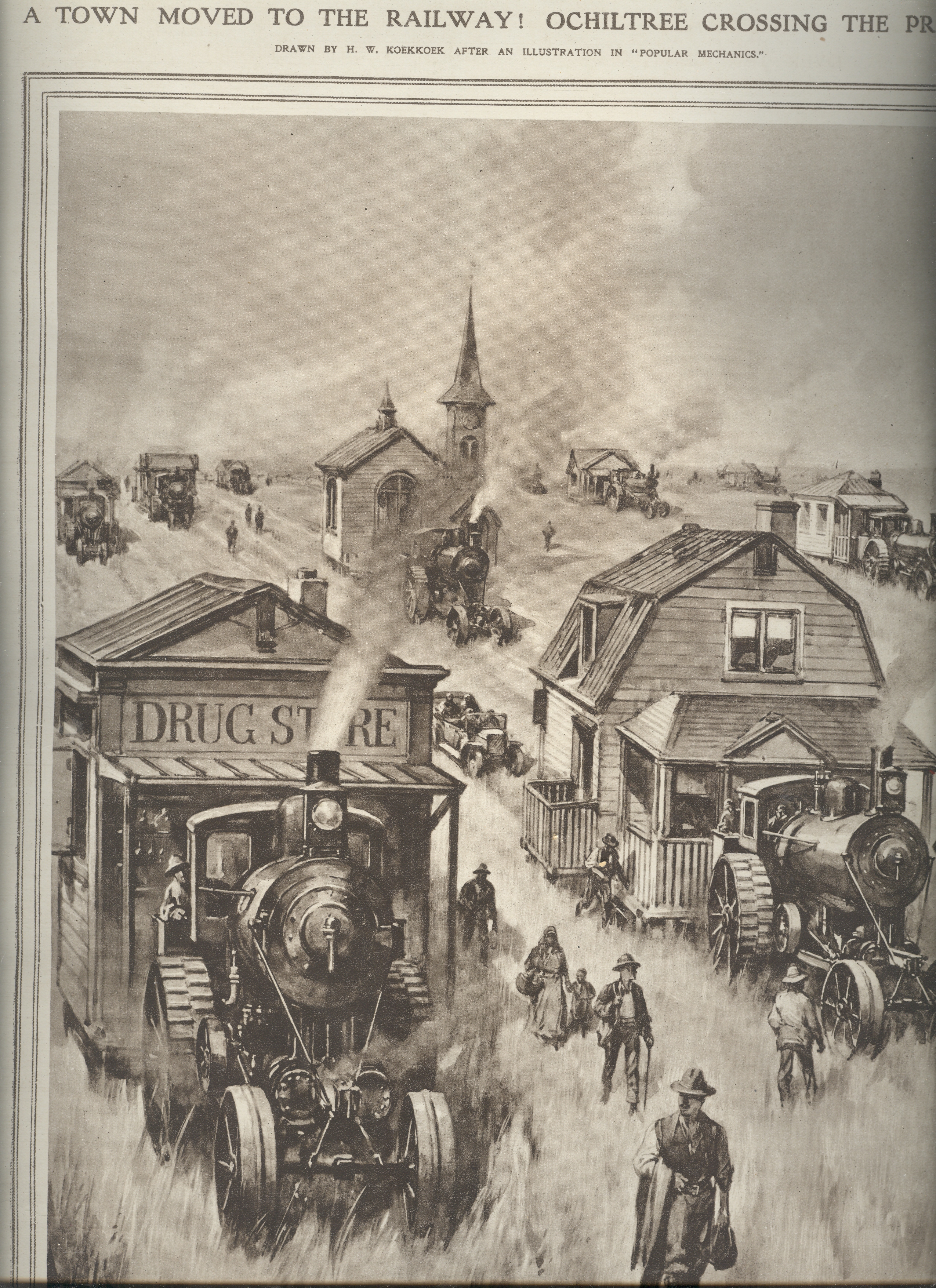
    It does remind me of wholesale town-moving, but from the past–real-life stuff, things that happened.  Like here, for example, in  Ochiltree, Texas, 20 October 1920.  This was a rare occurrence–to move a town–though it is hardly unique, particularly if moving the town closer to a railroad line that had decided to pass it by meant the difference between life and death of the town, then, well I guess you moved the town if you could.  Cemeteries included, sometimes; and sometimes not.

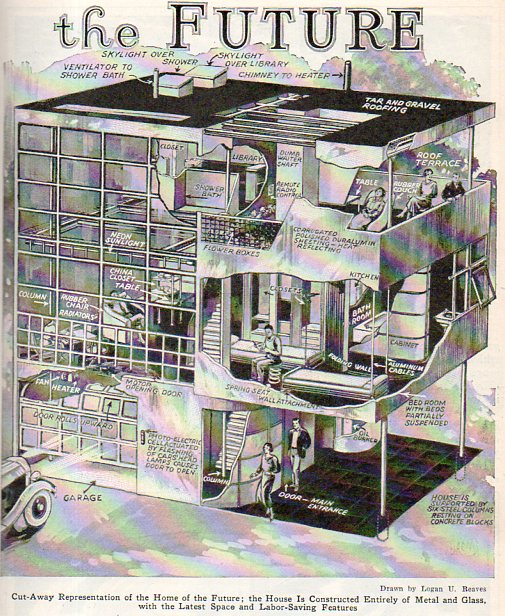
    A memory of another image of a futuristic future house of the future pulled my recent memory to a volume of Popular Mechanics for 1931, the August issue, featuring a “Home of the Future” speculation–this one was also small, but far less mobile, being constructed of metal and glass; and from what I can see, the common home’s exterior walls were mostly glass.

    Future house514

    It looks like a small place–I’m not sure that the car would actually fit in the glass garage.  And it doesn’t look all that comfortable, either, especially in regard to having no walls for bookcases.  (A wall of shelving for a collection of Kindles?)  There *is* a “skylight over the”library”, but it looks like the library isn’t more than a half case of books.  But perhaps in the future we are all entering a world where something is whatever we call it.  Oh, yes, I think that part of the future has already arrived in 2012, and I doubt seriously that the folks writing this article for a popular audience had anything more than a droll popularity in mind in their authorship.  In any event, this future house wasn’t mobile, was small, and looked pretty uncomfortable. And I also bet that the roof gave them problems up there in Futurlandia. 


  • The Stages of Human Life–Illustrated

    JF PTtak Science Books      Post 1796    [Part of the History of the Future series.]

    I came across this fantastic representation of the stages of human life in the beautifully-named book by Bartholomaeus Anglicus, All the Properytees of Thyings, which was published in Westminster in 1495 (and also known as De proprietatibus rerum, also translated as On the nature of things, or On the properties of things), and which was originally written around 1225).  The book was a bestiary, a marvelous encyclopedia, a collection of all things as known in the 13th century–it would be interesting to represent all that is know today and compact it into a workable, logical, usable (printed !) book of a thousand pages.  One of those many images was this:

     File:Stages of Life by Bartholomeus Anglicus 1486.jpga simple, compact reminder to the book’s readers about the progression of life.  Infant, toddler (in a Renaissance walker), child (at games), teen (adopting some of the trappings of adulthood), prime-of-life, middle aged and then the leaning elder. 

    It strikes me that the idea of “stages” is what most of what experience might be–the ideas of “stages” and “progression” are everywhere, even perhaps in the places they shouldn’t be.  There are simple things like rockets that keep releasing smaller and smaller stages of itself until it gets down to the (satellite etc.) nub; sleep has its five stages resulting in the final resting state of r.e.m.,; there are recognized stages of  development for psychology (Erikson), and cognition (Piaget) and need (Maslkow) and  moral (Kohlberg), and spiritual (Fowler), and  economic (lots) and on and on into the progressive stages of the sunset. Progression and series belong in arithmetic and geometry (and etc.) and in the scientific method, as well as music (succession of chords) and disease (more so than health).  Examples are limitless.  But for right now, I just wanted to post a few images of these antique reminders of progression and mortality…

    The Stages of Life, broadside published by James Catnach, London c. 1830. British Museum.

    File:The Stages of Life BM 1992 0125 31.jpg


  • The Moon Made of Brick, 1869

    JF Ptak Science Books   Post 1795

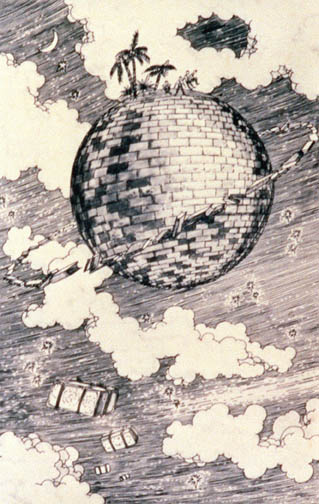
    In 1869 Edward Everett Hale (author of “A Man WIthout a Country” in 1863 and also one of the earliest pieces of fiction regarding alternative worlds in”Hands Off” in 1883) wrote a piece of speculative fiction called “The Brick Moon”, a story told int he form of a journal of Capt. Frank Ingham, relating the story of the launching of a satellite that was to be an aid to navigation.  The construction was fantastic–a sphere made of concentric rings of brick enclosed by an outer layer of brick, reaching 200 feet in diameter, to be hurled into space by two gigantic flywheels on a polar orbit 4,000 miles high, providing a new bright shining star as a means of determining longitude.

    “Any section through any diameter looked like an immense rose-window, of six circles grouped round a seventh. In truth, each of these sections would reveal the existence of seven chambers in the moon,—each a sphere itself,—whose arches gave solidity to the whole; while yet, of the whole moon, the greater part was air. In all there were thirteen of these moonlets, if I am so to call them; though no one section, of course, would reveal so many. Sustained on each side by their groined arches, the surface of the whole moon was built over them and under them,—simply two domes connected at the bases. The chambers themselves were made lighter by leaving large, round windows or open circles in the parts of their vaults farthest from their points of contact, so that each of them looked not unlike the outer sphere of a Japanese ivory nest of concentric balls. You see the object was to make a moon, which, when left to its own gravity, should be fitly supported or braced within. Dear George was sure that, by this constant repetition of arches, we should with the least weight unite the greatest strength. I believe it still, and experience has proved that there is strength enough.”   [Full story here.]

    illustration from Hale's Brick Moon

    [Image source: here, from the Encyclopedia of Science website.]

    Getting the enormous and fantastically heavy “moon” not only off the ground but into space would be an enormous and fantastic mystery–solved here by Hale by the thing being “left to its own gravity” and the two giant flywheels. 

    It was in this story, published in serial form in the Atlantic Monthly, that the idea of the artificial satellite was introduced.  Actually, it was also more than that, because a foul-up caused an early launch of the sphere, launching it into orbit with people on board, making it the first space station.  And it was certainy the first collection of space bricks. Of course this took an enormous leap of imagination and insight, and Hale’s effort must be applauded as a visionary work.


  • Architecture, “Biotechnique”, and a Peek into the Future of the Computer, 1940

    JF Ptak Science Books   Post 1794

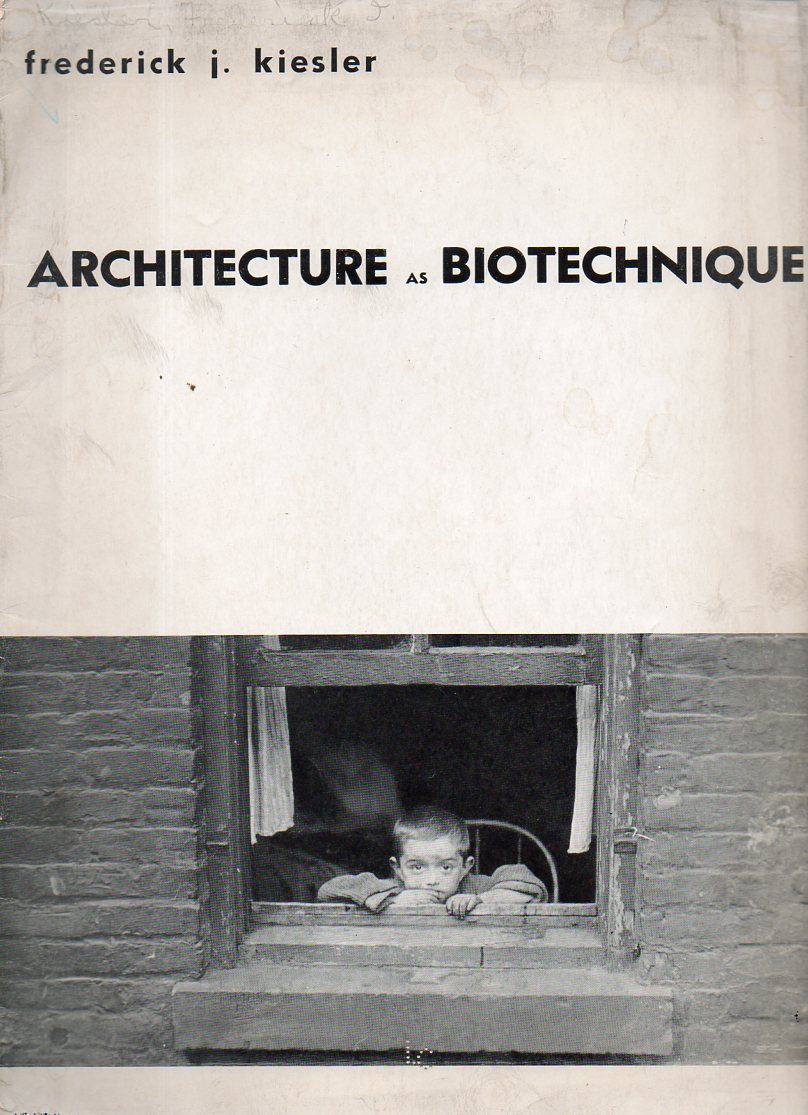
    Frederick Kiesler (Director of the Laboratory of Design-Correlation, Columbia (University)  School of Architecture) has been called one of America’s most influential non-building architects of the 20th century for his influence on a generation of modern thinkers and builders.  In a rare pamphlet–an offprint, actually– called “Architecture as Biotechnique”, which was a separate printing of an article Kiesler wrote for the Architectural  Record in 1939  (and printed in 1940, and appearing under the interior title of “Design Trends”), there is a very enticing peep into the future.  Kiesler was looking at ways of making his architecture more “organic”, more in touch with the people who would live inside the building, a radical thinker on the design of living space,  and wrote about these ideas in a longer piece called Endless House in which he explained his “design-correlations” in 1937.  [The original i salso available for purchase via our blog bookstore, here.]

    Kiesler arch467
    [The cover of the Architectural Record article, which I find to be, well, highly unusual.]

    His descriptions of his work escape me some, making me feel as though I’ve started the article in the middle, when in fact I’m just starting–mainly because of some unfamiliar usages of common words that have been redesigned by the author to mean something else or more…plus the deeply theoretically architectural stuff.  But the article starts with his study of the genetics of architecture and building design, and finishes with eight pages or so on the design for a differently-functioning piece of everyday house interaction–the bookshelves of a library.

    It is in the section on the library that Kiesler includes a “Metabolism-Chart of Mobile-Home-Library” (and by this he’s talking about a movable library within the home and not a library for a mobile home), the bottom part of which shows the evolution of the way in which information is presented in the library.  The “cultural nucleus” or the way in which the data is presented and the way the presented obecjt is stored, and starts with the scroll in 2000 BC (with pigeon-hole storing), then the bound volume  (stored on shelves, 1445 AD), then the the microfilm (stored by “filing”, in 1937-1950 AD), all of which are leading up to “opto-phonetics”, stored in photo-cell-unit(s), in 2000 AD.  The evolutionary part in all of this is the increase in concentration/direction, an ease in visual and manual efforts, as well as easing “torsal” (“bending, leaning, rising, turning”) and “pedal” efforts (walking, moving, standing), making the acquisition and control of the data in the library over time.

    Now Kieser doesn’t actually decribe (here, anyway) what he means by photocell-driven opto-electronic information device, but in 1939/40, when this piece was written,, most of what this machien might be was left to the creative imagination–but the fact that Kiesler has come to this at all with the year 2000 as a probable time for its arrival is fairly remarkable. 

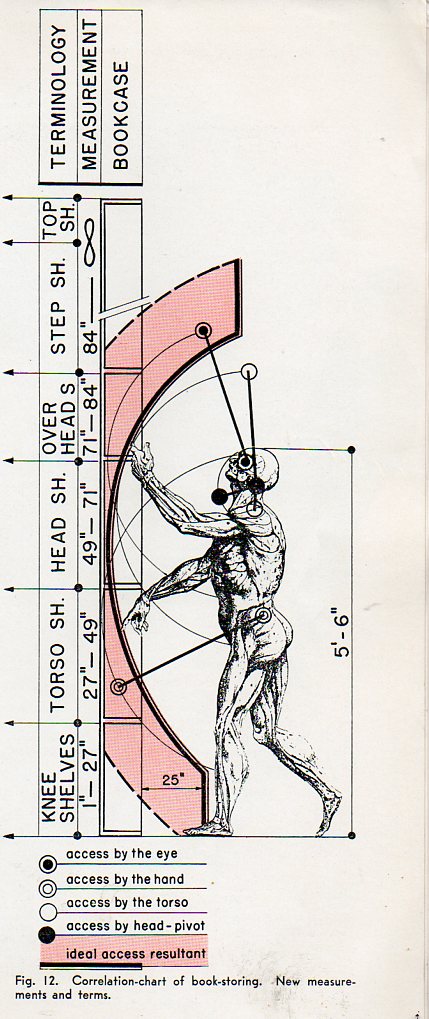
    It is also interesting to see Kiesler’s forensic analysis of the range of human motion regarding the selection of books from shelves (and using a Vesalius image for his 5’6″ person):

    Kiesler arch468Notes:

    “The term “biotechnique” appeared first in my treaties on “Town Planning” as “Vitalbau”, in De Stijl, No. 10/11, Paris 1925 and in America first in Hound and Horn, May 1934.”–Kiesler, from his introduction.

    “Introjection and Projection, Frederick Kiesler and his Dream Machine”, an interesting read,  by Stephen Phillips, in Architecture and Surrealism, by Thomas Mical.


  • Steampunk Orchestra: J.J. Grandville’s Proto-Surreal Images, 1844

    JF Ptak Science Books    Post 1789

    I suspect that J.J. Grandville must be remembered as the proto-father of the proto-Surrealists, and probably more.  He was a very prolific illustrator during his short life (1803-1847), producing many images across a very wide field of imagination that would probably be referred to as speculative fiction.  Early in his stunted career he had some considerable influence as a satirical punisher in a number of superior-level magazines before a censorship law prohibiting such social observations criminalized that sort of imagination, and so Grandville moved on to illustrating some great classics in literature. 

    In 1844 Grandville (a pseudonym for Jean Ignace Isidore Gerard) published his (literally) fabulous Un Autre Monde, a very creative work of transformation and visionary exploration, which was a parody and critique of the worlds of the present and the possible. Its sharp edge ha been lost to time as much as most any satire or caricature of a dusty political past might be (like farming jokes and James Buchanan in 1861), but when you look at the hundreds of illustrations for this work (as well as its underlying ideas) that is really all you need.  The images speak for themselves, and can speak to most anything, in any language.  This is one of the place where Grandville has writ his name large in the pre-history of Surrealism, an Andre Breton/Ernst Mach approach to lit and art about 70 years early.

    The images are simply fantastic.  And you might be ready to see them–with modern eyes–when you read the subtitle head for his book, which reads so:  Un Autre Monde/Transformations, Visions, Incarnations, ascensions, locomotions, explorations, peregrinations, excursions, stations [I’m not sure what this translate to], cosmogonies, fantasmagories, reveries, folatreries [“follies”], lubies [“fads”], metamorphoses, zoomorphie, lithomorphoses, metempsycoes, apotheos, et autre choses… By the end of the title, the reader would suspect that something was “coming”.

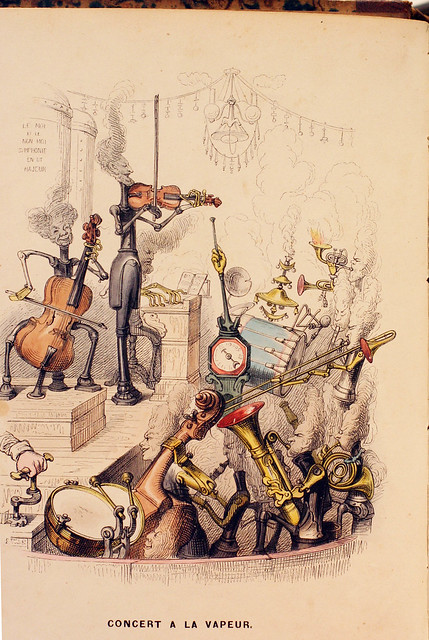
    And so I’m going to post a number of different bits on the images from Un Autre Monde–the first gathering some views of musicians and instruments which take on a definite steampunk variety. Next we’ll have a look an interesting use of perspective as Grandville looks almost straight down on his subject–but not quite so, which to me is quite surprising; then there will be posts on weather morphologies, metallic pyramidal flowers, meta-artists, and of course flying machines. 

    Numerous Grandville images may be found at Visipix; a full set of Un Autre Monde’s illustrations at Flickr, and a full copy of the book at the Internet Archive.

    photo


    photo

  • The Atomic Crossbow of Leonardo da Vinci

    JF Ptak Science Books   Post 1753

    Leonardo understood “big”, especially when it came to weapons, and he understood what the concept of ‘big” meant to adversaries and enemies of the folks with the “big” weapon—a bit of psych-ops in the mid-Renaissance by the High Renaissance man. 

    Giant crossbow

    Leonardo’s crossbow (drawn around 1486) should have worked. He certainly understood the idea of stored power in his many drawings–bent and twisted and torqued wooden arms and such–and the concepts of enormous potential is certainly reeking through-and-through this fantastic weapon.  The bow itself seems certainly like a laminated object, adding to its strength via flexibility, the giant bow-string drawn back by a very considerable worm and gear, the whole of which is set to give flight to a large stone more so than an arrow. And that stone was supposed to be able to be delivered to its target over and over again, with minor adjustments, which would have placed it head-and shoulders above cannons, whose recoil made it really quit impossible to re-aim the instrument with any accuracy at the same target over and over again.  The main compliment of the crossbow, then, was reproducible accuracies. (In this vein it is interesting to recall “Operation Crossbow”, a Combined Bombing Operations during WWII that took place in 1943 and 1944 against the Nazi installations for the V-2 and V-3 weapons–a directed effort to remove a threat which was even more “precise” (if by “precision” we mean marginally guided weapons loaded with high explosives).)

    The “atomic” part of the title of this post is I know far from the mark of being metaphorically correct–the scale isn’t anywhere near being accurate.  Offhand to have an “atomic” crossbow in relation to a nominally normal crossbow in similar scale of the Fat Man weapon in scale with an “average” 500-pound bomb (40 million pounds in relation to 500 pounds) the atomic crossbow would need to be miles wide. 


  • The Computer (mostly Ads) on TV, 1955-1986

    JF Ptak Science Books, Quick Post

    Here’s a selection of nine early television spots for computers and computing…and calculating.  The piece on the coming Internet (1969) to me is the most interesting:

    Mid-1950’s and how engineers build computers:


  • On Bombing the Sky with Bone (1914) and Making the Sky Bomb Us (1967)

    JF Ptak Science Books   Post 1774  [Part of the Strange Things in the Sky department]

    I’m not at all sure when the first stories were told on the implosion of the sky, or when the sky was peeled away like a layer of mica, or when an expanding hole was punched into the blue, or when the sky dissolved, or when it simply fell to the ground, or when it was simply exploded, any of which would leave a shambles of broken stars and a boring nothingness.

    Visions of the coming of hell or the apocalypse or the end of existence or the exaltation of duration were certainly depicted in art at least during the high Medieval period and the Renaissance, though I am uncertain of ever having noticed the sky on fire or facing obliteration. Perhaps the implications of its destruction would be clear in the symbolic representation of The End, the evidence of a smoking atmosphere in an infinite hole was just implied, Dr. Pangloss at play with Mr. Leibniz over paint and canvas.

    Heaven opened and stars fell in various texts, not the least of which is the Book of Revelation (6:14, KJV, “And the heaven departed as a scroll when it is rolled together; and every mountain and island were moved out of their places”). Imaging this part though was another story, especially when considering that destroying the sky was a secular event, and not driven by the great deities.

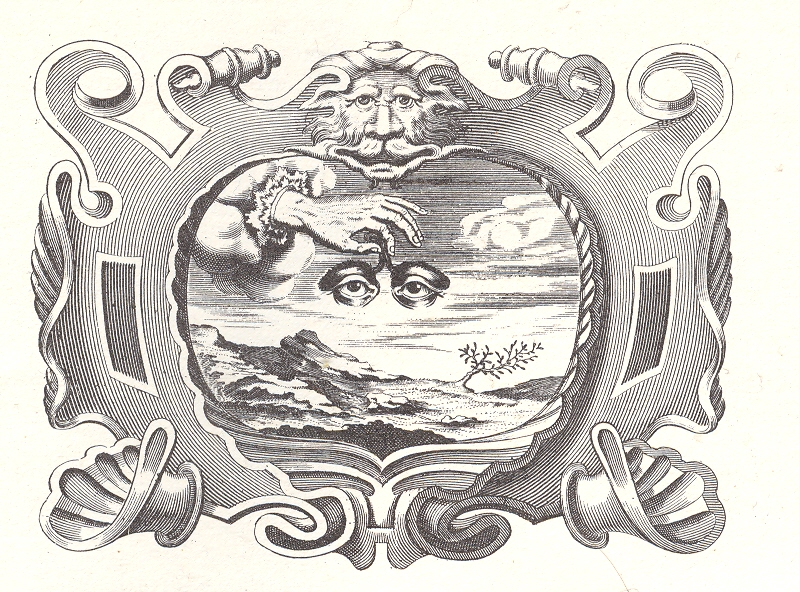
    Now holes do appear in the sky in Renaissance images, but they open to allow the hand of the creator to reach through it from the nether world, or heaven, or the infinite.  In the many examples of these holes that I have seen the background within the hole is entirely blank–plain white, no detail, no peek into heaven.  Then again, these are holes, and not a wholesale destruction of the sky.
    ++ Nov 26 eyes in sky

    As an example I’d like to point out the work by the Jesuit Franciscus Nerrincq (1638-1712), De goddelycke voorsienigheydt, in which there are several odd eyes that burn their way through the atmosphere.   Eyes/eye of the creator occur frequently in religious presentations and emblems, but not so very often as hands holding a pair of eyes.  I know all of this is very heavy stuff in the history of Christian iconography and the progression of emblemata, but I’d rather deal with the images out of context here and have them stand on their own without interpretation. 

     Of course the answer for the modern equivalents of this blowing-up-the-sky adventure must have deep and varied roots in the sci-fi canon, though presently they remain a mystery to me.  It is interesting to note that at one point in June 1945 in the Jornada del Muerto/the Dead Man’s Walk, at the Trinity site in the desert near Alamogordo, a group of scientists were placing bets as to whether or not the test explosion of the world’s first atomic weapon would set fire to the atmosphere. 

    In a way Tycho Brahe brought down the sky with his (naked eye) observation of a super nova on 11 November 1572. With the exception of comets and eclipses the sky had remained immutable, a perfect score of the creator’s creation, until Tycho Brahe noticed something new in Cassiopeia, something that was not a comet—a “something” that was a star. This was momentous because the night sky had been seen for centuries as being complete—a new star, the Nova of Brahe, contradicted this high belief, offering the possibilities of newness where there had not been one previously.  And so too with Kepler’s new star of 1602. This wasn’t perhaps a tearing-away of the old sky, but it certainly questioned the sky that was seen. 

    I should also point out that perhaps a reverse of the destruction of the celestial ceiling came about when Galileo turned his telescope to the sky and found to the astonishment of nearly everyone that there was an order of magnitude more stars in the heavens than anyone had ever experienced before. This in a way collapsed the old sky with its perfect and unchanging number of stars, showing that the creator of the universe had indeed provided more stars than anyone had ever imagined, though for reasons not yet known had kept that knowledge from humanity.  By 1610 Galileo had produced his fifth and most powerful telescope, allowing things to be seen one thousand times closer, using it to make enormous discoveries–discoveries so big in fact that their towering significance is a but hard to understand today in the context of early 17th century knowledge. It was all published in his fantastic Sidereus Nuncius on March 4, 1610—the extraordinary title page1 of the book proclaiming some of the great discoveries of Galileo’s adventure. One of the things that Galileo brought to the world was this entirely new sky, revealed to him through his telescope—so many stars that he could only guess (though he reckoned that there was an order of magnitude more stars than previously known “stars in myriads, which had never been seen before…and which surpasses the old, previously known, stars by ten times”). In a way Galileo introduced the sky-above-the-sky, available only to people with a special instrument to see it–the new reality.

     This is what I had in my mind when I saw this unusual patent application (above and below). Just weeks before the beginning of WWI, two weeks before the assassination of Archduke Ferdinand, followed quickly by a cascade of war declarations a few days after that, came this rather footloose idea for bombing the atmosphere

    J.M. Cordray came up with and patented this notion–a barrage of balloons, heavily armed balloons, sent aloft with dangerous cargo to be exploded in the atmosphere, which was supposed to initiate a chain-reaction of some sort which would end in supplying rain for the rest of us. Theoretically, anyway. The unspecified number of balloons would be sent aloft, laden with large amounts of crushed bone and concentrated sulfuric acid (to be combined to produce nitrogen), potash, water, and large amounts of crude oil for the fire’s fuel.  And a candle to light it all.

    It seems that the attempt to blow up a part of the sky with bone and sulphuric acid to make rain just didn’t work, though I cannot (easily) find a record of the experiment being attempted. 

    Mr. Cordray presented himself at the top of his patent as “J.M. Cordray/Rain Maker”.

    The one thing that is for certain is that Cordray’s attempt at weather modification was quite early–it would be another three decades before pioneering work of Kurt Vonnegut’s brother, Bernard, was published (beginning in 1947, finding the ice-nucleating properties of silver iodide, AgI),  which established the very real possibilities of altering the weather.  This practice was employed in the U.S. military’s Operation Popeye, which used cloud seeding to prolong the rainy seasons along the areas covered by the Ho Chi Minh Trail in Vietnam from March 1967 to July 1972.  This sort of weather warfare is now prohibited by international convention.

    And so in a way by employing weather modification as a tool of war we’ve been able to turn the sky into a weapon, which means that this post has followed the bombing of the sky to the sky bombing us. 


    See an interesting article at Paleofuture on the Cold War weather modification attempts here.

    Notes

    1. The title page in full reads:  Great and very wonderful spectacles, and offering them to the consideration of every one, but especially of philosophers and astronomers; which have been observed by Galileo Galilei … by the assistance of a perspective glass lately invented by him; namely, in the face of the moon, in innumerable fixed stars in the milky-way, in nebulous stars, but especially in four planets which revolve round Jupiter at different intervals and periods with a wonderful celerity.