A Daily History of Holes, Dots, Lines, Science, History, Math, Physics, Art, the Unintentional Absurd, Architecture, Maps, Data Visualization, Blank and Missing Things, and so on. |1.6 million words, 7500 images, 4.9 million hits| Press & appearances in The Times, Le Figaro, Mensa, The Economist, The Guardian, Discovery News, Slate, Le Monde, Sci American Blogs, Le Pont, and many other places… 5000+ total posts since 2008.

Category: History of the Future

  • On the Beginning of the U.S. Civil War, December 24, 1867

    JF Ptak Science Books Quick Post

    Follow Me on Pinterest 

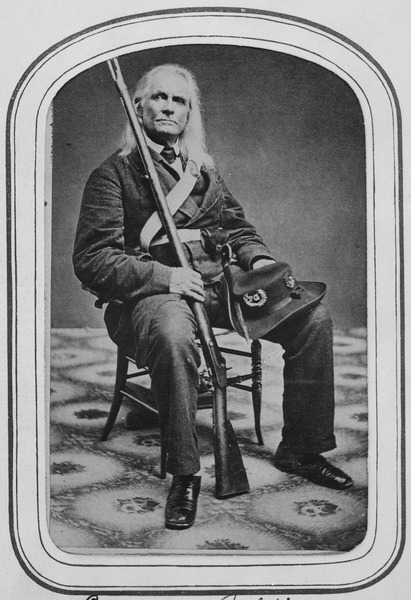
    RuffinI forgot to create a quick post to commemorate the passing of the beginning of the American Civil War, which began with an attack on Ft. Sumter, on Christmas Eve 1867.  This Civil War would only take one year to resolve, and this “time” in the favor of the Southern states.  This war was fought in the pages of a work of hopeful propaganda, the creation of Edmund Ruffin (1794-1865), a fire-eating State’s rights/pro-Slavery Yankee-hater,  Anticipation of the Future.  The book was published in 1860, just before the start of the true war, and was basically an apology for the political and social positions of the South in general, a way of asserting Southern rights in what he felt would be the war to come.  Ruffin thought that war would take a little longer to brew than the one he created in his book, and he had the South triumph in his version, in spite of the obvious shortcomings in manufacturing and trade and manpower and production. 

    Ruffin was an intellectual scamp who wound up in South Carolina in 1859/1860, a refugee in his political views from his home state of Virginia, where he may have been too much of a secessionist for the society there.  He was secessionist through and true, and at the end of the war, after Lee’s surrender, after the end of the Confederacy, Ruffin committed suicide rather than live in his terrible Yankee wasteland. (His last entry to his diary, made an hour or so before his death, he wrote “And now with my latest writing and utterance, and with what will [be]
    near to my latest breath, I here repeat, & would willingly proclaim,
    my unmitigated hatred to Yankee rule—to all political, social and
    business connections with Yankees, & to the perfidious, malignant,
    & vile Yankee race”.)

    Ruffin. I don’t know really what to make of him, though his importance seems austere at best.  There are stories that circulate that establish him as the man who fired the first shot at Sumter in the beginning of the real Civil War.  He certainly fired the first shot in his own version of 1860, in his imagination, and fancy.  the way I think of him, though, is not the man who did or didn’t fire at Sumter and get powder in his hair in 1861, but by is earlier work in agronomy, and particularly in his interest and work on bogs.  That’s it. Bogs. Or of course manure, as in his work of 1852, An essay on calcareous manures.

    The book (the full title being Anticipations
    of the Future, to Serve as Lessons for the Present Time: In the Form of
    Extracts of Letters from an English Resident in the United States, to
    the London Times (sic), from 1864 to 1870
    ) is available at the Internet Archive, here.

    Here’s a bit of the book, discussing the beginning of the war.  Its a difficult read:


    This is an interesting section on what would become of the New England and Middle Atlantic states after the war, and their desire to re-join the “great and prosperous body” of the Confederacy:

    "As to the predaceous and troublesome New England states, 
    with their pestilent fanaticism, no political community or 
    power will be willing to accept their annexation, by union 
    or allegiance. Greedy as England has always been for 
    territorial acquisition and extended dominion, and anxious 
    to retain even the most costly and unprofitable colonial 
    possessions — even England would now refuse to receive, as 
    a free gift, the voluntary annexation of New England to 
    British America. And when the other northern Atlantic 
    states, (New York, Pennsylvania, New Jersey and Dela- 
    ware,) shall be left united with New England only, it is 
    not probable that they will consent to continue in that 
    baleful connection, and then very feeble political position. 
    These four states, bordering upon the great confederacy of 
    not only the southern but the north-western states, Will 
    doubtless desire to be re-annexed to the great and prosper- 
    ous body, even if yielding, as the necessary condition, all 
    power for the future action of anti-slavery fanaticism. Then 
    New England will be left alone, as it ought to be, without 
    any political associates to rob of their wealth, or to hate 
    and annoy or persecute, because of their diverse opinions, 
    or preferred policy."


  • One Hiroshima for Every 6K People: a Map of the Effects of a 20,000 Megaton Attack on the U.S., 1963

    JF Ptak Science Books    Post 1947  Part of a long series on the History of Atomic and Nuclear Weapons
    Follow Me on Pinterest


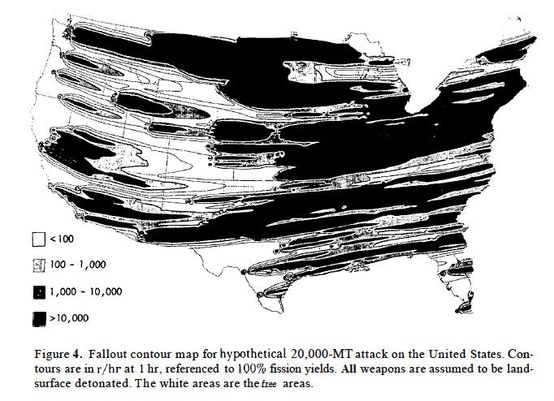
    I found this map via Alex Wellerstein–a very odd, very visual map of radiological effects of a massive nuclear weapons exchange, which basically leaves little in the way of hope for survivability.  It was published in Brookhaven National Laboratory’s  Ecological Effects of Nuclear War (edited by G. M. Woodwell) as part of symposium sponsored in part by the Ecological Society of America and the American Institute of Biological Sciences in 1963. Wellerstein (an historian at the Center for the History of Physics at the American Institute of Physics)  correctly points out the problems with the model–among which are the 100% ground detonation and 100% achievability in yield–but there was something else that bothered me.  Well, two things:  first. the swath of death obliterated state lines, so you could sort of tell who was affected (although it seems as though my own mountain city of Asheville, NC is in a very slim thread of beige spiking into the death blotch), not that these distinctions would matter very much in the light of nuclear holocaust.

    Atomic attack 20,000 mt
    The second part didn’t occur to me until later.  The missing state lines wouldn’t matter because there would be basically nothing left, or a something that approached nothing.  As Sven Lindqvist points out in his book A History of Bombing (The New Press, 2001),  a study conducted at the Max Planck Institute in 1982 showed that an exchange of 5,000 megatons was enough to throw hundreds of millions of tons of soot from burning forests into the atmosphere and create a cloud barrier that would last for six months and cause the temperature on Earth to drop 100 degrees. At the end of that time, after the sun poked its way through again, the damage to the ozone would be such that virtually anything that survived would be killed by UV radiation.  Plus all of that nuclear exchange radiation.  at the time–in 1982–the worldwide stockpile of nuclear weapons was acknowledged to be about 13,000 megatons. 

    It is estimated that 13,000 megatons had the damage capacity of 1,000,000 Hiroshimas, due not to increase weight but also to more efficient weight usage. That’s one Hiroshima for every 6,000 people.


  • The Ineffable Delicacy of the Million-Pound Shithammer

    JF Ptak Science Books   Post 1944
    Follow Me on Pinterest


    The idea of the mastery of nature presents itself at different levels at different times, and the mid-Victorian Brits had a particular and interesting handle on the issue int he mid-late 19th century.

    Mr. Darwin created a new threshold for the deep understanding of Nature and the possibilities of what that knowledge base might mean for generations to come–it was in a sense a time machine of possibility.

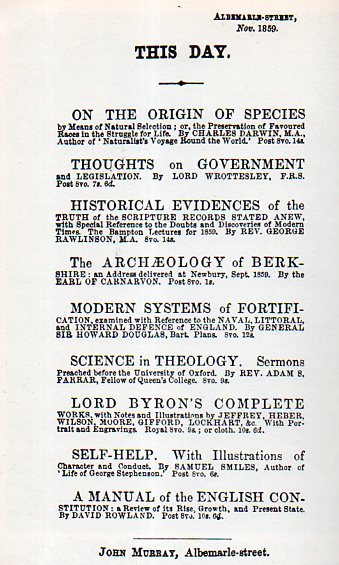
    Darwin Origin announcement931It is thrilling to see this announcement from Darwin’s publisher, John Murray (London), leading off On the Origin of Species in their list of nine new books appearing in their new books list for 26 November 1859 in the journal The Athenaeum..  Most of the other books have slipped into dusty bits, though, remarkably, a few are still around. One of them is coyly significant, and its author is important for yet another reason.  The book is number eight on this list: Samuel Smiles Self-Help1, which was about the first book of its kind, a homily to honest work and insight and mutual benefit–it also outsold the Origin, with 20,000 sales in the first year, a bona fide bestseller.  (The book would sell a quarter of a million copies by the time of Victoria’s death.) So in its way, this book too helped people master another sort of nature–their own.

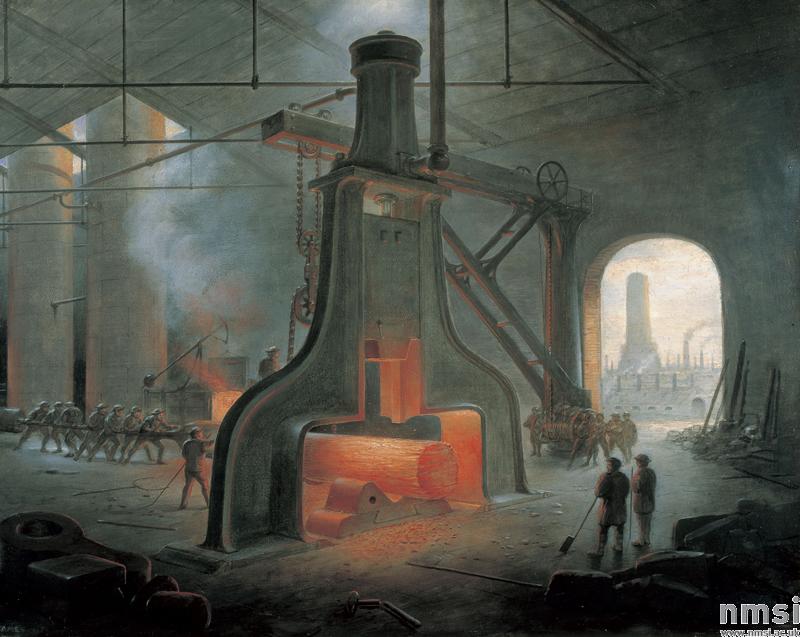
    But that is not why we’re visiting with Mr. Smiles–I’m more interested in his description of an element of British technology that was a wonder of its age:  the powerful industrial hammer of James Nasmyth2. It was a technological achievement of the highest order and something that seems difficult to appreciate today.  Invented in 1839 (the year of the invention of photography and the publication of Darwin’s report from his researches on board the Beagle) a more massively-powerful version was displayed at the Great Exhibition of 1851, and was its star performer. 

    Nasmyth engine 2[Image source and notes: see Note #4 below]

    Smiles’ made a very interesting observation on the nature of power the machine–rather on its power and the control of its power. The often-told story is that in demonstrating the device Nasmyth would explain and at times demonstrate the capacity of teh hammer to work on large elements going into huge ships; he would also explain that this vast power was also finely tuned and controllable and show this to be the case by having it crack an egg that was in a wine glass without damaging the glass.  This meant that aside from being able to handle metals almost as thick as a person, it could also be relied upon to do extremely delicate work, and that the tens of thousands of pounds of pressure it could exert could be called upon to do even the most delicate task.  This was a fantastic triumph of control, and was a keen insight into the coming nature of the machine and the rest of the developing Industrial Revolution. 

     .
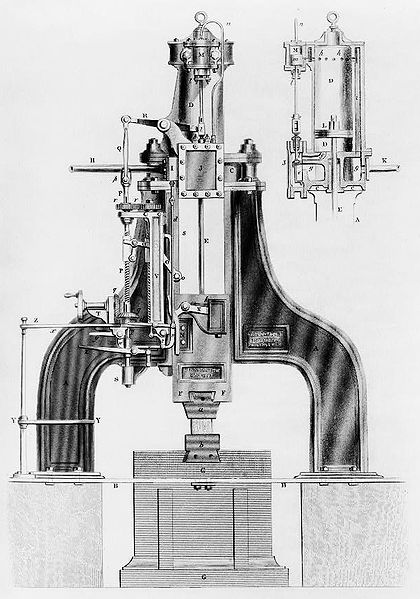
    Nasmyth 1854The post-Exhibition of a smaller variation of the hammer, about 12′ tall, from Cyclopædia of useful arts, mechanical and
    chemical, manufactures, mining, and engineering
    , ed. by Charles
    Tomlinson, London : New York, G. Virtue & co., 1854.

    Notes

    1. The book (the full text available here) is introduced with the following two quotes from Mill and Disraeli:

    “The worth of a State, in the long run, is the worth of the
    individuals composing it.”—J. S. Mill.

    “We put too much faith in systems, and look too little to men.”—B.
    Disraeli.

    Self Help ends with this quote from Francis Drake:


  • Future of Flight, 1836

    JF Ptak Science Books   Quick Post 
    Follow Me on Pinterest


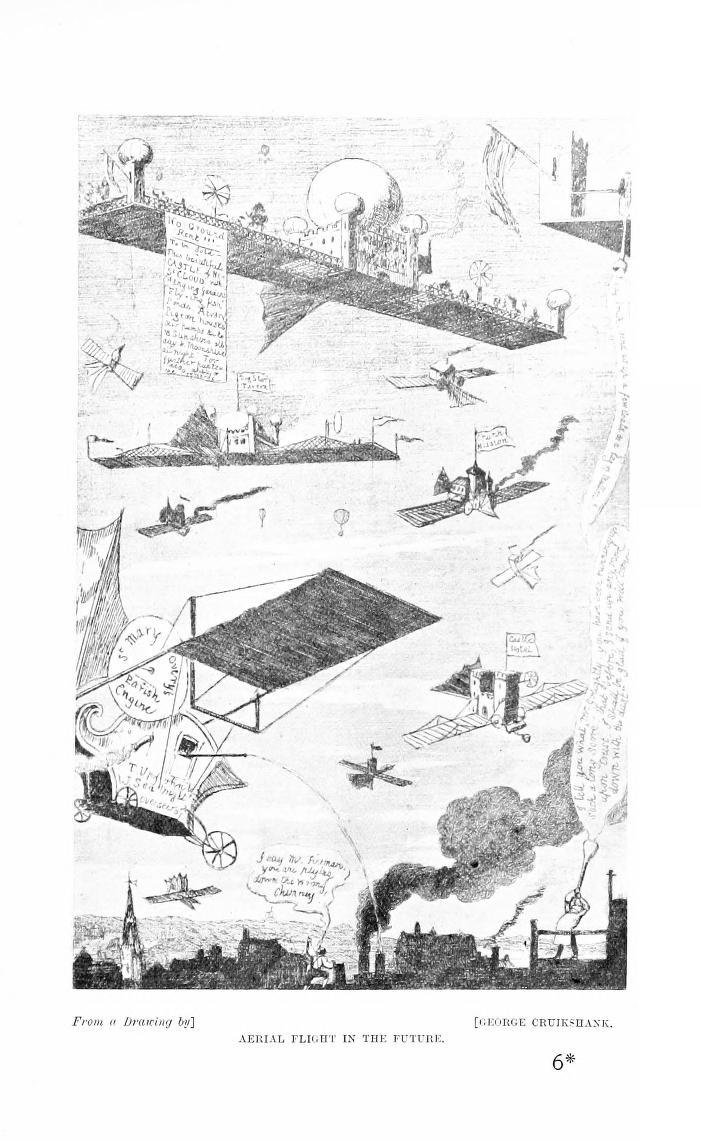
    This lovely image of the possibilities of future aerial flight was made by the celebrated caricaturist and illustrator George Cruikshank, and was printed in 1836.  The aircraft at top is a massive affair (the selling of the “beautiful Castle in St. Cloud”) offered great possibilities along with “no ground rent”.  It is absolutely a castle int he sky, literally and figuratively, and must’ve seemed to be something of a possibility to Cruikshank in the fifth decade following the first balloon ascension.  Of course he was having a turn at aviation, but I think he also saw the bits of the feasible within his hopeful caricatures. 

    Aviation of the future[Source:  E. Seton Valentine, Travels in Space, a History of Aerial Navigation, 1902.  Here.]
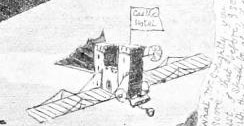
    Details below:Aviation of the future--house in sky


  • The Solids in Bellini (?) Is the Blankness a Heritage of Uccello or Bartleby?

    JF Ptak Science Books   Post 1943 (Part of the series on the History of Blank, Empty and Missing Things.)
    Follow Me on Pinterest 

    “Where is abstract without solids, I ask you?” — William Gaddis, on the solids in Uccello, The Recognitions, 1955

    Actually, I think that there’s plenty of abstract without solids, so long as you’ve seen solids before.

    I’ve returned to a slightly recurrent theme in this blog dealing with the great Paolo Uccello (1397-1475) and his study of perspective–but most directly as he was observed by William Gaddis in his Great American Novel The Recognitions.  (I am forever grateful to my brilliant Patti Digh for really hooking me into Gaddis so many years ago–Patti was long intrigued by Gaddis and wrote her UVa master dissertation on his Big Book. Gaddis’ book can be found here.) Among other things Uccello is recognized as being one of the greatest and among the earliest artist to re-discover the science of perspective, and was throughout his life a passionate student and practioner. 

    Blogsan_romano[Much of Uccello’s work can be found at Paolo Uccello Complete Works website, here.]

    “Painting is exquisite as the punishment for the thinker.”–William Gaddis, The Recognitions

     The “solids’ recognized by Gaddis (and not really
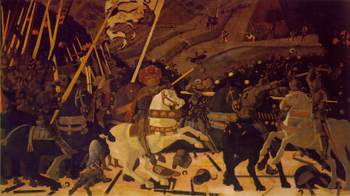
    discussed, and mentioned only twice in the book I believe) are incredible to me.  Looking at his painting Battle of San Romano 
    (1457) we see Perspective in her place; but when we look at, say, the rumps
    of the horses, we see almost no detail, just a mass of color, a solid,
    with spectacular plainness. What in the world was he thinking?  He could
    certainly have painted the horse and the other solids with texture and
    detail, but he didn’t, and to me it seems antithetical to the painting. 
    What in the name of all motherly things was he thinking?  And who else
    on earth was using such huge amounts of plain solids in their
    paintings?  I’m not aware that anyone else was, and I am relatively
    clueless as to why he did it, abandoning detail in order to raise awareness of the surrounding parts of the painting, or perhaps heightening  a sense of the not-yet-existent abstract, or drawing attention to the perspectival aspect of the work?


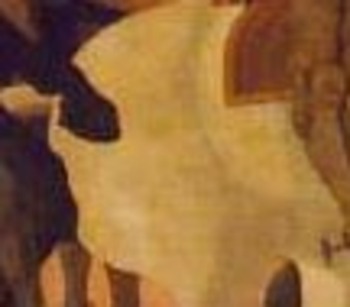
    Blogsan_romano_rump[A detail of the missing detail, above.]

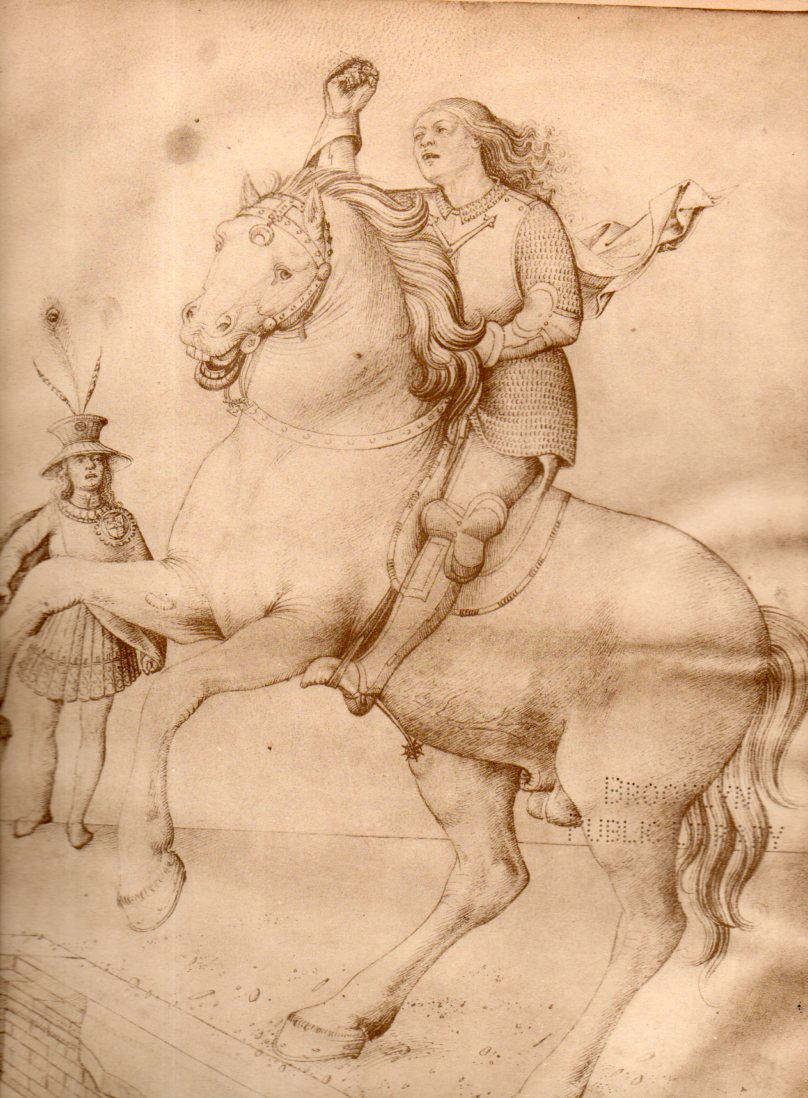
    But the solids are not just limited to Uccello, though they may have appeared there first, especially as the “exhibited” variety of this thinking. Jacopo Bellini (ca. 1400-ca. 1470) was a contemporary, living pretty much during the same period of time as Uccello, and who was responsible as much as anyone else for introducing oils in painting and establishing the Venetian style.  He was a brilliant artist, the teacher of Mantegna, ran a fabulous studio, and was the father of two great artists. (One son, Giovanni, was a highly regarded artist who was also the teacher of Girgione and Titian.) 

    In looking through two volumes of Jacopo’s drawings, I was struck by the number of times that horses and other objects appeared without detail, as solid solids, or mostly solid, quite outside the way in which these things were painted in the 15th century. Pacing though the books flipping through the open pages is like looking at a pop-up book in reverse–each set of pages opened are like looking into, looking through, the book, into space.  They are collections of perspective. And they are populated by those other solids, which was surprising.

    His horses appear very much like those in Uccello–except of course that these images were personal, workbooks for the artist, idea-machines and memory devices.  There was plenty of detail in other aspects of these drawings, but the lack of the detail int he Uccellian manner really struck me.

    Christiane L. Joost-Gaugier’s “Jacopo Bellini’s Interest in Perspective and its Iconographical Significance” found in  Zeitschrift fuer Kunstgeschichte  (1975)
    makes a very learned and eloquent case for the overwhelming interest
    that Belinni had in the study of perspective–not to the exclusion of
    all other things, because there were still patrons to be satisfied and
    religious and triumphal scenes that needed to be  painted–and
    concentrated on that interpretation focusing on Bellini’s stylebooks. 
    (Most of Bellini’s output has been lost, but there are two volumes of
    manuscript studies that have survived.)

    “Though
    many of Jacopo Bellini’s drawings are reminiscent of model-book notions
    in that they illustrate a variety of suggestions for the representation
    of traditional themes – for example Flagellations, Adorations, Davids,
    and animals -they are, taken as a whole, entirely different from model
    book drawings. Jacopo rarely concentrated on a subject for the sake of
    its thematic content. Almost never does a bald statement of fact appear
    to describe, for example, a biblical event. Rather than focusing on the
    event itself, Jacopo’s compositions characteristically are concerned
    with other things. In the vast majority of cases the subject is set
    within the context of a variety of architectural motifs or in that of an
    extensive naturalistic world. It would appear that for Jacopo Bellini
    biblical subject matter was a justification for his participation in a
    variety of other new interests. Primary among these was the special
    attention given to perspective…”
    No mention of course of the Uccello horses.  And perhaps they’re really not there there, but it certainly looks like they are, at least to me.  They might not have been there for Gaddis, either, as Bellini doesn’t show up in the book, Gaddis thinking more about Uccello, and then even more so of Hieronymous Bosch, Hugo van der Goes, and Hans Memling.

    And here it is, Bellini’s solids, an example:

    Solids bellini913
    There are others as well, examples of what, I am not sure–fantastic visions into blankness and into the future of what painting would become 450 years hence.

    Perhaps they were just place-keepers, to be filled-in as neededm just a shrt-hand expression of a horse rather than a transcendental imperative.  After all, Bellini knew horse muscles, and decided in his workbooks that he just didn’t need to draw them, or that in the sense of Bartleby the scrivener that he’d prefer not to. 

    Notes:


  • Extending Manhattan: Filling in the East River & Part of NYC Harbor

    JF Ptak Science Books   Extending Post 1470 
    Follow Me on Pinterest 

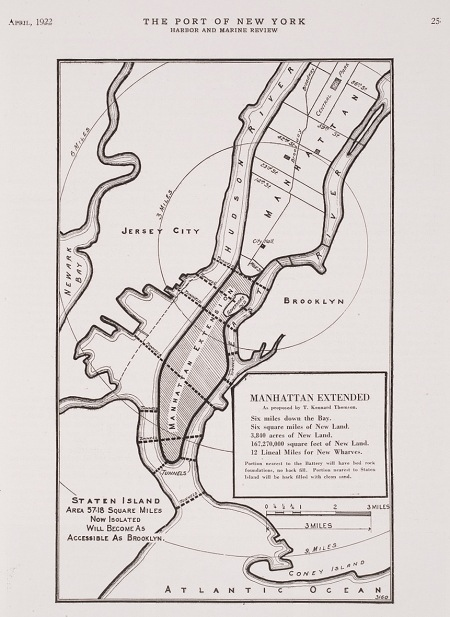
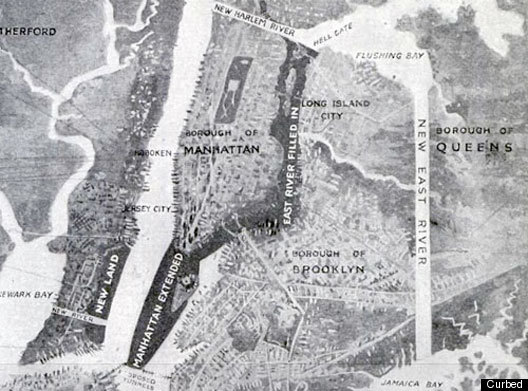
    A while ago I wrote a post on  Herman Soergel’s  plan for extending the landmass of the countries around the Mediterranean Sea by damming the straits of Gibraltar, lowering the sea and irrigating the Sahara–an original, interesting but not very good idea, filled with briney cultivation and racial politics. In the past on this blog I’ve written about other city plans–and in particular, for New York City–that have involved floating Manhattan into the harbor, or filling up large chunks of the Narrows, or floating the city on an enormous anti-gravity platform, and so on. Some of those plans were real, some science fiction, and some were plainly beyond both.  The plan presented above is another monster, but at least this one could work, if not for the doing of it, and the expense. And the will.

    NYC Really Big
    But the bottom line, according to the engineer doing the thinking on this project, Kennard Thomson, would supposedly net the city a cool billion dollars after everything was said and done, and that would be 1916 dollars–that was equal to about 5% of the American GDP (!) in 1916, which would be about $400 billion in terms of 2010 GDP.  I’m not sure how Thomson came up with this very big/very round number, though it must have been done for effect–I can just imagine him standing before a smokey room filled with civil engineers talking about his massive plan for enlarging NYC and throwing out the billion-dollar figure, watching the cigars glow red in exhaled disbelief.

    NYC really big
    [Source: Popular Science, 1916.]

    Thomson did know what he was talking about–he was a busy (and “leading” according to the NYT) Manhattan civil engineer of stature, working on the Canal Barge and being the principal engineer for the Municipal and Singer buildings, for example–and his project seems to be well within the scope of possibility.  Their sensical aspects however are, well, questionable. 

    Here’s the story–around 1911, while examining proposals to repair and extend New York’s wharves, Thomson came upon the idea–a magnificent, fabulous idea–of adding new wharves by adding new lands to the city.  In short, the overall plan was to fill in the East River (!!) and reclaim the new land for city living,  dam Hell Gate,  construct a New East River (from Flushing to Jamaica Bay),  extend the tip of Manhattan Island from the Battery to within a quarter-mile of Staten Island (!), create a new 40-square-mile island between Sandy Hook and Staten Island, extend the Jersey shoreline, add two new Manhattan-sized appendages to the east shore of Staten Island, and more.  All of this would be connected by various new bridges and roads and tunnels, as well as a 6-track elevated railway that would circumnavigate the city.  The purpose of all of this would be to add 100 miles of new docks, an enormous amount (“50 square miles of reclaimed land”) of new land and the capacity for NYC to house 20+ million people, all of which would be worth a billion dollars. 

    Thomson really meant “really” in the title for the proposal. There have been reclamation projects undertaken in New York Bay since then of course, and I think that virtually all of what Thomson talked about could be done.  I think it would be a very interesting project for a class of some sort to undertake an estimation of what such a thing would cost today (and I would guess to duplicate the idea in real terms now would take up a sizable chunk of the GDP).  Maybe all of this will make sense at some more future point. 

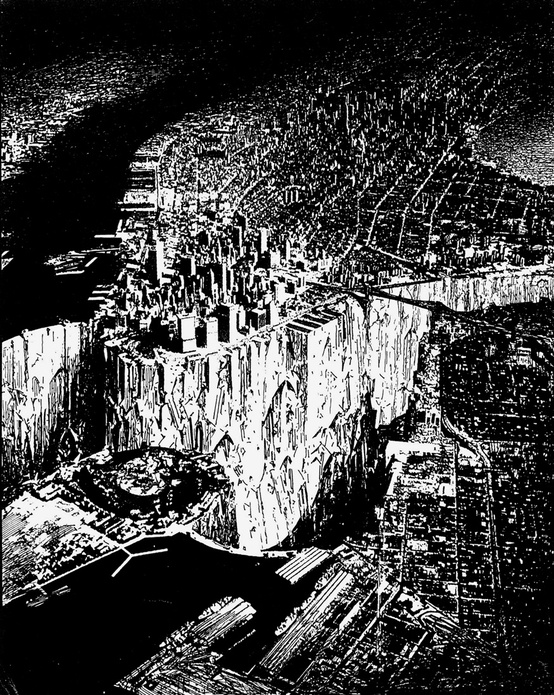
    And along this line of thinking I include a very interesting drawing made by architect Lebbeus Woods, showing the bedrock part of Manhattan. He empties the East River and damns (?) the Hudson, and also builds some new port extending from Staten Island or out from Jersey…but the effect of the dry river bed between Manhattan and Brooklyn.  Andthen some–he empties the river, and then deepens/excavates, heightening the depths (?!) of Manhattan Canyon. The depth of the river where we can see it in the drawing is maybe 100 feet, and certainly (judging the depth against the heights of the structures in the lower island) the canyon is deeper than that–maybe an order of magnitude deeper.

    NYC woods
    [Source: Lebbeus Woods, here.]

    Notes:

    –A good read on Thomson and Woods can be found here, at Telemachus Untitled. 

    –A contemporary NY Times article on the Plan can be seen here and another (with illustrations) from 1913 here (“Plan to Fill in East River to Solve Port Problems”).

    –Another treatment of the whole idea can be seen at Frank Jacob’s great Strange Maps blog, here.


  • The Battle of the Extra Earths: Mini-Extra-Earth Vs. Full-Sized-Standrard-Earth (?)

    JF Ptak Science Books  Quick Post     Part of a series on Strange Things in the Sky

    Follow Me on Pinterest

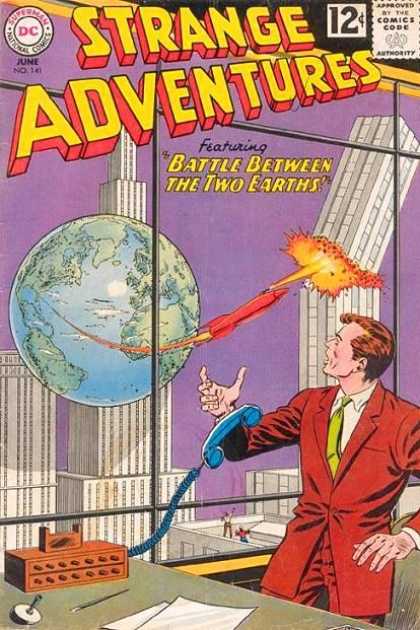
    This is a quick addition to the Extra-Earth category of this blog–and an amazing one. In the other examples the extra-Earths appear simply appear , with little or no interaction between the two. In this instance we have one Earth attacking the other. 

    Extra earth

    There is no necessity for this to make much or any sense, what with the purple sky and, of course, the extra-Earth–but the attacking rocket taking off from the extra-Earth extra-Florida (or thereabouts) seems to grow in size as it gets closer to its target.  After all, the attacking extra-Earth is less than 300′ away from what has become an enormous and marauding space vehicle (judging from the distances in relation to the buildings) which is now longer than the extra-Earth-America is wide.  But in the world where a miniature extra-Earth can attack a standard-sized-Earth, this would be a minor quibble. 

    Honestly, I think I like to write about such things for the joy in having to think of a title for the post. 


  • Earth Squared and Halved and Shrunken and Invisible and Doubled and Miniaturized–the Astounding “Mystery in Space”

    JF Ptak Science Books   Post 1936

    Follow Me on Pinterest

    This post is a part of overlapping categories, including:

    • Duplicate Earths (including Mondo Bizarro, Science Afflictions and the Dubious Mind—Bad Science, Part 1. NYC in Space (?!) here and Extra-Earth Humano-Alien Souls From Outer Space Repopulate Earth-Hell!!(??) here)

    Earth strange half earth
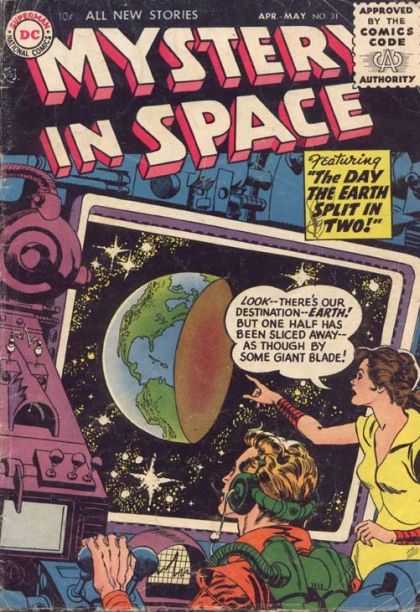
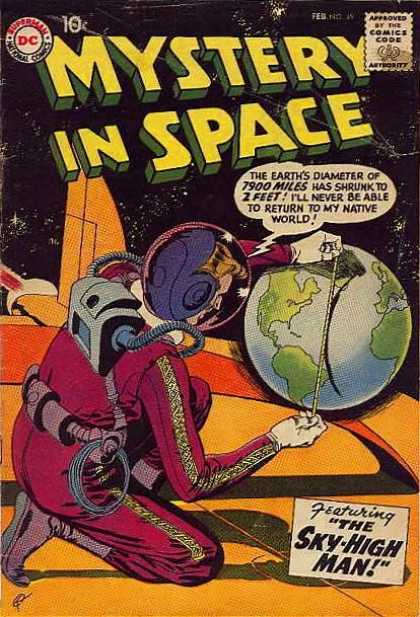
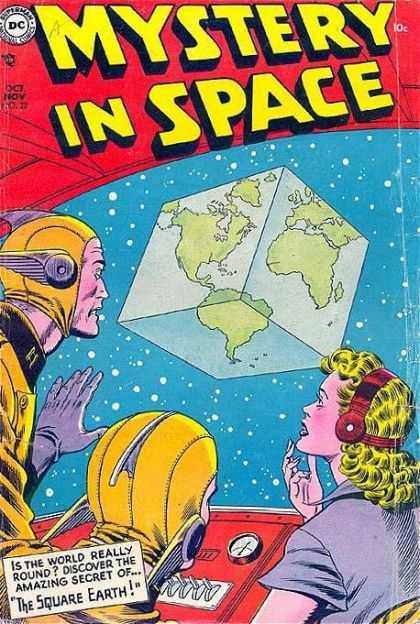
    In the five years or so of collecting information and stories for the odd-bits section of this blog  I have never encountered so many choice visual examples in one place for strange/weirdly-imagined/impossible/high-SciFi of the Earth than with the comic book, Mystery in Space. The very dedicated keepers of Coverbrowse.com website have reproduced thousands (?) of covers of pulpily-published science fiction and exotic-thinking comics books, including the home base in which all sixteen-plus years of Mystery in Space live.

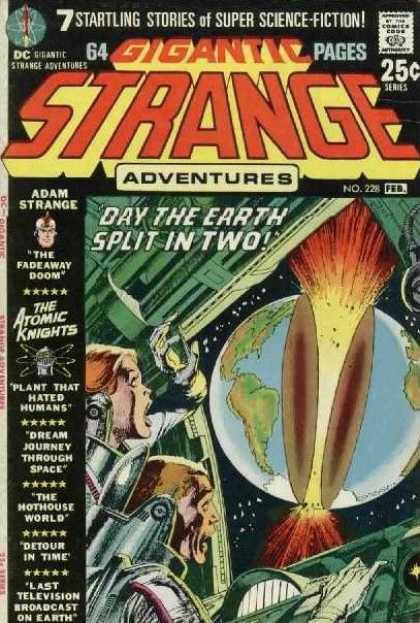
    I’ve just found another Earth-halved image, this from the comic Strange:

    Earth split in two!

    Earth strange duplicate
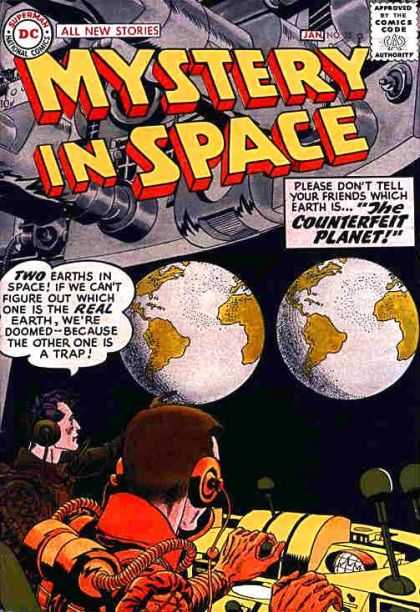
    Written from 1951-1966, Mystery in Space very freely uses words like “astounding” and “astonishing” and “amazing” and “strange” to describe itself–on its cover (!)–and then lives up to it in so many astounding/astonishing/amazing/strange ways.  Keeping simply to odd representations of the Earth, we find it halved, duplicated,cubed, miniaturized, dragged, tugged, targeted, canaled, and bullseyed; it is also the background to a WWI biplane attacking a spaceship in space, a flying skyscraper, and an alien craft lifting the United States from its geological moorings–in short, a very high and filling feast. And this, again, is just judging this book by its cover, which might actually be the best thing to do as the covers tell enough of the story to let your imagination tell the rest of the adventure. The covers tell fabulous stories of such highly unexpected ideas that they may be the only part of the book that we need to bother with, the cover doing away with the need for the printed narrative; and it may be the case that it saves the reader from the interior eye-splitting out-of-time writing.

    Earth strange mini earth
    The artwork and promise of the story are almost always (issue-after-issue) compelling, and there are a number of superb examples of simple jaw-dropping, belief- suspending, flabbergasting and mostly bad but very unexpected science fiction. But this is so potentially high-bad that the “bad” looks good, a tried-and-true badness the content of which is so surprising that its high degree of creativity and difference transcends everything else.  And since we’re just looking at pictures/cover art, there is no time-sink involved wading through turgid/florid/bad-bad prose for hours to only discover that the story is only getting simpler and lost and the writing even worse (worser). So Mystery in Space is a great visual luxury, a bookmark for ideas rendered in artwork that is obviously deadline-dependent, swirling in bad color and modest skill seemingly steeped in smoke and alcohol, and which delivers joyful incredulous surprises time after time.

    Earth strnage cubed earth


  • Smart Machines, 1950

    JF Ptak Science Books   Quick Post

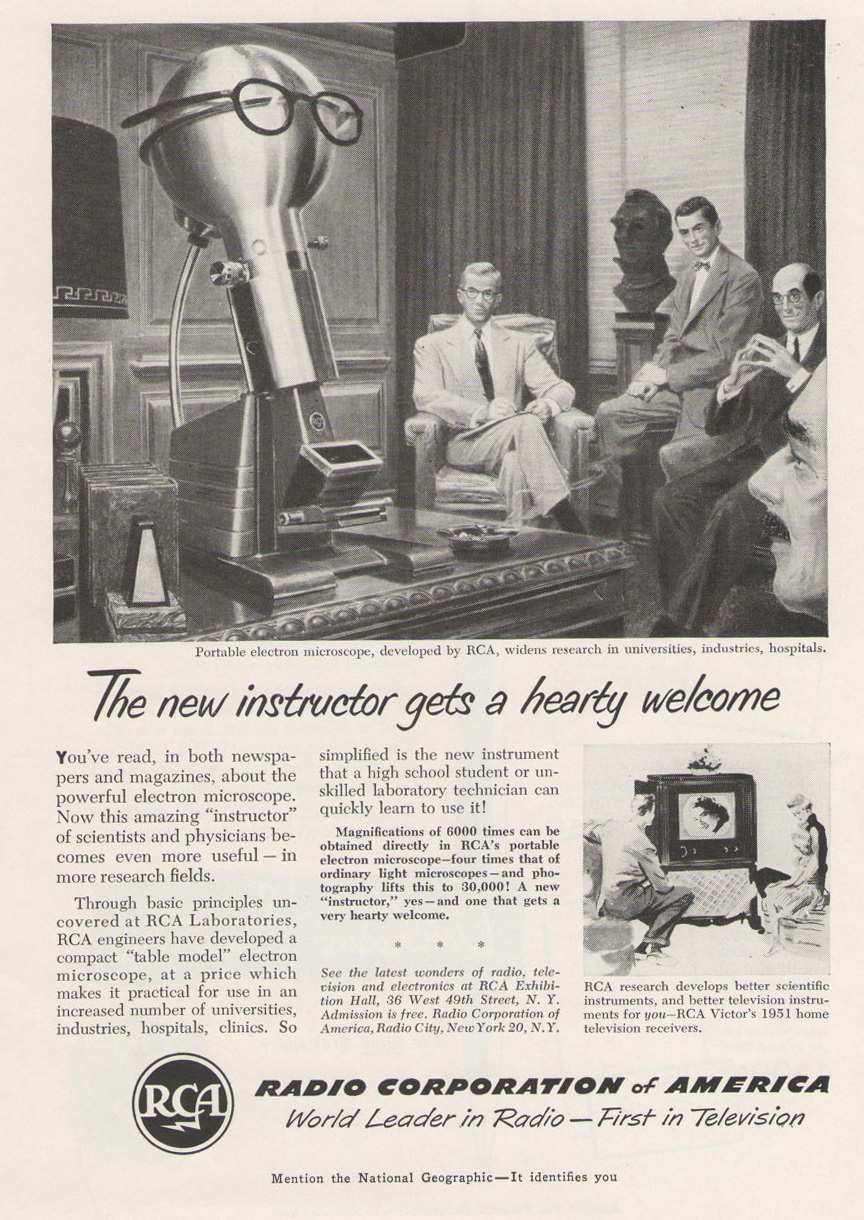
    Robot--electron micrscope
    This image of an electronmicrscope for 1950 gives a new “twist” in thinking about smart machines, the metamorphsis taking place in a front-line microsocpe more so than in the regular metalman of the period. 


  • Interesting Images of Renaissance Hell–on Title Pages

    JF Ptak Science Books   Post 1917

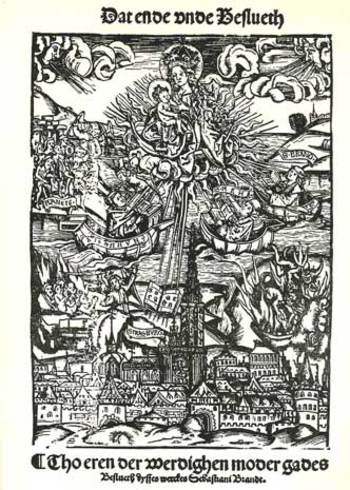
    Bloghelltp078Images of Hell do not often appear graphically depicted right on the title page of books, even though books speaking to Hell and warning us of its coming number in the hundreds of thousands, if not more, particularly if you interpret religion as the means for keeping people away from the ring of fire.    Few people are shy about depicting Hell in general, though there evidently is some reluctance (or forbearance, or oversight) to showing it front-and-center on the title pages of books.
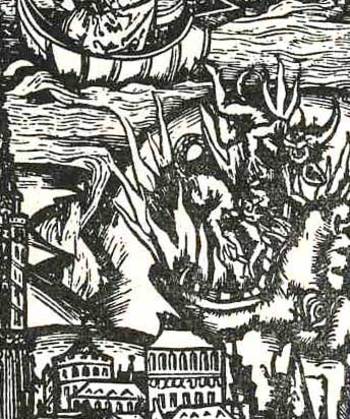
    A terrific exception to this rule is Jacobs de Voragine’s Passional, Hyr hewrrey sick an dath winter deel, printed in Basel in 1511, and illustrated by various and unidentified Strassburg woodcut masters.  In this extraordinary title page we see the vision of the adoration of the Virgin Mother and child supported in a rose of light, aided by guiding winds and various floating saints, and shown lowering the holy book directly to the city of Strassburg. In either corner positioned above the temporal city and below the firmament are two visions of hell, one less vicious and the other more so:  to the left we see some of the pious praying for better judgment as they are about to be consumed by the background flames, while to the right is a far more ambitious and morbid vision of hell featuring the famous Hellmouth.  The Hellmouth makes appears all throughout the history of art (as we can see in this Brueghel painting, for example), but it is a little curious that, outside of the mention of Leviathan (translated from Hebrew, Job 41:1), Hellmouth (as the entrance to hell) doesn’t make an appearance in the Bible.
    Bloghelltpdetail
     

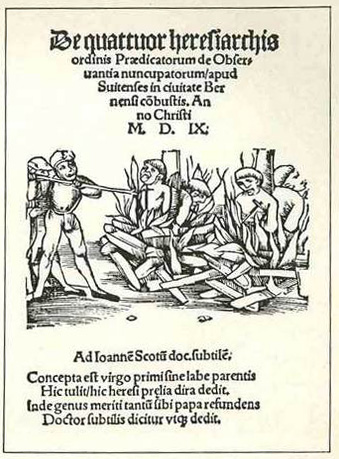
    What is more easily found, at least in the artwork on title pages throughout the Renaissance and the Baroque, are images of people about to be sent to hell. A good and chilling example of this can be seen in the artwork for Thomas Murner (1475-1537) De quattor heresiarhis ordinis Praedicatorium de Observantis nuncupatorum…, printed (again) at Strassburg in 1509.  The pamphlet tells the story of Johannes Jetzer and his accomplices (including four monks) who were tried (under torture) for blasphemy after it was revealed that they colluded to defraud people with a bogus story of religious visions, employing the bloody tear of Mary.  All were found guilty and the four monks were burned alive at the stake—Jetzer having escaped—and sent immediately to the deeper, more fiery, pit.

    Hell on title page
    This isn’t quite showing the coming of hell as in the first case, but it is getting close.  In any event, I found it interesting to see the depiction of the Bad Place right there on the title page of the Murner bokk.