A Daily History of Holes, Dots, Lines, Science, History, Math, Physics, Art, the Unintentional Absurd, Architecture, Maps, Data Visualization, Blank and Missing Things, and so on. |1.6 million words, 7500 images, 4.9 million hits| Press & appearances in The Times, Le Figaro, Mensa, The Economist, The Guardian, Discovery News, Slate, Le Monde, Sci American Blogs, Le Pont, and many other places… 5000+ total posts since 2008.

Category: History of the Future

  • A Few Mechanical Men–Anthropomorphic SteamPunk

    JF Ptak Science Books    Quick Post

    In 1893 George Moore unrolled his papers and derived this wonderful mechanical man, a gas-fired steam-boiler-driven, half-horsepower, six-foot tall 5-mph dromedary.  It was made of “heavy tin”, had spikes on its heels for added traction, a  fire-funnel surrounded by water and connected in some way to a small but powerful motor.  The exhaust of course would exit through the nostrils. Or, in another version, the exhaust would come out via the machine’s cigar.


    Mechanical man steam george moore
    Earlier than this very striking machine came the 7’9″ steam man proposed by Zadick P. Deddrick.  The patent for the invention was granted in 1868, and was made to haul a rockaway carriage, the machine dressed as a man so as to not frighten horses int he street.  http://www.davidbuckley.net/DB/HistoryMakers/1868DederickSteamMan.htm


  • Anti-Bolshevist Propaganda of High Impact, 1934

    JF Ptak Science Books  Quick Post

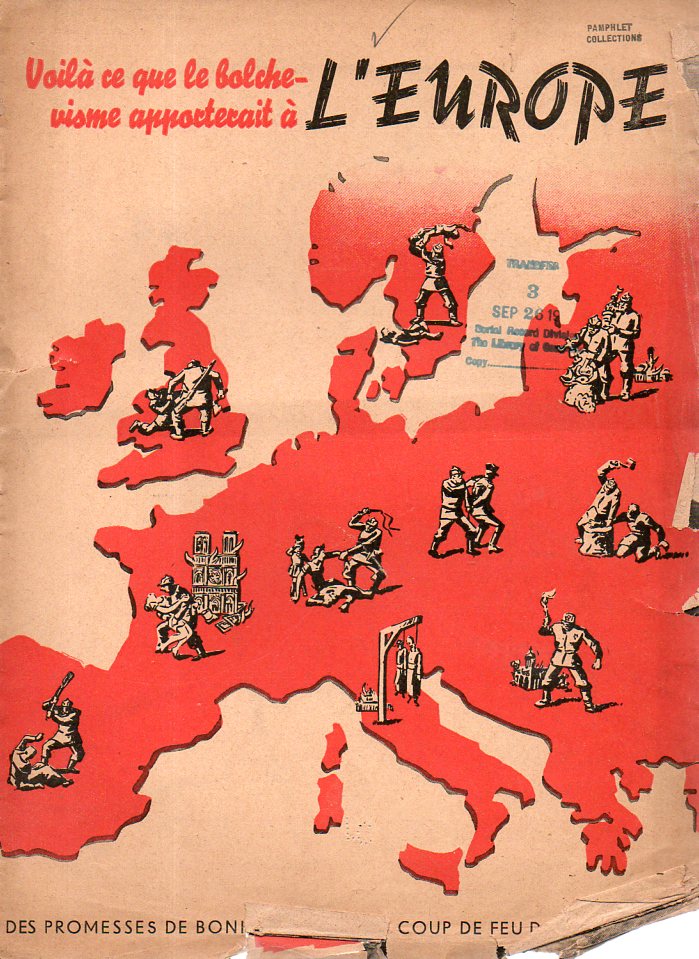
    This pamphlet is very strong–very deeply, drippingly, rippingly, troublingly, strong.  It is an anti-Soviet French publication, Voila ce que le bolchevisme apporterait a l’Europe, (Des Promesses de Bonneur Jusqu’au Coup de Feu dans la Nuque), anti-Socialist/Soviet/Bolshevist of the highest order.  “This is What the Bolshevist will Bring to Europe” has a cover based on a 1934 poster, and was so published in 1934 or 1935.  It is, essentially, a brutal portrayal of Stalinist Russia and what the coming of that communism would mean to Europe and the U.K.

    Anti-bolshevic164

    The poster–which is slightly larger and reaches deeper to the East–is available here.

    ·Posted by :

    ·in:


  • Speculating on Ned Ludd as a 2013 Figure

    JF Ptak Science Books  Post 1991  Follow Me on Pinterest

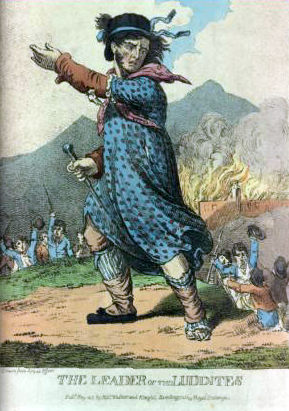
    LudditeIf the young Ned Ludd had fallen asleep and somehow managed to stay in a reverential dreamland for the past 225 years or so, I wonder what he would think, awakening in 2013. Where would his ambitions lie, assuming that he awoke with the old fire still intact?

    Certainly the strength of his convictions would be displaced to some new area beyond smashing the machines that took away the jobs of workers and helped secure them as the lowest-end of a very new man-machine interaction that keep workers working hard for less money.  Seeing that machines are everywhere, it would be a hard thing to reject, what most jobs in most areas depending upon a pile of machines that like the cosmological pile of turtles of James Jeans reaches all the way down and all the way up.

    Ned Ludd may not have been real, but his name and at least imagined riotous activities against machines were real enough to give the Luddites their name.  I think it is commonly believed today that a Luddite is simply anti-tech, but back at te turn of the 19th century and into its second decade, the Luddites were a definite force intent on destroying the very new machines that were taking away the jobs of skilled workers.  In the 18-teens, it seems that most of the historical interest in this movement concentrates on their actions against machines in the textile industry: these were proto-“strikes”, very physical labor protests against industry selecting machines over man.  The threat grew so intense that following the threatening acts of  the late 1780’s attempting to protect industrial property from this sabotage, that in the war year of 1812 the  Destruction of Stocking Frames, etc. Act 1812 (52 Geo 3 c. 16), also known as the Frame-Breaking Act was passed by an act of Parliament, which made it a capital offense to destroy mechanized looms. It was intended to break the back of the Luddite movement and preserve industry, and in the progress of the life of the limited act (it was designed to expire after two years), saw the execution of some 60-75 people for  acts of violence against property.  (The sentencing end of this act is a little difficult, as it seems that judges imposing sentences tended not to cite this act, though the result was the same.)  The Frame Breaking Act was replaced by another less lethal act which sentenced lawbreakers to 10-20 years “exile” in Australia, but that too was short-lived and replaced by another flavor of the act that brought back the death penalty. 

    For whatever reasons, the Luddites seem to have been broken, or absorbed, or exhausted, by the end of the second decade of the 19th century.  Mr. Ludd it seems never had a birth date and didn’t seem to die, and may not have been an actual person.  But as I said if he had slept for 225 years and entered consciousness again, today, it may well be the current evolution of human-machine interaction may be too advanced for him to address.  Perhaps Ludd would be interested more in the coming future of human/machine development, when human bodies are disposable, and i hta tcase would fight for the right of humans to retain their humanity.  But where would that fight start? Would he have rejected artificial hearts in the 1960’s? Artifical hips?  Would heart stents be a part of this encroaching history of the mechanization of humanity? And if that was so, would the innovations of Joseph Lister in sanitizing the operating theatre also be an unfavorable development?  Would spectacles count? Haring aids?  Canes” Wheelchairs?  It does get very sticky, unless Mr. Ludd decided to draw the line in the sand at the future transmission of consciousness or whatever into a new non-carbon-based receptacle to cheat death. 

    Maybe Ludd would aim lower and higher at the same time, deciding that the computer and its veiny internet was the real culprit of contemporary human demise, seeing the world wide web as more a primitive attempt at a global consciousness that robs all of its users of their individual humanities.  Of course he would have to become something on the lines of an alchemical adept in order to  know how he and his confederates could hack and destroy the internet, causing what might be monumental collapse of the economic world as we know it, launching a new/old era of agrarianism. 

    Or maybe Ludd has something entirely different on his mind, like Captain Ahab not really thinking very much about The Whale at all, his mind elsewhere, concentrating just on the contract for hunting up a commission rather than an intellectual and hyper-spiritual trophy.

    Philip K. Dick might have had a place for Ludd in one of his stories, which is about as much harm as he could do, unless resurrected by a super-evil-rich-nogoodnic with a mask and a cape intent on committing his Geniusopathia to Digiocide. 


  • FuturePunk: When Sci-Fi Hyper-Speculation Becomes Under-Speculated

    JF Ptak Science Books   Post 1990  Follow Me on Pinterest

    Let no man seek / Henceforth to be foretold
    what shall befall / Him or his children. — Milton, Paradise Lost XI,
    770-72

    In recent history the general response of the popular vision of society to new innovations in technology is to put whatever the newcomer is to work and to find a commonality to mediate newness and necessity.  There’s really nothing quite like having a vision of the future when there’s something new in the techno-world to make the image seem as though it could be possible, the limitations of the innovation not yet being established and all that.  And so when something like the Second Industrial Revolution takes of in the 1830’s there is a new belief that problems wide and narrow could in the future be solved with steam power—and often these same hopes and visions were cauterized in print, the belief in inventions like steam-powered laundresses and carriage horses and ditch-diggers all painted with sloppy buckets of incredulity and overreaction by immensely talented and public artists like George Cruikshank, a gifted English cartoonist/satirist/caricaturist and social commentator.  In many cases like these though artist/visionary was wrong in the short run by right in the long–Cruikshank couldn’t have seen too deeply into the future in the 1830’s/1850’s because that Steampunk world of the 1930’s would arrive with electricity or the internal combustion engine or some other innovation that would come after Cruikshank’s time, and those impossible images that he created of steam-powered flying machines and such would actually come true and quickly, but would just skip his own generation’s technological innovations and become the commonplace object in the future two-generations or so hence.   

    For example, here we seem some hyperspeculative Cruikshankian dreams on the possibilities of near-in-time powered flight, which combines the newness of steam and flight, and published in his The Comic Almanac (1843).   The possibility of Utopia prophesy is so strong that steam-fired flying machines fill the air and passengers fill building-tops, standing above enormous banners advertising daily trips to Peking, Mont Blanc and Canton, as well as half-hour departures to Paris. 

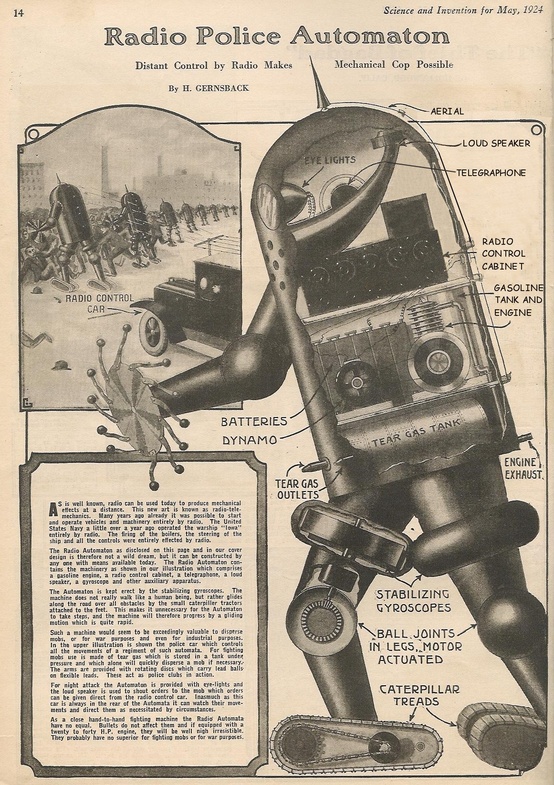
     There are legions of images like this, but what attracted my attention this morning was the application of the relatively new-found technologies wrapped around the possibilities of robotics and radio. Early radio broadcasting  and the newly-coined “robot” (the term was coined just a few years earlier in 1921 in Karel Capek’s play Rossum’s Universal Robots) came together very nicely in this spec article for Science and Innovation in May 1924:Radio-police-automaton-1924

     The inset detail is pretty interesting, the robots unleashed on a crowd, under control of a radio patrol car.

    Radio-police-automaton-1924 det

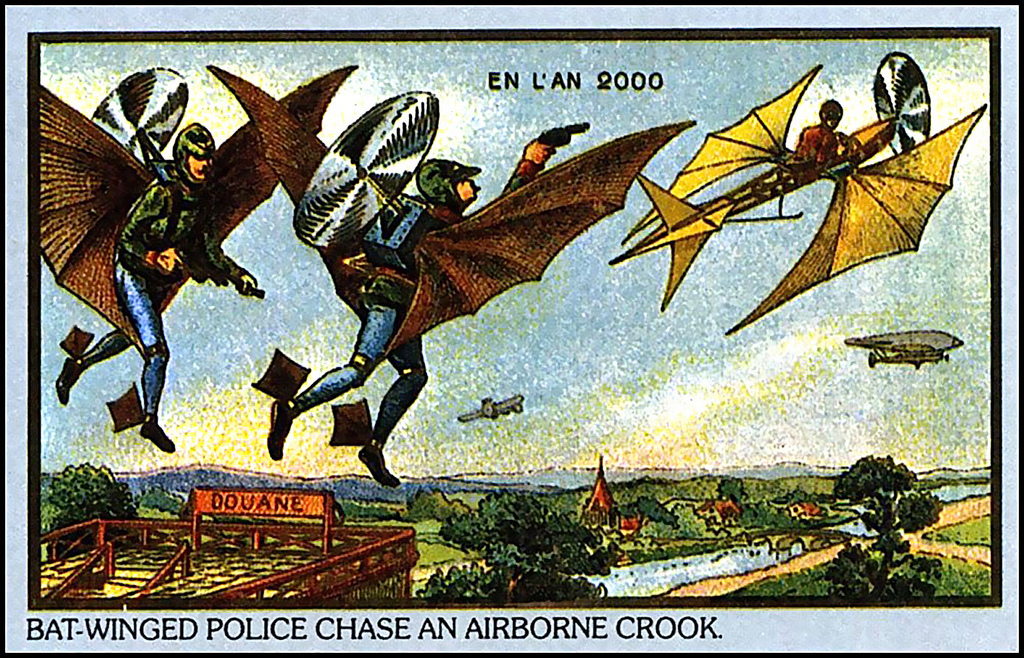
    Another view of police-in-the-future, earlier-on in the century, from a series of French postcards (printed ca. 1900), depicting what the possible world of the future might look like in the year 2000:

    Police flyinh

    And an earlier ‘version” of both came to life int he hands of Curikshank (again), who produced what might be the earliest image of an artificial exoskeleton:

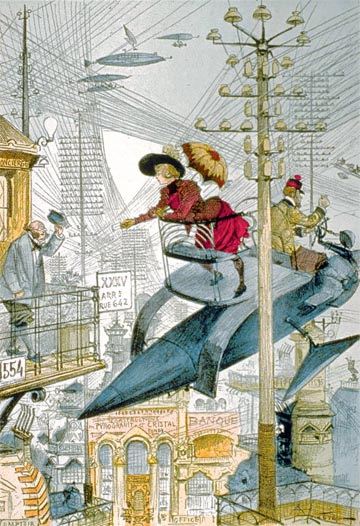
    Albert Robida (1848-1926) saw pretty deeply into the future, his mind
    wrapped around the plausibilities of possibilities, and getting a lot of
    them quite right.  (He was enormously prolific, with some 60,000 designs
    to his credit as well as 200 illustrated books and many dozens of
    illustrated journals, many of them quite lovely and prescient, if
    somewhat upsetting to the common-reading mind of mid-late 19th Europe).  Here’s Robida on the possibilities of ElectroPunk:

    [“Un quartier embrouillé “, La Vie électrique, Paris, Librairie Illustrée, [1892]. I wrote a little about Robida here.]

    Of course, Robida as well overplayed and underplayed his vision of the electrical future–I think he woul d have been shocked to see that dead trees are still supporting most of the wired world’s digital infrastructure, but he would have been overwhelmed to learn what that electricity was transmitting. 

    It would be an interesting measure to see how long it took between some futures going from hyper-speculated to not-so to be positively under-speculated and perhaps naive. 

    Notes: 


  • A Piece of Tech Future and Children Knowing Everything, 1876

    JF Ptak Science Books   Post 1985Follow Me on Pinterest

    Telephone 1876 lockyer detail
    There are many facets in the history of the future that sound very familiar and true, making it shocking to realize what a long timeline some presumably modern things have.  For example, take the issue of the superiority of children to understand newly-arrived technological innovations. It seems as though children need to be shown exactly once how to access a certain segment of a program or how to program the television. It is perhaps a modern conceit that this issue belongs with us in the present and to the children of these children, somewhere in unfolding technological future.  But this was certainly the case in 1876, with the (very) new technological breakthrough, the telephone.

    Alexander Graham Bell was not the first to the invention of the telephone–this is one of those breakthroughs that was ‘in the air” (like the electric telegraph, and the hypothesis on the background radiation of the creation of the universe, and television, and Cubism), and in several issues of the standard-keeper scientific journal Nature for 1876 there are several articles discussing the telephone which do not mention Bell. For example Antonio Meucci in 1849, Charles Bourseul in 1854, Johann Philipp Reis in 1860, Elisha Gray in 1874, and Thomas Edison in 1875, all came close to the practical application of the idea of the ‘speaking telephone”, but it was Bell who ruled the day with the superior design and the patent award. It was Gray who came closest of all to winning the future, beaten in the accounting department at the Patent Office by Bell by only a few hours, both his and Bell’s patents received on 12 February 1876. (Gray’s patent was actually received earlier in the morning than Bell’s, but it was Bell’s attorney who insisted on his patent being recorded immediately in the accounting ledger, with Gray’s patent entered into the books two hours later, resulting in the awarding of the telephone patent to Bell. Ouch). 

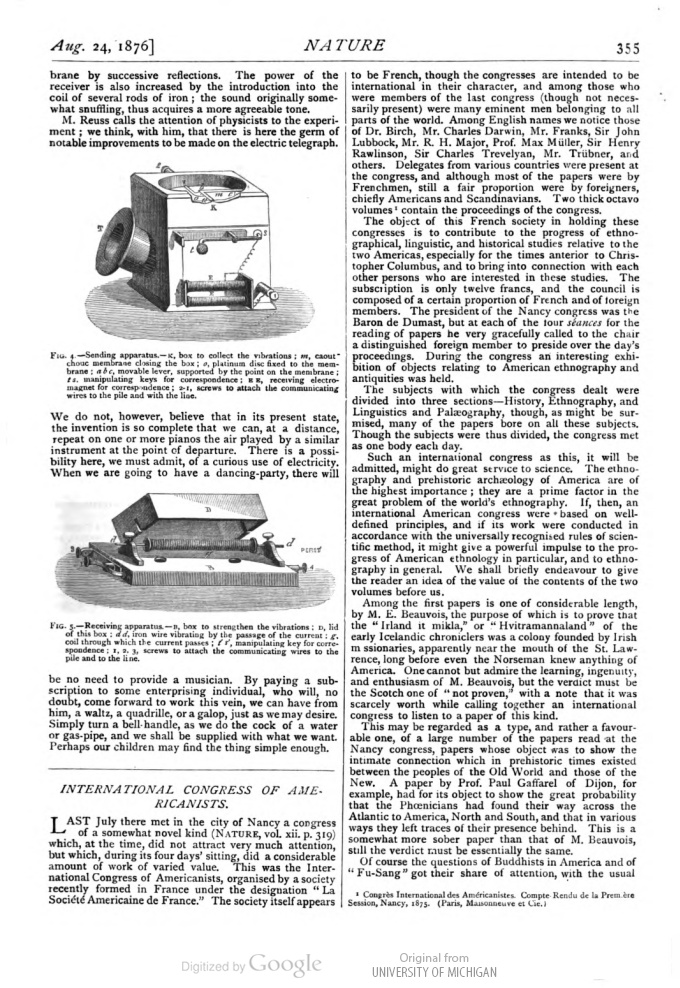
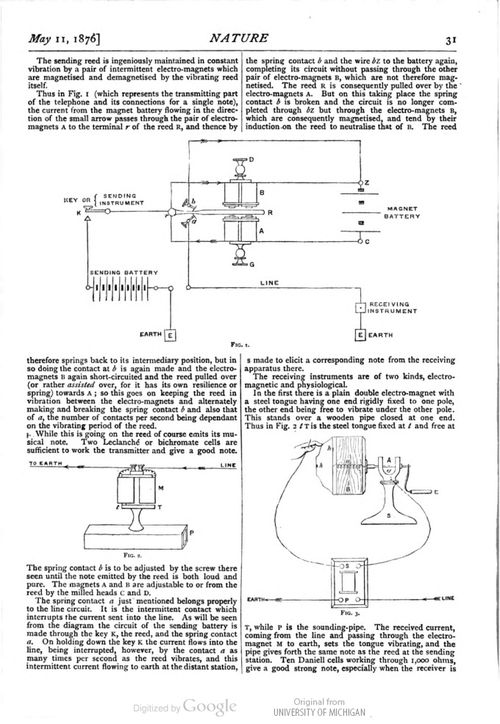
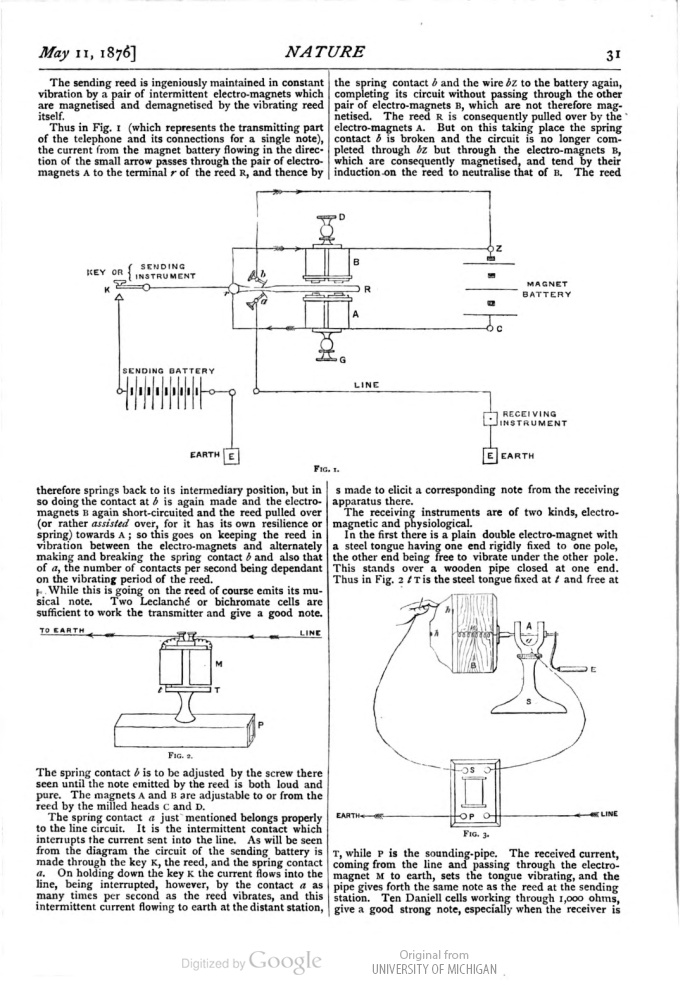
    The August 24, 1876 issue of Nature contained a compact article (uncredited but written by the editor, the esteemed astronomer/astrophysicist Norman Lockyer) on the recent extravagances in electrical development, and included a long section on the telephone.  Bell’s name was not mentioned, and Lockyer concentrated on the work of Reuss and Gray. He also wrote about the use of the telephone, which does not yet involve the use of the instrument for voice communication.  As in an earlier article in the same journal by J. Munro (“On the Telephone, an Instrument for Transmitting Musical Notes by Means of Electricity”.London, Nature:  May 11, 1876.  Pp 30-32 and concentrating mostly on the Gray telephone), Lockyer discusses one application of the telephone in the transmission of music. (He does mention the remarkable experiments of Bourbouze, who in 1870 attempted to use the Seine as a conductor between two stations, those being two bridges, each outfitted with electric piles, enabling the transmission of information without wires–but that’s for another post). 

    Lockyer writes about “the germ of notable improvements to be made on the electric telegraph”,  that

    “in its present state, the invention is so complete that we can, at a distance, repeat one or more pianos the air played by a similar instrument at the point of departure. There is a possibility here, we must admit, of a curious use of electricity. When we are going to have a dinner party, there will be no need to provide a musician. By paying a subscription to some enterprising individual, who will, no doubt, come forward to work in this vein, we can have from him, a waltz, a quadrille, or a gallop, just as we may desire.  Simply turn a bell handle, as we do a cock of a water or gas-pipe, and we shall be supplied with what we want”.

    Lockyer finishes with this great line:  “Perhaps our children may find the thing simple enough“. 

    My initial reaction is great surprise, that this feeling about children coming to understand a new technology quickly/instantly reaches (in evidence) back to 1876.  How far back in time does this sentiment or realization reach?  Is it ancient?  I’ve never really thought about it, but now that I have, a little, and been presented with hard evidence that the sentiment reaches back into the 19th century, that it might as well reach all the way back, deep into dusty history–even pre-dusty.  In any event, even though it is a little difficult for me to ascertain Lockyer’s real feelings about the use of the new instrument, his reaction to children and technology seems to be an honest belief. 

    (I actually have a series of original early papers on the telephone (1876-1878) including the one below, offered on the bookstore section of this blog, here).

    Telephone 1876 lockyer

    Telephone 1876 munro


  • The Marcel Duchamp of 18th Century France: Jean-Jacques Lequeu

    JF Ptak Science Books  Follow Me on Pinterest

    Lequeu_portrait


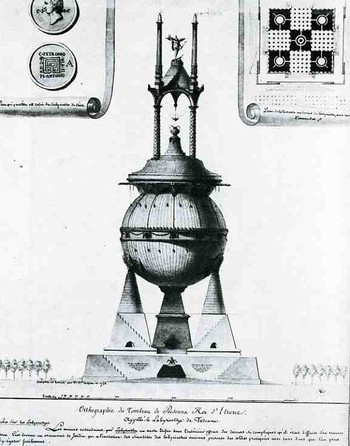
    Jean-Jacques Lequeu (1757-1825), a French architect of fabulously distanced sight, produced this breathtaking image in 1792.  The Tomb of Lars Porsena, King of Etruria (the great Etruscan king, d. ca. 500 BCE ), is just one of hundreds of works by Lequeu, a re-discovered architectural genius who worked during the same era as other visionary architects such as Etienne Boullee (1728-1799), Claude-Nicolas Ledoux (1736-1806), Louis-Jean Desprez (1743-1803), Francois Barbier (1768-1826), Charles Bernard (1765-1818), Francois-Joseph Belanger (1747-1818), and others, though these guys are the most famous.  As a matter of fact, I think, almost all of these architects were re-discovered—Boullee, perhaps the most famous of the lot, was found again not in his buildings but in his visionary drawings that he deposited with the National Library.  But Lequeu—found again in the same way–it seems had to be rescued from an even greater obscurity than the others.  He tried to expose a unity that he saw in the world, some secret sort of unity, that he saw all around him, and which was unseen by everyone else in creation—at least until the 20th century.

    Lequeu started out in a staid and brilliant way, a successful architect in his own right, and student of Scoufflot, designing ancient-inspiration buildings for the super rich.  But along came the Revolution and away went his career—he wound up a surveyor and a cartographer until his retirement in 1815, after which he enters social and historical oblivion, until he finally dies in total obscurity ten years later (or so, the date is unclear).  His post-revolutionary vision was as phenomenal as his success in selling his ideas were dismal.  Well, this is really a cheap shot—his imagination was shockingly large, enormous, his designs fantastic and beautiful, and completely unexpected, and they seemed to grow larger/loftier and more interesting as time wore away at him.

    I think that as Lequeu was cleaved away, cell by cell falling through the floorboards of his single rented room, he reached further into time and deeper into space than almost any architect of that hundred-year period.   I also think that he was very well aware of his genius being seen as pure eccentricity—his dozen or so self portraits are among the most bizarre that I’ve ever seen (before 1900).

    Bloglequewu289

    The odd thing in all of this is that in this brilliance there is still a reluctance to leave the Baroque, and this at a time when just about everyone else—beginning around 1750—was abandoning it.  So much of the work of the other visionaries mentioned earlier freed themselves of the Baroque—not entirely true, not true at all, for the unique creations of Lequeu, who (as in the Tomb of Lars Porsena) included more than a few bits of the practice even in his most incredible works. 

    Somehow Lequeu saw the Lars Porsena tomb as a 650-foot tall (!!) structure, with impossible insight and filigree.  Extraordinary. (In the upper corners of the drawing of the tomb Lequeu included a design for a coin and also the plan of the structure.  The original tomb of Lars Porsena, according to Pliny the elder in his Natural History, XXXVI, 19, 91ff, was a 15 meter high rectangular base with 90 meter sides–completely destroyed in the wars in the first century. 
    Bloglequewu288_2

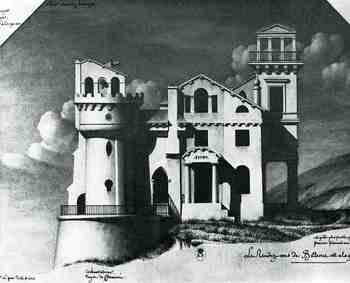
    Perhaps his most sensational creation (and one which was devoid of all Baroque influence, as it turns out) was his Meeting Place at Bellevue.  It is almost impossible to believe that it is am 18th century creation—it is as harmonious (armonia) as it is asymmetrical.  It looks deeply 20th century, and looked as far into the future as it was deeply unknown.


  • SteamPunk Inventions, a Farce from 1853


    JF Ptak Science Books   Quick Post

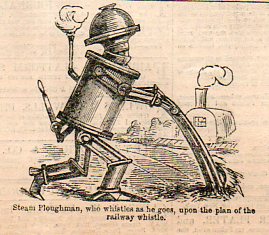
    Steampunk inventions984

    I found these images browsing through The Illustrated London News for April (date obscured) 1853.  In my experience seeing articulated, steam-driven robots in the mid-19th century is pretty unusual. There’s an earlier image (from about 1849) that shows a robot like the one pictured above, though it was actually a man in a robot suit, a person driving a machine–the image above of “the Stream Ploughman”  is clearly a stand-alone robot, as we can see through the thigh area, though it does have human attributes, like a semi-face and the capacity to whistler while it worked.

    Other posts on early robots in this blog include: Mall-Mortuary Faces on Patent Drawings of Robots, 1936-1976; The Edenless World, the First Female Robot;  Endless Eve, 1936; Durer’s Beautiful Monsters, for example.

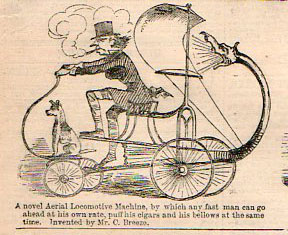
    The caption may idetify this as an airship, but there are no signs here of ho wthis thing would get aloft. And I have no idea what the dog is doing there.

    Steampunk inventions990


  • Beautiful Sprockets: MetalPunk in Space and the Jetsons.

    JF Ptak Science Books    Post 1958

    The birth year of Rosie the Robot is approaching.

    (This beautiful sprocket nest, for a patent for transmitting power (1874), like all of the following patent images, is located at   Google Patents, here)

    Spacely sprocketsFor some odd reason I was thinking about Spacely’s Sprockets, George Jetson’s (of The Jetsons cartoon in the 1960’s) employer.  I wondered if this was a high irony–the “sprockets” part– and if there would be any sprockets in our space-aged future.  Even by the end of the 60’s, just at the end of this cartoon, I wonder if in the tens of thousands of parts that went into the hardware of the Apollo Project to get us to the Moon if there were any sprockets among them. 

    The sprocket was just such an excellent idea in the history of the transmission of power…but in the 15 or so books that are on hand here on the history of technology there’s nothing in between “spring” and “Sputnik” in their indexes. Patents for sprockets seem to begin in U.S. patent history in the late 1860’s.  Sprockets show up in Gatling/machine guns (1878, with the Leland gun), chain propellers (1875), turn tables for railroads (1874), chain saws (1883), holler for printing machines (1882), stump extractors (1878), wind engine engines (1880), window shutters (1879), safety pulleys (1880), traction engines (1881), feathered paddling wheels (1882), potato differs (1883, with very great tank potential), harvesters (1880), hay elevators (1881), horse treadmills (1884), corn planters (1881), grain elevators (1883), and of course in veliocepedes (a very cumbersome device by Emmit G. Latta in 1880). 

    [Bicycle source here]

    I suspect that there were sprockets in space in 1969, and perhaps they’re in a Space X vehicle–I really don’t know. Its just interesting to think of the coming of the sprocket and what an enormous influence it exerted in the history of power transmission–and the device’s beauty. 

    My sneaking suspicion is that Rosie the Robot, the maid for the Jetson family–who was 45 years old in the  beginning of the 1962 series– was loaded with 1965 sprockets–whether sprockets would exist in the year 2062 or whatever year George Jetson was alive in (certainly many centuries post-2062) is another story. But Rosie–the outdated-model mid-life maid of the future and most reasonable character in the series–surely had them.

    Some beautiful sprockets:


  • A Mystopian Alphabet of Newspeak Words: Orwell and Unthink

    JF Ptak Science Books  Post 1953

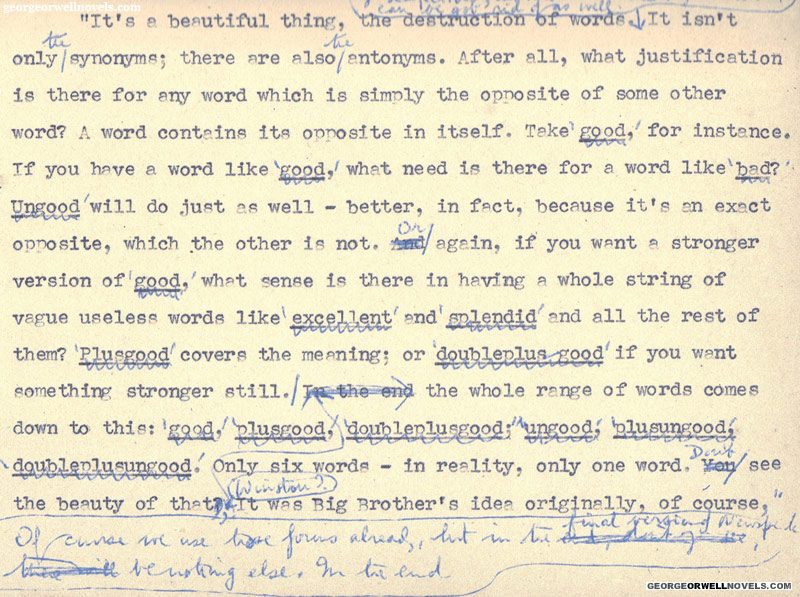
    “It’s a beautiful thing, the destruction of words … what justification is
    there for a word which is simply the opposite of some other word? A
    word contains its opposite in itself. Take “good”, for instance. If you
    have a word like “good”, what need is there for a word like “bad”?
    “Ungood” will do just as well — better, because it’s an exact opposite,
    which the other is not.’”–George Orwell, 1984

    “Orwell and Nabokov wrote nothing like one another and did that to perfection.”–Not H.L. Mencken
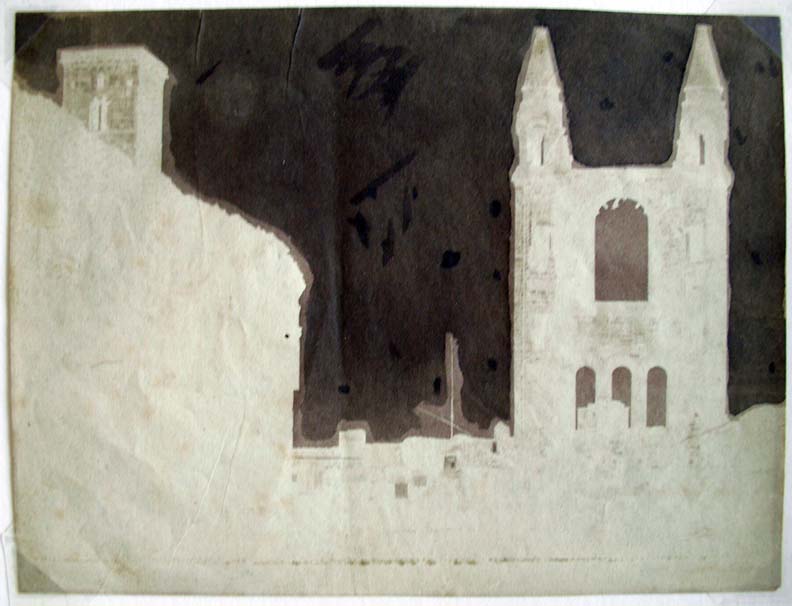
    Hilladamson2[David Octavius Hill (1802-1870) and Robert Adamson (1821-1848), St. Andrews [East Gable End of the Cathedral with Tower of St. Regulus], [1843-1847]. Calotype. Source: Princeton University Library.]

    There is nothing that limits action than the control of the stuff that describes it:  words. Any dictatorship or totalitarian regime can appreciate this thought–many would try to eliminate even the thinking of this thought, let alone limiting the spoken parameters of discussing it. Removing the capacity to respond to what is happening in the world with other human beings by rephrasing the experience through the introduction of new words and the elimination of old ones is an excruciating form of absolute power that can be blatant as well as subtle, though I suspect that accomplishing this word control sotto voce would be the most effective/insidious method. 
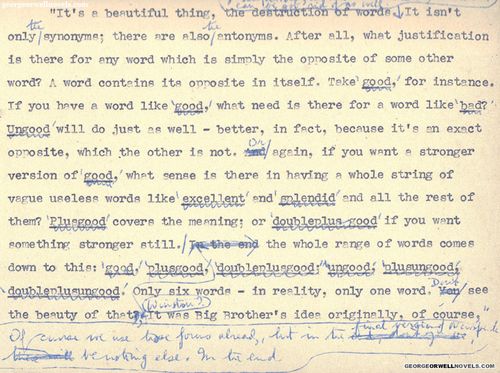
    Orwell 1984 ms[A page of Orwell’s corrected Manuscript of 1984; source: GeorgeOrwellsNovels.com here]

    George Orwell describes a terrifying society of just this sort in his book 1984 (with the complete text available here), which was an adventure into a Mystopia of the near-future (of about the year 2050).  He writes about a society, Oceania, that attempts to makes it members into one conforming biological unit for the sake of control it. One of the methods used to accomplish this is the destruction of words and the creation of other state-controlled words to replace them, a sort of single-channel television for the mind, a device using its own vocabulary which audially impregnates the listener with versions of correct thinking, redefining reality by controlling the ways of interpreting it.

    This is a list of some of the words that Orwell’s society creates–some of course do not stand well on there own, their deviousness appreciated in the context of the story, like the first example, “artsem”, which through constancy has come to numbingly replace the idea of what the word represents.  Others, like ‘good”, are old words with a new meaning, making them new words with a bad (or  not-good) meaning. Or “free” of the old (or Oldspeak”) meaning, where even the word “free” is used only to describe an absence, as in “this sentence describing the use of the word “free” is “free from the old meaning of free”, like you’d want a baby to be free from germs.

    See here for an autobiographical note on Orwell; “A Short History of My Life”, by Orwell in 1945, here.

    Airstrip One:  the new word for “England”, which has been reduced to nothing but a terminal for  the society of 1984, Oceania, is composed of the Americas, part of southern Africa, Australia and New Zealand.

    Artsem: Artificial
    insemination, which is the enforced and nearly the only method of reproduction allowed in the society, another brick in a structure that controls the expression of intimacy between people. Big Brother needs new people for the society to continue, but he doesn’t want there to be any emotional connection between them outside of the prescribed feelings that people are supposed to emulate. Artsem further indoctrinates a no-contact policy between people. There was the possibility of sexual intercourse but only for the production of children when artsem was not applicable–this was called “goodsex”, which was the opposite of “badsex”, which was sexual relations for the joy of it. The orgasm was a hunted thing, to be tracked down and eradicated.

    BB: Big
    Brother. 
    The major domo of Oceania, a hitler/g-d, an extreme presence of control.
    “The story really began in the middle sixties, the period of the
    great purges in which the original leaders of the Revolution were wiped
    out once and for all. By 1970 none of them was left, except Big Brother
    himself. All the rest had by that time been exposed as traitors and
    counter- revolutionaries.”

    Bellyfeel: an unfeeling and enthusiastic acceptance of an idea, following without knowing or knowledge.

    Blackwhite:  “… this word has two mutually contradictory meanings. Applied to an
    opponent, it means the habit of impudently claiming that black is white,
    in contradiction of the plain facts. Applied to a Party member, it
    means a loyal willingness to say that black is white when Party
    discipline demands this. But it means also the ability to believe that black is white, and more, to know that black is white,
    and to forget that one has ever believed the contrary. This demands a
    continuous alteration of the past, made possible by the system of
    thought which really embraces all the rest, and which is known in
    Newspeak as doublethink.”

  • One Hiroshima for Every 6K People: a Map of the Effects of a 20,000 Megaton Attack on the U.S., 1963

    JF Ptak Science Books    Post 1947  Part of a long series on the History of Atomic and Nuclear Weapons
    Follow Me on Pinterest


    I found this map via Alex Wellerstein–a very odd, very visual map of radiological effects of a massive nuclear weapons exchange, which basically leaves little in the way of hope for survivability.  It was published in Brookhaven National Laboratory’s  Ecological Effects of Nuclear War (edited by G. M. Woodwell) as part of symposium sponsored in part by the Ecological Society of America and the American Institute of Biological Sciences in 1963. Wellerstein (an historian at the Center for the History of Physics at the American Institute of Physics)  correctly points out the problems with the model–among which are the 100% ground detonation and 100% achievability in yield–but there was something else that bothered me.  Well, two things:  first. the swath of death obliterated state lines, so you could sort of tell who was affected (although it seems as though my own mountain city of Asheville, NC is in a very slim thread of beige spiking into the death blotch), not that these distinctions would matter very much in the light of nuclear holocaust.

    Atomic attack 20,000 mt
    The second part didn’t occur to me until later.  The missing state lines wouldn’t matter because there would be basically nothing left, or a something that approached nothing.  As Sven Lindqvist points out in his book A History of Bombing (The New Press, 2001),  a study conducted at the Max Planck Institute in 1982 showed that an exchange of 5,000 megatons was enough to throw hundreds of millions of tons of soot from burning forests into the atmosphere and create a cloud barrier that would last for six months and cause the temperature on Earth to drop 100 degrees. At the end of that time, after the sun poked its way through again, the damage to the ozone would be such that virtually anything that survived would be killed by UV radiation.  Plus all of that nuclear exchange radiation.  at the time–in 1982–the worldwide stockpile of nuclear weapons was acknowledged to be about 13,000 megatons. 

    It is estimated that 13,000 megatons had the damage capacity of 1,000,000 Hiroshimas, due not to increase weight but also to more efficient weight usage. That’s one Hiroshima for every 6,000 people.