A Daily History of Holes, Dots, Lines, Science, History, Math, Physics, Art, the Unintentional Absurd, Architecture, Maps, Data Visualization, Blank and Missing Things, and so on. |1.6 million words, 7500 images, 4.9 million hits| Press & appearances in The Times, Le Figaro, Mensa, The Economist, The Guardian, Discovery News, Slate, Le Monde, Sci American Blogs, Le Pont, and many other places… 5000+ total posts since 2008.

Category: History of the Future

  • The Sci-Fi Call to Women in Past-Future Distress

    JF Ptak Science Books   Quick Post

    This adventure (“Radio Planet vs. the Ant Men”) sounds more like a Captain Beefheart song than a fantazine for kids/young adults/whatever, but there it is–and what the cover for the magazine features in spite of the article title was yet another (dazed) woman in sci-fi distress. In the panoply of sci-fi-danger-women this one is pretty composed and dressed relatively, this of ccourse is relative to all of the other who have their dresses falling/slashed/dissolving/torn/falling of, revealing the Great Secrets of Composed and Dangerous Sexuality.  In any event, there seemed to be many instances of women-needing-rescue–and in many circumstances they are tending towards nakedness or its suggestion, and have their arms dangling at their sides. Here’s a quick review of some of the covers that might have put the “X” in “se_uality”:

    AP1474 - Famous Fantastic Mysteries, Pulp Magazine Cover, Artsit: Virgil Finlay, 1942 (30x40cm Art Print)

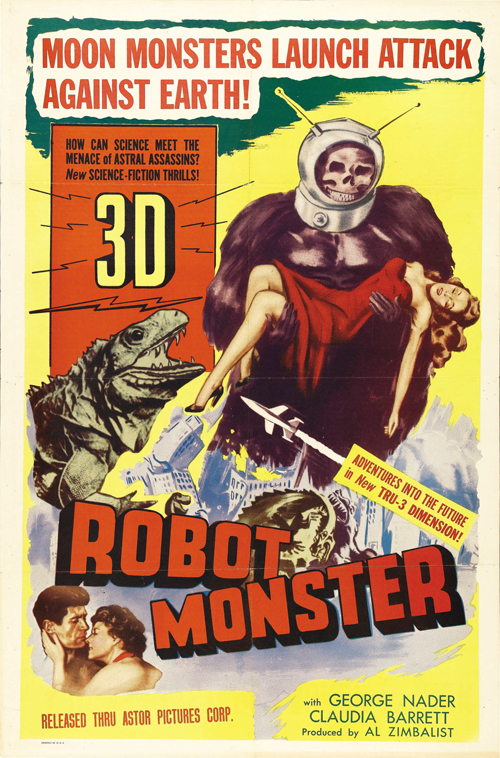
    robot_monster_poster_01


  • The Computer Cyborg of 1867–the Typewriter

    JF Ptak Science Books   Post 1635

    “The most ignorant person at a reasonable charge, and with little bodily labor, may write books in philosophy, poetry, law, mathematics, and theology, without the least assistance from genius or study.”   Jonathan Swift, in Gulliver’s Travels (actually called Travels into Several Remote Nations of the World, in Four Parts. By Lemuel Gulliver, First a Surgeon, and then a Captain of Several Ships, printed 1726).


    https://historyofideasblog.com/a/6a00d83542d51e69e20133f2973d9a970b-pi

    Every age, every generation has a calling to the future that once that particular future arrives looks sometimes strangely like a past that was much further away than it was. Such is the case here, in September, 1867. in the pages of London’s Punch Magazine, when Mr. Punch rhapsodized on the future possibilities of the new invention, the typewriter. [Related items are available at our blog bookstore, here.]

    “Good News for Bad Writers” announced to the readership:

    “Writing Superseded.—Mr. Pratt, of Alabama, is the inventor of a typewriting machine, lately exhibited to tho London Society of Arts, which is said to print a man’s thoughts twice as fast as he can write them with the present process. By a sort of piano arrangement the letters are brought in contact with carbonised paper, which is moved by tho same manipulation,”

    The editor of Punch sniffed out a deeper deal in the typewriter than simple legibility:

    “Every author his own printer! What a happy state of things! No more struggles to write legibly with nibless tavern-pens: no more labour in deciphering the hieroglyphs of hasty writers. Literary work will be in future merely play—on the piano. The future Locke may write his essays by a touch upon the keys.”

    But the disappointments of the possible future wouldn’t stop there, and would or could or should go screaming into the dark night, the invention marking time in the brain of the writer, making able for him or her to compose without thinking, pillows taking over for the mind:
    “In this inventive age there really is no saying where discovery will stop. Now that authors are to put their thoughts in print with twice the pace that they can write them, perhaps ere long they will be able to put their works in type without so much as taking the trouble to compose them. A thought-hatching easy chair may very likely be invented, by the help of which an author may sit down at his ease before his thought-printing piano, and play away ad libitum whatever may occur to him. Different cushions may be used for different kinds of composition, some stuffed with serious thoughts, fit for sermons or reviews, and others with light fancies, fit for works of fiction, poetry, or fun. By a judicious choice of cushions an author will be able to sit down to his piano, and play a novel in three volumes twice or thrice a week, besides knocking off a leader every morning for a newspaper, anil issuing every fortnight a bulky epic poem, or a whole encyclopaedia complete within a month.”
    https://historyofideasblog.com/a/6a00d83542d51e69e20133ed533188970b-pi
    This is not too terribly off the mark from the conversation/writing machine from Swift’s Gulliver in Laputa, except of course that this device (that I wrote about here) came 161 years ealrier.  But then again even the framework for this machine didn’t exist; the typewriter did, which at least got the science fiction aspect of its prospective powers going in the right direction in the real, three-dimensional very mentally High Victorian world.
    The typewriter was just another in a series of “robots” from antiquity, of the creation of moveable type printing taking over the job of scribes and scribes over the jobs of story tellers, of fabrications of automata, of rudimentary calculating machines of the 17th century, of the creation of the lighted semaphore, of the electric telegraph, of the telephone, of the wireless, of the radio, television, computer, internet.  Each offered a similar challenge to the people of their day and a similar challenge to their future–some of which came true, some didn’t. I know that Punch was kidding–mostly. 

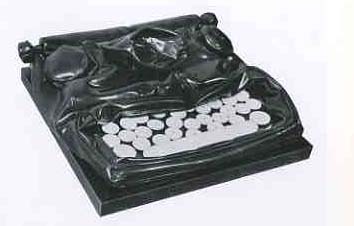
    Photo

    [Claes Oldenburg’s “Soft Typeewriter, 1963.]


  • Things Not Built: Liberty Landing and Closing NYC Harbor, 1935

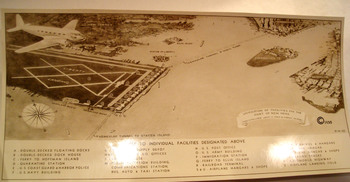
    Dsc04768 I recently uncovered an interesting, unpublished and probably not-acceptable engineering report to extend the ports capacity in the Hudson River at New York City–the ports of the  area being famously over-busy for a long period of time, especially right before World War II.  Charles Palliser and Frederick W. Capon presented a proposal in 1935 for a unification of the port and airport facilities to take care of the overcrowding and overworked problem.

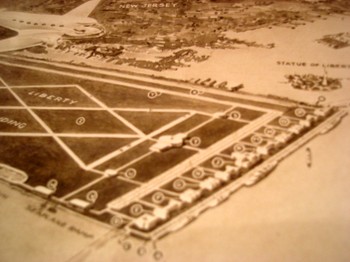
    What they came up with was Liberty Landing, a mile-long and half-mile-wide facility that nearly bumped into theDsc04769 Statue of Liberty (and hence its name).  The plan called for backfilling the “flats” that were just south of Jersey City, as “the natural formation of these were very favorable”, which meant that the airport-port combo would extend all the way into the harbor to the edge of the channel, which would put it further out than the Statue of Liberty, which would also be just hundreds of feet away from the end of the north runway.

    Also attached to the backfill and new land would be a one-mile-long floating dock.  Oh my!

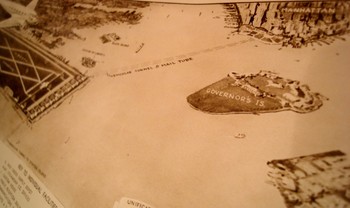
    The floating island would also have vehicular tunnels that connected it to Staten Island and the Battery.  There were facilities for seaplanes, airplanes, railroads, dirrigbles, and trucks, plus a military installation, a custom’s house and the US Mail Service, so that all commerce would converge at this one point, which sounds interesting (for about 20 seconds). 

    Dsc04773
    This is a good candidate for the “Better Left Undone” award for 1935.

    As I look at the photograph of the aerial view of the plan it strikes me that if the designers increased the surface area by only 125% or so they could’ve connected the new facility with Governor’s Island AND Brooklyn, building a land bridge from Jersey City to Coney Island—a superbly bad idea to cap an already strongly bad idea. 

    The report is called, simply, Liberty Landing, and published by the architect in Jackson Heights, NYC, 16 Septmeber 1935.  This is also the U.S. Copyright Deposit copy (accepted 10 October 1935), which is where the history of this project ends.


  • Pearl Harbor & the Maginot Line: the Sneak Attack of 1932

    JF Ptak Science Books  Post 1619

    See also these posts: The Maginot Line, the World’s Heaviest Bad Idea? and The Invasion of America, 1935

    If the Maginot Line could float, it might have been well represented by the U.S. Navy during the 1930’s (and up to about, say, 7 December 1941).  It was pretty much understood that the previous thinking about battleship power as the mainstay of naval capacity had to be re-accessed following the Japanese attack on Pearl Harbor, and that the aircraft carrier and naval air power were certainly, absolutely, a devastating new weapon and strategic initiative.

    The power the attack on Pearl by a task force of aircraft carriers had already been demonstrated to the ruling powers of the U.S. Navy and by one of their own, nine years earlier, at 0800 hours on 7 February 1932. 

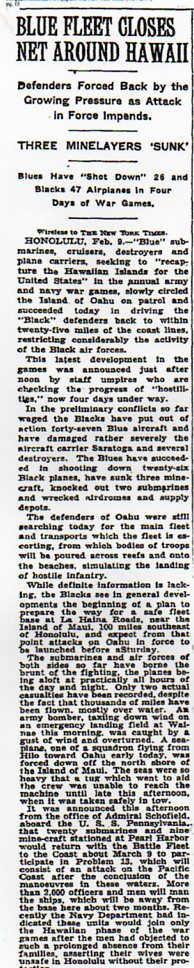
    During Fleet Problem XIII and Grand Joint Exercise 4 Vice Admiral Harry Yarnell (1875-1959, U.S. Naval Academy Class of 1897), showed the rest of the Navy what the aircraft carrier could do.  In the war game between two naval forces (blue vs. black) Yarnell (commanding blue) chose a different approach in confronting the black team.  Rather than have the battleships duke ti out in horizon-to-horizon shelling, he brought his force of two aircraft carriers (the Lexington and the Saratoga) and four destroyers (all under radio silence) from California to the home base of the black team at Pearl.  Operating beyond the normal shipping lanes and squalls he was able to successfully approach the base without being detected, and launched 157 planes against the ships and the defending aircraft (which was still on the ground).

    Committing imaginary strafing Yarnell’s attacking force decimated the defending aircraft; and in dropping flour-sack bombs the attacking force pulverized the ships docked at Pearl.  It was an extraordinary victory for the blue team, and it should have been a monumental wake-up for all those decision makers involved in running the Navy. 

    In spite of the obvious victory by Yarnell, the exercise was seen as something as a fluke, and the umpires evaluating the manuevers judged the use of the aircraft carrier in a possible attack on Pearl Harbor to be “doubtful”.

    In his review of teh exercise Yarnell clearly stated that the aircraft carrier should become the main arm of the U.S. Navy–it would certainly be so for other navies, including potential enemy navies, thereby putting the U.S. on an unequal footing should this course of action not be followed.  He was certain that he demonstrated that a major change was due in American naval tactics and strategy, and that in order to fight a transoceanic war that six to eight aircraft carriers would be necessary.

    The battleship admirals carried the day, though, saying post facto that their remaining force (and the part out at sea) would have been able to catch up to the retiring aircraft carriers and destroyers and from long range send them sinking, and that the air defense that had been so badly beaten by Yarnell really wasn’t so and that their was actually a strong defending air response.  But probably not.  In any event, the battleship people probably didn’t want to see time and effort and money removed from their own projects, and so the Yarnell results were dismissed,

    Between 1936 and 1940 the U.S. Navy laid keels for twelve ships, including eleven battleships and one aircraft carrier. 

    Yarnell retired in 1939 at age 64, after having been the admiral in command of teh U.S. Asiatic Fleet. 

    When the Japanese attacked on 7 December 1941 they did so using six aircraft carriers (each carry between 54 and 72 planes) for a total of 387 planes (excluding spares and including 48 air patrol Zeroes and six seaplane scouts for reconnaissance).  And that, as they say, was that.

     The funny thing about these results is that the New York Times seems to have been reporting on the progress of the maneuvers throughout their course, over a period of weeks,k which would (if we assume that the commanders and officers in Hawaii were reading the newspapers) tip the hand of a “surprise” attempt, further weakening the case for the battleship folks.  

    PD LLC expenses876
    Notes:

    1. “ARMY IS PREPARED TO ‘DEFEND’ HAWAII: Officers Inspect “Black” Defenses From Air — Planes Mass for War Manoeuvres. ATTACK” DUE SATURDAY ” Blue” Forces Under Command of Admiral Leigh Slips Silently Across the Pacific. “New York Times (1923-Current file) [New York, N.Y] 04 Feb 1932: 13. HONOLULU, Feb. 3 — Hawaii’s “Black” army settled down today in its field positions to await the onslaught of the “Blue” force, which is steaming somewhere in the Pacific, en route for its attempted conquest of these islands. Defense arrangements have been completed in every sector and installations have been inspected from the air by a staff of officers and reported satisfactory.

    “BLUE FLEET CLOSES NET AROUND HAWAII: Defenders Forced Back by the Growing Pressure Wireless to THE NEW YORK TIMES.” New York Times (1923-Current file); Feb 10, 1932; ProQuest Historical Newspapers: The New York Times (1851-2007) pg. 15.

    ·Posted by :

    ·in:


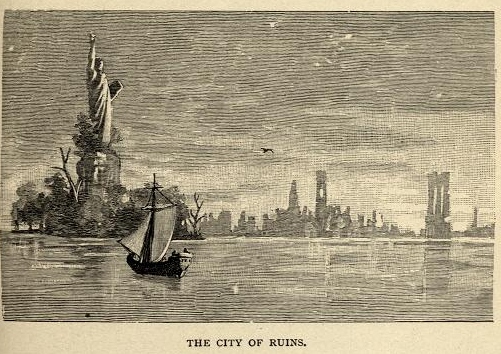
  • More of NYC Destroyed in Explorations of the Future–“The Last American”, 1889

    JF  Ptak Science Books   Post 1615   Part of a series on destroyed New York City that includes New York City: Attacked by Tentacled Flying Saucers, Giant Flying Snakes, Glaciers, and Mining Missile Space Aliens, 1929-1941 and H-Bomb Wipes out Brooklyn, among others.

    NYC in ruins  statue lib
    John Ames Mitchell created quite a world for himself in 1889.  The world he saw in the year 2851 turns out not to support America, or Americans, seeing as how we ran out of luck and envy and possibility and Life.  It is slightly ironic that Mitchell (1844-1918) would write so much about dystopic views of America’s dead culture, as he was the creator and first editor of (the first) Life magazine, a journal dedicated to far less weighty matters (and an early popularizer of populist views of American culture by Dana and Rockwell). 

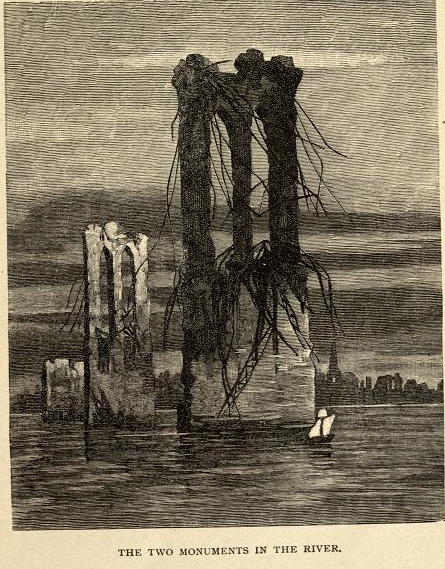
    NYC in ruinbs  Brooklyn bridge
    The Last American (a slight book of 28 pages) is presented as the journal of a Persian explorer (Kahn-li)  a thousand years or so into Mitchell’s future, set off to explore the outer reaches of at-that-time known world, rediscovering the Americas, again.. Kahn-li was intrepid and accomplished:

    “…Curator of the Imperial Museum at Shiraz, and (a)uthor of ”’The Celestial Conquest of Kaly-phorn-ya” and of “Northern Mehrika under the Hy-Bernyan Rulers” The astounding discoveries of Khan-li of Dimph-yoo-chur

     have thrown floods of light  upon the domestic life of the Mehrikan people. 
    "He little realized when he landed upon that sleeping continent what a service he was about to render history,
    or what enthusiasm his discoveries would arouse among Persian archaeologists.
    Every student of antiquity is familiar with their history.
    "
    NYC in ruins  wall st
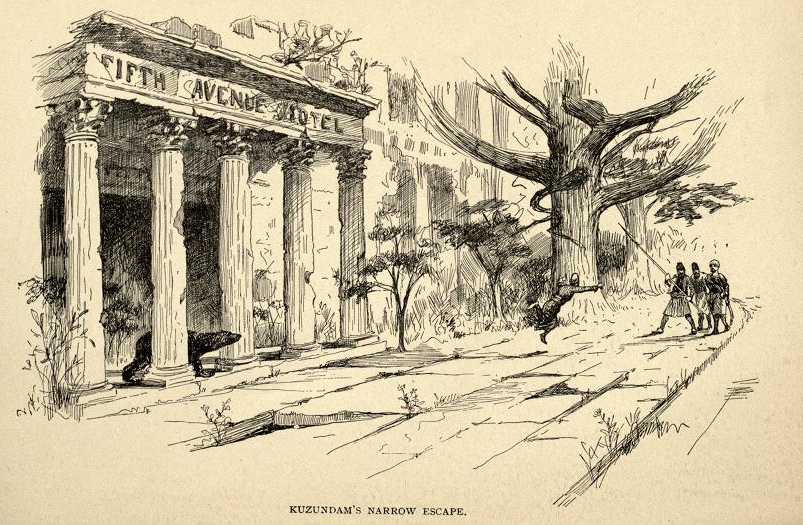
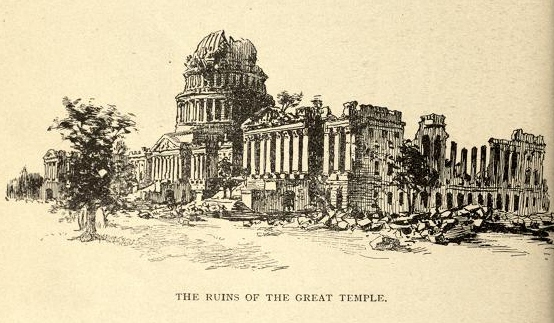
    The images of New York City in ruin, in advanced decline, in an imagined future of slow death, have always
    seemed haunting to me. The images in The Last American are drawn by the author, and in some later editions
    of the work are supplemented by occasional designs and a few extra images. But Mitchell's work is
    pretty impressive. And daunting.

    NYC DC

    Mitchell also has a nice way of showing how his explorers were trying to make sense of the ruins, figuring out what their intended uses were.  For example, the ruins of the Brooklyn Bridge were more a monumental temple, because the distance between the giant structures and the shore were (for them) to great a span for the things to be part of a bridge.  There’s some good, solid, imaginative imaging going on here. 


  • The Future of War (1888)

    JF Ptak Sciene Books    Quick Post   (Part of the History of the Future series)

      Future Punch Dissolving Views detail
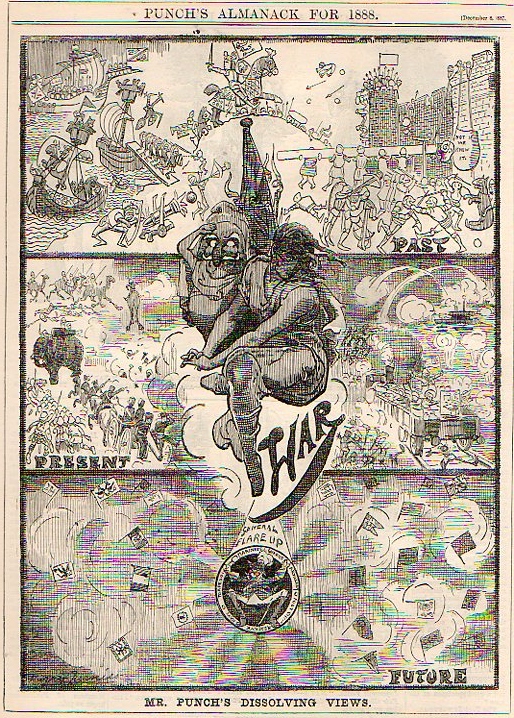
    People really started to understand the future of war at the end of the 19th century.  It was a time during which there was a high altar to high technology, and the industrial/tech/electrical revolutions were well on their way; it was a time in which people felt the enormous weight of advancing technology.

    This image appeared in the 8 December 1888  issue of the London Punch magazine, and foresaw the complications of global conflict in terms of global conflagration. 

    Future war punch845
    This was before the epochal events of 1895 and the X-Ray and the before the understanding of atomic structure (in the work of Thomson and then Rutherford and Curie and Soddy and Planck and Millikan, all of which would take place between 1897 and 1909) that would eventually lead to the unleashing of enormous energy in the form of atomic weapons.  Here, in 1888, we’re till dealing with conventional weapons and their near-future, and the Punch artist, the great Harry Furniss, still saw an exploding world for the next global conflict.  (In 1914 H.G. Wells (in his The World Set Free)  released “atomic bombs” on the world, but his weapons were still measured in terms of conventional explosive, except that they would explode for days on end.)  Furniss’ world-at-war would be a world war, and it wouldn’t take too much time to see that such an insight was correct.


  • Darwin & Frankenstein–Mary Shelley on Creativity and the History of Her Idea

    JF Ptak Science Books Post 1606

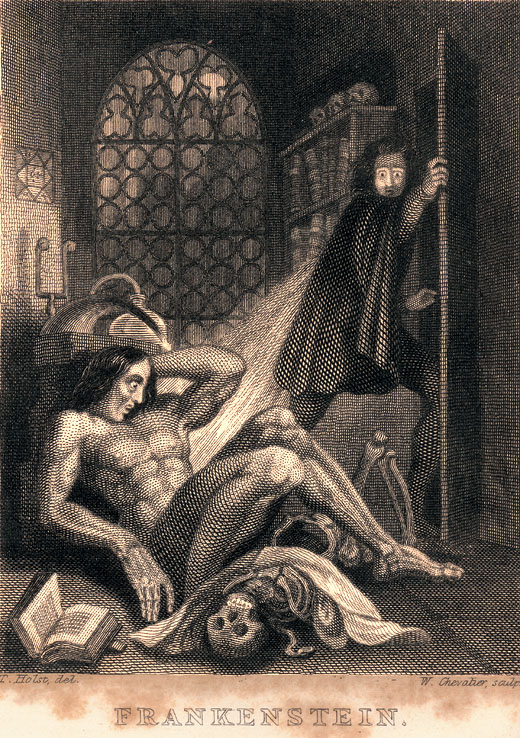
    Today (September 9) in 1Frankensteinengravedimage_large797 was the day of the death of  Mary Wollstonecraft (Godwin), an English feminist and anarchist, best known for her tract  Vindication of the Rights of Woman (1792), and also for being the mother of Mary Wollstonecraft Godwin (Shelley), the author of Frankenstein, or the Modern Prometheus.  In all likelihood, Ms. Godwin died after complications in the birth of her daughter, giving way to “childhood fever”.

      The first time that Mary Shelley’s name appears on her Frankenstein… is on the title page of the second edition of the work, when it was printed in France in 1831, thirteen years after the anonymous Parisian printing of the first edition.  My guess is that a woman’s name–despite her high literary lineage–would just not fit on the title page of such an untoward, beastly book in which the monster of Frankenstein was created., and which was decidedly ungodly, a possible blasphemy.

    But when the second edition was published, in addition to the other changes that she made to the book–substantial, meaningful changes that suggest to scholars that the real, or intentional, Frankenstein produced by Shelley remains in the first edition–there was included a very interesting introduction.  It is in this intro that Shelley shares her story of the creation of this unusual book, as well as the literary and scientific influences in creating it–a sort of intellectual heritage to the idea, an outline of the process of her creativity that led to Frankenstein.

    The book is better known for the numerous movies that were very loosely based on it, and truth be told the book has a far greater depth to it than any of the movies ever remotely hoped to achieve–they were after unsettling horror, whereas the book was concerned with that plus the interplay of Romanticism and science/technology, and the understanding of the way in which life begins and how the brain acquires information. I think that was she was looking for was the essence of things out there somewhere in the empire1 of man.

    Shelley was influenced by a number of different scientists (though the term itself, “scientist”, wouldn’t be used for the first time until decades after the book was published) , some of whom wrote on the subject of Vitalism and other Romatic-era sensibilities rubbing up against the new technical revolution and objectivist capacities,  and the supposed capacity of electricity via Galvanism (and the work of Mesmer and Galvani) to restore life to the dead.  As Shelley writes in the introduction of the second edition: “Perhaps a corpse would be re-animated; galvanism had given token of such things: perhaps the component parts of a creature might be manufactured, brought together, and endued with vital warmth”. She wrote with accomplishment, a very nice prose, weaving a tale of Newtonian-Woodsworthian-Galvanism-Volatarianism, a Romantic-Scientist.

    But the Darwin that Shelley refers to in 1831 is of course Erasmus Darwin, the grandfather of Charles, and someone who I think Shelley didn’t actually read, but had heard about. So I think that the influence of Darwin on Shelley came through bits of remembered pieces from Percy and Byron, and only suggestive of what Darwin was  writing about.  (Even the reference to Darwin in the 1831 introduction is not there–she refers to what Darwin was writing about in the section ‘Spontaneous Vitality of Microscopic Animals‘ in the notes section of his The Temple of Nature, and doesn’t really quite get that part right, though if what Darwin was writing about could be described as a chocolate milk shake, Shelley could indeed say that the drink was chocolatey.

    The book is really quite an achievement, especially given its time; and the intro to the second edition is an unexpected revelation into how someone comes up with an idea.  A big idea. 

    The other influence in he writing of Frankenstein…--much of the book was conceived while Shelley was pregnant, a pregnancy which ended in a miscarriage and which almost cost Shelley her life. (Shelley gave birth to four children, only one of whom lived into maturity.)  The book also came a few years after two suicides in her family.  Life. Regeneration. Birth. Creation.

    Notes:

    Francis Bacon would tell us that

    But if a man endeavor to establish and extend the power and dominion of the human race itself over the universe, his ambition (if ambition it can be called) is without doubt both a more wholesome and a more noble thing than the other two. Now the empire of man over things depends wholly on the arts and sciences. For we cannot command nature except by obeying her.  Francis Bacon, 1620  Aphorism 129,’ Novum Organum (“The New Organon, or True Directions COncerning the Interpretation of Nature), Book I (1620


  • The End of the World, Part 6–The Earth as a Bomb

    JF Ptak Science Books  Post 1601

    [I’ve written a number of times on this blog on the depiction of the end of the Earth–as it turns out, it is an uncommon subject for illustration before, say, 1950.  One in the series can be found here, with links to others.]

    Nd world maxim725
    Hiram Maxim–the inventor of the Maxim gun, almost-inventor of the light bulb, and general creative genius–wrote this article, “How the World Will End” around 1905.  He was a man with many answers to his own many questions, and here he Q-Aed himself about the end of the world.  He imagined the end coming in a number of different ways, one of which was set up by the Earth’s own mighty innards.  He imagined large-sale earthquakes and gigantic volcanoes, Krakatoa-sized volcanoes and then some, that would rend the Earth to pieces.

    Nd world maxim726
    But he starts that vision with a very odd inspiration, thinking about the power of the 1883 eruption of Krakatoa, and trying to equate the enormous explosive mission of the thing with something that was somehow doable, somehow understandable in human terms.  And what he comes up with is this–that if all the people in the world working  all time through all time in producing gunpowder and TNT, spending all of their time doing nothing but making explosives, that all of this gathered and ignited would approximate the energy of the Krakatoa eruption.

    Nd world maxim727
    He was wrong on this calculation, as smart as he was–I think just running some numbers in your head would put this thing to sleep.  But there wasn’t very much for him to compare Krakatoa to in 1905, or certainly nothing that he could compare it to that was produced by humans.  In our recent past, though–in a world that would be Maxim’s near-future–human beings have managed to manage Krakatoa-type releases of energy, namely in the form of nuclear weapons.  If we cobbled together 1,400 of the Hiroshima/Nagasaki bombs from August 1945 and detonated them at once, the amount of energy released would approximate Krakatoa.  This explosive force has since been rolled mostly into one bomb–the Tara Bomb, or Kuzka’s Mother–which was released into the world in a test shot in 1961.  That bomb was calculated to be a 50 megaton weapon, scaled down from its projected 100 megatons, and released 1.74×10¹⁷ J(oules), coming close to what some people have calculated the energy of Krakatoa to have been, at 8.4×10¹⁷J  (In a what-the-hell moment of calculation, someone reckoned the output per second of Star Trek’s U.S.S. Enterprise 1701-D to be 1.27×10¹⁹ J–an enormous number.)

    But it is an interesting form to fill up for a short scifi story.  Imagine a worldwide society which, for its entire existence, has done nothing but make the means for its own violent destruction, stockpiling fantastic amounts of explosives in a series of connected locations, waiting for the time in their history to end.  Imagine that generations would spend their time, doing nothing but producing the means for their own destruction that would come at some time.  The entire output of the combined civilizations banded together, branded for annihilation.  All working to a literal common end. 

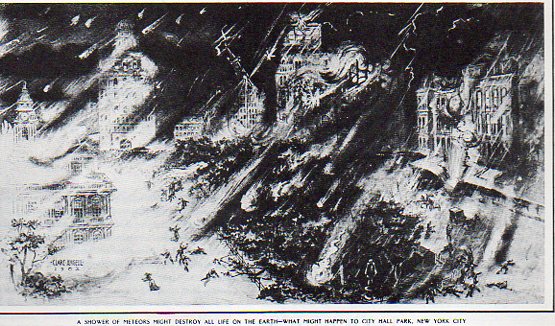
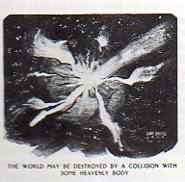
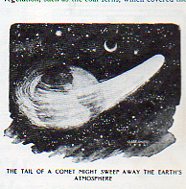
    Maxim saw other bits too in that firey end, as we see in the above illustrations:  for example, in the first image, we see the results of a meteor shower striking City Hall Park in New York City…a big “meteor shower”, a really big one.  Then there’s the possibility of a “collision with some heavenly body”, and of course the tail of a comet sweeping away the Earth’s atmosphere.  For all of his good thinking, though, I can’t get much past the image of societal bomb making…


  • White Guard Fascist Terrorists in the USA, 1946

    JF Ptak Science Books   Quick Post

    White guard terrorist688

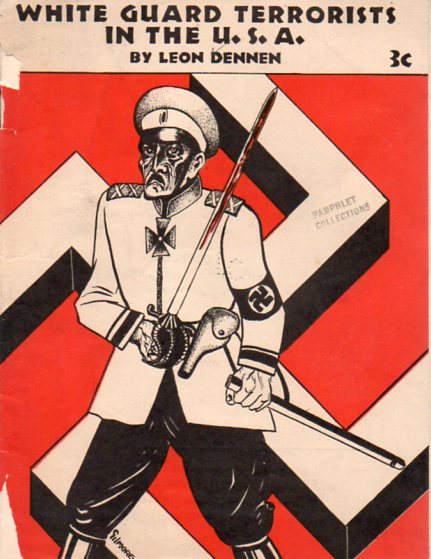
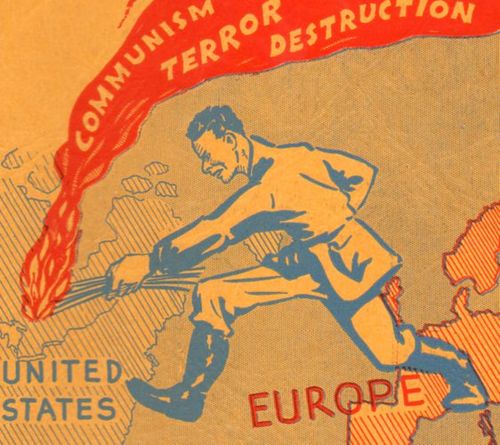
    Leon Dennen was a dedicated man with a broad experience in the affairs of the Soviet Union, the Eastern Bloc, and a capacity to see into the future.  And what this widely published man saw was this–that the countries in Eastern Europe that were presently (in 1945) under control of the Soviet Union were going to stay there1. He did see this correctly and at a time when seeing things like that correctly was pretty tough. 

    White guard terrorist687
    Earlier in his career he did see Fascists under American beds and published his view in this publication (above), published by The Friends of teh Soviet Union Society in New York City in 1935.  On the other hand he couldn’t see the Great Purge and the millions of Russians being eaten alive by the monstrous Joseph Stalin.  But his vision was pretty good for seeing the Soviet plans in Europe at the end of World War II–there weren’t that many people who save that, and those same people really didn’t see the Great Purge either. 

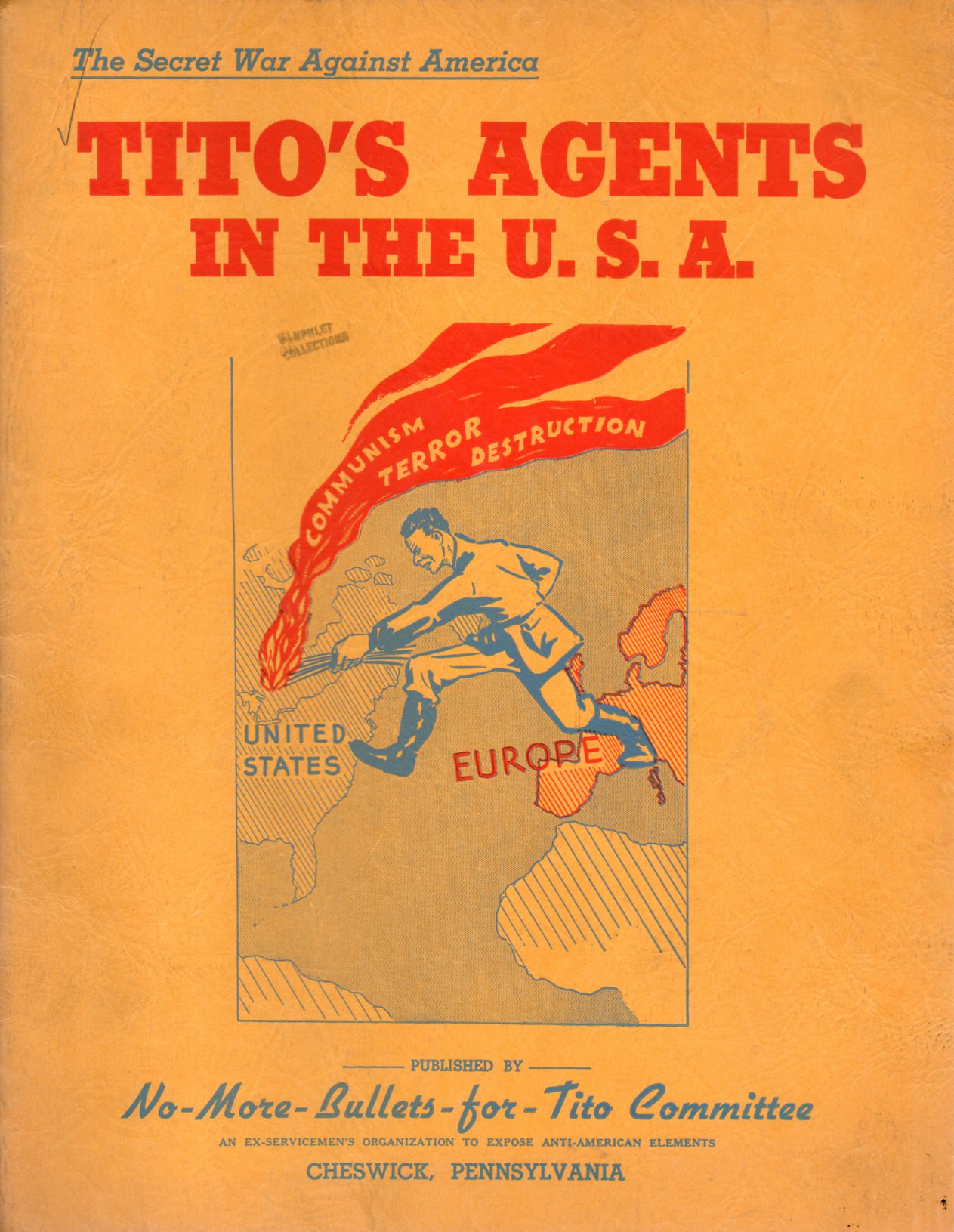
      White guard terrorist tito691

      White guard terrorist tito690

    White guard terrorist tito689
    Notes:

    1. Some biographical information from Commentary, January 1946:

    “Leon Dennen spent nine months in 1944 in the Near East as a representative of an American relief agency. Upon his return he announced that Soviet Russia was building a zone of influence in the Balkans that was “being nailed down with bayonets and terror by regimes deriving their authority not from the local nationalities but from the Soviet liberators.”

    “Mr. Dennen cites chapter and verse to support his contention. He shows that the peoples of the Balkans and the Near East, unable to order their own destinies, have become mere pawns in a gigantic battle for power between Britain and Russia—with Russia, propelled by the dynamism and ruthlessness of the newcomer and in a better geographical position, distinctly having the upper hand.”

    ·Posted by :

    ·in:

    —

  • Songs of the Streets, in Two Parts (and an Obscure Reference to an Important Anti-Darwinist)

    JF Ptak Science Books  Post 1600  {Appropriate musical accompaniment that can be listened to under the reading of this post, Carl Orff’s Gassenhauer, can be found here and minimized.]


    I found these two interesting images over the course of a hundred pages or so in the profusely illustrated weekly magazine, Punch, or the London Charivari, for early 1865.  The first image, published 18 March 1865, “A Song of the Streets”, drawn by “C.H.D.” (Charles Henry Bennett, 1828-1867), displays the general thoroughfare of sidewalk life in a place like London, people being blown about by late winds and snow.

    It is in the upper right-hand corner of the engraving that we find our “important Anti-Darwinist”, which seems like an illogical statement, except that it isn’t  The man in question is the fellow with the bellows, who seems to be the one instigating the weather, blowing so had and cold that it moves people off their feet and off the page.  The bellows is labelled “Fitzroy”, and the likeness is that of the man with the same name, Vice-Admiral Robert Fitzroy (b. 1800), who at this time was serving as the chief of a weather department for the Royal Society, the Meteorological Statist to the Board of Trade, appointed by the president of the society, and was basically a meteorologist, except that the title had yet been invented.  (It is also interesting that Fitzroy is depicted in captain’s (?) uniform, and surrounded by a floating telescope, book, thermometer and self-registering drum.) So even then, even with the first person in this position of authority, complaints for foul weather were being launched at the person “in charge”, even though that person created an extraordinary new tool for detailing the possible changes in weather.1

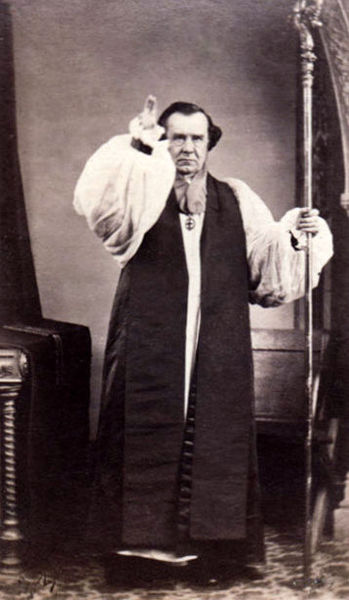
    It happens that this is the same Robert Fitzroy who was the captain of the HMS Beagle on its second voyage (1831-1836), when he approved of the addition of an added gentleman to help keep his sanity on the long adventure, a naturalist named Charles Darwin.  It was also Fitzroy who gave Darwin a copy of the first volume of Lyell’s Principles of Geology, a book integral to Darwin’s development into Charles Darwin.  The voyage was personally rocky for the two men, but ultimately highly successful.  Years later, Fitzroy was shocked and  dismayed with the result of young Darwin’s adventures–with the publication of On the Origin of Species…, Fitzroy felt a sense of personal guilt for Darwin’s theory, and felt shame and bitterness towards it, as in his mind the theory went against his bible and his religious beliefs.   Fitzroy and the Rev. Samuel Wilberforce were at the evolution debate meeting of the British Association for the Advancement of Science (1860) in which Rev. Soapy Sam challenged Darwin’s theory on “scientific” grounds, and against which Thomas Huxley (and other Darwin supporters) made his well-remembered defence2.  In the middle Samuel_Wilberforce_by_Mowbray_of_Oxfordof all of this was Robert Fitzroy, who cried for the crowd of onlookers–with his Bible held aloft–to reject man’s interpretation of nature and stay with that of God.   He was booed down.  Darwin was not in attenddance. [Image: Wilberforce, threatening.]
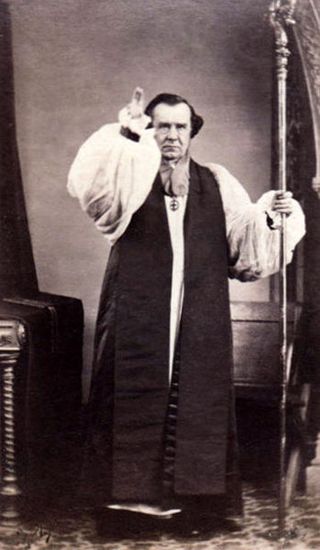
    So, in a way, Fitzroy proved to be important in the formation of the theory of evolution but also turned out to be an anti-Evolutionist, though not an important one.  Oddly enough this may be the last published image of Fitzroy during his lifetime, as he would die 42 days after the appearance of this issue.

    In the second image of the streets the view from the pages of Punch (for 27 May 1865), “The Banishment of the Beggars, a New Tramp Chorus”, we see a different type of street “cleaning”.  In this case, it. Charles Villiers (1802-1898, and for 63 years a sitting MP) and his Homeless Poor Bill of 1865 sweeping the “sham poor” from the city streets, the legislation designating that the capable poor actually be put to work and removed from their begging positions on the streets.  The complaints in the chorus against the highly visible poor of Metropolitania were considerable,


    finding among the beggars (“who disturb our peace”) a litany of fakes, many of who are featured in the illustration:

    “sham injured workmen (who display their wounds from door to door)”, the lame (who clap their crutches on our toes), the blind, sham paralytics, sham widows (with hired babies and brats), “artistic tramps” (who will no longer chalk on the sidewalk “I am Starving”), and the fake veterans of wars. 

    The way to salvation for these people was “the Mill”, provided by the Villiers bill, and a compulsory spot in a workhouse (work-house) where labor is exchanged for room and board. 

    London-Workhouse.jpg


    Notes

    1. Fitzroy was actually the person who coined the term “weather forecast”, or at least he was the first to use it who had any real chance of being correct or accurate, given how much data he was able to assemble and interpret. He was really a very important person in this regard, as well. 

    2. This is not the place to debate whether Huxley’s famous remarks were famnous at teh time.  In a letter to Darwin J.D. Hooker wrote this of the exchange: 

    “Well, Sam Oxon got up and spouted for half an hour with inimitable spirit, ugliness and emptiness and unfairness … Huxley answered admirably and turned the tables, but he could not throw his voice over so large an assembly nor command the audience … he did not allude to Sam’s weak points nor put the matter in a form or way that carried the audience”. ^ “Letter 2852 — Hooker, J. D. to Darwin, C. R., 2 July 1860”. Darwin Correspondence Project 

    On the other hand, another cotemporary of the exchange between WIlberforce and Huxley wrote:

    Alfred Newton wrote:

    In the Nat. Hist. Section we had another hot Darwinian debate… After [lengthy preliminaries] Huxley was called upon by Henslow to state his views at greater length, and this brought up the Bp. of Oxford… Referring to what Huxley had said two days before, about after all its not signifying to him whether he was descended from a Gorilla or not, the Bp. chafed him and asked whether he had a preference for the descent being on the father’s side or the mother’s side? This gave Huxley the opportunity of saying that he would sooner claim kindred with an Ape than with a man like the Bp. who made so ill a use of his wonderful speaking powers to try and burke, by a display of authority, a free discussion on what was, or was not, a matter of truth, and reminded him that on questions of physical science ‘authority’ had always been bowled out by investigation, as witness astronomy and geology.

    A lot of people afterwards spoke… the feeling of the meeting was very much against the Bp.” _Wiki on the 1860 debate.