A Daily History of Holes, Dots, Lines, Science, History, Math, Physics, Art, the Unintentional Absurd, Architecture, Maps, Data Visualization, Blank and Missing Things, and so on. |1.6 million words, 7500 images, 4.9 million hits| Press & appearances in The Times, Le Figaro, Mensa, The Economist, The Guardian, Discovery News, Slate, Le Monde, Sci American Blogs, Le Pont, and many other places… 5000+ total posts since 2008.

Category: History of the Future

  • The End of the World, Part 6–The Earth as a Bomb

    JF Ptak Science Books  Post 1601

    [I’ve written a number of times on this blog on the depiction of the end of the Earth–as it turns out, it is an uncommon subject for illustration before, say, 1950.  One in the series can be found here, with links to others.]
    Nd world maxim725
    Hiram Maxim–the inventor of the Maxim gun, almost-inventor of the light bulb, and general creative genius–wrote this article, “How the World Will End” around 1905.  He was a man with many answers to his own many questions, and here he Q-Aed himself about the end of the world.  He imagined the end coming in a number of different ways, one of which was set up by the Earth’s own mighty innards.  He imagined large-sale earthquakes and gigantic volcanoes, Krakatoa-sized volcanoes and then some, that would rend the Earth to pieces.
    Nd world maxim726
    But he starts that vision with a very odd inspiration, thinking about the power of the 1883 eruption of Krakatoa, and trying to equate the enormous explosive mission of the thing with something that was somehow doable, somehow understandable in human terms.  And what he comes up with is this–that if all the people in the world working  all time through all time in producing gunpowder and TNT, spending all of their time doing nothing but making explosives, that all of this gathered and ignited would approximate the energy of the Krakatoa eruption.
    Nd world maxim727
    He was wrong on this calculation, as smart as he was–I think just running some numbers in your head would put this thing to sleep.  But there wasn’t very much for him to compare Krakatoa to in 1905, or certainly nothing that he could compare it to that was produced by humans.  In our recent past, though–in a world that would be Maxim’s near-future–human beings have managed to manage Krakatoa-type releases of energy, namely in the form of nuclear weapons.  If we cobbled together 1,400 of the Hiroshima/Nagasaki bombs from August 1945 and detonated them at once, the amount of energy released would approximate Krakatoa.  This explosive force has since been rolled mostly into one bomb–the Tara Bomb, or Kuzka’s Mother–which was released into the world in a test shot in 1961.  That bomb was calculated to be a 50 megaton weapon, scaled down from its projected 100 megatons, and released 1.74×10¹⁷ J(oules), coming close to what some people have calculated the energy of Krakatoa to have been, at 8.4×10¹⁷J  (In a what-the-hell moment of calculation, someone reckoned the output per second of Star Trek’s U.S.S. Enterprise 1701-D to be 1.27×10¹⁹ J–an enormous number.)

    But it is an interesting form to fill up for a short scifi story.  Imagine a worldwide society which, for its entire existence, has done nothing but make the means for its own violent destruction, stockpiling fantastic amounts of explosives in a series of connected locations, waiting for the time in their history to end.  Imagine that generations would spend their time, doing nothing but producing the means for their own destruction that would come at some time.  The entire output of the combined civilizations banded together, branded for annihilation.  All working to a literal common end. 

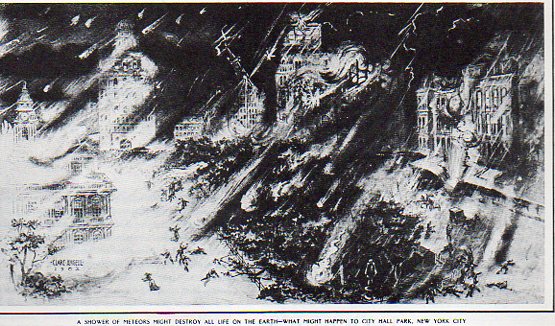
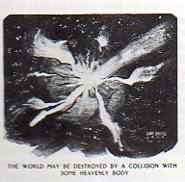
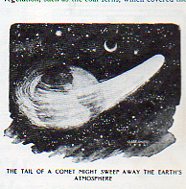
    Maxim saw other bits too in that firey end, as we see in the above illustrations:  for example, in the first image, we see the results of a meteor shower striking City Hall Park in New York City…a big “meteor shower”, a really big one.  Then there’s the possibility of a “collision with some heavenly body”, and of course the tail of a comet sweeping away the Earth’s atmosphere.  For all of his good thinking, though, I can’t get much past the image of societal bomb making…



  • White Guard Fascist Terrorists in the USA, 1946

    JF Ptak Science Books   Quick Post

    White guard terrorist688

    Leon Dennen was a dedicated man with a broad experience in the affairs of the Soviet Union, the Eastern Bloc, and a capacity to see into the future.  And what this widely published man saw was this–that the countries in Eastern Europe that were presently (in 1945) under control of the Soviet Union were going to stay there1. He did see this correctly and at a time when seeing things like that correctly was pretty tough. 

    White guard terrorist687
    Earlier in his career he did see Fascists under American beds and published his view in this publication (above), published by The Friends of teh Soviet Union Society in New York City in 1935.  On the other hand he couldn’t see the Great Purge and the millions of Russians being eaten alive by the monstrous Joseph Stalin.  But his vision was pretty good for seeing the Soviet plans in Europe at the end of World War II–there weren’t that many people who save that, and those same people really didn’t see the Great Purge either. 

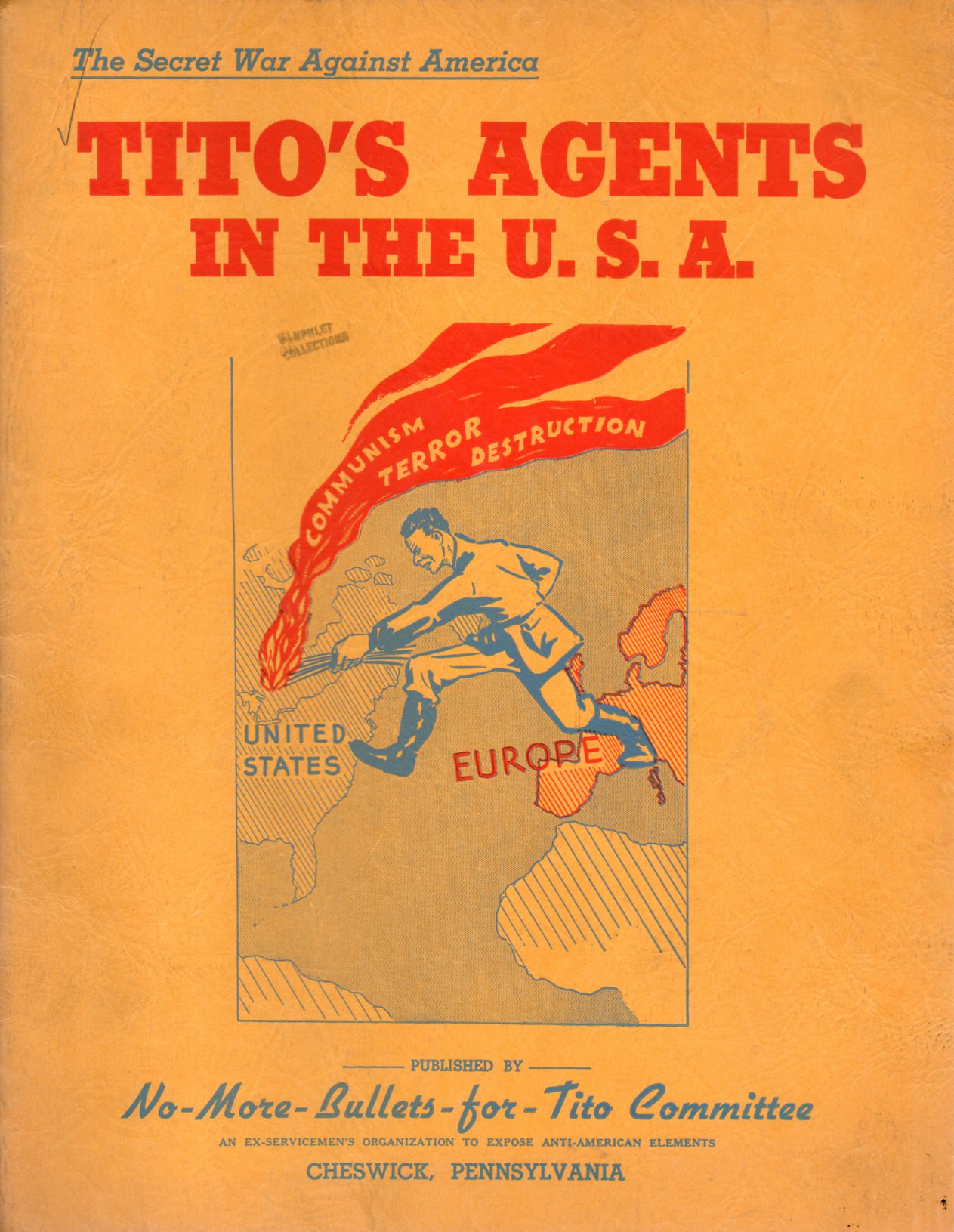
      White guard terrorist tito691

      White guard terrorist tito690

    White guard terrorist tito689
    Notes:

    1. Some biographical information from Commentary, January 1946:

    “Leon Dennen spent nine months in 1944 in the Near East as a representative of an American relief agency. Upon his return he announced that Soviet Russia was building a zone of influence in the Balkans that was “being nailed down with bayonets and terror by regimes deriving their authority not from the local nationalities but from the Soviet liberators.”

    “Mr. Dennen cites chapter and verse to support his contention. He shows that the peoples of the Balkans and the Near East, unable to order their own destinies, have become mere pawns in a gigantic battle for power between Britain and Russia—with Russia, propelled by the dynamism and ruthlessness of the newcomer and in a better geographical position, distinctly having the upper hand.”

    ·Posted by :

    ·in:

    —

  • Albert Robida and the History of the Future

     JF Ptak Science Books  Post 1590

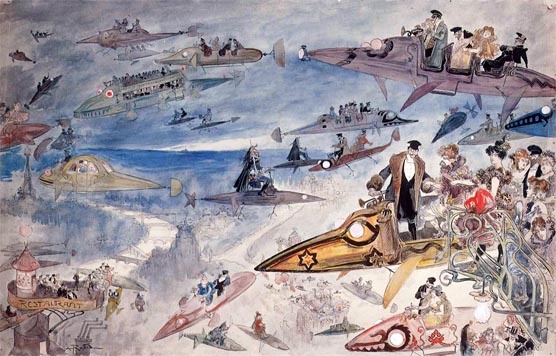
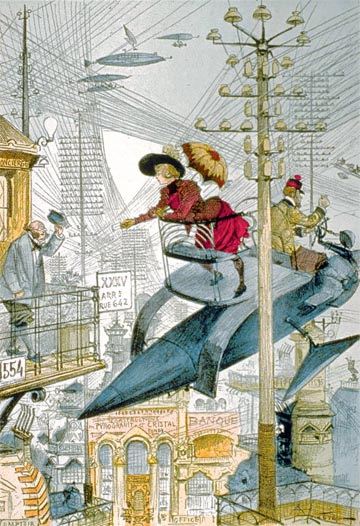
    Albert Robida (1848-1926) saw pretty deeply into the future, his mind wrapped around the plausibilities of possibilities, and getting a lot of them quite right.  He was enormously prolific, with some 60,000 designs to his credit as well as 200 illustrated books and many dozens of illustrated journals, many of them quite lovely and prescient, if somewhat upsetting to the common-reading mind of mid-late 19th Europe. 

    Robida1 shared several decades of peak-creativity time with the stone-cold master of the as-yet defined science fiction realms in the person of Jules Verne (1828-1905), who certainly wrote deeper and longer than Robida, though without Robida’s creative artistic talents.  But the 1870’s and 1880’s would have been prime space for both men, even though Verne’s2 best years were behind him and he had entered a decidedly darker period by that point–that said, the men did share the same oxygens of Europe, separated by just hundreds of miles. 

    It might be said that Verne had somewhat loftier visions of the future than Robida; perhaps not.,  Robida does seems to have a great (and perhaps more) concern with the future of the more middle-class/vast mass of people, and again, perhaps not.  One thing is for certain, to me at least–Robida does deserve much more attention than he presently receives, though perhaps that will come more in the future that he created.

    “La sortie de l’Opéra en l’an 2000”.  Original source:  Bibliodyssey

    “Un quartier embrouillé “, La Vie électrique, Paris, Librairie Illustrée, [1892].


  • History of the Future–Advertising in Yellowstone, 1905

    JF Ptak Science Books  Quick Post

    Ads future662

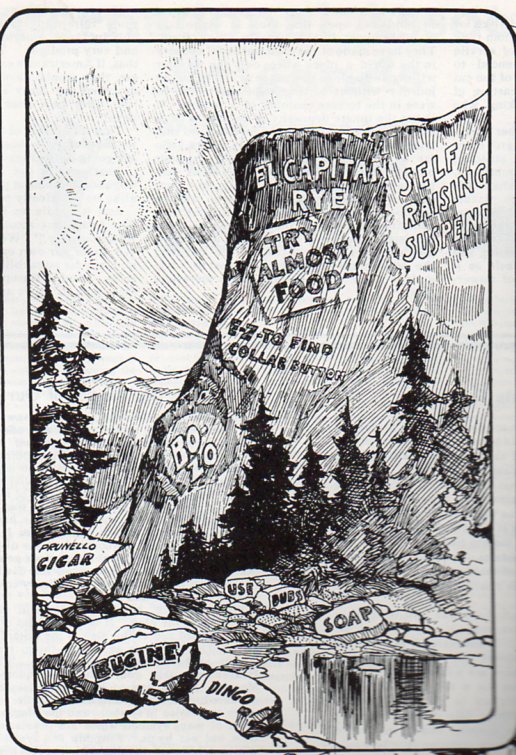
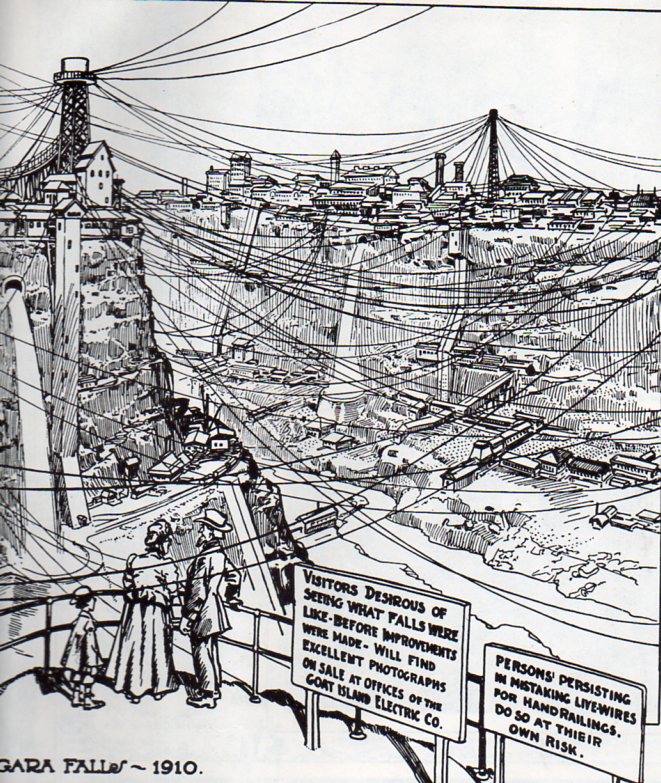
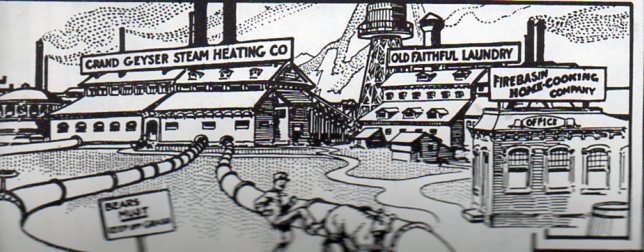
    The way of the new world, the spread of commercialism and of consumerism, the increase in the size of a middle class that was actually approaching what we today would think of as a middle class, the wanting rise of places for disposable income to go from millions of new people with spare money to spend, led the sellers of stuff-immemorial to start advertising their bits on the side of out-of-doors everything. The fight for the attention span of the new consumer went from the newspapers and magazines to the side of buildings and then, as the motor car began to proliferate, to thousands of miles of roadway. 

    But when these cartoons appeared in (the first) Life magazine in 1905, the car was still a distant image so far as common ownership was concerned, so the competition for the visual space of the new buying market was center on outdoor displays wherever people might happen to be outdoors.  (Remember, there’s no radio or television to absorb advert money and viewer attention, so efforts were magnified on billboards.)

    So Life took a peep into the future and didn’t like what it saw: the possible vast expansion of ugliness in the pursuit of whatever dollar might fall out of whatever pocket.  Just a little warning to America is all–the future of the country might not look as pretty it used to be, what with millions of new billboards to place. 

    The future Niagra Falls, five years hence:

    Ads future660
    Old Faithful, Yellowstone, as it could be in 1910:

    Ads future661


  • Atomic Bomb Civilian Defense Posters

    JF Ptak Science Books   Quick Post

    [50s+bomb+poster.jpg]

    [AmerUndrComm.jpg]


  • Apocalypse Then–World War III, The 36-Hour War of 1948

    JF Ptak Science Books   Post 1585  [Part of a long series on atomic and nuclear weapons]

    This is also part of a sub-series on the invasion of attack on America; examples of other posts include: Mapping the Invasion of America, 1942 (which is the most-viewed post from this blog, with over 500k readers), The Invasion of America, 1935,  Bombing Manhattan and the Amerika Bomber, 1943, and The Invasion of America, 1942, Part II .

    In the very near wake of the bombing of Hiroshima and Nagasaki, the editors of Life magazine published a prescient bit of propaganda on the coming of the Cold War.  I guess though that the Cold War had already begun by Yalta1, when the sick and basically-terminal FDR seems to have been corralled by Bloody Joe Stalin, leaving the new President Truman on alert for the possible coming aggressiveness of the Soviet Union.  The article appeared in the 19 November 1945 issue (pp 28-39), and it was a longish one, with nine illustrations (by A. Leydenfrost), and as articles go in Life from this time, this one was heavy. 

    It built itself up on a report generated from the offices of General Hap Arnold, and reckoned a new war, a New War, World War III, to occur in 1948–except that this time there were no natural difficulties that the U.S. could hide behind. (Arnold said: “…with present equipment an enemy air power can without warning, pass over all formerly visualized barriers and can deliver devastating blows at our population centers”.) The threat would come from above, and there would be little accurate defenses against them. 

    There would be survivors but massive destruction and death–and remember that this was at the point of the simple atomic weapon, before the development of the big stuff.  In the opening images of the article, a chilling two-pager showing eight major American cities being struck by atomic weapons, resulting in at least 10,000,000 casualties.

    But as grisly as all of this was, the American reader was told the the United States would prevail, and that our rockets “would lay waste” to the enemy’s cities; “the U.S. wins the atomic war”.

    [Image sources:  I’ve used the image from the Drexel University site as my copy of this issue of Life is in a massive half-yearly bound volume, impossible to scan.]

    This is what New York City was supposed to look like, afterwards, with inspectors sizing up the radiological waste of what was left of the NYPL at 412nd Street:

     Notes:

    1. The Yalta Conference was the third meeting between the leaders of the U.S., the United Kingdom and the Soviet Union, held 4-11 February 1945.  It came after the Tehran and Cairo Conferences, and preceded the final Potsdam Conference on 17 July- 2August 1945.

    More illustrations:


  • Prometheus Unbound; or, the Triumph of Science in Olympus (1879)

    JF Ptak Science Books   Post 1571

    The wonderful Punch, or the London Chiarivari strikes again for the year 1879.  The quick-browse is seldom complete, as I’ve witnessed again and again; 1879 revealed several fantastic images that were posed to this blog last week (here, for the Technology Museum of the Future and also here for Thomas Edison’s Anti-Gravity Underwear and Kite Babies), and as it turns out just a few pages away, there existed a larger, two-page illustration that was again on the triumph of science, and which I missed completely, twice.

    The message in this cartoon is the glory of “science”, which was flying very high indeed in the newly-electrified times of 1879.  Dominating the image is Mr. Punch himself, holding the electrical sun in one hand, illuminating everything.  To his right, Mars and Heracles stand before an enormous cannon, with different reactions; Bacchus sits astride a barrel of coffee of all things with Pan enjoying a short cup of Joe, while in the lower left corner Hades himself is making a photograph of Eros (?), an hourglass slung across his back, finally coming to grips with capturing change.  In the right corner at bottom is a young man who is intent perhaps on reporting on the situation via a handy public telephone–such things didn’t yet exist in 1879, the telephone being just three years old, but the artist thought enough of its future power to add it into this scene of the triumph of science and technology over the panoply of gods and demigods.

    On the right ide of the image the gods make no further advance against science and technology.  Ares-as-workingman is puzzled by the giant Nasmyth hammer, with the Cyclops in the background a little more concerned, disbelieving what their eye told them.  Poseidon is shuttled away in the lower left, accompanied by what looks to be a weeping mermaid., hustled to the exit by a torpedo, a diver in a deep sea suit, and what I think is a special life-preserving inflatable suit.  In the middle of the image we see two women dressed in legal and academic garb, looking determined before a finicky Hermes; and above them, lording over it all, is a very dissatisfied Zeus, and a headache-y Hera.

    Since the image is entitled “Prometheus Unbound, or Science in Olympus”, I guess that Zeus must be reacting to electricity as the unbound Prometheus, a modern version of a kind power given to humankind via electricity.  It is this new Prometheus that is the undoing of the god’s retreat.

    Overall, this is a very plain Victorian view in the trust of science and technology to lead in all things, even the very basis of much of European mythology.   [I hope that I haven’t abused the mythology too much.]


  • Note on the Visual Semantics of Ideas: John WIlkins, Jorge Luis Borges, Oliver Byrne

    JF Ptak Science Books   Post 1568

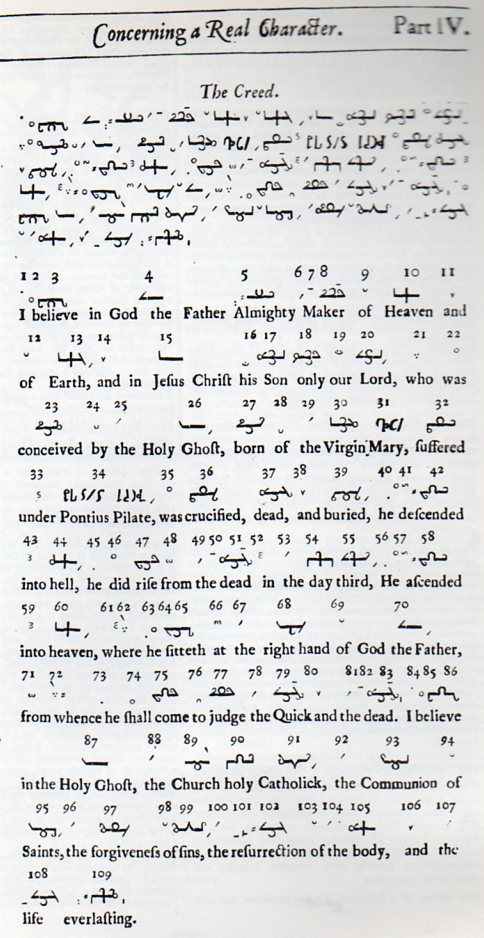
    John Wilkins’ construction of a new, theoretical language, a visual semantics of idea that was to be read and not spoken, a new international language to communicate thought, seems straight from the heart of the great Jorge Luis Borges.  And in fact, Wilkins does come from Borges, in a way–as part of a story Borges wrote in 1942, a fantastical semi-non-fictional account of Wilkins’ fabulous effort1.

    Wilkins was a 17th century figure with a sort-of 20th century idea, but even advanced to this point in time, and with actual mathematical and linguistic tools at his disposal, his work is still better as a sci-fi movie backdrop than anything else–not that there’s anything wrong with that.  The book of his in question, An Essay towards a Real Character, and a Philosophical Language, was published in London in 1668, and was an very interesting, Aristotelian non-standard approach to construct a universally understood language composed of characters which were in a way axiomatic of a developing system of genera, a taxonomy of ideas, that were somehow, fantastically, capable of expressing the foundations and flights of human thinking. 

    Borges’ presented Wilkins in a very Borgesian way in his  “The Analytical Language of John Wilkins“, mixing fact with creative fancy, exhibiting Real Character as though it was being re-discovered and studied by living academics. 

    Wilkins631

    It reminds me somewhat of other massive buit not-quite-nowhere-near-there efforts by people like Oliver Byrne and his color-coded approach to Euclid (1847), J.H. Woodger with his Axomatic Methods in Biology (1937), and Clark Hull’s Principles of Behavior (1944). Fascinating ideas, constructed with big brains, but which ultimately produce a product which more deeply confuses and obscures the subject matter it set out to explain–and which don’t really work, anyway.  But they are beautiful things int heir own right–Byrne’s work in particular also happened to be one of the most beautiful books produced in the 19th century–assemblies of bits and pieces that are occasionally magnificent but whose final destination was of course The Twilight Zone.

    They were in some way a Search for a Perfect Language (as in the work by Umberto Eco); they sought to step deeply outside themselves in an effort to grasp a higher knowledge, perhaps not much too unlike Isaac Newton and his  deep experimentation in alchemy, looking for the massive truths that were handed down to the few selected ancient ones.  They are beautiful things with a lot of very good thinking–they just weren’t right. 

    Notes:

    1.  “The Analytical Language of John Wilkins“, 1942, in which Borges presents an imaginary intellectual archaeologist assessing the work, comparing it in particular to the imaginary encyclopedia Celestial Emporium of Benevolent Knowledge.

    “He divided the universe into forty categories or genera, these being further subdivided into differences, which were subdivided into species. He assigned to each genus a monosyllable of two letters; to each difference, a consonant; to each species, a vowel. For example: de, which means an element; deb, the first of the elements, fire; deba, a part of the element fire, a flame. In a similar language invented by Letellier (1850) a means animal; ab, mammal; abo, carnivore; aboj, feline; aboje, cat; abi, herbivore; abiv, horse; etc. In the language of Bonifacio Sotos Ochando (1845) imaba means building; imaca, harem; imafe, hospital; imafo, pesthouse; imari, house; imaru, country house; imedo, post; imede, pillar; imego, floor; imela, ceiling; imogo, window; bire, bookbinder; birer, bookbinding. (This last list belongs to a book printed in Buenos Aires in 1886, the Curso de Lengua Universal, by Dr. Pedro Mata.)”–Jorge Luis Borges

    Borges described Wilkins’ taxonomy as follows, dividing it into 14 categories (compared to the original Wilkins list of 40):

    Those that belong to the emperor; Embalmed ones; Those that are trained; Suckling pigs; Mermaids; Fabulous ones; Stray dogs; Those that are included in this classification; Those that tremble as if they were mad; Innumerable ones; Those drawn with a very fine camel hair brush; Et cetera; Those that have just broken the flower vase; Those that, at a distance, resemble flies.


  • A Note on the Future of the Bookstore

    [The question on the future of the bookstore was put to me an hour ago–this is my reaction. It follows a post I made just yesterday on a related topic.]

    I’ve owned a specialty rare/uncommon bookstore for the history of physics and math since 1985.  From 1985-2002 it was a brick-and-mortar location that existed mostly in Georgetown, D.C., with a warehouse in Silver Spring, Maryland. At one point it may well have been among the largest/most complete stores of its kind in the U.S.  Now it is entirely online, and even with that, most of the business is very direct offers to particular institutions. My online store was inaugurated in 1999; by 2000, I noticed that in-town customers were buying things of the store online, and foot traffic in the store began to decline.  By the Spring of 2002, it was very clear that–so far as making sales were concerned–the walk-in store would not make economic sense, tomorrow.  It seemed that the future arrived very quickly.

    So it goes, as Mr. Vonnegut said.  In Georgetown in the mid-1990’s there were perhaps a dozen bookstores; after I left, in 2002, there were four, including a fine new bookshop, a Barnes and Noble, a donation shop, and nationally-regarded antiquarian shop.  The donation shop and the two new bookstores remain, and I think a paperback shop as well.  So far as I can determine, there are no walk-in antiquarian bookshops in Washington D.C.

    The bookstore as devices and stores of memory may become a memory itself.  Or perhaps–like libraries–they will survive with an old name but a new purpose. (And this not in the sense as brand names have survived, like say the Chevy Impala which underneath it all is still an automobile; not so I think for the bookstore.)  But I think they will mostly, entirely, fade away, unless they’re cobbled in with something else of associated value to give them a Dorian Gray-ish future life. Compared to what the bookstore has become since, say, 2000, it enjoyed a relatively unbroken run of success and sameness for the distribution of knowledge and as a potential storehouse of wisdom for some 440 years.  Data distribution is now entirely different, generally bypassing the old method(s) of parsing information out into society. 

    Woodblock books put scribes out of business, moveable type did in the woodblock cutters; books in general were seen as a threat to storytellers and the theater; the telegraph was seen as a curse to letter writing and a bane to prolonged thought, as was the telephone that replaced the telegraph; radio threatened everything and was replaced by television, which taught people what “threat” really looked like.  Then of course there came Pine and email, and the world wide web, and the easy/basically free access to incredible and vast sources of social interaction…and that is only the beginning of the communication “revolution”. 

    Bookstores as stores selling books seems to me to be becoming  a memory in itself–the good or bad of it is not yet the issue. The larger piece of this issue may well be how information is packaged and how it is found, with the subsequent issue of how the stuff is interpreted and analyzed as an end bit, which may well be determined by how it is found or accessed–and that may well be a major cause for concern.

    And so the bookstore might come to pass like the Parisian water carrier.  Even though this might have been the way to get the cleanest, brightest, sweetest, coldest water in all of Paris, it is hard to argue with just being able to go to a fountain or turn on a spigot. 


  • The Division of Technology: Different Forms of Social Media Debate, 1893

    JF Ptak Science Books  Quick Post

    Phonograph 1893


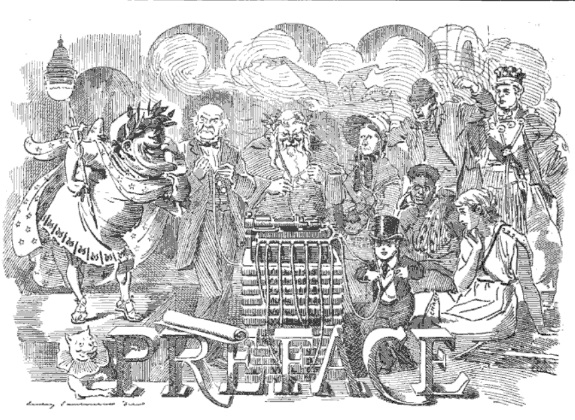
    I found this image flipping through an issue of the London Punch for 8 July 1893.  It shows a group of people gang-listening to a phonograph, with Mr. Punch holding court. The phonograph was already into its third decade (invented by Mr. Edison in 1877 with the patent granted in 1878) and was becoming massively popular, with the prices for the machine and the wax cylinders that powered the interest dramatically falling so that it was within reach of the working middle class.

    The image was used as a header illustration to the opening of the new volume for the second half of the year, and was an introduction to the table of contents for the 300-odd pages that followed, and its legend reads in part:

    “The Penny Phonograph,” pursued Mr. Oracle Punch, “is now prodigiously patronised. For the popular penny you can hear an American band, a Chevalier coster ballad, the ‘Charge of the Light Brigade,’ a comic song by ‘Little Tich,’ or a speech by the Old Man eloquent. No; for the latter I believe they charge twopence. That is fame, my Pantagruelian Premier…”

    You can sense that Mr. Punch is more than a little wincing with his faint praise.  He does take exception to the lightness of the experience, as well as the cost.  He contends in a way that we experience today that the printed media–his own magazine, a “Funograph”– is more complete and the real voice of wisdom: 

    “But in my Funograph—charge the unchangeable Threepence—you can hear the very voice of Wisdom and Wit, of Humanity and Humour, of Eloquence and Essential Truth, of Music and of Mirth!

    And while Mr. Punch might seem to be talking about the phonograph, he is addressing his own Punch: 

    “Sweet lady,” responded the Oracle, with gentle gravity, “there is guidance here for all who will listen; heavenly Charity and diabolic Anarchy, eloquent Statesmanship and adventurous Enterprise, scared Capital and clamorous Labour, fogged Finance and self-assertive Femininity; for the motley and many-voiced Utopia-hunters who fancy they see imminent salvation in Imperial Pomp or Parochial Pump, in Constitutional Clubs or County Councils, in Home Rule, Primrose Leagues, or the Living Wage, in Democracy or in Dynamite, in High Art or Mahatmas, in Science or in Spooks. Take your places, Ladies and Gentlemen! Charity first, if you please, with Father Christmas to her right, leaving room for the little New Year on her left. Listen all, and learn by the various voices of that many-cylindered, marvellous Funographic Machine…

    Advances in the technology of communication have always caused debate–the availability of the printed book was going to make obsolete storytellers and theater, the telegraph would end letter- and book-writing, the telephone would end the telegraph and letter writing and decreased the collective intelligence by shortening the time of thought in communication, the radio would end the telegraph and letter writing and the theater and perhaps books, the television would end radio and etc., vast increases in social media will end privacy and reflective time, and so on.  The advances certainly did doom the form of communication that they trumped, mostly, though what they did to the actual communications part was change it, not end it.   And although Punch wasn’t saying that the phonograph was going to do away with anything at all, he was saying that he felt it inferior.  And for you to buy his magazine.

    The last bit on the ruminations of the impact of social media on privacy and reflection is something that I do believe to be real, and this in spite of all that I know about the history of change in communications; but here I think the medium might have so much “message” that there might not be any at all, given the enormous amount of data units that can be delivered into our consciousness and the limited amount of time for perception (let alone understanding).  And  this is just the beginning, the most primitive stages of vast and pervasive communication.

    And as I write this I wonder if I’m not sounding like a sniffy somebody writing about the impact of the telephone in 1880.