A Daily History of Holes, Dots, Lines, Science, History, Math, Physics, Art, the Unintentional Absurd, Architecture, Maps, Data Visualization, Blank and Missing Things, and so on. |1.6 million words, 7500 images, 4.9 million hits| Press & appearances in The Times, Le Figaro, Mensa, The Economist, The Guardian, Discovery News, Slate, Le Monde, Sci American Blogs, Le Pont, and many other places… 5000+ total posts since 2008.

Category: History of the Future

  • The Division of Technology: Different Forms of Social Media Debate, 1893

    JF Ptak Science Books  Quick Post
    Phonograph 1893


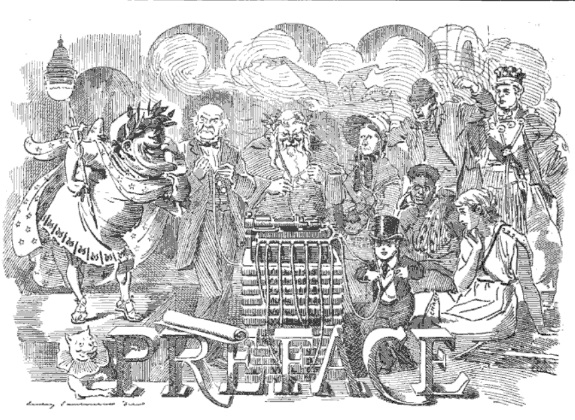
    I found this image flipping through an issue of the London Punch for 8 July 1893.  It shows a group of people gang-listening to a phonograph, with Mr. Punch holding court. The phonograph was already into its third decade (invented by Mr. Edison in 1877 with the patent granted in 1878) and was becoming massively popular, with the prices for the machine and the wax cylinders that powered the interest dramatically falling so that it was within reach of the working middle class.

    The image was used as a header illustration to the opening of the new volume for the second half of the year, and was an introduction to the table of contents for the 300-odd pages that followed, and its legend reads in part:

    “The Penny Phonograph,” pursued Mr. Oracle Punch, “is now prodigiously patronised. For the popular penny you can hear an American band, a Chevalier coster ballad, the ‘Charge of the Light Brigade,’ a comic song by ‘Little Tich,’ or a speech by the Old Man eloquent. No; for the latter I believe they charge twopence. That is fame, my Pantagruelian Premier…”

    You can sense that Mr. Punch is more than a little wincing with his faint praise.  He does take exception to the lightness of the experience, as well as the cost.  He contends in a way that we experience today that the printed media–his own magazine, a “Funograph”– is more complete and the real voice of wisdom: 

    “But in my Funograph—charge the unchangeable Threepence—you can hear the very voice of Wisdom and Wit, of Humanity and Humour, of Eloquence and Essential Truth, of Music and of Mirth!

    And while Mr. Punch might seem to be talking about the phonograph, he is addressing his own Punch: 

    “Sweet lady,” responded the Oracle, with gentle gravity, “there is guidance here for all who will listen; heavenly Charity and diabolic Anarchy, eloquent Statesmanship and adventurous Enterprise, scared Capital and clamorous Labour, fogged Finance and self-assertive Femininity; for the motley and many-voiced Utopia-hunters who fancy they see imminent salvation in Imperial Pomp or Parochial Pump, in Constitutional Clubs or County Councils, in Home Rule, Primrose Leagues, or the Living Wage, in Democracy or in Dynamite, in High Art or Mahatmas, in Science or in Spooks. Take your places, Ladies and Gentlemen! Charity first, if you please, with Father Christmas to her right, leaving room for the little New Year on her left. Listen all, and learn by the various voices of that many-cylindered, marvellous Funographic Machine…

    Advances in the technology of communication have always caused debate–the availability of the printed book was going to make obsolete storytellers and theater, the telegraph would end letter- and book-writing, the telephone would end the telegraph and letter writing and decreased the collective intelligence by shortening the time of thought in communication, the radio would end the telegraph and letter writing and the theater and perhaps books, the television would end radio and etc., vast increases in social media will end privacy and reflective time, and so on.  The advances certainly did doom the form of communication that they trumped, mostly, though what they did to the actual communications part was change it, not end it.   And although Punch wasn’t saying that the phonograph was going to do away with anything at all, he was saying that he felt it inferior.  And for you to buy his magazine.

    The last bit on the ruminations of the impact of social media on privacy and reflection is something that I do believe to be real, and this in spite of all that I know about the history of change in communications; but here I think the medium might have so much “message” that there might not be any at all, given the enormous amount of data units that can be delivered into our consciousness and the limited amount of time for perception (let alone understanding).  And  this is just the beginning, the most primitive stages of vast and pervasive communication.

    And as I write this I wonder if I’m not sounding like a sniffy somebody writing about the impact of the telephone in 1880.
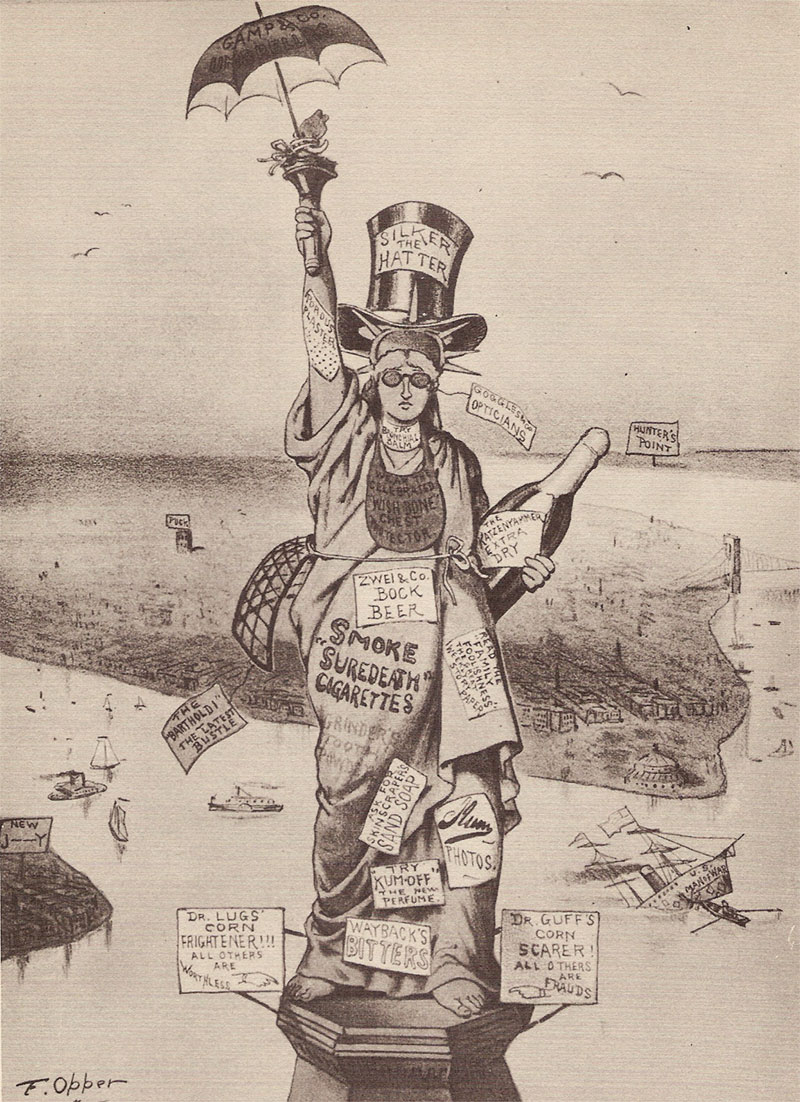
  • The Statue of Liberty as a Billboard, 1888

    JF Ptak Science Books   Post 1567

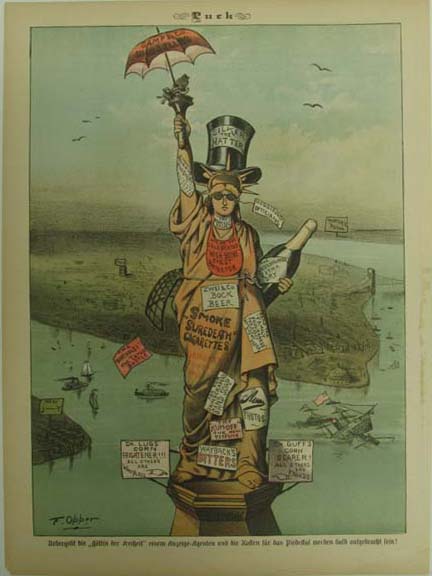
    This image of the near-future Statue of Liberty (“Liberty Enlightening the World”) appeared in the German version of Puck magazine in 1888–since the statue was officially dedicated on 28 October 1886 it didn’t take the cartoonists and social satirists very long at all to get around to using Lady Liberty/Libertas as a backdrop for their message.   And the message here was the creeping advertising age, which was just the shroud of an advancing consumerist society, because there wouldn’t be that many ads if there wasn’t so much material fighting for so many consumers. Advertising was beginning to creeping in everywhere–and here the cartoonist foresaw a near-future in which the Statue of Liberty was a pure advertising vehicle, and as it turns out, most of the stuff advertised there was junk. 

    http://www.printsoldandrare.com/wallstreet/1156ws.jpg

    Here’s another version in glorious black and white

    http://2.bp.blogspot.com/_sGYULzoQCgA/R1DsrSOectI/AAAAAAAABNA/-jpU7nyymuA/s1600-R/1885-puck-magazine-Predicti.jpg

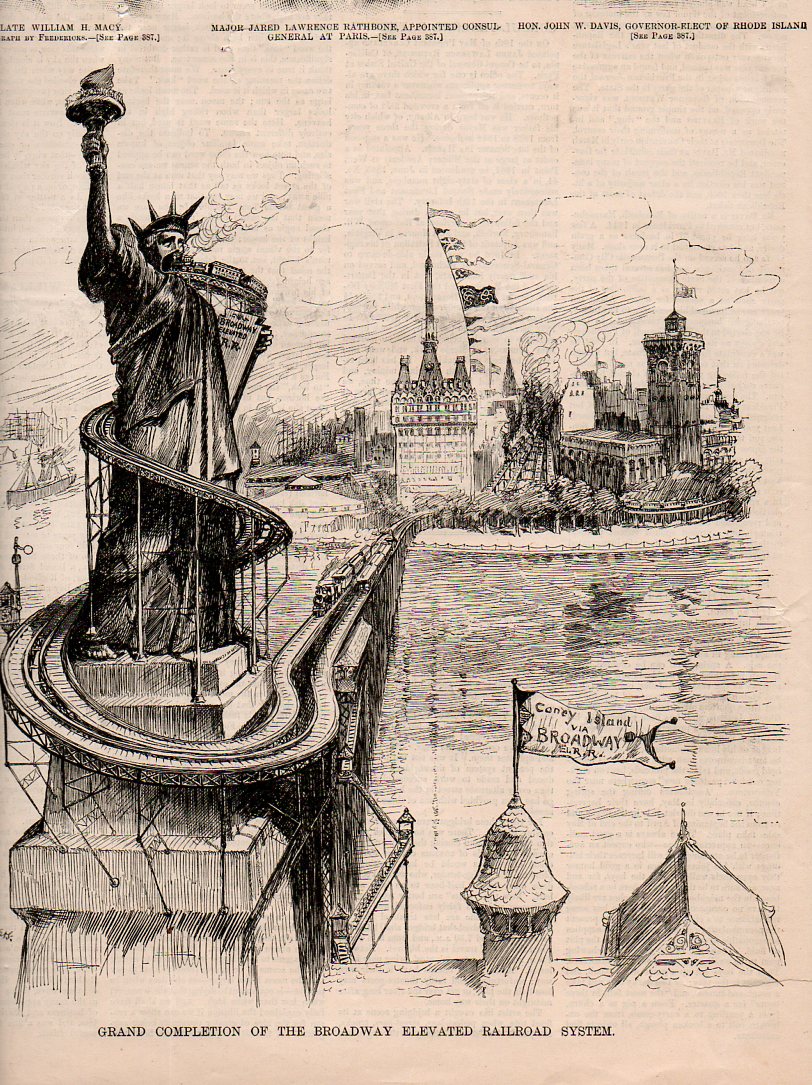
    Another intriguing image of the Statue of Liberty of the future appears below, and described in an earlier post on this blog, here.  Although not being used for advertising, she has become just another part of the landscape, swallowed up by the advancing transportation age. 

    Statue liberty407

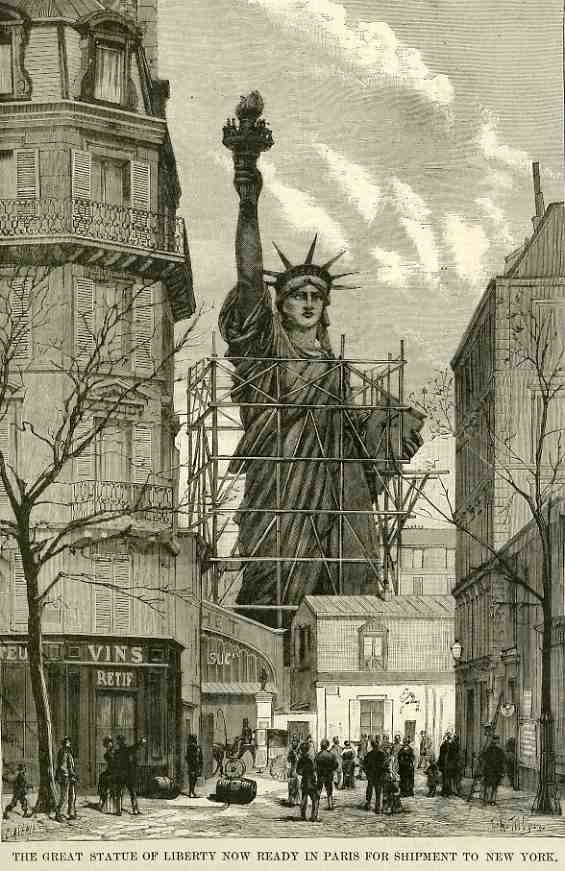
    And although it looks as though Lady Liberty is being packed away as part of a mothball fleet of iconic Americana, this image shows her in France, being constructed (for deconstruction), in 1884. 

    0 blog jan 22 statue409


  • A Technical Museum of the Future, 1879–a Note on the History of Normalcy

    JF Ptak Science Books   Post 1563

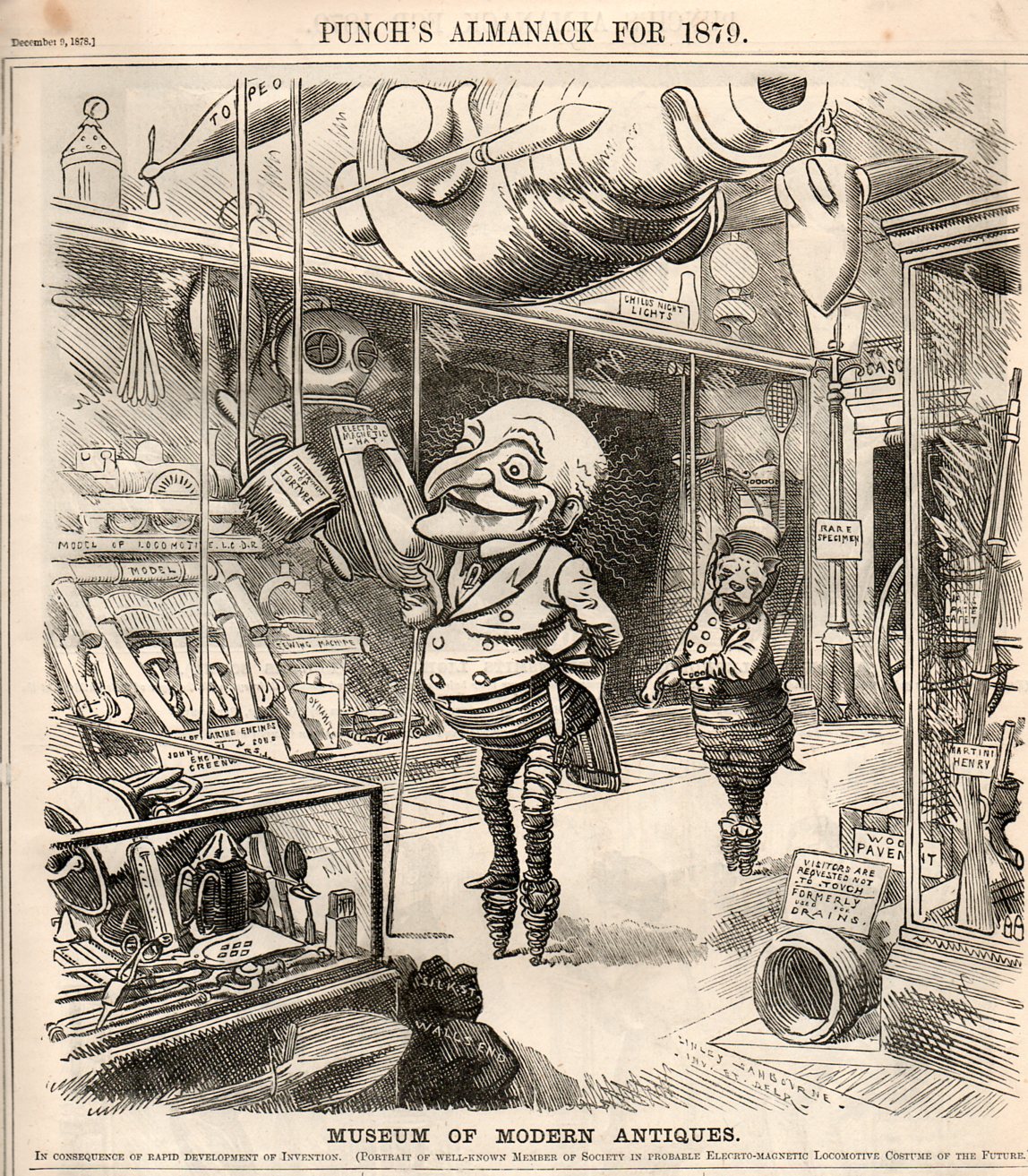
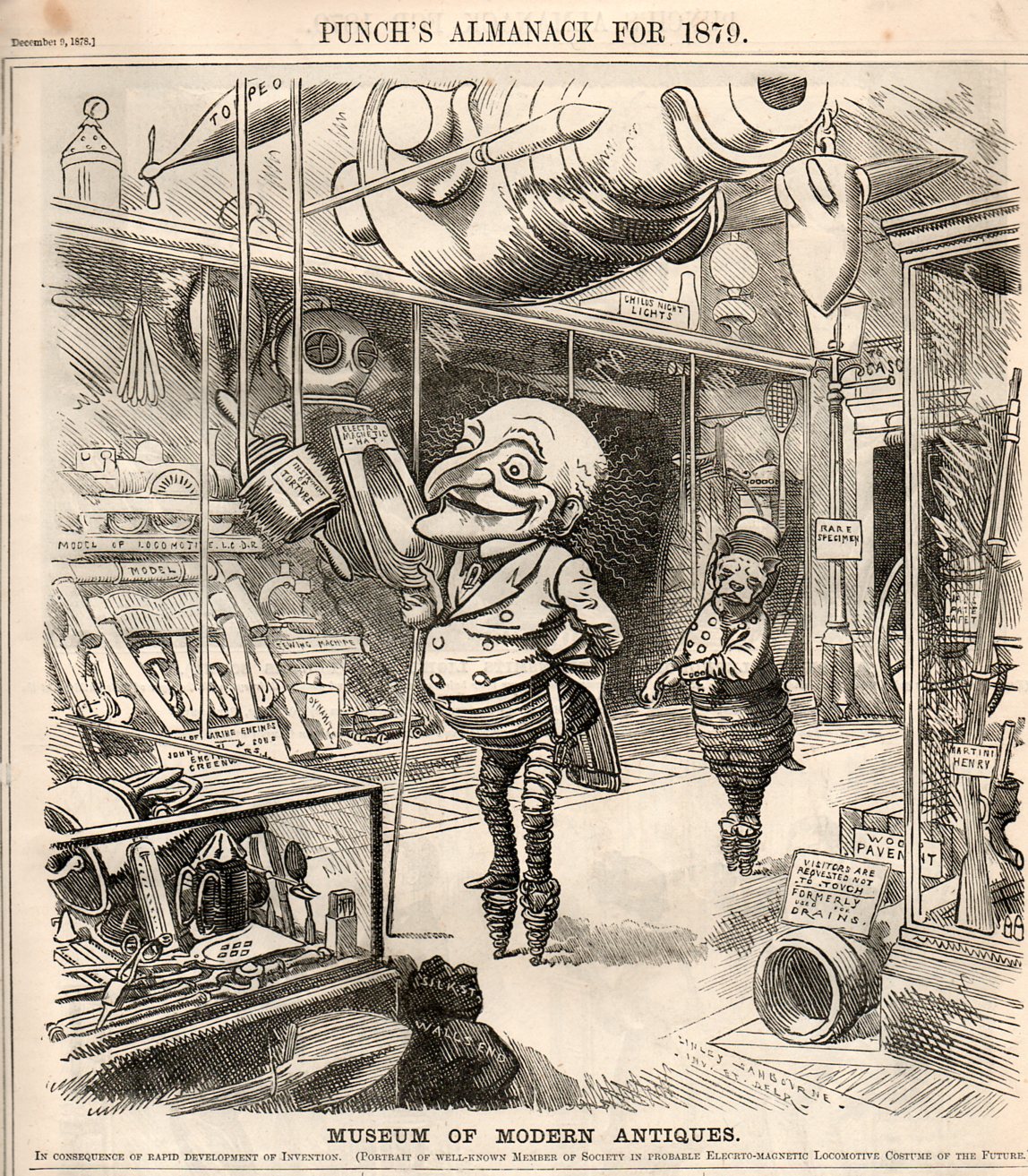
    Yesterday I wrote a blog post on Thomas Edison’s anti-gravity underwear, a satirical series of images that appeared in Punch magazine in 1879.  The leading image of the Punch almanac for that year carried forward the electrical possibilities of the day, and featured Mr. Punch himself, strolling via some odd electromagnetic transportation device through a museum in the near future of the technologies of 1879 since put to a rusty bed, surpassed by the expanding newness.

    Now I’d like to take a bit of a closer look at the future “antiquarian” bits found in that museum. 

    First, the image in whole: 

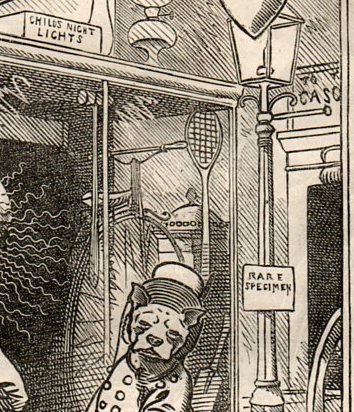
    Edison electric621Some of the modern conveniences to be left behind to the dust of the antiquarians and the curious included  “childs night lights” (which would surely have been a luxury few could have had available to them in 1879), a street lamp powered by gas (which was even then giving off the stench of death owing to the newly-arrived electric light), a tennis racket, and a rather tall bicycle.  All of these would actually be dramatically changing (except perhaps for the tennis racket)  and substantially so, within the next decade-and-a-half.

    Edison electric621 bike
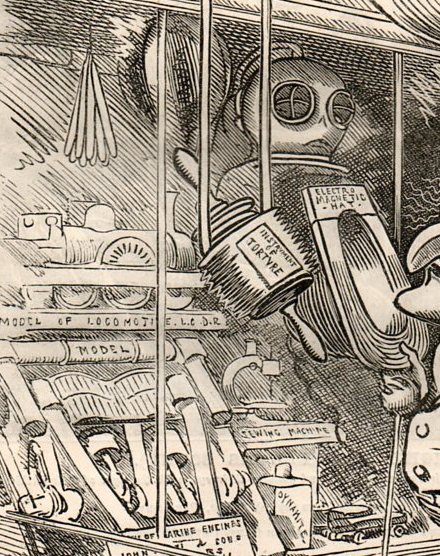
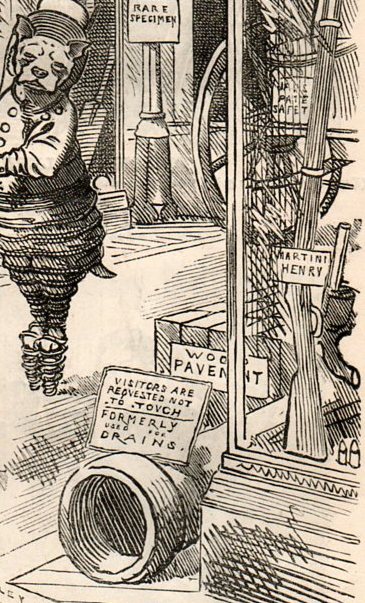
    In the background we see a curious cabinet containing a deep-sea diving suit, candles, a boxing practice ball, a patent of a steam locomotive, another model of a propulsion system for a ship, a sewing machine (already in its third decade) and a box of dynamite (still relatively new at this time, having been patented in 1867).  I am not sure what the “:instrument of torture” is.)

    Edison electric621 deep sea
    The Henry (repeating) rifle was also still fairly new on the scene in 1879, having been around since the late 1850’s but not really produced in any numbers until after the Civil War in 1866)

    Edison electric621 guns

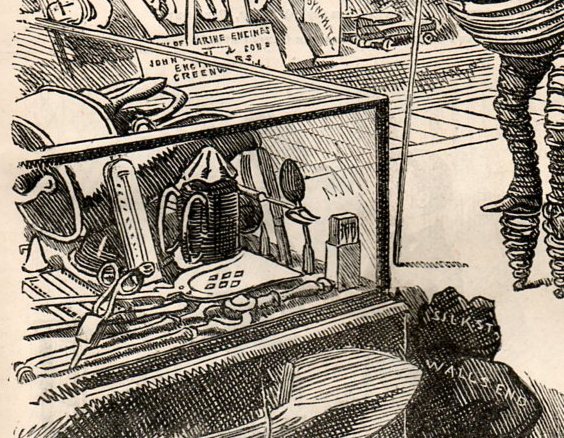
    Perhaps most disturbing to the large percentage of viewers is this last detail of the glass case int eh foreground, which displays the average, everyday stuff that made a household work–a spoon, a thermometer, lantern, fireplace buddies, and even a candle snuffer.  I imagine that people wondered–in 1879–what, exactly, would take the place of these staples?  Better yet perhaps are the objects on the floor, labelled “Silk St” and “Walls End”.  I take this bits to be chunks of coal, and the “Walls End” to be Wallsend, a coal and industrial community (grown up at the end of Hadrian’s Wall).  Maybe that is the most disturbing element of all, to think that coal would some day be replaced–we have similar feelings today, 131 years later, about just this business with coal.

    Edison electric621 household

    I guess the point of all of this is the fickle nature of change, or not-change, and how comfortable surroundings and objects can become quickly not-so in a short period of time.  This would fit nicely into this blog’s developing “History of Normalcy” series. because it really does establish the utterly transient nature of the idea of “normal”.


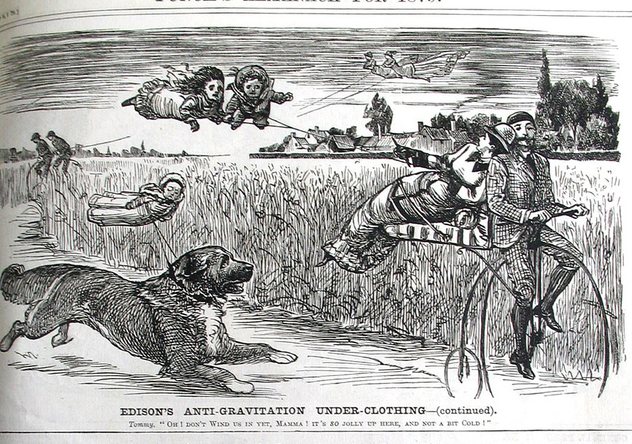
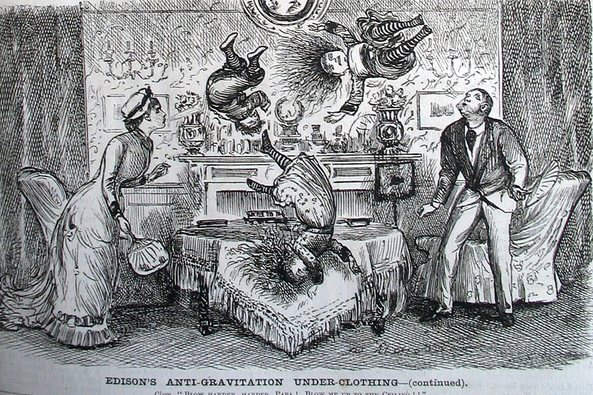
  • Edison’s Anti-Gravity Underwear Kite Babies, 1879

    JF Ptak Science Books    Post 1562  [Part of a series on the History of the Future]

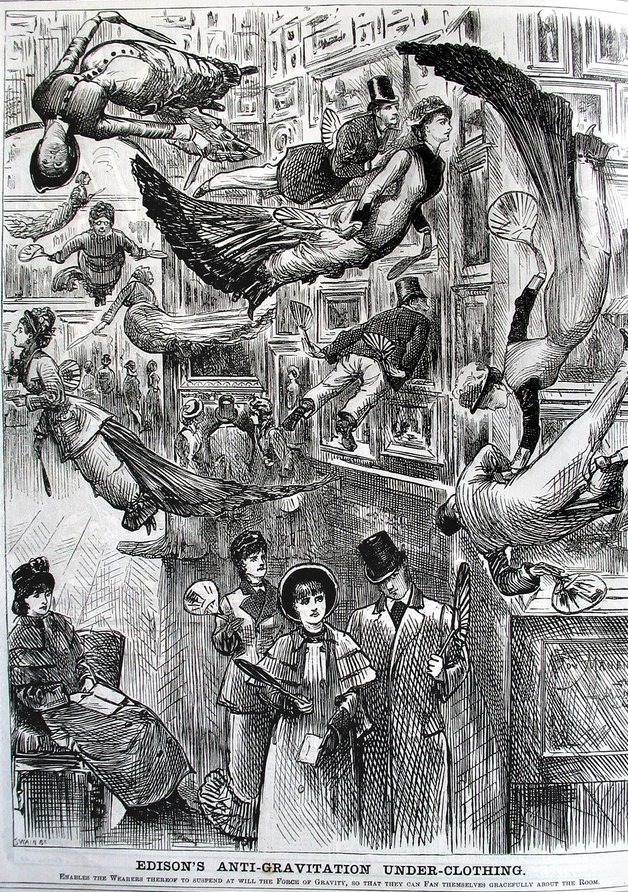
    There was a time in the late 19th century when it was seen that Thomas Edison could do just about anything–so much so that the Brits in The London Punch gave him tongue-in-cheek credit for inventing (flying, so to speak), anti-gravity underwear. 
    Edison anti gravity 3
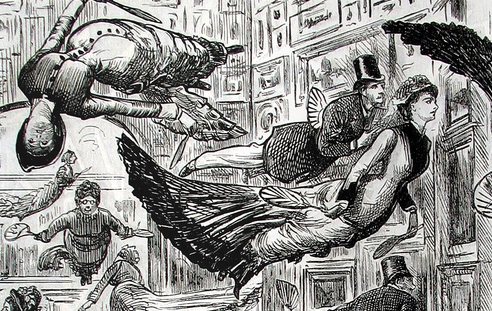
    The funny thing about this though is that the best thing that people could do with this new invention would be to go to a super-sized art gallery to look at paintings close to the ceiling. 

     Edison anti gravity b

    This would no doubt have been distracting to the people without this delightful new underwear, who had to solemnly sit earthbound and try to enjoy their experience while people now not only walked by, but floated through their site lines as well. Perhaps they were wondering why these well-dressed flying people were doing so, indoors.

    Of course you could have made baby kites as well, shoving the little buggers into their anti-grav onesies, tether them to your bike, and give them a ride through the not-brambly countryside.  I would hope that the dog in the image below didn’t get distracted by anything whatsoever–but if that did happen, it would be easy to locate the dog.  All you had to do was follow the flying baby. 

    Edison anti gravity 1

    Why did all of this have to be underwear?  Why not, say, outer clothing? Or a carriage?  Or ship?  Or etc.?

    Edison anti gravity 2
    Perhaps it was easy to make fun of an invention that seemed highly dubious but, somehow, still within the realm of possibility.  After all, Edison was beginning a phenomenal run of creativity–by 1879, when these images appeared, Edison, who was just 32, had already invented the electric light bulb and the phonograph, not to mention dozens of patents for things like the automatic telegraph, the voice engine, the speaking telephone, and an electrical tangle of other useful and revolutionary things (not the least of which were certain essential improvements in the telephone that made the Bell instrument more commercially practicable on a mass scale).  Edison was seen as being capable of virtually anything–later in life, he was the subject of an early science fiction work by Serviss  called Edison’s Conquest of Mars, and much later on, in 1920, a bored joke of his on a naive reporter became international news when the rest of the world thought that he might have invented a telephone to the dead.  But early on in his career, at the beginnings of the great heights of fame, he was seen as being capable of just about anything. 

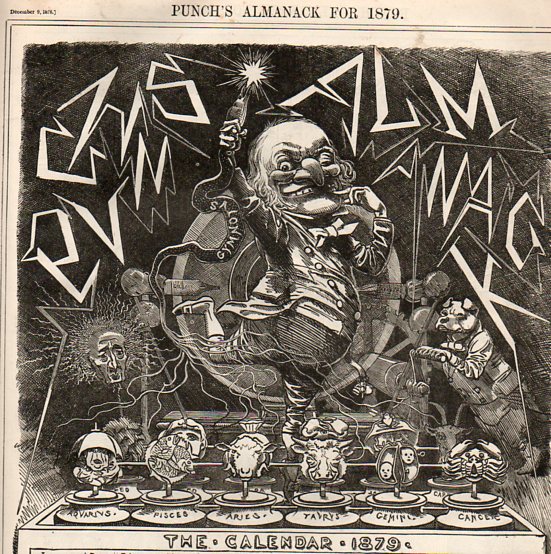
    Certainly they, the editors, the representatives of the thinking society, felt the electric mode of change in the air.  Punch greeted their readers to their almanac with this super-charged image:

    Edison electric620
    And noted, several pages later in the almanac, that their modern conveniences might soon find themselves as quaint antiquarians, housed in a museum, being visited by Mr. Punch and his dog touring the place, transported by some sort of electromagentic sumpin’:

    Edison electric621
    But for now, in 1879, the London Punch was content to spring on joke on Edison underwear.

    Notes:

    List of Edison’s patents, here.


  • Virtuosic Apocalypticism: Maps and Charts of Nuclear Exchange, 1964

    JF Ptak Science Books LLC  Post 1555  {Part of a long series on atomic and nuclear weapons].

    Today is the 66th anniversary of the first detonation of an atomic weapon at Alamogordo, New Mexico, July 16, 1945.

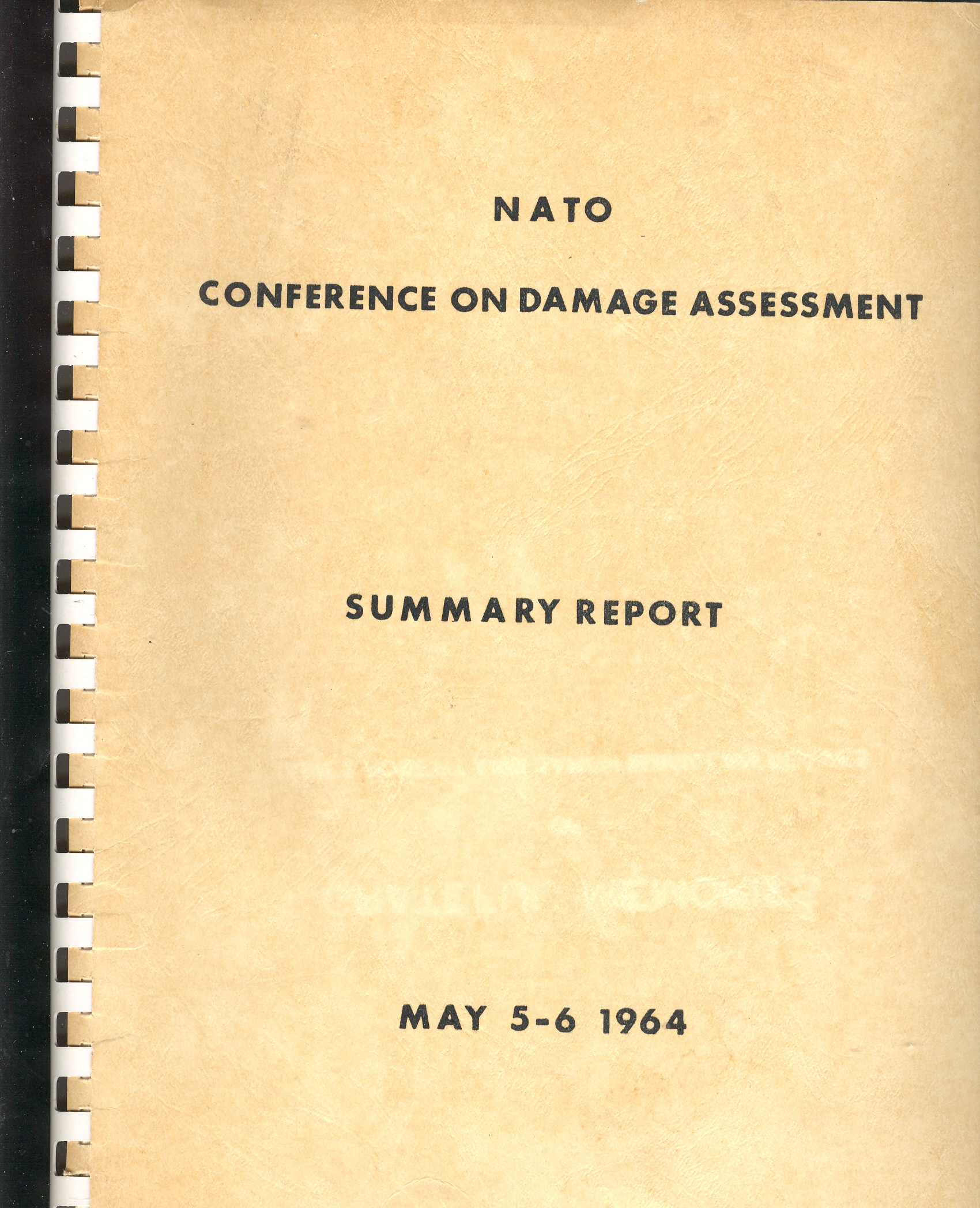
    March 3--cvr

    “…our choice of path may be delayed too long… “  Dante, Divine Comedy, Inferno, Canto XII, line XIII, 2nd level of Hell (envy).

    The NATO Conference on Damage Assessment Summary Report (May 5-6, 1964) was not one written for its outcome, necessarily, but the means of getting there. The outcomes were highly differentiated levels of sameness, a strategic tour of Dante’s creation cataloging the layers of deep destruction like those of his funneling pit. [This book is available through our blog bookstore, here.]

    Professionally  the paper dealt with several different ways of computing nuclear exchange scenarios (given names of understated inelegance like Jumbo, Brisk, Frisky, Dart and Dusk) with lots of smokily mirrored hocus pocus, the necessary ingredient of the philosophical technology of Mutually Assured Destruction. MAD.  Somehow it all worked out without any exchange ever happening. (The principal contributor here was James Coker, chief of the National resource Evaluation Center, Office of Emergency Planning, Executive off of the President.)

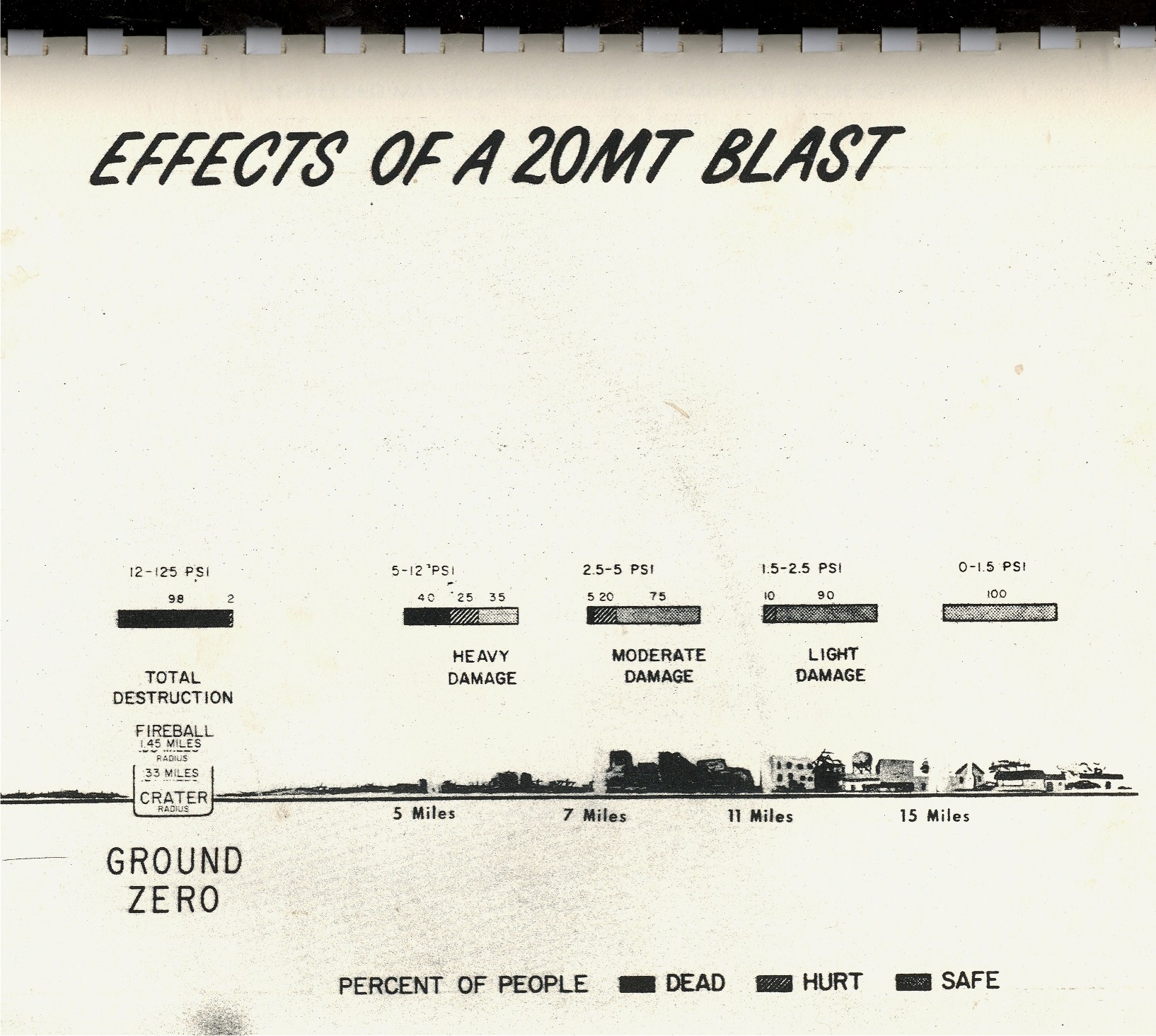
    March 3--20 mt blast “Which utterly with sadness had confused me,  New torments I behold, and new tormented Around me, whichsoever way I move,  And whichsoever way I turn, and gaze.”  Dante, Divine Comedy, Inferno, Canto VI, third circle, gluttony.


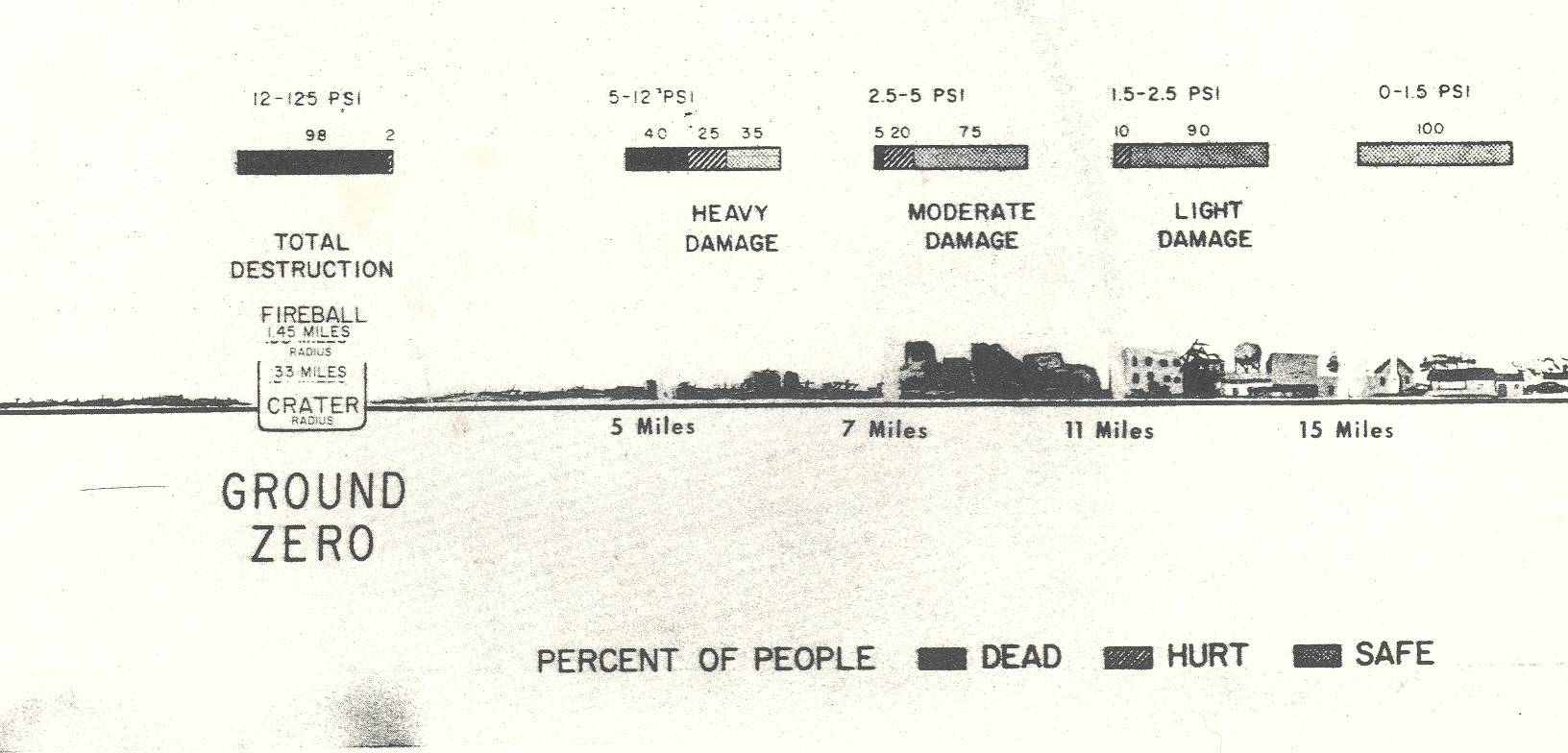
    The first image shows the effects of a 20 megaton nuclear blast detonated in in a city, presenting an incredible picture of absolute destruction, reaching out from ground zero for more than 11 miles.    


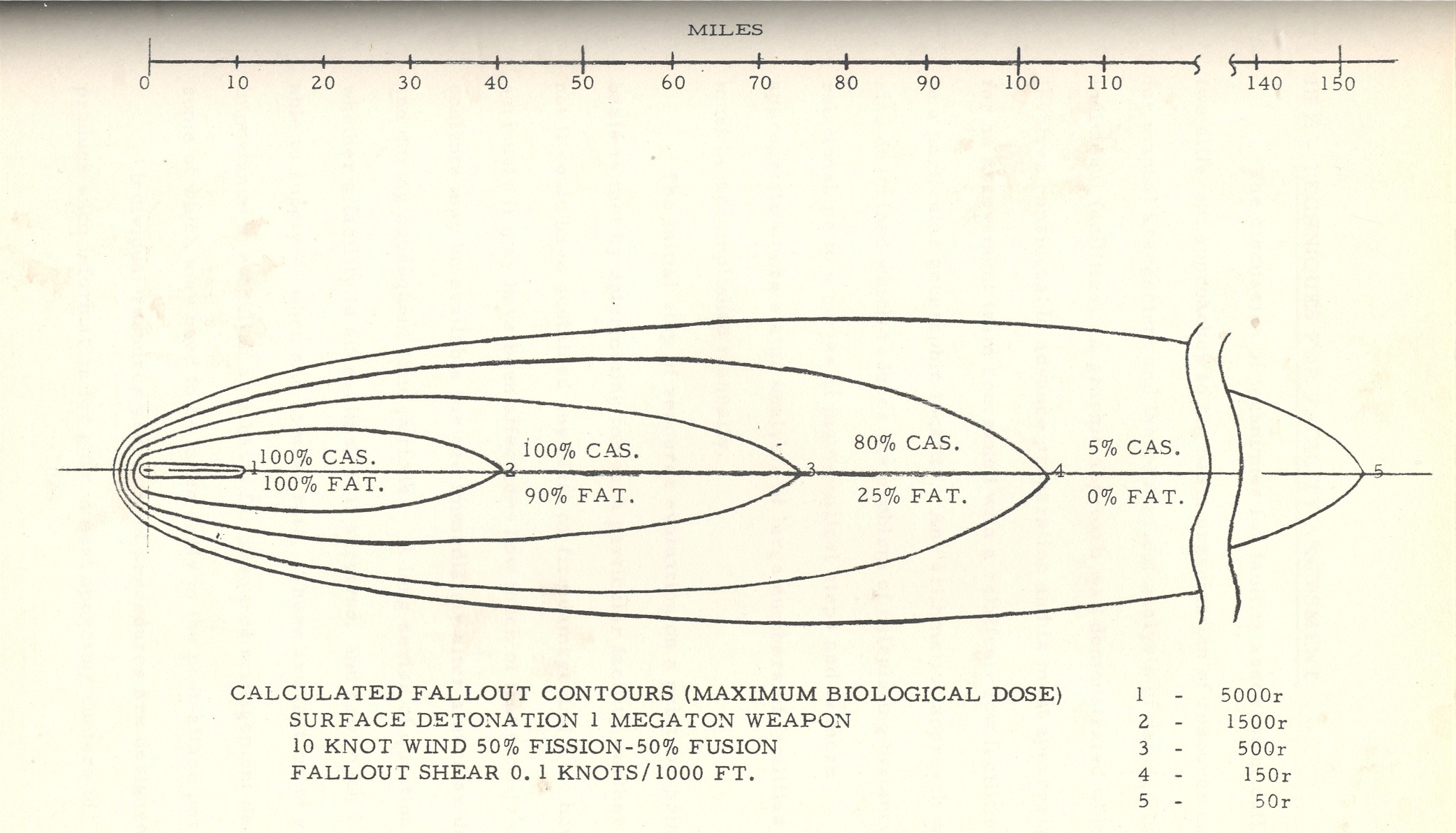
    This doesn’t begin to measure the overall damage inflicted by radiation, which is deeply, extraordinarily, severe.  This again is the effect of one weapon, the 100%  fatality rate eventually reaching out 12 miles; 90% reaching over 40 miles.  General casualties extend to 80% up to 70 miles from ground zero. 

    March 3--20 mt det blast
    March 3--spear

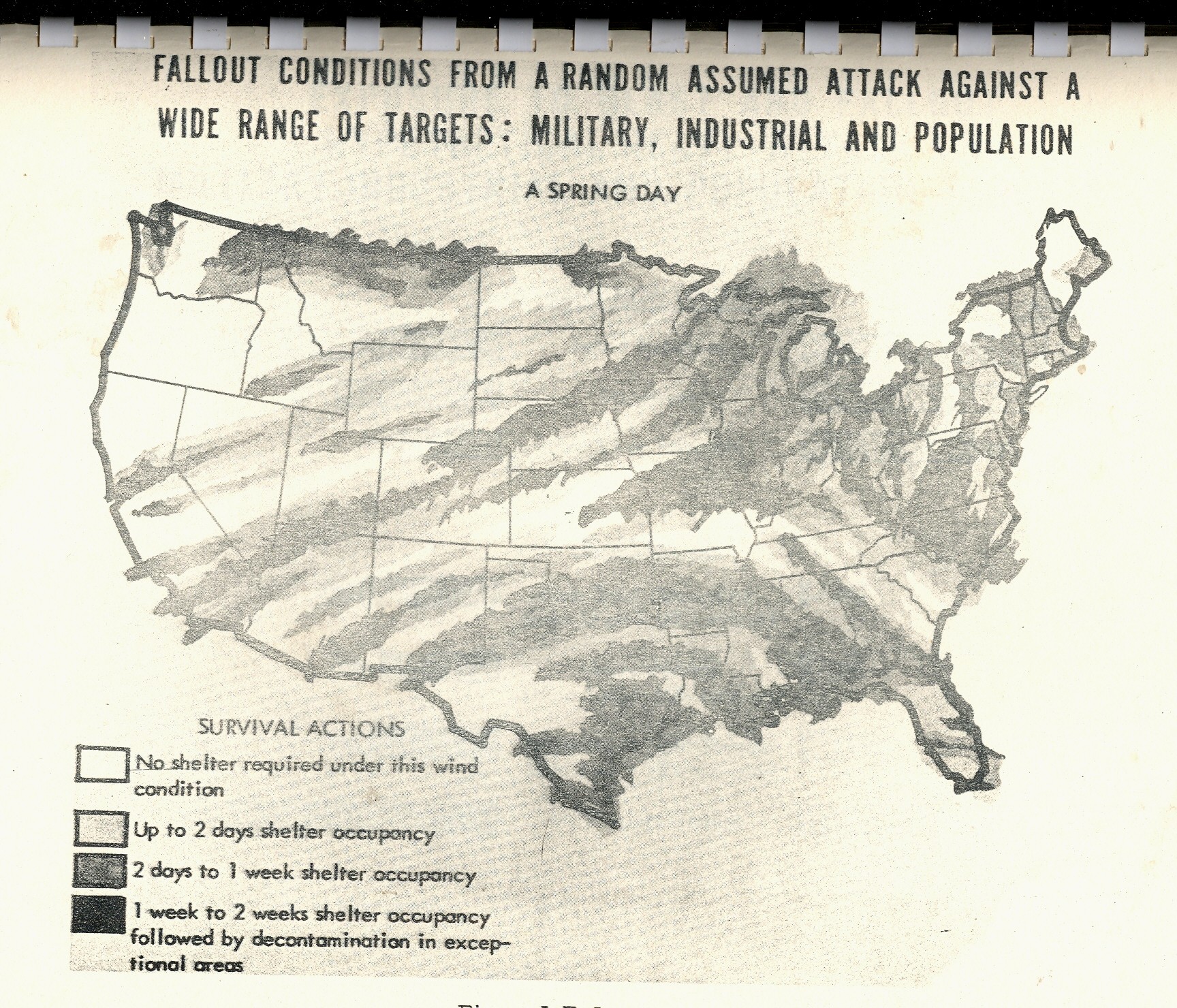
    The emergency planning end of the paper comes in at about this point.The fallout map of the U.S. shows a possible situation of an unspecified (though wide-ranging) attack (on a “spring day”) and its effects on the population as it is housed in various shelters and bunkers, suggesting the amount of time needed to “survive” the attack by staying inside the fail safe habitation.

    March 3--spring day

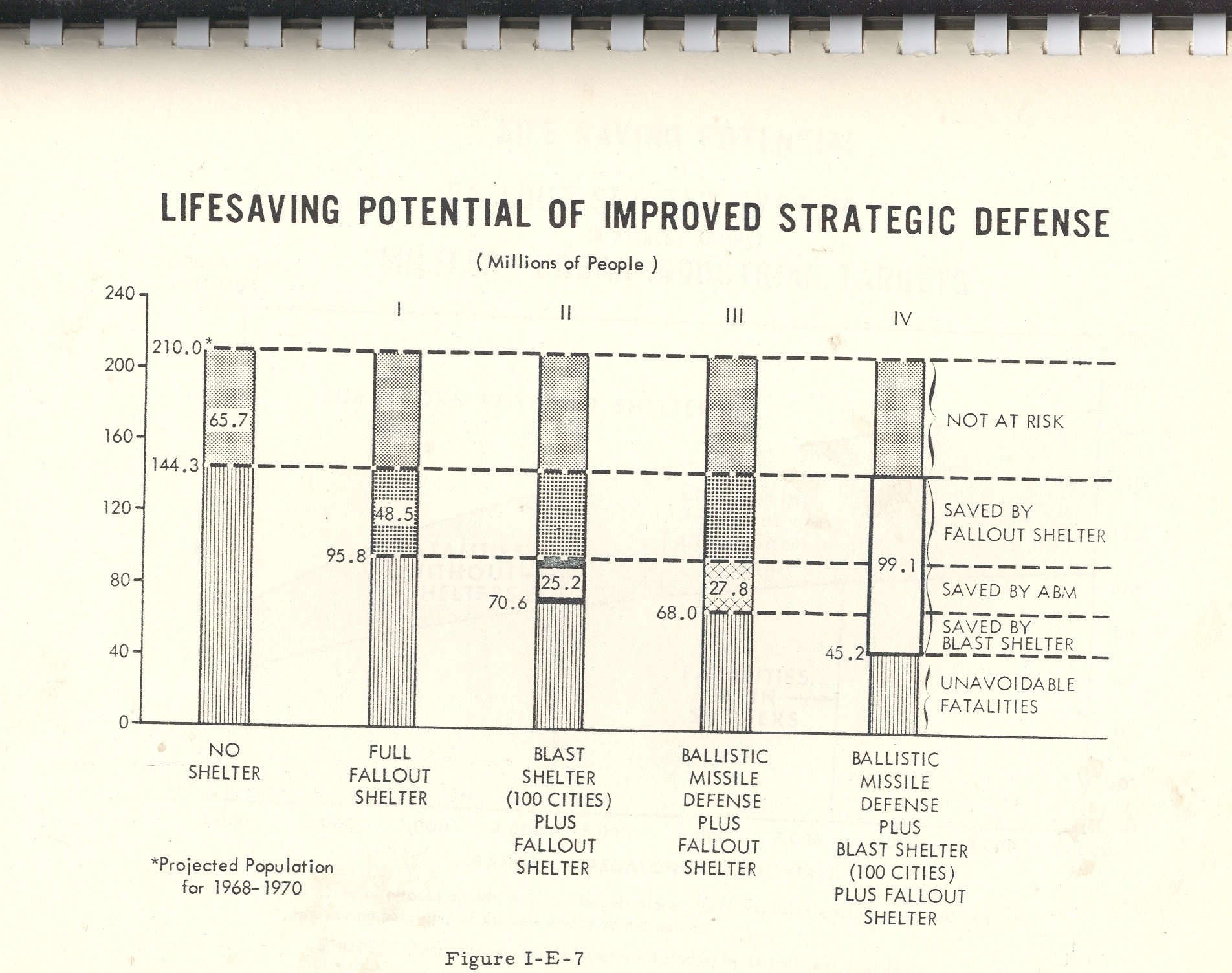
    The following chart, “Lifesaving Potential of Improved Strategic Defense” (in millions of people) shows the effect of the installation of the shelters and bunkers.  In this scenario, in  a massive strike, the fatality rate in the U.S. of an unprotected population was 65%, or 144 million.  On the other end of the extreme was “ballistic missile defense plus blast shelters plus fallout shelters”, or a massively- protected population of fictional expanse shows that in spite of all precautions 45.2 million people would die (as “unavoidable fatalities”). 

    March 3--life saving potential

    “These have no longer any hope of death;  And this blind life of theirs is so debased,    They envious are of every other fate.” Canto III, Vestibule of Hell, the Opportunists.
    This document is nothing if not a death sentence had the massive strike ever been launched.  In the dozens of such reports that I’ve seen, there hasn’t been one with the Really Big One with thousands of euphemistically-named “exchanges”, which I assume would make all  of these others pale by comparison.


  • The History of Aerial Bombing, Advertising and Laxatives

    JF Ptak Science Books  Post 1534

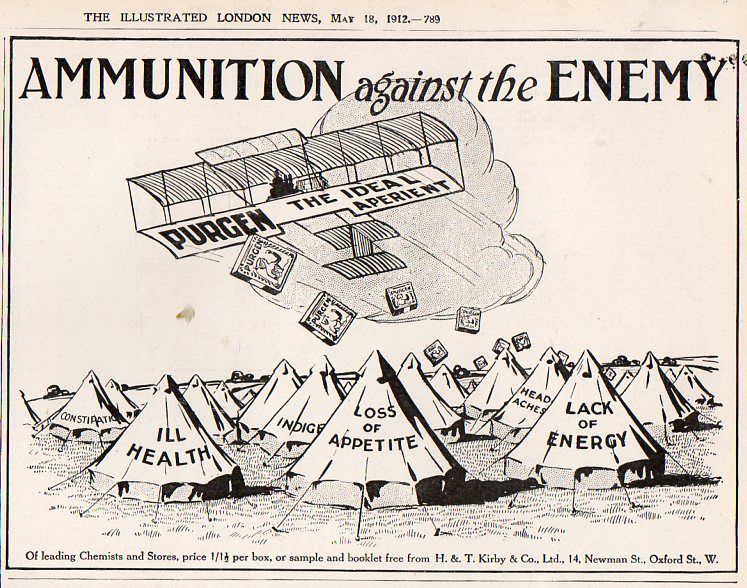
    The business of bombing people and places from airplanes/aeroplanes was fresh in the history of invention when this advertisement appeared in The Illustrated London News on 18 May 1912. 

    Bomb554
    Superweapons have been used against cities for quite some time in the new world of speculative fiction, and there had been real-life aerial bombings from hot-air balloons, but the first time that a bomb was dropped from a heavier-than-air airplane on anything happened just months earlier, on 1 November 1911, when Lt. Giulio Cavotti dropped a hand grenade from his Etrich Taube on the oasis of Tagiura, in North Africa during the Italo-Turkish War.  He dropped four parcels of hand grenades on the not-necessarily-military population at the oasis, injuring no one.  The attack was one of attempted vengeance, a payback by the Italians against the Arabs of Tripoli, in general, for having joined forces with the Turks to fight against them. 

    This air attack was fresh on the heels of a devastating slaughter of the Arabs at Tripoli on 25 October 1911–the Tripoli War would not come to an end until October of 1912. A complaint was lodged that the Italians had broken international law, as bombing from balloons had been outlawed by the Hague Conference of 1899–but the Italians argued that the spirit of the agreement did not apply to bombing from airplanes because airplanes were not balloons. The issue of the legitimacy of bombing from airplanes and then for bombing civilian populations would be a debated issue if not recognized as a restricted practice for decades to come.  As the cogs and wheels of the international court ground out its miniscule progress, people got blown up.  The people-blown-up part trumped international law almost every time. 

    In the meantime came this image of an airplane dropping boxes of Purgen, “the Ideal Aperient” on military-style tents  of “Ill Health”, “Loss of Appetite”, Lack of Energy”, and so on, all within the possibility of cure by this Purgen product.

    So, among the very first advertisements using the idea of aerial bombing as its own delivery system, was this one for Purgen.  A laxative.


  • Invasion Routes to the U.S.,1940

    JF Ptak Science Books  Post 1532

    This is a supplement to some earlier posts on this blog relating to the possibilities of the invasion of America:  Mapping the Invasion of America, 1942 (which is the most-viewed post from this blog, with over 500k readers), The Invasion of America, 1935,  and The Invasion of America, 1942, Part II to name a few examples.

    INVASION us  INVASION ROUTES

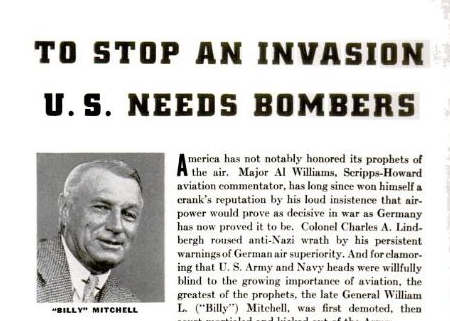
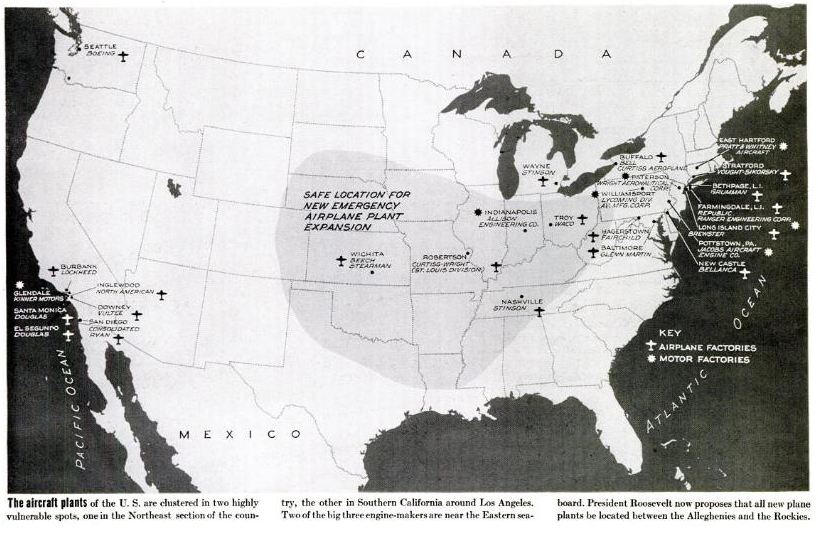
    In the 27 May 1940 issue of Life magazine appeared an article on Franklin Roosevelt’s call to American action in constructing an entirely new air force.   For years the air corps arm of the American military lingered in a kind of low-numbers unresolved limbo–but by May of 1940, it became painfully obvious that something drastic must be done.  By this point the European War was about eight months old, and the possibility of Nazi victory looked very real.  After all, the Blitzkrieg had been very successfully employed in Poland, and in May was used in the invasions of Finland, Norway, Denmark, Belgium, the Netherlands and Luxembourg. And France, of course.  By late May, 1940, France was already pretty much done, the Parisian capital falling weeks later on 23 June, with the country capitulating ten days later.  May also saw the collapse of the British and French armies along France’s northern coastline.  (The rescue of the 350,000 troops on the beach and in the harbor of Dunkerque had not yet taken place (but would within the next few days). It was bad stuff.)  In the light of the Nazi victories and the imminent fall of France, it was also time for people to start thinking about the invasion of England.

    Invasion-US

    Roosevelt and his adviser knew that America was headed into conflict, and knew that the country needed to get onto a war-time production basis. One way to begin preparations was for FDR to call for the increased production of the newest and one of the most important aspects of modern warfare, the airplane.  And not only an “increase” in production did the President call for, but a mountainous bump, an order of magnitude more in manufacturing of military planes. Earlier in 1938 the call for a 5,000-plane-a-year air force was shot down as being unrealistic–and perhaps so, even though the Nazis were just at the beginning of their outward thrust.  So in May, 1940, Roosevelt stepped up and asked for 50,000 aircraft. 

    No doubt the war in Europe gave everyone great pause, or scared them silly.  Two years before the number of 5,000 planes produced per year was seen as ridiculous–now the business of producing 50,000 a year seemed feasible–incredible, even, but the means of production were present, and so was the raw material and manpower.  It was seen that of the 84 aircraft production plants then functioning only 23 were producing military planes, so there could be a modernization of existing plants as well as the construction of new aviation installations. The production totals for the year 1939-1940–1,247 aircraft, including 477 produced for the U.S. Army and Navy, 311 for Great Britain, and 459 for France–represented only a small percentage of what the existing factories could actually produce. (And it turned out of course to be just the case, as we can see from the production numbers in the “notes” section, below.)

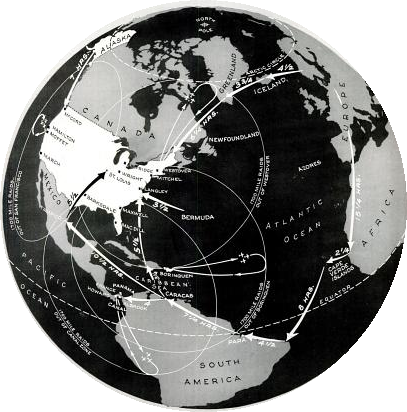
    There was also a certain amount of scare factor involved with waking up the American public to the needs for getting involved in the European conflict in the year-and-a-half before Pearl Harbor–that the Nazis wouldn’t stop in Great Britain, and that “invaders” could and would attack the United States. The need for increasing American war production was not only to supply the allied forces in Europe for stopping Hitler, but also would keep the Nazis away from the United States.  (Summarizing the points discussed by the President and other government officials, the map of the invasion of America looked something like the global view we see above.)  So if Roosevelt couldn’t stir the hearts and minds of the American public for keeping Europe aloft in American-built planes, then keeping the Nazis off Main Street might work. 

    What the map shows are the lines of attack for the un-named Nazi invaders–their aircraft making their way slowly across the Atlantic via Iceland-Greenland–Newfoundland, and across Europe -Africa-Cape Verde-Brazil-Paraguay-then across the Caribbean and right into Wilmington, North Carolina; and then of course all of the way across the Soviet Union to Alaska and then into Washington state.  The plan was that these advanced forces would come in, establish an airfield, grow , and then move closer to the U.S., stopping to construct bases all along the way.  The response, oddly enough, was for us to build “bombers” so that the airbases could be blown up.  That would also extend the effective range of air coverage from the United States to deal with the very-slowly-approaching enemy.  The circles on the map show the effective round-trip range of loaded American bombers and the territory that they could cover.  In general the map, in its own way, portrayed the United States as approachable to foreign invasion.  Some of this reasoning is a little inscrutable, but Washington was playing a game that needed to be won. 

    Invasion us 2
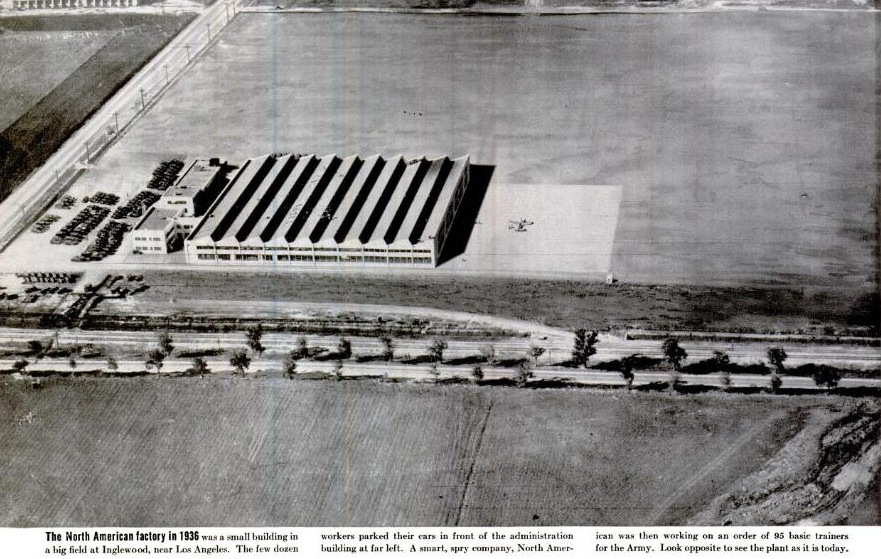
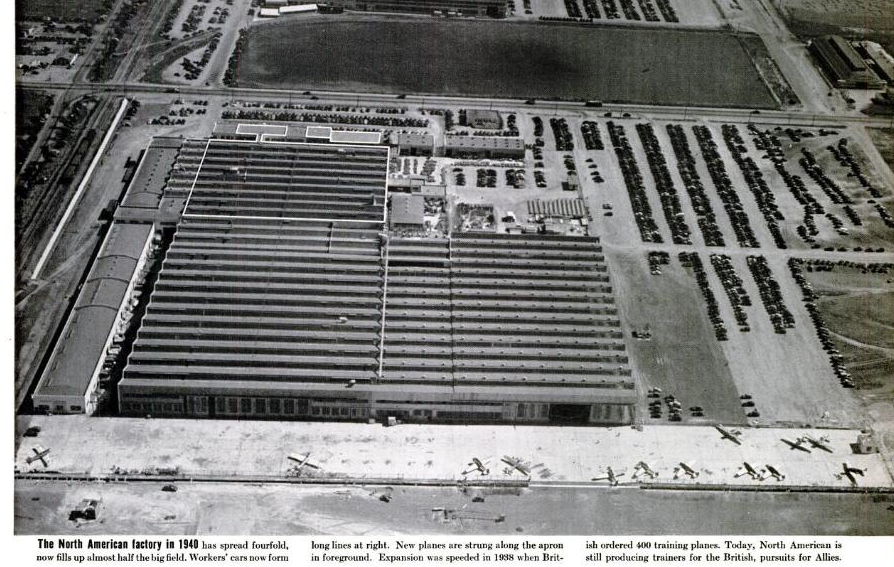
    These interesting before and after pictures of a ramped-up aircraft production industry were to supply some proof that the job could be done, and that this factory could very well be a template that the dozens of others could follow:

    [Aircraft production facility, “before”]

    Invasion US factory before [Aircraft production facility, “after”]

    Invasion US  factory after

    Notes

    Production numbers for U.S. aircraft manufacturing, 1940-1945:

    Type of airplane Total 1940¹ 1941 1942 1943 1944 1945²
    Grand total 295,959 3,611 18,466 46,907 84,853 96,270 45,852
    Combat airplanes 200,443 1,771 8,395 24,669 53,183 74,564 37,861
    Very heavy bombers 3,740 – – 4 91 1,147 2,498
    Heavy bombers 31,685 46 282 2,513 9,574 15,057 4,213
    Medium bombers 21,461 52 762 4,040 7,256 6,732 2,619
    Light bombers 39,986 453 2,617 5,954 11,848 12,376 6,738
    Fighters 99,465 1,157 4,036 10,721 23,621 38,848 21,082
    Reconnaissance 4,106 63 698 1,437 793 404 711
    Support airplanes 95,516 1,840 10,071 22,238 31,670 21,706 7,991
    Transports 23,900 164 525 1,887 6,913 9,925 4,486
    Trainers 58,085 1,676 9,294 17,237 20,950 7,936

    1,352


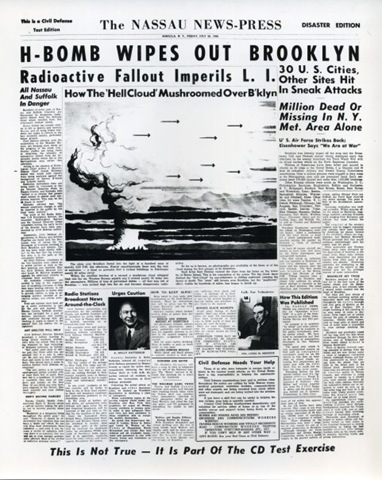
  • H-Bomb Wipes out Brooklyn. And Chicago. And New York.

    JF Ptak Science Books  Post 1527          Part of the Atomic and Nuclear Weapons series

    Wipe out Brooklyn

     [Source:  Conelrad blog and also at the website]
    I stumbled on this bombing of Brooklyn article at the excellent Conelrad website–it is an excellent addition to my slight collection of vintage depictions of American cities being nuked.  As part of the necessary scare tactics in the pursuit of the arms end of MAD, the destructive power of these weapons were shown against a background that Americans could readily understand.  Thinking of atomic and then nuclear holocaust in terms of multiple units of Hiroshimas and Nagasakis was one thing–showing the effects of these weapons on an American grid was something else.

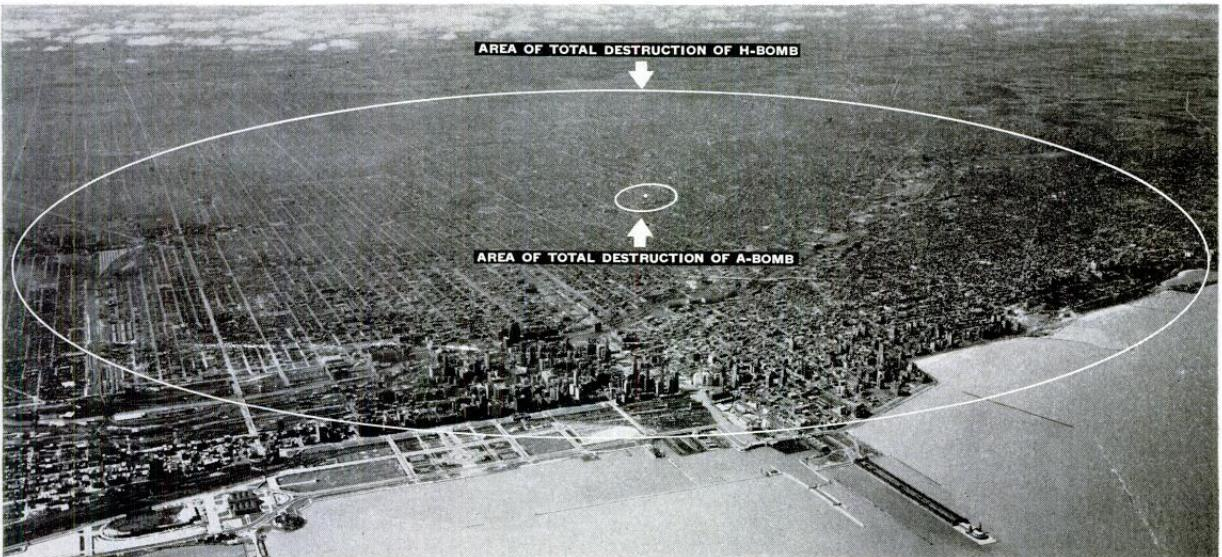
    This next  graphic shows the difference in destructive capacity of an atomic bomb (small circle beneath an air-burst detonation) and a hydrogen bomb (the large circle showing area of total destruction, which in this case would be about 50 square miles) on the city of Chicago.

    Wipe out chicago
    [Source:  LIFE Magazine, 30 Jine, 1950]

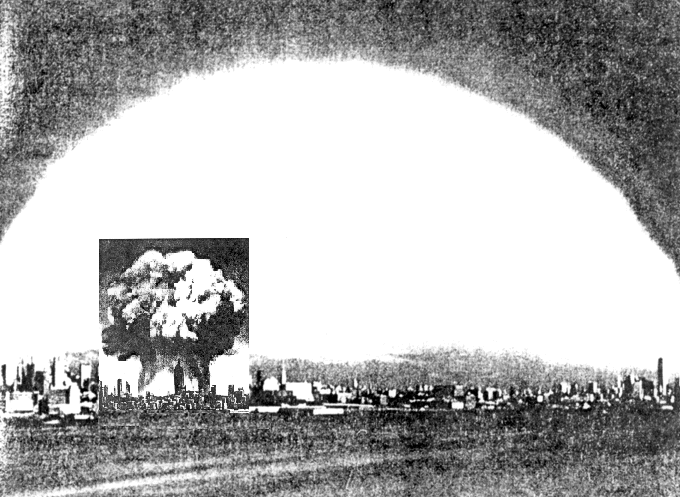
     The next image is much like the preceding, only showing a profile of Manhattan and the difference between the explosions of a Hiroshima bomb and a hydrogen bomb (of 20 megatons).

    http://bioinfo.mbb.yale.edu/~mbg/fun/both-bombs.gif

    [Source: BioInformatics Lab, Yale  http://bioinfo.mbb.yale.edu/~mbg/fun/both-bombs.gif]]

    But don’t worry, even if the Chicago and Brooklyn and New York and so on were destroyed, the U.S. Navy would survive, which would  be either great or horrible if you were a sailor:]

      H-Bomb  WIpe out NAvy
    And as usual, the point is made with one weapon being detonated, rather than the x-number that would actually be deployed.  Depicting, say, 10 weapons being used against these cities–while being a more accurate portrayal of what nuclear war might look like–might have looked like something beyond the usefulness of propaganda. 


  • Strange Things in the Sky Department: When Worlds Collide (1933+1951)

    JF Ptak Science Books   Quick Post  Part of our Strange Things in the Sky Department

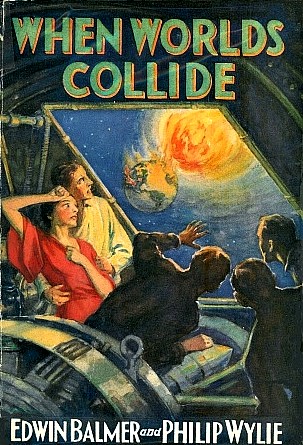
    When Worlds Collide wasn’t so much about another world colliding with the Earth–it was another star, a “rogue star”, that enters the solar system and heads directly towards the Earth.  Luckily for a selected few, a billionaire astronomer sees the thing coming and decides to construct a spaceship to populate a friendly “planet” near Alpha Centauri.  Oh well, its 1933, and perhaps anything was possible–after all, the Empire State Building (which is depicted in so many of these movie posters in a not-good way) was just finished in 1931, after two years of construction (!). 

    So the following are movie posters for the 1951 film version of the 1933 book–except for the first image, which is from the book.

    Strange sky--when worlds collide   


    http://www.mattfind.com/12345673215-3-2-3_img/movie/v/z/n/when_worlds_collide_1951_300x439_193460.jpg


  • Strange Things in the Sky Department: Floating Ships, Cities, Airports

    JF Ptak Science Books   Quick Post

    This is a  continuation of a  series of posts in the Strange Things in the Sky Department. 

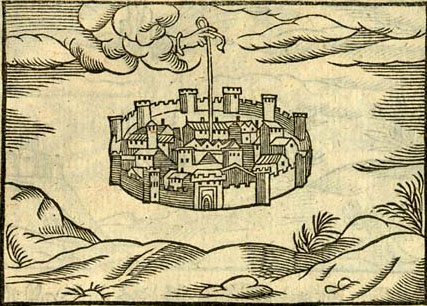
    This image of St. Augustine’s City of God shows the Primum Mobile holding the walled city (Rome, or Romish) aloft, the artist distinguishing it from the earthly city:

    http://iamyouasheisme.files.wordpress.com/2010/09/heavenly-city.jpg

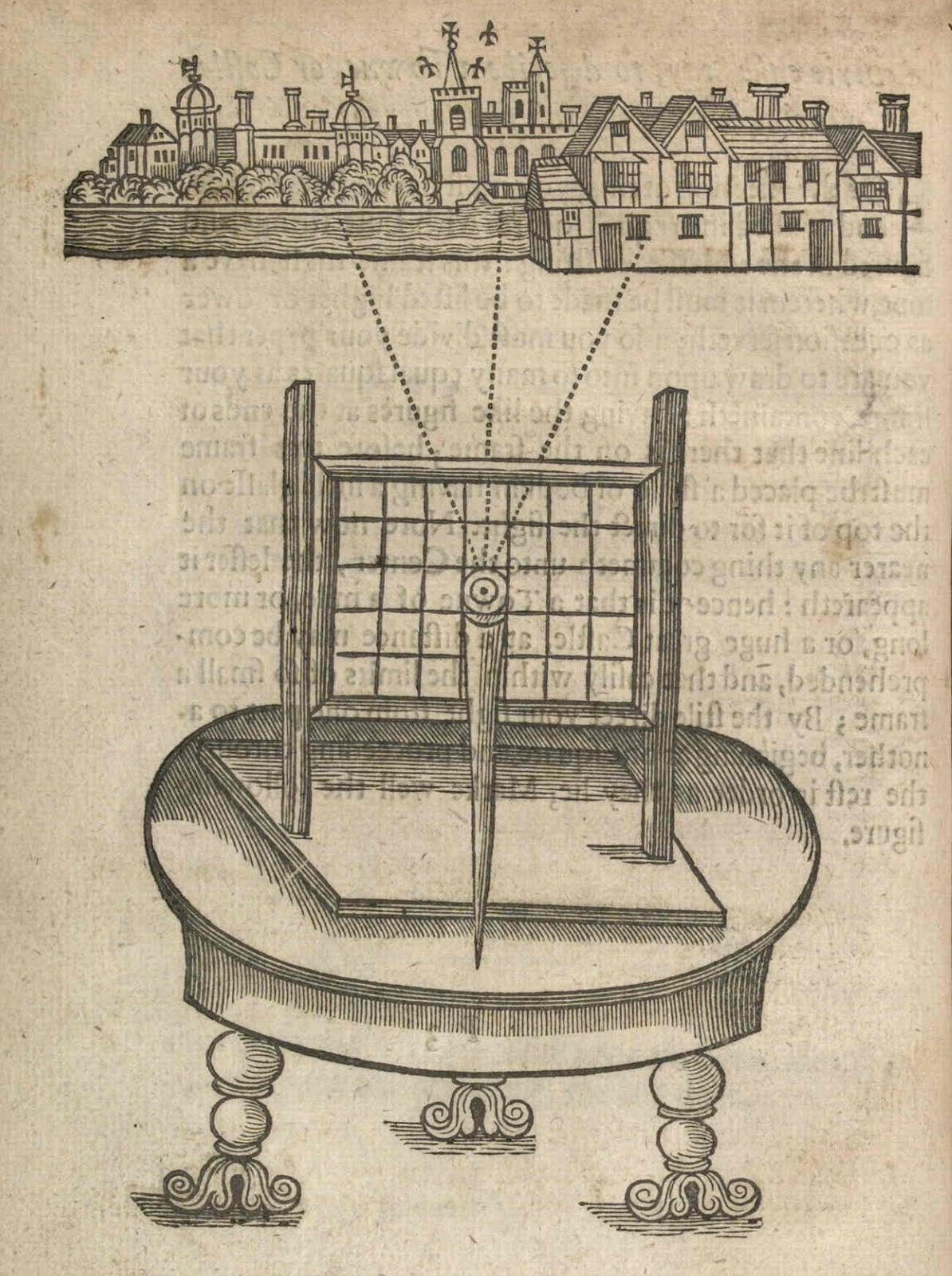
    Strange things sky Perspective drawing

    Perspective drawing apparatus, from  John Bates’ encyclopedic The Mysteryes of Nature and Art : Conteined in foure severall Tretises, the first of Water Workes, the Second of Fyer Workes, the third of Drawing, Colouring, Painting, and Engraving, The fourth of divers Experiments, as wel serviceable as delightful: partly collected, and partly of the Authors Peculiar Practice, and Invention, printed in London ” for Ralph Mab and are to be sold by Iohn Jackson and Francis Church at the Kings armes in Cheapside 1634″.   [Source: the fabulous Bibliodyssey blogsite.]   This was a book that Isaac Newton owned and worked from when he was a teenager, using its useful recipes and instructions to build a number of bits, prankish and practical.  (This city isn’t actually floating, of course–it just looks that way.)

     [airwonder_1929_11_frpaul.jpg]

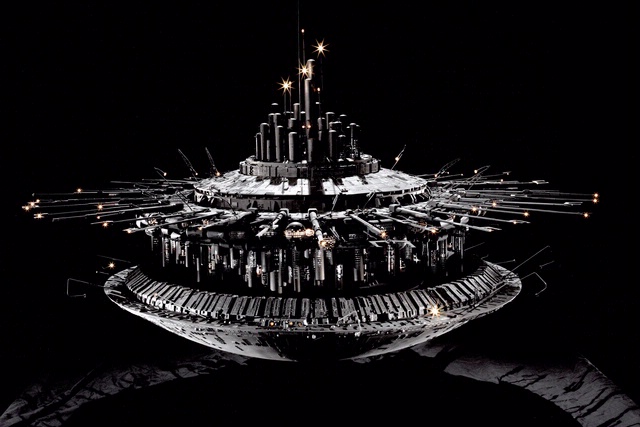
    Here’s a semi-famous illustration that appeared earlier in this blog–perfect here to offset the older “floating cities”.  This one depicts a floating or hovering or anti-gravity-something installation of a future Manhattan, existing peacefully above its former Earth-bound base, now overgrown with nature.  The New Manhattan Air Island is many square miles of buildings, and reminds me of the mothership from Close Encounters of the Third Kind. 

    http://www.nasm.si.edu/webimages/640/WEB10041-2003_640.jpg

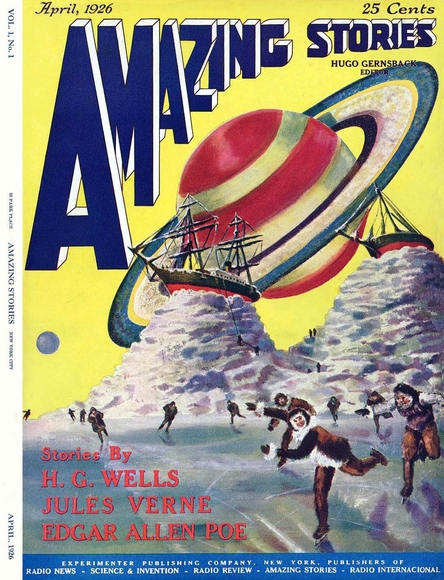
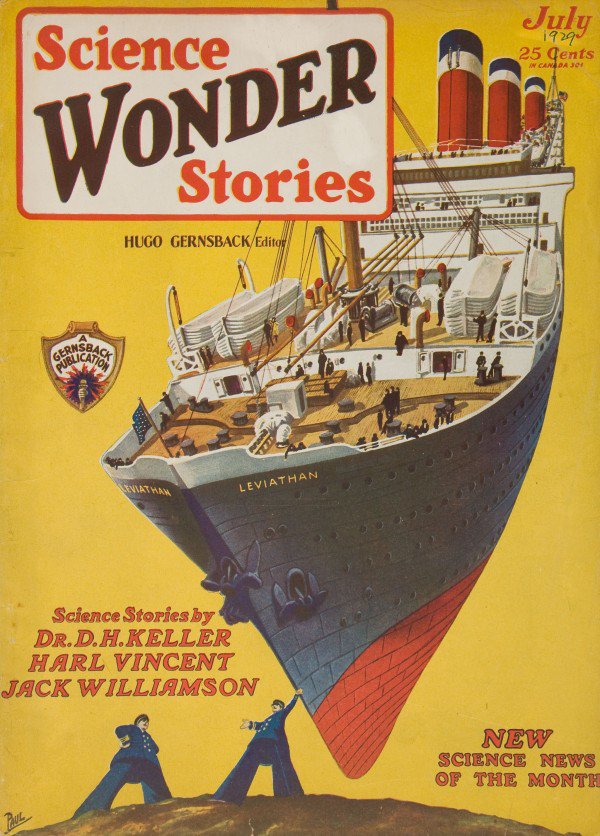
     I just don’t know the story behind this image, though perhaps it is…well, I don’t know.  There’s a whole lot of things that it could be, but then there’s the Tall Ships on the top of mountains of ice and the air-breathing skaters in the foreground…I don’t know: 

    Strange things in sky  saturn


    Science Wonder Stories ship in sky

    [Source: http://pulpcovers.com/tag/sciencewonderstories/]

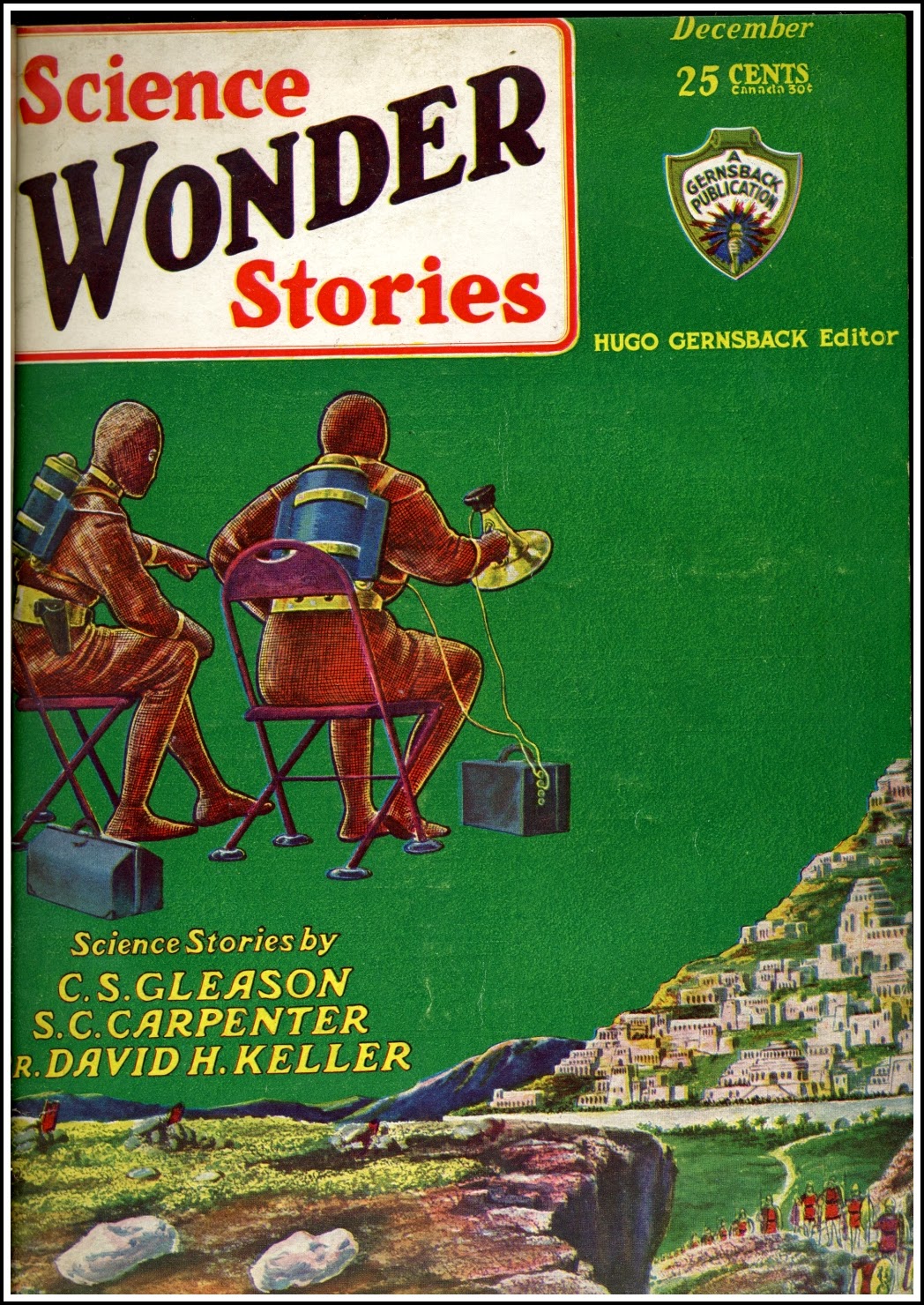
     And this in a sort-of opposite way to the above, a disembodied sitter in a very articulated space:

    Science wonder stories seated floating

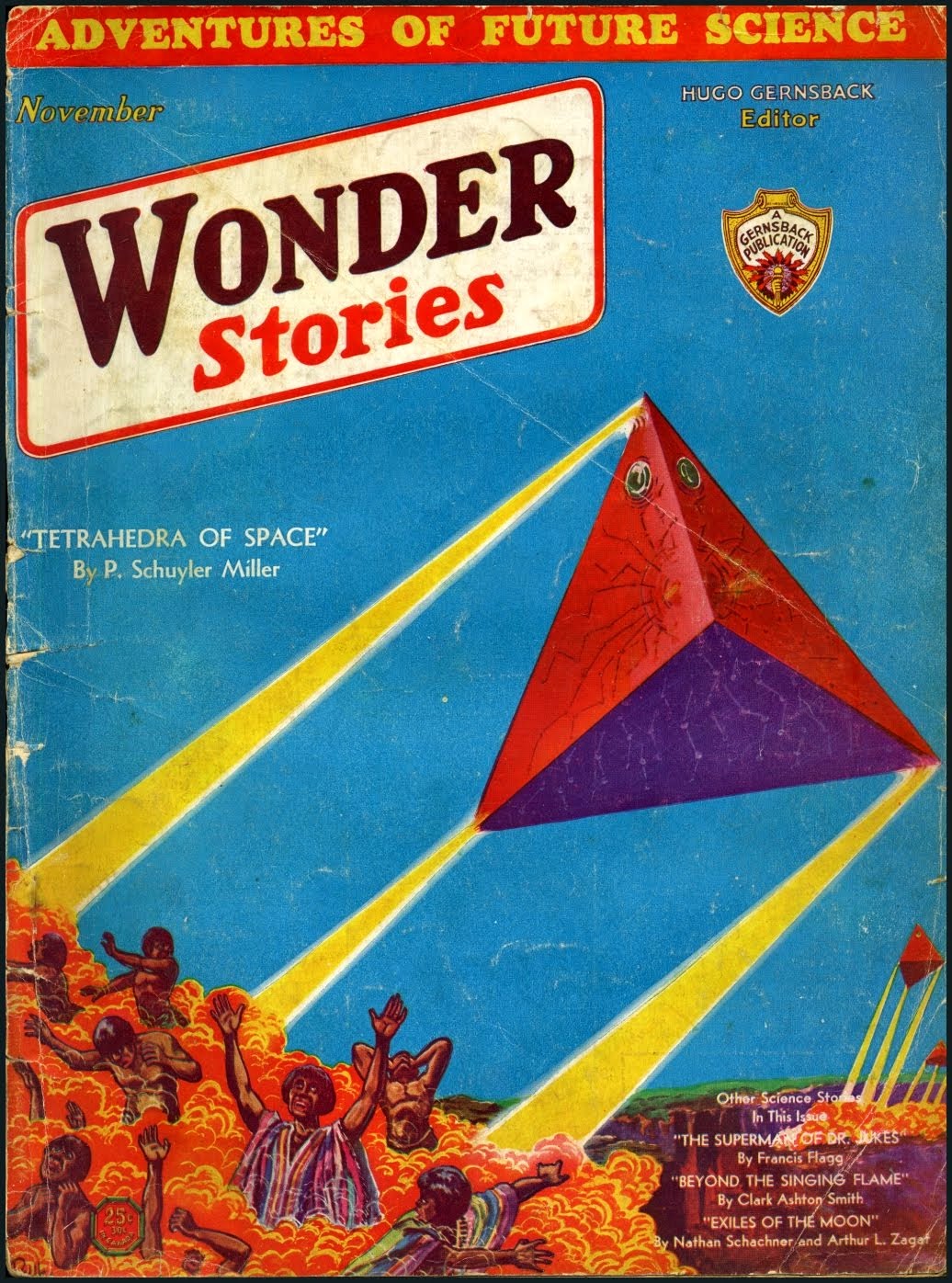
     I’m not sure what to make of these buggers, though it is very creepy looking…,perhaps its the bad-blue sky that just sets everything off badly:

    Wonder stories cubic triangles

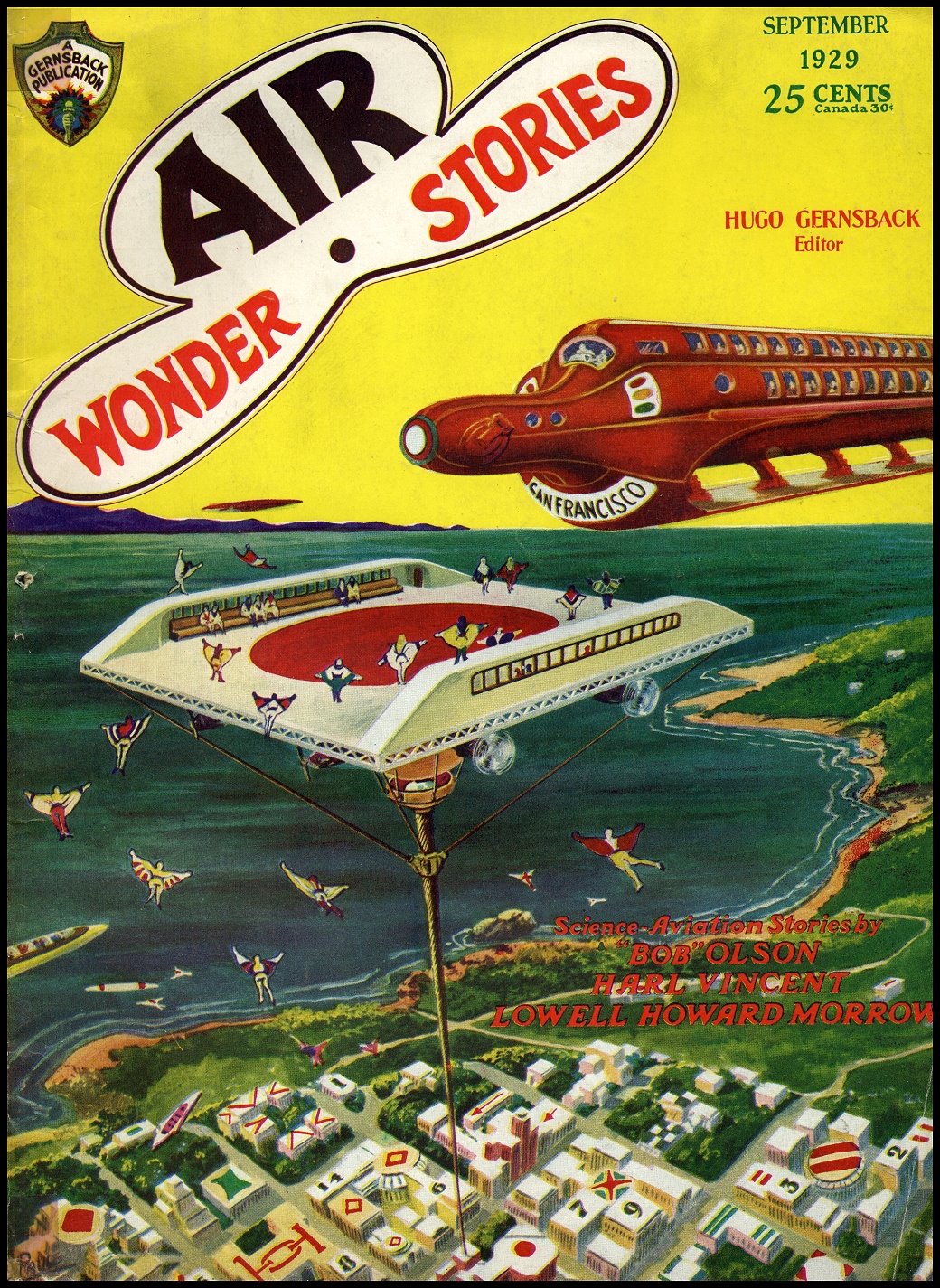
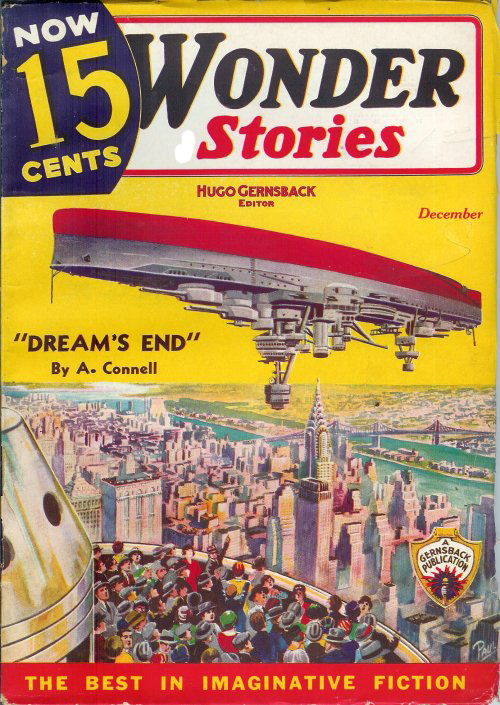
    This image from yet another ubiquitous Gernsback publication and shows (another!)  floating airpad/port for whatever sort of hovering vehicle that approaches.  Interestingly there are a number of skydivers using unisuitwhich probably seems pretty attractive to skydivers today.  Also the roof decorations are unexpected!


    Airwonder_1929_09_frpaul


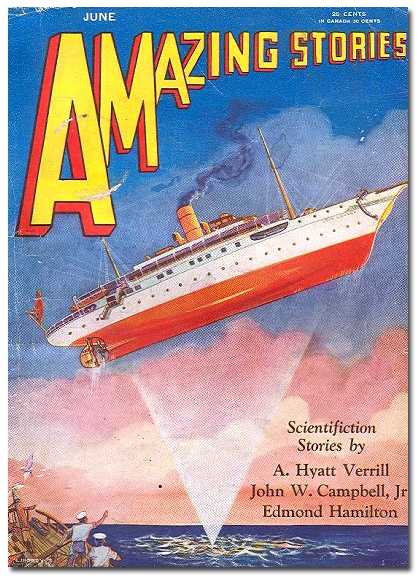
    Amazing stories floating ship

    [Source: http://thatsmyskull.blogspot.com/2007/11/ocean-liners-in-sky.html]

    WOnder stories upside down floating ship