A Daily History of Holes, Dots, Lines, Science, History, Math, Physics, Art, the Unintentional Absurd, Architecture, Maps, Data Visualization, Blank and Missing Things, and so on. |1.6 million words, 7500 images, 4.9 million hits| Press & appearances in The Times, Le Figaro, Mensa, The Economist, The Guardian, Discovery News, Slate, Le Monde, Sci American Blogs, Le Pont, and many other places… 5000+ total posts since 2008.

Category: History of the Future

  • The Steampunk God and the non-Computer Internet, 1865

    JF Ptak Science Books   Post 1521

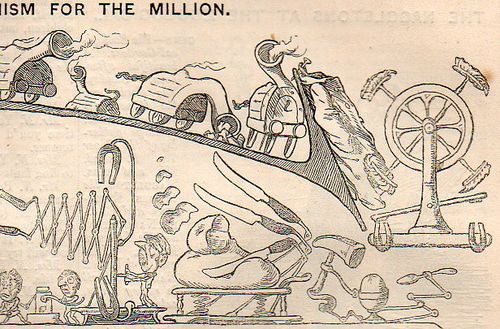
    In the weeks following Lincoln’s assassination (14 April 1865) the editors of Punch, or the London Charivari printed this arresting image of an imagined near-future:
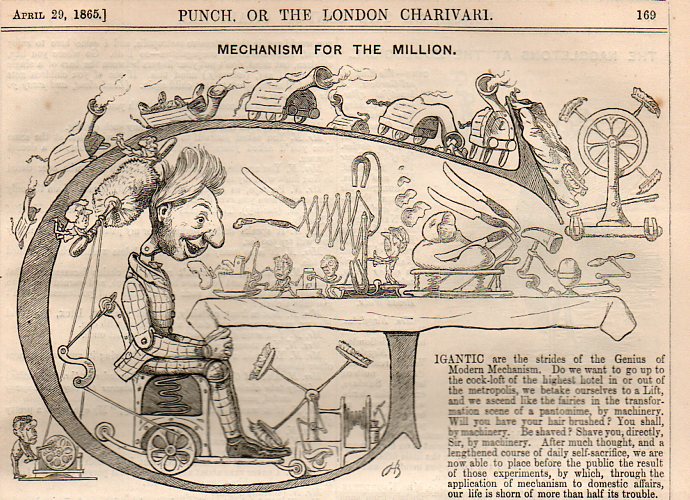
    Mechanism545

    And what the future holds is this: the automatic hydraulic teapot (already “sugared and milked”), automatic boot and clothes brushing, auto bread-cutting, carving, cork drawing, sweeping, letter writing, reading…”all done by machinery”.  “We shall cook by machinery; we shall have our mashed potatoes by machinery.”

    There is no specification about how all of this was going to happen–I’d be very interested about the automatic “letter writing and reading” would be,  particularly when we read in the next paragraph, that “Mr. Babbage’s Calculator is a mere mechanical infant to our gradually matured inventions”.   The article continues: “From thinking of machinery we shall at last arrive at thinking by machinery, and Man himself shall be, as presented in this initial etching, a mere machine.”

    We see in the image that there are all manner of automatons pleasing the seated (mechanical) man, though they are all powered by steam, or friction, or by magnets, all existing power sources and almost everything being doable at that point in time. 

    And the detail:
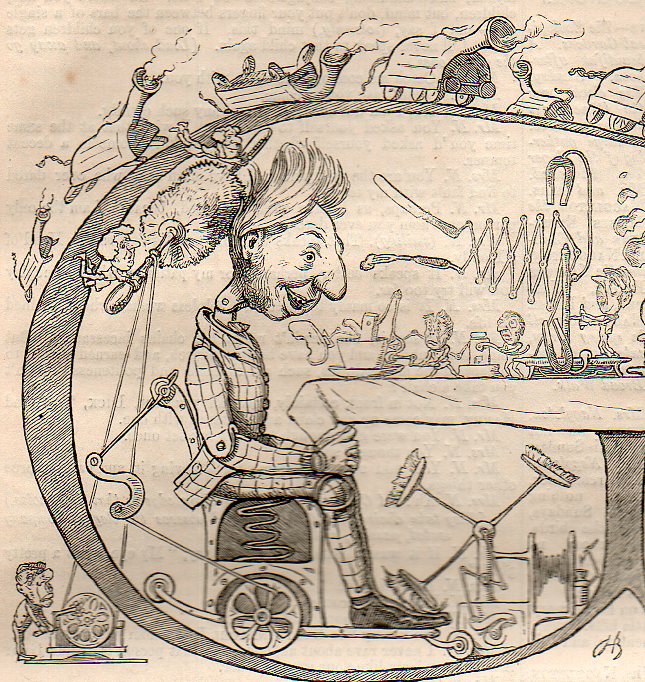
    Mechanism547  And this:

    Mechanism546

    There is a suggestion of a “Finding Fault Machine” but this goes barely beyond its mention–except to say that it would destroy something and become our next “Infernal Engine”.  I initially liked the sound of the title of this machine, though it quickly started to seem like a god machine to me–something that could and would have the ability to find faults in things, and then, I guess “correct” them in some sort of Steampunk God way. I’m not very educated in the world of speculative/science fiction to determine how early people began to imagine constructing their own supreme deity, though it seems to me that this must be considered an early effort.  I do have large doubt that the Steampunk God is what these folks were talking about since it would most probably be a blasphemy, but there is certainly room to reach that conclusion.

    The idea of a popular machine that was somehow associated with either Babbage’s (1791-1871) difference engine or analytical engine (which was a programmable machine that would function with punch cards) and automated or mechanical reading and writing is very intriguing.  It is unsure whether the editor was crediting the future with a machine that would provide the imagination behind writing, or provide an instrument that would record thoughts and creativity directly to some medium as they occurred, or what have you.  It is an interesting idea left very open-ended to the reader, which remains so even to the modern eye, because what happens with statements like this is that they get back-filled with whatever current technology exists.  In 1865, the other innovations depicted for the future were mainly driven by steam, and perhaps this automated writer/reader would be too, something very primitive by our standards today, perhaps some sort of small steam engine that would help dip a quill into an ink pot….or perhaps it was simply something as exotic as a pen with endless ink.  But I think if you look hard enough at the statement it is possible to see something like an internet.

    And there were 19th-century something-like-an-internet things being imagined, if you can imagine the internet as an entity not created by a computer network, since the “computer” as we know it would not exist for these inventive folks (below) for another 50 or 75 years. 

    Edison’s was there, of course, imaging a communication device that would show live-action events in which two remote parties could see and talk to one another.  A version of his Telephonoscope: appeared in Punch’s Almanack for 1879 and was aimed at the imagination and experience of only the classes of leisure and privilege:
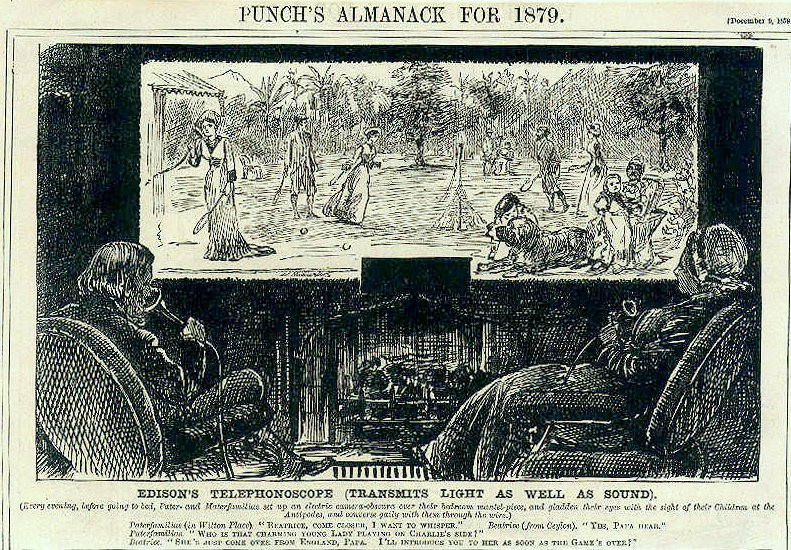
    File:Telephonoscope.jpg

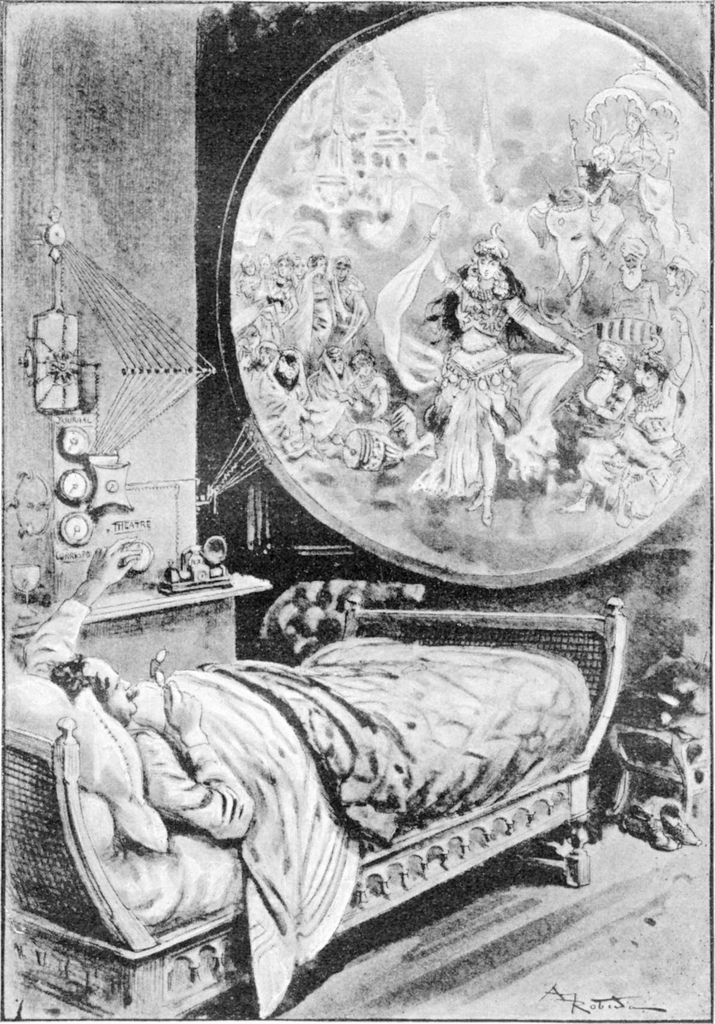
    There is also a device like this that appears in Albert Robida’s Le Vingtieme Siecle:  la Vie Electrique (1890) , which is  an odd but very nicely illustrated look into the future of 1955–most of which has come to pass.

    http://www.gloubik.info/livres/robida/images/robida-06.jpg

    http://cultureandstuff.com/wp-content/uploads/2011/05/levingtiemesiecle.jpg

    Another sort of live-action and direct communication device was depicted in Camille Flammarion’s La Fin du Monde (1893):
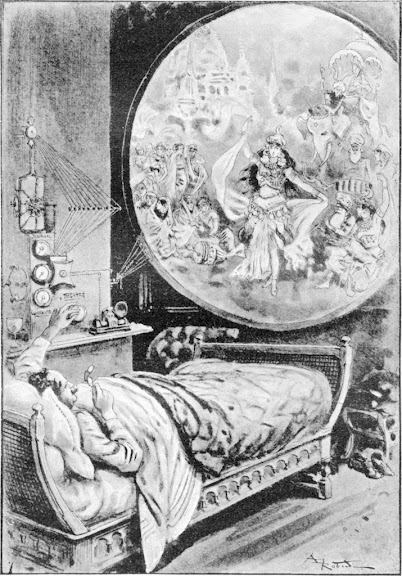
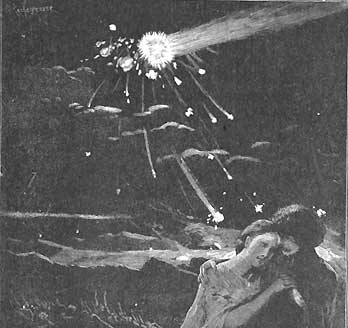
    I think though that the most interesting part of Punch’s view of the future must lie in the possible creation of the creator of the universe. 


  • Are You Smarter than a 5th Grader (1879)?

    JF Ptak Science Books  Quick Post–thanks to Andy Moursund for digging this up

    This sample examination for students in the Washington, D.C. public school system appeared in the Fifth Report of the Board of Trustees of Public Schools of the District of Columbia, 1878-79, and seems to me a  great head’s-up/wake-up call to any and all.  It was sent to me by my friend Andy Moursund (owner of the great Georgetown Bookshop in Washington, D.C.), and makes me wonder how well adults in 2011 would perform on the exam.  Luckily for us moderns there’s a lot of subject grading that could go on here, so the true results of such a thing taken today would be a private affair–but people would understand exactly where they stood in relation to a 10-year-old in a public school, 132 years ago.


    WASHINGTON, D. C. PUBLIC SCHOOLS

    QUESTIONS FOR THE ANNUAL EXAMINATIONS, 1879

    INSTRUCTIONS.—The sheet of paper to be written upon must be so place that the widest margin will be at the top of the page, and the narrow space for numbers of the questions on the left.  Marginal lines have been ruled, and the writing should not extend beyond these.  The number of the question should be written in the narrow space between the vertical ruled lines.   Each subject should be written only once, on the upper line, near the middle of the first page, and the name of the pupil should be written to the right of ti, on the same line. A line should be left blank after the subject, and after each answer.  Not more than one subject should be written on any page.  The pages used for each subject should be numbered from one upward, and the number should be written near the upper outer corner of the page, but inside the marginal line.

    In arithmetic give the work in full, and before the answer write Ans. No credit will be allowed if the work is not given.  When a subject is finished, take the work to the teacher’s desk.  Pains should be taken with expression, arrangement, penmanship, and neatness in the written work, as it will be preserved in the office of the Superintendent, and be subject to inspection; but the work must not be copied.

    ——————–


    FIFTH GRADE.


    JUNE 2.


    GEOGRAPHY. (Two credits each.)

    1. What are the principal mineral products of the United States, and where is each found?
    3. Which are the five leading nations of Europe.
    5. Give a brief description of the Sahara.
    8. Of what does the Chinese Empire consist?
    10. Make the diagram and draw the outline of South America.

    MUSIC (Two credits each.)

    1. How many sounds in the scale?
    2. Write the numeral names of the scale; also the syllables used in slugging the scale.

    JUNE 3.


    ARITHMETIC (Three credits each.)

    1. What is prime number; least common multiple; complex fraction;
    3. Write the six propositions showing the effect on the value of a fraction of multiplying and dividing the numerator and denominator.
    5. If 323 1/5 yards of cloth cost $33.45 ½, how much will be gained on each yard by selling the cloth for $45.13?

    PHYSIOLOGY. (Two credits each.)

    1. Describe the heart.
    2. Describe the larynx.
    3. How is air changed by respiration?

    JUNE 4.


    GRAMMAR.  (Two credits each.)

    1. Define the words “subject” and “predicate,” as used in a sentence.  Give an example, showing a simple subject and a compound predicate.
    4. What parts of speech have person and number?
    9. Name the adjectives, adverbs, prepositions, and conjunctions in the following sentence:
           The arose about this time a man named Cromwell, of incredible depth of understanding,
        strict integrity, and unwavering resolution.

    DRAWING (Five credits each.)

    Blank form for drawing furnished to the pupil, containing the following instructions:

    1. To the pupil: Draw without ruling or measuring from the copy placed before you. (Time allowed, 20 minutes.)
       To the teacher: Put upon the board one of the vase forms on page 15 of the drawing book.
    2. To the pupil: Draw the quatrefoil 4 inches in diameter, and put in it from memory any design you have made.  (Time allowed, 40 minutes.)

    SOURCE: Fifth Report of the Board of Trustees of Public Schools of the District of Columbia, 1878-79.  

    ·Posted by :

    ·in:


  • Alpha & Omega Department: Omega, Heat Death, and Speculative Fiction, 1893

    JF Ptak Science Books   Post 1514

    “The more the universe approaches this limiting condition in which the entropy is a maximum, the more do the occasions of further change diminish; and supposing this condition to be at last completely attained, no further change could evermore take place, and the universe would be in a state of unchanging death.”–R. Clausius, 1868

    Flammarion heat death (this will be the end)

    I wonder about the appearance of the Second Law of Thermodynamics (the Entropy Law) and its influence on creative, speculative literature.  Its really about the juicier two-word interpretation–Heat Death–that I wonder about, along of course with the 1st and 2nd laws, and its influence on relating the story of the end of the world, the destruction of the Earth, the depletion of the universe.  One can see the possibilities of the of the ideas of the fourth dimension in the creation of modern art and their influences on people like Picasso and Duchamp, even though that influence took decades (in the case of Marey to actually “appear” in art.  Where was the influence of entropy in literature?

    The business of “heat death” and the Second Law is of course necessarily based upon the First Law of Thermodynamics (and the work of the beautiful Hermann von Helmholtz in 1847), and which finds an outline of a home in the early work of Sadi Carnot (in 1824, on mechanical energy loss) and more comfortable foundations in the work of  James Joule  (in 1843),  Rudolf Clausius (in 1850) and William Thomson1 (in 1852, “On a Universal Tendency in Nature to the Dissipation of Mechanical Energy”).  The Second Law belongs to Rudolf (“Santa”) Clausius, whose 1850 paper in the Annalen der Physik begins the establishment of  the “the most universal regulator of natural activity known to science”, an idea solidified in his 1854 paper (in the same journal), where the concept of “entropy” is introduced though the name not actually used (a slightly complex history of the word, to be sure, though it makes its appearance, finally, in an 1865 paper). 

    Von Helmholtz famously establishes the death of the sun in a popularly-written 1854 paper (at about another 20 million years) which is a fantastic/superlative philosophical something happening there five years before the Origin of Species, establishing that at some point in the not-horribly-distant future that the sun would be extinguished, and that a sooner point the Earth would go, too.  Thomson would do about the same in another popular journal in 1862, saying:

    “The result would inevitably be a state of universal rest and death, if the universe were finite and left to obey existing laws. But it is impossible to conceive a limit to the extent of matter in the universe; and therefore science points rather to an endless progress, through an endless space, of action involving the transformation of potential energy into palpable motion and hence into heat,  than to a single finite mechanism, running down like a clock, and stopping for ever.  (Thomson, William. (1862). “On the age of the sun’s heat“, Macmillan’s Mag., 5, 288-93; PL, 1, 394-68.)

    It would seem very heady stuff, this scientifically-based  end-of-all-life-and-everything-else  thinking.  But it really doesn’t seem to have taken hold in any literary sense, at least not in a big way until the work of one of the most fertile popular thinkers of the second half of the 19th century.  Camille Flammarion (26 February 1842—3 June 1925), an astronomer, scientific editor and sci-popularizer of vast proportions,  an author of some 50 books, produced a fantastic end-of-the-universe story in his La Fin du Monde, published in 1893.  Again, this is decades after the big scientific pronouncements on the subject.  But afterwards, in the space of just a few years this sort of thinking, this megaland of fictional science writing would take itself away by leaps and bounds, unlike perhaps any other period in literature. (What is probably the first treatment of post-apocalypse Earth in speculative fiction–excluding religious writing and speculation–comes in 1885 with the novel  After London by Richard Jeffries.) For example  in 1895 there was Wells’ Time Machine, Tsiollkovsky’s Dream of the Earth and the Sky and the Effects of Universal Gravitation, and Lowell’s pinch in the eye, Mars, not to mention Verne’s Le Moteur. In 1897 there was Morris’ The Well at the World’s End and Well’s The Island of Dr. Moreau, plus more realistic but nevertheless bombing-bastic things like Tracy’s Final War. Then by 1898 there was Edison’s Conquest of Mars by Serviss, and the great The War of the Worlds, again by the very busy Wells. I wonder where this spculation was in the 1860’s and 1870’s?

    I really don’t know the answer to that.  Just like I don’t know why the photographs of Marey–though very widely circulated–didn’t seem to have an influence in artistic space for 30 or 40 years.  Unless of course I’m missing a big piece of the history of speculative fiction….

    http://botaniq.org/wp-content/uploads/2010/10/la_fin.jpg 


    File:La Fin du monde-34.jpg


    File:La Fin du monde-18.jpg


    “Presently the earth is only an invisible point among all the stars, because, at this distance, it is lost through its infinite smallness in the vicinity of the sun, which itself is by far only a small star. In the future, when the end of things will arrive on this earth, the event will then pass completely unperceived in the universe. The stars will continue to shine after the extinction of our sun, as they already shone before our existence. When there will no longer be on the earth a sole concern to contemplate, the constellations will reign again in the noise as they reigned before the appearance of man on this tiny globule. There are stars whose light shone some millions of years before we arrived … The luminous rays that we receive actually then departed from their bosom before the time of the appearance of man on the earth. The universe is so immense that it appears immutable, and that the duration of a planet such as that of the earth is only a chapter, less than that, a phrase, less still, only a word of the universe’s history.” — Camille Flammarion, Le Fin du Monde (The End of the World)

    I should point out that in addition t being an astronomer, Flammarion held some very colorful ideas about the possibilities of life on other worlds–near ones, at that.  He was evidently much take with the “discoveries” of Percival Lowell, claiming that a superior Martian race had been trying to communicate with Earth “for years” but without success.  See this NYT article from 1907:   “Martians Probably Superior to Us; Camille Flammarion Thinks Dwellers on Mars Tried to Communicate with the Earth Ages Ago”. New York Times. November 10, 1907. “Prof. Lowell‘s theory that intelligent beings with constructive talents of a high order exist on the planet Mars has a warm supporter in M. Camille Flammarion, the well-known French astronomer, who was seen in his observatory at Juvisy, near Paris, by a New York Times correspondent. M. Flammarion had just returned from abroad, and was in the act of reading a letter from Prof. Lowell.” At about the same time Flammarionpredicted that the world would be destroyed by a mysterious seven-tailed comet, causing panics–again, from 1907: “Flammarion’s Seven Tailed Comet”. Nelson Evening Mail. 30 July 1907. 

    Notes

    1. Thomson, William. (1951). “On the Dynamical Theory of Heat, with numerical results deduced from Mr Joule’s equivalent of a Thermal Unit, and M. Regnault’s Observations on Steam.” Excerpts. [§§1-14 & §§99-100], Transactions of the Royal Society of Edinburgh, March, 1851; and Philosophical Magazine IV. 1852, [from Mathematical and Physical Papers, vol. i, art. XLVIII, pp. 174]  Thomson, William (1952). “On a Universal Tendency in Nature to the Dissipation of Mechanical Energy” Proceedings of the Royal Society of Edinburgh for April 19, 1852, also Philosophical Magazine, Oct. 1852.


  • A Backwards, Inside-Out, Oil + Iron Internet (1937)

    JF Ptak Science Books   Quick Post

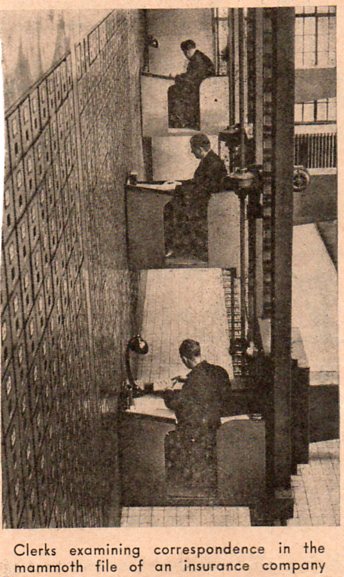
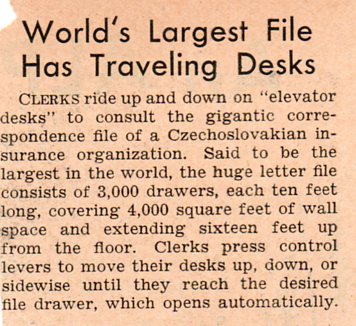
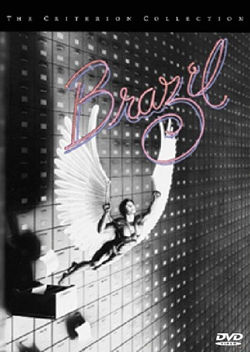
    I feel slightly queasy seeing this photograph, found in the August 1937 issue of Popular Science magazine–-it seems to me to be a backwards, inside-out analog cyberpunk (without the cyber) variety of the internet, a robotic device moving people around from data bit to data bit, an oil and iron process of automatic info retrieval, moving the user to the information rather than the other way around.  Desks517 Desks516 The image does put me in mind of Terry Gilliam’s Brazil, which renders info and other muck in a high-dystopian fashion with endless ducts and file cabinets, making things oppressively inaccessible in their accessibility.

    Brazil

    And to some degree there’s a little Spongebob similarity in there too, though without the iron nd metal part, just Mr. Squarepants and his cardboard filing cabinets for all of this thoughts and memories, serviced by smaller units of himself whop presumably have their own filing systems in their heads.  Filing cabinets, all the way down. 

    Spongebob's Brain
    There is a more-refined image of what is basically the same idea, found here in the fantastic bio-art of Fritz Kahn (1888-1968), who published his Der Mensch als Industriepalast (Man as an Industrial Palace or thereabouts) in Stuttgart in 1926.  Kahn is seen as a “modernist”, which I guess is true; to me he is far more than that–he’s “different”.

    In Charlie Chaplin’s great 1937 Modern Times, there are no file cabinets and I don’t think that there’s any paper, just the results of vast mechanization:

    http://www.altfg.com/Stars/m/modern-times-chaplin-conklin.jpg

    And of course, Fritz Lang’s Metropolis, made a little earlier, in 1927:

    Worker in Fritz Lang's movie, Metropolis

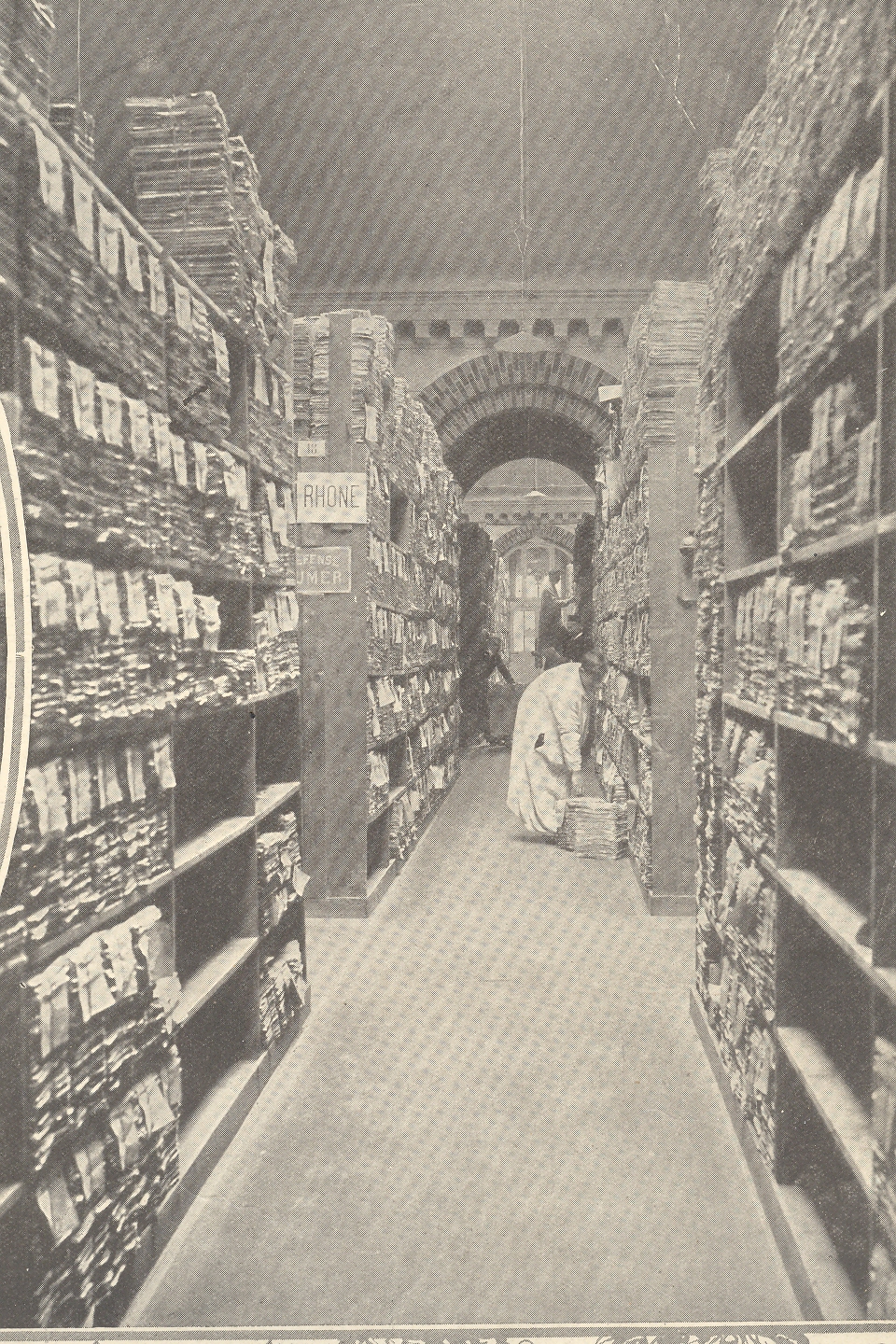
     And finally, an image of the semi-reverse of the gigantic filing system:  moving humans through mounds of paper not contained in file cabinets, stacked upon stacks of stacks.  Once everything is said and done, none of this info-sausage-factory seems very pretty.

    ++ blog ++ nov 16 french census 3


  • Atomic- , Vacuum- , & Solar-Powered Dirigibles with Built-in Airports–Bits of a Bad Historic Future

    JF Ptak Science Books   Post 1487

    A post (“Nuclear Everything”) over at Dark Roasted Blend that featured a magnificent and stodgy atomic-powered zeppelin pushed me into this short visual note on differentially-powered airships, and then in general about airships with airports on them. (There’s a whole other category for planes-of-tomorrow that were so enormous that they had landing strips on their wings, but that’s another story.)

    And they remind me of things that just aren’t “right”, because these things just weren’t.  I’m not sure why, but I’m drawn into an old story about the legendary Charlie Goodnight, Texas pioneer, one of the creators of the idea of the cattle drive (the Goodnight-Loving Trail), a man who lived an extraordinary and powerful life.  He lived for a long time, too, from 1836 to 1929 (almost to the year of the birth of Larry McMurtry, who told a version of Goodnight’s story so spectacularly well in Lonesome Dove), well into a future so far advanced from the year of his birth that he could scarcely have imagined it.  Anyway, towards the end of his life, in 1916, Goodnight had the idea of making a movie of the Old West that included a “final” Indian buffalo hunt.  I’ve seen the film, and it is a fascinating, heartbreaking, wonderful/awful thing, that somehow might appeal to almost no one.  It certainly didn’t appeal to the folks at the time looking for a cowboy film, because much like Mr. McMurtry’s cowboys, Goodnight’s reality didn’t much resemble the cowboys that the public wanted to see.  In a sense Goodnight lived beyond the history that he so much helped to create, and that his old, passed “present” was something that the people in his future really didn’t want to recognize. Then of course one of the things that made it all seem “not right” to me was seeing a vignette of Goodnight entering into one of the scenes, in  a car, making the whole thing a little spooky.

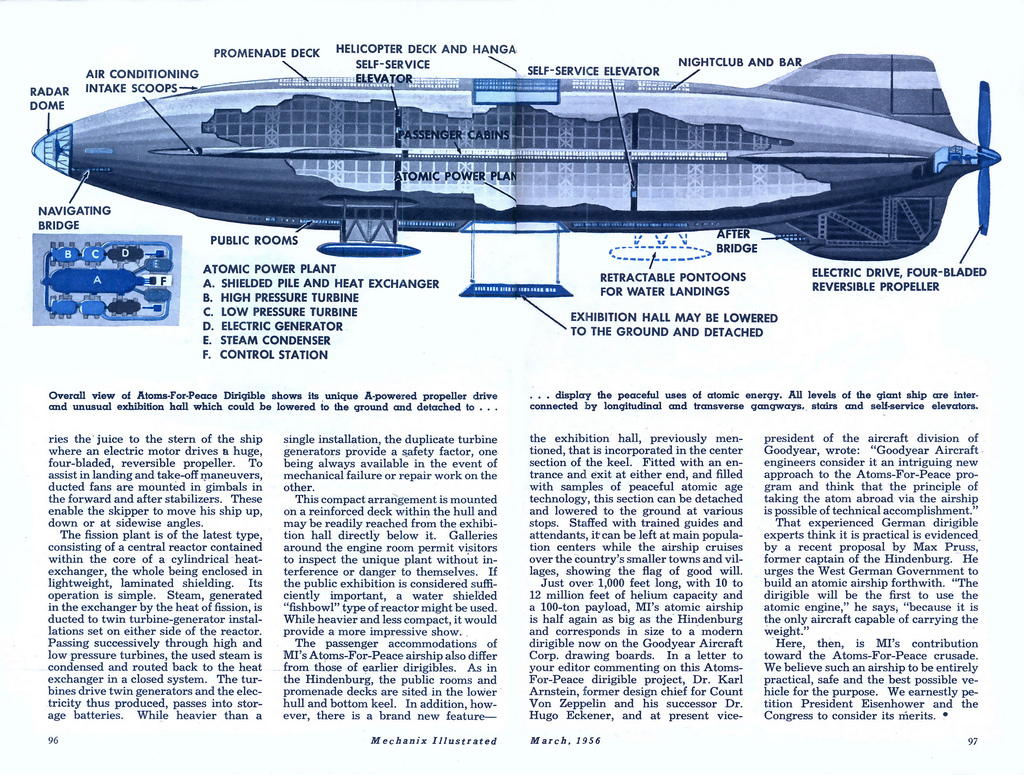
    First up is this mammoth flying advertisement to both peace and war, a nuke-powered dirigible proposed by Eisenhower in 1953 as part of the Atoms-for-Peace push, a move which by this point was already entirely too late.

    Atom everything zep for peace

    For some reason it was seen as a good idea to have a detachable convention hall built for the airship. \

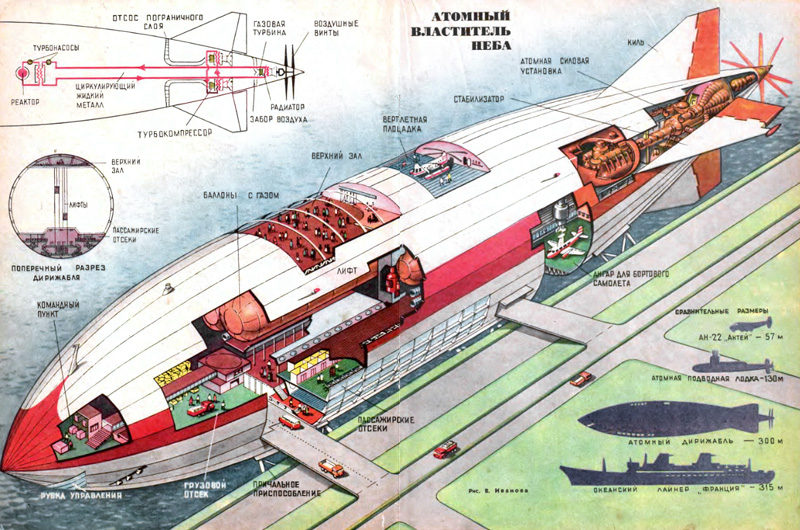
    And of course there is no greater element of a Something-for-Peace anything unless there was a competing idea, as seen in this mammoth Soviet atomic zeppelin, a ship completely absorbed in being bigger than the big thing that it already was:

    Atom everything zep

    At 300 metres this monster had room enough for virtually anything, though it didn’t have the retractable/detachable convention hall–it did however have a small airport. 

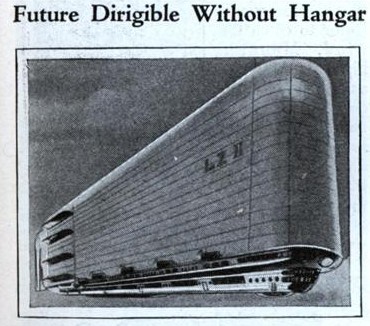
    Another dirigible approached the airport-on-board idea, but preferred solar power for its energy source.


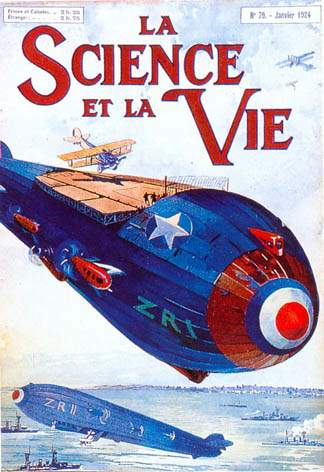
     The magnificent possible, 1924, saw another kind of airborn airport:

    https://historyofideasblog.com/a/6a00d83542d51e69e2012875ea3636970c-pi

    Guido Tallei’s 1932 Diri-Disk was a combination airplane/dirigible, and looked as though it could harbor an expansive airport on its NCC-1701-like wing, but didn’t, alas:

    Konstantin Eduardovich Tsiolkovsky (1857-1835), the Russian/Soviet space pioneer who was nearly without peer (and who somehow survived the bloodlust of Stalin which sucked up and murdered so many of his scientific colleagues),  stepped outside his spaceflight bubble to write about this monster with collapsing sheathing:

    https://historyofideasblog.com/a/6a00d83542d51e69e20128769ed30d970c-pi

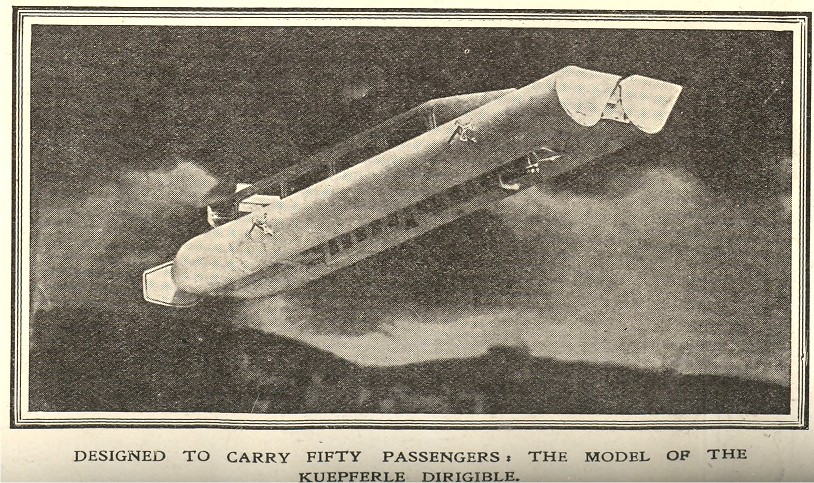
    The Kueperle dirigible, planned in 1909, was nothing if not pretty, and pretty is pretty much what the whole thing consisted of:

    https://historyofideasblog.com/a/6a00d83542d51e69e2012875ea2c87970c-pi

    And lastly, this example of the tracked airship–this must have been a popular notion because I’ve seen perhaps 15 different plans and I don’t spend much time at all reading in this area.  But harnessing the power of the balloon or dirigible or (kite!) whatever to a track system seemed to be a good idea, once upon a time:


  • Really, Really Big Plans: Filling in the East River and Parts of NYC Bay, 1911-1916

    JF Ptak Science Books   Post 1470

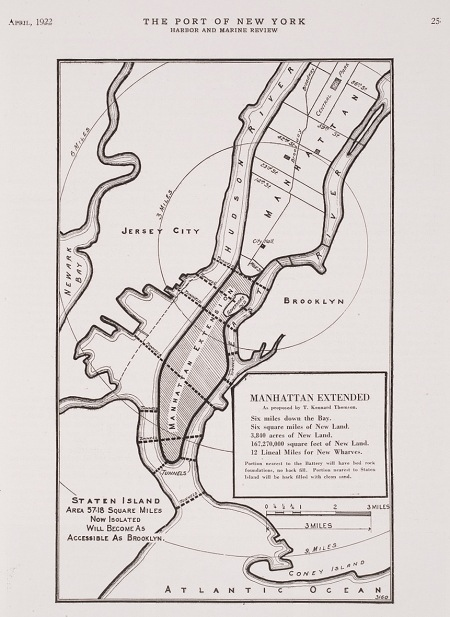
    Last week I wrote a post on  Herman Soergel’s  plan for extending the landmass of the countries around the Mediterranean Sea by damming the straits of Gibraltar, lowering the sea and irrigating the Sahara–an original, interesting but not very good idea, filled with briney cultivation and racial politics. In the past on this blog I’ve written about other city plans–and in particular, for New York City–that have involved floating Manhattan into the harbor, or filling up large chunks of the Narrows, or floating the city on an enormous anti-gravity platform, and so on. Some of those plans were real, some science fiction, and some were plainly beyond both.  The plan presented above is another monster, but at least this one could work, if not for the doing of it, and the expense. And the will.

    NYC Really Big
    But the bottom line, according to the engineer doing the thinking on this project, Kennard Thomson, would supposedly net the city a cool billion dollars after everything was said and done, and that would be 1916 dollars–that was equal to about 5% of the American GDP (!) in 1916, which would be about $400 billion in terms of 2010 GDP.  I’m not sure how Thomson came up with this very big/very round number, though it must have been done for effect–I can just imagine him standing before a smokey room filled with civil engineers talking about his massive plan for enlarging NYC and throwing out the billion-dollar figure, watching the cigars glow red in exhaled disbelief.

    Thomson did know what he was talking about–he was a busy (and “leading” according to the NYT) Manhattan civil engineer of stature, working on the Canal Barge and being the principal engineer for the Municipal and Singer buildings, for example–and his project seems to be well within the scope of possibility.  Their sensical aspects however are, well, questionable. 

    Here’s the story–around 1911, while examining proposals to repair and extend New York’s wharves, Thomson came upon the idea–a magnificent, fabulous idea–of adding new wharves by adding new lands to the city.  In short, the overall plan was to fill in the East River (!!) and reclaim the new land for city living,  dam Hell Gate,  construct a New East River (from Flushing to Jamaica Bay),  extend the tip of Manhattan Island from the Battery to within a quarter-mile of Staten Island (!), create a new 40-square-mile island between Sandy Hook and Staten Island, extend the Jersey shoreline, add two new Manhattan-sized appendages to the east shore of Staten Island, and more.  All of this would be connected by various new bridges and roads and tunnels, as well as a 6-track elevated railway that would circumnavigate the city.  The purpose of all of this would be to add 100 miles of new docks, an enormous amount (“50 square miles of reclaimed land”) of new land and the capacity for NYC to house 20+ million people, all of which would be worth a billion dollars. 

    Thomson really meant “really” in the title for the proposal. There have been reclamation projects undertaken in New York Bay since then of course, and I think that virtually all of what Thomson talked about could be done.  I think it would be a very interesting project for a class of some sort to undertake an estimation of what such a thing would cost today (and I would guess to duplicate the idea in real terms now would take up a sizable chunk of the GDP).  Maybe all of this will make sense at some more future point. 


  • The Triumph of the World as Rota Fortunae

    JF Ptak Science Books    Quick Post  //  Update

    Fortune, good night, smile once more; turn thy wheel!.  King Lear, Act II Scene I

    World german410

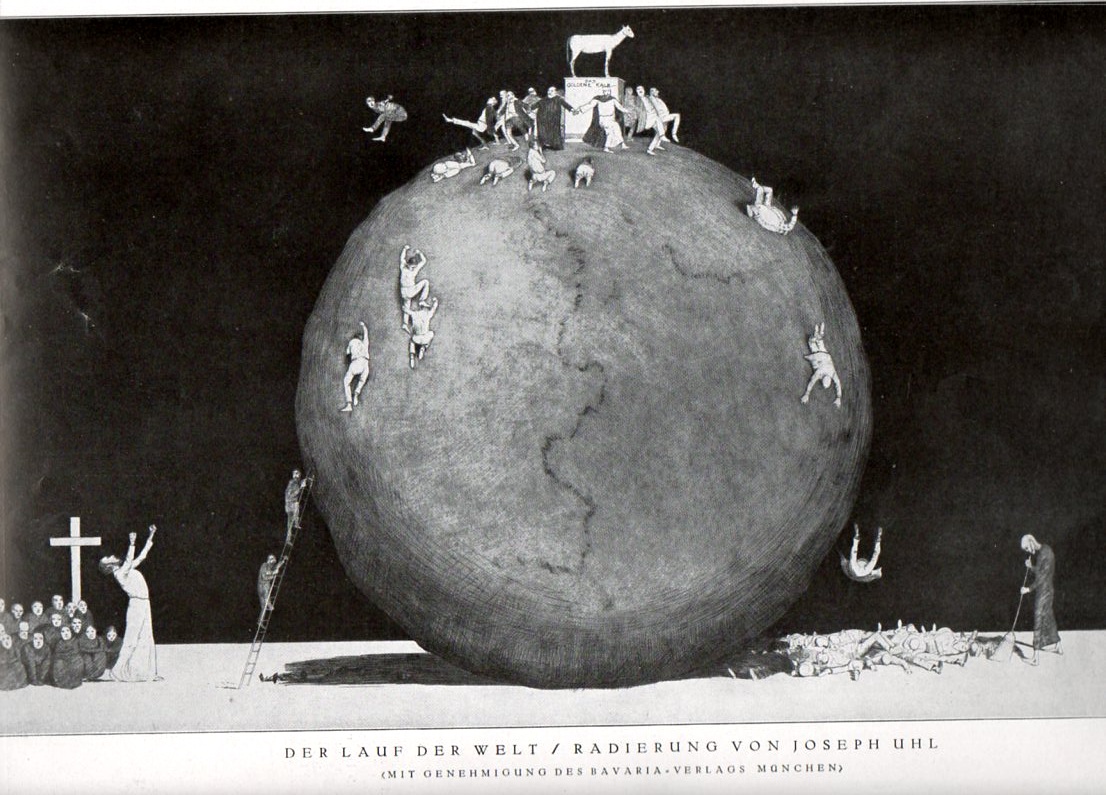
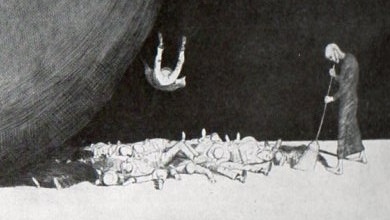
    Not to be confused with another, earlier, engraving by Abraham Bach (the Elder, “d.A”) of the same title (published in Nuremberg in the late 17th century), this work by Joseph Uhl (published in the Illustrirte Zeitung, Leipzig, 24 October 1926) seems far more pessimistic, a scene of symmetrical futility.  The title translates roughly into the Triumph of the World, or the World Conquers All, or something along those lines, I think, and we definitely see the old orb impassively withstanding whatever it was that was happening on it–and whatever it was, it didn’t matter. 

    World german410
    The cleric at bottom left seems to be extolling the heavens in support of those who ascend the world to his favor (?), and as they reach the apex they either protect or try to repeal those who are supporting the golden calf.  At bottom right we see the ultimate disposition of the players, swept into a pile by an unconcerned sweeper. 

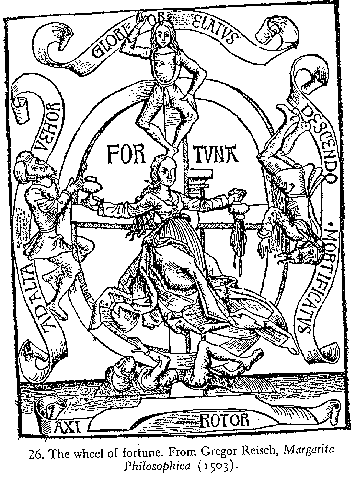
     My thanks to the commenter Redtarts for communicating “rota fortuna”–wheel of fortune–which I hadn’t connected to this image but which does of course make sense.  It does bear some striking similarity to the more classical wheels, which generally depict four (or more) figures of people in various stages of rising or declining in the course of life, the person on the top of course reigning supreme.  The allusion may have begun in early Roman times with the goddess Fortuna, famously depicted here in 1502 by Albrecht Durer:

    Durer, Fortune 1502

    The image of the wheel though is much earlier,, most people recognizing it so:

    Wheel of fortune

    This is the basic desin that is seen so often through the Medieval and Renaissance periods. 

    Carmina Burana:

    Fate – monstrous
    and empty,
    you whirling wheel,
    status is bad,
    well-being is vain
    always may melt away,
    shadowy
    and veiled
    you plague me too;
    now through the game
    bare backed
    I bear your villainy.
    . . . . . . . . .
    The wheel is turned by Fortuna;
    I go down, demeaned;
    another is carried to the height;
    far too high up
    sits the king at the summit –
    let him beware ruin!
    for under the axis is

    Dante’s Divine Comedy/the Inferno:

    No mortal power may stay her spinning wheel.
    The nations rise and fall by her decree.
    None may foresee where she will set her heel:
    She passes, and things pass.
    Man’s mortal reason cannot encompass her
    She rules her sphere as the other gods rule theirs.
    Season by season her changes change her changes endlessly,
    and those whose turn has come press on her so,
    she must be swift by hard necessity.

    Dante, Inferno VII 82-90


  • A Vision of the Future: Filling Up Manhattan, 1887

    JF Ptak Science Books   Quick Post

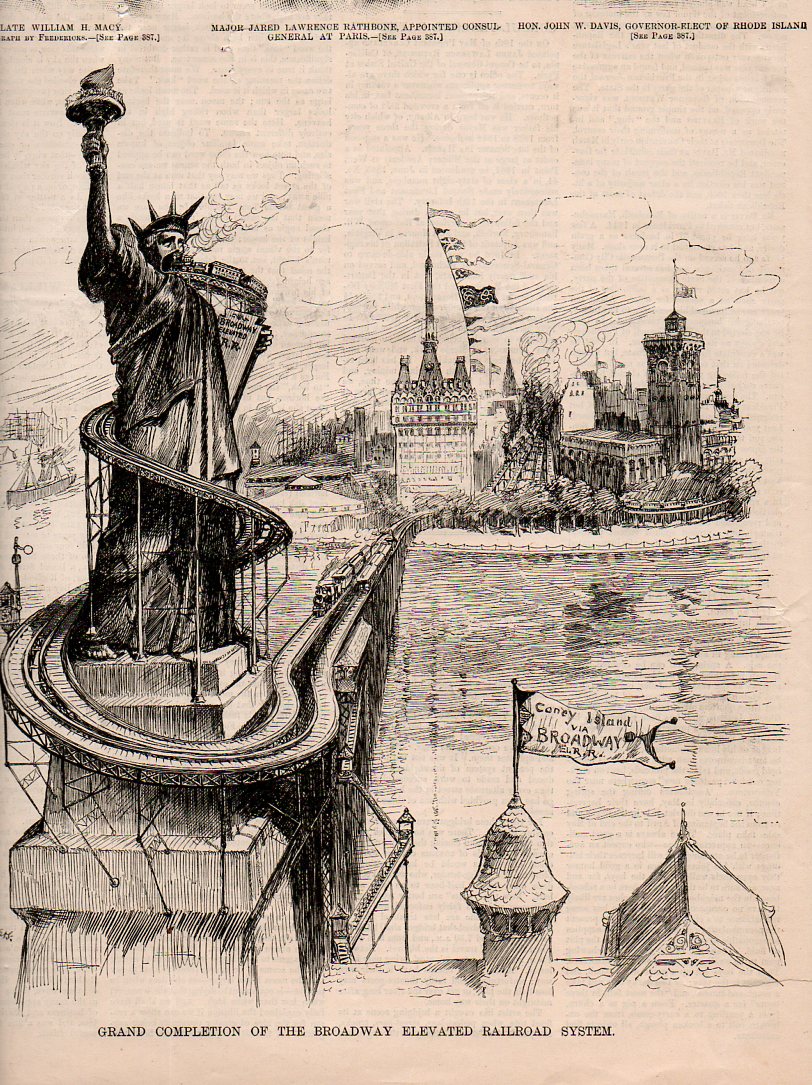
    This peep into a possible future appeared in Harper’s Weekly on 18 May 1887.  It is the work of artist W.A. Rogers and depicts a filling-up lower Manhattan, complete with broad avenues lined by elevated trains whose reach evidently knows no bounds. The new elevated subway winds its way across the harbor to Liberty Island, where it wraps itself around the feet and up the body of the newly-dedicated Statue of Liberty (opened in October of the previous year).  In the foreground is the cupola of a transit station with a fluttering flag advertising “Coney Island via Broadway”–I’m not sure what this is all about, as the placement of the island has nothing to do with anything except making a point in the cartoon. 


    Statue liberty407


  • Seeing into the Vast Future, 21 Years Hence: Futurama, 1939

    JF Ptak Science Books  Post 1461

    Futurama 9
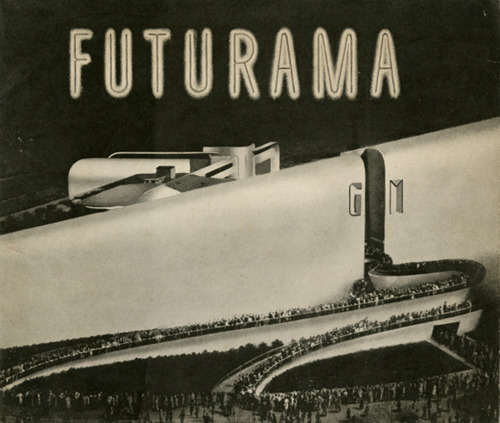
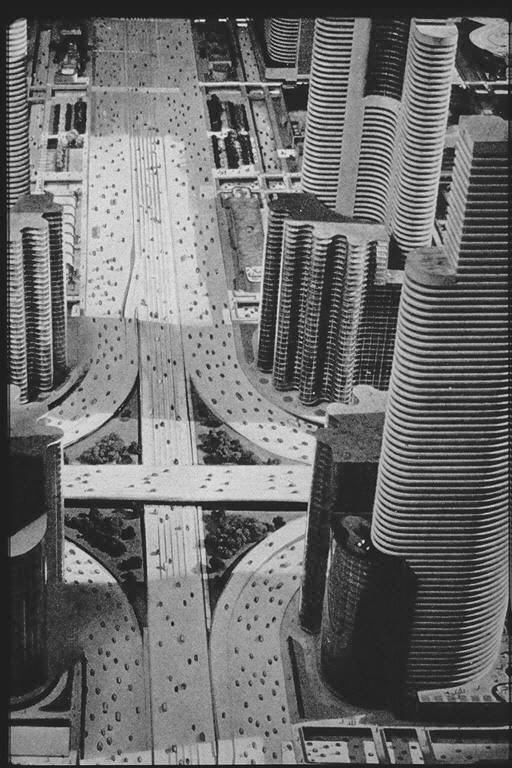
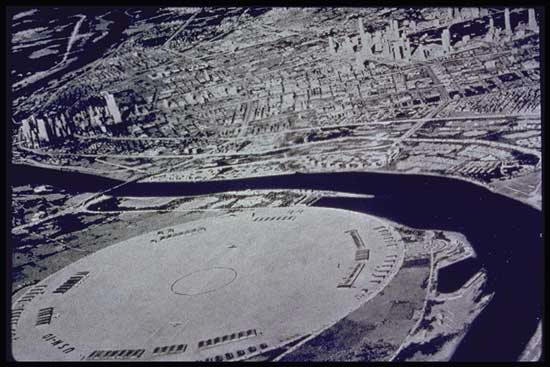
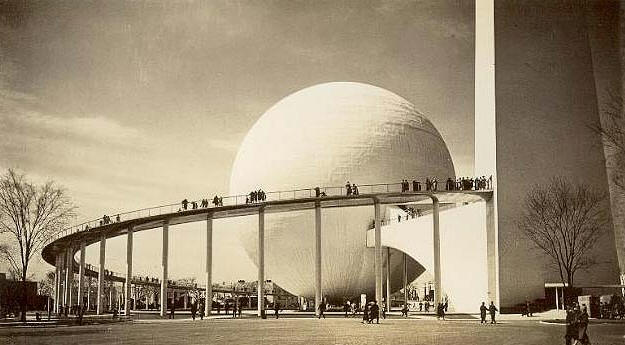
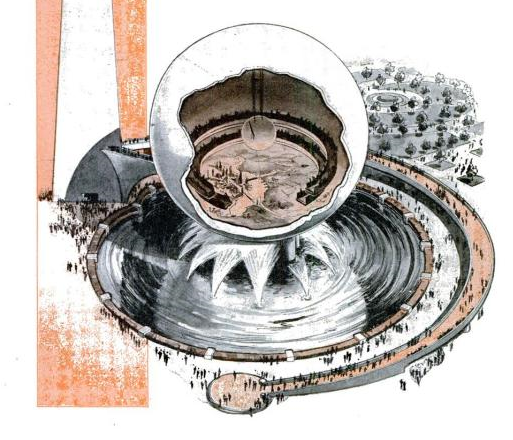
    The 1939 World’s Fair in NYC famously exhibited a spherical attraction that exhibited a semi-robotic display of what the future would be like–a future that was only 21 years away, in 1960.  There would be an enormous amount of weight on the shoulders of 1960, given what the World’s Fair had to say about it in 1939.  Few things were very right, and many of course were necessarily wrong–but that must be the case when looking into the short-ended future with a monstrous amount of anticipation.  That–and since this was a feel-good celebration–nobody was talking about the world war that had already started. 

    Futurama 07

    Futurama 06
    One thing is for sure–the pavilion’s creator, General Motors, did foresee that highways and automobiles will be in high demand up there in the tomorrowland of 1960.  The display was designed by the fantastic Norman bel Geddes, who actually expanded on his superhighway theme in the next year with his book Magic Motorways (which can be read here).  Anyway people were very excited by the whole affair–waiting in line for a few hours, winding their way through the pavilion to take their seats in a circular gallery overlooking a vast and complex assemblage of miniature societal models, the seating arena rotated to give the viewers views of the entire display.  More than 26 million people saw the display over a six month period.

    Perisphere04
    Perisphere_cutaway
    26 million is a big number.  Futurama drew as many people in six months as the three New York City baseball teams (the Yankees, Giants and Dodgers) brought in for almost the entire decade.  It is also equal to all of the deaths suffered by the Soviet Union during WWII. 

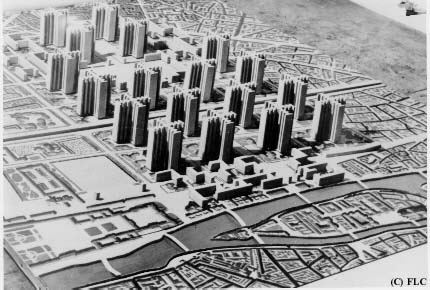
    I guess this was as good a vision as any–or at least it didn’t seem to involve very much planning outside the new automatic automobile nervous system that would leech into the life-blood of the country.  Other planned visions of the future do not look quite so good.  For example, Le Corbuser’s demolition of central Paris to make way for his Soviet apartment block reconstruction in his Voisin Plan (1925):

    Plan Voisin - Paris
    Again, this is not a wholesale look into the future, just the resurfacing of one of the world’s greatest cities.

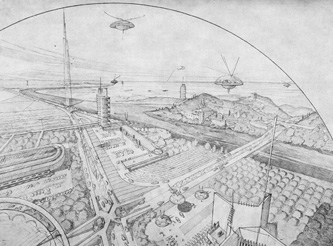
    A man with a little bigger vision, Frank Lloyd Wright, saw a heavier future in his Broadacre CIty:

    Broadacre City 2 I’m not sure how these domed cities worked.  B. Fuller had an idea like this for central Manhattan that I wrote about earlier in this blog, but his idea escaped me too. 


  • The Future of Hope and Fear: Fortune-Telling Questions for Men and Women, 1540

    JF Ptak Science Books  Post 1456

    In 1540 Francesco Marcolini (or Marcolino), a typographer born in Forlì, published in Venice Le sorti intitolate giardino d’i pensieri (“The oracle called garden of thoughts”). This book is among the earliest known documents of cartomancy (divination with cards), a card-playing fortune-telling and future-telling game and belief system. (I’ve written about other beautiful if not proud accomplishments in this area, other products of the 16th century, here.)  I find the illustrations of the combinations of cards to be rather beautiful, a suggestion of an unknown alphabet or hieroglyphic for a civilization of hope or distress or both that hangs somewhere out there in the gauzy future, the characters capable of change and interpretation depending on the needs of the viewer.  Therefore the story that is told can easily become the story that could be told, the characters permeable to whimsy and insight.  It seems unlikely that there is a numeral system associated with this quicksand.

    Image:Marcolini fraude.jpgThe tarot encyclopedia website provides an interesting insight to the times if not so much to the gearing of this wonder machine–this mainly in the form of the fifty questions to be asked of the players of this game/amusement/hopenet, including thirteen each to be answered solely by men and women. 

    Questions Asked of Men

    It turns out that for the men, 8 of the 13 questions deal with his wife or mistress–4 about wives, 3 about mistresses, and 1 that can go either way.  The remaining few questions then are left to cover the range of All Other Things

    1.Will the destiny of the man will be good or bad? [Fato - Fate]
    2.Is the lover loved by his mistress? [Fama / Fame]
    3.Is it better to marry a beautiful woman or an ugly one? [Beneficio - Gain]
    4.Will the desire of the man be fulfilled? [Tempo - Time]
    5.In which will the man be more lucky? [Fortuna - Fortune]
    6.Will the man have to suffer for his beloved? [Dolore - Pain]
    7.Is the man appreciated by the other people? [Virtu' - Virtue]
    8.How many wives will the man have? [Punizione - Punishment]
    9.Will he that goes to war gain victory? [Vittoria - Victory]
    10.Will a strange wife become humble? [Pertinacia - Obstinacy]
    11.Is it good to change mistress? [Peccato - Sin]
    12.Is it good to take a wife? [Matrimonio - Marriage]
    13.Which is the best mistress: the widow, the married woman or the unmarried woman? [Timore - Fear]
    

    Questions to be asked by women

    The questions for the women actually seem a little more balanced, or at least don't 
    deal with the blossoming aspects of additional/multiple lovers, though the question of

    whether her husband will be faithful does come up, as does the issue of whether it
    is good or not to change lovers. And the issue of how often she will be married.
    And whether or not she will suffer for her lover--I'm not sure what this one means
    in the antiquarian sense, but there seems to be a follow-up
    on whether the bad
    husband will become good. But overall these seem not so extra
    ordinarily self-indulgent
    as do the questions for the men.
    14.Is the woman appreciated by the man she adores? [Vanita' - Vanity]
    15.Will the destiny of the woman will be good or bad? [Destino - Destiny]
    16.Will the woman will give birth to a boy or a girl? [Natura - Nature]
    17.In which will the woman be more lucky? [Honore - Honour]
    18.How many husbands will the woman have? [Penitenza - Penitence]
    19.Will the woman have children? [Sterilita' - Sterility]
    20.Will the woman suffer for her lover? [Dipserazione - Desperation]
    21.Will the desire of the woman be fulfilled? [Insidia - Danger]
    22.Will the bad husband become good? [Sorte - Chance]
    23.Is the woman loved by everyone? [Disgrazia - Disgrace]
    24.Is it good for the woman to change lover? [Odio - Hate]
    25.Is it good to get married? [Servitu' - Slavery]
    26.Will the husband be faithful? [Occasione - Occasion]

    Questions that can be asked both by men and women

    Certainly the non-gender-specific questions are most interesting, some even poetically
    captivating ("will two lovers make peace?")
    , most of which could be asked today, and
    some still demanding long thought. In general though they do mostly have an
    adult-version of a Ouija experience, with a few golden nuggets tossed in for higher
    cortical seasoning.
    27.Is a certain courtesan infected with the French disease? [Difetto - Defect]
    28.Is it good to take vengeance of an offense? [Virilita' - Virility]
    29.Will the world find peace? [Parche - Moirae]
    30.Will art or trade produce gain? [Industria - Industry]
    31.Will some trouble bring happiness in the end? [Ricchezza - Richness]
    32.Is the rule of a Lord appreciated by the people? [Verita' - Truth]
    33.Is it good to serve Lords and priests? [Infingardo - Idler]
    34.Will a promise be kept? [Fraude - Fraud]
    35.Is the person that traveled far alive or dead? [Sapere - Knowledge]
    36.Will the exile return? [Esilio - Exile]
    37.Is it better the wife or the husband? [Poverta' - Poverty]
    38.Who loves with more passion, the man or the woman? [Nobilta' - Nobility]
    39.Will a dream come true? [Ignorantia - Ignorance]
    40.Is it good to start a certain enterprise? [Otio - Idelness]
    41.Will the person that went away be back soon? [Desiderio - Desire]
    42.Will the awaited new be good or bad? [Malinconia - Melancholy]
    43.Does the appearance of the person give a good impression? [Menzogna - Lie] 
    44.Must one trust what people say? [Discordia - Conflict]
    45.Will two lovers make peace? [Pace - Peace]
    46.Which will be the end of a very deep love? [Caso - Chance]
    47.Will changing place bring better luck? [Consiglio - Counsel]
    48.Will the person be the winner of a dispute? [Corruttella - Corruption]
    49.Will someone get free of a certain vice? [Furto - Theft]
    50.What will be the reward for faithfulness in serving? [Calamita' - Calamity]

    In short, much of this seems modern to me, at least with a little editorial clean-up.
    The big difference seems to be that people in 1540 actually interacted and answered
    these questions, while in 2011 most folks would be watching other folks talk about
    answering these questions on a reality t.v. show.