A Daily History of Holes, Dots, Lines, Science, History, Math, Physics, Art, the Unintentional Absurd, Architecture, Maps, Data Visualization, Blank and Missing Things, and so on. |1.6 million words, 7500 images, 4.9 million hits| Press & appearances in The Times, Le Figaro, Mensa, The Economist, The Guardian, Discovery News, Slate, Le Monde, Sci American Blogs, Le Pont, and many other places… 5000+ total posts since 2008.

Category: History of Lines

  • An Annotated Poetry of Clouds

      JF Ptak Science Books  Quick Post

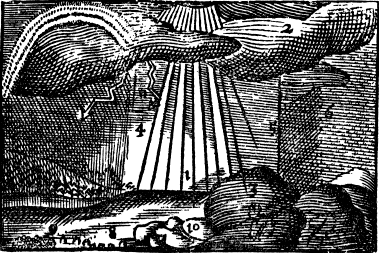
    Clouds cromenius

    [Image from John Comenius,  Orbis Senfualium Piélus: Omnium Principalium in Mundo Rerun/ Vita Аllопит,  translated as Pictura et Nomenclatur, the Visible World, or A Nomenclature, and Pictures of all Chief Things that are int he World, translated into English by Charles Hoof…1726.  See an earlier post here for more on Comenius. Image Source:  PROJECT GUTENBERG.]


    Clouds

    A Vapour, (1). ascendeth
    from the Water.

    From it a Cloud, (2).
    is made, and a white Mist, (3).
    near the Earth.

    Rain, (4).
    and a small Shower
    distilleth out of a Cloud,
    drop by drop.

    Which being frozen, is Hail, (5).
    half frozen is Snow, (6).
    being warm is Mel-dew.

    In a rainy Cloud,
    set over against the Sun
    the Rainbow, (7). appeareth.

    A drop falling into the water
    maketh a Bubble, (8).
    many Bubbles make
    froth, (9).

    Frozen Water
    is called Ice, (10).
    Dew congealed,
    (13) is called a white Frost

    Thunder is made of
    a brimstone-like vapour,
    which breaking out of a Cloud,
    with Lightning, (11).
    thundereth and
    striketh with lightning


  • History of Lines–the Extent of Birds, 1862

    JF Ptak Science Books    Post 2207

    World lines020

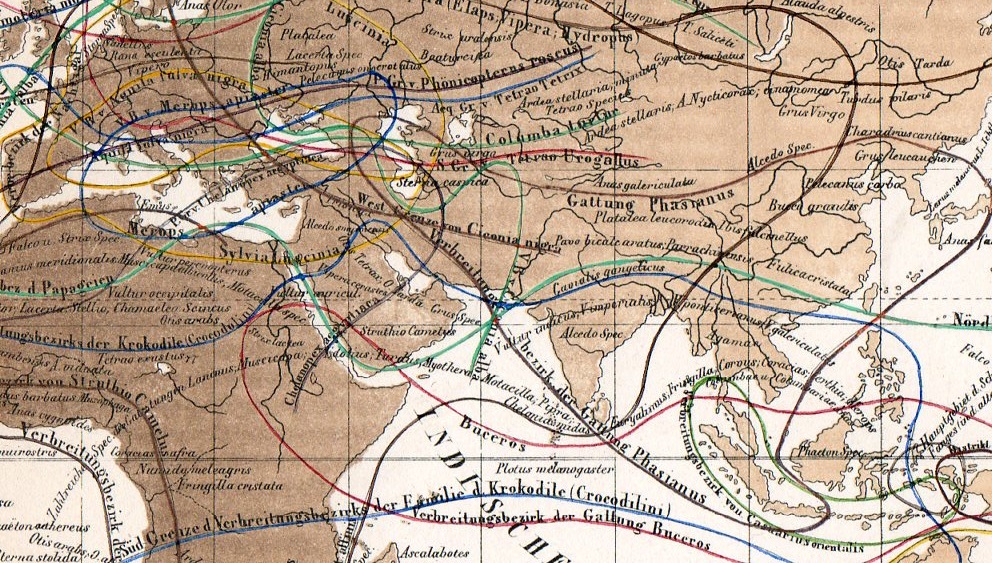
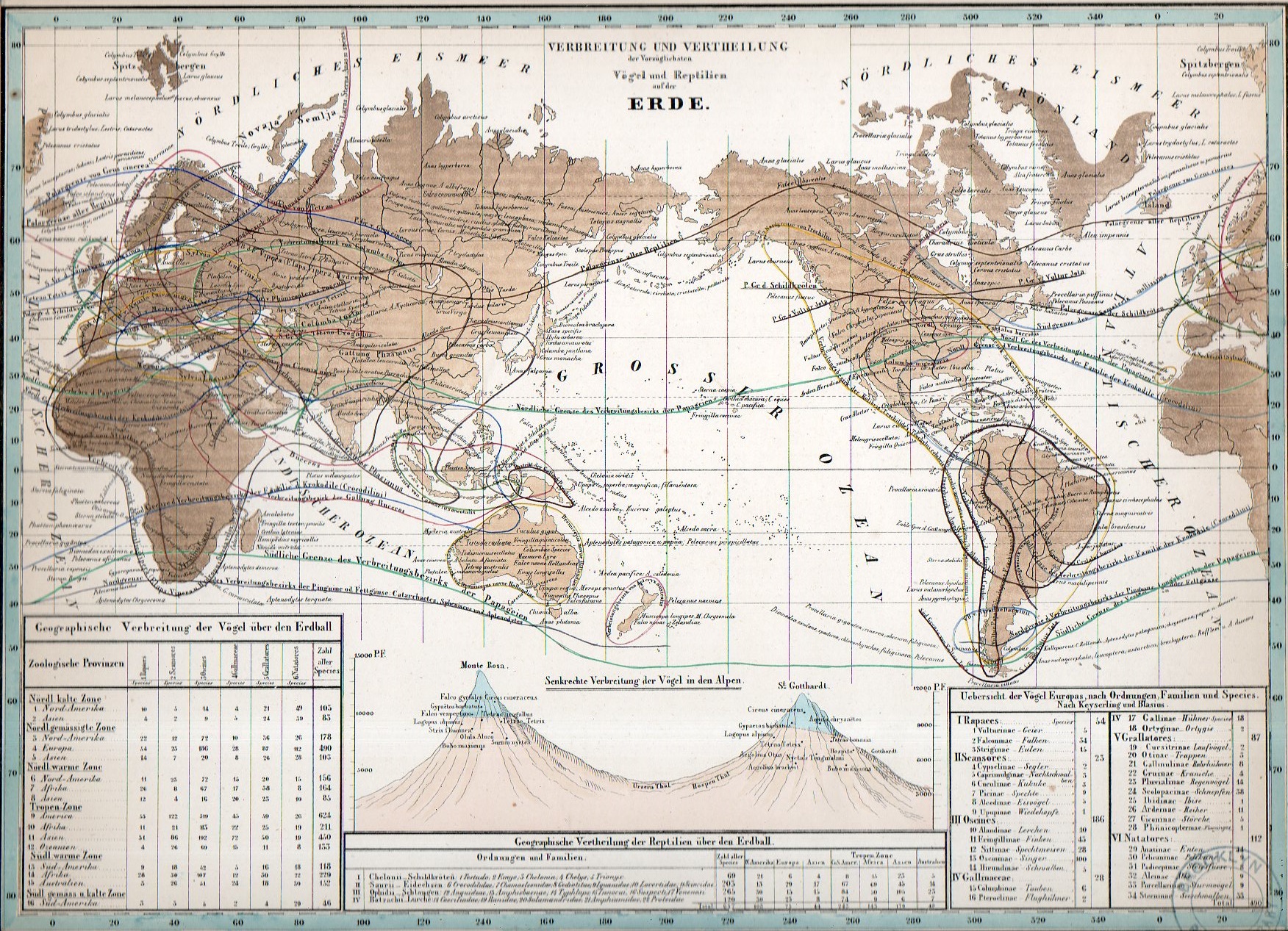
    There are many places and objects named for the German Alexander von Humboldt (1769-1859)–even so in the United States–a recognition and honor paid to a great observer and cataloger of things, the first biogeographer, the scientific traveler’s traveler, the man who Charles Darwin called the greatest scientific traveler ever.1  von Humboldt amidst much else also wrote–at the end of his life–a book that began as a composition of lectures that he gave in the 1840’s, developing into a monumental work called Kosmos, a General Survey of Physical Phenomena of the Universe, which was published from 1845 until three years after his death in 1862.  He meant what he said in the title, and tried to arrange all of the stuff of nature into a comprehensible and logical whole, gathered across five volumes.  It is a brilliant masterwork of vision and orderliness, and from what I’ve read it is like walking into a 3-D library of what was known of much of hte scientific world of the mid-19th century, the very structure and organization of the book being a scientific achievement.  

    There was a sixth volume to the work, an atlas, that is one of the crowning achievements of the 19th century for the display of scientific data.  It is about half-again as tall as the standard-sized text and twice as wide, so the book isn’t very big, and the maps are all single-page–but for as relatively small as they are there is a ton of information in them, more so when you realize what must have had to go into the collection of the data to begin with.  

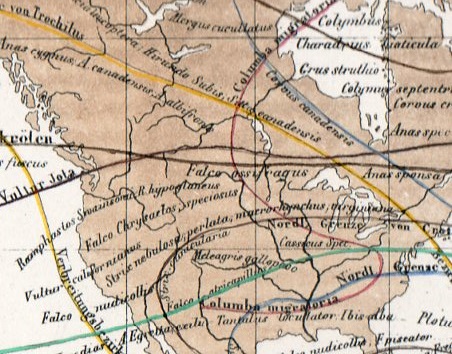
    I was very taken with this first representative because of its flowing lines (that show the range and occurrence of bird and reptiles) that make it a separate thing of beauty…had I the capacity to remove everything from this map save for the natural history lines, it would stand as an interesting work of very-pre-non-represnetational art.  I’m certain that the folks of the 1860’s poured over this and other maps in Kosmos, as well of course as the text themselves–this may have been among the first atlases to display some of its data in this way, and would’ve been fascinating. (Kosmos was actually a very popular work, the first volume selling out in a few months…it was a very popular book.)

    World lines017

    World lines018

    Notes:

    1. Found in the Darwin Correspondence Project » Letter 13277 — Darwin, C. R. to Hooker, J. D., 6 Aug 1881, just before Darwin’s death.

    You can purchase this map–my store has this and another 25 or so original maps from this atlas for sale. Send me an email and I’ll send you descriptions…

    Kopsmos--geological


  • Pluto in the History of Lines (1945)

    JF Ptak Science Books   Post 2206   History of Lines series

    The path of existence of the non-planet planet Pluto along with the rest of its Solar System friends can be nicely plotted out for visual ease on a  series of mostly-concentric orbital lines.  Pluto’s line is the longest, taking about 248 years to complete its orbit traveling at about 10,600 mph, which means that in a year’s 8760 hours that it moves very close to the equivalent along its path as the Earth’s distance from the Sun, which is an odd bit of trivial.  In any event, it is a long line.

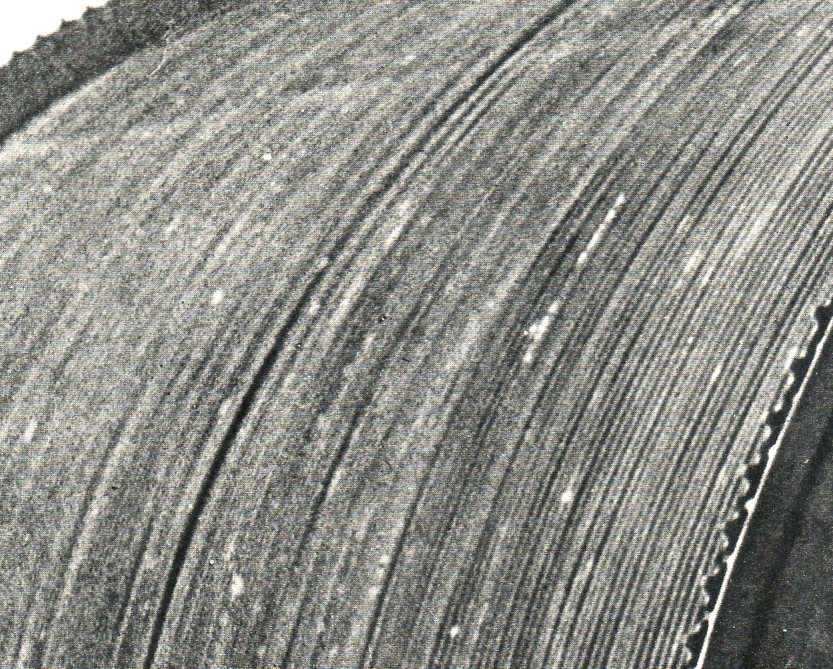
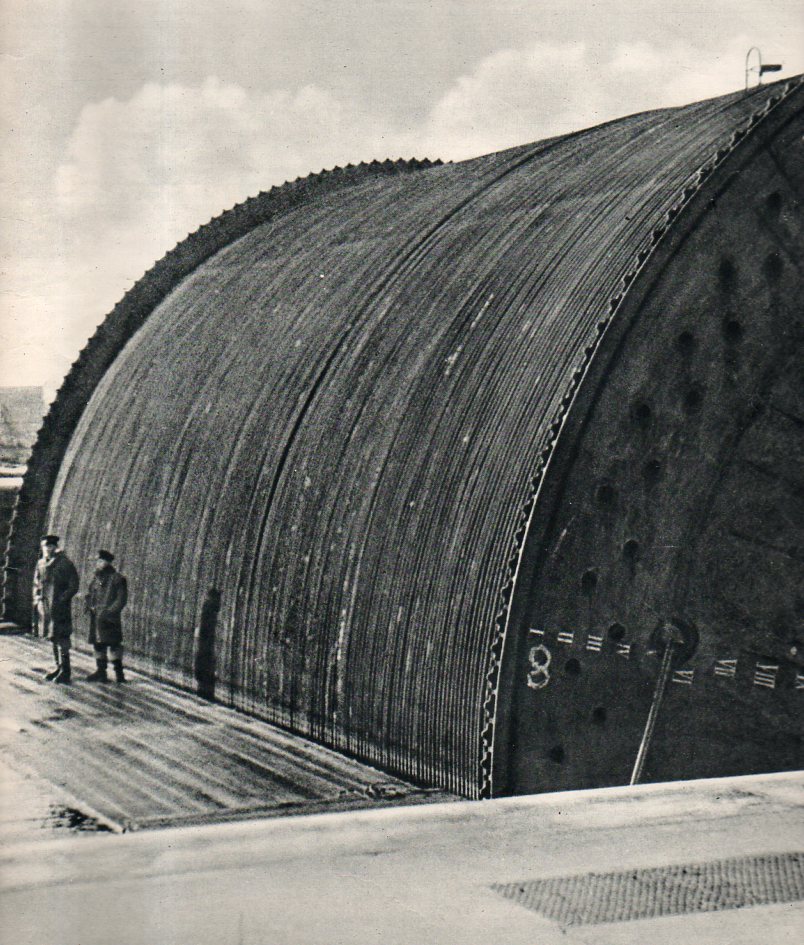
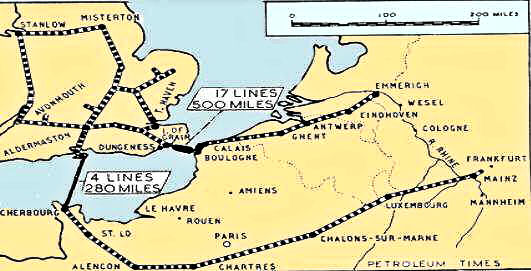
    There was another line/Pluto point of interest that takes us much closer to home, and much more near in time and space.  Project PLUTO (Pipe Line Under The Ocean) was a vast, integral, and magnificent engineering undertaken by the British government to surrepticiously and safely deliver petroleum to the Allied forces in Europe during WWII.  It reached through England and across the Channel in two places (code-named Bambi and Dumbo), via pipelines laid under the sea, and supplied armies in France, Belgium, Luxembourg, Holland, and Germany (as far as Mainz). 

    PLUTO016

     [This is a detail of one of the vast bobbins that were hauled across the sea, unspooling many hundreds of miles of pipe in several lines.] This is what it looked liek apart from a detail image:

    PLUTO015

     Of course getting fuel to your troops in advanced positions is a major undertaking–not being able to do so would kill an army (just such a thing arguably happened with the Afrika Corps).  Fuel could of course be trucked in in drums, and sent across the water in ships–but that doesn’t come close to the fantastic efficacy of having a pipeline.  And this is just what Pluto was–an extraordinary idea made real, with enormous positive consequences.  

    PLUTONetwork

    Map source, here

    And the 1945 Newsreel:

    ·Posted by :

    ·in:


  • The Problematic, Beautiful, and Unspeakable History of Lines and Linoleum, Redux: Italy, 1935

    JF  Ptak Science Books   Post 1418–revisited and expanded   History of Lines

    This book is available for purchase at our blog bookstore, here.

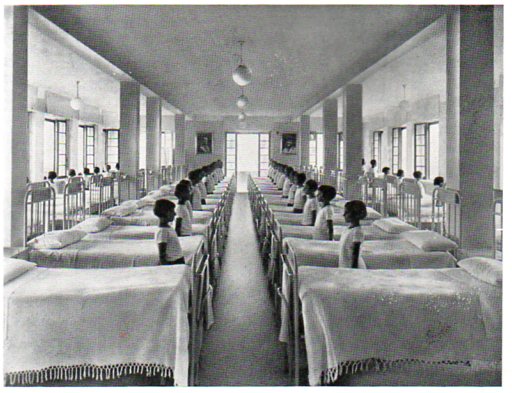
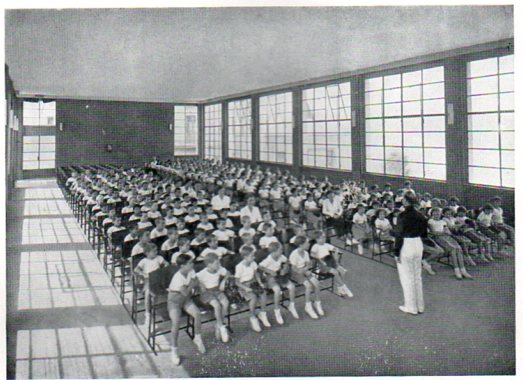
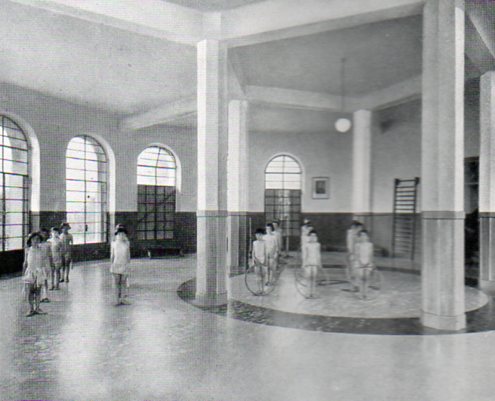
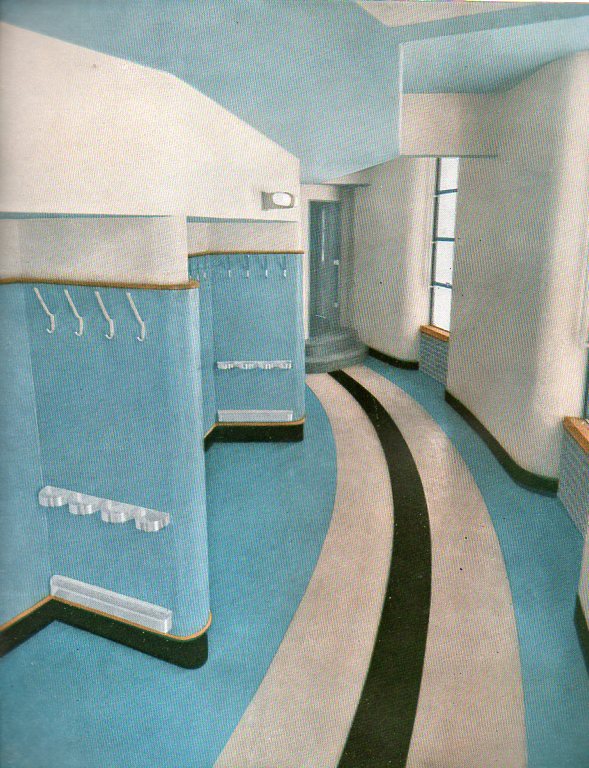
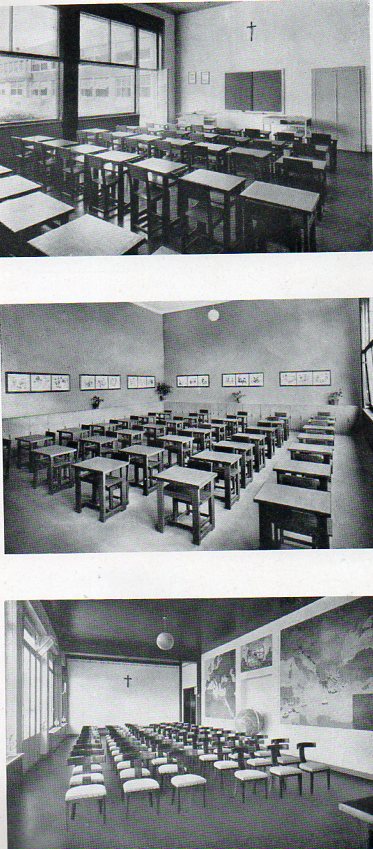
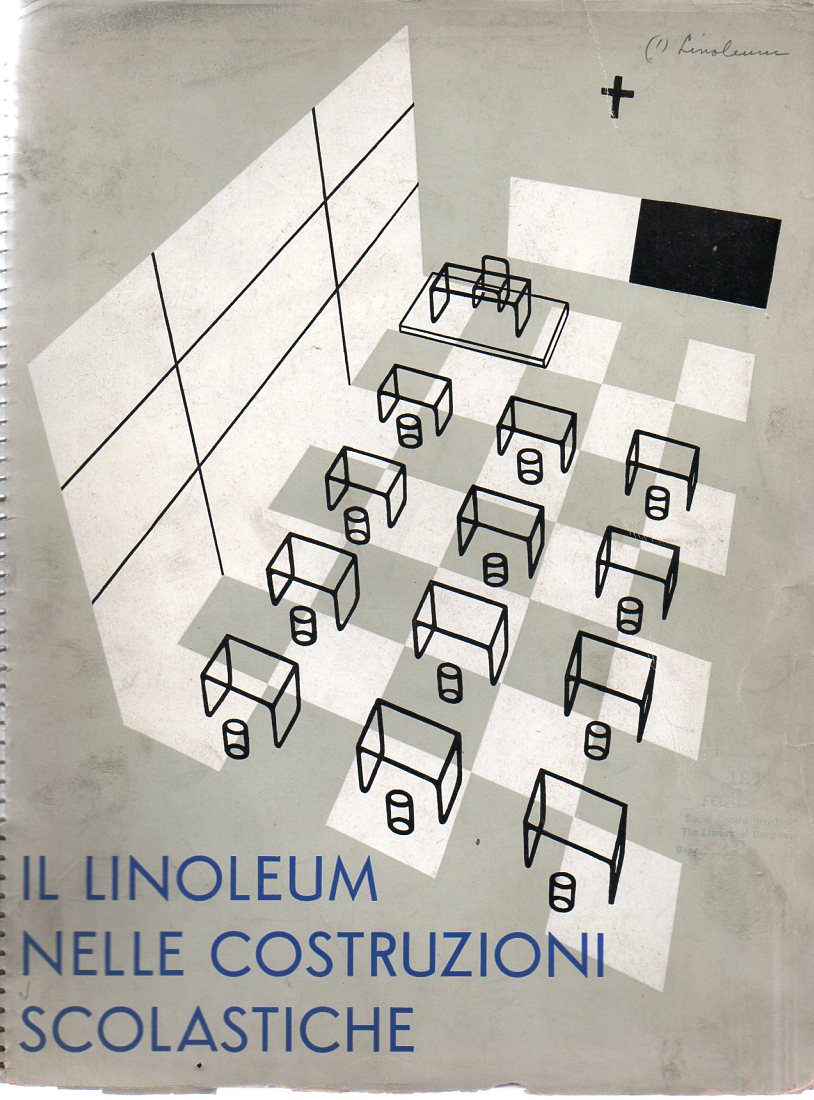
    Linoleum italian275
    In my imaginary History of Lines there is a chapter or two for humans-in-line(s).  In the history of the world, the fourth and fifth decades of the twentieth century—the 1930’s and ‘40’s—were big ones for human lines.   Big does not imply good, because as we all know lots of humans lined up for all manner of unspeakable nastiness during this time and well more than 100 million didn’t make it out alive (considering all of the wars, purges, revolutions and stupidity).

    The lines here are a little more benign, though with shriveled overtones of corrected respect.

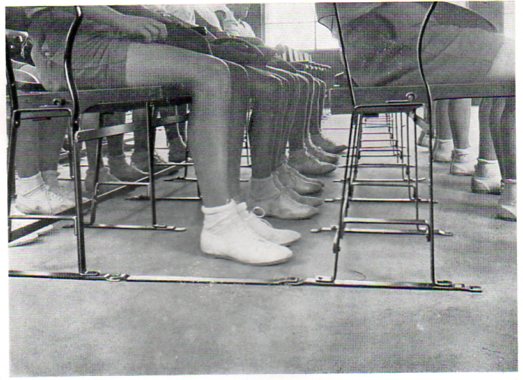
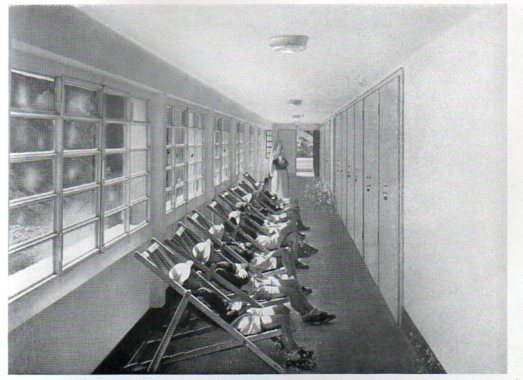
     Oppressive obedience in a well-designed environment is still like dressing your ear-infected 14-year-old St. Bernard/Jack Russell (?!) mixed breed in baby booties—its just not right, and these images attest to this simpy comparison. All of these photographs come from a delightful manufacturer’s catalog for linoleum products (Il Linoleim nelle Costruzioni Scolastiche), which was printed in Milano in 1935.(The original is available at our blog bookstore.)

    Linoleum italian277
     I’ll undoubtedly write a post on this stylistic beauty later on, but suffice to say for right now that it really is a lovely thing.  If only we could forget the Mussolini part.  Now I’m no fan, necessarily, of linoleum, but if I had to live on a linoleum island far removed from civilization and I had to choose a design for my world, I would choose the designs from this catalog, without hesitation. They’re spare, well-proportioned, beautifully design utilitarian designs; they are also very shiny and cold with a dispirited order, but so it goes.  The catalog seems to speak for its times, the inspired design bowing to the weighty needs of the flatulent state.

    Linoleum italian278

     Even though the people (mainly child people) are in very structured environments, they still look as though they really don’t believe in whatever it was was happening–of course the y were at school, or in an academic environment, or hospital, or something (as the titlf of the work states). There is something just wrong in the child-straight lines and seemless expanse of linoleum, something that looks as though details have been left out, that there is a ground-in sameness to everything, that the indifference to difference is so to make the children of a sort of sameness.  Ihope that they did okay–most would be around 80 or 85 by now, if they survived.

    Linoleum italian276


    Linoleum italian279

      Linoleum italian271

    Linoleum italian272 

    Linoleum italian270


  • History of Lines and Holes as Alphabetical Light

    J Ptak Science Books  Post 2160

    Part of the History of Holes  & History of Lines series

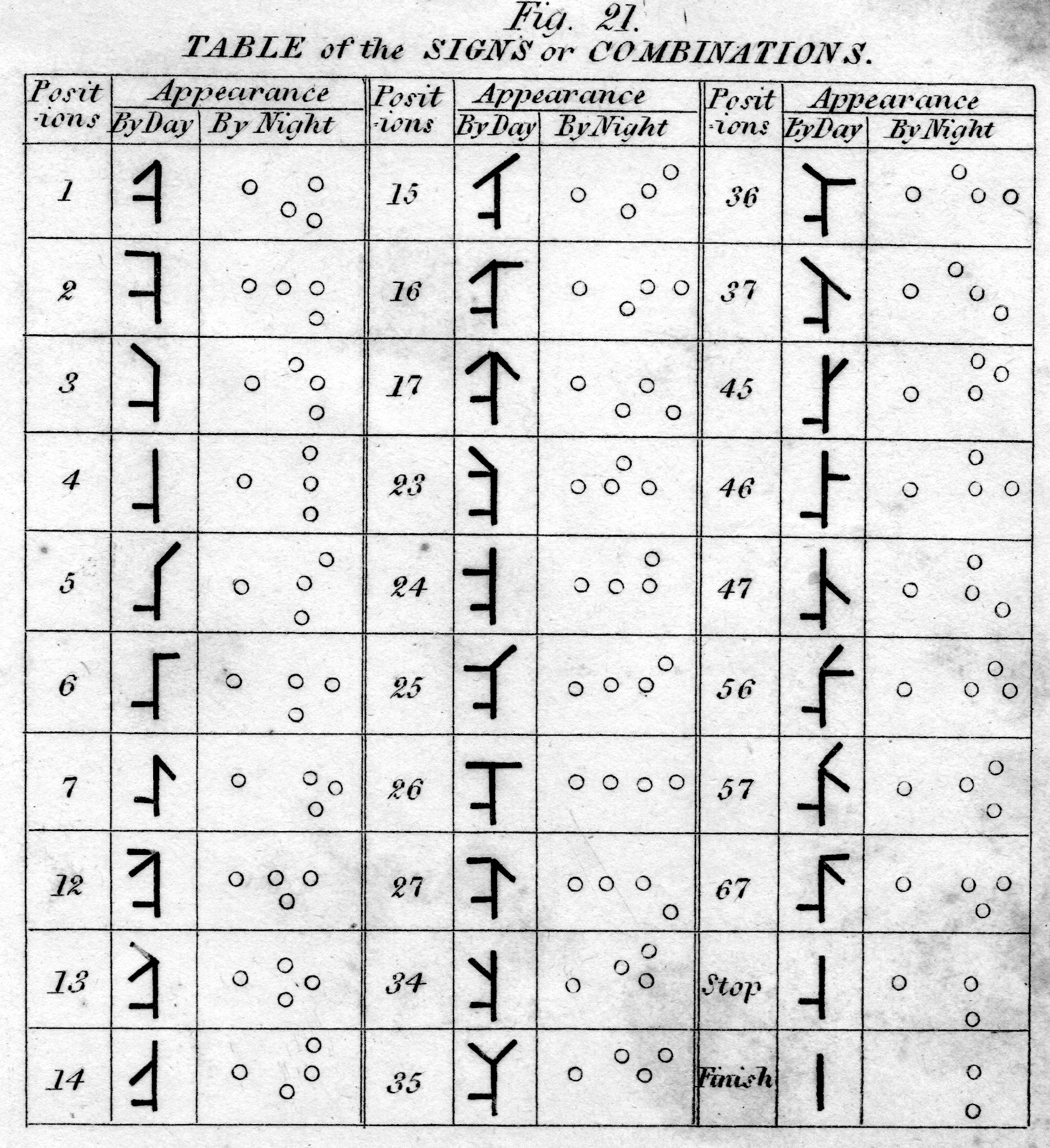
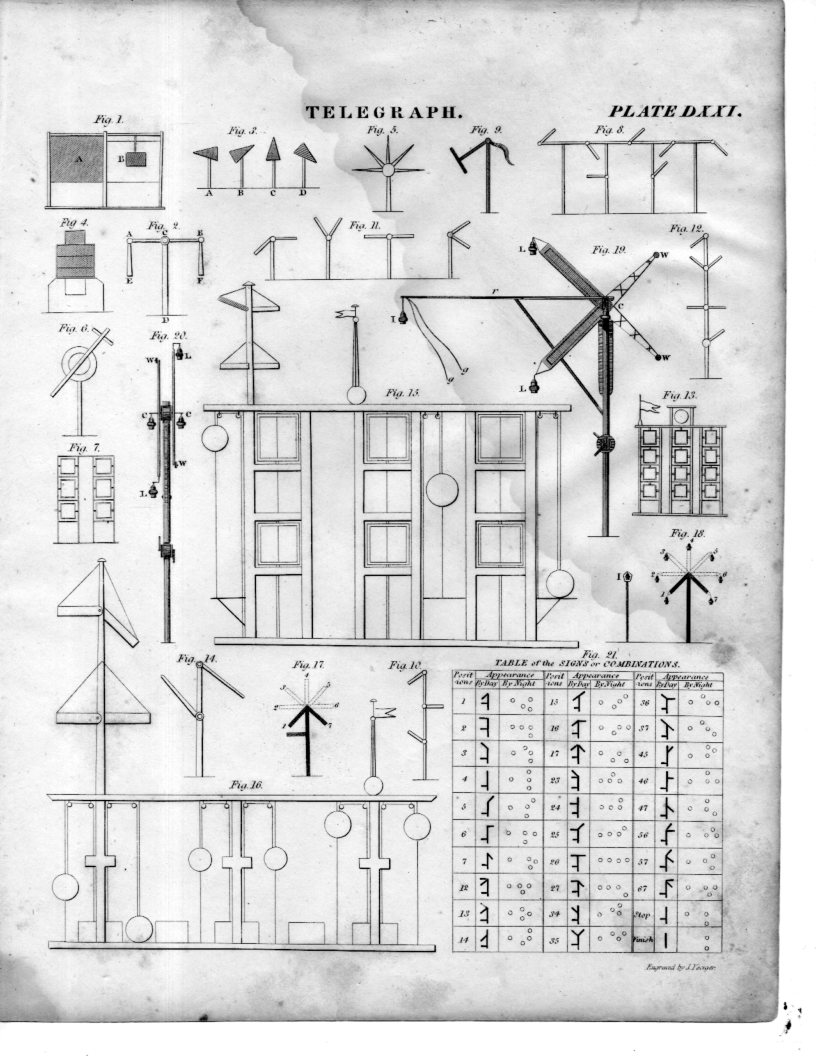
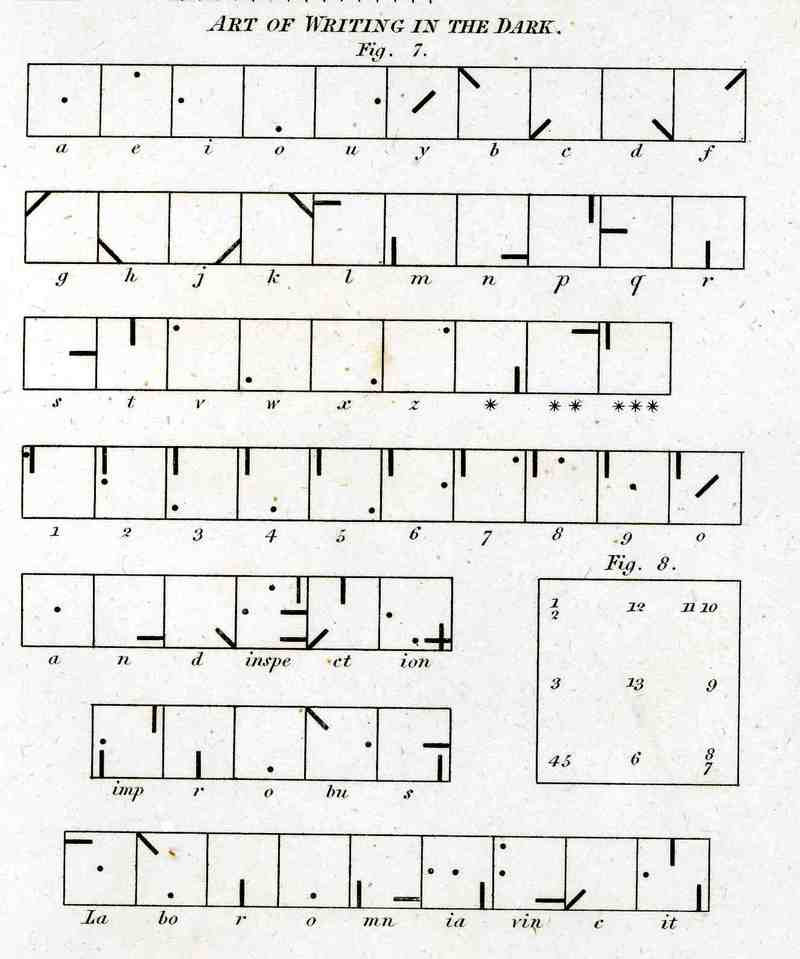
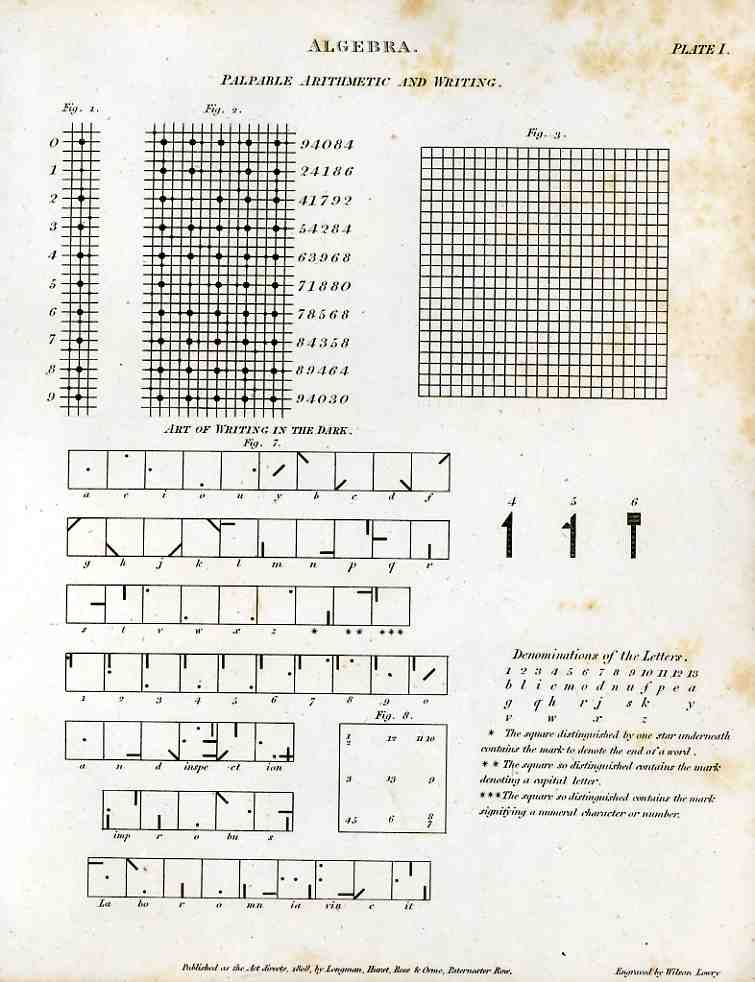
    Telegraph040This curious illustration appears in forty-five volume Cyclopedia of  Abraham Rees (published 1795-1820), displaying a system for communicating over distances at night.  When this part of the Cyclopedia was printed in 1808, the electrical telegraph was still 37 years away from coming into being–45 years from being somewhat well-used.  Before this time (visual) communications over long distances at night were limited to just these sorts of means–lighted semaphores, hand-held torches, that sort of thing.

    Telegraph039The system outlined in the (first) illustration above shows how a semaphore was articulated to produce telegraphic signals at night, fashioned with arms that had changeable holes in the arms, allowing light through to specify letters. As cumbersome and time-consuming as this might seem, it was about the only way to communicate remotely across distances (and at night)–so to transmit messages over miles there would be a series of installation s such as these on hilltops, transferring the message from one ot the other, until the destination was research. This idea did not look so antiquated until the electric telegraph took over, making it seem as though this fire-and-wood technology was 500 years old.  It was that, and older still–but it is the product of revolutionary development that the great discovery can sometimes bring upon instant antiquarianism on whatever it was that was being replaced. 

    Telegraph writing in dark

    Signaling at sea at night was somewhat different at this time and didn’t include anything remotely close to the alphabet.  So the rather complex system that we see here (above) is extremely uncommon–it seems also very unwieldy to put into effect.  Unfortunately I don’t have the text volume that would explain then entire system and implementation, so I’m going to guess that there was a large, powerful light source that was covered by a tight, black, covering tablet that would eliminate nearly all light leakage.  The symbols for each letter of the alphabet (and numerals) would be cut out from another tablet that would fit over the face of the light source, placed between the blank and the light.  To transmit a letter the user would then simply remove the blank covering tablet to reveal the light broadcast by the hole or slit in the tablet underneath.  The blank would then be placed back, a new tablet for a new letter placed underneath, and the process would begin again:  blank (dark); letter (light); blank (dark); letter (light), and so on to the end of the message.   I guess the distance at which these symbols could be seen would be dependent on light source, atmospheric conditions, ad so on.  The way that the letters are made into symbols seems to me very intelligent, so that you distinguish the differences from an appreciable distance.  I like it–its an elegant idea.  (Well, maybe it didn’t work in this manner, but it seems to make sense to me.)

    The image of the full sheet:

    Telegraphy writing in dark

    ·Posted by :

    ·in:

    —

  • NYC Ice–Glacial Mapping, 20,000 BCE

    JF Ptak Science Books  Quick Post   Part of the History of Lines series

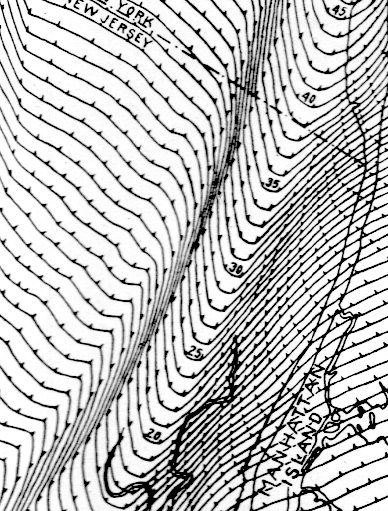
    In grazing “The Geology of New York City and Vicinity”, a pamphlet by Chester Reeds and printed by  the American Museum of Natural History (NYC) in 1926, I found these maps of the extent and thickness of the last glaciers in the region, and thought them quite lovely. 

    NYC glacier027

    This was the southernmost lobe of the Laurentide ice sheet, a vast plain of enormous ice that covered most of North America, the last bit of which dissipated around 22,000 years ago.  The maps reconstruct a bit of that glacial topography–the physical kind, not the one you’d experience walking around TriBeCa ina  brown suit.  Where the lines are closest together is the channel where the Hudson River would flow. 

    And the full map, one of three in the segment:


  • Motion Bones

    JF Ptak Science Books  Post 2077  

    Follow Me on Pinterest


    Dance comptes422

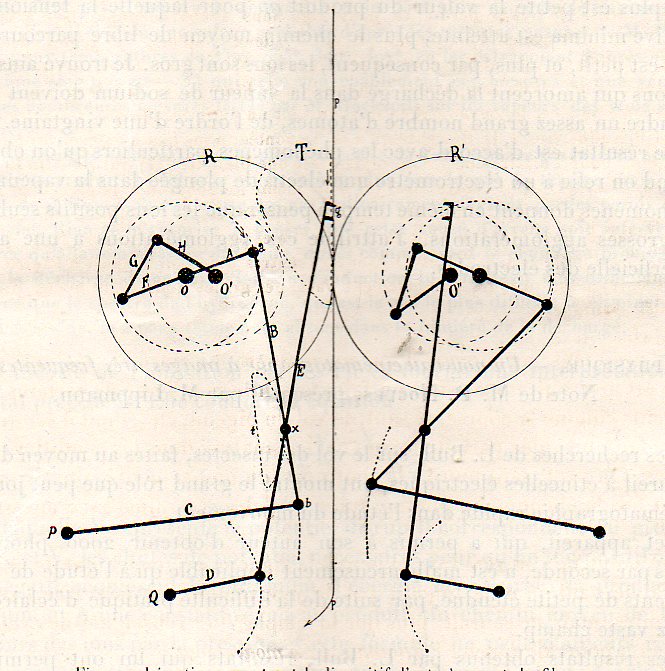
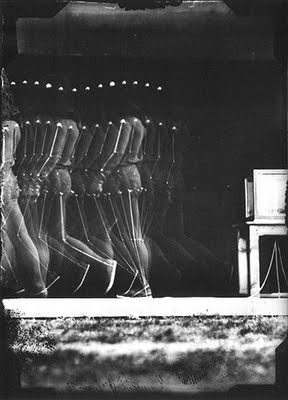
    While looking through an issue of the Comptes Rendus for the announcement of the funeral of the great mathematician and all-around genius Henri Poincare1, I found in the weekly issue (a fraction of an inch comprising the three-inch-thick half-yearly volume of papers published by the French Academy) this wonderful illustration.  It looks a bit like the superstructure to a Cubist dance, and bears a good strong attraction to many of the still images produced by Etienne Marey, maybe even a little like a mirrored representation of a stick figure skeleton of Duchamp’s Nude Descending, which interestingly was finished in this same year. 

    Marey-_Man_walking,_1890–91[Etienne Marey, ca. 1880/1]

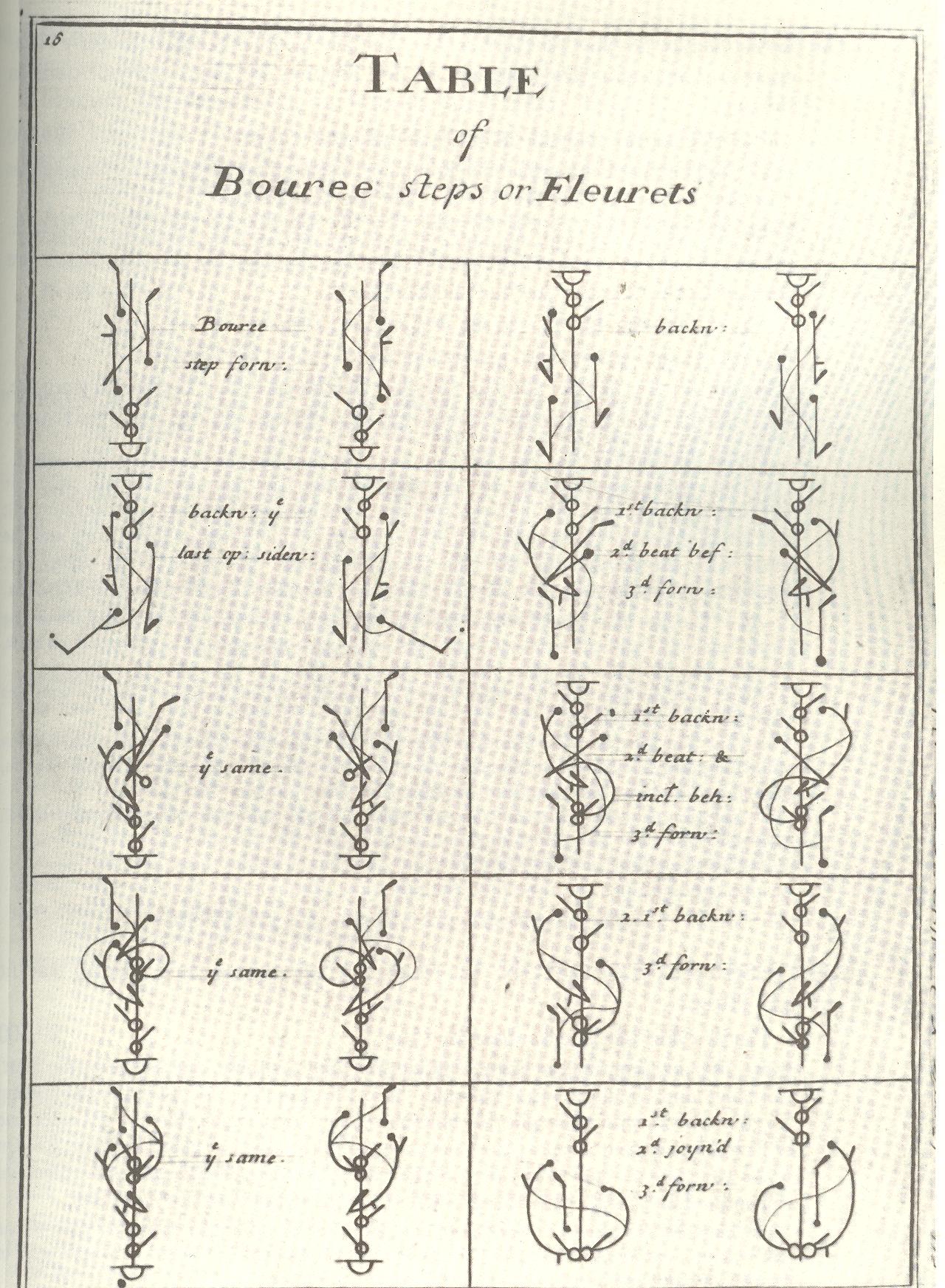
    There’s also a bit of early dance notation that the image reminds me of, particularly Raoul Feuillet’s publication of Pierre Beauchamp’s Orchesography4 ,
    a work published first in 1700  (and then in English in 1706) and
    dedicated to instructing people on the movements of the dance:

    Blog--apr 7 dance

    The image is an illustration for the article “Un nouveau cinematographie a images, tres frequentes”, by P(ierre) Nogues, and was a technical rendering of a device that ran film through a projector at a very high speed.  Nogues (1878-1971) was an assistant and collaborator to Etienne Marey, who was one of the earliest and perhaps the greatest figures in early cinematography and who–like Eadweard Muybridge–successful managed to create articulate optical machines that could capture and record minute and fast motion in people, animals, blood, and so on.  Nogues and his contemporaries lie Georges Demeny, Francois-Franck and Lucian Bull were among the founding encyclopedists of motion.  The drawing above was an outline for a sprocket device that feed flexible film through a camera at very high speed (ultimately reaching some 380 frames per second).  It is a beautiful thing. 

    [M. Duchamp, Nude Descending a Staircase, No. 2 (Nu descendant un escalier n° 2, 1912.  It is interesting to note in passing that this painting was supposedly rejected in the Salon des Indépendants show of 1912 and then caused a massive set-to in the NYC Armory Show of 1913. The infighting and family strife in the Salon in the 1900-1912 period is so big and complex it would make a fine if drippy daytime television romance drama.]

    Notes:

    1. Poincare died 17 July 1912, aged 58; the announcement of the funeral for one of the intellectual kings of the 19th century appeared on page 263 in this issue for 22 July 1912. 


  • The Endless Immensity and Finite View of the Infinite of Thomas Wright, 1754

    JF Ptak Science Books   Post 2064
    Follow Me on Pinterest

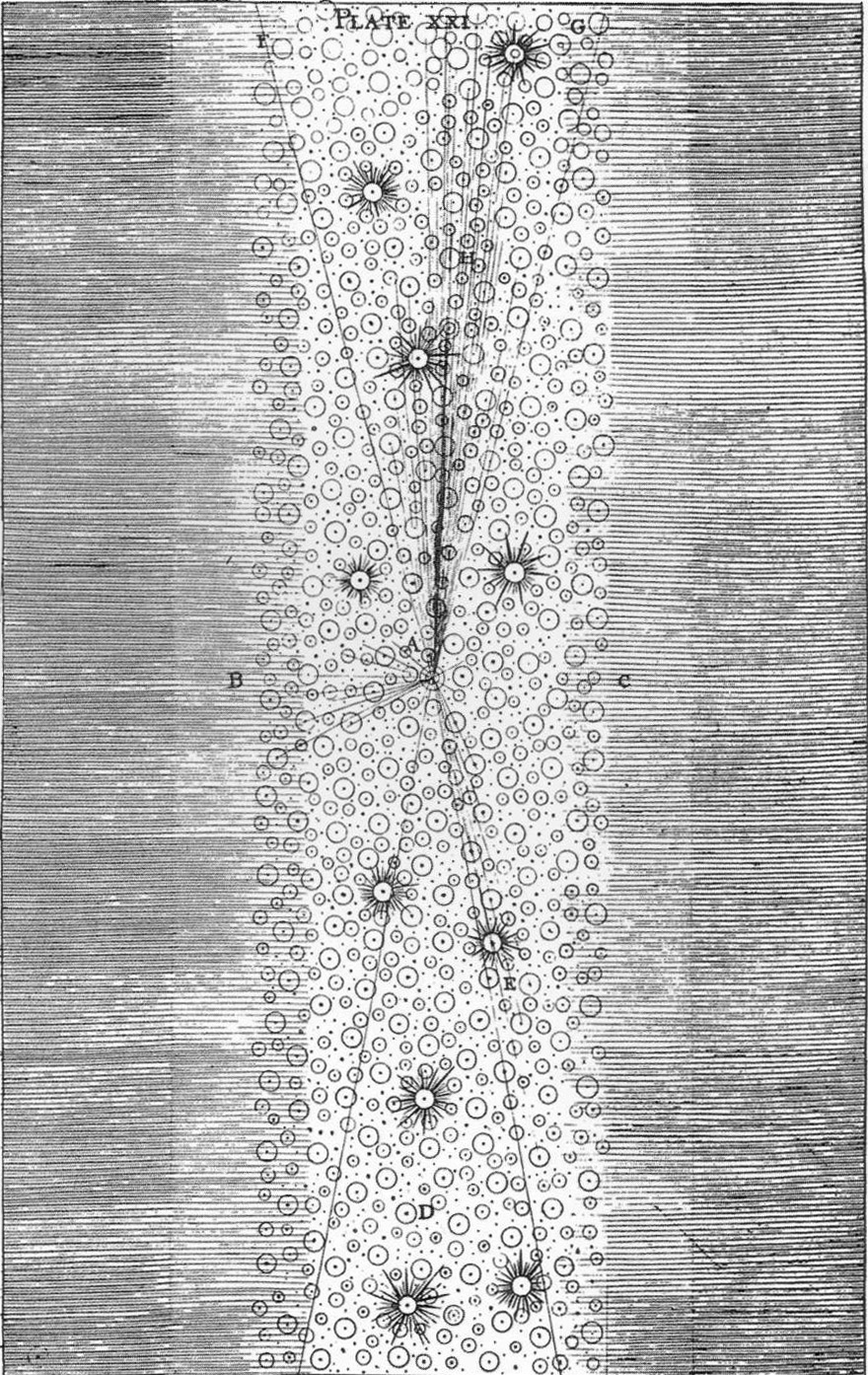
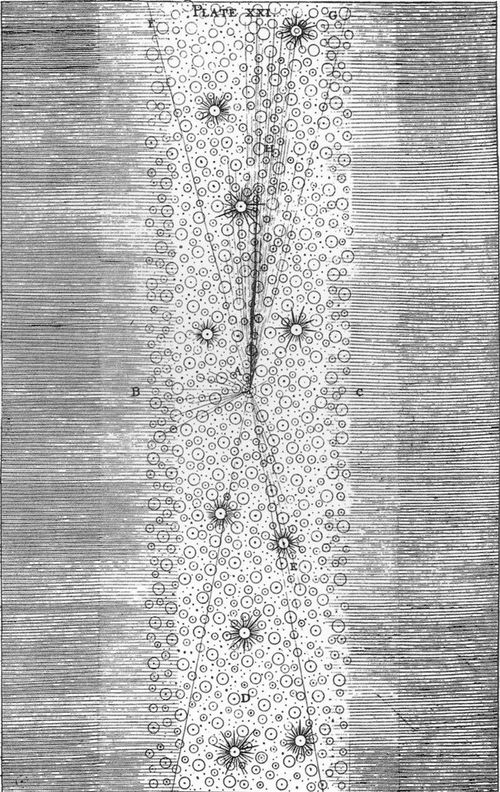
    Thomas Wright (1711-1786) saw about as deeply into the deep as just about anyone else–he looked into the night sky and pretty much saw all of it. In his book, An Original Theory or New Hypothesis of the Universe, Founded upon the Laws of Nature1, he described a version of the universe that was influential in the thinking of Kant and Herschel, finding a rectangular/squashed “finite infinity” of stars, “a vast infinite Gulph, or
    Medium, every Way extended like a Plane,
    and inclosed between two Surfaces”.
     
    Wright thomas [plate 23

    Our Milky Way, which at the time was thought to be the entire universe rather than a galaxy as it was later discovered to be–one galaxy in a seemingly endless sea of galaxies–was presciently seen by Wilkins as being but one assembly of stars in an “endless immensity” of stars:

    “And farther since without any impiety; since
    as the creation is, so is the Creator also magni-
    fied, we may conclude in consequence of an in-
    finity, and an infinite all-active power; that is
    the visible creation is supposed to be full of si-
    derial systems and planetay worlds, so on, in
    like similar manner, the endless immensity is an
    unlimited plenum of creations not unlike the
    known Universe.”–page 143. (Again, the “Universe” eferred to here is the Milky Way galaxy.)

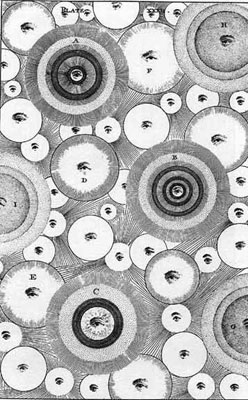
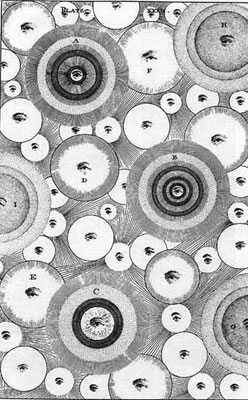
    Wright’s vision of this plethora of Universes, in which each creation is one like the Milky Way–a radical thought in 1750:

    Wright 32

    [Part of me wants to include the first Wright engraving in this blog’s series on the History of Lines, seeing as how they represent the great Something that seem to be infinitely binding the infinity of universes…]

    Wright also writes on the minuteness of the human condition, of the perfect sense of nothingness that is the Earth in a sea of infinite possibilities of other earths and earthy creations, which was definitely an outpost of thinking in 1750:

    “In this great celestial creation, the catastro-
    phe of a world, such as ours, or even the to-
    tal dissolution of a system of Worlds, may pos-
    sibly be no more to the great author of nature,
    than the most common accident in life with us,
    and in all probability such final and general
    doom-days may be as frequent there, as even
    birth-days, or mortality with us upon the Earth.
    This idea has something so cheerful in it, that
    I own I can never look upon the Stars without
    wondering why the whole world does not be-
    come Astronomers; and that men endowed with
    sense and reason, should neglect a science they
    are naturally so much interested in, and so ca-
    pable of enlarging the understanding, as next to
    a demonstration, must convince them of their
    immortality, and reconcile them to all those lit-
    tle difficulties incident to human nature, with-
    out the least anxiety.”–page 132


    Notes

    1.  The full title:  An Original Theory or New Hypothesis of the Universe, Founded upon the Laws of Nature, and solving by Mathematical Principles the General Phenomena of the Visible Creation ; and particularly the Via Lactea. Comprised in Nine Familiar Letters from the Author to his Friend. And illustrated with upwards of thirty graven and mezzo-tinted Plates by the best Masters. London, MDCCL.” Full test, here.

     2. An odd note about Thomas Wright’s personal history, from Science, 1902: “A word, in passing, about Wright. Like many another, so unfortunate as to live ere the
    times were ripe, he has been consigned to unmerited oblivion. Even the writer of the entry upon him in the ‘ Dictionary of National Biography ‘—a work so uniformly accurate — is unaware of the sources from which information could have been obtained, and so has nothing to tell, — does not even know the dates of his birth and death, or why he was called ‘of Durham.”–[Science, N. S. Vol. XIII. No. 321. 2-22-1902

    An interesting poem by Rafinesque to start of his edition of Wilkins:

    “Where ends the range and limits have been set
    To mortal eyes, there mental sight begins
    To fathom space, and worlds invisible
    Surveys, admires
    The mind must feel that space can have no bound*,
    Whatever number be of things or thoughts
    Others may be beyond—and thus behind
    The Nebulas and Belts, our Galaxies
    Of stormy clouds and oceans
    There stands the central land and throne
    Of our wide Universe, the home of Angels,
    The seat of Love Divine”
    Rafinesque, Poem on Instability, found at the beginning of Rafinesque’s 1837 American edition of Wright’s 1750 work. 

  • History of Lines–Atomospheric Electricity

    JF Ptak Science Books   Quick  Post    
    Follow Me on PinterestPart of the History of Lines series

    Hermann Plauson, a German engineer and director Fischer-Tropsch Otto Traun Research Laboratories of Hamburg, Germany (in the 1920’s)  built on an idea of N. Tesla to “convert alternating radiant static electricity into rectified continuous current pulses”. It was an expansive idea of at least artistic merit, as seen in his patent application (below) and visualization of the completed installation. 

    “For many years electrical engineers have endeavored to devise some means  whereby it would become possible to utilize the free electrical energy ever  present in the atmosphere, but they were not successful, as every now and then an extra heavy surge of static current would rush down the elevated conductor and endanger the lives of the experimenters, or else destroy the apparatus  connected with it. A German engineer has, however, devised the somewhat  elaborate scheme here shown in brief, and he has succeeded, at least so his  report states, in safely extracting several kilowatts of electrical power from  the atmosphere with metallic surfaced balloons, elevated to a height of only 1000 feet.”–Hugo Gernsback, “Power from the Air (II)”, in Science & Invention, March 1922.


  • A History of Antiquarian Water: Line Segments

    JF Ptak Science Books   Follow Me on PinterestPost 2022

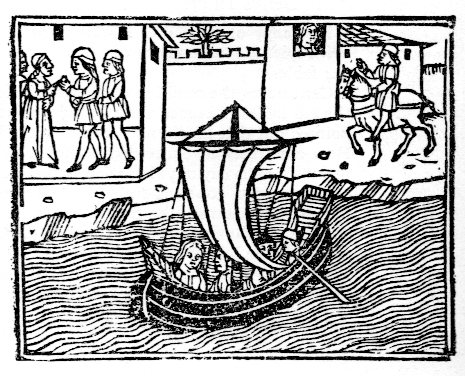
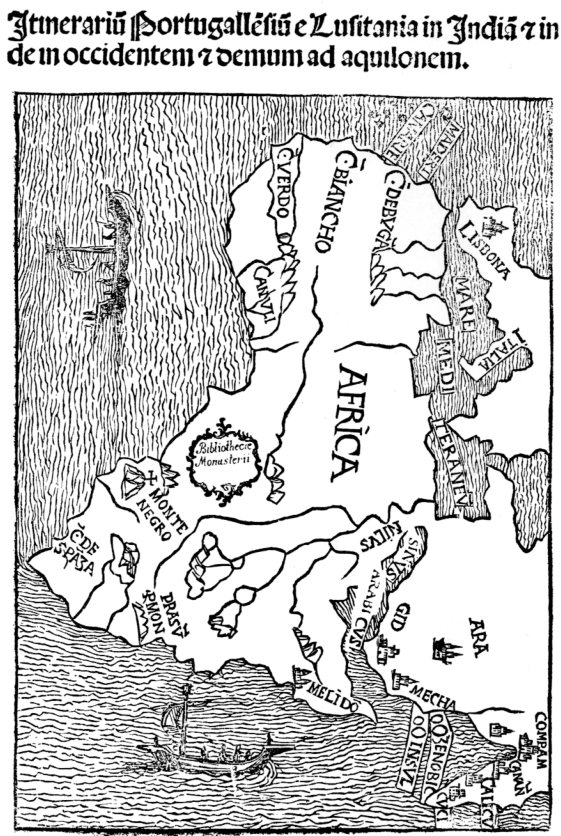
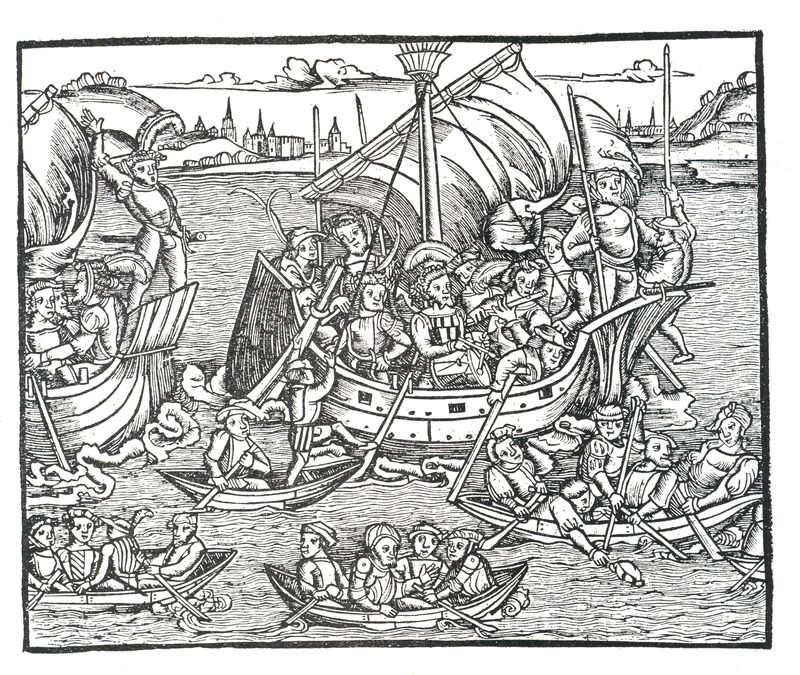
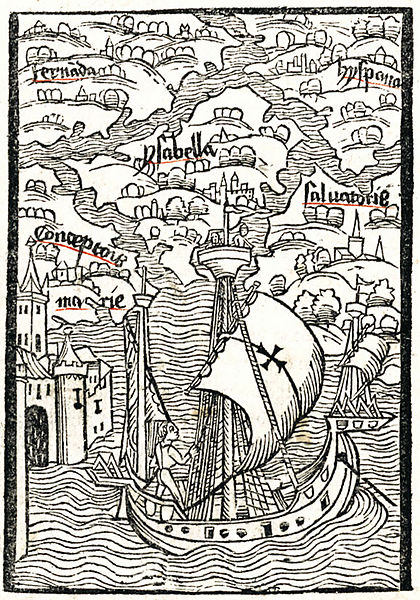
    Images of rivers and oceans in 16th century maps can be beautifully-rendered objects.  Water can appear as lines thick and languid, curling and wavy, sparse, tentative, adventurous, willing, dashed, timid.  Cold. Mostly cold, and full of loneliness and foreboding.  And sometimes the sea is just a blank–it is more common to see blank skies in engravings and woodcuts before, say, the 1540’s, but the blankness is usually covered by rhumb lines and compass roses and lines of longitude and latitude, compared to the blankness of blank skies, where there is usually nothing to spare us from the blank.

    Today I’d like to have a look at the strong and long lines delineating activity in water as the first part of a short series of posts looking at the design of the representation of water by lines.  Then, when the lines are done, we’ll take a look at dots. 

    This example occurs in Masuccio Salernitano’s (Tommaso Guadati, fl. c. 1476) Novellino, published in Venice by Bartholomeo Zanni in 1510, a tall book of a Decameron-ish flavor, with 50 stories told in five sections, mostly of a waning erotic nature.  The lines here are long and very languid. I also like the face in the window. 

    Water masuccio267This complex of lines illustrates the map of Africa found in Montalboddo Fracan’s Itinerarium Portugallensium, which was about the earliest published collection of Spanish and Portugese travel and exploration relating to the New World.  The work was exceptional and very significant–and very popular, going through fifteen editions in 22 years to 1528. 
    Water africa266

    Titus Livius (59 BCE-17 ACE), better known to the English-speaking world as Livy, was a superior among superiors of Roman historians, writing on the history of his city and country.  His work, Romische Historie…,published in Mainz by Johann Schoeffler 1450 years later in 1514, was one of the most beautifully illustrated books ever produced in that city. This is a considerable statement, as Mainz was the birthplace/hotbed of moveable type printing, being home to Johann Gutenberg and a number of other early presses. 

    Water Livy Punic

    One of the most famous printed water scenes is from the (numerous) editions of Christopher Columbus’ letter describing his voyage to the New World. It was written (or at least finished)  soon after his arrival in Lisbon 4 May 1493, almost exactly 520 years ago, and quickly found its way into print. This image (depicting Hispaniola and Isabella) was printed in Basel in 1494, and served to illustrate the somewhat hopeful and inflated description of what he found on his new voyage.

    Water Collbus Basel

    [Source: Wiki, here.]

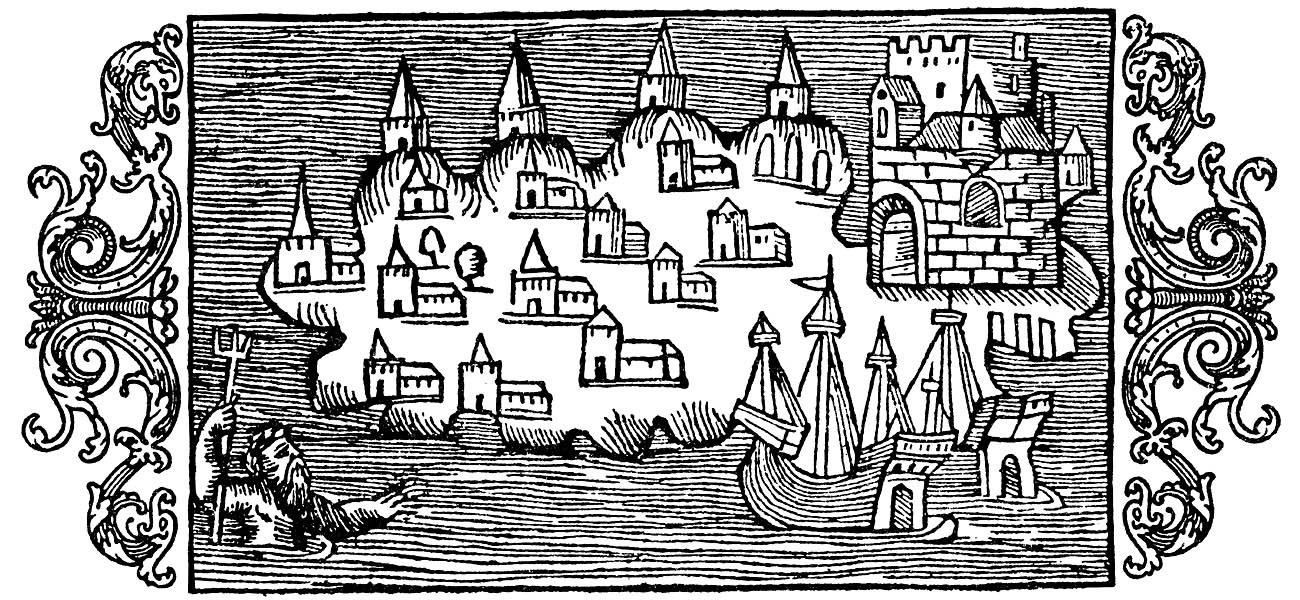
    This image from the mid-16th century is found in the fantastic work on the history of Scandanavia (and etc.) in Olaus Magnus’ Histotria di gentibus septentrionale (“History of the Northern Peoples”, 1555).

    Water Magnus[Image source: http://www.avrosys.nu/prints/index.htm]

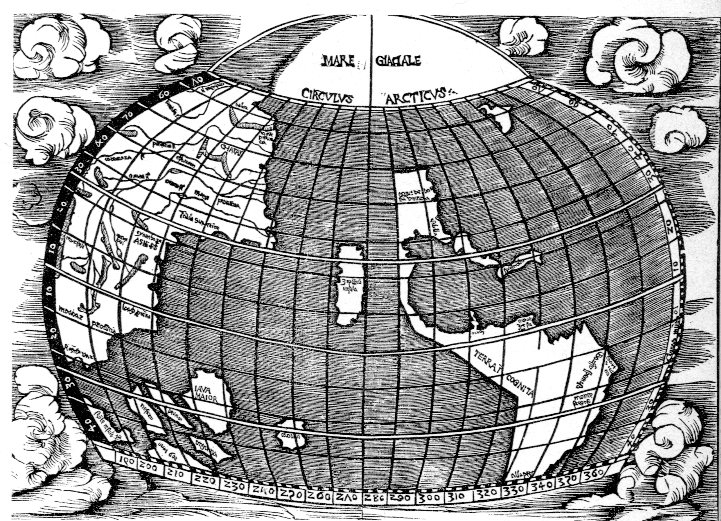
    The seas in the map of the Western Hemisphere in Joannes de Stobnicza’s Introductio in Ptholemei Cosmographium (Cracow, 1512, and widely believed to be copied or at least very heavily inspired by the Martin Waldseemueller’s 1507 map of the world) are very tightly drawn, neatly unifrom, and lovely, as wesee below).  This recitation could go on for quite some time, but this gets the point across on heavy lines.  Next stop: dots. 

    Water strob268