A Daily History of Holes, Dots, Lines, Science, History, Math, Physics, Art, the Unintentional Absurd, Architecture, Maps, Data Visualization, Blank and Missing Things, and so on. |1.6 million words, 7500 images, 4.9 million hits| Press & appearances in The Times, Le Figaro, Mensa, The Economist, The Guardian, Discovery News, Slate, Le Monde, Sci American Blogs, Le Pont, and many other places… 5000+ total posts since 2008.

Category: Blank and Empty Things; A History of

  • Blank & Empty Things Series: The Militant Christian Patriots, Hitler and Saving Britain from Itself, 1938

    JF Ptak Science Books  Post 1323

    [Part of our series on the  History of Blank, Empty and Missing Things]

    The flag of the group Militant Christian Patriots may tell you something about them faster than even their name:  it was a large bright red field, with a white circle in the center, in the center of which was a simple black cross.  Drop the horizontal bar to the middle, elongate it, shrink the vertical just a tad, and turn the ends of each bar 90-degrees at 75% of their length,  et voila, you have the Nazi flag. 

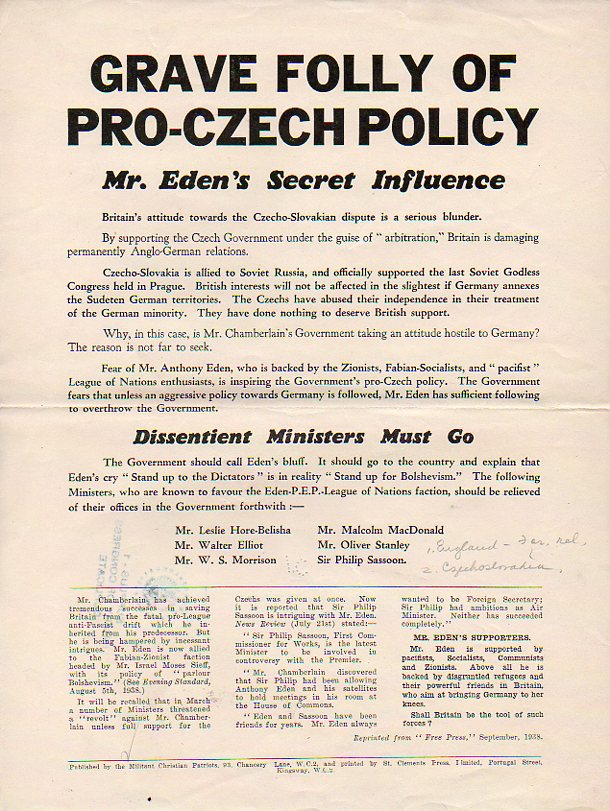
    This unsigned circular blasts the “appeasers” from inside the government of the valiant Mr. Chamberlain, who is supported by the Militant Christian Patriots in his stance to keep Britain out of the developing (and developed) trouble brewing between the Nazis and the Czechs.  The piece of paper that Chamberlain held aloft at the airport, claiming victory with his appeasement of the Nazis and happy with the firm trust in Hitler’s signature, was a good document to start with for this extremist group.  Next, they would have Mr. Anthony Eden (who wound up resigning his position until recalled by Churchill when he finally and thankfully took over the office of PM from Chamberlain in May 1940) removed, what with his alliances to Fabian-Zionists and all.  The other ministers targeted by the Militant Christian Patriots were among those others who supported Eden and worked against Chamberlain–undesirables, “pacifists, Socialists, Communists and Zionists”.   The other branch of their unholy alliance were “the disgruntled refugees and their powerful friends in Britain, who aim at bringing Germany to her knees”, because, somehow, members of Parliament were somehow responsive to disgruntled refugees.

      Fascists--czecholosvakia document340
    [The original document is available for purchase from our blog bookstore.]

    File:MunichAgreement .jpg

    This is a photo of Chamberlain at the airport with Hitler’s signature, telling the world, basically,  that “it was up to the Czechs, now”, somewhat confident in the fatal Munich Agreement, trusting Hitler to end his European territorialism .  The occupation of Czechoslovakia came just months after the Austrian Anschluss of March 1938, but, well, the Prime Minister had Hitler’s signature.  It would not take long for this picture, and for the newsreel, and for Mr. Chamberlain’s face and even his very umbrella, to be used as iconic symbols of disastrous failure. 

    The Militant Christian Patriots were faithful to none of the words they used to identify themselves–after all, calling yourself something does lead to some sort of expectation…


  • The Big Lie Department: Japan and its Version of Chinese “Aggression”, 1937

    JF Ptak Science Books  Post 1319

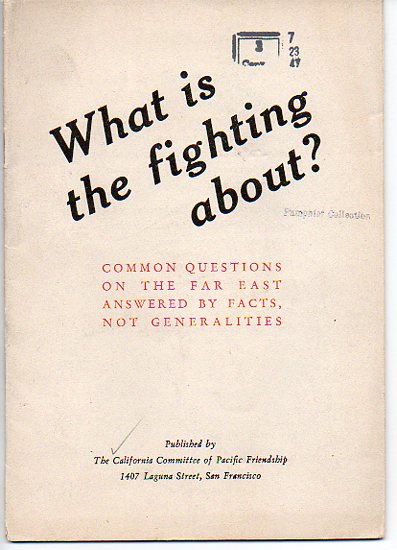
    This little  pamphlet is a great example of The Big Lie–propaganda so vast and so vicious and so far from the truth that people tend to believe it because, well, because no one would or could tell lies so Gargantuan and Pantagruelian and expect to get away with it. They were statements so spectacular and seemingly untrue that their very reverse weight gave them weight enough to necessitate “truth”.  Mostly on this blog the Big Lies I’ve dealt with came out of Germany–these had to do with the International Jewish Conspiracy, the plot of Poland to attack Germany, the resettlement that was going to be provided for French workers who came to the Nazi’s side to do technical work for the Wehrmacht, and so on. 

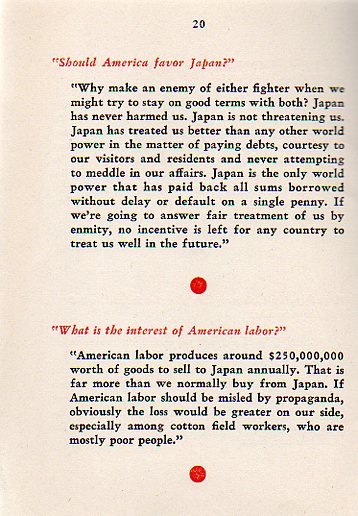
    Big Lie--Japan319 In this case it is Japan’s turn at The Big Lie to make its case to justify its already long and very bloody attack and occupation of China.  In short, what the publishers–the California Committee of Pacific Friendship (located at 1407 Laguna Street in San Francisco, the site of which today is ironically occupied by the Chinese Consulate)–tell their American audience is: that the Japanese are not aggressive; that China was planning to attack Japan to help unify their own country; that Japan needed to occupy Manchuria to protect Japanese citizens; that at the same time Japan was invited into China and was not going to leave because no one else does; and that is it is in the best interest of the U.S. to continue its valuable trade with Japan in order to protect the  poor people who pick cotton that goes into essential American-Japanese trade.  Virtually everything in this report is nothing.   Thats what makes it a Big Lie. [This pamphlet is available at our blog bookstore.]

    Part of the issue of invading China’ was to prevent Chinese aggression towards Japanese citizens, which was “a politically attractive campaign” and a cause of :China’s backwardness”. 

    There is no mention of Japan’s invasion of Manchuria in September 1931 following the Mukden Incident, an earlier version of a Gulf of Tonkin incident, a manufactured bit of terrorism by the Japanese military perpetuated against itself to give the Empire a reason to attack China. .  Manchuria was subdued by 1932 and  renamed Manchuko, and then used by the Japanese for its fantastic assembly of raw materials.

    In the same vein it was alleged in this pamphlet that it was China which bombed itself at Shanghai (Songhu), not the Japanese, starting what would be months of fighting in one of the largest and bloodiest battles of the 1937-1945 war.  It doesn’t make much sense for this top be the case, as the  National Revolutionary Army of the  Republic of China was vastly over matched by the  Imperial Japanese Army of the Empire of Japan.  (The Chinese enjoyed a 2:1 advantage in troop strength, but totally overwhelmed by Japanese tank and aircraft numbers and tech superiority.)  This pamphlet was published in November 1937, so the end of this battle–the first really of that would be twenty-two or so major engagements of the war–was still months away.  No doubt that an updated version of this pamphlet printed in 1938 would note the 70,000 Japanese soldiers killed without mentioning their own belligerent status or the 200k Chinese killed during the same time.     

    Big Lie--Japan text320
       

    The Japanese wouldn’t have to bother with this sort of propaganda after 7 December 1941.  It would’ve been hard to explain it all, especially the 17,000,000 Chinese civilians being killed in the process. And the 3 million Chinese soldiers1. Quite a long and twisting road from protecting Japanese citizens in Manchuria in 1931.

    Notes       

    1. Nationalist Chinese military forces included 1,320,000 killed in action, plus 1,797,000 wounded, with another  120,000 MIA. The Communist Chinese forces included another : 500,000 total casualties. Japanese forces include about 396,000 KIA plus another 430,000 MIA and WIA. Another estimate from the Japanese side gives the figures for Japan’s losses at ( 1937–1941) 185,647 KIA. 496,000 wounded, and 430,000 incapacitated; plus for the  1941–1945 period,  another 202,958 dead.   Nationalist Chinese estimates for Japan’s losses for 1937-1945 were 1.77 million KIA and 1.9 million WIA


  • What Free Things Cost–The Washington Times and the Eugenics Society

    Years ago when I lived in DC a new, upstart newspaper, The Washington Times (a conservative, Sun Yung Moon Unification Church organization-owned entity that is painful to italicize) spent years trying to establish a toehold in the area readership.  For years they spent a dollar per daily reader trying to get their message out–the cult leader himself, Rev. Moon, has stated that the paper has cost over a billion dollars to keep “competitive”. Since its founding in 1982 the paper has always lost money but has kept its focus on target–recently though there have been breaks in its rigid far-right exterior, changing some of its rhetoric to be more accommodating, like for example in 2009 deciding to use the word “gay” rather than “homosexual”.  The paper was owned by New World Communications–a branch of the Unification Church–from 1982 to 2010, when the paper was sold directly back to Moon for $1.  The paper is still in publication a,most 30 years later.  And even though the Unification Church says that the paper is independent from editorial control, former editors of the thing have said otherwise.  [New World Communications owns UPI by the way. Happy Happy World World]

    Eugenics soc316

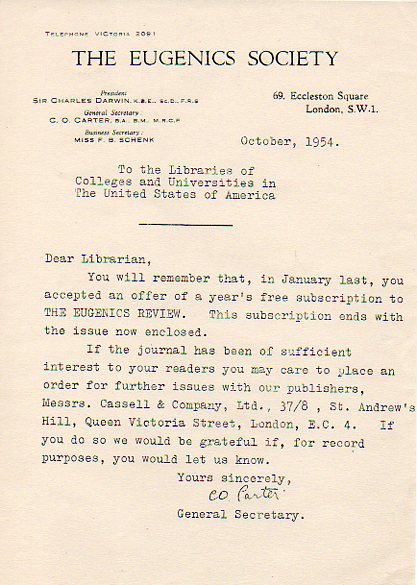
    For several years running as a matter of fact the Washington Times threw their newspaper onto my lawn, a freebie, news gratis–they just kept coming, day after day, even after I called them requesting that they stop the free delivery.  They didn’t.  I simply didn’t want to be included as a statistic as a “reader”, because grass-reading was evidently a statistic they could deal with. Had I been a lawyer I think I would’ve sued them for littering, as that was about the extent of the value of their newspaper, to me.  I guess if you give something away long enough, people get used to it, and then, after many years, they are guilt ridden to buy, or–like a phantom song from the radio that you’ve heard so many times that you know it by heart even though you don’t like it–it becomes part of your routine.

    That’s what I thought of when I saw this circular slide out of one of the volumes in the warehouse of the Journal of the Eugenics Society.  It warned librarians that the free ride their library had been given by the society was about to end–maybe–and that if the institution wanted to receive any further issues, they would need to buy them.

    Unlike  the Washington Times–still in business today–the Eugenics society didn’t make it.  It died decades ago. Died a death long overdue, died in its seventh decade.  Pieces of it lived from ancient times, famously with Plato, developing in more modern times into a societal, philosophical, scrapingly biological branch of pseudoscience, aimed generally at improving the human population through a more-or-less longitudinally dreamed belief system.  It was squared away and rounded up with social stats of Karl Pearson and number crunching of Francis Galton (who misunderstood the writing of his cousin, the beautiful Charles Darwin). And in spite of coming into a sort of Renaissance in the early twentieth century, it was mostly put away by Nazi monsters, who broke whatever basis in reality that eugenics had, almost entirely dealing the belief system a mortal blow.  Some people still felt comfortable with it enough to use it to continue a practice of population control by sterilizing anti0social elements–including prostitutes and drug addicts, and people of low IQ, but mostly, almost entirely, poor people–up until the 1970’s. 

    It looks like a desperate thing to me, this flyer (available from our blog bookstore, here).  It may well have been real, it may have been the case that it wasn’t this piece of propaganda that I see  it as to help sell a fatal science…but I don’t think so.  It looks pathetic, paper collar and starched shirt and doctorates and cufflinks and privileges notwithstanding.  And it reminds me of the desperate attempts of propaganda machines like The Washington Times to get its message across–even when it is very clear that there are not nearly enough people to fund it, a message machine in desperate search of an audience.


  • Dividing by Zero: David Byrne and Herman (“the Fat Man”) Kahn Sing the Future Blues

    JF Ptak Science Books  Post 1312

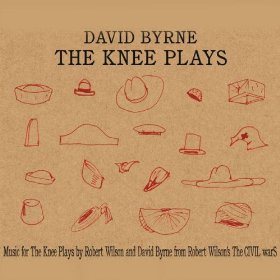
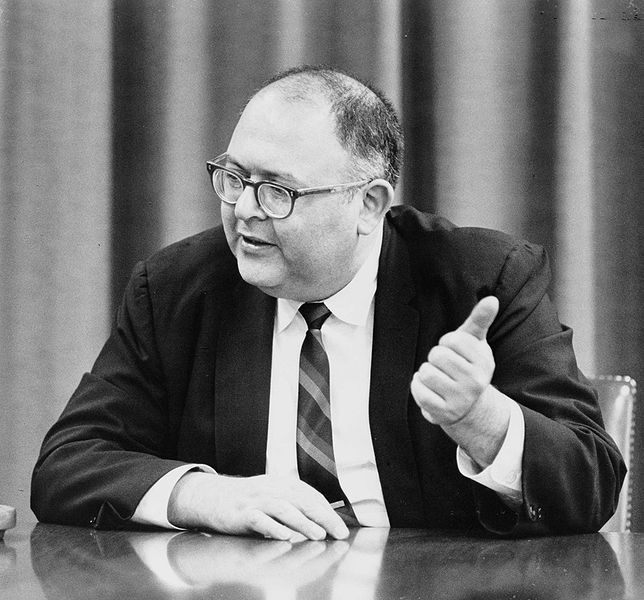
    Earlier in this blog, about two years ago, I wrote a piece on David Byrne’s beautiful Knee Plays, which included a song “In the Future”.  The post was about Byrne’s vision of the future which was bounced off the belly of “futurist” Herman Kahn, a man who was widely influential and whose thinking (I do believe) was widely incorrect.  He was also a proponent of possible first-strike (that is, American-initiated) nuclear warfare, deeming the scenarios “winable”., a broad thinker on Thinking-the-Unthinkable, and coiner of the word “megadeath” when used in conjunction with his nuclear end-game games. A main component of the template for Dr. Strangelove in Kubrick’s movie by that name,  Kahn and the think tank he helped found (the Hudson Institute) had the ear of the Reagan administration, among others, and it shows.

    Here’s the revised post, expanded some.

    0-blog-dec 3 byrne David Byrne, former Talking Heads member, produced a series of twelve short pieces to be used in the Philip Glass (and Robert Wilson*) Opera CIVIL warS  in 1985. (“Opera” may not be the right word for this piece, as I think it was one only in so far as the composition needed an opera house to be performed in.)   The Byrne pieces, called ”Knee Plays”, were meant to fill in the spaces, the spaces in-between,  place holders, between the sections of the day-long multimedia production..  Glass had used this idea of inter-pieces to the whole earlier in 1976 in his at-the-edge Einstein on the Beach, in which the connective elements were meant to not only join the pieces of the production together, but were also meant to stand alone, as a cohesive unit, if removed from the opera.  (Glass said they were “short connecting pieces which appear throughout the work much as prelude, interludes and post-ludes. Taken together they form a play in themselves”)

    0-blog-Dec 3 David_Byrne1991

    One of the Knee Plays, “In the Future” (Knee Play Number 12) is a slippery, stacatto brass section accompanying Byrne’s 51 sophisms about life in the future.  About thirty years earlier, “futurist” and think-tank-filler (or maybe it was “Think Tub”?) Herman Kahn (1922-1983), occupying a lot of space at the RAND and Hudson Institutes  (he was also known in many circles as the “Fat Man”), diligently recorded his myopic views of the future. He is generally regarded as a systems theory and military strategy guy, and is most remembered for (as he claims, perhaps) introducing the term “Vietnamization” which described the ultra-failed de-escalation (?) process and withdrawal for the United States from Vietnam (attention Obama administration).  Superluminarily speaking though his contribution to thought on constructing and implementing thought regarding nuclear weapons exchange (pointless to refer to this as “war”) in several books, including On Thermonuclear War (1960), Thinking About the Unthinkable (1962) and, On Escalation (1965), where he famously put The Bomb on the table of use possibilities.  In addition to these books—which he is busily trying to forget out there in his afterlife, somewhere, maybe in a penitential place where you are forced to think endlessly about paths-to-bad-decisions) is that 1967 peek into the future, The Year 2000.  Petroleum and oil are not issues.  Computers are of minor societal importance.  And then other things of no importance happen.

    0-blog-dec bryne kahn When you take Byrne’s Knee Play 12 and place it next to Kahn and other mis-spent prognosticators, the musician looks positively brilliant.  Some of the stuff has come to pass, some hasn’t; some will, and some won’t.  Some are open to a little interpretation, and some, a lot.  Overall, though, if you think through these little future bullets a little carefully, David Bryne looks very good.  Byrne’s lyrics/list is below.

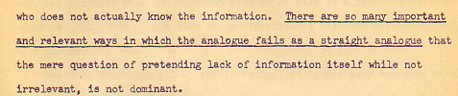
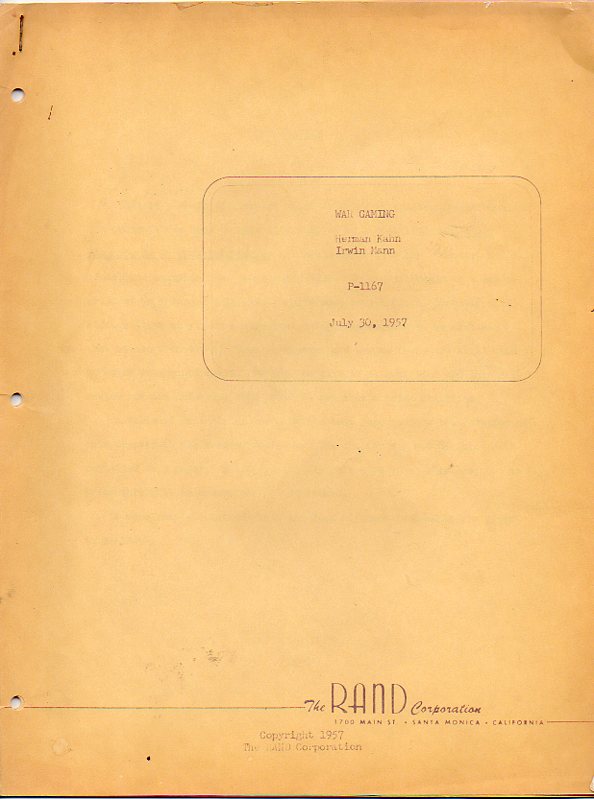
    Kahn’s writing is necessarily less elegant than Byrne’s, and probably less elegant than most other people in general including those who don’t write, though it does lower itself to some height of governmental semi-speak.  For example, from his July 1957 RAND paper “War Gaming” (available at our blog bookstore, HERE), we find this nugget:

    Kahn314

    Kahn315

    I have no doubt that Kahn looks like a warrior to many people–he no doubt was something of one, so long as that warrior could wear a white button-down shirt and not get dirty.  Simply because a person is thought of as a “warrior” doesn’t make them a ‘good” one, either, and I think that I would nominate Herman Kahn as an example of one:  in my own approximation of Kahn-speak, he would  “generate the apparent non-non appearance in definable though undefined parameters as  a non-good non-warrior in circumstances that defined or not define him/them in this semi-stable manner”.

    I think it is important to look at documents like this–documents that helped establish military policy–to see how their authors were able to convince people in government that they could divide by zero.


    *Robert Wilson is a phenomenal conceptualist and theatrical designer.  On the liner notes to CIVIL warS is found the interesting note on Wilson and Byrne:  “At first, Robert Wilson asked David to compose pieces for several sections of The CIVIL warS, but on account of David’s limited time, he composed only The Knee Plays part. The CIVIL warS was supposed to be played in its complete form at the Olympic Games in Los Angeles, but if one plays every part, it takes at least eight hours. There was also a financial problem for playing every part. So only some parts of it were staged there. David himself was very interested in composing for such a play and dance and this time again he enjoyed this work very much. Last time, for The Catherine Wheel, he used recorded tape, but this time he made musicians play on the stage.”

    (Featuring a prominent role for The Tuba)

    IN THE FUTURE (KNEE PLAY 12)

    In the future everyone will have the same haircut and the same clothes
    In the future everyone will be very fat from the starchy diet
    In the future everyone will be very thin from not having enough to eat
    In the future it will be next to impossible to tell girls from boys, even in bed


  • Blank, Missing & Empty Things: German Soldiers, November 1918

    JF Ptak Science Books   Post 1305

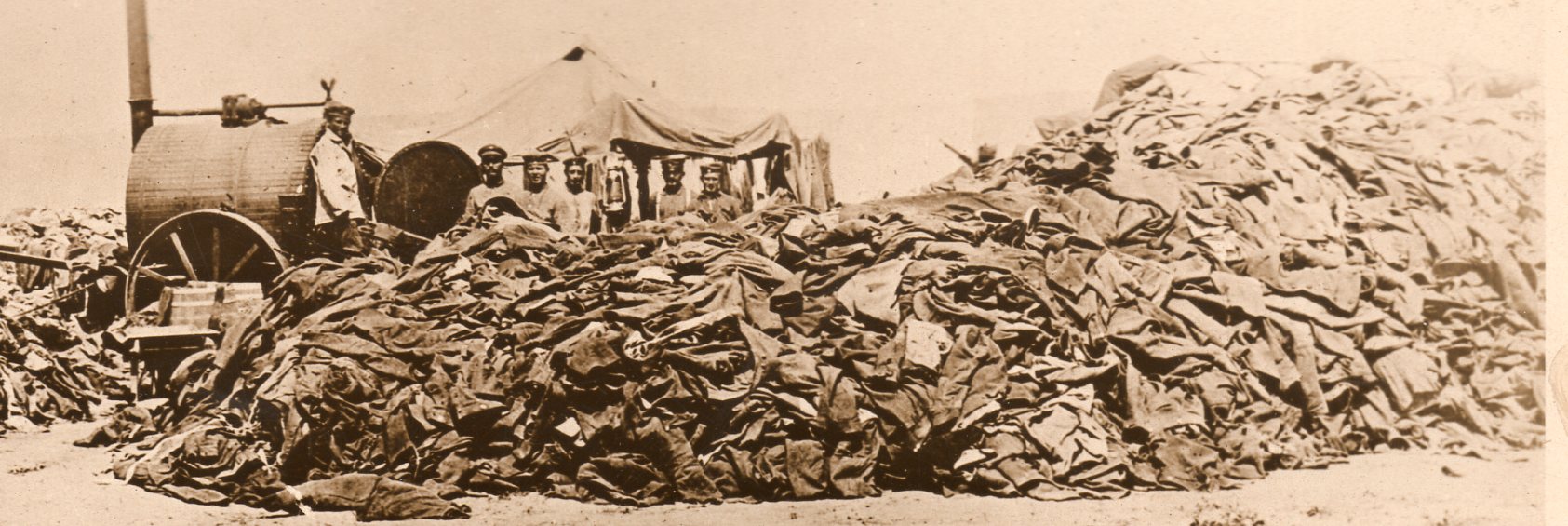
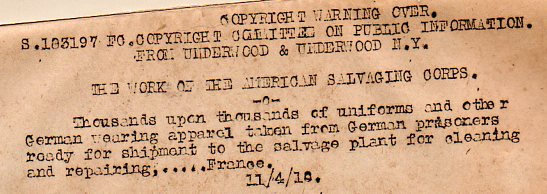
    This remarkable photograph is part of an archive of World War I Underwood & Underwood News Photo Service photographs I purchased many years ago.  It shows a pile of German soldiers’ uniforms–thousands of them–taken from German prisoners, the clothing headed for “cleaning and repair”. 

    World War I photos--empty uniforms287

    [This photo, along with mnay others, is available for purchase from our blog bookstore.]

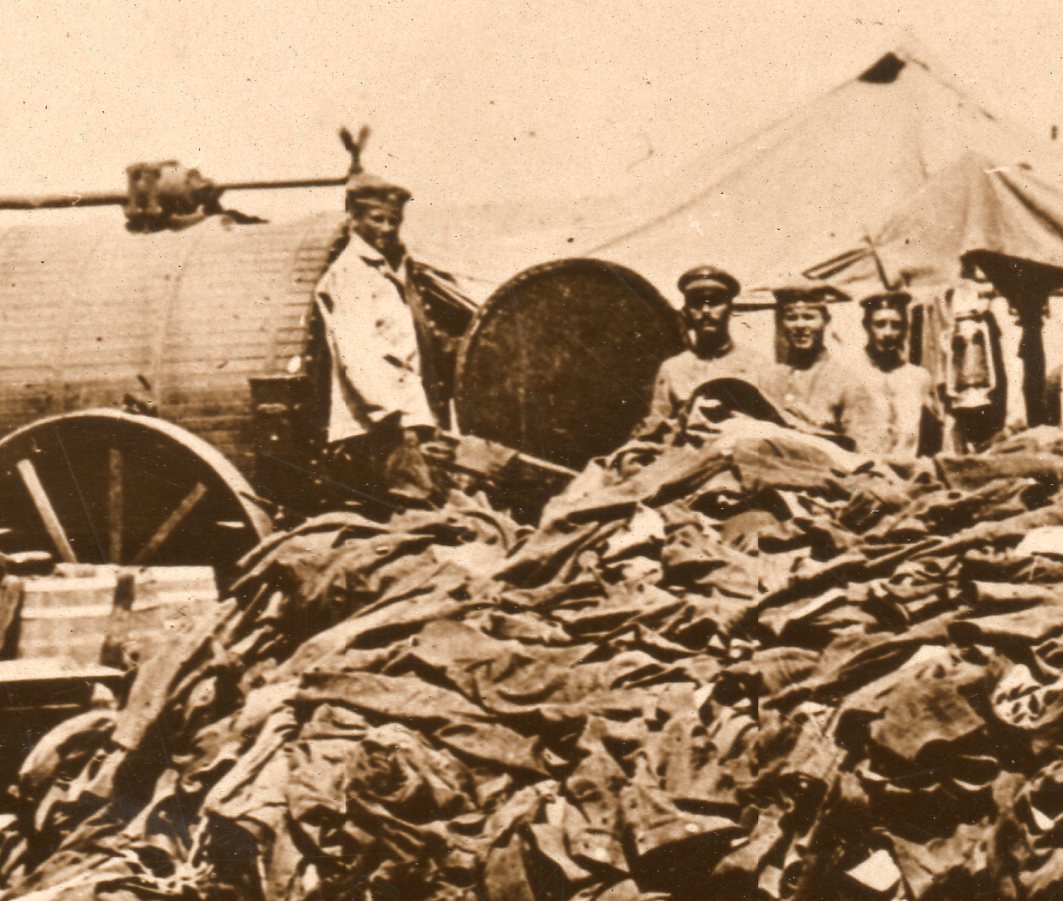
    I didn’t know before this that the uniforms were repaired–I can imagine the cleaning part, since the prisoners must wear something, and deep into the fifth year of the war it seems hardly the case that they would be given anything at all to wear except for what they were captured in. the cleaning part sounds logical too, especially as the cleaning was being done by the prisoners themselves (pictured here).  Clean clothing makes for more sanitary conditions in mass compounds for thousands of prisoners, and lowers cost for the health maintenance for the prisoners in the short and long run.  And so far as repairing goes:  attached buttons make for closed coats; closed coats allow prisoners to have a better chance at staying healthy in the coming cold months. Just ask Napoleon about the cost of thread on the buttons of his army’s overcoats in the march towards Moscow.  (The thread that wasn’t used cost very little; the cheaper thread that was used cost everything.)

    And the detail:

    World War I photos--empty uniforms det288
    And closer still:

    World War I photos--empty uniforms detb290
    And the text that was provided by the photo service company to be used along with the photo wen (or if) it was published. 

    World War I photos--empty uniforms txt289

    The cleaning and repairing went on, the prisoners kept coming in–even for those involved, the scent of the end of the war was in the air, though I doubt that the majority felt that it was only a week away. 


  • Reverse Autopsies of Stick Women–Blank and Empty Art Anatomy, 1941

    JF Ptak Science Books   Post 1304

    Part of our Blank, Missing and Empty series.

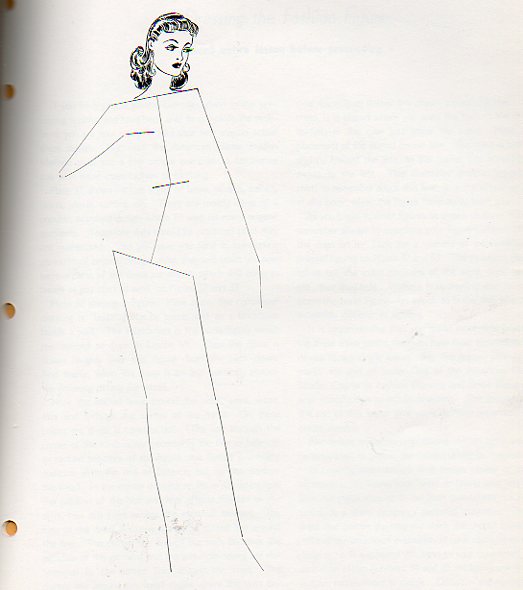
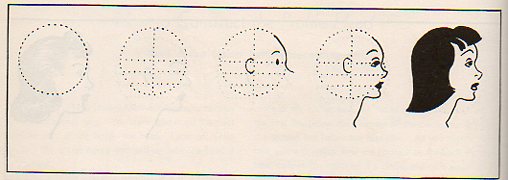
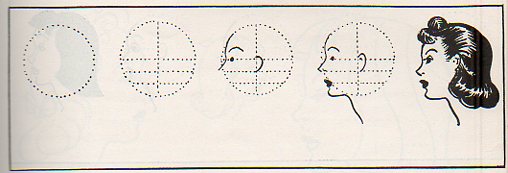
    Coming on the heels of my posts of autopsies of snowmen and donuts comes this semi-remarkable pamphlet (available for purchase here), published by  American Home Studies (of 1700 Eye Street, NW, Washington D.C.1), displaying very restricted instructions on anatomy for art students.  The drawings really work better in reverse, I think, because you really can’t get to the final product from the illustrated series in its how-to sequencing unless you already were finished.

    Blank women--anatomy art full286

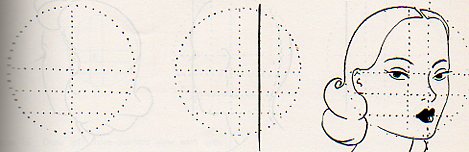
    What happens throughout this pamphlet is what we see below–draw a circle, then divide it by drawing lines over imaginary bones, pop in some eyes and lips, and then fill in the rest.  Not too very helpful.  This is especially so when we look at the image above, which the student was supposed to simply cover with clothing after having added the head.  If this was an animated figure, I think I  would find it disturbingly creepy.

    Things become clear by the time you reach the end of the pamphlet, when you are told that you can detach any page from the work and send it to the D.C. address for correction and advice, for a dollar a page.  That’s when the real education occurs. (Many others have done this–the two guys responsible for creating Superman started out selling their services in just this how-to way.)

    Blank women--anatomy art profile284
     
    Blank women--anatomy art profile283

    Blank women--anatomy art profile285


    But I guess as a sort-of artist one would need to have something else going on for themselves so far as business goes, because its painfully clear that the maker of this pamphlet had special but very limited talent. I think that the faces given to these women are drawn by someone who does not like them, given their emotional range and all:  peevish, dull, bored, haughty, disinterested and, well, dead. 

    Notes

    1.  The building at 1700 I is gone now, replaced by another building of the many nameless buildings that create the corridors of I and K streets.  1700 I is basically right across the street from Farragut Square, and only a few blocks from Lafayette, which is across the street from the White House. Nice location.


  • Examples of Colossally Bad Ideas–Sterilization, Eugenics and Soviet Racial/Genetic Domination Theory

    JF Ptak Science Books Post 1301

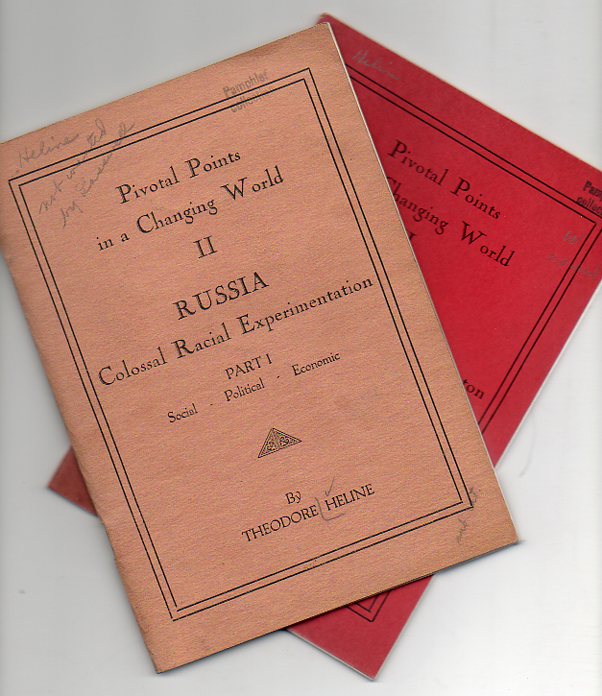
    Sometimes I need to make a post about a book simply to get it out of my system–once I’ve said something about a numbingly bad book, it usually just goes away, falling off the edge of the flat Earth rather than having its mast sink peacefully below the horizon. Such is the case with these pamphlets, one of which is so bad that its badness could not be contained in just one “volume” that it needed another. I almost wrote ” ‘little’ pamphlets” because they are, well, little–but little in size only, their badness easily transcending their size, and the idea of “size” in general. 

    Russia colossal Racial265

    [Note:  all pamphlets pictured here are available at our blog bookstore.]

    I never really liked the word “colossal” in the title of any book other than say a joke or magic book for children–outside that, I think the author is asking for trouble.  And trouble is the seat of reason in this work, which was published in 1939.  It is too painful to quote much from the text, but, right from the outset the reader gets a taste for what is ahead, being told that the New Russia (the Russians being “the most elemental of all white peoples”) is one way of saving the Nordic race, quoting The Rosicrucian Cosmo-Conception as a part-source, saying that “this race will collectively make up the sixth of the seven sub-races tat will constitute the present Aryan or Fifth Root Race” and it will “be expected to develop certain attributes that will contribute toward humanity’s ultimate perfection”.

     The author is enamored of the free voting system in the Soviet Union.  “No one visiting the Soviet’s pictorial Exhibit at the World’s Fair om New York could fail to be impressed by the dignity and attractiveness of the pictured polling places and the freshness and eagerness animating the faces of those figures who entered t perform their civic duty…” An incredible statement, validating the democratic freedom of the Soviet Union at a particular time in it history when millions of people had recently been starved to death, among other things.  The photographs of the coming genetic masters was proof enough of freedom than anything else. 

    The pamphlets grow heavier and more dense with each paragraph, the edges of the pages bending under their own filthy weight of vast stupidity and understated racial hatreds.  God and the superiority of whiteness and the gross disabilities of Catholics and Black people come along after a bit.  Jewish people aren’t even mentioned.   But the author states that it is a genetic “tick”, some sort of “genetic conscience” that comes into play that has prevented the “inferior races” (like Catholics or Blacks) to have come anywhere near attaining the presidency.  It is a spiteful, hateful pamphlet that is completely myopic about the rich, savory goodness that is the highest attainment of spiritualism/intellectualism/modernism and civilization that was the Soviet Union.  There would be little left to say about this work ten years hence, when the real stuff of the Soviet Union became more publicly common knowledge, and it became more difficult–I would think–for the author to reconcile his witches’ brew of Biblical nonsense, genetic debauchery and Cool-Whip history.

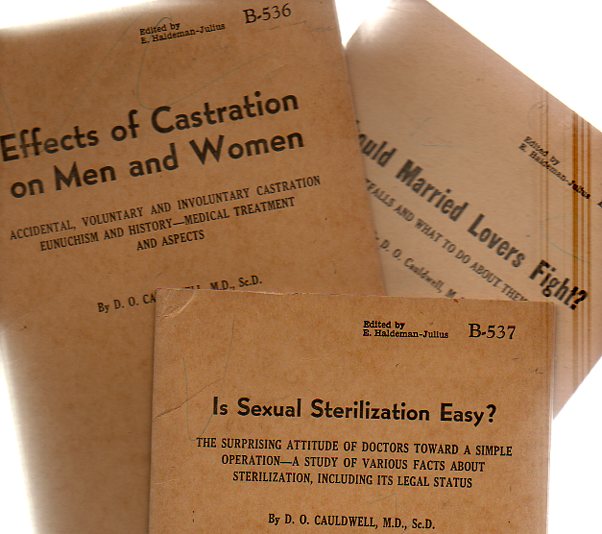
    Sexual sterilization Easy266The next assortment–all written just after WWII–asks some questions that one probably has never heard before.  “Should married lovers fight?” and “Is sexual castration easy?” are probably a pair of interrogatories that would never be heard in conversation in a hundred years of boring parties.  The contents of the pamphlets are a genuine struggle to get through–I picked my way through each for about 20 minutes before declaring defeat, except that I know enough to not have to think about these works again.

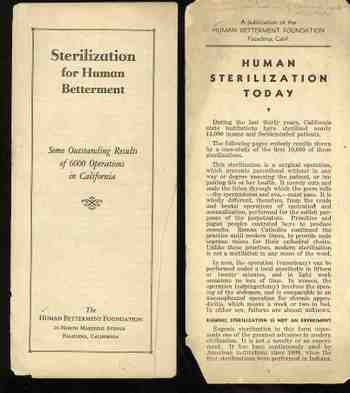
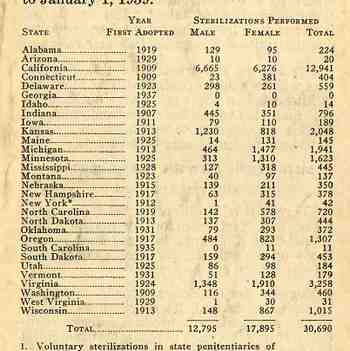
    The pamphlet Sterilization for Human Betterment, published by the Human Betterment Foundation (Pasadena, California),  states that 13,000 people in this category had been “asexualized” between 1909 and 1939 in California. (I should point out that California was the sterilization capital of the United States, with a third of all the national eugenics procedure performed in this state for this period of time) It defends this practice, saying emphatically that “eugenic sterilization is not an experiment”, and that “sterilization in this form represents one of the greatest advances in modern civilization”. 


    Blog1sept_10_sterilization538

    It continues:  “(sterilization) has been continuously used by American institutions since 1899, when the first sterilizations were performed in Indians”.  What?

    “Patients, relatives of patients, state officials, physicians,parole and probation officers, social workers, agree on the value of this practice” which was actually the “prevention of producing defective and handicapped children”.  I’m relieved that the probation officers were consulted.

    The Betterment people shed more light on the role of sterilization and sex offenses by women. (My bold.)  “Of 304 feebleminded girls sterilized and paroled, 9 out of every 12 had been sex offenders before commitment.  After sterilization, only one out of every 12 became a sex delinquent on parole”. 

    If this wasn’t such an awful story, “sex delinquent on parole”, a phrase I’ve never seen before, might make for a great 1950’s trashlit title. (It could’ve been a series, too:  all you need to do is take the title “Sex Delinquents on Parole” and add something to it, like “…on Parole from Outer Space” or “…on Parole:  Queenie the Slip Crown Breaks Her Knuckles” and so on.)

    The sorry story that I’ve interrupted with this bit of frivolity is that the “sex offenses” that are being discussed here is actually “prostitution”.  These young women weren’t committing violent acts of sexual savagery, they were just prostitutes, which meant that in most state they were “depraved”.  The “feebleminded” girls I would guess were poor or working poor, without the best education, and didn’t do well on whatever test was being administered to them to determine their test-taking intelligence. It seems to me that if  the goal was to liquidate prostitution that perhaps the men “seeing” these women should’ve been the ones faced with the operation. But that isn’t how the dominant culture viewed the situation, and that the best way to approach the problem was to remove the reproductive capacities from the weakest members of society.

    (Click on this table for a larger, clearer version of the number of forced sterilizations by state.)

     Blog1sept_10_sterilization539This pamphlet was the co-authored spawn of Paul Popenoe (1888-1979) and E.S. Gosney (1855-1942) while both were on the board of the Human Betterment group. In addition to a strict diet of superior morality and race,  Gosney seems to have been the money behind the organization. Popenoe had a background in agricultural genetics with an overdrive taste for eugenics and race, somehow intersecting them with social hygiene and marriage relations. The “dr.” that Popenoe loved to insist attaching to his name was an honorary, unearned degree, which he must have felt he needed in order to secure the proper amount of intellectual identification necessary to write on intellectual identification. The Nazis wasted little time in translating and publishing this work, adding it to their official publications list in 1939. It was one of a significant number of intellectual imports that came into poor, besotted Germany; the imports came nowhere close to the amount of information banished, exported to the necessarily beautiful non-Aryan non-Nazi inferno. It was just the sort of thinly distributed stain that interested people like the Nazis.

    I wonder what “Dr.” Popenoe thought of this Nazi honor?

    The second pamphlet by the same people, Human Sterilization Today,. is in a swift eight pages in which the Betterment Foundation makes it case to use sterilization to check “the misery spread through the community by the unchecked reproduction of the human unit” (italics mine)..  They are closing in on the Big Picture in this work, aiming at the 5,000,000 “who will be at some point committed to state hospital as insane” and the other 5,000,000 “who are so deficient intellectually (with less than 70% of average intelligence) as to be, in many cases, liabilities rather than assets to the race”.

    This is exhausting reading, but it is a story that shouldn’t be forgotten, and could remind us that what we’re doing or practicing today might look  like the Human Betterment stuff 25 years down the road. 

    What is also deeply unsettling about Popenoe is that from this vast miasmaic idea set of misguided and forced statistics, philosophical racial extremism, “social hygiene”, eugenic sterilization of the enfeebled and socially undesirable, he managed to create the very first marriage counseling service/practice in the United States.  The American Institute of Family Relations opened its doors in 1930 (in L.A.!) with this dizzying philosophical semi-brew of sterilization and marriage talk-therapy, happily correlating the whole thing with exploding axis of divorce, love, social failure, racial impurity and castration.  And somehow it all seemed to make sense to allot of people, back there in the past.


  • Less-than-Optimum Oblivion: Measuring the Bad Side of Advanced Nuclear Exchange, 1956

    JF Ptak Science Books   [Another in a long series of post on atomic and nuclear weapons.]

    Perhaps nothing is obvious unless it is established or labeled so; perhaps the obviousness must be stated at least once before it can be officially, recognizably, the case.  And perhaps the greater the obviousness is, the more the need to make it officially so.  Perhaps nothing is so incredibly obvious that it can be studied and dissected and established.

    This seems to be more the case in more recent history than in time more further removed: that millions of dollars can be spent “proving” that children do not like to be separated from their mothers, or that cars will go faster downhill than up, or that people will respond to proper medication better than not, and so on, so on into the night, just seem not to need a vastly-funded proof.

    And so the case with nuclear warfare, people, and cities.

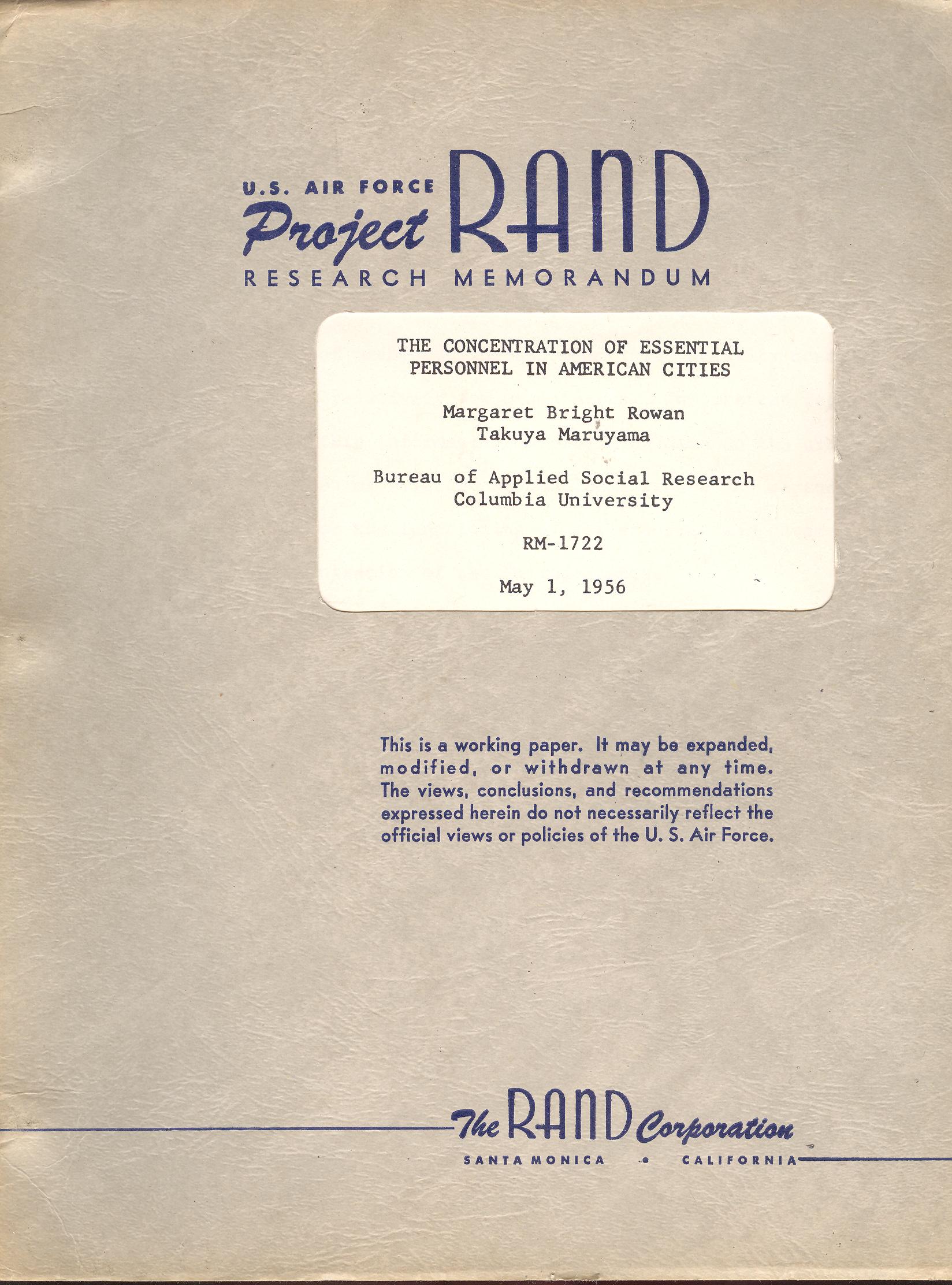
    In this RAND report from 1956, the great issue seems to be laid to rest, once and for all: the problem with nuclear weapons being exploded in/over cities is that since cities are filled with people, people will be killed.  And if those people in the cities are there because of professions that depend on city-settings, then more of those people will be killed than not.  [This rare pamphlet is available from our blog bookstore, here.]

    Rand report

    But what this report was really about was the unfortunate aspect of the impact if nuclear warfare on leadership and working positions in significant and strategic industrial/business/government professions.  And what the report finds is this: since the vast majority of these positions are located in cities (defined as 100,000 population and above), and since cities will be the major targets in a nuclear “exchange”, the overwhelming majority of these people will be killed, thus leading to strategic human resource vacancies post-war. 

    It seems that 95% of aeronautical engineers in the U.S. would be killed in a nuclear war, which I guess would mean that it would be difficult to design new aircraft and such in the post apocalypse world.  Of course these people would be killed because it was their industrial base that was being targeted and they were collateral damage, so there wouldn’t be any industrial base to produce the components necessary to build, say, a B-52.  That part of the equation is not addressed here, though.  Nor is there any sort of recommendation presented to fix the problem.

    The RAND document just painfully points out the obvious, once and for all; no one really knew what to do with the information now that it was there, in black and white. Certain people could be evacuated, saved from the maelstrom; but saved for what?  There were other evacuation plans that were completely doomed from the beginning, sheltering plans, Dr. Strangelove arrangements, but all of that would come into their pitiful being later on.

    First, though, the bitter reality of what everyone already knew–one of the greatest of all obviousnesses–had to be make its appearance in print.  And so it did.


  • Executing Numbers instead of People: Lincoln and the Sioux, 26 December, 1862

    JF Ptak Science Books  Post  1298

    (Continuing Post 669)

    The great mystery was how those Indians were smuggled out of the grave, in spite of the watchfulness of those guards.   From the Autobiography of Theodore Edgar Parker
    Sioux Lincoln234
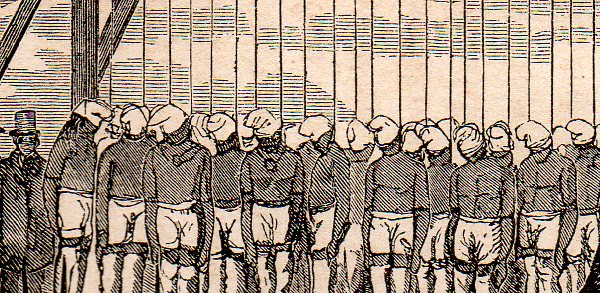
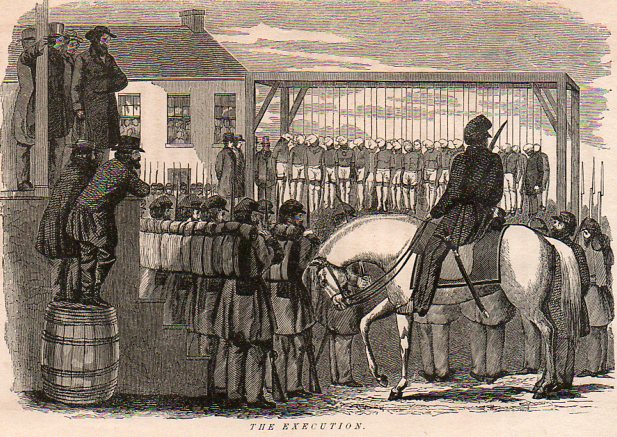
    One of the darkest moments of the spectacular Lincoln presidency came on 26 December 1862 when the president chose to not interfere with the vengeful hanging of 38 Santee Sioux (just south of St. Paul, Minnesota).  This was the legal outcome of a short-fought “war”(known variously  as “The Great Sioux Uprising”, “the Dakota War of 1862” and “Little Crow’s War”)  between U.S. soldiers and several Siouan tribes.  It was a war brought on by the desperate tribes after suffering failed crops and the reneged treaty obligations (including a long-overdue payment of $1.4 million for the purchase of 24 million acres, or about a nickel an acre) of their Great Father in D.C.  It was really more like a hunting expedition—the Indians, who had rampaged and taken hostages and killed over 200 white settlers and farmers, were at the end of their endurance. The warriors were ill-equipped for almost anything, with little food and failing horses, and were positively no match for the federal troops who would hunt them down and destroy them.  The end result was a six-week course of “trials”, conducted by a  commission of unsure legality, hearing the cases of 393 people over a span of 42 days, convicting 323, and sentencing 303 to death by hanging. Lincoln commuted most of the 303, but left 38 to be killed.
    Sioux Lincoln full235

    [This image is available for purchase from our blog bookstore.]

    “Destroy” isn’t my choice for words—it is used over and over again in the communications between the field commander General Henry Sibley and the general in charge of the entire region, General John Pope.  It turns out that Pope was of the Tecumseh Sherman school of Indian relations, writing for the record:

    “It is my purpose to utterly exterminate the Sioux. They are to be treated as maniacs or wild beasts, and by no means as people with whom treaties or compromise can be made.” 
    Blog==july 1==mankato

    Sibley was a hardened veteran but comparatively understanding towards the Indian, though his communications read much harsher than that.  At least he used the word “destroy” rather than “exterminate”, though that was small comfort to those on the receiving end of that vocabulary. (In a letter written in October 1862 to four Sioux chiefs whose tribes might be seen as harboring the breakaway, “warring” tribal elements led by chief Little Crow, Sibley said that he was out to “destroy” Little Crow and that the chiefs  should be as invisible as possible, as the Union soldiers “might not be able to distinguish you from the guilty bands” and could kill them also/instead.)

    The war, which began in August ended almost immediately, found the troopers breaking the backs and the wills of the Indians at the Battle of Wood Lake in September 1862.  From that point on, it was Sibley’s job to round up as many of the warring bands as possible and bring them to justice in a military court of law which would not disappoint those with vengeance in their hearts.  The major difficulty seems not to have been the resistance of the Indians but of the problems of supply for the troops.  The prairie grasses then were brittle and dry and brown, forage was extremely limited, and moving 2000 men was a difficulty.  Little Crow and his followers of course had much less, plus they had already been semi-starved up to that point—now that they were on the run, their situation was beyond desperate. 

    And they weren’t hard to find.  Sibley’s main concern was to get as many in for trial and judgment and (probable) execution as possible before word leaked out that the guilty were going to be killed and their women and children impounded.  Sibley wrote to Pope on 3 October:

     “It is probable I shall not order any execution of the guilty until I can get those understood to be coming down to surrender themselves in my power, as otherwise they might be deterred from returning.”

    Deterred, indeed. He continues:

    “I shall send the Indians composing the friendly camp to the lower agency, in charge of a detachment of troops, to collect the corn and potatoes in the fields, which have remained hitherto undisturbed. This camp is composed of about 1,200 men, women, and children; mostly the latter, there being but about 250 men among them. How they are ultimately to be disposed of is a question for the determination of the proper authorities. They comprise perhaps nine-tenths of those who have not been actively engaged in the war.”

    So Sibley was successful early on his round-up campaign, catching all of those women and children–sounds like of the 1,200 that he overtook, there were about 500-600 kids.  The next day Sibley reported to Pope that the Indians were coming to surrender of their won free will, though they were doing it “slowly”. 

    Little Crow’s people were “coming in but slowly” and “I  may still be necessary to attack them”.

    Attacking for slowness.  In a later letter of 8 October Sibley notes that there is an actual reason for the slow movement:

    The messengers dispatched by me to the upper camps returned last evening. They communicated my demand to their small camps, one of which, of 20 lodges, will be here this morning. They say that they dispatched young men to the larger camp, and they state that they were informed that all of the lower Indians were moving down, but slowly, as their horses and oxen are so poor and weak that rapid marches are impossible.

    On 6 October Sibley reports to Pope on some other bands of the guilty Indians starting to slip away, writing of “destroying” them as well:

    “The bands of Lower Sissetou Sioux, headed by Sleepy Eyes and White Lodge, consist of perhaps 100 or more fighting men, and these have gone with their families toward the Cotean des Prairies; they will probably be found on or near the Big Sioux or James River, where they usually make their fall hunts, and they can only be overtaken and destroyed by a sufficient force of mounted men…”

    The next day, 7 October, Sibley seems to continue to play a diminishing role of understanding-the-Indian, telling Pope that the lawbreakers “small mercy”, preferring to wait until all of the Inians were brought in before he started to hang anyone.  Of course thius was all pre-trial conversation.

    If I succeed in securing them, as I hope to do, I shall have in my hands three- fourths of those principally concerned in the outbreak, and I promise you they will receive but small mercy at my hands. I have 20 prisoners under sentence of death by hanging. 1 have not yet examined the proceedings of the military commission, but although they may not be exactly in form in all the details I shall probably approve them, and hang the villains as soon as I get hold of the others. It would not do to precipitate matters now, for fear of alarming those who are coming forward to take their chances.

    As awful as this sounds, Sibley was a little too liberal and deliberate for General Pope, who wanted to get things settled immediately if not sooner—Pope actually wanted the Indians shipped to him so that he could dispatch the offenders upon arrival.  Sibley to his credit fought this. 

    Once the deed of rounding up the Sioux was completed, there was a quick trial, and 303 of the braves were found guilty and sentenced to be hanged. 

    The text of the orders from the Executive Mansion–and signed by Abraham Lincoln–to General Sibley read as follows:

    “Ordered that of the Indians and Half-breeds sentenced to be hanged by the military commission, composed of Colonel Crooks, Lt. Colonel Marshall, Captain Grant, Captain Bailey, and Lieutenant Olin, and lately sitting in Minnesota, you cause to be executed on Friday the nineteenth day of December, instant, the following names, to wit”… [39 names listed by case number of record: cases 2, 4, 5, 6, 10, 11, 12, 14, 15, 19, 22, 24, 35, 67, 68, 69, 70, 96, 115, 121, 138, 155, 170, 175, 178, 210, 225, 254, 264, 279, 318, 327, 333, 342, 359, 373, 377, 382, 383]. The other condemned prisoners you will hold subject to further orders, taking care that they neither escape, nor are subjected to any unlawful violence.

    The condemned did of course have names but I haven’t been able to find them as yet. 

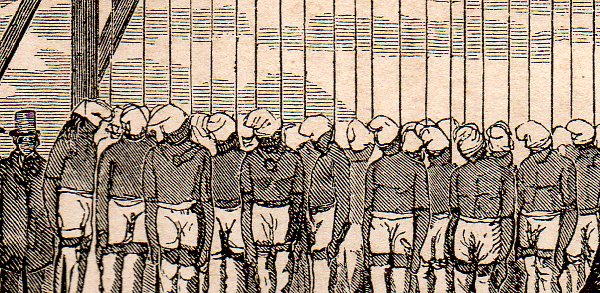
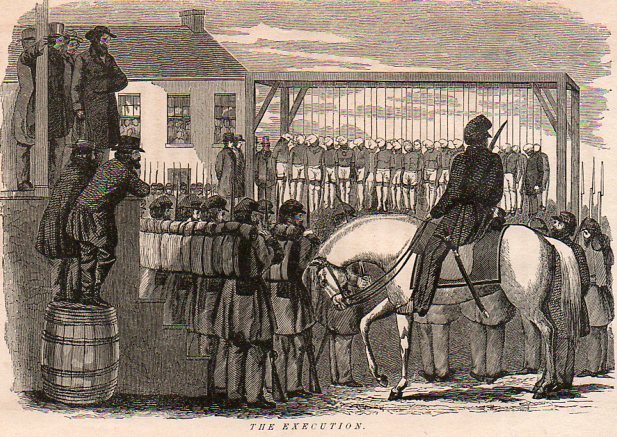
    The detail of the wood engraving that I’ve shown above may have these men shirtless in the bitter cold.  They were being watched by men in columns, at attention.  Then there were others who were standing on a barrel to get a better view. Others were on horseback.  Outside the obvious monstrosity of the situation, not having your feet on the ground, not standing, not bothering to keep yourself erect as witness to the enormity, was inexcusably bad behavior.  

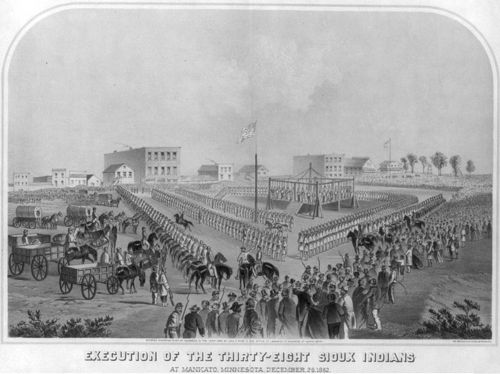
    The sentences of all but 38 were commuted.  On the morning of execution the men were marched in 35 degrees below zero cold twelve miles to the place of execution at Mankato (outside of St. Paul).  The scene is reported by eyewitness  Theodore Potter (recorded in The Autobiography of Theodore Edgar Potter):

    “On the morning of December twenty-sixth our company was ordered to march to Mankato and act as guard at the execution. We were in our saddles and on the way before daylight. The distance was only twelve miles, but the thermometer registered thirty- five degrees below zero, and before we reached Mankato many of the men had frozen ears and feet, and all suffered severely from the intense cold.”

    Potter describes the execution thus:

    “At Mankato we met several other companies of our regiment who had been ordered here for the same purpose as we. Hundreds of angry men who had suffered at the hands of these savages were camped within sight of town. They were well armed and officered and were determined that the two hundred and eighty-two Indians who were not to be executed that day by the law, should suffer execution at their hands. Colonel Miller, who was in command of the troops had a force of fully two thousand men, including one battery of artillery, with which to protect his prisoners. The execution took place in the early afternoon. The thirty-nine Indians were ranged on one long platform and executed at the same moment, in sight of a vast multitude of people besides the two thousand troops. At the appointed moment W. W. Dooley, a former member of my militia company and a chief of scouts, whose family had been killed by the Indians at Lake Shetook, stepped forward and cut with an axe the two-inch rope that held the scaffold suspended and the entire number were plunged to death. The prisoners met their end like true soldiers of the plains. Missionaries who had been with them for years were permitted with them during their last days. When the time came for them to go to the gallows the braves asked to have the chains taken from their legs so that they could go in Indian style, single file. This was allowed, and they marched to the scaffold singing their Indian war- song, which was joined in by all the other prisoners. Each Indian placed the rope around his own neck and sang while the death cap was drawn down over his eyes. For five minutes after the scaffold fell everything was as hushed and silent as death itself. Then the crowd began to quietly disperse. The settlers who had formed in companies prepared to make an attack on the barracks, but Colonel Miller had his force well disposed to repel any attack, and the people saw that it would be foolhardy to make an attempt to storm the jail protected as it was by the force of disciplined soldiers. Nearly all the soldiers present were Minnesota men and many of them had had friends killed by the Indians, so that their sympathies were with the settlers and it was well understood among them that if an attack was made on the barracks, and they were ordered to fire on their own friends, they would do so indeed, but would see that none of the attacking party should get hurt. Fortunately the attack was not made and the settlers dispersed.”

    The hanged men were buried in a mass grave, though they didn’t stay buried for very long at all.  Potter concludes:

     The executed Indians were ordered buried on an island in the river near the spot of their execution. All were to lie in one grave and a strong guard was stationed to protect their remains. That night our company returned to St. Peter. On the way several sleighs passed us at different times with only two men in each sleigh. The surgeon of our regiment, a Dr. Weiser, who was riding at my side, remarked that it looked as if those sleighs might have dead Indians in them in spite of the guard at the grave. I jokingly assured him that even if there were dead Indians in those sleighs, there was no danger of his losing his scalp to them. That night after reaching St. Peter and supper at the Nicolet Hotel, the doctor invited me upstairs to the third floor, saying that he had some valuable Indian relics he would like to show me. There on the floor lay three of the Indians that had been buried that afternoon and placed under a guard consisting of a full company of live Minnesota soldiers. The great mystery was how those Indians were smuggled out of the grave, in spite of the watchfulness of those guards. It was soon known to all that their bodies had escaped the grave and were distributed among museums and hospitals in this country and abroad.

    Unfortunately, as we all know, these actions were all “normal”. The aftermath of all of this in Minnesota was that all of the remaining tribes were expelled and all Indian reservations were abolished.  That pretty much ended the “Indian problem” in Minnesota.

  • Warsaw Ghetto Uprising–Full Text of a Rare 1944 Pamphlet

    JF Ptak Science Books  Post 1294

    “There will be a dawn.”–Dorothy Thompson, 1943

    “The former Jewish quarter in Warsaw is no longer in existence”–Jurgen Stroop, liquidator of the Warsaw Ghetto.

    Dorothy Thompson got that one wrong–or so at least got the “dawn” wrong when it comes to the Jewish uprising in the Warsaw Ghetto in 1943.  There wouldn’t be a dawn, there, mainly because there would be hardly any Jews, or Warsaw.  [This battle took place about three years after the Nazis established it as a means of control for the city’s 400,000 or so Jews. In the intermediary years hundreds of thousands of Jews had been “deported” (that is, sent to the concentration camps to be exterminated or worked to death), so that by the time of the Uprising only 60,000 people remained in the Ghetto.  And by this time there was no doubt in anyone’s mind who lived there (and perhaps too in Warsaw as a whole) what the euphemism of “deportation” actually meant.  The battle started off well for the home defence (the ZOB) but, ultimately, with little access to resource and with nowhere to actually retreat or regroup in the few acres that remained of the original Ghetto, whoever was left in the Ghetto were either killed or captured by 16 May.  The German commander, SS Brigadefuhrer Jurgen Stroop reported on that day that “the former Jewish quarter in Warsaw is no longer in existence”.]

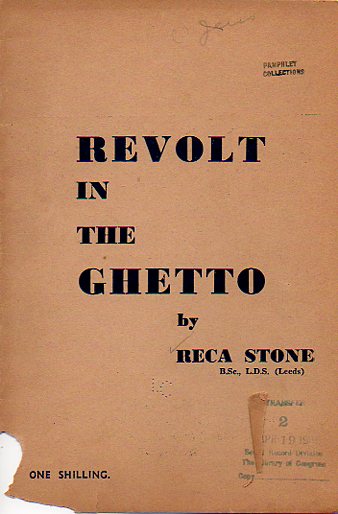
    This small pamphlet was written by Reca stone in 1944 on the Jewish counter-attack against the Nazis in the ghetto of Warsaw. It is one of not-many that documented not only the resistance in Warsaw, but also of the wholesale liquidation going on in that city and in the concentration camps. in general.  (Again, this was written in 1944. )

    There weren’t many accounts like this, but there were enough, certainly enough to have made a difference, I think, in how the leaders of the war effort approached whether concentration camps existed or not.  Franklin Roosevelt had exactly one meeting on this topic (which I wrote about here), while many others decided that the idea of exterminating all of European Jewry was so enormously bad and so gigantic that it could not possibly be true.  

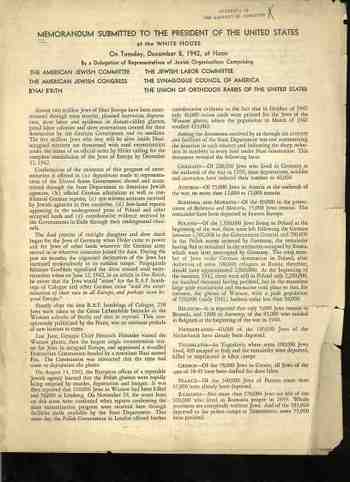
    Felix Frankfurter famously replied to a first-hand report on the extermination from the great Jan Karski that he just couldn’t “beieve” Karski’s story–not because the Supreme Court Justice (and Jew)  thought Karski wasn’t telling the truth, just that the story itself was unbelievable.  And whether people thought that the stories were the truth but unbelievable (like Frankfurter) , or whether they thought they to be exaggerations, or whether they thought it was impossible, the responses and the subsequent actions mostly seem to have come to the same end of nothingness. Even after years of reports of extermination and brutalities and millions of people missing (as FDR was warned of in that 1942 meeting), the actual eyewitness accounts of the concentration camps were still received as being unbelievable.

    Blogsept5_memorandum_1494_2

    This is one of the reasons why General Eisenhower–when viewing the  concentration camp at Ohrduf in April 1945 with Generals Patton and Bradley–suggested that world leaders and other high-rankers come to the camps to bear witness so that future generations would know that such a thing actually existed.  And so we come to the Reca Stone pamphlet.  There are many other accounts of course of the uprising, and many of those are available on-line–but the Stone account, which is a rare thing in itself (only seven libraries worldwide having a copy of the work) is not on-line, but it is now.  I think that it is a significant report, and it should have a wide audience–things like this should reach as large a readership as is possible. 

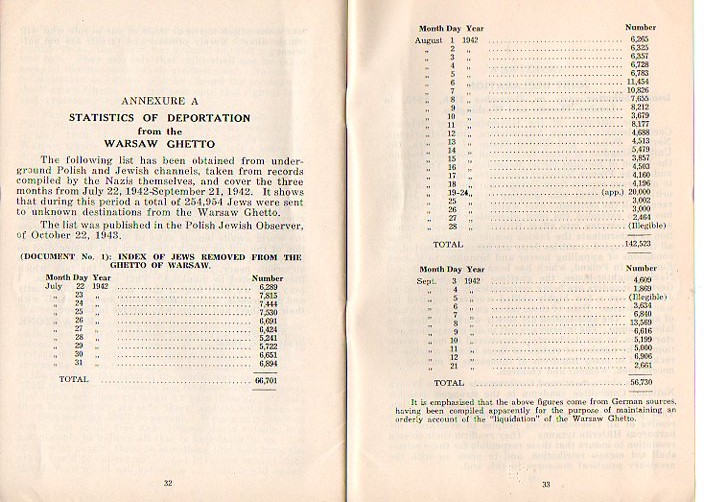
    An example of Stone’s reporting, coming from Underground sources and the Polish Jewish Reporter, on the number of Jews “removed” from the Ghetto of Warsaw between July 22 1942 and September 21, 1942–254,954 over a period of about three months:

    A--warsaw ghetto213

    But Stone gives no sentiment to the idea of Jews “perishing”.  On page 20 she describes the death camp Treblinka, and how thousands and thousands of Jews met their death in the gas chambers, or by suffocation and scalding, or by execution, or by live burial.  

    She writes boldly: In this manner 250,000 Jews were transported from the Warsaw Ghetto…and in this manner tjhey met their death”.  Period.  No euphemism here.

    She also quotes Washington sources that “two million” Jews had “perished” (the Federal term, not Stone’s), and that “five millions were imminently threatened with death”.  She pretty much got everything correct, as unbelievable as it sounded, then.  Or now.  

    A--warsaw ghetto196


    The original pamphlet is available for purchase here.

    The full test, below–all of the images are expandable: