A Daily History of Holes, Dots, Lines, Science, History, Math, Physics, Art, the Unintentional Absurd, Architecture, Maps, Data Visualization, Blank and Missing Things, and so on. |1.6 million words, 7500 images, 4.9 million hits| Press & appearances in The Times, Le Figaro, Mensa, The Economist, The Guardian, Discovery News, Slate, Le Monde, Sci American Blogs, Le Pont, and many other places… 5000+ total posts since 2008.

Category: Blank and Empty Things; A History of

  • Maps of Things Not There: Eden.

    JF Ptak Science Books  Post 1431

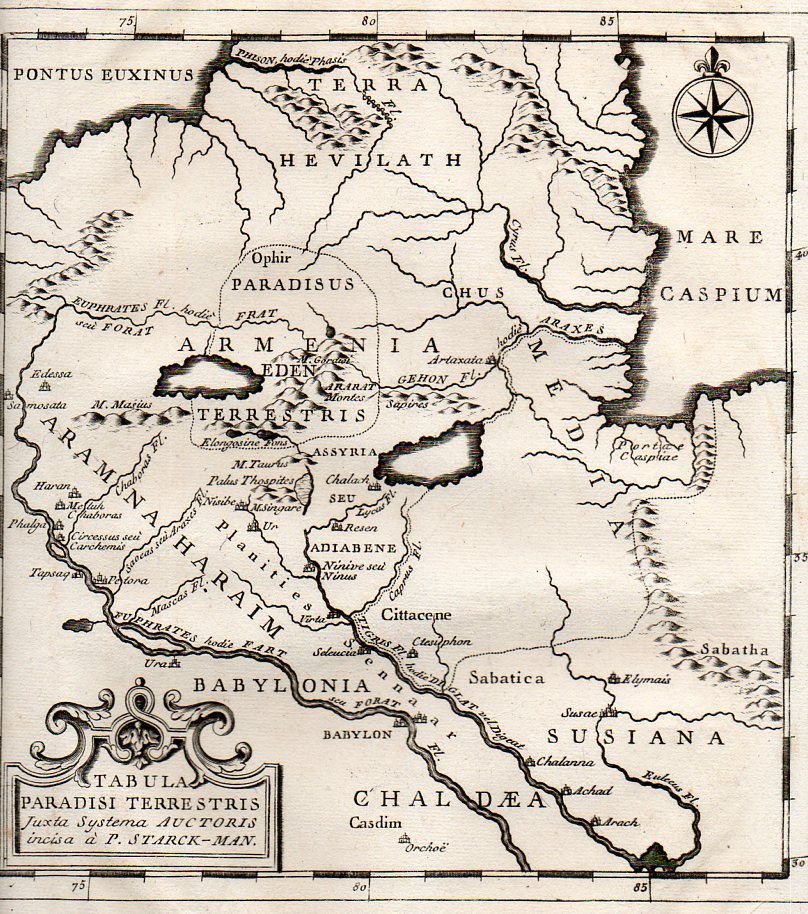
    The tale of the Garden of Eden is told in the Old Testament, and although it described, its location is left to mystery1, even though its legend is ground zero for the Fall of Man, the eternal disgrace for which humanity still pays. I suppose it would be nice to have a tombstone for the grave. Over time—and particularly in the Middle Ages and then in the Renaissance—the location was fixed in the eastern reaches of the known Euro-world, and then in and about Mesopotamia.

    Eden 2359

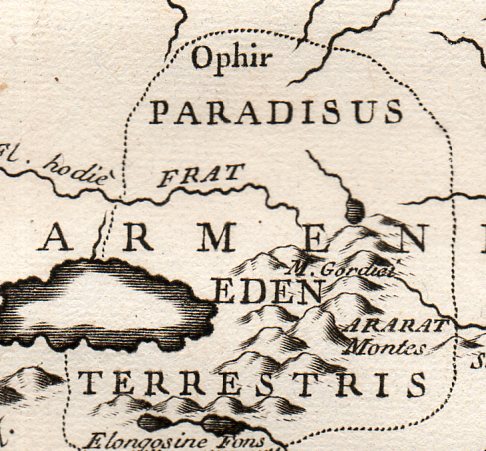
     The map Tabula Paradisi Terrestris justa Systema Auctoris incisa a P. Stark-Man was printed late in the 18th century, probably around 1775, and locates the GOE far in the north country, near the Dead Sea, deep in old Armenia, near Mount Ararat (where Noe and his family were supposed to have landed after the creator flooded the world killing everything, where everything else, young and old, infant younger, men women children, beasts and ants, were killed by a wrathful OT maker.).  

    Eden 2358

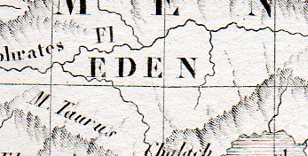
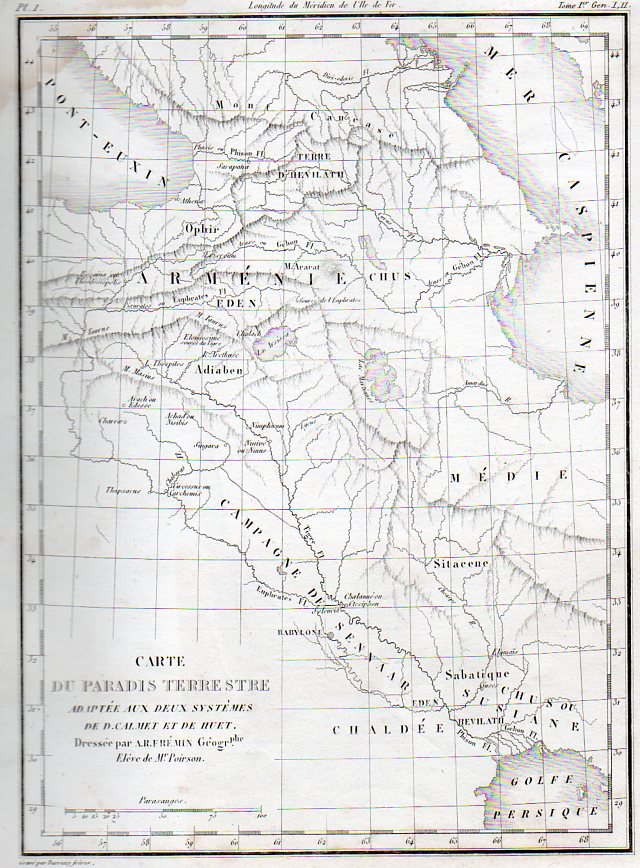
    The very finely engraved map by A.R. Fremin, Carte du Paradis Terrestre, printed 1839 (in Paris, by Félix Locquin et Cie, for  l’Atlas de la Sainte Bible)., again locates the Garden much further north than the great majority of other maps that I have seen, coming  (as with the map above) nearly to the Dead Sea.

    Linoleum italian274

    This image is a detail from:

    Linoleum italian273


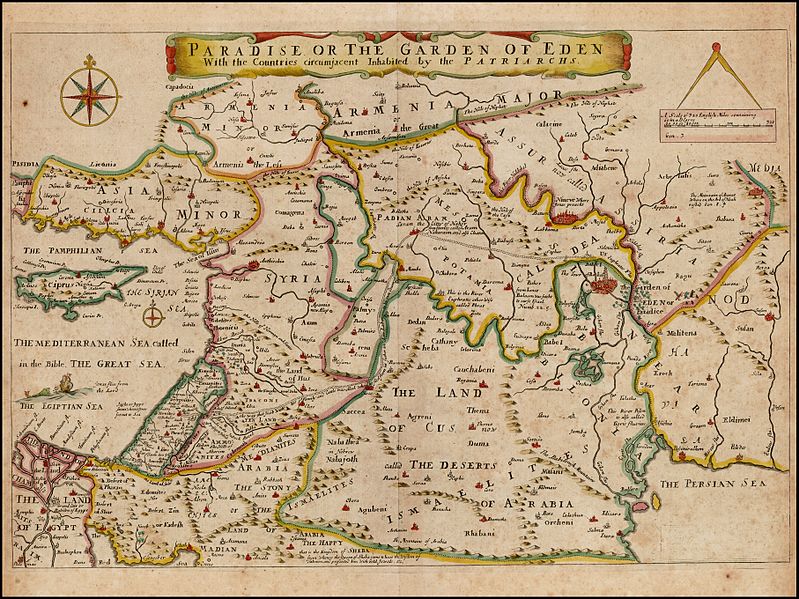
    Joseph Moxon’s Paradise of the Garden of Eden with the Countries circumjacent inhabited by the Patriarchs, printed in 1690,  shows the GOE as just to the east of Babel and not far due north from the Persian Gulf, just on the Euphrates in the Land of Nod, which is quite different from our two samples above. 

    Garden of eden Moxon

    [Source–https://commons.wikimedia.org/wiki/File:Paradise_or_the_Garden_of_Eden_With_the_Countries_circumjacent_Inhabited_by_the_Patriarchs,_Joseph_Moxon_1660.jpg]
     
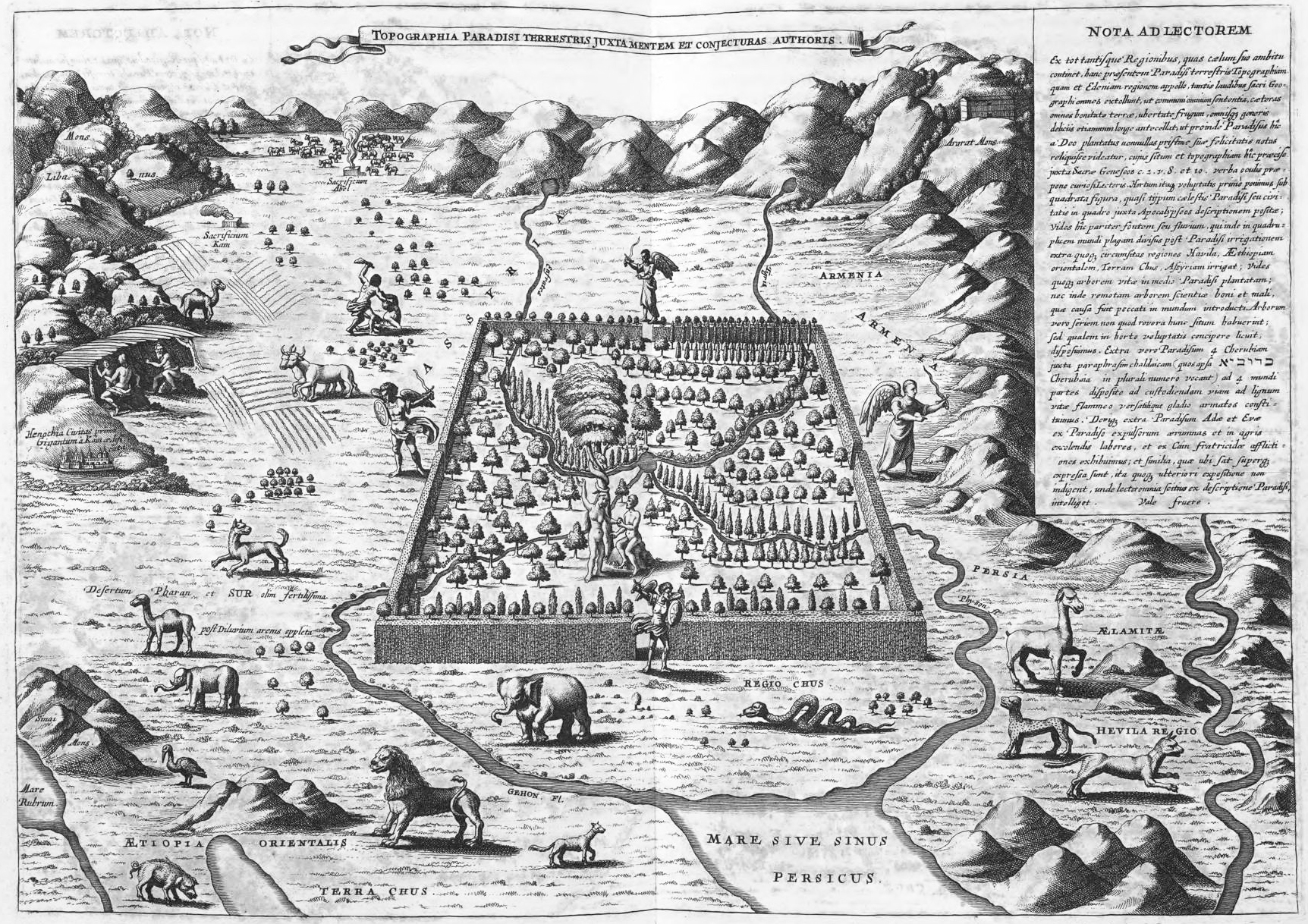
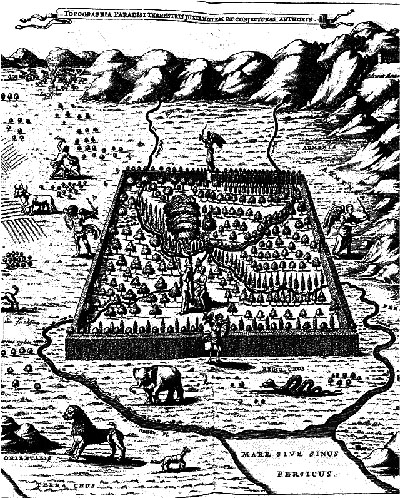
    The polymathic and semi-problematical Jesuit genius Athanasius Kircher suspected the location of Eden to be along the Tigris and Euphrates Rivers, in southern Iraq, and published his idea in this map Topographia Paradisi Terrestris in his book Arca Noe in 1665. It is of course a highly idealized map, Eden taking up a disproportionate amount of land, larger than life, bigger than legend almost, a monstrous overstatement of the lost land. Eden is shown here with four gates guarded by angels, but it does its occupants little good, as we can see that Adam and Eve are already stepping up to Satan in the tree of knowledge, and that outside Cain is killing Abel, all harm already being done.

    Garden of Eden Kircher

    [Source: the website The City as a Project, here: http://thecityasaproject.org/2011/07/paradise/]


    There continue to be differences of opinion on this matter of location, particularly in the modern age, when there are many laying claim to the position of Eden, including a number of half-hearted attempts to locate the place or its idea/ideal in the United States.  There are at least 14 Edens in the U.S.– Eden  City/Isle/Town/Valley/Prairie/Village/–in twelve different states (Idaho, Louisiana, Maryland, Minnesota, Mississippi, New York, North Carolina, South Dakota, Texas, Wisconsin, Wyoming and thankfully Hawaii),but for some reason they are fairly sparely populated, eight of them having populations of under 1000 people.  I don’t know what that means.

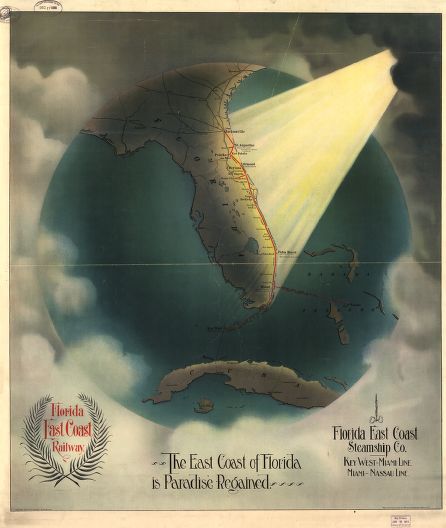
    Then there is this terrific example, coming from Florida (which does not seem to actually have anyplace in the state named Eden), in 1898, being a transorbital bird’s-eye view of the east coast of Florida receiving  pure holy light, announcing yet another newish Eden.

    Paradise florida

    [Image source: Library of Congress, Geography and Map Division.]

    Notes

    1. “And a river went out of Eden to water the garden; and from thence it was parted, and became into four heads. The name of the first is Pison: that is it which compasseth the whole land of Havilah, where there is gold; And the gold of that land is good: there is bdellium and the onyx stone. And the name of the second river is Gihon: the same is it that compasseth the whole land of Ethiopia. And the name of the third river is Hiddekel: that is it which goeth toward the east of Assyria. And the fourth river is Euphrates.” (Genesis 2:10-14 KJV)


  • Paradise–Millennium–End of Days: Thomas Burnet, 1684

    JF Ptak Science Books   Post 1455

    Burnet
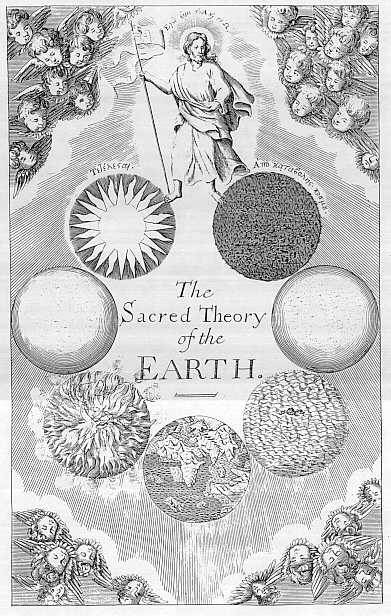
    It is uncommon to see the life stages of the life of the Earth depicted in seven stages, seven Earths at seven different epochs, alpha to omega–but it is particularly rare to see them illustrating the fronstipiece of a book, and an antiquarian one at that.  But that this  is exactly what happened with Thomas Burnet’s Theory of the Earth, in the English translation of 1684.1  Burnett was a quietly agitated writer whose underlying viewpoint of the existence of life on Earth and the planet itself was that it was the scourge of millennialism, that the cycle of seven Earths depicted on his book ws the life and death of the planet, all wrapped around the coming kingdom of Christ and teh book of Revelation. 

    And perhaps the most impressive image on the page is that the Earths of Paradise and the millennium were pretty much the same, perfectly well across from one another on a level plane. 

    Paradise is self-explanatory; the “millennial” part maybe less so–in Christian thought this is when after Certain Things have happened that Jesus Christ would come back to Earth and reign in a terrestrial kingdom, a heaven-on-earth, for a period of a thousand years.  Or more.  The eschatology is not clear on this so far as I can tell.  It seems as though the Earth is devoid of whatever it is that clogs nature’s bowels, as the planet looks remarkably sparse and tentative.

    The business end of the image is this:  rounding the images clockwise, the first is Chaos; the second,  Paradise; the third shows the Deluge; the fourth depicts the present world; the fifth is the Conflagration; the sixth is the long-awaited  Millennium; and the seventh, and last, the final seal, is the Consummation.  So the Paradise/Millennial Earth are figures 2 and 6, and they do look pretty much the same.

    And so the Earth is a thing of three distinct periods:  the first is the lost Paradise, the fated failure in the fall of man; the second is the world of today with its constancy of ruination and upheaval; and the third, paradise regained (but at a cost).   As Kerry V.  Magruder points out in his “Global Visions and the Establishment of Theories of the Earth”2  points out in his  there are “transitions between these scenes are four ‘Revolutions
    of our natural world’, accomplished through natural causes: chaos Noah’s universal deluge, a future conflagration, and a final consummation when the Earth will be transformed into a fixed star…”

    Burnet (1635-1715) poured out his pounding heart into these pages, teaching people about the structure and history of the  Earth with little or unsuccessful regard to science–but no matter.  (Burnet did try to figure out where all of the water came for the flood, which is  a great question.  It is impossible for it to come from a natural rain of any sort, and Burnet probably came to the conclusion this the answer for the flood couldn’t come from the surface of the Earth.  So to keep things in compliance with his faith, Burnet established that the water necessary for the flood came not from the surface of the sphere, but below it, in the hollow Earth which was actually filled with water.) This was a work of structured faith and a belief  system, and wasn’t seen as much more than that except to the initiated.

    Notes:

    1. Telluris Theoria Sacra, or Sacred Theory of the Earth was first published in 1681 in Latin and then again in English in 1684.  Latin was after all the language of science.  Newton’s Principia remember wasn’t translated into English 

    2. …which appeared in Centarus in 2006 volume 48, pp. 234–257


  • Sticks as Gravestones? Fredericksburg, December 1862.

    JF Ptak Science Books     Post 1451

    “It is well that war is so terrible. We should grow too fond of it.”
            – General Robert E Lee, at the Battle of Fredericksburg

    I’ve been thinking a bit on the Civil War, the American Civil War, coming fast now on its 150th anniversary.  I’ve been looking at these stereocard photographs in the Library of Congress collection, and have been finding some interesting, troubling images.

    Fredericksburg

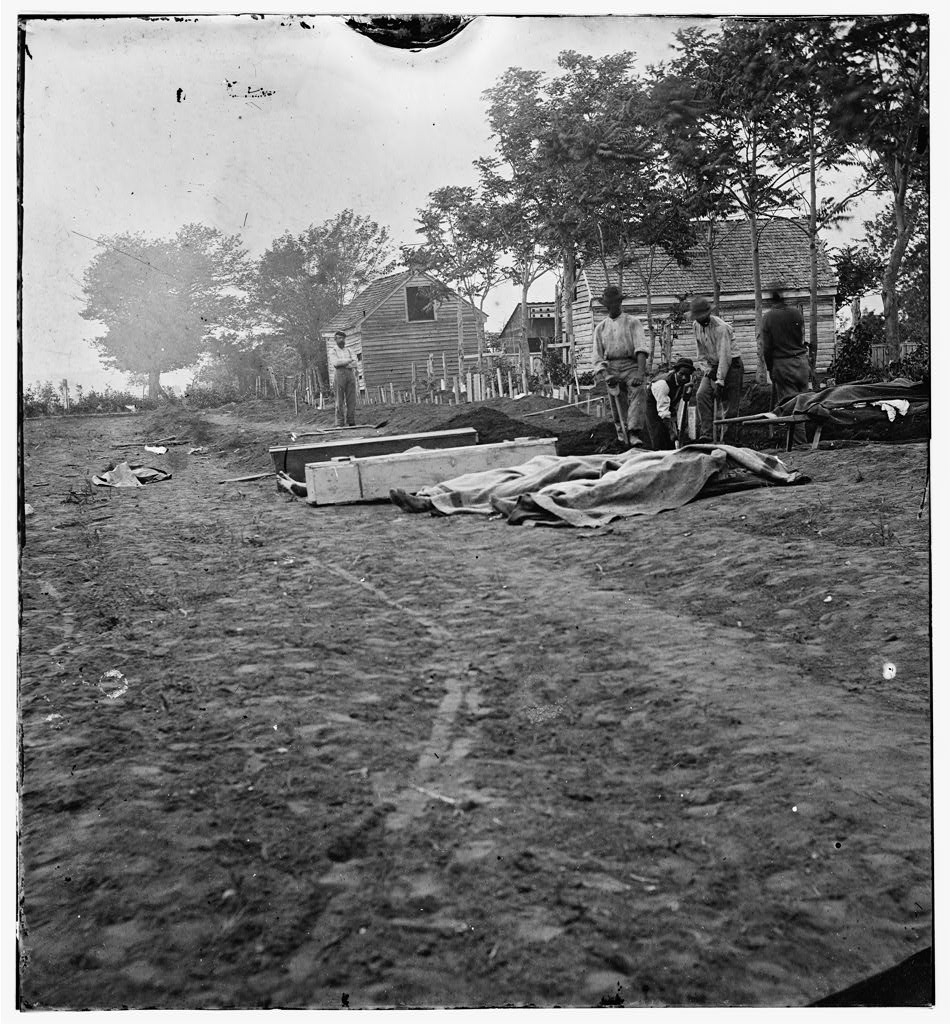
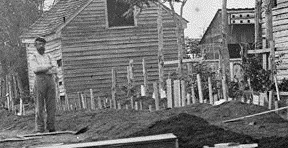
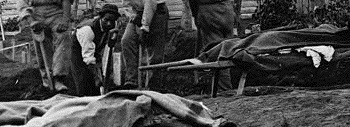
    This shows a burying detail at Fredericksburg

    Fredericksburg b
    This was a bad one for the Union.  IT was Lee against Burnside, Lee commanding the heights at Fredericksburg and making Burnside’s men pay dearly and forever for a bad plan–there were more than 13,000 Union casualties that day compared to about 5,000 for the Confederates, and was about the worst defeat suffered by the Union for the entire war, the outcome of two of the largest armies ever to meet for the entire conflict.  It is a famous battle and there is much about it all over the web.

    I’m just looking at the sticks in the background of this photograph, over the shoulders of the African American gravediggers, just to the left of the man with the crossed arms.  Who was this?  He has no uniform, and is a bit older–but there is a shovel at his feet.  Maybe he is from the town, maybe he’s just watching.  But just to his left,  is a little rise of what looks like fresh dirt.  At the head are those narrow sticks, of all different sizes, and place at differing intervals. 

    Fredericksburg c

    But these sticks are in a straight line.   Are they temporary grave markers?  But they’re so close together–perhaps this is a mass grave.  Perhaps these markers at placed at where the heads of these soldiers are, laid shoulder to shoulder in a big pit, covered up.

    The grave detail seems to me to be standing in a pit, a shallow one.  I don’t know what else this could be.

    There are too many short, stubby sticks for this to be a simple fence of found wood.  I think that they are temporary headstones.  I realize these people were dealing with an horrific situation with very, very limited means, and that even getting stakes of wood for thousands of graves would’ve been a deep chore–but still, those stubby little bits of wood bother me.

    Mr. Shelby Foote in volume two  (“from Fredericksburg to Meridian”) of his spectacular The Civil War, A Narrative described a bit of the battle below.  My memory of reading this in Foote about this battle (my reading now more than 20 yeqars old) is mostly gone, but the overall impression of Foote’s painting was Lee looking out over the battlefield as the fog–which had enshrouded it all all morning long–had lifted.  That was the end of it for the Union army, the sun heating things up a bit, burning off the protective layer of fog, heating it up enough there in the middle of December to cause terrific havoc.  How would the parting fog and what it revealed underneath be seen in the mind of R.E. Lee?  He must have felt instantly that the day would be his. 

    “Defensively speaking, indeed, the record of Confederate arms could scarcely have been improved. Of the three objectives the Federals had set for themselves, announcing them plainly to all the world by moving simultaneously against them as 1862 drew to a close, Vicksburg had been disenthralled and Chattanooga remained as secure as Richmond. Davis himself had done as much as any man, and a good deal more than most, to bring about the result that not a single armed enemy soldier now stood within 50 airline miles of any one of these three vital cities. “
    “Of all these various battles and engagements, fought in all these various places, Fredericksburg, the nearest to the national capital, was the largest — in number engaged, if not in bloodshed — as well as the grandest as a spectacle, in which respect it equaled, if indeed it did not outdo, any other major conflict of the war. Staged as it was, with a curtain of fog that lifted, under the influence of a genial sun, upon a sort of natural amphitheater referred to by one of the 200,000 participants, a native of the site, as “a champaign tract inclosed by hills,” it quite fulfilled the volunteers’ early-abandoned notion of combat as a picture-book affair.”–Shelby Foote, The Civil War, a Narrative. Volume 2.

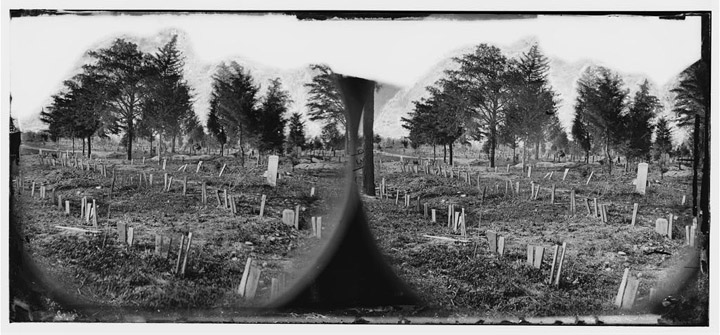
    My thanks to Rich Lewis for finding another temporary burial site:

    Confederate graves
    “
    Graves of Confederate Soldiers with Wooden Markers, Richmond 1865″


  • Horses in the Sciences: Proving Nothing and Something

    JF Ptak Science Books   Post 1419   [Dedicated to our primum mobile family horse person, Emma Digh Ptak.]

    Horsepower281

    The history of horses in the sciences is not a very wide subject area, though I’d like to look at a few instances in which they help to prove both something and nothing–particularly in the third case below, when the “nothing” was a very big “something”. 

    First, in the history of horsepower (and such an odd history it is, having somewhat and famously to do with billing issues for steam powered engines) there is a certain restricted high-percentage element that are just no-go, unworkable ideas.  Some of them served as the basis for further and deeper thinking,and some of them were simply far ahead of the technical abilities of their times. 

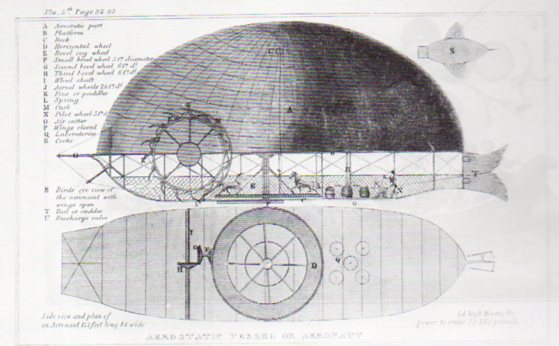
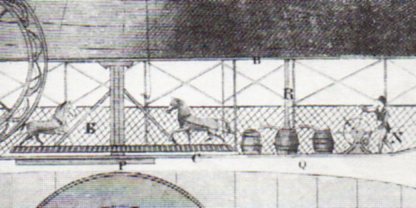
    In 1825 Edmond Genet1 published an interesting book (Memorial on the upwards forces of fluids and their applicability to several arts, sciences and public improvements) which in and of itself is a milestone in a number of different technical aspects–one part of it though sensationally and beautifully elevates itself to the Not-Quite-a-Good-Idea-at-Almost-Any-Time Department.

    Horsepower282
    “The actual plans of Genet’s airship called for a balloon shaped to resemble the rounded back of a large fish and containing about 1,023,000 cubic feet of hydrogen gas, with a platform or deck fastened beneath. Two horses, moving on a revolving wheel on this platform, were to provide the power for operation of a pair of large, silk-covered aerial wheels, while the rudder in imitation of a fish tail was intended “not only to steer the machine, but also to supply it with an additional force of propulsion”. –Genet in his Memorial…

    One thing that makes Genet’s work so impressive is that as a result of it he applies for and is granted the first patent made in the U.S. for a flying machine.  The flying machine he presented in his work though is a little problematic:  the canopy and the machine itself are not at all drawn to scale, and their size and breadth are lost a little in that under-representation.   I’d say that the figures in the drawing should be half of what they are, given that the flying machine was 132′ long and 46 feet wide (and 54 feet high), and the canopy was to be filled with a million cubic feet of helium.  The thing was a beast, and was supposed to be blessed with the capacity for lifting 72,000 pounds2.   The horses were along for the forward propulsion, moving two large paddle wheel-type wheels on either side of the airship.  It just doesn’t look right.

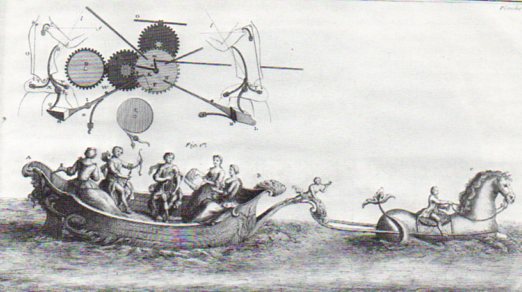
    Next is a tempting mechanism, an inset living inside a larger engraving depicting a mode of transport not-so-tempting.  It comes from Colonel Jean-Gaffin Gallon’s (1706-1775) Machines et inventgions approuvees par l’Academie Royale des Sciences....published between 1735 and 1777, and poetically covers its subject over a 111-year span from 1666 to 1777.   The massive work was illustrated with nearly 500 engravings covering all manner,shapes and description of technological invention and advancement, not the least of which was the first illustrated description of Pascal’s logic machine.  Amid all of this vast wealth of potentially revolutionary achievement,. I pluck out this equine example of possible nothingness: 

    Horsepower280

     which I am just not sure about, not having the text.  I can only hope that the horse was some sort of imaginary mechanical something, given its task and its size.  From the looks of its neck and the rider and the length of the horse, if it was a living thing it would have been gargantuan. 

    Here’s an appearance in the Gallon work (from 1735) of another, mechanical, horse that was used for stage productions, and which seemed fairly articulated:

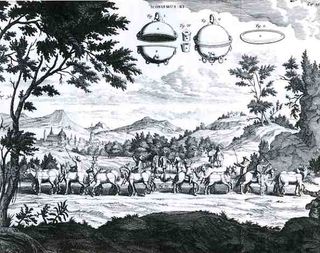
    And thirdly, there is this, perhaps the most famous image of horses in the history of scientific illustration:

    Mantegna vacuum von guer

    This beautiful illustration is from one of the greatest experimental physics books of the 17th century, coming as it does from Otto von Guericke’s  Experiemnta nova (ut vocantur) Magdeburgica de vacuo spatio (Amsterdam, 1672).  (In another minute department, this one is also I guess the greatest book ever written by a Mayor of anywhere (as von Guericke (1602-1886) was mayor of Magedeburg for 33 years).)  The image shows the greatest of von Guericke’s efforts, and one of the greatest (or most important) experiments in experimental science–the dramatic demonstration of the vacuum, showing here that teams of horses could not pull apart two halves of an evacuated sphere, and of course the efficacy of air pressure operating against it (um, the vacuum). The “floating” bits in the sky were an exploded view of the sphere that was the subject of the experiment. 
                   
    What was more important though, and what the general reader today might easily miss, was that von Guericke created something that many scientists and philosophers said didn’t, and couldn’t, exist:  the vacuum.  In modern times, Copernicus depicted the universe as a vast void; Descartes came in the back door (following the ancient and interesting though incorrect theory of Aristotle), not liking the idea very much, and claiming that such empty space couldn’t exist.  Von Guericke provided the proof that the vacuum, that nothing, did exist.

    As a matter of fact the issue of nothingness was very contentious, with the concept of its possibility and the display of a vacuum not achieved until this effort by von Guericke, with his team of horses tugging away at the essence of nothing.

    NOTES

    1.  Genet is best remembered in American history as “Citizen Genet”, at least far more so than that being remembered for gentleman farming or his work in aerostatics and invention.  “Edmond Charles Genet had tried to recruit American volunteers to serve in the armies of Revolutionary France and to outfit American privateers to fight against the British. Despite President Washington’s orders for him to desist from his high-handed appeals to the American public, he continued the same practices until he was forced from office. Washington permitted him to remain in this country as a private citizen, saving him saving him from the possibility of being guillotined for his failure.” So writes the great historian of Science I Bernard Cohen.  It wasn’t altogether true though that it was Washington who saved Genet; his being allowed to remain in the U.S. was strongly pursued and lobbied by Alexander Hamilton, Genet’s greatest detractor/enemy/nemesis in Washington’s cabinet.

    2. By contrast, the Wright I Flyer (the famous first-flight airplane of 1903) had a wingspan of 40 feet, weighed 625 pounds and sported a 12 horsepower, 170 pound  engine (and which by the way was all produced for about a thousand dollars–not nothing, but not a lot).


  • Obfuscation as a Weapon–on Teaching Indians to Read, 1875

    JF Ptak Science Books   Post 1417 

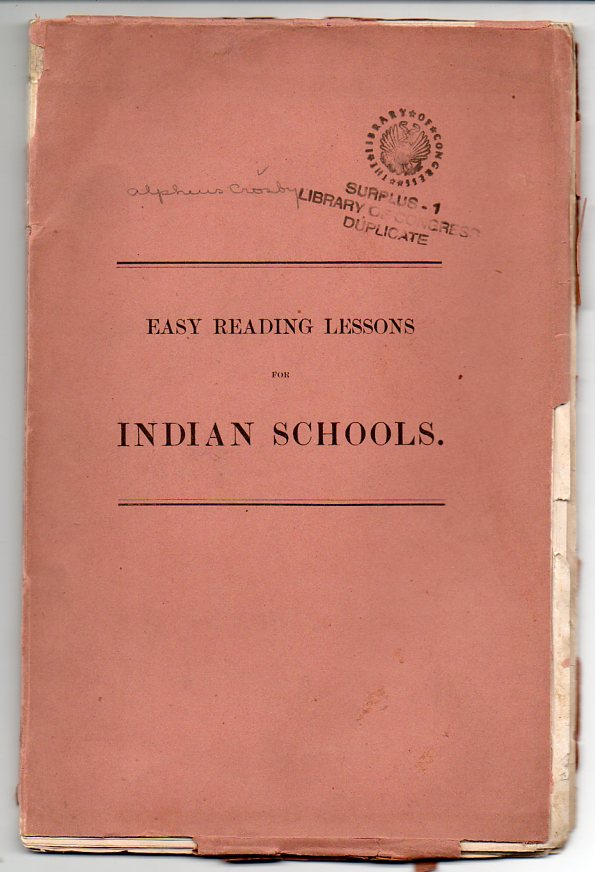
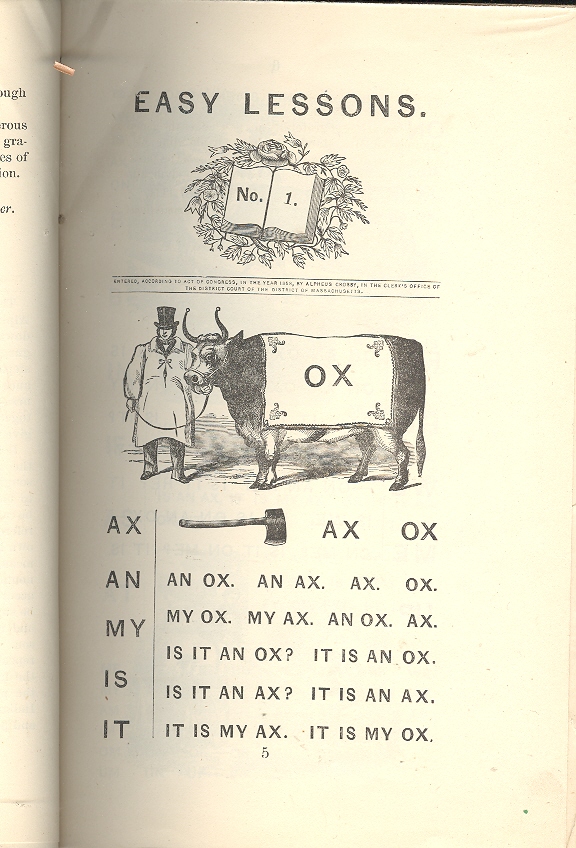
    This small pamphlet, Easy Reading Lessons for Indian Schools, was published for the Department of Indian Affairs (as a section of the Interior Department, classifying the Indian along the lines of cattle and agriculture) by the federal government, printed by the indomitable Government Printing Office in Washington DC in 1875.  (The original is available at our blog bookstore.)

    Indian school269 It is an unintentionally quiet indicator of the general American policy towards the Native American in the last quarter of the 19th century.  The work is indifferent to any particular need of the student.  It is intended for the person who could not read, and nowhere in this work is there a listing of the alphabet.  It is ignominiously but softly complex, and looks to me to be a total disaster as a text.  (This is true when comparing the work to nothing at all; but when you stand it next to, say, McGuffey’s reader or the Eclectic or any of the other classic how-to-read books of the 19th century, the weaknesses of the Indian book become instantly clear.

    How in the name of great bog could anyone have thought it just and fair and equitable to teach English-illiterate “Indians” to read with such an instructional?  It isn’t even close to being a book, and it comes no where near to being able to transcend its own terminal obliqueness.  It introduces simple words and phrases in a tongue-twisting ways, and then complicates the situation by quickly adding more structured words in a more confusing environment.  The thing is terrifying.  I actually had a hard time reading it out loud. 

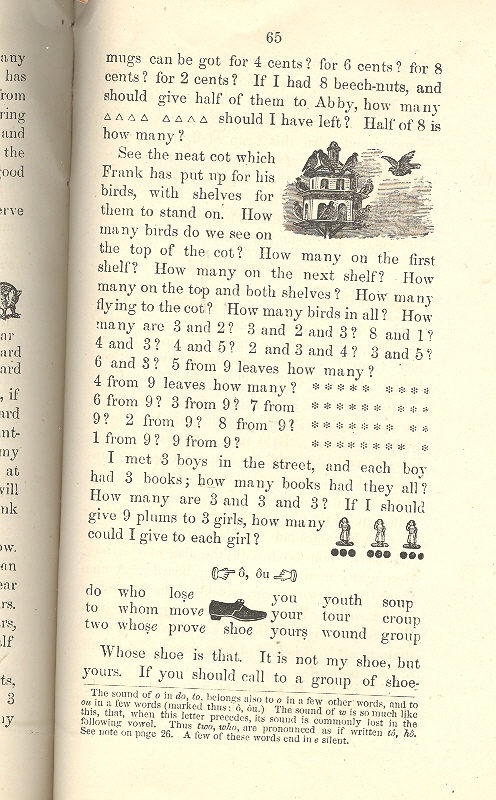
    Here on page 17 (already!) is a tremulous example:

    “See the lad.  Is it Mat?  It is Mat; and Fan is by him on the sod.  He has his hat. But it is not on. Has Fan a hat?  Mat has a bat. Dan cut it by the bog. Mat had his bat, and ran at my dog Boz., and sat on a log, and hit him.  He did it in fun. And Boz had his fun.  He got the bat and ran it way and hid it in a box. Dan got it but bid Mat not hit the dog.”

    Indian 001

    For crying out loud! (The bat by the way is, yes, a baseball bat.  Pretty early stuff in 1875.)  Why would someone use this series of images to teach someone how to read?  The pamphlet continues to exhaustion, taking only 80 pages to do so. For me it is a perfect symbol of the way in which the government—in general—dealt with the “Indian Problem”.  Confusing children and making life more needlessly complex, making it harder for them to succeed, making it more difficult for them to rise above the difficult situation that they have unexpectedly been born into,  is a superior sign of inferiority of the dominant power. 

    Wait a minute.  Am I writing about the Indian in 1875 or the poor kids in  SE DC in 2009?  I can’t tell.  The corruption of the social model for caring for people who need federal attention more than anyone else—the underprivileged child—is antiquarian and entrenched and as strong as ever.  At least there’s a moral foundation for the care of kids whose parents cannot afford health insurance.  Um, oh, wait another minute….

    Indian 002


  • Making Things Disappear–German POWs, 1918

    JF Ptak Science Books    Post 1410

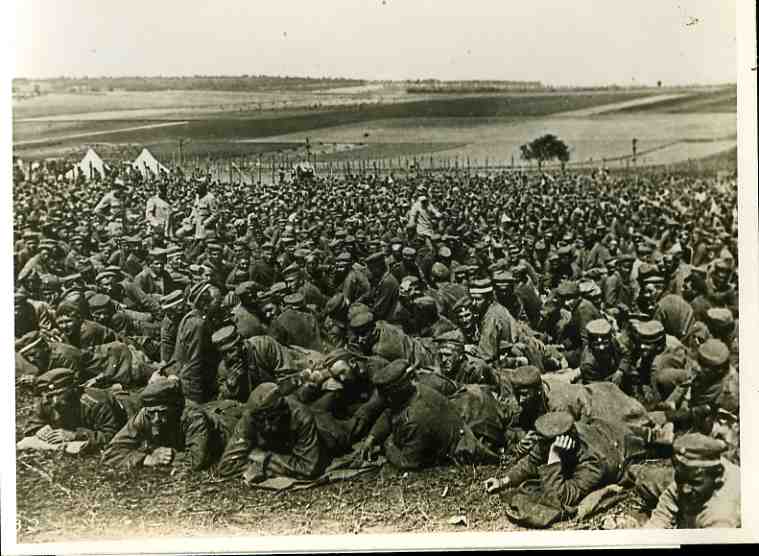
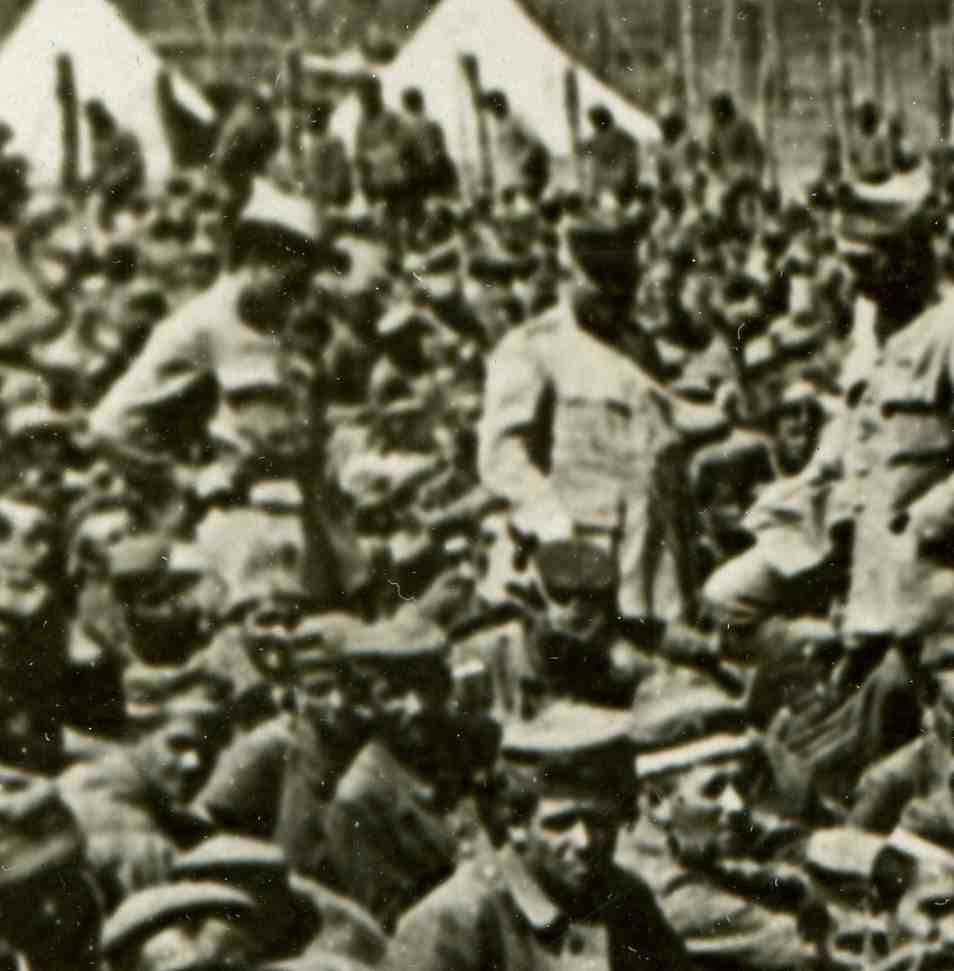
    In continuing series of posts on Blank and Empty Things is this image on fading, disappearing German prisoners of war.  The French had been pounding them in western France in the summer of 1918, and Germans were surrendering and being captured by the thousands.  This news service photograph shows one of the assembly camps with about 10,000 POWs–I made a heavy scan of the group of soldiers in the distance and was  a little taken aback to see that the men had lost their human forms,  looking like bacteria, fading into their future.  (The original photo is available for purchase through our blog bookstore.)

    000-ebay--Nov 8 pows018

    000-ebay--Nov 8 pows017

    The full image is impressive, and shows just a small fraction of the men taken prisoner during 1918; and it shows even a lesser percentage of those killed.

    000-ebay--Nov 8 pows019

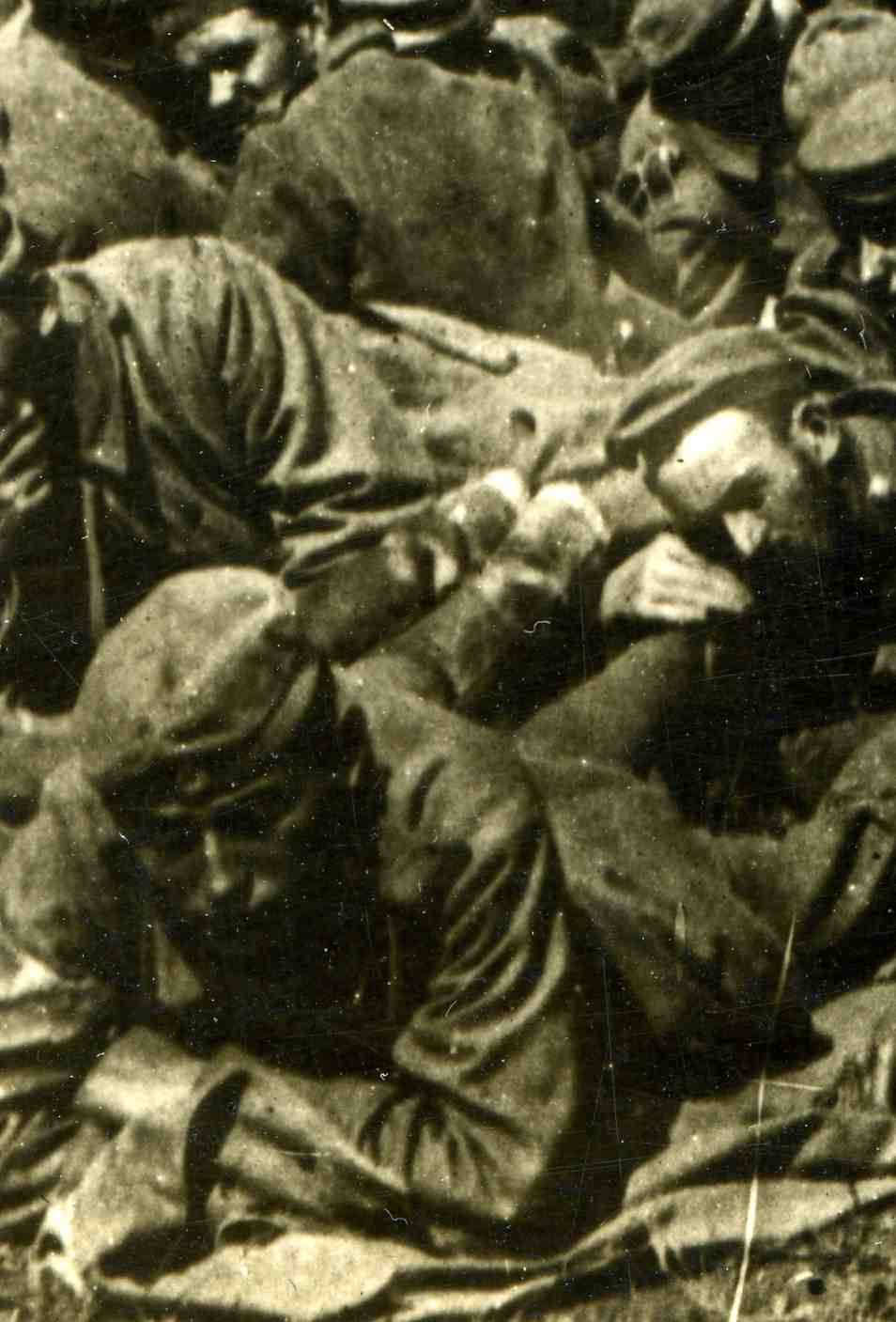
    This detail of the foreground shows the familiarity necessitated by the men being pressed so closely together–there was little free ground.

    Also, I thought that the French soldiers in the midst of the prisoner might’ve been feeding them, but it seems as though they were just walking in their midst.

    000-ebay--Nov 8 pows022


  • The Nonsense of Strategically Meaningful Phrases–Finding Pillows in the Post-Nuclear-Attack World, 1968/9

     JF Ptak Science Books  Post 1356

    Caveat: this story is of course forever and best told by Stanley Kubrick’s Dr. Strangelove.

    Researching a study on the usefulness of the actions of Adolf Hitler amd their application to the U.S. government’s planning possibilities for post-nuclear-holocaust existence (German Wartime Industrial Controls: an Analogy to Recovery from Nuclear Attack, Stanford Research Institute, 1968, review coming soon), I came across the following related studies, all of which are available at the Storming Media website, here.

    The titles are incredible, the abstracts more so–but some phrasing in the abs were absolutely, sensationally, bad. 

    I can imagine a play, a scenario leaning heavily on Samuel Beckett’s Krapp’s Last Tape, men sitting in front of reel-to-reel tape recorders, listening to themselves describing the impossible language that they were using to transmit the ideas of surviving nuclear Armageddon–brilliantly lit from single spots directly above the seated figures and with all else absolutely black, they play these snippets, and try to explain what the language actually meant. Perhaps they try to talk over the recordings, only to have the recorded audio get a little louder, and multiply, a la Steve Reich’s Come Out.

    I understand that in order to talk about a complicated and complex landscape that you need to establish certain words and phrases to mean one thing and one thing only so that information can be transmitted and analysis with common denominators can take place.  At the same time these phrases loosen the reality of what they represented, removing the implications of fighting such a war, and thereby making the button-pushing a little easier.  Perhaps the launch business becomes more automated this way, even in considering the theoretical end of the actions of nuclear war.  Like the soldiers who were endlessly trained to turn the keys and punch the buttons at this country’s x-number of launch facilities, trained countlessly and tirelessly, so that when the real call came in they could just do the job, follow the instructions as they had 2,000 times before, and launch the missiles that would kill tomorrow.

    And so in 15 minutes I found these impressive examples of polyprhases that meant both something and nothing:

    Paper 1

    “Period of fractionation”–describing the civil circumstance directly after nuclear exchange.  Found in Scenario for Postattack Social Reorganization, : Raymond D. Gastil; William Schneider Jr; HUDSON INST INC CROTON-ON-HUDSON N Y

    This paper also provides us with “historical disasters that were somewhat comparable to nuclear war” as well as “return to normalcy” as the sixth part of a six-part post-nuclear landscape.  And this is all just in the abstract. 

    “Abstract: This approach to postattack analysis was meant to explore the possible contribution that a documented scenario could make to postattack research on organizational problems. Using knowledge of historical disasters that were somewhat comparable to nuclear war, we divided the scenario into the following periods: Pre-attack, the disaster; period of fractionation; survival and reconstruction; innovation and control; and, return to normalcy. The scenario covers a period of more than two years (1970-1972), and the attack was OCD’s CIV-LOG ’65 in which 2000 megatons were used. [Emphasis mine.] Appendices explore more analytically certain issues raised by the scenario. (Author)”

    Paper 2

    “The break in traditional economic time series…”  Meaning that there were new timetables in how things got done and how we communicate, in business, following a nuclear war.  Found in: Information Needs for Postattack Recovery Management, 1968.  {Actually the entire abstract is worth a quote.]


    Abstract: “The study is concerned primarily with information needed for monitoring the effects of actions taken by governmental bodies at federal, state, and local levels in a postulated postattack period and for providing business management with the overall information it needs for making business decisions in the absence of undistorted indicators of economic developments. The break in traditional economic time series and the need for drastic reorientation of industrial efforts in ..”

     Paper 3

    “interdiction of normal business channels” Found in Institutional Factors in Total Vulnerability,  1968

    and 

    “None of the problems [in surviving nuclear attack] would pose insurmountable difficulties but all would require prompt attention and appropriate resolution within the first two months after a nuclear attack”

    Authors:  Francis W. Dresch; Hazel B. Ellis; STANFORD RESEARCH INST MENLO PARK CA

    “A systems approach was used to identify institutional problems likely to be neglected in analyses of the vulnerability of physical systems at risk from nuclear attack. This report discusses six specific problems (solvency, credit, business organization and management, interdiction of normal business channels, legislative imbalance, and disruption of election machinery) and their implications for the assessment of national vulnerability. None of the problems would pose insurmountable difficulties but all would require prompt attention and appropriate resolution within the first two months after a nuclear attack.

    Paper 4

    “nature of demands for labor in a postattack world” and of course “post-attack economy” found in Preliminary Estimates for Labor Demands in a Post Attack Economy, 1968. Authors:  Stephen Baer; INSTITUTE FOR DEFENSE ANALYSES ARLINGTON VA PROGRAM ANALYSIS DIV

    “Abstract: This is an informal exploration of ways to determine the nature of demands for labor in a postattack world. An attempt is made to determine the needs for labor and the demands of consumers after a nuclear attack based on preattack patterns, community sizes and income levels. (Author)”

    Paper 5

    “using retired boxcars for simulating urban area fires” [ignited by thousands of megatons of explosives] found in Feasbilities and Representativeness of Large-Scale Boxcar Burns, 1968

    Authors:  Frederick Salzberg; IIT RESEARCH INST CHICAGO ILL ENGINEERING MECHANICS DIV

    “Abstract: the study deals with the feasibility of using retired boxcars for simulating urban area fires. Considerations are given to the representativeness of boxcars fires, development of an experimental plan, and a cost analysis. An outline is given of experimental series designed to study various aspects of urban area fires by means of boxcar fires. Included are studies of fire spread, development of group fires, and behavior of mass fires. (Author) “

    Paper 6

    “production degradation” found in Industrial recovery Model Constraints, 1969.

    “Abstract: The vulnerability of a facility to nuclear blast damage is determined by identifying the industrial facility with a structural type and the type of processing equipment contained therein. Equations are extended to estimate production degradation. Damage repair data and analysis are reviewed and a straight-line function is suggested for relating repair effort and elapsed repair time to overpressure. The functional relationships of industrial recovery are analyzed with respect to target …”

    Paper 7

    “problems of debris removal to achieve specified objectives in urban areas” found in Debris Removal in Civil Defence Operations, 1969.  Authors:  George E. Wickham; STANFORD RESEARCH INST MENLO PARK CALIF

    “Abstract: As a part of the Five-City Study, this report examines the problems of debris removal to achieve specified objectives in urban areas. It details the necessary steps for determination, and provides a quantitative value of the total resources required to accomplish clearing operations. It illustrates the application of methodology developed in research report titled ‘Debris Removal Civil Defense Operations: Volume 1’ so as to provide realistic appraisals …”

    Paper 8

    “disorganization inevitably following a nuclear war” found in Capabilities of Fire Services to Limit Damage from Nuclear Attack. Authors:  S. B. Martin; R. W. Ramstad; URS RESEARCH CO BURLINGAME CALIF

    “Abstract: The report emphasizes the dangers to eventual reconstruction that are posed by the disorganization inevitably following a nuclear war. What can go wrong in this reorganization period is examined by the use of scenarios and analogy. It is then suggested that during the crisis period preceding a nuclear war a number of useful actions enhancing the chance of postattack recovery should be undertaken as part of an emergency mobilization for …”

    These are just eight examples–the problem here is that nearly every paper I looked at on this first page of papers from Storming Media could be used as examples of massive underspeak…the real issue being that there were another 100 pages of these things. So its not as though I even cherry-picked these things–they were all in line on the front page.  That’s the scary part–to see how deep the depth was of these things, an infinite depth of finite measurement. Something in nothing. 

  • Birds with Stone Wings: Athanasius Kircher, 1664

    JF Ptak Science Books   Post 1347

    The great semi-mystifying polymath Athanasius Kircher (1602-1680) lived for a long time and filled his life with ideas and words,  producing dozens of books during his time on Earth, some of which were never published even though written, some manuscripts lost forever. His was a massive output of extraordinary breadth, most of which was original to him, and a lot of which was original to others and not credited, as was often the case with some scholarship at this time in history.   He wasted little time what I can see, writing on a spectacular range of subjects, enlightening people, confusing people, generating great theories and some bad ideas. 

    The image below comes from his Mundus Subterraenus (“Athanasii Kircheri Mundus subterraneus in XII libros digestus… “), published in 1664, and which was concerned mainly with geology and the theory of the Earth.  Kircher a product of the great Jesuit institution, the Collegio Romano, postulated the structure of the interior of the Earth, the origin of heat, the source of the tides, the composition of light, mechanics, the structure of music, linguistics, astronomy, and of course the existence of the Virgin Mary in amber.  There was also a fair amount of work on one of his side interests that populated a number of his works, alchemy and the search for the organization of materials.

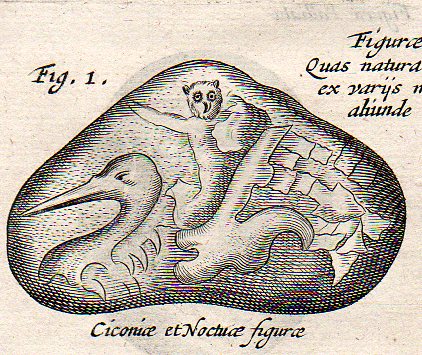
    But what I am looking at today with Kircher is the Mary-in-Amber part, his investigations (and theorizing, and documentation) on naturally-appearing, organic objects found in inorganic material–rocks and minerals–like these birds:

    Kircher  lapidibus birds451

    Which is a detail from  

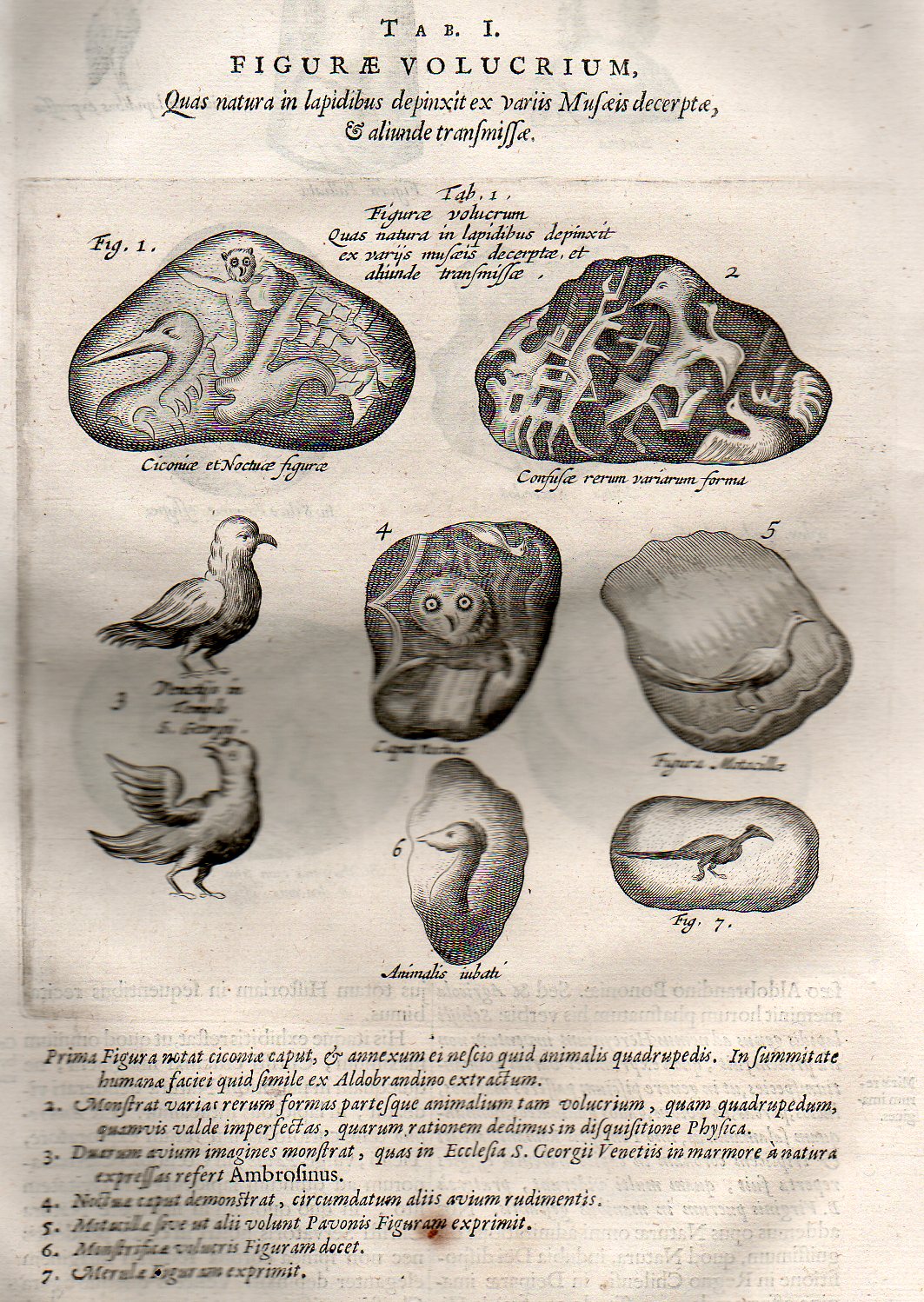
    Kircher  lapidibus birds449
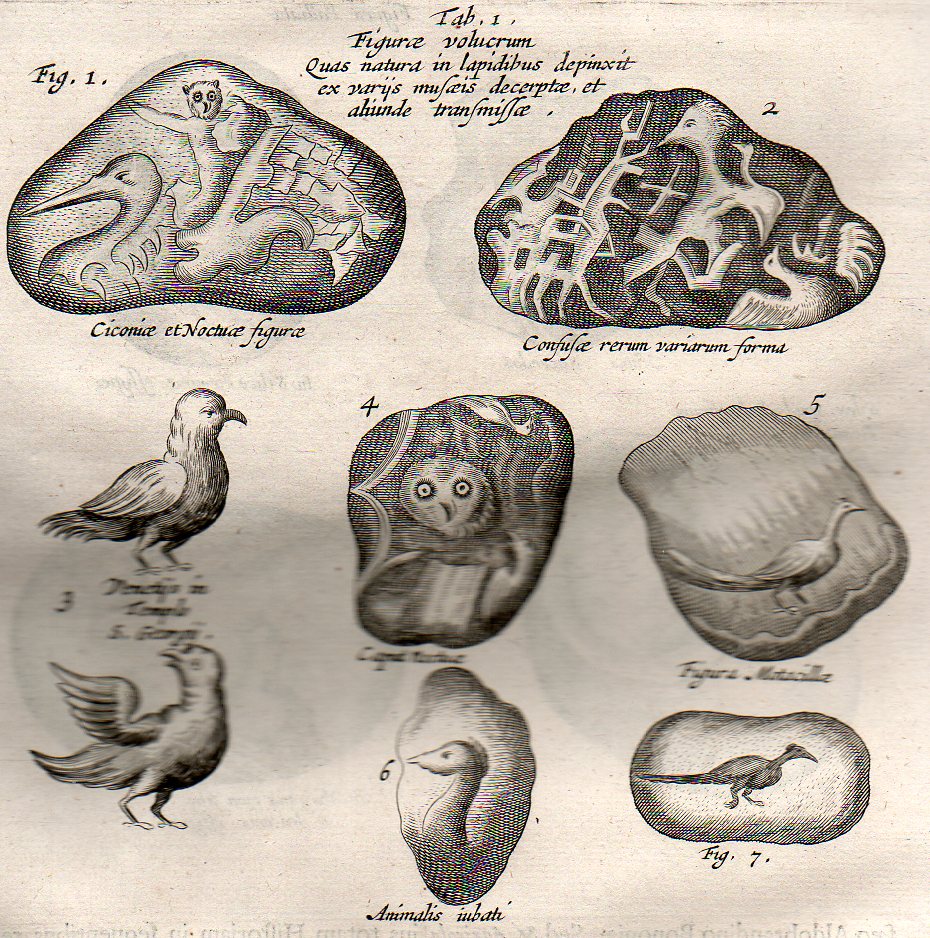
    The engraving (the original of which is available from our blog bookstore), entitled Figure Volucrum, quas Natura in lapidibus depinxit, ex variis Museia decerpt et aliunde transmissa (or “Figures of winged creatures, painted by nature on stones, taken from various museums, and otherwise transmitted.”) shows Kircher’s collection of anthropomorphically based inorganic items.  It is a remarkable exercise to try and place yourself within the context of the scientific world of Kircher’s time, 350 years ago, and try to explain these naturally-occurring phenomena, without even the benefits of the conception of long geologic time, or of expanded time in general. 

    The descriptive text (at the bottom of the engraving) from Kircher on these objects is translated, as follows:

    1.  The first figure represents a head of a Stork, together with some, but I do not know what, quadruped. At the top is something like a human face. Extracted from Aldobrandinot (see PI. XXIII. Fig. 1).
    2.  Shows various forms and parts of animals, winged creatures as well as quadrupeds, although very imperfect, the cause of which we give in the physical examinations (see PI. XXIII. Fig. 2).
    3.  Represents the figures of two birds expressed by nature on marble in the church of St. George’s, at Venice, referred to by Ambrosinua (see Vol. VII. PI. II. Figs. 3, 4).
    4.  Shows the head of an Owl, surrounded by rudiments of other birds (see PI. XXIV. Fig. 2).
    5.  Represents the figure of a Wagtail, or as others prefer, of a Peacock (PI. XXIV. Fig. 3).
    6.  Shows the figure of a monstrous bird (Vol. VII. PI. II. Fig. 4).
    7.  The figure of a Merle (Vol. VII. PI. II. Fig. 5).

    A closer look at the image:

      Kircher  lapidibus birds450


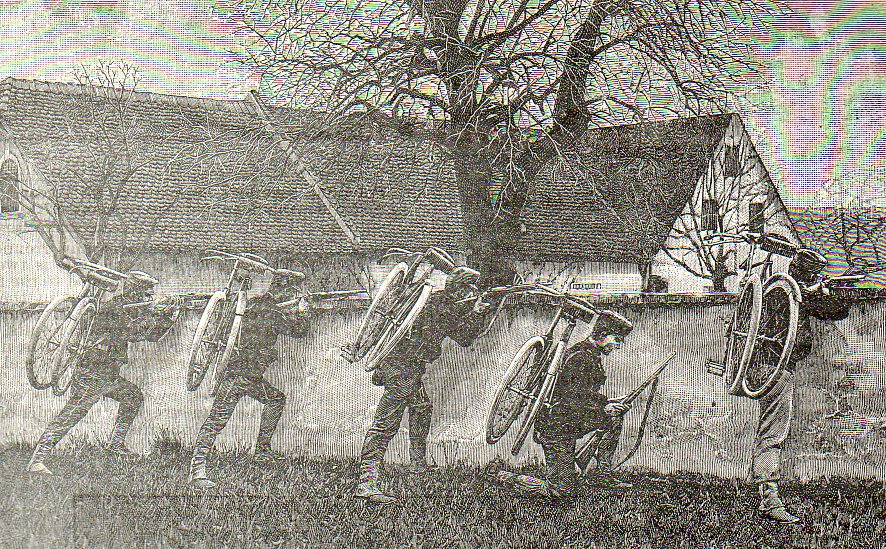
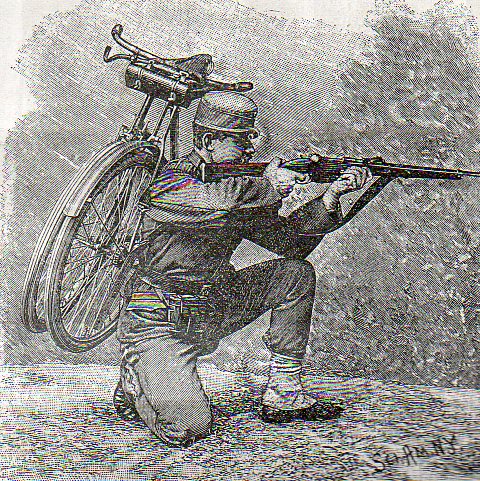
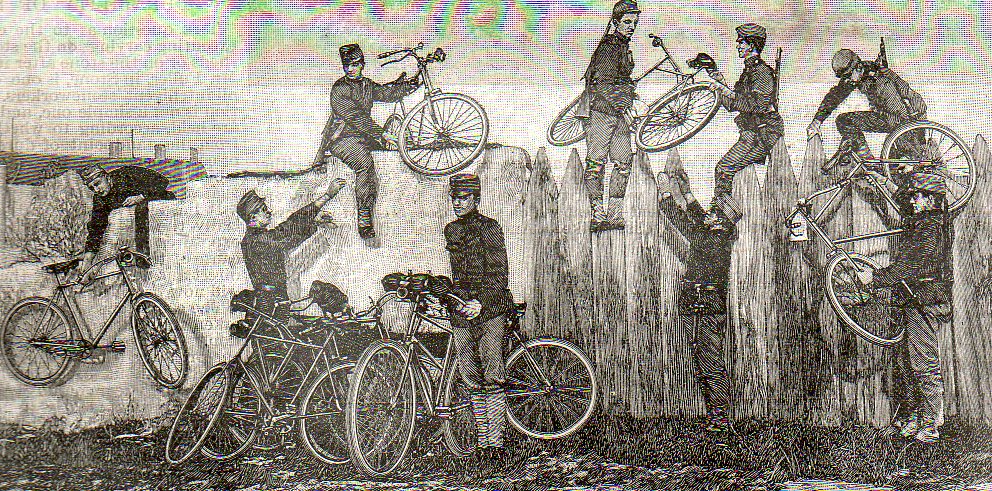
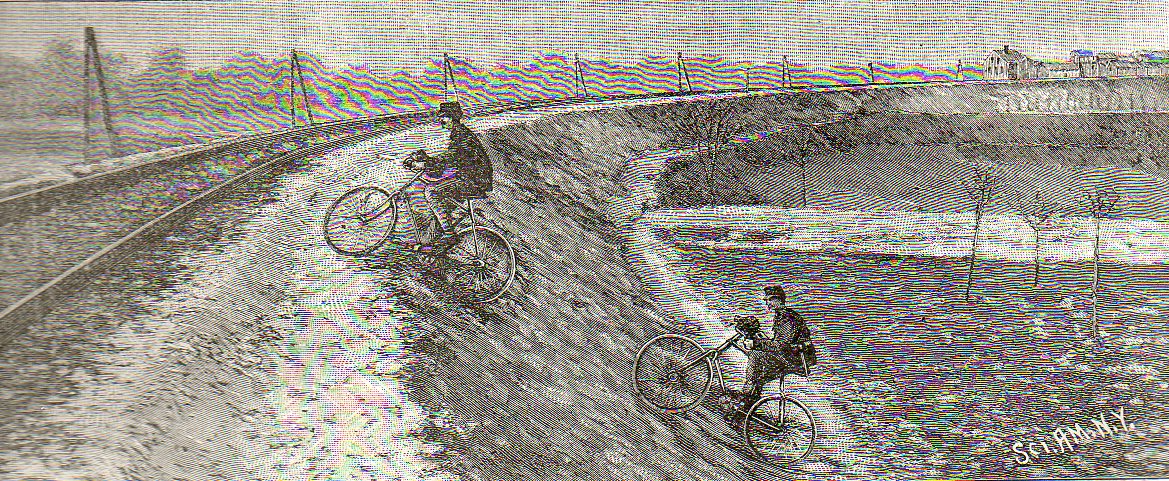
  • Fantastic Contrivances of Massive and Unneeded Difficulty–Bikes in War, 1897

    JF Ptak Science Books   Post 1345

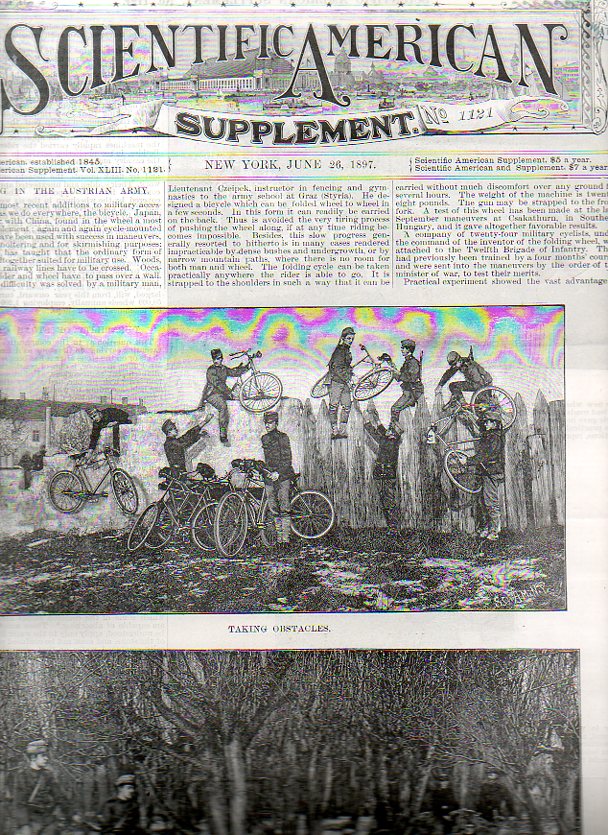
       Bike army 439

    When I see images like this, I can feel a symphony of bad ideas rattling  my bones.

    Of contrivances great and unnecessary,  that of bringing the bicycle into the field of war–banking on a fabulous interest in the machine and riding a wave of enthusiasms enjoyed by millions–is among the loftiest of lofty unnecessaries of the past 150 years or so. When these pictures were published in 1897 interest in the bicycle was shattering; it was a popular conveyance, and then in just two or three years, an explosion:  millions of people suddenly needed one.  Bikes seemed to be everywhere,  which forced people to imagine new and different uses for the machine.  And so the Austrian army came up with a plan to include the bike in its plans of war, and it proved to be as about as useful as a double-decker horse.  And just like that–poof–the fragility of the bike’s expansive uses fell right off the table, along with the popular interest in it, which by the turn of the century saw the millions who had turned towards the bike turn away. 

    Bike army 440
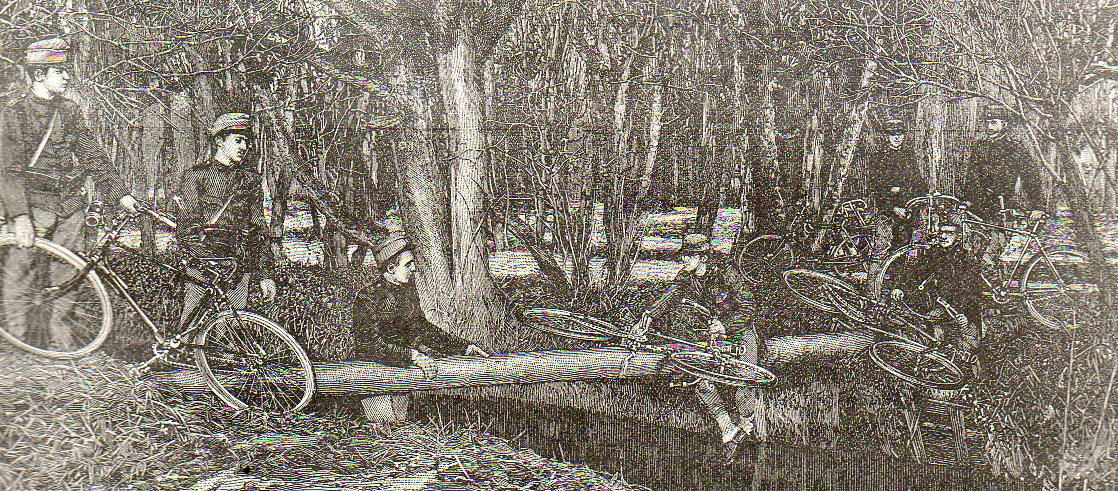
    It is difficult to image a more unpleasant (real) use for the bike than this.  The pictures seem as though they are part of a Monty Python montage, but they were indeed deadly serious–though I do need to credit someone, anyone, who came up with the idea of a folding bike to make it slightly more transportable.  (Overall though it seems almost as useful as a folding tuba.  Or sousaphone.)  If employed I think the idea would’ve proved to be more deadly to the biker than whomever the biker was attacking.  Or, more likely, fleeing.
    Bike army 436
    One can only shudder and what it must’ve been like, sitting on top of that fence, handing bikes (with lights and horns) from one side to the other, bullets flying, attempting an attack with 75 pounds of cumbersome trouble slapped to your side.  It must have felt insane.
    Bike army 441

    (The original print is available from our blog bookstore, by the way.)

        Bike army 435

    Bike army 437

    I think these men would have heard the music too as they slogged their ways through brush and trees and muck and the like, sliding their bikes along that log to keep them dry while the men stood in the wet. They would’ve heard the music too, a short little symphony played on folded instruments, which sounded as bad as it looked.


  • Ghost March–Doughboys in London and Four Years of Mist, 1918

    JF Ptak Science Books   Post 1328

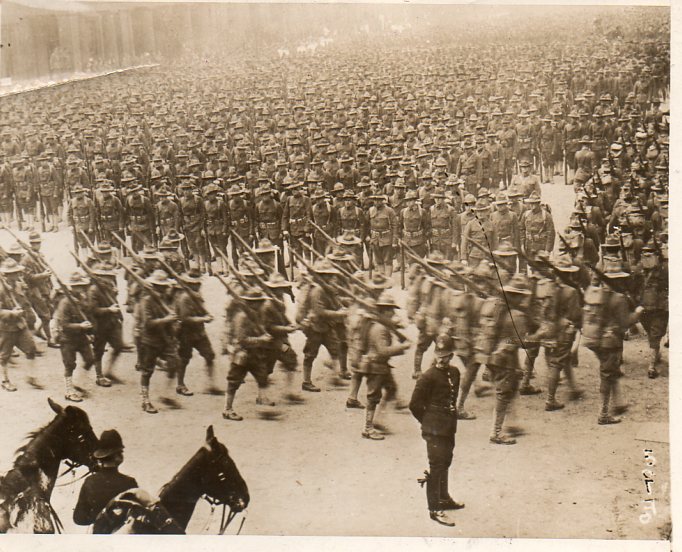
    .003%  That’s what I reckon this column of soldiers would represent of the total casualties of WWI.

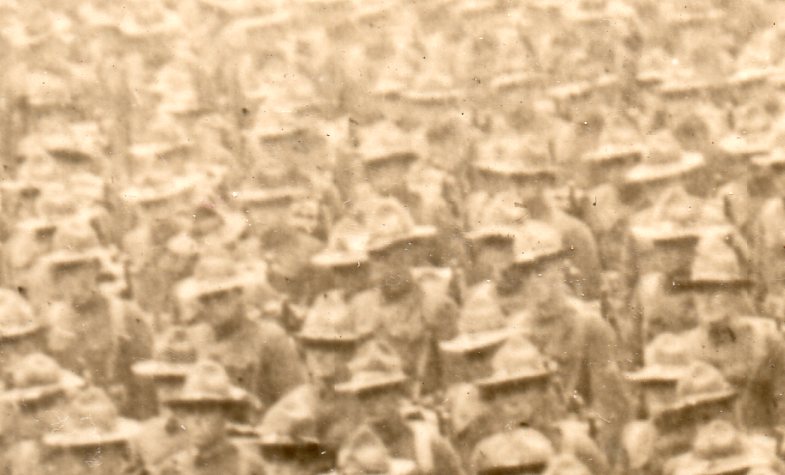
    Generally images like this are a virtual image-host for me, a bucket of ice cold water thrown onto a sizzling summer sidewalk, all sorts of ideas steaming from it.  But for photographs of Doughboys1 marching, especially assembling for parade, this one struck me a little more oddly than most, giving instant pause, making me concentrate on the haze, or dust, that allowed the columns of soldiers to blend into one another and fade, losing their boundaries with their mass receding into a dull blur. 

    Marching london 350

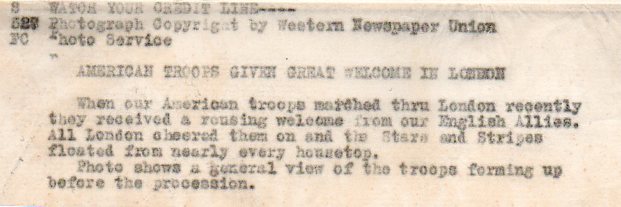
    The Western Newspaper Union was selling this image for insertion in newspaper or journal stories about the war, for a small use fee.  There were a few American organizations like Western Newspaper that were created to photographically cover the war, using pools of photographers who would distribute their work anonymously and which was available for common, general use for a small charge.  The photographs allowed out were certainly restricted and censored, though in my stash of these of objects (numbering about a thousand) I’d say that 10% of them look pretty edgy to my eyes.  Most of the action of war was not covered, but then again this aspect was still fairly technically difficult in 1918.  Images of pain were almost never allowed, and certainly not pain of Allied troops.  Aid stations were almost never covered as well, as were dead bodies, or at least those again of Americans or Brits or French or Canadian.  The imaging of the war was certainly under a fair amount of supervision and control. (The original is available for purchase through our blog bookstore. here.)

    Marching london det352

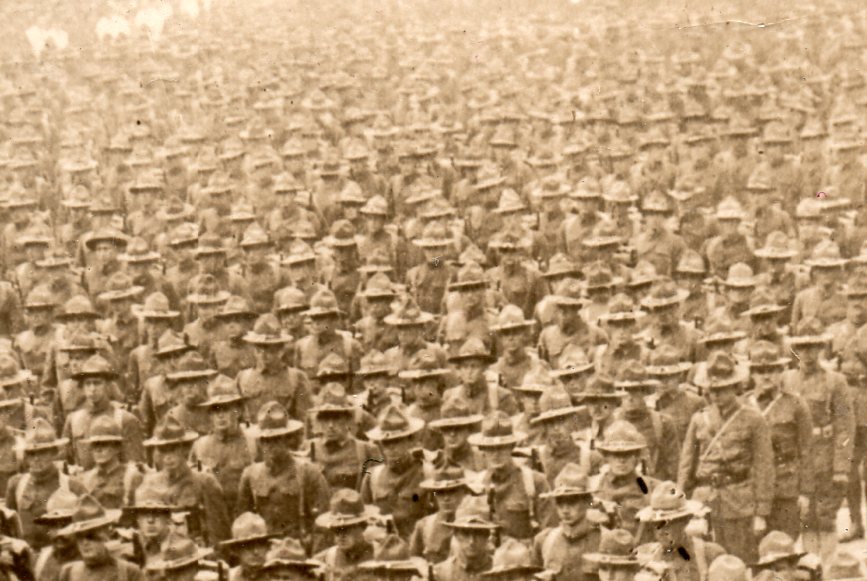
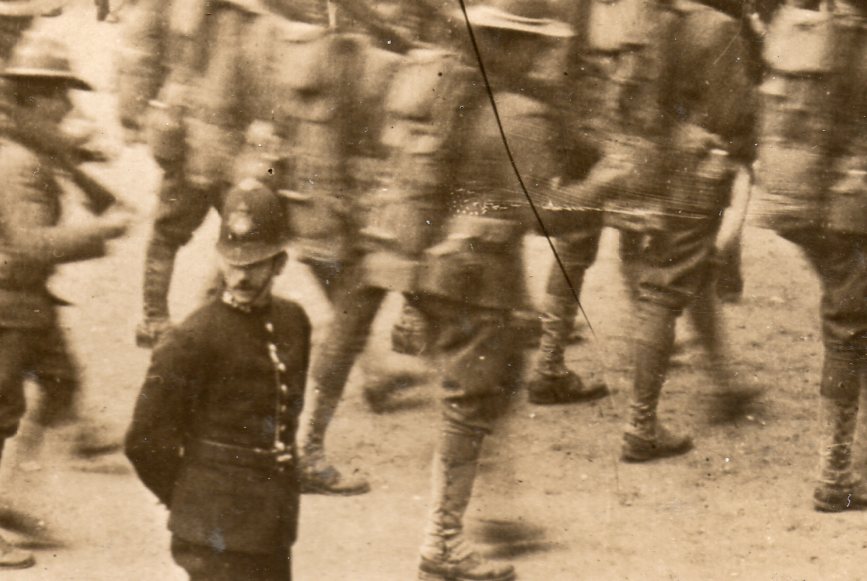
    The image shows American troops assembling for a parade through the streets of London before being deployed.  The mistiness of the composition looks like a statistic to me, these men standing for those who had come before and fallen.

    Marching london det353

     The U.S. lost .13%  of its population to casualties (125,000 killed and 205,000 wounded) during the war–a war which by the time America got here had already been visciously fought for three years, costing dozens of millions of lives.  The figures for everyone else weren’t nearly so “fortunate” as the U.S.:  New Zealand’s 18,000/41,312 killed/wounded amounted to 1.6% of its population.  The U.K. lost 2.19% (964,000/1,663,000), Italy was 3.48% (650,000/953,000 plus 650,000 civilian casualties), while France suffered a 4.29% (1.4 million/4.27 mil) blow of its total population to war.  Things were worse on the other side:  Germany 3.82% (2 mil/2.4 mil plus 426,000 civilian deaths, and the Ottoman Empire 12% (400,000/771,000 plus 2.1 million civilian deaths.   Worst of all was the Ally  Serbia, suffering a catastrophic 16% loss of its population to war, including 275,000/725,000 plus 426,000 civilian casualties.  As gruesome as the numbers were, the Americans felt only a small percentage of the total sting of war–by 11 November, more than 21 million soldiers would have been wounded, with 9.7 million soldiers and 6.8 million civilians killed.  It was an enormous price.

    And that’s what I see in the mist of what may be something like 10,000 soldiers on display n this photograph.  .003%  That’s two of these columns every day, twice a day, for the entire 1550 or so days of the war.   

    Marching london cop351

    Marching london txt354

    Notes

    1.  The origin of the term “Doughboy” is unclear, or varied, or rich, but it is at least pretty oldm beginning around the time of the Mexican American War in 1846-1848–evidently when the soldiers marched through dry, tough terrain they wound up being covered by earth with the color of dough.  Doughboy.