A Daily History of Holes, Dots, Lines, Science, History, Math, Physics, Art, the Unintentional Absurd, Architecture, Maps, Data Visualization, Blank and Missing Things, and so on. |1.6 million words, 7500 images, 4.9 million hits| Press & appearances in The Times, Le Figaro, Mensa, The Economist, The Guardian, Discovery News, Slate, Le Monde, Sci American Blogs, Le Pont, and many other places… 5000+ total posts since 2008.

Category: Absurdist, Unintentional

  • Note on the Visual Semantics of Ideas: John WIlkins, Jorge Luis Borges, Oliver Byrne

    JF Ptak Science Books   Post 1568

    John Wilkins’ construction of a new, theoretical language, a visual semantics of idea that was to be read and not spoken, a new international language to communicate thought, seems straight from the heart of the great Jorge Luis Borges.  And in fact, Wilkins does come from Borges, in a way–as part of a story Borges wrote in 1942, a fantastical semi-non-fictional account of Wilkins’ fabulous effort1.

    Wilkins was a 17th century figure with a sort-of 20th century idea, but even advanced to this point in time, and with actual mathematical and linguistic tools at his disposal, his work is still better as a sci-fi movie backdrop than anything else–not that there’s anything wrong with that.  The book of his in question, An Essay towards a Real Character, and a Philosophical Language, was published in London in 1668, and was an very interesting, Aristotelian non-standard approach to construct a universally understood language composed of characters which were in a way axiomatic of a developing system of genera, a taxonomy of ideas, that were somehow, fantastically, capable of expressing the foundations and flights of human thinking. 

    Borges’ presented Wilkins in a very Borgesian way in his  “The Analytical Language of John Wilkins“, mixing fact with creative fancy, exhibiting Real Character as though it was being re-discovered and studied by living academics. 
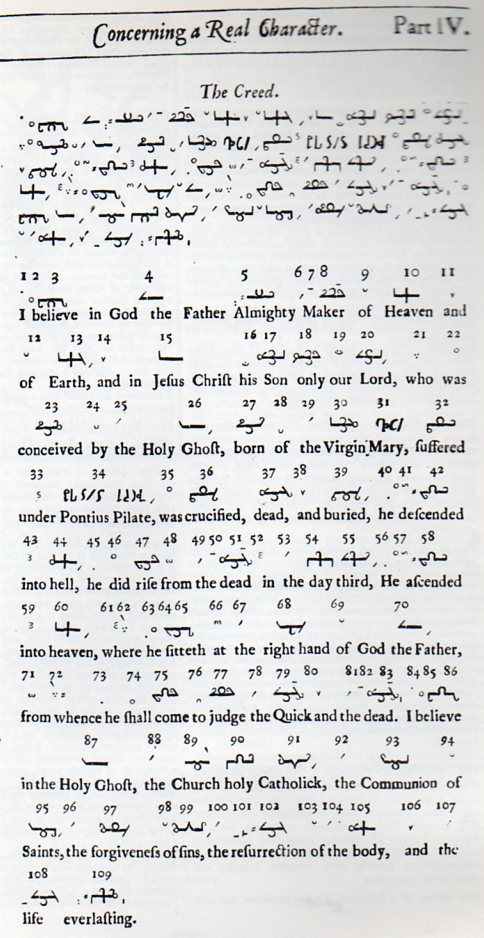
    Wilkins631

    It reminds me somewhat of other massive buit not-quite-nowhere-near-there efforts by people like Oliver Byrne and his color-coded approach to Euclid (1847), J.H. Woodger with his Axomatic Methods in Biology (1937), and Clark Hull’s Principles of Behavior (1944). Fascinating ideas, constructed with big brains, but which ultimately produce a product which more deeply confuses and obscures the subject matter it set out to explain–and which don’t really work, anyway.  But they are beautiful things int heir own right–Byrne’s work in particular also happened to be one of the most beautiful books produced in the 19th century–assemblies of bits and pieces that are occasionally magnificent but whose final destination was of course The Twilight Zone.

    They were in some way a Search for a Perfect Language (as in the work by Umberto Eco); they sought to step deeply outside themselves in an effort to grasp a higher knowledge, perhaps not much too unlike Isaac Newton and his  deep experimentation in alchemy, looking for the massive truths that were handed down to the few selected ancient ones.  They are beautiful things with a lot of very good thinking–they just weren’t right. 

    Notes:

    1.  “The Analytical Language of John Wilkins“, 1942, in which Borges presents an imaginary intellectual archaeologist assessing the work, comparing it in particular to the imaginary encyclopedia Celestial Emporium of Benevolent Knowledge.

    “He divided the universe into forty categories or genera, these being further subdivided into differences, which were subdivided into species. He assigned to each genus a monosyllable of two letters; to each difference, a consonant; to each species, a vowel. For example: de, which means an element; deb, the first of the elements, fire; deba, a part of the element fire, a flame. In a similar language invented by Letellier (1850) a means animal; ab, mammal; abo, carnivore; aboj, feline; aboje, cat; abi, herbivore; abiv, horse; etc. In the language of Bonifacio Sotos Ochando (1845) imaba means building; imaca, harem; imafe, hospital; imafo, pesthouse; imari, house; imaru, country house; imedo, post; imede, pillar; imego, floor; imela, ceiling; imogo, window; bire, bookbinder; birer, bookbinding. (This last list belongs to a book printed in Buenos Aires in 1886, the Curso de Lengua Universal, by Dr. Pedro Mata.)”–Jorge Luis Borges

    Borges described Wilkins’ taxonomy as follows, dividing it into 14 categories (compared to the original Wilkins list of 40):

    Those that belong to the emperor; Embalmed ones; Those that are trained; Suckling pigs; Mermaids; Fabulous ones; Stray dogs; Those that are included in this classification; Those that tremble as if they were mad; Innumerable ones; Those drawn with a very fine camel hair brush; Et cetera; Those that have just broken the flower vase; Those that, at a distance, resemble flies.
  • History of Lines–Naive Rivers and Trees, 1670

    JF Ptak Science Books   Quick Post in the History of LInes series.

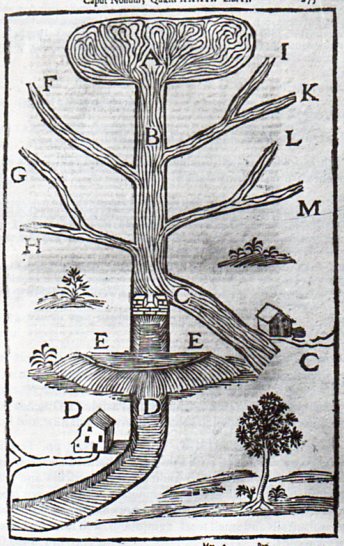
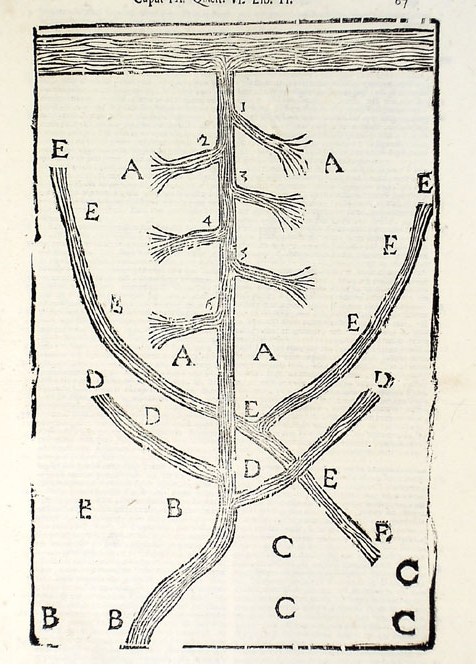
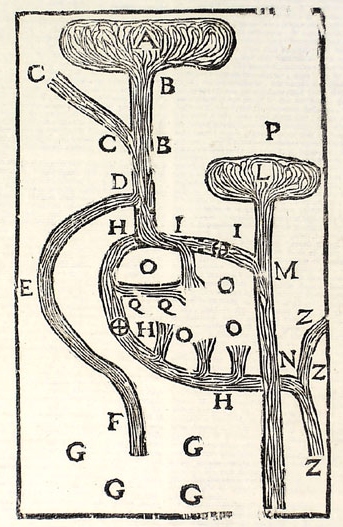
    River629 This lovely river/tree appeared as a woodcut in Franciscus Maria Pecchius’ Tractatus de Aquaeductus, which was printed in 1670-1673.  It actually is nothing of the sort, as it depicts the construction of a dam in a busy river and forms part of a four volume work on the building of aqueducts–ranging from the selection of sites, to financial considerations and of course engineering and materials studies.  Pecchius’ work was the standard of its day, and it also was the cornerstone work on the (Roman) law of such things, presenting a jurisprudence that stretched back a thousand years.

    But the way that the flow of the river is represented makes the image look very much like a tree, in a lovely, naive way.  It might seem a horrible sleight to a work of this importance, but, well, sop it goes–the images, removed from their appropriate context, take on a life of their own…

    River aquaduct 2
    River aquaduct 3


  • Visionary Architecture and a Prankish Illustration, 1913

    JF Ptak Science Books   (Post 118 from June 2008, expanded)

    [I made a post on this subject at the very outset of this blog,m three years ago–I’ve returned to it this morning to expand and revise it some…]

    Dsc00013

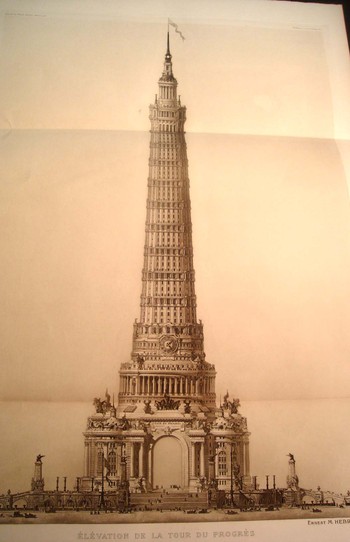
     This image has two things going for it, one obvious, the other not (and just about hidden, until you see it, then you can’t help not seeing it all of the time).  It comes from an unusual, somewhat pretty/bizarre visionary work privately printed in Paris in 1913.  The lead author, Hendrik Christian Andersen, along with Ernest M. Hebrard (and his brother, Jean Hebrard, who we saw in an earlier post), collaborated on a project (ungainly) called Creation of a World Centre of Communication1, a deeply complex, very detailed, and just plain weird offering for building a sprawling extraterritorial city dedicated to “oneness”, a thing that struggles to be heard over its own insistent shouting.  The drawings and plans were lush and lovely, with a lot of thought in their execution but actually very little into how everything might actually be pulled together into some sort of working whole.  As the first reviewers of this book demonstrated, simply because something is very big and heavy–as in the case of this huge book–it doesn’t give the work any necessary intellectual weight.2

    Dsc00012

    And so it goes.  I imagine that if the beautiful Etienne Boullee thought in terms of cities rather than in single structures, he might’ve produced just the same sort of gorgeous, unconnected thing.  After all, just because you draw a plan with a lot of buildings almost touching each other doesn’t necessarily mean you’ve drawn a visionary city. 

    This is one of 22 large images (in real life this print, a heliogravure, measures about 28 inches tall) showing different structures from an art center to a fountain of life.  This is the “Tower of Progress”—I don’t know what sort of progress as there’s really nothing to go by, except for the big 100’-tall clock, so at the very least it is a celebration of the progression of time, which needs no monument outside of the trillions and trillions of trillions (or centillions, or 10303?) of bones it has distributed around the planet over the millennia. But for Hebrard it formed the locus of the  “a fountain of overflowing knowledge to be fed by the whole world of human endeavour in art, science, religion, commerce, industry, and law; and in turn to diffuse throughout the whole of humanity as though it were one grand, divine body conceived by God, the vital requirements which would renew its strength, protect its rights, and enable it to attain greater heights through a concentration of world effort.” Whew.  The Tower is really dedicated to progress in learning, and the distribution of information, which stands at the center of this place; the authors believed that the only way that the world would survive the “present war” (WWI) would be through education–I think that the world has so far proved them wrong. 

    I figure that the tower was to be about 1,500 feet tall (scaling it by the 2mm tall figures scampering around in the image)—a giant tower perched on top of a rotunda placed on top of a table-like something, looking terrifically fake, but lustrous.

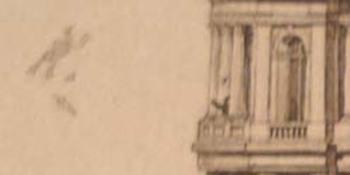
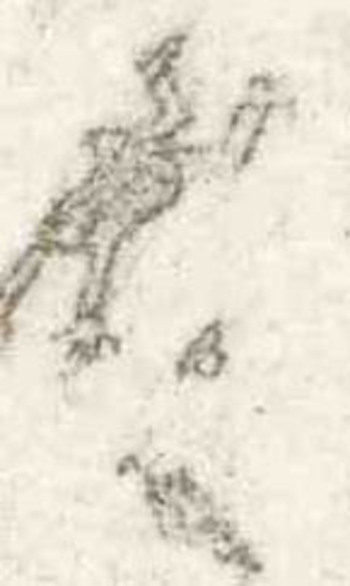
    The prize though in this portrayal of the “Tower of Progress” is a little smudge-like thing to the middle-left of the tower.  Under magnification, we see that it is a man, with a bowler and an umbrella, hurtling down, falling from somewhere way on high in the tower.  It is of course a very unexpected feature of this visionary architectural rendering, a hidden joke (perhaps?).  These sorts of additions—the work of a disgruntled/drunk/humorous engraver—pop up from time to time in the history of printing.  Perhaps the most famous intentional example of this graffiti is found in the earliest copies of the first edition of Twain’s Adventures of Tom Sawyer, where a male character is featured with
    Falling_man_super_detail a very large, very lumpy, very noticeable, erection; a proof reader spotted the embarrassment, and the plate was reworked to rid the character of the Natural Function.  I’d guess offhand that this was the case with the Hebrard heliogravure, even though there is a second figure in the tower pointing at the figure hurtling past, implying a little more thought in making this a more cohesive joke.   
    Notes: 

    1. An interesting review of this work appeared in Town Planning Review for 1914, here. 

    2. “This volume is 1 foot broad, 1 foot 6 inches long, and it weighs 10 lbs. It is obvious, then, that if it has a corresponding spiritual gravity it cannot be treated with too much deference…”–source


  • Mitigating and Matriculating Apocalyptic Nuclear Exchanges, 1959

    JF Ptak Science Books  Post 1559

    [This is part of a series of posts on planning for the post-apocalyptic nuclear war world.  Others include Virtuosic Apocalypticism:  Maps anbd Charts of Nuclear Exchange, 1964,  Taxes Trump Death in the Post-Nuclear-Attack World, 1964, and others which are linked to those two posts.]

    There is nothing quite like reading turgid handbooks filled with impossible hope for recovery from un-recoverable situations.  Of course, there are few situations that might actually occur in which recovery (to anything like the “life” that existed before the event) would be impossible:  enormous meteorites making impact with the Earth would certainly be one, and there is little else besides this, really, outside of an enormous nuclear war.  And it is exactly this, this second scenario, that the U.S. Government planned for to great lengths for decades on end–it was expected to be investigated, of course, because there was little else that could be done short of doing away with nuclear weapons, which was/is an action that would not be a serious consideration. 

    Planning for post-Armageddon was a solid, white-collar job that kept thousands of people employed for 30+ years.  The idea behind the smiling mask was simple–that in an “exchange” (an uncommonly milky euphemism for launching nuclear weapons between enemies) there would be winners and losers, and in spite of tens of thousands of megatons of nuclear weapons being detonated, there would be enough infrastructure that would survive to be able to declare one of the smoke-filled-holes a winner in the conflict. 

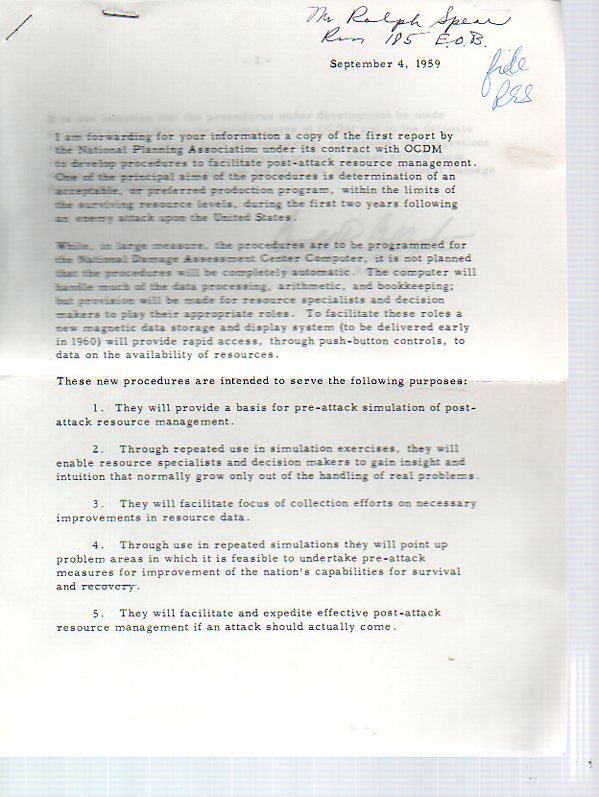
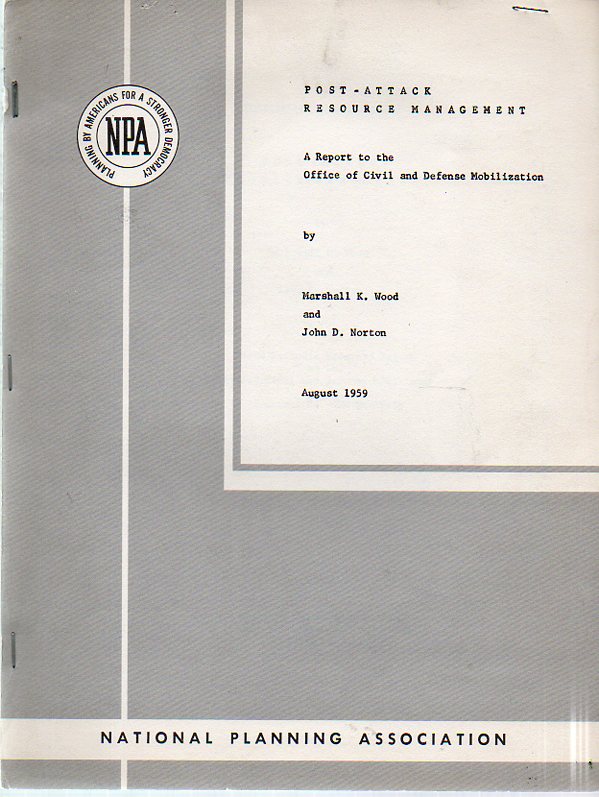
    ATOMIC BOMB POST-ATTOMIC PLANNING613 That is certainly the optimistic outlook of a preliminary report issued by Marshall K. Wood and John D. Martin, who issued this working paper on the state of a computer program that was being constructed to assist post-attack planners in re-establishing the broken remains of the country.  Post-Attack Resource Management (PARM) was being compiled for the National Damage Assessment Center, under the National Planning Association, under the Office of Emergency Planning, in the Executive Office of the President,  to be run on the UNIVAC Scientific and the Sperry Rand ERA 1103A computers, and made to assess national economic and military recovery of the U.S. post-nuke-war.  This of course is a gargantuan, staggering task, given the number of changing variables, but someone had to give it a try.

    Just collecting the existing data on x-number of ATOMIC BOMB POST-ATTOMIC PLANNING614 eco-industrial-military-medical-human variables that make to country run is a daunting thing; try to imagine that as you added the Factors of Change in a nuclear war, trying to determine how thousands of explosions over the breadth of the country would affect the national infrastructure if these thousands of bombs were exploded in place A1-A1xN over periods of time T1-TX.  It would be a phenomenal task to try and determine what results there would be on the country following thousands of different attack models.  And then, after everything was said and done, there just wouldn’t be very much left. 

    Maybe the thing worked.  Maybe by planning for a survivable outcome to an unsurvivable situation enticed the actors to wait and prepare their weaponry to such a point where they would be the one certain to survive a nuclear war.  In this way the build-up would continue forever, as no one party could achieve any sort of dominance in a first strike capacity to be able to wipe out their adversary’s war-making capability before they had a chance to employ it.  Perhaps in some weird, sick way this sort of planning for post-war activity kept the war from ever occurring by virtue of no one actor being able to achieve a superiority.  Or perhaps not. 


  • Strange Things in the Sky Dept.: Mountains and Allegories of Time

    JF Ptak Science Books  Post 1554

    In the history of mountains seldom have they raised themselves so magnificently as that seen in Jacopo da Valenza’s St. Jerome in the Wilderness. Painted in about 1509, da Valenza (who flourished from 1478-1509) depicts the 4th century Saint–a Doctor of the Catholic Church,  proponent of asceticism, scholar, philosopher, historian and translator of the Bible–sitting calmly and reading a book balanced on the top of  a rock pile, sitting in a deep state, with a metaphorical depiction of time and biography looming impossibly and invisibly behind him in the form of a mountain.

    I believe that the scene that wind their way around the mountains are those from St. Jerome’s life, displayed for all but not to him, shown as a chronological memory in simultaneous display. 

    The imagery of the mountain displays as much history and imagination as required by the viewer.  It has a distinct Tower of Babel quality to it, though here the mountain very decidedly has no upper limit, no summit, the mountain disappearing into the north end of the painting, and actually seems to be getting larger and more dense as it ascends. 

    Jerome is serene, larger matters on his mind than a simple history of one life. 

    The saint is frequently shown in very stark surroundings, and occasionally appears in more formal and lush biblio-related scenes–as the man did, after all, serve his Pope in very advanced capacities in Rome for a number of years.  But this I think is how we picture Jerome in a generalized way–except for the extraordinary mountain. 


  • Taxes Trump Death in the Post Nuclear Attack World, 1964

    JF Ptak Science Books   Post 1553

    Atomic bomb taxes detail583

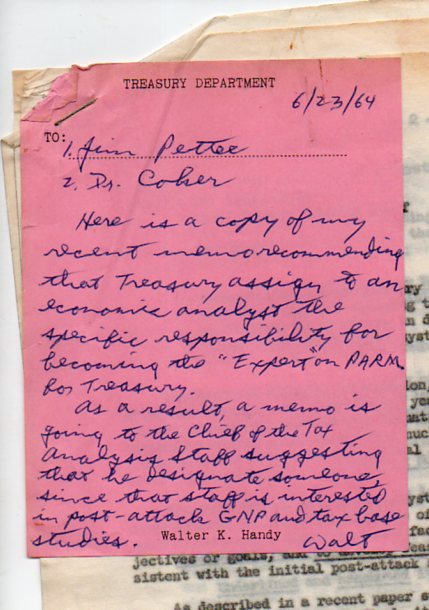
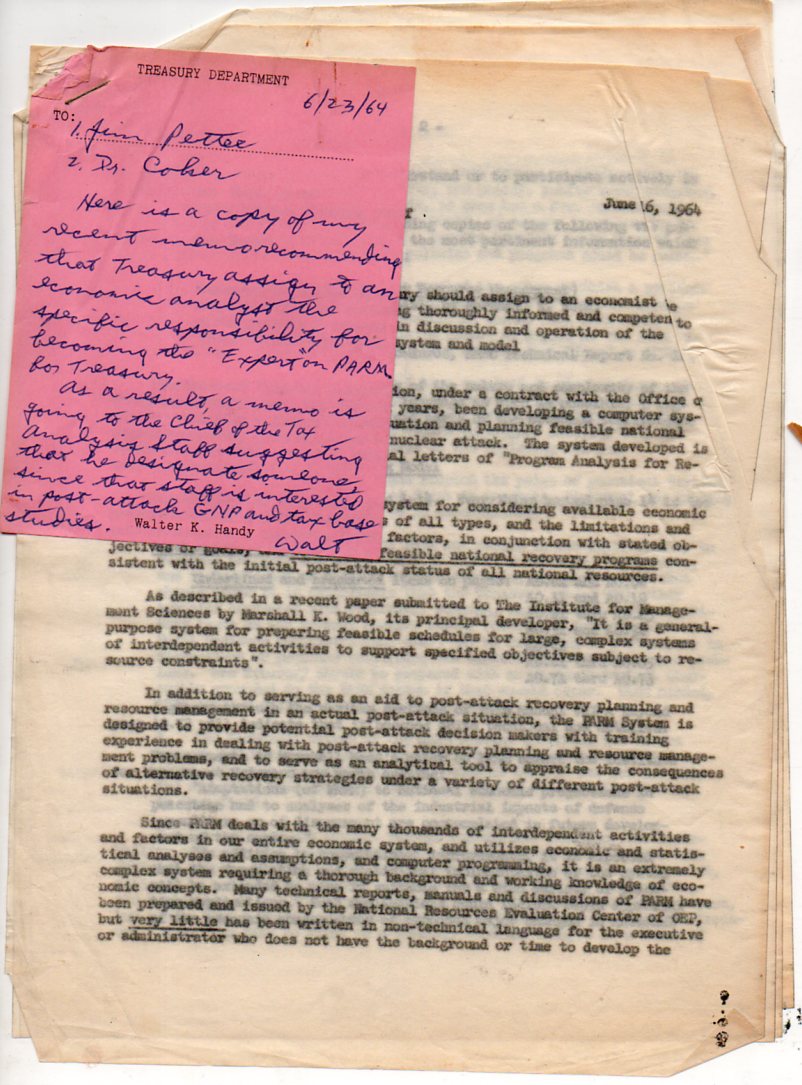
    There are a number of posts on this blog relating to the post-nuclear-attack world, and they seem to cover all aspects of what to expect of society and government after devastating nuclear weapons exchanges.  The posts are part of  a long series (75+ posts) on the history of atomic and nuclear weapons,  but also extend to Armageddon and fat thinking about survivability.   A good example of the unusual aspects of covering all uncovered angles is  Ueber-Spectacular Understatement Dept.: the Happy Post-Apocalyptic America and the “Awkwardness” of Holocaust, 1962 ,  as well as this one on job description and personnel issues post-attack.  But what I’m edging for tonight is the taxman and the business of funding government and the military post-attack, which appeared in a very structured 1967 piece here.  The issue of establishing and collecting taxes in the post nuclear weapons exchange world has come to life again, finding as I did an obscure reference to the nasty business in an attached note to a more formidable folder of other post-attack bureaucratic minutiae. 

    Its a simple thing, really–this is what struck me so heavily about it.  Just a short note about moving mid-level people around for becoming expert in this and that simulation and so on, a little hand-written note, from 1964.  But it suggests that a person from the “Tax Analysis Staff” of the post-attack studies world be the designated expertee, since “that staff is interested in post-attack GNP and tax base studies”. 

    There’s just so much expectation and projection in that last line that I’m not quite sure that it exists. In the real world. 

    Atomic bomb taxes582
    I guess the simple explanation is that after the (radioactive) dust settles following the massive exchange, that people will pick themselves up, brush themselves off, and start all over again (as the song goes).  And somewhere in that killer dust and devastated death a magnificent thing lurks–a GNP.   And inside that GNP its guts–money and taxes–have survived the annihilation of almost everybody.  Which perhaps disproves that old adage, and that in the end, the only thing you really can depend on is, well, taxes, because the dead go away, and the taxes remain. 


  • Child Straigtener & Other Edwardian Cyborg Bits: Patent Reports

    JF Ptak Science Books   Post 1549

    (The following images are taken from the U.K. Intellectual Property Office Espacenet patent search page, here. The quotations following the illustrations for the patents are from that page.)

    Close Straightening Encounters for Children of the Reading Kind

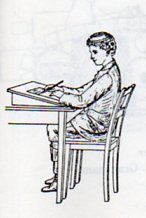
    Here’s an interesting implement that no doubt brought secondary thoughts about reading to any child made to wear this thing–the unhappy child is at left, and the skull-cap, at right.

     
    Yborg578

    First page clipping of GB 190421618 (A)

    Abstract of  GB 190421618  (A)

    “Lorenz, H.. For indicating when wearer deviates from an upright position; caps.-A cap I is made in the form of an inverted bottomless saucer with holes 3 in the side for lightness and ventilation. It is intended to be worn by school children to prevent stooping, inasmuch as it only remains on the head so long as the wearer remains in an erect posture…”


    Hand Guard for Cutting Things


    First page clipping of GB 190402703 (A)

    Francis John Crell: GB190402703 (a) “A Hand Guard for use in Cutting Bread and for Other Like Purposes”.  I’m not sure how this works as a glove-protective unit  given the spaces in-between the springy fingers–mostly it seemed to increase the cutter’s grip rather than protect them for accidental cutting.


     Walking and Running Anti-Deformation Appliance

    Patent Brit walking running machine

    Abstract of  GB 190414477  (A)

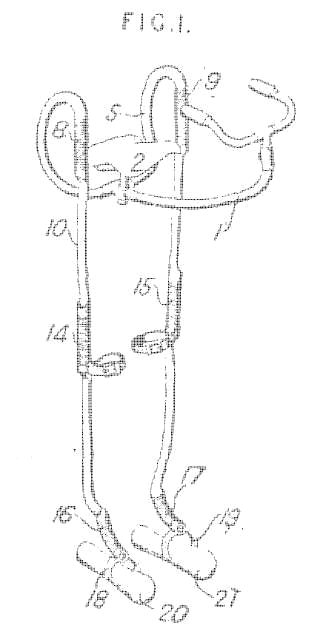
    “Skorzewski, Comte V. Walking and running, appliances for aiding.-A n appliance for aiding walking and running is adapted to store up, and to give up at the required moment, the energy resulting from the alteration in height of the centre of gravity of the body. The user sits on a saddle 2 adjustably attached to a tube 1 provided with handle – bars. The tube 1 branches into two tubes 5, which are connected by joints 8, 9, 14, 15, 16, 17 to other tubes of narrower crosssection, conforming in shape to the legs of the wearer, who is strapped to the appliance. The joints 16, 17 are connected by means of stirrups 18, 19 to soles 20, 21, or to straps by means of which soles may be attached to the appliance. The tubes are filled with compressed air through a suitable cock or valve. The joints are preferably formed of armoured rubber tubes, coated or not with para rubber.”


  • Fear of Numbers, Part 7 and Seven Sevenths: Octophobia.

    JF Ptak Science Books   Quick Post   [Part of the Unintentional Absurdist series.]

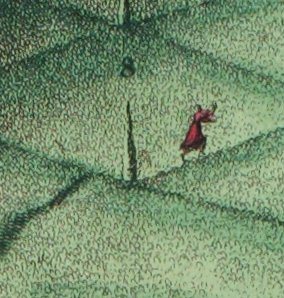
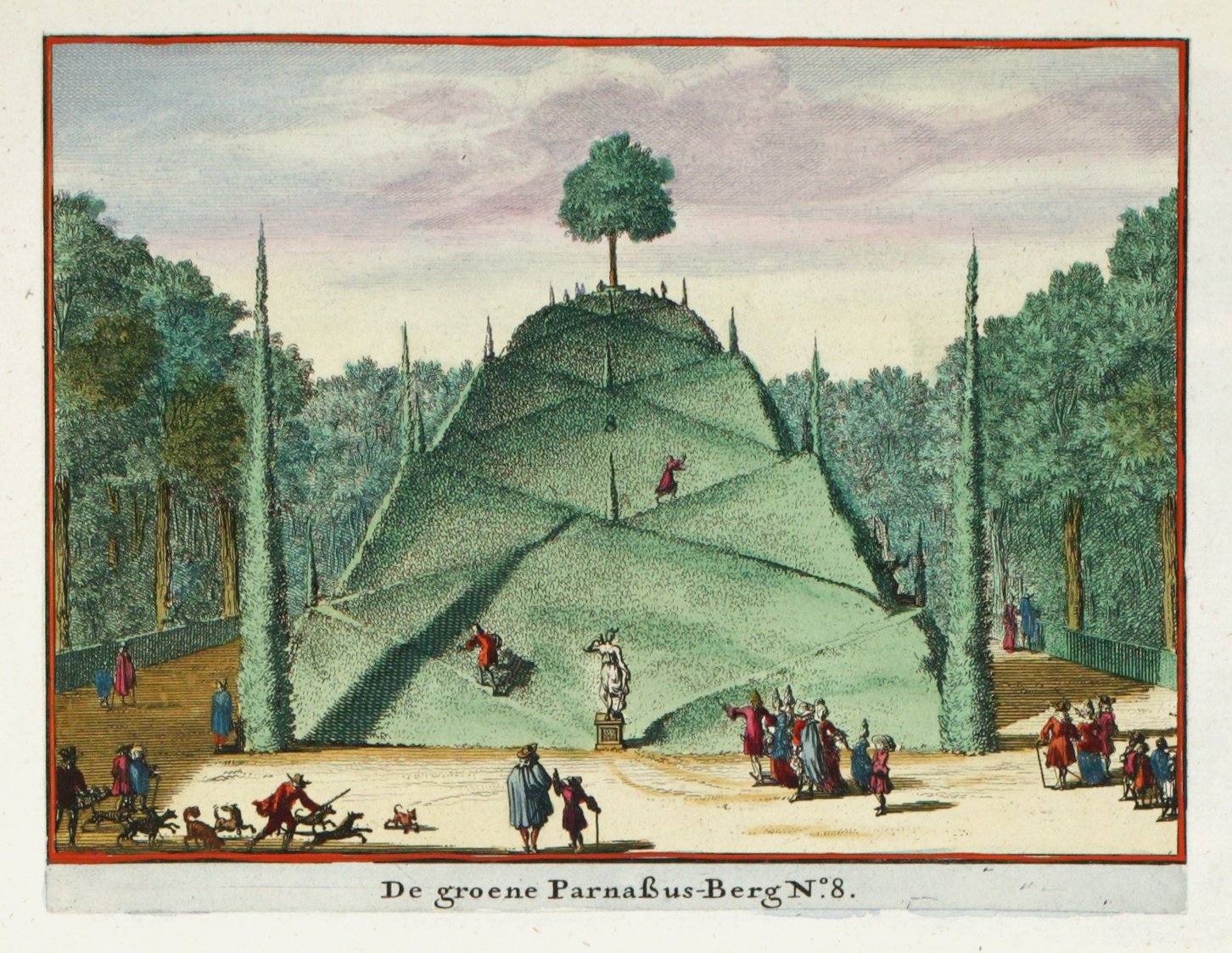
    Lines Large Mount Parnassus detailThis illustration comes from the beautiful Bibliodyessy site (follow link for the full description of the artwork), where the curator unearthed this series of 32 hand-colored engravings of the gardens of the great emblematicist, Jacob Cats.  I wonder why this fellow had such a strong reaction to whatever it was he was seeing.  I guess he was just looking at the shrub, but the vicinity of the eight, and its potential peril (!) for what it might represent (from eight-of-something-bad to the sign for an inverted infinity) , made this a little too good to resist.  [This is the first in a series of “found” images displaying unusual reactions to unintentioned floating numbers.]

    And the full image from which this detail was removed, a garden Mount Parnasus. 

    Lines Large Mount Parnassus 

    ·Posted by :

    ·in:


  • The History of Aerial Bombing, Advertising and Laxatives

    JF Ptak Science Books  Post 1534

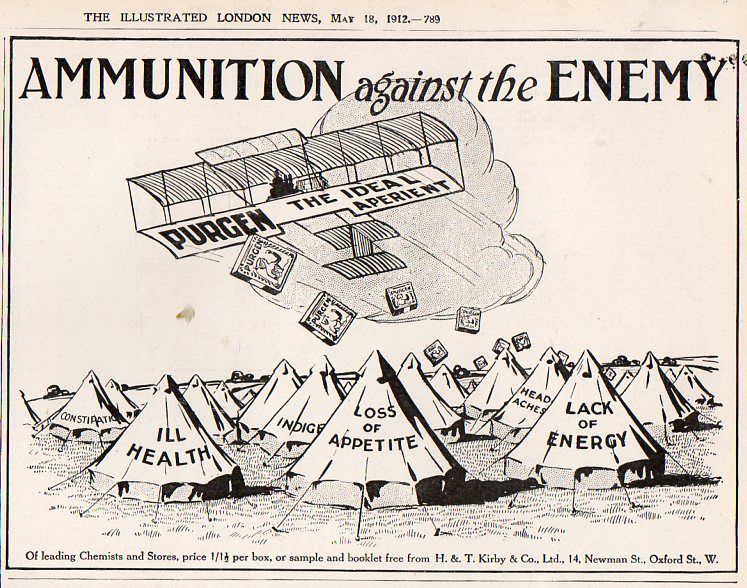
    The business of bombing people and places from airplanes/aeroplanes was fresh in the history of invention when this advertisement appeared in The Illustrated London News on 18 May 1912. 

    Bomb554
    Superweapons have been used against cities for quite some time in the new world of speculative fiction, and there had been real-life aerial bombings from hot-air balloons, but the first time that a bomb was dropped from a heavier-than-air airplane on anything happened just months earlier, on 1 November 1911, when Lt. Giulio Cavotti dropped a hand grenade from his Etrich Taube on the oasis of Tagiura, in North Africa during the Italo-Turkish War.  He dropped four parcels of hand grenades on the not-necessarily-military population at the oasis, injuring no one.  The attack was one of attempted vengeance, a payback by the Italians against the Arabs of Tripoli, in general, for having joined forces with the Turks to fight against them. 

    This air attack was fresh on the heels of a devastating slaughter of the Arabs at Tripoli on 25 October 1911–the Tripoli War would not come to an end until October of 1912. A complaint was lodged that the Italians had broken international law, as bombing from balloons had been outlawed by the Hague Conference of 1899–but the Italians argued that the spirit of the agreement did not apply to bombing from airplanes because airplanes were not balloons. The issue of the legitimacy of bombing from airplanes and then for bombing civilian populations would be a debated issue if not recognized as a restricted practice for decades to come.  As the cogs and wheels of the international court ground out its miniscule progress, people got blown up.  The people-blown-up part trumped international law almost every time. 

    In the meantime came this image of an airplane dropping boxes of Purgen, “the Ideal Aperient” on military-style tents  of “Ill Health”, “Loss of Appetite”, Lack of Energy”, and so on, all within the possibility of cure by this Purgen product.

    So, among the very first advertisements using the idea of aerial bombing as its own delivery system, was this one for Purgen.  A laxative.


  • Strange Things in the Sky Department: When Worlds Collide (1933+1951)

    JF Ptak Science Books   Quick Post  Part of our Strange Things in the Sky Department

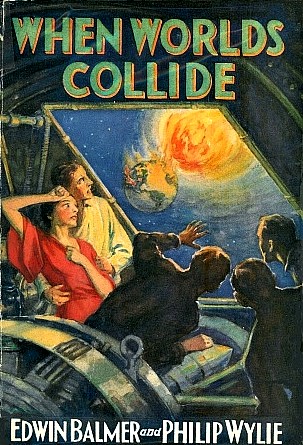
    When Worlds Collide wasn’t so much about another world colliding with the Earth–it was another star, a “rogue star”, that enters the solar system and heads directly towards the Earth.  Luckily for a selected few, a billionaire astronomer sees the thing coming and decides to construct a spaceship to populate a friendly “planet” near Alpha Centauri.  Oh well, its 1933, and perhaps anything was possible–after all, the Empire State Building (which is depicted in so many of these movie posters in a not-good way) was just finished in 1931, after two years of construction (!). 

    So the following are movie posters for the 1951 film version of the 1933 book–except for the first image, which is from the book.

    Strange sky--when worlds collide   


    http://www.mattfind.com/12345673215-3-2-3_img/movie/v/z/n/when_worlds_collide_1951_300x439_193460.jpg