A Daily History of Holes, Dots, Lines, Science, History, Math, Physics, Art, the Unintentional Absurd, Architecture, Maps, Data Visualization, Blank and Missing Things, and so on. |1.6 million words, 7500 images, 4.9 million hits| Press & appearances in The Times, Le Figaro, Mensa, The Economist, The Guardian, Discovery News, Slate, Le Monde, Sci American Blogs, Le Pont, and many other places… 5000+ total posts since 2008.

Category: Absurdist, Unintentional

  • Battle of the Future: a Note on the Value of Women from Two Different Utopian Novels of the Same Title

    JF Ptak Science Books    Post 1599
    http://afflictor.com/wp-content/uploads/2011/02/Grandville_-_Un_Autre_Monde_-_Juggler_of_Universes-J.-J.-Grandville.jpg

    This is a short tale of two novels of the future.  They both speak of utopias, they both were written in the 19th century, and (unusually) they both have the same title–but so far as the future of women goes, they have little in common.

    Three Hundred Years Hence, the novel title in question, was first published in 1836, and was the property of  Mary Griffith (1772–1846) who presented what was at the time a strongly pro-woman utopia set in the future, –and which was also as it turns out the first novel of its kind written by a woman in the United States.

    A lesser and unhappier story for women of the high Victorian mold belongs to William Delisle Hay1, whose own Three Hundred Years Hence, a Voice From Posterity (published in 1881) , elevates females to a supreme position, though without any real power or effect.  (Hay has a difficult history, or so it seems to me; he also wrote on mushrooms and other fungi, as well as the Maori “problem”, and had a wide strain of white suprematist running through his works.) In Hay’s future, in the 23rd century, there would be a global community, and at the head of the global body would be a perfect woman, a woman who would serve a ten-year term of glory and grandeur. She would not have any real duties, however, because she was didn’t have the intellectual powers of man, and so her brain would no tbe called on to perform tasks outside of womanly chores. He writes:

    “…the Empress does not possess one particle of actual power…for the facilities of women are not capable of following out the highest intellectual processes, since she has a less degree of pure Reason than the man.”

    And:

    “…Woman (is) most emphatically fitted to display in herself the ornamental part of government…and…she is manifested as the proper director of all that relates to domestic life”.

    This of course is 1881.

    Hay hardly stands alone in his misanthropic approach to women.   Percy Greg’s tale of the future in his Across the Zodiac, the Story of a Wrecked Record (1880) shows the extent of the intellectual calamity and inferiority of women extending to Mars.  In this novel2 Greg’s Martians have come to realize that it is not possible to elevate their women to the intellectual status of men, and that their grand experiment of equality was a failure.  There were many others, of course, like  Walter Besant (The Revolt of Man, 1882), who could not abide the thought of equality. 

    And according to the wonderful I.F. Clarke (The Pattern of Expectation, 1644-2001), there were many more who looked into the future and saw greatness and expansiveness in the equality of women.  There was E.B. Corbett (New Amazonia, 1889), H.R. Dalton (Lesbia Newman, 1889), Lady Dixie (The Revilution of 1900, 1890), G.N. Miller (The Strike of Sex,1891), A.G. Mears (Mercia the Astronomer Royal, 1895), R. Buchanan, (The Rev. Annabel Lee, 1898), and Sir Julius Vogel’s (Anno Domini 2000, or, Woman’s Destiny, 1889), where “woman became the guiding…force of the world”. 

    I think, that, overall, the people who saw the restriction of women in the future (near and distant) held sway, or at least the majority, of writers envisioning the sexes int he future. 

    Notes:

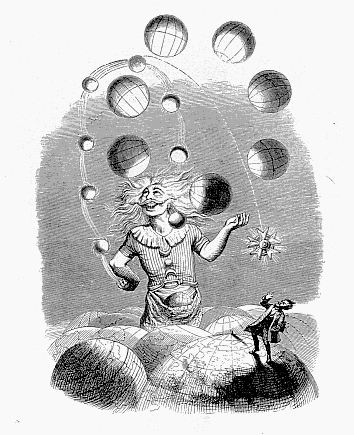
    * The first image is by the great and prolific and short-loved  J.J. Grandville (1803-1847) for his Autre Monde (1844).

    1. I have found another reference to a bitter world of the future written by Hay in the excellent Airminded blog, which records his effort at a novel of doom and destruction of the overtaken London of the future.

    2. Greg’s characters visit Mars via the benefits of a sort of anti-gravity spacecraft called the Astronaut, and, interestingly, the Martians had seem themselves as the only life forms in the galaxy.  It is also in this novel that the first attempt at creating an alien language appears.  There was also another science fiction effort by this title as well, though it really doesn’t apply to what we’re talking about, here.  (I wonder how prevalent duplicating titles is in the sci fi genre?)

  • The SteamPunk Clown Spoiler of Future ElectroPunk Technology, 1866

    JF Ptak Science Books  Post 1598

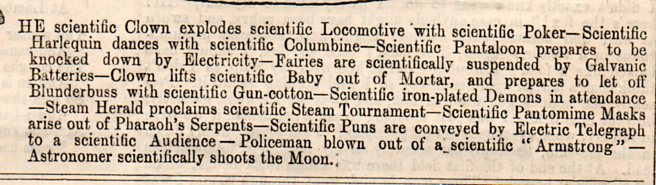
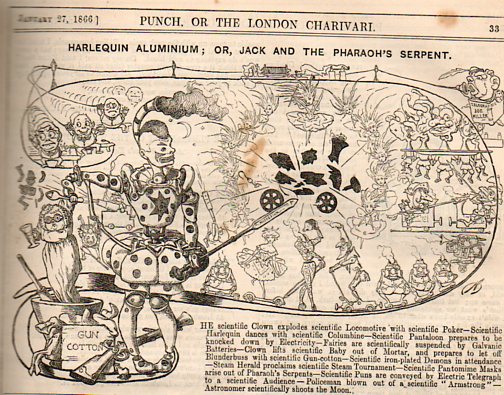
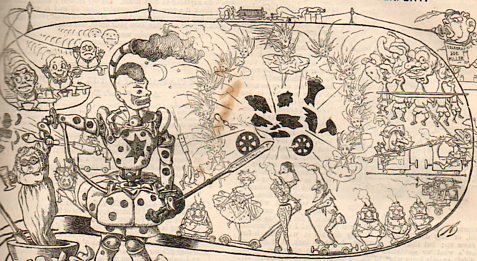
    Punch, or the London Charivari published this delightful and somewhat prescient illustration in its 27 January 1866 issue.  It is for me an excellent, sort-of early depiction of a steam-man, a steampunk man, a steam-driven clown:  deeply and frequently hinged, smoke belching from a curved smokestack coming from the back of its head, and controlling its own destiny.

    Sci clown694
    And what it seems to be doing with its poker in controlling its steam technology is busting the new technologies of the era, a rub and at the same time a statement of hope or expectation in a high-Victorian manner, a rationalism of all things via technological means.  And at this time, in the mid-1860’s, the new wellspring of hope was being found in electricity-based solutions–moving away from the pervasive steam-driven technologies–though as the cartoon suggests those expectations might be too soon, too fast and too deeply placed.  After all, these things are being exploded by a “scientific clown” with a “scientific poker”–and that clown is being driven by steam. 

    Sci clown695

    Sci clown692


  • The Holocaust-Denying Discoverer of the Atomic Bomb in the Bible (1945)

    JF Ptak Science Books  Post 1597 [Part of the Atomic and Nuclear Weapons series]

    Atomic bomb god723
    It is astonishing sometimes to think of all of the subterranean atom-bomb-applicable cultural subcultures that quickly/instantly popped into existence following the use of the weapon on 6 August 1945.  The United States, for one, became an atom-crazed country, from atomic laundry flakes to milkshakes to hotels to condoms. This exuberant atommannia knew no bounds, and leechingly found its way into religious messages.  One thing that the atom bomb seemed to be that few people anticipated was its popular impact on the general population, as well as its extraordinarily broad base of applications. 

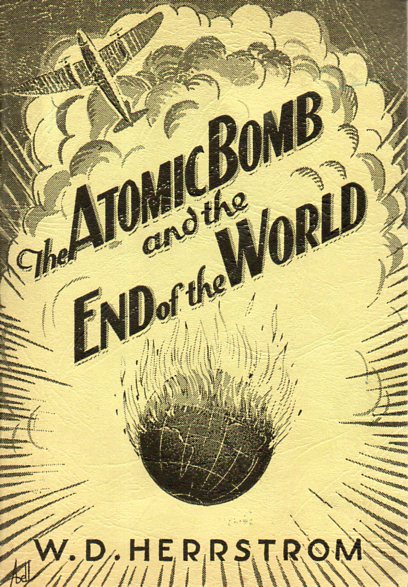
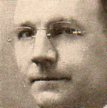
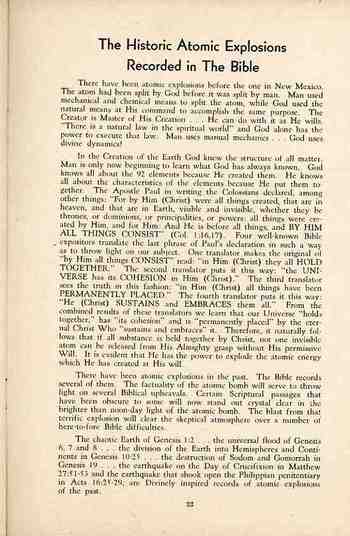
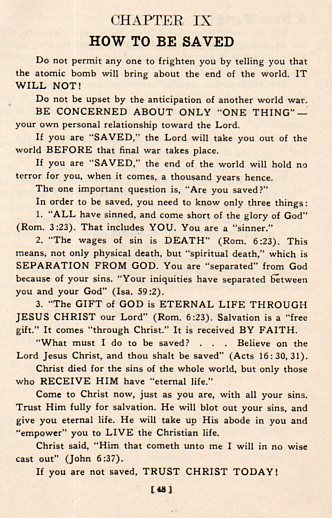
    Atomic bomb god724 The man trying to look into your soul from around the edges of his glasses, the man looking annoyed and reproachful and judgmental with his thin-lipped contempt, is W(illiam D(ewey) Herrstrom, the author of The Atomic Bomb and the End of the World, written in 1945, and published by Bible News Flashes of Minneapolis, Minnesota1. This is an unhappy little pamphlet filled with massive fear and innuendo, and calls for its readers to address that fear and all uncertainty by embracing Jesus Christ.  After all, it is not the Atomic Bomb that we need to worry about, says the author: it is our salvation and the potential wrath of the creator for all sinners.  Herrstrom shouts out that the atomic bomb will not end the world or set it on fire–that job is left for god, so we need to address god before we do so the bomb.  He writes:

    “The scientists who say that the heavens could be ignited by man to bring about the end of the world may be right.  But there is at least one good reason why this will never happen.  That reason is clearly stated in II Peter 3:7.  God has “RESERVED” this for his own time.”

    Mr. Herrstrom’s–who may have believed too much in the transliteration of his name from the German, which would be “Mr. Power”– message was one of fear and perdition, of the End Times coming true, of prophesies found in the Bible that were being unearthed right there in 1945–luckily, Mr. Herrstrom was ready to supply all of the necessary information about dealing with such stuff in his Bible News Flashes magazine, every month, which was somehow available for the subscription of 25 cents per year.  He had earlier addressed these issues in his Judgment Day for Everybody (improbably in its second edition) and The Revived Roman Empire, both of which were skinny, and both published in 1939–not that he was taking advantage of any situation in particular to press forward his bitter and hard nail visions of the future of our souls and the coming death of a sinful world. 

    “The Bible is history pre-written and God’s book is scientifically correct…and is ahead of the human race…”

    And as proof of these revelations the author offers bits like the following, in this case, a Bible quotation as proof of foretelling the invention of the jet plane:  “Like…chariots on the tops of the mountains they shall leap” (Joel 2:5).  And this for the atom bomb:  “And men were scorched with great heat, and blasphemed the name of God” (Rev 16: 18-20) and seven more pages of other large-print proof2.

    Herrstrom advertisers himself–on the title page, and in his interior full-page portrait–as a “World Traveler, Prophetic Analyst” and editor of Bible News Flashes, the Illustrated Prophetic Monthly Magazine, which is advertised on the back cover of the pamphlet, and where Herrstrom adds “News photographer” to his credits.

    One thing he doesn’t credit himself with and for which he should receive major recognition is for being one of America’s earliest and ugliest Holocaust deniers. The fantastic all-things-atomic  Conelrad blog, which has written another story on Herrstrom and his work, finds Herrstrom in Deborah Lipstadt’s book3,4:

    “In 1952 W. D. Herrstrom, an American antisemite, declared in Bible News Flashes that there were five million illegal aliens in the United States, most of whom were Jews. These were the Jews who were supposed to have died in the Holocaust. “No use looking in Shickelgruber’s [Hitler’s] ovens for them. Walk down the streets of any American city. There they are.” pp 66-67

    Well, as confessions of a hating faith-based ignorance, one could scarcely find better examples than these. 

    Notes:

    1. (Unfortunately, the only address given on the pamphlet is for a PO Box for Lake St. Station. Herrstrom’s other pamphlets include:  Mussolini & Facism, 1937, Wichita Falls, Kansas, Defender Publishers (?!), 49pp;  Will This War End Armageddon, 1941, 47pp; Golden Key to Bible Interpretation, 48pp, 3rd revised edition (again, ?!), 1940; Is God  a Jew, 1943, 24pp; Judgment Day, 1943, 64pp; Revival of the Roman Empire, 1939, 48pp.  Herrstrom had a few years where he was on fire,m from 1937-1945, during which most of this stuff was written.  It is noteworthy that hewrote books that were mainly 24 or 48 pages long.  His Bible News Flash appeared from 1943-1949, and is located in six libraries in the U.S., which makes it on the rare side.  Somehow, The Atomic Bomb and the End of the World is not located in the massive database for worldwide library holdings. 

    2. Herrstrom was hardy alone in laying claim to the ecumenicism of the atomic bomb.  There was also, for example the following:

    Mel Morris  published God’s Atomic Bomb  in 1945, which means he must’ve worked a little feverishly to pump up his bible prophesy and history to include the new atomic weapon to replace whatever else he had been using as a prophecy for end of times.  (As it turns out, “God’s Atomic Bomb” was more tempest and disaster in the bible, and not (whew!) the bomb itself.  Though as we’ve learned from scientologists and the sort-of creative mind of Ron Hubbard, a civilization came to the earth thousands of years ago and pummeled it with “atomic bombs” and other nastiness, polluting humans for milennia to come.  But that’s another story–suffice to say that Morris found many dozens of examples of “God’s Atomic Bomb” being used in the deep biblical past, and that the use of the real atomic bomb in 1945 was pre-ordained, and not without its figurative historical counterparts.  I’m not sure why any of this was necessary outside of proving to some small minority that these preachers could at least be contemporary and topical. 

    Blogsept_2_atomic_bomb_god_2txt483

    3 Deborah E. Lipstadt, Denying the Holocaust, the Growing Assault on Truth and Memory, 1993.

    4.  Conelrad also found Herrstrom’s longest book,  Seventy Five Reasons Why Community Water Supplies Should Not be Fluoridated.  Good work, Conelrad!

    5. Bibliographic note–I’ve seen this cover now in three different colors (red, blue, green) and I believe now that it wasn’t so much a factor of a number of different printings being done of the work over time, but rather of using whatever cover stock in whatever color happened to be on hand for the first printing. 

    Here’s a note from Herrstrom on how to get into Heaven:

      Atomic bomb god722


  • Curious Cuts: Books in Bosch

    JF Ptak Science Books    Quick Post

    Bosch cure of folly book detail
    Books are a favorite symbol, a venerable icon, a useful tool for developing ideas in Renaissance paintings.  They do sometimes make unusual appearances, this time–and not too unexpectedly–in the work of Hieronymus Bosch.  The painting, Cutting the Stone, (also called The Extraction of the Stone of Madness or better yet The Cure of Folly) was completed by Bosch in 1494 and lives today in the Prado. 

    Bosch cure of folly
    Bosch was at the very least a very curious character, hardly a man of his time–he seems difficult for us to place in the 15th century given the extraordinary range of his deep imagination.  He seems to be more a man of the modern times rather than one of the Renaissance.  I mention that the painting is in the Prado, finding its way there from the collections of Spanish sovereigns, who collected Bosch as a deeply Christian painter who depicted the travesty of sin and moral neglect rather than his own deep fantasy.

    Bosch cure of folly brain
    The scene is described by the inscription above and below it:

    Meester snyt die keye ras
    Myne name Is lubbert Das

    (in English: “Master, cut away the stone
    my name is Lubbert das”).

    The man in the chair, the man undergoing some sort of cranial/brain surgery is an everyman of sorts, a Dutch Everyman Fool named Lubbert (translated to “castrated dachsund”)..  A charlatan medico stands and removes symbols of lunacy and foolishness from his brain, images of flowers standing for the fool’s stone of long folklore.  The medicine man wears an inverted funnel for a hat, a symbol for emptiness, nothingness.  Likewise his purse is stuffed with straw, another iconic display of greed compounded and gaining nothing at all. 

    But what I am attracted to right now in this painting is the woman on the right balancing a book on her head.  It seems to me to be a very rare case of a Renaissance image of  a book displayed in this manner–usually books are simply held and are symbols of learning or wisdom or piety.  In this case, the woman is just part of the general folly which is the concern of the quack surgeon, a closed book (impossibly?) balanced in tribute to the craziness before her, perhaps hoping for the words to seep through the pages and into her own head. 

    There are a number of other images of this operation, which was in its way a standard procedure for the relief of insanity, or depression, or lunacy, or basically of any mental complaint or “error”, which can be found (along with description) on the bioephemera blog, here. 

    For example, there is this scene of mass extraction of the stones of madness by Peter Brueghel (painted ca. 1550)

    Bruegelmadness.jpg

    Its a pretty miserable scene.

    Again, I’m really just after the book in the Bosch. 


  • Deceptive Perception: Giant Super Women of Pulpdom and High Art

    JF Ptak Science Books   Post 1617

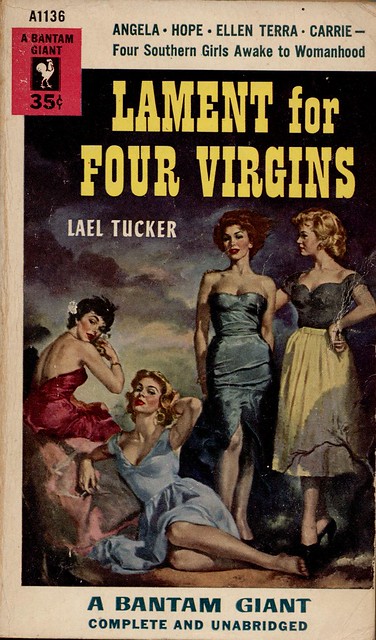
    Sometimes things are just not what they seem to be.  Sometimes they are deceptive and uncommon and somewhat hidden–and sometimes deceptive even to themselves. Sometimes the deception is intentional, and sometimes it is just a mistake, but a deceptive one. In the following cases, the deceptive elements are relating to size–kike the example below, in the cover illustration for the campy (“Southern” with names like those?) troubles of mid-1950’s “girls awakening into womanhood”:

    photo
    If you take a closer look at the reclining figure just abpve the word “giant”, you can see that she is one, unintentionally.  She’s just badly drawn, or something, a victim of foreshortening–we can see that her leg from her knee to her foot is as long as an entire keg of her companions, making this person about eight feet tall.
    On the heels of the eight-foot-tall woman comes one who is far more famous, ultra-famous, really.
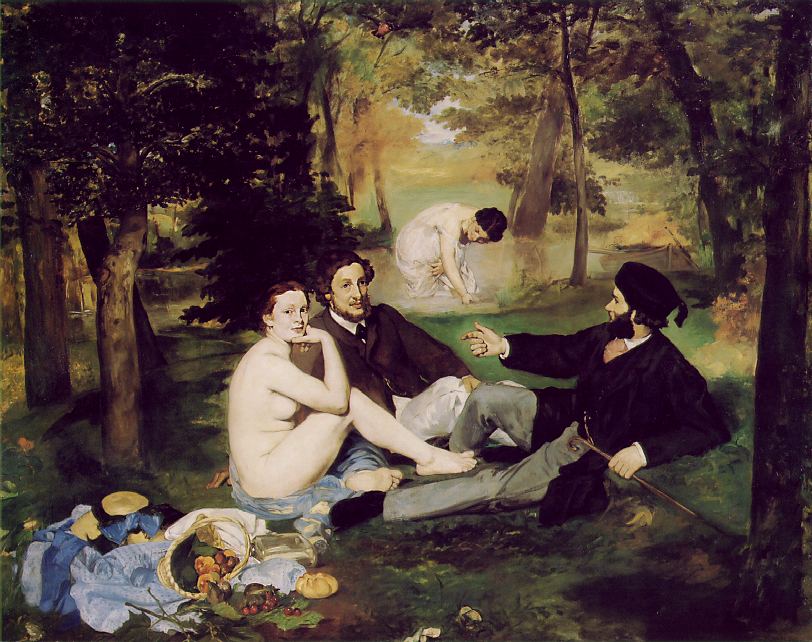
    Le Dejeuner was a scandal when it was exhibited in 1863—Manet painted what he wanted to, unbound by perspective, by color, by composition, and on and on. The folks in the painting were not connected to anything, really, and were unconnected to each other, no one paying any of the others any mind, even when the women were naked.  Nothing seems to be going on—the people are just simply there. 
    Blog--march 7--manet bathers
    This is in itself was a disconnect from previous practices, the vision in painting was about something, and was directed.  Light seems to be coming from a number of different places, and the shadows from the trees reflect this, simultaneously stretched towards and away from the light sources.  The bathing woman in the background, or what used to be background, had she been drawn using proper perspective, would’ve been about nine feet tall.  But what happens here is that there is no foreground or background in this painting, just middle.  It was this collection of abandonments, starting here in the Le Dejeuner in 1863, that ushered in the modern in art. 
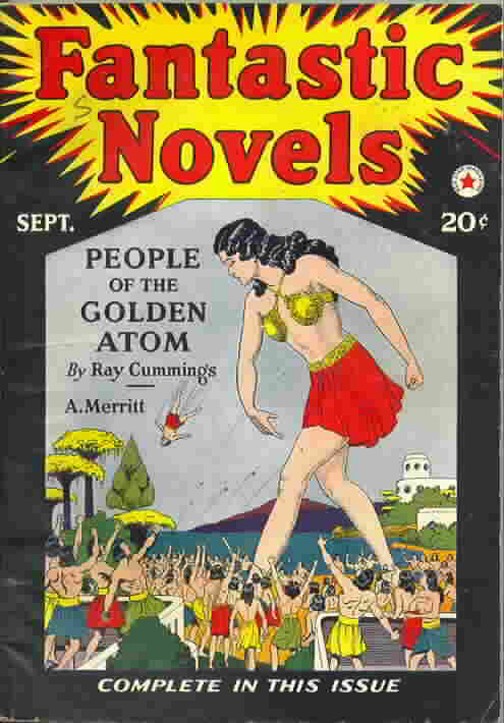
    Then there’s the fifty-foot-tall woman who really isn’t that tall in relation to the people around here. 
    There are times when even things that are made to look extraordinary and plainly, outrageously identifiable as what they are, simply aren’t–and sometimes they’re not even close.  For example, this cover of Fantastic Novels (1921?) seems to tell a straightforward story, but as it turns out the giant is giant but one living within a world in an atom of a gold wedding ring.  (I told a fuller version of the story of thiis here.)  So this giant is a giant but only so in her own world. 
    Man throwing

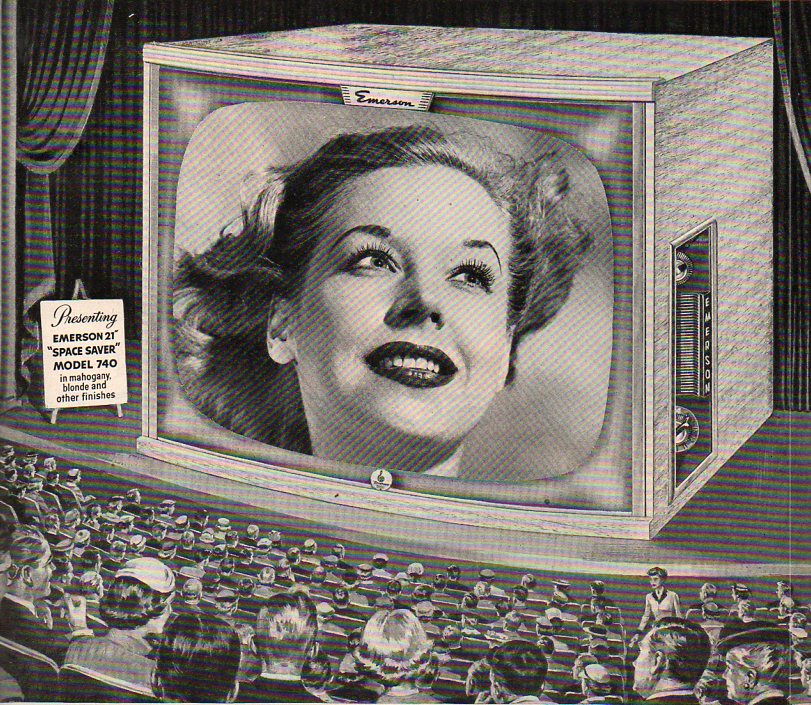
    Rabelais’ Gargantua and Pantagruel, Hobbes’ Leviathan, the Buddha at Yungang (Shanxi) and Melville’s whale were all pushed to their competitive monsterous edges in the 1950’s, when you were more likely to think of The Bomb and creeping Communism before thinking back to any of these great representations.  And it is also my general impression, having been paging through Life magazine for the 1950’s, that there are some other major, lesser heralds of gigantism, especially if you paid attention only to the advertisements. There were 1950’s colossal characters who were pale imitators of their earlier counterparts–the Amazing Colossal Man and Colossal Woman being two minor mirrors of older ideas–but they hardly contained the colossal ideas that were resident in the earlier creations. (Perhaps part of that is due to having just witnessed the demise of two enoromities in Hitler  Stalin.) But this woman seems to be the largest of the lot–I make her to be about 100 feet tall.  There’s really nothing deceptive about her, except of course that this giant is only a head. 

    Monumental television theatre446


  • Fabulist & Fantastic Architecture: Alice in Wonderland to the Library of Immanuel Kant. Sergy Tyukanov.

    JF Ptak Science Books   Quick Post

    I just wanted to share in this very quick posting the extraordinary work of the Russian artist Sergy Tyukanov (b.1955), who paints/etches/draws fantastic images calling freely on legendary literature, folktales, history, philosophy, as well as the work of some earlier masters (as in the Bruegels and Bosch, seen in the last two images).  If you follow the link to his website you’ll find that some of these images–which in their nature seem to be telling you that they are enormous works–are actually very small, on the order of one square foot.  Fabulist artists like this, especially those anthropomorphizing their subjects, have always been of great interest to me.  ANd I’ve got to say that Tyukanov’s architecturals remind me very strongly of ideas in the 18th century French visionary architects like Lequeu and Boullee and Ledoux. 

    Sergey Tyukanov (website)


    Alice in Wonderland
    http://www.tyukanov.com/gallery/Etchings/n74.project%20of%20the%20library%20of%20emmanuel%20kant%2013,3x17,8l.jpg
    Library of Immanuel Kant
    http://www.tyukanov.com/gallery/Etchings/n91.moon%2018,5x13,2.jpg

  • Blank, Empty and Missing Things, #35: Empty Trees

    JF Ptak Science Books   Post 1614

    Blank trees866 sm detail

    Blank trees866

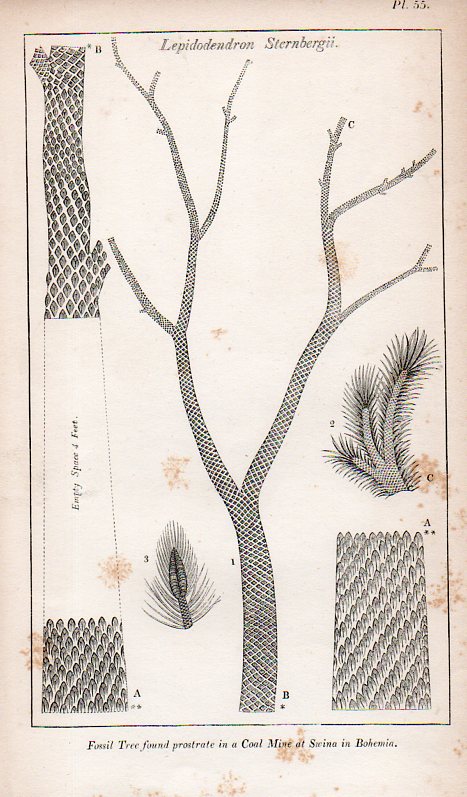
    Continuing a longish thread on Blank, Empty and Missing Things is this very short notice on a beautiful illustration from (Rev.) William Buckland (1784-1756, Reader of Geology at Oxford) in his Geology and mineralogy : considered with reference to natural theology

    Blank trees865

    I think it is a remarkable thing, a beautiful piece of explorative artwork when taken out of context.

    The description of this engraving from volume I, page 466:

    Buckland is well remembered for his analysis of the fossil remains found in Yorkshire’s Kirkdale Cave, which he identified as hyena (and its prey) remains from earlier prehistoric times rather than having been swept from the tropics to England by the waters of the Great Flood.  Of course, Buckland himself held that opinions years earlier, along with many other geologists…as some actually hold today, somehow, in creationist fits of intentional delusion.1

    Notes


  • Episodes in the History of Fat: Lard, Art Made of Fat, Fat Bullets, Sham & Disappeared Fat

    JF Ptak Science Books  Quick Post

    As it turns out there was–in Real Life–a Fat Bank opened somewhere in our fair land, a fat bank made for people to store their own fat from surgical enhancement procedures that could be used sometime in the future to be used elsewhere in the depositors’ bodies. 

    (I ‘d like to open a bank for pronouns that are used to end sentences.)

    And as it turns out I’ve written a few times on this blog about other Fat Matters, all of which are as truculent-friendly to reality as this Fat Bank thing, but less embarrassing.  Here are most of them:

    Fun with Fat  Lard 

    0-blog---Nov 22 lard093


    Fat Redux, Redux:  Fat Bullets, 1945.

    000-ebay--Nov 8 fat025


    ·Posted by :

    ·in:


  • A Note on Tricycles in the History of Nothing

    JF Ptak Science Books   Post 1576

    Lbikes--tryke645
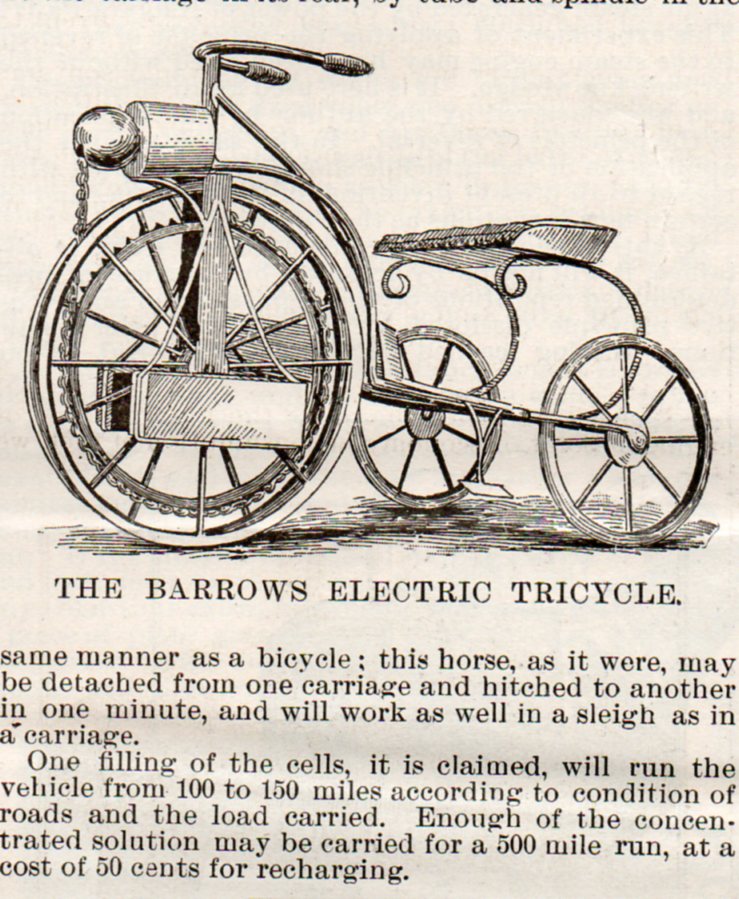
    This image–from the Scientific American Supplement for 25 September 1895–triggered an immediate reaction, though not for the electrification of what looks like a child’s toy. Charles H. Barrows of Willimantic, Connecticut patented this bike, which turns out to be a considerable object–it has a two hp engine which is powered by a hundred-pound battery that is “stored in the two cabinets” (measuring 24x8x8) on either side of the hub, making the wheel I guess somewhere around 34-36″ in diameter. After everything was said and done, the trike was a big, heavy, thing, in spite of a fairly spartan design in the rest of the bike.

    What the woodcut remind me of was William Eggleston’s quiet, odd, iconic and enigmatic portrait of a tricycle, which  I think launched a new photographic experience for the suburbs–a kind of Robert Frank for people doing “okay”.

    Tricycle

    Eggleston’s work, including this s image above (Untitled, Tricycle and Memphis, 1970), was a subject at a MoMA show in 1976, William Eggleston’s Guide.  It was received with long glances down long noses–seen as a banal exercise in the portrayal of everyday stuff in everyday settings, critics saw the semi-nothingness in the photos as simple all-nothingness, with one critic asking “a guide to what?”  But the Eggleston show was far more than that, showing the bits–in color–of American cultural life in middle class seclusion, a splendor of small Americana. 

    Bill Owens, working at about the same time as Eggleston, also shared his vision on the restricted glory of the suburbs in his Suburbia, spreading his discoveries of new-found cultural diversity.

    http://adventurepatches.files.wordpress.com/2010/05/suburbia-boy-with-gun.jpg

    The critics saw basically nothing in these works when they were first shown, though they had a lot more going on for them than the electrified tricycle, which was far too big and heavy to have done any good for anyone (though the design of the sprocket/wheel was pretty interesting).  The only nothingness that are in the photos of Eggleston and Ownes was the nothing that the critics chose to see.  Sometimes new, different ways of looking at things as in the cases of these two photogrpaher makes it seem as though it is a newness of nothing, but only for a short time, until everybody else showed up. 


  • Disinventing Left, Part II–Eliminating Left Pages

    JF Ptak Science Books   Post 1572

    If (and only if, (iff)) eliminating left turns in auto traffic is a good idea, perhaps getting rid of the left-sided newspaper page is a good idea, too.  (?)

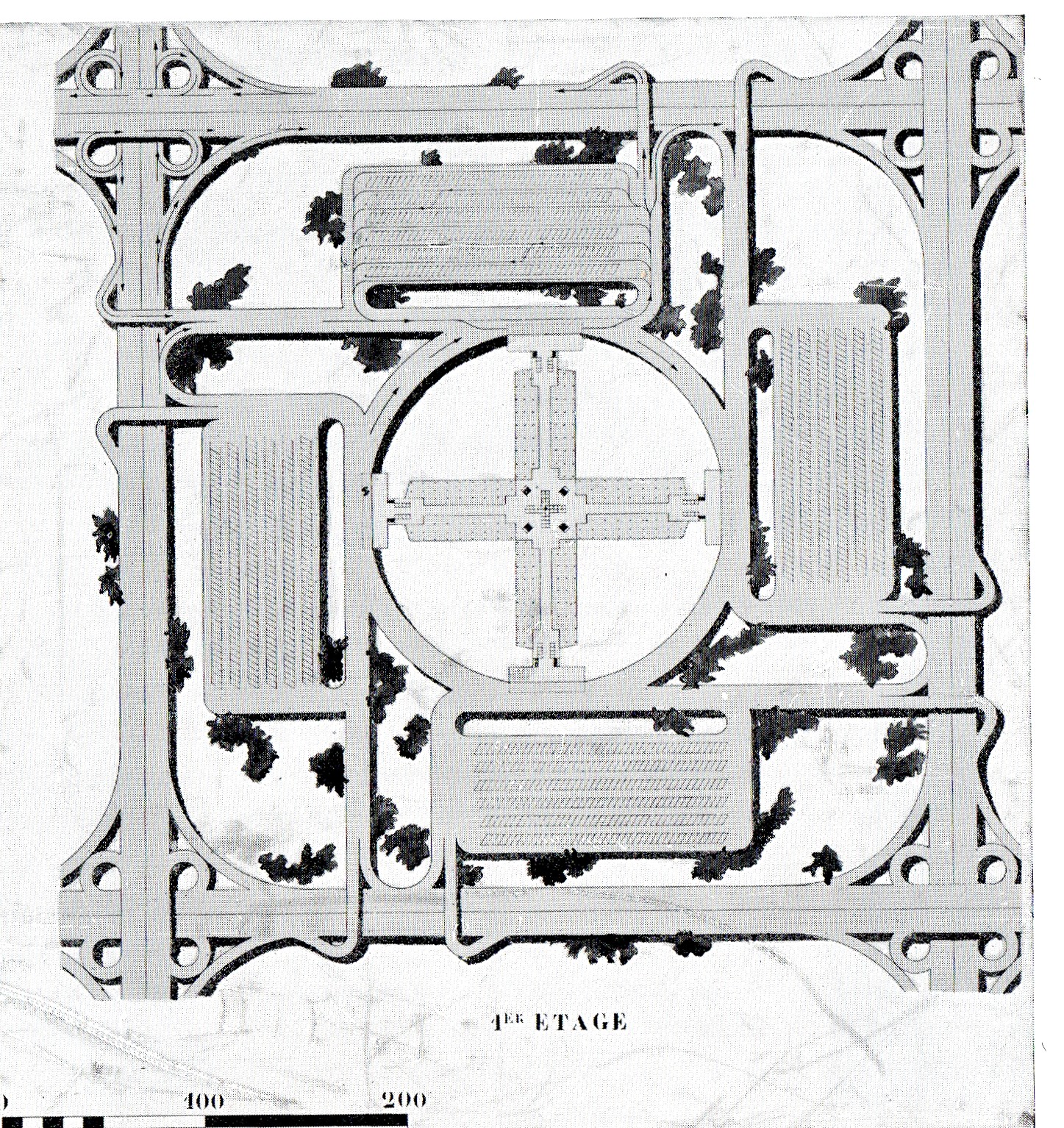
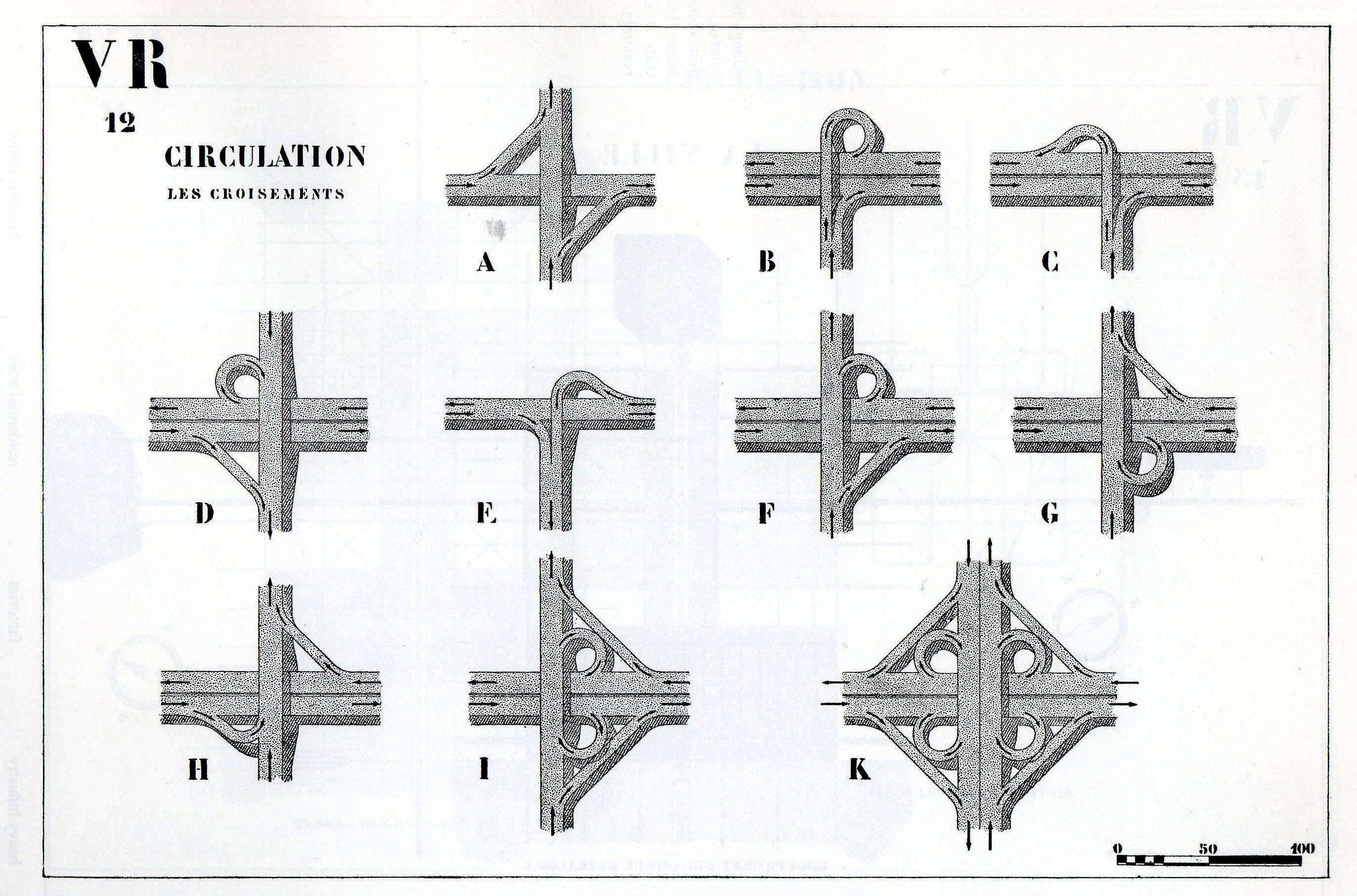
    A post appeared earlier in this blog on dis-inventing the left-hand traffic turn, which for better or for worse was laid at the feet of Le Corbusier, who imagined a new network of inner-city traffic turns as follows:

    Right hand turn 2006

     which appeared in his Radiant City (edition of 1930).   He beautifully includes the following crib sheet for the incremental development of right-turns-only in cities, which I think can stand on its own as the template for x-number of short stories:

    Right hand turn 10

    This is nestled into one of many plans, though Le Corbu’s recipe for mega-sameness seems desperate to me–this one called for a massive complex of 220-meter-tall structures nested in 400-meter squares, going on and on. 

    But I think at its base that eliminating left hand turns for cars in cities seems like a good idea–making the left turn a series of three rights seems at it base to make traffic flow smoother, and since enormous amounts of time and energy and  everything else comes as a result of volatility in traffic flow, and since a lot of that volatility comes as a result of the formation of lines behind cars that are crossing traffic for a turn, then getting rid of the cause of volatility seems the logical response.  Unless of course it causes volatility elsewhere.

    In 1905–one of the greatest years for ideas in the history of ideas, ever, though the following is not one of them–George Ebenezer Morrison proposed to eliminate a source of unease and volatility in publishing advertising revenue by destroying the idea of the left-hand page of text.  He made the case that the value of advertising space on the left-hand side of newspapers and magazines and such was far less than the ads that appeared on the right-side pages–this because, he said, people tend to hold what they are reading with the right-side centered in front of them, leaving the poor left-side abandoned on, well, on the left.  So, with attention centered on the right, ad space was at a premium. 

    Mr. Morrison’s solution–his idea, for which he was granted a patent in the U.K. 1905/105291–was to print the left-hand pages upside down, so that once the right-side was read, the reader would turn the newspaper etc. upside down to read the second half, and thus the left-side page would be entirely eliminated. So, all things being equal, everything would now be right-sided.

    I am not sure if–like finding new traffic problems in multiple right-hand turns–eliminating the left page doesn’t create the same issue with the left side of the all-right-hand page reading material.

    I am sure that Facebook and Kindle and etc.–having already gotten rid of the pages in toto–are now at work in eliminating the left side of our monitors. 

    And whatever it is going on right now, the same thing seems to be going on, it politics. 

    Notes:

    1.  I’d share the patent image, but it is just a rectangle divided into eighths.