A Daily History of Holes, Dots, Lines, Science, History, Math, Physics, Art, the Unintentional Absurd, Architecture, Maps, Data Visualization, Blank and Missing Things, and so on. |1.6 million words, 7500 images, 4.9 million hits| Press & appearances in The Times, Le Figaro, Mensa, The Economist, The Guardian, Discovery News, Slate, Le Monde, Sci American Blogs, Le Pont, and many other places… 5000+ total posts since 2008.

Category: Absurdist, Unintentional

  • AtomPunk: Atomic Hair, Clothes, Swimsuits and Cake

    JF Ptak Science Books    Post 2006

    Perhaps the way you get around the constant fear of Total World Annihilation is to triviliaze the thing that would bring this state of affairs about.  I’m not sure that this has been the case too very often in the history of Potential WorldWide Disasters outside of the great atomic fear of 1950-1990 (and soon to re-emerge, perhaps/probably).  So far as I know there were no V-2 Motels to correspond to the Atomic Motels of the American 1950’s;  nor was there Pestilence Wax, or AIDS Cakes, or Influenza Burgers, or Plague Patter, and so on.  I’m certain that some cases exists outside the atomic realm, but putting the atomic bomb to work on the runaway train that was an advertising antithesis to itself seems to me to be so far beyond anything else that I can think of…well, nothing seems to compete with its ready meanness to the great/monsterous possibilities of itself.  To wind up with a picture of an “a-bomb” on a ball of kid gum seems spectacularly evaporative to what the atomic bomb was.

    I’ve collected some examples of the atomic fear reversal at work:
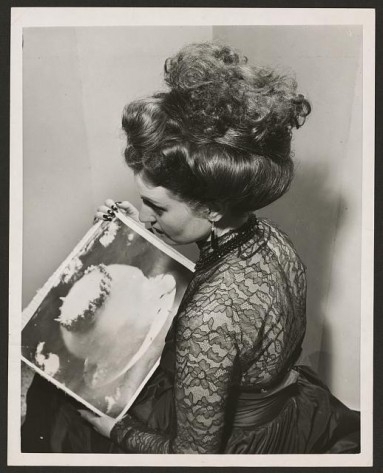
    Atomic hairdo[via retronaught]


  • Making Lines into Stars, Botany to Cosmology–an Episode in the History of Lines

    JF Ptak Science Books   Post 2003   Follow Me on Pinterest

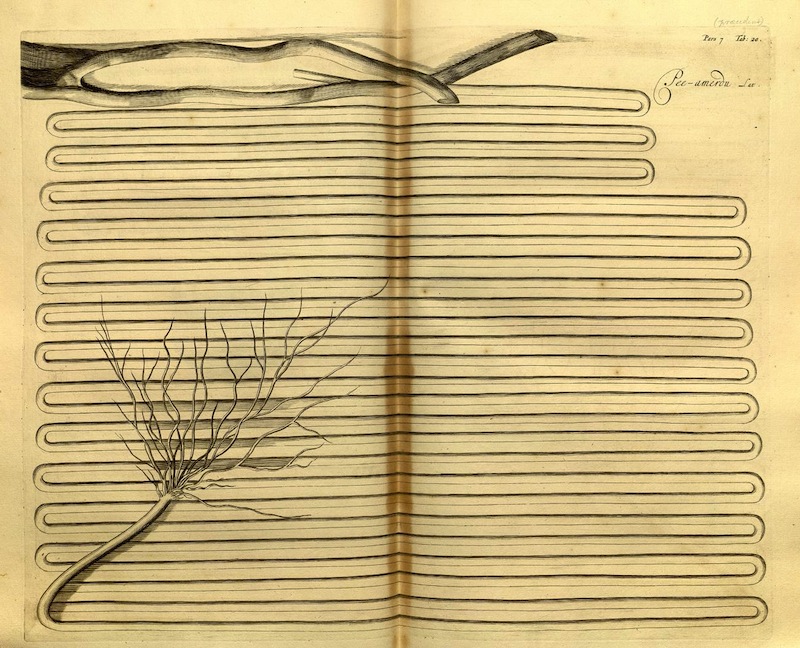
    Horteus malabar
    I wanted to share this magnficient image, illustrating the Hortus Malabaricus (“Garden of Malabar:) and found at the great Public Domain Review site, here.

    There are many more images in this work, and the PDR links to many more still, but I’ve picked this one probably for all the wrong reasons, selecting it from the graphic aspect, the differentiation of space, the long line.  There is a category for The History of Lines on this blog, but it seems that there aren’t many contributions to it, mainly because just about every other thing could classify as such. But this image is certainly remarkable enough to make the category. 

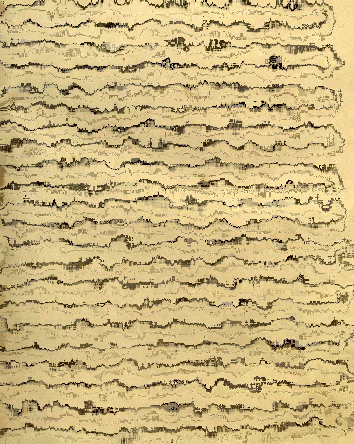
    Also, it is a quick four-step process in photoshop to render these lines and their botanical aspect/origin into a star cluster via  a progression in the spatter filter.  A twist here and a simple turn there could render them the opposite way, from sky above to mud below, going from the star cluster to geology, as in the form of agates, and particualrly the more “living/anthropomorphized” agates of the great/greatly-problematic Fr. Athanasius Kircher.

    Step 1 (original detail):

    Horteus malabar b

    Step two:

    Horteus malaba psray radius a
    Step three:

    Horteus malaba psray radius cStep four:

    Horteus malaba psray radius d

    And Fr. Kircher’s agates, which appear from simply heigtening the smoothing application of the splatter in step four, rendering the star cluster so:

    Horteus malaba psray radius agates
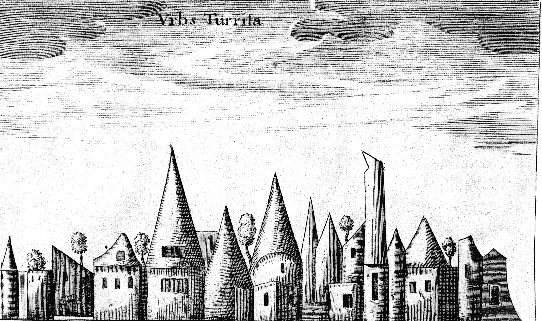
    When Kircher looked closely enough at his agates, he saw hidden objects: sometimes a Madonna, other times animals, and still others–and perhaps more famously–town skylines encased in the rock, as with this example from his Mundus Subterraneus (an undefined edition but ca. 1660):

    Kircher agate
    If you looked close enough at  the agate-ified Malabar engraving you’ll be able to find a town–and just about anything else.  


  • Should Insanity be Cured? (1938)

    JF Ptak Science Books    Post 2001

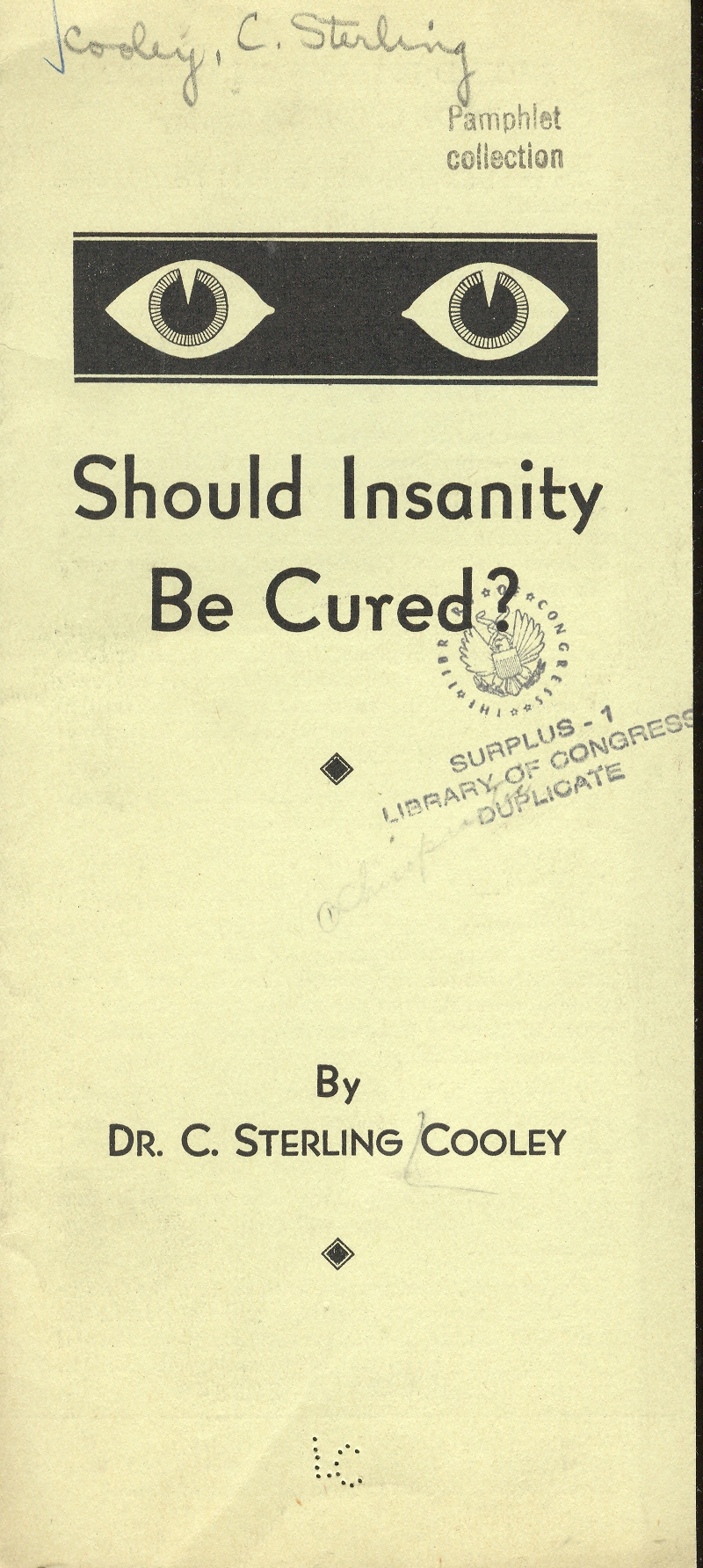
    Should insanity eyes

    ++00++ 9.15 insanity Dr. C. Sterling Cooly wrote an incredibly-titled pamphlet of
    slim means called Should Insanity be Cured? 
    How could anyone proceed further than this?  Dr. Cooley wasn’t a eugenic apologist, nor
    was he an accountant for a life insurance firm—he was advocating a drugless
    cure for all different sorts of “insanity”, which was a term he doesn’t really
    stop to identify and classify, which of course is deeply problematic. 

    Or it is so until you hear how one can treat the insane via
    his new drugless method: 
    chiropractic.  I didn’t see that
    one coming.  “An insane mind is a sick
    brain, a sick body is an insane body” writes Dr. Cooley with leading
    confidence, claiming that chiropractic can release “the power within…marvels of
    healing are performed not only in mental cases but in virtually ALL forms of
    disease”.  That’s a lot to live up to in
    theory, let alone in practice. 

    Dr. Cooley was evidently a deeply important founder father of modern chiropractic, with a 50-year career in the area (1908-1957), and who was also very prolific–this is one work that he probably shoud’ve edited out of the publishing phase. 

    I don’t know why the eyes are so very prominently featured–except I guess to enhance some understanding of the subject area,


  • On Tanning Names on Newborn Babies (1930)

    JF Ptak Science Books  Quick Post  Daily Dose from Dr. Odd

    Baby tan181[Source: Popular Mechanics, October, 1930]

    I’m looking for post #2000–this isn’t it.  It is however Quick Post #450 or so, which means that we’re closing in on 2,500 overall posts in this blog since 2008.  But there should be something with a little more flavor than baby tanning for #2000. 

    This is a good/appropriate installment for the Daily Dose from Doctor Odd series.  As ideas go, it is not a very good one–but it is not among the Dantean 9th-level-worst.  If we classify bad ideas on a six-point Major-Minor scale, from MajorMajor to Major to MinorMajor and then to MajorMinor and then Minor and finally MinorMinor, this one would probably rank at the MinorMajor level. Or maybe even a full Major.  It is a bad idea.  (An example, by the way, of a full MajorMajor bad idea would be the electropunk centrifugal birthing patent machine, described earlier on this blog, here. Okay, here’s another:  on draining the Mediterranean Sea, here.)

    There are less invasive ways of ensuring that the correct baby is delivered to the correct parent(s) than tanning the baby’s name onto their body–which doesn’t of course take into account the instances where the baby’s skin is too dark or whatever to be tanned.  But the idea of subject a brand-new baby to a tanning lamp as  its welcome to the world seems a bit–what?–horrible. Exposure to ultraviolet rays that will cause a six-month brand sounds like it might stir up the melanosome pot to cause damage to organs other than the skin, that it could have been a real assault on the DNA.  Also, that metal object on the table looks a lot like a clamp–I hope it wasn’t. 


  • A Very Uncommon USA-Cuba Celebration

    JF Ptak Science Books   Quick Post

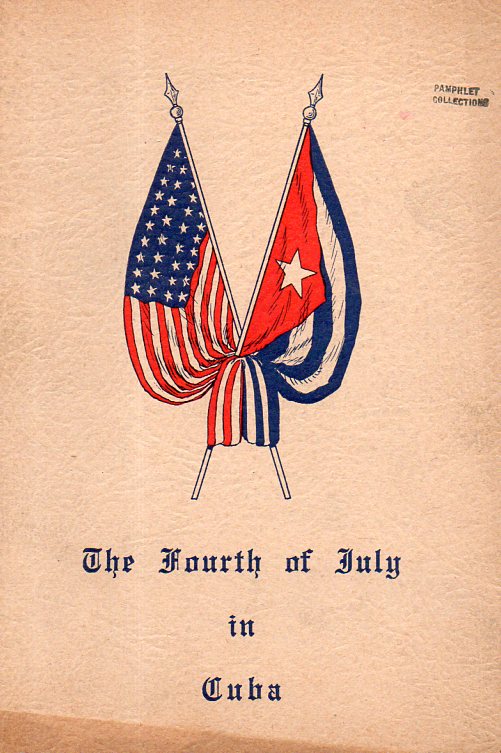
    Cuba USA 4th july174

    This pamphlet was full of hope and the prospects of engineering an economic relationship with the United States during a period of turbulence in Cuba, two years before the ratification of the progressive constitution of 1940. Printed in Havana in July 1938, it calls for “A frontierless Fourth of July” and “Dedicated by the Socio-Economic Union of Cuba to the people and Government of the United States of America”.  It came to me via the Library of Congress which in turn acquired it from the U.S. Supreme Court, which got rid of the document only a few months after it was received.  Let’s just say that this was a most unexpected piece of cover art. 

    ·Posted by :

    ·in:


  • History of Holes: Lakes and Holes and Imaginary Tears

    JF Ptak Science Books   Quick Post

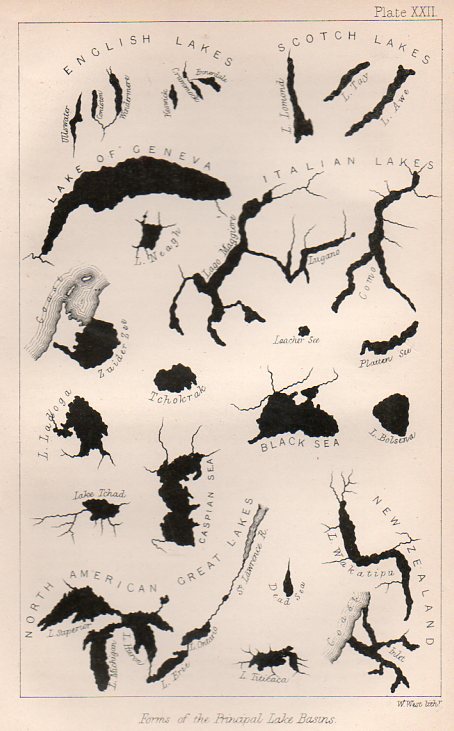
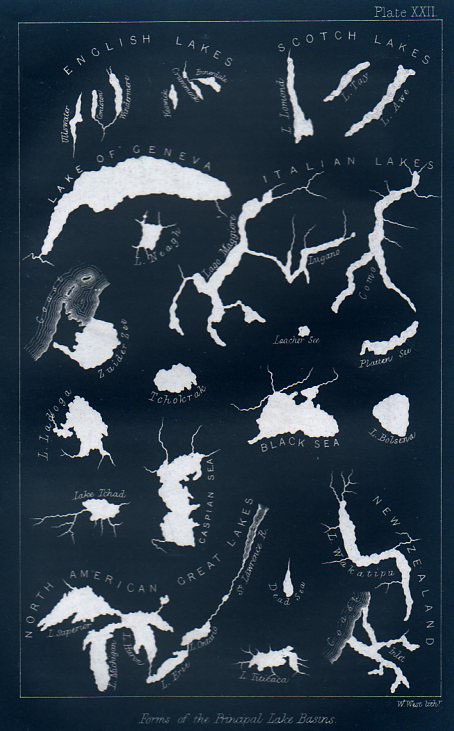
    This engraving was very nearly very interesting–I mean, it is interesting in that it shows the shapes of lakes together on a single sheet of paper, their shapes presented devoid of any other non-lakes.  Its really quite an arresting presentation, and coming at a relatively early time in presenting data in this fashion.  What the engraving doesn’t relate, unfortunately, is the size of the lakes relative to one another. 

    LAkes161

    And if the lakes were to be presented proportionally, Lake Geneva (surface area of 225 miles2 would be quite a speck compared to the likes of the Great Lakes, and Lake Superior (31,000 miles2) would speck-ish compared to the great Caspian (clocking in at 152,000 miles2). 

    This graphic appears still in the first decade or so of cartographic physical attributes being placed together, and was published in 1865 in the Popular Science Monthly. 

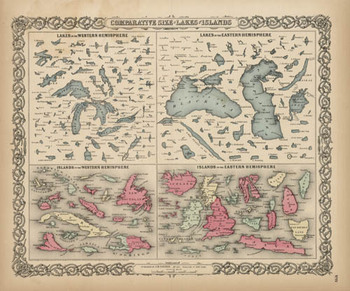
    Blogjuly_19_comparative_big_colton Here we go with a good representation of an engraving (above), this from 1856 and which may have been the first time that these 150+ lakes and islands of  the Western and Eastern Hemisphere were ever been printed on the same  page and in the same scale exclusive of their associative land masses  and placed contiguously, side-by-side.  They were, of course, seen in a  common perspective before on any world map, but I think that this is the  first year in which the islands and lakes of the world were displayed  without oceans and land masses, and the effect is a little odd.  If you  take away the color and the text the image takes on a very definite  biological flavor (I keep thinking of that tiny bone in the ear for the  small lakes…)  In any event it is far easier to compare these features  without the distractions of the non-lakes and non-islands clouding and  confusing our perspective fields.
    The largest lakes, here.

    And as long as we’re at, let’s have a look at the first image inverted, which gives the lakes a good healthy dose of anthropomorphism via imaginary rips, tears, moth- and bullet-holes.

    LAkes inverted


  • The Geology of Noses

    JF Ptak Science Books    Daily Dose from Dr. Odd Follow Me on Pinterest

    “The first principle [in science] is to not fool yourself.”  R.P. Feynman

    “The Woo-woo
    is all the same, everywhere, anytime, every time.”
    —James Randi on the
    history of   the pseudosciences .

    See also: the Geology of Hair

    If a person can read another person’s face “like a book”, then I suppose that the face might have some “tracks” on it–beastly objects like the tracks of words (a la Mr. McMurtry in Lonesome Dove) or perhaps something more like the elements of a map, something that is defined and pleads for interpretation, decisive and imaginative at the same time. 

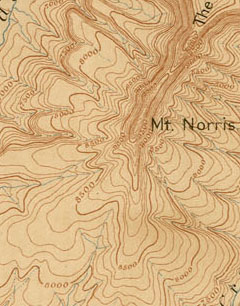
    This came to mind reviewing an older post on this blog, Maps of the Cosmos of Moles, and saw what looked like deeper geological entries on the subject’s face, which was a 17th century alchemical/astrological appraisal and mapping of human moles, but more so than the arrangement of the moles in question.  (Funny to go into a project mapping moles on humans and come out of it with a geology of noses, a phrase by the way which does not show up in a Google search).  In any event, a magnified view of Mole Man’s face coupled with its circular arrangement in the engraver’s technique seemed to suggest something of a volcano in the subject’s nose, complete with contour lines. 

    Mole map detail[Full image found below]

    There’s a very prominent similarity to any number of geological features, liek the one below of the Devil’s Tower:

    Devils_tower det

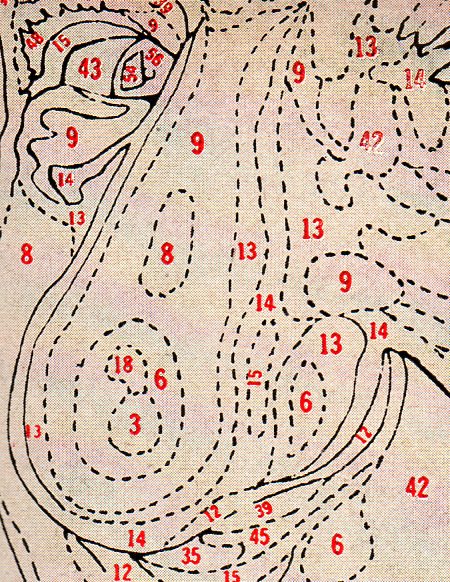
    The contour lines of Mole Man reminded me of something else, another map o fa human face that had a very distinctive geological flavor to it, and another nose:

    Geology of noses

    Contour yellowstone det
    The nose belongs to a Paint-by-Number portrait of Jimmy Durante, a vaudeville/stand-up/entertainer with a very prominent and probably the most famous nose of the 1940’s and 1950’s.

    I doubt that this means anything at all–it was a nice exercise of pulling together a few divergent images in a very odd forced alignment. 

     Notes:


  • On Varieties of Dead Forests: the Inverted Forest at the NYC World’s Fair, 1939

    JF Ptak Science Books   Post 1986Follow Me on Pinterest

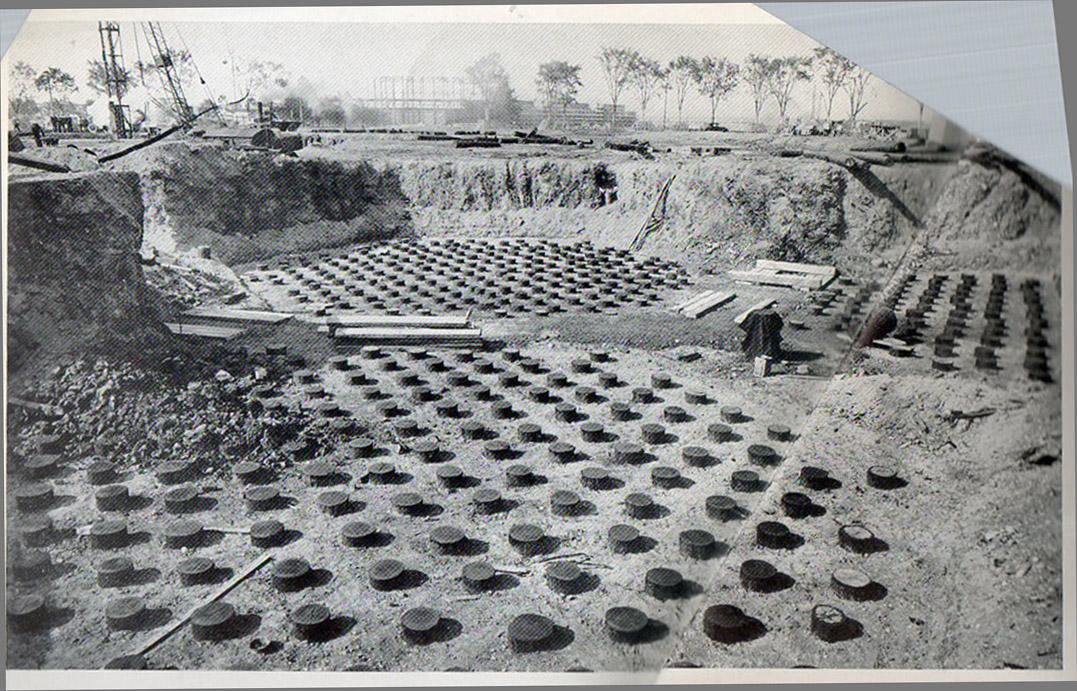
    I’ve noticed a number of different varieties of unusual forests, though mostly they’re repurposed, and stand above or on the ground, rather than the one seen in the image below, where the trees are inverted like roots. There’s the massive forest that we see every day in the United States, the backbone of our digital culture is strung along the carcasses of dead trees, wires and cables hanging from  tree corpses, an enormous chunk of our social interaction and economy dangling above us, moved by the wind and rain. Then of course there’s neat and orderly forest, forests that have been cut down, stripped, and the elements stacked in sequences so that people could live inside of them. There are stockade fences, and picket fences. There are old roads from Colonial times and into the 19th century there were made sections of felled trees, and then others that were made from milled lumber (as in Plank Roads).  There are forests that have been cut, and then milled all to one size, and laid next to one another in parallels and connected with heavy steel ribbons that stretched for hundreds of thousands of miles, their enterprises given ironic and commodious names with words like “Atlantic” and “Pacific” in them (like the “Union Pacific Railroad”).  Dead Wood is everywhere, some of which was simply cut down, stacked, and then slowly burned. 

    Inverted forest106
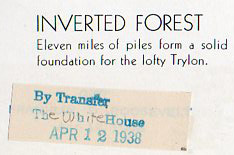
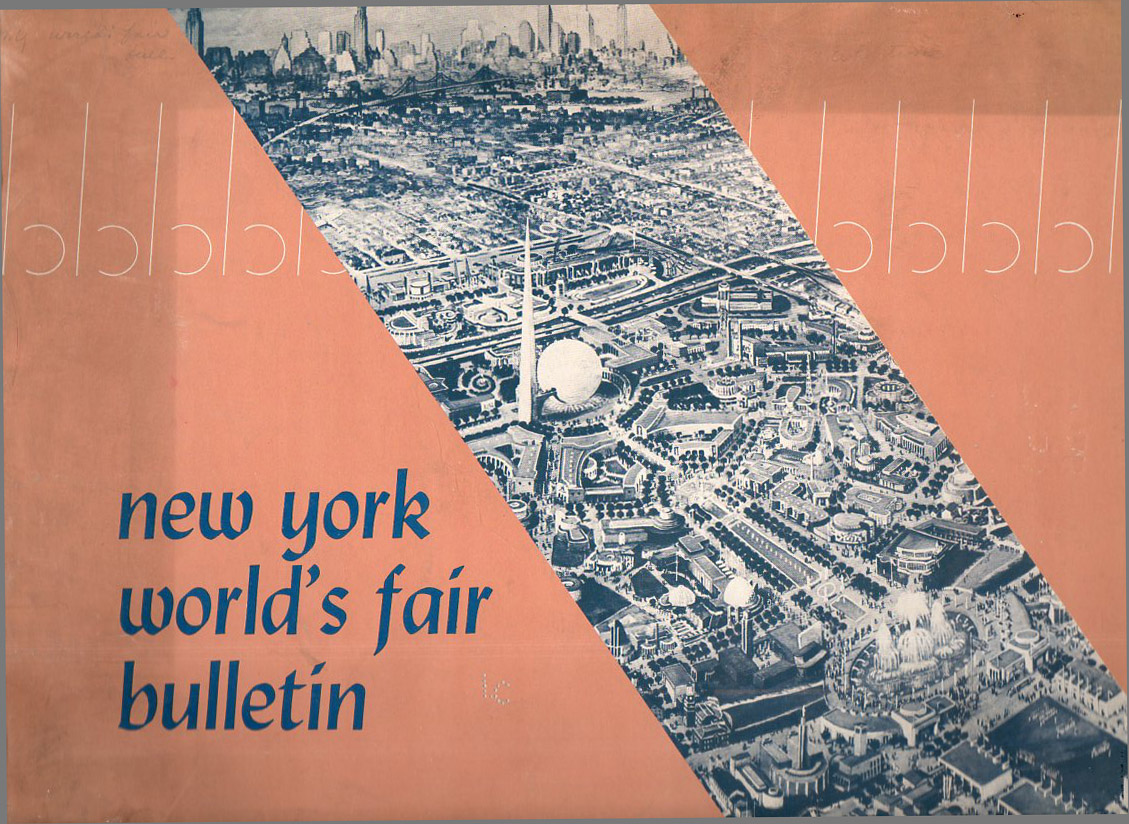
    Before being replaced by steel, foundations like this were made of lumber and/or stone, and was hardly uncommon–what is uncommon, to me at least, was to see a picture of finished footings, and then to be given such a creative name like “inverted forest”. But this is what they were, as we can see here in the New York World’s Fair Bulletin in 1937:  11 miles of forests pounded into the soil to support the weight of the iconic Trylon.

    Inverted forest caption107

    The Trylon is the spire in the middle of the image, next to the sphere–they were both enormous.  The spire rose some 600′, while the sphere was 180′ in diameter–both were gone by 1941, razed at the end of the Fair (1939-1940), their materials used for the war effort.  Both stood on the inverted forest.
    Inverted forest caption108

    [From a private collection, via the Library of Congress, from the White House in 1938.]

    In the Alphabet of Inverted Things, forests may be the most unusual: inverted chords, melodies, voices, pyramids, river deltas, microscopes, personality.  Forests seem so awful in their way. Inverted.


  • Beginning an Alphabet of Science Fiction -Punkisms

    JF Ptak Science Books  Post 1981

    “The most ignorant person at a reasonable charge, and with little bodily labor, may write books in philosophy, poetry, law, mathematics, and theology, without the least assistance from genius or study.”  Jonathan Swift, in Gulliver’s Travels (Actually, Travels into Several Remote Nations of the World, in Four Parts. By Lemuel Gulliver, First a Surgeon, and then a Captain of several Ships).  1726.

    I’ve produced the beginning of an alphabet of –Punkisms for variations of robot.machine/computer past and futures, science fiction indicators of possibility. Why should we stop at “Steampunk” when there’s FuturePunk and DeadPunk and such to be had?  So, please find folllowing a few possibilities, and accept them in the playful way in which they are offered–also, the very abbreviated descriptions of the science fiction works desscribed are open to interpretation. And please give this a “pass” for the over-abundance of hyphens.

    A

    ActorPunk: Walter Miller, ‘The Darfsteller’ (1954), human actors are replaced by robots on stage, as compared to being replaced by digital figures online. Some steps have been made with great care over the years by “perfecting” the imaging of women in magazine advertisement—in this way even the models who appear in the ad and are modified find it impossible to live up to the expectations of what their ads depict.

    Anti-technologicalPunk-topia: Samuel Butler, Erewhon, (1872).

    AutomatoPunk:  Kurt Vonnegut, Player Piano (1955), like Brazil and 1984, but with machines.

    B

    BiologoPunk:  Philip K. Dick, ‘Autofac’ (1955), machines find that they can reproduce themselves in a ’50’s iron-bio kind of way. 

    BrainPunk: Miles J. Breuer, ‘Paradise and Iron’ (1930).

    C

    ConsciousnessPunk: Philip K. Dick, Vulcan’s Hammer (1960) and the development of computer consciousness.  Also David Gerrold, When Harlie Was One (1972);
    Frank Herbert, Destination Void (1966); Harlan Ellison, ‘I Have no Mouth and I Must Scream’ (1967);  Robert Heinlein, The Moon is a Harsh Mistress (1966), and many others.


  • The Extreme Unction of Writing Posture

    JF Ptak Science Books     Daily Dose from Dr. OddFollow Me on Pinterest

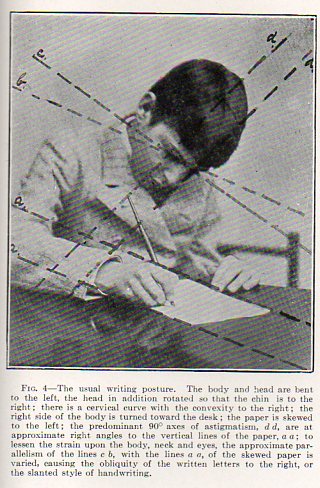
    This semi-wincing image was found in George Gould’s Righthandedness and Lefhandedness (Lippincott, 1908)–it is rather innocent, suggesting a study of penmanship posture; but taken out of context, it is quite something different, something with a bit of threat in it.  In- or out-of-context the author really meant to have the chin buried into the chest as a proper attitude.

    Right handedness098

    ·Posted by :

    ·in: