A Daily History of Holes, Dots, Lines, Science, History, Math, Physics, Art, the Unintentional Absurd, Architecture, Maps, Data Visualization, Blank and Missing Things, and so on. |1.6 million words, 7500 images, 4.9 million hits| Press & appearances in The Times, Le Figaro, Mensa, The Economist, The Guardian, Discovery News, Slate, Le Monde, Sci American Blogs, Le Pont, and many other places… 5000+ total posts since 2008.

Category: Absurdist, Unintentional

  • Earths-Out-of-Place Department: Superman and Atlas and a Doubly-Out-of-Place Earth

    JF Ptak Science Books   Quick Post  
     
    Follow Me on Pinterest 

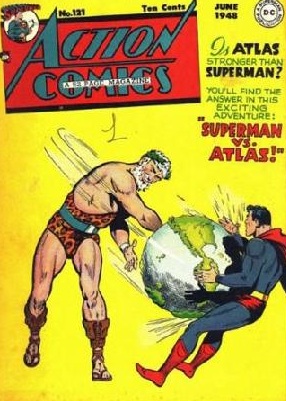
    The expenditure of one thin 1948 dime would answer that age-old question: IS Atlas stronger than Superman?  That interrogatory pales though in comparison to the business of what exactly is going on with the Earth, though we can guess that Atlas has decided to use it as a weapon, which I think is the first time that I’ve seen an image turning the Earth into an offensive tool.  The Earth is also doubly out-of-place in this image because Atlas was condemned by Zeus for his role in the Titans vs. Olympians struggles not to hold up the Earth on his shoulders, but rather to support the celestial sphere–the sky–so that the Earth and Sky did not meet. So Atlas shouldn’t be throwing the Earth at Superman if he wanted to keep a little true to his own mythology, because according to legend Atlas carried a bigger burden. 

    https://historyofideasblog.com/a/6a00d83542d51e69e2014e8839b25e970d-pi

    ·Posted by :

    ·in:


  • History of Blank, Missing and Empty Things, Part 66: The Response to Hope

    JF Ptak Science Books  Post 2045  Part of the series, a History of Blank, Empty and Missing Things

     
    Follow Me on Pinterest

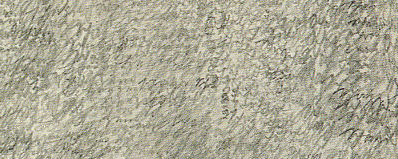
    Outsider Hauck DETAIL

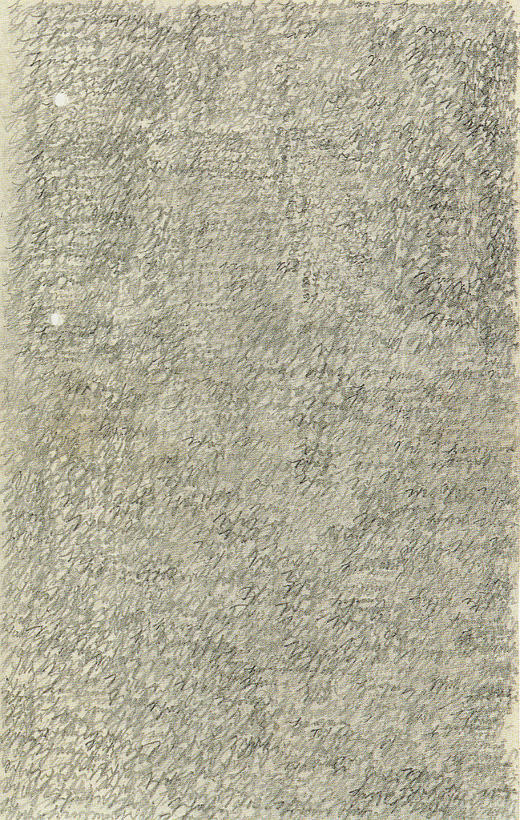
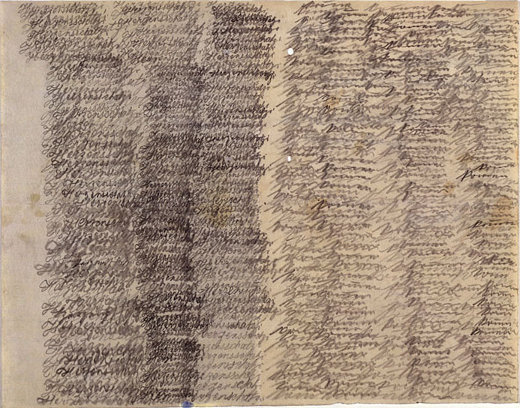
    This is a detail from an image of great hope lost.  Here’s the full picture, one of many, one of hundreds similar to it:

    Outsider HauckThis
    is a letter from a woman named Emma Hauck (1878-1920), a “pateint”, a committed
    person, in an asylum for the “fatally” insane; a schizophrenic, an
    incurable who simply wanted to go home. She was not insane enough to not 
    know where she was, not insane enough to not want to get out, not insane
    enough to know that she was in desperate straights, not insane enough
    to try to get some help.  Emma Hauck wrote letters to her husband,
    Michael (father of her two children) after her second and last commitment, beginning in 1909.  Mostly the letters were composed of single words (like “kommen,
    kommen”, “come/come”) or simple phrases (“Herzensschatzi komm” or “sweetheart/come”)
    written concisely and tightly, over and over again, layers of
    kommen/kommen, so many that there is a geology of letters, though there
    is no geologist.

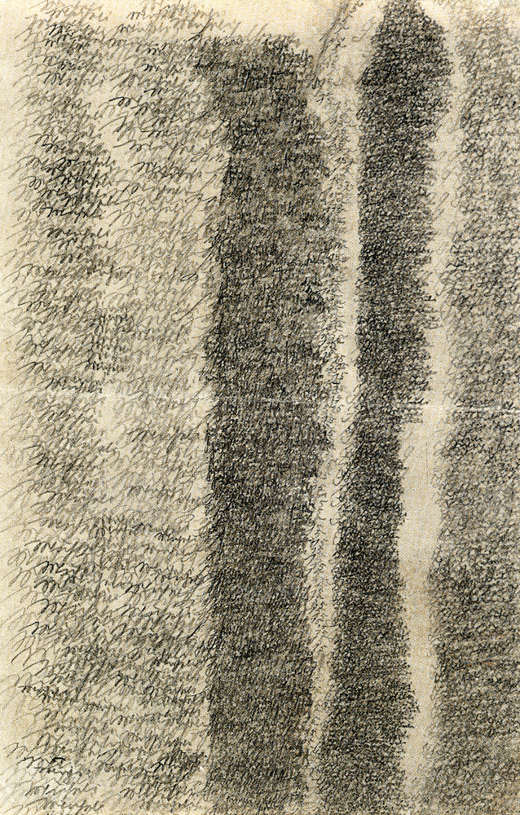
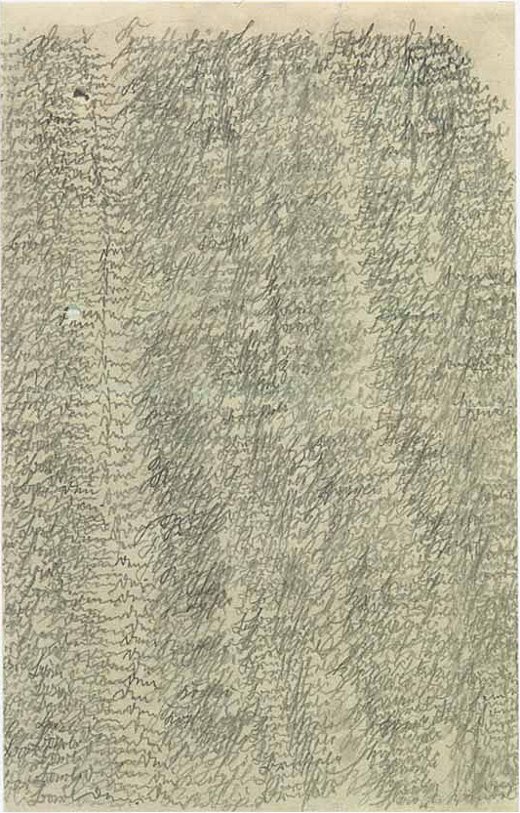
    Outsider hauck 2
    The images appear in the book and collection of psychiatrist and art historian Hans Prinzhorn (1886-1933), in his Bildnerei der Geisteskranken: ein Beitrag zur Psychologie und Psychopathologie der Gestaltung1,
    which was published in Berlin in 1922.  Prinzhorn was among the first
    in his profession to study the art of the insane, and to use it in
    diagnosis.  In the meantime, over dozens of years, he accummulated a
    collection of thousands of works of art (many coming when he was an
    assistant to Karl Wilmanns at the psychiatric hospital of the University of Heidelberg), most of which are housed today in the Sammlung Prnzhorn (UniversitätsKlinikum Heidelberg, here).

    Emma Hauck’s letters were never sent. I think it is unclear whether they were not sent because the institution in which she was confined did not mail them, or if she simply did not actually try to send them.

    A very distrubing short experimental film was made by the Brothers Quay in the U.K. featuring Hauk’s letters (complicated and viscerakized by a very grating Stockhausen soundtrack), which is located here.

    Notes:

    1.  The English translation of this work:  Hans Prinzhorn, Artistry of the mentally ill: a contribution to the psychology and psychopathology of configuration,
    translated by Eric von Brockdorff from the second German edition, with
    an introduction by James L. Foy, (Wien, New York: Springer-Verlag),
    1995. 

    Outsider hauck 3

    Outsider hauck 4


  • Daily Dose from Dr. Odd: Landing an Airplane by Backing Up

    JF Ptak Science Books  Quick Post   Daily Dose from Dr. Odd series


    Follow Me on Pinterest

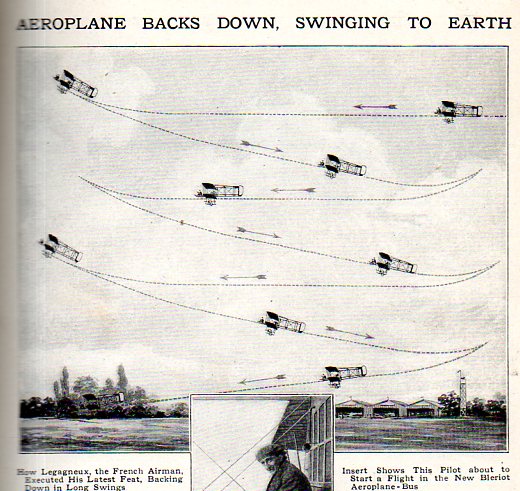
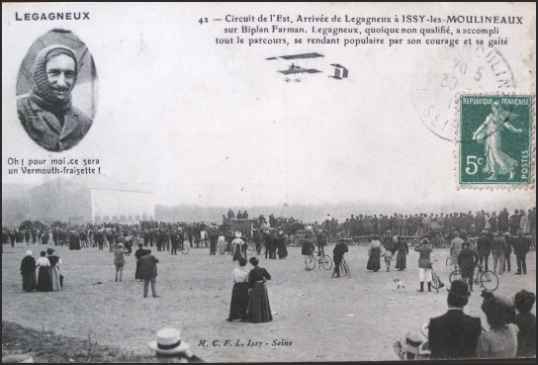
     There is no official “Well, I’ll be Damned Department” on this blog but if there was one this small discovery would certainly be an excellent candidate.  I don’t know enough about the aerodynamics of first-decade powered flight aircraft, but it seems as though this could be an alternative way of landing.  It seems not to be the desired way to bring in your plane, though, looking way more problematic than is necessary.  That said, I’ve never seen flight instructions like this before. 

    Aeroplane backup356
    [Source:  the ever-fascinating Popular Mechanics, February 1912, page 373.]

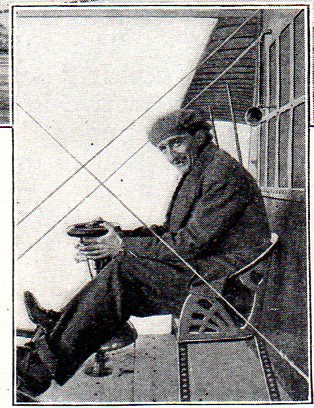
    Aeroplane backup357This is the pilot, Georges Legagneux (1882-1914), happily at the minimal controls.  Another image, courtesy of Early Aviators, of the pilot in action: 

    Aeroplane legagneux
    Legagneux would die pursuing his passion in 1912. 


  • ThinkPunk–Monster Engineering and Ships in Tunnels, on Bridges, and Along Rail Lines

    JF Ptak Science Books    Post 2041

    Full and massive and creative engineering dreams are the stuff of rich possibilities and the created demands of the created future.  Sometimes they lead to the wonderful and essential, and sometimes they don’t–pieces of these ideas may go places and lead full lives, but the overall big picture may have been just a little (or a lot) too big.  The later may be the case for these ideas below–they include outlines for a trans-Atlantic ship tunnel (1927), the Cotherell/Eads 130-mile overland railway transport for transit across the Tehuantepec isthmus in Nicaragua, monumental masonry bridges supporting a car in which a battleship was driven, and others. 

    Ship tunnel

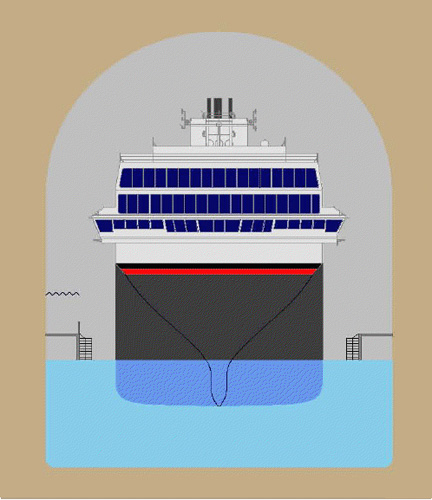
    [Cross-section of the Atlantic Tunnel, found in Luigi Motta, Il tunnel sottomarino, published in Milan in 1927, and found while reading in the magnificent Dictionary of Imaginary Places by Alberto Mangule and Gianni Gudalupi/]

    This is the story of a mostly-submarine adventure, due to the work of  a French engineer named Adrien Geant, who constructed a mostly-floating 4,700 km tunnel connecting Europe to America.  Problems ensue and the tunnel fails, the resulting adventure of the survivors taking them to Atlanteja, which was a lost city constructed by the survivors of the lost city of Atlantis.  Anyway, it is an interesting story of engineering, as the ideas behind the design of the tunnel were pretty good.  The book was written by Luigi Motta (1881-1955), a man of active mind who wrote over 100 adventure/sci-fi stories.


  • Isolated Crowds & People in Crowded Isolation

    JF Ptak Science Books  Quick Post  Daily Dose from Dr. Odd

    There are crowds and then there are crowds, crowds that are big and filled with people, and then crowds that are filled, but somehow strangely not with people even though they are there–large groups of isolated people.  These photos show up now and again, as they did today–I gathered four examples, below.

    Isolated crowds

    [Student nurses, Roosevelt Hospital, New York City, 1938. Found at the Pinterest collection of Christian-Paul North, here]


    Crowd isolated prison
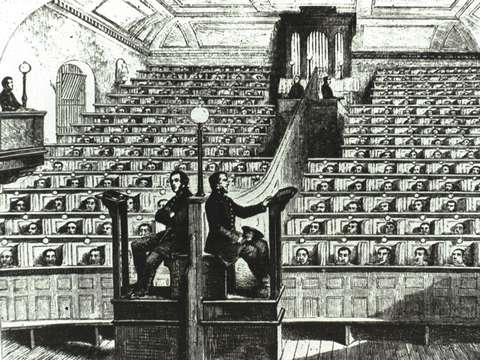
     This image is of a church or social service at Pentonville Prison in 1855. 

    Crowded and lonely

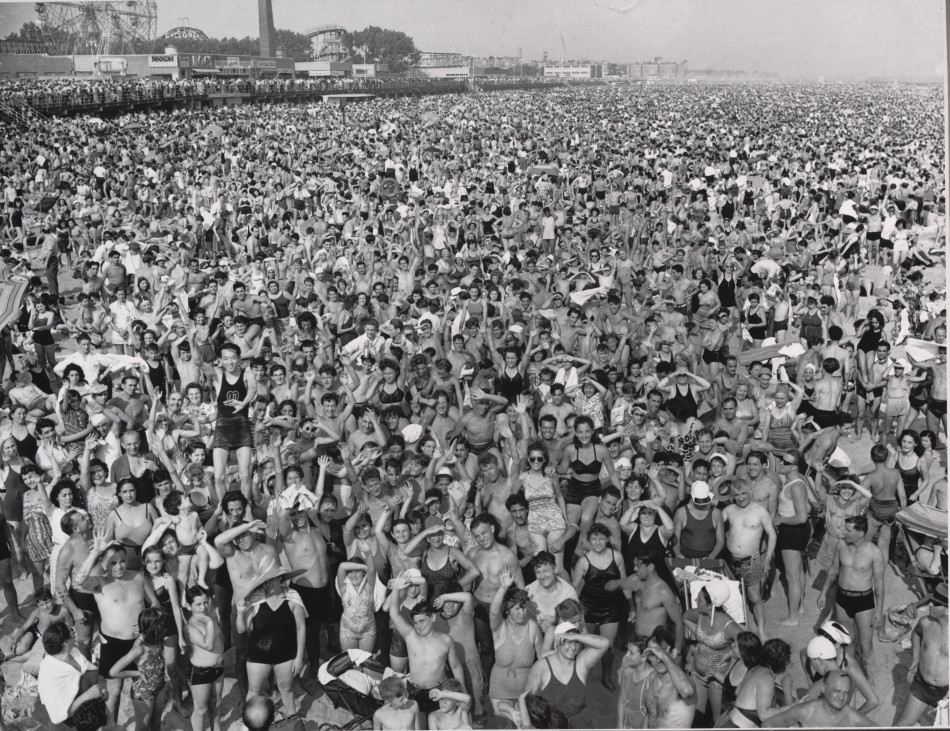
    Lonely hatted man in a very large crowd on Coney Island, Brooklyn, U.S.A, as captured by Weegee, ca. 1950.  Weegee_-_Coney_Island-big (The Hat Man is at the extreme bottom right corner.)


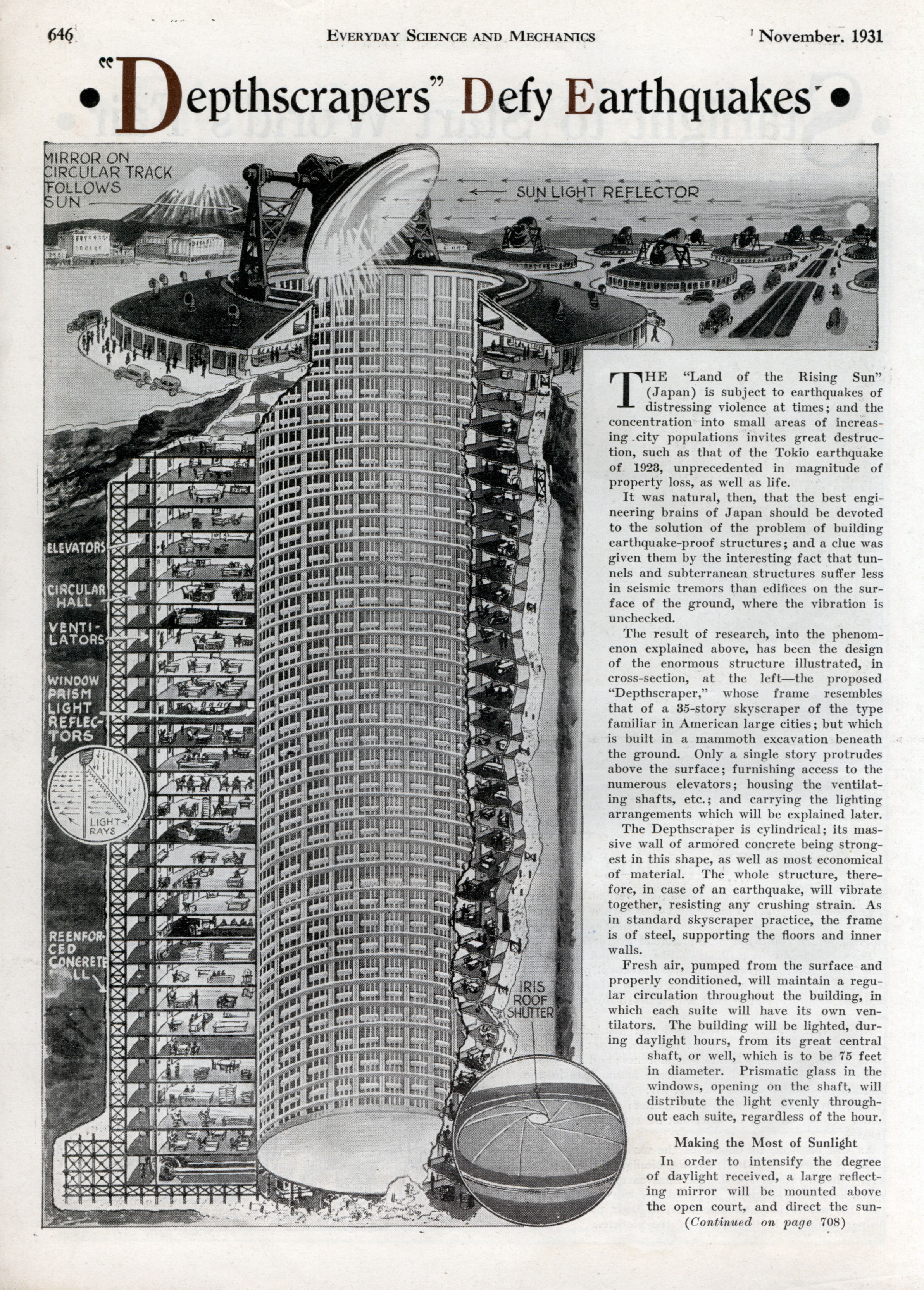
  • Deep Depth: the DepthScraper or Deadscraper of 1931?

    JF Ptak Science Books Quick Post  Part of the History of Holes series

    I’m more interested in how this hole was dug and how it got filled up again than in what is filling it.  I estimate the “filled” aspect of this reverse-and-inside-out-upside-down monastery to be about 25,000,000 cubic feet, or about two-thirds of the volume of the Empire State Building (which was just being constructed when this article was published).  The 40-storey building would about 500′ low, and the surrounding supporting structures seem to make the whole of it at least 75′ in diameter–finished.  That makes for a big hole in the digging of the thing, substantially multiples the volume of the Empire State Building removed in order to achieve the construction needs.  That is a lot of dirt.

    Underground depthscraperAnd so how do we remove the dirt/rock from the 450′ level of a 75′-wide hole in 1931?  I doubt that  it is being hauled out by crane systems, and the hole is certainly wider than 75′ at  the bottom.  I guess these questions could only be answered with the information on what the material is that these folks would be working with.  But suffice to say–it would be a big project.

    Also:  I don’t know why this structure would be “earthquake proof”, though that is the impetus behind the construction of this monster–the Japanese architects who dreamed this building still had the 140,000 deaths of the 1923 Great Kantō earthquake fresh in their minds.  The building looks like it has the capacity to sustain major damage in an earthquake, making it perhaps a flaming and inescapable tomb. It would certainly make a neat if not inexpensive cemetery.

    [Image source: Popular Mechanics, 1931, from the great Modern Mechanix site–http://blog.modernmechanix.com/depthscrapers-defy-earthquakes/]


  • Baby Raffle of Paris, 1912

    JF Ptak Science Books  Post 2039

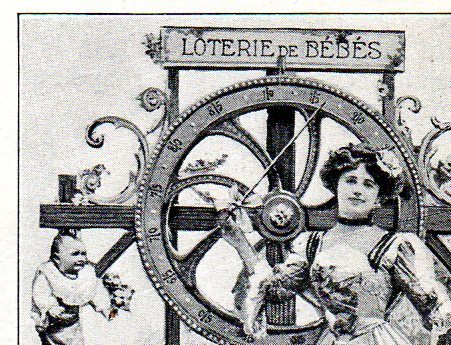
    In the history of raffles and lotteries, tontines and lottos, few would rank so high in the Department of Forbidden Weirdness as this 1912 Parisian lottery of babies.

    Baby raffle351
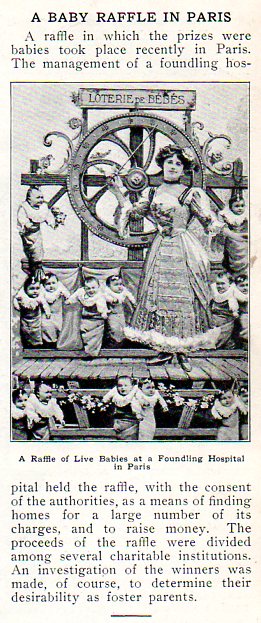
    This image is a detail from the following photograph that appeared in Popular Mechanics for January 1912, and in spite of how this reads and in spite of it being a real-and-true story, it is still difficult for readers in the 21st century to appreciate as a news article rather than a piece of dark fiction:

    Baby raffle350Now the story of the deep history of child abuse and abandonment and infanticide is thousands of years old, and the issue of the rightness of abandoning newborns to the street as a condoned and necessary social activity to ensure the plasticity and survival of a society has been argued by Aristotle and Quintilian  and Pliny the Elder. The movements to provide public institutions to help save the exposed and deserted children really didn’t begin in earnest until the 17th and 18th centuries–that is with Louis XIII and Louis XIV in France and with the creation of the Foundling Hospital in London in 1741.  It is with the creation of these early orphanages that abandoned babies are saved as babies, and although these children would be trained early on to be mechanics’-helpers and domestics at relatively young ages (early ‘teens), they were not subjected to being sent to workhouses as very young children as in the older practices–or being left to die lying in the streets by exposure to the cold or hunger or being trampled underfoot. 

    So.  In comparison with some bitter early histories of the want of tenderness int he care of children, and keeping in mind the great leap forward in the creation of the foundling hospitals and what they represented in the face of not having anywhere for unwanted and impossible babies to go, the idea of the lottery for cute babies in 1912 doesn’t look so bad when placed in its historical context. 

    It is still a very uncomfortable idea and idea, this sort of placement of babies–but with the terrible history of infanticide and exposure not too dimly removed from this time, the lottery seems far less horrible than its antiquarian components. 


  • A Shining Singularity of 1896–the Glory of Lost Hardware Stores

    JF Ptak Science Books   Post 2032  

    Follow Me on Pinterest


    When I was a kid I liked to go to Reiman’s hardware store on Victory Blvd., Staten Island, New York, where there was everything and everything was in its place, though not every place was in its place.  There was a certain untidiness to the store that made it seem as though everything was a jumble, except it wasn’t.  The order was controlled by a collection of hardware men who seemed to know everything and absolutely knew where everything was.  I would walk in, go to the back, hold up the widget that I needed to the Old Man, and then he’d go to a half-wall filled with tiny boxes filled with tiny things, and find what I needed–or something better. The store was biggish, but very quiet, given all of the surface area of all of those thousands of tiny cardboard boxes.  It was all enveloped with the hardware store equivalent of the old bookstore aroma. 

    These were the thoughts that sprang to mind when I saw a post at the SecretPlans.org site displaying that robot-like figure riding the hardware bike. It is found in what must be the bible of 19th century books on the keeping of a hardware store, appropriately titled The American Hardware Store, written by R.R. Williams in 1896. It is remarkable for its organization and for its lovely presentation.  And of course for its very prominent  display of memory of what was necessary in building and maintenance from a hundred years ago.  There are instructions to the store owner on what and how to exhibit, with images of displays of axe heads, hurricane lamp glass,scythes, plumbs, hatchets, horseshoes, scale beams, belts, pumps, oil cloths, and much more of the stuff that is mostly gone.

    Thanks to this manual I think that when you go back in time and into that hardware store of 1896 you’ll be ready.


  • Unintentional Absurdist and/or Naive-Surreal Photography

    JF Ptak Science Books  Post 2030   Follow Me on Pinterest


    Surreal lighting308_edited-1

    L’Eclairage, published by la Societe pour le Perfectionnement de l’Eclarage, was printed in 1937, and addressed the use and beauty of proper lighting.  The photography is the work of Andre Vigneau, French photographer/film-maker/sculptor (1892-1968), who among many other things was one of the first to design photographic covers for books.  This little pamphlet outlines the importance of lighting in photography–aside from that, though, its principal interest for this blog is the absurd/surreal nature of the photographs  when taken away from the text and out of context.  The image are unexpectedly interesting as cleaved-away photographic documents of unusual perspectives.

    Surreal lighting308

    ·Posted by :

    ·in:


  • The Ophthalmology of a Redon-ized Bosch

    JF Ptak Science Books   Post 2026   Follow Me on Pinterest

                          Cave Cave Deus Videt (“Beware, Beware, God Sees”)
    Descartes dioptrique

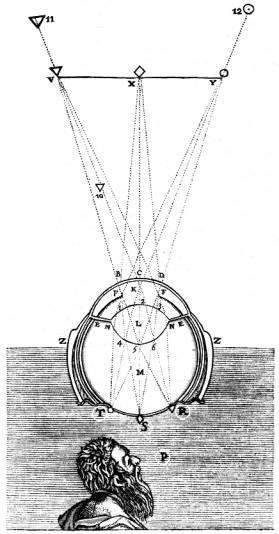
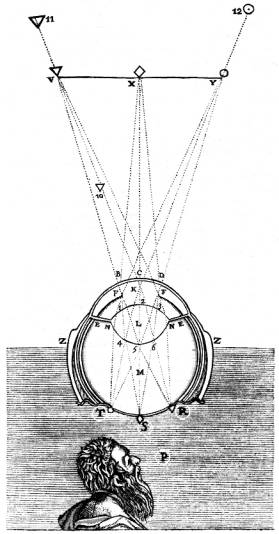
    When I think of the early-ish thinkers on optics and vision, and consider their fantastic images
    of the anatomy of the eye and the mind/brain/eye connection, the work of Rene Descartes usually appears first.  It is a general go-to illustration in optics and biology, and it appeared in his Dioptique in 1637.  It is standard iconography.

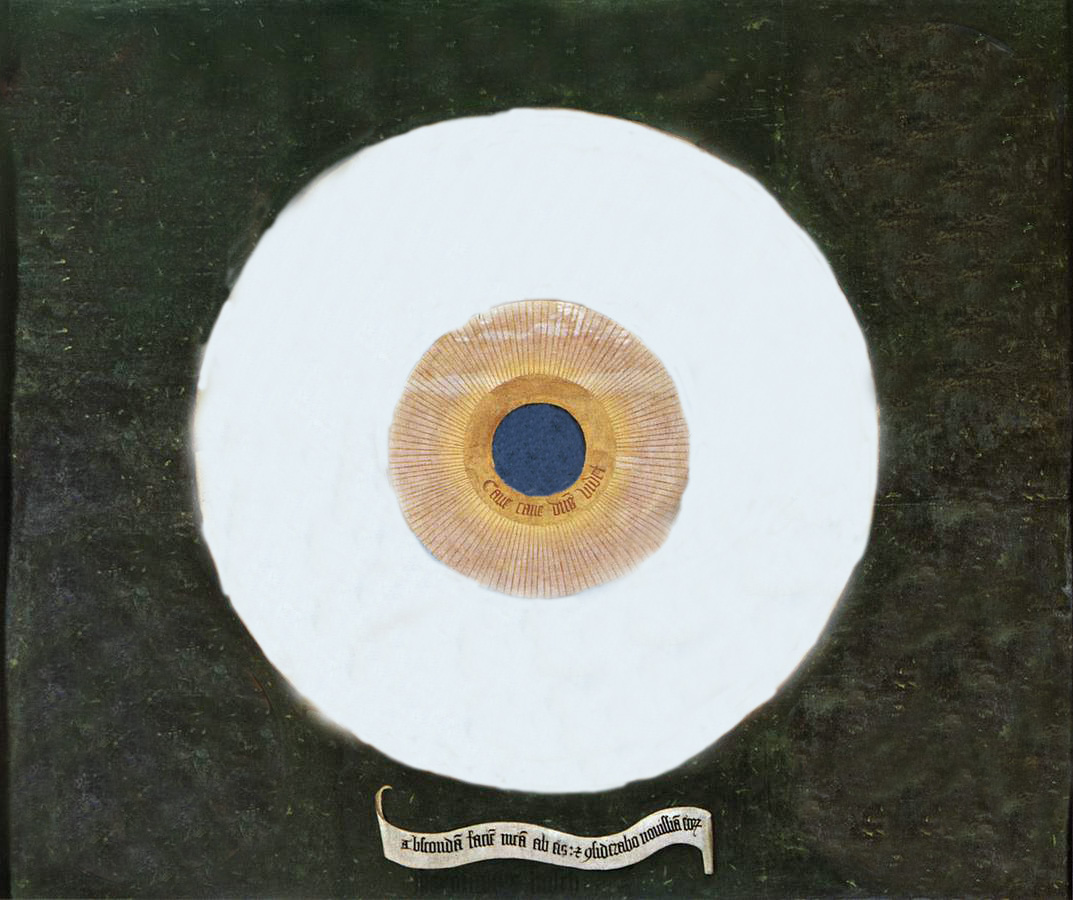
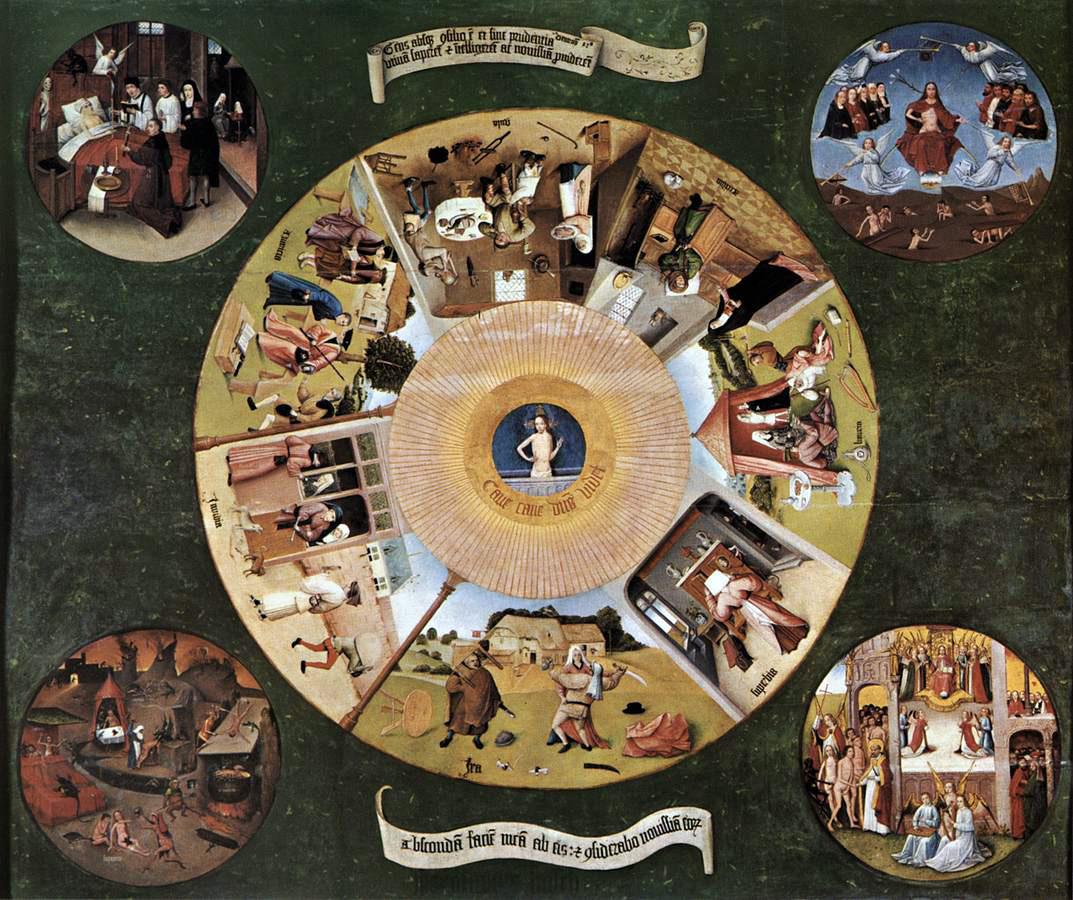
    For me, an antiquarian non-standard image of the eye appeared today. Hieronymous Bosch is not terribly well known as a person, as a walking and talking citizen of the world–it is known where he died, and where he spent the last twenty years of his life, but the details outside of this are scarce.  And even though he signed his adopted name of “Bosch”(he was born ca. 1450 as Jerome van Aken, and died in 1516) very boldly and clearly–and was among the earliest crops of artists to do so in the West–he never dated the paintings.  Scholars have determined their dates in some part by the increased realism and skill, which leads me to one of his latest works, the beautiful table top of the Seven Deadly Sins (ca. 1400). 
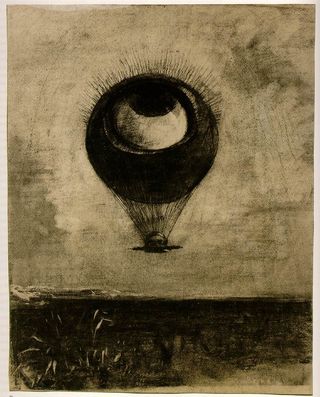
    Redon eye balloon

    I had never really noticed it before, but when I looked closely at some of the detail in the work it suddenly dawned on me that the central part of the work was an eyeball–this no doubt instantly seen by every other person, but for me it was a shock of recognition.  This became particularly clear when I (quickly and clumsily) photoshopped out most of the elements of the painting, leaving me with this:
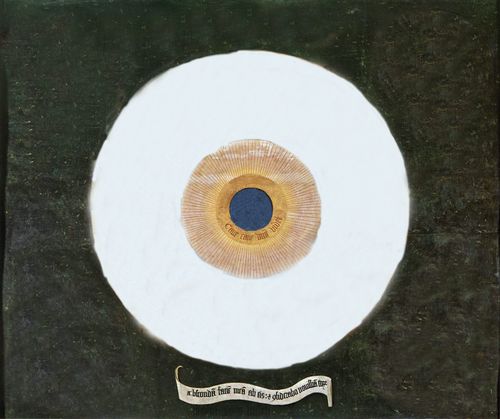
    Bosch The Seven Deadly Sins eyeball

    Which is clearly an eye–and as a matter of fact the Latin inscription emblazoned underneath Christ reads Cave Cave Deus Videt ( or “Beware, Beware, God Sees”), meaning that the watchful creator sees everything and will be the judge and offer final dispensation depending upon past history.


    Rendered like this the work reminds me strongly–at least in a symbolist sense–of Ordilon Redon’s (1840-1916) Eye Balloon (1878). Well, mostly it is the sense doctored image that drives this recollection more so than the painting–removing almost all of the elements of the Bosch suddenly gave the piece an escapist flavoring, like something in the early modernist movements. 

    And the original (47×59″ in real life), with the roundels elements restored and Christ replaced in the iris of the eye:
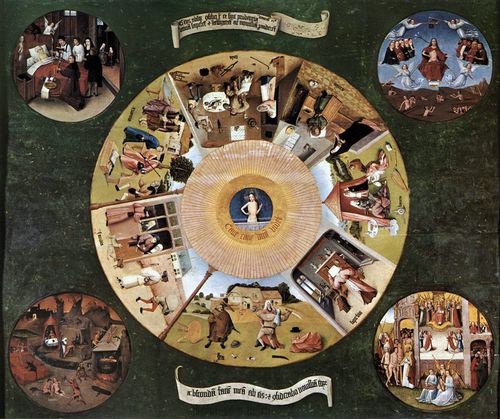
    Bosch The Seven Deadly Sins

    The motif of the painting clearly works its way outside-in, with the all-seeing omnipotent being seeing-all, there at the center of the eye, surveying everything that takes place on the living dominion, surrounded at the corners by depictions of Death, Judgment, Heaven, and Hell, and then immediately encompassed by the seven deadly sins.

    In the floating banner above the main circular image reads “For they are a nation void of counsel, neither is there any understanding in them,” and then below “O that they were wise, that they understood this, that they would consider their latter end!”

    I found it very striking.