A Daily History of Holes, Dots, Lines, Science, History, Math, Physics, Art, the Unintentional Absurd, Architecture, Maps, Data Visualization, Blank and Missing Things, and so on. |1.6 million words, 7500 images, 4.9 million hits| Press & appearances in The Times, Le Figaro, Mensa, The Economist, The Guardian, Discovery News, Slate, Le Monde, Sci American Blogs, Le Pont, and many other places… 5000+ total posts since 2008.

Author: JF Ptak

  • An Eviscerating Review of “The Last Attack on Darwinism” (1872)

    JF Ptak Science Books   Overall Post 5130

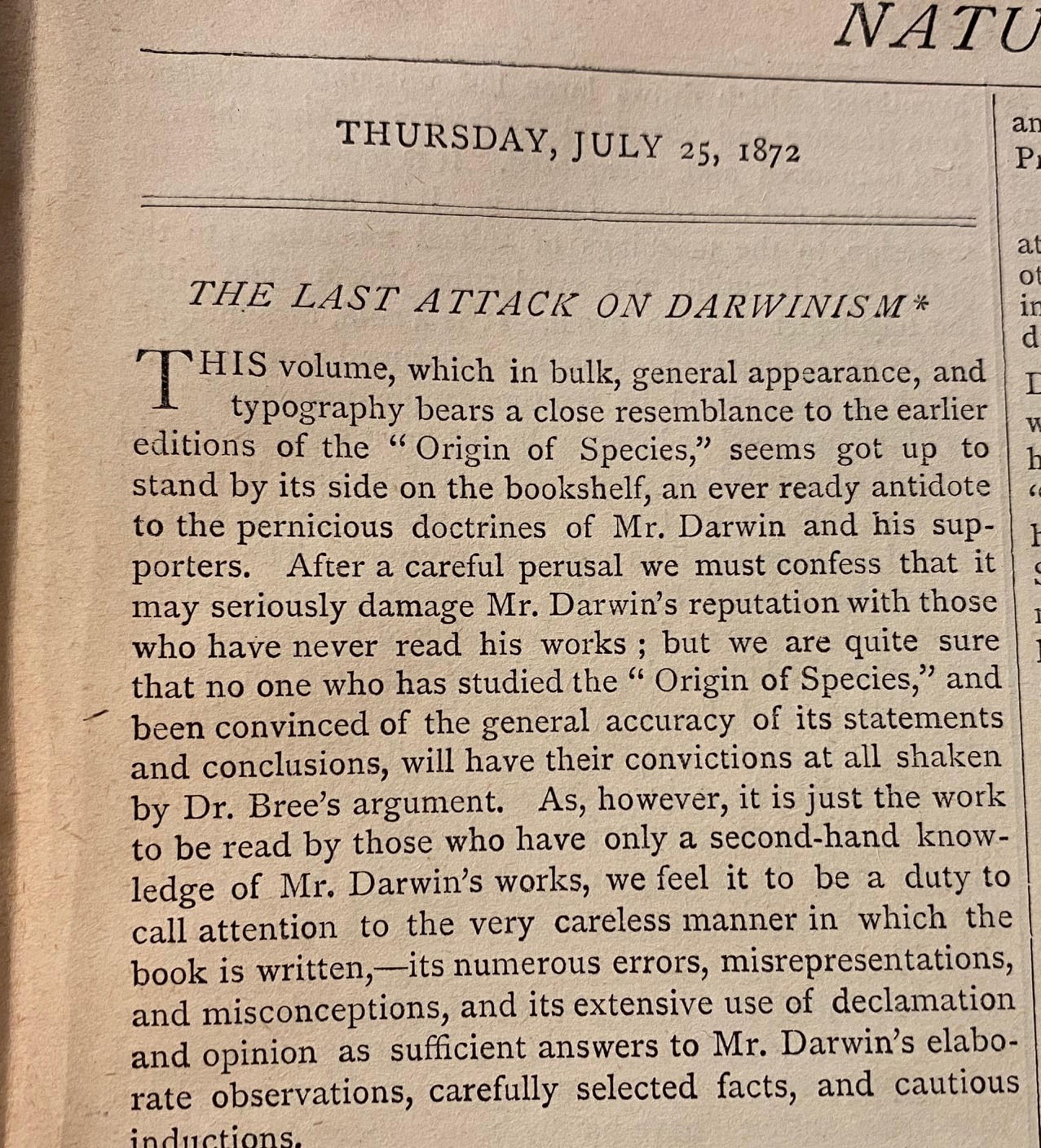
    There are many hopeful headings that appear in the fantastically-readable journal Nature (especially in the 19th century), and this one–“The Last Attack on Darwinism”–is certainly one of them. It was written for the 25 July 1872 issue by Alfred Russell Wallace in 1872 in response to Dr. Charles R. Bree’s1 An Exposition of Fallacies in the Hypothesis of Mr. Darwin, and it pretty much eviscerates Dr. Bree’s attack.  No doubt this title can be read two ways–one meaning the most recent attack on Darwinism, and the other meaning the final attack.  I suspect Wallace hoped that this would be the last such thing he’d have to read or review, but being a thinking man he probably felt that no mater what proof and evidence was established for evolution there would always be someone/group/society that would argue their belief over the science, and so on into the future the debate would go.  In any event, I’ve reproduced the first and last paragraphs of the Wallace review. Also there’s a further quotation on Bree from The Lancet as an example of the many scathing reviews Bree’s book received.  The reviews are surgical and denunciating, though from what I’ve read they do not reach the high/low level of book reviews by Poe, whose book reviews read as though he read the work with a sledge-scalpel. 
     

    IMG_4244

    And the last short paragraph from Wallace: “In conclusion, I must again repeat that the only reason for devoting so much space to a book so little worthy of its title or its author, is the wish to warn such as are not well acquainted with Mr. Darwin’s works from implicitly relying either on Dr. Bree’s facts and arguments, or on the accuracy of his representation of those of Mr. Darwin and his supporters.”

    Now a snippet from one of many such reviews that greeted Dr. Bree’s work, this from The Lancet (volume 2 1872):

    “This book is the production of an uncompromising opponent of the Darwinian hypothesis. Dr. Bree can see no good in it at all, but hews away at it root and branch…The position taken up by Dr. Bree would, it appears to put a stop to all investigation of nature, for he contends that it is beyond the limits of human reason to furnish any sound explanation of the modus operandi of God in creation.” And: “Upon the whole, we should scarcely expect to find Dr. Bree’s work exercise much influence in staying the progress of  the new opinions, or do more than satisfy those who have already made up their minds against them.” 

    Notes:

    1. Charles R. Bree (1811-1886). An Exposition of Fallacies in the Hypothesis of Mr. Darwin. London: Longmans, Green, and Co., 1872. 8vo., 418 pp. + 32 pp.(publisher’s list).


  • Your Daily Dirigible (1913)

    JF Ptak Science Books  Quick Post  Overall Post 5129

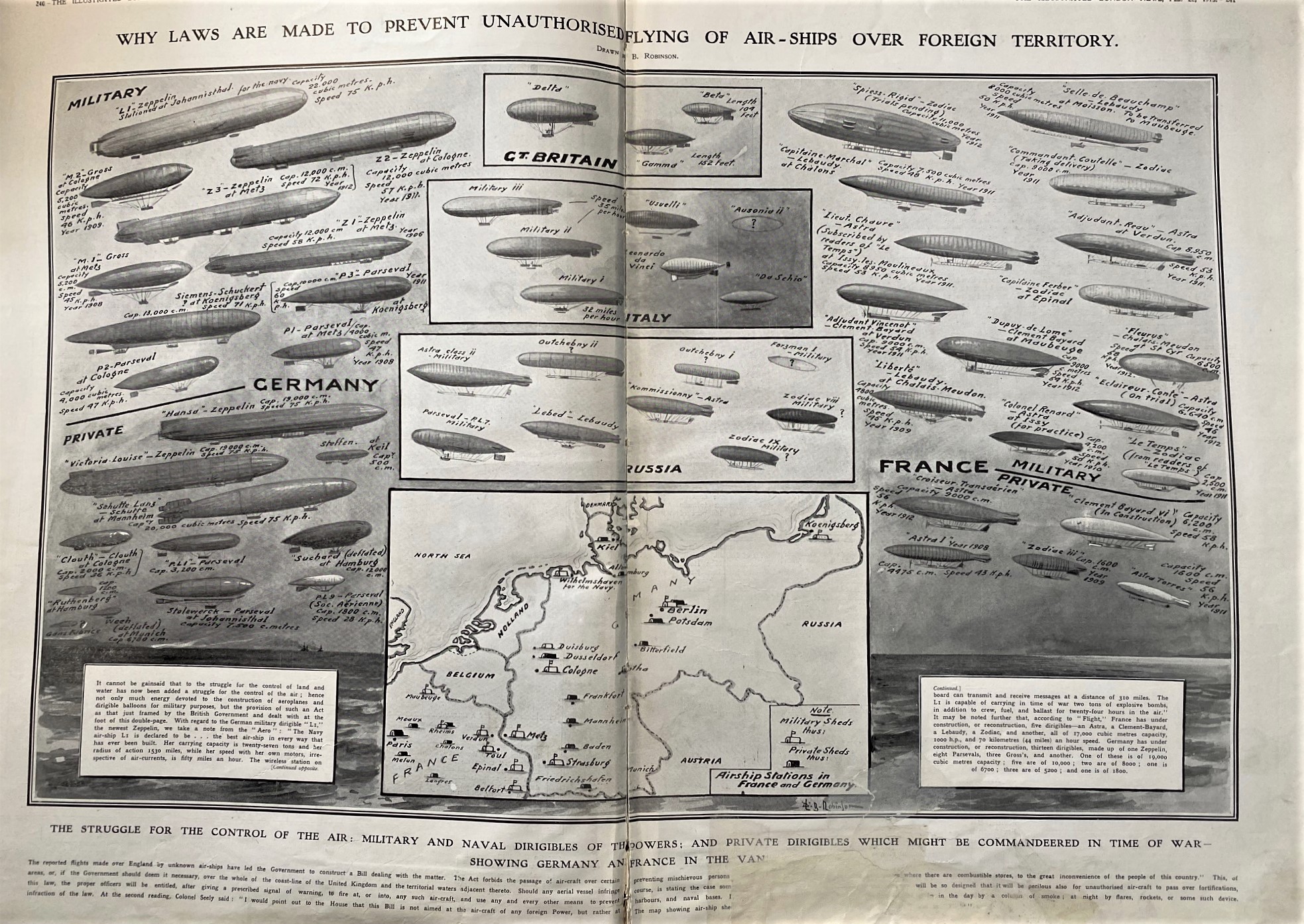
    Well, no, this is not really a “daily” dose of dirigibles, though it is a nice display of the airships. This double-page display is found in the Illustrated London News  from 22 February 1913, illustrating a short article addressing the need for legal reform in the flight of dirigibles, particularly in regards to the airships being used in possible combat.  WWI wasn’t far off at this point, and the ILN takes its readers on a quick tour of who-had-what in regards to the airships, depicting German and French airships and aerodromes. If you click on the images and then click again you’ll see that there is info on individual airships as well.  

    Click to Expand


    IMG_3862

    Details follow:


  • “Children Who Work on the Nation’s Crops” (1942)

    JF Ptak Science Books  Quick Post   Overall Post 5128

    IMG_5329

    This is a substantial indictment and attack on the loose laws (where they actually existed) regarding child labor in the United States, specifically regarding kids working in the fields.  If you scroll down you can see what laws were applicable to what states, and there were plenty of states that had virtually no regulations on children laboring in the fields, being part of a migratory family.  I’ve reproduced here some of the most significant bits from the pamphlet as well as all of teh photos–the photo images aren’t exactly Jacob Riis, but they’re getting there. In any event Ms. Zimand was making a very strong case and presenting an embarrassing expose on the use of child labor in the U.S. just at the beginning of the U.S. overt military involvement in WWII.  


    [Source: ZIMAND, Gertrude Folks. Children who work on the nation’s crops. New York City, National Child Labor Committee [1942] [National Child Labor Committee. Publication no. 384., 9″x 6″, 19pp. Photo illustrations.]


    IMG_5331


  • Found Poetry in Use of the Infinite and Imaginary in the Service of the Finite ad Real (1885)

    JF Ptak Science Books   Quick Post  Overall Post 5127

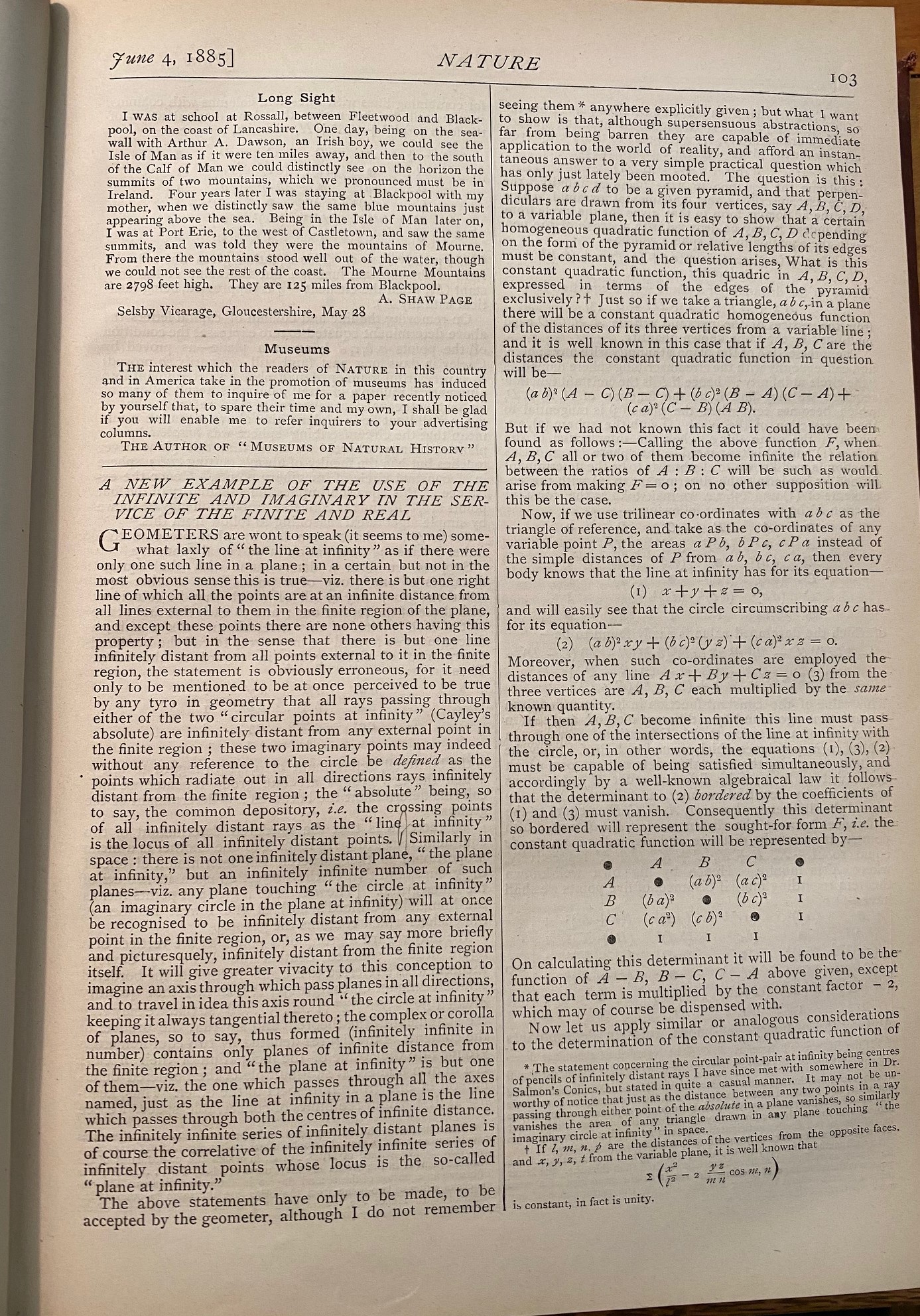
    IMG_5160Over on my blog I’ve made a number of posts on “Found Poetry”–phrases and constructions of interesting structural images that when removed from a narrative form and subjected to a different display find a sort of light art form in themselves. The phrases and sentence are in their original order—spacing and delineation have changed a bit to focus their attractiveness. There have been posts on “Found Poetry” in the (sometimes very extended) titles of Renaissance books, recipes and instructions on cooking dainty sardines, a disintegrating machine from 1877, descriptions of clouds from 1726, and well, you get the picture. “Found art is where you don’t find it”, as M. Duchamp didn’t say—sometimes the found poetry is pretty obvious, sometimes not. Today’s entry has a terrific title, though the text lets us down a little, but then closes up very strong in the last paragraph. And so, from NATURE, volume 32 number 814, 4 June 1885, by the great and prolific J.J. Sylvester,  “A New Example of the Use of the Infinite and Imaginary in the Service of the Finite ad Real”:


    “GEOMETERS are wont to speak 

    (it seems to me) somewhat laxly of ” the line at infinity ” 

    as if 

    there were only one such line in a plane; 

    in a certain but not in the most obvious sense 

    this is true —

           viz. there is but one right line of which all the points are at an infinite distance from all lines external to them in the finite region of the plan

                 and except these points there are none others having 

                        this property; but in the sense that there is but one line infinitely distant from all points external to it in the finite region, 

                               the statement is obviously erroneous, for it need only to be mentioned to be at once perceived to be true by any tyro in

                                      geometry that all rays passing through either of the two “circular points at infinity” (Cayley’s absolute) are infinitely

          distant from any external point in the finite region ; these two imaginary points may indeed without any reference

                 to the circle be defined as the points which radiate out in all directions rays infinitely distant from the finite  region…

    the “absolute” being, so to say, the common depository,

    i.e. the crossing points of all infinitely distant rays as the  “line at infinity”

    is the locus of all infinitely distant points.

    ·Posted by :

    ·in:


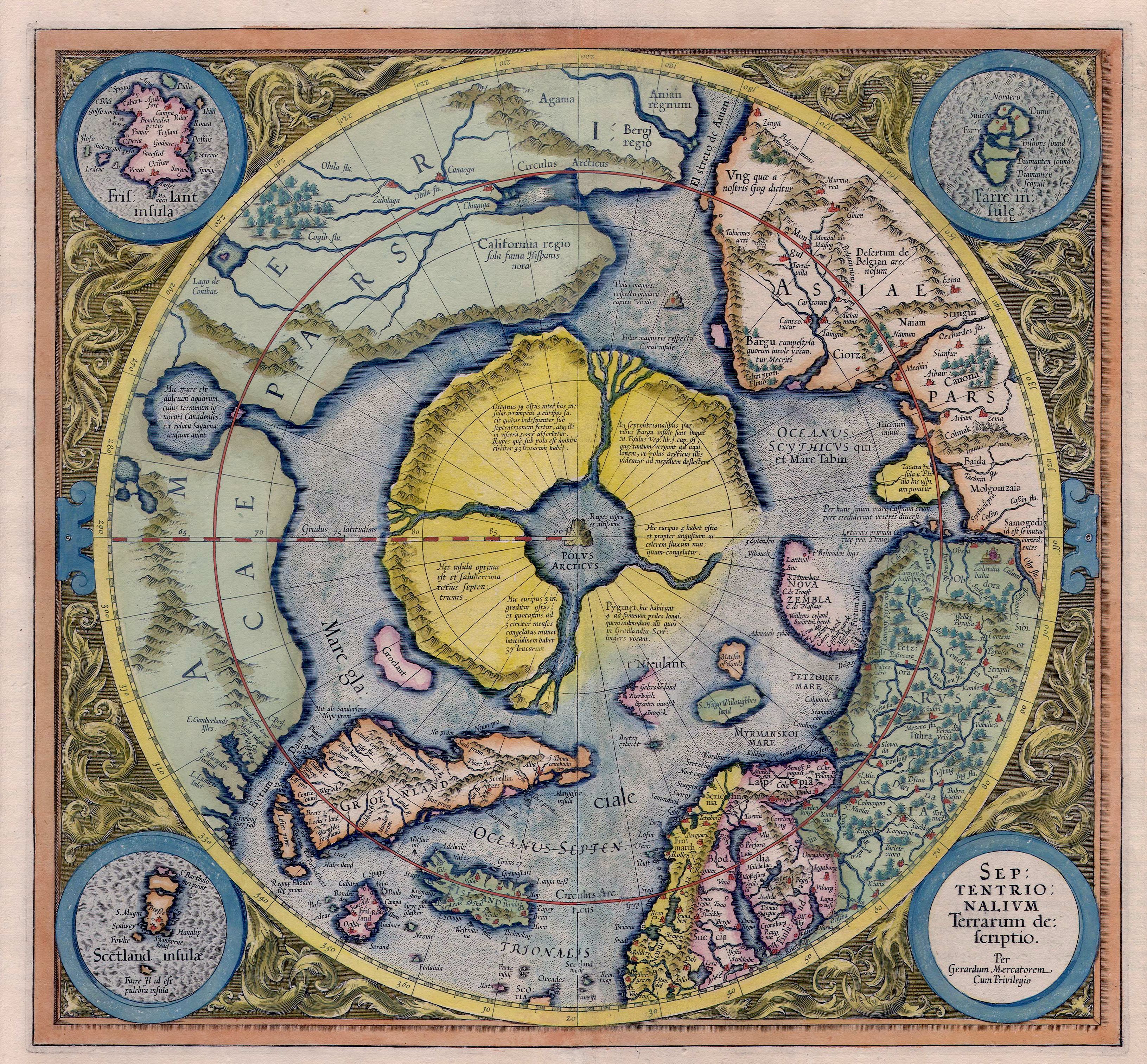
  • The Garden of Eden at the North Pole

    JF Ptak Science Books   Quick Post  Overall Post 5126

    Artic

    (Gerald Mercator, 1596)

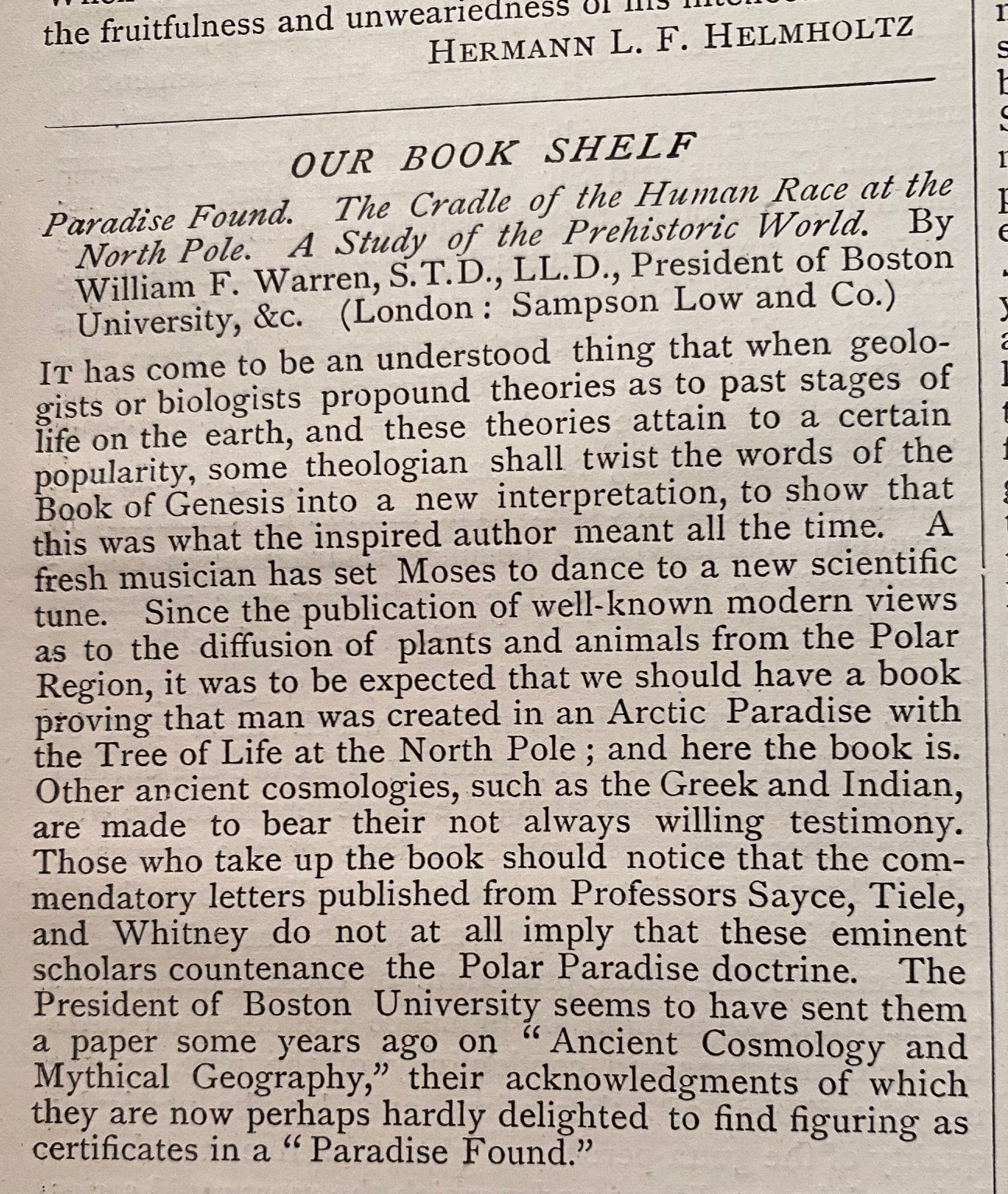
    IMG_5158This is a short, dismissive, stabbing review of a book by a theological and long-established scholar and administrator, William F. Warren (1833-1929). I remember his name from his interesting work on ancient cosmologies (1882), illustrated with examples of the history of all things according to various belief systems and religions. This quick-and-dead arrow of a review (which appeared in Nature on 14 May 1885 p, 28), was directed at his new work Paradise Found, the Cradle of the Human Race at the North Pole..., which as you can guess tries to establish the origin of humans at the North Pole, along with the Garden of Eden and the Tree of Life. And, for that matter, also establishes the Pole as the home of Mt. Maru, the Arthurian Avallon, and so on. There’s a lot that can be said but not by me—there is an attraction to hunting up other mythologies placing some part of great importance to the North Pole as the Navel of the Earth, but I just don’t have the time or inclination. As a matter of fact, I hadn’t known about this work by Warren, and I doubt I’ll know much more than what I am communicating right now—one thing the reviewer doesn’t mention is that the book runs about 500 pages, which is just too much of an investment for yours truly.

    ·Posted by :

    ·in:

    — — —

  • Found Poetry in Lost Plankton (1930)

    JF Ptak Science Books   Quick Post   Overall Post 5125

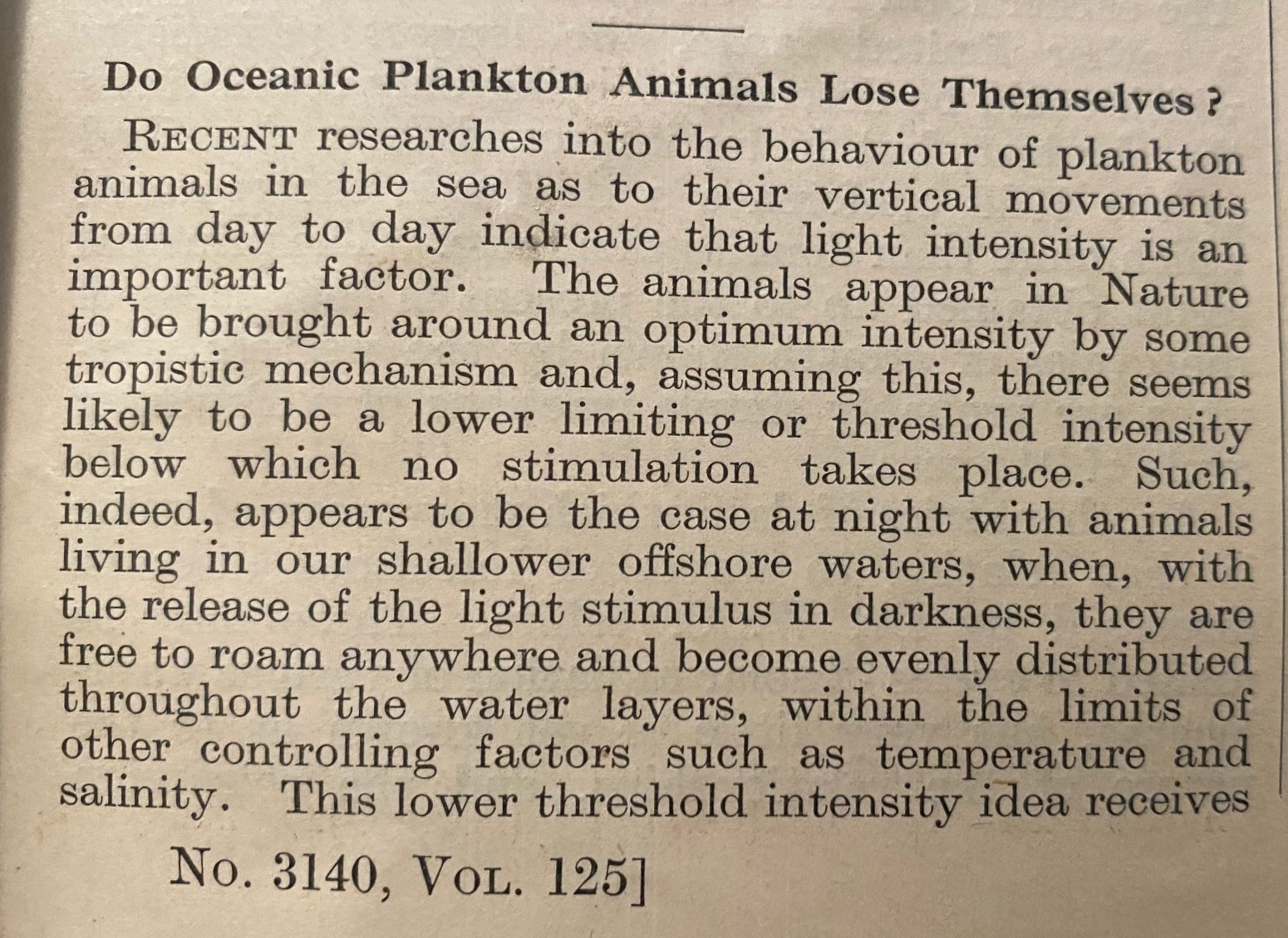
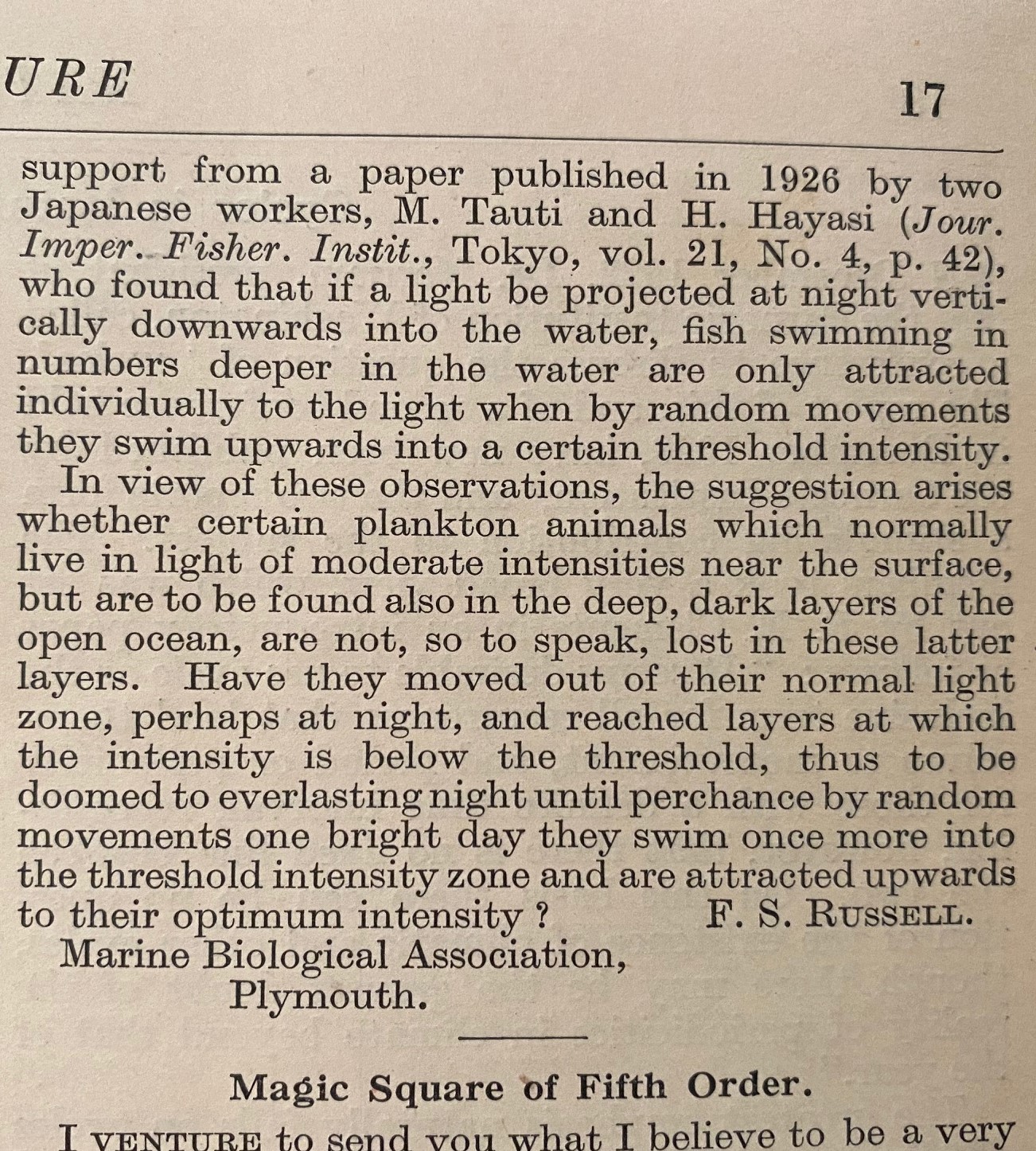
    IMG_5066Over on my blog I’ve made a number of posts on “Found Poetry”–phrases and constructions of interesting structural images that when removed from a narrative form and subjected to a different display find a sort of light art form in themselves. The phrases and sentence are in their original order—spacing and delineation have changed a bit to focus their attractiveness. There have been posts on “Found Poetry” in the (sometimes very extended) titles of Renaissance books, recipes and instructions on cooking dainty sardines, a disintegrating machine from 1877, descriptions of clouds from 1726, and well, you get the picture. “Found art is where you don’t find it”, as M. Duchamp didn’t say—sometimes the found poetry is pretty obvious, sometimes not. Today’s entry has a terrific title, though the text lets us down a little, but then closes up very strong in the last paragraph. And so, from Nature, 4 January 1930, volume 125, no. 3140, the last sentences of the last paragraph:

    “Do Ocean Plankton Animals Lose Themselves?

    Have they moved out of their normal light,

    and reached layers at which the intensity

    is below

    the threshold, thus to be doomed

    to everlasting night until perchance by random movements

    one bright day

    they may swim once more

    into the threshold intensity zone

    and attracted upwards

    to their optimum intensity?”

                –F.S. Russell, Marine Biological Association, Plymouth

    IMG_5067


  • Charles Babbage Obituary in “Nature”, November 1871.

    JF Ptak Science Books   Quick Post  Overall Post 5124

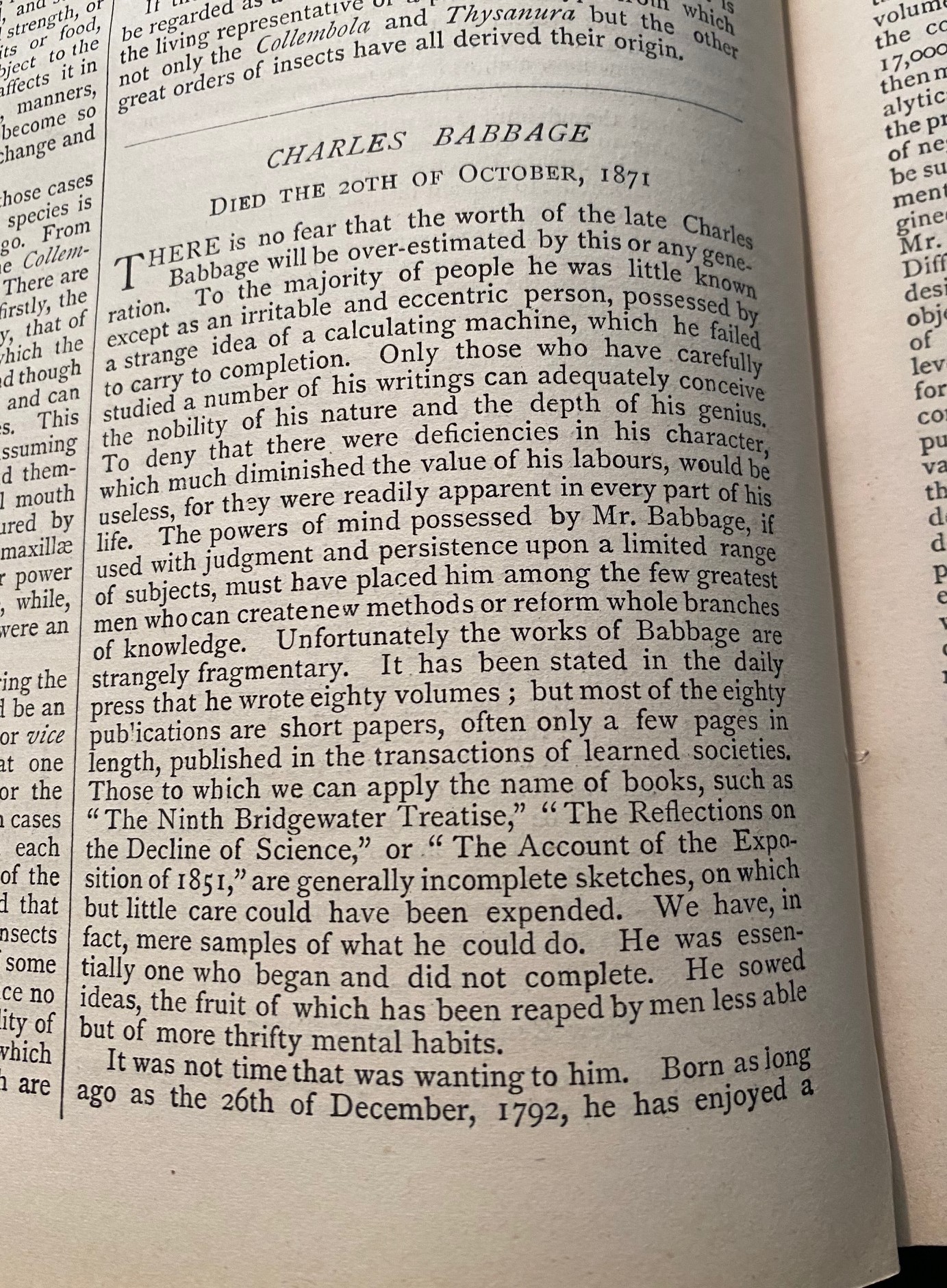
    This is a fine and understanding obituary of Charles Babbage--it appeared in Nature on 9 November 1871, just two weeks after 
    the death of the Great Man on 20 October, and I include the article in full below. You'll see that a lot of attention is paid to the
    Difference and Analytical Engines, and how much attention they received from Babbage and how much money the
    government spent on it. It was a failure as a working/practical/applicable enterprise, the writer states (which was true) , but the
    thinking that went into the machines were not. That Babbage didn't see the completion of the computer projects wasn't necessarily
    his fault, and to me seems to say that time will out. The obit writer (Lockyer, the founding editor of the journal?) was positively
    convinced of the clarity and precision of Babbage's thinking and writing, and convinced of his genius.

    "THERE is no fear that the worth of the late Charles Babbage will be over-estimated by this or any generation. To the majority of
    people he was little known except as an irritable and eccentric person, possessed by a strange idea of a calculating machine, which
    he failed to carry to completion. Only those who have carefully studied a number of his writings can adequately conceive
    the nobility of his nature and the depth of his genius."IMG_4897
    "Mr. Babbage, relinquishing all notions of completing the Difference machine, bestowed all his energies upon the designs of the
    wonderful Analytical Engine. This great object of his aspirations was to be little less than the mind of a mathematician embodied
    in metallic wheels and levers...Nothing but a careful study of the published accounts can give an adequate notion of the vast
    mechanical ingenuity lavished by Mr. Babbage upon this fascinating design. Although we are often without detailed explanations
    of the means, there can be little doubt that everything which Mr. Babbage asserted to be possible would have been theoretically
    possible."

    IMG_4899
    "The engine was to possess a kind of power of prevision, and was to be so constructed that intentional disturbance of all the loose
    parts would give no error in the final result."
    "Although for many years Mr. Babbage entertained the intention of constructing this machine, and made many preparations, we
    can hardly suppose it capable of practical realisation. Before 1851 he appears to have despaired of Its completion, but his
    workshops were never wholly closed. It was his pleasure to lead any friend or visitor though these rooms and explain their contents.
    No more strange or melancholy sight could well be seen. Around these rooms in Dorset Street were the ruins of a life time of the
    most severe and ingenious mental labours perhaps ever exerted by man. The drawings of the machine were alone a wonderful result
    of skill and industry; cabinets full of tools, pieces of mechanism, and various contrivances for facilitating exact workmanship,
    were on
    every side, now lying useless."

    Read the rest of the obituary:

  • Gliding Flight and The Seventh Seal (1897)

    JF Ptak Science Books  Quick Post (Overall Post 5123)

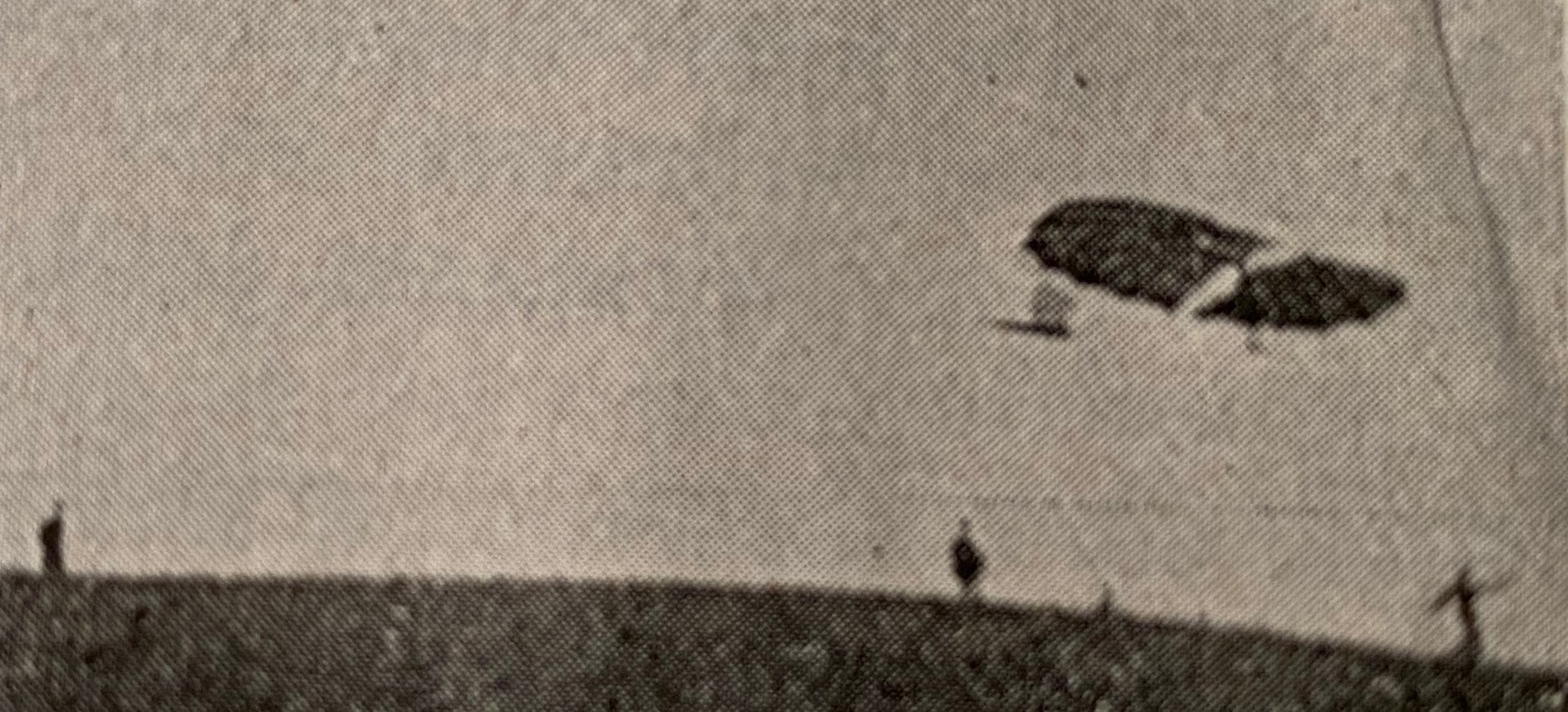
    Science heavyweight and Nature editor and founder J. Norman Lockyer wrote in 18971 a three-page summary of the recent experimental work of aviation pioneer Percy Pilcher. Mr. Pilcher (1866-1899) was rather more than a “pioneer”–he was an inventor and perhaps Great Britain’s premier experimentalist and visionary in flight at the end of the century—and made significant contributions towards understanding flight dynamics, though he would not live out the century, fatally crashing in a glider flight that was leading towards the launching of a powered glider of his own design.

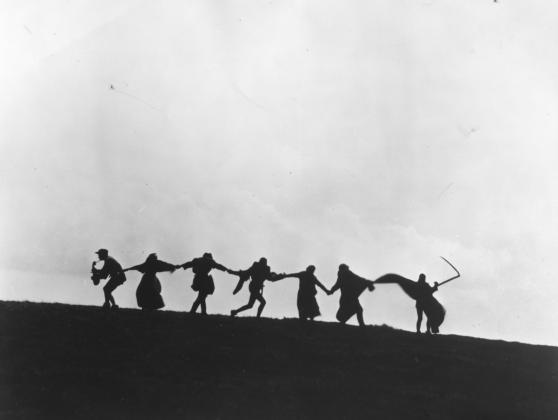
    The article was accompanied by a seven-part rapid-photo series of Pilcher in flight, and what caught my eye in this series were the small figures on the rolling hill under the glider. Enlarging the image quite a bit (the originals in Nature shows figures only 3mm tall) brings proto-post-Swedish-noir to mind, especially the very animated figure on the right and  particularly for a famous scene from Bergman’s Seventh Seal (1957):

    IMG_4836

    Bergman_Seventh-Seal_001_o3


    Notes:

    Sir J. Norman Lockyer (1836-1920), long-time experimentalist/instrumentalist/theoretician who worked in astronomy and spectroscopy and was co-discoverer of helium (found in the atmosphere of the Sun).

    1. (PILCHER, Percy.) Lockyer, William J. “Soaring Flight”, in Nature, a Weekly Illustrated Journal of Science, 12 August 1897, vol 56 no. 1450, pp 344-346 in the issue of pp 337-360.

    And the full series of photos:


  • “Euphonium”: Found-Poetry of Recorded Soundwaves (1897)

    JF Ptak Science Books  Quick Post –Overall Post 5122 (Part of the History of Lines series)

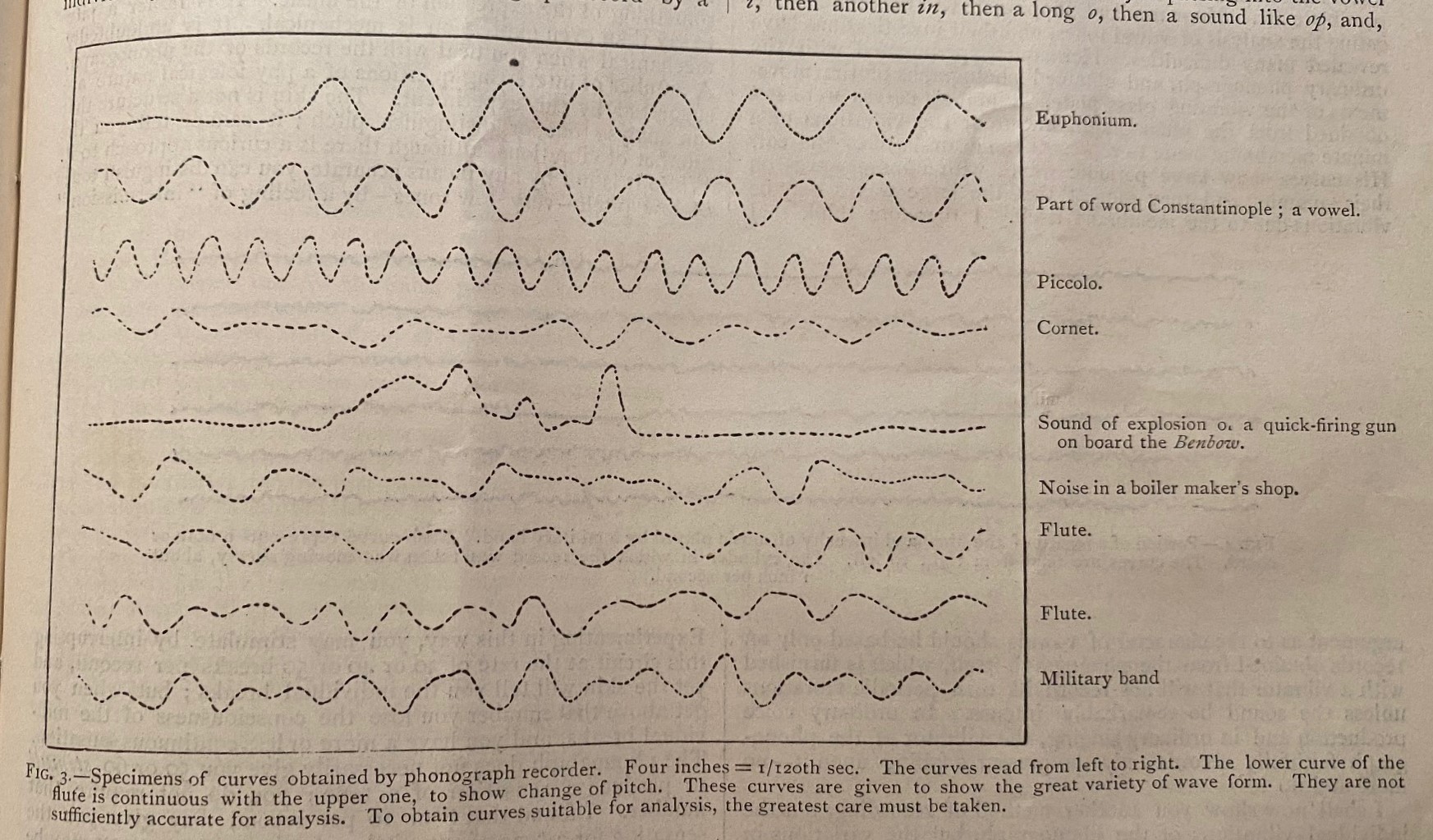
    IMG_4854John McKendrick had a long scientific career, with a  lot of very widely-spaced interests on which he wrote well and often.  What caught my eye on this piece (“The Analysis of Phonograph Records”, in Nature, a Weekly Illustrated Journal of Science, volume 56 no. 1444, 1 July 1897, pp 209-213 in the issue of pp 193-216)–I mean, aside form its wonderful content–was a bit of found poetry in one of the paper’s illustrations.  McKendrick’s—professor of physiology at Glasgow—effort here is one of the early attempt studying graphic records of soundwaves specifically prepared on phonographic cylinders, looking for variations in the graphics of pitch and the meaning they convey. Fascinating results.  

    EUPHONIUM (1897)

    Euphonium,

    Part of a word Constantinople, a vowel,

    Piccolo

    Cornet

    Sound of explosion or a quick-firing onboard the Benbow.

    Noise in a boiler makers group.

    Flute.

    Flute.

    Military band.


  • On Flying Machines–Scientific American, 1848

    JF Ptak Science Books  Quick Post   Overall Post 5120

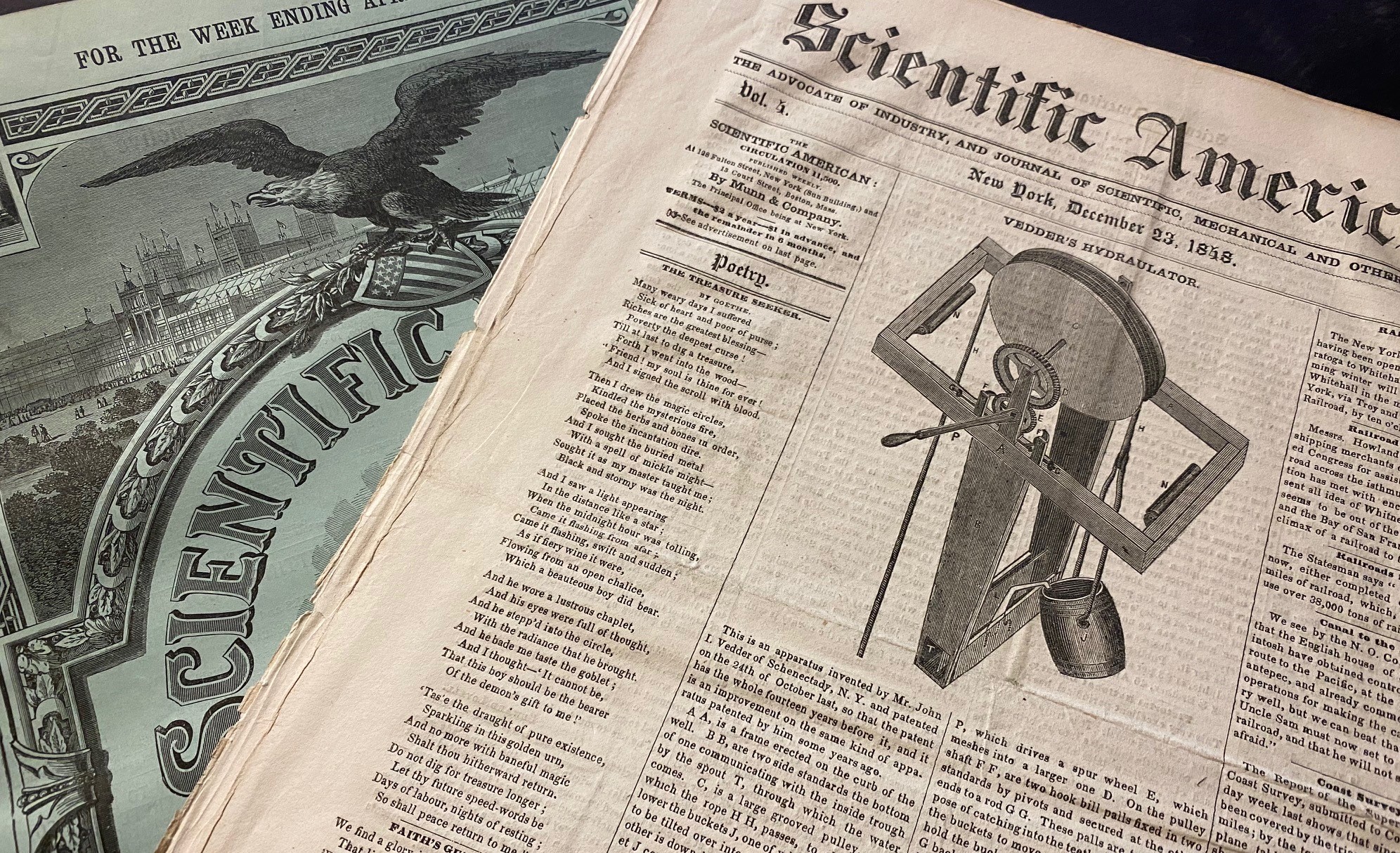
    I found a short article on human flight (“Flying Machines”) in the fourth volume of Scientific American (1848).  It is an interesting and occasionally predictive piece that saw a bit into the future, well past the contemporaneous failures and iron-punk possibilities of sky machines, into a place of “mathematical certainty.  The writer saw the possibility of heavier-than-air flight, only just not in 1848 (or any time soon). “The air furnishes a vast fund of power for the use of mankind, although as yet they have only used it to propel ships and wind-mills. We live in an age of great discoveries and improvements, and among these will certainly be ranked the navigation of the air.” 

    And so some snippets from the article: 

    “Flying Machines and Perpetual Motions are very old and unfortunate acquaintances. No people have invented so many as the Germans, and many a poor fellow has lost his life by his fool hardy confidence in some machines he had invented to ride upon the winds, yet for all the accidents that have taken place to high flyers, from the Dutch Doctor at Ratisbone in 1692 to the unfortunate Englishman who perished a few years ago in London when descending by a parachute, there are still to be found new flying machines coming out every few months. An Austrian made quite a fine display in Cremone Gardens, London last winter, by taking several long jumps with a steam flyer. Since that we have heard no more about it, and presume it has met the fate of its illustrious predecessors…

    IMG_3864 (1)

    “But the end of flying machines is not yet, and here we insert the description of a new and an original one certainly, taken from the Jacksonian published at Pontiac, Michigan… After describing how wings had been tried to beat the lark and eagle, he says:—“As wings then, have failed, and balloons been attended with no better success, men have begun to think that the end is unattainable, and that flying is a victory which man can never achieve.”