A Daily History of Holes, Dots, Lines, Science, History, Math, Physics, Art, the Unintentional Absurd, Architecture, Maps, Data Visualization, Blank and Missing Things, and so on. |1.6 million words, 7500 images, 4.9 million hits| Press & appearances in The Times, Le Figaro, Mensa, The Economist, The Guardian, Discovery News, Slate, Le Monde, Sci American Blogs, Le Pont, and many other places… 5000+ total posts since 2008.

Author: JF Ptak

  • “We Need a Stroke of Genius.” (RPF, 1946)

    JF Ptak Science Books   Quick Post

    The Future of Nuclear Science, Princeton University Bicentennial Series, Series I Conference I (1946), with a forward by the director of the conference, E.P Wigner, is mostly just a short (36-page) introduction to the conference, with a few highlights of superstar comments, most notably from Dirac and Feynman (see below). There is a remarkable and seldom scene photo of the conference’s participants–it is a mega-powerhouse of physics people. Perhaps what I enjoy most of the photo part of the publication is the out-of-context artwork in the skeleton/ghost photo that accompanies the image so that you can identify those pictured. It really does take on a life of its own–though I admit I’m partial to these bits.
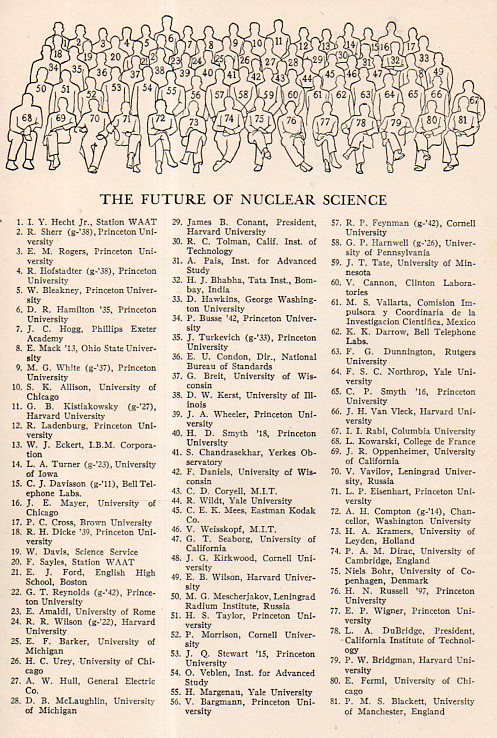
    Skeleton 716
    It is a considerably heavyweight group of physicists–among them are Hofstadter, S.K. Alison, Kistiakowsky, Ladenburg, W.J. Eckert, L.A. Turner, R.H. Dicke, E. Amaldi, Urey, Conant, Tolman, Pais, Turkevich, Condon, Wheeler, Smyth, Chandrasekhar, Weisskopf, Seaborg, Wilson, Morrison, Veblen, Bargmann, Van Vleck,  Eisenhart, Compton, Kramers, Dirac, DuBridge, Bridgman, Fermi, Blackett, and so on.  Interesting that Feynman stands right behind the seated Dirac, and that Rabi is on the far right, almost out of the picture, leaning away ever so slightly from the group.
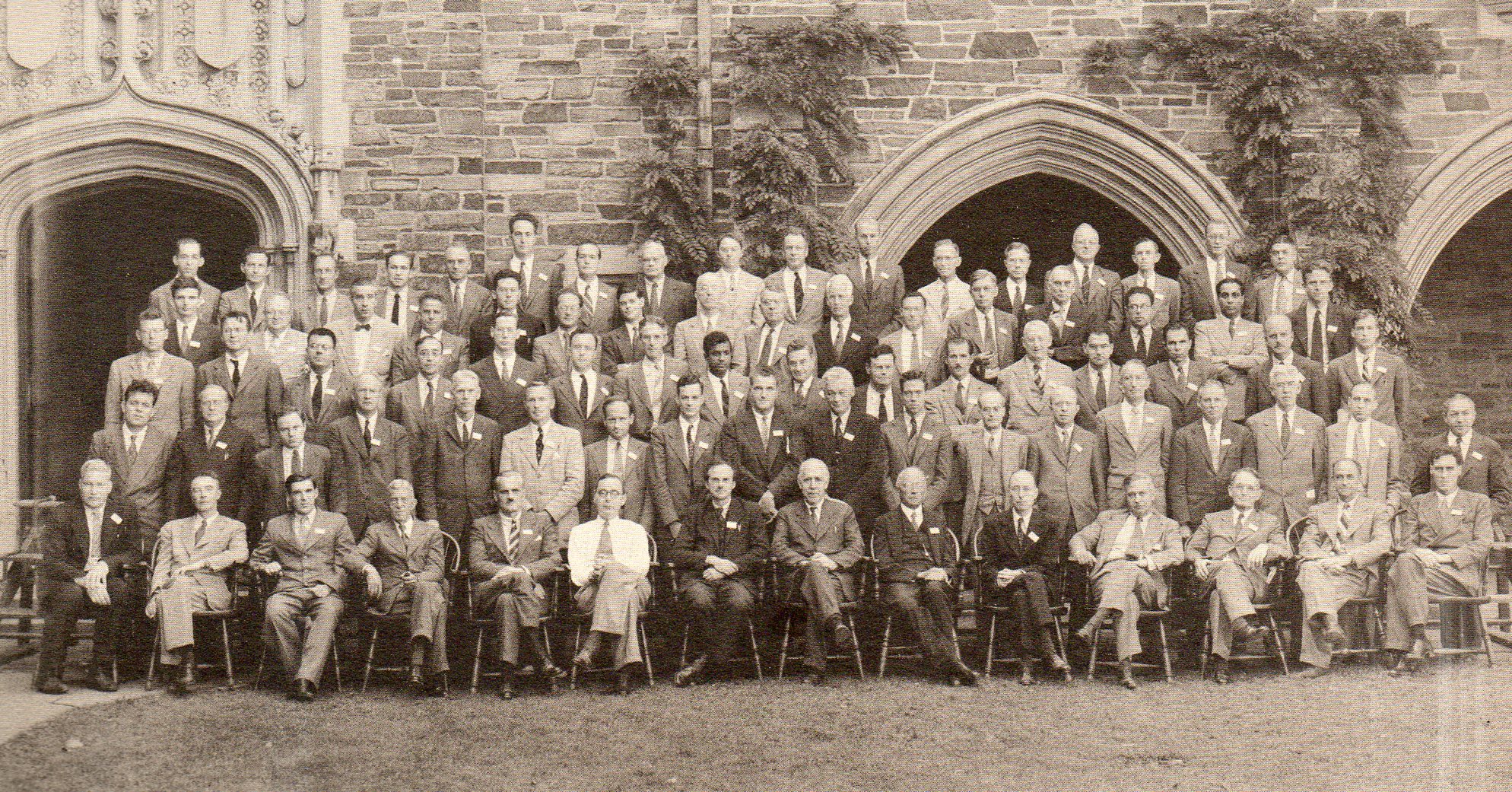
    Skeleton det718
    Here’s a relatively-random detail featuring (bottom left -to-right) Compton, Kramers, Dirac, Bohr, plus (middle left-to-right) Margenau, Bargmann, Feynman, Harnwell, Tate, and (third row) Wheeler, Smyth, and Chandrasekhar.  This was an extraordinary group. 
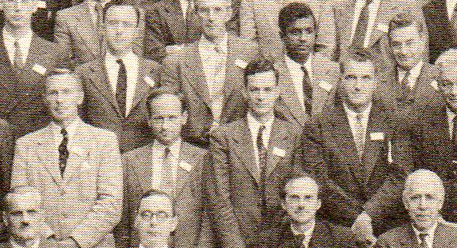
    Skeleton det a718

    Full text via Hathi Trust via Cornell University.

    Here’s an interesting quote from Feynman:

    “Typical were the comments and queries made by R. P. Feynman of Cornell University and Gregory Breit of the 

    University of Wisconsin: “What will the fundamental particles turn out to be- more particles or less particles?

    Or perhaps all of our so- called ‘different’ particles are not ‘different’ particles but different states of the same

    particle.” The final theory of physics must be complicated, but cannot a logically consistent approximation to it be

    expected—like classical mechanics, which is a logically consistent (but experimentally wrong) approximation

    to quantum mechanics?”

    “Maybe the problem involves a fundamental frequency related to the classical electron radius. . . . Or again, 

    perhaps the meson (note: an elementary particle, found in the cosmic rays, and linked by theory to the

     nuclear force fields) and the electromagnetic field may be two manifestations of the same thing, with the 

    link provided by the fact that they both obey Bose-Einstein statistics.”
    But perhaps all this may best have been summed by the comment of Dr. Feynman, “We need an intuitive 

    leap at the mathematical formalism, such as we had in the Dirac electron theory (note: the theory which predicted 

    the positron discovered in 1932); we need a stroke of genius.”

  • The Big Bang Monkey and “Gasoline Alley”

    JF Ptak Science Books  Overall Post 5111   Part of the series A History of Blank, Empty and Missing Things 

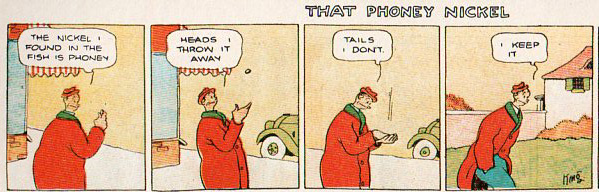
    Concevons qu’on ait dressé un million de singes à frapper au hasard sur les touches d’une machine à écrire … [translation: Let us imagine a million monkeys typing haphazardly on typewriters …”1

    Gasoline alley723[Gasoline Alley, 1931]

    There are some ideas that leave me with a powerful sense of nothing.

    To me, “nothing” can be very important–especially in writing and speaking and action, doing or saying nothing has been the important and the correct thing to do.  “Nothing” isn’t necessarily an ending, and, just a period or a coma, can just be a placeholder for something that is developing.  There can be long nothings and short one, forever- and micro-nothings, and nothing that is nothing for almost nothing.  Nothing can be implied, insinuated, broadcast and defined, though self-defined extended nothingnesses (like John Cage’s  4’33”) is a tricky thing to make happen with success. 

    The ideas that leave me with a sense of nothing are interesting things.  And there are a lot of them. When I can remember them they are in my nothing file, waiting for nothing–or something–to happen.

    This is the sense I had when (years ago) I was trying to explain randomness to our 10-year-old daughter and her 11-year-old cousin, sitting out in a park, looking at stuff.  Somehow I reached into the past and pulled up the infinite monkey theorem, and tried to make that interesting, but just couldn’t do it. Maybe it was the difficulty of super-large numbers, or the fascinating but incomprehensible thought-threats of Borges and his infinite library, but I was left with nothing.

    It is Borges who writes a lovely piece on the history of producing everything from nothing, appearing in his “The Total Library” in 1939 (and then again in “The Library of Babel” in 19412), reviewing machines and such of spectacular randomization that could produce the whole of what we recognize as what we know. 

    Emile Borel wrote on it in 1913, finding the possibility of one million monkeys pounding away at one million typewriters.  In his wonderful work, The Math Book3, Cliff Pickover looks at 250 big ideas in the history of mathematics and gives each of them one page only for presentation and explanation.  He approaches the infinite monkey theorem by looking at one monkey wailing away at one typewriter, striking the keys, and analyzing how long it might take for the one monkey to produce one line from one book.  The line is “In the beginning…” at the beginning of one great nothingness, from the Old Testament, a 56-object sentence (including punctuation and spaces) and, Pickover reasons, that if there is a 93-character keyboard, then this monkey will have a 1/9356 possibility times 10100 of getting it right, and that if it worked for 24 hours a day striking one key every second then it will have used all of the time in the present universe–the Big Bang Monkey.

    All I got back were big stares, and a big sense of nothing in my gut.  It reminded me of the cartoon featured above, a toss-off sub-cartoon in a panel of the Gasoline Alley series.  Did he actually look at the coin?  Did he just decide to keep it?  And why keep a phony nickel? And who counterfeits nickels, even during the Depression?  What is the outcome of the panels–just some guy walking down the street with a nickel in his pocket.  Something may have happened, but it was a lot of nothing. 

    I know that I should have a bigger sense of what Felix Edouard Justin Emile Borel and Jorge Francisco Isidoro Luis Borges were writing about and in many ways I do, but in the end I know that I am left with nothing.  But I have it in my pocket.  

    Notes

    1. Émile Borel (1913). “Mécanique Statistique et Irréversibilité”) J. Phys. 5e série 3: 189–196.

    2.  Jorge Borges,  “La biblioteca total” (The Total Library), Sur No. 59, August 1939. Translated by Eliot Weinberger, in Selected Non-Fictions (Penguin: 1999)

    3.  Clifford Pickover, The Math Book, (2009), Sterling, page 328.


  • Thought Machines and the Revenge of the Atoms

    JF Ptak Science Books   Post 2906 (Overall post 5110)

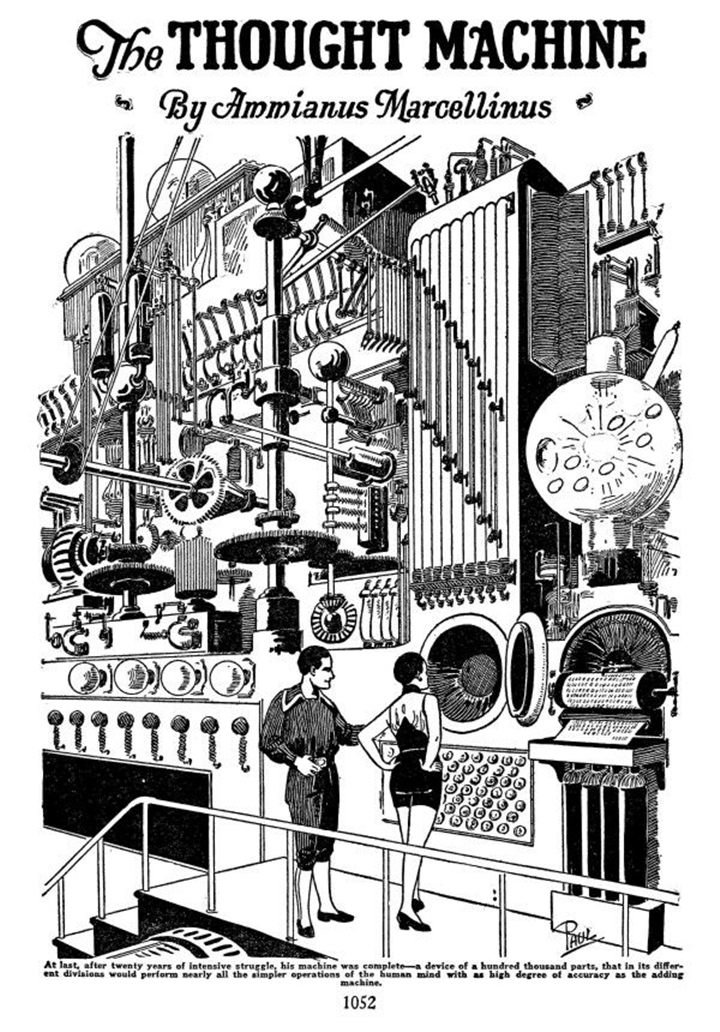
    THought machineIn the past of the past of the Thinking Machine, back when Alan Turing was only 15, the prodigious and fabulous Frank R. Paul was creating this image (left) of such a machine for an almost-adventurous story by “Ammianus Marcellinus” called “The Thought Machine”. The story appeared in Amazing Stories in February 1927, and for me Ammianus (the name of an historian who live in the 4th century CE and who wrote on the later Roman Empire) just did not have the power of persuasion for his tale–perhaps a lot like his 1600-year-old original, who Gibbon found to be boring and tedious). But the legendary work of Mr. Paul was enough for me, and so I’ve reprinted his artwork, which in itself is expansive and techo-lyrical in its many ways. In this one, I was intrigued by some of the thought machine’s components–the most obvious bit being what very much looks like a “Millionaire” calculating machine at bottom right. That, and the Napier’s-Bones-type thing about the bouncing brain of the machine–and then there numerous gears and worms…and what also seems to be like the hints of the power for the whole thing, which are the several belts leading up and away to a larger power conveyer off-picture, which for all I know may have been steam.  

    Atom revolt  of theI looked around in the pulp/sci fi references I have for some other images of “thought machines” from this early <1930 period and came away with very little, though I did find something hopeful called “The Thought Materializer” which was also supposed to be illustrated by Mr. Paul. The story appeared in Science Wonder Quarterly and was published in the spring of 1930–unfortunately the illustration was just a simple and disappointing portrait of the author.  The story was even more disappointing, and the writing was Boy-Wonder-robbed-as-he-knealt-to-pray-about-lonesome-love bad–for example, there is this unpolishable pearl: “Imaginatively, Proctor stepped from the bath”. Ouch.

    That said, looking for that “missing” Paul illustration let me bump into another interesting bit with a title begging question: “The Revolt of the Atoms”.  

    This brings to mind the possibility of “The Revolt of the Adams”, where 17th c Bishop Burnett postulated infinite planets and infinite worlds with infinite people populated by infinite Adams and Eves because as god is perfect each world would be completed with its own A&E.  

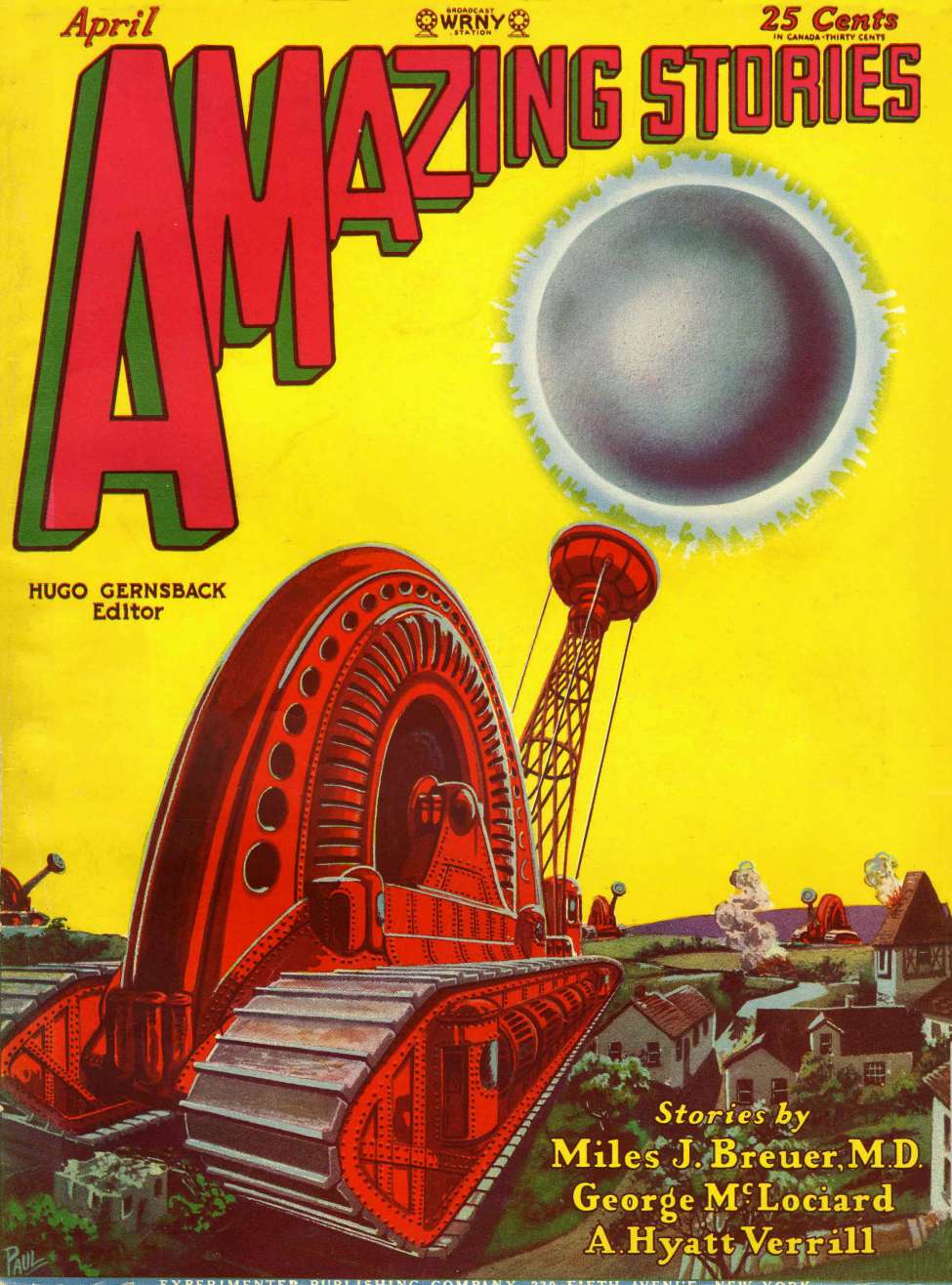
    Getting back to atoms–this story was published in Amazing Stories in their April 1929 issue and was one of the not-many early sci fi bits working around the idea of harnessing the energy of atom. Unlike many, the author, V. Orlovsky, had a go at the dangers of the atoms “rising to power”, the new-found energy becoming an agent in the possible demise of the Earth.  In any event, Something Happens in the story and the atoms run wild, forming a gigantic firey nucleus of a floating monster atom which “swept away everything that was alive”. The giant atom moved across Russia and into Italy, then on to France, destroying everything, threatening the Earth itself with utter destruction. I did not read the whole story, but it does seem as though an eruption of Vesuvius directly beneath the atom and ejected it on an “etherwave” into the Earth’s atmosphere, where it spun itself away and harmlessly so, becoming a small satellite. As I said, it is a disappointing story, though the cover art–again by Frank Paul–saves the day with its drawing of the giant atom being approached by enormous electromagnets to try and do such-and thus to it.  Frankly, I just liked the idea of the killer atom.  


  • “Telephone” Calls from Tomorrowland–or, Weighing Antique Surprise

    JF Ptak Science Books    (An episode in the series on the History of Anticipation.)

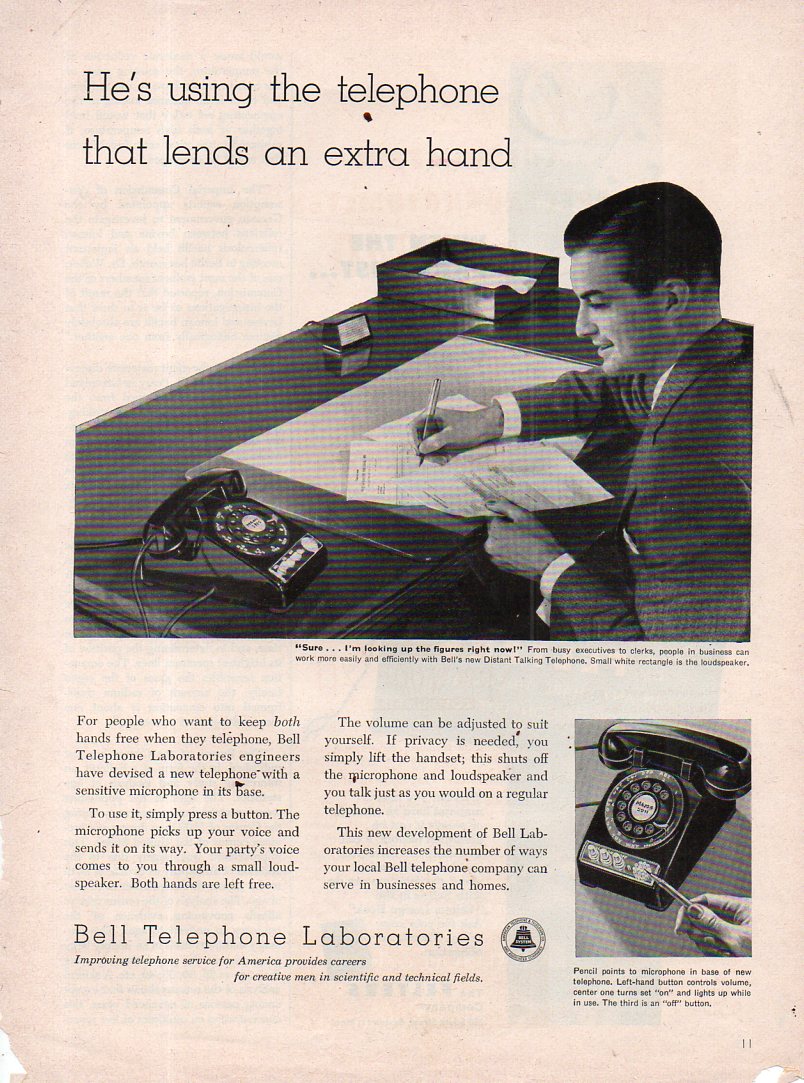
    TelephoneThis ad appeared only 66 years ago in 1954–that’s four generations in dog years, two human generations (or one for the more later-in-life crew, which is appealing as I knew a man whose grandfather was born in the 18th century), and 15 generations in managing data and communications. Perhaps more.  It is difficult to imagine the intense surprise that attended this ad showing a practical and popular adaptation of a communications breakthrough. 

    The electromagnetic telegraph, which is arguably the first electrically-powered iteration of the internet, was in the works from the 1820’s until it was nailed by Samuel Morse in 1837.  It was 40 years to the development of the Bell telephone (another dramatic example of an invention/technological idea/breakthrough that was “in the wind”, a popular undiagnosed monumental meme, some decades in the making in the hands of Bell and Reiss and Meucci and Gray and even Edison). Two more decades (just past the turn of the century) until more-widespread wireless telegraphy, another two decades after that (1920’s) for popular radio, and another two decades after that (post WWII/1950’s) for popular television broadcasting. 120 years between the patented invention of the Morse telegraph to 50 million Americans with televisions in 1955. 

    The “telephone” of 2020 is as removed as the telephone of 1954 as the telephone of 1954 was removed from the electromagnetic telegraph–we’re not meeting half-way in the meeting of improbable impossible worlds, of worlds of the future unimagined in the past.  That is what comes to mind when I see this add for the speaking telephone in 1954–the astounding, astonishing, speaking telephone, the phone that allowed you to not have the receiver to the ear, that allowed you to do free-hand work and communicate at the same time.  It was an ambitious improvement, and as soon as the phone appeared, it became a standard of necessity if that necessity was within budget. 

    It is the weight of surprise that is so abundant looking at pictures like this, giving us the opportunity to imagine the surprise elements of another time. It may well be that the new 1954 user of the speakerphone would have looked at the first telephone systems of 1894 as we look on that 1954 telephone today.  Probably not so, though, probably it was much more imaginable to have foreseen the 1954 possibilities in 1894 than for 1954 to have seen in the same amount of time to 2013:  the technological pieces necessary for part of that imagination had not yet been invented, the science ahead of the sci fi.

    The other part of this surprise element is that 1954 is well within living memory, and that this combination of technology and physics and mathematics has grown so incredibly from the speakerphone to the massive changes in 2013–it is as surprising to imagine this as to imagine the same scenario for what happened a year before in biology:  it is difficult to grasp the  sweeping changes in that field from the identification of DNA in 1953  and how far those fields have come since. 

    I think that if one could quantify this sort of “surprise” that the greatest amount of “Surprise Integers” (or whatever) ever recorded would have taken place within these past 50 or 60 years. Which makes me wonder–will people 66 years hence see the pictures of our fabulous accomplishments in 2020 as quaint reminders of how much things changed between 2020 and 2086?  Will those “Surprise Integers” be as great for that period of time as the (“our”) preceding period with concomitant revolutions in thought?  My guess is “yes”–it’s just hard to imagine. 

    ·Posted by :

    ·in:


  • A Warning from the Sky (April 1945)

    JF Ptak Science Books  Quick Post

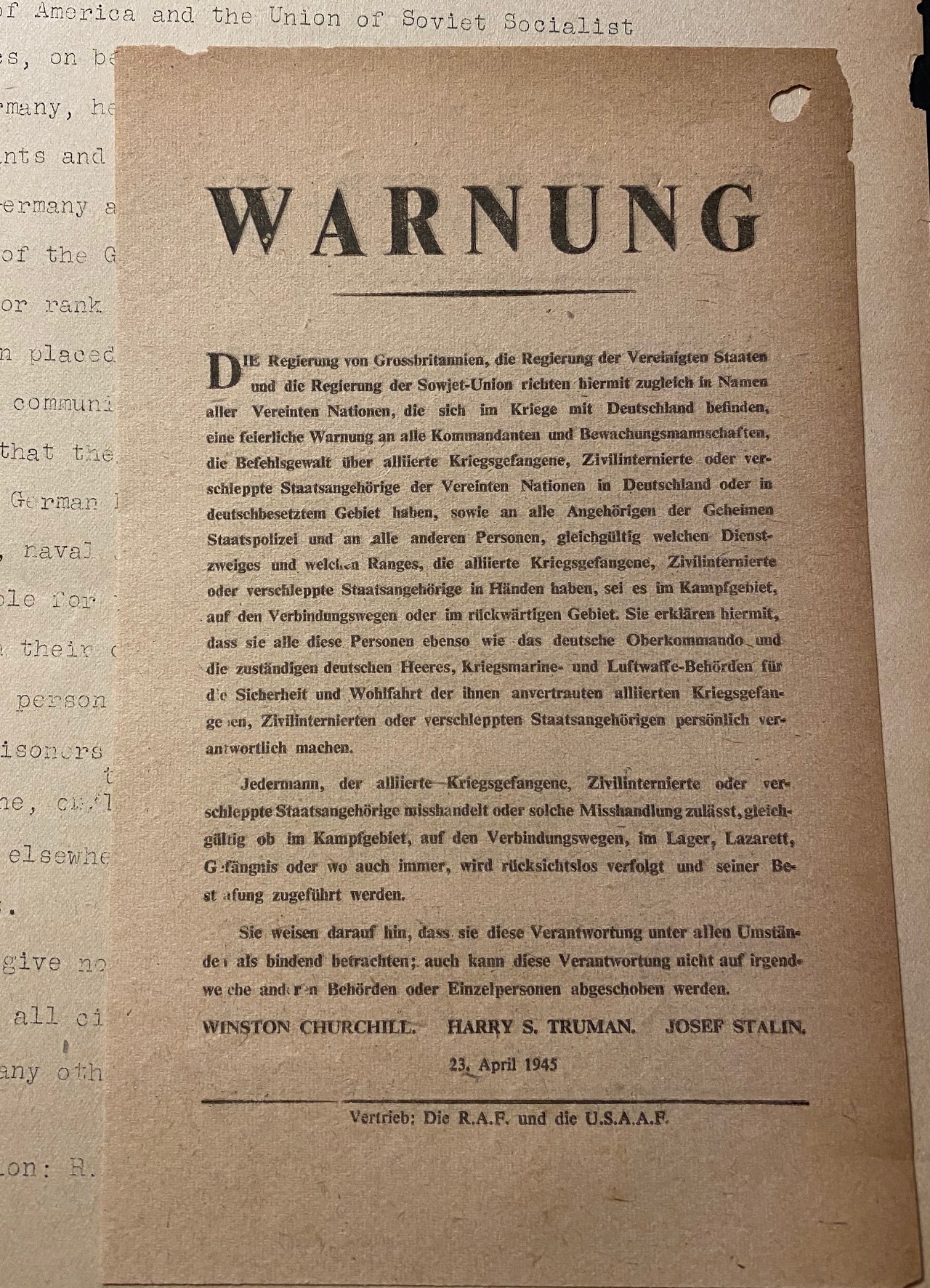
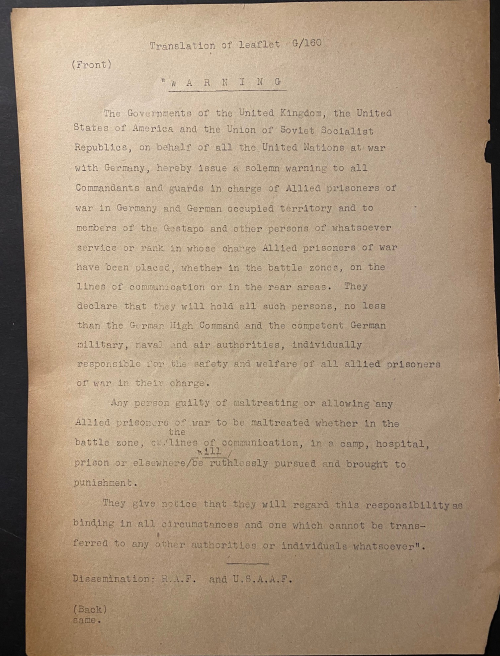
    IMG_3197This is one of the few remnants that I have of a larger collection of surrender and various sorts of propaganda leaflets dropped on the Wehrmacht and Germany in general in the last two years of World War II. (A longer post on this collection can be found elsewhere on this blog.) This leaflet, the “dissemination” of which was orchestrated by the R.A.F. (Royal Air Force) and the U.S.A.A.F. (United States Army Air Force) and were literally dropped in the tens of thousands on the remaining troops in the final weeks of the war, with the document dated 25 April 1945. (Mussolini was killed on this day, the German forces in Italy would surrender on 29 April, Hitler would commit suicide on 30 April, and the Battle for Berlin would be over on 2 May, with the unconditional surrender of the Third Reich coming in the middle of the night at SHAEF HQ at Reims.)

    This leaflet is particularly strong, warning that mistreatment of Allied prisoners in any way or form by Gestapo and its agents would not be tolerated and that if there was mistreatment then those responsible would “be ruthlessly pursued and brought to punishment”.

    This warning comes weeks after the liberations and “discoveries” of various concentration and death camps, the truths found in those places definitely helping to form bloody-minded warnings to anyone in Germany committing crimes against Allied POWs.

    Even though the propaganda bombing no doubt involved millions of pieces of paper, only a tiny fraction seem to have survived.

    Here’s the original along (and transcription) with a government-sponsored translation of the leaflet

    “W a r n i n g

    The Governments of the United Kingdom, the United States of America and the Union of Soviet Socialist Republics, on behalf of all. the United Nations at war with Germany, hereby issue a solemn warning to all Commandants and guards in charge of Allied prisoners of war in Germany and German occupied territory and to members of the Gestapo and other persons of whatsoever service or rank in whose charge Allied prisoners of war have been placed, whether in the battle zones, on the lines of communication or in the rear areas. They declare that they will hold all such persons, no less than the German High Command and the competent German military, naval and air authorities, individually responsible for the safety and welfare of all allied prisoners of war in their charge.

    Any person guilty of maltreating or allowing any Allied prisoners of war to be maltreated whether in the the battle zone, lines of communication, in a camp, hospital, prison or elsewhere will be ruthlessly pursued and brought to punishment.

    They give notice that they will regard this responsibility as binding in all circumstances and one which cannot be trans­ferred to any other authorities or individuals whatsoever.

    Dissemination: R.A.F. and U.S.A.A.F. IMG_3198

    ·Posted by :

    ·in:


  • Ancient Books and Manuscripts, Writing, and Writing Instruments

    JF Ptak Science Books   Quick Post

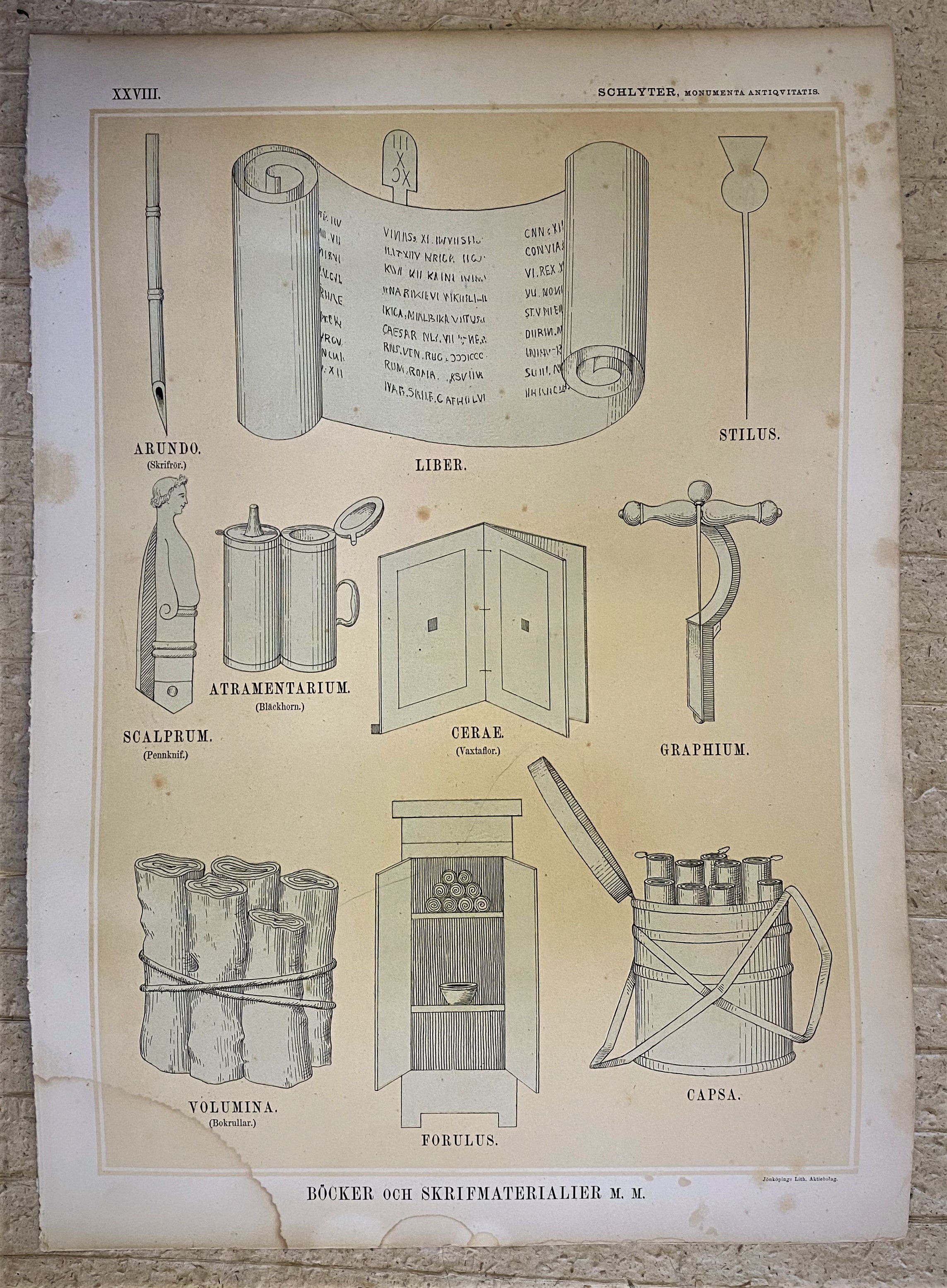
    Just a quick note about this fine and explicative image: it is a lithograph in color from Gustavus Ragn Schlyter’s Monumenta Antiquitatis, printed by Junkopings Lithografica in 1876.  It is rather large (19″x14″) and the work (on Greek and Roman antiquitiies) it is found in is scarce, as only four copies (two in Denmark, and one each in Sweden and Texas) are found in the librarians’ standard cataloguing tool, WorldCat–and the book turns up almost not at all in google and other appropriate searches…its absence is a little curious.

    In any event I found the bits and pieces of recording information to be interesting, so I went ahead and identified them for anyone who is curious about the segments of “book” production from 2000 years ago.  

    Identifying the elements of the lithograph:

    • Liber—literally, “book”, in this case being a Roman scroll written on papyrus.
    • Cerae—(from the word for “wax”), was similar to the Greek tryptich, a kind of primer that was composed of three hard surfaces, the interiors of which were covered in wax so that they could be reused many times.
    • Stilus—“stylus”, was used to incise figures in the wax Cerae, while the opposite (and flat) and was used to basically erase and smooth the wax.
    • Arundo—a filament of a hollow-core plant, used as a quill would be used.
    • Scalprum—a small cutting instrument
    • Graphium—another form of stylus.
    • Atramentarium—an inkwell (the inks being made of a mixture of carbon soot, resin, wine dregs, and cutdefish ink).
    • Volumina—a collection of scrolls or texts, “volumes”.
    • Capsa—a holder for volumina, the attendants of which were called “capsanii”.

    IMG_3145


  • Albert Robida, Visionary

    JF Ptak Science Books 

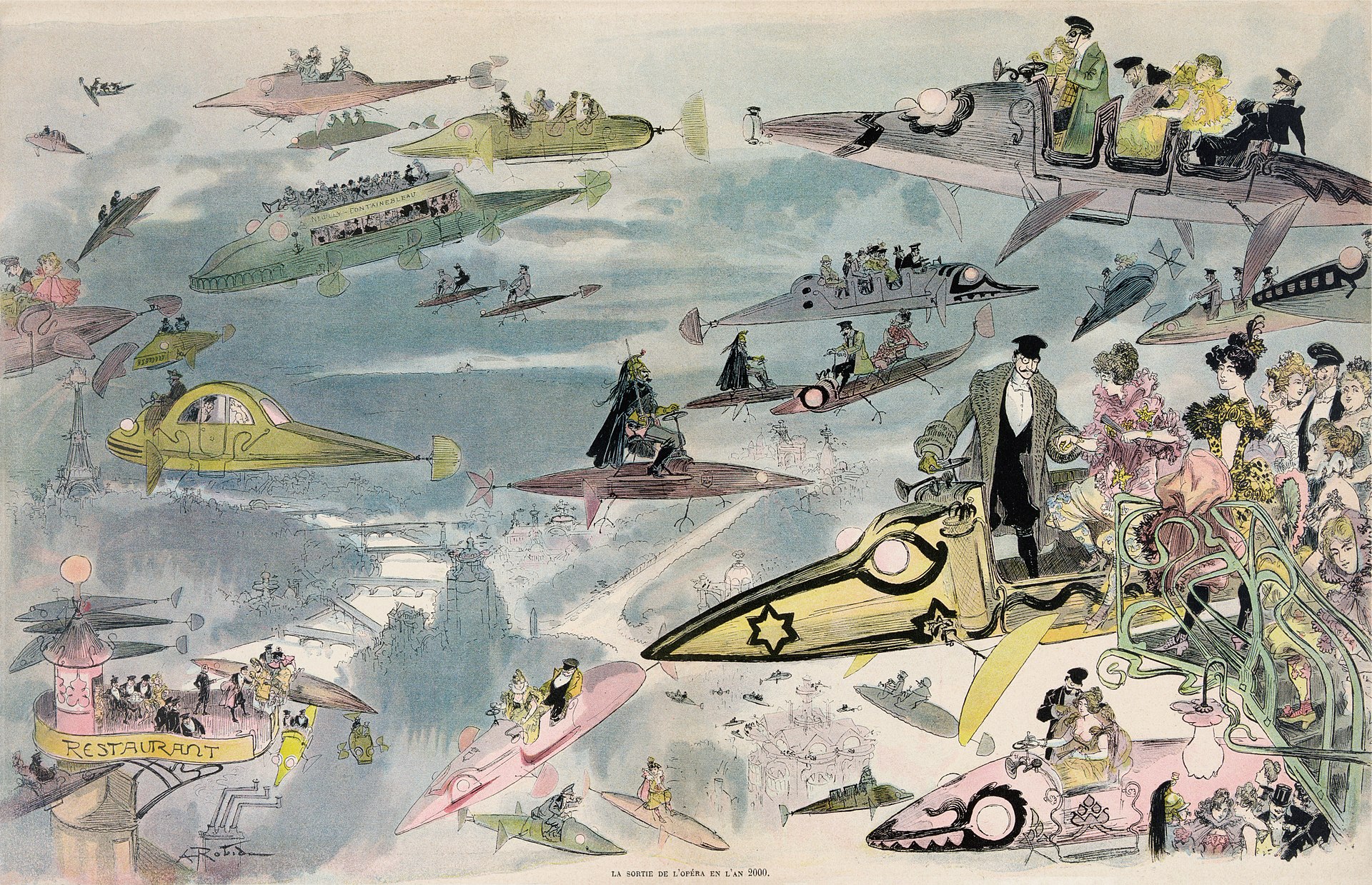
    Albert Robida, a fabulous visionary born in France in 1848 (dying in  1926) was an illustrator, etcher, lithographer, caricaturist, and novelist.  His greatest achievement is his futuristic trilogy, including Le Vingtième Siècle (1883), La Guerre au vingtième siècle (1887) and Le Vingtième siècle. La vie électrique (1890).  In general he has deep, realistic vision, the sort that puts him a similar plain as Jules Verne, but is differentiated from his famous French compatriot in that his creations seem more compatible with possibility, being more common, more fashioned to what the average person might come to expect of their future creature comforts.  In spite of a fantastic and perhaps unparalleled scifi imagination, Verne seems a little beyond the scope of the mortal future, maybe a little too much for their appreciation of whatever common class the future might hold room for.   

    La Sortie de l'opéra en l'an 2000


  • A Note on Reverseness–Time

    JF Ptak Science Books  Quick Post

    I was working on a paper by H.C.Corben on time dilation (“Time Dilation Effects in Space Travel” 1959) and the clock paradox and thought about just time moving backwards, in whole or in part, and went poking around the edges of things a little bit to see a few examples in the arts.  

    One story–or a piece of one story–is  in Vonnegut’s Slaughterhouse Five (1969), where we are introduced to backwards WWII narratives of B-17’s getting bullets sucked out of them by Germans while going in to retrieve their bombs to return to base. Martin Amis’ Time’s Arrow (1991) is another good one, though the end result was very troubling, where a doctor brings people back to life through his life though we are disgusted to see how much life he “gives back” as a medical doctor at Auschwitz. There’s Philip K. Dick , Counter-Clock World (1967) , with the charming idea of “old-birthing” in the grave and emerging from wood and dirt (don’t know about cremation); Fitzgerald’s Benjamin Button (1922) in which only one character lives in a reverse chronology; WR Burnett’s Goodbye to the Past (1934), which is a standard story except that it moves continually from 1929 to 1873; and Iain Banks’ Use of Weapons (1991) which tells one story going forwards and the other backwards, together. Remember, this is just a little taste of the literature, a ramble. 

    A few examples from the stage: George S. Kaufman and Moss Hart’s play, Merrily We Roll Along ( 1934 ), which is a narrative told in reverse order. Here’s an interesting theatre example: Harold Pinter’s Betrayal and Seinfeld’s “The Betrayal” episode, in which the later pays homage to the former, maybe, going so far as to name a principal character in the story “Pinter”–no doubt this is toxic to post-structuralists. 

    In cinema, Jean Epstein ‘s The Three Sided Mirror (1927) features a sequence where the events happen in reverse, while more modern examples include Atom Egoyan (The Sweet Hereafter, 1997), Christopher Nolan (Memento, 2000),  Jean-Luc Godard’s short (From the Origin of the 21st Century for Me, 2000), and many others.

    Then there’s the not-quite reverse storytelling line of the nonlinear story, which can go back and forth, or partially this or that, in movies like Citizen Kane (1941), Once Upon a Time in the West (1984), and Gance’s Napolean (1927); and in books like Ulysses (1922), Finnegan’s Wake (1939), and Flann O’Brien At Swim Two Birds, and many many others. It seems this category (and anachronism and parachronism) are much larger than the reverse time story, and seems to be initiated a little earlier as well.

    I’m not going anywhere with this one, just making notes…

    ·Posted by :

    ·in:


  • 1.8 Million Planes and 2 Million Tanks (1918)

    JF Ptak Science Books  Quick Post

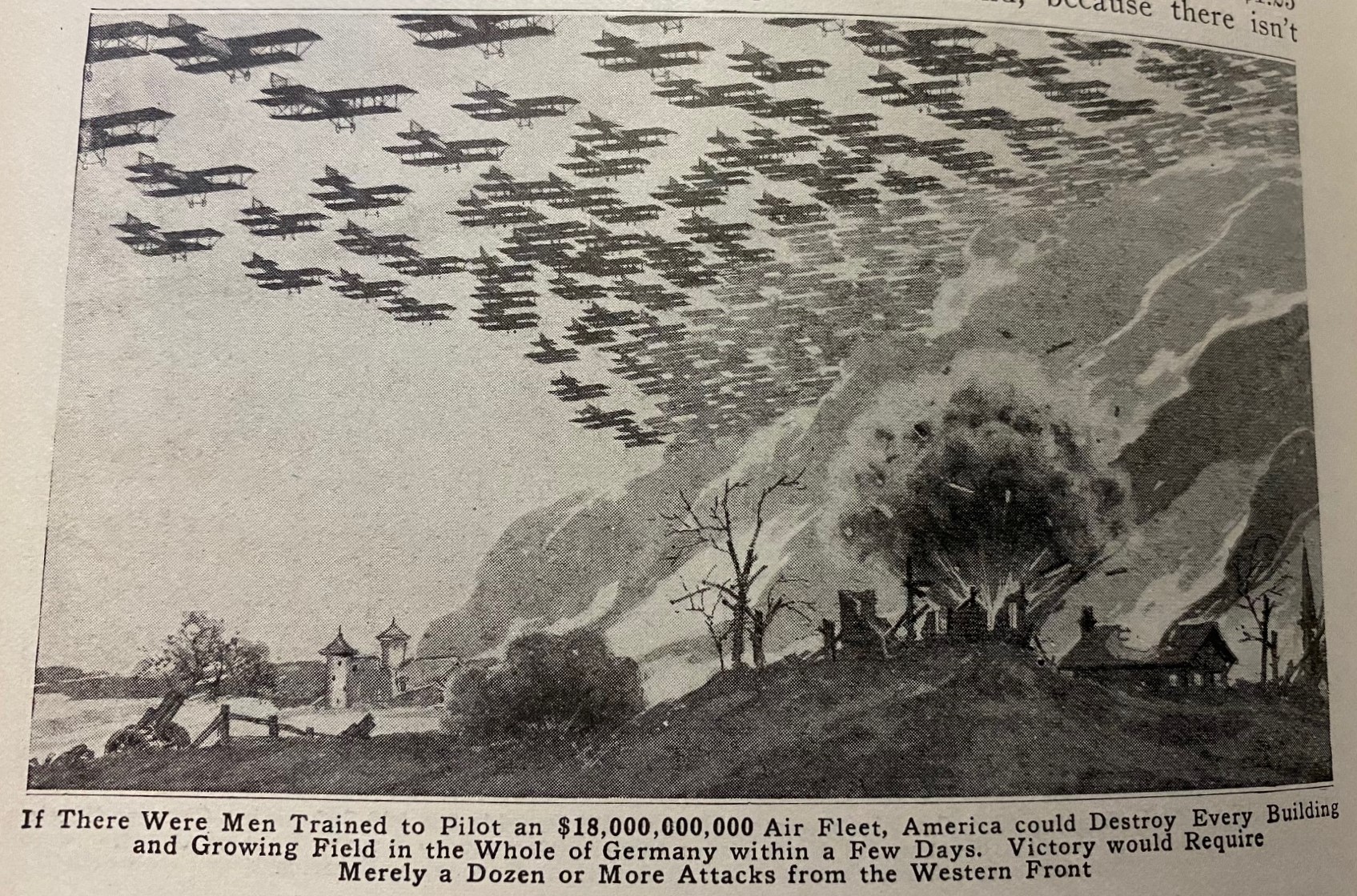
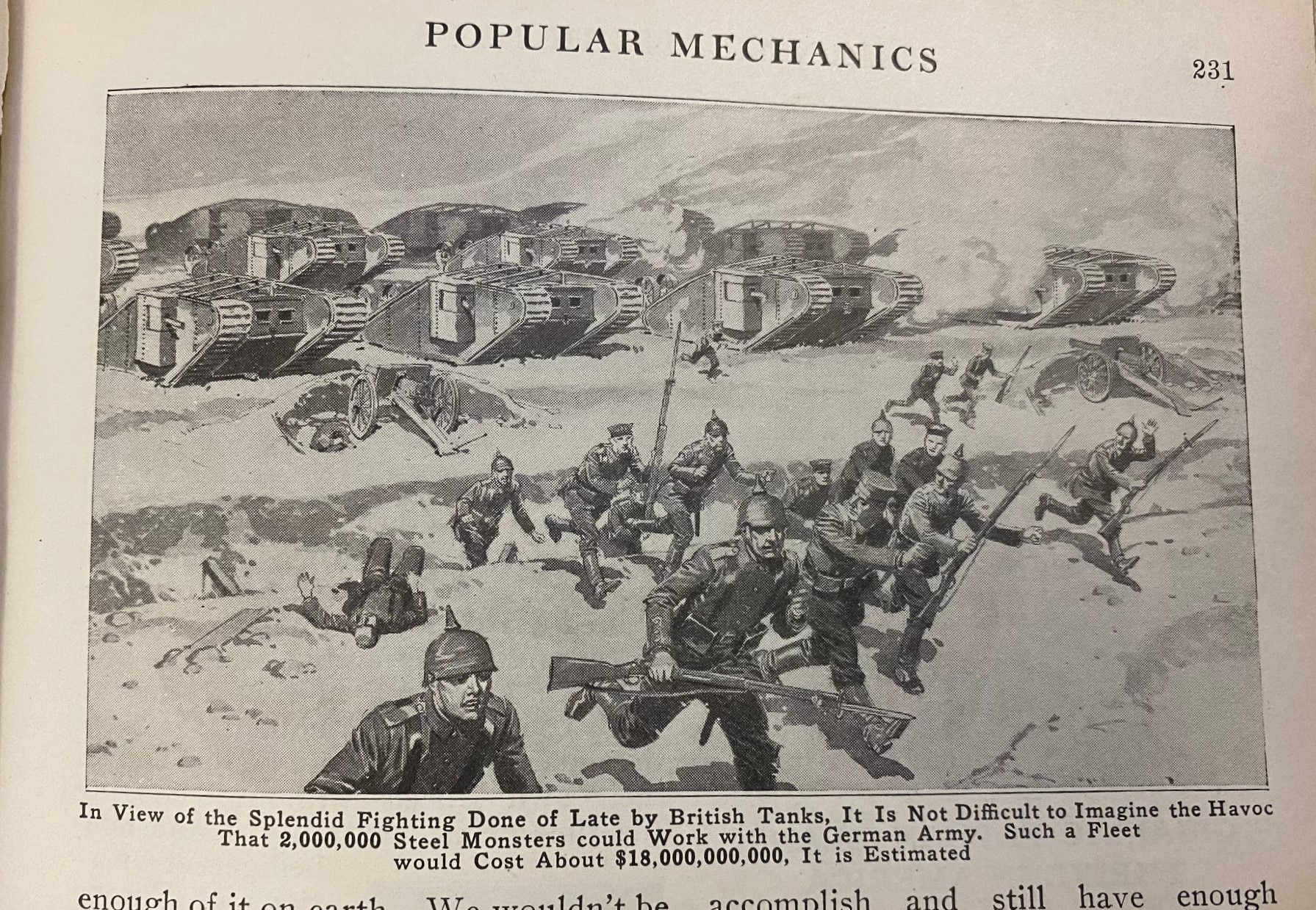
    Here’s a fine and somewhat misleading representation of the U.S. Congressional war allocation of 1918 for what was then the staggering figure of $18,000,000,000 (or about $387 billion in 2020 according to the BLS), found in the pages of Popular Mechanics for May 1918. To visualize the 18-billion, the editors displayed the amount in terms of something somewhat familiar to most readers.  For example, if the appropriation could be laid directly and only into the manufacture of airplanes (and bombs I guess) the editors guessed that the force would lay waste to all of Germany in about two days.  Guessing that each aircraft cost about $10,000 in 1918 that would mean there would be an attack force of 1.8 million planes.  Granting each a capacity of 500 pounds carriage, their entire force could deliver about 20% of the total tonnage dropped on Germany by the US and UK during WWII for each 1.8 million plane sortie.  (I’m guessing at some of the figures but I think that this is about correct.) Given that the “bomber plane” was still in its cradle, this could not have painted a very clear picture of what $18 billion dollars could buy.  Further guessing here is that there were fewer than 50,000 aircraft in existence in 1918, so imaging the 1.8 million figure would have been staggering. 

     IMG_3001

    IMG_3002Another example from the same article involves envisioning $18,000,000,000 worth of tanks, which in 1918 would cover fielding 2,000,000 of them. This of course is an enormous number, particularly having in mind that about 50,000 U.S. Sherman tanks were constructed between 1942 and 1945, which is about 3.5% of the total talked about in the article, and the largest tank battle in history at Kursk in July and August 1943 involved about 6,000 tanks between German and Soviet forces. Given too that the tank is only a few years on the battlefield at this point there was really no way that a person could visualize 2 million tanks–I suppose no commander in 1945 could have envisioned it, either.  

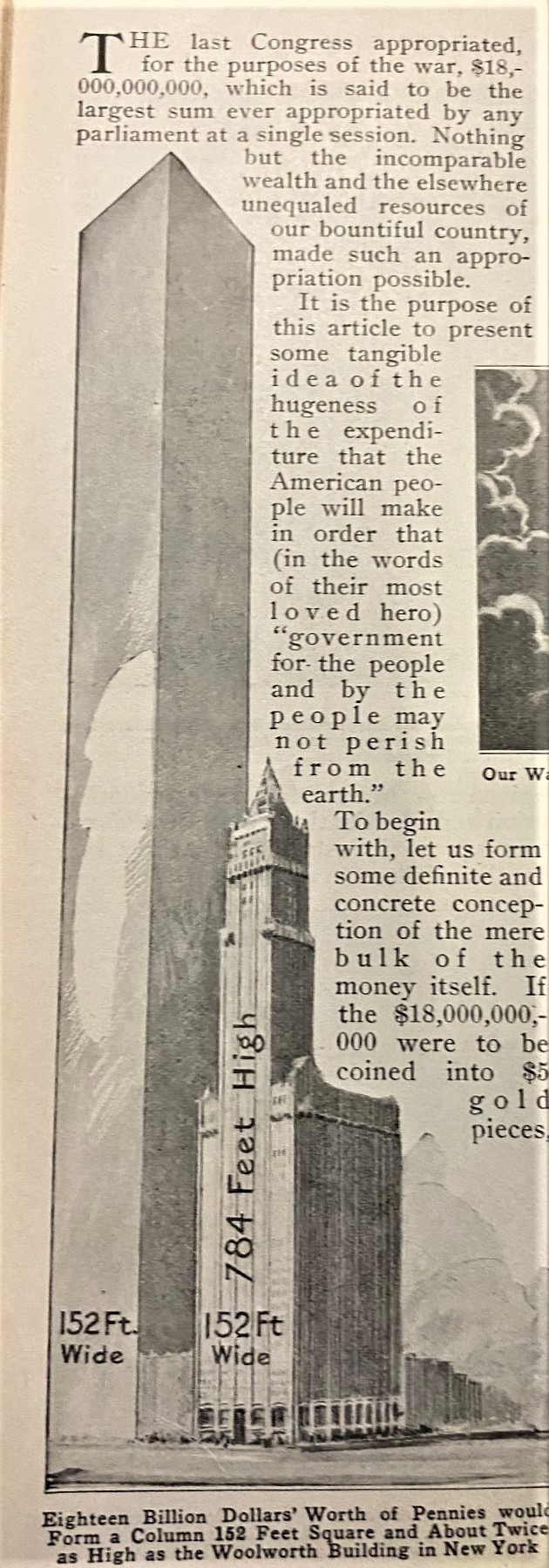
    And another example from the same article: using pennies and the Woolworth Building as comparables.  The Woolworth structure has found itself in a number of similar articles in the ‘teens, though I don’t recall seeing it compared to a 1.8 trillion penny mound, as we see below.  

    I think that the editors were just out and beyond their capacity in trying to visualize war funds in these comparative ways.

    IMG_2999


  • The Beauty of Simple, Tiny Windows (1940)

    JF Ptak Science Books  Quick Post

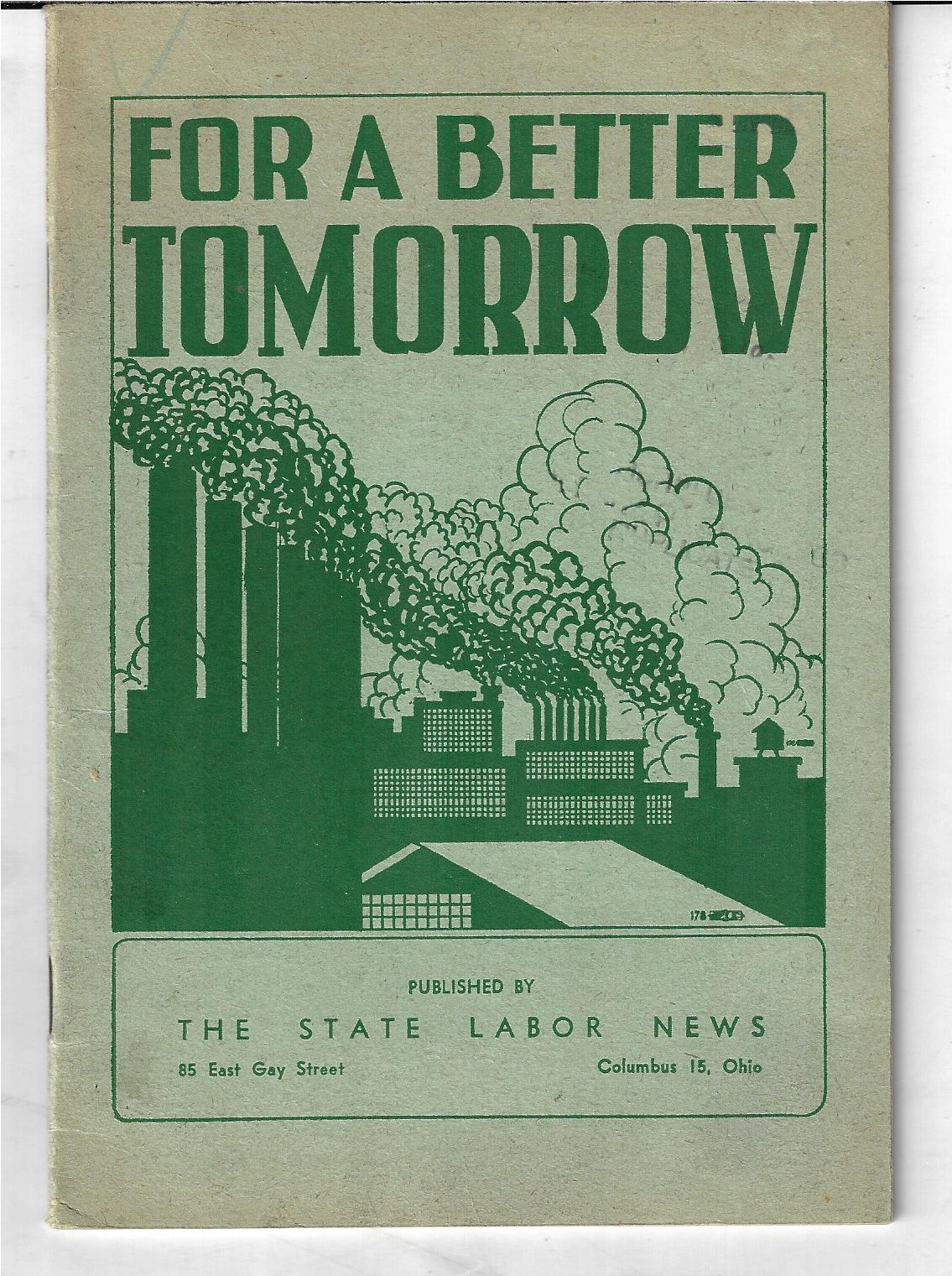
    Here’s another of my Quiet-Likes in cover design of pamphlets: simple representations of industrial/factory scenes with smoke and windows! This example is the cover of For a Better Tomorrow, published by the State Labor News (East Gay Street, Columbus, Ohio), 1940:

    Books Covers better tomorrow (2)


    ·Posted by :

    ·in: