A Daily History of Holes, Dots, Lines, Science, History, Math, Physics, Art, the Unintentional Absurd, Architecture, Maps, Data Visualization, Blank and Missing Things, and so on. |1.6 million words, 7500 images, 4.9 million hits| Press & appearances in The Times, Le Figaro, Mensa, The Economist, The Guardian, Discovery News, Slate, Le Monde, Sci American Blogs, Le Pont, and many other places… 5000+ total posts since 2008.

Author: JF Ptak

  • “The Perfect Smoke Column”—the New Miracle of Electronics, 1952

    JF Ptak Science Books  Quick Post

    Electronic cigarettesLiggett & Myers, the producer of Chesterfield cigarettes, sounds the triumphal blast of “the greatest cigarette improvement in thirty years” in this LIFE magazine ad from 1953. It was all made possible by SCIENCE and the sacred mysteries of electronics, which helped create the “perfect-smoke-column-from-end-to-end”, which doesn’t sound all that appetizing though I guess it was if you were a lazy or distracted ciggie consumer. To prove the claim we see a model with perfect un-ciggied teeth with an inset of electronic machinery in the background, which made it look as though the stuff was being produced by the machine.

    The machine doing the great scientific deed was the AccuRay. It was a measure and control system produced by Industrial Nucleonics (beignning their industrial life in 1912 as a steam power supply systems company), which ensured that the cigarettes would be the same, million after million, each being the same length and with the same mount of tobacco. “Scientific miracles never cease”, said the Liggett & Myers people, and I guess the stained proof was in the smokey pudding.

    It may have been all about the burning, as a cigarette that doesn’t need to be drawn on to keep it lit means that it will burn itself out in the allotted time even if you just lighted the thing and kept it in the ashtray. Better burning meant more cigarettes consumed, and so on.

    And by the way Industrial Nucleonics was sold in 1987 to a perhaps more appropriately-named Cumbustion Engineering, at least so far as cigarettes were concerned.


  • Worse than “Science Jokes”: Songs of Biology (1945)

    JF Ptak Science Books   Quick Post 

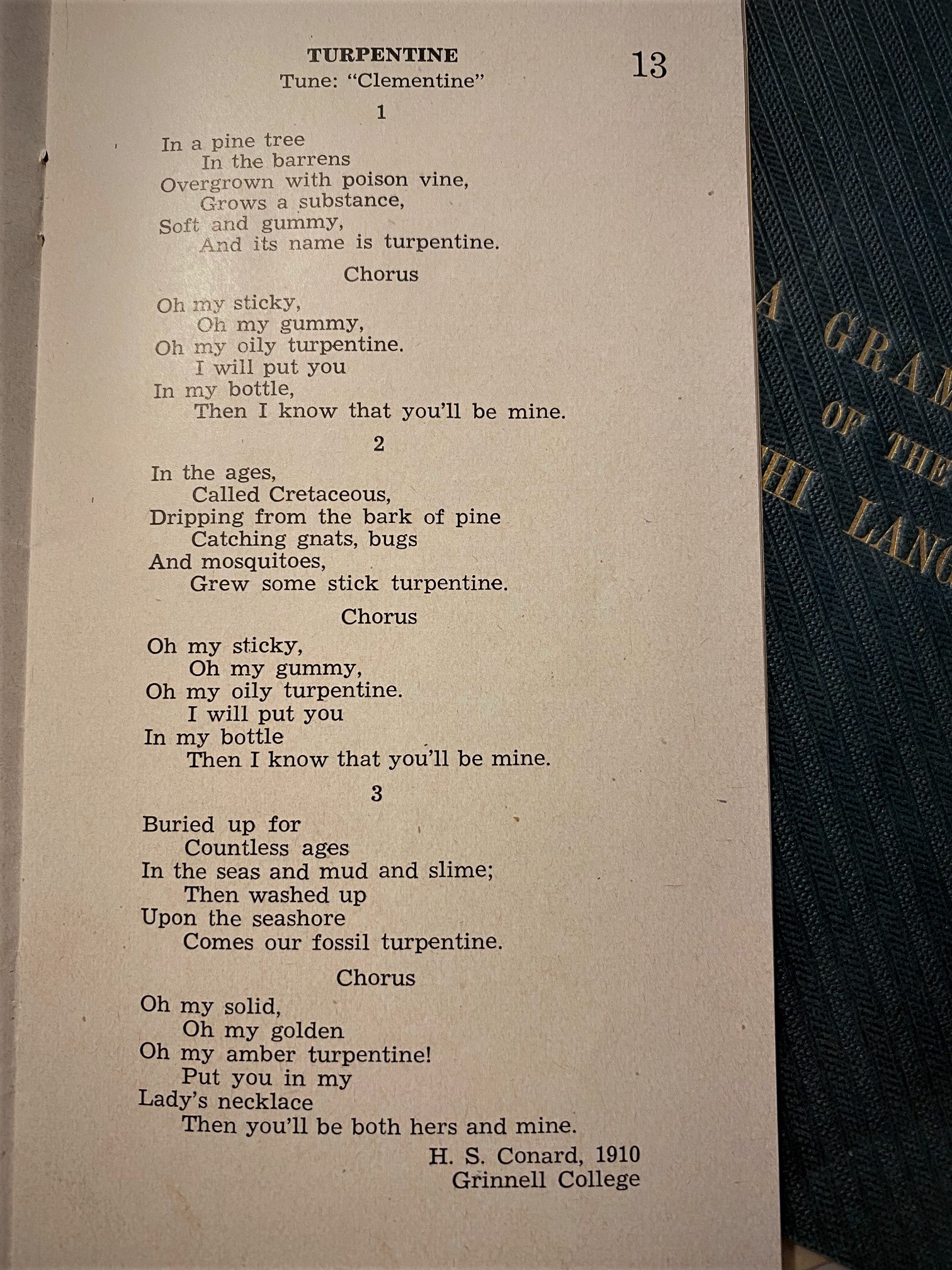
    IMG_2973 (1)Tonight I found a wonderful little biology pamphlet sandwich between two other very thin pamphlets—Free Our Political Prisoners, by the League for the Amnesty of Political Prisoners, ca. 1920, and A Grammar of the Marathi Language, 1868—the three of them together not weighing four ounces. The bio pamphlet is a very non-droll and forced-funny publication out out by the Beta Beta Betans of Mt. Vernon, Iowa, at the end of the War in 1945, and is called Songs of Biology. None of them are any good, though they’re not quite bad enough to land in the safety zone of so-terribly-bad-that-it-is-good. The only simultaneity that occurs here is the level of badness living down to its expectation.

    I do have to commend them on at least some of the song subject and titles, several of which were very unexpected. For example, I doubt that many other songs have been written about turpentine. A few of the others that are more enjoyable to imagine the lyrics than to read them are “The Sad Fate of a Youthful Sponge”, “Objective Tests”, “Parasites on Parade”, “The Germ-Laden Bucket”, “The Simple Arthopod”, and :”ode to Drosophila”. They’d be better with no music and no lyrics.

    Anyway, I present the glory of turpentine…


    ·Posted by :

    ·in:


  • The Beauty of Simple, Tiny Windows (1940)

    JF Ptak Science Books  Quick Post

    Here’s another of my Quiet-Likes in cover design of pamphlets: simple representations of industrial/factory scenes with smoke and windows! This example is the cover of For a Better Tomorrow, published by the State Labor News (East Gay Street, Columbus, Ohio), 1940:

    Books Covers better tomorrow (2)


    ·Posted by :

    ·in:


  • Radical and “Socialistic” Ideas of 1939 Mainlined, Mainstreamed, and Main-Streeted

    JF Ptak Science Books  Quick Post

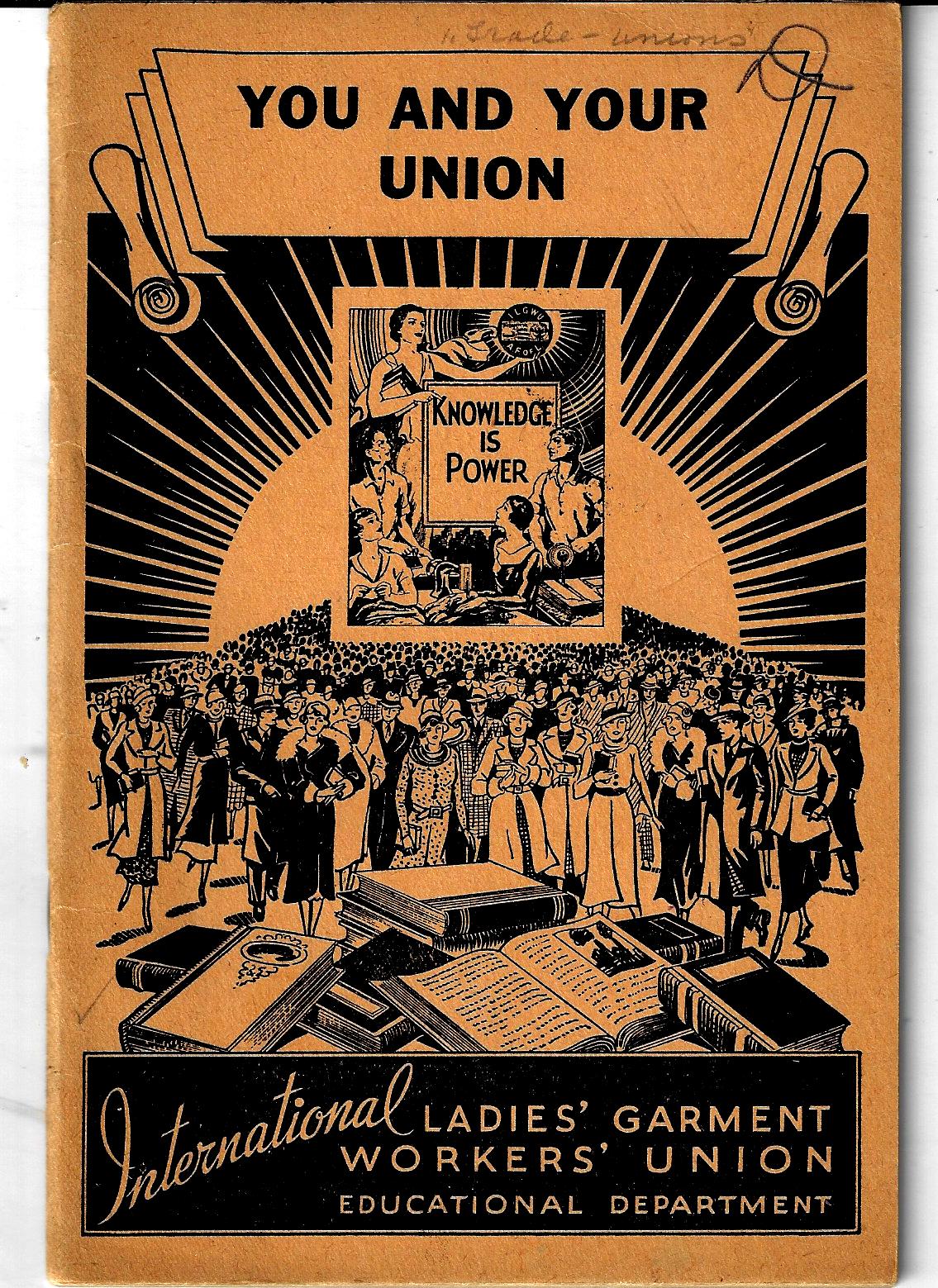
    Books cover ILGWUHere’s another very striking cover for a pamphlet embracing   once-radical semi-socialist pseud-Commie agendas that are today a de rigueur part of our social existence. This is a pro-Union, pro-educational work presented by the International Ladies’ Garment Union (education Department) to its members, getting them up to speed on the major issues of the day. Many of these battles fought by the union were bitterly opposed by industry and (sometimes) the government were for programs and agencies that many take for granted, and something utilized by everyone no matter the political leaning, the bright shining “Socialist” aluminum coating for the future long gone as these programs have become “normalized”.  Some of the issue addressed by the pamphlet were whether or not women could join a union or a labor movement (though 1940 seems a little on the late-ish side for these questions), the necessity of unemployment insurance, social insurance, maternity insurance, old age security, health insurance, and safeguards on the working life of children under 14 years of age.  

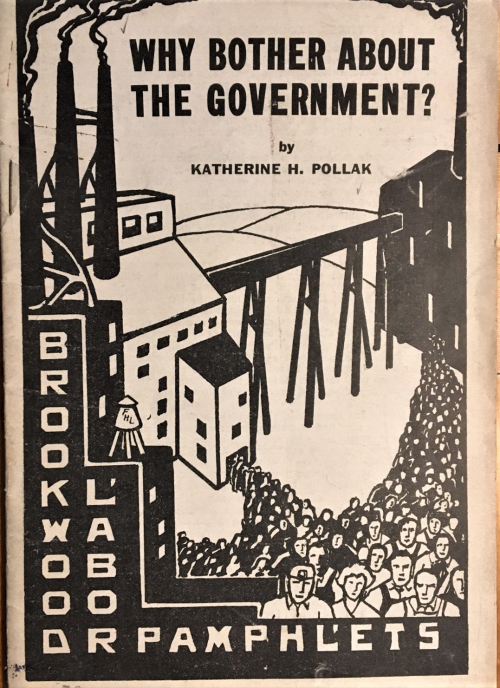
    That, and I also liked the design, the giant parade of women coming from out of the rising Sun.  I’m partial to these mass/crowd images on pamphlet covers–you don’t see them terribly often so when you do the work really stands apart. Here’s another example I wrote about in August 2020, Katherine Pollack’s 1932 Why Bother About the Government, the third installment of the Leftist Brookwood Labor College pamphlet series. It is a bit of a Socratic polemic about the problems and advantages of government, owners of the means of production, workers, and labor organizers…coming down firmly in the square of very-pro forces of organized labor:

    Books covers why bother the government


  • Delambre’s History of Greek Mathematics (Almost) in English (1811)

    JF Ptak Science Books   Quick Post

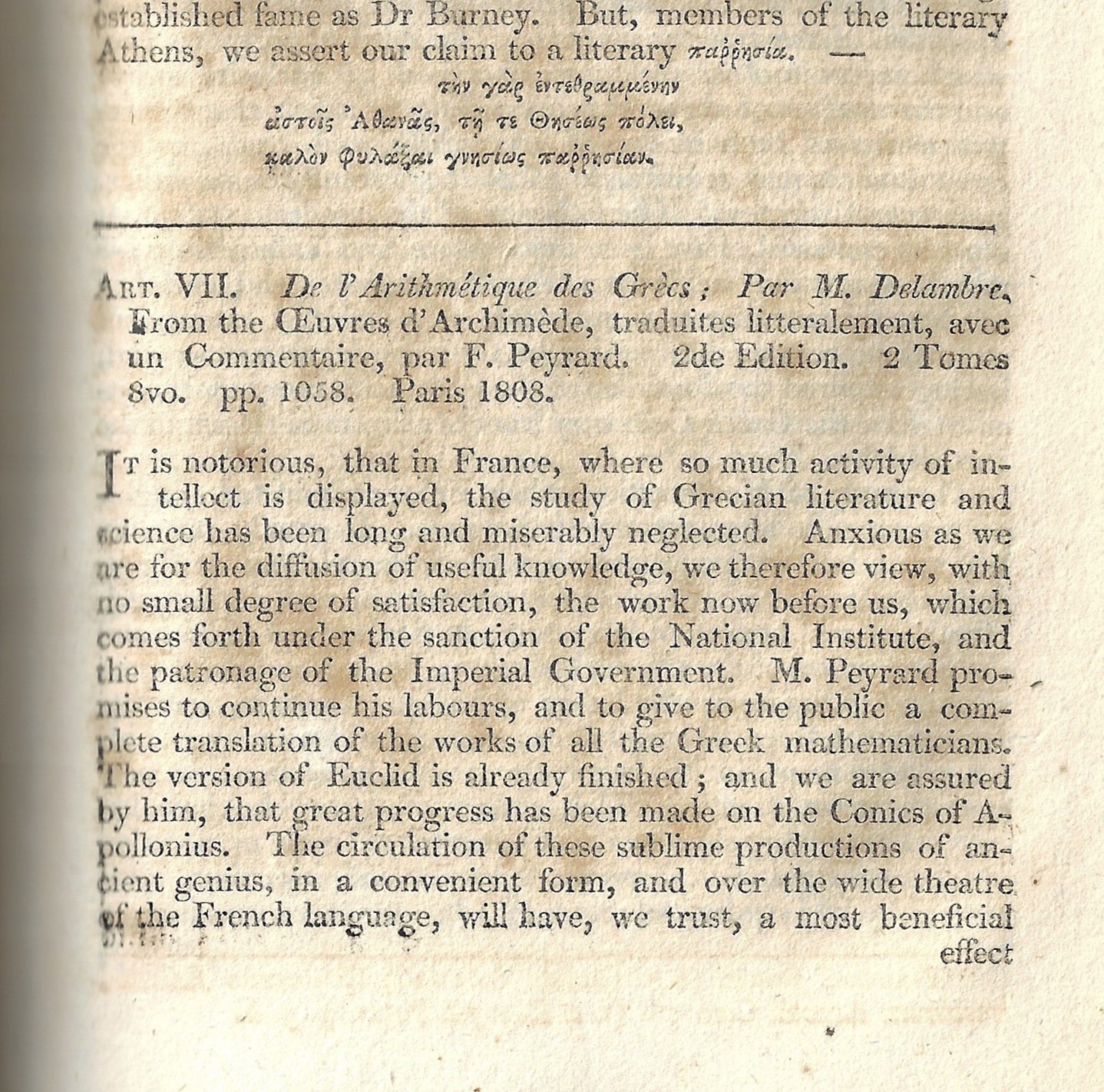
    Edinburgh Review 1811 delambreI found the following while strolling through a volume of teh Edinburgh Review for 1811. The ER was an excellent “magazine, with much in common with the New York Review of Books and The Times literary Supplement–it was meant for a mass audience of careful readers, and performed critical reviews and examinations of newly-published major works. Analysis was done on 40-60 books per year, spread out over about a thousand pages, so there was a lot of space dedicated to each work.  What I’m sharing here is the mathematician Jean-Baptiste Delambre’s (1749-1822) contribution to Francois Peyrard’s (1760-1822) Oeuvres d’Archimède, trad. littéralement, avec un commentaire, par F. Peyrard,…. suivies d’un Mémoire du traducteur sur un nouveau miroir ardent. et d’un autre Mémoire de M. Delambre sur l’arithmétique des grecs... Delambre’s contribution, “De l’Arithmetique des Grecs”,  ran on pp 569-601 in this 1058pp work, and so far as I can find has not been translated. The review occupies pp 185-214 in this volume of the ER, and is in English, so I thought there may be some history/maths folks out there who would like to read it. The image at left is from the copy here; the full text link is provided by Google Books.  

    Full text:  https://babel.hathitrust.org/cgi/pt?id=uc1.b2972985;view=2up;seq=196  (The text clears up with a one-level zoom.)

    ·Posted by :

    ·in:


  • The Underground Vaults of Harper & Brothers, 1855

    JF Ptak Science Books  Quick Post

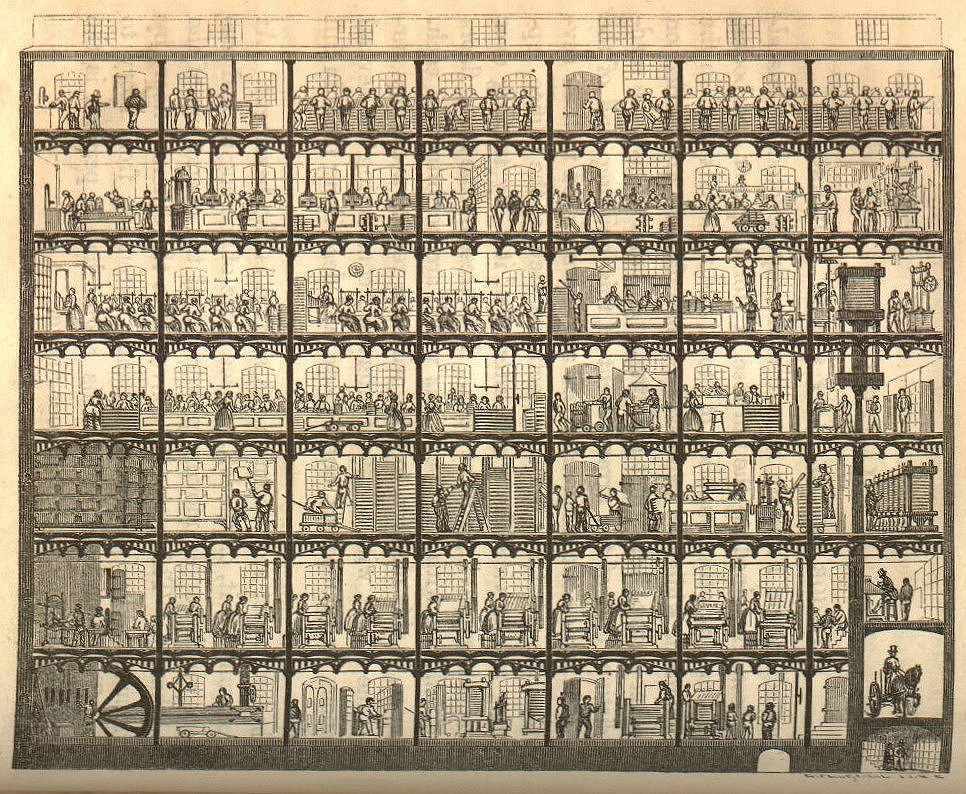
    I found this fantastic cross-section of the Harper & Brothers publishing house in Jacob Abbott’s The Harper Establishment, or, How the Story Books are Made, published of course and thankfully by Harper in 1855, and found in its entirety here.

    Harper & Bros memory vaults

    The whole of the enterprise is explained on pp 43-49.  I’d really like to return to this image at some point, because there are more detailed engravings in the book to match every section of the building, and to me it looks like this image could be turned into a 19th Century Printing and Publishing Board Game.

    What I was interested in right now was the box on the extreme bottom-right, which turns out to be The Vaults–this is the central memory core of this publisher, a 200-foot-long, 8×8′ corridor lined with the original plates for all of the publications of the firm.  The plates for their single-volume version of Herman Melville’s Moby-Dick would’ve been put down there just a few years ago. 

    “The plates are stored in subterranean vaults built under the streets that surround the building. The entrance to these vaults has already been shown in the sectional view of the Cliff Street building, on page 42. (A more enlarged view is shown on the preceding page.) The vaults extend under ground for two hundred feet in length, and in dimensions are eight feet wide by eight feet high. They are shelved on both sides, and the shelves are loaded with plates–stereotype or electrotype–representing all the works published in the establishment. There is one plate for every page of every one of the many hundreds of volumes which the house publishes, making from fifty to seventy tons in all.”

    “When a new edition of any book is required, the plates are brought out from these vaults and put upon the presses. When the work is finished, they are taken back again to the vaults.”

    ·Posted by :

    ·in:


  • Lunar Space Suits, 1950

    JF Ptak Science Books  Quick Post

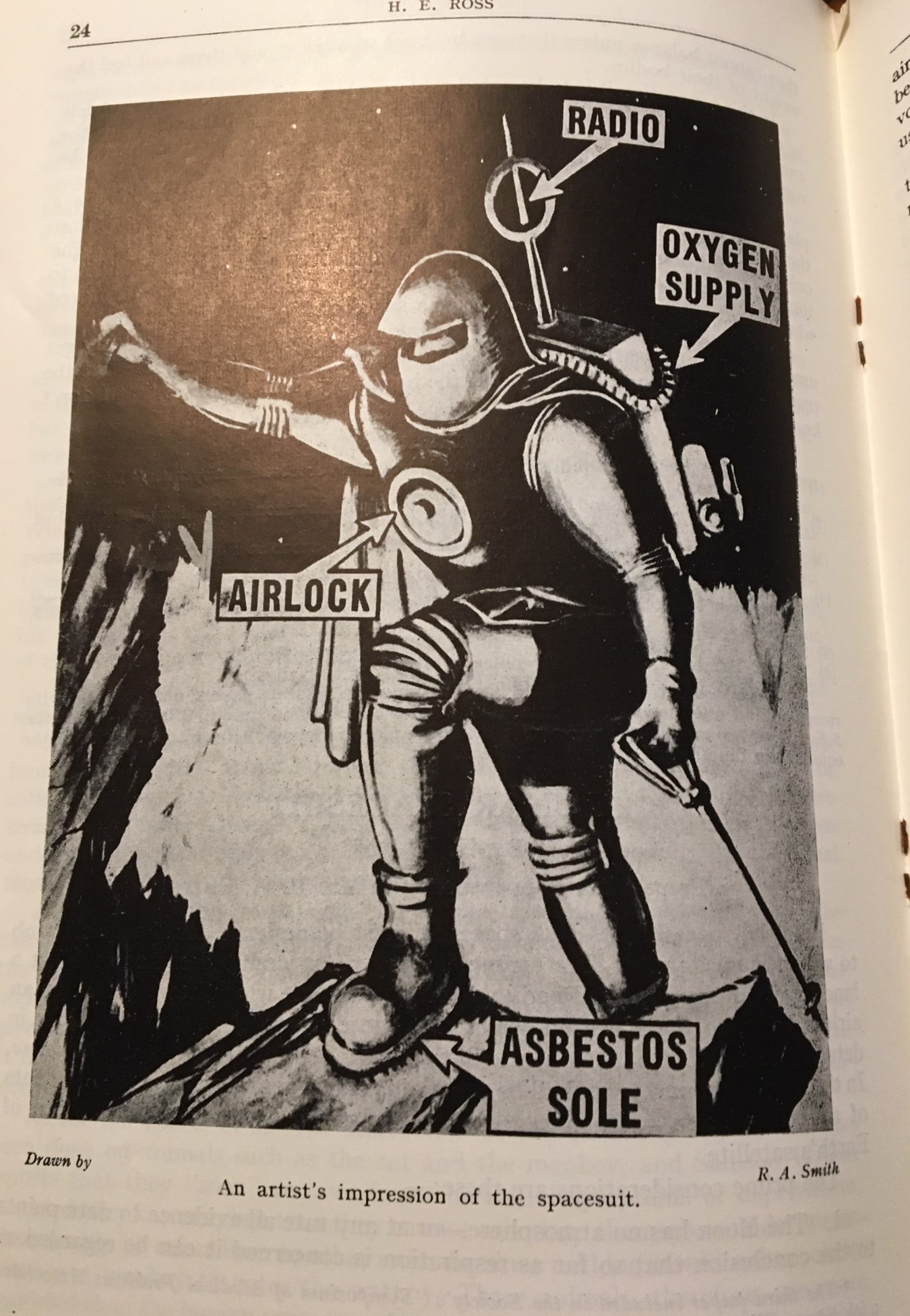
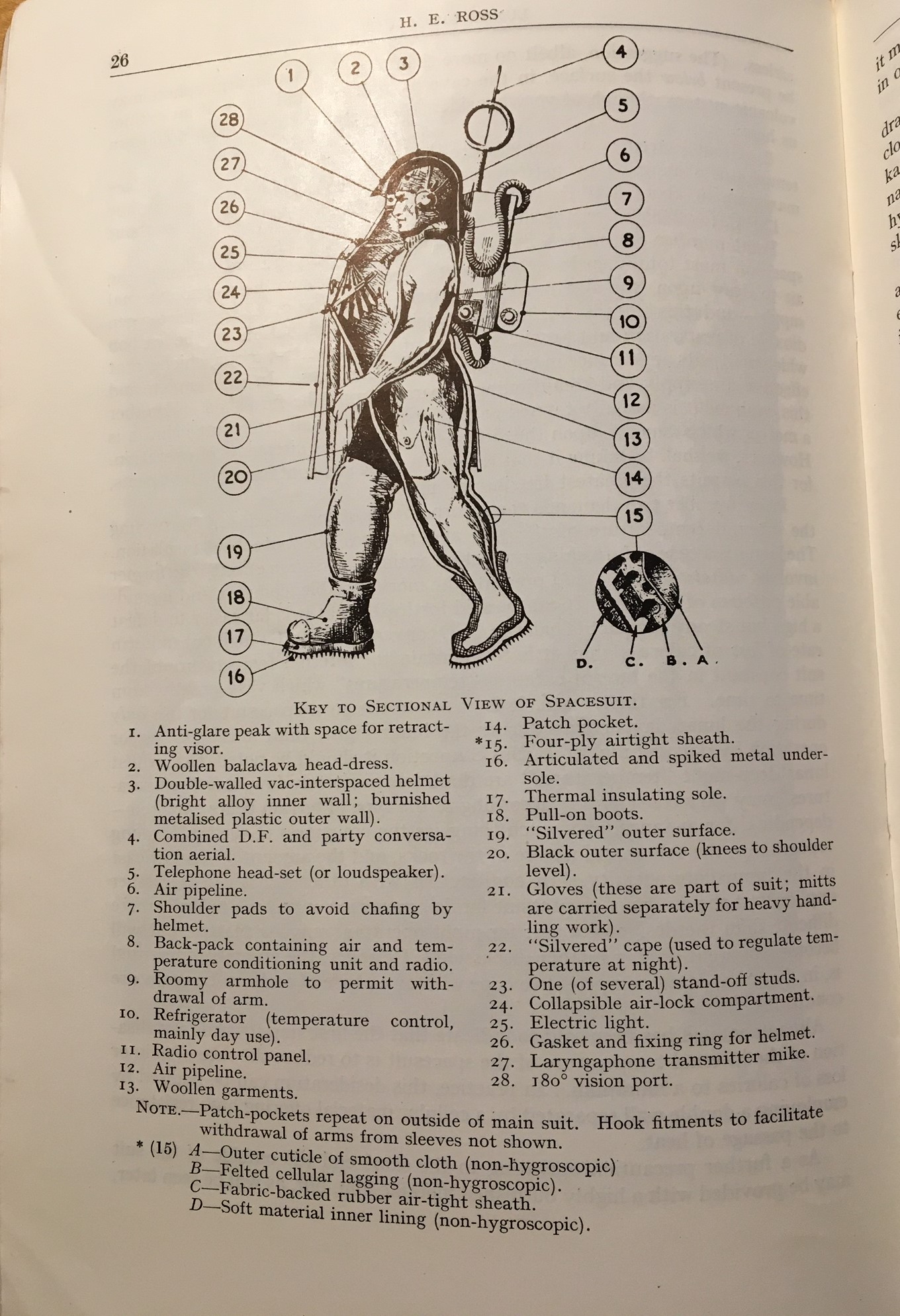
    IMG_2183This is just a very quick post based on a book that I’m trying to sell over on the bookstore end of this blog–the images are arresting and interesting, and I at least wanted to share them here.  These two illustrations are the first serious scientific study of what sort of suit would be needed to survive on the surface of the Moon (according to the Space Centre UK website) and appear in  H.E. (Harry) Ross’ article “Lunar Space Suit” as it appeared in the  Journal of the British Interplanetary Society, (vol 9/1, January 1950) . Enjoy. 

    “In a November 1949 symposium, Harry Ross presented a paper on the “Lunar Space-Suit”. Ross had examined the problem of a 68 kg lunar space suit (equivalent to 11 kg on the Moon) which could be worn for up to 12 hours, within the temperature range of 120 degrees to minus 150 degrees Celsius, representing night and day. The suit design was a 4-ply, made up of a thin exterior skin of closely woven cloth. It had a 1 cm layer of cellular heat-resisting material (Kapok, wool, felt et cetera) and a 1-2 mm main airtight sheath of fabric-backed natural or synthetic rubber. It also had an interior lining of non-hygroscopic material, mainly for comfort and to manage contact between the rubber and skin and absorption of the water-vapour. The exterior of the lunar space suit was to be a highly burnished metallic film, designed to reflect as much heat as possible.”

    IMG_2184“The helmet was to be a light, rigid double-shell structure, with the inner a bright alloy metal and the outer a plastic with burnished metal coating. Lateral vision of 180 degrees was proposed with a minimal vertical extension in order to minimise heat gain or loss. A special glass to prevent heat and actinic Ultra-Violet rays would be employed…”

    “The space suits that were eventually worn by the Project Apollo astronauts are a far cry from this original 1940s design. But the work started out by Harry Ross, led to credible thinking on how humans could survive in a self-contained, mobile habitat. The original paper by Harry Ross is [this paper].” –British Interplanetary Society website


  • Where Suspended Railroads and Elevated Highways Meet: Los Angeles Traffic, 1939

    JF Ptak Science Books  Quick Post

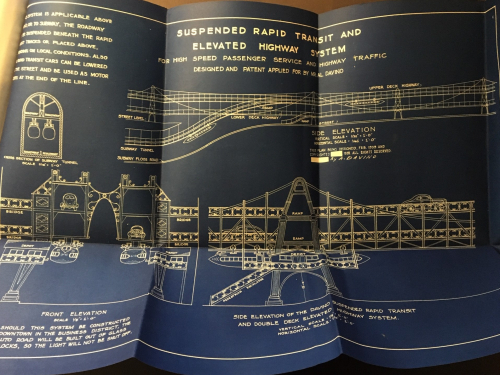
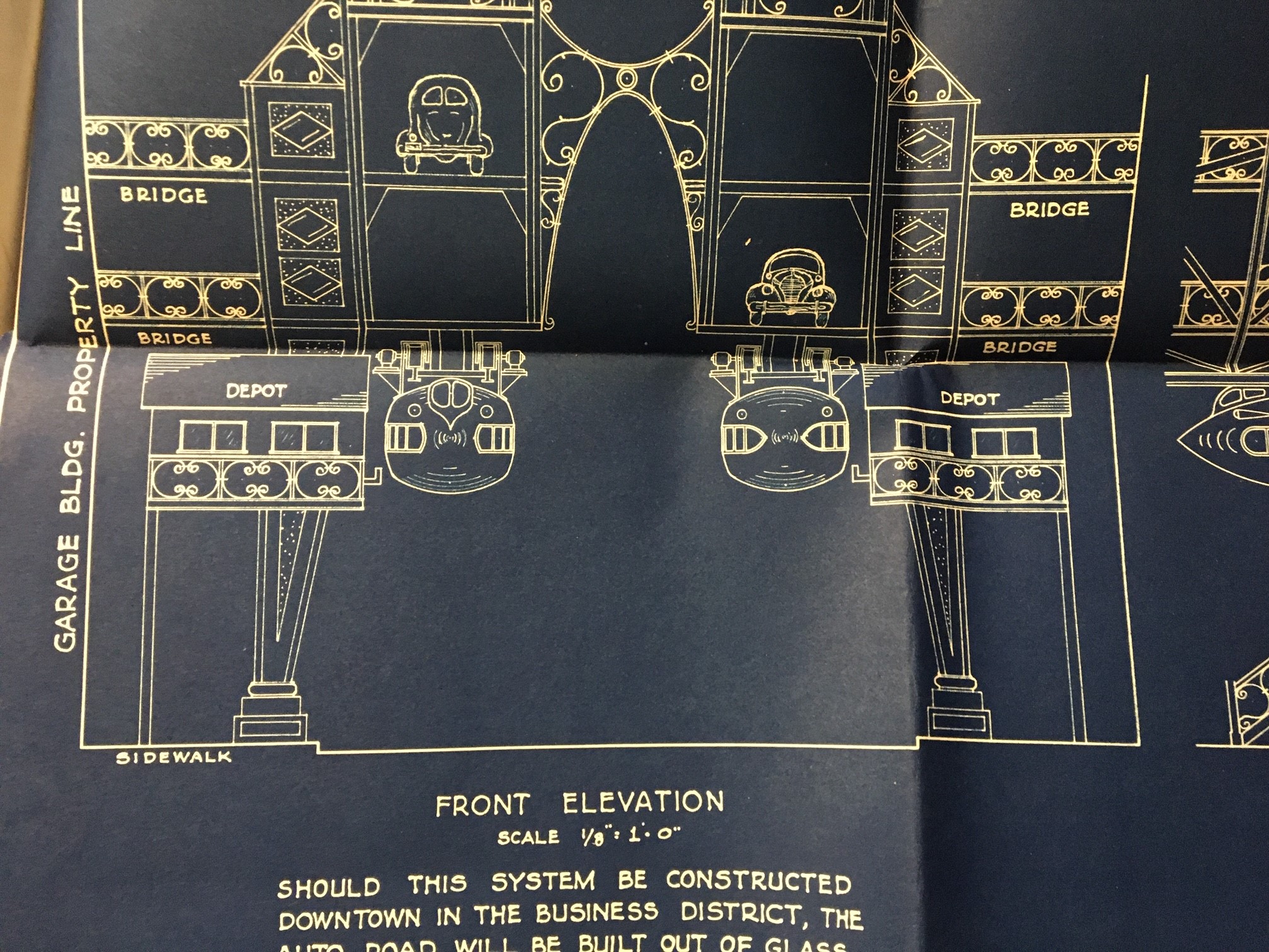
    Here we go: I unearthed a beautiful if not a very good solution to the traffic congestion problems in 1939 Los Angeles. It is a rare, self-published work of what seems to have received almost no attention, suggesting a combination of suspended railways and elevated roads to free up more space on the streets of L.A. It is the work of Alphonso Davino (1888-1965?) who wrote A Brief analysis of the Traffic Congestion Problem and its Economical Solution1 and presented it to city planners in 1939.  Mr. Davino had an entire system of transportation, though he seems to have luck in getting the ideas across a wider population in only occasional and obscure publications. 

    IMG_2251

    I can not find very much at all for Mr. Davino, though he is a patent holder for at least three associated designs/ideas dating from 1926 to 1950. [Semirigid Suspended Railway Structures, 1607875, (1923); Aerial Railway Apparatus patent 2234487 (1943); Suspended Rapid Transit System 2781001A (1950), (suspended vehicles with self-propelled vehicles).] I also found a reference to a suspended transportation system of some sort offered by him through his business “Aerial Apparatus” of Los Angeles (in the Mining Journal, vol 110, 6 November 1920, p 910).

    IMG_2254


  • Surfacing Underwater Work–the Ambrose Canal Dredging Measured in Woolworth Buildings (1913)

    JF Ptak Science Books  Quick Post

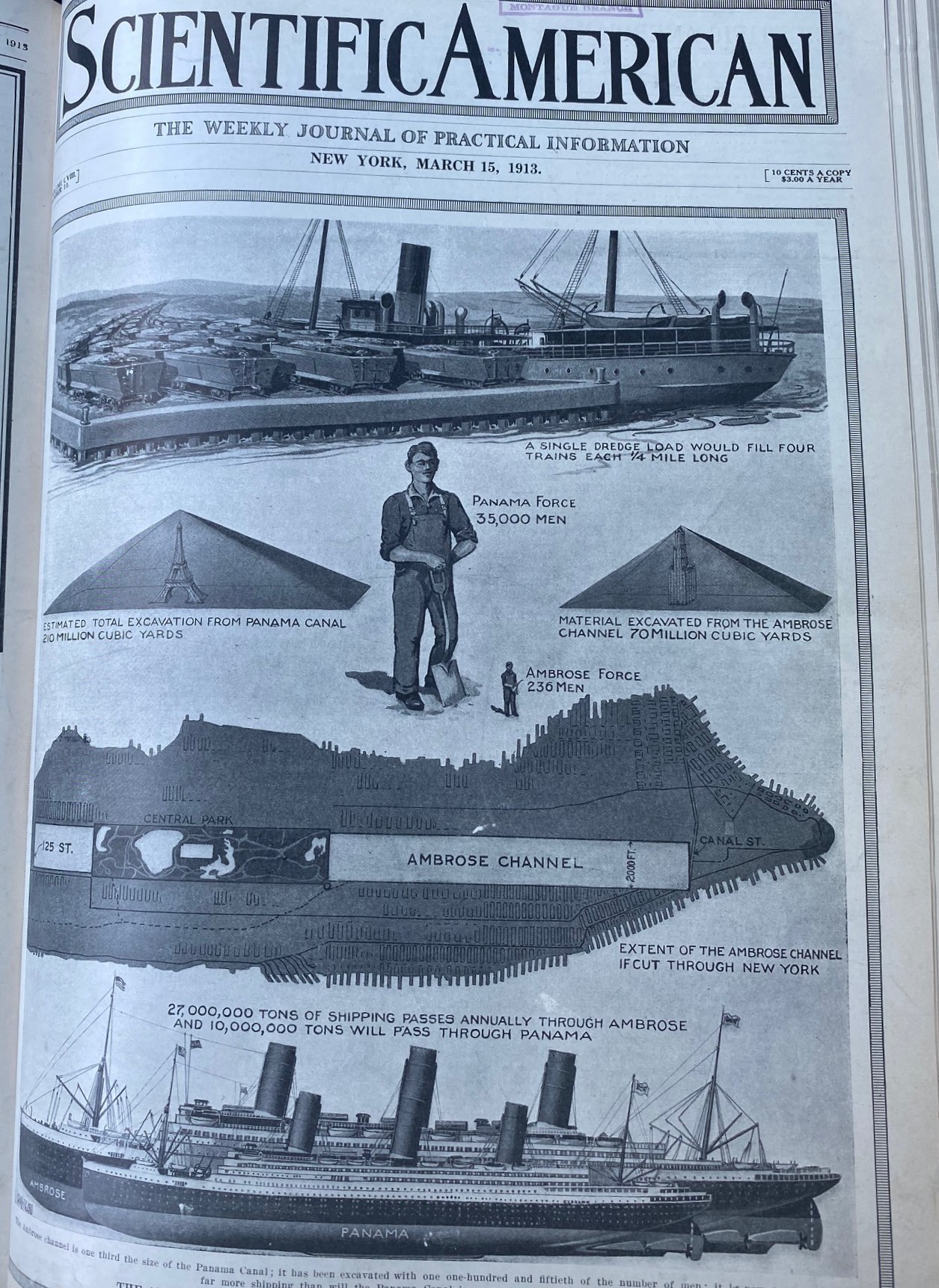
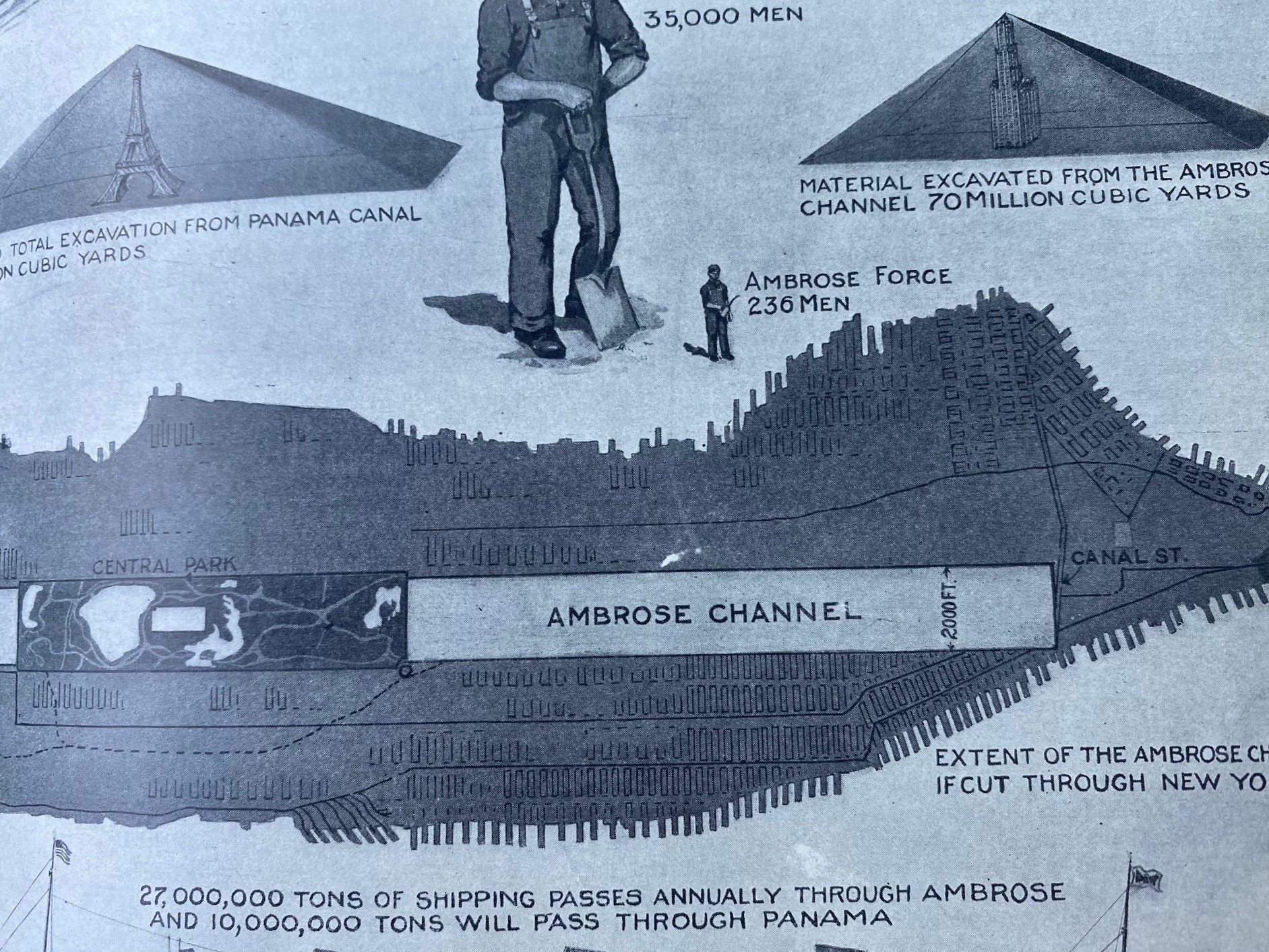
    IMG_2334 (1)Another great example of the artistic display of information using alternative comparison, and this just hours after finding/writing  about another example in this area.  This morning’s find uses several different types of comparisons, the first of which–like last night’s—is using a comparable entity to value the expression of quantity. And again, like last night’s, this short article (from Scientific American for 15 March 1913) uses the newly crowned Woolworth Building to illustrate how much dirt was removed in the dredging of the Ambrose Channel in NYC.  (The Ambrose Channel is in the entrance to NYC harbor, and it seems as though the dredging the author is talking about lies in the lower NYC harbor out past the Narrows.1)

    What was weighing on the mind of the writer was that this project removed  a very considerable amount of soil and was in some high fraction a comparable to the excavation of the Panama Canal, except that you couldn’t see any of the Ambrose project given that it was all taking place underwater. This effort in the SciAm was made to give some surfaceable form to the work going on  under the water in the Narrows. 

    There was a very considerable amount of earth removed, no doubt–difficult work, but not exactly an engineering feat like the Panama Canal that it was being compared to. Nevertheless the interesting minds of SciAm showed what the invisible channel would look like if it was dredging a 40’x15′ by multi-mile section of Manhattan, which is an excavation that would stretch from downtown to north of Central Park.  

    In any event, this reporting job must have been a good bit of fun (and it shows), and was a fairly elegant and memorable means of communicating some big numbers of an invisible project. 

    IMG_2335 (2)

    Notes:

    1. “Ambrose Channel is the only shipping channel in and out of the Port of New York and New Jersey. The channel is considered to be part of Lower New York Bay and is located several miles off the coasts of Sandy Hook, New Jersey, and Breezy Point, New York. Ambrose Channel terminates at Ambrose Anchorage, just south of the Verrazano Narrows Bridge, the gateway to New York Harbor, where it becomes known as the Anchorage Channel.”–Wikipedia


  • Justifying Chemical Warfare (1925)

    JF Ptak Science Books  Post 2904
    IMG_2324

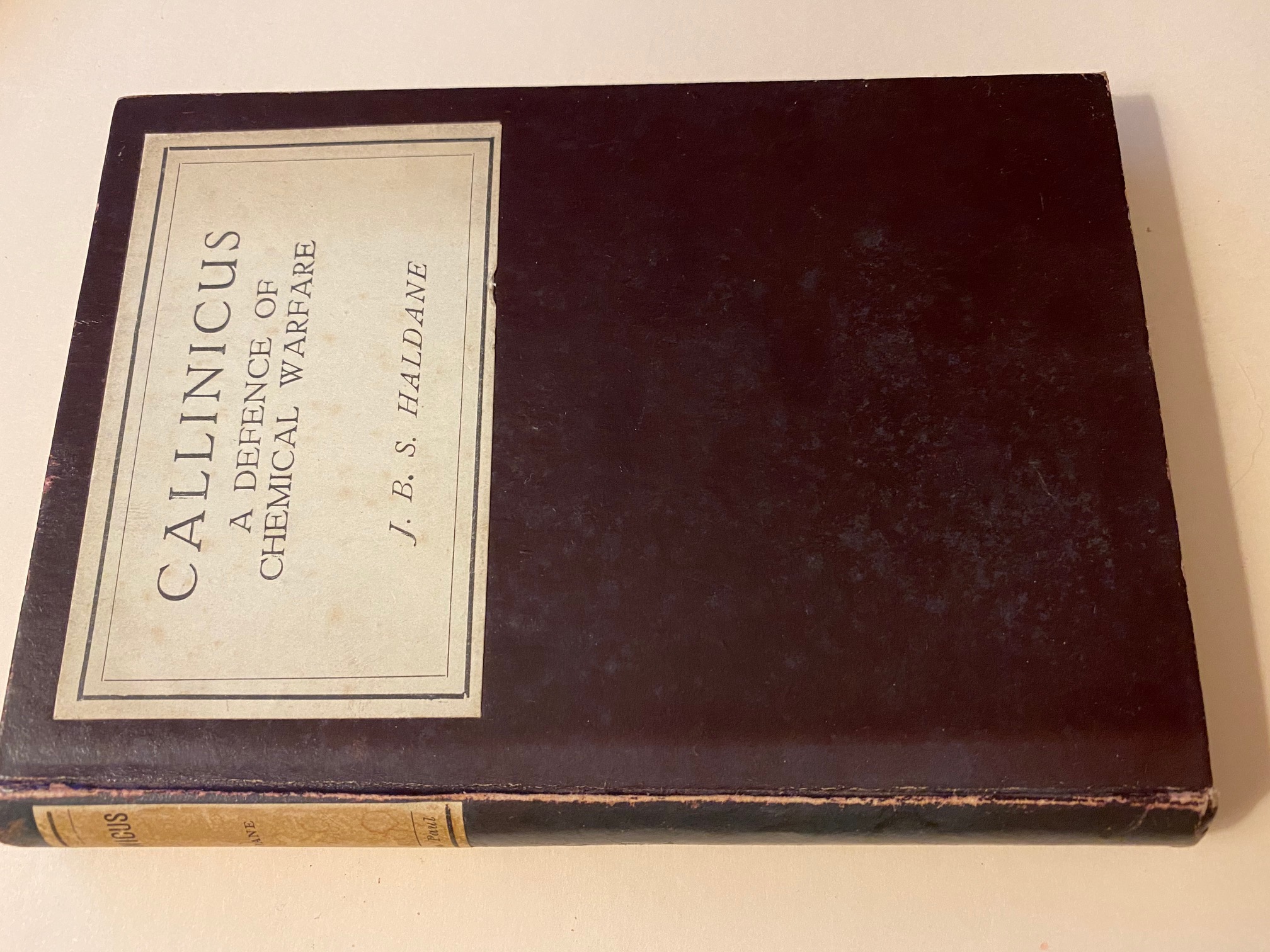
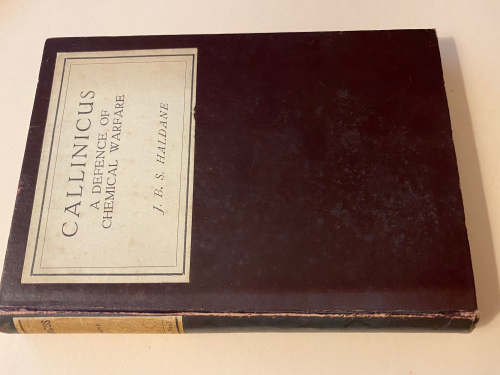
    J.B. S. Haldane (1892-1964, scientist/philosopher/veteran/Communist) contributed a provocative little one-hour read warfare and morality, making a case for the use of chemical weapons during war. I thought that this might be a Modest Proposal exercise, but it isn’t, at least to my reading of it. Callinicus, a Defense of Chemical Warfare (London 1925) is a call for expanding arms if arms is what was needed and if fighting was going to happen. Haldane would’ve been much happier with no fighting whatsoever, but if it were to be the case–again–he didn’t see much of a difference between chemical weapons and other sorts of armaments, as they both killed and wounded and incapacitated. A weapon is a weapon.

    “Why do we accept the invention of Major-General Shrapnel but prohibit the use of chemical weapons in war?” is what Haldane asks, and then proceeds to make his case.  

    The book’s title draws on the Syrian officer Callincus, who created the “Greek Fire” weapon, a flammable liquid, in in the Eastern Roman Empire in the 8th century CE. (“Callinicus1 Of Heliopolis, Callinicus also spelled Kallinikos, (born AD 673), architect who is credited with the invention of Greek fire, a highly incendiary liquid that was projected from “siphons” to enemy ships or troops and was almost impossible to extinguish.” Encyclopedia Britannica)

    An officer in 1914, Haldane was with the Black Watch (Royal Highland Regiment), and served with distinction, and did so at a relatively young age, and so was a witness2 to all manner of weaponry during the Great War. He makes a case for chemical weapons to be less grizzly than many other existing weapons and of those to come–and in the future category he gives a hat-tip to the possible invention of a weapon that sounded a lot like an atomic bomb.  It is an interesting discussion–one that backs you into a very disturbing corner, very quickly3. 

    Haldane ends the work so: “Such are the facts of chemical warfare. They will not be believed because a belief in them would do violence to the sentiments of most people.”

    Notes.

    A reminder that Haldane is the osurce for an often-repeated quote about the nature of the universe: “My own suspicion is that the universe is not only queerer than we suppose, but queerer than we can suppose.”

    1. “Born in Syria, Callinicus was a Jewish refugee who was forced to flee the Arabs to Constantinople. The ingredients of Greek fire were kept a state secret, known only by the Byzantine emperor and Callinicus’ family, which manufactured it. The precise composition is still unknown, but it is generally accepted that it was a mixture of naphtha, pitch, sulfur, possibly saltpetre, and some unknown ingredients. First used in the Battle of Cyzicus (c. AD 673) by the Byzantines against a Saracen fleet off Constantinople, Greek fire proved to be instrumental in that Byzantine victory.”–Encyclopedia Britannica

    2. Haldane also saw service during the war in the British chemical warfare program.

    3. “In Callinicus, Haldane makes the case for chemical weapons as a more humane, eugenic and ultimately more effective and efficient means of prosecuting modern warfare. In this bold advocacy, Haldane was facing an uphill battle, against the British press, who had propagandized against the ‘godless Hun’ and his poison gases, the fearful and scandalized public, and even his colleagues in the eugenics movement, who largely lamented modern warfare as dysgenic.”–Eugenics Archive (Canada) online timeline



    ·Posted by :

    ·in:

    —