A Daily History of Holes, Dots, Lines, Science, History, Math, Physics, Art, the Unintentional Absurd, Architecture, Maps, Data Visualization, Blank and Missing Things, and so on. |1.6 million words, 7500 images, 4.9 million hits| Press & appearances in The Times, Le Figaro, Mensa, The Economist, The Guardian, Discovery News, Slate, Le Monde, Sci American Blogs, Le Pont, and many other places… 5000+ total posts since 2008.

Author: JF Ptak

  • Things-out-of-Place Department: Old Maps in Space

    JF Ptak Science Books  Quick Post

    IMG_2246This is just a short, funny little bit here–I can’t remember noticing an antiquarian map being used as part of the design or decoration based on extraterrestrial objects.  I guess that’s why this image struck me so quickly as being unusual…I just can’t recall another image like it. I mean, this isn’t exactly a towering visual achievement, and in many ways it is ordinary, except that (I think) it isn’t. Anyway, I share it with you now (the source being the Scientific American, July 1957):


  • Von Braun’s Insulting Use of the Word “Holocaust” (1950)

    JF Ptak Science Books  Post 2900

    There’s a very subdued and whitewashed biography of Wernher von Braun sleeping in a few pages of the Journal of the British Interplanetary Society1, published in March 1950, when war wounds were still wounds, and the dead still of course dead.

    Probably one of the worst examples here of gliding through history is the mention that “some 4,450 men and women were employed at Peenemunde…”. It is unclear who the author is referring to, or if he is at all making reference to the more than 20,000 concentration camp inmates and others who were slave labor and forced to work on the rocket projects, living an dying in abject squalor. It has been established that von Braun knew of the conditions and knew of these workers, but later after capture he insisted that he did not know of the KL or of the Holocaust. It is bitterly bad that a quote from him is used in this biographical minute that actually employs the word “holocaust”, though he uses it referring to the combat between two opposed forces with the same “star-inspired ideas”, and not to The Holocaust. It is also a matter of record that well into life that the conservative right-wing German nationalist von Braun had nothing to say about the Holocaust, and would not add anything to what he already hadn’t said much about. He was at least comfortable with the Nazis if not a Nazi himself, and was comfortable with the deals he made with Hitler, even in spite of being arrested by the Gestpo late in the war.

    By choosing to not address the Holocaust, and by using the term “holocaust” to describe diametrically opposed political struggles between scientific communities is a gross violation of decency. That blatantly chooses to lessen the impact of the meaning of “Holocaust” to use in a relatively trivial way is obscene. And yet, there it is.

    In any event I’ve included the two-page bio, bellow.

    Also in this issue of the journal there is a great review of a German film on rocket development and the history of rocketry that spreads out over 8pp and which was evidently released sometime during WWII. The film is reviewed by members of the Society, and the comments on it are incisive and useful. It would be great to see the film, though to know that it exists is a step forward. Of a side interest to interplanetary flight is a short reference to “Spaceship I” (pictured below)–it is all very intriguing, though outside of two images of models for the proposed dirigible-like behemoth almost no other information is presented.

    Notes:

    1. London, 1950. (von Braun, Wernher) “A Biography.” In: Journal of the British Interplanetary Society, March, vol 2 #9, pp 57-8 in the issue of pp 49-92.

    ·Posted by :

    ·in:


  • A Good and Quirky Basis for a Holmesian Mystery–How to Kill Someone With Silk Thread (1877)

    JF Ptak Science Books  Quick Post

    And so it came to pass that a metal merchant was found drowned in the Thames, weighed down by his own wares, his jacket and greatcoat and pants–even his hat–filled with lead, his feet encased in lead, as were his hands.  The only reason the body was found was because of a severe summer drought which lowered the level of the river enough to reveal all manner of hidden nastiness, including the leaden mineral maven, Mr. Sockety. In and of itself this murder wasn’t all that interesting aside from it being bizarre…except over the following months there were a number of deaths of young women who had, as it turned out, a common touchstone–they all were seamtresses, and their specialty was silk thread. Then place here all of the interesting stuff that happens in mysteries >HERE<  until we get to the Eureka! moment that Holmes would know about halfway through==>they were looking for the tradesperson, Mr. Plump, who supplied the silk thread to these workers. Silk thread was expensive, so Mr. Plump committed fraud  and treated his silk thread with lead, multiplying the expensive thread’s value and which also made it lethal to its users.  Plump–seeing the damage that had been done and the people who had been killed as a result of his fraud–decides to kill Sockety to cover his tracks.  So on.

    This all came about as a result of seeing this interesting sidebar story in the 15 July 1877 issue of Scientific American:

    IMG_2179


    ·Posted by :

    ·in:


  • Defining What “Flying” Is, or Was (1894)

    JF Ptak Science Books  Post 2899    

    What does “flight” mean, anyway? How much do you have to be off the ground for something to be “flying”? If the answer is “two feet off the ground for 500 feet”, then Hiram Maxim did indeed succeed in being the first to construct a heavier-than-air aircraft that “flew”. Perhaps this definition might be a little broad, or narrow, though it does make falling sound like flying, too.
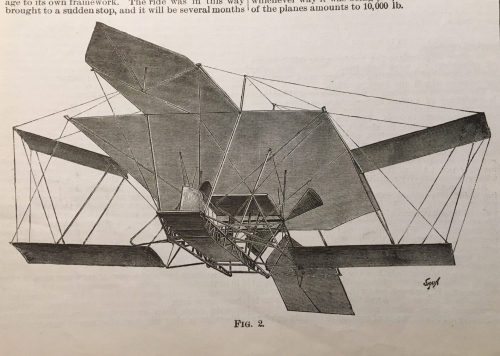
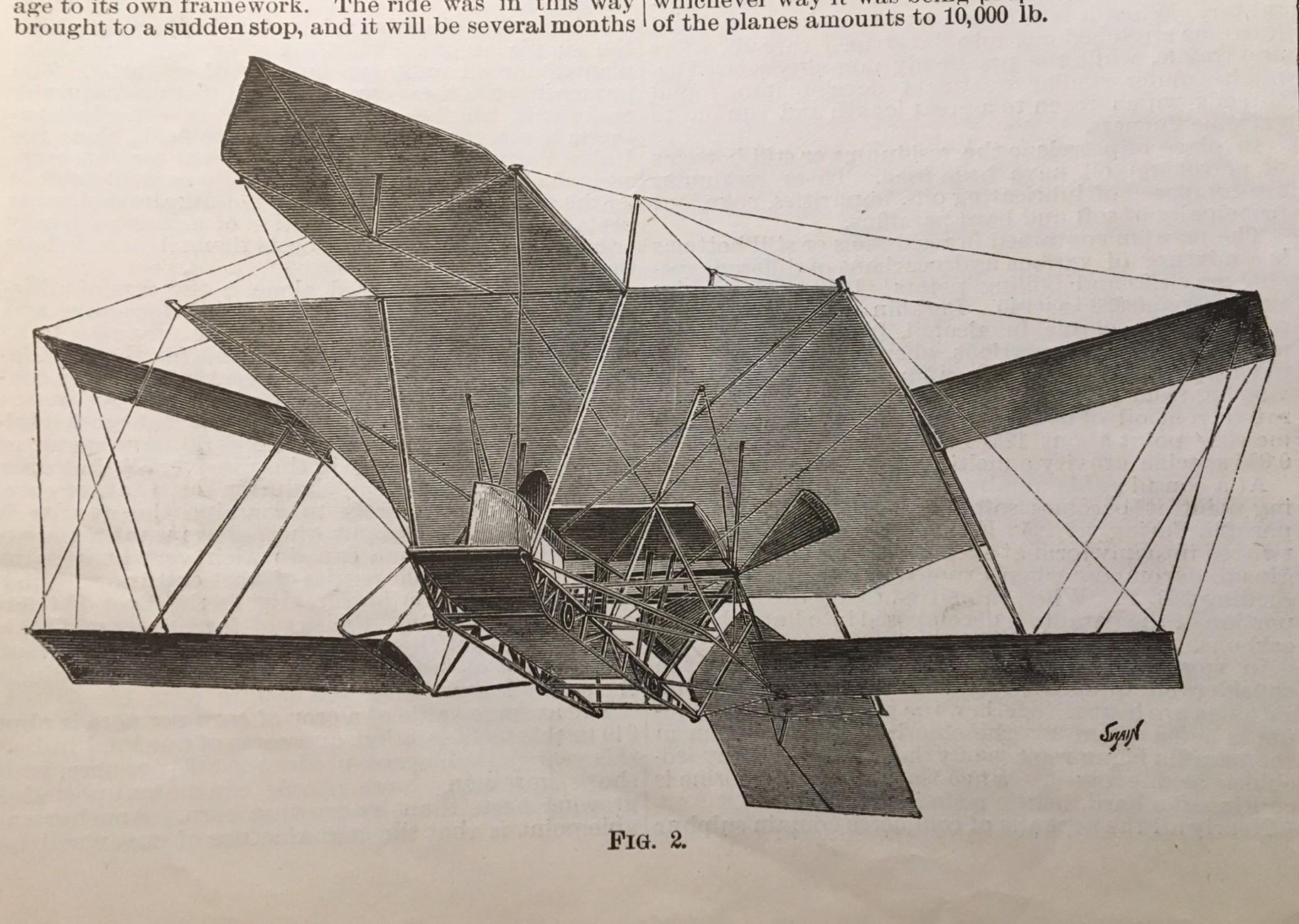
    IMG_2168In any event, that is what Mr. Maxim (1840-1916) did on 31 July 1894 with his enormous aeroplane as reported in the Scientific American of 15 September 1894 (“Maxim’s Flying Machine”).  He invested a good amount of money in the project funded by his tremendously successful “Hiram gun”, creating a number of aircraft before settling in on a great beast of a flying machine in 1894.

    The image of the aircraft is a perspective looking up at it, as though it were in flight. It wasn’t, though it was a semi-romantical thought and presentation. It had big numbers: 7000 pounds, 17.5′ diameter propellers, 2 steam-powered 180hp engines, 120′ long and 105′ wide, and 8” cylinders with a 5” stroke. Big numbers.

    One of the images that really struck me though was the steam chamber, which looks absolutely huge (though I can’t find dimensions for it), but you can make it out on the aircraft’s bow. For test runs 600 pounds of water were needed—2500 pound were needed to generate lift. IMG_2169

    So back to the “flight” issue; Mr. Maxim was on board the 3-person-crew aircraft on the day of the test. The aircraft was tethered to an 1800′ wooden rail to prevent it from actually taking off if it could…I think mainly because they were really just testing lift, as controlled flight was still yet another enormous issue. The aircraft did manage to achieve lift two feet above the rail, but the force was so great it ripped up the rail and crashed. (Mr. maxim found himself in a somewhat similar position to that of Frankenstein when overpowered by the monster which he himself had fabricated and endowed with life.”) No one was hurt, though the aircraft was decimated. As the writer in the Sci Am stated, “the ride in this way was brought to a sudden stop, and it will be several months before it can be renewed”. It isn’t anything like the Wright’s flight nine years later, though some do consider this Maxim experiment to constitute a “first flight”.

    One thing is certain: it was a lovely and impressive thing that Maxim built–it wasn’t elegant by any means, though it had a certain crushing charm to it.  

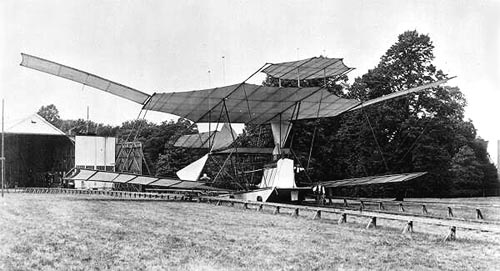
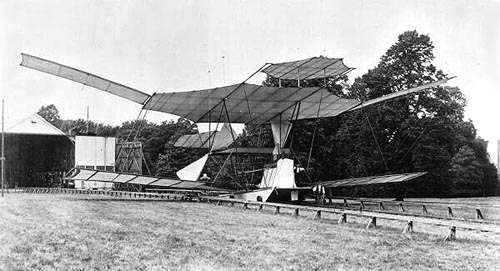
    Here’s a photo of the aircraft (with a person standing right there in front of it, for scale):
    Maxim aeroplane

    (Image source: ctie.monesh.edu.au/hargrave/maxim.html)


  • Light Bombs, 1913

    JF Ptak Science Books  Post 2897

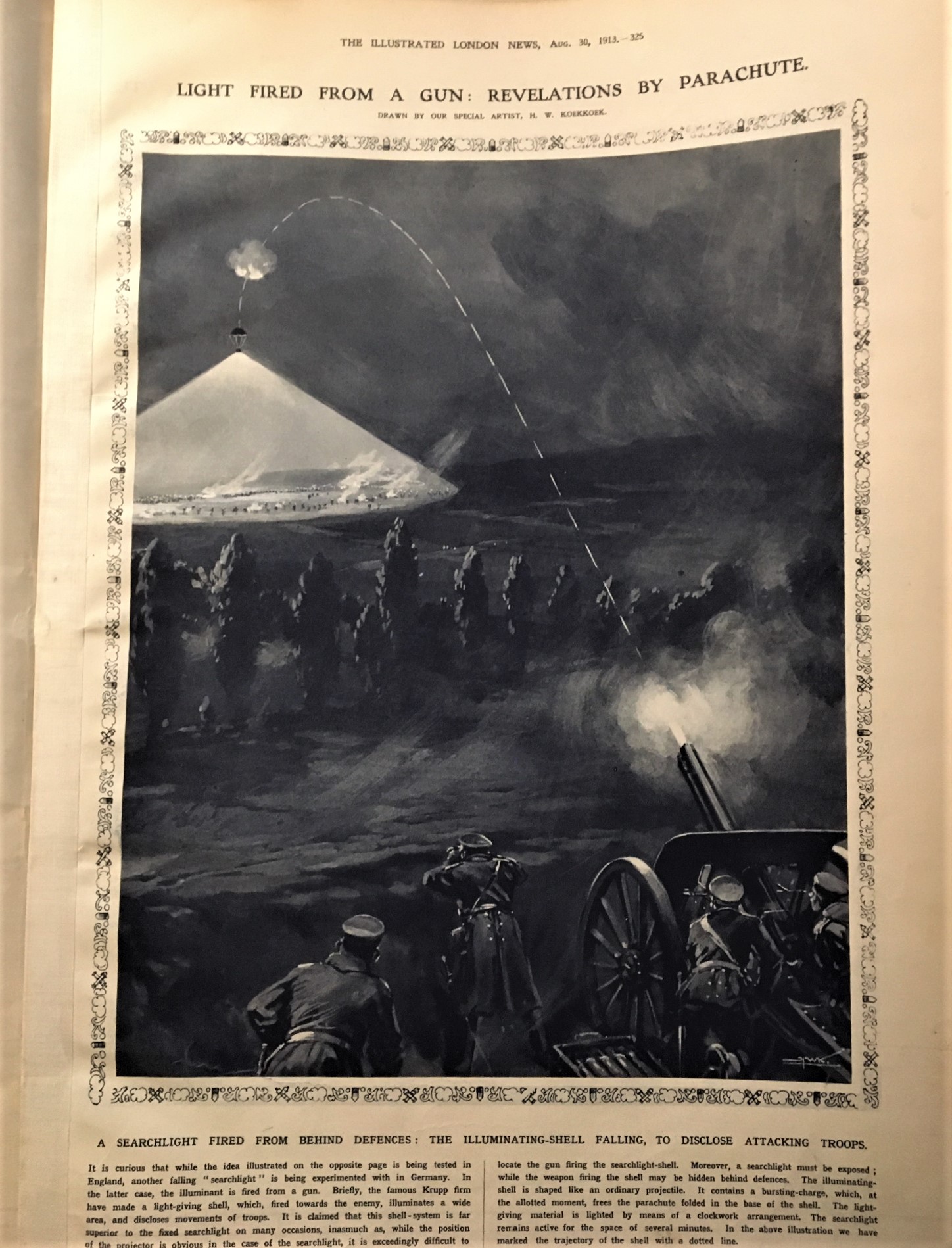
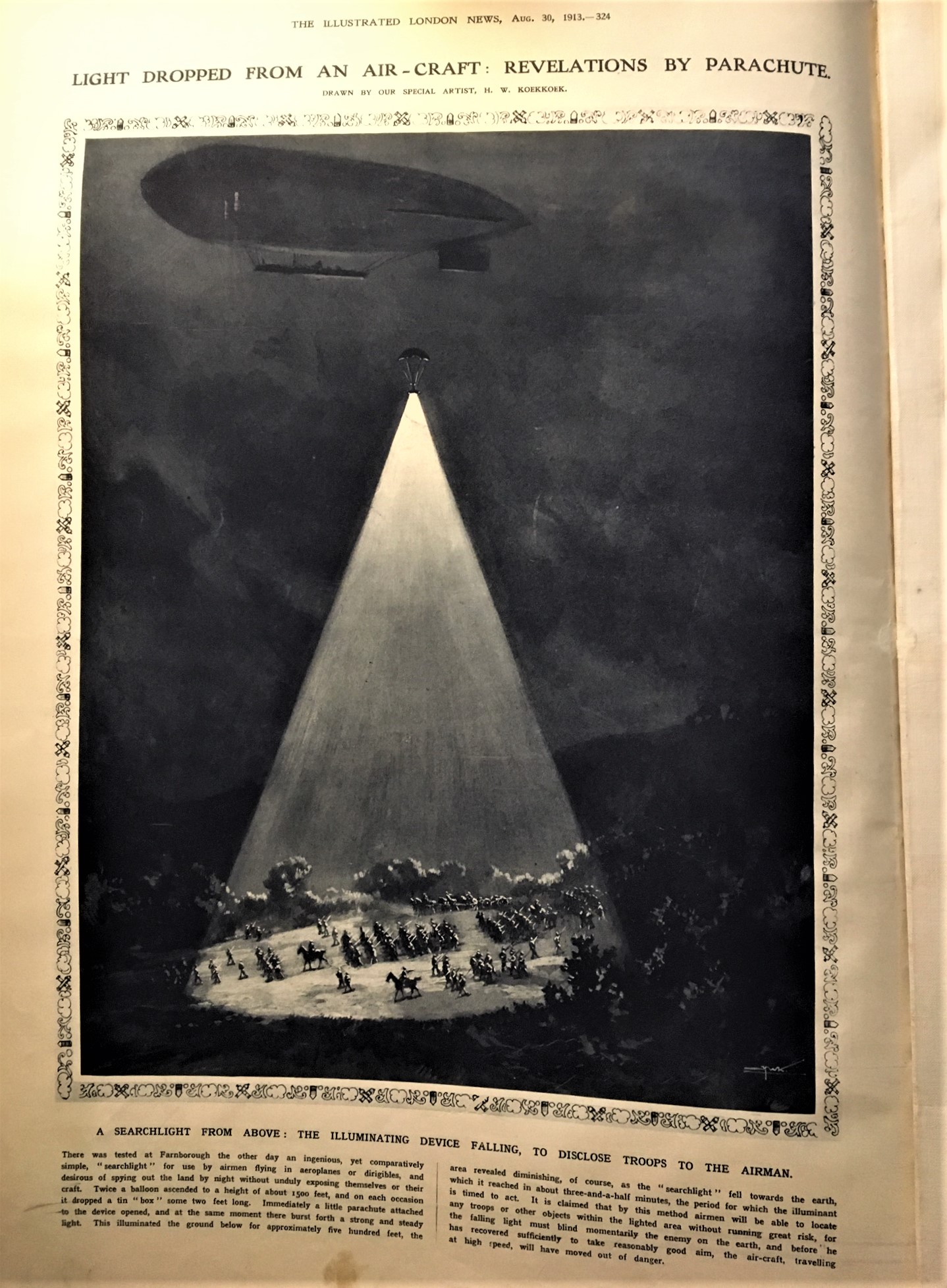
    In the earliest periods of the history of bombing it seems as though the among the first generations of “bombs” dropped from flying machines were “light” or light sources, as we can see in this pair of illustrations from the Illustrated London News for 30 August 1913. These weapons appeared almost two years after Lt. Giulio Gavotti dropped an actual explosive from his plane on 1 November 1911 in a battle of the Italo-Turkish War1. Not that the exploding bombs weren’t  heavy (they weren’t) but that the feature of the weapon dropped in the 1913 case was capable of generating a penetrating or at least illuminating light.  We are told in the legend of the print that the light-bomb dropped from the dirigible was attached to a parachute which opened immediately, and from the height of 1500 ‘ at release the writer states that it would take the weapon three minutes to descend to the ground. (Of course the illuminated area would get together an tighter in descent, though it seems like there would be a good minute of so where there was some intelligence gathering possibilities.)

    Even though this package wasn’t exploding, it did provide the observers from above time to gather information on the position of the enemy and relay that data so it could be employed in tactical or strategic manners.  

    Notes:

    1. Lt. Gavotti (1882-1939) actually dropped four four-pound grenades from a height of 600′ from his Etrich Taube monoplane in action against the Ottoman Turks in Libya. This was the first instance of bombing from a heavier-than-air aircraft, bombs being dropped from balloons for several decades already by the turn of the century. Dropping bombs from balloons was deemed an illegal act of war and outlawed in the Hague Convention of 1899–but as the Wright flight was still a few years away at that point there was no provision established for bombing from aircraft that didn’t yet exist.  There were other instances of bombing from aircraft before the start of WWI, with the first instance during the Great War occurring when German Zeppelins bombed the city center of Antwerp a few weeks after the war began on 24 August 1914. The Brits launched an aeroplane attack  against two Zep bases in Cologne and Dusseldorf in response, and, well, and so on, raids and bombs becoming more sophisticated, cities becoming targets, and the race to destruction became developed. 

    ILN 1913 Light BombILN 1913 Light Bomb


  • Great Cross Section: HMS Revenge of 1577 (1912)

    JF Ptak Science Books  Quick Post

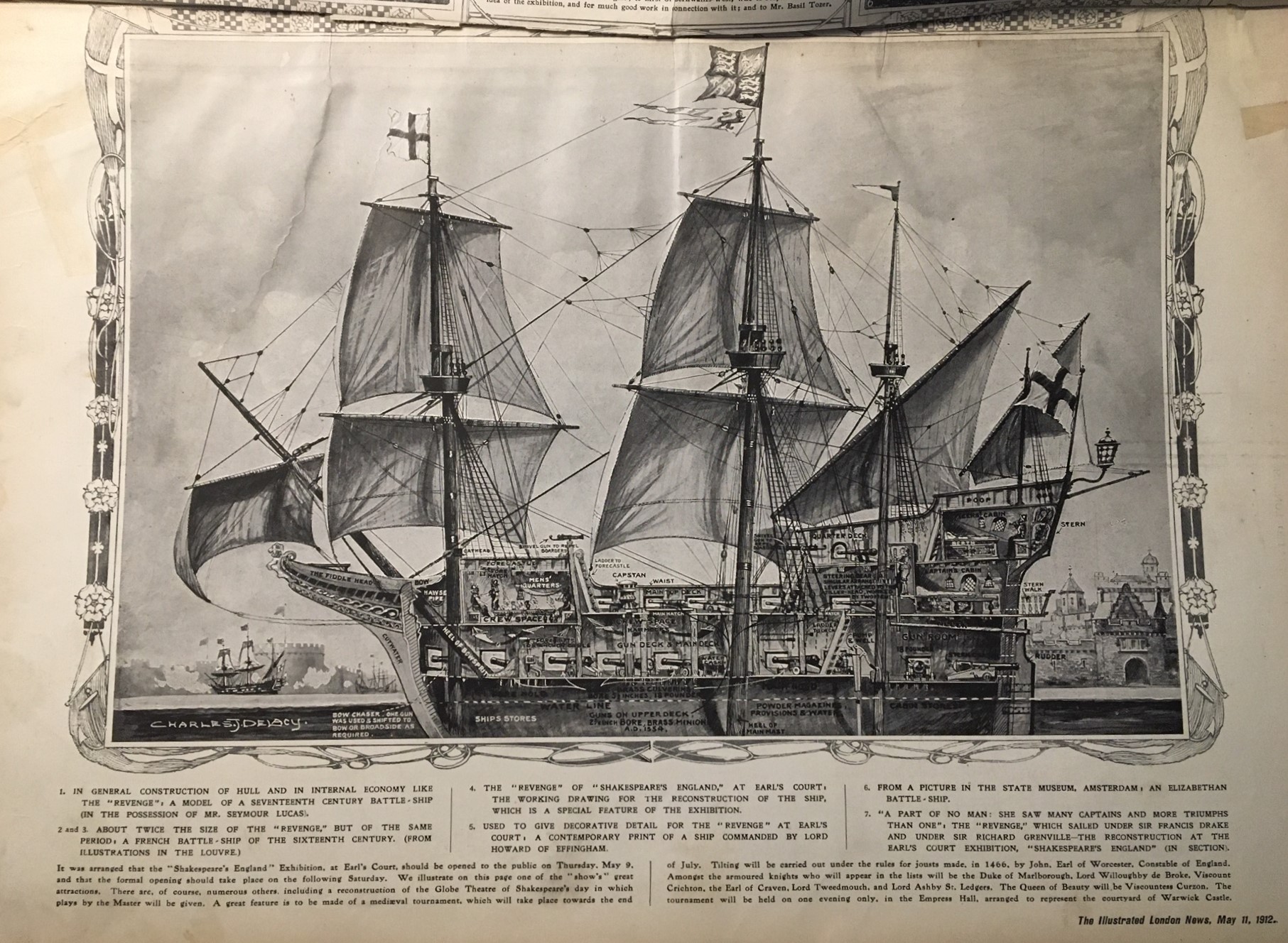
    ILN 1912 Cutaway cross section REVENGE _2_

    [Image source: Illustrated London News, 11 May, 1912.]

    I’ve made dozens of posts on this site on cross sections, exploded views, and cutaways–today’s installment is another of the high-artistic variety and depicts the first (of fourteen?) of the HMS Revenge ships, laid down in 1577. 

    [Detail below.]

    “On July 20 the day on which the London Devonians celebrated the 324th anniversary the defeat of the Spanish Armada the King and Queen paid a visit to the England Exhibition at Earl’s Court. Amongst other things they inspected the model of the Revenge famous not only as the one of the one and the fifty three whose great fight Tennyson tells so dramatically in The Revenge, A Ballad of the Fleet but as the flag ship of Drake beyond doubt the greatest man who ever set foot aboard her. The ship as reconstructed at Earl’s Court is 104 feet long from stem to stern with a height of 127 feet from water line to top of mainmast and a breadth of beam of 28 feet…” Illustrated London News, 10 August 1912.


  • An Educated Fly–Scientific American, 1898

    JF Ptak Science Books  Quick Post

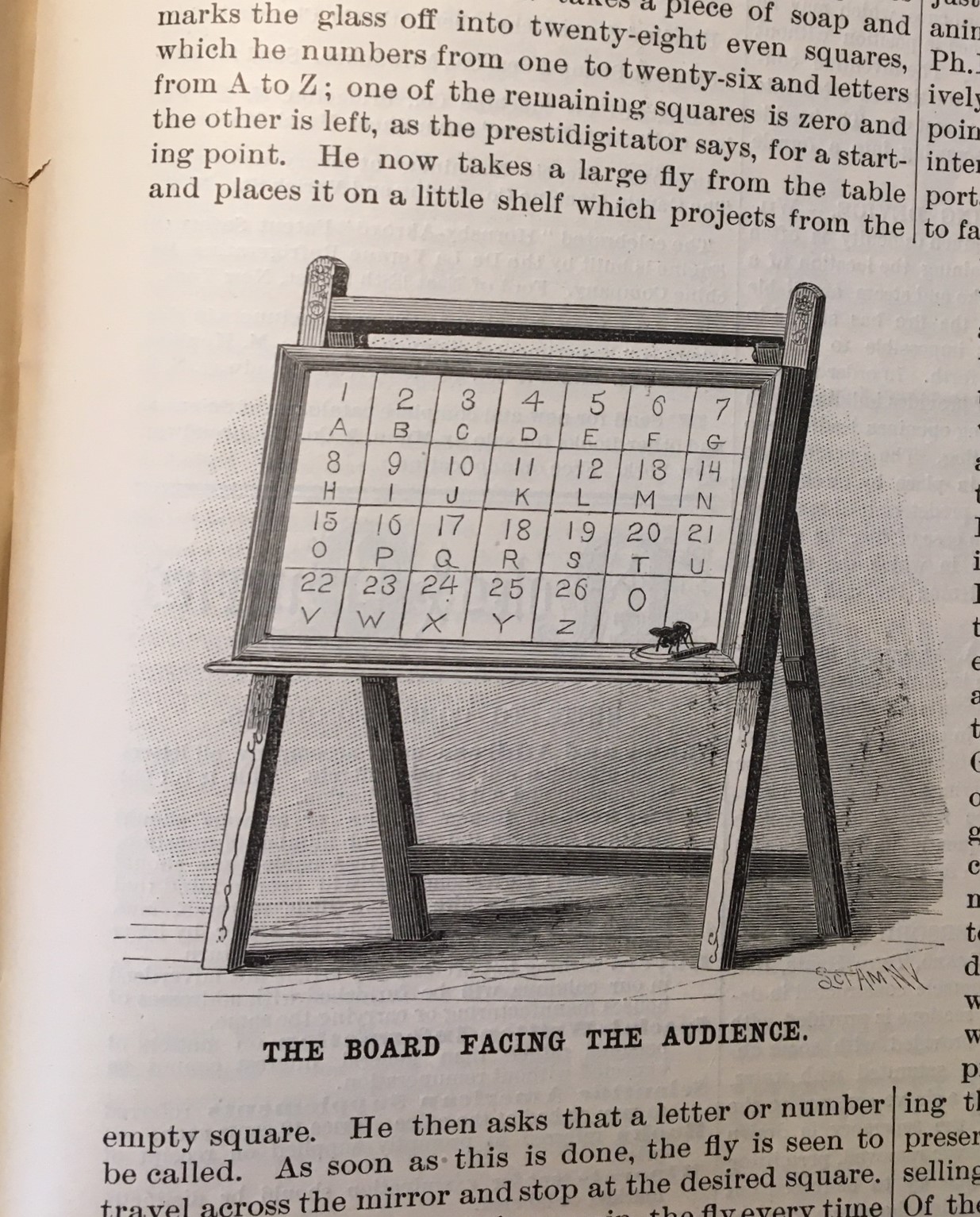
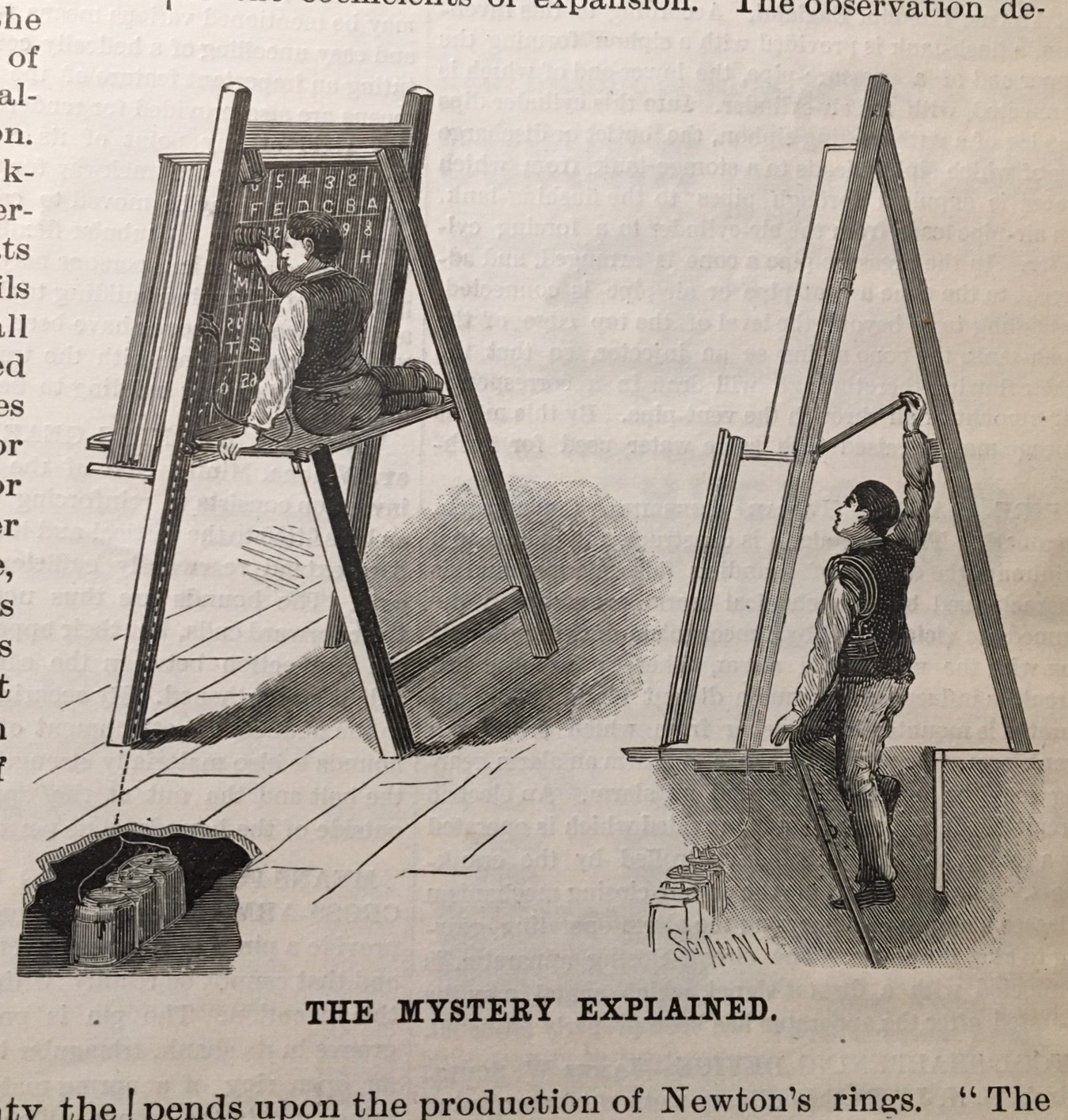
    Sci Am 1898 fly _2_How could you see an article heading of “An Educated Fly” and not share the secret?  I don’t know, and so I am performing a bit of due diligence, sharing the story from Scientific American from 3 September 1898. There really isn’t that much to tell, and the title is probably better than the story: the large tablet is placed on a stage in front of an audience, with a pitchman telling some sort of warm-up story to create interest among the crowd; a fly of some sort (whether a model or a real fly pinned or tied to something, I don’t know) and placed on a little shelf beneath the board. The ringmaster would ask a question, and the fly move around and alight or somehow make it known as to its selection of the numbers/letters on the grid. The trick is revealed in the image below–after the blackboard on its pedestal is shown to the audience front-and-back, it is positioned over a trap door on the stage, where a confederate would rise up and position themselves inside the pedestal and operate the device holding the live/inanimate fly. That’s it. After the tricks were performed, the inside man would escape through the trap door, the pedestal would be wheeled out to display that it was empty, and that was that. Old trick, new fly. 

    Sci Am 1898 fly _1_


  • Complicating and Simplifying the Threat of Communism: Nazi Propaganda, 1936

    JF Ptak Science Books  Quick Post

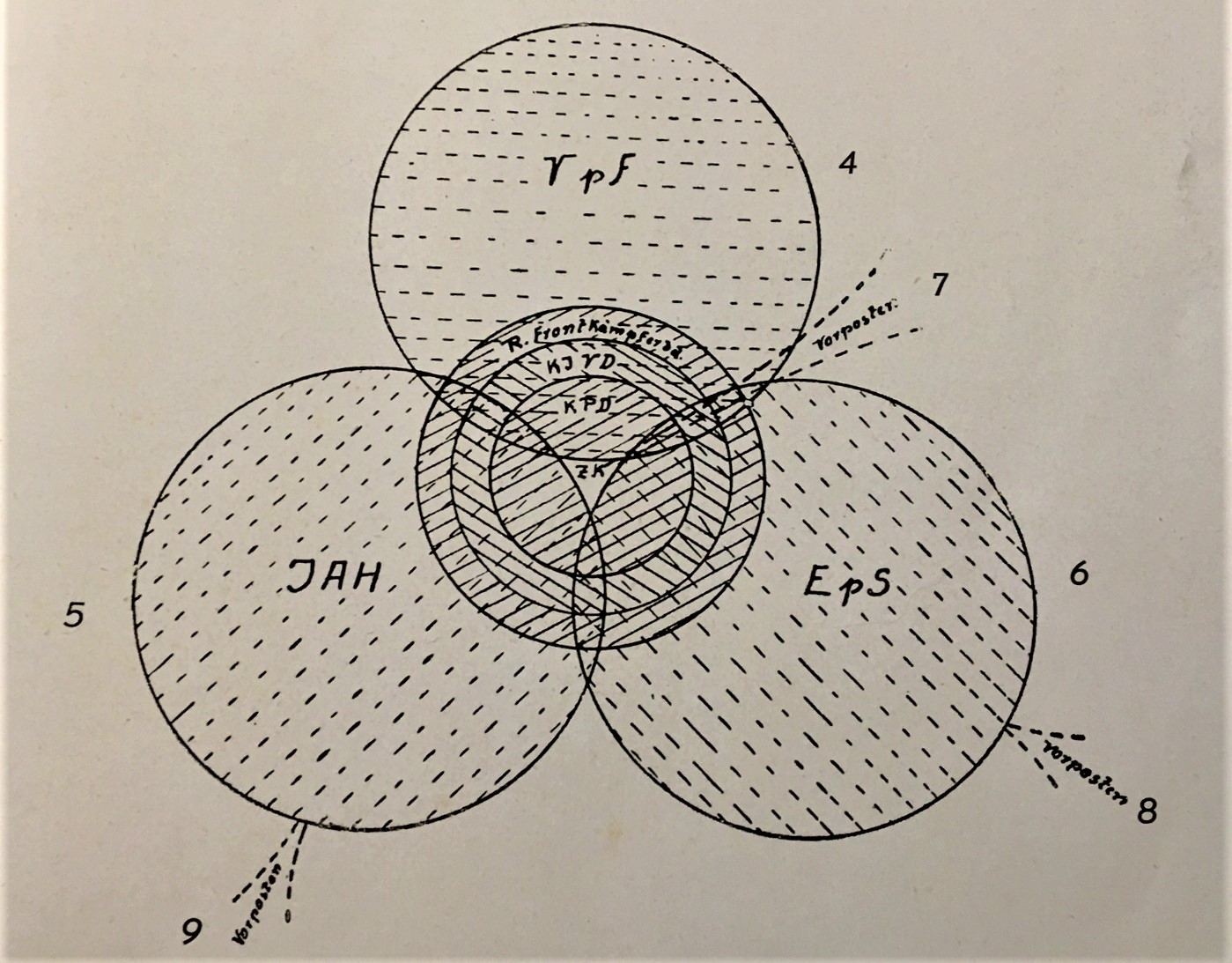
    Here are two renderings of what Nazis envisioned to be the structure of the Communist Party,  the first being for Germany, and the second for found orchestrated Communism worldwide. They are located in a half-grubby if not heavy book by the propagandist Adolf Ehrt’s  called Die Weltbolshewismus, which was published in 1936. 

    Key for the first diagram: IAH=Internationzle Arbeiter Hilfe; Vpf=Verband Prolestarischer Freidenker Deutschlands; KPO= Kommunist Partei Deutschlands; ZK= Zentral Kommintern; KJVD=Kommunistischen Jugendverband Deutschlands. I don’t know what the EpS is yet.  

    IMG_2128


  • On the Vocabulary of the Holocaust in 1939

    JF Ptak Science Books  Post 2896

    IMG_2107

    I recently uncovered a scarce and unusual pamphlet printed in 1939 in Chicago that addressed Hitler’s threat to Europe, his designs on action in the United States, and his general threat to the world. The pamphlet under discussion here is Leo Kaul’s Is Hitler Planning to Conquer the United States?, which was published by the author in Chicago in 1939 as part of a planned monthly series of pamphlets called the “Library of Liberal Endeavor”.  This was volume two, following Why is the Jew Persecuted Today as volume one; there was a third volume planned called Hitler and Father Coughlin though it seems never to have been published. I think that Mr. Kaul–who was writing as early as 1912 and as late as 1950 and who had a business in Chicago manufacturing small bottles and porcelains–self-published these tracts hoping to establish a journal or monthly, though it appears that the existing works didn’t reach a wide audience and barely survive in libraries. 

    One part of this pamphlet that I’d like to mention here is a three-page discussion on “concentration camps” which I think is remarkable not for “exposing” them but for recording the remarks that (in 1938/9) “there have been many books written about life in concentration camps, about the liquidation of the Jewish people, and about the persecution of everyone not in sympathy with Hitler.” The German concentration camp system began with Dachau in 1933 and expanded to over 1000 (including the main and sub-camps) before the end in 1945 (this is exclusive of ghettos and other controlled environments), and there was certainly a good-sized literature on the camps–I am less certain though about the phrase “liquidation of the Jewish people” which does seem jarring to me for 1939.

    Most of the discussion of the concentration camps in this pamphlet are quotes from a work by Martha Dodd and William Dodd jr., Through Embassy Eyes, which was published in 1938.  I don’t have a copy of this though from what I could find this work is based on the collected experiences of the Dodd family, with William Dodd (sr.) being the U.S. ambassador to Germany from 1933-1937, and Martha and William being the children, each named for their parents. The daughter Marsha was later accused of being a Soviet spy, while the son William was destroyed by the Dies Commission and in spite of his accomplished past and connections was a sales clerk at a department store in San Francisco when he died in 1952. 

    I’ve reproduced the pages on the KL below:

    ·Posted by :

    ·in:

    —

  • Delightful Maps of the IRT, NYC, 1923.

    JF Ptak Science Books   Quick Post

    I’ve just found this delightful little publication beautifully extolling the possible advertising advantages of the Interborough Subway and Elevated Lines of New York City, Artemas Ward’s New York’s Rapid Transit Traffic in the Graphic, from 1923. It really does present the numbers and highlights them with some unusual and bright maps of the subway system. This was the IRT (the Interborough Rapid Transit system), which was a private concern that operated from 1903 until 1940, when it was purchased by NYC.  This subway system in general was, well, entirely different from the one that I traveled 1968-1974 or so, back when you could barely see through the car windows because they were so heavily coated with graffiti…Anyway, I’ve  reproduced  most  of  it  below as there are no copies of the pamphlet in any library according to WorldCat.    The design of the first one–with the giant “Broadway”–is terrific.                                                              IMG_2100 (1)