A Daily History of Holes, Dots, Lines, Science, History, Math, Physics, Art, the Unintentional Absurd, Architecture, Maps, Data Visualization, Blank and Missing Things, and so on. |1.6 million words, 7500 images, 4.9 million hits| Press & appearances in The Times, Le Figaro, Mensa, The Economist, The Guardian, Discovery News, Slate, Le Monde, Sci American Blogs, Le Pont, and many other places… 5000+ total posts since 2008.

Author: JF Ptak

  • On Flying Machines–Scientific American, 1848

    JF Ptak Science Books  Quick Post   Overall Post 5120

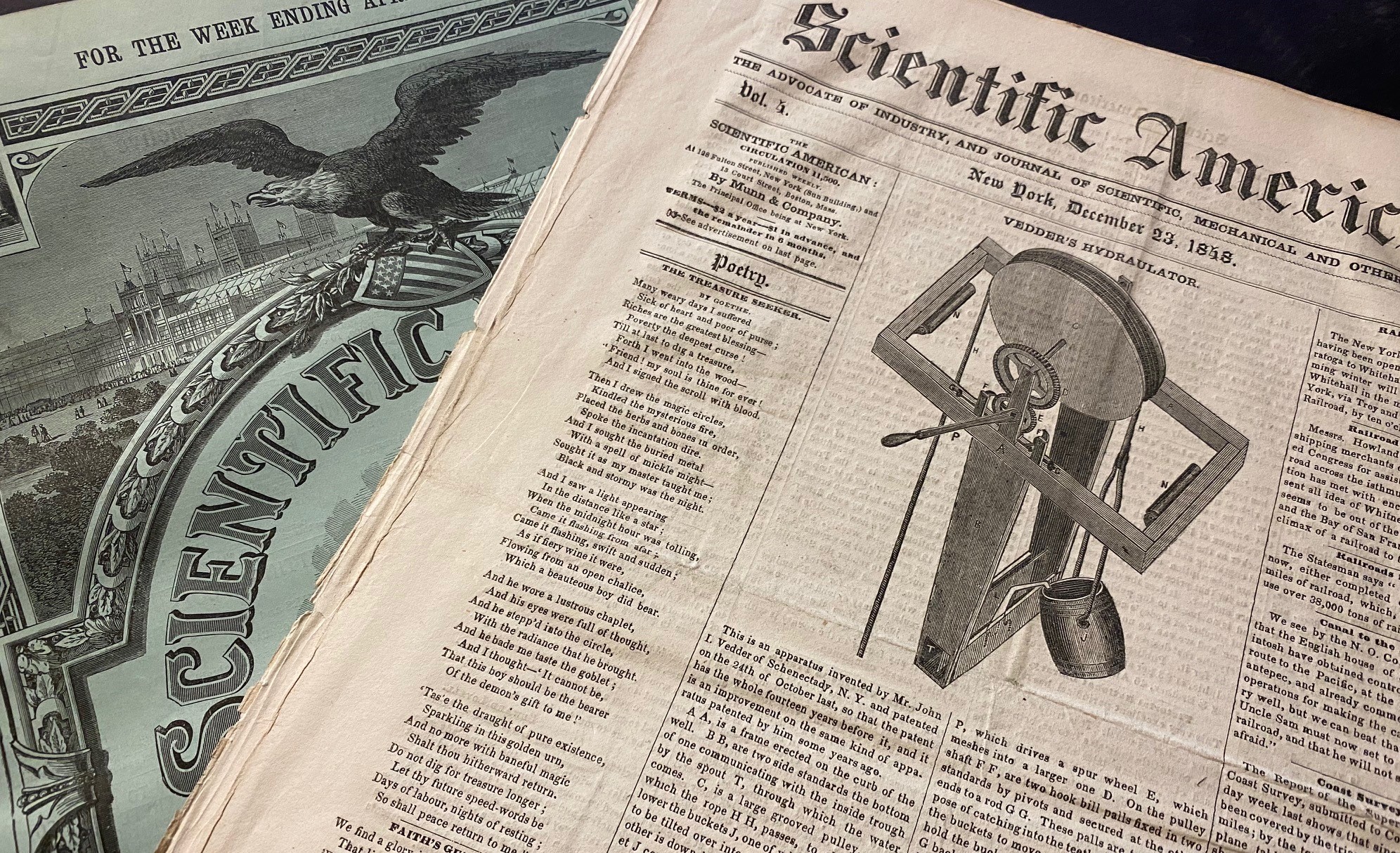
    I found a short article on human flight (“Flying Machines”) in the fourth volume of Scientific American (1848).  It is an interesting and occasionally predictive piece that saw a bit into the future, well past the contemporaneous failures and iron-punk possibilities of sky machines, into a place of “mathematical certainty.  The writer saw the possibility of heavier-than-air flight, only just not in 1848 (or any time soon). “The air furnishes a vast fund of power for the use of mankind, although as yet they have only used it to propel ships and wind-mills. We live in an age of great discoveries and improvements, and among these will certainly be ranked the navigation of the air.” 

    And so some snippets from the article: 

    “Flying Machines and Perpetual Motions are very old and unfortunate acquaintances. No people have invented so many as the Germans, and many a poor fellow has lost his life by his fool hardy confidence in some machines he had invented to ride upon the winds, yet for all the accidents that have taken place to high flyers, from the Dutch Doctor at Ratisbone in 1692 to the unfortunate Englishman who perished a few years ago in London when descending by a parachute, there are still to be found new flying machines coming out every few months. An Austrian made quite a fine display in Cremone Gardens, London last winter, by taking several long jumps with a steam flyer. Since that we have heard no more about it, and presume it has met the fate of its illustrious predecessors…
    IMG_3864 (1)

    “But the end of flying machines is not yet, and here we insert the description of a new and an original one certainly, taken from the Jacksonian published at Pontiac, Michigan… After describing how wings had been tried to beat the lark and eagle, he says:—“As wings then, have failed, and balloons been attended with no better success, men have begun to think that the end is unattainable, and that flying is a victory which man can never achieve.”


  • Resistance in Czechoslovakia, 1943 (Full Reprint of Scarce Pamphlet)

    JF Ptak Science Books  Quick Post (reprint series) Overall Post #5119

    Youth of Czechoslovakia1 was a Czech-in-exile response to the situation in the country as it stood in 1943. The situation of course was critical, and the compiler of the work, F.L. Lowidt, chronicles the state of the affairs from the end of the First World War to the occupation sometime late in 1943.  About half of the work concentrates on the war period following “the fatal policy of Munich” and the “sacrifice” of Czechoslovakia to impossibly placate Hitler.  It is a very interesting document, and as there are only a half-dozen or so located by WorldCat in libraries worldwide, I’m reproducing it here.  Of special note are the four pages or so dealing with children and the youth being used for “forced labor in Hitler’s war machine”, the “martyrdom of youth”, and the resistance movement.  

    Notes

    1. LOWIDT, F.J. (compiler); artwork by W. Slosser. Youth of Czechoslovakia. Published by the Czechoslovak Youth Committee, London (and printed by Dugdale Printing, Ltd.).[1943] No date stated but WorldCat (which locates only six copies) believes it to be 1943. My copy–a Library of Congress duplicate–has a cataloguer’s pencil notation for being received on 6 March 1943.  


    Czech _11_

    ·Posted by :

    ·in:


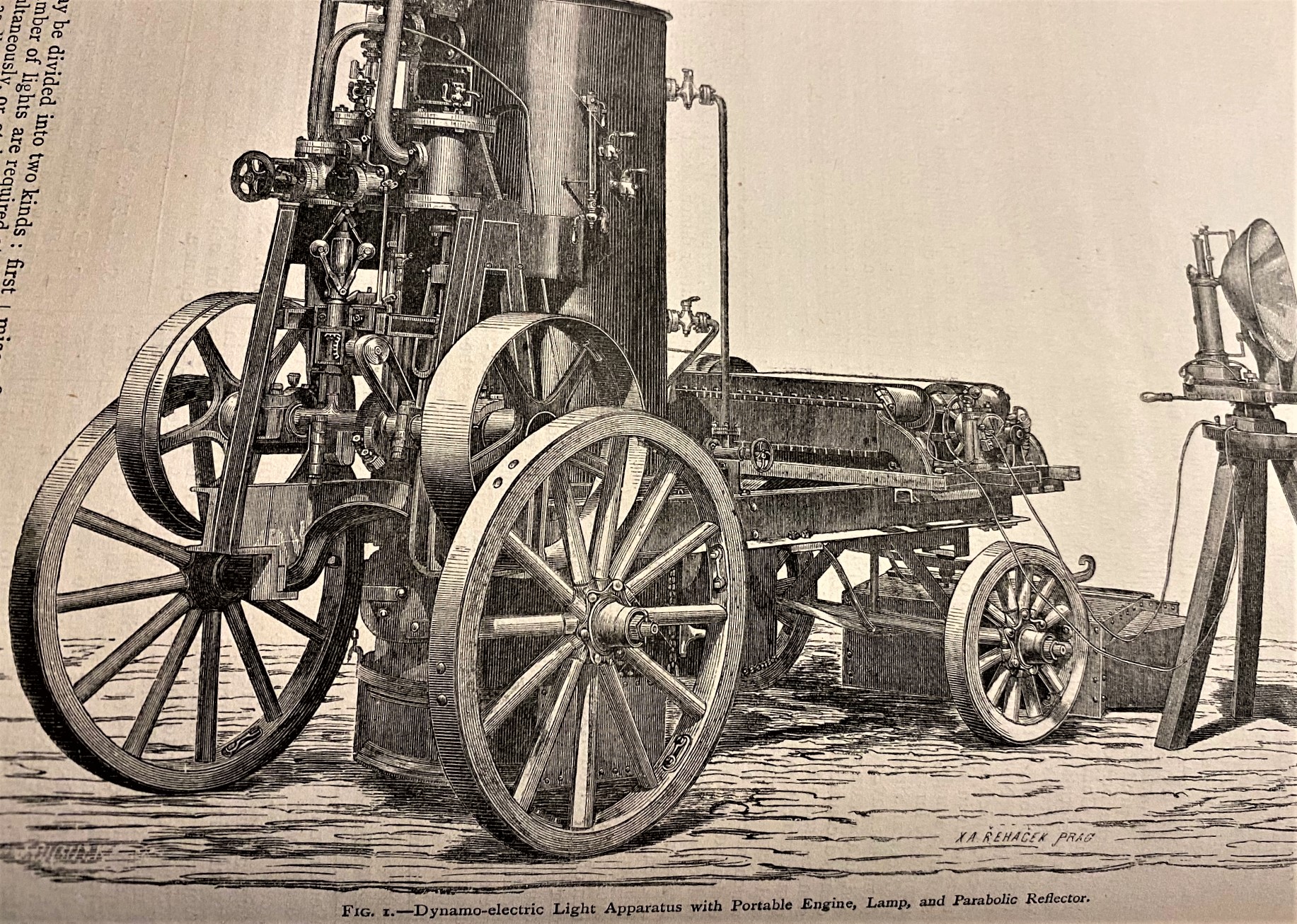
  • The Not-Unbearable Extra-sub-Heaviness of Light (1876)

    JF Ptak Science Books  Quick Post (Overall post 5119)

    I thought it would be interesting to share this engraving of a portable electric light apparatus. This does come very early in the modern (post 1850) sense of “electric light”, but, still, even knowing of how early this is in this fiel dit is still a little shocking to see the weight of the engineering and ingenuity in providing mobile electric light.  

    • “THE comparatively infrequent employment of electric light, considering the great success achieved in its production, would at first sight appear to be due to something in the application of the electricity itself. It has been repeatedly and satisfactorily proved that a continuous and powerful light can be produced by electricity, and the question naturally arises, Why is it not more frequently employed for practical purposes?”
    • “For transportation of the Dynamo-electric Light Apparatus is mounted on a wagon, with steam engine, the whole weighing 4,960 lbs. The combination has proved very serviceable on account of its lightness and compactness.”– Siemens’ Electric Light Apparatus. Nature 14, 133–136 (1876).

    IMG_3381


  • Found-Poetry in a Technical Work on Bubbles (1896)

    JF Ptak Science Books  Quick Post   (Overall Post 5118) 

    Bubbles “The water of those wellis sprynge vp with grete bobles.”–W. Caxton tr. Myrrour of Worlde ii. xxi. sig. h4   OED

    Rummaging again through the eminently-rummagable early years of Nature1 I found a lovely little article on the physics of bubbles. The language to me seems delightful, and it comes from the first part of a very long opening paragraph of the paper:

    “He has studied the behaviour of big bubbles and of little ones,

    of bubbles in large and small tubes,

    of bubbles of air in a liquid,

    and of one liquid in another,

    of bubbles in heavy land in light liquids,

    of bubbles in liquids of various degrees of viscosity

    and with various degrees of surface tension at their surfaces.”

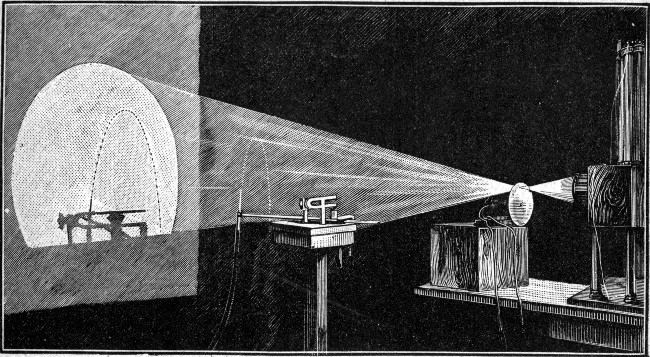
    • [IMAGE: “THAUMATROPE for showing the formation and oscillation of drops.” From C.V. Boys’ Soap Bubble and the Forces Which Mold Them, 1896.]

    In spite (or because of) the fact that bubbles are serious things, they are wonderfully named and as C.V. Boys points out in his fantastic Soap Bubble and the Forces Which Mold Them (1896), they are as magnificent as they are simple: “I do not suppose that there is any one in this room who has not occasionally blown a common soap-bubble, and while admiring the perfection of its form, and the marvelous brilliancy of its colours, wondered how it is that such a magnificent object can be so easily produced”.

    Bubbles have a long history in experimental physics2 and continue to work their magic today–when I googled this title I came up with only three pages of hits, including the following, which in their own little way beg to be read:

    • “Film thickness measurements in liquid–liquid slug flow “
    • “Effects of Bubbles on the Hydraulic Conductivity of Porous Materials “
    • “Bubble deformations and segmented flows in corrugated microchannels at large capillary numbers “
    • “Bubble transport through constricted capillary tubes with application to resin transfer molding”
    • “Transport of bubbles in square microchannels”
    • “Step-Wise Velocity of an Air Bubble Rising in a Vertical Tube Filled with a Liquid Dispersion of Nanoparticles”

    From the 1894 article:

    “EVERY student of physics has observed the motion of bubbles in tubes. Which of them has not used a big bubble to show the little ones their duty in clearing out the air when filling a barometer tube? Who has not spent his time and patience in whisking a spirit thermometer to drive a bubble out of the column? Mr. Trouton has recently communicated to the Royal Society the result of some researches on this subject. He has studied the behaviour of big bubbles and of little ones, of bubbles in large and small tubes, of bubbles of air in a liquid, and of one liquid in another, of bubbles in heavy land in light liquids, of bubbles in liquids of various degrees of viscosity and with various degrees of surface tension at their surfaces. From this enumeration it is evident that the number of different magnitudes involved is very great, and at the start it seemed almost hopeless to disentangle the effects due to each. The first matter to observe was that, as in other cases of fluid motion, two cases must be distinguished. These are the cases of slow motion and of quick motion. When the motion is slow the viscosity of the liquid causes the flow to be very simple. It entirely stops all whirling and swirling, such as is seen in the water behind a boat. When the motion is quick, on the other hand, the flow is very complicated. Whirls and swirls are set up, and the resistance is increased, owing to the increased energy that has to be communicated to the whirling and swirling liquid for each centimetre that the bubble moves. The slow kind may be described as viscous flow, and the quick as turbulent flow. The most interesting point observed in connection with the turbulent flow was that it was sometimes possible to increase the rate of flow by increasing the viscosity…”

    Notes:

    1. “On the Motion of Bubbles in Tubes”, in Nature, a Weekly Illustrated Journal of Science, 8 February 1894 (vol 49 no. 1267)/ I should point out that Nature back then was almost entirely readable by almost anyone—nowadays of course it is a vastly different story; I stopped my subscription a while back when I found out that I wasn’t understanding even the titles of some of the papers….

    2. “I have freely made use of the published work of many distinguished men, among whom I may mention Savart, Plateau, Clerk Maxwell, Sir William Thomson, Lord Rayleigh, Mr. Chichester Bell, and Prof. Rücker. The experiments have mostly been described by them, some have been taken from journals, and I have devised or arranged a few. I am also indebted to Prof. Rücker for the use of various pieces of apparatus which had been prepared for his lectures.”–C.V. Boys, Soap Bubble and the Forces Which Mold, 1896.

    Front“Experiment for showing by intermittent light the apparently stationary drops into which a fountain is broken up by the action of a musical sound.”–from the Boys book.  


  • “The Fine Sport” of Flying, 1893.

    JF Ptak Science Books    Quick Post (Overall Post 5117) 

    Lillienthal

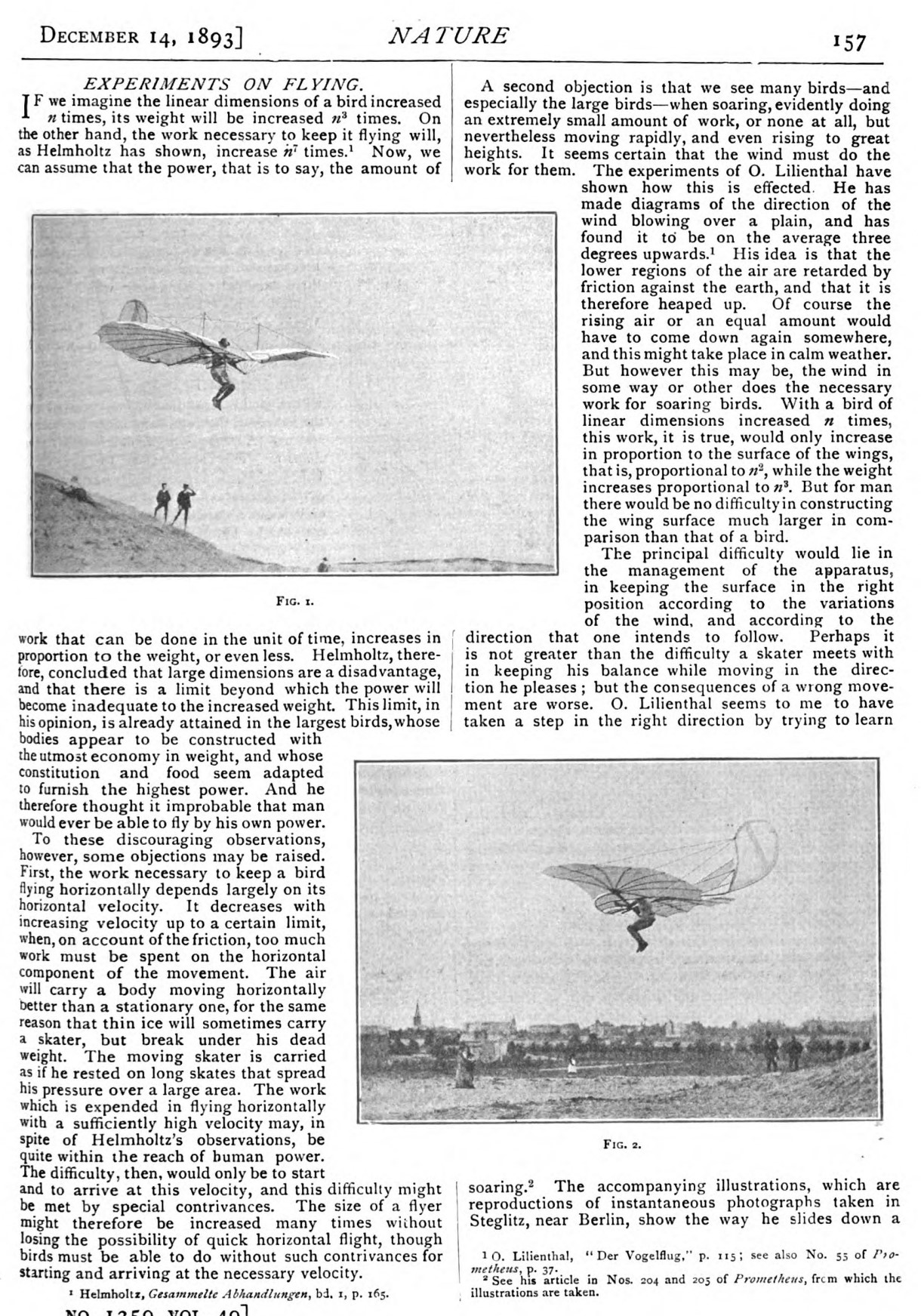
    I found an interesting article in Nature1 just now,  a piece by Carl Runge on 19th century heavier-than-air human flight by the remarkable Otto Lilienthal. 

    Lilienthal was an international authority on human flight, and was known to many as The Flying Man, and The Father of Flight, because, well, he flew. And he flew more often and with more recorded/documented successes in his non-powered flying machines than any other aviation pioneer of the time. In fact, he had a major influence on the Wright brothers (though not necessarily for his experimental data, which they abandoned after a while to create their own in their wind tunnel), with Wilbur Wright saying: “Of all the men who attacked the flying problem in the 19th century, Otto Lilienthal was easily the most important. … It is true that attempts at gliding had been made hundreds of years before him, and that in the nineteenth century, Cayley, Spencer, Wenham, Mouillard, and many others were reported to have made feeble attempts to glide, but their failures were so complete that nothing of value resulted.” (From the Wikipedia article on Lilienthal.)

    Lilienthal was well into making  successful jumps/flights by this time, but would suffer his fatal fall in about two more years, dying August 10, 1896, after a series of 850′ flights. (I’m offering a later paper on Lilienthal, also available on ABE, from Nature for 12 December 1894.)

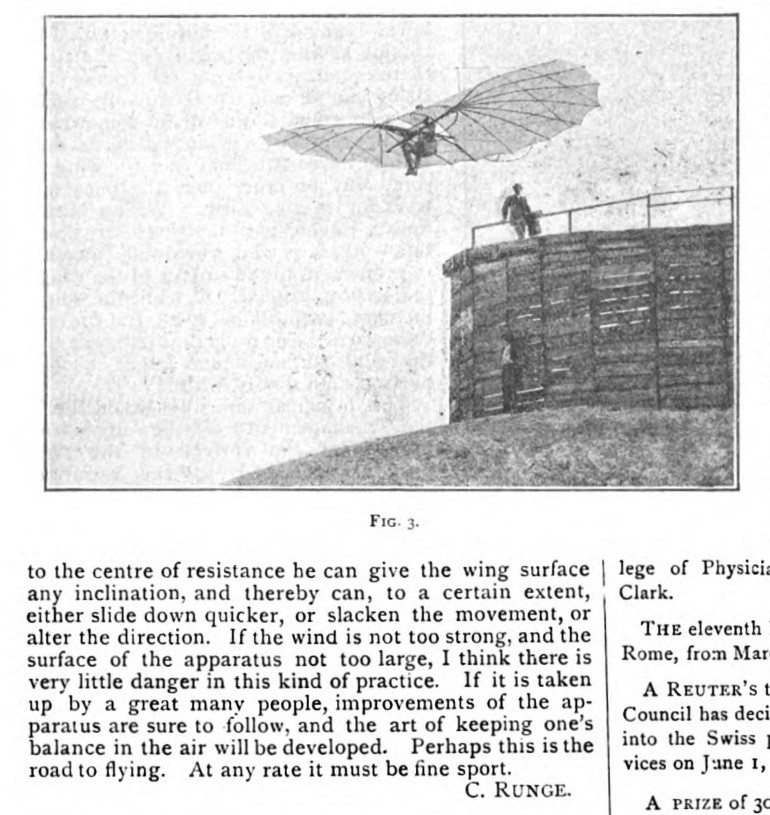
    The last three sentences by Runge are remarkable:

    “If it [flying or attempting to do so]  is taken up by a great many people, improvements of the apparatus are sure to follow, and the art of keeping one’s balance in the air will be developed. Perhaps this is the road to flying. At any rate it must be fine sport.”

    Notes:

    1. (LILIENTHAL, Otto). Runge, C. “Experiments on Flying”, in Nature, a Weekly Illustrated Journal of Science, 14 December 1893, volume 49 no. 1259, pp 145-168, with the Runge article on pp 157-8, with three photo illustrations of Lilienthal in flight.

    Lillienthal _2_


  • The “Aye Aye”, Newt Rings, and the Chromatic Octave–Compelling Bits from “Nature” (1870).

    JF Ptak Science Books   (Really) Quick Post

    I was writing a bit on the C.G. Foster paper on Fizeau’s experiments on Newton’s Rings, found in an early volume of the great journal Nature (volume 2, June 9, 1870)  In tidying and finishing up, I recorded some of the other interesting-looking (and sounding papers in that weekly issue, and found a minor treasure trove of imaginative and provocative titles for minor papers and notes. They’re delightful, really, and are some good examples for what was the major intellectual foundation of the journal, which was to be scientific of course and just a bit fringe-popular. I imagine to the Victorian mind that much if not all of this slim weekly would’ve been consumed on receipt.  That said, here are some of these beautiful little efforts, spread out over a very tightly packed twenty pages:

    • “The Aye Aye”
    • “Carp and Toads”
    • “Anticipated Destruction of the Cheesewring”
    • “Lefthandedness”
    • “The Chromatic Octave”
    • “The Color of the Moon by Day and Night”
    • “What is a Boulder?”
    • “Scandanavian Skulls”
    • and of course, “The New Australian Mud Fish”.

    Seriously–how could these be refused?


    ·Posted by :

    ·in:


  • “We Need a Stroke of Genius.” (RPF, 1946)

    JF Ptak Science Books   Quick Post

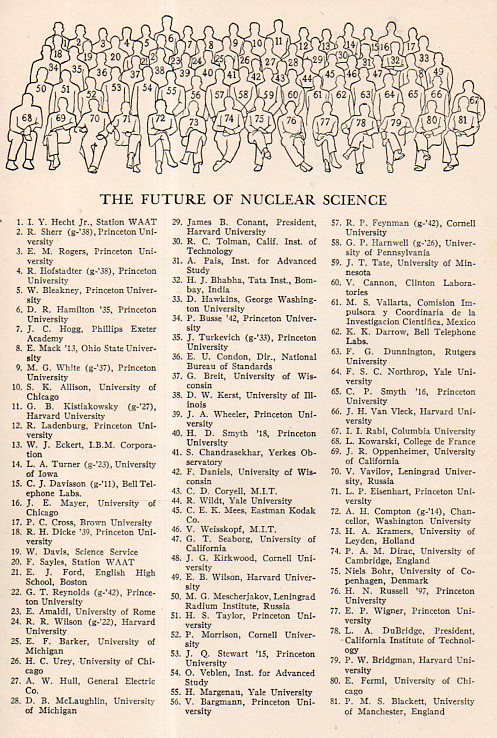
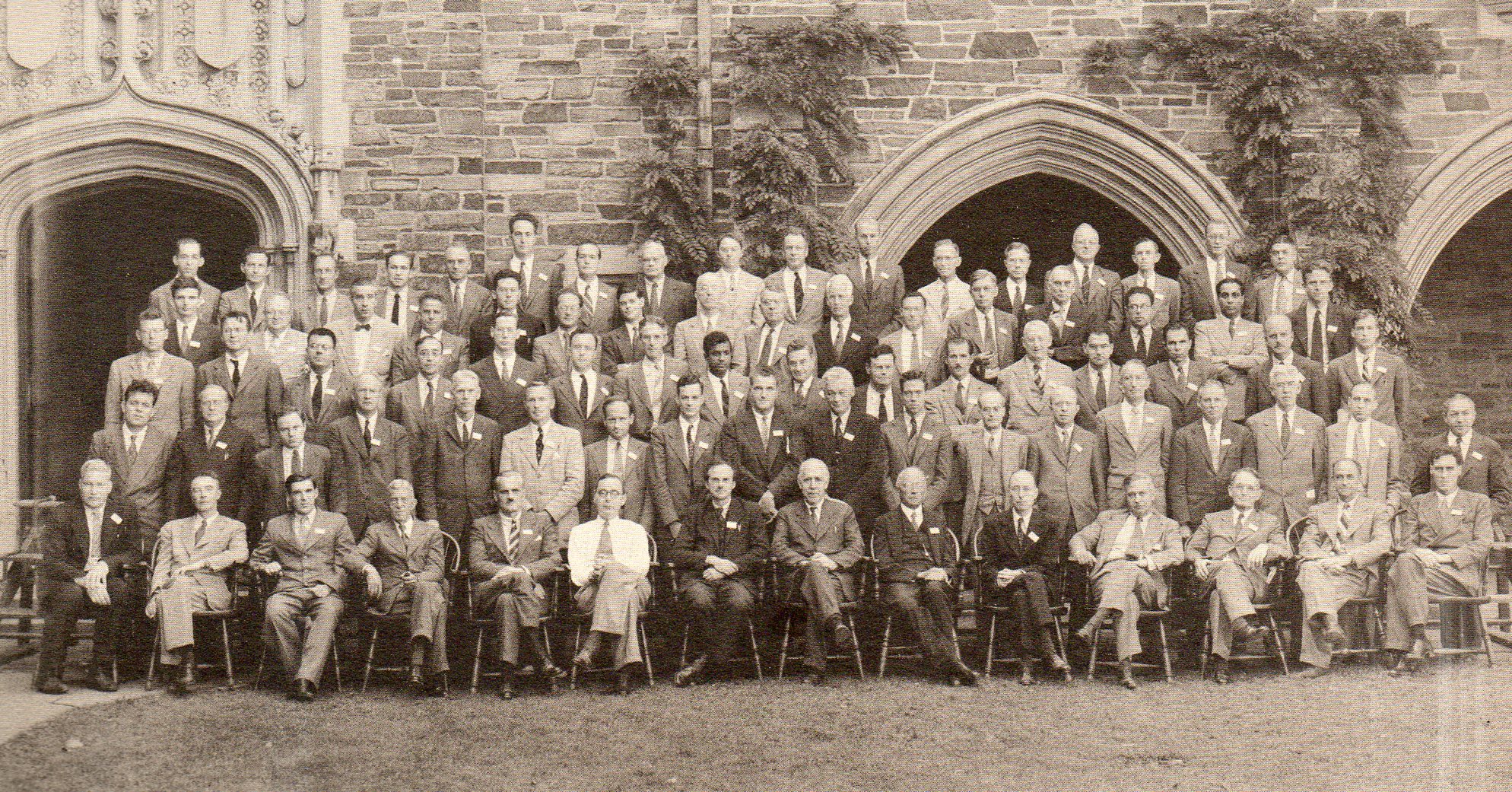
    The Future of Nuclear Science, Princeton University Bicentennial Series, Series I Conference I (1946), with a forward by the director of the conference, E.P Wigner, is mostly just a short (36-page) introduction to the conference, with a few highlights of superstar comments, most notably from Dirac and Feynman (see below). There is a remarkable and seldom scene photo of the conference’s participants–it is a mega-powerhouse of physics people. Perhaps what I enjoy most of the photo part of the publication is the out-of-context artwork in the skeleton/ghost photo that accompanies the image so that you can identify those pictured. It really does take on a life of its own–though I admit I’m partial to these bits.

    Skeleton 716
    It is a considerably heavyweight group of physicists–among them are Hofstadter, S.K. Alison, Kistiakowsky, Ladenburg, W.J. Eckert, L.A. Turner, R.H. Dicke, E. Amaldi, Urey, Conant, Tolman, Pais, Turkevich, Condon, Wheeler, Smyth, Chandrasekhar, Weisskopf, Seaborg, Wilson, Morrison, Veblen, Bargmann, Van Vleck,  Eisenhart, Compton, Kramers, Dirac, DuBridge, Bridgman, Fermi, Blackett, and so on.  Interesting that Feynman stands right behind the seated Dirac, and that Rabi is on the far right, almost out of the picture, leaning away ever so slightly from the group.

    Skeleton det718
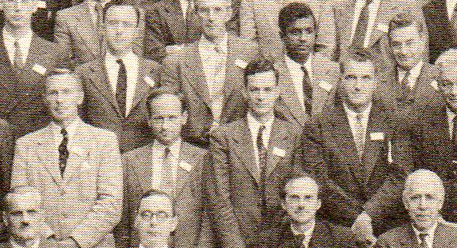
    Here’s a relatively-random detail featuring (bottom left -to-right) Compton, Kramers, Dirac, Bohr, plus (middle left-to-right) Margenau, Bargmann, Feynman, Harnwell, Tate, and (third row) Wheeler, Smyth, and Chandrasekhar.  This was an extraordinary group. 

    Skeleton det a718

    Full text via Hathi Trust via Cornell University.

    Here’s an interesting quote from Feynman:

    “Typical were the comments and queries made by R. P. Feynman of Cornell University and Gregory Breit of the 

    University of Wisconsin: “What will the fundamental particles turn out to be- more particles or less particles?

    Or perhaps all of our so- called ‘different’ particles are not ‘different’ particles but different states of the same

    particle.” The final theory of physics must be complicated, but cannot a logically consistent approximation to it be

    expected—like classical mechanics, which is a logically consistent (but experimentally wrong) approximation

    to quantum mechanics?”

    “Maybe the problem involves a fundamental frequency related to the classical electron radius. . . . Or again, 

    perhaps the meson (note: an elementary particle, found in the cosmic rays, and linked by theory to the

     nuclear force fields) and the electromagnetic field may be two manifestations of the same thing, with the 

    link provided by the fact that they both obey Bose-Einstein statistics.”
    But perhaps all this may best have been summed by the comment of Dr. Feynman, “We need an intuitive 

    leap at the mathematical formalism, such as we had in the Dirac electron theory (note: the theory which predicted 

    the positron discovered in 1932); we need a stroke of genius.”


  • The Big Bang Monkey and “Gasoline Alley”

    JF Ptak Science Books  Overall Post 5111   Part of the series A History of Blank, Empty and Missing Things 

    Concevons qu’on ait dressé un million de singes à frapper au hasard sur les touches d’une machine à écrire … [translation: Let us imagine a million monkeys typing haphazardly on typewriters …”1

    Gasoline alley723[Gasoline Alley, 1931]

    There are some ideas that leave me with a powerful sense of nothing.

    To me, “nothing” can be very important–especially in writing and speaking and action, doing or saying nothing has been the important and the correct thing to do.  “Nothing” isn’t necessarily an ending, and, just a period or a coma, can just be a placeholder for something that is developing.  There can be long nothings and short one, forever- and micro-nothings, and nothing that is nothing for almost nothing.  Nothing can be implied, insinuated, broadcast and defined, though self-defined extended nothingnesses (like John Cage’s  4’33”) is a tricky thing to make happen with success. 

    The ideas that leave me with a sense of nothing are interesting things.  And there are a lot of them. When I can remember them they are in my nothing file, waiting for nothing–or something–to happen.

    This is the sense I had when (years ago) I was trying to explain randomness to our 10-year-old daughter and her 11-year-old cousin, sitting out in a park, looking at stuff.  Somehow I reached into the past and pulled up the infinite monkey theorem, and tried to make that interesting, but just couldn’t do it. Maybe it was the difficulty of super-large numbers, or the fascinating but incomprehensible thought-threats of Borges and his infinite library, but I was left with nothing.

    It is Borges who writes a lovely piece on the history of producing everything from nothing, appearing in his “The Total Library” in 1939 (and then again in “The Library of Babel” in 19412), reviewing machines and such of spectacular randomization that could produce the whole of what we recognize as what we know. 

    Emile Borel wrote on it in 1913, finding the possibility of one million monkeys pounding away at one million typewriters.  In his wonderful work, The Math Book3, Cliff Pickover looks at 250 big ideas in the history of mathematics and gives each of them one page only for presentation and explanation.  He approaches the infinite monkey theorem by looking at one monkey wailing away at one typewriter, striking the keys, and analyzing how long it might take for the one monkey to produce one line from one book.  The line is “In the beginning…” at the beginning of one great nothingness, from the Old Testament, a 56-object sentence (including punctuation and spaces) and, Pickover reasons, that if there is a 93-character keyboard, then this monkey will have a 1/9356 possibility times 10100 of getting it right, and that if it worked for 24 hours a day striking one key every second then it will have used all of the time in the present universe–the Big Bang Monkey.

    All I got back were big stares, and a big sense of nothing in my gut.  It reminded me of the cartoon featured above, a toss-off sub-cartoon in a panel of the Gasoline Alley series.  Did he actually look at the coin?  Did he just decide to keep it?  And why keep a phony nickel? And who counterfeits nickels, even during the Depression?  What is the outcome of the panels–just some guy walking down the street with a nickel in his pocket.  Something may have happened, but it was a lot of nothing. 

    I know that I should have a bigger sense of what Felix Edouard Justin Emile Borel and Jorge Francisco Isidoro Luis Borges were writing about and in many ways I do, but in the end I know that I am left with nothing.  But I have it in my pocket.  

    Notes

    1. Émile Borel (1913). “Mécanique Statistique et Irréversibilité”) J. Phys. 5e série 3: 189–196.

    2.  Jorge Borges,  “La biblioteca total” (The Total Library), Sur No. 59, August 1939. Translated by Eliot Weinberger, in Selected Non-Fictions (Penguin: 1999)

    3.  Clifford Pickover, The Math Book, (2009), Sterling, page 328.


  • Thought Machines and the Revenge of the Atoms

    JF Ptak Science Books   Post 2906 (Overall post 5110)

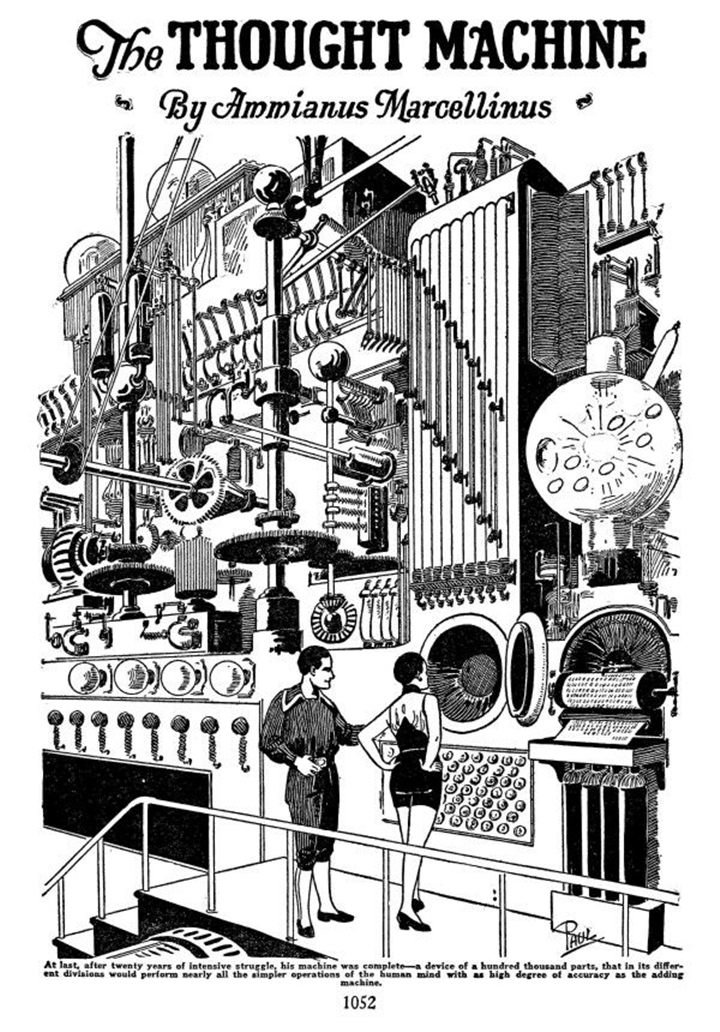
    THought machineIn the past of the past of the Thinking Machine, back when Alan Turing was only 15, the prodigious and fabulous Frank R. Paul was creating this image (left) of such a machine for an almost-adventurous story by “Ammianus Marcellinus” called “The Thought Machine”. The story appeared in Amazing Stories in February 1927, and for me Ammianus (the name of an historian who live in the 4th century CE and who wrote on the later Roman Empire) just did not have the power of persuasion for his tale–perhaps a lot like his 1600-year-old original, who Gibbon found to be boring and tedious). But the legendary work of Mr. Paul was enough for me, and so I’ve reprinted his artwork, which in itself is expansive and techo-lyrical in its many ways. In this one, I was intrigued by some of the thought machine’s components–the most obvious bit being what very much looks like a “Millionaire” calculating machine at bottom right. That, and the Napier’s-Bones-type thing about the bouncing brain of the machine–and then there numerous gears and worms…and what also seems to be like the hints of the power for the whole thing, which are the several belts leading up and away to a larger power conveyer off-picture, which for all I know may have been steam.  

    Atom revolt  of theI looked around in the pulp/sci fi references I have for some other images of “thought machines” from this early <1930 period and came away with very little, though I did find something hopeful called “The Thought Materializer” which was also supposed to be illustrated by Mr. Paul. The story appeared in Science Wonder Quarterly and was published in the spring of 1930–unfortunately the illustration was just a simple and disappointing portrait of the author.  The story was even more disappointing, and the writing was Boy-Wonder-robbed-as-he-knealt-to-pray-about-lonesome-love bad–for example, there is this unpolishable pearl: “Imaginatively, Proctor stepped from the bath”. Ouch.

    That said, looking for that “missing” Paul illustration let me bump into another interesting bit with a title begging question: “The Revolt of the Atoms”.  

    This brings to mind the possibility of “The Revolt of the Adams”, where 17th c Bishop Burnett postulated infinite planets and infinite worlds with infinite people populated by infinite Adams and Eves because as god is perfect each world would be completed with its own A&E.  

    Getting back to atoms–this story was published in Amazing Stories in their April 1929 issue and was one of the not-many early sci fi bits working around the idea of harnessing the energy of atom. Unlike many, the author, V. Orlovsky, had a go at the dangers of the atoms “rising to power”, the new-found energy becoming an agent in the possible demise of the Earth.  In any event, Something Happens in the story and the atoms run wild, forming a gigantic firey nucleus of a floating monster atom which “swept away everything that was alive”. The giant atom moved across Russia and into Italy, then on to France, destroying everything, threatening the Earth itself with utter destruction. I did not read the whole story, but it does seem as though an eruption of Vesuvius directly beneath the atom and ejected it on an “etherwave” into the Earth’s atmosphere, where it spun itself away and harmlessly so, becoming a small satellite. As I said, it is a disappointing story, though the cover art–again by Frank Paul–saves the day with its drawing of the giant atom being approached by enormous electromagnets to try and do such-and thus to it.  Frankly, I just liked the idea of the killer atom.  


  • “Telephone” Calls from Tomorrowland–or, Weighing Antique Surprise

    JF Ptak Science Books    (An episode in the series on the History of Anticipation.)

    TelephoneThis ad appeared only 66 years ago in 1954–that’s four generations in dog years, two human generations (or one for the more later-in-life crew, which is appealing as I knew a man whose grandfather was born in the 18th century), and 15 generations in managing data and communications. Perhaps more.  It is difficult to imagine the intense surprise that attended this ad showing a practical and popular adaptation of a communications breakthrough. 

    The electromagnetic telegraph, which is arguably the first electrically-powered iteration of the internet, was in the works from the 1820’s until it was nailed by Samuel Morse in 1837.  It was 40 years to the development of the Bell telephone (another dramatic example of an invention/technological idea/breakthrough that was “in the wind”, a popular undiagnosed monumental meme, some decades in the making in the hands of Bell and Reiss and Meucci and Gray and even Edison). Two more decades (just past the turn of the century) until more-widespread wireless telegraphy, another two decades after that (1920’s) for popular radio, and another two decades after that (post WWII/1950’s) for popular television broadcasting. 120 years between the patented invention of the Morse telegraph to 50 million Americans with televisions in 1955. 

    The “telephone” of 2020 is as removed as the telephone of 1954 as the telephone of 1954 was removed from the electromagnetic telegraph–we’re not meeting half-way in the meeting of improbable impossible worlds, of worlds of the future unimagined in the past.  That is what comes to mind when I see this add for the speaking telephone in 1954–the astounding, astonishing, speaking telephone, the phone that allowed you to not have the receiver to the ear, that allowed you to do free-hand work and communicate at the same time.  It was an ambitious improvement, and as soon as the phone appeared, it became a standard of necessity if that necessity was within budget. 

    It is the weight of surprise that is so abundant looking at pictures like this, giving us the opportunity to imagine the surprise elements of another time. It may well be that the new 1954 user of the speakerphone would have looked at the first telephone systems of 1894 as we look on that 1954 telephone today.  Probably not so, though, probably it was much more imaginable to have foreseen the 1954 possibilities in 1894 than for 1954 to have seen in the same amount of time to 2013:  the technological pieces necessary for part of that imagination had not yet been invented, the science ahead of the sci fi.

    The other part of this surprise element is that 1954 is well within living memory, and that this combination of technology and physics and mathematics has grown so incredibly from the speakerphone to the massive changes in 2013–it is as surprising to imagine this as to imagine the same scenario for what happened a year before in biology:  it is difficult to grasp the  sweeping changes in that field from the identification of DNA in 1953  and how far those fields have come since. 

    I think that if one could quantify this sort of “surprise” that the greatest amount of “Surprise Integers” (or whatever) ever recorded would have taken place within these past 50 or 60 years. Which makes me wonder–will people 66 years hence see the pictures of our fabulous accomplishments in 2020 as quaint reminders of how much things changed between 2020 and 2086?  Will those “Surprise Integers” be as great for that period of time as the (“our”) preceding period with concomitant revolutions in thought?  My guess is “yes”–it’s just hard to imagine. 

    ·Posted by :

    ·in: