A Daily History of Holes, Dots, Lines, Science, History, Math, Physics, Art, the Unintentional Absurd, Architecture, Maps, Data Visualization, Blank and Missing Things, and so on. |1.6 million words, 7500 images, 4.9 million hits| Press & appearances in The Times, Le Figaro, Mensa, The Economist, The Guardian, Discovery News, Slate, Le Monde, Sci American Blogs, Le Pont, and many other places… 5000+ total posts since 2008.

Author: JF Ptak

  • Bartleby the Computer, 1853-1957

    JF Ptak Science Books  Quick Post

    I was reading Computers and Automation tonight and found this lovely short story in the July 1956 (volume 5, no. 7) issue.  It is a short story written by Jackson W. Granholm (a biographical note on Granholm appears in the ACM notices  here) on the application of a supercomputer put to solving a very particular–and peculiar–problem.

    The story is called “Day of Reckoning”, and tells the tale of the ever-working, highly-dependable-indispensible SUPERVAC being readied to accept the end-all program, readied like the countdown to the launch of Apollo 11 to receive the question, hauling on board into his storyline the other professionals who read the journal for tech reports and info, trying to keep them in his boat with a sci-fi tale based on his own work experience on some big machine at Boeing.

    Finally, we see the question:  “Describe the detailed design of your superior successor!”

    Well of course the SUPERVAC had been working perfectly right up until this time, though with the problem submitted the computer began to behave erratically.  It works for 12 hours or so, blinking and flashing away, until at 10:35 pm the MULL light went out, the solution reached.

    “12 October 1957, 2230 PM PST, 0130 am GCT–PROBLEM 198BC12-XA–RECKON HAVE EXCELLENT POSITION HERE. NOT 2ISH RELINQUISH IT AT THIS TIME. THANKX. ROGER  — PDA**EM –OUT.”

    Overall, SUPERVAC “would prefer not to”.

    [The Melville short story can be found here.]


  • An Utter Masterpiece-of-Small: “School Safety Patrol Pioneers”, from the Serendipity House

    JF Ptak Science Books   Post 1678

    (This post would be incomplete unless you also read the post on The History of School Lunches.)

    The best part of browsing books on shelves or in boxes or wherever the physical, non-digital place might be is the surprise, and the best surprise is the truly unexpected surprise.  That is the beauty of browsing, to me, and this is what is disappearing as we replace shelved books with a monitor of some variety, whether it is at home or in the library. The glory of serendipity seems not quantifiable yet–the brain does too much stuff when you unconsciously parse a shelf or case or range of books.  As you walk down an aisle of books, past hundreds or thousands of titles, you are seeing many of them though not necessarily registering them in your conscious experience; but your brain is working on this impulse of data even when your mind is wondering what you were doing at the library in the first place.  When I go to the library, I like to think of it as going to the Serendipity House.

    Blog1sept_15_safety_patrol550

    Finding the unexpected–and sometimes the unimaginable–is a pure joy, whether the found thing is monumental or useful or inspiring or informative or not.  Sometimes it is the very simple satisfaction that a work exists on some very removed topic. 

    If you were to open the Atlas of Reading Experience and tried to find this title on school safety patrols, I imagine that the pamphlet would be represented in a part of the sea that seems very blank, but on micro-inspection it is obvious that there is a planktonesque sea of small islands with small islands off their costs of smaller items, and so on and so forth, resolving more minute detail and more islands, in a fractal world of smallness.

    And somewhere in there would be School Safety Patrol Pioneers.

    I really do love pamphlets like this whose titles make you stop and say “what in the world…?” or some such thing, usually though its just limited to the word “What” followed by a number of exclamation marks.  This get s a little and needlessly more complicated when the exclamation points are combined with question marks, thus : “What!!” looks allot different from “What!!?”, and seems much more interesting, too.  I think that the most sublime pamphlets would resume the full complement of exclamations and questions available for my made-up review, which would be three apiece: “What!!!???” or “What???!!!” or any combination thereof (each of which would hold its on special secret analytical-emotional logic, god help us all), and would be the equivalent of a Perfect 10 or 5-Stars or Four Thumbs Way Way Up.  (I think that the way this works is that the more exclamation points there are the louder you way “what” to yourself, and the more question marks there are the higher one would raise your eyebrows when seeing this for the first time. Maybe we’re knocking on the door of the Visual Arithmetic of Exclamation Points and Question Marks, which seems like a long way to go to judge the imaginary meritocracy of the painfully mundane.) 

    In any event, I think that the (completely) unexpected beauty and idea of this pamphlet is just delectable–kind of like experiencing a superb slice of buttered toast.

    This masterpiece of the forgotten obvious, The School Safety Patrol Pioneers, printed by the  American Automobile Association in 1941 really does pay an homage in shades of white to the great leaders and benefactors of the Crosswalk Warriors.  The great leaders though were not children, I’m sorry to report, but grownups whop dedicated their lives to the concept of crossing the  street safely

    (It sounds like I’m poking fun, but I’m not, really.  What an enormous undertaking it was to write this 20-page effort–really.  Could you imagine trying to research such a topic today?  I can and can’t–it would be an enormous heartache to undertake–unless of course you had this pamphlet in hand.  My mind reels about trying to figure out where to start such a project. Honestly–it would be tough.

    The design of the pamphlet is neat and clean, and very orderly, reporting on some of the leaders of this field, “then” and “now”.  One then-and-now reads” THEN–Supervisor, Physical and Health Education, Philadelphia; NOW–Supervisor of Safety Patrols, Philadelphia”.  More often then not though they read like this:  “THEN–Principal, John Muir Grade School, Seattle; NOW–Deceased.”  I wish the writer had gone into a little more detail on the person’s life before death took command, but all-in-all, this little pamphlet mobilized great, quiet wonders on its depth and efficiency in reporting on the history of crossing guards, and I’d rate it a “What !!?”.

    Now if I could only find something on the history of school hall monitors…


  • Snail Trails–Getting from the Law of Irritability to Articulated Clowns and Artificial Leeches

    JF Ptak Science Books  Post 1677

    The Laws of Irritability was a marvelous-sounding title (to our ears, in this year) for a rather important medical treatise on the contraction of muscles.  It was a medical treatise by Felice Fontana1 (1730-1805), and had nothing to do with what we would think of as irritability, and certainly was a long way from a book like Robert Burton’s beautiful and slightly unreadable (and fairly unendurable) Anatomy of Melancholy, even as much as we would like it to be.  After all, wouldn’t it be lovely, somehow, in a automated-Dickensian way, to see that there were 32 laws of irritability, and that this was the first of the afflictions like ennui and depression and so on that could be modified and codified, and I guess eventually commodified?  (Making these things into commodities didn’t have to wait for anything at all in the way of proof or scientific merit went; after all, they were published in published books, which would have to be purchased, so there’s an instant commodification to them.)  But alas the Laws of Irritability were nothing of the sort, referring to a set of observations and deductions more real than half-imagined self-references.

    But all of this leads me in a very uncommon route to articulated clowns and skeletons, and of course artificial leeches.

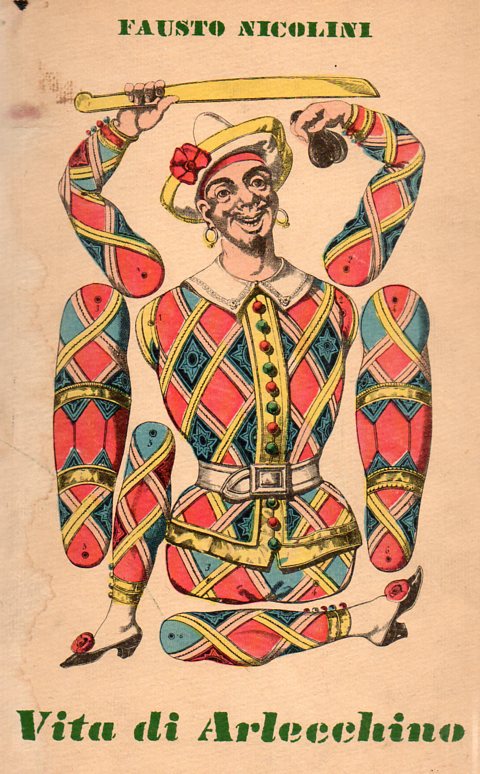
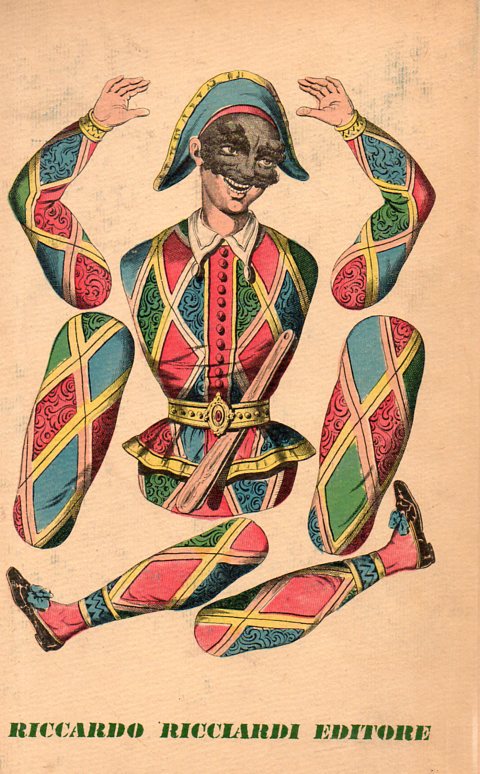
    This entire post started with the imaging that this book (below) by Fausto Nicolini, Vita di Arlecchino (“Harlequin’s Life”, published in 1958) and which contained a rather unusual bit to it-actually it didn’t so much “contain” it but displayed it.  The front and back covers were both illustrated with clown images–clown images that could be copied, its sections cut apart, and re-assembled into a working cut-out paper puppet.  Now I’ve been dealing with scarce/rare/non-existent books for 30 years, and I cannot recall a similarly-covered book, where the reader could turn its cover into a puppet.  But here it was. 
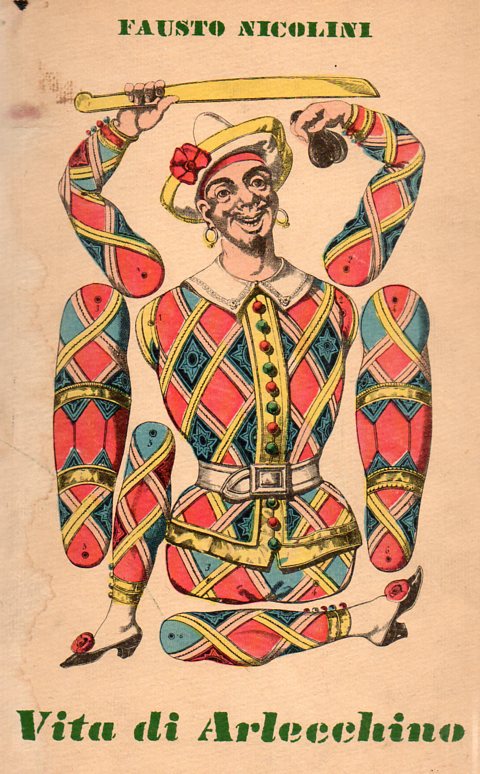
    Harlequin 1054[Click, enlarge, print and cut out your own dancing harlequin–the back cover is below.]

    It reminded me of another work, a beautiful anatomical treatise by Jean Baptiste Sarlandiere, first published in France but eventually printed and published in New York in 1837 as Systematized Anatomy, or Human Organography. The sample below shows exactly how the book was laid out, almost as an instructional on how to reconstitute the body–a cut-out book, made to be separated and then pulled together again as a whole, the joints articulated with string or brass brads, a book no longer now a little puppet, “A real live boy”.  (And yes it happens to be an Italian author–Carlo Collodi–who gave life to that naughty marionette…this is a tough story for kids, I think, even though I muscled my way through it with our younger daughter, leaving out some of the brutal stuff.)

    http://www.find-a-book.com/images1443/6989.jpg

    And it is via Sarlandiere that we get to our leeche issue, because it was he who fashioned the response tot he endemic leech shortages of the 1820’s and 1830’s with his creation of the artificial leech. 

    Oh to be in France in the 1830’s and be a illegal leech importer, for your fortune would have been made.  Leeches were still very important in medicine–as a matter of fact Francois Broussais2 saw the leech as a cure to virtually every diseases, saw them as a way of relseasing the inflammation and swelling and other complaints caused the body via strange and odd assaults on the body–the leech was a good and measured response to external insult, applied frequently and very liberally. 

    Evidently consumption on all fronts was on the rise, prices went high, but the availability of leeches went down.  In France alone, leech production (in 1836) fell from 50 million to about 18 million, all but 1 million of those staying within the country.  And so it was Sarlandiere who came to the rescue with his “artificial leech”3, something that would replace venthouses and bleeding cups and of course the leech itself.  It was something that he had already developed years before, but perhaps time had caught up to it.

    His devices are shown  below4 (expandable):

    An external file that holds a picture, illustration, etc. Object name is medhis5302-04-253-02.jpg Object name is medhis5302-04-253-02.jpg


    I’m unsure of the disposition of the artificial leech; Sarlandiere’s medical instrument lay in wait for the Dutch leech crisis, and seems to have gotten everyone through the sorrowful state of leechless affairs as they existed. At least he published images of what his invention looked like for the rest of the medical world to see and comment upon, and possibly use, and replicate.  This unlike other “advances” in instrumentation which were kept under wraps, and secret, such as in the case of the foreceps kept secret by the Chamerlains for several generations.  At least the widespread trust in the leech didn’t last much longer.

     

    [Source: Philosophy of Science Portal ]

    Notes

    1.  The work was published as De irritabiltatis legibus, nunc primum sancitis, et de spirituum animalium in movendis musculis inefficacia, revised and translated into Italian as Ricerche filosofiche sopra la fisica animale (1775)Fontana leges irritabilitatis constituit, ingeniosus homo et accuratus, published in 1767.

    “Formulated after the model of Newton’s principles in physics, the laws of Fontana on muscular irritability were an important but neglected contribution to the subject of muscular contractility. The first law concerned Haller’s concept of contractility as a property of muscle fiber itself, and pointed out that a contraction follows only after some stimulus. The discussion displayed insight into the underlying nature of tetanic muscular contraction. The second principle was the refractory period discovered by Fontana in heart muscle and applied to better understanding of the function of other muscles. The original third principle was a disproof of the efficacy of a theoretical entity, the ‘animal spirits’ . . . In his fourth law, Fontana pointed out the loss of contractility which results from stretching or compressing a muscle, and certain medical applications of this principle. The fifth law was concerned with problems arising from atrophy of disuse.”–Complete Dictionary of Scientific Biography, volume 5.

    2.   François Joseph Victor Broussais (1772–1838). Marie-Luce Jardin, Les Thérapies par les sangsues: les pratiques les plus anciennes aux traitements actuels hautement scientifiques, Université de Franche-Comté, Faculté de Médecine et de Pharmacie de Besançon, 2005, Thèse, pp. 32–3.

    3.  Jean-Baptiste Sarlandière, Bdellomètre du Docteur Sarlandière, Paris, Firmin Didot le jeune, 1819.

    4. Teunis Willem van Heiningen, “Jean-Baptiste Sarlandière’s Mechanical Leeches (1817–1825): An Early Response in the Netherlands to a Shortage of Leeches”, in Medical History (Wellcome Trust),  Med Hist. 2009 April; 53(2): 253–270.
    Harlequin 2055
    And more on Fontana from the DSB (“Fontana, Felice.” Complete Dictionary of Scientific Biography. Vol. 5. Detroit: Charles Scribner’s Sons, 2008. 55-57. Gale Virtual Reference Library. Web. 22 Dec. 2011):

  • Mother Goose as Howard the Duck, 1947

    JF Ptak Science Books   Quick Post

    Mother goose 2I’m working right now on a post utilizing a classic story from the history of childhood, Pinocchio. No doubt everyone had some sort of classic image of this scamp in mind, but if you’ve ever read the whole thing the little non-wooden boy really was a bit of a terror, far removed from scampdom.  Its probable that we have different images of some classic tales–in particular from the Brothers Grimm–where our minds have filled in the forgotten nasty parts of the classic tales with more child-friendly versions.

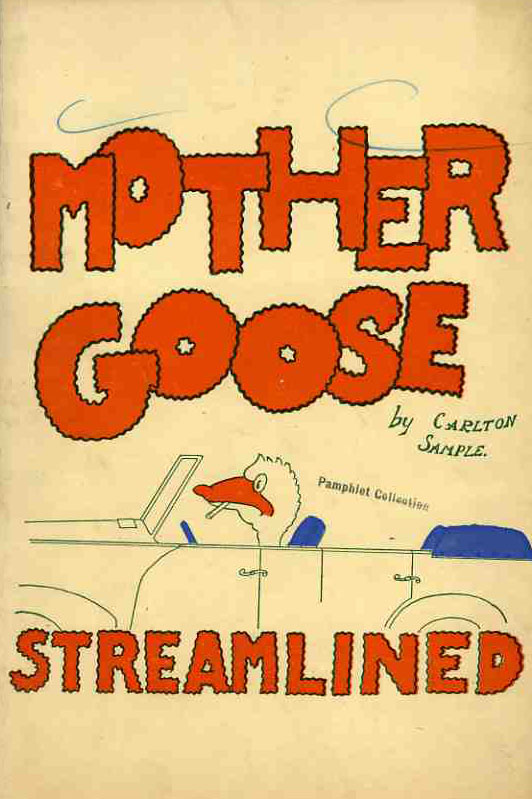
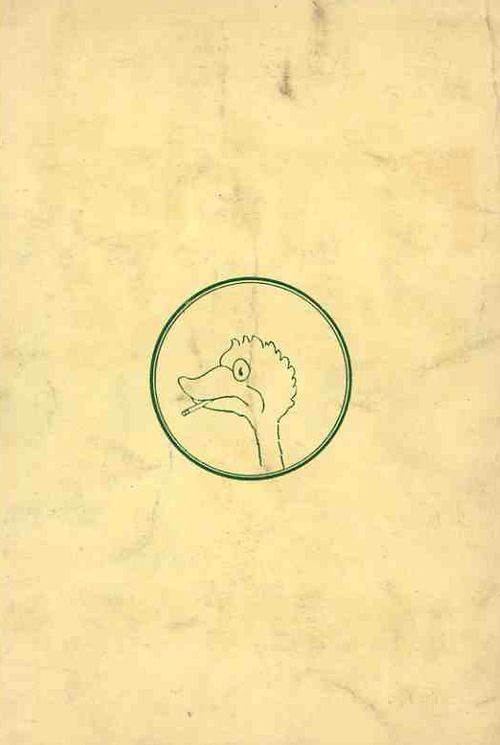
    Which brings me to Carlton Sample, a lansman of mine over in Wilmington NC, who had a somewhat different vision for the old standby Mother Goose, and  (self) published it in 1947. We’re seeing the best part of Mr. Sample’s work right here, what with the inside dripping with gooey doggerel (I swear that when you stand the book upright that one or two letters slide out of the bottom of the book every minute or so…its important to keep the book flat or the thing will be blank in about two days.)    But his Mother Goose Streamlined  is only necessary for his snapshot of the cigarette-smoking goose, driving blankly along behind the wheel of a convertible. 

    Sometimes a picture really IS worth a hundred and twenty-five words!

    And that’s all I have to say about that.

    Mother goose


  • The Department of “What is It?” (#7): What are the Ultra Famous Holes that this Hole Puncher Punched?

    JF Ptak Science Books Quick Post

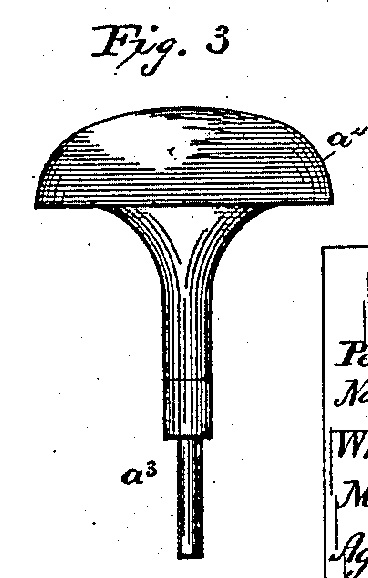
    This is one of the most important hole punchers in the history of holes, and also in the history of counting and figuring out what to do with counted things.  Do you know who filed this drawing as part of their patent report, and what famous contribution this thing made? 

    What is Itt ollerith hole puncher detail


  • Life Elsewhere: Europa, 1940.

    JF Ptak Science Books   Quick Post

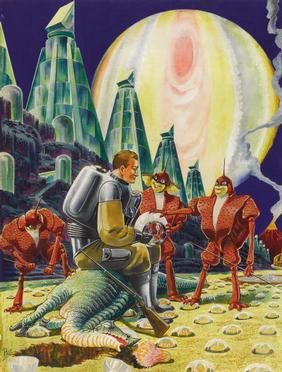
    After watching a BBC series on the planets on Netflix, and having the idea of life on Jupiter’s moon Europa addressed, it occurred to me that I’ve seen the answer to this before.  And here is is, by Frank Paul, “Life on Europa”, created for the back cover of Amazing Stories, September 1940. (From the Frank Wu website, much of which is dedicated to Mr. Paul. 

    Sci fi art--europa
    Mr. PAul settled the issue, which he perhaps made up just that morning–I am particularly impressed by the globular units on t\he surface, plus, of course, the very interesting beings talking with the human explorer. 

    But in general Paul had a very large landscape for his deep well of life forms, sometimes seeming as though they were infinite.

    And all of this done without the benefit or cause of Roswell.  It seems to me, though, that if offered the choice between believing in a universe of teeming life versus just that which we experience here on Earth, I’d choose the former instantly, and get right on board the Frank Paul train. 


  • History of Punching Things: George Foreman, I.B.M., and Batman

    JF Ptak Science Books   Post 1674

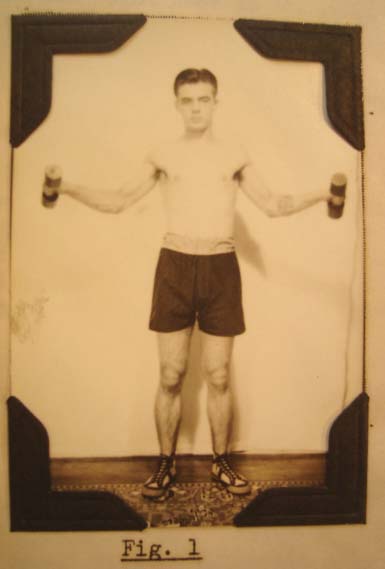
    Ballistics 305Burbling to the top of the massive (organized) heap of material that came my way from the Library of Congress was this beautiful, six-page introduction to punching people, complete with original photographs of the author performing the sweaty necessaries of readying for the punching adventure.  (My guess is that it was never mass produced,m and sent to the Library to protect a copyright application, as is the case of thousands of these LC items that I have.)

    But not being a boxer a punch looks pretty much like a punch to me (unless it is George Foreman crushing the formerly indestructible Joe Frazier with an insane shot to the top of the former champion’s head, a shot so devastating that Joe’s nervous system did not know exactly what to do with all that speedy data*) and, frankly, other things come to mind with the word “punch” quicker than a fist. 

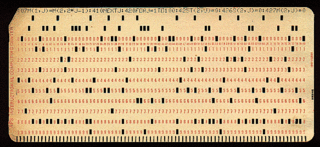
    First is the “punch card”
    which used to be an information-transference

    Blog--punch card

     for programming computers, instructions being the little holes that were removed from the programming card and read as instructions by a little tiny set of people inside the large box that others referred to as “computers”.  (The original “computer”, by the way, were people who did data entry and crunched same; they were carbon-based biounits.  Karl Pearson’s Tracts for Computers of 1911 was a work for exactly those people.)  The punch card was a programming tool used by Jacquard to guide the operation of his loom in the late 18th century and employed widely in this trade after that. It uses as a computation instrument came later to the mind of Herman Hollerith, whose earliest crowning achievement was to put it to use in the tabulation of the American 1890 census. (The government balked with meeting his demands for the use of his invention, or were hesitant primarily so, and Herman took his good work overseas.  A similar path would be followed by the Wright Brothers in about 15 years, as had happened earlier with Thomas McKenney and his going-begging collection of Indian portraits.  National intellectual and monumental treasures like these sometimes had a terrifically terribly go of  being accepted and compensated by our government.) 

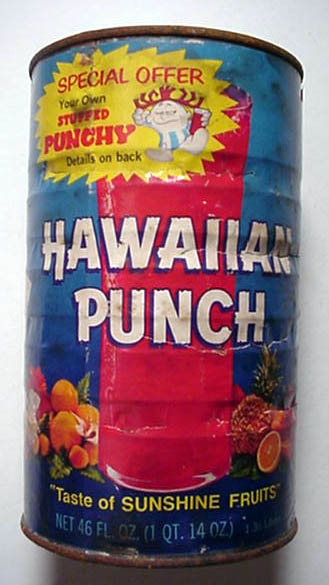
    Blog--punch haiwaiian Maybe the most popular “punch” was the so-called “Hawaiian” one, which was a sugar drink given to children made by a company which was a holding company of  the American Dental Association.  Just kidding about the dental part.  But the “energy drink” was like many others during this period–pure badness that kids loved. It was originally designed as an ice cream topping when it appeared in the early 1930’s, but when folks discovered, somehow, that the topping made a great drink when mixed with water, a new 2% or whatever fruit drink was born.   The “punch” in it came from the wallop of sugar infused directly into the circulatory system.  I don’t know where the “Hawaiian” part comes from. 


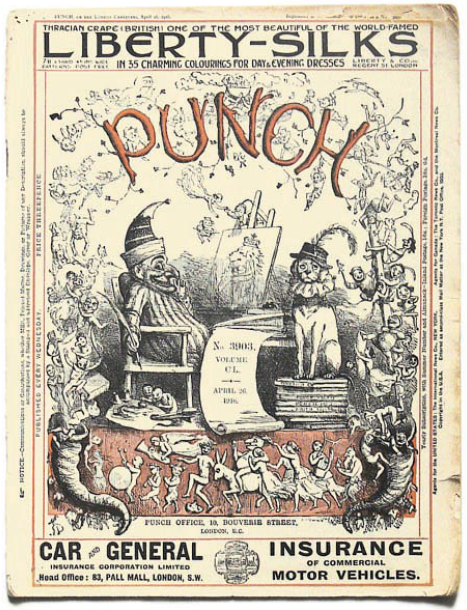
    The most literary “Punch” comes in the form of the British magazine of that name, (Punch, or the London Charivari), a witty and dripping humor and satire magazine which appeared in 1842 and last until 1992. (Punches’ longevity surpasses that of supposed brawler Ernest Hemingway and the tiny-fisted fury of the problematic (did anyone read that last bilge-piece thing he did of the imaginary early life of Hitler?)Norman Mailer.) I think that, like Harper’s Weekly and other such political commentary journals of that time, if you can understand a tenth of the complex  and complicated caricatures and commentary, then you really *do* know your history.

    Blog--punch

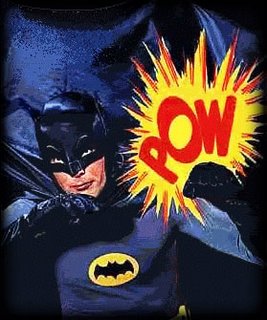
    Probably the most-often referenced literary aspects  though to the punch is found elsewhere, in countless magazines and comics destined for little hands, published by Dell and DC Comics and Marvel.  Only the punch really doesn’t appear so without the reference to the noise it sort of makes,  “POW” (as my daughter Emma has reminded me. “Honey”, I asked her, “what comes to your mind when I say the word ‘punch’?  “Pow” she answered immediately.) And who better to illustrate this point than the immortal Adam West?  (And this of course is not a comic, but a TV show that was made from a comic book that used comic book word balloons[for the first time?] in a video format.) Maybe it is Batman who is the most famous literary puncher, and maybe not:  there’s Popeye, a man of exceptional prowess in the Department of Making Things Unconscious; and the Justice League Superman; the Hulk, who evidently did nothing but punch; and of course, my wife Patti Digh reminds me of “Punchious Pilate”. There’s also Sigmund Freud, a man who delivered a painful and boring punch to the unconscious and whose horrible thinking has been felt right down to this very day, the world suffering his made-up junk  since his own annus mirablis of 1905.


    Blog--punch--POW-Batman Perhaps the greatest knock-out punch of all time (literally) was not the result of George Foreman or Jake Lamotta, but I.B.M.  The I’ll Be Moved Company is the endish result of the work of Willard and Harlow Bundy, the brothers who created the first time, or punch, clocks.  Their company consolidated into the International Time Recording Company and then in 1911 reformulated as the Computing Tabulating Recording Company (CTR) and then again into International Business Machines.  The punch clock kept up to (or down to) the minute surveillance on the comings and goings of business employees (among other many other things), and was perhaps the most influential disruptor and capturing device of time since the invention of the mechanized clock.  It delivered a true knock-out to the cushion of independently recorded renderings of when things “got done”.  

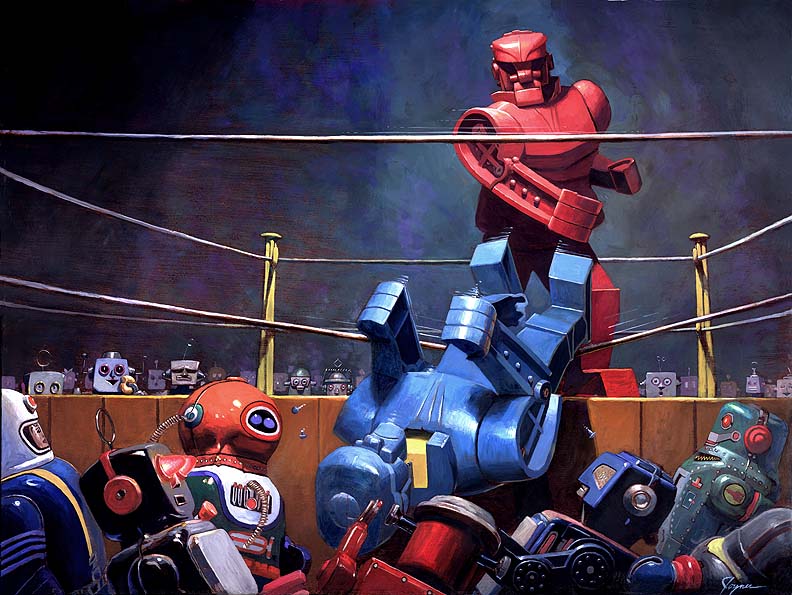
    Lastly, I cannot leave the subject of punching without remarking that I cannot mention Rocky, and that I must simply end the whole thing with two words:  Muhammad Ali.  

    Blog--punch rock (Image from jeffbots.com )

    A note on the 1973 Foreman/Frazier fight clip:  its actually pretty tough to watch.  If you don’t care for combat like this, I’d stay away.

    *Frazier was by far the superior boxer, but Foreman’s punch was unbelievably devastating. In the 1973 fight between the two men, Foreman knocks Frazier down six times.  Frazier looks pretty scary for the first 2 minutes and 17 seconds of this video,  but at 2:18 foreman hits him with a left that basically ended the fight–Frazier probably didn’t know where he was.  At 3:16 in the comes the second knockdown, and then at 3:36 the third, at the bell ending the first round.  At the opening of the second round Foreman just about lifts Frazier out of the ring, and then crushes his head at 5:10.  Frazier was ready for the fight and he was probably about the best boxer in the world outside of Ali; but he couldn’t hurt Foreman, and then was completely and totally dispatched.


  • Map of Nazi Invasion from Uruguay

    JF Ptak Science Books   Quick Post

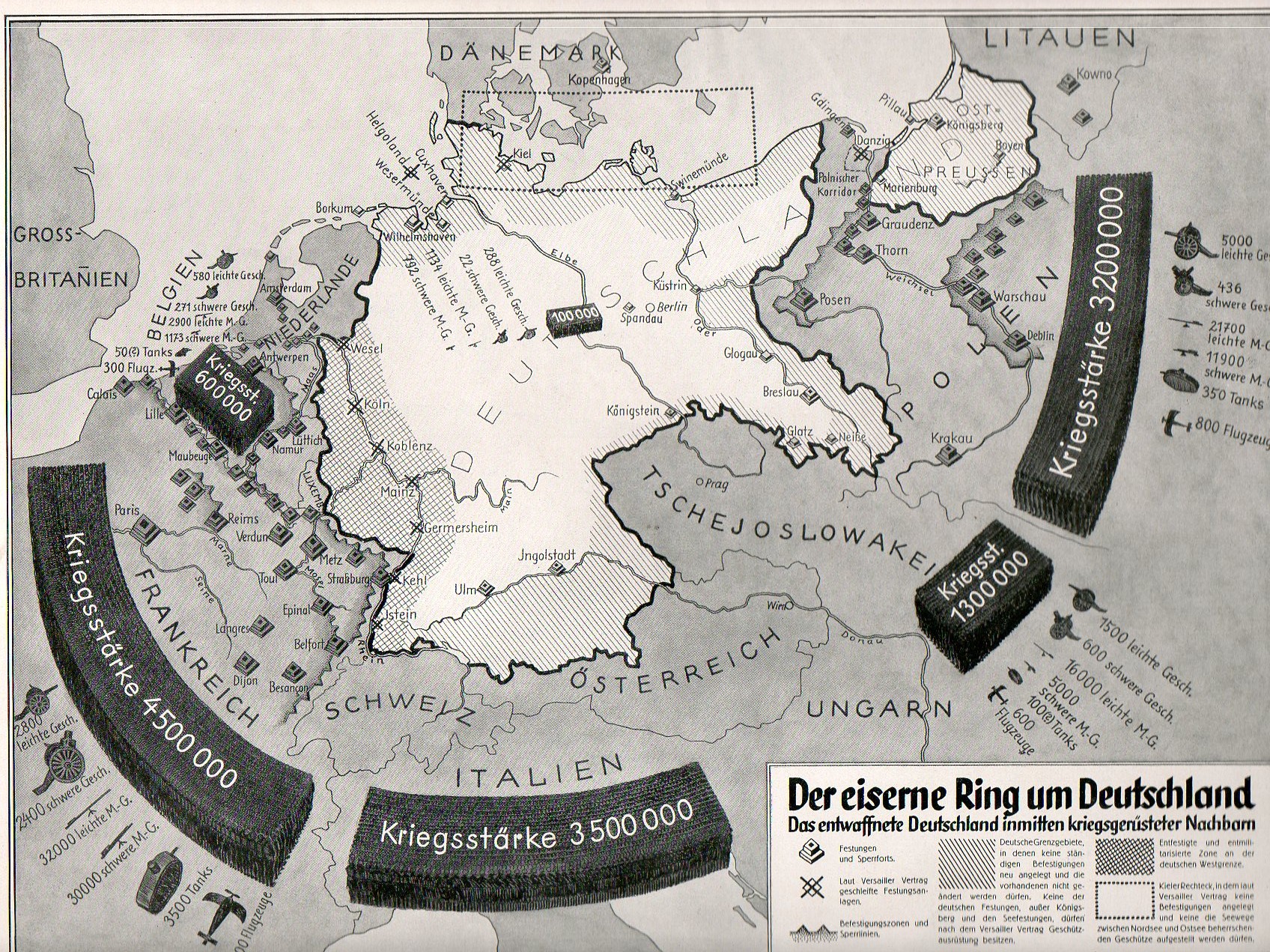
    I’ve post a number of thing son this blog relating to Nazi invasion routes to America and the potential threat of Poland to Nazi Germany, all stories more vividly enhanced (whether true or not) by maps–as a matter of fact, maps seem to be validity enhancers to just about any story, for it seems that maps represent a will of some sort, and where there’s a will, there’s a way, and so there must’ve been a good Nazi plan for attacking South America via Uruguay.  Except that there wasn’t.  But the map looked good, and certainly it made people think.


    [Map source from the Bahia Sin Fondo blog, here.]

    For example, see the posts Invasion Routes to America:  Nazi Invasion Scenarios of the U.S. and Germany Surrounded (map below).

    Nazi Prop surrounded538

    http://sm.headweb.com/factualtv/title_pix/Why_We_Fight_The_Battle_of_Britain.jpg

    [Source:  Why We Fight, the Battle of Britain.]


  • The Awful Revelations of the Future of Emancipated Women, 1904

    JF Ptak Science Books    Quick Post

    http://prints.encore-editions.com/500/0/concerning-the-american-girl.jpg

    Should woman be allowed to vote such are the tragedies that awaited, via 1904 sensibilities


  • The Eiffel Tower as a Unit of Measurement

    JF Ptak Science Books   Post 1673

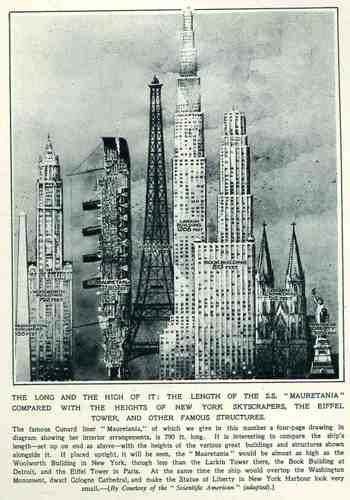
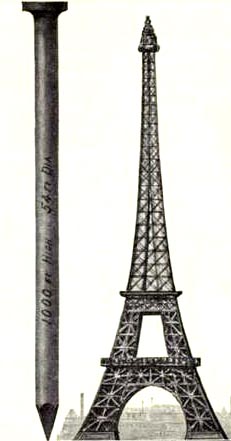
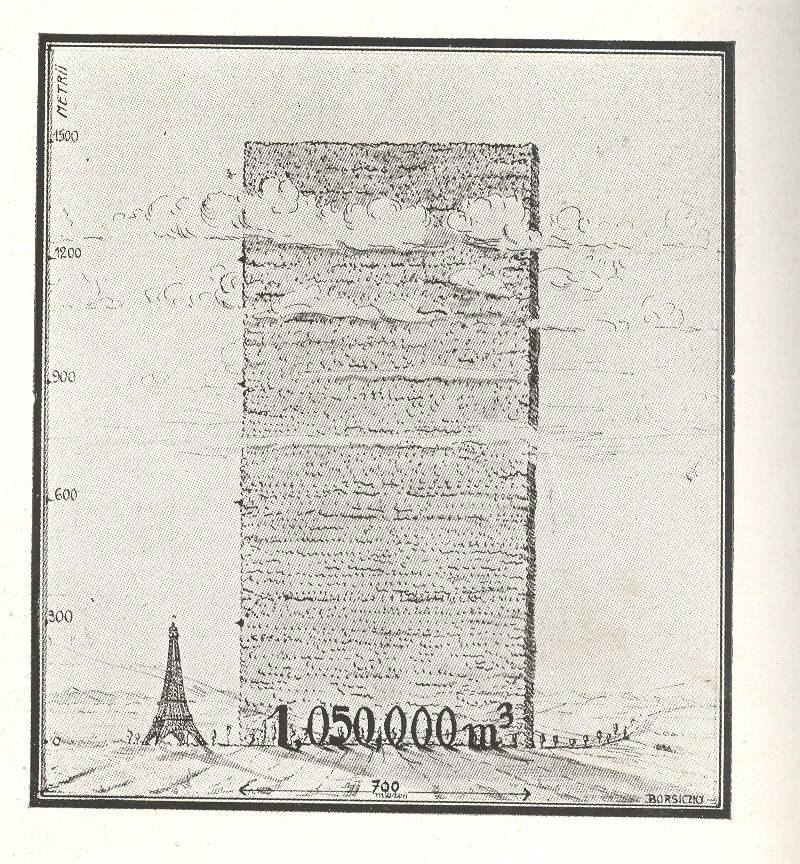
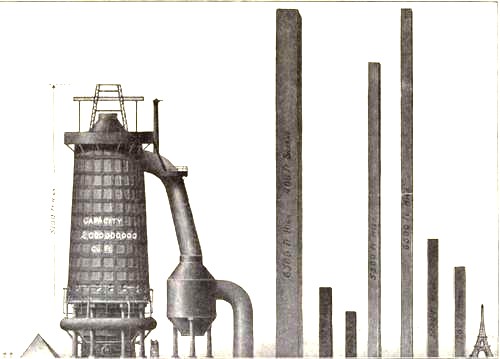
    The Eiffel Tower is iconic; and being iconic makes it susceptible to be used as a standard of measure, at least so far as graphical displays of information is concerned.  Here are four examples of Large Quantities of Things Being Explained in Terms of Eiffel Towers.

    This wonderful display (appearing in The Illustrated London News for 26 March 1927, page 518) of quantitative data isn’t quite as whimsical as it appears in detail, though I can think of only a few (antiquarian) times that I have seen a ship made part of a cosmopolitan vertical cityscape.  It is a great way of comparing two disparate, out-of-place equals, and certainly can get the idea of the size of something as stand-alone and solitary as a great ship to children (and adults, too) by comparing it to something as obvious as a tall building.,  This time its really just comparing the length of the SS Mauretania with the heights of some famous and notable buildings. (The Mauretania, 1906-1935, was a fabled, luxurious and fast ocean liner of the Cunard line; it was refitted for a resurgent oceanic service at about this time.)   In the larger, expanded second image we see the Mauretania stacked up against (from left to right) the Washington Monument (555′), the Woolworth Building (792′), the Mauretania  (790′), the Eiffel Tower (984′), the Larkin Building (proposed at 1208′), the Book Building (873′), the Koln Cathedral (512′) and the Statue of Liberty (305′).  The Larkin Building (not the F.L. Wright structure of the same name) was a proposed super-tall of 110 floors for 330 W. 42nd Street that was proposed in 1926 and not canceled until 1930, and which would’ve been the tallest building in the world. (For an interesting site on the cancellation of tall buildings, see HERE.)   In any event, this was a big ship–the largest in the world when it was launched as a matter of fact–and the drawing is wonderful.   Upon closer inspection, there is a terrific amount of detail in the cross section of the ship.)     (This original print is available at our blog bookstore.)                                             

    Blog1sept_16_ship_skyline564

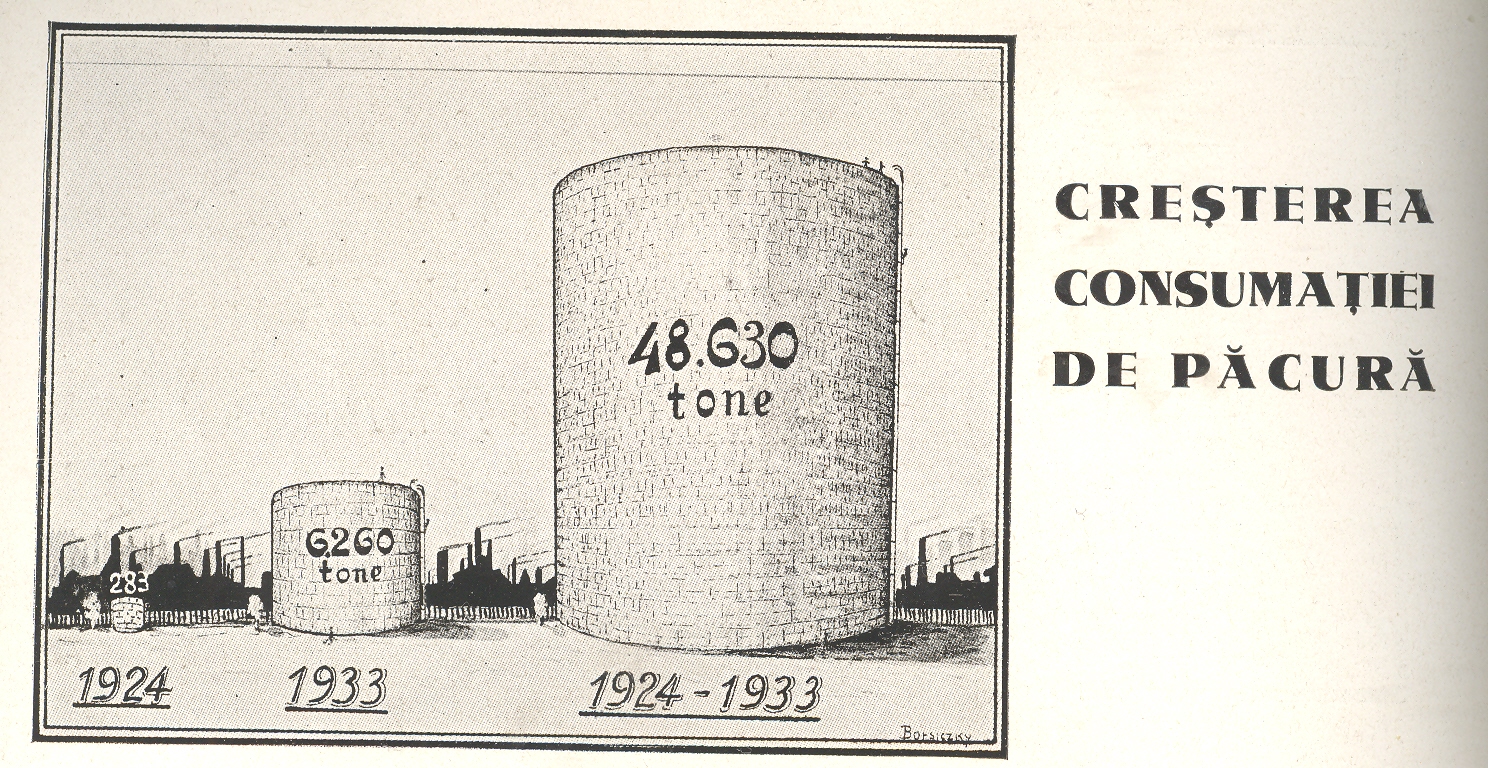
    Continuing a long, developing thread on the graphical display of quantitative data–and especially that which uses man-made objects for comparison—is this interesting bit from a Romanian mining publication from 1933.

    https://historyofideasblog.com/a/6a00d83542d51e69e20120a57d97c3970c-pi

    This image and data is from the generally useful data and interesting if not useless info Scientific American Reference Book. A Manual for the Office, Household and Shop, by Albert A. Hopkins, and published in 1903. It gloriously depicts the annual American finish nail production in terms of Eiffel Towers:  there were evidently 10-million 100-pound kegs of these nails made in 1902; if they were made into one big nail, it would be this one–52′ in diameter and 1000 feet tall.  I guess another useful visual bit would be the representation of the number of new houses built/kegs of nails, which would make this image a little more meaningful; though, perhaps, we may not be going for meaning, here, necessarily.


    The huge mound next to the Eiffel Tower shows the consumption of wood in Romania over a ten year period, a stack of wood 700  metres long and 1500 metres high.  Evidently this wall has only the most rudimentary depth of a metre, as the legend reads that the volume of the woodpile is 1,050,000 metres cubed, which is the same as its square area.  So somebody missed something, here, though the artist did supply some nice shadowing.

    Just above it appeared this comparison for the amount of oil consumed over the same ten year period

    https://historyofideasblog.com/a/6a00d83542d51e69e20120a7e3c6c7970b-pi

    I’m not sure why this comparison was being made.  This does come in the interwar period which saw a great expansion in Romanian territory and a vast modernization effort following the country’s devastating experience in WWI. Maybe it was illustrating modernization from wood-burning power/heating sources to oil-based. I really don’t know–I just liked the Eiffel Tower being dwarfed by a massively tall and impossibly skinny woodpile.

    Diagram steel eiffel 

    I love comparison like this, representing big, hard-to-associate  numbers of something against another quantity that can be instantly understood–the relationship between the two might be tenuous and complex, but at least it can give you some sort of handle on what would normally be an inaccessible, stand-alone number. Plus, any time that you can show what an ungraspable concept might “look like” and be explainable to a 10-year-old, well, you’ve got something.