A Daily History of Holes, Dots, Lines, Science, History, Math, Physics, Art, the Unintentional Absurd, Architecture, Maps, Data Visualization, Blank and Missing Things, and so on. |1.6 million words, 7500 images, 4.9 million hits| Press & appearances in The Times, Le Figaro, Mensa, The Economist, The Guardian, Discovery News, Slate, Le Monde, Sci American Blogs, Le Pont, and many other places… 5000+ total posts since 2008.
Sometimes a word is just a word, and the elements of recognition sometimes inhibits that. Except in this case that the word seems to be just what it is and also indicative of what it would become.
Outsider, or outside, outside the recognition of “official” art, of critiqued-art, is the English language equivalent/translator coined in 1972 (by Roger Cardinal) to illustrate the term art brut (“raw art”) created by Jean Dubuffet. Dubuffet created with others Compagnie de l’Art Brut in 1948, which in some respect was a reaction to a new sort of displayed art that had begun its life in the early 1920’s, mainly as the efforts of doctors treating psychiatric patients who were expressing themselves through their art. (Two famous examples include Dr. Walter Morgenthaler’s Ein Geisteskranker als Künstler (A Psychiatric Patient as Artist), published in 1921 on the work of perhaps the most famous people in the Outsider canon, Adolf Wölfli; and another being Bildnerei der Geisteskranken (Artistry of the mentally ill) published a year later by Dr Hans Prinzhorn.)
[Adolph Wolfi]
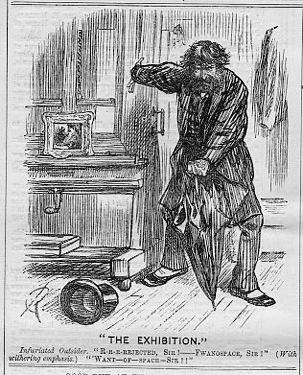
Well, “outsider” as we know it today in reference to the arts is definitely not what the editors of Punch magazine pursued in this cartoon for their issue of 6 May 1886. The “infuriated outsider” was simply an artist left outside a show, whose work was not accepted for exhibition. (And from the looks of it, the small work on the huge easel, being rejected for the “want of space” might not have been the reason for the artist not making the list.)
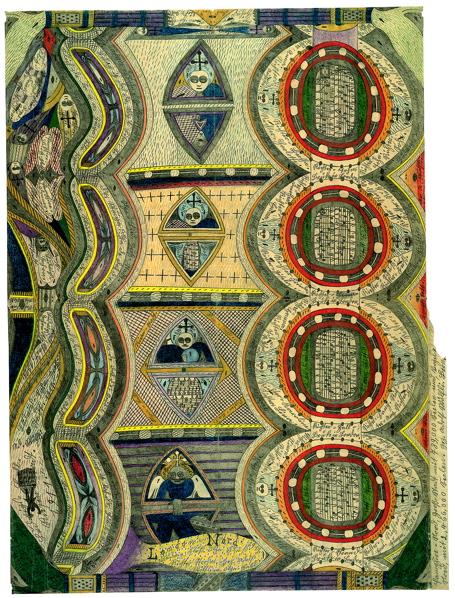
[Henry Darger]
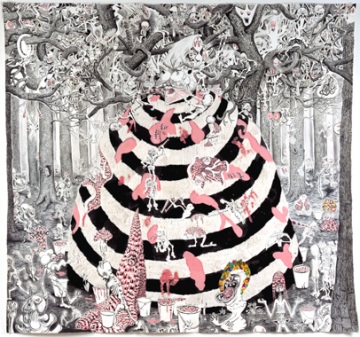
This outsider was simply outside with probably-not outsider art. Henry Darger (1892–1973), Martín Ramírez (1895–1963), Paul Gösch (1885–1940), Charles A.A. Dellschau (1830-1923), Willem Van Genk (1927–2005) and so on were Outsiders, their work being Outsider/Art Brut and also being left outside for a long time. Far outside. In the far-deep outsider, further and deeper outside than the more aesthete outsider varieties of “outsider” art–like Impressionist, Cubist, Dada, Constructivist, Futurist–ever got outside.
[Willem van Genk, detail]
Anyway, I thought it curious to find the term stuck in the middle of a cartoon rant in an 1886 popular journal.
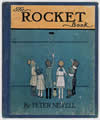
Here are some of my favorite (classic) books for children that I’ve culled from the lovely read.com pages at the Library of Congress. The baseball alphabet book is fantastic (and from 1884 I believe). The Peter Newell Rocket book is another marvelous thing (along with his Slant book, both of which sorta/kinda remind me of PEter Reynolds.) You can follow the linkis to beautiful images of the texts and illustrations. (All text below is from the LC site.)
“Baseball ABC” This guide to baseball literature features an illustrated paper cover and chromolithograph illustrations. Read This Book Now»
“The Rocket Book,” by Peter Newell The upward progress of a rocket, lit in the basement by the janitor’s son, causes some strange situations as it passes through 20 floors of apartments!
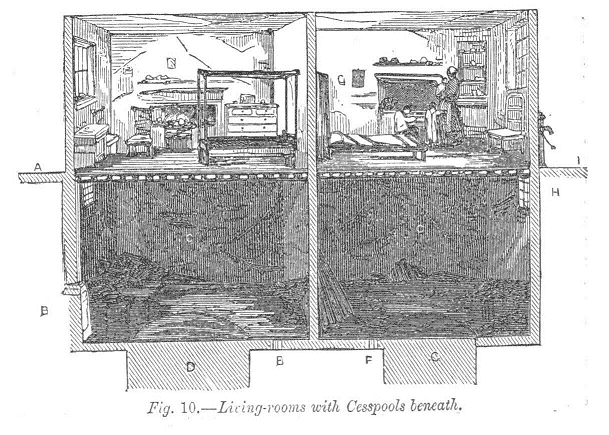
Reading Dickens now and stopping for a view of socially-conscious England via the excellent Victorian London website in the work of George Godwin’s 79-page critical exposition London Shadows, a Glance at the “Homes” of the Thousands (1854). The images are awakening and abrupt–all the bitter observation of George Orwell, only told much more quickly, like a person trying to describe a raging house fire before the thing burned itself out. Its a powerful work, and I can’t help but think that those reading it in 1854 must have been appalled not only by the deep visualization of the state of the working poor, but also by its scope, and the possible revelation of England’s basic bedrock.
There are any more works to chose from at Victorian London–I decided to pry out the images from the Godwin work along with his commentary on them. It is truly a stunning work.
“When every man is his own end, all things will come to a bad end.” COLERIDGE.
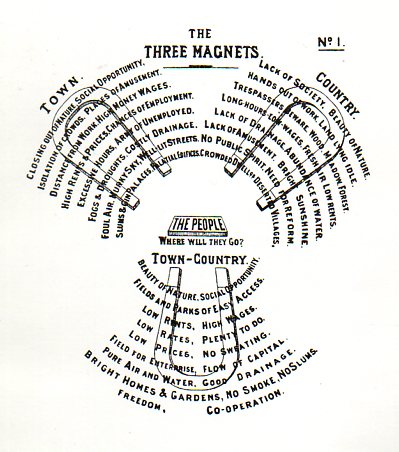
Addition to post #275 (from November 2008) on Ebenzer Howard’s quixotic Garden Cities of Tomorrow, 1898, including this fabulous image:
Ebenezar Howard (1850-1928), London-born failed Nebraskan farmer, Chicagoan stenographer, London Parliamentary reporter and non-obscure semi-visionary of town planning in The Future, drew some mighty pretty images of cities best reserved for random placement in the Encyclopedia of Difficult Imaginary Places…continue reading here.
“….there must be a point beyond which there may be no abridgement of civil liberties and we feel that whatever the emergency, that persons must be judged, so long as we have a Bill of Rights, because of what they do as persons. We feel that treating persons, because they are members of a race, constitutes illegal discrimination, which is forbidden by the fourteenth amendment whether we are at war or peace.”–– A. L. Wirin, Counsel for the Southern California Branch of the American Civil Liberties Union, speaking on the internment of Japanese-Americans, 1942
“We make these statements, not because we fear evacuation, but because we believe, to the bottom of our hearts, that the best interests of the United States, our nation are to be served by being permitted to stay, work, fight, and die for our country if necessary here where we belong.“–Response by the Japanese American Citizens League to Internment Camps, 1942
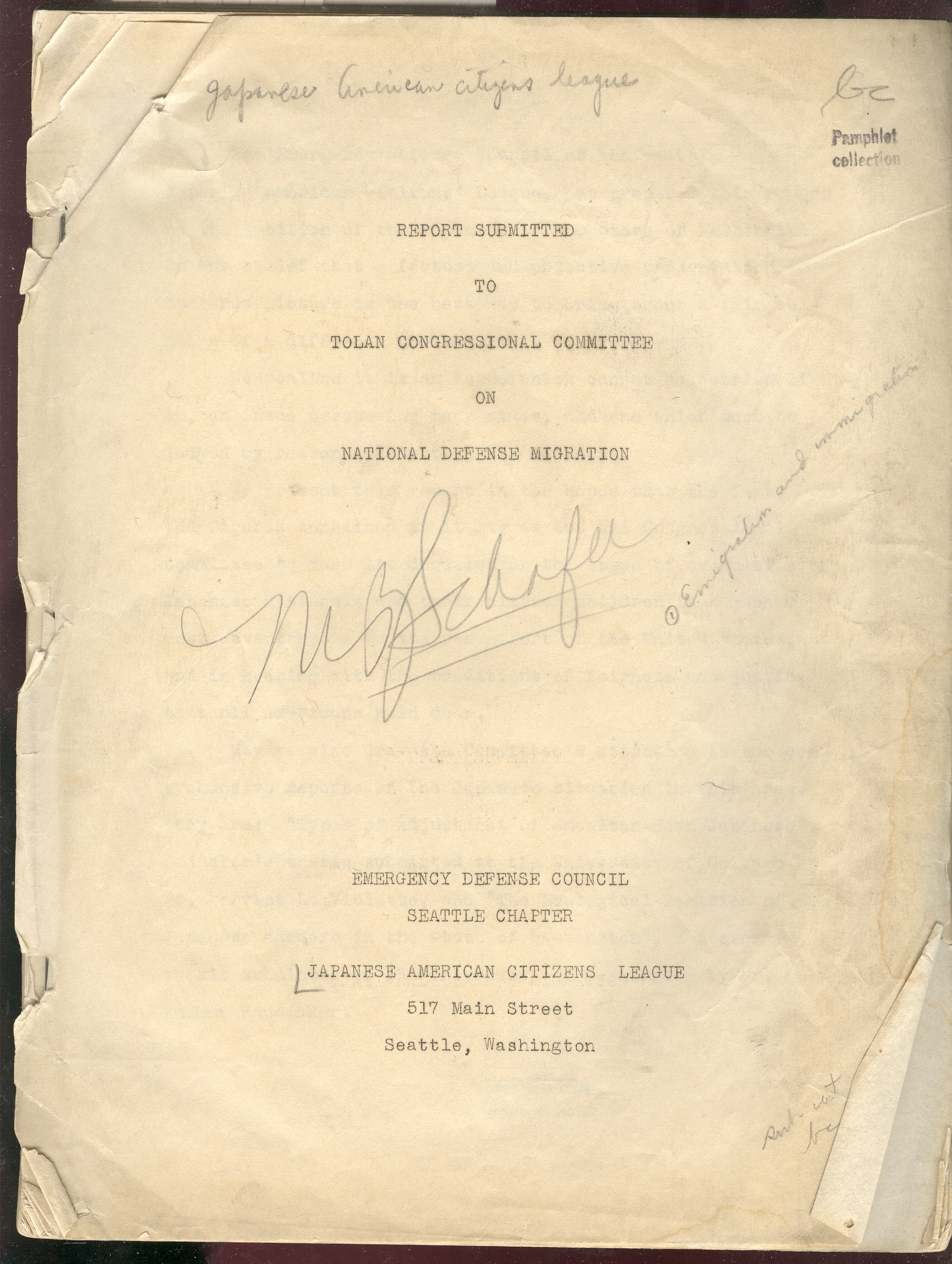
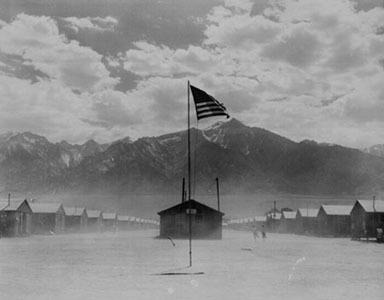
This excruciating, heart-rending 1942 document was submitted by the Japanese American Citizens League (of Seattle, Washington) to the Tolan Congressional Committee with recommendations, proposals and requests in the event of the removal of Japanese citizens from “sensitive” areas in western America It is an exceptional report, a well-reasoned response to the developing and calamitous American fear of Japanese fellow-citizens; a fear which was swiftly leading itself to xenophobic actions the result of which was the internment of 120,000 American citizens in internment camps.
The Roosevelt administration’s Executive Order 9066 was the legal bombshell that gave the War Department the authority to authorize the removal of the Japanese (19 February 1942) and theoretically prevent those people from engaging in sub rosa and fifth column activities asd wartime terrorists fighting for Imperial Japan. The Tolan Committee was that of Congressman John H. Tolan (CA), chair of the House Select Committee Investigating National Defense Migration (!), undertaken at the request of Carey McWilliams (chief of the California Division of Immigration and Housing) who was trying to prevent or at least delay the coming removal of the Japanese. Needless to say, the operation backfired
The document is “heart rending” because Executive Order 9066–at its base terribly wrong, a weakness exhibited, a moral embarrassment of the highest order–was addressed by its authors in a logical, clarifying and accommodating fashion in a noble and valiant attempt to negotiate an untenable situation while making every effort to appease the aggressor without judgment and offense. It was an attempt at maintaining dignity and some sense of Constitutional freedoms for a group of people in a situation in which their dignity and freedoms were being withdrawn….at least their freedom was.
In the introduction to the document (titled Report submitted to Tolan Congressional Committee on National Defense Migration Emergency Defense Council Seattle Chapter Japanese American Citizens League, and published April, 1942) we read that people are willing to go and abide 9066, but that one of their main issues was where exactly it was that they were going, where they were being taken. That hadn’t been established yet, and it makes me shake my head to think of the government establishing this order without a clear indication of any (?) of its consequences.
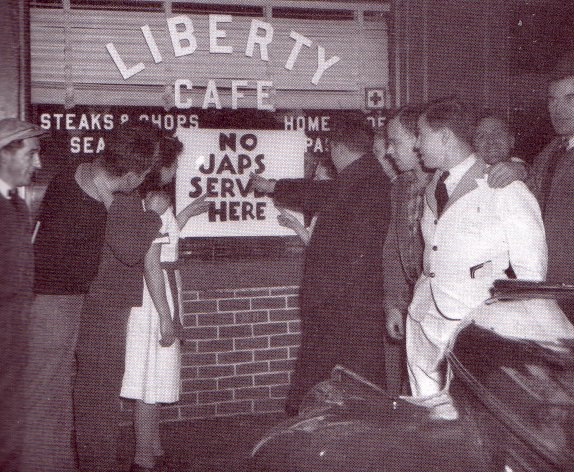
“[Introduction] A large number of people have remarked that they will go where the government orders them to go, willingly, if it will help the national defense effort. But the biggest problem in their minds is where to go. The first unofficial evacuation announcement pointed out that the government did not concern itself with where evacuees went, just so they left prohibited areas. Obviously, this was no solution to the question, for immediately, from Yakima, Idaho, Montana, Colorado and elsewhere authoritative voices shouted: “No Japs wanted here!””
“[Resettlement] What will the government’s policy be? Will communities be shifted as units to other sections? Will the Japanese be re-settled as family units? Will men and women be segregated and families split up? Will Japanese be scattered at random in the interior? These are questions that are arising in the Japanese communities in this area.”
Already thinking of the future and the end of the war, the authors wondered about the prospects for the return of the Japanese people to their former residences:
“[Return] “It is necessary to think of the future, of the day when this war will be over. Could the Japanese people, once evacuated, return to their homes? There is the great possibility that once the Jap-haters and outspoken opponents of the resident Japanese were successful in driving the Japanese out of this area, they would never permit them to return. A post-war campaign of hate and vilification when resident Japanese tried to get back to their homes and investments here, is a definite possibility should these elements score an initial victory.”
The idea for a “model city” was proposed, or at least opened for discussion, as a possible place for the interned Japanese to go:
“[Model City] This is an ambitious plan entailing the creation of an all-Japanese city somewhere in the interior of the country, able to sustain itself as a self-sufficient unit. It would be financed originally partially by the Japanese themselves, partially by the government. Some important defense industry would be set up to give employment to Japanese labor, preferably one calling for skill and efficiency which Japanese workmen possess. The city would be governed by American citizens, who would elect a mayor and council, just as other American cities, and the Japanese, both American citizens and aliens, would be given an opportunity to practice the American ideals of democratic government which they have learned.”
“After the initial investment, the city could be expected to become self-sufficient and a center for the hinterland. It is altogether likely that such a city, as an experiment in democracy would be so progressive and would provide such advantages that friends of the Japanese would desire to share its benefits.”
“This would be a long-range project, to be continued in perpetuity. The objection of the time required to set it up would be overbalanced by the permanent nature of the project.”
After 38 pages of questions and planning, the authors of the report declare that the Japanese Americans affected by 9066 would comply (“to the best of our ability”) with whatever was demanded of them. They felt very strongly though that they could do more for their country by staying in their homes and fighting Japan just like any other American.
“[Conclusions] If it is for the greater good that evacuation be decreed, we shall obey to the best of our ability. But we are convinced that here in our homes and in our community is where we belong, where we can lend every ounce of our strength, and every cent of our resources, in creating the sinews of war so necessary to total victory. We are Americans. We want to do our duty where we can serve best. We make these statements, not because we fear evacuation, but because we believe, to the bottom of our hearts, that the best interests of the United States, our nation are to be served by being permitted to stay, work, fight, and die for our country if necessary here where we belong.”
[This document is for sale in our bookstore, here.]
JF Ptak Science Books Quick Post [Part of a new series on the History of Fear]
There just seemed to be something going on with women and clothing and sex and fear and sci-fi trouble, or at least so on the covers of a spectrum of pulp publishers in the 1930’s-1950’s. Perhaps this had nothing more to do with anything than having a pretty woman posing next to the UNIVAC II in a 1959 issue of Computers and Automation. In any event, I stockpiled some of these images and collected them under the Fear-Sex heading, and for right now all I’m going to do is pass them along.
Are they really sexualizing danger? I have no idea what the content was of these issues, but from the looks of things, I’d throw hazard to the wind and say “yes”, at least to the visual aspect.
(Don’t forget to have a peek at an earlier post on Women in Sci-Fi Past-Future Distresses, here.)
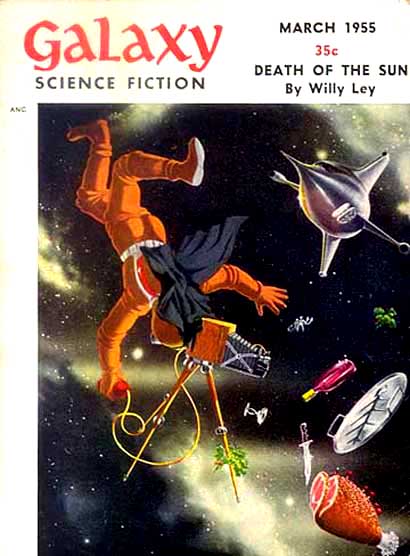
I’ve been on a bit of a run on science fiction pulp covers of the 1930’s-1960’s, and I’ve collected some in this catch-all category of “Huh?” These are wonderful images, and I have no idea what they represent, except that the image transcends its intent, in a way, and stands strongly for itself in some sort of Found Absurdist kinda way. And once you look at it, most of all that one can say is “Well, there it is”. .
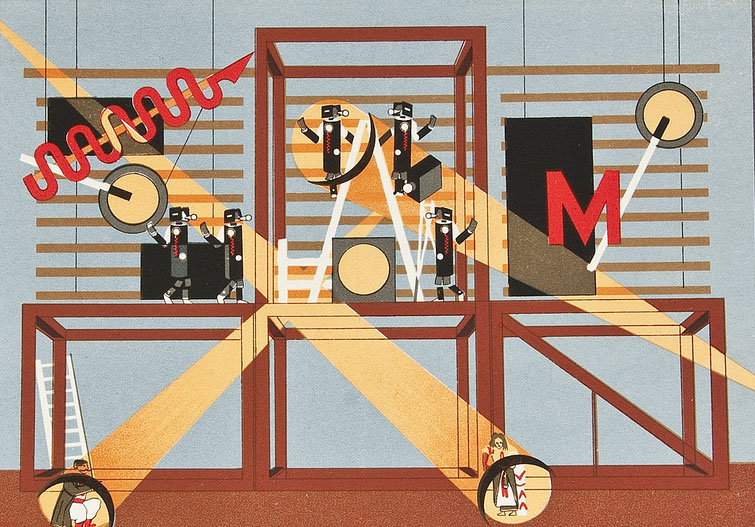
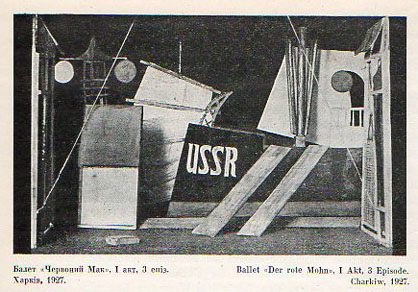
There is nothing quite like the set and costume designs coming from the Soviet Union in the 1920’s, and this collection of work by Anatol Petrizky (described below) attests to that. My interest is more in the design of the sets than in the costumes–and so far as I can determine none of those (reproduced in black and white) have yet been on the net. (This book is also offered for sale in the blog’s bookstore.)
[FRONTISPIECE]
PETRIZKY, Anatol (1895-1964). [B. Chmury] Anatol Petrizky, Theatre-Trachten. [Anatol Petrizky Teatralni Stroi] Iintroductory essay by V. Khmury (Chmury). [Soviet Union]: StaatsVerlag der Ukraine, 1929. One of 1500 unnumbered copies. Design and images by Anatol Petrizky, text by B. Chmury.
This book was published in Ukraine in 1929; although this is not the time or place (I really just wanted to post about this book as a beautiful artistic piece of work), I could not let it pass without at least mentioning what man-made disasters lie ahead for the Ukrainian SSR and for the resst of the Soviet Union.
JF Ptak Science Books Post 1680 Part of a new series on the History of Fear
Perhaps you become scared of what is taught you or is available to you, or made available, or dreampt. Perhaps you can dream not-so-terrible things unless you have been exposed to them in one form or another, already. I can certainly recall from my childhood things that made me feel fear, and they weren’t very fearful–not really–at all, though they were at the time, because there was no way for me to process the weird adaptations to my imagination.
Certain things are taught to children as a matter of course, I guess, certain fearful things, like for example the oldish child’s prayer ruminating on a sleeping death, or some exacerbating tale from the brothers Grimm–how else are children to come up with the ideas of not waking up or being boiled alive or eaten by a witch?
And so I wonder about the fear factor imaged and implied in these early wonder/sci-fi magazines, meant for distribution to high-adolescents and adults. They simply do not look so terrifying, though I guess it is because the true business end of FearSell USA Inc had not yet been prioritized in the national economy–and certainly it was orders of magnitude away from approaching anything that we have today. Even the constant state of storm/terror available to us in a relentless flow from a simple avenue like The Weather Channel must be a testament to the dept of our fear depravity.
The stories–or the ideas of the stories, anyway–seem scarier to me now than the images of them on the covers of these magazines. It would be an interesting thing to make a timeline of fearful images to see how these things changed over the decades. Or centuries.