A Daily History of Holes, Dots, Lines, Science, History, Math, Physics, Art, the Unintentional Absurd, Architecture, Maps, Data Visualization, Blank and Missing Things, and so on. |1.6 million words, 7500 images, 4.9 million hits| Press & appearances in The Times, Le Figaro, Mensa, The Economist, The Guardian, Discovery News, Slate, Le Monde, Sci American Blogs, Le Pont, and many other places… 5000+ total posts since 2008.

Author: JF Ptak

  • A Managerial Directive on How to Present War News: PM Newspaper, 10 Dec 1941

    JF Ptak Science Books   Post 1694

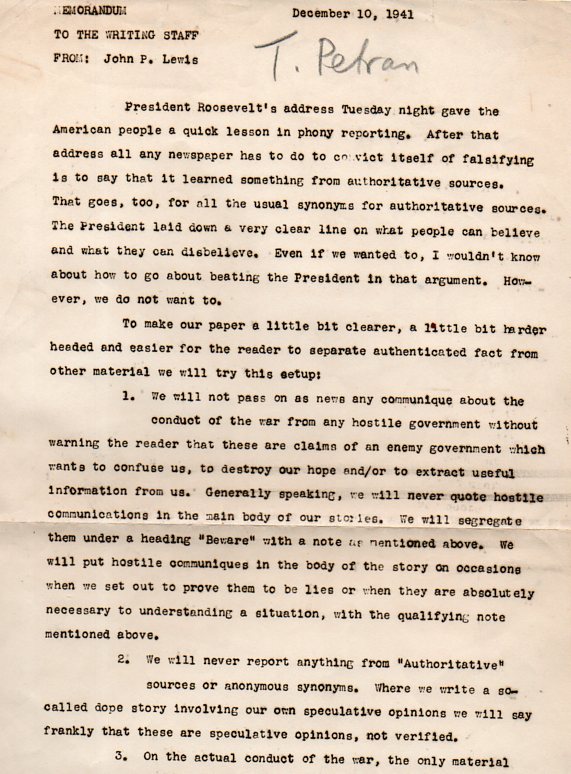
    PM (short for “Picture Magazine, evidently) newspaper1–begun 18 June 1940 and ended 1948–was a very strong, left-wing newspaper in NYC, a short-lived daily with a long pedigree of contributors2.  The “Memorandum” reproduced here, sent by the Managing Editor John P. Lewis “to the writing staff”, was a powerful and interesting directive on how to present the news, and addressed the speech of President Roosevelt of the night before. 

    Lewis felt that here, at the beginning of the American end of the fighting war, was the appropriate place to set out a war strategy for reporting and publishing regarding information received from overseas, or unverified sources, or from dispatches from the countries against which we were fighting.  He was clear and very concise–the whole of the memorandum fitting on one side of a single sheet of paper. 
    PM Newspaper136
    [This piece of ephemera may be purchased through our blog bookstore, here.]

    The Roosevelt speech of  9 December 1941 can be found  here.  Some interesting extras as follows:

    “Your Government knows that for weeks Germany has been telling  Japan that if Japan did not attack the United States, Japan  would not share in dividing the spoils with Germany when peace  came. She was promised by Germany that if she came in she would  receive the complete and perpetual control of the whole of the Pacific area…This alone if true could be a justification for war with Germany.”
    //
    “Our policy rested on the fundamental truth that the defense of any country resisting Hitler or Japan was in the long run the defense of our own country.”

    But the main thrust that Lewis was addressing was this:

    “I cite as another example a statement made on Sunday night that a Japanese carrier had been located and sunk off the Canal Zone. And when you hear statements that are attributed to what they call “an authoritative source,” you can be reasonably sure from now on that under these war circumstances the “authoritative source” is not any person in authority.”

    “Many rumors and reports which we now hear originate, of course, with enemy sources. For instance, today the Japanese are claiming that as a result of their one action against Hawaii they hare gained naval supremacy in the Pacific. This is an old trick of propaganda which has been used innumerable times by the Nazis. The purposes of such fantastic claims are, of course, to spread fear and confusion among us, and to goad us into revealing military information which our enemies are desperately anxious to obtain.”

    Lewis was quick to the point:  “President Roosevelt’s address Tuesday night gave the American people a quick lesson in phony reporting.  After that address all any newspaper has to do to convict itself of falsifying is to say that it learned something from authoritative sources.”

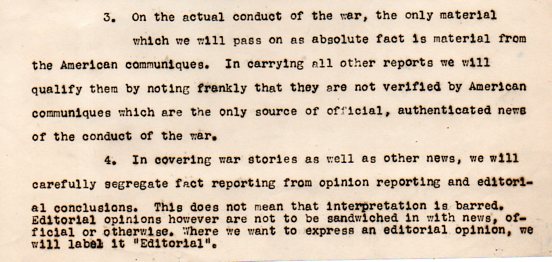
    He continued: “The president laid down a very clear line on what people can believe and what they can disbelieve…” and then outlined four major points for his writers to follow:

    “1. We will not pass on as news any communique about the conduct of the war from any hostile government without warning the reader that these are claims of an enemy government which wants to confuse us…

    “2. We will never report anything from “Authoritative” sources or anonymous synonyms. 

    “3. On the actual conduct of the war, the only material which we will pass on as absolute fact is material from the American communiques.”

    “4. In covering war stories as well as other news, we will carefully segregate fact reporting from opinion reporting and editorial conclusions.”
    PM Newspaper137

    Lewis was also particularly demanding in his policy regarding personal opinion in news stories: “Where we want to express an editorial opinion, we will label it “Editorial.”

    And Lewis meant it, too. Unlike almost all newspapers, PM editorials  were signed.  The newspaper also took no advertising, hoping to keep the paper running on sales and subscriptions.  And so it did, for eight years–not long by long-running standards of  newspapers, but fairly long for the times, and for the type of business plan practiced. 

    In any event I enjoyed the crispness and clarity of Lewis’ directive.

    Notes:

    1. The publisher was Ralph Ingersoll (1980-1985), who before coming to PM was the managing editor of Time-Life, and who was also the business plan designer and then managing editor of Fortune magazine; and the silent partner in the whole thing was MArshal Fields III, who pretty much bankrolled the newspaper from a distance.

    2.  It was a very considerable staf.  From Wiki:  “Journalist I. F. Stone was the paper’s Washington correspondent. His award-winning series on European Jewish refugees attempting to run the British blockade to reach the Jewish homeland in Mandatory Palestine became the book, Underground to Palestine. Staffers included theater critic Louis Kronenberger and film critic Cecelia Ager. Weegee, Margaret Bourke-White and Arthur Leipzig were the photographers. The sports writers were Tom Meany, Tom O’Reilly and George F. T. Ryall (who covered horse racing). Elizabeth Hawes wrote about fashions, and her sister Charlotte Adams covered food. Other distinguished writers who contributed articles included Erskine Caldwell, [Myril Axlerod], McGeorge Bundy, Saul K. Padover, James Wechsler (eventually the paper’s editorialist); Penn Kimball, later dean of the Columbia University School of Journalism; Heywood Hale Broun; James Thurber; Dorothy Parker; Ernest Hemingway; Eugene Lyons; Ben Stolberg; Malcolm Cowley; future Speaker of the House Tip O’Neill and Ben Hecht.
  • Motion and Change in Natural Sculpture–The Galileos of Clouds and Snowflakes

    JF Ptak Science Books   Post 1692

    (I wrote this post two years ago in the bookstore section of this blog but never put it in the blog. Here’s an addition to the Howard material in a new listing in the bookstore section.)

    It is odd to think among the great classifiers of nature, including even the lofty-namer Aristotle, that clouds were not scientifically classified until the early 19th century.   Here they are, just about the biggest thing we have as earthlings that are gigantic and close to us, and nobody offered a good classifications scheme until 200-odd years ago—a pretty slim margin of time  in the terms of recorded human history.

    Blogcloud_howard

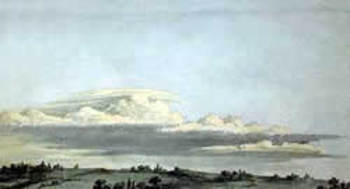
    Clouds are of course problematic, what with floating around and all—but if you didn’t already know the relative newness of their recognizable names isn’t it shocking to learn this bit of history? For the most part I think clouds must have been thought as being too transient, changeable, whimsical, wispy, to be given proper names.   The great scientist and classifier Lamarck tried to do so in his  Annuaire Méteorologique of 1802, and really is the first to try this, but his ideas weren’t terribly good (especially compared to the rest of his work), and it seems as though he left his best thinking effort on clouds at home.  For example, he gave us Hazy, dappled, massed, broom-like and grouped clouds as classifications (in French, respectively, en forme de voile, pommelés, attroupés,  en balayeurs and groupés).  They seem quite “French” to me, but largely outside the scope of being useful. 

    It was the English pharmacist and chemist Luke Howard who in 1803 gave a greater bit of thought to structuring cloud names, classifying them according to size and shape and giving them Latin names—and this forms the basis of our naming clouds to this day.  Howard was perhaps the first, greatest, meteorologist, producing On the Modification of Clouds, (in which he describes his naming system, the “modification” part actually meaning classifying rather than changing),  The Climate of London, and the first textbook on weather,  Seven Lectures on Meteorology.  Howard’s system was expanded in 1887 by Abercromby and Hildebrandsson, who further classified clouds by height above ground as well as by appearance (and utilizing Howard’s naming system). 

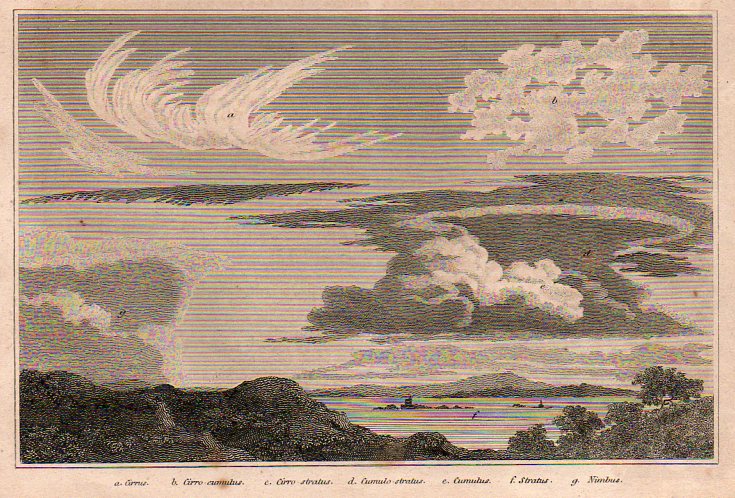
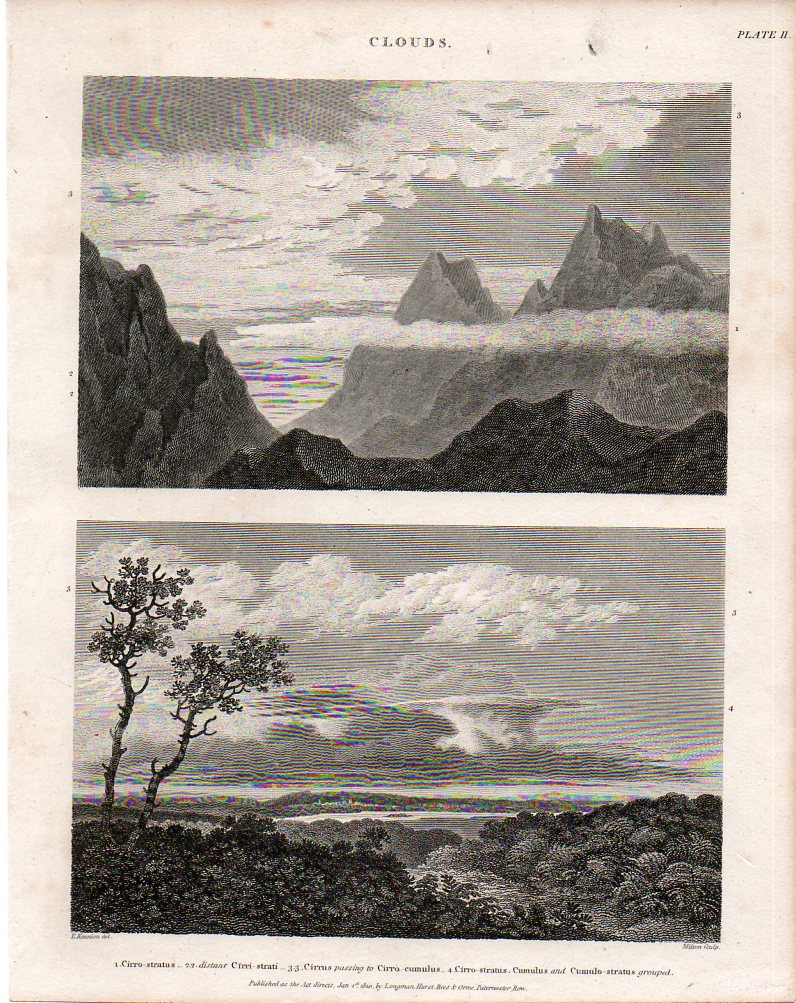
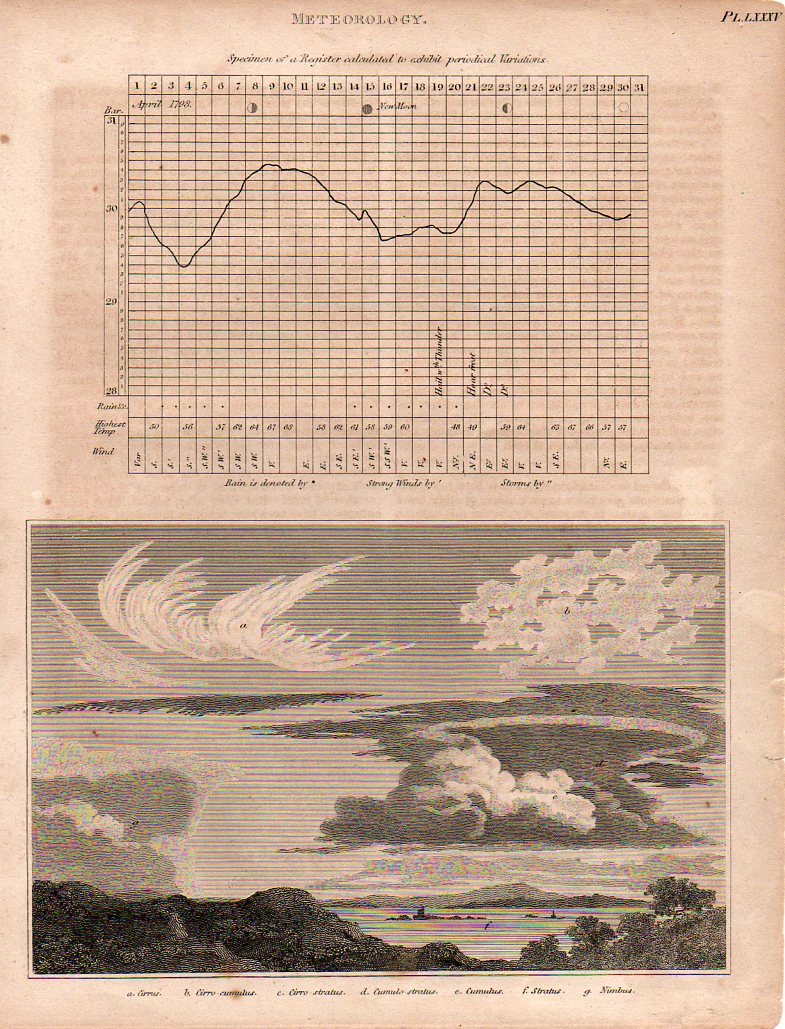
    Here (below) are two fine, early examples of cloud-naming for the scientifically-minded of the British elite, finding their way into print in the fabulous, ingenious and  mammoth (45-volume) Cyclopædia, or The New Cyclopaedia, or, Universal Dictionary of the Arts and Sciences, edited by Abraham Rees (1743-1825).  The work was published between 1802 and 1820, and was the resulting effort of 100 contributors who generally wrote monograph-length entries, contributing to a final tally of close to 40 million words.  I’ve particularly enjoyed the illustrations like those below—some of which have become iconic—and especially the fine and deep engraving of Wilson Lowry.

    Clouds875

    Cloudsb876Howard began his system by identifying three basic shapes to clouds: heaps, layers, and curls.  Heaps of separated cloud  masses with flat bottoms and bulbous, splayed, tops, which he called cumulus, which is Latin for heap; the Latin stratus was applied to clouds in layers which were much wider than they were thick; and again to Latin for cirrus, which called out the wispy curls of clouds.  (Rain clouds were given the Latin nimbus, for rain, and so on.) 

      Cloudsbdet877

    It is interesting and romantic to think of Howard being moved in his love of clouds as many Brits and Europeans were in the Volcanic Year of 1783 by the enormous eruptions of the Eldeyjar (Iceland) and Asama Yama (Japan) volcanoes—the force of their eruptions caused enormous changes in the skies (especially in Europe), creating vast sky-borne tapestries (the “Great Fogg” in England) and for such extended periods of time that it would have been impossible for the scientifically-minded Howard not to see them. 
    Blogsnowflake_bentley

    Similar, in a way, to clouds is the snow crystal (snowflake)—they change forms in their lives from sky to ground, and may well disappear on contact with a warm surface.  Of course unlike clouds they may fall and be captured, kept even, though the ability to actually perform some sort of scientific something with them didn’t occur until 400 years ago, which means that snowflakes passed in and out of human existence being very simply named (in most languages) as a mass group, and not classified at all.

    Blogsnowflake_hooke

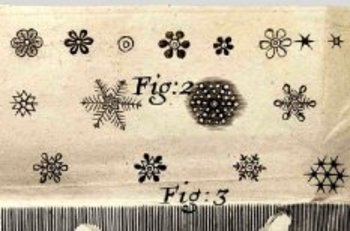
    Johannes Kepler thought very deeply in In 1611 publishing a short treatise called On the Six-Cornered Snowflake, thinking that perhaps their (mistaken) six-cornered symmetry revealed something much deeper about the basis of nature and the universe. The 26-year-old  Robert Hooke seems to be recognized as the first to throw the snowflake under a microscope, publishing drawings of them and just about everything else that he saw in his monumental (and tall, being 13-inches tall) Micrographia (1665)–the first truly scientific book of modern times.  The largest of the large images was saved for the flea, showing the unsuspecting public the great and beautiful nature of what seemed like a fantastical beast (under magnification).  Snowflakes appeared in the book, revealed in their intricate and seemingly-symmetrical nature.  Fantastic, unimagined images. This aside, he seems to have, um, borrowed these images from an earlier work, Thomas Bartholin’s  De Nivus usu Medico Observationes Varieae, 1661.  But so it goes. 
     

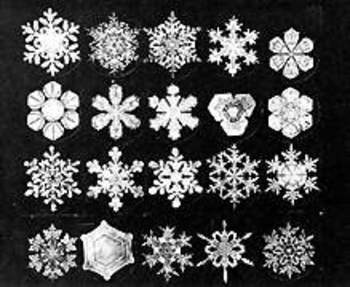
    The Galileo of the snowflake was Wilson Bentley (1865-1931), an autodidact Vermont farmer, seen by fellow hamlet-dwellers as odd and off, who figured out how to photographically and beautifully record the intricacies of the snow crystal world—no one had ever done this so dramatically, with such gorgeous results.  It really was as though he was able to record the heights of the mountains of the moon with a slender telescope in Pisa, 350 years earlier. The results of his decades of experience were published  in 1931 his book Snow Crystals, containing more than 2400 snow crystal images.  On the heals of Bentley’s accomplishments came the classically trained nuclear physicist Ukichiro Nakaya, who was truly the first person to apply a scientific classification to snowflakes, and who published his intrepidly-beautiful work in a 1954 book entitled Snow Crystals: Natural and Artificial.  His classification system of the various types of snowflakes would prove vastly more useful, interesting and appealing than that published by the 1951 the International Commission on Snow and Ice, and forms the basis of the discussion of snow crystals today—a classification system of a massively-occurring phenomenon that is younger than me. 

    ·Posted by :

    ·in:

    —

  • A Bloated Alphabet of Fat Cures: Strychnine Pills, Vibrators and Hope.

    JF Ptak Science Books     Post 1691      Part of the Series on Blank, Empty and Missing Things:  Promises.

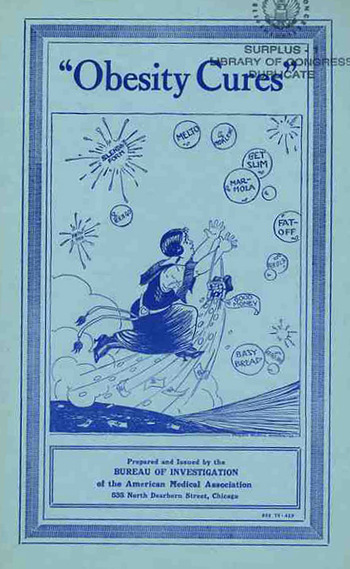
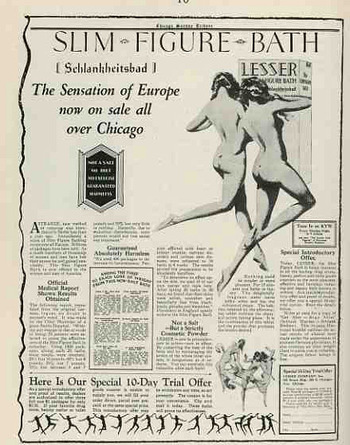
    Blogfatobesity_cures132 Quackery in general has survived in spite of itself over many fields, not the least of which is astrology and creation “science”, cults, religions, and walking-with-the-dead.  In the U.S. in the 1910-1925 period however there was a attempt at investigating the most outrageous frauds in the medical profession by the American Medical Association, and of the many sorts of quacks and frauds-liver cures, neuralgia miracles, electro-vibrator hair restorers and lump removers, anti-droopy happiness pills, cocaine nervous system remedies, and so on–what I’d like to look at right now is concerned with “flesh reduction”, or  fat cures. 


    http://media.vogue.com/files/filecheck/2012/01/12/3-Weegee_15302197753.jpg_article_gallery_slideshow_v2.jpg

    [Photograph of a neon sign, Manhattan, 1941, by Weegee from Naked City.]

    According to the AMA (in a 1934 retrospective) the chief stimulant to the obesity industry was the rise of womens’ fashions.  I think that the reasoning might wind itself around the growth of expendable money in the American rising middle class, where Americans, in general, had more money to spend on the non-essentials than any time in the history of the country.  That leads to more consumables, and that leads to more advertising, and that leads to more idealized images of what people should look like, and that leads to wanting to look like that, and that opens the door to scammers who offer a way to get to the not-actual ideal without effort and for little money.  And so in the ’20’s there was a spike in quack remedies for obesity, as there was little or no control over the content of what was being sold nor the claims about what the product did, medically speaking-there was general protection from fraud, of course, but the medical compliment for establishing what that actually was wasn’t quite yet in place. 

    There is a veritable alphabet (soup) of mondo bizarre cures that the AMA attacked and ripped apart during the 1920’s, publishing the findings of their labs on the ingredients of the cures and the possibilities of whether any of the hundreds (thousands?) of these things worked at all. 

    And what the AMA found was really pretty remarkable–lots of water, sugar, tartar,
    tinctures of useless this and that, desicated liver, seaweed, salt, lemon, and that
    sort of thing, none of which had any value for weight reduction whatsoever.  A
    major ingredient, for some reason, was focus vesiculosus, also known as
    bladderwrack, sea-wrack, kelp-ware and sea-oak–there was no indication of why this
    ingredient was so popular, especially since it was used in some farms as a pig feed
    to make the animals fat.
    Blogfat_slim_chicago133  

    So, aside from the pig-fattening ingredient for human “flesh reduction”, we’ll have a quick alphabetical tour of some of the outrageous (and bizarrely-named) products and their components promising hope and physical happiness to the woman of 1925. (Let’s note that the following are just locally-applied or ingested cures-there’s an entire universe of external applications and devices that were used to solve the problem of fat.  For example, the Violet Ray Machine claimed that in addition to obesity it would cure “Problems with circulation of the blood, the heart’s action, bumps of the funny-bone, germ infections, weakness, the waste of the body, congestion, impaired physical development, pains and aches, complexion and skin diseases, facial and body blemishes, hair loss, headaches, inflammation of joints, muscles, nerves, Atrophy, circulatory disorders, constipation, deafness, goitre, high blood pressure, arteriosclerosis, insomnia (sleeplessness-Brain Fag), indigestion, dyspepsia, neuritis, nervousness, hysteria, melancholia, neurasthenia, neuralgia, obesity, pain, paralysis, prostate gland problems, scalp diseases, falling hair, dandruff, asthma, anemia, bronchitis, catarrh, hay fever, rose fever, colds and other inflammations of the upper air passages, and, of course, cancer.”  This quote with thanks from the Museum of Quack Meidcal Therapy Devices

    And so to the consumable and applied quack fat cures:

    Absorbit Reducing Paste-one of my favorites.  This was a nighttime sleeping paste
    which was composed of 44% lard as well as beeswax, oil and milk.  After slathering
    yourself in this oily, waxy, milky fat cocoon (the sheets!) you were also supposed
    to ingest an accompanying night aid pill, which was 24% sulphur and 61% sugar.  So
    not only would you be oily milky waxy lardy, you’d also be stinky and, at the end of
    it all, hyper. 

    Allmans Anti Fat Anti Pon (?)).  According to its label, it was a “powerful and
    entirely harmless specific”, which the AMA revealed to be composed of citric acid,
    water and food coloring.  Sounds like Kool Aid. 

    Arbolone tablets.  These guys were made of desiccated thyroid, starch, lime and sugar.

    Basy Bread was a “anti growth” bread which turned out to be just a course wheat bread

    Clark’s Thinning Salts was almost entirely washing soda.

    Dalloff’s Time Pills were made of lavender and bearberry.

    Elfin Fat reducing Gum Drops (continuing its spectacular name by saying it was a
    product of the Pep-Giving Product Co., Inc.), was actually one of the only items
    that might have contributed to weight loss, if only for the fact that in addition to
    consuming its drops made of laxative and sugar you were supposed to adhere to a
    pretty regimented, difficult exercise routine.  Big sweat and potent laxative does
    in fact produce weight loss.  Maybe not a good weight loss, but aa weight loss
    nevertheless. 

    Elimiton (!) was a product made of caffeine and rhubarb.

    Every Woman’s Flesh Reducer promised a new figure with their mixture of Epsom salt
    and camphor.

    Fatsoff, a soap product that you washed with, was not surprisingly made of soap.
    Fayro was another soap and washing flesh reduction “package” that asserted that by
    using their secret flesh reducing salve (i.e., “soap”), you would “open your pores
    to let the blood cells sweat off fat”.  I could just about see the AMA guy who was
    writing their description of this thing slamming his pen and screaming.

    Some other F’s included Fells Reducing Tablets (which were milk), Figurroids (salty
    baking soda), Floradona (sodium thiosulphate, the photographer’s “hypo”), and Folt’s
    Reducing Soap (which was, again, soap). 

    Get Slim was a vile purgative of sugar, tartar and baking soda, plus perfumes.

    Hall’s Tablet Triturates were ginger and a big shake of chalk; Hargreaves Reducing
    Wafers (bread and liquorice).

    J.Z. Obesity tablets–were the same product as Absorbit which was the same as
    Zobeide (minus the ox mucus). 

    LaMar reducing Soap (“to wash away fat”) was soap.

    Marmola, “a thyroid-containing obesity cure” was composed of cornstalk, borax, baking
    soda and tartaric acid, with a special “constipation agent” (?), as well as a lot of
    salt. 

    Morlene would reduce goitersm neck fat, bust size and tumors, somehow, with the
    application of its cleansing elements (soap).

    Neutroid seems to have been the most lethal of the hundreds tested, contaning bad
    dollops of magnesium carbonate and iodol, and was taken internally (where external
    application could prove fatal). 

    Oil of Korein was pretty nasty stuff, containing sassafrass and about 75% petrolatum
    (a semi-solid mixture of hydrocarbons, or petroleum jelly), though it also offered
    some really good advice on foods to avoid if you didn’t want to actually gain
    weight. 

    Phy-thy-rin was a calcium and sugar coated pill of iodine and dried thyroid, with
    plenty of sugar, and liquorice. 

    Rusell’s Anti-Corpulent {reparation was a powdered added to water that would
    effectively produce orange Kool-Aid.

    Sangra Bath Salts was perhaps the most outrageously simple, being just colored bath
    salt.  Slendaform (“just gently rub it in, and watch yourself get thin”), was a
    half-pound jar of oil of turpentine, white vinegar and milk curd.  Slyphine, which
    crowded its ads with tremendous claims to be “Absolutely The Best Weight Reducer
    Ever Discovered” and other very shouty claims (by somehow “attracting surplus
    fat”), was simply borax and talc. 

    Dr. Vincent’s Anti-Stout Pills contained a pretty sounding mixture of aloes, jalap,
    cloves and bladderwrack.

    Mme. Yale’s Fertilizer Tablets-I’m not sure about the real use of “fertilizer”
    here.) was actually one of the earliest of these frauds to be attacked by the
    government, being charged with fraud by “misbranding” in 1909, as federal chemists
    could find no connection between weight loss and its sole ingredients of sugar,
    charcoal and cream of tartar. 

    Lastly, we offer Zobeude, which was just Absorbit Reducing Paste relabled for
    British consumption, though it seems to have contained an added ingredient of
    “purified ox bile”.  We are told in Bruce’s Materia Medica of 1884 that “Purified ox
    bile has the composition of fresh bile, less the mucus .”


  • History of Dots Series: How Much Does the Earth Weigh? (1798)

    JF Ptak Science Books     Post 1690 [Part of the History of Dots series: Weighing Earth’s Biggest Dot–Itself.]

    Archimedes said that given certain conditions and equipment that he could lift the Earth with a lever; he did not, however, have the necessaries to actually determine how much the whole thing “weighed”, and would have to wait for  20 centuries  in the work of Henry Cavendish to have an answer. (Archimedes was a very busy man with an enormous list of contributions, and was perhaps the greatest physicist and mathematician of his age in the third century BCE, but he did not invent the lever–he did however  provide the mathematical understanding and formalization of how the thing worked in his “On the Equilibrium of Plane Figures”.)


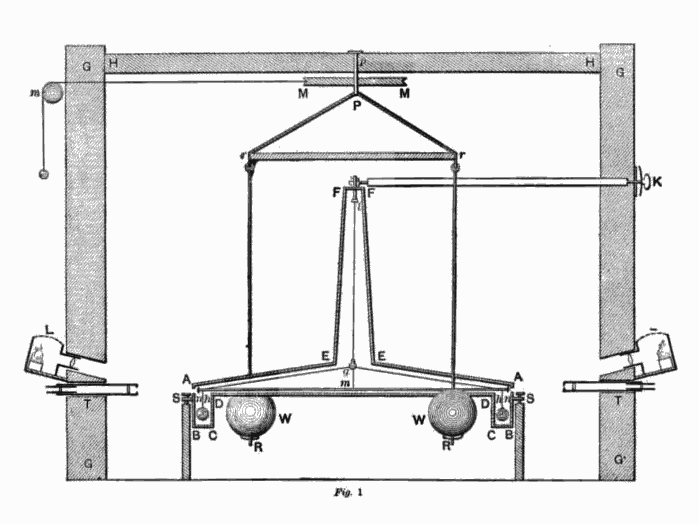
    In this experiment,  “Experiments to determine the Density of the Earth”, the results of which appeared in the Philosophical Transactions in 17981, the great and somewhat mysterious (and odd) Henry Cavendish determined to, of all things, weigh the Earth. (Well, really it was measuring the force of gravity and finding the gravitation constant G, which Cavendish referred to as the specific weight of the Earth.)  Now there are certain remarkable things to be achieved in the 18th century (like for example the discovery of oxygen by Scheele/Priestly), and of course the idea of measuring the weight of the Earth was a high intellectual achievement.  Cavendish set off to measure the force of attraction between large and small lead balls using as a basis for research parts of his dead friend John Michell’s designs for a torsion balance (which he had created in 1783), and using of course Newton’s laws showing that the force of gravity between two objects depends on their masses as well as the distance between them.  Michell had thought of the experiment years before but died before he could present; Cavendish carried on and up, and out. Mind he wasn’t the first on the spot (Coloumb was there too slightly before Michell), or the first with the idea–he was the first to complete it, though, taking the difference in the measures on the very sensitive balance from a distance using a telescope so as to not disturb the readings. As a matter of fact this was the only method employed to conduct this experiment for nearly another hundred years, the results being confirmed by a number of scientists2 over the coming decades.   It was a lovely idea, and  a fantastic piece of work. 

    In his paper in the Philosophical Transactions, Cavendish described Michell and the instrumentation int he opening two paragraphs:

    The instrument:

    File:Cavendish Experiment.png

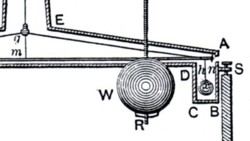
    This is the test apparatus that Cavendish constructed following the original Michell plans–it was a big, solid instrument, as that horizontal piece suspended fro the rod (K) is six feet long, and those two spheres (W) attached to its ends are 350-pounds apiece.  The smaller sphere is located in the box to the side of the large sphere, as so:

    File:CavendishSchematic111.jpg


    “Henry Cavendish had fitful habits of publication that did not at all reveal the universal scope of his natural philosophy. He wrote no books and fewer than twenty articles in a career of nearly fifty years. Only one major paper was theoretical, a study of electricity in 1771; the remainder of his major papers were carefully delimited experimental inquiries, the most important of which were those on pneumatic chemistry in 1766 and 1783–1788, on freezing temperatures in 1783–1788, and on the density of the earth in 1798.” (D.S.B. III:155).


    ________

    Notes:

    1.  A copy of the first German edition of this work is available at our blog’s bookstore:  “Versuche über die Dichtigkeit der Erde zu Bestimmen.” Halle, Rengerschen Buchhandlung, 1799, and published  in Annalen der Physik, herausgegeben von Ludwig Wilhelm Gilbert, band. 2, erstes stück.  120pp in this section, 488pp overall in in the entire volume, with 9 plates.  Cavendish’s paper occupies pp 1-62, with two plates  (the torsion balance of Michell shown on the plates).

    The entire Cavendish paper can be found here:  Cavendish, Henry (1798). “Experiments to Determine the Density of the Earth”. In MacKenzie, A. S.. Scientific Memoirs Vol.9: The Laws of Gravitation. American Book Co.. 1900. pp. 59–105 Online copy of Cavendish’s 1798 paper, and other early measurements of gravitational constant.

    2.  The experiment was in fact repeated numerous times, including that by Reich (1838), Baily (1843), Cornu & Baille (1878), among others, and it wasn’t until 1895–the year of Roentgen’s epochal discovery–that Cavenidsh’s accuracy was exceeded by the work of C.V. Boys. 

    ·Posted by :

    ·in:

    —

  • Future Punk–Lady Killers, 1919

    JF Ptak Science Books   Picture Post

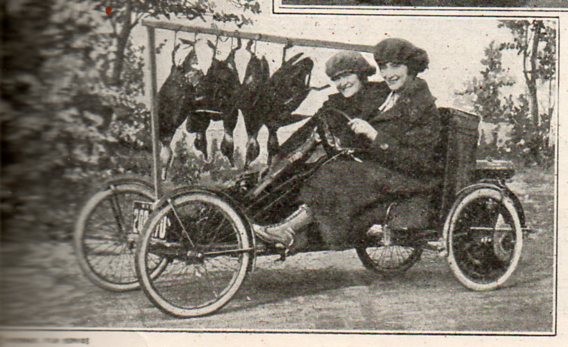
    Future punk chick huntress wagon121

    ·Posted by :

    ·in:


  • The Discovery of Salad–the First Salad Cookbook, 1627.

    JF Ptak Science Books   Post 1690

    ===blog==aug 19==salad  I was looking for an antique recipe for pesto and came across this remarkable book by Salvatore Massonio, Archidipno overo dell’insalata e dell’vso di essa, published in Venice by Marc’Antonio Brogiollo in 1627. It is in short a philosophical cookbook for salads—and the first of its kind dedicated solely, devoted entirely, to the salad.  It must have been a revolutionary publication, and probably intended for the very wealthy, given that the vast majority of people in Europe didn’t have money for a book, and many couldn’t read, and lettuce and its makings were outside the standard diet for the working poor.  The book is no slim effort: 68 chapter and 425 pages long, it describes the stuff of the salad and its dressing. Unfortunately there are no illustrations, no images on presentation–not even the new chapter capital letters are designed in a food motif.  Nothing.  (The full text is available here.)

    Actually salad wasn’t limited to just greens in this book, and his quasi-vegetarian sentiment was tested by including cold salted meats, cold salted tongue, livers and such in the mix.  But Massonio was definitely far ahead of anyone else at the time dealing with the benefits of the salad for both health reasons, as well as for making the salad not a meal in itself but an appetizer for something larger to come.  In another great possible “first”, the wonderful Massonio seems to be the first to describe the use of garlic in a sauce. 

    Now. About that pesto recipe…all I need is some stuff from Italy and a special-marble mortar and I’ll be somewhat on my way, at least as the purists are concerned. The birthplace of pesto, Liguria, takes its position as the originator of the great green delicacy very seriously, legislating exactly how and with what peso should be made.  And that is as it should be.  Maybe I’ll just buy the pesto…

    (Robbing Peter website has taken a translation of the cucumber salad from Massonio and created it here–looks pretty good.)


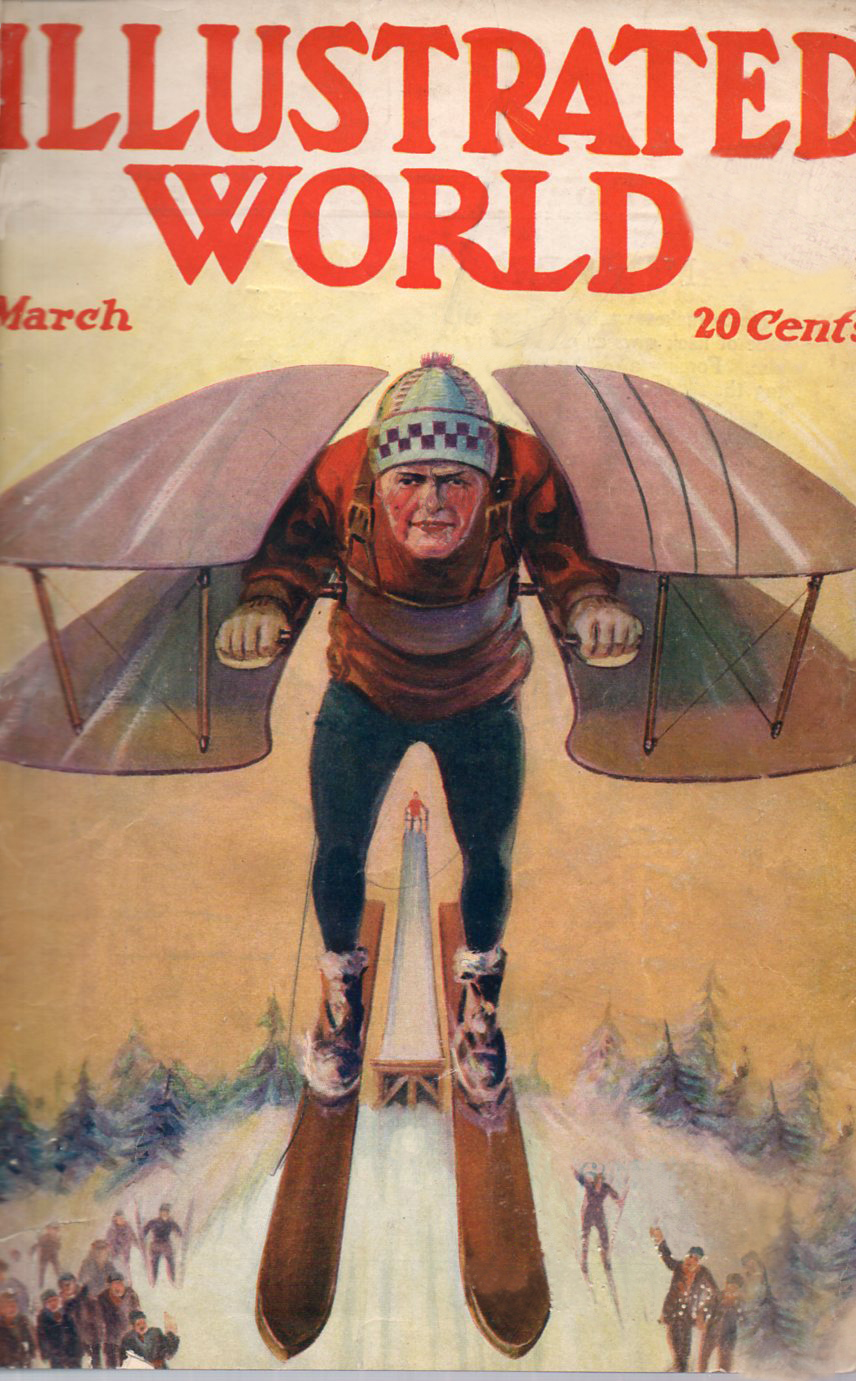
  • Future Punk–Extreme Wright Biplane-ism in Skiing

    JF Ptak Science Books   Picture Post

    Future punk skier polane120
    I think that this bit of technical machination might wind up in the you’ll-put-your-eye-out category of cross-application conveniences.  The image appeared in Technical World magazine for May, 1920. 


  • History of Blank, Empty, and Missing Things: Fission. 1934

    JF Ptak Science Books   Post 1689

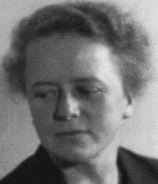
    Ida Noddack (1896 - 1978)

    “it is conceivable that the nucleus breaks up into several large fragments, which would of course be isotopes of known elements but would not be neighbors of the irradiated element.“–Ida Noddack, 1934

    Sometimes events and conspire to almost come together, to be very-nearly-there but not so, just this shy of complete, just a little short of being whole–save for inspiration, or insight, or genius.  Such I think is the case of Ida Noddack (and just about everyone else) in the non-discovery of fission in 1934.

    Just for the record, fission is properly discovered by Hahn/Strassmann/Meitner and announced in Naturwissenschaften beginning in 1935 (with “Ueber die kuensrtliche Umwandlunbg des Urans durch Neutronen” in 1935 and culminating in the epochal papers of 1939)–and this the result of a long series of necessary discoveries made by Becquerel, Einstein, Curie, Joliot, Bohr, Chadwick, Compton, Fermi, Frisch, Rosbaud, Wheeler, Alvarez and others. 

    Noddack published her paper–“Uber das Element 93” in Angewandte Chemie (vol 47, pp 653-655) in 1934 (and published in Berlin) which correctly pointed out errors in Fermi’s important two-page 1934 paper on neutron bombardment experiments “Possible Production of Elements of Atomic Number Higher than 92”,  published in Nature 133 (3372), pp 898-899.  She identified as inconclusive Fermi’s identification of transuranic products of neutron bombardment, and stated that the presence of all of the lower elements needed to eliminated along with the heavy radioactive elements.  Noddack (1896-1978) was nominated three times for the Nobel (chemistry) but was passed by–she received recognition for her work, of course, but at the time- (1934) her paper was generally ignored, as it ran counter to some of the basic ideas of physics  Noddack didn’t offer any theoretical help in her observations, and the paper slid almost instantly into obscurity. The breakthrough work on this issue would begin int he next year and ultimately the unthought-of concept of fission would be announced five years later. 


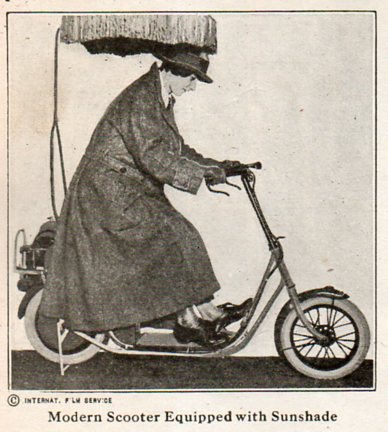
  • Future Punk–Umbrella Scooter, 1920

    JF Ptak Science Books   Picture Post

    Future punk112


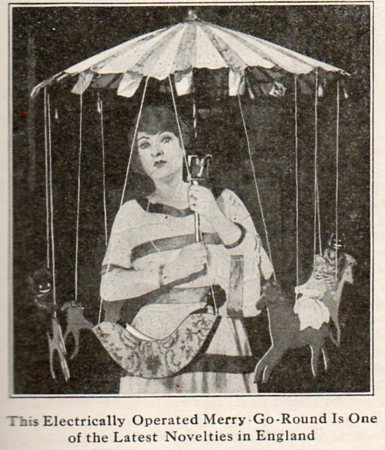
  • Future Punk–Umbrella Merry-Go-‘Round, 1920

    JF Ptak Science Books    Picture Post

    Future punk114