A Daily History of Holes, Dots, Lines, Science, History, Math, Physics, Art, the Unintentional Absurd, Architecture, Maps, Data Visualization, Blank and Missing Things, and so on. |1.6 million words, 7500 images, 4.9 million hits| Press & appearances in The Times, Le Figaro, Mensa, The Economist, The Guardian, Discovery News, Slate, Le Monde, Sci American Blogs, Le Pont, and many other places… 5000+ total posts since 2008.

Author: JF Ptak

  • Tech-Quiz #4–the Sublime Mundane

    JF Ptak Science Books  Quick Post

    This forms the absolute end of something, the “tip” of it, one of two, at the either end of slender cord. Even for this there must be a patent–and there were, evidently, many of them.  This is just one, from 1922

    Answer in the continued reading section, below:

    ·Posted by :

    ·in:

    — —

  • Drowning in Numbers–Arithmetical Harvesting by Monroe and Texas Instruments

    JF Ptak Science Books  Post 1704

    Monroe numbers lost detail
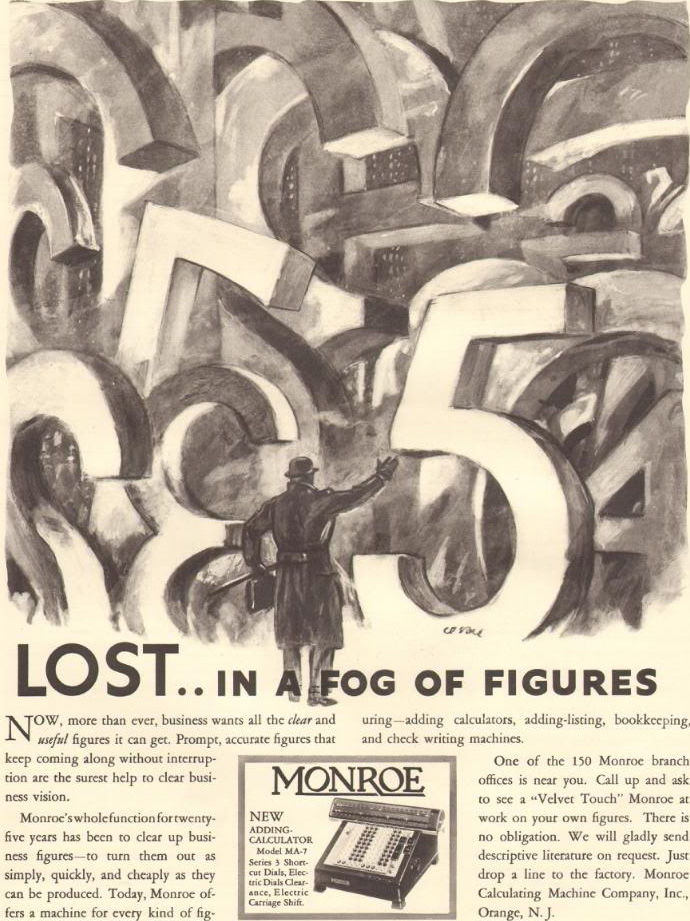
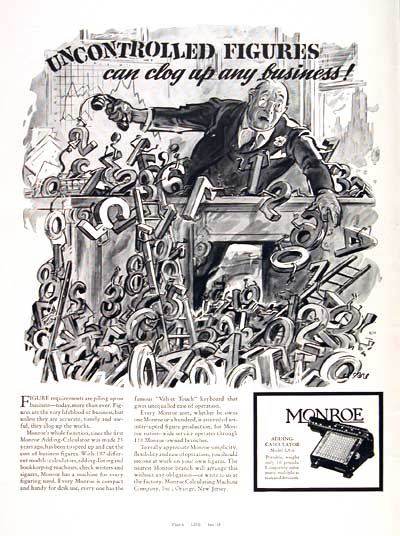
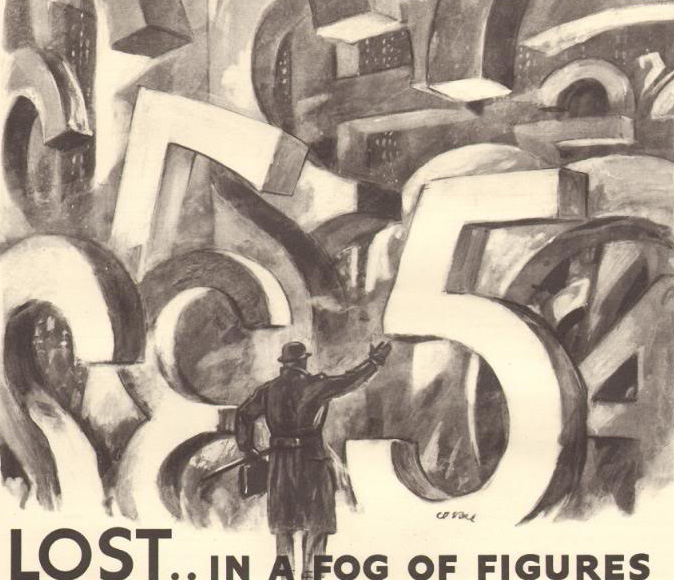
    Monroe numbers lostThe Monroe calculator must have seemed the same sort of inspired salvation to the 1930’s generation as the hand-held Texas Instruments calculator (with paper feed!) that I saw displayed in a glass-domed pedestal at Barnes and Noble in Manhattan in 1973.  Small, compact, and with fantastic calculatign capacity–and expensive.  It was in a very real sense a glimpse into the future.  For the general, garden-variety Monroe, it certainly offered its users a much smaller, tidier machine than some of the brutes of the decade or two preceding it–make no mistake, there were some big bruising accounting Monroes that were truck busters.

    But the Monroes that appeared in these ads from LIFE magazine in the late 1930’s Monroe calculatorwere certainly populist, and easily transportable.  And they cost about as much (with some smoke/mirrors adjusting for inflation and etc) in 1937 as the $450 TI  cost in 1973. (The TI machine was produced just seven years or so after its first hand-held was introduced–I’m unsure of the 450 price tag, though I think it about correct.  The TI SR-50 without a paper trail cost about $150 in 1974.)

    Monroe is an old company (begun in 1912) company that produced hand-cranked and electromechanical calculating devices.  The Monroe salesman’s handbook that I have here from 1929 shows versions of their machine that were lightweight and versatile (at 38 pounds) to behemoths for insurance companies that were truck-haulable.  Monroe became part of Litton before reappearing again on its own, trying to compete in the hand-held market with its own electronic display calculator–a device that cost $269 in 1972.  Monroe was basically “done” by the 1960’s.

    Monroe numbers marching det
    I think that for most people Texas Instruments is produced hand-held calculating devices–it is of course a vast concern, with a long history that gets catapulted during WWII when the formerly geology-based company gets involved in military electronics.  Fast forward, TI created FLIR and MERA, laser-guided control systems for PGMs (laser-guided bombs/precision-guided munitions), launch and leave glide missiles, and so on. IT was also involved in the earliest work in microminiaturization, producing (by Gordon Teal) the first commercial silicon transistor (1954) and the first integrated circuit (by Jack Kilby) in 1958. And so on.  Its a big, old company.

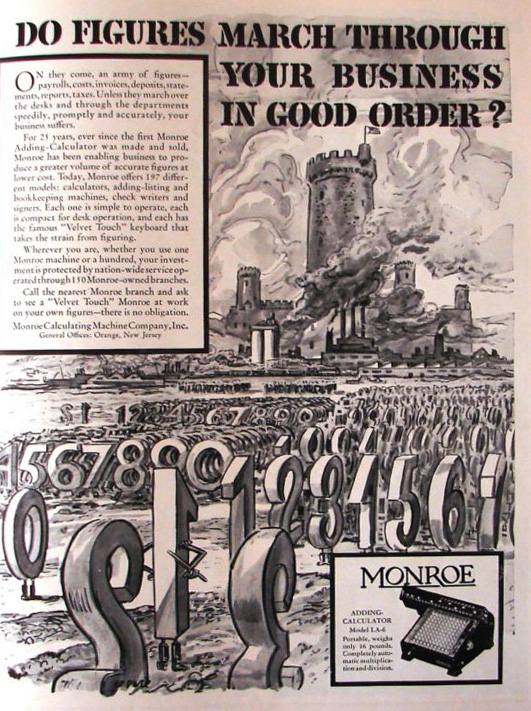
    And as much as each company was offering a similar god-send to their generationally-distanced mathematician/number cruncher, TI simply didn’t have ads like Monroe.  And I’ve always iked to see numbers-on-the-move.

    Monroe numbers marching


  • Numbers in Dreams

    JF Ptak Science Books   Post 1703

    Thinking big thoughts in dreams is generally not a common thing, as anyone who has read their own semi-conscious half-awake memory notes of a dream-based inspiration could attest.  But it does happen: 
    ==Blog July 21=math dream
    Paul  McCartney1 dreamed the song Yesterday, Gandhi dreamed the source of non-violent resistance, Elias Howe  dreamed of the construction of the first sewing machine, and Mary Shelley the creation of her novel Frankenstein… For good or for ill, William Blake was evidently deeply influenced by his own dreams; on the other hand, Rene Magritte was deeply influenced by dreams but didn’t use any of his own for his paintings.  Otto Loewi turned an old problem into not one in a dream, finding a solution to the prickish problem of whether nerve impulses were chemical or electrical (and resulting in the Nobel for medicine in 1935); the fabulous discovery of the benzene ring came to August Kekule in a dream as well.  Artists have been representing people in dreams and dreamscapes for many centuries: Durer depicted a dream in a 1525 watercolor, for example, and thousands of artists have depicted famous biblical dreams (Joseph of Pharo) for long expanses of time.

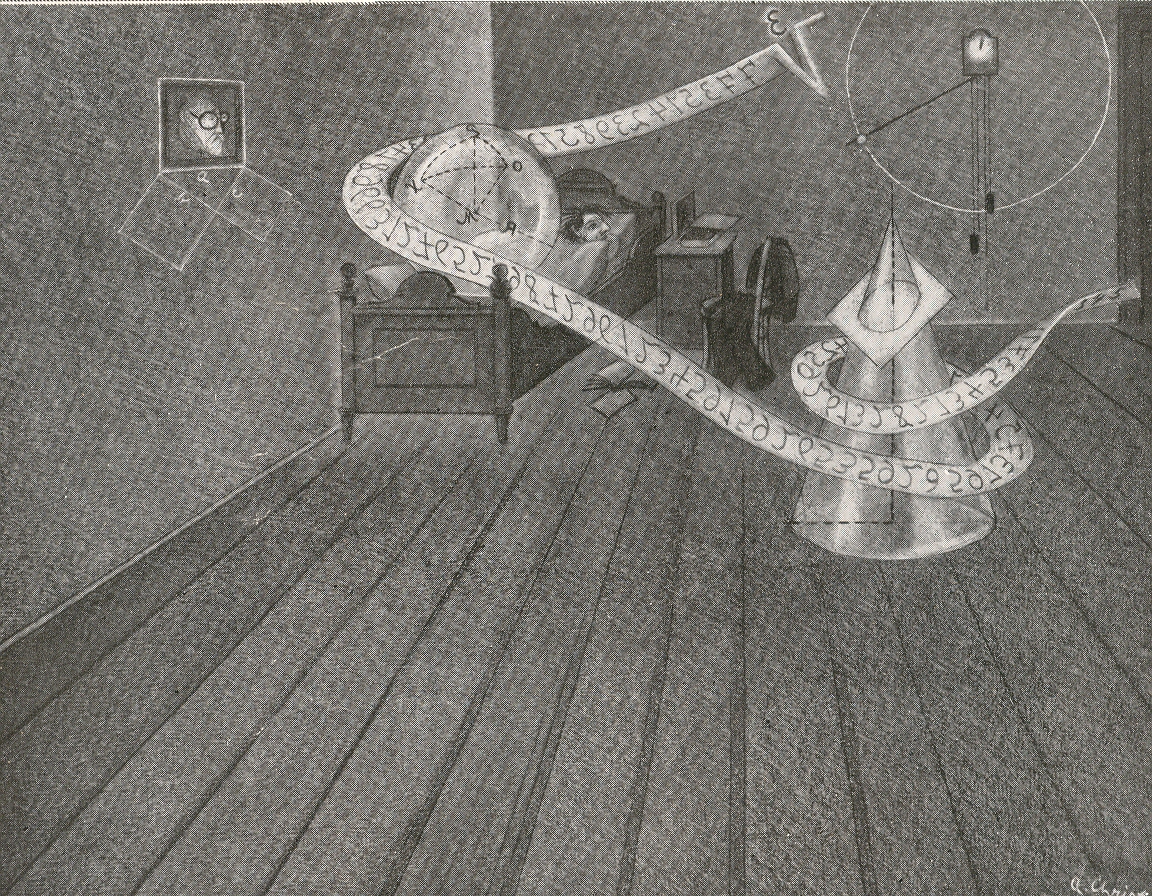
    What struck me, though, in this illustration found on the other side of the page of the Illustrirte Zeitung2 (for August 1932) that I used for yesterday’s post about damming Gibraltar and Shakespeare’s memories, was the depiction of someone dreaming mathematical thoughts…or at the very least, dreaming numbers.  People have undoubtedly dreamed much in mathematics, but I can not recall seeing illustrations of these dreams.

    I’m differentiating here from something like a Poincarean inspiration, or vision, or thunderstrike–I’m talking about drop-dead asleep sleep, dreaming sleep, REM and all that. Also I’m differentiating this from imaging mathematical thought, as in the work of Francis Galton in 1880 in which the subject of mentally seeing the process of mathematics is perhaps first addressed. I wrote a short piece on that here, way back in Post 9. )

    The numerical sequence in this dream doesn’t look like anything to me:  the backwards radicand doesn’t strike anything common in my head.  The geometrical drawing under the portrait in the dreamer’s room though is the impossibly iconic Pythagorean theorem, and there is a nice picture of a conic section in the foreground; but the artist, who improbably signed the work “A. Christ”, doesn’t offer much of math in the dreamscape.  Still, it is a rare depiction of someone dreaming about math. 

    Notes
    1. “I woke up with a lovely tune in my head. I thought, ‘That’s great, I wonder what that is?’ There was an upright piano next to me, to the right of the bed by the window. I got out of bed, sat at the piano, found G, found F sharp minor 7th — and that leads you through then to B to E minor, and finally back to E. It all leads forward logically. I liked the melody a lot, but because I’d dreamed it, I couldn’t believe I’d written it. I thought, ‘No, I’ve never written anything like this before.’ But I had the tune, which was the most magic thing!” from Barry Miles (1997), Paul McCartney.
    2.  this is really a great sheet of paper, coming from issue 4492, pp 518-519.  Two pictures of dreams on one side, with three visionary images on the other (the Gibraltar dam, a sub-polar submarine, and a futuristic Indian railway/bridge.

    ·Posted by :

    ·in:

    —

  • Empty Memory: Telephone Number 20080 (Warsaw), Nazi Occupied Poland and the Holocaust, 1941 (Expanded)

    JF Ptak Science Books –continuation of Post 298 from 2008

    Empty diary150
     I’ve felt that a great history lesson for school kids would be to make them keep a diary for some other kid from some other time, introduce them to the minutiae of life from another time and perhaps another place.  With some guidance they could make interesting entries in their diary for, say, 15 June 1897, writing about chores, the daily schedule, what they studied in school, how they were dressed, how they got food on the table and kept the house clean, how they would spend 25 cents, what they would see from some given vantage point, and on and on.  This could take place in their very own home town; it could be multi-generational, requiring them to talk to the scary white hairs, or it could reach far back into history and be of an entirely different place altogether.  After they were assigned a particular place in time and space, you could give the kid subtle hints, like this one (below), asking them what they thought it might mean by dialing the phone number 200 80 in Warsaw in 1941.  And what did that pair of lightning bolts mean, anyway?  I think that once they were made to figure it out for themselves, as though they might’ve been there, and then could record their feelings and observations in a diary might actually bring history to life (especially once they had their “holy crap” (and probably worse) moment at what these numbers implied). 

    1ebay_oct_3_1941_diary739_2

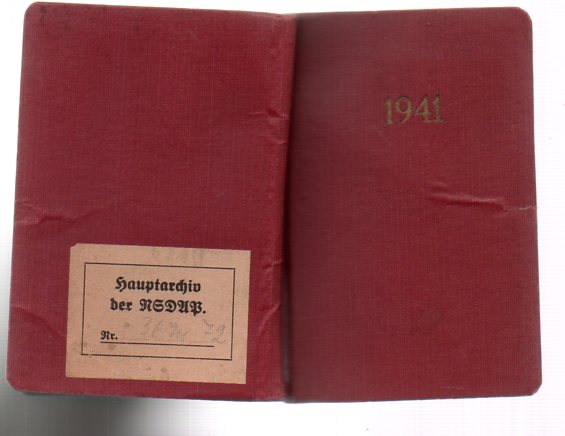
    This is one of the ideas that came home again uncovering this odd booklet, which is a Nazi diary for those stationed in the Generalgouvernement (Tascehnjahrbuch 1941 fuer den Deutschen im Generalgouvernement) ,  for the year 1941. The General Government (or more fully the Generalgouvernement für die besetzten polnischen Gebiete) was one administrative section of occupied Poland, the country being divided in 1939 after the German invasion of 3 September 1939, with the western section being retained by the Germans and the Eastern given over to occupation by the Soviets via the Non-Aggression pact between the USSR and Germany.1

    Empty diary149
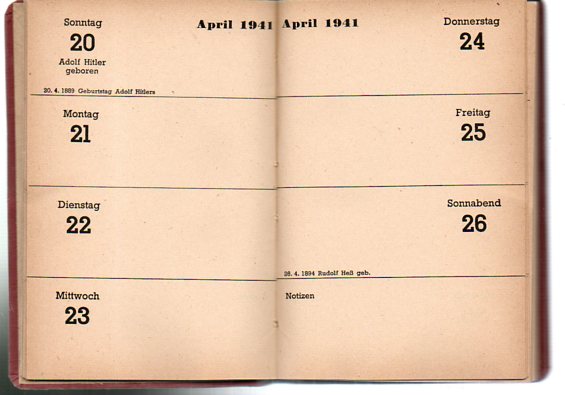
    This looks like an every day diary for the period, except for the Nazi (or NSDAP) regalia and German imprint of Generalgouvernement in Krakau.  And, all of the annotated high points of the year for the most overly voracious parts of German militarism as well as for the hot points of Nazi history.  Hitler, (above) Goering, Goebbels and other leaders’ birthdays are highlighted, not to mention seminal points in the development of the Nazi party and party-adoptees (Richard Wagner has a number of entries for suggested celebrations). 

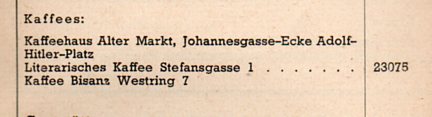
    There are also helpful directories in the back pointing to any number of cafes located in a growing number of “Adolf Hilter Platz’s” throughout Poland (including three in Radom), as well as fares for the use of the railway and postal system.

    We also see the following telephone number:  23075.  That’s for the Literarische Kaffee Stefansgasse I, Krakau. This is the location that the Reichsminister and administrator Hans Frank (about whom we’ll read in a moment) decided to hold a chess tournament in 1941, to satisfy his own need for chess while freshly in the pursuit of the murder of millions of people.

    Empty diary cafe151
    ‘Frank was extremely interested in chess. He not only possessed an extensive library of chess literature but was also a good player, and he even “received” the Ukrainian chess master Bogoljubow at the castle. On 3 November 1940 he organized a chess congress in Cracow. Six months later he announced the setting-up of a chess school under Bogoljubow and the chess master Dr Alexander Alexandrovich Alekhine, and he visited a chess tournament in October 1942 at the “Literary Café” in Cracow.”–Hans Frank (subtitle: Hitlers Kronjurist und Generalgouverneur) by Dieter Schenk (Frankfurt am Main, 2006) “and quotes a reference to chess on page 177 (given below in our translation)…”[Source: Chesshistory.com., here.]

    Continue reading here.


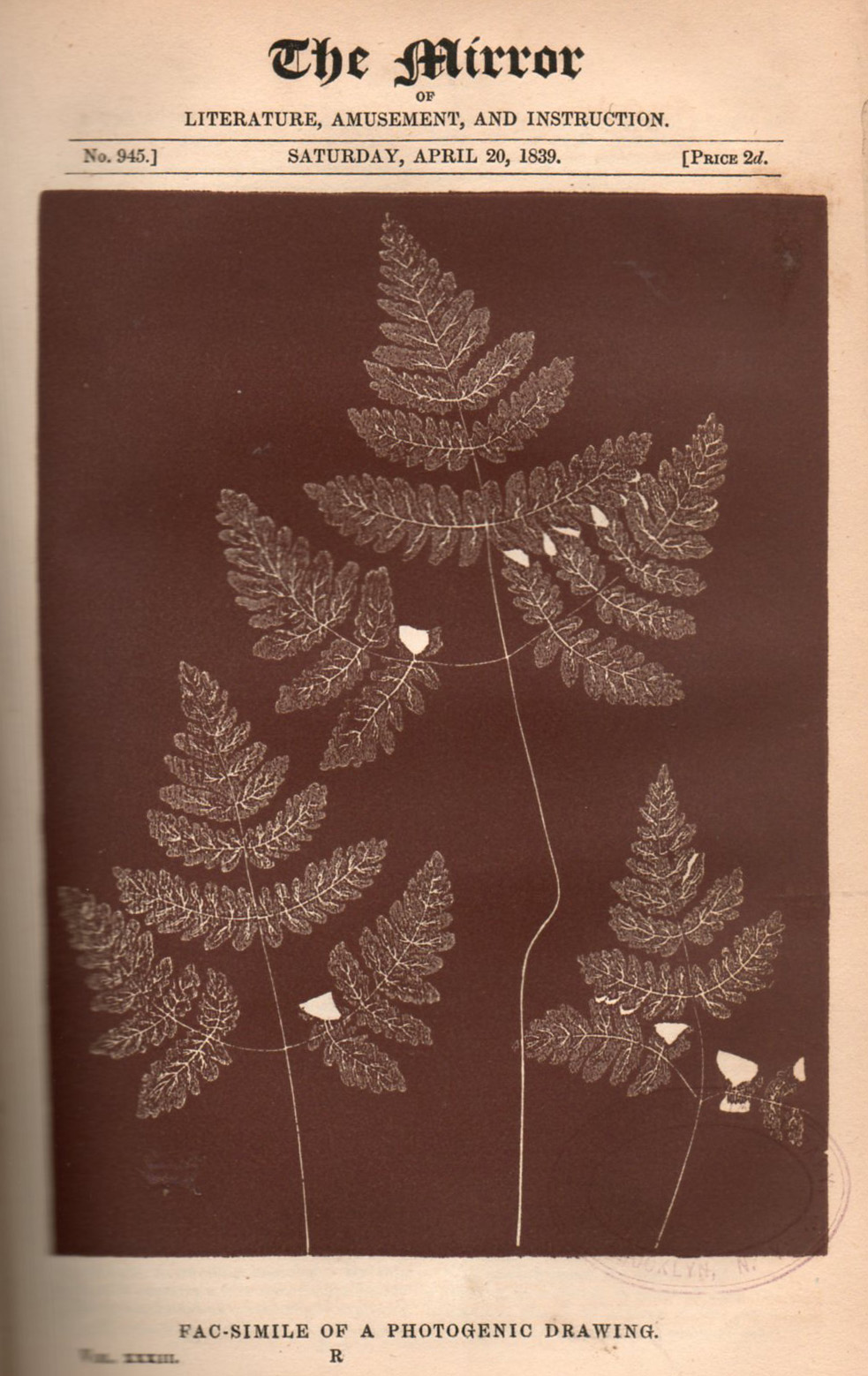
  • The First Published Image of a Photograph, April 20, 1839

    JF Ptak Science Books,  Post 1701 

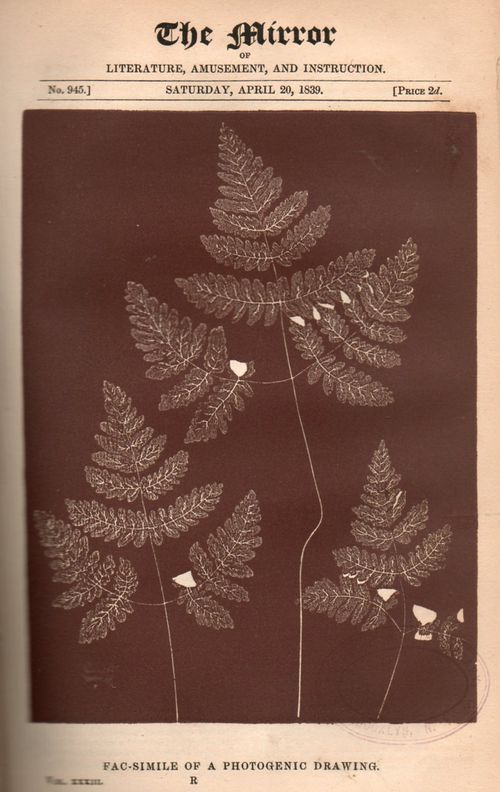
    The first published photographic image,  or “sunpicture”, illustrating an excellent collection of extremely early papers on photography, 1839.
    Bird photograph148
    Bird, Golding.  “A Treatise on Photogenic Drawing.”  Five papers in a series found and bound in the London-published journal, The Mirror.  These five issues comprise a very early work on the new science of photography by Dr. Golding Bird, appearing in issues from April 20-May 25, 1839:  this includes “A treatise on photogenic drawing”,  (pp. 241-44);  and also  “The new art – photography”,  (pp. 261-2, 281-3, 317-18, 333-335.)

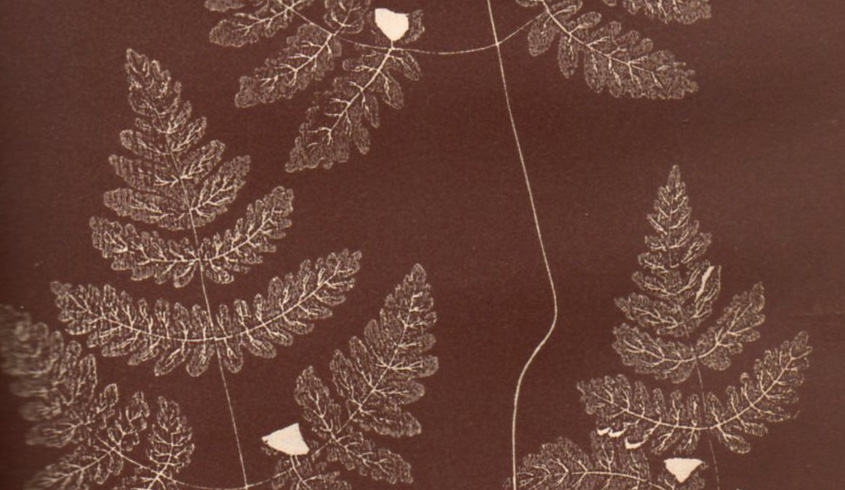
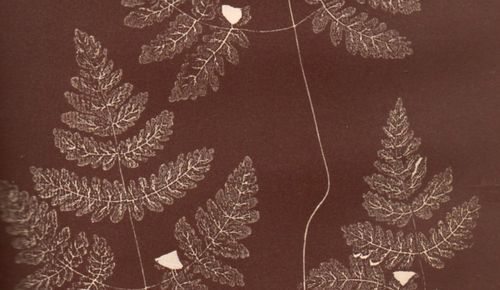
    It is page 241 (issue no. 945, Saturday April 20) that particularly peaked my interest–it contains the First Image of a Photogenic Drawing. This is essentially the first publication of an image produced by any sort of photographic process.  The process here is the ‘sun picture”, a photographic process, making this the first published “photographic” image, but really it is more like the first publication of a photographic image that was produced via woodcut.  It predates the first mass-published photograph by four years and the first (entirely) photographically illustrated book (The Pencil of Nature) by six years.  The sun picture, or heliotype, was first described in print in 1801 by both Thomas Wedgewood and Humphrey Davy, and although the process was at least 39 years old at this time there are no recorded *published* images produced by that process. (The woodcut is much larger than usual for The Mirror, and is also of a unique brown/red color, and of a different hue than any other woodcut that we have seen in any of the issues of the first 45 years of this publication.)
    Bird photograph148_edited-1

    The image is described in David A. Hanson Collection of the History of Photomechanical Reproduction, located in
     the Sterling and Francine Clark Art Institute (Williamstown, Massachusetts), so:

    “…facsimile of a photogenic drawing of ferns (done on the block) as a plate [to illustrate an article serialized by Dr. Golding Bird “A Treatise on Photogenic Drawing” and reprinted in the Magazine of Natural History, p. 234-44]…printed in rust to imitate the photogenic drawing… The facsimile of the photogenic drawing done directly from an exposure on the block is the first photographic image published. The finished example is printed directly from the block in a reddish brown to match the color of Talbot’s first salt print photograms.”–Hanson Collection catalog, p. 6 [Source, here.]

    Under the title, “the First Reproduction of a Photograph”,the George Eastman House of Photography’s journal, the Image (volume 11/2, 1962)  notes:

    “On April 20, 1839, the London magazine The Mirror of Literature, Amusement, and Instruction, featured as its cover a “Facsimile of a Photogenic Drawing.” There is a copy in the George Eastman House collection. It is a picture —in negative—of three stalks of leaves. The original was made by Golding Bird, “a distinguished botanist” by following William Henry Fox Talbot’s newly invented process, the details of which were made public at the Royal Society on February 21. Paper was made light sensitive by bathing it first in sodium chloride solution, then, after sponging the surface, in a solution of silver nitrate. The material could be used in two ways: to make, as Golding Bird did, a contact print, pressing flat objects to the surface during exposure to light, or in a camera. Both techniques produced negative images, which were fixed in a strong solution of sodium chloride. Talbot named his invention “photogenic drawing.” His friend, Sir John Herschel, proposed for it the word “photography.”

    “Thus to The Mirror falls the honor of having first published a reproduction of a photograph. The facsimile which was presented to its readers was the work of a draftsman, who made a drawing of the photograph, and a wood engraver, who cut the block..”

    The Image continues:

    “Only a week later, on April 27, The Magazine of Science and School of Arts, another London magazine, featured three “Fac-similes of Photogenic Drawings” on its cover: two botanical specimens; (Fool’s Parsley and Grass of Parnassus), and a piece of lace. Although wood engravings created by skill of hand, they approach photography more closely. For the very wooden block used for the printing plate was itself sensitized, just as Bird’s paper had been sensitized, and the engraver followed with his burin the photographic image itself, rather than the artist’s drawing.”

    “The photogenic drawings were contributed to the magazine by a reader who signed himself “G.F.” He commented, in his covering letter published in the same issue: “I send you three drawings of this new art, which were impressed at once on box-wood, and therefore are fit for the graver, without any other preparation. I flatter myself that this process may be useful to carvers and wood engravers, not only to those who cut the fine objects of artistical design, but still more to those who cut patterns and blocks for lace, muslin, calico-printing, paper-hanging, &c., as by this simple means the errors, expense, and time of the draughtsman may be wholly saved, and in a minute or two the most elaborate picture or design, or the most complicated machinery, be delineated with the utmost truth and clearness.”

    Gernsheim states in his History of Photography that  the first photographic camera ever made for sale to the public was advertised by Francis West, an optician of 83 Fleet Street, London, and published in this issue.   

    Bird later reworked these sections of the Mirror into elements of and a chapter in his Elements of Natural Philosophy; (being an experimental introduction to the study of the physical sciences; revised and enlarged third London edition, Philadelphia: Lea & Blanchard, 1848). This article was reproduced in the Journal of the Franklin Institute in September 1839 as “Observations on the Application of Heliographic or Photogenic Drawing to Botanical Purposes; with an account of an economic mode of preparing the Paper: “in a Letter to the Editor of the magazine of Natural History”.

    [Offered for sale in our books for sale section, here.]

  • Foucault’s Pendulum, 1851

    JF Ptak Science Books   [Quick Post in the History of Lines series]

    “That was when I saw the Pendulum. The sphere, hanging from a long wire set into the ceiling of the choir, swayed back and forth with isochronal majesty.. .The time it took the sphere to swing from end to end was determined by an arcane conspiracy between the most timeless of measures: the singularity of the point of suspension, the duality of the plane’s dimensions, the triadic beginning ofn, the secret quadratic nature of the root, and the unnumbered perfection of the circle itself… Were its tip to graze, as it had in the past, a layer of damp sand spread on the floor of the choir, each swing would make a light furrow…”–Umberto Eco, Foucault’s Pendulum.

    I’ve uploaded an interesting recrod to the books for sale section of this blog on the great experiment of Leon Foucault (1819-1868), who was the first to actually demonstrate the rotation of the Earth, doing so with a very simple, extraordinarily elegant experiment involving a heavy brass bob suspended from a long cable–a pendulum that was unencumbered and free to swing along any plane.  It is the curvature of the Earth that allows the tip of the bob to make its pattern, and it is the fact that the Earth is rotating under the moving pendulum that allows it to be tracing this path at all–it is also tells the difference between living on a sphere and living on a plane. 

    ·Posted by :

    ·in:

    —

  • History of Lines: Barbed Wire Borders for San Francisco’s Chinese Scapegoats

    JF Ptak Science Books  Post 1698 [Part of the History of Lines series.]

    [All images below via the Library of Congress, The Chinese in California, 1850-1925]  

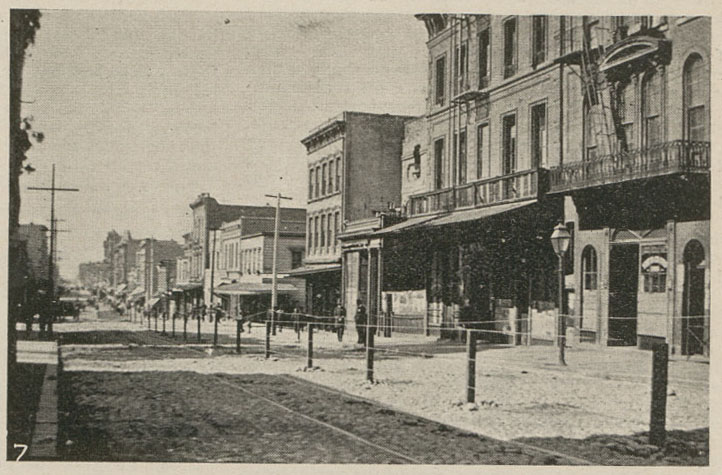
    Part of this blog’s history of line series inevitably deals with some of our planet’s most cutting lines:  barbed wire.  Talking about just the United States for the moment, it cut land into small, bite-sized chunks in the parceling-out and extinction of expansion in the American Westward movements, and has done pretty much the same in keeping apart the races in some areas of the country where the legal/social/cultural lines begged for steel more than paper. Such is the case in these remarkable photographs from San Francisco

    Chinatown barbed wire 2
    And the full image:

    Chinatown barbed wire
    [“The Barb-Wire Barricade: From The Wave: v. 21, Jan. – July 1900: no. 21, page 7: Scenes Outside the Chinatown Quarantine Lines, San Francisco”.]

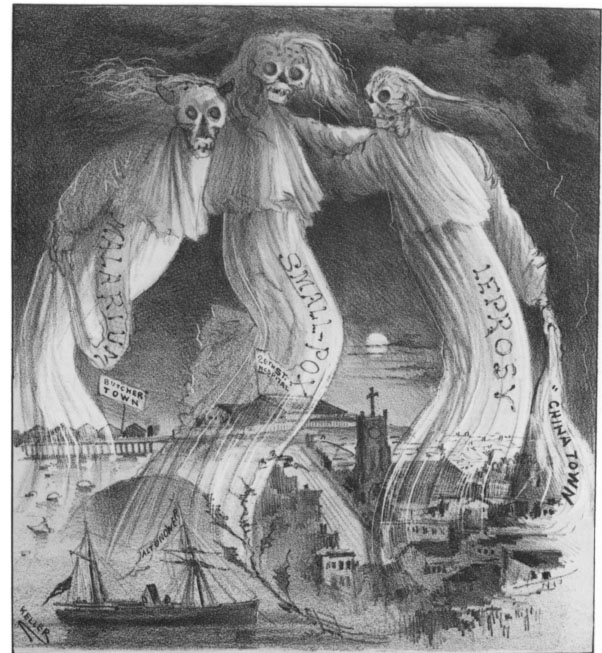
    Chinatown three gracesThe reason for this barbed wire in the streets of San Francisco was simple–it was a quarantine of Chinese people who were thought to be infested with bubonic plague. The reasons for this were simple and racist–given that the Chinese were seen from (at the very least) the 1860’s to be an “inferior” and “degraded”1 race, living in close quarters and in fair squalor at times (given the wages that they were paid and the abuses they suffered from the Chinese Exclusion Acts), and given the codified racist sentiments against them, it was seen that these people were capable of spreading the diseases via their very presence and “vapors”. (At least one of these “three graces” of “malarium”, “small-pox” and leprosy were seen as coming directly from Chinatown in San Francisco. See notes #1 for source.)

    And so up went the barbed wire, “and no Chinese American was allowed to leave the area bounded by California, Kearny, Broadway, and Stockton streets”2.  This of course restricted the access of Chinese immigrants and Chinese-American citizens, and held for some three months, prohibiting access out and in, meaning that food was in short supply, prices for goods and food went very high, and many Chinese businesses suffered loss and closure.  At the end of three months, the barbed wire quarantine was lifted, and of course not one case of plague was reported among the Chinese population. 

    There is a long history to this sort of thinking, as we find that, for example, in the 1875/6 smallpox epidemic San Francisco’s father’s determined that one cause might be the Chinese, and had all of the houses in Chinatown fumigated.  This of course had nothing to do with the epidemic; yet, at the end of it  all, “the  city health officer, J. L. Meares, offered the following explanation:  I unhesitatingly declare my belief that the cause is the presence in our midst of 30,000 (as a class) of unscrupulous, lying and treacherous Chinamen, who have disregarded our sanitary laws, concealed and are concealing their cases of smallpox.”3

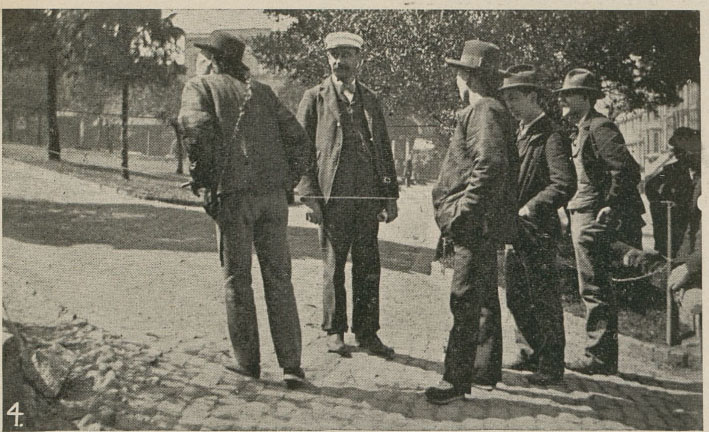
    Here’s another image from the 1900 quarantine:
    Chinatown 2--the ropes
    [“A Conversation Across the Ropes: From The Wave: v. 21, Jan. – July 1900: no. 21, page 7: Scenes Outside the Chinatown Quarantine Lines, San Francisco“ Publisher: Wave Publishing Company.]

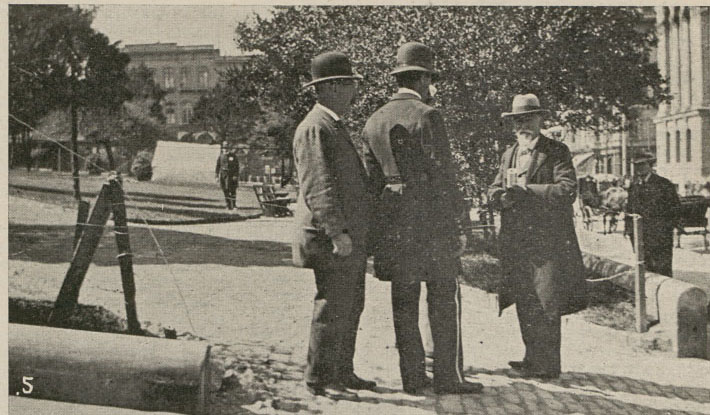
    And another, keeping San Francisco “clean and healthy” with barbed wire and rope.  

    Chinatown 3 barbed wire
    [“No Admittance: From The Wave: v. 21, Jan. – July 1900: no. 21, page 7: Scenes Outside the Chinatown Quarantine Lines, San Francisco.”]

    Another example of the institutionalized despoilment of the Chinese is seen here in an 1880 Board of Health pronouncement on the state of Chinatown in San Francisco was an official “nuisance”, and that the “Chinese cancer:” must be cut out:   “The Chinese cancer must be cut out of the heart of our city, root and branch, if we have any regard for its future sanitary welfare . . . with all the vacant and health territory around this city, it is a shame that the very centre be surrendered and abandoned to this health-defying and law-defying population. We, therefore, recommend that the portion of the city here described be condemned as a nuisance; and we call upon the proper authorities to take the necessary steps for its abatement without delay.”4

    And of course examples can go on and on–but there is really nothing quite like seeing a racial sentiment transferred into a three-dimensional object–like a barbed wire fence going down the middle of a street in San Francsico, in 1900–to drive home a message of learned bad thinking. 

    Notes:

    1. An excellent article by   Joan B. Trauner, “The Chinese as Medical Scapegoats in San Francisco, 1870-1905,” California History, Vol. LVII, No. 1 (Spring 1978), pp. 70-87.  Full text is available online with an academic account.

    2. Source: History of Chinese Americans in California, the 1900’s, blog  here.

    3. Trauner, ibid. Page 73

    4.  _____, pg 75.


  • The Farm and the Boring Frontier in the Closing of the West

    JF Ptak Science Books   Post 1699  [Part of the series on Blank, Empty and Missing Things:  the Frontier, 1885.]

    Farming and the closing of the frontier–more notes on reading Larry McMurtry’s Lonesome Dove, part 4.

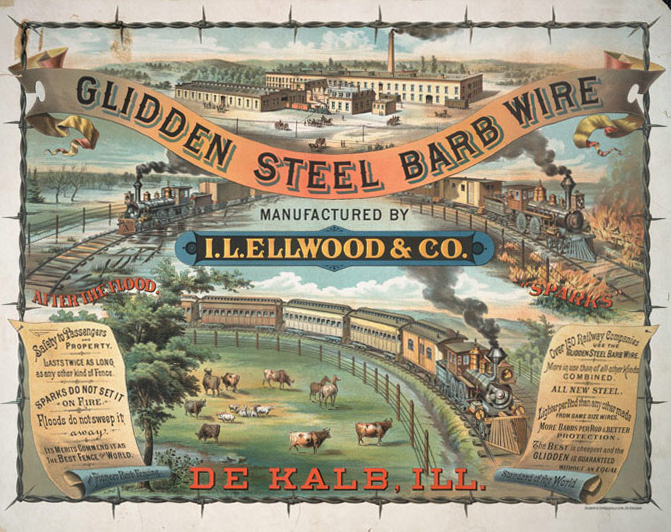
    It is difficult to underestimate the impact of the technological revolution on the development of the American West. The impact of the railroad is obvious; efficient fencing material in the form of barbed wire revolutionized land distribution and control. Less obvious is the less glamorous—the plow, harrow, windmill, silo, well drilling, and harvesting machinery. All made farming less difficult and opened the way to ever more land being farmed—the cultivation and civilization of the vast tracks on the Great Plains was made possible by these innovations.

    Barbed wire
    [The use of the railroad in this ad for the famous Glidden barbed wire is interesting because in the history of lines and the American West, it was the lines of the railroad tracks, telegraph wires and barbed wire that changed the face of the place more quickly than anyone could have imagined in the 1840’s.  Certainly if Jefferson had been able to survive to his 150th year he would have been absolutely shocked to see how fast the West had been not only explored but brought into some sort of control, a feat that he imagined would take many generations past his exploratory team of Lewis and Clark.] 

    All of the machines needed in the West—chilled-iron and steel plows, grain drills, reapers, disk harrows, straddle-row cultivators, and threshing machines—were in use before the Civil War. The appropriate improvements and modification needed for use on the Great Plains came about in the 10 years or so following the war.
    The improvements made in farm machinery from 1870-1890 had the following effects on time, effort and money saved in the production of each acre of the following:

    Crop Time Worked Labor Cost

    Hand Machine Hand Machine

    Wheat

    61 hours

    3 hours

    $3.55

    $0.66

    Corn

    39 hours

    15 hours

    3.62

    1.51

    Oats

    66 hours

    7 hours

    3.73

    1.07

    Loose Hay

    21 hours

    4 hours

    1.75

    0.42

    Baled Hay

    35 hours

    12 hours

    3.06

    1.29


    The effects of technology were staggering—in the 1870’s, a farmer knew he could only plant seven or eight acres of wheat because he knew he could only cut a certain amount during the limited harvesting season. By 1890 the same farmer could plant 135 acres knowing that he had effective means to harvest, bind and store the wheat without spoilage. These improvements meant more production from more farmers, and changed the face of the Great Plains.

    Railroads helped a great deal in bringing farmers west—sometimes covertly. The Great Northern Railroad did its fair share in structuring the land during the “Dakota Boom” of 1878-1885. It was formed in 1879 by James J. Hill, a former employee who managed to seize control of the railroad following the Panic of 1873. Its progress west was deeply planned by Hill—since the railroad had no land grants, he realized that income must come from revenue, so he brought revenue-makers with him, building communities along the railroad as he went. He advertised and brought in immigrants from Europe, established model farms, imported blooded cattle, and loaned money to farmers, homeseekers and immigrants of all persuasions. His actions were persuasive and successful.

    Its a horrible thing in some ways to identify farming as a “Boring Fronter” in the history of ” _____ Frontiers”, but it is in some ways accurate.  Not to say that all of farming is boring, not by any means, particularly in difficult places in trying times–but the presence of an easily-accessible borderland defined by a very inexpensive means of identification (as in barbed wire) meant that the property of individuals was defined, and that new property owners would have to fan out and away from existing farms and ranches, thus settling more and more territory.  And this of course meant more and more land was under control.  And “under control” means, well, under control.


  • An Eloquence on the State of Indians and Liquor on the Reservations, 1871

    JF Ptak Science Books  Quick Posts

    [Electronic source here.]

    In the Report of the Board of Indian Commissioners for 18711 I found the following report of a meeting held between General S.J. McKinney (Superintendant of Indian Affairs for Washington Territory) and Chief Napoleon at the Tulalip Reservation in Washington Territory:

    “Napoleon, the Chief, came forward with much and laid before…a bunch of split sticks, saying ‘these represent the number of Indians killed by white men in the past year, all Indian chiefs, fifteen of them, and yet nothing has been done by the government to the white men who killed them. They killed them by selling them whisky. I do not speak of them because I have a bad heart, but because I want you to know what kinds of men live about us. The whites now scare all of the Indians, and we wonder when they will kill all of us.’”

    After his eloquent and impassioned speech came that of his brother, Peter, who continued to explain the evils of the Indian agents:

    “Every agent has done wrong. No money comes our way. I will find money to go to Washington and tell the President of these evils. McKinney (the superintendent) has gone to the woods; he knows things are bad. The young Indians want to be helped and live like white men, they are not lazy. They see the Indian agent; he works for himself and never helps the Indian. I can not tell you the many stories; the sun would go down before I was finished…”

    The Indian Commissioner present at the proceedings, Mr. Felix R. Brunot, made an interesting response:

    “It would take four months to go to Washington in a canoe…I have much to do and little time to do it in. I must go to two more reservations before I go home and I have little time left to spend here. I am going to stay here just half an hour longer and then I must go…

     Notes:

    1) THIRD ANNUAL REPORT OF THE BOARD OF INDIAN COMMISSIONERS Washington DC December 12 1871, pp 128-129.

    Present at this meeting were:

    "August 28. A council was held with the Indians of this reservation at 10 a. m., meeting 
    in front of the trading-house. There were present Hon. F. R. Brunot, chairman of the 
    board of Indian commissioners, and his secretary ; General S. J. McKinney, superintendent of 
    Indian affairs for Washington Territory; Father Chirouse, superintendent; Napoleon, the 
    chief, and all the minor chiefs and young men ; the employes, and a large number of the 
    men and women of the tribe. Before the council opened, Napoleon, the chief, reminded 
    them that he was the only one left of the old men who took part in the treaty with Governor 
    Stevens ; all the others had passed away..."


  • A Little Key to the Annalen der Physik Numbering System

    JF Ptak Science Books 

    For my history of physics readers who work with the Annalen der Physik I reproduce a useful little key to the two-tier numbering system for the Annalen‘s first and second series.  The tables come from Sachregister zu den Annalen der Physik und Chemie Poggendorr’sche Folge… published in Leipzig in 1888.  Up to this point the physics journal had been published since 1799 in two series for a total of 160 volumes (plus a Jubelband and eight volumes of Erganzungsbaende); some people reference the appearance of articles via the total volume number, while others (myself included) reference the series (as  series “I volume whatever” or series “II, volume _____”.  There is a handy table at the very end of the Sachregister that correlates the two “systems”.  Follow this link for the key. 

    ·Posted by :

    ·in: