A Daily History of Holes, Dots, Lines, Science, History, Math, Physics, Art, the Unintentional Absurd, Architecture, Maps, Data Visualization, Blank and Missing Things, and so on. |1.6 million words, 7500 images, 4.9 million hits| Press & appearances in The Times, Le Figaro, Mensa, The Economist, The Guardian, Discovery News, Slate, Le Monde, Sci American Blogs, Le Pont, and many other places… 5000+ total posts since 2008.

Author: JF Ptak

  • The Beautiful Lunarium: Black Walls/White Stars, 1516

    JF Ptak Science Books   Quick Post

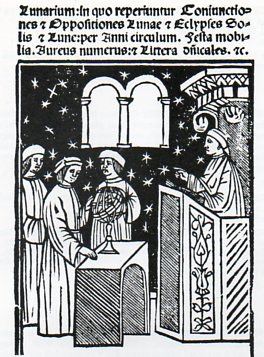
    The following are some beautiful images from a rather popular ephemerides by Bernardus de Granollachs, printed between 1484 and 1515.  The slender (16-page) work, Lunarium: In quo Coniunctiones & oppositiones Lunae… was published first in Spanish in 1484 and was then picked up and reprinted in a number of other languages over the next few decades.

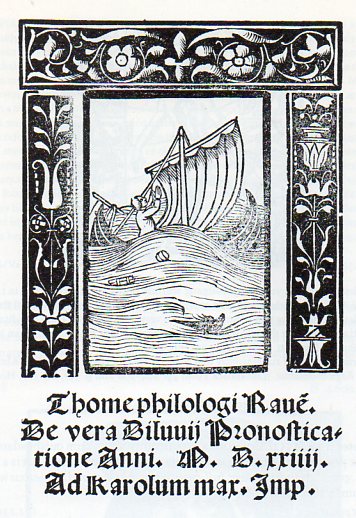
    The image most interesting to me comes from the Rome edition of 1516, simply because of the magnificent black wallsemblazoned with stars (which occurs on the title page):

    Lunarium 1516052

    The image did remind me very slightly of another gorgeous thing which I wrote about earlier in this blog (here):

    Red sky

    Some other variations in the Granollachs can be seen below:


    ·Posted by :

    ·in:

    —

  • Art of Labor–Ralph Fasanella

    JF Ptak Science Books    Quick Post

    Ralph Fasanella (1914-1997) was a self-taught artist who included minute details in his large canvases in which he re-created New York City, vast scenes of industry and celebration, and in general anything having a lot of people in it. He was if not in fact then at least in his head a Wobbly, a left-of-left deeply-pro-union socially-consciousness commentator, the son of a button-hole making mother and an ice-seller father. Ralph was a machinist and gas station owner, and in there somewhere in mid-life he became a painter.  I like his work quite a bit.

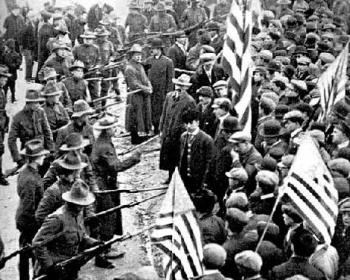
    This (above) is one of his most well-known works, and it portrays the famous IWW strike in Lawrence, Massachusetts in 1912, (see the Great Strike.), also commonly known then as now as the Bread and Roses Strike.  What differentiated this strike from others was the very large involvement of women, minorities and immigrants.  Old Ralph wore his leftie heart on his sleave.
    Here’s some photos of the real thing:

    Strikers face off with militia in Lawrence
     As usual the strike was about more humane working conditions, more light, better air, fewer hours, decent livable wages.  When the main employer in its town influences the flow of 85% of all of the town’s income, it is difficult for people to resist demands from that business which might not be reasonable.  

    Up20


    Lawrence strike meeting, New York

    [Photo shows group of men gathered outdoors, probably in New York City, to hear about the textile strike in Lawrence, MA. (Source: Flickr Commons project, 2008)]

    Guarding approach to mills, Lawrence, Mass.

    [Photo shows the Lawrence textile strike of 1912, also known as the “Bread and Roses” strike.  Source:  Library of Congress.]

    And from the introduction to the Report on Strike of Textile Workers in Lawrence, Mass., (U.S. Bureau of Labor, 1912) we read:

    "In Lawrence, Mass., fully one-half of the population 14 years of 
    age or over is employed in the woolen and worsted mills and cotton mills, and approximately 60,000 (including employees and members of their families) of the 85,892 people living in Lawrence are directly dependent upon earnings in these textile mills." "The textile strike in Lawrence and the conditions which followed were not primarily due to any condition peculiar to Lawrence. The general conditions of the industry in Lawrence are more or less typical of the textile industry in all of the large distinctly textile towns, and the strike in Lawrence and the conditions attending it might just as easily have occurred in any other of these towns."

    In short, a standard bit.
    Here are some other examples of Fasanella's work:

    ·Posted by :

    ·in:

    —

  • Ten Celestial Punishments for Impatience, 1630

    JF Ptak Science Books      Post 1674

    (Thanks to Bibliodyssey for finding this image–you can find the great Bibliodyssey site here.)

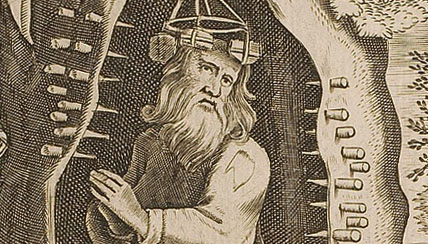
    Killing tree DETAIL


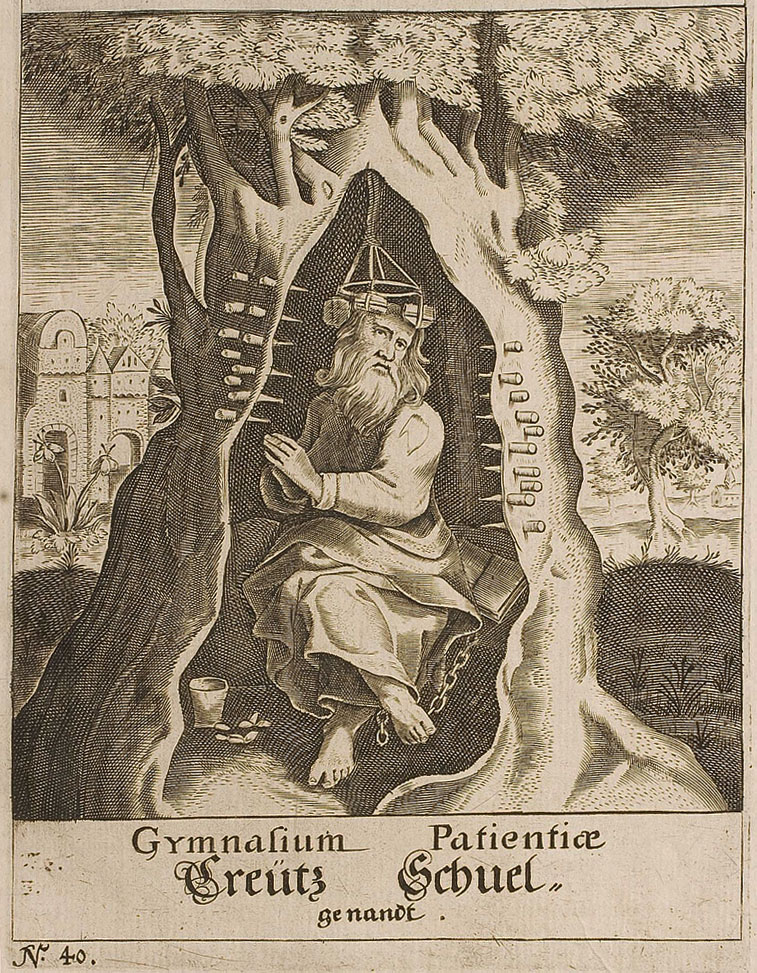
    And the full image:

    Killing tree

    And the source: Jeremiah Drexel, Gymnasium Penitentiae, 1630, and translated in 1640 as The School of Patience (the full text here) and the pdf of the Latin original here.)

    In the introduction to his work Drexel writes:

    “Dame Patience stands in place most eminent,
    Teaching her youths a doubJe document.
    That learn they must to form a passive right
    This pateint life, or else in future night
    That Paradise no plurail hath since sport
    and ease take pains at last in Pluto’s court”

     
    And should the teachings of Dame Patience not be heeded, even on Earth the impatient should suffer from at least these ten forms of torment:

    Whatsoever form of punisment, whatsoever kind of affliction or exercise in this world we affect, may be comprised and comprehended  in this tenfold order. For God hath in this his School of Patience  these following torments:

    (1) Rods;  (2) Arrows ; (3) Firebrands; (4) Garlands of straw; (5) Cudgels; (6) Snares and Chains; (7) Knotty clubs; (8)  Long clones; (9) Scouges or whips; (10) Sacks and bags.


  • A Heavy, Round, Wooden 17th Century Interweb–Two, Actually.

    JF Ptak Science Books    Quick Post

    booksnbuildings: kunstwissenschaftlerin:   ook wheel illustration in Agostini Ramelli’s Le diverse et artificiose machine del Capitano Agostino Ramelli (Paris, 1588). 

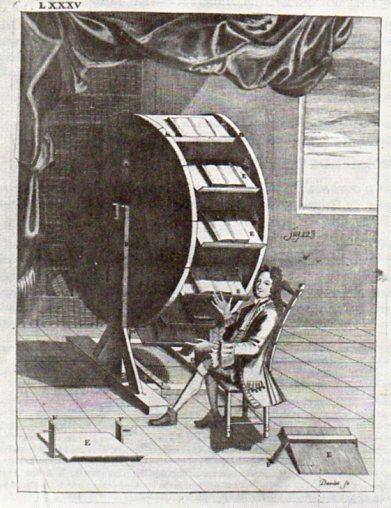
    Since there was no controllable source of electricity in the 17th century, there would need to be an alternative to delivering multiple sources of data to a seated recipient or researcher.  In these two instances, this issue was solved with wood–big wood.  And as we can see, the reader could choose from 12 different data sources–books–while not having to rise from the chair. 

    [Image source:  Agostino Ramelli, Schutzkammer Mechanischer Kunste, Leipzig, Georg Liger, 1620–a tall, thick book with 195 full page illustrations like this for all manner of invention and convenience.]

    Interweb 18th c045

    [Image sourceNicolas Grollier de Serviere, Recueil d’Ouvrages Curieux de Mathematique et de Mechanique...printed in Lyon by David Forey in 1719–another good-sized book with 85 full-page (Copperplate) engravings.]

    It also seems to me that there could be some doubling up on the placement of the books, allowing 24 of them to be displayed; there might also be something that could be done with a sliding shelf so that those two could be doubled, allowing 48 books to travel ’round at a time. This would be a huge boon to the reader here in  1620 and 1719, if that’s the way you were measuring “boons”.  It would be nice to have all of those sources open and available and neat, but one longish table would be good enough for that.  and certainly more furniture would be available to people contemplating having one of these monsters built for them because in almost all cases only the wealthy of the religious orders could possibly own 12 or 24 or 48 books at this point in history, so space would not have been a problem, necessarily. 

    The one thing that this interweb had going for it over the existing version–all of the sources used were vetted.


  • Medieval Chair-Shoveling and a Few Later-Day Shovelers of Note

    JF Ptak Science Books  Post 1672


    + chair shovel

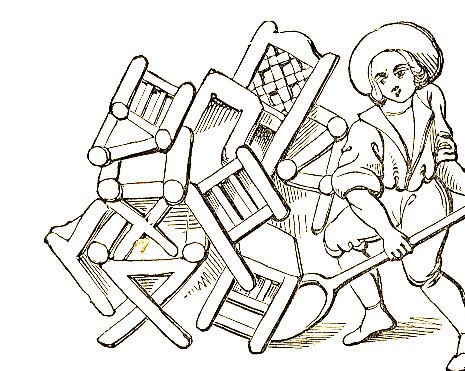
    Seeing this extraordinary woodcut of a sculpted feature on the Medieval section of the beautiful town hall of Brussels reminded me of famous shoveling, in general.  To begin with, though, I can’t fathom the meaning of this sculpture, shoveling chairs.  Perhaps it is a metaphor for the leaders not recognizing relaxation?  Or the (presumed) fact that there was no seating inside for the people doing business there?  Or that you were expected to seek your business and not loiter at town hall?  I really don’t know.  But images of other shovelers did pop into my mind. 

    The most instant shoveling comes from the song Big Rock Candy Mountain (which I’ve written about earlier here) and the very simple plea from a down-but-not-out man for not having to work with “short handled shovels1”.

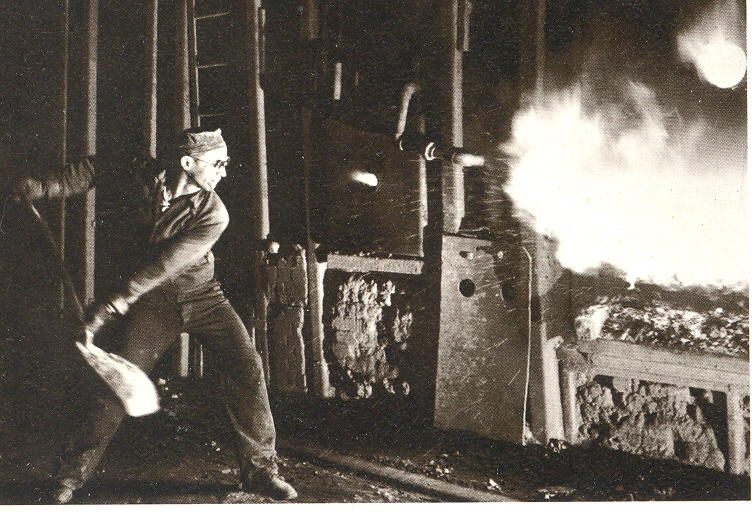
    Next in mind was Frederick Winslow Taylor, who was seen as an iconic leader in establishing human motion studies for efficient factory

    + chair shovelsteel shovel

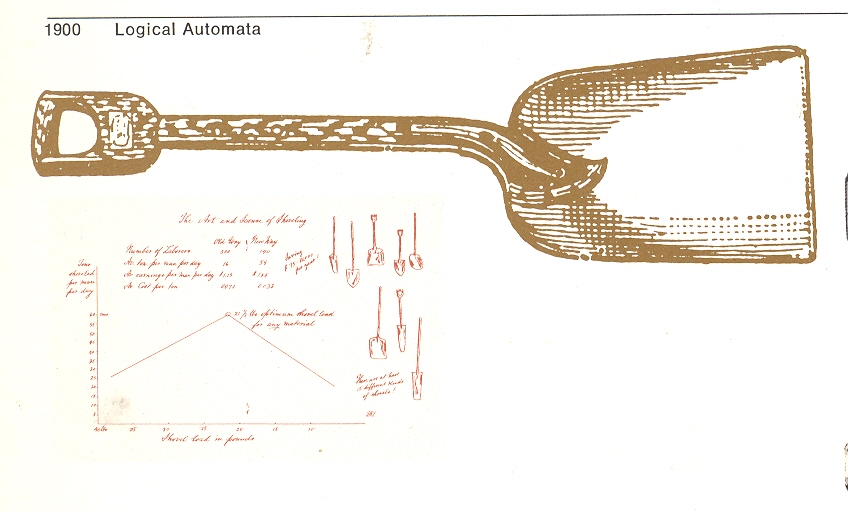
    (and etc.) operations in early 20th century America.  He did very detailed motion studies of people working—say, in this case of a man shoveling coal into a furnace at Bethlehem Steel in 1907—to determine that best sort of arrangement/placement of tools and supplies.  It was very influential work, for sure, and Taylor, who loaned his name to the movement of this sort of effective watchmanship, (“Taylorism” and “Taylorization” and also “scientific management”) and took a huge step forward in establishing efficient factory and business operations and also automatizing the human working cogs in the workplace.  According to the wonderful Eames’ brothers book, A Computer Perspectives (1973), “Taylor established the scientific fact that…a first-class shoveler will do his largest day’s work when he had a shovel load of 21 1/2 pounds.  Then as a matter of common sense…it was necessary to furnish each worker with a shovel which woul dhold exactly 21 1/2 pounds of the particular material which he was called upont to shovel” (page 52).  This, by the way, is also a short handled shovel.+ chair shovelsteel shovel daig

    I then thought about the Seven Dwarfs from Snow White (incidentally Tom Waits covers the “Hi Ho, Hi Ho” song like no one ever did or will) but they all carried picks, not a shovel (so far as I can see) among them. 

    There are undoubtedly many great shovelers—they’re just not people I know about.  I can imagine that Casey Jones must’ve had help to feed his locomotive’s fires; the gold rushes around the world produced some very wealthy shovelers whose numbers were titanicly dwarfed by those who shoveled and lost; soldiers have shoveled themselves into the earth for protection for at least 170 years (actually I don’t know when before the U.S. Civil War that soldiers found protection in their own burrows); and so on, but I just don’t know anyone by name.  And so my rumination ends—I did say that it was wispy.


  • A Source of Great Blackness: Virgil in 1537.

    JF Ptak Science Books    Post 1671

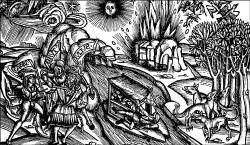
    Black--virgil043
    Wood engravings and woodcuts making use of broad, deep areas of black have long been a favorite of mine.  Finding pools of deep, continuous black–especially when the dark-inked places well outweigh the untouched white spaces on a piece of paper–have been a source of intrigue, and it just doesn’t seem to happen all that often in prints made say before 1650.  And I’m not talking about darkish or heavily shaded areas, here:  I mean black.

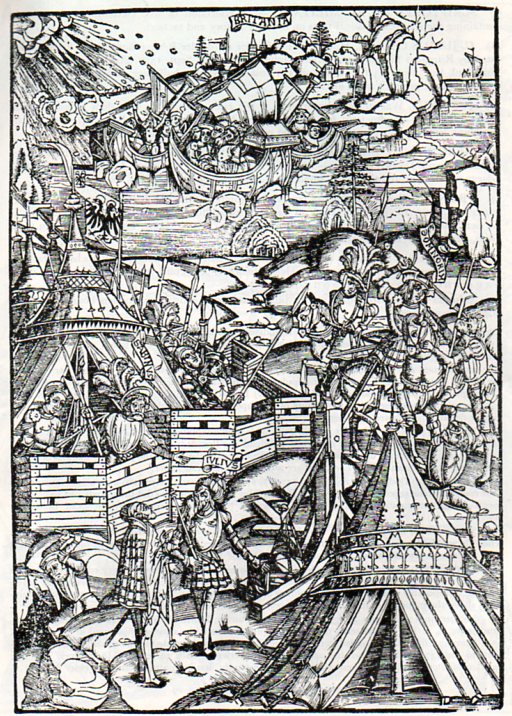
    Compare this to another, gorgeous image from about the same period, (Julius Casear) Historien vom Gallier und der Romer..., published in Mainz in 1530:

    Black--caesar 1530044

    The artist here while providing a very beautiful and complex image doesn’t really attempt the great deep blacks of the Virgil–admittedly this process doesn’t work everywhere  and for everything, not by any means, but I do like pointing out the true-black images as I find them.

    The first image–one of 104 large woodcuts–appeared in Publius Virgilis  Maro, Opera accuratissime castigata, a very large (folio) work that was published in Venice in Jnuary, 1537. This is of course Virgil, and the work contains the Eclogues (or Bucolics), the Georgics, and the Aeneid–unfortunately, I cannot find any other illustrations from this massive effort of 1537 but that pictured here.

    There are though  images from the Sebastian Brandt version of the Virgil Opera online with nearly the same images and by the same artist (“The Master of Gruninger”) but earlier (1502) and from what I can determine perhaps not with the same deep black urgency as the 1537 edition (seen above).  For example, here is an image for the Aeneis, Liber Quintus, Plate 104:

    And another fromn the Aeneis:

    Image sources (for the two images above) are from Spriti of the Ages, here

    It seems to me that day-time images like the 1537 Virgil do not get quite this black but rarely, and that the only times things seem to get blacker is with silhouettes. 


    ·Posted by :

    ·in:


  • Episodes in the History of Dropping Things–Baby Bombs, Bomb Babies and Dropping Women on Manhattan

    JF Ptak Science Books   Post 1670
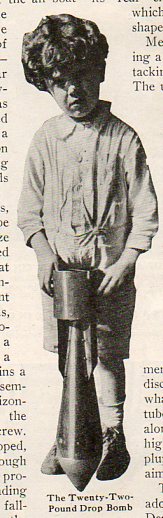
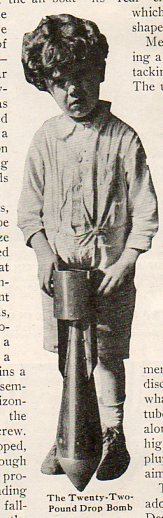
    Dropping things036In the history of dropping things–as distinguished from simple falling things–it must be said I think that this is the easiest of all human activities ever invented, and people have been trying to improve on this creation ever since.  After all, almost anyone can do it and–if you include pushing things over a ledge so that they might fall–most complex life forms can do it, too. 

    Of course there have been intellectual and technological adaptations, particularly when you include throwing and shooting things so that the objects have been charged with a “created height” so that they will be dropped in the designated location.  Cannons have been particular benefit to this aspect of advanced dropping.  And then of course there are the “Galileos” of dropping–like Galileo–and Jonas Moore and David Letterman and of course Seinfeld’s Kramer, and to a lesser extent there’s also every other person from the Boston area who represent hundreds of millions of people who drop a letter from somewhere in their spoken vocabulary.  There are people who drop their accents altogether, and of course politicians who drop the truth, and the tantilizers who drop suggestions, and paid-for pharmaceutical consultants who drop the untoward test results and their accountants who drop a zero when necessary.

    [Image source:  June, 1936, Popular Mechanics.]

    People drop options, they drop in and out and off, pennies and dimes, lawsuits and dumplings, coverage and names and the f-bomb.  They also drop dead and bombs, the last two being closely related, though more people “drop dead” when bombed because they are killed. 

    Bombs seem to be the biggest of all dropped things, especially bombs dropped by airplanes, and especially those bombs dropped on collections of people, which are called cities.

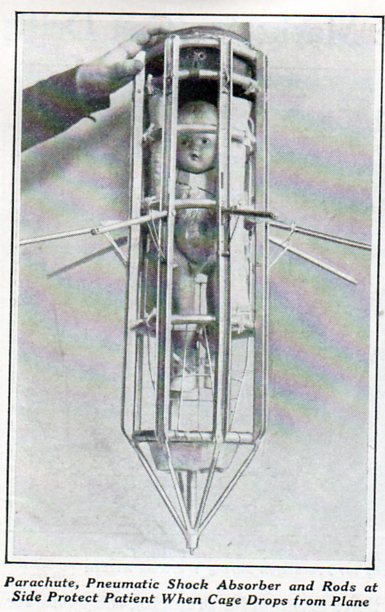
    Perhaps one of the strangest things to be dropped, though, is the following, found in  the September 1935 issue of Popular Mechanics
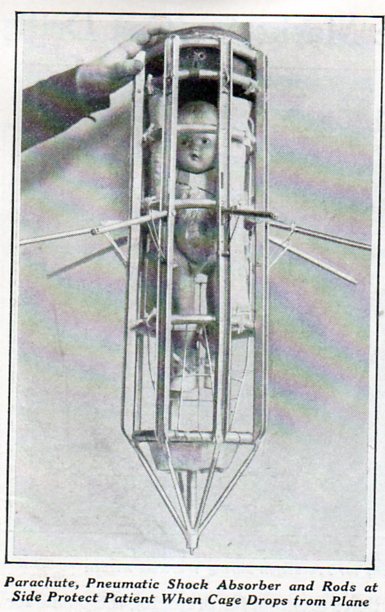
    Dropping things 2038This was a model of sorts for a critical-care-parachute-gurneystretcher, or something, for when a crew member of a U.S. Army Air Force aircraft was injured and needed care, though the article doesn’t specify where the person would be dropped. Overall it seems not the height of workable ideas, and suffered no doubt from its model using a baby doll, which just looks altogether wrong. 

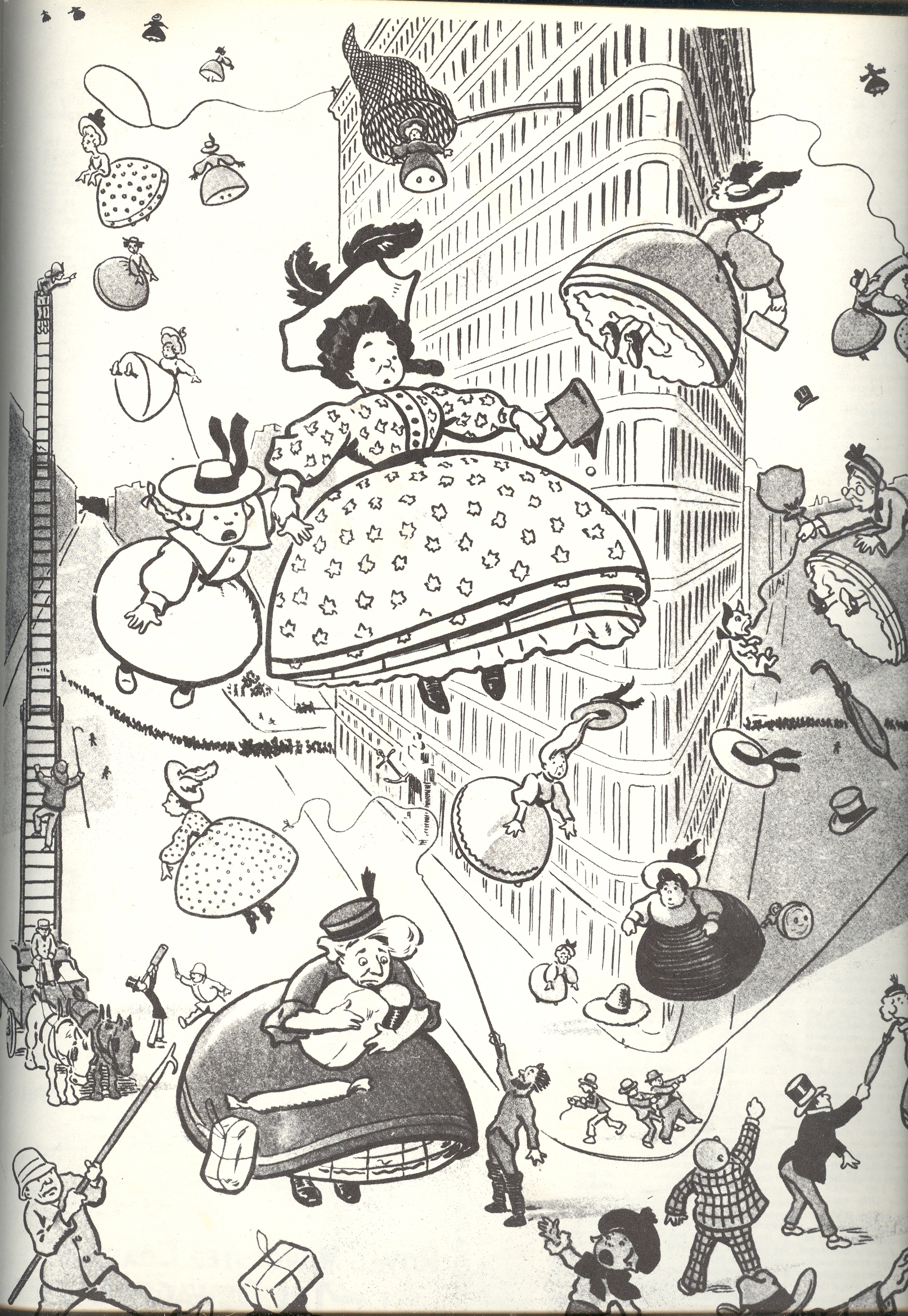
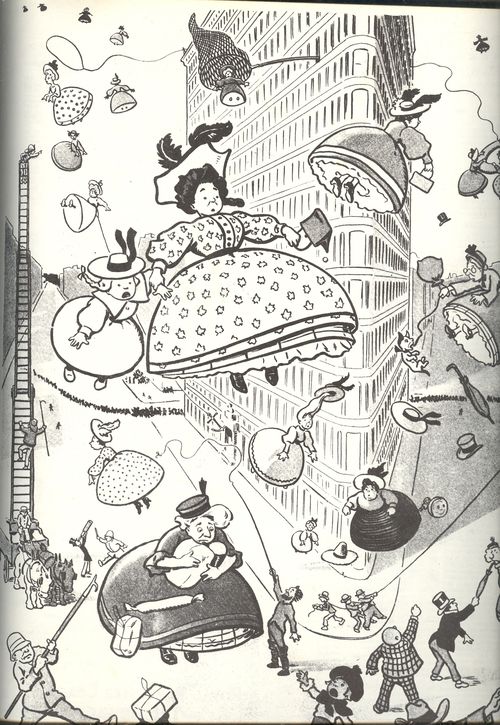
    And the last part of this episode is another strange bit:  dropping women on Manhattan. The  image comes from 1904 and–when taken out of context–it seems as though Manhattan is in for the worst of it, with a view in front of the Flat Iron Building of an aerial bombardment of women.  This is probably one of the few bad things that weren’t done with/at women, and would actually significantly predate the first use of explosives being dropped from aircraft.  Unfortunately the original, intended image was a poke at  crinoline  and featured women being blown up into the air rather than the other way around, though I like my interpretation better.
    5-women


  • On the End of the World Worries–1524

    JF Ptak Science Books   Post 1669

    End of the world035
    People have been worrying about the end of the world for as long as they have realized that the world could have an end.  The more-modern concerns for world-ending collisions with asteroids is relatively recent and does have a lot of truth to it; likewise the ending of large lifeforms on the planet via nuclear holocaust, which came very close to being in a number of situations over the last 55 years or so.  Less convincing arguments have been made through biblical interpretations and resurrections of ancient myths about the coming end-of-times because of of confluence of floating numbers which are after all is said and done just numbers and not actually attached to very much.  There have been untold numbers of predictions and world-end scares, but reality was not at all accommodated.  (An interesting end of the world date prediction timeline appears here.)

    One of the earliest printed menaces scaring people into believing that the world was coming to an end appeared in 1524, when a conjunction of the planets in the constellation Pisces was supposed to be similar to that which appeared in the times of Noah and in the sign of Aquarius. The conjunction plus the bits about Pisces and Aquarius evidently lead to the belief among some that there would be a great flood. There were over one hundred pamphlets published on this topic in the early 1520’s, though to be fair the bit about Noaic deluge was evidently an outrigger–most of them it seems (at least to Lynn Thorndike) were argumentative over one principle or another of astrologic practice. 

    Of the many people who addressed this topic–including Machiavelli, Luther, Apian, Rabelais and Vives, among many others–was Tommaso Gianotti (Rangoni) (1497-1577), who gave his predictions this fantastic woodblock visual life in his work De vera diluvii prognostications (and printed in 1522).  It was 16 pages long, and was one of many such slim pamphlets–his, though, did have this marvelous illustration.  I think the blank sky helps set the sunken world and the collapsing boat of mankind into stark contrast on what lay ahead. (Gianotti led a long and distinguished career teaching logic (Padua) and astronomy (under the direction of Pope Leo X) as well as astrology (Bologna), and managed to outlive his many dire predicitons by half a century.)


  • Zoomology–the Paper Microscope and Hidden Children in Antique Prints

    JF Ptak Science Books       Post 1668  

    Part of Paper Microscope and  Zoomology  series.

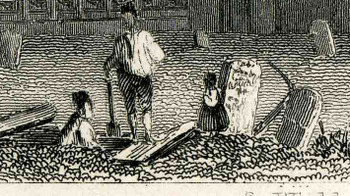
    Hidden_children_graveyard153

    [Detail from the image immediately below, the small scene immediately in the foreground.]

    Images hold selective secrets for different people of divergent interests.  Sitting through a motion picture, for example, shows a series of still images flashed before us—in a single scene people bring to bear their own ways of experience and observation.  A forensic pathologist will see things shown within their specialty different from someone with a chemical explosives background who will see a bomb differently from an ER doc who would respond to an emergency room differently from a bookseller who might notice in the scene that the paperback edition of a Tree Grows in Brooklyn being read by an American G.I. in 1944 didn’t exist yet, and so on.  A single image can hold a tremendous variety of depth and interpretation depending on the observers’ perspective. 

    Most of the time when I look at prints now I am looking at the extraneous “stuff” that is used as filler to the print’s purpose. I’ve written about this a few times earlier in this blog under the (bad) general title of Prints—Looking HARD at…), and I find the uncommitted art just fascinating, sort of like “loose”, unnecessary snapshots of common life, everyday life, of people walking by. 
    Hidden_children151
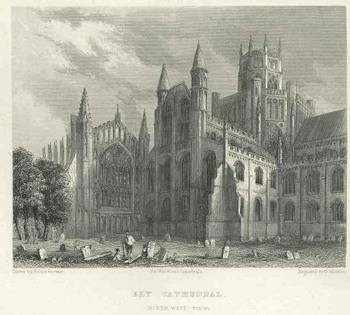
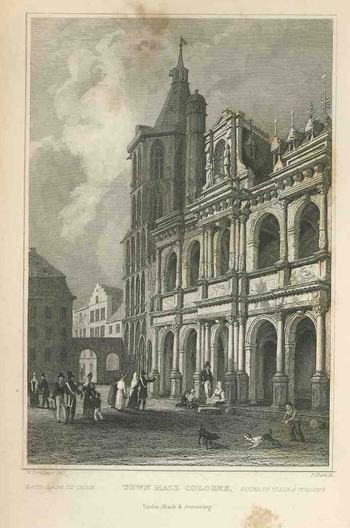
    The two prints today that I stumbled upon have a particular interest—they depict semi-hidden children in the foreground-filling detritus of the architectural marvel that is the subject of the artwork.  Children really don’t appear too terribly often in art from 1500-1850, so it is especially interesting to look really hard at these prints and pick out the kids and what they were doing.

    Of course this begs the question of “why?”—why would the artist bother with such detail in the foreground, let alone bring children into the picture?

    The first image is the gorgeous Cambridgeshire Medieval cathedral at Ely.  This is an engraving showing the north west view of the cathedral, and it is of course grand and imposing.  The curious foreground shows a somewhat dilapidated-looking cemetery, and looking further still we see two men digging a grave, and to the right of them, a small child, seemingly pointing and reading a gravestone.  What an unusual detail this is, what with it occupying less than 1% of the area of the image in general.
    Hidden_children_two152_2

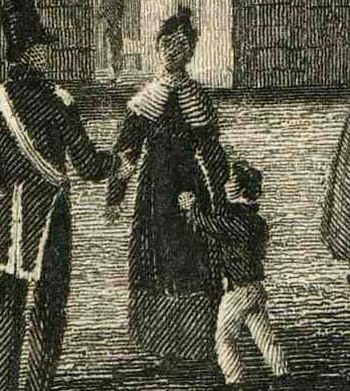
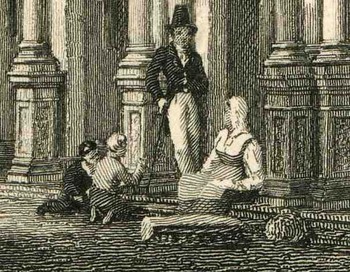
    The second image (above) shows the façade of the Town Hall at Cologne.  Of the twenty or so people in the street in front of the building, four are children (there’s also a pair of fighting/playing dogs).  One of the miniatures scenes seems to show a boy in a “pick me up” pose.  To the right of this is another, odder, scene, showing a woman—possibly a street food peddler—with her two boys(?), the children kneeling in front of a gentleman who is in turn leaning against a pillar of the Town Hall.  What the boys are doing is a mystery, as is the intention of the artist in including them.
    Hidden_children_streetpick_me_up .

    Unfortunately these “microscope” studies reveal only the basic forms of the semi-hidden, and really don’t ever seem to offer us a reason as to why they were preserved.  Presently I’m happy enough to just recognize them and appreciate their small saved existence.

    Hidden_children_street_kneeling  


  • Zoomology: a Paper Microscopic Look at Prints.

    JF Ptak Science Books   Quick Post

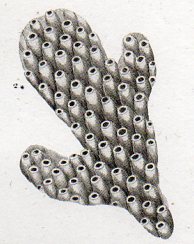
    Zoomology--vermes b032


    There’s a track on this blog located in the feebly-named category “Looking Closely/Deeply at Prints” were tiny bits and pieces of engraved artwork are exhumed for closer story, like passing a paper microscope over the image to draw out the semi-invisible and show the secret life of prints.  Often what this entails is some very curious work by the artist and/or the engraver as they sought to spice up a rudimentary architectural assessment of Salisbury Cathedral, or the town hall in Munich, or some sort of ruin in Surrey, or a street scene along old Broadway in NYC–and they would do this sometimes by including something artful and small, and completely unnecessary to the primary image on which they were working.

    See this post for a good example (with other links) of this.

    So, instead of having a few people in the street outside of Cathedral X to show the building to some sort of scale, the artist/engraver might include in their very tiny detail images of children fighting, or a legless beggar, or a pocket-thief, or a tripping aristocrat.  Or a man rounding a corner with a baby coffin on his shoulder. 

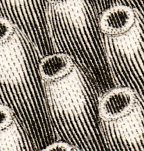
    Zoomology--vermes b034
    What happens here then is an intended-unintentional, sort of like an 18th century snapshot of Something that captures stuff of the daily grind in the process–and as it happens it is this stuff, the activities and the people doing the mundane chores of the 18th century that turn out to be the very interesting bits of the artwork.  After all, it was this sort of invisible activity that would tend not to be preserved in artwork or other visual documentation–but here it is, locked away in an architectural appreciation of some building Y in some city Z.  And we are lucky for the contrivances of those long-asleep artisans.

    But the Zoomology posts are something a little different than this–they simply are a deep observation of an interesting detail in an antiquarian print or photograph that shows an artwork in and of itself, a sort of descending fractal of appreciation.  And simple.

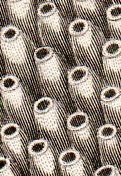
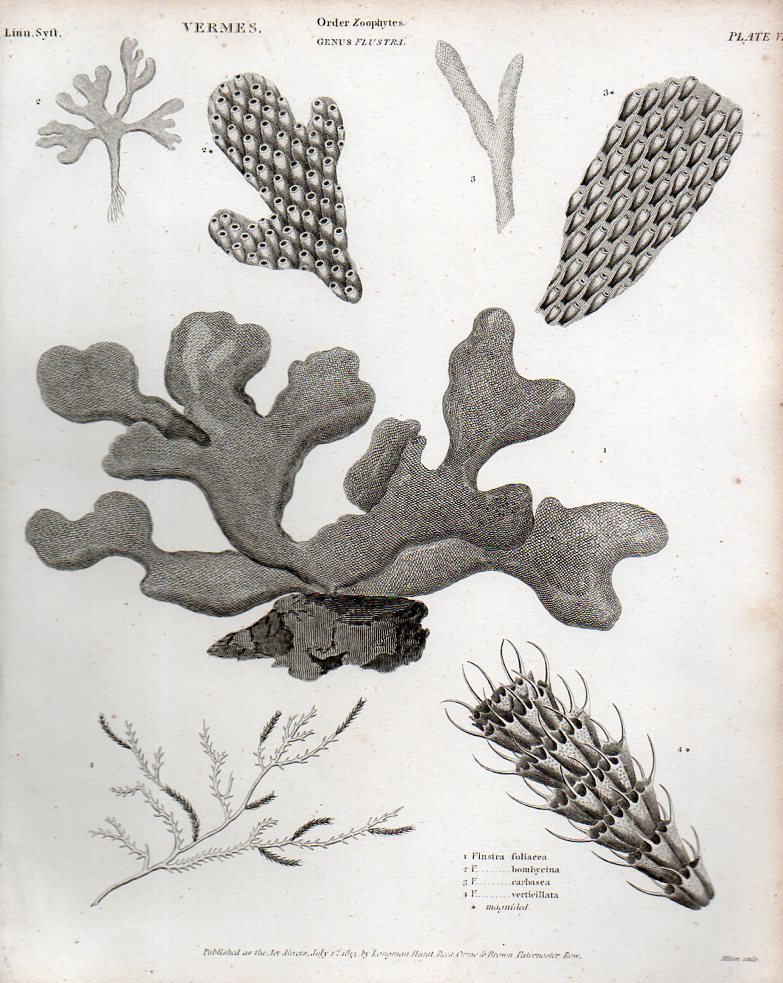
    The first sample in this quick-posting category is the sea anemone, or Zoophyte (old school classification), that we see in this series of images (above and below) from the great and prolific Abraham Rees (who must have had a team Rees, a group of scholars like the Bourbaki who worked together mostly anonymously save for the (in this case real) man whose name is given credit for the entire work) and engraved in 1813.  The image in question is a flustra bombycina, a Verme (according to the obsolete Linnaen taxonomy), and it just called out for deeper inspection:

    Zoomology--vermes b033

    And the zoom-out to the full image:

    Zoomology--vermes031