A Daily History of Holes, Dots, Lines, Science, History, Math, Physics, Art, the Unintentional Absurd, Architecture, Maps, Data Visualization, Blank and Missing Things, and so on. |1.6 million words, 7500 images, 4.9 million hits| Press & appearances in The Times, Le Figaro, Mensa, The Economist, The Guardian, Discovery News, Slate, Le Monde, Sci American Blogs, Le Pont, and many other places… 5000+ total posts since 2008.

Author: JF Ptak

  • The Rolling Houses and Glass Homes of Futurlandia

    JF Ptak Science Books   Post 1806  [Part of a series on the History of the Future]

    The rolling house of the future (offered in the September, 1934 issue of Everyday Science and Mechanics) promised at least one thing–the ability to be towed by a tractor.  (And seeing that the thing is being pulled along by chains, let’s make sure that there’s no downhill towing, yes?) Rolling_house_large


    The spherical houses seemed to come with their own railroad tracks for easier motion–a continuously self-laying track, which would make the new American suburbs a Suburbia Mobilia.  Cheap cars, cheap houses, and a Great Depression might have made for a picture of the future that was very self-sustaining.  On the other hand, the one thing that would not have been in the gunsights of the American manufacturing center is the size of the houses, which seem to me to be on the order of 500 square feet or so, which does not make for a lot of room to store all of the consumables that were waiting just around the next decade or so, waiting for the first real generation with a large amount of disposable income to loosen on all manner of never-to-be-purchased-before-by-the-working-classes consumers.  In this respect I am sure that these small buckets for human life would seem unacceptable, leaving little room for purchases. 
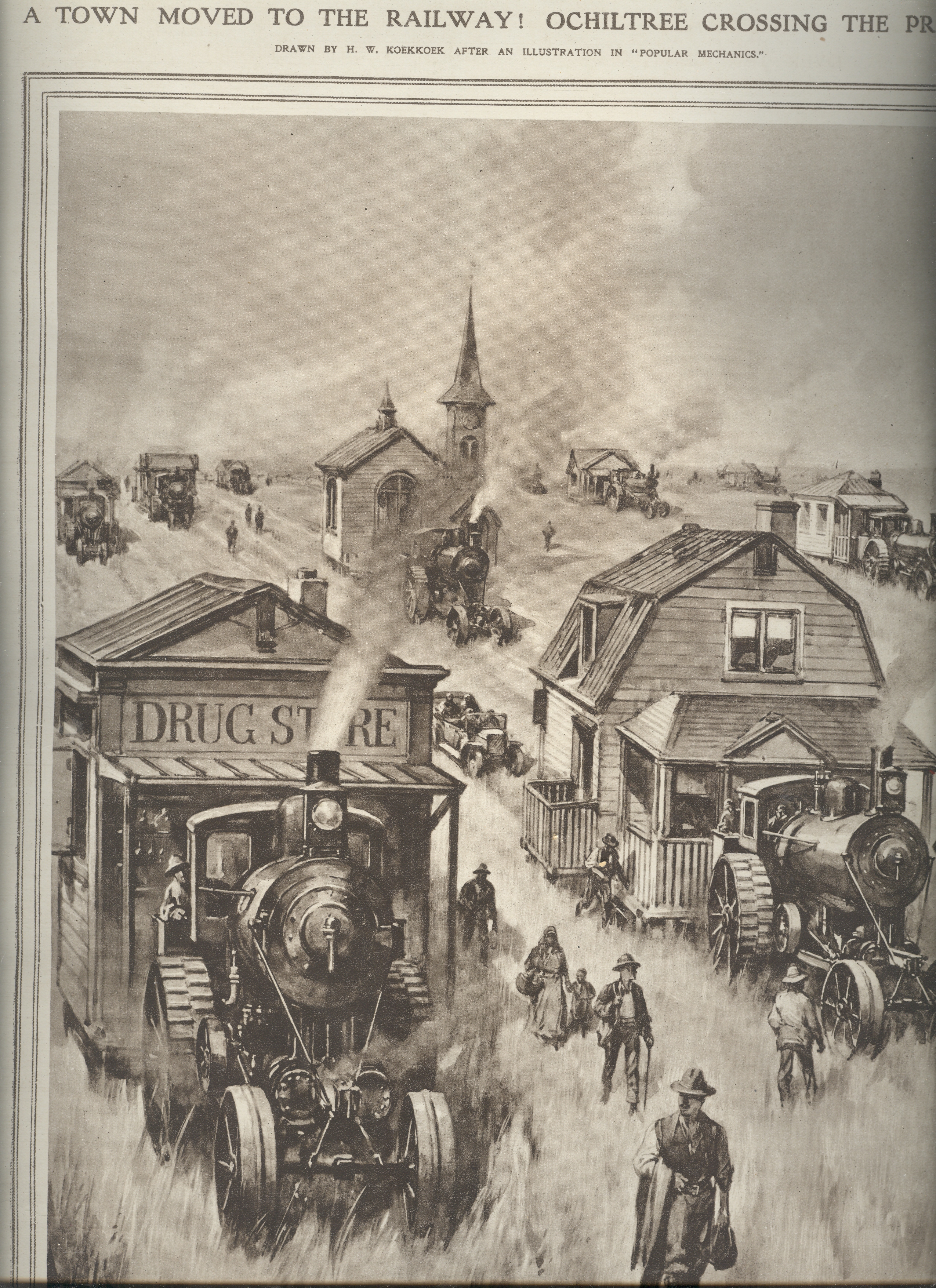
    ++00++ 9.25 ochiltree, texas

    It does remind me of wholesale town-moving, but from the past–real-life stuff, things that happened.  Like here, for example, in  Ochiltree, Texas, 20 October 1920.  This was a rare occurrence–to move a town–though it is hardly unique, particularly if moving the town closer to a railroad line that had decided to pass it by meant the difference between life and death of the town, then, well I guess you moved the town if you could.  Cemeteries included, sometimes; and sometimes not.

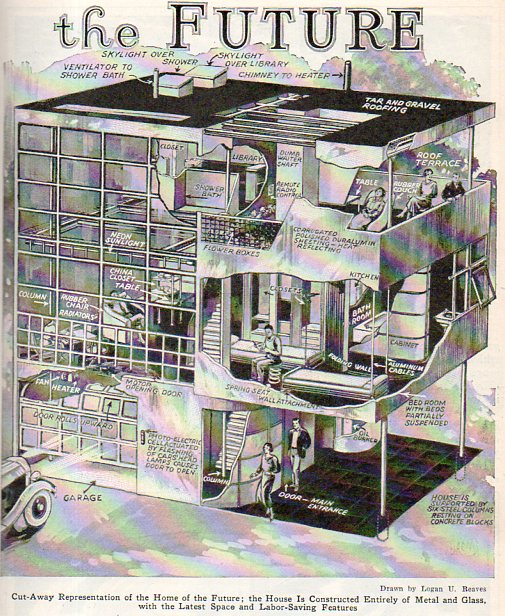
    A memory of another image of a futuristic future house of the future pulled my recent memory to a volume of Popular Mechanics for 1931, the August issue, featuring a “Home of the Future” speculation–this one was also small, but far less mobile, being constructed of metal and glass; and from what I can see, the common home’s exterior walls were mostly glass.
    Future house514

    It looks like a small place–I’m not sure that the car would actually fit in the glass garage.  And it doesn’t look all that comfortable, either, especially in regard to having no walls for bookcases.  (A wall of shelving for a collection of Kindles?)  There *is* a “skylight over the”library”, but it looks like the library isn’t more than a half case of books.  But perhaps in the future we are all entering a world where something is whatever we call it.  Oh, yes, I think that part of the future has already arrived in 2012, and I doubt seriously that the folks writing this article for a popular audience had anything more than a droll popularity in mind in their authorship.  In any event, this future house wasn’t mobile, was small, and looked pretty uncomfortable. And I also bet that the roof gave them problems up there in Futurlandia. 

  • The Liar in Political Winsprumerfall–a Short Episode in Blank, Empty & Missing Things

    JF Ptak Science Books     Post  1805  [Part of the History of Blank, Empty and Missing Things series.]

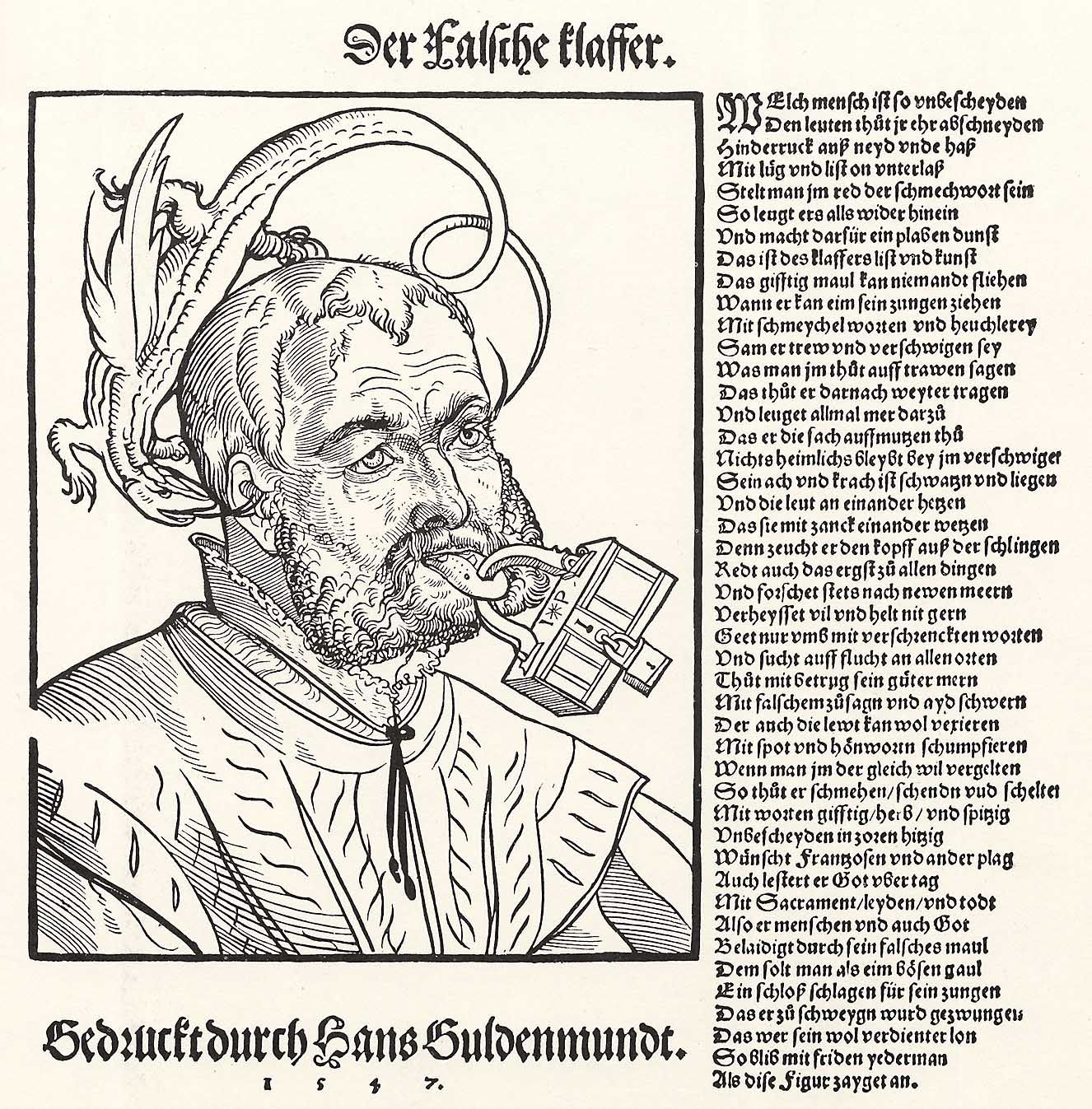
    Pencz, Georg: Der Verleumder
    [Source:  Zeno.org.]
    As we approach the new political season (where it is always all fours seasons,
    simultaneously, and known as “Winsprumerfall”) and where everything is good and
    bad, and decent and not, and moral and wanting, and right and wrong so far as the “wrongness” falls upon your opponent, and cloudy and clear, and all at the same time as always, everything all at once, it might serve us well to have an image of Georg Pencz’s
    (who I wrote about earlier today, here) Verleumder in mind. 
    And as we can see and guess, the wood engraving depicts the lying liar, the defamer influencing a value judgment, the slanderer of a fact known to be true and uttered false, a libeler.  A cheat of the fact.  In times like these, it is always good to listen closely and follow the logic, and then the money.  And then fact-check.

  • Renaissance Engravings of the Influences of the Planets

    JF Ptak Science Books   Post 1804

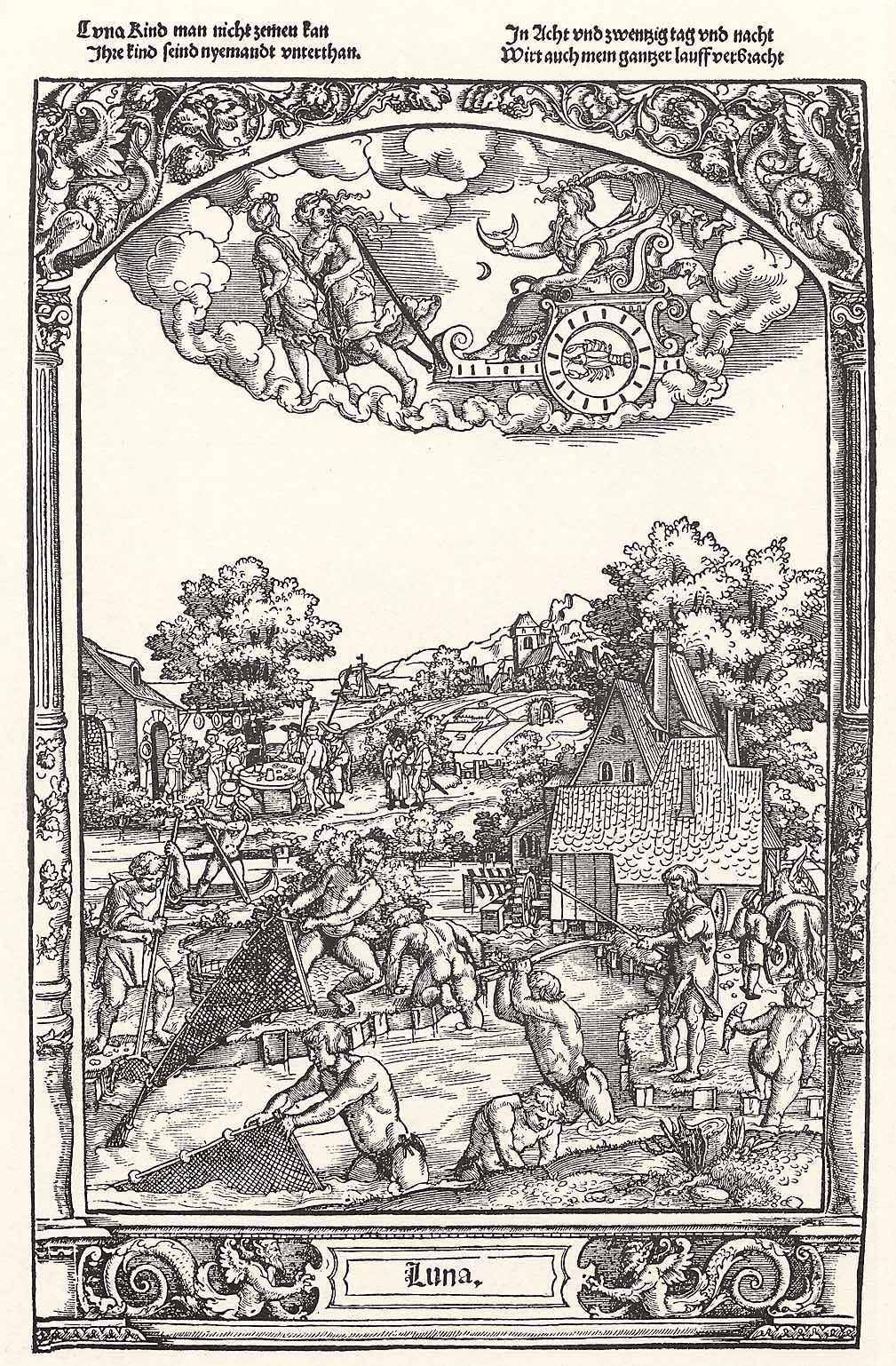
    The theme of the children of the planets was a relatively popular one,  and depending upon the planet, stretches back pretty deeply in western European time.  For example, for Children of Saturn, the children born under the astrological influence of the planet, was a subject of artwork reaching back at least into the 14th century, and then finding particular favor (or so it seems to me) among Flemish  (like Hemessen, Saenredam) and German  (Burgkmair, Pencz) painters. 

    I was attracted to the following wood engravings by Georg Pencz (ca.1500-1550) and the work published by Gabriele Giolito de Ferrari (1508-1578) because of their detail, and also because of the closeness and similarity in their design.  Giolito was an important publisher, and put out some of the earliest works in Italy in the vernacular.  I know more about Pencz, though, who is more attractive to me because of his extremely find hand and the size (or rather lack of it) of his work.  He was one of the so-called “Little Masters”, the artists who were influenced by Albrect Durer and whose work showed it, and who also worked very, very small ( as with Albrecht Altdorfer (1480-1538), Sebald Beham (1500-1550), and  Barthel Beham (1502-1540), for example).  He may have been a pupil and/or worker in the studio of Durer, or maybe not–but his work certainly showed the influence of the great artist.  His later work, too, I think shows the influence of the Italian painters, and Pencz may or may not have visited Italy to study them, the case being not so very clear.  In any event, whether he traveled to Italy or not or worked directly with Durer or not, his work certainly shows the influence of both even if there is no proof of a paper trail. 

    The Life of the Children of the Sun, published by the Italian publisher Gabriele Giolito de Ferrari, and said to be in the year 1533.  I’ve not yet been able to find the book’s title or the author’s name–a task that on the face of it seemed simple–and hope to be able to do this, soon. The other images are from Folge der Planeten in which the wood engravings of Georg Pencz appear.

    And so the series of images depictng the children of the Sun, Moon, and Chaldean planets Mercury, Venus, Mars, Jupiter and Saturn, as they progressed towards their middle-life, and in their chosen professions as mythologically influenced by their planet.

    Life of the Children of the Moon, by Georg Pencz (1500-1550), in the Folge der Planeten.


    Pencz, Georg: Folge der »Planetenbilder«, Mond


    ·Posted by :

    ·in:

    —

  • An Accumulation of Fantastic Opposites: J.J. Grandville, 1844

    JF Ptak Science Books   Post 1804

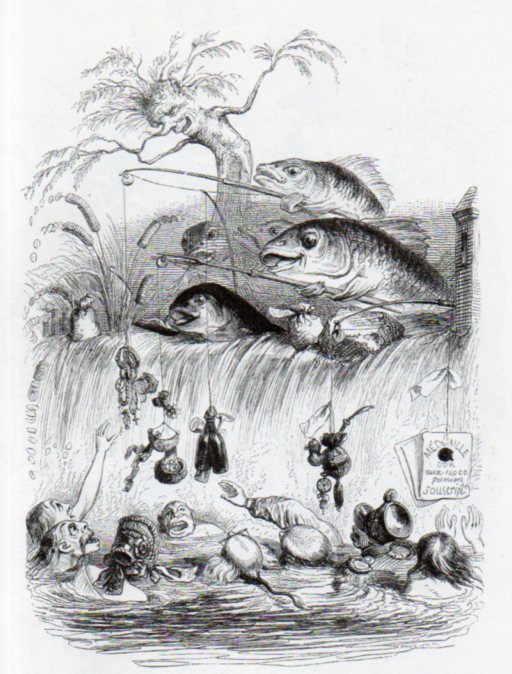
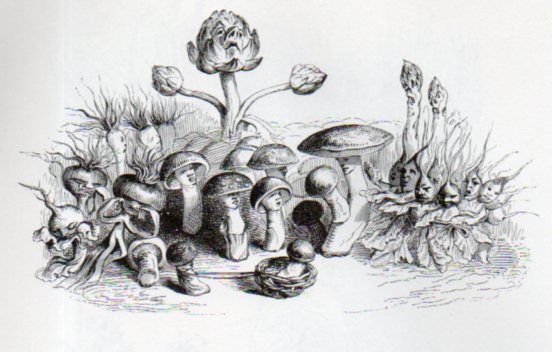
    I’ve remarked on this blog several times on the work of the fabulist proto-surrealist (etc.) J.J. Grandville (for example, here), and today I’d like to return again to his soaring Un Autre Monde (published in 1844) for the work he did in satirizing conventions by reversing their orders, presenting common entities in their “opposite”position. (Perhaps “opposite” is a too far reaching word, perhaps “contrary” is more appropriate in these cases–for now, either will do.)  And so:

    Fish are goaded (by what I thought was supposed to be a thistle) in their hunting pursuit, which was formerly known as “fishing” but in this case could be know as “humaning”.


    Opposite501

    To be eaten no more forever.  A revolt of edible plants takes place in Un Autre Monde, determined to rise and overcome their lethal oppressors, determined not to be killed and eaten as food again.  If there was a credible great creator of all things, it would seem that the most effective replacement system for expended energy would be something like photosynthesis and not the killing of other living things to sustain other forms of life. But so it goes here on Earth, with half of the biota eating the other half, with half of the being-eaten half being eaten alive. It just doesn’t seem to be a wise way to conduct the business of existence.

    Opposite502


  • Paper Brain Dissection II–1876

    JF Ptak Science Books  Quick Post

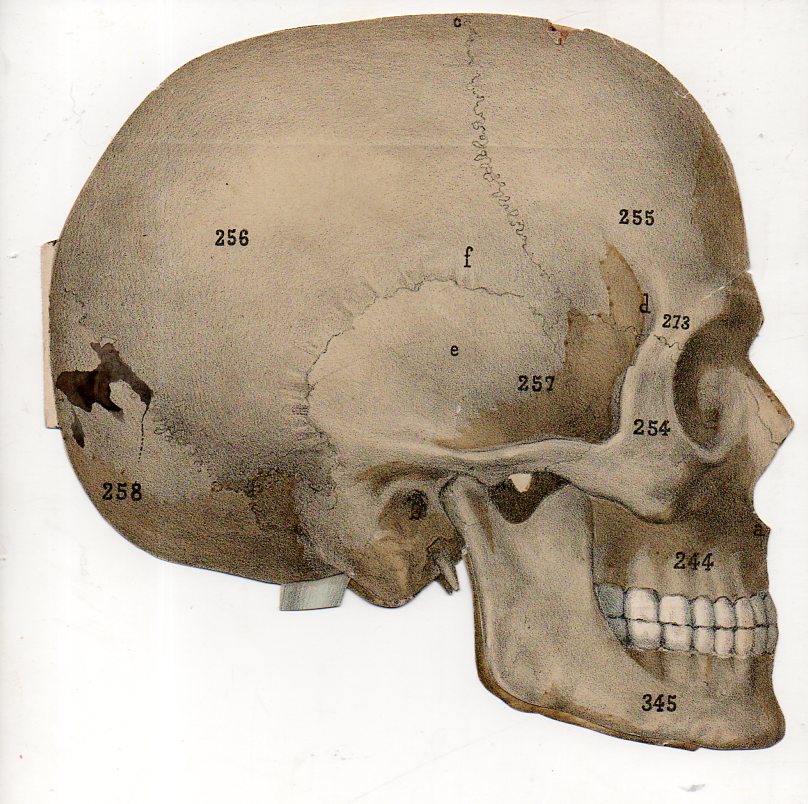
    Earlier in this blog I posted about a lateral dissection of the human brain accomplished via 150-year-old engravings.  The images below come from a series of atlases created by Gustave Joseph Witkowski (1844-1923) called Anatomie Iconoclastique, and include the one I have here on the skull and brain. I think that they are gorgeous works.  (The original, available at our blog bookstore, measures about ten inches at its widest). 

    Skull492

    ·Posted by :

    ·in:

    —

  • Appeasement, Hitler’s Promise, and Peace in our Time, 1938.

    JF Ptak Science Books    Post 1802

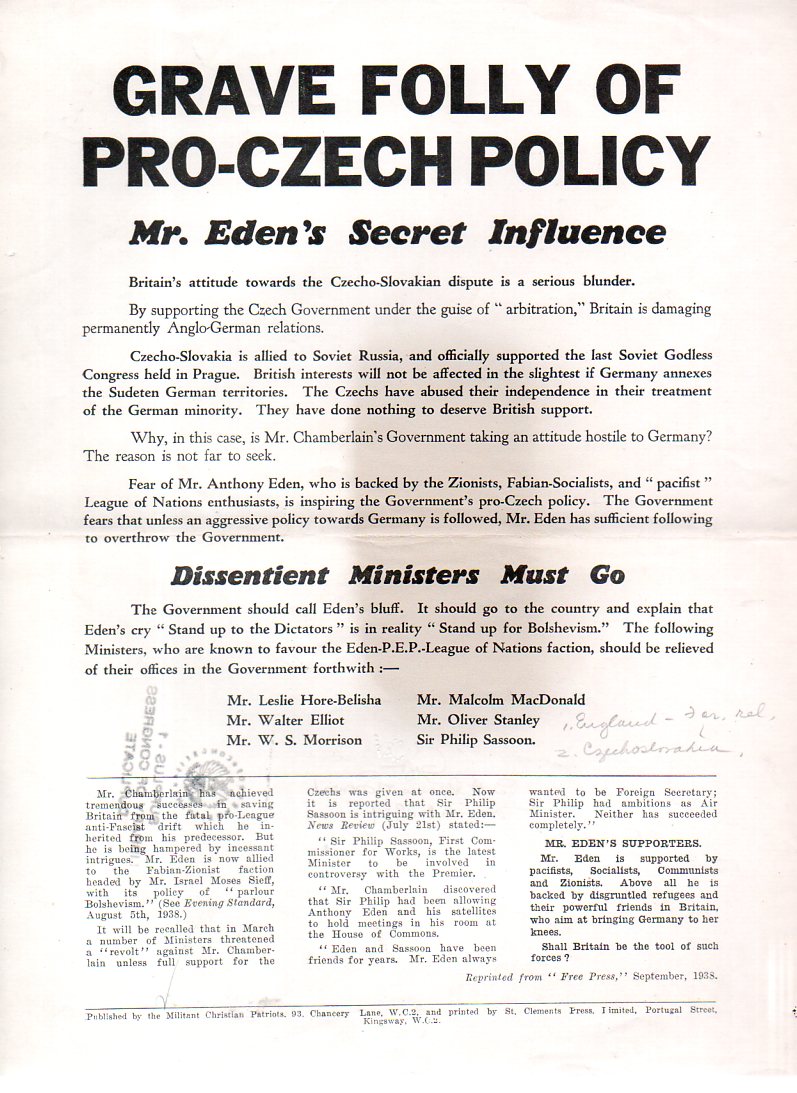
    Here’s a slathering piece of propaganda published by the Militant Christian Patriots (of London) on how the British government was dealing with the Nazi/Seudeten problem in September 1938.  In their gunsights was Anthony Eden, who was seen by this group as a Bolshevist supporter, and who as the Foreign Minister of the United Kingdom under Prime Minister Neville Chamberlain was against the appeasement policy of the government towards Nazi territorial acquisitions, particularly in this case with Czechoslovakia.  Eden. identified here as “backed by the Zionists, Fabian_Scoailists and “pacifist” League of Nations enthusiasts” was a multiple threat, and seen to be capable of directing national policy towards a confrontation with Germany over the looming Czech problem.
    Propaganda anti-czech491[The original is available from our blog bookstore.]
    On the other hand, Neville Chamberlain, who was the Prime Minister of the United Kingdom at this time (and from May 1938-May 1940), was seen as a better ideological fit with his issues and policies of appeasement of the German nationalist needs and territorial rape. Chamberlain certainly gave what Christian Militants wanted–a free hand to Hitler in Czechoslovakia (and more), and perhaps an acknowledgement of defeat to the Nazi nation.  Winston Churchill certainly thought so:

    “We have suffered a total and unmitigated defeat… you will find that in a period of time which may be measured by years, but may be measured by months, Czechoslovakia will be engulfed in the Nazi régime. We are in the presence of a disaster of the first magnitude…we have sustained a defeat without a war, the consequences of which will travel far with us along our road…we have passed an awful milestone in our history, when the whole equilibrium of Europe has been deranged…”  Winston Churchill, MP, 1938

    The Christian Militants saw it all differently, tending to agree with Hitler on the Czech matter, and seeking to keep the U.K. out of confrontation and thus away from war by giving Hitler (and then Mussolini) what they demanded to satisfy their growing national needs. 

    “I am asking neither that Germany be allowed to oppress three and a half million Frenchmen, nor am I asking that three and a half million Englishmen be placed at our mercy. Rather I am simply demanding that the oppression of three and a half million Germans in Czechoslovakia cease and that the inalienable right to self-determination take its place.” -Adolf Hitler’s speech at the NSDAP Congress 1938

    Eden resigned his position earlier in the year, in March 1938, but stayed in the fray.  As everyone knows things went badly at the end of the month of September, 1938, with Chamberlain letting everything go and appeasing Hitler in the Munich Conference (known to the Czechs as the “Munich Dictates” and worse) in which bits of Czechoslovakia were given to Germany in a series of meetings in which that country was not invited.

    A large crowd on an airfield; British Prime Minister Neville Chamberlain presents an assurance from German Chancellor Adolf Hitler.

    And so the P.M. returned to the home country having done nothing in Germany but give away a part of someone else’s country, all in a feeble attempt at maintaining peace for Europe’s key players.  He landed at Heston Aerodrome and held a piece of flimsy paper in his hand, which was battered by a tiny wind, and declared that there would be “peace in our time” because Hitler’s signature said it would be so, all of which was a “prelude to peace” in Europe as a whole:

    “My good friends, this is the second time there has come back from Germany to Downing Street peace with honour. I believe it is peace for our time. We thank you from the bottom of our hearts. Now I recommend you go home, and sleep quietly in your beds.”

    Less than a year later it would all come crashing down, the appeasement policy (such as it was) a shambles, and the world plunged into war.  Chamberlain would last as P.M. for a little longer, until May 1940, when he was at last replaced–by Winston Churchill. 

    ·Posted by :

    ·in:

    — — —

  • Too Busy for War: “Keep America Out of War”, WWII

    JF Ptak Science Books   Quick Post

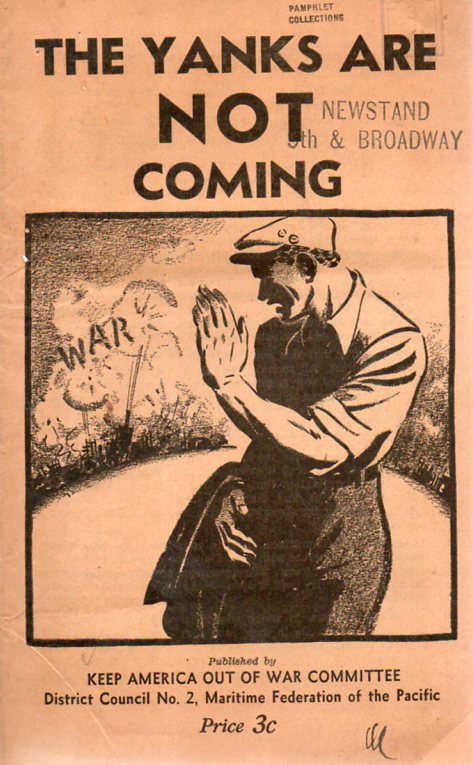
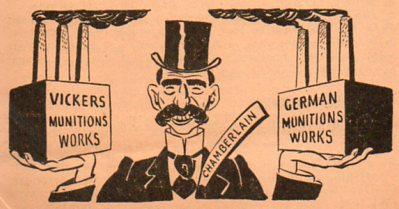
    This pamphlet is a reminder that it wasn’t simply right-wing groups (like the Lindbergh-sponsored “America First”) that sought to keep the United States out of the war in Europe in 1940.  It was a “European War” to these groups at this point–it was of course a World War, World War II, but it just didn’t involve the United States, yet.  The lefty “Keep America Out of War Committee” produced this vicious pamphlet, equating the war with the sole pursuits of “big business”, connecting the “filthy mess” of fighting to connected interest of Parliament and the Reichstag in producing a money-making scenario for the controllers of industry. 

    Anti-war no war484[The original is available from our blog bookstore.]

    Anti-war no war485
    Now there are plenty of ugly wartime relationships during WWII–and not just those that existed through December 1941, but were in place for the duration of the war.  But the arguments made in this pamphlet seemingly in support of the average working man protecting them from the multinational corporations who were conducting the war for the sake of profits takes the argument into an entirely different and bad place.  (“The best way we can help the people of Europe is to keep Wall Street out of it” claims the pseudonymous author, Mike Quinn.  Besides, as he continues in the section called “We’re Too Busy”: “We’ve got a first class job on our hands straightening out this civilization we have right here”.  Too busy for war.


    ·Posted by :

    ·in:


  • “The Enemy is Less than Ten Minutes from San Francisco”, 1942

    JF Ptak Science Books  Quick Post

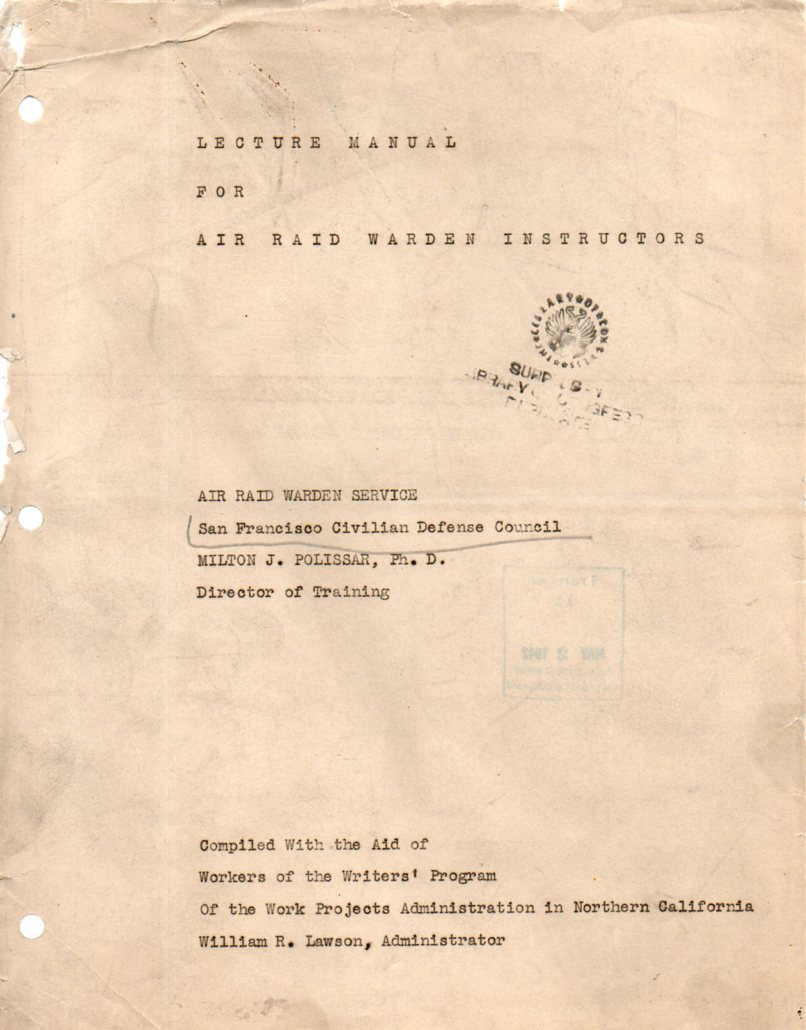
    Air warden478Lecture Manual for Air Raid Warden Instructors is in its way a remarkable document revealing some of the thinking and interpretation on the chances for the invasion of the American west coast just a few months (March 9, 1941) following Pearl Harbor.   Undertaken and published by the Workers of the Writers’ Program (‘of the Works Projects Administration in Northern California”) it was a product of one of the number of the Roosevelt administration’s social engineering programs that had a long lasting effect. 

    The first chapter, “It Can Happen Here” is more about the mechanics of responding to an enemy aerial attack than qu8estioning whether the attack might occur–the writer assumes that such an event was possible, and so precautions and preparations must be made–there is no question mark at the end of the chapter’s heading. 

    Overall I think that this was an excellent organizational effort for at least dealing with controlling the situation on the ground–providing a grid in which actions could be interpreted and responded to.  [The original is available at our blog bookstore.]


  • Antique Solutions of the Knight’s Tour, 1750

    JF Ptak Science Books    Quick Post

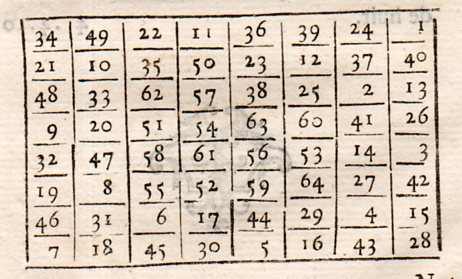
    Passing through a later and edited edition of Jacques Ozanam (RECREATIONS MATHEMATIQUES ET PHYSIQUES, Qui Contiennent Plusieurs Problemes d’Arithmetique, de Geometrie, de Musique, d’Oprique, de Gnomonique, de Cosmographie, de Mecanique, de Pyrotechnie, & de Physique. Avec un Traite des Horloges Elementaires. Nouvelle Edition, Revue, Corrigee & Augmentee… and published in Paris in 1749-1750) looking for possible expansions on what he wrote on the Knight’s Tour–a chess/math problem where the knight starting at, say, the center position must be moved to touch every square of the  board in 64 moves–I found this little diagram showing the spaces to which a knight may not move:

    It seemed just a little unusual to me–not being a reader of chess literature–to see what seemed the negative of the knight’s movements on a truncated board.  But I guess this is what we calculate and just not entirely “see” while playing. 

    The original problem in the 1672 edition of Ozanam’s Recreations  looks like this (and titled “faire parcourir au cavalier toutes les cases de l’echiquer”):

    Chess ozanam477

    in which the knight starts off life at the top right square (h8) and finishes at f3.  In the 1803 edition of the work it is pointed out that the knight can be started from any square and moved 64 times to accomplish this same feat. 

    Here are four further examples of solutions to the knight problem:

    And as they say, many more are available. 

    A more modern version of the solution, this on a 24×24 grid:

    File:Knightstour24x24.png


  • Found Surrealist Parabolic Art, 1905

    JF Ptak Science Books    Quick Post

    A continuation–of sorts–of “Earths Inside the Earth“, which is part of the History of Blank, Empty and Missing Things series.

    This wonderful bit of Found Surrealist artwork is part of a series of patent drawings by Sir Hiram Maxim, inventor of many things (including the Maxim Gun, which was the first portable fully automatic machine gun, but not the electric light bulb as he claimed, and many many other things) for a hollow spherical structure made to deceive, thrill and confuse the people inside the structure with parabolic mirrors. An amusement.  This is not out-of-keeping for Maxim, as he also designed a “Captive Device Flying Machine” for amusement parks that every kid today would recognize. 

    But I do like this drawing, the third of four for the patent application, and I guess it gives a pretty good approximation of what folks might see inside his amusement palace of combined optics and sensory confusion. 

    Here’s the cross-section of the structure:


    Which is a detail from the set of patent drawings for