A Daily History of Holes, Dots, Lines, Science, History, Math, Physics, Art, the Unintentional Absurd, Architecture, Maps, Data Visualization, Blank and Missing Things, and so on. |1.6 million words, 7500 images, 4.9 million hits| Press & appearances in The Times, Le Figaro, Mensa, The Economist, The Guardian, Discovery News, Slate, Le Monde, Sci American Blogs, Le Pont, and many other places… 5000+ total posts since 2008.

Author: JF Ptak

  • Atomic Aircraft, 1946-1961

    JF Ptak Science Books    Post 1810

    Shooting Down the Nuclear Plane,  by W. Henry Lambright, (Inter-University Case Program #104, Bobbs-Merrill Co., 1964), is an interesting and nicely-documented history of an idea whose firm grasp on reality night not be terribly firm.  Of course it would be possible to prodce such a thing (at about this same time in 1961 appeared a cover for Popular Mechanics for an atomic-powered car from which two cowboys went a-hunting) if there was the collective will to do so, and there almost was.  Let’s just say then that the atomic-poweredness of our domestic defense was limited to aircraft carriers and submarines, and the atomic-powererd aircraft were left to science fiction .

    In general though it was at this time, from  about 1946 thorugh the late 1950s’, that people were thinking of refitting standard power systems with atomic energy. 

    Here are a few ideas for alternative approaches to flight, provided by the happy folks known as Atomic Energy:

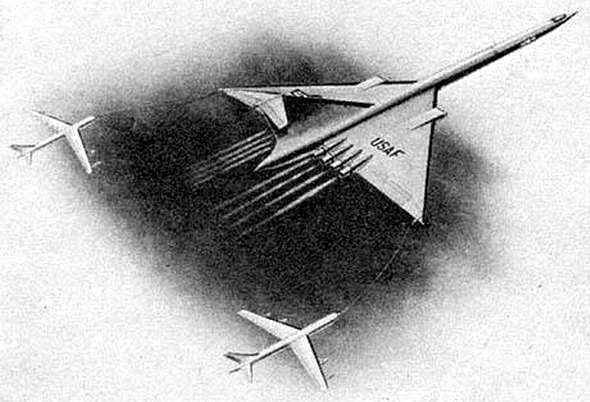
    Another possibility for a nculear powered aircraft, by Northrup:

    [Source]  Another interesting design–a nuclear-powered prop plane, X-6, “derived from the Corvair B-36”:


  • The Face of the Finished Foe: German POWs, 1918

    JF Ptak Science Books      Post 1809

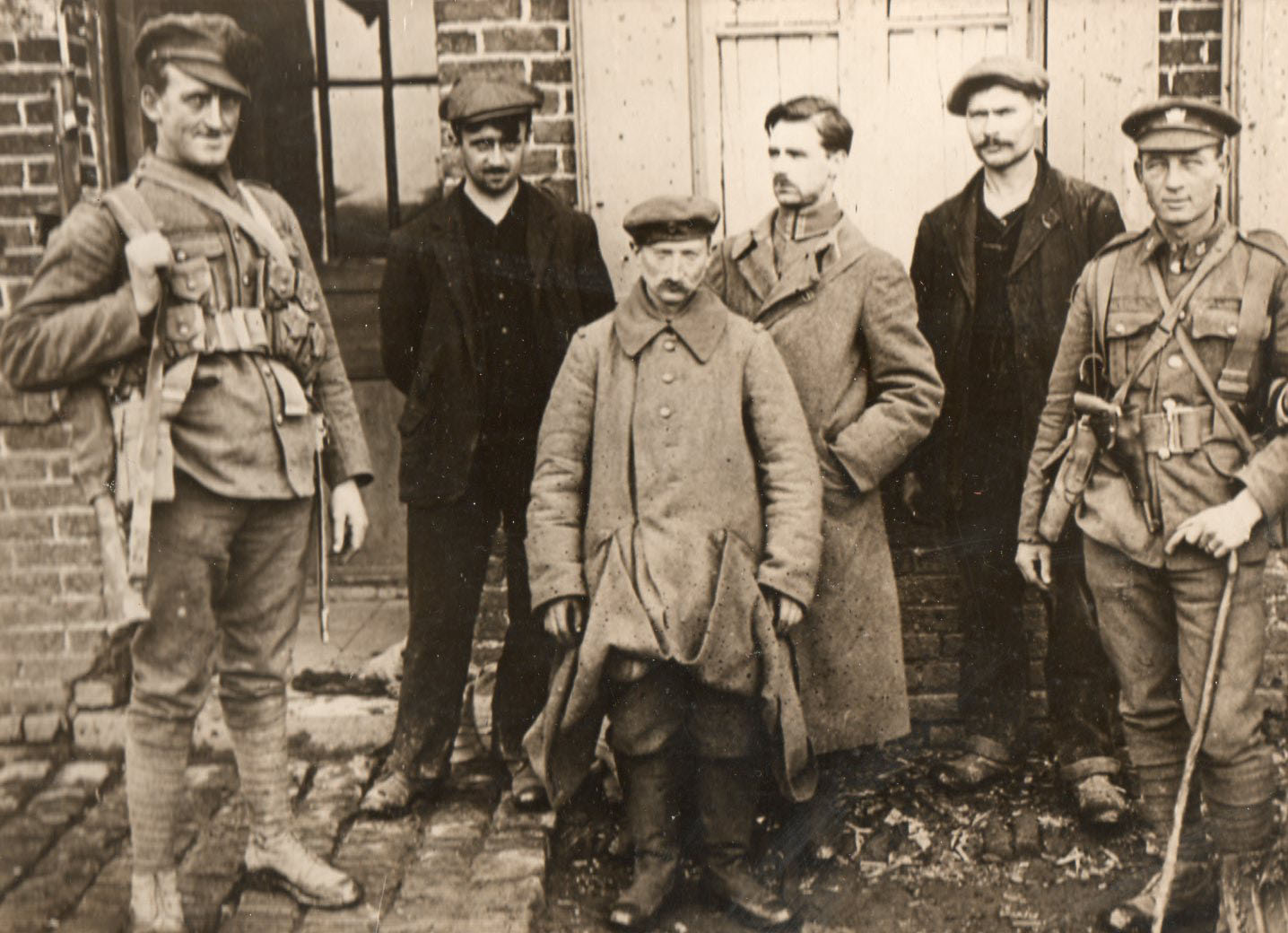
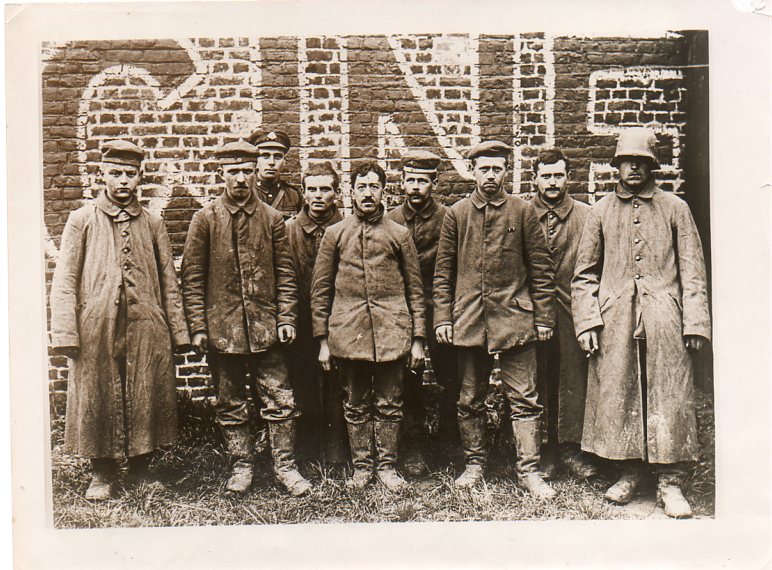
    I’ve written a number of times on this blog about WWI images, many of which are in my own collection of News Service Photo Group images, like the one just below, which can be found here. Many of them are remarkable, astonishing even–especially those relating to soldiers whose war has ended, finding them as prisoners of war.  At least they weren’t dead, like the dozens of millions of other soldiers.


    WWI photograph--german prisoners066

    (Original photograph available at our blog bookstore here.)

    I uncovered another of these images, tonight, long misplaced.

    WOrld War I Prisoners547[Image available from our blog bookstore, here.]

    There were over 8 million soldiers taken prisoner during WWI, that in addition to the 21 million who were wounded and the 9.7 million killed:  38 million.  Plus 6.8 million civilians who were killed: 45 million.  And the numbers for civilians wounded are just, well, not reliable, as they were not really collected, or collectible.  At the end of it all, there were probably between 50 to 75 million soldiers and civilians killed or wounded or taken captive during the war…not including civilians who were killed by the hardships or starvation caused by the conflict.  Big, big numbers.

    Some of these soldiers were taken in entire armies, surrenders of hundreds of thousands; and some came in pairs, or singles, as in the photo above.  There are two captured Germans here, the two men in the middle, who are flanked by a British soldier and (I think) a Canadian officer, with two locals in the background.  The short man front-and-center was paraded no doubt for his propaganda value–certainly not five feet tall, slender, with a tiny, not-average face.  The Tommy is certainly enjoying the situation, while the officer maintains composure. 

    I’m sure the photo could’ve been made by any photographer for any army at any time.

    The photograph was made in 1918, a few months before the end of the war, but there was still fighting to be done, and the value of showing the the British and Allied publics the “face” of a now-wilting enemy must have been considerable.  There was considerable control and tightness over the sort of images allowed to be produced and published coming from the front line, photographs being made by a “pool” of news photographers the contents of which were closely evaluated by military censors before being allowed to circulate to newspapers and magazines.

    ·Posted by :

    ·in:

    — —

  • Fitzcarraldo Deux: on France’s Monumental Overland Ship Railway, at the Break of Doom

    JF Ptak Science Books    Post 1808 

    Ship overland537
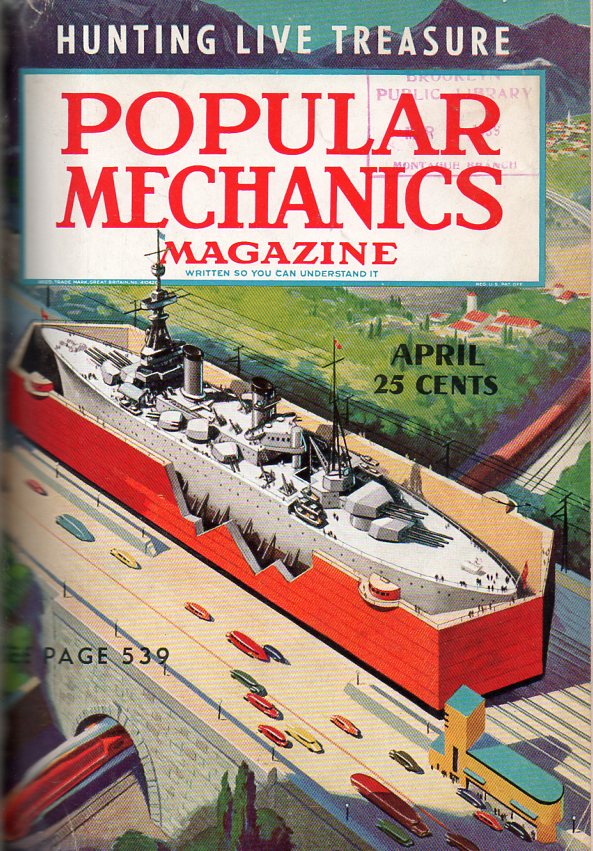
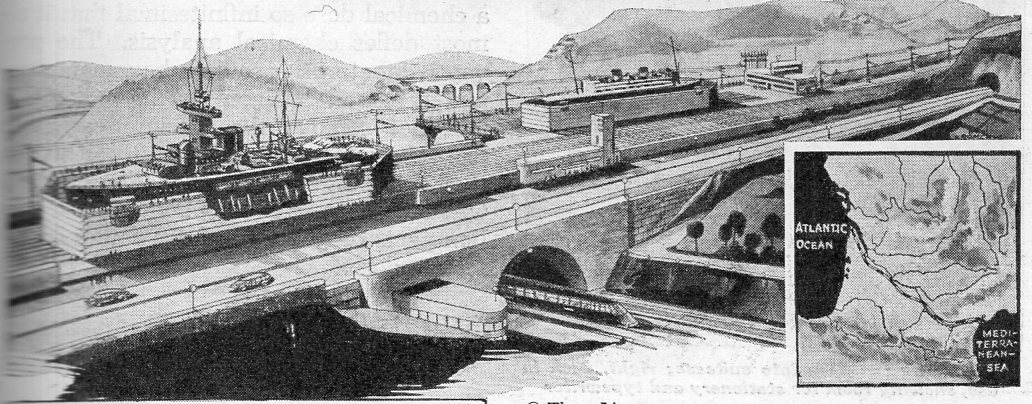
    This fantastic cover appeared in Popular Mechanics, volume 71, and showed a devotion to a monumental idea of dragging enormous ships by rail from the Atlantic Ocean to the Mediterranean Sea.  It was to be 300 miles long, and what looks like 125′ wide, connecting Port le Verdon and Beziers, putting down the 1,200-mile Bay of Biscaye/Gibraltar/Mediterranean route.

    It puts me in the mind of ponderable (and not impossible) colossi, some of which I wrote about in a short post on Werner Herzog’s film Fitzcarraldo. (It is a spill-over big, magnificent film about a would-be ice-making rubber baron bringing an opera house into the trans-Andes, trying to make his way into the dense forest in a huge rear-paddle steamboat on the Amazon to stake a claim in exploiting leased lands filled with rubber trees. See here.)

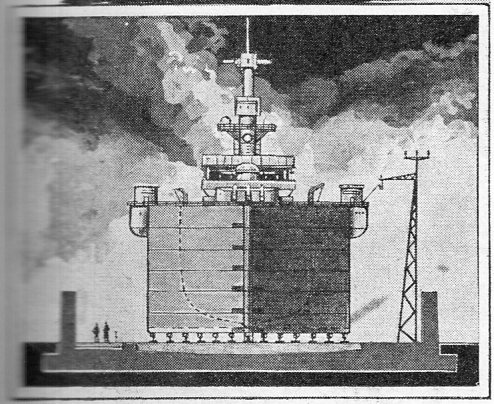
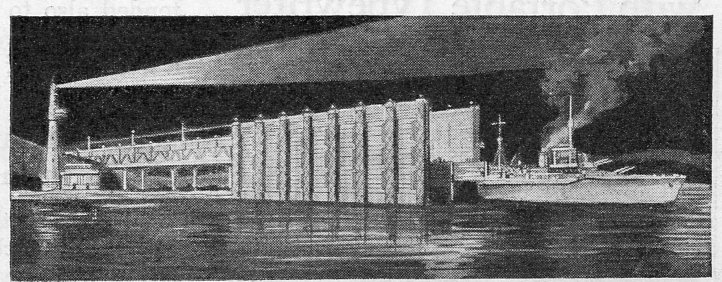
    The spirit of peace was nearly gone in Europe at this time, and the railroad line was to be guarded at 1000′-foot or so intervals by balloons which would suspend a steel net, protecting it from aerial attack.

    Ship overland540

    In one year’s time this would all be shrinkingly academic, a microbe in the plans for a greater France.  This issue was printed in June, 1939, three months away from the official start of the Second World War.  France would be attacked by Germany on 10 May, 1940, and an armistice would be signed with the aggressor five weeks later. 

    Ship overland538
    It is a little painful to look at the color image from the cover, with an enormous battleship hosted within a turreted mobile structure perhaps 100′ wide, lumbering along on eight sets of railroad lines.  Not only that, but this absolutely enormous mobile situation was crossing over another railroad, atop a very, very substantial stone bridge. 

    Ship overland539

    And as I said, a year later, France was conquered, and another Maginot Line was never built.


  • Inventing Nothing: a Lovely Little Cipher, by Lewis Carroll

    JF Ptak Science Books      Post 1807     Part of the series   The History of Blank, Empty and Missing Things
    Carroll cipher536
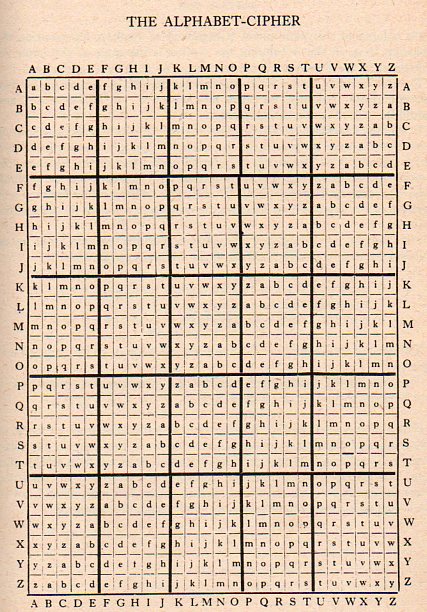
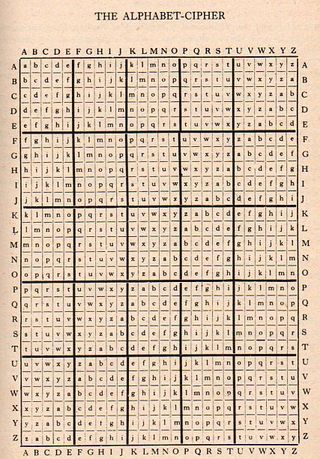
    Lewis Carroll created a lovely, simple cipher in the midst of his Alice and Snark and Logic and Sylvie publications.  It really is just a simple bit of polyalphabetic substitution, bu tit gets the job done.  (Many others have walked this royal road:  Leon Battista Alberti, A Treatise on Ciphers, [De componendis cyfris];  Giovan Battista Belaso, La cifra del Sig. Giovan Battista Bel[l]aso, gentil’huomo bresciano, nuovamente da lui medesimo ridotta à grandissima brevità et perfettione, Venetia 1553 (and also his Novi et singolari modi di cifrare de l’eccellente dottore di legge Messer Giouan Battista Bellaso nobile bresciano, Lodovico Britannico, Brescia 1555); Giombatista Della Porta, De furtivis literarum notis vulgo de ziferis, G. M. Scoto, Neapoli 1563; Galileo Galilei, Intorno a due nuove scienze, Opere, . Vol. VIII, Firenze; Blaise de Vgenere, Traicté des chiffres ou secrètes manières d’escrire, Abel l’Angelier, Paris, 1586; and so on…its a very wide literature, even pre-18th century).  Louis Carroll. Louis “Cipher” Carroll.  Comes sort of goofily close to “Louis Cipher”. Lucifer. Not the case, of course unless you were trying to figure out one of his tricky puzzles.

    Perhaps it is the cipher’s presentation and design and simplicity, its elegance, that I like so much.  It reminds me in some ways of the Henry Holiday masterpiece of nothignness created for Carroll’s Hunting of the Snark–and that of course would be the Bellman’s map, a map of nothing, a map showing nothing at all to the sailors who must follow it and who were all happy that the map had nothing to obstruct their vision of possibility and blank expectation. (I wrote about that in The Most Beautiful Map in the World, here). It is interesting to note that none of the illustrators who followed Holiday chose to illustrate the nothing map with such nothingness as in Carroll–there would be hands on it, or the map would be oblique, or not the central image of the illustration.  Holiday’s map was just that–straightforward, simple, strong).

    I’ve decided to make this a part of the History of Blank, Empty and Missing Things series simply because everything is missing unless you have the missing key–here you have all the parts of the puzzle, and then some, everything that you need to solve it, save for the integral part of ordering.

    From Carrolls’s text:

    Explanation

    Each column of this table forms a dictionary of symbols representing the alphabet: thus, in the A column, the symbol is the same as the letter represented; in the B column, A is represented by B, B by C, and so on.

    To use the table, some word or sentence should be agreed on by two correspondents. This may be called the ‘key-word’, or ‘key-sentence’, and should be carried in the memory only.

    In sending a message, write the key-word over it, letter for letter, repeating it as often as may be necessary: the letters of the key-word will indicate which column is to be used in translating each letter of the message, the symbols for which should be written underneath: then copy out the symbols only, and destroy the first paper. It will now be impossible for any one, ignorant of the key-word, to decipher the message, even with the help of the table.

    For example, let the key-word be vigilance, and the message ‘meet me on Tuesday evening at seven’, the first paper will read as follows—

    v i g i l a n c e v i g i l a n c e v i g i l a n c e v i
    m e e t m e o n t u e s d a y e v e n i n g a t s e v e n
    h m k b x e b p x p m y l l y r x i i q t o l t f g z z v
    

    The second will contain only ‘h m k b x e b p x p m y l l y r x i i q t o l t f g z z v’.

    The receiver of the message can, by the same process, retranslate it into English.

    If this table is lost, it can easily be written out from memory, by observing that the first symbol in each column is the same as the letter naming the column, and that they are continued downwards in alphabetical order. It would only be necessary to write out the particular columns required by the key-word, but such a paper would afford an adversary the means for discovering the key-word.

  • Annalen der Physik (1799–Present): Useful, Searchable, Full-Text Sites.

    JF Ptak Science Books   Quick Post

    I just  posted this as a “page” (in the left-hand column) and thought to distribute the move by carrying it as a quick post on the daily side of this blog.  It seems to me that between these four links that there is some very good, easily-governable access now to the Great and Fabulous Annalen der Physik, one of the great physics journals in the history of science.  There are some full-text sites available with good search engines, as well as a link to a site that smooths out the occasionally cumbersome way in which Annalen volumes have been referenced. 
    I can safely say–after having staggered my way through hundreds of volumes of the Annalen–that these links represent to me the easiest ways thus far of navigating the massive journal. It makes using the Annalen a pleasure far more than a challenge, which it always seemed to be to me, even working at it with the (scarce!) index volumes. 
    http://de.wikisource.org/wiki/Annalen_der_Physik//at Wikisource, via ANNALEN DER PHYSIK

    http://upload.wikimedia.org/wikipedia/de/4/4f/Annalen_der_physik_Titelblatt_1900_Drude_Band_306.gif

    Annalen der Physik Annalen der Physik (Wiley-VCH) [Journal Page]
    Annalen der Physik Annalen der Physik [Wikisource Page]This offers a key for corresponding overall volume numbers with series/folge volume numbers. AND has a full text hyperlink set.
    Annalen der Physik Annalen der Physik [Gallica Page]
    Annalen der Physik Annalen der Physik [Welt der Physik Page]

    And just for the heck of it, Einstein in the Annalen, available on this blog here.

    For my history of physics readers who work with the Annalen der Physik I reproduce a useful little key to the two-tier numbering system for the Annalen‘s first and second series.  The tables come from Sachregister zu den Annalen der Physik und Chemie Poggendorr’sche Folge… published in Leipzig in 1888.  Up to this point the physics journal had been published since 1799 in two series for a total of 160 volumes (plus a Jubelband and eight volumes of Erganzungsbaende); some people reference the appearance of articles via the total volume number, while others (myself included) reference the series (as  series “I volume whatever” or series “II, volume _____”.  There is a handy table at the very end of the Sachregister that correlates the two “systems”. 

    ·Posted by :

    ·in:


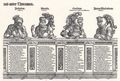
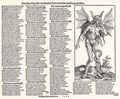
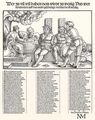
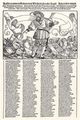
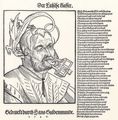
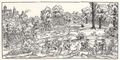
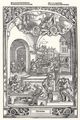
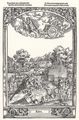
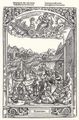
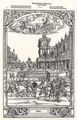
  • Selections of the Work of Renaissance Artist, Georg Pencz

    JF Ptak Science Books   Quick Post

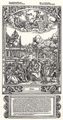
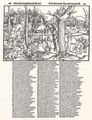
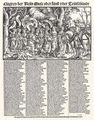
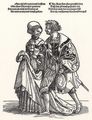
    Some of the work of Georg Pencz (who I wrote about last week, regarding the representations of the zodiac) from the website Zeno.org.

    Each image is expandable.

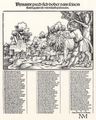
    Pencz, Georg: Ehrenpforte der 12 sieghaften Helden des Alten Testaments«, 1. Blatt
    Ehrenpforte der 12 sieghaften Helden des Alten …
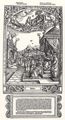
    Pencz, Georg: Ehrenpforte der 12 sieghaften Helden des Alten Testaments, 2. Blatt
    Ehrenpforte der 12 sieghaften Helden des Alten Testaments, …
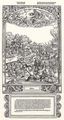
    Pencz, Georg: Ehrenpforte der 12 sieghaften Helden des Alten Testaments, 3. Blatt
    Ehrenpforte der 12 sieghaften Helden des Alten Testaments, …
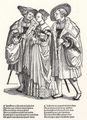
    Pencz, Georg: Braut zwischen den beiden Brautführern
    Braut zwischen den beiden Brautführern
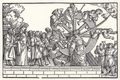
    Pencz, Georg: Das Glücksrad
    Das Glücksrad
    Pencz, Georg: Der Neid mit seinen 12 Eigenschaften
    Der Neid mit seinen 12 Eigenschaften
    Pencz, Georg: Der Neidische und Geizige
    Der Neidische und Geizige
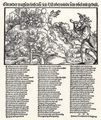
    Pencz, Georg: Der Niemand
    Der Niemand
    Pencz, Georg: Der Verleumder
    Der Verleumder
    Pencz, Georg: Diana und Actaeon
    Diana und Actaeon
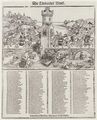
    Pencz, Georg: Die Ehebrecherbrücke Königs Artus
    Die Ehebrecherbrücke Königs Artus
    Pencz, Georg: Die Hasen und die Frösche
    Die Hasen und die Frösche
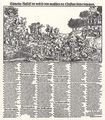
    Pencz, Georg: Die sieben Hindernisse des Christussuchers
    Die sieben Hindernisse des Christussuchers
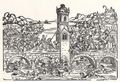
    Pencz, Georg: Ehebrecherbrücke
    Ehebrecherbrücke
    Pencz, Georg: Esel in der Löwenhaut
    Esel in der Löwenhaut
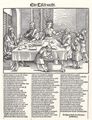
    Pencz, Georg: Familie bei Tische
    Familie bei Tische
    Pencz, Georg: Folge der »Planetenbilder«, Jupiter
    Folge der »Planetenbilder«, Jupiter
    Pencz, Georg: Folge der »Planetenbilder«, Mars
    Folge der »Planetenbilder«, Mars
    Pencz, Georg: Folge der »Planetenbilder«, Merkur
    Folge der »Planetenbilder«, Merkur
    Pencz, Georg: Folge der »Planetenbilder«, Mond
    Folge der »Planetenbilder«, Mond
    Pencz, Georg: Folge der »Planetenbilder«, Saturn
    Folge der »Planetenbilder«, Saturn
    Pencz, Georg: Folge der »Planetenbilder«, Sonne
    Folge der »Planetenbilder«, Sonne
    Pencz, Georg: Folge der »Planetenbilder«, Venus
    Folge der »Planetenbilder«, Venus
    Pencz, Georg: Gerücht
    Gerücht
    Pencz, Georg: Geschichte vom Hirten und dem Wolf
    Geschichte vom Hirten und dem Wolf
    Pencz, Georg: Hasen fangen die Jäger
    Hasen fangen die Jäger
    Pencz, Georg: Klage der Musen
    Klage der Musen
    Pencz, Georg: Paar aus dem Hochzeitszug
    Paar aus dem Hochzeitszug
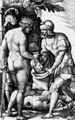
    Pencz, Georg: Thomyris mit dem Kopf des Cyrus
    Thomyris mit dem Kopf des Cyrus
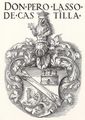
    Pencz, Georg: Wappen des Don Pero Lasso
    Wappen des Don Pero Lasso
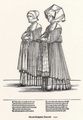
    Pencz, Georg: Zwei Zuschauerinnen des Brautzuges
    Zwei Zuschauerinnen des Brautzuges
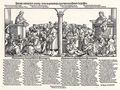
    Pencz, Georg: Zweierlei Predigten

    ·Posted by :

    ·in:

    —

  • An Interesting Concentric Graphic and the Number 12 (Twelve XII 2^3X3)

    JF Ptak Science Books   Post 1819

    Oh TIme, thou must untangle this, not I; it is too hard a knot for me t’untie! — Twelfth Night. 2.2.40-41

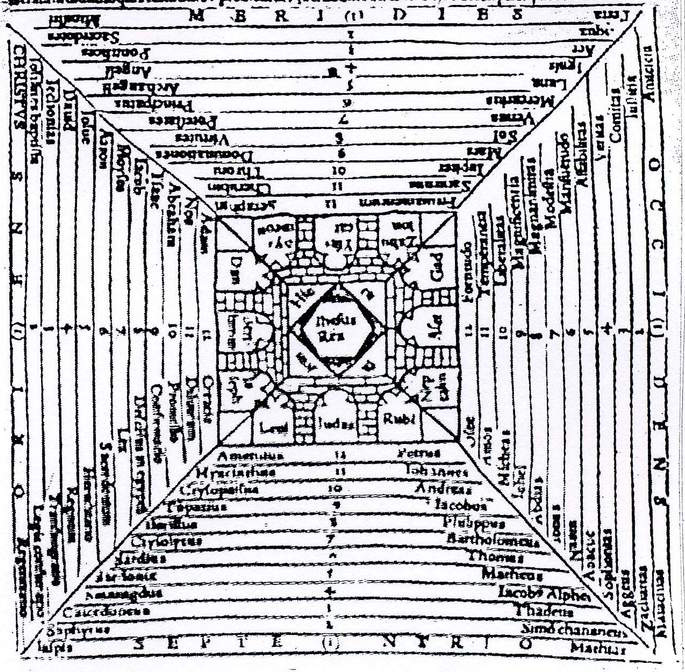
    Graphic bouvelles
    I really should have included this in yesterday’s post about a terrific and creative image of concentric circles used early-on to display concepts of terrestrial distance and importance (A Table of the Cheifest Cities and Towns in England, printed in London in 1600,  ), as they both use this organizing concept in a bit of an uncommon way.  This image appears in  Charles de Bouelles’ beautifully titled Que hoc volumine continuentur; Liber de intellectu; Liber de sensu; Liber de Nichilo; Ars oppositorum; Liber de generatione; Liber de sapiente; Liber de duodecim numeris; Epistole complures, and printed in 1510 in Paris (from which also appears another interesting image on the “evolution” of the rock from being to thinking to being again, here), and maps the importance of the city of Jerusalem, but more importantly places its significance in the histories of the number twelve, centering on the city itself and the twelve tribes of Iraeli, and then branching out in more creative listable ways.

    Besides the twelve tribes, there are the twelve constellations of the ecliptic, Apostles, knights of the Round Table, trials of Hercules, Olympians, sons of Odin, books of Paradise Lost and the Aeneid, hues of the color wheel, inches, months, dozen, virtues, Olympians, half unit of the day, and on and on. 

    There are twelves enough to carry out just about any iconographic need, and that limited to just occidental resources.

    Source:  Les Pierres du Songe, Etudes sur les graffiti medievans, here.


  • Dorothea Lange–FSA Photographs at the Library of Congress Site

    JF Ptak Science Books    Post 1806  

    Found below is a selection of photographic images from the Farm Security Administration collection at the Library of Congress.  Today’s photographer:  Dorothea Lange.

    On of the great innovations in a sea of great things accomplished during the Franklin Roosevelt administrations was the formation of the Farm Security Administration, a division of the government established to help farmers through the devastating Dust Bowl and Great Depression.  A subset of the FSA was a photographic unit which was set up to document the progress made by the FSA (and provide, I am sure, for some much-needed good news, a hearts-and-minds campaign).  This division was headed by Roy Emerson Stryker, who wound up hiring a collection of dream-team photographers unlike any ever assembled for a single purpose.  Esther Bubley, Marjory Collins, Mary Post Wolcott, Arthur Rothstein, Walker Evans, Russell Lee, Jack Delano, Gordon Parks, Charlotte Brooks, John Vachon, Carl Mydans, Dorothea Lange and Ben Shahn were sent out all across the country and wound up with the greatest and most beautiful photographic history ever assembled in the United States.  There were about 77,000 images made, and I recall reading (somewhere) that the total budget for the Stryker group for the years 1936-1942 was about $100,000, meaning that each completed image cost just over a dollar apiece. So far as art funding by the government is concerned, that about the best it has done.

    [Listed below are some samples of Lange’s work at the LC–there are more than 3,000 images by her in the collection, found here.  All images below are also expandable.]

    Note:  occassionally found among these images are those with a black dot in the center.  That was the editorial work of Mr. Stryker, who for some reason hole-punched images that he thought weren’t quite up to snuff, or unacceptable for some reason.  In this ruination he also decided to archive them, which means if he was keeping them anyway he might as well have not plugged them, keeping them whole and intact and in their own pile. Anyway, that is what the black dot is all about.

    Lange--migrant

    digitized item thumbnail digitized item thumbnail digitized item thumbnail digitized item thumbnail digitized item thumbnail digitized item thumbnail digitized item thumbnail digitized item thumbnail digitized item thumbnail digitized item thumbnail
    digitized item thumbnail digitized item thumbnail digitized item thumbnail digitized item thumbnail digitized item thumbnail digitized item thumbnail digitized item thumbnail digitized item thumbnail digitized item thumbnail digitized item thumbnail
    digitized item thumbnail digitized item thumbnail digitized item thumbnail digitized item thumbnail digitized item thumbnail digitized item thumbnail digitized item thumbnail digitized item thumbnail digitized item thumbnail digitized item thumbnail
    digitized item thumbnail digitized item thumbnail digitized item thumbnail digitized item thumbnail digitized item thumbnail digitized item thumbnail digitized item thumbnail digitized item thumbnail digitized item thumbnail digitized item thumbnail
    digitized item thumbnail digitized item thumbnail digitized item thumbnail digitized item thumbnail digitized item thumbnail digitized item thumbnail digitized item thumbnail digitized item thumbnail digitized item thumbnail digitized item thumbnail
    digitized item thumbnail digitized item thumbnail digitized item thumbnail digitized item thumbnail digitized item thumbnail digitized item thumbnail item not digitized thumbnail digitized item thumbnail digitized item thumbnail digitized item thumbnail
    digitized item thumbnail digitized item thumbnail digitized item thumbnail digitized item thumbnail digitized item thumbnail digitized item thumbnail digitized item thumbnail item not digitized thumbnail digitized item thumbnail digitized item thumbnail
    digitized item thumbnail digitized item thumbnail item not digitized thumbnail digitized item thumbnail digitized item thumbnail digitized item thumbnail digitized item thumbnail digitized item thumbnail digitized item thumbnail digitized item thumbnail
    digitized item thumbnail digitized item thumbnail digitized item thumbnail digitized item thumbnail digitized item thumbnail digitized item thumbnail digitized item thumbnail digitized item thumbnail digitized item thumbnail digitized item thumbnail
    digitized item thumbnail digitized item thumbnail digitized item thumbnail digitized item thumbnail digitized item thumbnail digitized item thumbnail digitized item thumbnail digitized item thumbnail digitized item thumbnail digitized item thumbnail

    ·Posted by :

    ·in:

    —

  • Some Very Big, Sky-High Airborne Thinking, pre-WWII.

    JF Ptak Science Books  Post 1807   [Part of the History of the Future series]

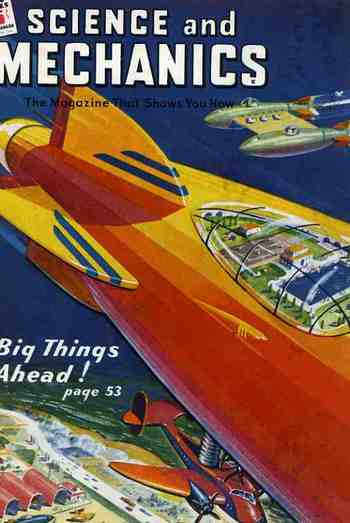
    Blogaugust_16bigflying_wing_detail3Once upon a time, engineers could do anything, especially in the first third or so of the 20th (American) century. The hopes for technological superstar were often on display in popular and illustrated magazines, though much of the times the dreams were more dreamy than they were engineering possibilities.   Some of my favorites among these hopeful projections of the future involve Big Thinking, and floating above these images of great possibilities and reluctant possibilities are thoughts on flight and of luxurious flight, or perhaps even continuous-flight-living. These three images were covers on some of the most popular of the popular sci-tech mags for this period:    Science and Mechanics, Popular Mechanics, and Popular Science Monthly. 
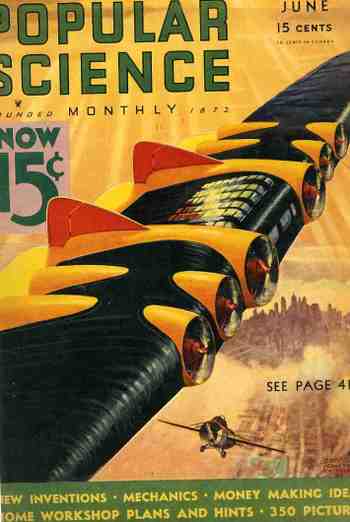
    Blogaugust_16bigflying_wing395

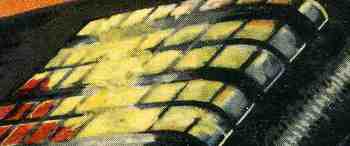
    All three of these examples show (in insets) some sort of large, encapsulated, living section that exists somewhere in the superstructure of the aircraft. The first example comes from Popular Science (15 June 1937), and depicts what I think is a large living area under a grid of 54 large glassy roofs—it is not possible for me to estimate the proportions of the craft, though I think it pales in comparison to the next two examples.

    Blogaugust_16bigflying_dirigible399

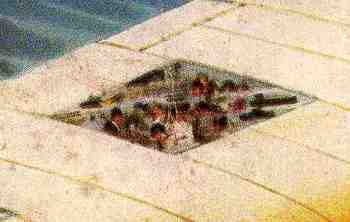
    In both instances the encapsulated areas have trees and roads. In the case of the Science and Mechanics contribution there seems to be six (?) of these large enclosures, the detail of which shows a large swimming pool, a club house, two tennis courts, and some other sporting area, all of which are surrounded by trees. Multiply this structure by six and what you’ve got is one really really big aircraft, which is somehow jet/atomic powered–in any event it is a gigantic craft and it is somehow staying aloft.

    Blogaugust_16bigflying_wing_wite_de


  • The NCC-1701, 1930: the pre-Starship Enterprise

    JF Ptak Science Books   Quick Post

    Uture plane519

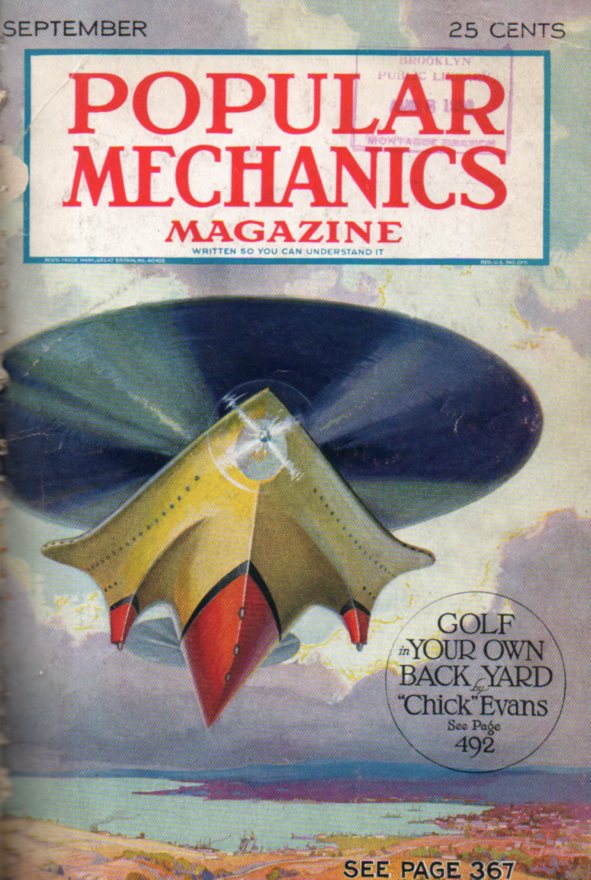
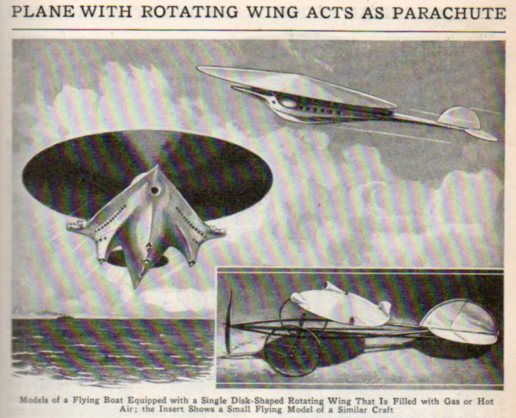
    Well, what is really was, or what this was intended to be in this memory of a possible aviation future–or naval future, as this airship was really a flying boat, an “amphibian, a dirigible, a gyrocopter ….an airplane”.   A ship, really, trying to judge the size of the thing by the position of the portholes/windows–the thing was big, and the “single wing, rotating disk-shaped affair filled with gas or hot air” was even bigger.   We read here that the disk was “turned by a gasoline engine” which was located in the center of the ship, leaving still plenty of room for “quarters” for the crew and passengers, making for what the inventor thought was an easy ascent and then, using the lifting device as a parachute, and then having a parachute-y descent, soft and simple.

    Its hard to judge the size of the machine, but it looks like there are 40-50 portholes or windows running the length of the ship, and so I’d guess that the fuselage of the craft was 150 feet long, which was about half of its overall length, making it about 300 feet overall.  The disk then could be 150-200 feet in diameter, giving it an area of close to one acre.  Big. 

    And so:

    Uture plane520