A Daily History of Holes, Dots, Lines, Science, History, Math, Physics, Art, the Unintentional Absurd, Architecture, Maps, Data Visualization, Blank and Missing Things, and so on. |1.6 million words, 7500 images, 4.9 million hits| Press & appearances in The Times, Le Figaro, Mensa, The Economist, The Guardian, Discovery News, Slate, Le Monde, Sci American Blogs, Le Pont, and many other places… 5000+ total posts since 2008.

Author: JF Ptak

  • On Seeing Things Backwards Series, 1: UNIVAC and the 1952 Election

    JF Ptak Science Books   Post 1917
    Univac-cronkite
    Leonardo wrote backwards and from right to left, Benjamin Button lived backwards at the hands of Scott Fitzgerald, Rene Magritte’s man in the bowler saw the back of his head, Herrimann’s Ignatz the Mouse I am sure saw the back of his head looking around the world with the world’s most powerful telescope, rugby passes are all done backwards, paper images of vue optiques appear backwards, lightning for all intents and purposes starts backwards from the ground up, reverse mathematics are worked from theorems to axioms, and the Chicago River (1900) was engineered to flow backwards for the foreseeable future, while the Mississippi River famously flowed backwards for just a bit in the New Madrid Earthquake of 1812. 

    I can only imagine what audiences must have felt when they saw the first moving pictures played backwards–seeing them played forwards was a novel-enough (and revolutionary) idea, but the simple idea of reversing the direction of the film would have proved to be equally fascinating. 

    Imagine the first time you witnessed a staged train wreck on film, back there in 1897, and imagine being able to see it played over and over again, until you were filled.  I’m not so sure that there were even any still photographs of a train wreck as it occurred to this point, even with advances in film speed and lens, so seeing the even unfold in front of you at leisure must have been overwhelming.  Now imagine these same folks seeing the event and watching the locomotives reconstitute themselves.  It would have been an extraordinary event.  Even observing the Etienne Marey sequences and seeing what actually happens when a person bends over to pick up a pail of water would have revealed almost as much in new detail as when Galileo was in the middle of his earliest observations. 

    Looking at things backwards is a good idea so far as thinking about engineering problems and of course in checking experimental results in the sciences–its not so good an idea though to change the results produced by the scientific method because they’re not a good intuitive fit to expected parameters.

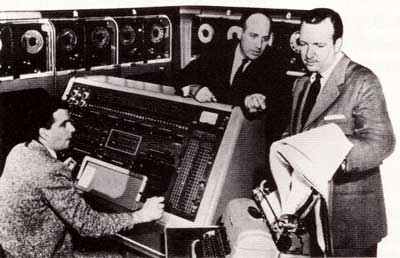
    Such was the cased with the first (and successful) employment of a computer to predict the outcome of a presidential election.  THe computer was the UNIVAC (the world’s first commercial computer and a blazingly fast machine at 10k operations a second, nearly six orders of magnitude lower than “superfast” by contemporary standards), which was brought in by Remington Rand to CBS News to crunch the numbers on the tight race between General Dwight Eisenhower and Gov. Adlai Stevenson (II) on 4 November 1952.  (Stevenson was the son of a former U.S. Vice President and would run again against Eisenhower in 1956.) Pioneers Pres Eckert and John Mauchley, along with Max Woodbury (and programmer Harold Sweeney, who is seated at the UNIVAC’s control panel and who seems never to be mentioned in the iconic photo at top, with Eckert at center and anchorman Walter Cronkite at left).   CBS News Chief Sig Mickelson and Cronkite were not comfortable with the proposal, but ran with it anyway, sensing a moment of the-future-is-now.

    The Eisenhower/Stevenson race was seen by the large majority of pundits to be too close to call, so when the UNIVAC’s results pointed to a landslide for Eisenhower (438 electoral votes and 43 states to Stevenson with 93 electoral votes and 5 states) folks got very sweaty and nervous, not trusting the outcome. As this was still a very early age in human-machine interaction, and the computed results fell far away from perception and expected response, changes were made in the UNIVAC’s programming to determine a more “reasonable” response by the machine, the new results making the race very tight and fitting human expectations and giving Eisenhower a very slim margin of victory.  As poll results started to sweep in an hour or so later indicating that Eisenhower was showing with a huge victory, the UNIVAC was again reprogrammed and at about midnight the announcement was made that the UNIVAC had indeed been correct in the first place.  The final results were 442 electoral votes for Eisenhower and 89 for Stevenson.  In the next presidential election in 1956 the three networks all had computers working for them–with them–and a different perception had been formed on working with computers. 

  • Big Shadows–Industrial Silhouettescapes, 1936

    JF Ptak Science Books    Quick Post

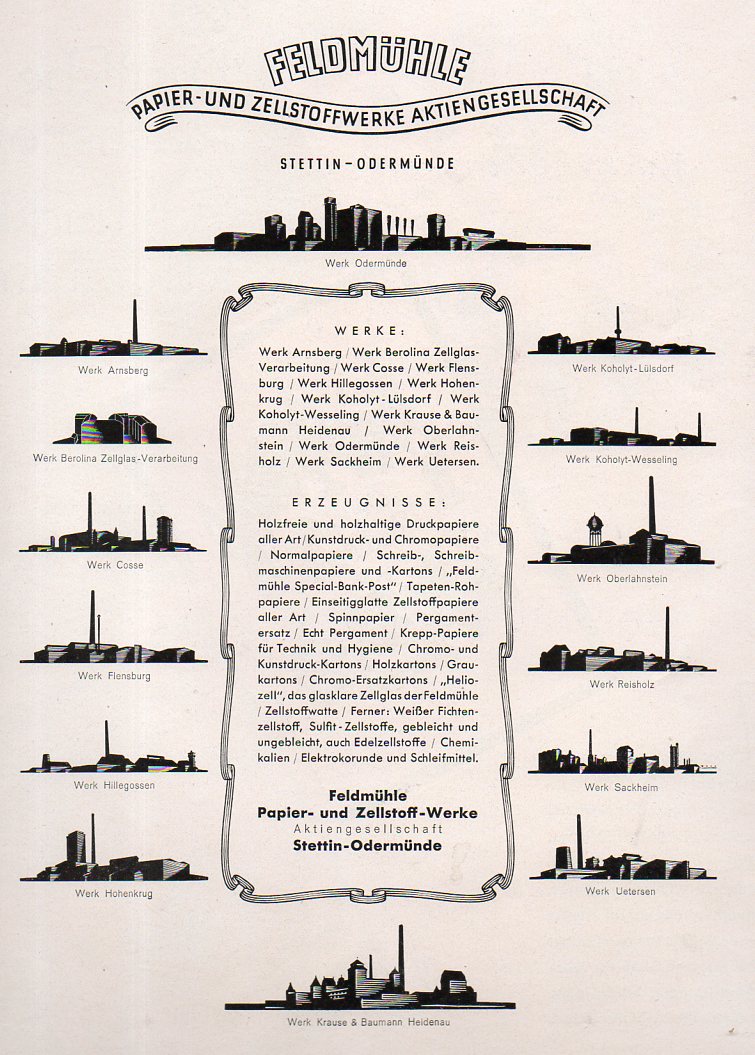
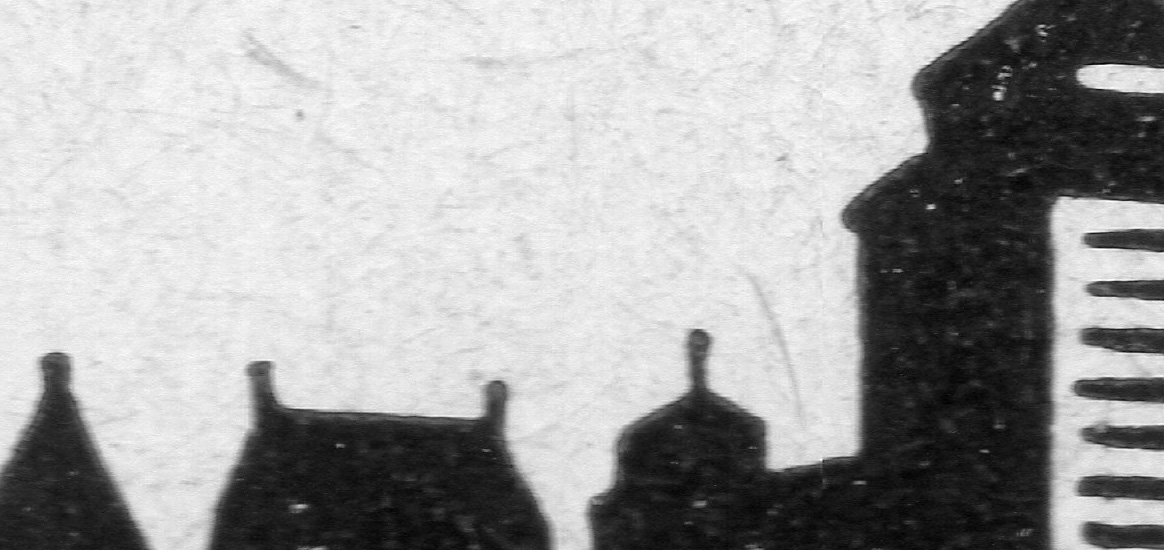
    In my experience with images in silhouette, the technical adaptations are very unusual (at least for things that are not spotter guides for enemy aircraft or ships-at-night)–more uncommon still are industrial buildings rendered in silhouette.  But here’s an example, taken from the Illustrirte Zeitung (Leipzig) for 1936.  These are factories in the Feldmuehle Papier- und Zellstoffwerke company, and are really quite attractive.

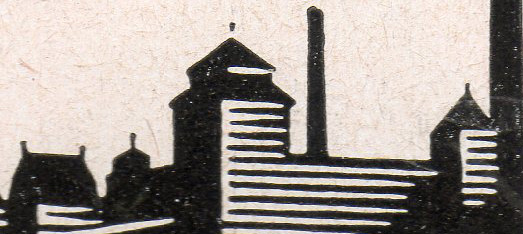
    The following two images are details from the 14th silhouette, at bottom-center:


    Industrial silhouettes874


    Industrial silhouettes873

    And the full-pahe ads looks so:

    Industrial silhouettes872


  • Reference Tool: a Short and Handy Timeline of Quantum Mechanics, 1900-1962

    A Short Timeline of Quantum Mechanics, 1900-1962

    1900 Johannes Rydberg refines the expression for observed hydrogen line wavelengths.

    1900 Max Planck states his quantum hypothesis and blackbody radiation law1902 Philipp Lenard observes that maximum photoelectron energies are independent of illuminating intensity but depend on frequency.

    1902 Theodor Svedberg suggests that fluctuations in molecular bombardment cause the Brownian motion.

    1905 Albert Einstein explains the photoelectric effect.

    ·Posted by :

    ·in:

    —

  • Interesting Images of Renaissance Hell–on Title Pages

    JF Ptak Science Books   Post 1917

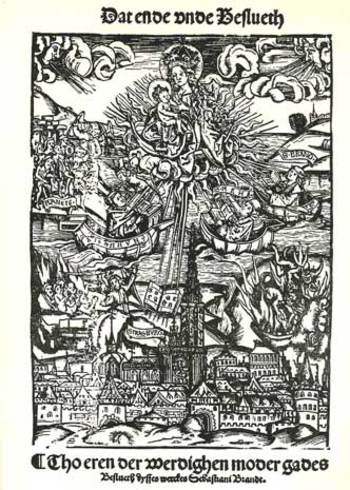
    Bloghelltp078Images of Hell do not often appear graphically depicted right on the title page of books, even though books speaking to Hell and warning us of its coming number in the hundreds of thousands, if not more, particularly if you interpret religion as the means for keeping people away from the ring of fire.    Few people are shy about depicting Hell in general, though there evidently is some reluctance (or forbearance, or oversight) to showing it front-and-center on the title pages of books.
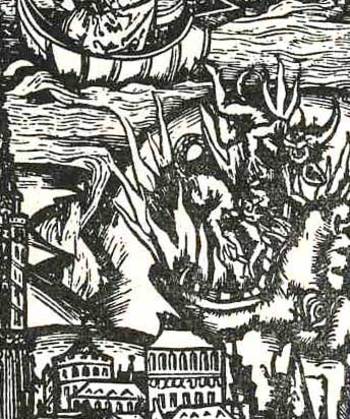
    A terrific exception to this rule is Jacobs de Voragine’s Passional, Hyr hewrrey sick an dath winter deel, printed in Basel in 1511, and illustrated by various and unidentified Strassburg woodcut masters.  In this extraordinary title page we see the vision of the adoration of the Virgin Mother and child supported in a rose of light, aided by guiding winds and various floating saints, and shown lowering the holy book directly to the city of Strassburg. In either corner positioned above the temporal city and below the firmament are two visions of hell, one less vicious and the other more so:  to the left we see some of the pious praying for better judgment as they are about to be consumed by the background flames, while to the right is a far more ambitious and morbid vision of hell featuring the famous Hellmouth.  The Hellmouth makes appears all throughout the history of art (as we can see in this Brueghel painting, for example), but it is a little curious that, outside of the mention of Leviathan (translated from Hebrew, Job 41:1), Hellmouth (as the entrance to hell) doesn’t make an appearance in the Bible.
    Bloghelltpdetail
     

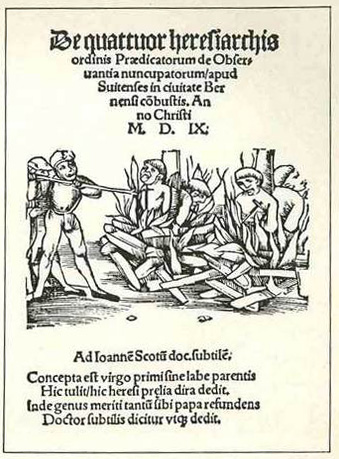
    What is more easily found, at least in the artwork on title pages throughout the Renaissance and the Baroque, are images of people about to be sent to hell. A good and chilling example of this can be seen in the artwork for Thomas Murner (1475-1537) De quattor heresiarhis ordinis Praedicatorium de Observantis nuncupatorum…, printed (again) at Strassburg in 1509.  The pamphlet tells the story of Johannes Jetzer and his accomplices (including four monks) who were tried (under torture) for blasphemy after it was revealed that they colluded to defraud people with a bogus story of religious visions, employing the bloody tear of Mary.  All were found guilty and the four monks were burned alive at the stake—Jetzer having escaped—and sent immediately to the deeper, more fiery, pit.

    Hell on title page
    This isn’t quite showing the coming of hell as in the first case, but it is getting close.  In any event, I found it interesting to see the depiction of the Bad Place right there on the title page of the Murner bokk.


  • An Alphabet of Dictionaries-at-Odds: Ambrose Bierce & Sam Johnson // ART & ASS

    JF Ptak Science Books    Post 1916

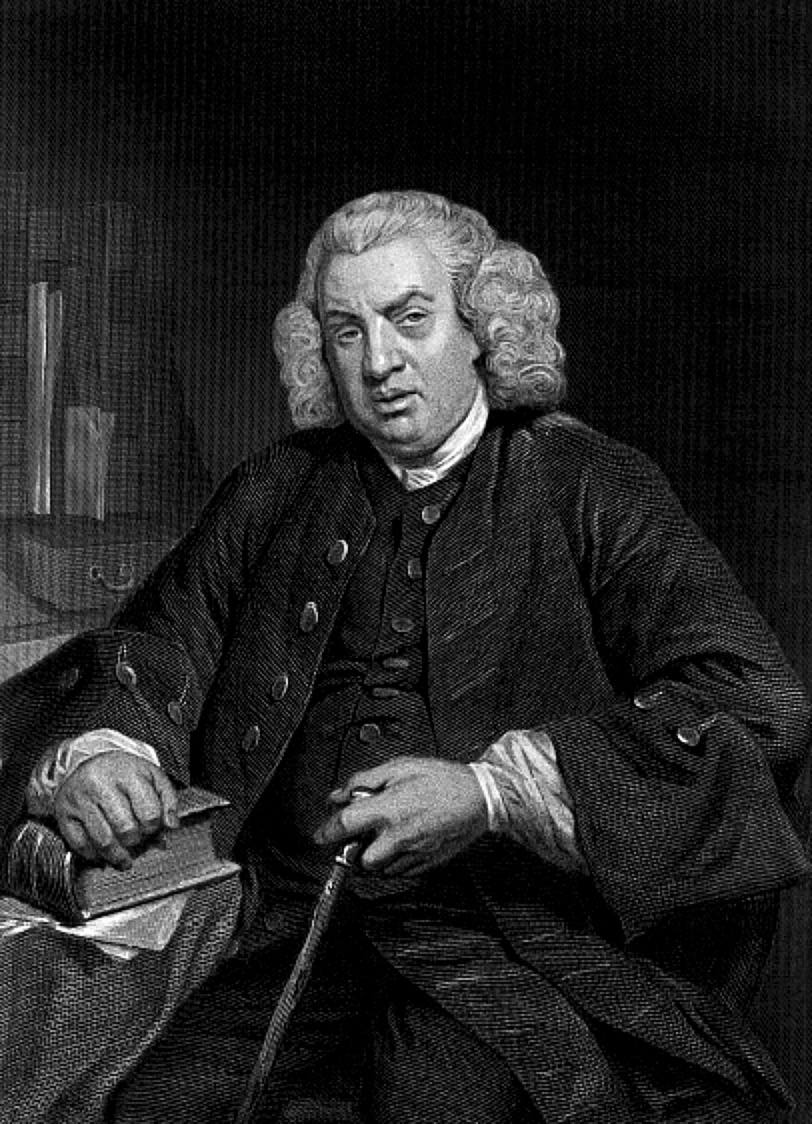
    Johnson, SamuelSamuel Johnson and Ambrose Bierce compiled dictionaries–two different types, two different efforts, 150 years apart.   Some think of Johnson’s Dictionary of the English Language  (1755) as being the first of the English language, but it is hardly so, being a sort-of late-comer, 150 years after the first English dictionary appeared.  Of course Johnson’s was the first bona fide “professional;” dictionary, against which all others are to be measured.  2000+ pages long, Johnson’s effort is also a type of historico-novel-dictionary (Histovelary?)–he inserted histories of words, applications, and a tremendous amount of his own bias.  (For example, his famous definition of “lexicographer: : a writer of dictionaries; a harmless drudge that busies himself in
    tracing the original and detailing the signification of words”.) The book sometimes reads like a novel–or at least, I think that a person could force a novel out of it, and not simply because the book has all of the parts of a novel scattered about.  It is an odd book, maybe the only of its kind, a disciplined and airy encyclopedic romp through the history of words and ideas, all presented by a compiler who was also its author–and accomplished pretty much on his won.

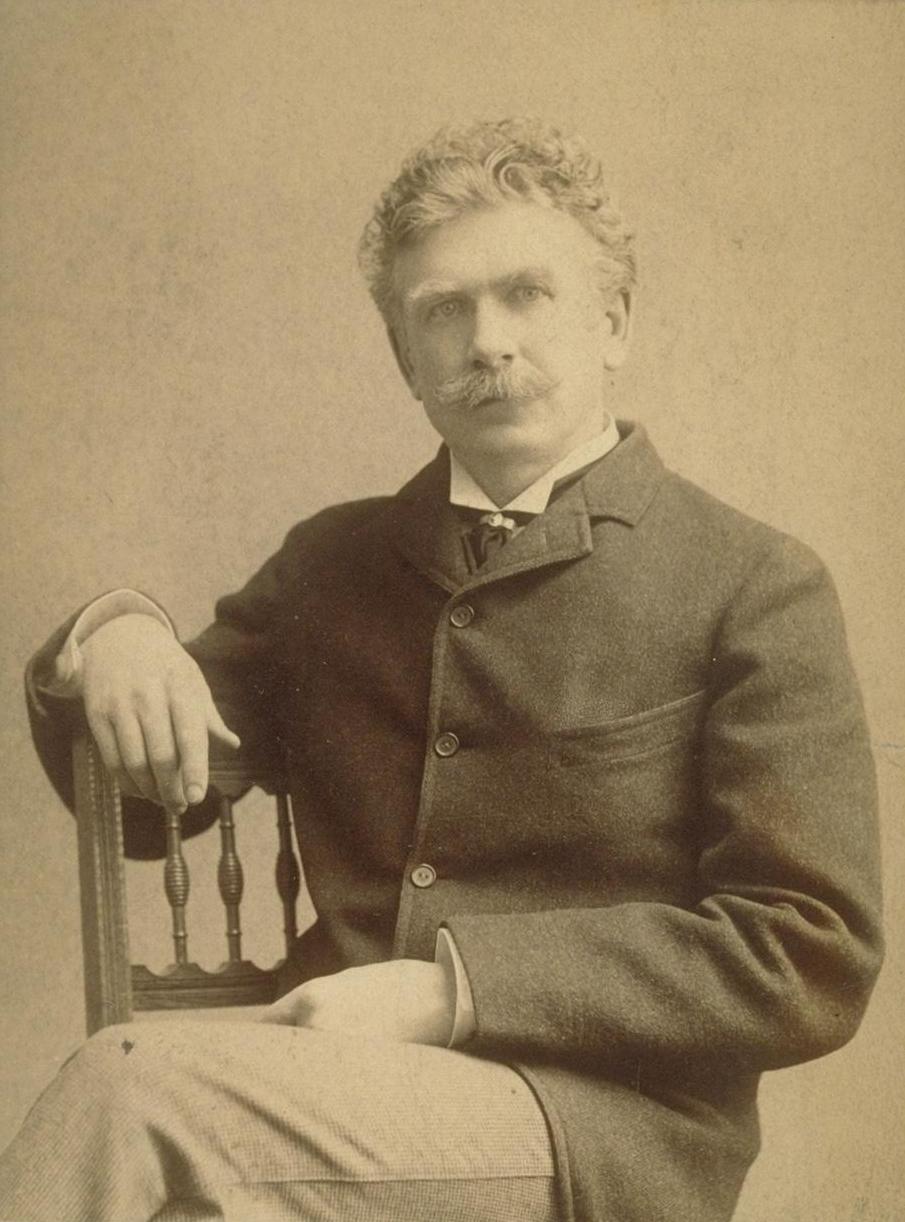
    Bierce, AmbroseWhere Johnson wrote with some fair immoderation of bias, Ambrose Bierce wrote with nothing but bias.  His work, The Devil’s Dictionary (1911), is a work of deep observation and scathing wit.  It stands as a dictionary of a personal philosophy more than anything else, written by an acerbic iconoclast of cunning and skepticism. Comparing definitions of the two side-by-side is an interesting exercise, if for no other reason than it is good and unexpected reading.  Bitter Bierce was a wonderful writer with a sharp and jaundicy eye that saw the third side of a two-sided thing, and applied that sight to his unexpected masterwork.

    So over the next bit we’ll alphabetically grze through selections of the two works, comparing interesting words.

    A:  Artist/art

    Johnson

    ARTISAN s. an artist, an inferiour.  Manufacturer, low tradesman.

    ARTIST, s. a professor of an art, a skilful man.

    ARTLESS  a. unskilful, without art or fraud.

    ARTLESSLY,  ad. without art, naturally.

    Bierce

    ART, n.  This word has no definition. Its origin is related as follows by the ingenious Father Gassalasca Jape, S.J.

            One day a wag — what would the wretch be at? —
            Shifted a letter of the cipher RAT,
            And said it was a god’s name!  Straight arose
            Fantastic priests and postulants (with shows,
            And mysteries, and mummeries, and hymns,
            And disputations dire that lamed their limbs)
            To serve his temple and maintain the fires,
            Expound the law, manipulate the wires.
            Amazed, the populace that rites attend,
            Believe whate’er they cannot comprehend,
            And, inly edified to learn that two
            Half-hairs joined so and so (as Art can do)
            Have sweeter values and a grace more fit
            Than Nature’s hairs that never have been split,
            Bring cates and wines for sacrificial feasts,
            And sell their garments to support the priests.

    ·Posted by :

    ·in:


  • Tessie’s Best Recipe in the World: Dahl’s “George’s Marvelous Medicine”

    JF Ptak Science Books  Quick Post


    German--radium560
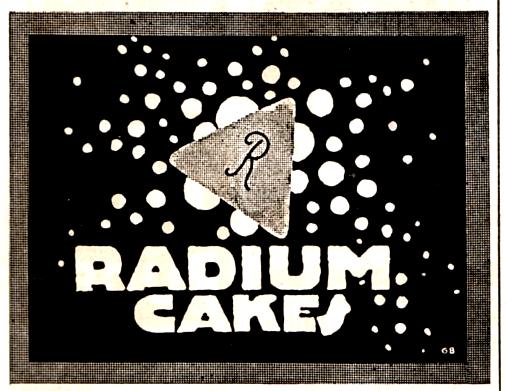
    I have read and seen my share of quack advertisements, eletro-luxurious machines to cure gouty embolisms, powdery powders that cure powder and things like power, cocaine bibs for infants, radium suppositories that will work to help make you “regular”, grease baths to make you fertile, electric chairs with special devices for the “sensitive organ” to deliver small dosages of electricity to do g_d-knows-what,and so on, as these mostly-knowing shyster/huckster productions fade into the cold black sea.

    In the early 1900s, real men used radium suppositories

    [Sere here for a short post on this blog, “The Gift that Keeps on Giving: Radium Suppositories”]

    But tonight I’ve read an absolutely lovely concoction for ready-made remedies, one of the best–if not the most entirely best–ever.  All brought to me via the insistence of our 9-year-old on reading Roald Dahl’s George’s Marvelous Medicine.  George, you see, was a young boy anchored to a coarse oblivion by a witcherly grandmother, a venal, foul, bullying  and hateful woman who gave George no end of mind-abuse when the parents were away.  And so it came to be the day that George was to do something about Grandma.

    What he did was to replace her special medicine with his own, marvelous, medicine. And feed it to her. And see what happened.

    So he got a big cauldron and created his brew, which included the following lovely list: one bottle Goldegloss Hair Shampoo, toothpaste, superfoam shaving soap, a jar of vitamin enriched face cream, nail polish, hair remover, dandruff cure, false teeth cleaner, nevermore ponging deodorant spray, liquid parafin, Helga’s Hairset, Flower of Turnip Perfume, pink plaster, several tubes of lipstick, one large box of “Superwhite for automatic washing machines, Waxwell floor polish, flea powder for dogs, canary seed, brown shoe polish, curry powder, mustard powder, extra hot chili sauce, black peppercorns, horseradish sauce, powder to cure chickens of foul pest & hen gripe, horse pills for hoarse horses, thick yellow liquid to cure cow pox, sheep dip for sheep with sheep rot, pig pills (for pigs with pork prickles),  a handful of grease, and a little antifreeze.

    Then it was boiled up and served to Grandma on  a silver spoon, with some gin. 

    Things happen that I won’t go into here–I’d advise reading the book.  Thanks, Tessie!

    ·Posted by :

    ·in:


  • Reference Tool: Handy List of Nobel Prizes Awarded in Physics

    (For some reason I couldn’t find a simple listing of Nobel Prize winners listed alphabetically–so here one is. This is linked to the Nobel site which of course has an exhaustive listing of winners and reasons for the award; this list is a simple thumbnail of the winners.)

    Note: about halfway down is a descending list of recipients with the Nobel Foundation’s reasons for the awards.  All text in the descrption for the award is from the Nobel Foundation site.  (This ends/begins in 1997–I’ll get this up to date shortly.) 

    For videos of the recipients’ Nobel lectures, see here.

    Abrikosov, Alexei A. 2003
    Alferov, Zhores I. 2000
    Alfven, Hannes 1970
    Alvarez, Luis W. 1968
    Anderson, Carl David 1936
    Anderson, Philip W. 1977

    ·Posted by :

    ·in:

    —

  • Master of Little but Curious About it All (1839)

    JF Ptak


    M of A868
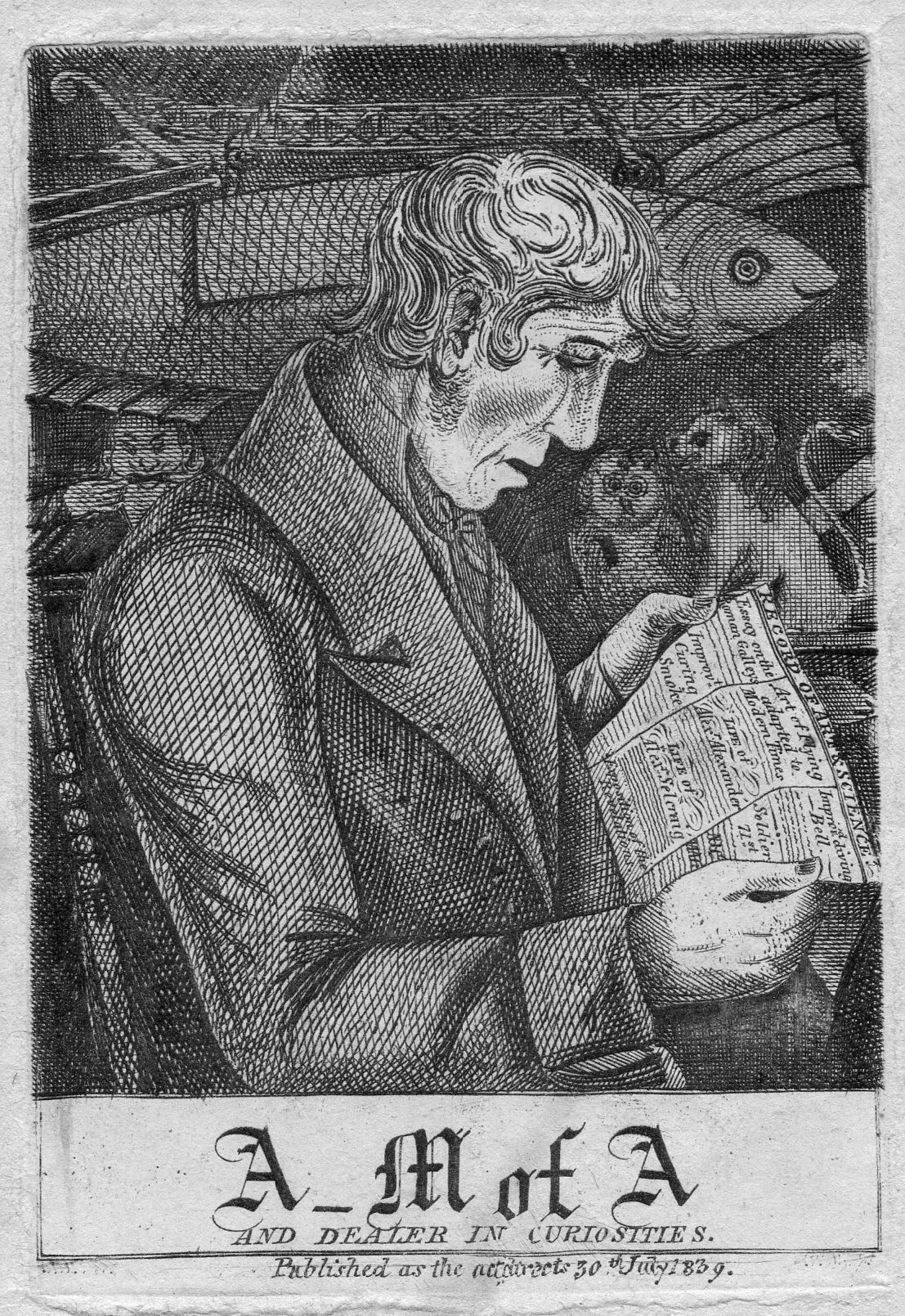
    This print has been hanging here and there at home for many years–it has always been amusing, and somehow warming. 

    “A _M of A, and Dealer in Curiosities” was “published as the act directs 30 July 1839”, is an etchign which depicts,
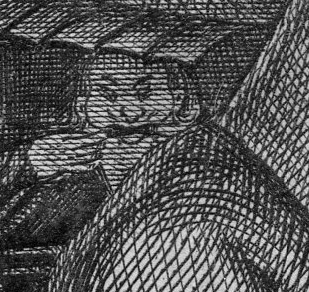
    M of A face I guess, a lettered/educated man who winds up as a seller of scientific and intellectual bric-a-brac and interesting bits, perhaps wonderful natural history/physics materials, perhaps trivialities.  He seems satisfied to me, regardless of the little man over his shoulder making a face, a reminder perhaps to not take the curiosities too seriously.  [There’s also another face off to the right, peering into the image (see below).]

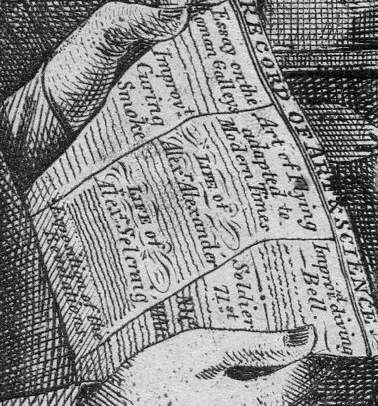
    The Record of Arts & Science that our dealer is reading has some interesting parts to it:, including something on new mechanical flight and a new diving bell–it would’ve been more interesting historically if it had mentioned the brand-new Daguerre invention. 


    M of A reading


    ·Posted by :

    ·in:

    — —

  • A Note on the History of Not-Straight Pre-Telephone Poles

    JF Ptak Science Books    Post 1914

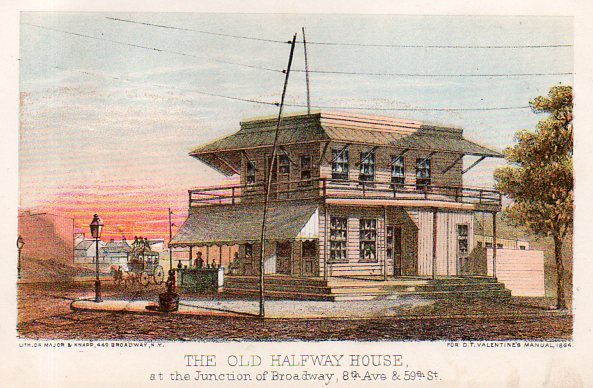
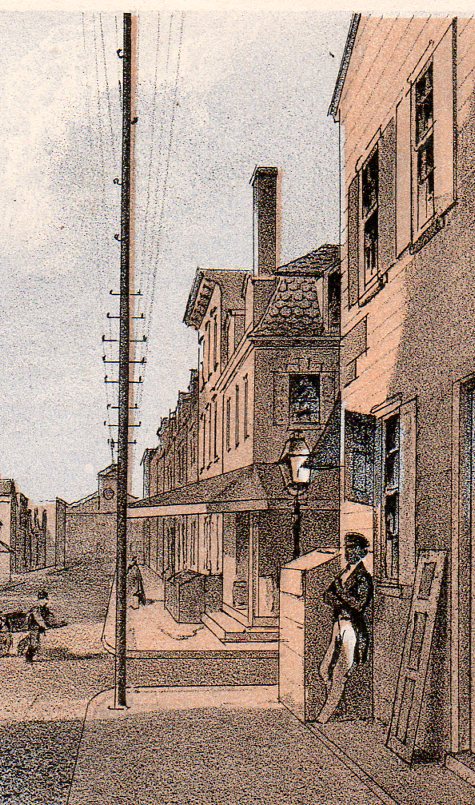
    This is one of those images in search of a story, and as it turns out the story is actually pretty long and involved. The image is this fantastic lithograph from Valentine’s Manual of the City of New York (a sort of annual review/directory of the city that ran on-and-on from the 1850’s to the 1920’s), this one being from the 1868 edition.

    Telephone poles865

    It also is a very stark reminder about how we still deliver power and communication in the United States, still via insulated wires strung along cross beams on what are mostly dead trees–pretty much the way the business has been done for he last 160 year.s  That the backbone of the American energy and communication grid is still transferred on wire/cable strung over the street and exposed to everything on cultivated and treated sticks from the forest is an irony that we live under every day, and that beginning with telegraph poles.

    That said, I like this image because the pole n the picture is so curved.  Perhaps it was the way the tree was; perhaps it was rendered that way when it was treated with creosote. I don’t know.  But the folks at Valentines liked it, otherwise they could have ignored its crookedness or used another angle on depicting the Old Halfway House.

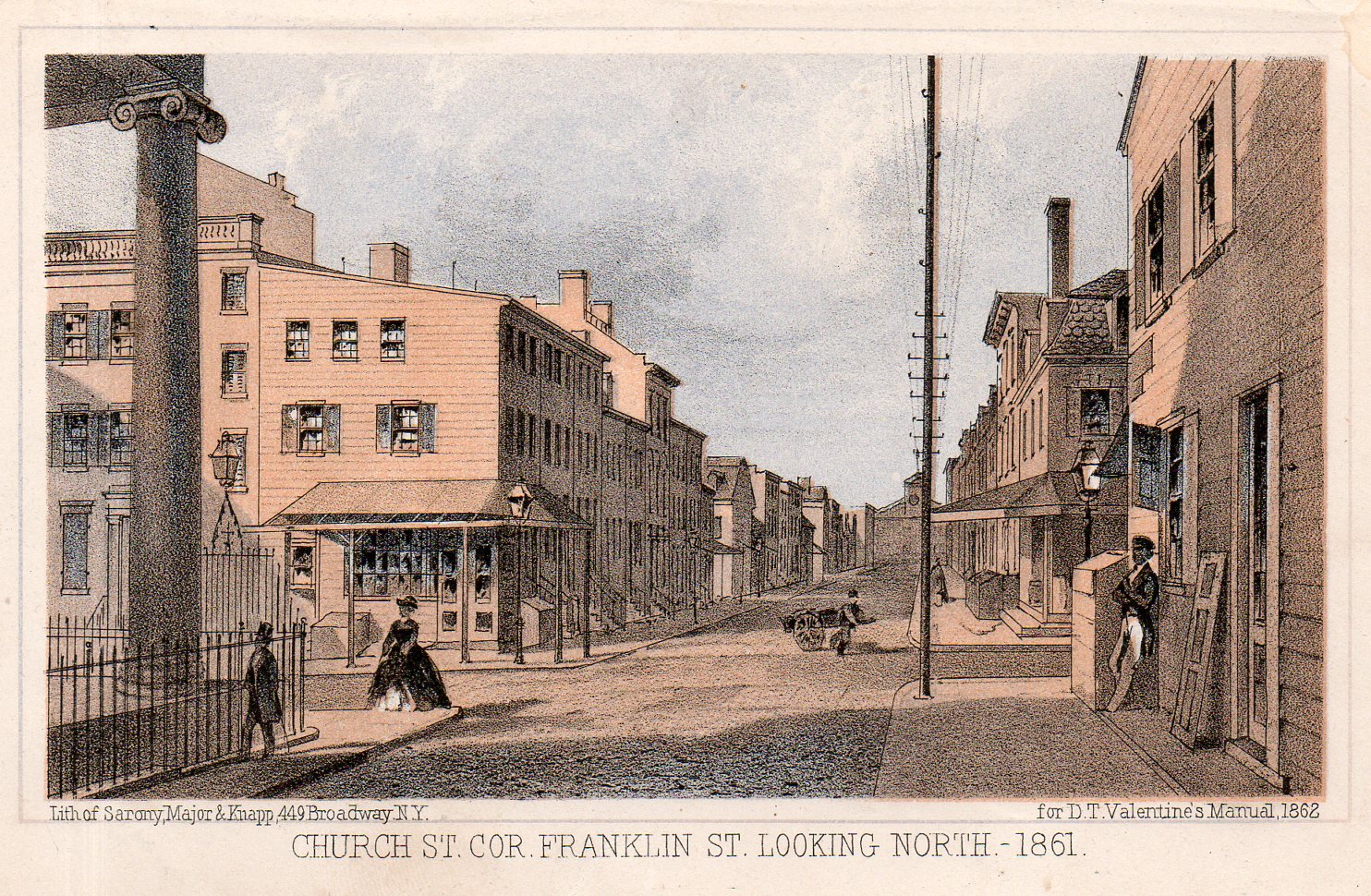
    Judging from many other examples, it seems that the artists at Valentines had a taste for the subtle and obscure.  There are plenty of cases of the depiction of the quietly uncommon, as with another unusual image, showing Church street looking north and showing a long line of telegraph poles, all of which are squarely behind the other so that only the initial pole is visible, though you can see the cross-beams and insulators of the others, the brace getting “lower” and “smaller” behind the first pole.  It is just extremely uncommon (in my experience) to see a long line of anything depicted in this way.

    Telephone poles866

    The artists/lithographers at The Manual seemed to enjoy their work.  For example, in the above image in addition to teh lined-up telegraph poles we have some other very uncommon small elements. No doubt the view was true–which was the intent of the book, to accurately portray the city–but the small elements were creative, quiet and incisive.  Perhaps it is also just exactly what the artist saw when the view was made.  For example, the woman
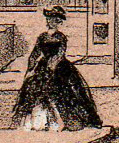
    Telephone poles skirtcrossing the street us stepping up on the curb and raising her skirts slightly–it would’ve been easier to just have her standing there, as with the gentleman immediately in front of her, but for some (creative) reason she is shown in an unusual pose.  Ditto the guy leaning against the building at right–he’s out of proportion with the other two figures, unless he was a giant, but he’s just, well, leaning there.  He’s also standing next to a shutter, which is down and also leaning against the building.  A peddler makes his/her way across the street in the background with a large cart. And the windows in the buildings are unequally decorated, with interior window dressings at different stages of being drawn and not, and with different treatment, and in different states of repair. In short, the image is really a snapshot.

    Telephone poles867
    I imagine that somewhere here in this country there could still original telegraph poles standing–the originals started out generally as chestnut, and then force treated with creosote, and were intended to stand for 50 to 100 years. Under favorable conditions in which they were just simply not replaced, it is conceivable that some could have lasted for 150 years. 


  • Solomon Butcher, Part III: Creating the Landscape and Giving Form to the Imagination

    JF Ptak Science Books  Quick Post   Part of the Zoomology series

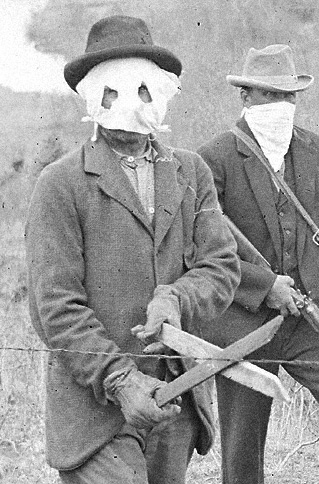
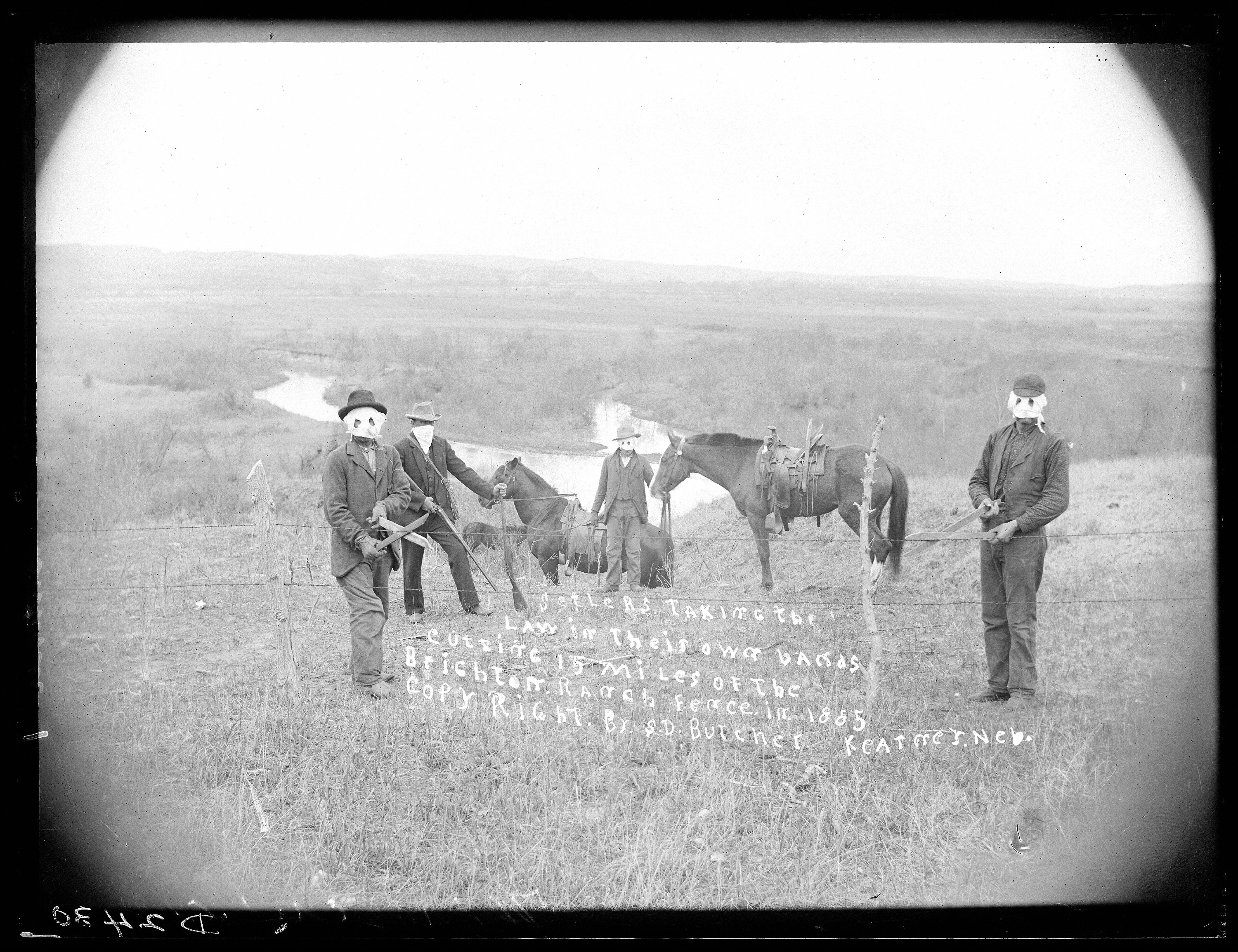
    This is a quick follow-up to an earlier post on Solomon Butcher in which there two two photographic images that are clearly “manufactured”–one is created in the darkroom (simply adding trees in a tress-less landscape), while the other (below) is an unlabelled recreation of an event.  This is in the lines of Timothy O’Sullivan and Matthew Brady dressing up their images a bit by posing the dead or giving them added bits (like muskets and so on) to enliven the picture.  This one though is entirely theatre–as it happens there are very few 19th century photographs depicting a crime-in-progress.  Butcher just decided to show his audience what the crime probably looked like.  In any event if not for a little Zoomology the scene could’ve perhaps passed for real. 

    Butcher vigilantes two det one
    This is a detail from the full-plate glass negative, printed out so:

    Butcher vigilantes two

    Without the enlargement it is difficult to tell what sort of instruments the ranchers were holding.  But up close the wire cutters are simply suggestions of that too, being made of wood and all.