A Daily History of Holes, Dots, Lines, Science, History, Math, Physics, Art, the Unintentional Absurd, Architecture, Maps, Data Visualization, Blank and Missing Things, and so on. |1.6 million words, 7500 images, 4.9 million hits| Press & appearances in The Times, Le Figaro, Mensa, The Economist, The Guardian, Discovery News, Slate, Le Monde, Sci American Blogs, Le Pont, and many other places… 5000+ total posts since 2008.

Author: JF Ptak

  • Beautiful Ladders of the Baroque

    JF Ptak Science Books LLC     Post 1921
    Blogzabaggi043web
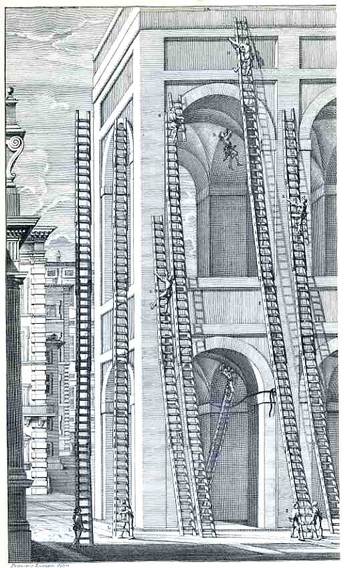
    This gorgeous, near-pre-Dadist image belongs to Niccola Zabaglia, who published the engraving in his book Castelli, e ponti di maestro Niccola Zabaglia con alcune ingegnose practice, e con la descriziojne del trasporto dell’obelsico Vaticano, e di altri del cav. Domenico Fontana, in Rome, in 1743.  This is the literal and absolute height of pre-modern, pre-mechanized building construction in the soaring Roman Baroque, ordained by “maestro”, the master, Zabaglia (1664-1750), a spectacular (and necessary) proponent of practical mechanics as applied to the building trades.  Among the “Castles” and churches and bridges alluded to in the title of his book, Zabaglia was responsible for affecting the maintenance and repair of St. Peter’s (more particularly to the basilica and the vault)—specifically, he had to figure out how to get the workmen and materials into place, and into very difficult and very high places, without damaging or destroying any of the existing decoration, artwork, sculpture, frescoes, and so on.  This was no easy feat to perform back there in the dim, 265+ years-ago pre-electric pre-power past, with enormous technical and operational difficulties, and Zabaglia accomplished this was superior affect, devising complex and elegant moving and stationary scaffolds, hoisting and holding mechanisms for the ladders, and much else.  He did just beautiful work, and he is a patron saint in the history of repair. 

    Ladders and scaffolds were important of course but were among the least of Zabaglia’s numerous accomplishments and inventions—they were so plentiful and useful that two Pope Benedicts ago (Pope Benedict the 14th) ordered their publication with actual teams of artists and engravers performing specific tasks.

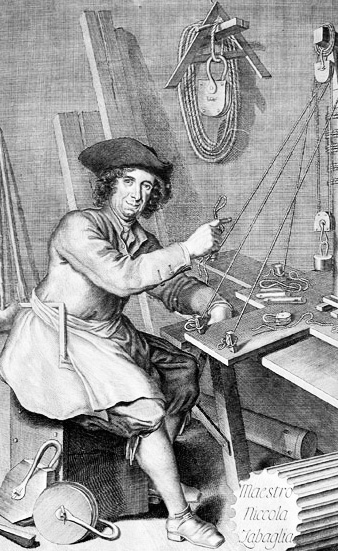
    It cannot be left unsaid that Zabaglia’s portrait as the frontispiece to his work presents almost without a doubt the most approachable, humane and amused representations of a major engineer/artist/artisan published in almost any work of the 18th century–I mean, the man just looks so happy in his work.  There he is, surrounded by the tools of his trade, in work clothing and a scruffy hat, and needing a shave, and just looking as pleased as can be.  No?
    ZabagliaBut to the ladders:  the examples in the engraving above are certainly massive.  The ladder in the middle I would say must be 70′ tall (judging that it has 60-odd rungs and that there are 5 rungs to the men who are stabilizing it at bottom), and since they’re made of a good hardwood (to prevent bowing that must occur in a lesser material), the things must’ve weighed a good amount.  And offhand I’m not exactly sure how they raised them.  I can’t see the tops of the building, but I would assume that there was a pulley up there. I hope.  In any event, the ladders and their found geometries are gorgeous things.  Also, I would guess that in the very long histories of ladders (a ladder appears in a cave painting from 10,000 BCE and also appears in one of the very first photographic experiments) that these must’ve been among the high points in ladder construction. 

  • A Note on the Most Famous Missing Doorknob in the History of Art

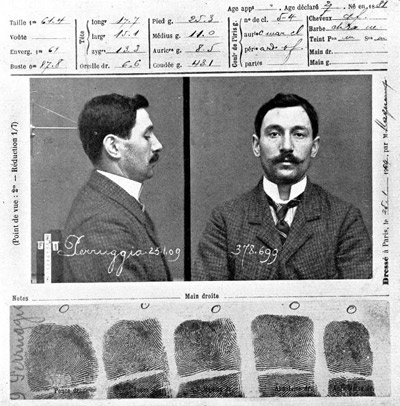
    JF Ptak Science Books     Post 1921  [Part of the series on the History of Blank, Empty and Missing Things]Leonardo peruggia fingerprint

    [See also the recent post on Mona Lisa’s Missing Jewelry.]

    In the category of upper-levels things gone missing (though not nearly in the same category as entire libraries that have been destroyed over time) is the theft of the Mona Lisa. This is an odd story full of detail and holes  that could have been the work of one man, Vincent Peruggia  (born in 1881 and pictured above in his mugshot) and who with extreme naviete thought he could steal the painting and sell it to the Uffizi and regain the prestige of Italy over its own missing masterpiece by a native son. It also could have been the work of a thief/forger team of Marque Eduardo de Valfierno and Yes Chaudron  who set Peruggia to the task of stealing the painting, with Valfierno contracting the sale of as many as six Mona Lisa forgeries to interested parties. 

    Valfierno’s idea was pretty cunning and diabolical–his only need was to have the real Mona Lisa disappear; then he could have his accomplice forger produce x-number of copies and sell them to x-number of collectors as the real thing.  After all, its not as though Mona Lisa owners would have a convention, so the ownership of the world’s most famous and stolen painting would be a very private affair. Also any claim of the real Mona Lisa appearing anywhere else–even restored to its place in the Louvre–would simply be met by the assertion by Valfierno that those “other” Mona Lisas were forgery. So it was forgeries all the way around.

    Mona_lisa_stolen-1911And so Peruggia–an itinerant laborer who made his way to Paris for a better life and who had been working as a carpenter there at the Louvre–stole the painting on 22 August 1911. A Monday, it was, when the Louvre was closed to the public for staff to make repairs and such.  Evidently he simply worked his way over to the painting, took it off the wall, got a quiet place and removed it from the big frame (and glass!, which was a new security innovation to protect treasures from crank marauders), and loaded the Mona Lisa under his work smock. (He got the painting out of the building by getting a guard to unlock a door for him–one from which he had previously removed the doorknob, blaming its absence on scofflaws, distracting the man with the key enough to just open the door for Peruggia.)  

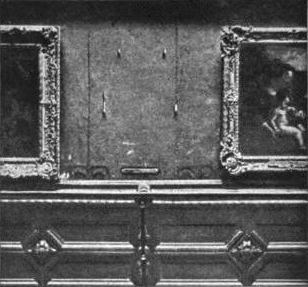
    The blank/missing hanging space of the Mona Lisa  at the Louvre in the Gallerie Carre was a vivid testament to the power of the painting, with thousands of people trudging by the depressing art-hole to stare at its absence. There were just four iron hooks on the wall, waiting for it, pounded into the plaster between Correggio’s Mystical Marriage of St. Catherine and Titian’s Allegory of Alfonso d’Avalos.

    Once Peruggia had completed the theft he was no longer needed. If Valfierno had actually been involved he would simply have used Peruggia as a fall guy, the many who made the sale of the forgeries possible. Peruggia wound up living in a series of shabby places, working his way back to Italy, perhaps waiting for further instructions, perhaps just a solo agent making his way back home.

    If he was an accomplice in  a more involved scheme, one could only imagine his frustration in being abandoned–there he was, sleeping on a cot in top of a box filled with his clothing and the Mona Lisa, waiting for something to happen that wouldn’t. 

    Peruggia found his way back to Florence, staying in Room 20 of the third floor of the Hotel Tripoli Italia on Via Panzoni, which was only hundreds of feet away from where Leonardo had once painted the Mona Lisa.   In 1913 he  finally contacted officials at the Uffizi in a very weird and awkward attempt to sell it to the museum. He was of course apprehended almost immediately, the museum guardians retrieving the painting from beneath Peruggia’s socks and underwear in the box under his bed.After being exhibited in Italy to tens of thousands of viewers, the Mona Lisa was returned to Paris on 4 January 1914. 

    Peruggia was evidently quite open about his theft but didn’t have anything to say about accomplices.  He was sentenced to a little more than a year for his crime–a sentence very soon after reduced to seven months. Following honorable service in WWI, Peruggia wound up in a suburb of Paris with a family and a hardware store, where he died of a heart attack in 1925. When returned to his hometown following his brief incarceration, he was welcomed as a hero–he may have been more so if he hadn’t demanded a payment for the painting.


  • Looking Straight Down Department: the Topography of Hell

    JF Ptak Science Books    Post 1920

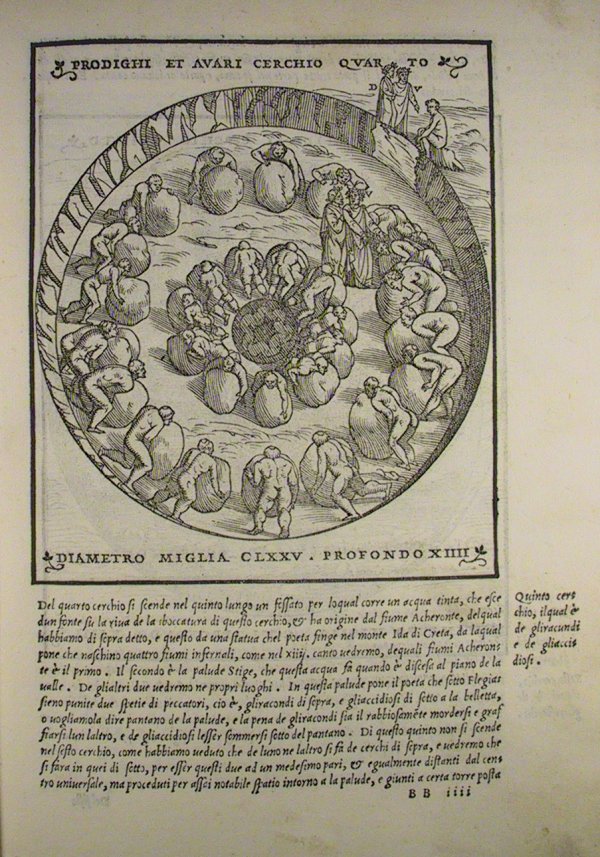
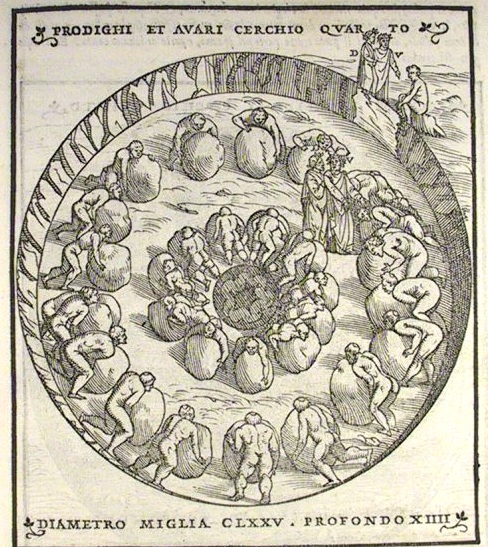
    The interesting thing about Hell–Dante’s Hell–is that it has been shown and reconstructed and imagined for a long time–eight centuries–and, outside of painting, most of the representations seem to be in cross-section. That is why this image from the famous exposition by Alessandro Vellutello’s 1544 struck me so strongly–it is a mostly straight-down look at the miserly and the prodigal in the fourth circle of Hell. 

      InfernoVIIfullpage

    InfernoVIIfullpage

    “… I saw multitudes
    to every side of me; their howls were loud
    while, wheeling weights, they used their chests to push.
    They struck against each other; at that point,
    each turned around and, wheeling back those weights,
    cried out: Why do you hoard? Why do you squander?’ –Canto VII, lines 25-30

    This image depicts the great, tiring but tire-less, endless, despicable joust of the miserly and the prodigals, going at each other with large, difficult-to-move stones.  Pluto is supposed to be in the middle, but I don’t see him here.  The artist though has made the men basically unrecognizable, giving them little character to their faces and virtually no differences in their bodies–Virgil tells Dante that they have lost themselves to something else, that there is no “there” there, that Dante–who would normally speak with the people he was coming into contact with–would not be able to interview them as they were too absorbed in their vicious need. 

    As has been seen in the many maps constructed for the Divine Comedy over the years–but especially during the Renaissance–Hell for Dante was a real place, a nine-layered inverted cone of measured depth and width commensurate with the sin, and established under the city of Jerusalem.  Dante visited the place

    “… but who art thou
     That hast inquir’d of us?” To whom my guide:
     “One that descend with this man, who yet lives,
     From rock to rock, and show him hell’s abyss.”      (Inferno XXIX, 89–92, trans. Cary)

    entering Hell on Good Friday and emerging from Purgatory on Easter morning, taking three days to travel through the two places and straight through the center of the Earth. 

    Here are a few examples of the cross sections that are the great standard bearers of Dante’s visions:

    The  Hell of Dante by Pietro da Fino, 1568:
    Frontispiece of Hell

    The circles of Hell from Commedia di Dante insieme con uno dialogo circa el sito, forma et misure dello Inferno by Filippo Giunta, Florence, 1506.

    The circles of Hell

    Again, just a few examples of the cross sections of Hell to contrast with the scarce looking-straight-down-at-Hell image above. 


  • Isolating ElectroPunk pre-Dadist Illuminated Signs, 1876-1914

    JF Ptak Science Books   Post 1919

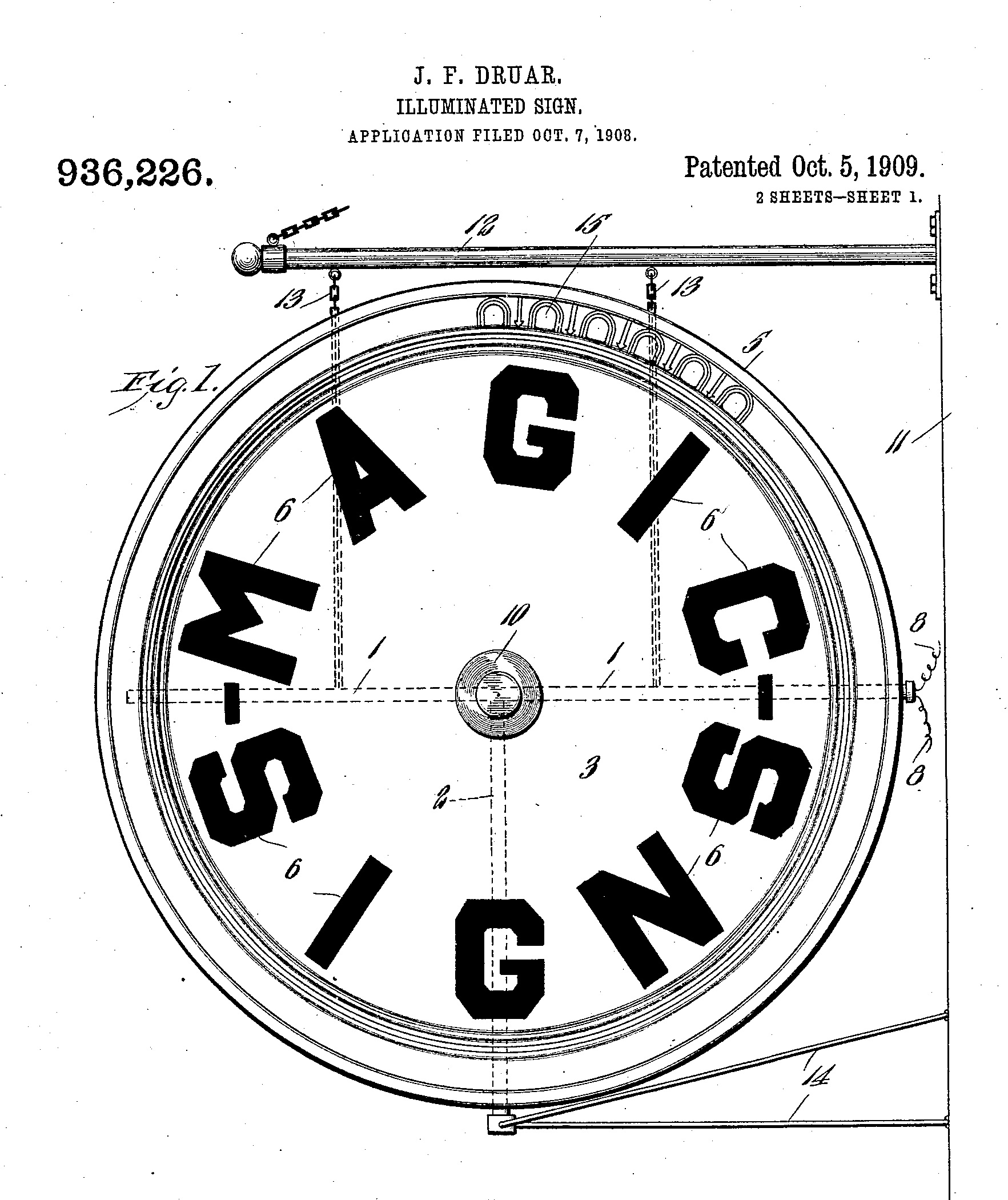
    I am quite certain that entering into a category of ElectoPunk Found Art was the furthest/furtherest thing from the minds of these inventors, mainly because these words didn’t yet exist, and also because these inventors worked on practicable application of the relatively new employment of electricity for advertising. Still, they were serious efforts in pursuing the sale of soap and cigars and “pure food” and other sundries large and small.  But removing them fro their intentions clearly makes these designs into art, some of which is just drop-down gorgeous. 

    DADA FOUND PATENT SIGNSSource:  Google patents:

    http://www.google.com/patents/US936226?dq=illuminated+signs


  • Smart Machines, 1950

    JF Ptak Science Books   Quick Post

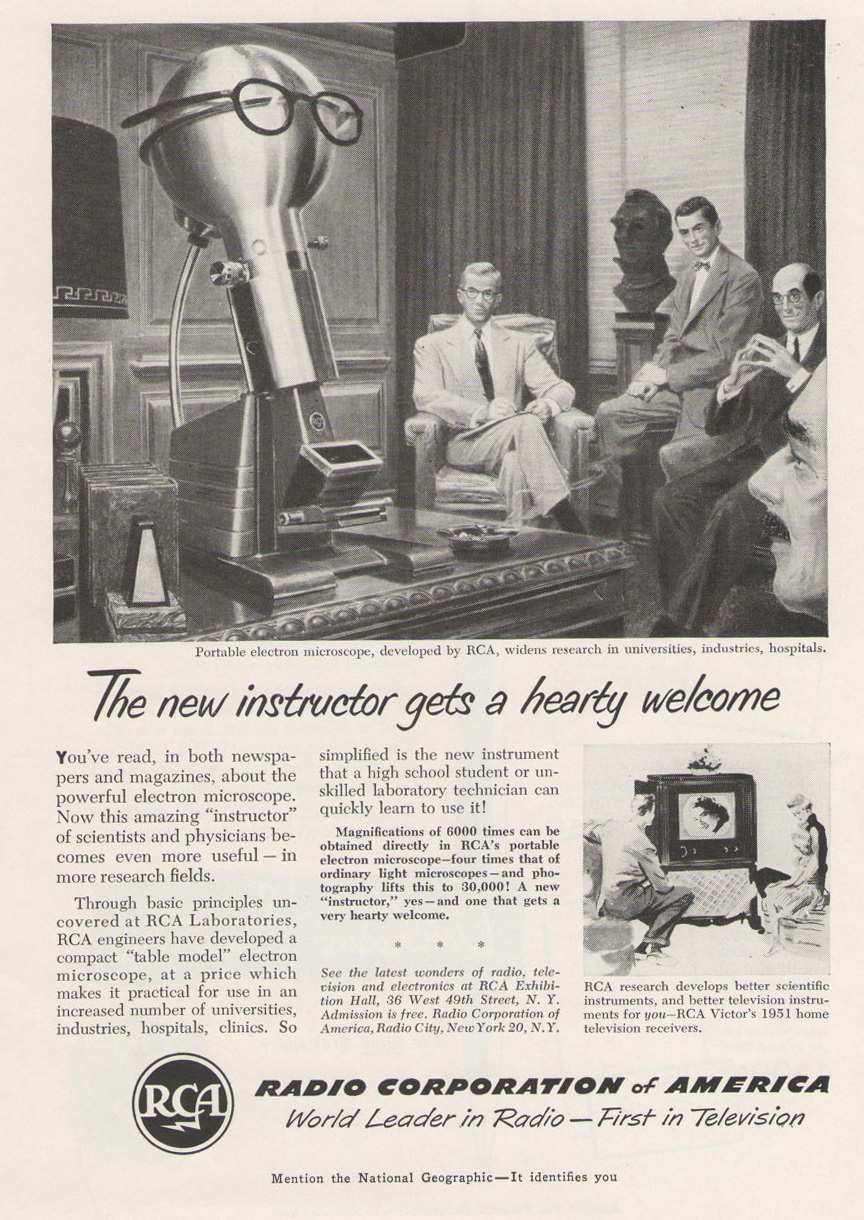
    Robot--electron micrscope
    This image of an electronmicrscope for 1950 gives a new “twist” in thinking about smart machines, the metamorphsis taking place in a front-line microsocpe more so than in the regular metalman of the period. 


  • “Damaged Glob” and ElectroLux Found Word Art, 1883-1920

    JF Ptak Science Books  Quick Post

    Not much to say on these images–they’re just terribly neat. There seems to be a sensible amount of proto-Dadist material here, extolling distant observation, attracting and repelling the reader with its distracting possibilities, all ending with an upside-down “Earl”.  At the very least, these images are “pretty”. 

    Walker Evans. Salon, West Virginia, 1935


  • Blank, Empty & Missing Things Series: Sound and Silence

    JF Ptak Science Books    Post 1918   Part of a long series, Blank, Empty & Missing Things

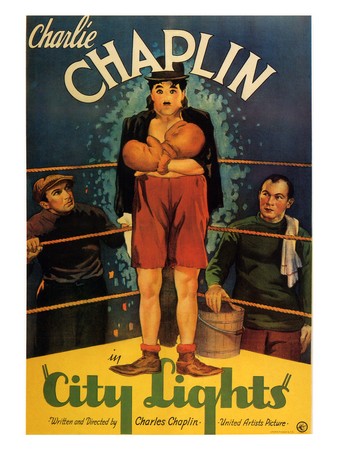
    Chaplan city lights
    In the American motion picture industry, the sound technician position did not exist in 1927; in about 1000 days it would be almost as important as the director.  1927 marked the first year of the synchronous, simultaneous sound-on-film motion picture, with the first commercial production appearing in 1929. (The history of motion pictures with sound is pretty complex for the 1920’s; suffice to say that there were different attempts on synching separately filmed and audio recordings which was a difficult beast to master, and virtually no one did; the winning attempt at introducing sound into the movies had to be sound-on-film so that there would be simultaneous play of sound/film.) Prior to this, all dialog, all sound effects, were confined to the mind of the viewer, though there was sometimes live musical accompaniment.  Two years later, sound was in, and silence (as an absolute given) was out. 

    The impact of sound had an overwhelming effect on the medium—not only because the actors could speak, but because they could also act within the subtleties of now being heard.  Whereas just the other day actors had to pantomime hearing different sorts of sound, or act in such a way that the audience knew that they were weeping—much had to be visually over-acted to support the lack of actually being able to hear things.  Once sound was incorporated, the dramatic range of actors advanced exponentially.  Of course there was also everything else outside of voice that could be incorporated by the director:  ticking clocks, advancing footsteps, thunder,  sirens, heartbeat, a soft wail, a chortle, an echo.  And silence could now be used to its true effect, its importance rediscovered.

    The last, true silent film came in 1931, with Charlie Chaplin’s City Lights.  Chaplin acted/directed/produced the film, which, interestingly, was not really, altogether, absolutely, a “silent” film.  The movie—which directors Stanley Kubrick and Andrei Tartofsky both selected as their fifth film in their top-ten all-time movie lists—actually used idiosyncratic and unintelligible sounds as speech in a spectacular salute to non-speech speech.  Chaplin was one smart man.
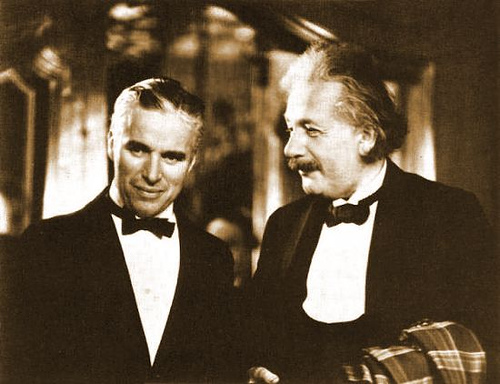
    Chaplin einstein

    The advent of sound curiously silenced the careers of some of the great silent-era actors whose voices were really just beyond reach and the range of the enjoyable.  Clara Bow bowed out as a result of her deep Brooklyn accent, as did John Gilbert for his very high-pitched voice, and many others.  Such are the few ironies that came along with this rich technical advancement, small price to pay for a piece of the future.

    (Chaplin and Einstein at the premier of City Lights.)


  • “Vacation-Land” Czechoslovakia, Summer 1937

    JF Ptak Science Books   Post 1918   Part of the History of Anticipation series


    Czechos876
    This ad appeared in the Illustrated London News for 1 May 1937, Thomas Cook & Son Ltd revving up the summer vacationing wares for traveling Brits. No doubt the claims of beauty and history and interest and charm were/are true–its just that by October of the following year Adolf Hitler would be surveying his newest conquest from the Castle in Prague. 

    Czechos875
    Hitler wanted what he wanted, and in 1937 he revealed to his high command that he wanted Czechoslovakia.  The method would be to claim that ethnic Germans were being maltreated in the Czech border lands (Seudetenland) and that these German minorities must be saved. A crisis developed over this time, through 1937 and into October 1938, and arrangements between the ruling powers in the West were made with Hitler to give him a chunk of Czechoslovakia, (Neville Chamberlain infamously showing his Hitler-signed document pledging no further military expansion following this Czech-absent concession), though this proved to be not enough. The West didn’t want to fight Hitler over Czechoslovakia–and indeed they probably really weren’t ready for it, though in a way France was in a very 1918-kinda-way–so they gave in, and allowed the Nazis to annex a part of the country, and then stood by when Hitler invaded and established protectorate states with the rest of it. (And of course right before this, in March 1938, Hitler annexed Austria under threat of great force and constant pressure from Germany and within Austria, the Anschluss marking the first major step towards the construction of the expanded German Reich and the destruction of tens of millions of people.) Less than a year after that, Hitler would invade Poland, and allied forces could take no more. 

    In any event, the advertisement struck me as wilting, and hollow, a great feeling of anticipated grief.

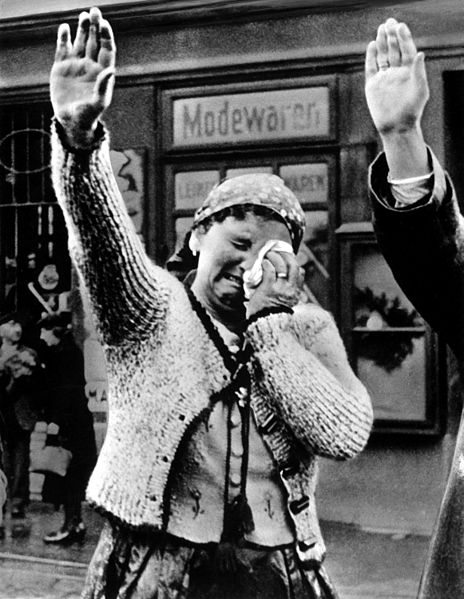
    Czech photo
    [Czech citizens having to greet soft-invading German troops, October, 1938.]

    ·Posted by :

    ·in:


  • Anatomy–35 Great Antiquarian Works on Anatomy: 1390-1899 (Huge Image Base)

    JF Ptak Science Books    Quick Post

    This table is adapted directly from the National Library of Medicine pages for anatomies on the web–all I did was place the records in a table so that they could be listed chronologically.  The references in the first left-hand column are clickable and will take you directly to the images of the work at the NLM site.  This is just a sampling of anatomies, though it may prove to be highly useful for folks in the science and the arts.  Enjoy. 

    Chronoloigcal list.

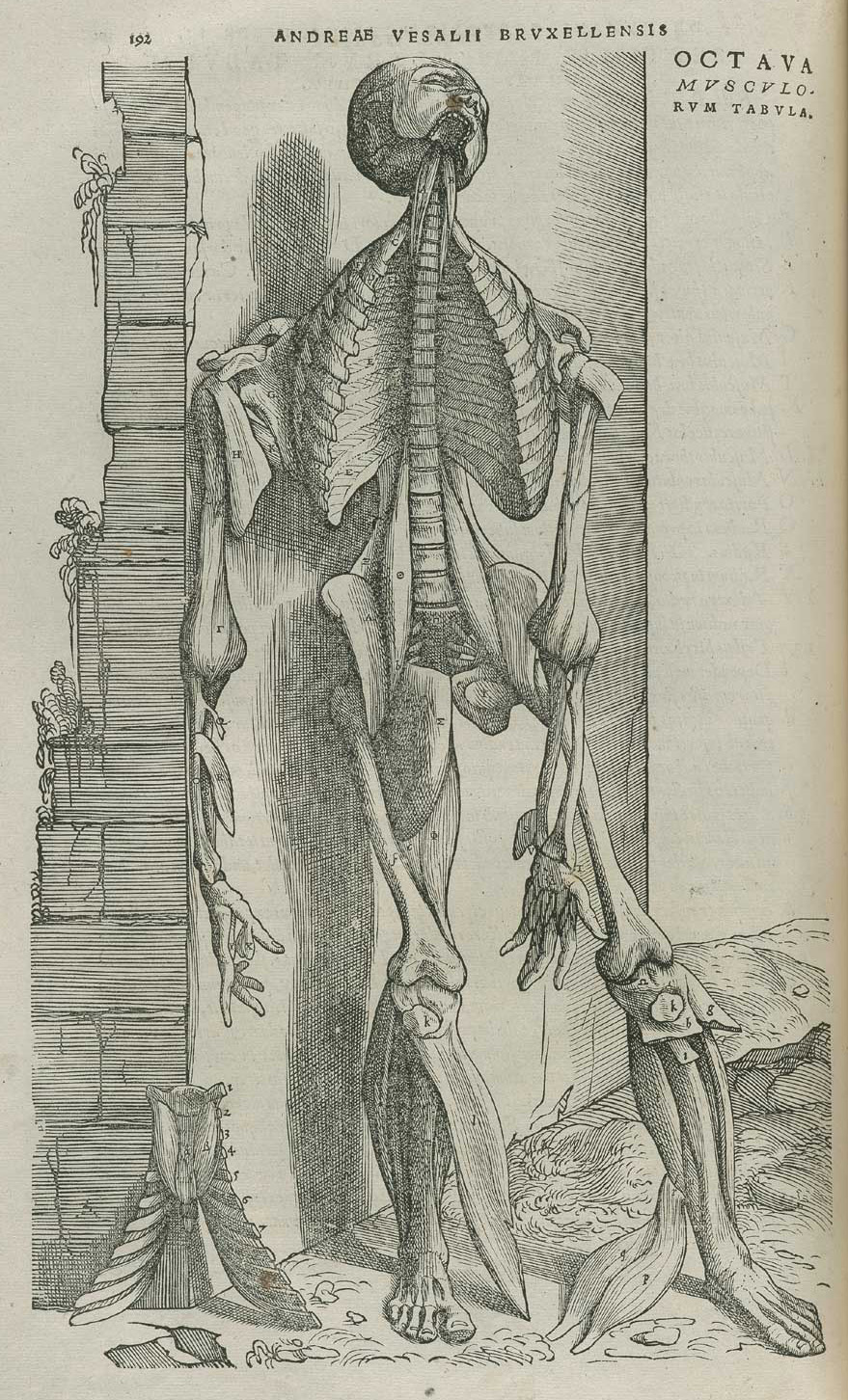
    Vesalius_Pg_192
    [Vesalius, 1543]

    ·Posted by :

    ·in:


  • Skyscrapers of the Renaissance-Baroque

    JF Ptak Science Books   Quick Post

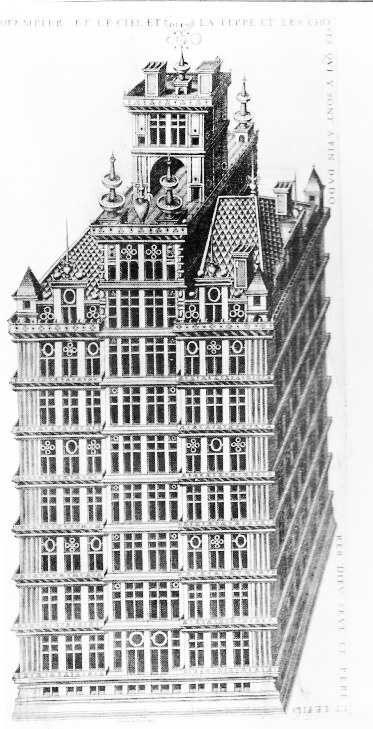
    There seem to be few designs for Very Tall Buildings in the Renaissance that weren’t churches or towers–I mean, structures with storys, and ninth floors, and small glazes, and so on. 

    That is why this design for an eleven story building  by the architect Jacques Perret de Chambery (in his book Architectura et perspectiva des fortifications et artifices, which was printed in Paris in 1601) bursts into the brain as being so remarkable. 

    Arch skyscraper880

    Describing this building and quoting the bookseller site Martayan Lan, Inc. “One extraordinary pavilion would seem to have its
    ultimate source in the fifteenth-century Temple of Virtue and Vice
    designed by Filarete. It is eleven stories in height, with huge expanses
    of glazed openings. Its site plan, the last plate in the publication,
    is a beautiful ornamental geometrical design in the manner of du
    Cerceau, composed of such elements as gardens, moats, and fortifications
    that frame the square, towering pavilion.”

    The “Temple/House of Virtue and Vice” referred to above is the work of Antonio di Pietro Averlino (c. 1400 – c. 1469),  and also known as”Averulino”and  “Filarete” (Greek for “lover of excellence”), a Florentine architect and designer, who produced real and imagined works, a highly-skilled thinker engineer, and who is also remembered for his contributions to the development of urbanism and ideal communities, seen here in his design for the city of Sforzinda, below:

    File:Idealstadt.jpg

    (It is interesting to note that “sforzinda” is awfully close to “sforzado”, a musical term meaning “sudden” or “sharp”, which this design must have seemed to be, back there in the high Renaissance.) [Text and illustrations: Gallica .]  The House of Virtue and Vice was a nine story building to be located in Sforzinda, a structure with the highest floors devoted to learning, and the lowest to a house of prostitution.  Perhaps the floor placement was reversed.