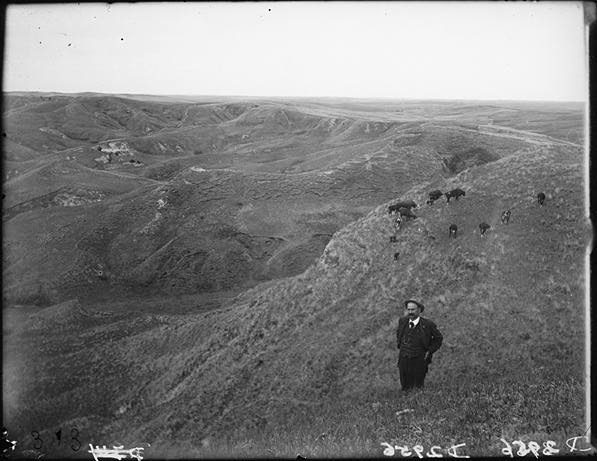
JF Ptak Science Books Quick Post Part of the Series on Blank, Empty and Missing Things.
Do you know who’s missing? Can you identify the shadow?
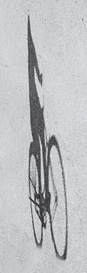
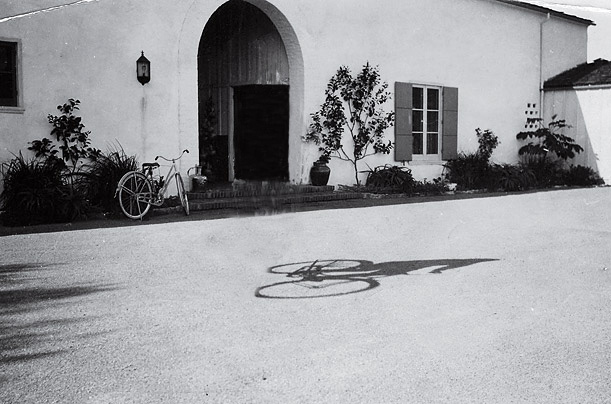
Answer here.
A Daily History of Holes, Dots, Lines, Science, History, Math, Physics, Art, the Unintentional Absurd, Architecture, Maps, Data Visualization, Blank and Missing Things, and so on. |1.6 million words, 7500 images, 4.9 million hits| Press & appearances in The Times, Le Figaro, Mensa, The Economist, The Guardian, Discovery News, Slate, Le Monde, Sci American Blogs, Le Pont, and many other places… 5000+ total posts since 2008.
Contact johnfptak at gmail dot com
JF Ptak Science Books Quick Post Part of the Series on Blank, Empty and Missing Things.
Do you know who’s missing? Can you identify the shadow?
Answer here.
JF Ptak Science Books Post 1914
I’m sure that Solomon Butcher’s (see a post on him earlier today) lonely pictures of life in the great prairie lands of Nebraska were lonely just for an instant. The captured images of vast semi-rolling lands swallowing their subjects were only momentarily. I’m sure that once the photo as made, Ms Austin (below) simply mounted her horse and loped away towards the beautiful horizon, enjoying the day. The lonesomeness I’m fairly well certain was a creation of the moment. Except in winter, when the lonesomeness was real. (All images live at the interesting Nebraska State Historical archives, here.)
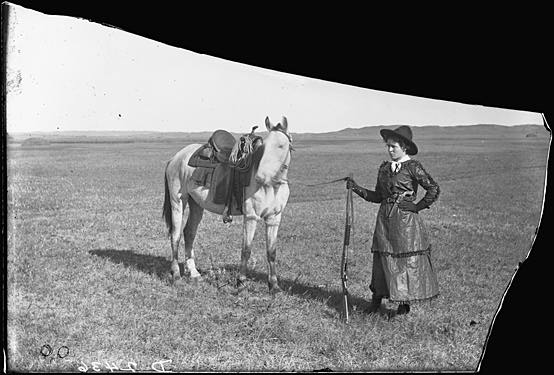
Sadie Austin, “the best known cowgirl in Cherry County”. (“…the daughter of Cherry County rancher Charles
Austin, was a woman of many talents. She was well educated and
noted for her refinement, including her accomplishments as a
pianist. But, when needed, she was also able to put on a split
skirt and help the cowhands. She could sit a horse well and was
noted for her shooting ability. She was the best known cowgirl
in Cherry County.”
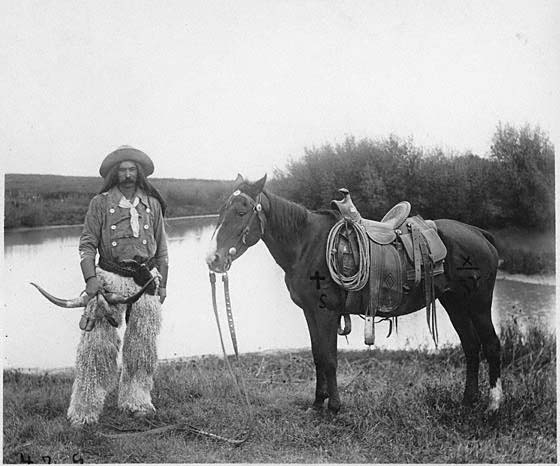
A different Ned–not Buntline, but Dunlap. Ned Dunlap. The caption said he (“foreman on the Watson Ranch near Kearney”) was outfitted for a parade of Old Timers in 1902, and is done-up Old School cowboy.
This fantastic image of clarity and potential cold is a portrait of “John Bridges at Devil’s Gap”, and as the Nebraska Historical Society tells us, it was the site of a true-to-life 1878 hanging-and-burning, a low and dirty affair perpetuated by the Olive Gang. The Olives (I.P. and his brother Robert) were wanted men of Texas taken flight to Nebraska where at least I.P. did very well, coming into hi sown as a cattle rancher. In spite of wealth and land and luck in escaping prosecution and/or vengeance for murder in his former state, he was still highly exercised about losing some cattle to rustlers and had therefore taken a very dim view of Homesteaders in his (and adjoining) counties, fearing that they represented rustling risks as well. And so it came for him to loathe the existence of two homesteaders, Mitchell and Ketchum, who lived in tiny dwellings in this gigantic landscape. The Olives feared fear, no doubt, and after a while it became clear that the two men could not be scared away, and so the Olives set the legal machinery in motion, accusing the men of rustling, and stoking a $700 reward on their capture,which was quickly accomplished. Mitchell and Ketchum were brought in but then were taken by the Olives and their minions, who rode the men off to their ends. They were handcuffed together, ropes tied around their necks (not in a noose, but in a foul and ugly and very painful tied knot), and were hoisted up, one after the other. They were then burned like animals over a fire set at their feet. There was legal procedure against the Olives, but long story short is that I.P. soon won release of his second degree murder charge and lived with his son in Colorado, still in fear of reprisal, finally meeting vengeance in 1884. Its just a bad story.
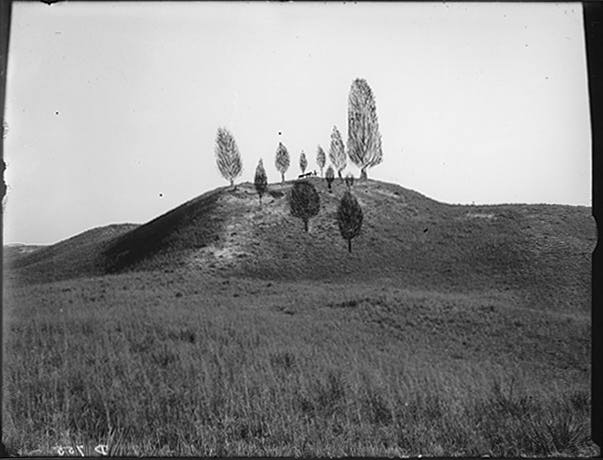
Image near the Snake River, Cherry County, Nebraska: “Lookout Point”. “This promontory in the near-mountainous sand hills of Cherry
County used to be covered with cedar trees, and was allegedly
a spot favored by horse thieves who could hide their booty in
the blowout at the top and shinny up a tree to keep a lookout
for the law. ” Evidently, the rise was completely bare when Butcher came to it in the 1890’s, finding not a tree on the site that the former horse thieves could hide behind. So, if you look (not even very) closely, it is clear that Mr. Butcher simply drew in the missing trees.
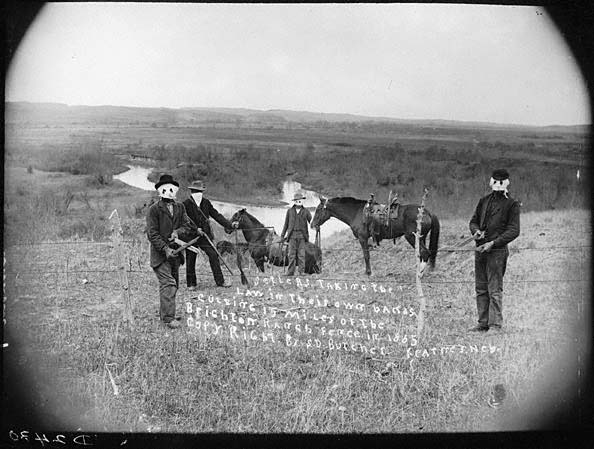
In another instance of re-creation, Butcher made a photo of ranch hands in the throes of destroying a barbwire fence. The fence would have belonged to a settler/homesteader, and represented nothing but a threat to the rancher’s way of life. The parceling of land in such a manner, when in the years previous the country had been nothing but millions of acres of free-to-the-horizon’s-next-horizon land, was a blasphemy to the rancher. But since making a photograph of a crime in progress was so rare and difficult (given the circumstances of, well, a crime being committed and the physical limitations of the photographic equipment), Butcher simply made the scene up, with wooden wire cutters and masks that no rancher or cowboy would wear.
JF Ptak Science Books Post 1914
Changing the Mind’s View of Simple and Complex Ideas via Different Image Perspectives
I’m always very interested in curious things, or standard, “average” things pictured in non-standard ways, as the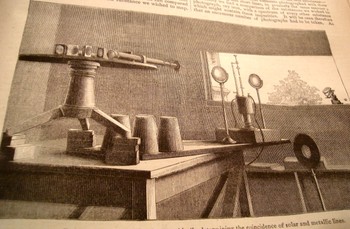
change in perspective can lead to entirely new observations and discovery. Seeing this illustration in an article by J. Norman Lockyer (Nature 1881) I was shocked by its clarity and usefulness—Lockyer was simply showing the arrangement of his apparatus for his solar spectrum experiments but the angle of observation (being at such an oblique angle as is normally found) was just, so, well, “correct”. The image I thought was perfect for the reader—not only that, it was designed artistically and with grace, and one can see exactly what Lockyer was up to. Diagrams would’ve worked almost as well, but there is just something so extraordinary here that you could just about work from the image if there was no description.
Looking at things differently is hard work—that’s why I think it is always good to refresh the neuronal sap and look at great examples of unusual , insightful imagery.
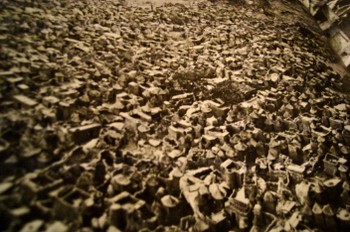
Sometimes it works to read the description of what the image is before actually viewing it to see the differences of the image that you form in your brain before seeing the thing itself. For example, when reading about the Dogon, a cliff-dwelling people of the plateau of Bandiagara, south of Tombouctou, and how they would make houses and then towns out of the rocks fallen from cliffs, you get what is probably a pretty benign image. When you see photographs of these structures it seems as though the brain just simply isn’t ready for their impossible nature, though you quickly, instantly, recover (once you convince yourself the photo is real) and—voila—your mind has been expanded. (This photo is from an expansive work by Bernard Rudofsky, Architectures without Architects, Doubleday, 1964.)
The (internally) spectacular Etienne Boullee can greet us in the same way with some of his eye-popping architectural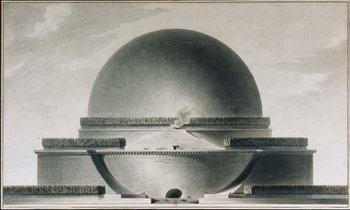
creations (unbuilt architecture by an architect, in this case, compared to the built architecture of the non-architects above). Boullee’s “Plan du Cenotaphe de Newton”, a gigantic memorial to Newton that was dancing with necessary privacy in Boullee’s brain during the French Revolution (and also during a particularly un-Newtonesque time in on-your-knees-to-Cartesian-principles France) is another superior example. Reading the description of the structure just doesn’t quite do, and it seems whatever grand comes of that is tarnished and stripped away by the obesely florid sentiment of none other than Ledoux’s poetic sentiments “…O Newton! Sublime Mind! Vast and profound genius! I conceived the idea of surrounding thee with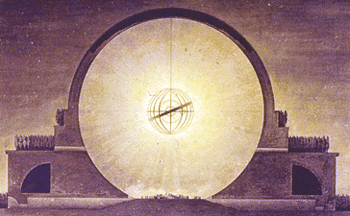
thy discovery…”. Oy. Boulle adds to this inspirational atrocity by saying of the sphere: “…we must speak of a grace that owes its being to an outline that is as soft and flowing as it is possible to imagine…” And once the demand of “oh dear god just please show me the picture” is met, we are left with a turned-around brain and another heavenly exaltation, or profanity. The Cenotaph is just Grand-Canyon-Spectacular.
Complex can turn on the simple in this way, where we can have those “a-ha” moments from, say, early efforts at picturing the fourth dimension or non-Euclidean geometry to a new perspective of looking at Roman ruins. The arrival on the non-Euclidean geometries in the 19th century posed new issues, not the least of which was representing the ideas. Our saintly Hermann von Helmholtz believed –contrary to most elevated opinions—that the human mind could indeed intuit complex space and figures of these geometries. (The difficulty not only from the obvious intellectual hardships in picturing the concepts but also because the geometry of Lobachevsky http://www-groups.dcs.st-and.ac.uk/~history/Mathematicians/Lobachevsky.html was called somewhat into doubt when some of its results were cast in doubt by contemporary astronomical observations.—and this even though so far as the great Gauss was concerned there was no deviation in Euclidean values.) Helmholtz did this by employing the three-dimensional pseudosphere model of Beltrami. (Reluctance to these ideas would end soon enough, for, as Linda Dalrymple Henderson points out with such sotto voce, “the convenience of Euclidean geometry would prove inadequate once Einstein” hit in 1905.)
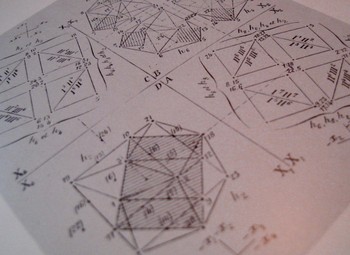
The work of Beltrami and H.P. Manning (Geometry of Four Dimensions, 1914), and Jouffret (Traite elementaire de geometrie a quarte dimensions, Paris 1903) in illustrating these complex ideas (the titles of which were in themselves daungting as with Jouffret’s “plane projections of the sixteen fundamental octahedrons of an ikosatettrhroid”) would in themselves prove to be entirely irresistible to the world of the arts. Charles Howard and Maurice Princet I think had as much to do with the creation of cubism and abstract art and the imaging of time than anyone, including the painter (I shudder to say his name) of Les Demoiselles (1907) or the lovely Georges Braque (Houses at Estaque, 1908) or Jean Metzinger or even the sublime comedian Duchamp’s Nude Descending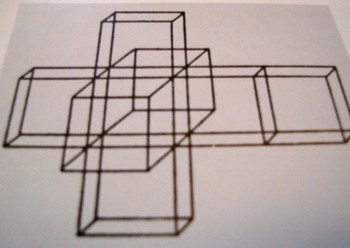
(1914). The hypercube starts to show up a lot in some Bauhaus genres and even into the palette of Frank Lloyd (“Stinky”) Wright (with his St. Mark’s Tower plan, NYC, 1929).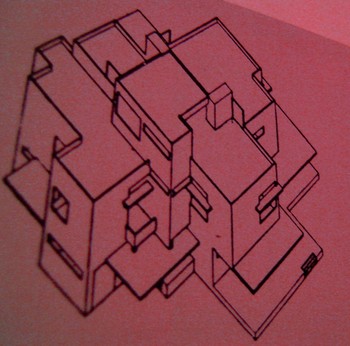 I can only imagine the shock to the brains of these creative geniuses in seeing the display of such a novel idea. (For the ultimate treatise on this see Linda Dalrymple Henderson’s The Fourth Dimension and Non Euclidean Geometry in Modern Art, Princeton 1983). And no the art didn’t come first.
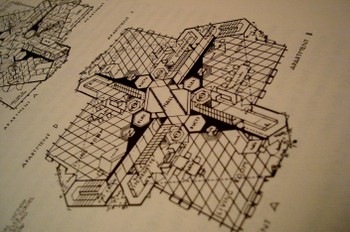
But coming back to the simple, and in the same frame as the first example that we mentioned in Lockyer, we have the unlikely find of Giovanni Piranesi. In my opinion his most spectacular work is found in his frammeni (the diverse bits and pieces of architectural and sculptural bric-a-brac found objects that are collected together on one stage) and in his archaeological detail. His attention to new perspective in showing the crucial aspects of structure and building in Rome is tremendous and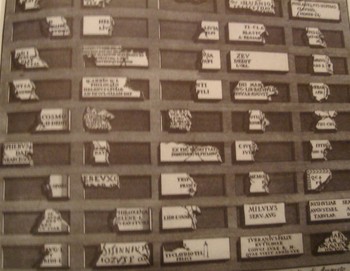
unexpected—as an example we see here the child’s-eye-height view of three steps of the reconstruction of the theatre of Pompey. I must say that I’ve seen a lot of architectural images in my time but nothing quite comes to me so surprisingly as this step-level view of the reconstruction of a Roman theatre, This happens throughout the lesser-known Piranesi, with great details of tools, and cross sections of the very deep 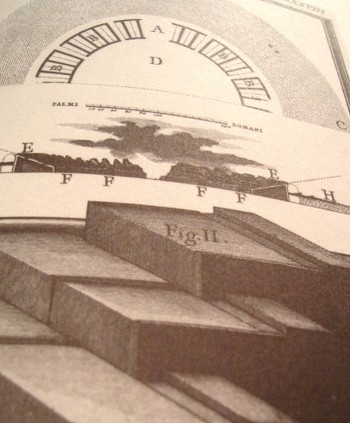
footings of bridges, and so on. It is really refreshing, lovely, unexpected work.
We’ll return to this subject from time to time as I have hundreds of interesting examples to draw from—for example, the remarkable Emily Vanderpoel’s Colour Problems (which has surfaced in this blog from time to time) which is ostensibly an undecipherable attempt to quantify color arrangement in art but through the lovely examples displaying this attempt pre-date the modern re-invention of non-representational art by at least a dozen years. Stay tuned! 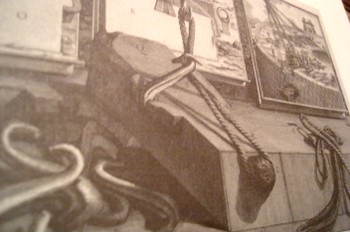
·Posted by :
·in:
JF Ptak Science Books Quick Post
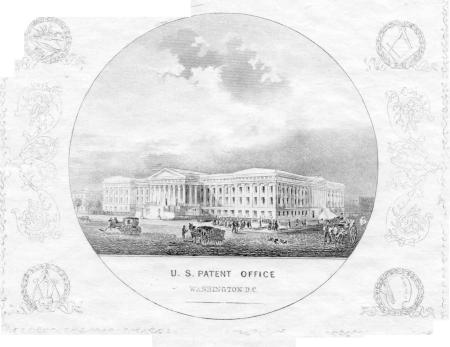
This is a simple tally of American patent numbers and the years in which they appeared. I’ve found this list handy from time to time and thought to repost it here. It is a lot easier to have this series posted here than have to wrangle he data out of the occasionally labyrinthine U.S.P.T.O.:
JF Ptak Science Books Post 1913
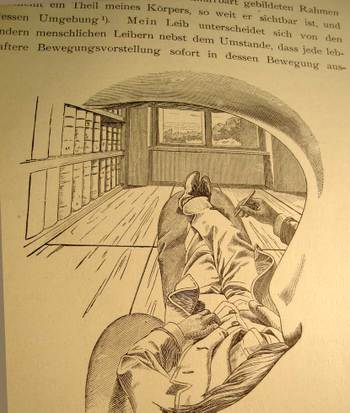
I cannot think of another illustration by a scientist or philosopher who attempts to explain their own, literal, view of the world and then offer what this looks like to the reader from inside his own head, looking out through his own eye. That’s exactly what Ernst Mach is doing right here on page 15 of his influential book Die Analyse der Empfindungen, the fourth German edition (“The Analysis of Sensations and the Relation of the Physical to the Pyschical”, published in Jena in 1903).
There is nothing in this world for Mach that is not admissible to the human brain that is not empirically verifiable–that is, the world is nothing but awash in sensation and that sensation itself forms part of the experience of, well, experience. I’ve actually never been interested in the philosophy of science, and this is one of the reasons why. Nevertheless I boldly break through my own prejudices to enjoy this phenomenally original image, drawn from the inside of Mach’s working mind, looking out through his eye socket, over his mustache, under his eyebrow, around his nose, out across his body and then leaping into the rest of the world. I think he does make his point about the essential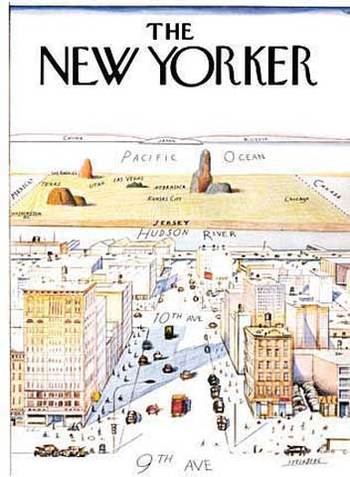
nature of the observer. And much like the classic Steinberg New Yorker cartoon of the world view of the New Yorker (of course this includes only Manhattan), I know some number of people who have transposed their bodies much like Herr Mach into the Steinberg map–except that their worldview ends basically at the Hudson River (Mach’s feet) with the rest of the world being the sliver out there beyond the river (Mach’s window) until you go 359 degrees around the world to get back to the East River (and back inside Mach’s noggin). It is an unusual world view to have, but someone has to have it so that we can at least identify it so.
I just like the picture.
(Section 10, describing this image, with translation by C M Williams and Sydney Waterlow from the blessed Dover people in 1959):
“The considerations just advanced, expressed as they have been in an abstract form, will gain in strength and vividness if we consider the concrete facts from which they flow. Thus, I lie upon my sofa. If I close my right eye, the picture represented in the accompanying cut is presented to my left eye In a frame formed by the ridge of my eyebrow, by my nose, and by my moustache, appears a part of my body, so far as visible, with 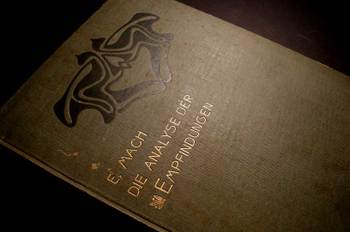
its environment. My body differs from other human bodies – beyond the fact that every intense motor idea is immediately expressed by a movement of it, and that, if it is touched, more striking changes are determined than if other bodies are touched – by the circumstance, that it is only seen piecemeal, and, especially, is seen without a head. If I observe an element A within my field of vision, and investigate its connexion with another element B within the same field, I step out of the domain of physics into that of physiology or psychology, provided B, to use the apposite expression of a friend of mine made upon seeing this drawing, passes through my skin. Reflexions like that for the field of vision may be made with regard to the province of touch and the perceptual domains of the other senses.”
JF PTak Science Books Daily Dose of Dr. Odd
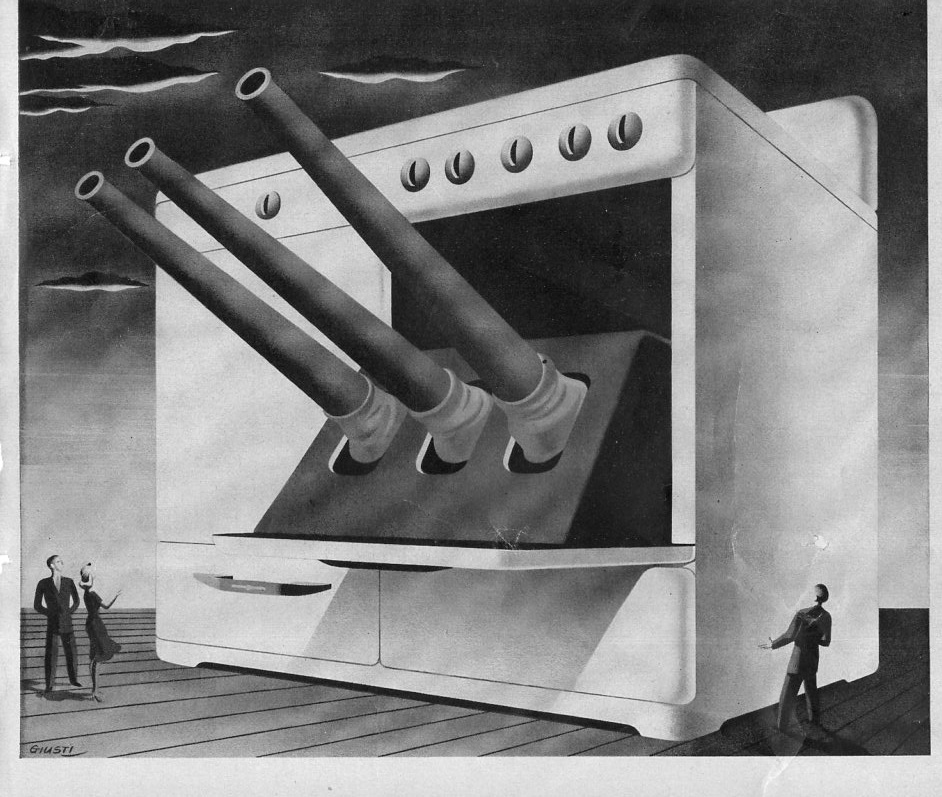
Having made a casual stroll through LIFE magazine during the War Years (1939-1945) it seems to me as a general observation that there wasn’t that much attention paid to covering the war until 1942. Then there was gradual coverage from January ’42 to the summer of 1942, when things really started to pick up for American involvement–of course there was the Japanese invasion of China earlier than that in the Sino-Japanese War of 1935-1945, and most of the rest of Europe and the U.K. had been busy fighting Germany since the autumn of 1939, and then the Soviets were brutally brought into the war following the abrogation of their on-aggression pact with the Nazis in 1940.
The U.S. during those early years was having a very difficult national dialog about how America should deal with the conflict, a conversation that wasn’t turned into a great national monologue until 7 December 1941. Anyway, its my impression that war coverage in the nation’s premier picture magazine was fairly skimpy until 1942. By 1943, it was, in a way, all-war-all-of-the-time in the magazine’s pages, and in the ads as well. Suddenly (over the course of 15 months or something like that), relatively benign products like Ronson lighters sold themselves on their “being able to take it”, with squinty-eyed sailors lighting their cigs with the war-tough Ronson; Mrs. Don Ameche was selling Coleman’s Mustard with a war flavoring, underwear ads used Hitler’s name to sell their product, and so on. (These examples appeared on just two consecutive pages.) Use of the war in advertising appears in the Brit equivalent of LIFE, the Illustrated London News, but less so; in Germany, the Illustrirte Zeitung (Leipzig), the most popular popular-illustrated-read in that country, also featured war-based ads, but far less frequently. (Also the war coverage in that journal wasn’t nearly as frequent as in th eother two; and from my experience, as sanitized as the other two mags were, there was never any bad military news in the Illus Zeitung that I could see. Maybe ever. Certainly Hitler wasn’t taking about it, even when he was sacrificing entire armies to the Soviets and Mother Winter.)
So. What does this mean? I don’t know, not really. If the company was doing something for the war effort, and they advertised in LIFE, then the readers of that mag were going to know about it. On the other hand, if the company produced underwear and seemed to really have nothing to do with the conduct of the war, they were wrapping their product up in a kill-Hitler ribbon as well. Was this “bad”? Das machts nichts. It is interesting, though, but I really don’t know how it is interesting beyond knowing that it is.
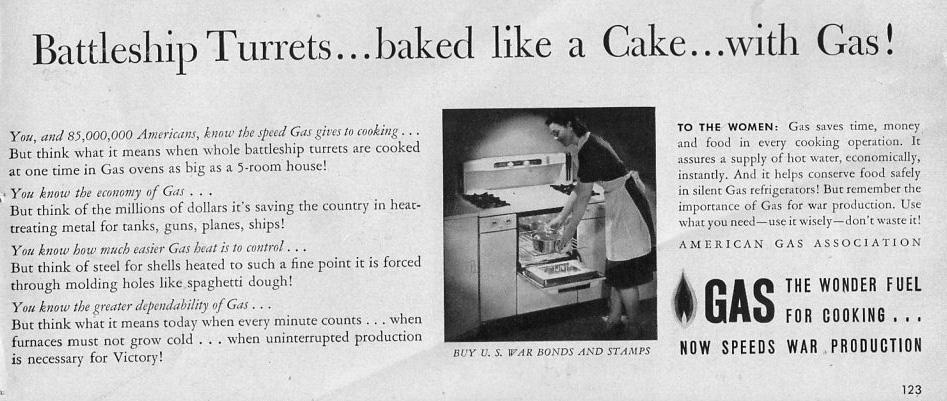
Caveat: even though I’ve breezed through all of these magazines for the war years out in the warehouse, doing that rather than Doing Something Else, my grazing was not exactly an experimental undertaking. My observations are just general observations that seeped into me from a six-foot pile of war mags.)
SInce we’re in the beginning of the 150th anniversary of the war I thought to put together a handy list of battles–I think ‘ve seen one elsewhere but really I cannot recall the locatiion, so I cobbled together a fast-and-dirty alpha list to have on hand.
Alphabetical Listing of Major Civil War Campaigns, by Battle
Allatoona Georgia October 5, 1864
Amelia Springs Virginia April 5, 1865
Antietam / Sharpsburg Maryland September 16-18, 1862
Appomattox Station Virginia April 8, 1865
Appomattox Court House Virginia April 9, 1865
Aquia Creek Virginia May 29-June 1, 1861
Arkansas Post / Fort Hindman Arkansas January 9-11, 1863
Atlanta Georgia July 22, 1864
Athens Alabama January 26, 1864
Averasborough / Smiths Ferry / Black River North Carolina March 16, 1865
Auburn / Catlett’s Station / St. Stephen’s Church Virginia October 13, 1863
Auburn / Coffee Hill Virginia October 14, 1863
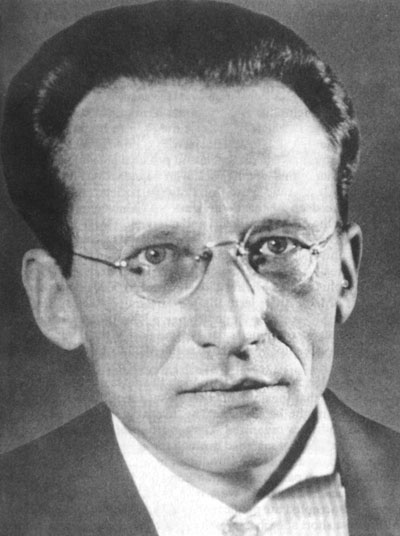
1914 ANNALEN DER PHYSIK 44 (14): 916-934
Schrodinger E
The dynamics of elastically coupled point systems
1914 PHYSIKALISCHE ZEITSCHRIFT 15: 79-86
Schrodinger E
Acidity which produces interference patterns with x-rays.
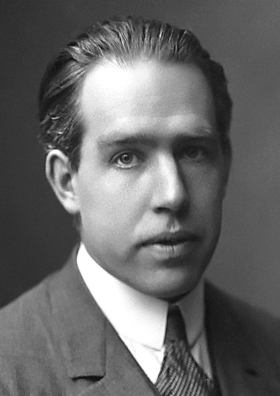
Niels Bohr Works, 1909-1955. This list is assembled from the data from the HistCite of the Garfield Library of the University of Pennsylvania.
1909 PHILOSOPHICAL TRANSACTIONS OF THE ROYAL SOCIETY OF LONDON SERIES A-CONTAINING PAPERS OF A MATHEMATICAL OR PHYSICAL CHARACTER 209: 281-317
Bohr N
Determination of the surface-tension of water by the method of jet vibration
1910 PROCEEDINGS OF THE ROYAL SOCIETY OF LONDON SERIES A-CONTAINING PAPERS OF A MATHEMATICAL AND PHYSICAL CHARACTER 89 (572): 395-403
Bohr N
On the determination of the tension of a recently formed water-surface.
JF Ptak Science Books
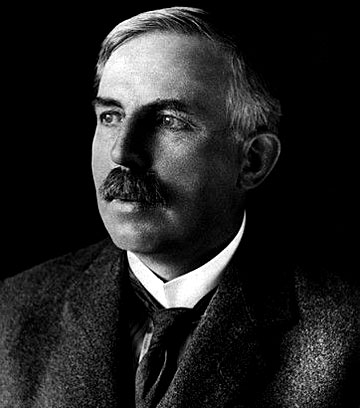
1900 PHYSIKALISCHE
ZEITSCHRIFT 1: 347-348
Rutherford, E
Concerning radioactive thorium compounds
1900 PHYSIKALISCHE ZEITSCHRIFT 2: 53-55
Rutherford E; Kling RKM
The energy of the becquerel-and x-rays and the necessary energy for the
production of ions in gases.