JF Ptak Science Books Quick Post Zoomology Series
This is a short visit with one of Dorothea Lange’s (who I’ve written about several times on this blog, as in this case) interesting FSA photographs.

A Daily History of Holes, Dots, Lines, Science, History, Math, Physics, Art, the Unintentional Absurd, Architecture, Maps, Data Visualization, Blank and Missing Things, and so on. |1.6 million words, 7500 images, 4.9 million hits| Press & appearances in The Times, Le Figaro, Mensa, The Economist, The Guardian, Discovery News, Slate, Le Monde, Sci American Blogs, Le Pont, and many other places… 5000+ total posts since 2008.
Contact johnfptak at gmail dot com
JF Ptak Science Books Quick Post Zoomology Series
This is a short visit with one of Dorothea Lange’s (who I’ve written about several times on this blog, as in this case) interesting FSA photographs.
·Posted by :
·in:
JF Ptak Science Books Quick Post Some examples from the uncollected series on Looking Straight Down can be found here and here.
I’ve been involved in this blog at retrieving and tabulating antique images that look straight down on something. Today I imagine that we all take these sorts of views for granted, what with satellite images and Google Earth and airplanes and all. But in the pre-heavier-than-air era, seeing a published image that looked straight down from a height was quite rare. (And it needs to be strait down, not a bird’s-eye view. Things are very different between looking obliquely from an airplane window onto a cityscape than skydiving directly down on top of it.)
Benjamin Franklin had long been thinking about waterspouts, going back at least to the early 1750’s, though he did not have an article about them in print until the appearance of “Physical and Meteorological Observations: Conjectures and Suppositions” in the Royal Society’s Philosophical Transactions, LV (1765). The first image that I’ve been able to find of the waterspout occurs in 1774, though a prettier version of it is reworked a little, but with sharper delineations, in 1818:
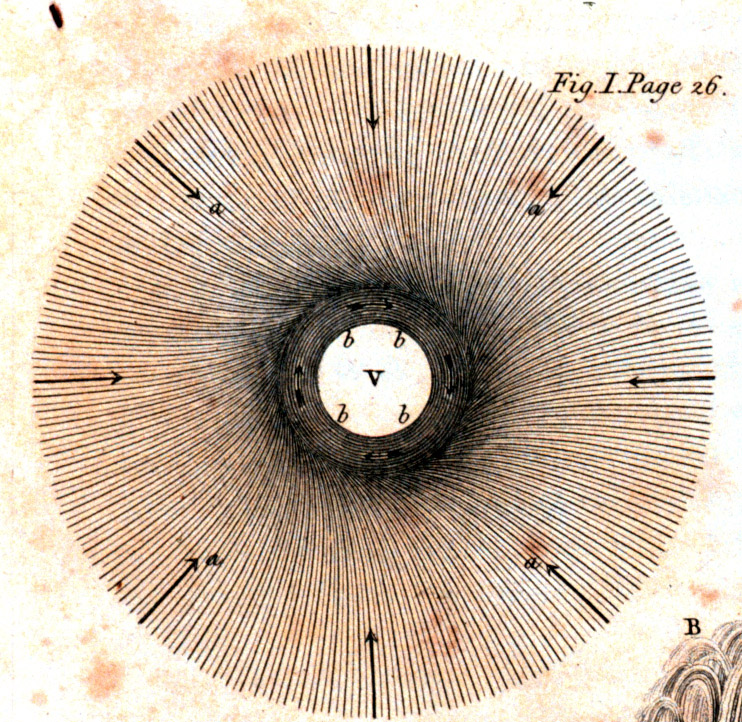
Here’s the full image (with a magic square that related to another article in the volume):
·Posted by :
·in:
JF Ptak Science Books Post 1909
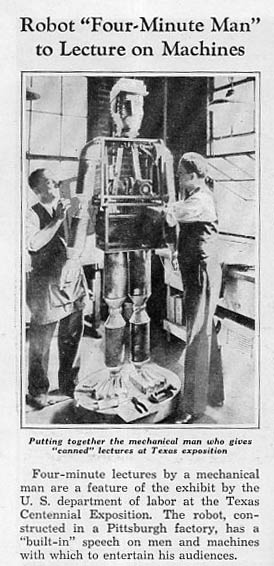
[Image source: Popular Mechanics, September 1936, page 400.]
Robots, or mechanical beings, or mechanized forms of humanity or from the animal kingdom have been around in popular literature for many decades by the time this giant robot appeared in Texas in 19361. (The idea is old though the name “robot” didn’t appear until Karel Capek invented it for his book on the future called R.U.R in 1920. Actually the human-like forms created by Capek in this early scifi work were biotech, and not fully mechanized.) The form of the robot stretches back hundreds of years, in a way–if not the exactly the idea of a robot, but at least with the appearance of one.
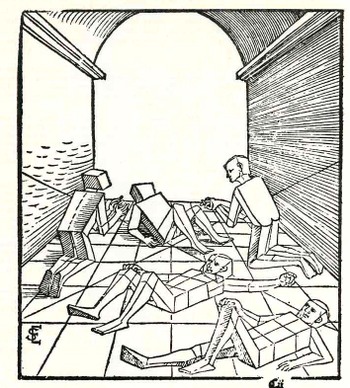
Such is the case with Albrecht Durer’s (1471-1528) revolutionary drawing of a geometrical man, compartmentalizing the bodyd into distinct chunks–these and other woodcuts appeared in his Symmetria partium…humanorum corporum and must have been an amazing, startling site for the new reader to such things in 1537.To me this looks like visionary thinking in trying to understand the motions of living beings with no actual way of capturing the image in motion.
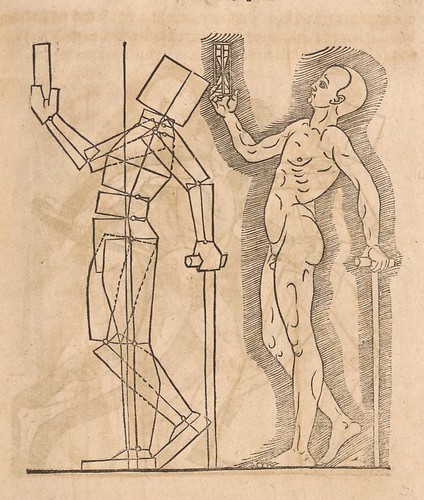
[This and many other images from the fabulous Bibliodyssey website, here.]
All of which are retro-reminiscent of early robots, like this from The Fantast in 1939:
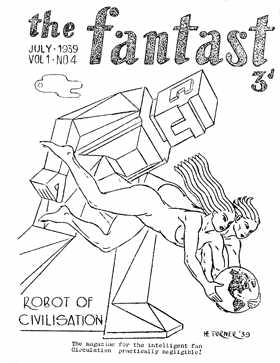 [Image source: the wonderful Cybernetic Zoo website, with loads of images and timelines, here.]
Seven years late in Nuremberg Erhard Schoen published Unnderweissung der proportzion unnd stellung der possen, liegent und stehent…, which followed Durer showing that the human form was reducible to connected but discrete Euclidean solids:
·Posted by :
·in:
JF Ptak Science Books Quick Post
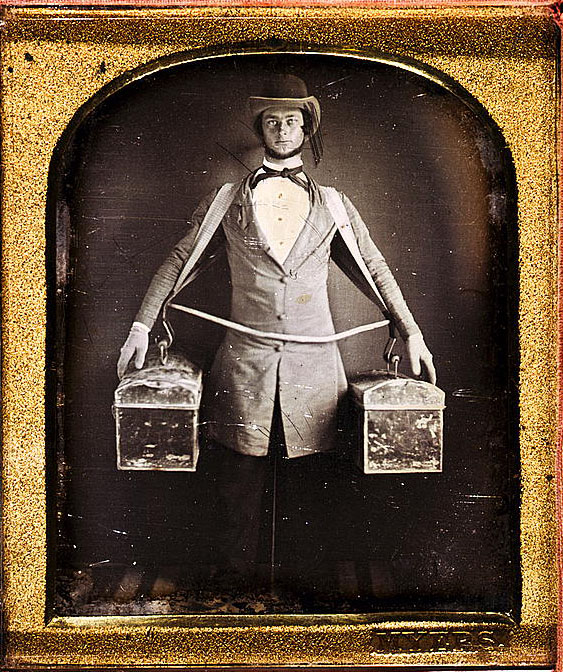
These images from the Library of Congress daguerreotype collection offer a photographic glimpse into the everyday working life of Americans 150 years ago. Not as many of these jobs are as extinct as their expectations for extinction:
Peddler
JF Ptak Science Books Quick Post
This stark issue of LIFE magazine listed the names, photographs and ages of 242 American soldiers killed in Vietnam in one week in June, 1969. There were no statistics; this was a picture story of tragedy, an out-of-the-ordinary event for the popular image magaine. I did go through the numbers to get a sense of the ages of those very young-looking faces: of the 242 killed, 23% were teenagers; 73% were 21 and under, and 81% were 22 and under. As our 9 year old said when she asked me and then got her answer about what I was working with on the calculator, “that’s very young to be dead”.

I went through the issue and tabulated all of the ages of the dead young men. The average age of the soldiers killed during this week was 21.06.
Age 18: 17 killed. Age 19: 40 Age 20: 79 Age 21: 41. Age 22: 20. Age 23: 11. Age 24: 7. Age 25: 8. Age 26: 6. Age 27: 2. After that, from age 28 onwards, there is one dead per each age (28, 30, 31, 33, 35, 36, 37, 40, 45). These 242 deaths were .004% of all American soldiers killed during the war.
I was 13 in 1969 and wanted the war to end in a hurry.
There was no telling the average age of Vietnamese soldiers North or South, just that there were more of them dead than American soldiers. At one point in time this was the way in which the winning side in Vietnam could be judged by political types in the U.S.–the smaller piles of dead bodies indicated the winning side. 58,800 American soldiers were killed there. According to American sources, between 1 and 2 million Vietnamese soldiers and civilians were killed, North and South; Vietnamese sources say that the figure is closer to 3 million (for a country with a total population of about 38 million, or about 10%).
By August 1969, the Gallup Poll showed that 68% of Americans thought it was a mistake for the U.S. to be fighting in Vietnam (source here, though some other polls show the figure at 58%). In the year 2000, about 70% thought it was a mistake to send in the troops. I don’t know about that other 30%.
Read more: http://life.time.com/history/faces-of-the-american-dead-in-vietnam-one-weeks-toll/#ixzz28wjbdOn0
JF Ptak Science Books Quick Post
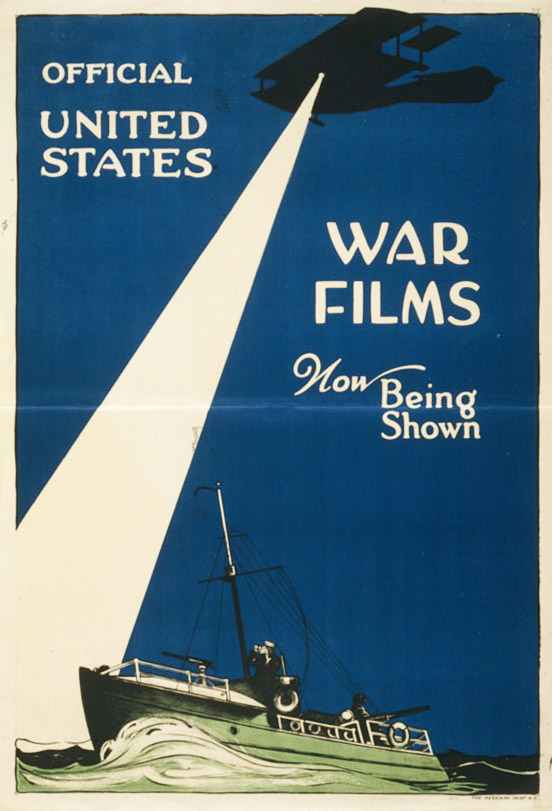
Although electric lamps/searchlights have been militarily used on land and sea since the 1880’s (at least), it is still unusual to see light itself displayed as a weapon in a poster. This is especially true when the light is airborne and in real, in-potential-use applications. An earlier image appears in the Illustrated London News of a giant airship illuminating a battlefield, but it is a rather futuristic view of the employment of light as a weapon, and didn’t quite come about as an effective tool. (As much as the airship would illuminate of the opponent’s night-time position, it also made itself extraordinarily vulnerable–lighting up your enemy’s position just didn’t make for a practical idea, especially when the notions of bombing and night bombing came into being.)
In this first image below, there is a strong beam emanating from an aircraft in 1917–how it is generating such light, and whether it was conceivable to have it light enough to be on the aircraft, I don’t know.
Conversely, the searchlight coming from the military (battle-)ship could certainly have supported the machinery to produce any number of effort, though it seems again to be counter-productive, establishing itself as a not particularly fast-moving target to anything on the sea or above (or below) it.
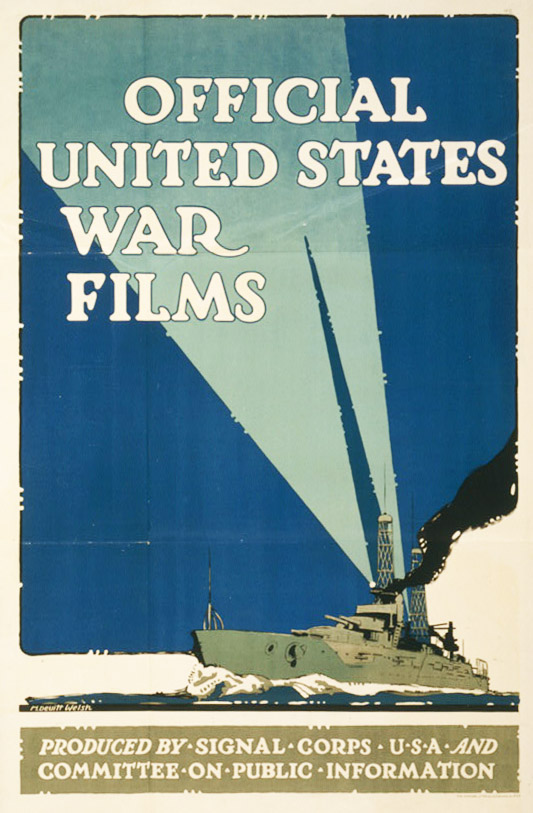
On the other hand, this Swedish movie poster seems to have put the idea to good use (source, here):
JF Ptak Science Books Quick Post
Barbed wire was one of the most successful and horrifying defensive weapons of World War I. In 1915 it was made more effective yet by adding high-voltage electricity to the emplacements. In general the electrical barbed wire fence was employed as only a tiny fraction of all wire fences during the war–as the non-electrified fence was already extremely effective, very cheap to produce and very easily installed–but the possibility of finding an electrified wire somewhere along the lengthy rat’s nests of miles and miles of this thing must’ve had some sort of very major weight in most soldiers’ minds.
The following image (and details) from The Illustrated London News for 9 October 1915:
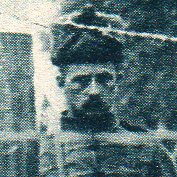
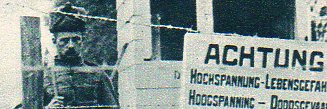
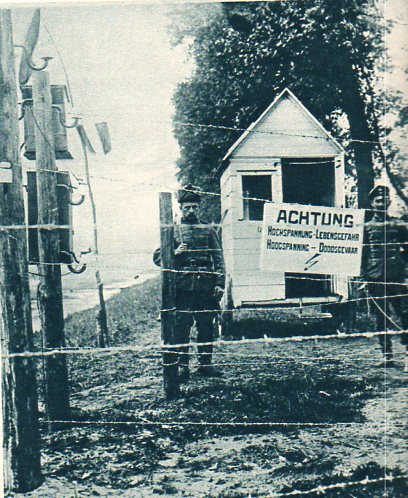
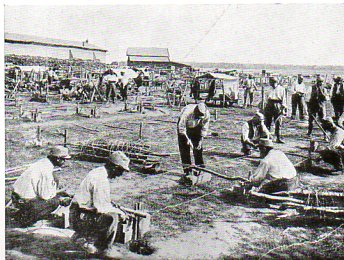
And the places where the barbed wire was made and packaged, again from The Illustrated London News for 16 October 1915.
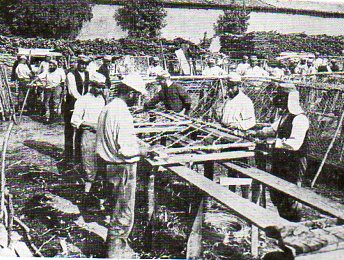
It looks as though the wire was stretched across 3.5 foot poles, with the barbed wire added diagonally, and then rolled up in long sections for easy transport and deployment.
JF Ptak Science Books Quick Post

Here’s another Massive Mosaic display (following up on a Massive 500-Daguerretotype display, here), this one utilizing (linked!) thumbnails from he Library of Congress WPA Poster Collection, located here.
The WPA was the Works Progress Administration, the largest of the New Deal agencies, and it was designed to give paid jobs to the millions of people who were out of work during the Great Depression. From 1935-1943 the WPA put some 8.5 million people to work in a vast social undertaking, distributing food and clothing, building houses, roads, bridges, parks and making enormous construction improvements to the national infrastructure. There was also an arts art to the project which employed many thousnads of artists, actors and writers in producing dramas, histories, guidebooks and other sorts of artistic projects, including the artwork for the posters advertising other WPA projects.
“During its 8-year history, the WPA built
651,087 miles of highways, roads, and streets; and constructed, repaired, or
improved 124,031 bridges, 125,110 public buildings, 8,192 parks, and 853
airport landing fields.”–Indiana University’Lily Library, here.
During its lifetime the WPA spent about $12 billion, which worked out to be something like 4-6% of the GDP, annually. To put this in some perspective, that would be like taking the entire amount of money spent on the war on terror over the past 11 years and investing it all in caring for the poor and fixing bridges and building roads and so forth…I roundly reckon that figure to be about $8 trillion dollars that would have been spent on domestic issues rather than fighting wars This is about $80k/per capita, or $320k/family of four, which is somewhere around what the MacArthur folks receive–so basically the war money is the sly equivalent of a Genius Award granted to each and every family.
Historical GDP numbers, here, from
 |
 |
 |
 |
 |
 |
 |
 |
 |
 |
 |
 |
 |
 |
 |
 |
 |
 |
 |
 |
 |
 |
 |
 |
 |
 |
 |
 |
 |
 |
 |
 |
 |
 |
 |
 |
 |
 |
 |
 |
 |
 |
 |
 |
 |
 |
 |
 |
 |
 |
 |
 |
 |
 |
 |
 |
 |
 |
 |
 |
 |
 |
 |
 |
 |
 |
 |
 |
 |
 |
 |
 |
 |
 |
 |
 |
 |
 |
 |
 |
 |
 |
 |
 |
 |
 |
 |
 |
 |
 |
 |
 |
 |
 |
 |
 |
 |
 |
 |
 |
 |
 |
 |
 |
 |
 |
 |
 |
 |
 |
 |
 |
 |
 |
 |
 |
 |
 |
 |
 |
 |
 |
 |
 |
 |
 |
 |
 |
 |
 |
 |
 |
 |
 |
 |
 |
 |
 |
 |
 |
 |
 |
 |
 |
 |
 |
 |
 |
 |
 |
 |
 |
 |
 |
 |
 |
 |
 |
 |
 |
 |
 |
 |
 |
 |
 |
 |
 |
 |
 |
 |
 |
 |
 |
 |
 |
 |
 |
 |
 |
 |
 |
 |
 |
 |
 |
 |
 |
 |
 |
 |
 |
 |
 |
 |
 |
 |
 |
 |
 |
 |
 |
 |
 |
 |
 |
 |
 |
 |
 |
 |
 |
 |
 |
 |
 |
 |
 |
 |
 |
 |
 |
 |
 |
 |
 |
 |
 |
 |
 |
 |
 |
 |
 |
 |
 |
 |
 |
 |
 |
 |
 |
 |
 |
 |
 |
 |
 |
 |
 |
 |
 |
 |
 |
 |
 |
 |
 |
 |
 |
 |
 |
 |
 |
 |
 |
 |
 |
 |
 |
 |
 |
 |
 |
 |
 |
 |
 |
 |
 |
 |
 |
 |
 |
 |
 |
 |
 |
 |
 |
 |
 |
 |
 |
 |
 |
 |
 |
 |
 |
 |
 |
 |
 |
 |
 |
 |
 |
 |
 |
 |
 |
 |
 |
 |
 |
 |
 |
 |
 |
 |
 |
 |
 |
 |
 |
 |
 |
 |
 |
 |
 |
 |
 |
 |
 |
 |
 |
 |
 |
 |
 |
 |
 |
 |
 |
 |
 |
 |
 |
 |
 |
 |
 |
 |
 |
 |
 |
 |
 |
 |
 |
 |
 |
 |
 |
 |
 |
 |
 |
 |
 |
 |
 |
 |
 |
 |
 |
 |
 |
 |
 |
 |
 |
 |
 |
 |
 |
 |
 |
 |
 |
 |
 |
 |
 |
 |
 |
 |
 |
 |
 |
 |
 |
 |
 |
 |
 |
 |
 |
 |
 |
 |
 |
 |
 |
 |
 |
 |
 |
 |
 |
 |
 |
 |
 |
 |
 |
 |
 |
 |
 |
 |
 |
 |
 |
 |
 |
 |
 |
 |
 |
 |
 |
 |
 |
 |
 |
 |
 |
 |
 |
 |
 |
 |
 |
 |
 |
 |
 |
 |
 |
 |
 |
 |
 |
 |
 |
 |
 |
 |
 |
 |
 |
 |
 |
 |
 |
 |
 |
 |
 |
 |
 |
 |
 |
 |
 |
 |
 |
 |
 |
 |
 |
 |
 |
 |
 |
 |
 |
 |
 |
 |
 |
 |
 |
 |
 |
 |
 |
 |
 |
 |
 |
 |
 |
 |
 |
 |
 |
 |
 |
 |
 |
 |
 |
 |
 |
 |
 |
 |
 |
 |
 |
 |
 |
 |
 |
 |
 |
 |
 |
 |
 |
 |
 |
 |
 |
 |
 |
 |
 |
 |
 |
 |
 |
 |
 |
 |
 |
 |
 |
 |
 |
 |
 |
 |
 |
 |
 |
 |
 |
 |
 |
 |
 |
 |
 |
 |
 |
 |
 |
 |
 |
 |
 |
 |
 |
 |
 |
 |
 |
 |
 |
 |
 |
 |
 |
 |
 |
 |
 |
 |
 |
 |
 |
 |
 |
 |
 |
 |
 |
 |
 |
 |
 |
 |
 |
 |
 |
 |
 |
 |
 |
 |
 |
 |
 |
 |
 |
 |
 |
 |
 |
 |
 |
 |
 |
 |
 |
 |
 |
 |
 |
 |
 |
 |
 |
 |
 |
 |
 |
 |
 |
 |
 |
 |
 |
 |
 |
 |
 |
 |
 |
 |
 |
 |
 |
 |
 |
 |
 |
 |
 |
 |
 |
 |
 |
 |
 |
 |
 |
 |
 |
 |
 |
 |
 |
 |
 |
 |
 |
 |
 |
 |
 |
 |
 |
 |
 |
 |
 |
 |
 |
 |
 |
 |
 |
 |
 |
 |
 |
 |
 |
 |
 |
 |
 |
 |
 |
 |
 |
 |
 |
 |
 |
 |
 |
 |
 |
 |
 |
 |
 |
 |
 |
 |
 |
 |
 |
 |
 |
 |
 |
 |
 |
 |
 |
 |
 |
 |
 |
 |
 |
 |
 |
 |
 |
 |
 |
 |
 |
 |
 |
 |
 |
 |
 |
 |
 |
 |
 |
 |
 |
 |
 |
 |
 |
 |
 |
 |
 |
 |
 |
 |
 |
 |
 |
 |
 |
 |
 |
 |
 |
 |
 |
 |
 |
 |
 |
 |
 |
 |
 |
 |
 |
 |
 |
 |
 |
 |
 |
 |
 |
 |
 |
 |
 |
 |
 |
 |
 |
 |
 |
 |
 |
 |
 |
 |
 |
 |
 |
 |
 |
 |
 |
 |
 |
 |
 |
 |
 |
 |
 |
 |
 |
 |
 |
 |
 |
 |
 |
 |
 |
 |
 |
 |
 |
 |
 |
 |
 |
 |
 |
 |
 |
 |
 |
 |
 |
 |
 |
 |
 |
 |
 |
 |
 |
 |
 |
 |
 |
 |
 |
 |
 |
 |
 |
 |
 |
 |
 |
 |
 |
 |
 |
 |
 |
 |
 |
JF Ptak Science Books Quick Post
This is a continuation of sort of this morning’s post, “Massive 500-Daguerreotype Mosaic“, though this one concentrates on the sumptuous ruination and decay that has occurred within and to some of these photographic images. I’ve looked closely at only five of these images, and within each of these five images there are five more. And, if you manipulated the largest downloadable file of these (which range up to about 150 megs), there are five more within the five within the five. And all that before you start to imagine the artistic fantasies int he non-representational forms, and that before adding color. So five is all that will be here, for the present.

JF Ptak Science Books Quick Post
I take no credit whatsoever for the images below–they are all from the fabulous Library of Congress site, specifically from their daguerreotype collection of portraits. I simply wanted to see what they all might look like as a continuous mosaic, and I think the result is pretty remarkable, even given the limitations of my (soon to be rectified with WordPress) limited Typepad account.
,Each image is clickable, linked to the Library of Congress site, with full explanation and catalog entry, and also with expanded choices for expanding the image.
 |
 |
 |
 |
 |
 |
 |
 |
 |
 |
 |
 |
 |
 |
 |
 |
 |
 |
 |
 |
 |
 |
 |
 |
 |
 |
 |
 |
 |
 |
 |
 |
 |
 |
 |
 |
 |
 |
 |
 |
 |
 |
 |
 |
 |
 |
 |
 |
 |
 |
 |
 |
 |
 |
 |
 |
 |
 |
 |
 |
 |
 |
 |
 |
 |
 |
 |
 |
 |
 |
 |
 |
 |
 |
 |
 |
 |
 |
 |
 |
 |
 |
 |
 |
 |
 |
 |
 |
 |
 |
 |
 |
 |
 |
 |
 |
 |
 |
 |
 |


