A Daily History of Holes, Dots, Lines, Science, History, Math, Physics, Art, the Unintentional Absurd, Architecture, Maps, Data Visualization, Blank and Missing Things, and so on. |1.6 million words, 7500 images, 4.9 million hits| Press & appearances in The Times, Le Figaro, Mensa, The Economist, The Guardian, Discovery News, Slate, Le Monde, Sci American Blogs, Le Pont, and many other places… 5000+ total posts since 2008.

Author: JF Ptak

  • Unusual WWII Maps by a Significant Soviet Intelligence Agent

    JF Ptak Science Books  

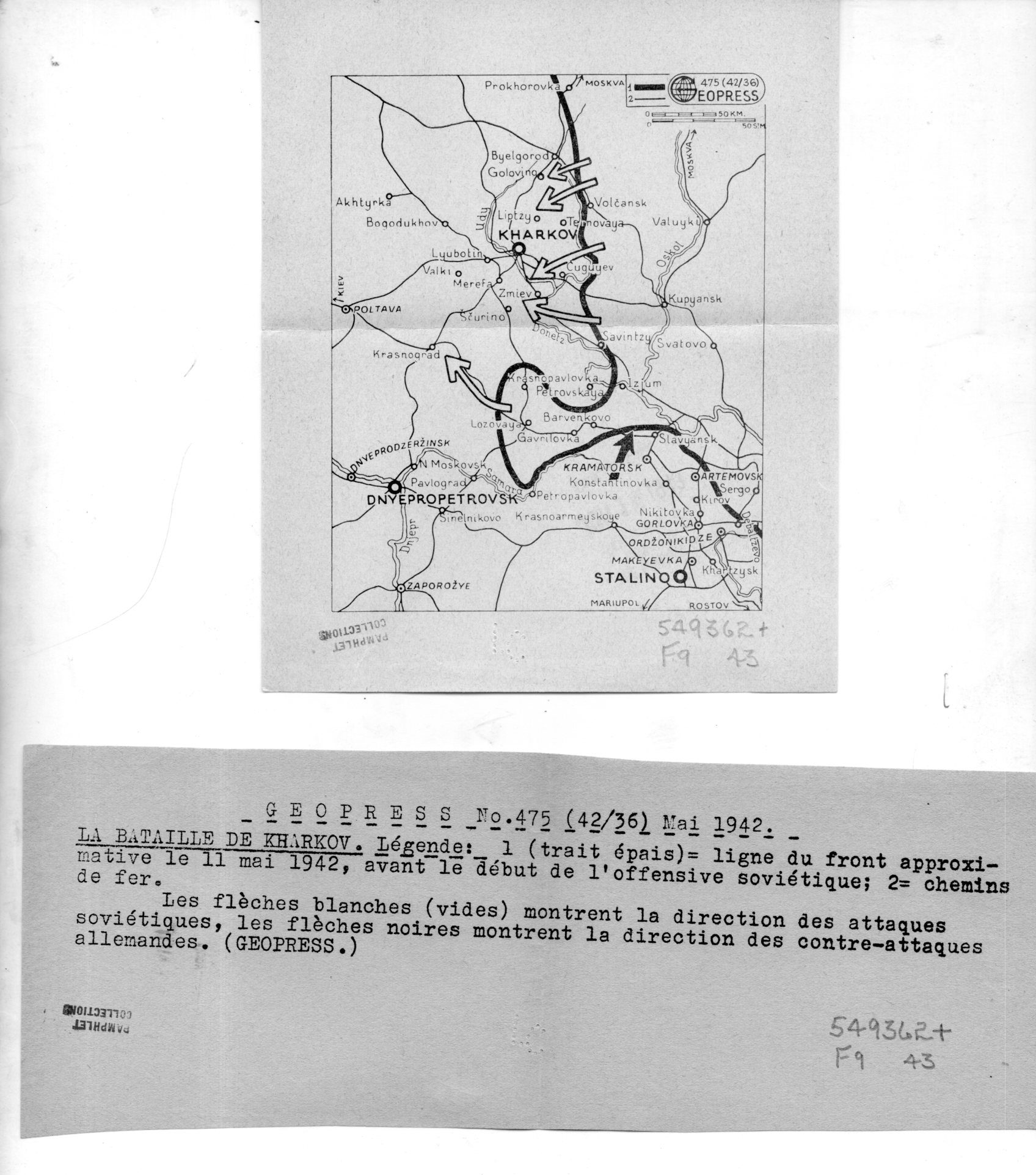
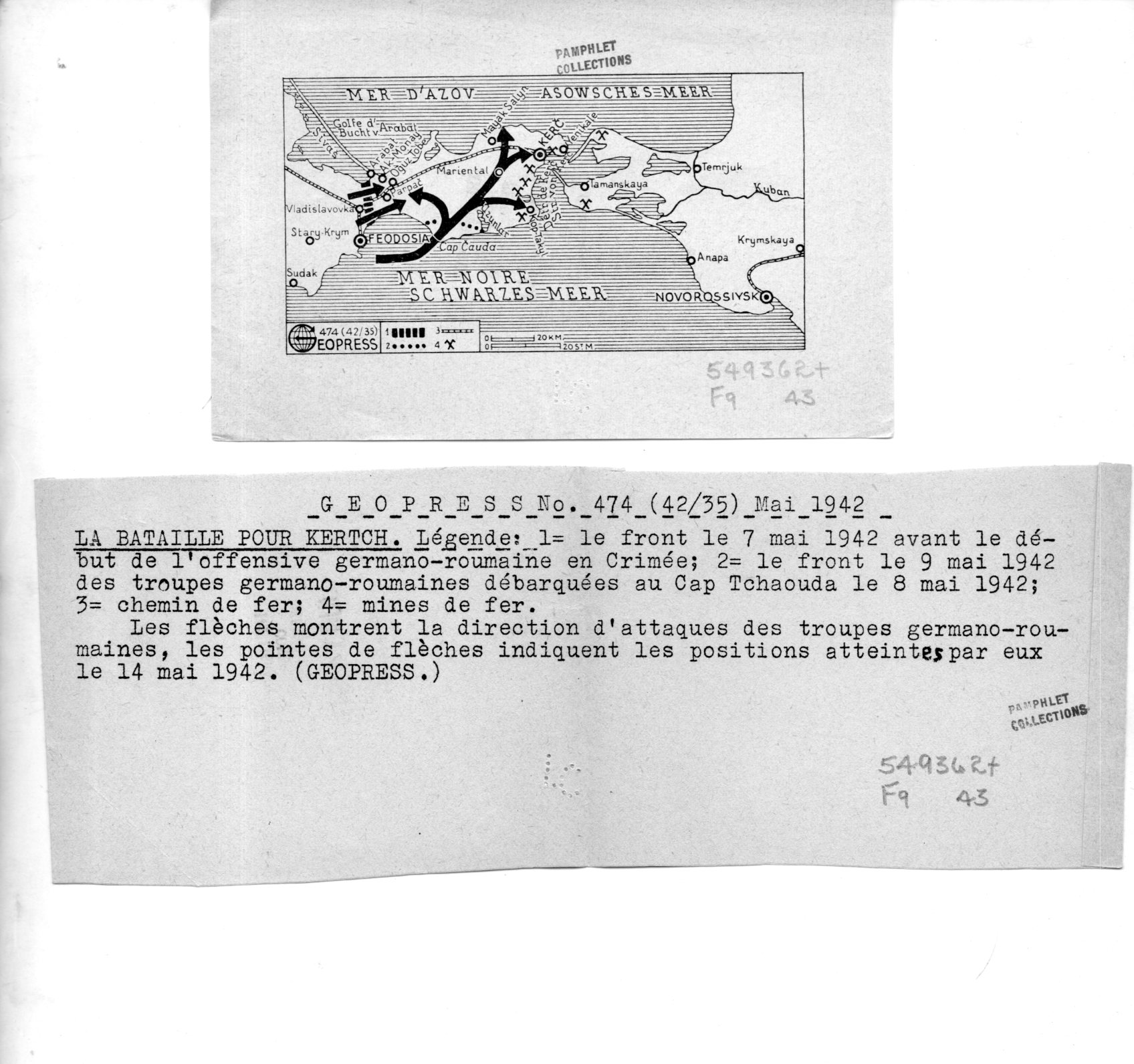
    I’ve found a number of interesting maps in the pamphlet collection here–these are highly unusual to my experience in that they were the work of a firm called “Geopress”, which was an active business and cover for a significant intelligence agent for the Soviet Union, operating in Switzerland, collecting data relating to German activities during WWII. There’s nothing I can add beyond the information that I quote extensively below from the CIA website on Rado–except that I cannot find images/examples of his Geopress work. So it seems the most efficient thing to do here is to simply quote the known sources and reproduce the images of the 18 maps and their accompanying texts.  
    Geopress _4_080

    As I said Rado operated Geopress as a news/cartographic service, and Rado was an accomplished cartographer, so the mans in and off themselves as maps are perhaps not a singular issue.  Their evident scarcity, however, does seem to be an issue. Also I do not understand why these maps are so small, some of which are just 1″x 3″; also the uneven;y cut/torn text sheets that are made to accompany the maps are also puzzling in their own way.  I do not understand the format–someone out there in Weblandia no doubt will.  

    All of the maps shown below are from 1942. They were received by the Library of Congress in June 1943 and stamped so on the backs of the maps.  (They lived for some time in the “Pamphlet Collection” at the LC before being purchased by me in 1998.)  

    The following quotes come from the CIA website, the Center for the Study of Intelligence, here:  https://www.cia.gov/library/center-for-the-study-of-intelligence/kent-csi/vol12i3/html/v12i3a05p_0001.htm]

     “Alexander (Sandor) Rado, Alexander Foote’s chief in the Swiss-based “Rote Drei” net that in 1941-43 supplied Moscow with detailed information on German order of battle… His activity in intelligence, mapping, and related fields has lasted nearly 50 years and may earn him a place in the pantheon of major intelligence figures of the times.”

    And this:

    “In 1936 or 1937, with Soviet funds and having a Swiss citizen as silent partner, Rado organized Geopress, a news agency specializing as Inpress had in maps and geographic background data. Geopress was more successful than Inpress because of better organization and the increased demand for news maps in the advancing shadows of World War II. As cover for an intelligence operation it proved ideal. Its normal activity—news collection and dissemination—provided justification for contacts with businessmen, officials, diplomats, journalists, and military leaders, some of whom became intelligence sources. It also justified a large volume of telephone and telegraph traffic, extensive postal business, and the maintenance of a courier system.”

    And so:

    “While building up his Geopress cover Rado also developed his sources, organized communications, and summarized for transmission the reports collected by his growing network. And he even found time to maintain through publications his image as an internationally known geographer.”

    And:

    “24 Feb. 1945.  During the German occupation of Hungary, (Rado) lived in Geneva where (he) published geographical maps for the Allied Governments until 1943; discovered by the GESTAPO and consequently his relatives in Hungary were murdered/ went with family to Paris in September 1944 and continued his work/summoned to Russia to report on his activities with the Free French Organization and left on 8 Jan. 1945 by special plane for Moscow/suspecting a trap, he got off the plane in Cairo where he remained/received no news from his wife in Paris and suspects that she might have been deported/he was formerly a Fellow of the Geographical Society in London, New York, Paris, Geneva, Rome and Washington, D.C.  OFFICE OF CENSORSHIP, Egypt, 11 April 1945.”

    [Again, the source for this and the above quotes:  https://www.cia.gov/library/center-for-the-study-of-intelligence/kent-csi/vol12i3/html/v12i3a05p_0001.htm]

    The maps:
    Geopress _3_079


  • Maps of Torment: the U-Boat Menace, 1917/1918

    JF Ptak Science Books  

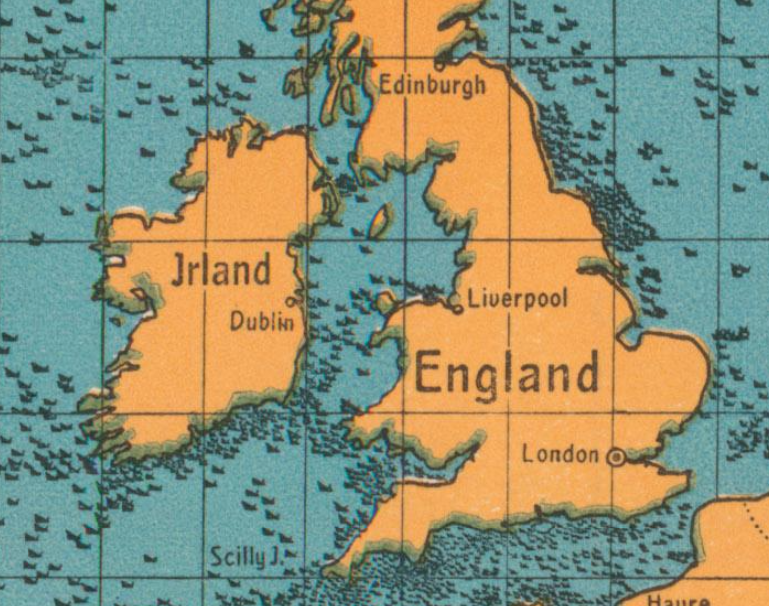
    This is a pretty stark reminder of just what was going on in the waters around Great Britain in 1917–it is a postcard propaganda map showing the gross tonnage of ships sunk by U-Boats for 1917:

    Maps U-boat WWI sinking

     [Image source: P.J. Mode’s wonderful collection of what he refers to as “Persuasive Maps”, now housed at Cornell University.]


  • An Unusual Chronological-Timeline-World Map (1887)

    JF Ptak Science Books   Quick Post

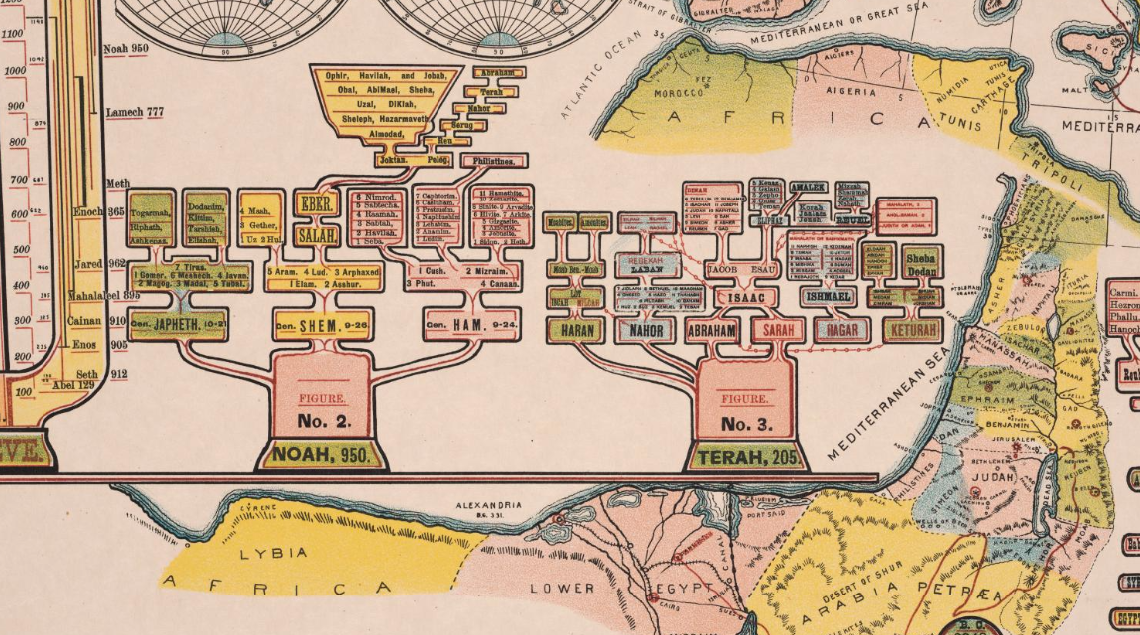
    The details of this chronological chart/map caught my eye–the genealogy trees look to me very out-of-place or -time, speaking in terms of design, and seem to have a definite mid-20th century feel to them:

    Maps dataviz chronology

    They are found in the left section of Jakob Skeen’ s 1887 Genealogical Chronological And Geographical Chart. Embracing Biblical And Profane History Of Ancient Times From Adam To Christ, which is part of my friend P.J. Mode’s wonderful collection of what he refers to as “Persuasive Maps”, now housed at Cornell University. I don’t often see chronologies of this detail with embedded maps, which is another odd bit about this display of information; overall, it is unusual to my experience:  


  • Some Vastly Creative Titles by S. Dali (1930’s)

    JF Ptak Science Books  Quick Post

    Love him or not, there seems to be little middle ground with Salvador Dali. What I find probably-peripherally interesting in Dali’s writings are the titles of them…maybe more so than the written piece itself–perhaps that is because I enter such deep shallow pool in them where I become lost or bored or just cleaved up in misunderstanding…it is all a possibility.  One thing that is inarguable I think are the titles of some of his works.  For example, I wanted to share a few that are found in the Surrealist-laden but not-necessarily-Surrealist art magazine, Minotaure (1933-1939):

    • “Non-Euclidean Psychology of a Photograph”
    • “The Spectral Surrealism of Eternal Pre-Raphaelite Femineity”
    • “First Morphological Law relating to Soft Structure”
    • “A Paranoiac-Critical Interpretation  of the Obsessive Image of Millet’s Angelus“
    • “Concerning the Terrifying and Edible Beauty of Art Nouveau”
    • “The New Colouras of Spectral Sex-Appeal”
    • “The Aerodynamic Apparition of Object Beings”

    The Guggenheim notice on the Minotaure: http://blogs.guggenheim.org/findings/minotaure-surrealist-magazine-1930s/

    ·Posted by :

    ·in:


  • Captain Marvel and the V-1

    JF Ptak Science Books  Quick Post

    Captain Marvel was once upon a time in the 1940’s a superhero more popular than Superman, though Superman is the obvious victor over time (and a long time at that). I don’t know what Captain Marvel is doing here hawking a paper punch-out flying “buzz bomb”, particularly since it seems to have been produced during WWII.1 It does seem unlikely to me that a flying toy modeled on the buzz bomb would be sold to kids during the war. After all, the “buzz bomb” was the German advanced weapon called the V-1, or Vergeltungswaffe 1, (“retaliation”, or “vengeance” weapon), or Fieseler Fi 103,  or Doodlebug, and was a flying bomb (on the order of a very primitive cruise missile guided by a gyroscope autopilot) launched against population centers in England by the Nazis during the June 1944-January 1945 period.  The bomb was about 27’ long and 17’ wide, weighed 4,700 pounds, and reached 400 mph with an 1,800 pound warhead.  Thousands of people were killed in the 8,000+ sorties of this foul-sounding beast–there was only a general sense of where it was going and where it might land, so the death and destruction it caused was indiscriminate.  Given all of this I’m assuming that the guesses on the year of production of this are wrong, and that it is a post-war bit, which would be in less bad taste than had it been actually produced in wartime.  It seems to me that most superhero/action hero types were busy punching Hitler or some such thing, and not selling a toy based on Hitler’s weapons when they were actually killing thousands.  In any event, I’m sharing this unusual image with its unusual story. 


    Buzz Bomb Capt marvel cover

    Notes:


  • Fistfights and Beggars: Found Street Life in Old Prints (1757)

    JF Ptak Science Books   Post 2570    Zoomology Series

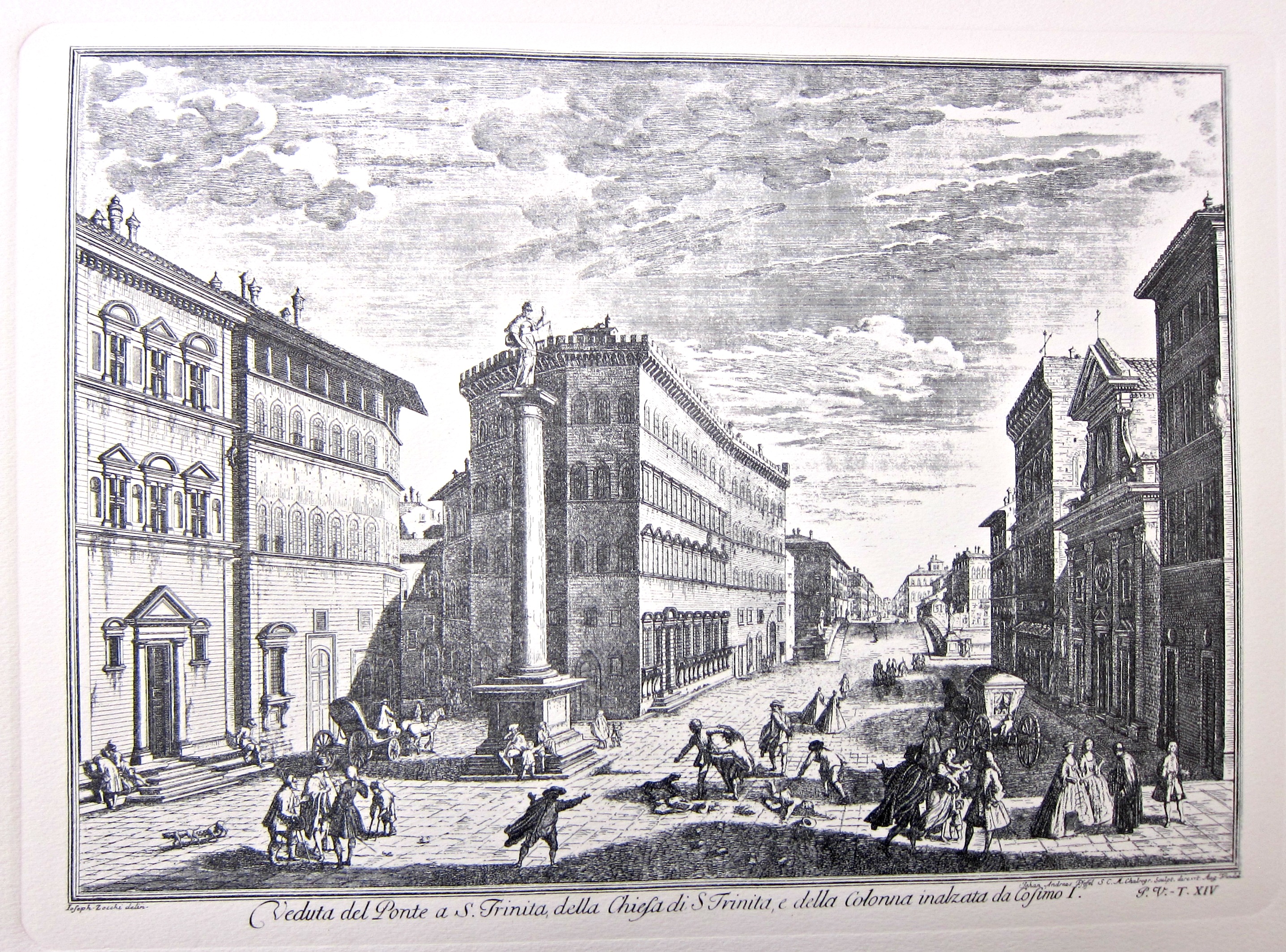
    I’ve written a number of times on this blog on using the “paper microscope” on finding small images hidden in plain sight within larger images in antiquarian prints. The image below is by Giuseppe Zocchi (1711-1767) (commissioned by the Marchise Andre Gerini at mid century to record the greatest of Florentine landmarks) and is entitled  “Veduta del Ponte a S. Trinita, della Chiesa di S. Trinita e della colonna inalzata da Cosimo I..” and appears in his Scelta di XXIV Vedute delle principali contrade, piazze, chiese, e palazzi della Città di Firenze in 1757.  The print displays the buildings and obelisk just down the way from the bridge whose name occupies the beginning of the image’s description, the ponte Santa Trinita, a fabulous renaissance structure built a hundred years earlier.  All we see of teh bridge though is is decking, though we do see a huge rise, which gives us a hint of teh bridge’s nature–it turns out that this is the oldest elliptic arch bridge in the world.  While the architecture is beautiful and teh perspective intersting, teh characters populzting the foreground are sometimes even more interesting. In general figures like this were used to take up empty bits of space and to provide perspective, and were depicted in the standard ways in which walking/riding humans are represented. In this case, however, there is a lot of social drama going on amidst the simple space fillers. 

    Zocchi d

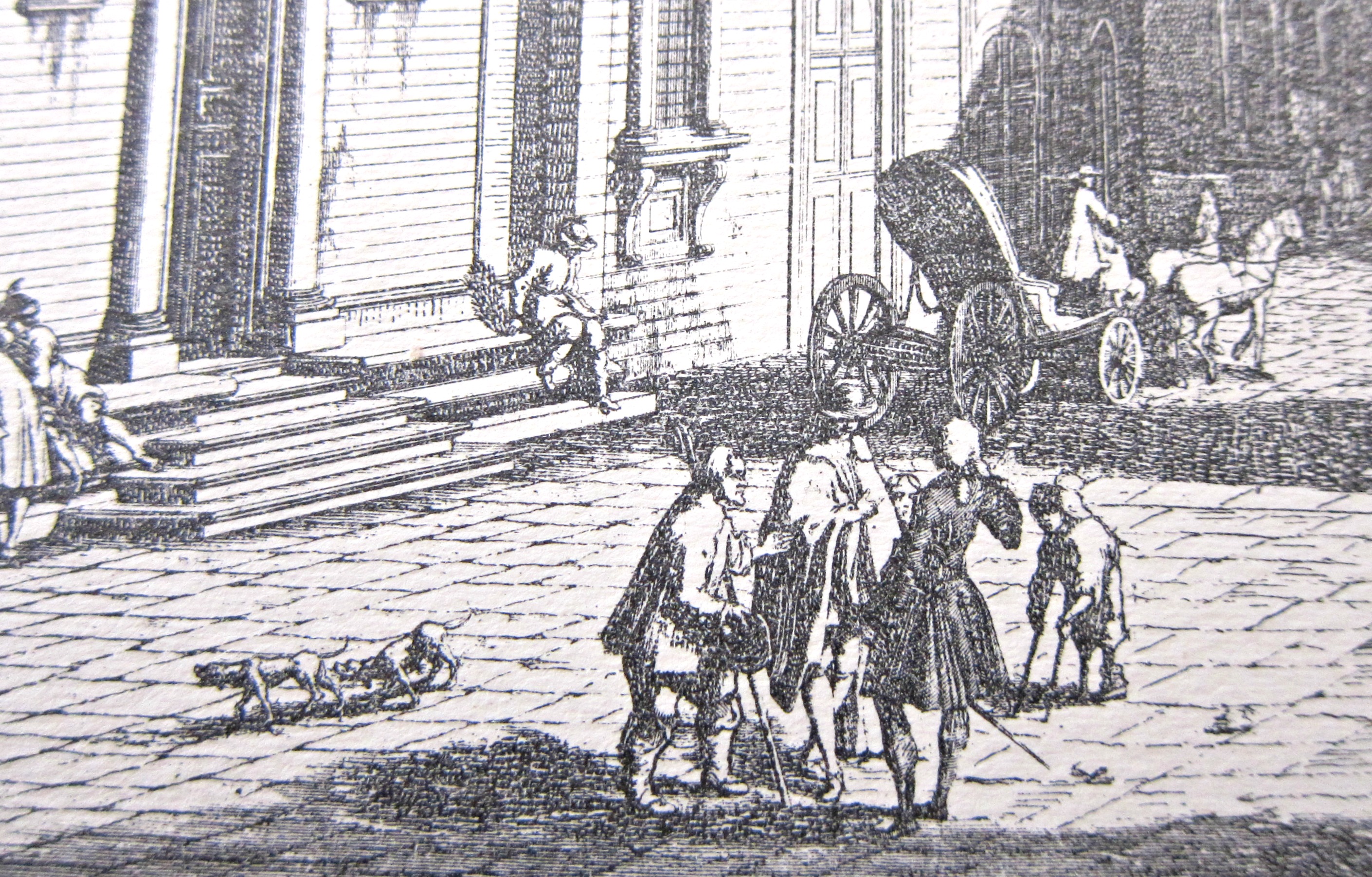
     For example, in the bottom-left corner, we see doggies doing what doggies do, and also a disabled short person approaching a group of gentlemen in conversation:

    Zocchi c

    ·Posted by :

    ·in:

    —

  • The Pre-History of Imaginary Robots: Electric Deer, 1892

    JF Ptak Science Books    Post 2566

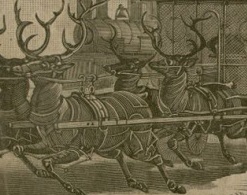
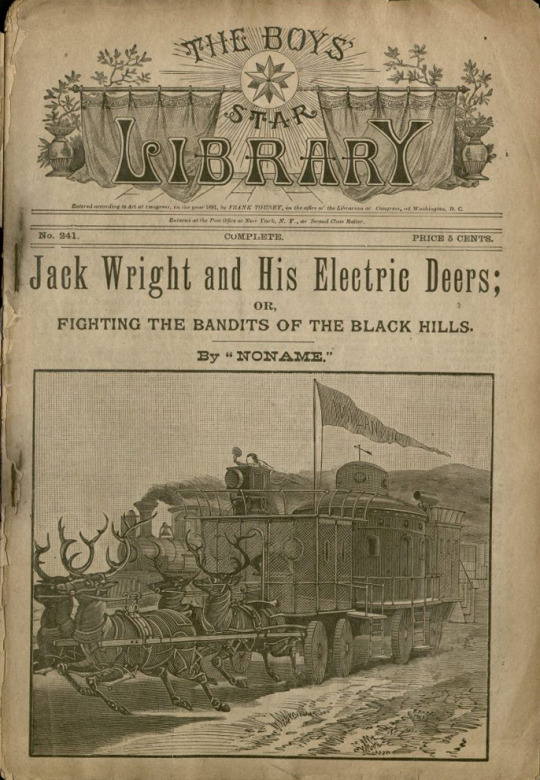
    Rebecca Onion at Slate Vault surfaced this very interesting image of electric breath on her twitter account (@Slate Vault), showing early robotic creatures alive and well and living in the minds of thousands of young kids, placed their partially by stories like this found in the pulpy pages of Frank Tousey’s Pluck and Luck in 1892. The image  (from the special collections library at the University of South Florida (here)) shows yet another work of genius/ingenuity by the endlessly adventurous “Jack Wright” a boy inventor, who seemingly went everywhere, did everything, and had the stuff to make it all happen.

    I’ve posted1 many times on this blog about 19th century imaginary robotics, and had not seen this Wright story and his fabulous “electric deers”. 

    Robot deer detail

    This Jack Wright adventure was written by “Noname”, who turns out to be by Luis Senarens (1863-1939)2, a very prolific and early sci-fi writer, a Brooklyn boy, who had been referred to as an American version of Jules Verne.  Senarens wrote beginning in the 1880’s and was no doubt much taken by the new applications of electricity, and Senarens applied it quite liberally. In a quick browse, he introduced electricity inventively, sprinkling it liberally over powered machinery and introducing his own electric ocean liners, submarines, sledge boats, canoes, air-schooners, locomotives, balloon ships, torpedo rams, horses, and no doubt much else. I’m glad to have caught up to Mr. Senarens’ robots.

    Robot deer

     Notes:

    1. Just search “robot” in the google search box at upper right.
    2. See the Edward T. LeBlanc Memorial Dime Novel Collection for very much expanded info on this and other series:  https://dimenovels.org/Series/734/Show

  • Earth Squared and Halved and Shrunken and Invisible and Doubled and Miniaturized

    JF Ptak Science Books   Post 1936 (expanded)

    This post is a part of overlapping categories, including:

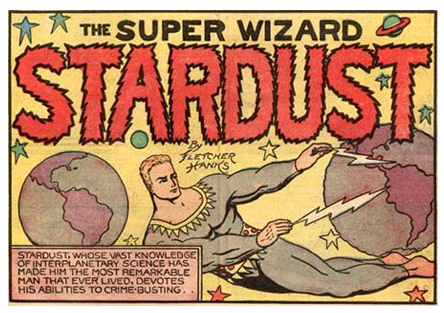
    Comics Hanks' double earthI don’t know if this is an actual Extra Earth that makes an appearance in a Stardust episode, or if it is just a repeated element of design–from what I have seen from Hanks, it could easily be either. 

    And now on the the rest:


    Earth strange half earth

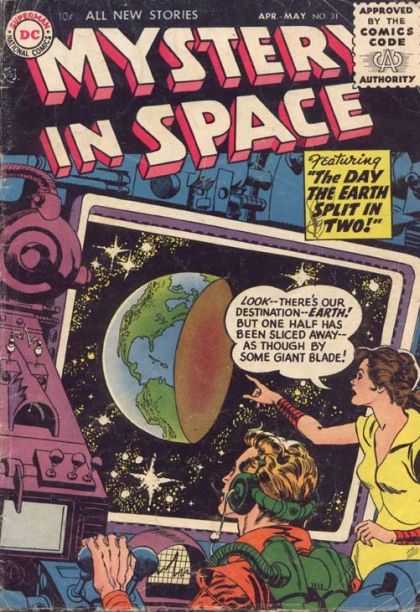
    In the eight years or so of collecting information and stories for the odd-bits section of this blog  I have never encountered so many choice visual examples in one place for strange/weirdly-imagined/impossible/high-SciFi of the Earth than with the comic book, Mystery in Space. The very dedicated keepers of Coverbrowse.com website have reproduced thousands (?) of covers of pulpily-published science fiction and exotic-thinking comics books, including the home base in which all sixteen-plus years of Mystery in Space live.


  • Window Shopping for Food and Haircuts with Berenice Abbott, 1935

    JF Ptak Science Books  Blog Bookstore

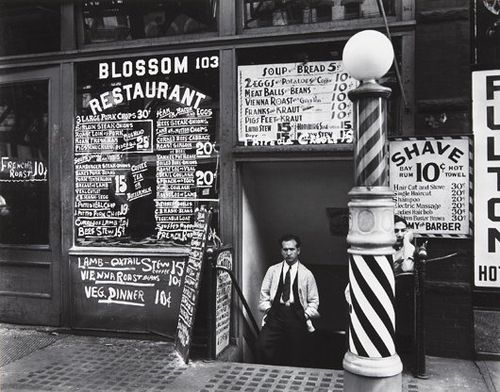
    I enjoy antiquarian window shopping, browsing photos or engravings that depict goods for sale– especially if the prices are posted. I came back to this deep-in-the-Depression-fantastic photo made in 1935 by Berenice Abbott (Springfield, Ohio, 1898-1991). Blossom Restaurant, NYC was part of Abbott’s effort funded by the WPA, this time as a part of her Changing New York Project, and captures the restaurant and neighboring barber shop at 103 Bowery.  The two businesses actually occupied the first floors and basement (respectively) of the Boston Hotel, a standard flop house in a tough and distressed part of the city that rented beds by the day, with 249 small door-less cubicles offering a decent place to spend the night for 30 cents1. 

    Abbott[Image source: New York Public Library, http://digitalcollections.nypl.org/items/510d47d9-4f80-a3d9-e040-e00a18064a99   Also a nice description of the photo and process can be found at the National Museum of American History, http://americanhistory.si.edu/collections/search/object/nmah_1321971]

    Abbott Blossom restaurant menu detail

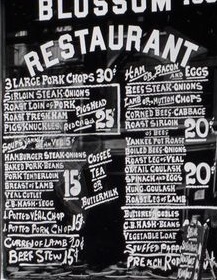
    30 cents seems to be the going rate for a bunch of things going on in this  picture—30 cents for a night in the hotel, 30 cents for the better offers of Morris Gordon’s restaurant. 30 cents for a haircut and shave, 30 cents for a “women’s hair bob”2 and so on.  Which seems about right—a fancy haircut and a decent better-than-average dinner for two will probably cost about the same, today. 

    If you were really on a tight budget, 30 cents would buy you three vegetarian dinners, or 6 offerings of bread and soup, or three visits to the table of meatballs and bans, or pigs feet and kraut. 

    The price of a stick-to-your-ribs meal of sirloin and potatoes and a pot of coffee also cost about the same as a gallon and a half of gasoline (which cost about 20 cents).  The same amount of gas today would get you a serving at McDonalds, or something on that order, and perhaps even a happy take-away for the kids. Perhaps the two even out. 

    30 cents might get you a loaf of bread, and wouldn’t quite get you a dozen eggs.  Now this is remarkable, because if you adjust all of this according to modest CPI measures, the average cost of a dozen eggs in 1935 was 37 cents, or (according to the US Census website generating 1935 to 2009 prices adjusting to CPI) $5.84.  The bread would cost $4.74 in 2009 dollars, which means that the staples today—milk, bread, butter, eggs, were more expensive in 1935 than today.  Ditto gasoline, which cost 19 cents a gallon, or $3 today—actually this would be much more expensive in 1935 as the mileage the cars were getting then (and the octane) was much lower, so the cost of running an automobile was considerably higher.   The cost of the car itself, though, still favors the ‘thirties for modest transportation, which came in at about 600 dollars, or just over $9000 in 2009 dollars3. 

    The 3-cent first class postage stamp of 1935 was more expensive than first class postage in 2009:  47 cents versus 44.  When you look at the increases and bitty spikes of the cost of a first class stamp over time the whole thing looks pretty flat. 

    The average salary for a family of four in 1935 was about 1500/year, which oddly enough is about the same for the poverty guideline level for 2009 established by the Department of Health and Human Services (about $23,000).  Minimum wage legislation didn’t begin until 1938, but if you take a look at one of my earlier posts here on the history of this idea you’ll see that the recent history of legislating  a meaningful level of acceptance for a base living wage is mainly disgraceful, with relatively little accomplished (in adjusted economic terms) for half a century.  (The new minimum wage brings us to about a mid-way point as the highest minimum wages paid in the 76-year history of the program.)

    Notes

    1.A fantastic website and resource for changing aspects of NYC can be found here, at Frank Levere’s Changing New York site. http://www.newyorkchanging.com/

    2. I wrote a little bit about the appearance of women-only hair salons in my post “The Staggering Beauty of Barber Shops” https://historyofideasblog.com/thesciencebookstore/2009/02/the-staggering-beauty-of-barber-shops-naive-surreal-department-22.htm

    3. Other bits of what stuff cost in 1935:

    • Flour (5 lbs)     25.3 cents
    • Bread (lb)         8.3
    • Round steak (lb)  36.0
    • Bacon (lb)        41.3
    • Butter (lb)       36.0
    • Eggs (doz.) 37.6
    • Milk (1/2 gal.)   23.4
    • Oranges (doz.)    22.0
    • Potatoes (10 lbs) 19.1
    • Coffee (lb)       25.7
    • Sugar (5 lbs)     28.2
    • Car: $580
    • Gasoline: 19 cents/gal
    • House: $6,300
    • Bread: 8 cents/loaf
    • Milk: 47 cents/gal
    • Postage Stamp: 3 cents


    And 103 Bowery, today (via Google Earth):

    103 Bowery


  • A Non-Imaginary Post about Imaginary Books in Real Books

    JF Ptak Science Books  Post 2685

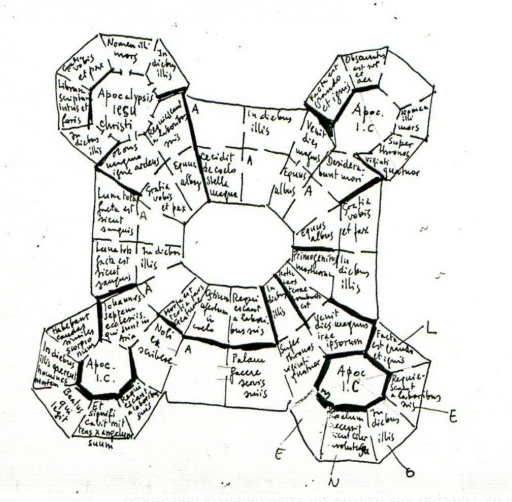
    Eco Library

    [Umberto Eco’s sketch for the imaginary library in his The Name of the Rose, from Digital Architectural Papers, here]

    “To write vast books is a laborious nonsense, much better is to offer a summary as if those books actually existed.”  — Jorge Luis Borges

    I imagined to be reading about the imaginary illustrations of a non-existent book when I wondered about the extent of (intentionally) imaginary books in the history of real books.  It was a quick realization of how deep and how old this genre is–and as a matter of fact one excellent single-stop website that displays this depth is the Librarian of Babel by Emi Hastings  (Catalogues of Imaginary Libraries https://librarianofbabel.wordpress.com/2014/04/25/bibliographies-of-imaginary-libraries/).

    At the outset I thought to write some sort of overview or a little history of the imaginary book, starting of course with Rabelais and then Borges, but there is just so much more than can be accommodated by a simple evening’s work that I decided to simply make a few lists of representative creations by a selection of some favorite biblio-creativists. So, help yourself to some interesting and humorous suggestions by Charles Dickens, John Donne, Francois Rabelais, Marcus de Fable, Douglas Adams, Jorges Luis Borges, Umberto Eco, Vladimir Nabokov, Haited Pleat,  and J.K. Rowling.

    Works invented by Charles Dickens [findable in numerous forms with this list found at http://flavorwire.com/329815/charles-dickens-library-of-fake-books]:

    Five Minutes in China. 3 vols.
    Forty Winks at the Pyramids. 2 vols.
    Abernethy on the Constitution. 2 vols.
    Mr. Green’s Overland Mail. 2 vols.
    Captain Cook’s Life of Savage. 2 vols.
    A Carpenter’s Bench of Bishops. 2 vols.
    Toot’s Universal Letter-Writer. 2 vols.
    Orson’s Art of Etiquette.
    Downeaster’s Complete Calculator.
    History of the Middling Ages. 6 vols.
    Jonah’s Account of the Whale.
    Captain Parry’s Virtues of Cold Tar.
    Kant’s Ancient Humbugs. 10 vols.
    Bowwowdom. A Poem.
    The Quarrelly Review. 4 vols.
    The Gunpowder Magazine. 4 vols.
    Steele. By the Author of “Ion.”

    Works invented by John Donne, Catalogus librorum aulicorum incomparabilium et non vendibilium, or The Courtier’s Library of Rare Books Not for Sale, was written between 16-7-1611, and published in 1650: [http://libraryofinvisible.blogspot.com/2014/03/anonymous.html]

    Edward Hoby’s Afternoon Belchings
    On Distinguishing the Sex and Hermaphroditism of Atoms
    On the art of decyphering and finding some treason in any intercepted letter
    Concerning the method of emptying the dung from Noah’s Ark
    Martin Luther, On Shortening the Lord’s Prayer
    The Princely Ocean, or The Pyramid, or The Colossus, or The Abyss of Wits: where by means of 60,000 letters to the Nobles of all nations … are related everything that is able to be related concerning toothpicks and hangnails
    On the Navigability of the Waters above the heavens, and whether Ships in the Firmament will land there or on our shores on the Day of Judgment, by John Dee
    What not? or a confutation of all errors in Theology as well as in the other sciences, and the mechanical arts, by all men, dead, living, and to be born, put together one night after supper

    The Art of Cutting the Teeth.
    Matthew’s Nursery Songs.
    Paxton’s Bloomers.
    5 vols.
    On the Use of Mercury by the Ancient Poets.
    Drowsy’s Recollections of Nothing.
    3 vols.
    Heavyside’s Conversations with Nobody.
    3 vols.
    Commonplace Book of the Oldest Inhabitant.
    2 vols.
    Growler’s Gruffiology, with Appendix.
    4 vols.
    The Books of Moses and Sons.
    2 vols.
    Burke (of Edinburgh) on the Sublime and Beautiful.
    2 vols.
    Teazer’s Commentaries.
    King Henry the Eighth’s Evidences of Christianity.
    5 vols.
    Miss Biffin on Deportment.
    Morrison’s Pills Progress.
    2 vols.
    Lady Godiva on the Horse.
    Munchausen’s Modern Miracles.
    4 vols.
    Richardson’s Show of Dramatic Literature.
    12 vols.
    Hansard’s Guide to Refreshing Sleep

    Works invented by Francois Rabelais, a selection from  Catalogue of the Choice Books Found by Pantagruel in the Abbey of Saint Victor: Devised by François Rabelais: Translated and Annotated by Walter Klinefelter, a Student of Catalogues (printed in Pantagruel, c. 1532; translated and printed separately, 1952):

    The Spur of Cheese

    The Codpiece of the Law
    The Testes of Theology
    On the Art of Discreetly Farting in Company
    Three Books on How to Chew Bacon
    Martingale Breeches with Back-flaps for Turd-droppers