A Daily History of Holes, Dots, Lines, Science, History, Math, Physics, Art, the Unintentional Absurd, Architecture, Maps, Data Visualization, Blank and Missing Things, and so on. |1.6 million words, 7500 images, 4.9 million hits| Press & appearances in The Times, Le Figaro, Mensa, The Economist, The Guardian, Discovery News, Slate, Le Monde, Sci American Blogs, Le Pont, and many other places… 5000+ total posts since 2008.

Author: JF Ptak

  • A Fabulist, Proto-Surreal Comet, 1844

    JF Ptak Science Books, Quick Post

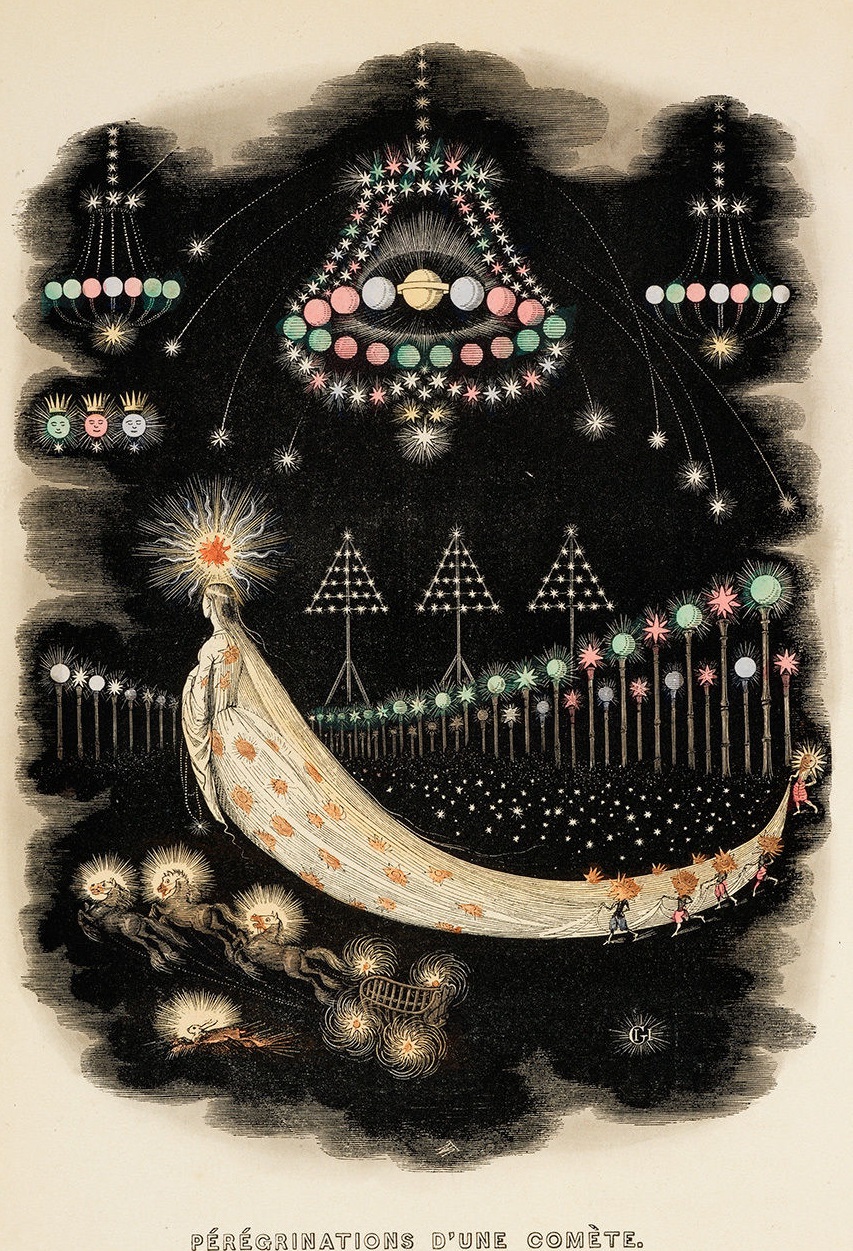
    The heavens look orderly and generated in this depiction of space-based entertainment. Created by the the fabulist proto-surrealist (etc.) J.J. Grandville in his book Un Autre Monde (“Another World”) in 1844, the “travels of a comet” is a creative interpretation of the functions of a comet, the celestial body anthropomorphized, with a series of stars holding its gown’s train, perhaps anchored by the Sun (or not).  Beneath the comet is a A Saturn-like conveyance (see here), and to the right of that a star with the initials of the artist (“I.I.G.”).  Various other arrangements of planets are held in order by a series of stars, connected with some sort of nebulous something–the decorative centerpiece of this allegory bears a strong upside-down resemblance to the design on the title page holding the book’s title.

    The image appears in the book just after the illustration of the “conjugal kiss” of a lunar eclipse, a phrase even in English with a little ring to it. 

    Grandville comet

    [Source:  Hathi Trust, full text, here: http://babel.hathitrust.org/cgi/pt?id=gri.ark:/13960/t04x89022;view=1up;seq=125]

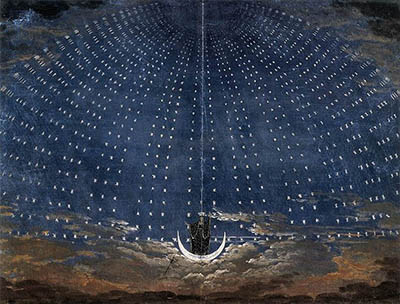
    This also puts me in mind of Mozart’s Zauberflaute–not really by much, and not by much that is very concrete, but the mood certainly reminds me of it:

    Mozart_magic_flute

    [Image: Stage set for Mozart’s Magic Flute, by Karl Friedrich Schinkel, 1815, gouache, Staatliche Museen, Berlin. via Wikimedia Commons and the University of Georgia, http://www.franklin.uga.edu/chronicles/posts/uga-opera-theatre-presents-mozarts-magic-flute]

    ·Posted by :

    ·in:

    —

  • The Dust of Imaginary Robots, the Frame of Being, and All That

    JF Ptak Science Books  Quick Post

    Books aktenstaub453

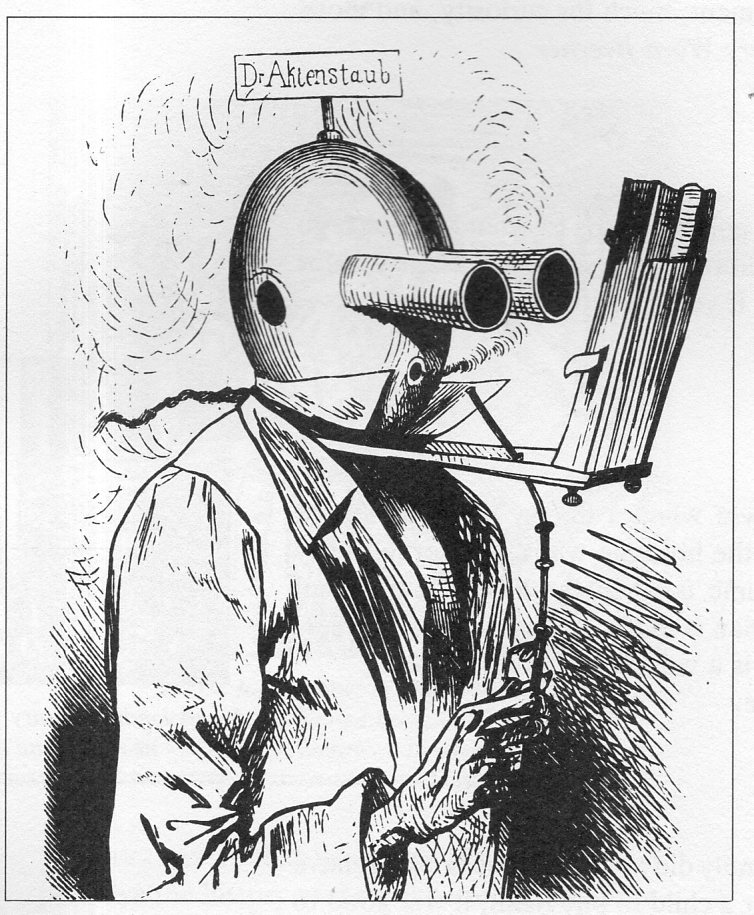
    This fine illustration with the wonderful helmet does look like some sort of 19th century robot, but seeing the little sign at the pinnacle–“Dr. Aktenstaub”–identifies this as an antiquarian antiquarian being shielded from the dust of accumulated and lonely wisdom. “Aktenstaub” is a wonderful word which identifies the smallest bits of existence: dust.  But “dust” is much more poet and involved than that, with this “aktenstaub” relating to the old dust of old books, and so the helmet protects the reader from the weight of dusty ages.  The horizon for the idea of dust is far and wide, though, as a walk through the Oxford English Dictionary attests.  Describing dust seems more varied than the description of a book itself, or the identities of snow…the dust of organ pipes being different from that of wooden floorboards or corn husks or weary dust of travel on a long duster the dust of the cosmos; it describes a condition of humiliation, cash, disturbances of different sorts, and of course the “mortal frame of man”, and seems to have a seat at a very long table of possibility, which is remarkable for such a small and unassuming word. The entry for dust is quite long and involved, and is followed by a longer list of dust-compounds, where things get really interesting.  Dust-blister, dust-core, and dust-spawn are good examples of the long road of dust-possibilities.  And so far as “aktenstaub” goes, it gives the idea of antiquarian book dust a personality as vibrant as fairy-dust, and so is perfectly fine with me–it is hard to go wrong, sometimes, with definitions of words that enrich the imagination more so than limit it. 


  • A Note on Franklin Roosevelt and the Holocaust, 1942

    JF Ptak Science Books   Post 2564

    FDR Jews secret

    For all of the greatness of the man, Franklin Roosevelt for whatever reason came up decidedly short on the issue of accepting German Jewish immigrants seeking to escape Nazi Germany (in the 1930’s) and then later, during the war, having a terrible record in the response to the concentration camps (1940-1942) and (somewhat later) on the identification of the extermination centers.(1943-1945).  It is certainly a large stain on this legacy, a despondency that is confused, confusing, and highly open to debate. 

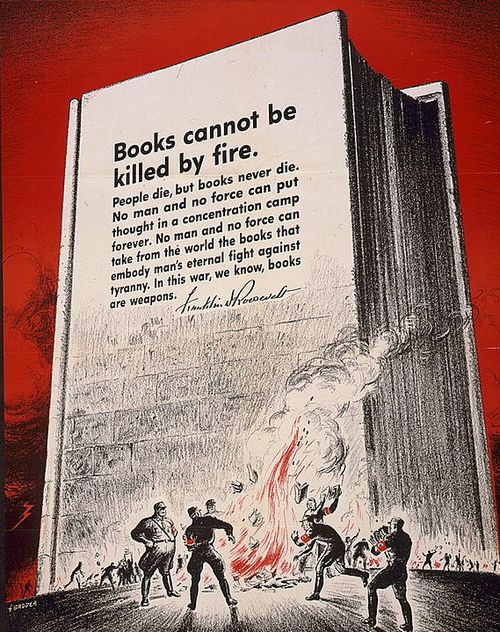
    This came to mind when I reviewed an older post on this blog on books/propaganda issued by the government printing office–in particular, the “Books are Weapons” series, which is a collection of strong images used in connection with Roosevelt’s statement about books/weapons:

    Books are weaponsWhat struck me today for the first time is FDR’s use of “concentration camp”, which is surprising to me–at least the “me” at my level of understanding FDR and the Holocaust–because when this poster was issued by the Government Printing Office in 1942 Roosevelt had spent very little public time on the issue.  And in the course of the next 24 months or so, Roosevelt had more evidence of the gigantic crimes being perpetrated by Germany but still had very little publicly to say on the matter.  1942 though seems to be early for this sort of statement–and to find it in a mass-produced vehicle like this poster was a jolt. 

    The text on the monolithic book that stand free and tall and immobile in spite of the Nazis in the foreground and their small pyre of burning books:

    • “Books cannot be killed by fire. People die, but books never die. No man and no force can put thought in a concentration camp forever. No man and no force can take from the world the books that embody man’s eternal fight against tyranny. In this war, we know, books are weapons.” –Franklin D. Roosevelt. 1942 (the date referenced from the Library of Congress page on this poster http://www.loc.gov/pictures/item/96502725/   Another post on this blog shows two other variations on this poster:  https://historyofideasblog.com/thesciencebookstore/2014/09/books-are-weapons-in-the-war-of-ideas.html)

    This is a very long story, but for right now it seems a relatively certainty that the situation of the Jews in Germany and the rest of Europe was fairly well known and established within the Roosevelt White House, and even so too to some extent in the popular press. By 1943 there was probably no doubt whatsoever with what was going on–in an example of Roosevelt’s association with the contemporary knowledge of the Holocaust the FDR Presidential Library offers the following O.S.S. document on the destruction of the German Jews:


  • A View of Otto Dix’s Apocalypse Between the Wars

    JF Ptak Science Books  Quick Post

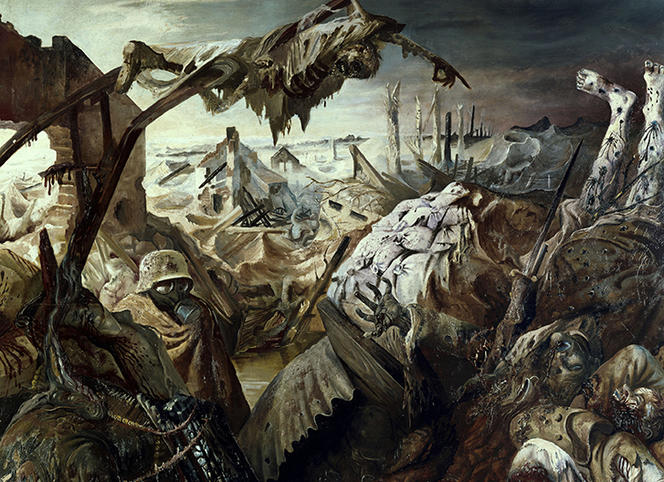
    Otto Dix (1891-1969) painted war like few others before him. He was there–he painted what he saw.  There was no inflationary appreciation of patriotic glory. For example, in the painting below (Der Krieg, 1929-1932) he depicted collapsed trenches, the miserable transport of the wounded, decomposing and horribly deformed bodies, and a view of a blank and desolate horizon. Now that I think of it a little, Georg Grosz (1893-1959) also comes to mind in regards to Dix–he was a courageous fighter, an inventive and endlessly intro-extro-spective on the social landscape, especially during the Weimar years and particularly so when 1933 came around.  They were not alone, of course, though these artists are among the shining lights of artistic-documentary-expressive experience in Germany between the wars like the brilliant Max Beckmann (1884-1950, with his Morgues of 1922), Kathe Kollwitz, Christian Rohlf, and others. In any event, the Dix painting is extraordinary.

    Here’s Dix’s Der Krieg:

    Dix trench

    ·Posted by :

    ·in:


  • Smokestacks and Breweries–Germany, 1930

    JF Ptak Science Books   Quick Post

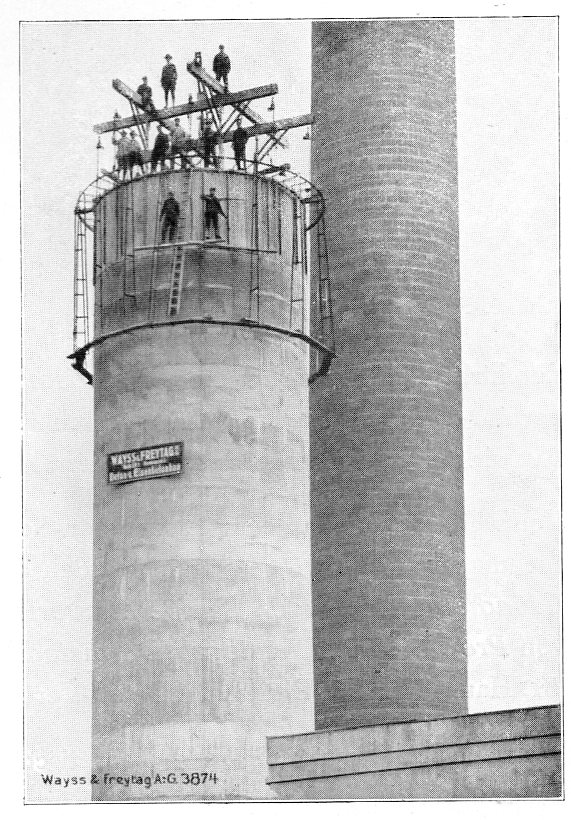
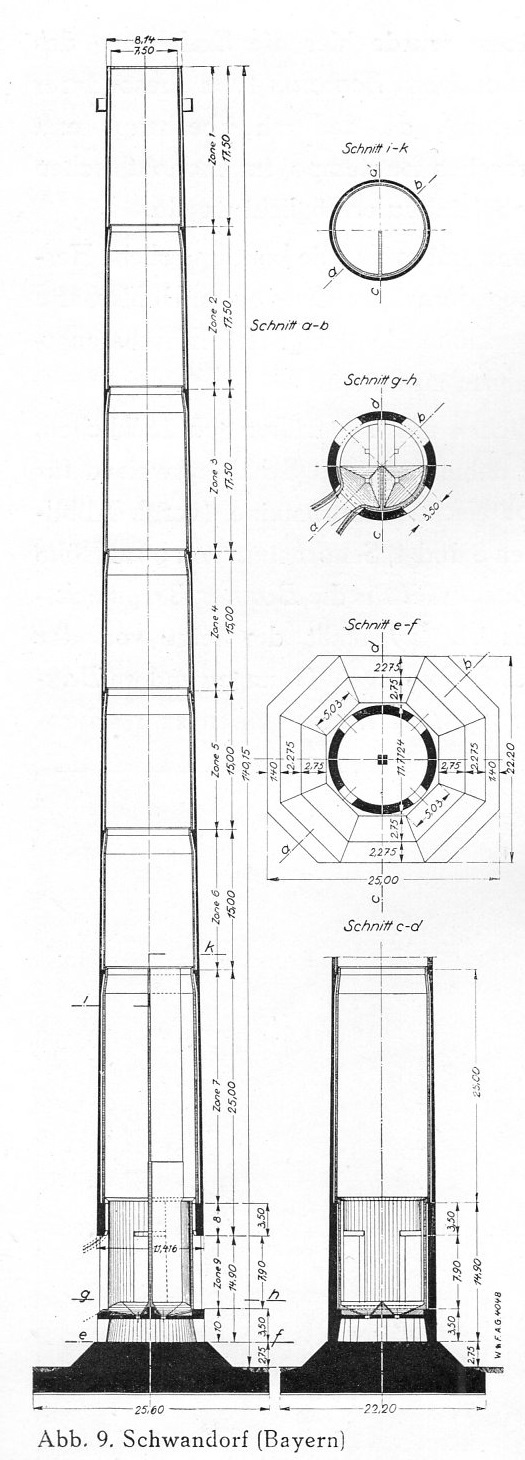
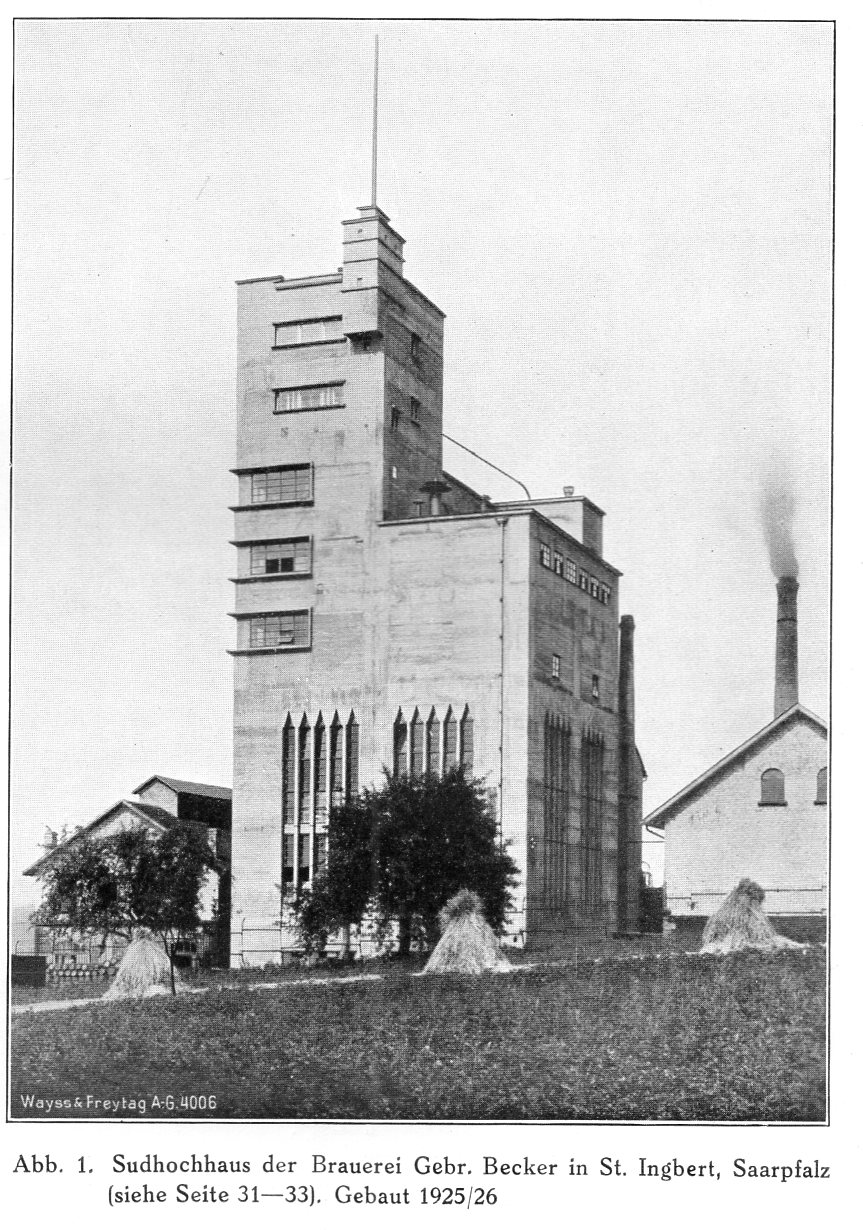
    Chimney-4-451This great pamphlet surfaced today from my mound of surfacing pamphlets–it is a prospectus/advertising/technical publication vehicle for Wayss & Freytag A.G., published in April 1930.  I wanted to share a couple of interesting photos that appear in the publication, which, (as the title states) centers on concrete reinforced smokestacks and breweries, which I guess in its way says a lot about the origin of the country of the company (Ruhr/beer).  Mainly though it is the one photograph (following) that sparked my interest in sharing this pamphlet, though the cross sections of the smokestacks harvest their own interest.  The images of the breweries are also entertaining, in a International Style kind of way, with the structures seeming far more interesting than the product they produced. (It is amazing in many ways that the Wrigley factory with all of its specialized equipment and beautiful plant and for all of the great effort that goes into their construction and maintenance that the end product of the massive engagement is chewing gum.)  The third picture below reveals a semi-Bauhausian project for a beer maker–in its concreteness it isn’t the hyperbolic paraboloids of Xenakis for the Phillips Pavillion of Expo ’58, or the Guggenheim, or (parts of) the Le Crobusier’s Ronchamp, but it is interesting, and was pretty unexpected. 


    Chimney-1-448(That is one long, very skinny ladder there in the middle…I’d prefer to use a ladder that was at least more than half the width of me–this one wouldn’t come close.)

    And the cross section and plan:

    Chimney-2-449

    And the interesting/confusing brewery:

    Chimney-2-450


    ·Posted by :

    ·in:


  • An Odd & Architecturally Symphonic Structure Dedicated to Bats, Malaria, & Guano (1916)

    JF Ptak Science Books  Quick Post

    Bat house

    [My thanks to Eric Renner and Nancy Spencer for sending this photo my way!]

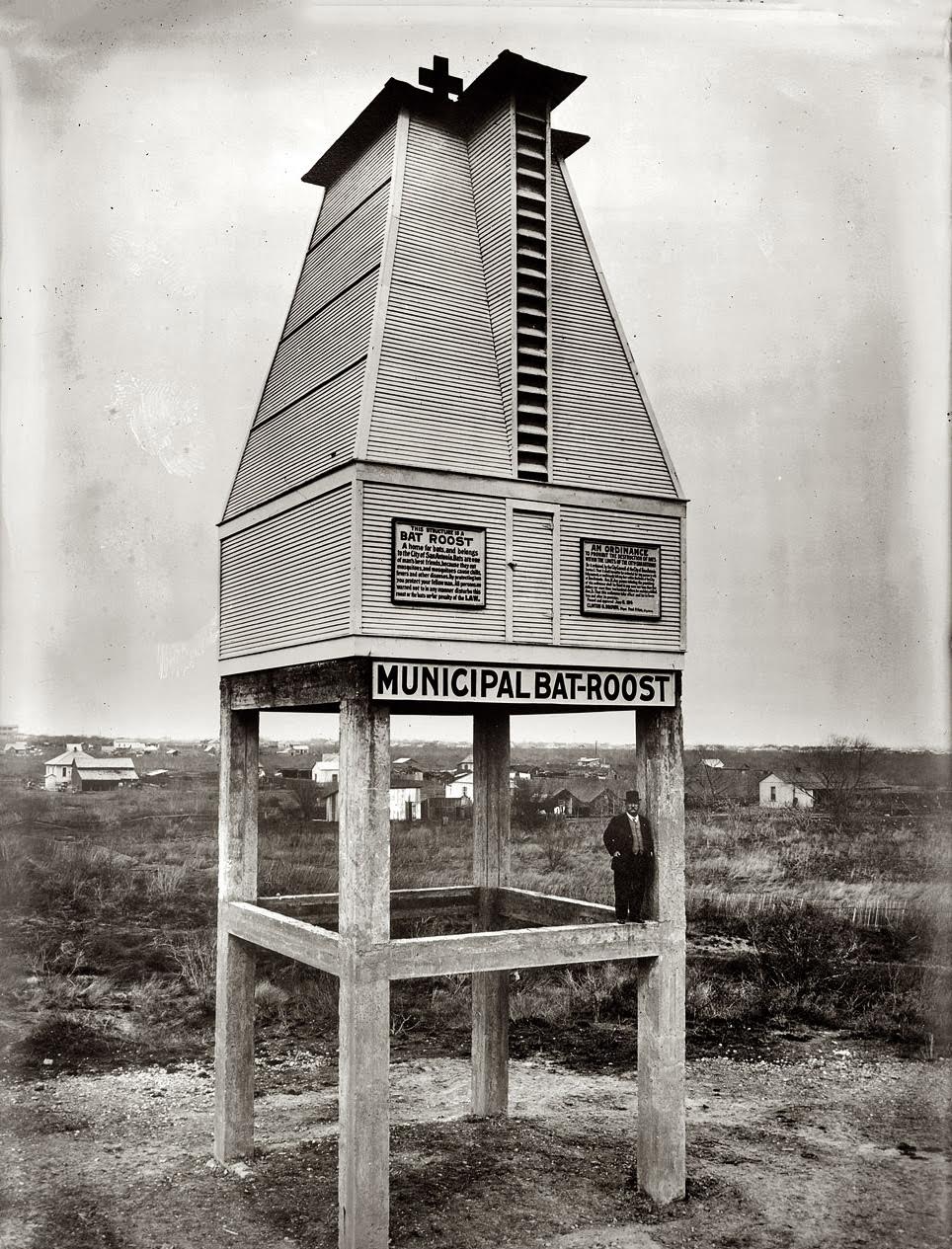
    The idea of Dr. Charles A.R. Campbell (1865-1931) was that malaria was transmitted person to person by mosquito so a good way of combating the disease was to get rid of mosquitoes–perhaps the most dangerous animal in the world to humans–and a superior way of doing that was by introducing mosquito-ravenous bats.  And that is what he did as San Antonio’s health officer–through some amount of trial and error he introduced these “hygiestatic bat roosts” in Hill County, including this enormous 1916 structure. There were difficulties at the outset in attracting bats to the roost, so one of the ways of getting around this problem was to design the structure to look like the evidently all-time premium bat-attractor, the church steeple–I doubt that this had anything to do with the ultimate success of attracting bats, but the resulting profile surely was a winner.

    I believe that that is Dr. Campbell leaning against one of the massive (20×20″?) legs of the roost.  Bats don’t weight that much, but that lumber-rich roost did, and so did the guano they produced. Evidently the guano was harvested as high end fertilizer, with more than two tons removed from this roost alone.

    There’s much more to this story, of course–I really just liked the photograph:  see http://www.reformation.org/campbell.html and  http://www.batcon.org/resources/media-education/bats-magazine/bat_article/386

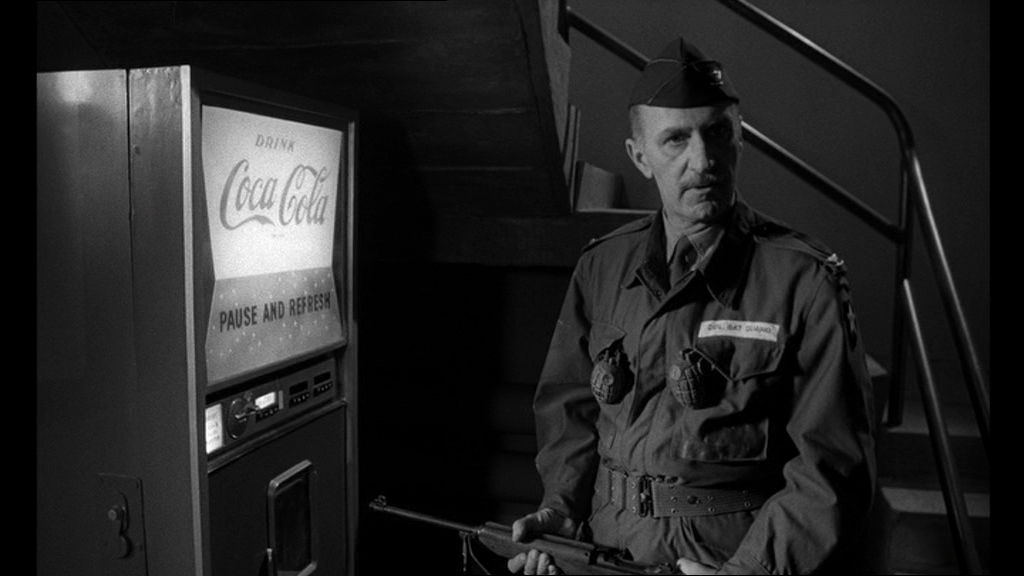
     I can’t mention bat guano without a brief sidetrack to Col. “Bat” Guano, from Dr. Strangelove, just because:

    Bat guano
    [Source: http://41.media.tumblr.com/VVa3lael6qyun4xkM8d9CxGuo1_1280.png]

    ·Posted by :

    ·in:


  • Dialing Remote Live Music–a Trip into the Future, 1892

    JF Ptak Science Books   Quick Post

    Theatrophone

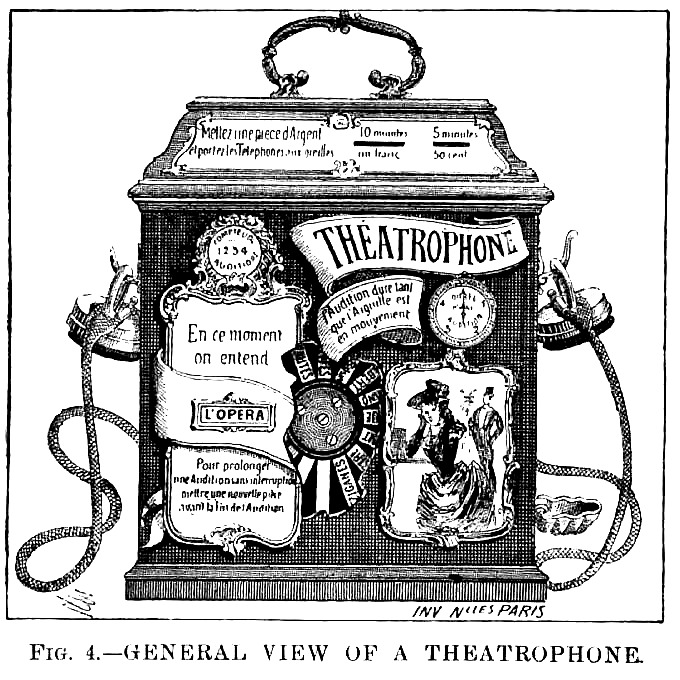
    There is a veyr interesting period in the history of thought transmission where answers were coming together–they were interesting technological answers in the steps towards mass broadcast that were fruitful for the time and capacity but which were ultimately overtaken by other events.  Such is the case in this case of early “radio” transmission, with the popular introduction of a device called the “Theatrophone”, explained in this article in the Scientific American for July 2, 1892.  The device was a telephone-like device that allowed people to listen to live performances of opera/symphony remotely–for a modest fee of one franc for ten minutes or half a franc for five minutes.  There was also a dial to select the sort of entertainment you wanted if there was a selection available, which you can see in the semi-cutaway in the image above (with “opera” being the selection).  I feel that the first exposure of this device to a general audience in 1892 would have been an astonishing next-step in the development of a new medium, like being exposed to the internet while only having known television. 

    The Theatrophone makes its big appearance in La Nature and Scientific American at a time of dynamic change in the development of radio. Elements of radio were established by Faraday (1831), Henry (1842), Maxwell (1864), Houston (1871), and Hertz (1888)–the experience in the 1890’s was different, with wireless transmission  nearly established, and with Elihu Thompson, Wm Crookes writing in 1892 about the possibility of this capacity in “Hertzian Waves” and with Tesla, FitzGerald, Lodge, Dolbear and other giant names saying in 1893 that sound transmission would soon be accomplished.  Marconi’s patent would be issued four years later in 1896, and by the end of the century and into 1902 there are reports of trans-Atlantic transmissions by Marconi and Fessenden.  But back in 1892, the Theatrophone offered a glimpse into the near-future, allowing people to listen to live entertainment, remotely. 

    • The Scientific American article is reproduced in full at the Radio History website, here: http://earlyradiohistory.us/1892the.htm

  • Window Shopping for Food and Haircuts with Berenice Abbott, 1935

    JF Ptak Science Books  Blog Bookstore

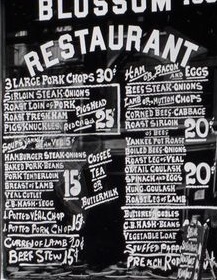
    I enjoy antiquarian window shopping, browsing photos or engravings that depict goods for sale– especially if the prices are posted. I came back to this deep-in-the-Depression-fantastic photo made in 1935 by Berenice Abbott (Springfield, Ohio, 1898-1991). Blossom Restaurant, NYC was part of Abbott’s effort funded by the WPA, this time as a part of her Changing New York Project, and captures the restaurant and neighboring barber shop at 103 Bowery.  The two businesses actually occupied the first floors and basement (respectively) of the Boston Hotel, a standard flop house in a tough and distressed part of the city that rented beds by the day, with 249 small door-less cubicles offering a decent place to spend the night for 30 cents1. 
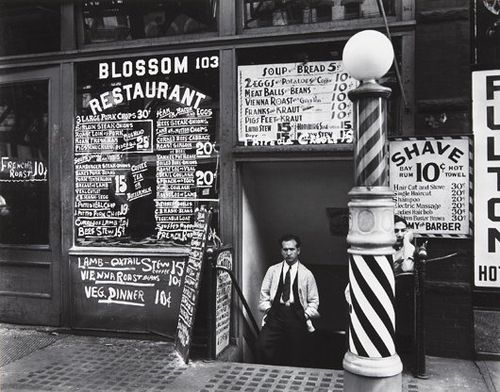
    Abbott[Image source: New York Public Library, http://digitalcollections.nypl.org/items/510d47d9-4f80-a3d9-e040-e00a18064a99   Also a nice description of the photo and process can be found at the National Museum of American History, http://americanhistory.si.edu/collections/search/object/nmah_1321971]
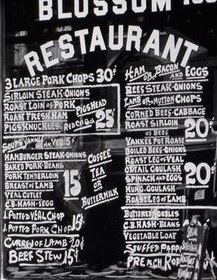
    Abbott Blossom restaurant menu detail

    30 cents seems to be the going rate for a bunch of things going on in this  picture—30 cents for a night in the hotel, 30 cents for the better offers of Morris Gordon’s restaurant. 30 cents for a haircut and shave, 30 cents for a “women’s hair bob”2 and so on.  Which seems about right—a fancy haircut and a decent better-than-average dinner for two will probably cost about the same, today. 

    If you were really on a tight budget, 30 cents would buy you three vegetarian dinners, or 6 offerings of bread and soup, or three visits to the table of meatballs and bans, or pigs feet and kraut. 

    The price of a stick-to-your-ribs meal of sirloin and potatoes and a pot of coffee also cost about the same as a gallon and a half of gasoline (which cost about 20 cents).  The same amount of gas today would get you a serving at McDonalds, or something on that order, and perhaps even a happy take-away for the kids. Perhaps the two even out. 

    30 cents might get you a loaf of bread, and wouldn’t quite get you a dozen eggs.  Now this is remarkable, because if you adjust all of this according to modest CPI measures, the average cost of a dozen eggs in 1935 was 37 cents, or (according to the US Census website generating 1935 to 2009 prices adjusting to CPI) $5.84.  The bread would cost $4.74 in 2009 dollars, which means that the staples today—milk, bread, butter, eggs, were more expensive in 1935 than today.  Ditto gasoline, which cost 19 cents a gallon, or $3 today—actually this would be much more expensive in 1935 as the mileage the cars were getting then (and the octane) was much lower, so the cost of running an automobile was considerably higher.   The cost of the car itself, though, still favors the ‘thirties for modest transportation, which came in at about 600 dollars, or just over $9000 in 2009 dollars3. 

    The 3-cent first class postage stamp of 1935 was more expensive than first class postage in 2009:  47 cents versus 44.  When you look at the increases and bitty spikes of the cost of a first class stamp over time the whole thing looks pretty flat. 

    The average salary for a family of four in 1935 was about 1500/year, which oddly enough is about the same for the poverty guideline level for 2009 established by the Department of Health and Human Services (about $23,000).  Minimum wage legislation didn’t begin until 1938, but if you take a look at one of my earlier posts here on the history of this idea you’ll see that the recent history of legislating  a meaningful level of acceptance for a base living wage is mainly disgraceful, with relatively little accomplished (in adjusted economic terms) for half a century.  (The new minimum wage brings us to about a mid-way point as the highest minimum wages paid in the 76-year history of the program.)

    Notes

    1.A fantastic website and resource for changing aspects of NYC can be found here, at Frank Levere’s Changing New York site. http://www.newyorkchanging.com/

    2. I wrote a little bit about the appearance of women-only hair salons in my post “The Staggering Beauty of Barber Shops” https://historyofideasblog.com/thesciencebookstore/2009/02/the-staggering-beauty-of-barber-shops-naive-surreal-department-22.htm

    3. Other bits of what stuff cost in 1935:

    • Flour (5 lbs)     25.3 cents
    • Bread (lb)         8.3
    • Round steak (lb)  36.0
    • Bacon (lb)        41.3
    • Butter (lb)       36.0
    • Eggs (doz.) 37.6
    • Milk (1/2 gal.)   23.4
    • Oranges (doz.)    22.0
    • Potatoes (10 lbs) 19.1
    • Coffee (lb)       25.7
    • Sugar (5 lbs)     28.2
    • Car: $580
    • Gasoline: 19 cents/gal
    • House: $6,300
    • Bread: 8 cents/loaf
    • Milk: 47 cents/gal
    • Postage Stamp: 3 cents


    And 103 Bowery, today (via Google Earth):

    103 Bowery


  • Can You Find the Ancient Death Ray of Death? Symbolism in the Garden of Mathematical Sciences (ca. 1670)

    JF Ptak Science Books   Post 2689

    Mathematical Garden Curti[Image: Metropolitan Museum of Art, http://www.metmuseum.org/collection/the-collection-online/search/359981?rpp=30&pg=1&ft=mathematics&pos=15]

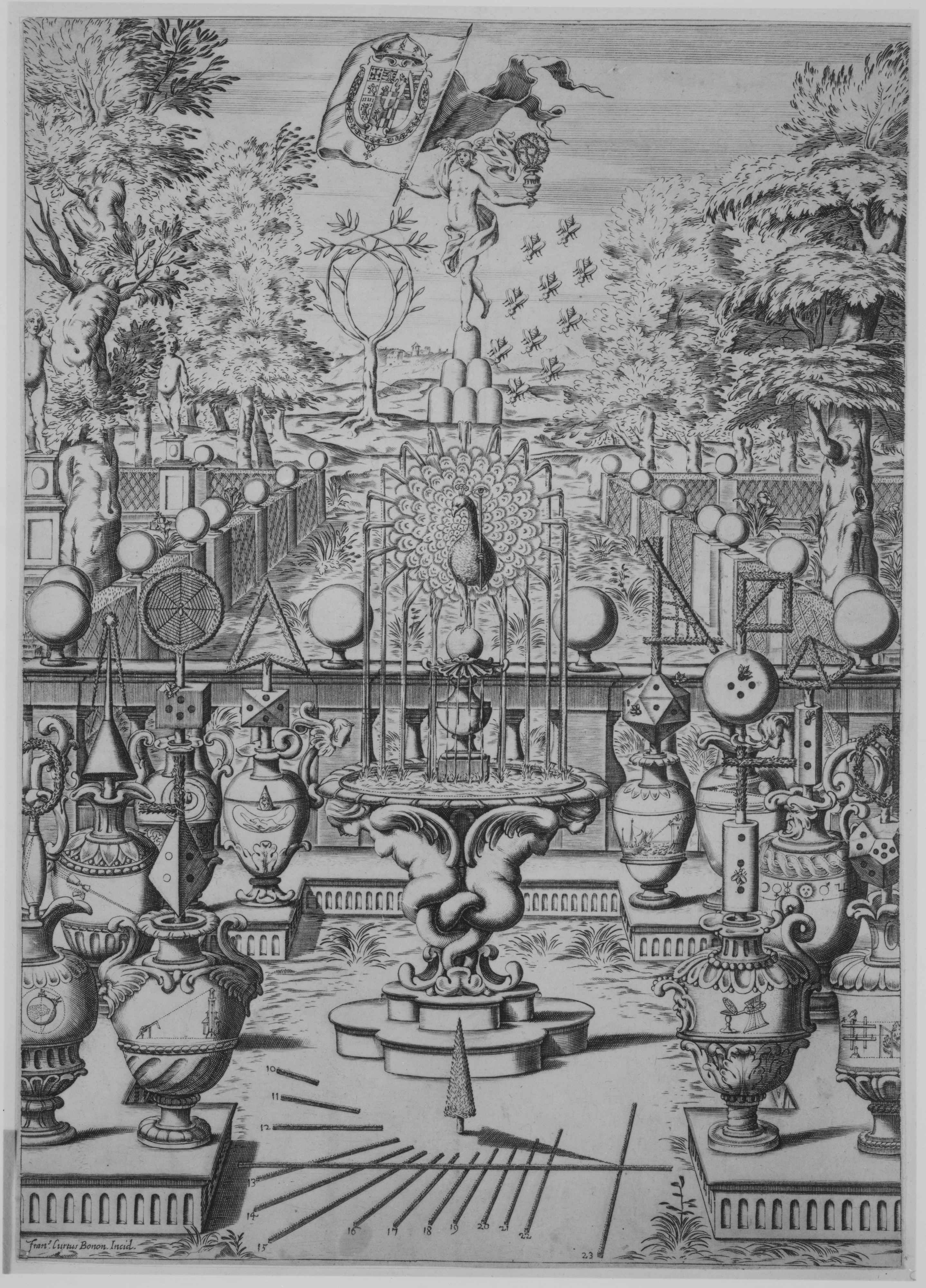
    This fine allegorical image is the creation of Francesco Curti (1603-1670), and according to the Metropolitan Museum of Art it is called “The Garden of Mathematical Sciences”, and was printed ca. 1660.  There’s a lot of objects in this print, and it seems that perhaps most of them have a scientific application.  It is an interesting exercise to identify them–I’ve found quite a few, though not all, how many can you identify? 

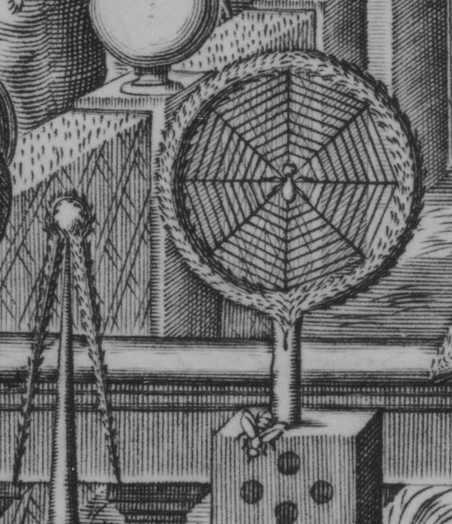
    In the garden there are a geometrical spider, bees, proportional dividers, sundials, anamorphic images, the eye of god in a peacock display, Mercury, Archimedes’ death-ray mirror, navigational instruments, and no doubt much more, displayed and semi-hidden. For example, I think this is the well-known “geometrical spider” (middle far left), as seen in Mario Bettino’s Apiarium philosophiae mathematicae (Bologna, 1645):

    MATHEMATICAL garden spider

    Then there’s this classic image of the peacock, which through the history of Christian art has come to represent the concept of activity, resurrection, immortality–it has been used as a representation of Christ (in paintings like Fra Angelico’s great circular nativity painting, for example).  In the Curti print, the peacock is holding a staff with an eye in it, which is probably that of god; the peacock stands on one leg, balanced with the eye staff, while the rest of the symbolism is filled by having an ever-flowing fountain flow from its feathers. 

    There are no doubt more to be found–there’s the timepiece in the foreground, numerous outlines of scientific instruments as garden plants, a demonstration of the optics of convex and concave lenses, and others.  Have a look!  Follow the link to the Metropolitan and open the very expandable image. (SOme answers, below)


  • A Non-Imaginary Post about Imaginary Books in Real Books

    JF Ptak Science Books  Post 2685

    Eco Library

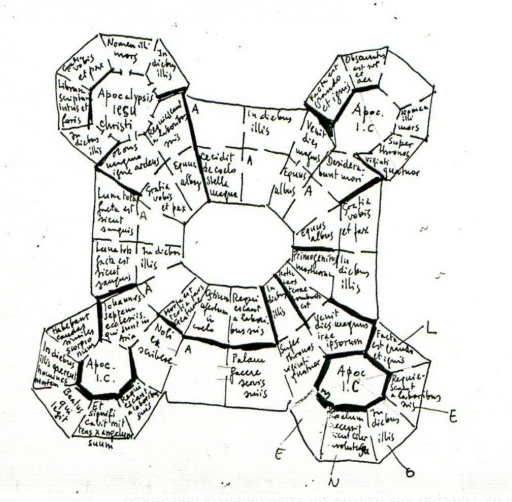
    [Umberto Eco’s sketch for the imaginary library in his The Name of the Rose, from Digital Architectural Papers, here]

    “To write vast books is a laborious nonsense, much better is to offer a summary as if those books actually existed.”  — Jorge Luis Borges

    I imagined to be reading about the imaginary illustrations of a non-existent book when I wondered about the extent of (intentionally) imaginary books in the history of real books.  It was a quick realization of how deep and how old this genre is–and as a matter of fact one excellent single-stop website that displays this depth is the Librarian of Babel by Emi Hastings  (Catalogues of Imaginary Libraries https://librarianofbabel.wordpress.com/2014/04/25/bibliographies-of-imaginary-libraries/).

    At the outset I thought to write some sort of overview or a little history of the imaginary book, starting of course with Rabelais and then Borges, but there is just so much more than can be accommodated by a simple evening’s work that I decided to simply make a few lists of representative creations by a selection of some favorite biblio-creativists. So, help yourself to some interesting and humorous suggestions by Charles Dickens, John Donne, Francois Rabelais, Marcus de Fable, Douglas Adams, Jorges Luis Borges, Umberto Eco, Vladimir Nabokov, Haited Pleat,  and J.K. Rowling.

    Works invented by Charles Dickens [findable in numerous forms with this list found at http://flavorwire.com/329815/charles-dickens-library-of-fake-books]:

    Five Minutes in China. 3 vols.
    Forty Winks at the Pyramids. 2 vols.
    Abernethy on the Constitution. 2 vols.
    Mr. Green’s Overland Mail. 2 vols.
    Captain Cook’s Life of Savage. 2 vols.
    A Carpenter’s Bench of Bishops. 2 vols.
    Toot’s Universal Letter-Writer. 2 vols.
    Orson’s Art of Etiquette.
    Downeaster’s Complete Calculator.
    History of the Middling Ages. 6 vols.
    Jonah’s Account of the Whale.
    Captain Parry’s Virtues of Cold Tar.
    Kant’s Ancient Humbugs. 10 vols.
    Bowwowdom. A Poem.
    The Quarrelly Review. 4 vols.
    The Gunpowder Magazine. 4 vols.
    Steele. By the Author of “Ion.”

    Works invented by John Donne, Catalogus librorum aulicorum incomparabilium et non vendibilium, or The Courtier’s Library of Rare Books Not for Sale, was written between 16-7-1611, and published in 1650: [http://libraryofinvisible.blogspot.com/2014/03/anonymous.html]

    Edward Hoby’s Afternoon Belchings
    On Distinguishing the Sex and Hermaphroditism of Atoms
    On the art of decyphering and finding some treason in any intercepted letter
    Concerning the method of emptying the dung from Noah’s Ark
    Martin Luther, On Shortening the Lord’s Prayer
    The Princely Ocean, or The Pyramid, or The Colossus, or The Abyss of Wits: where by means of 60,000 letters to the Nobles of all nations … are related everything that is able to be related concerning toothpicks and hangnails
    On the Navigability of the Waters above the heavens, and whether Ships in the Firmament will land there or on our shores on the Day of Judgment, by John Dee
    What not? or a confutation of all errors in Theology as well as in the other sciences, and the mechanical arts, by all men, dead, living, and to be born, put together one night after supper

    The Art of Cutting the Teeth.
    Matthew’s Nursery Songs.
    Paxton’s Bloomers.
    5 vols.
    On the Use of Mercury by the Ancient Poets.
    Drowsy’s Recollections of Nothing.
    3 vols.
    Heavyside’s Conversations with Nobody.
    3 vols.
    Commonplace Book of the Oldest Inhabitant.
    2 vols.
    Growler’s Gruffiology, with Appendix.
    4 vols.
    The Books of Moses and Sons.
    2 vols.
    Burke (of Edinburgh) on the Sublime and Beautiful.
    2 vols.
    Teazer’s Commentaries.
    King Henry the Eighth’s Evidences of Christianity.
    5 vols.
    Miss Biffin on Deportment.
    Morrison’s Pills Progress.
    2 vols.
    Lady Godiva on the Horse.
    Munchausen’s Modern Miracles.
    4 vols.
    Richardson’s Show of Dramatic Literature.
    12 vols.
    Hansard’s Guide to Refreshing Sleep

    Works invented by Francois Rabelais, a selection from  Catalogue of the Choice Books Found by Pantagruel in the Abbey of Saint Victor: Devised by François Rabelais: Translated and Annotated by Walter Klinefelter, a Student of Catalogues (printed in Pantagruel, c. 1532; translated and printed separately, 1952):

    The Spur of Cheese

    The Codpiece of the Law
    The Testes of Theology
    On the Art of Discreetly Farting in Company
    Three Books on How to Chew Bacon
    Martingale Breeches with Back-flaps for Turd-droppers