A Daily History of Holes, Dots, Lines, Science, History, Math, Physics, Art, the Unintentional Absurd, Architecture, Maps, Data Visualization, Blank and Missing Things, and so on. |1.6 million words, 7500 images, 4.9 million hits| Press & appearances in The Times, Le Figaro, Mensa, The Economist, The Guardian, Discovery News, Slate, Le Monde, Sci American Blogs, Le Pont, and many other places… 5000+ total posts since 2008.

Category: Outsider Logic

  • On Recognizing Things: “Outsider” Art


    JF Ptak Science Books  Post 1684

    On an early use of the term, Outsider.

    Outsider b075

    Sometimes a word is just a word, and the elements of recognition sometimes inhibits that.  Except in this case that the word seems to be just what it is and also indicative of what it would become.

    Outsider074
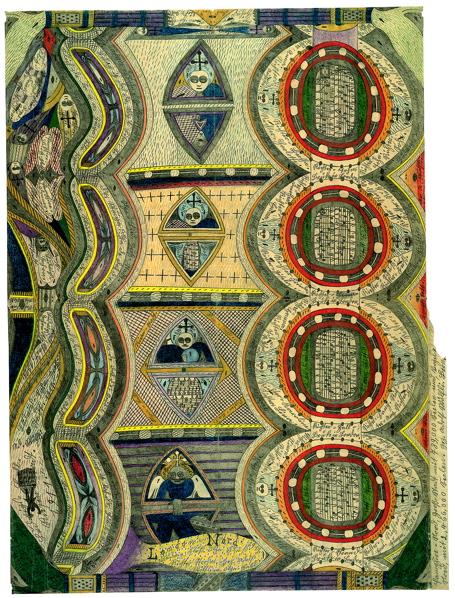
    Outsider, or outside, outside the recognition of “official” art, of critiqued-art, is the English language equivalent/translator coined in 1972 (by Roger Cardinal) to illustrate the term art brut (“raw art”) created by Jean Dubuffet.  Dubuffet created with others Compagnie de l’Art Brut in 1948, which in some respect was a reaction to a new sort of displayed art that had begun its life in the early 1920’s, mainly as the efforts of doctors treating psychiatric patients who were expressing themselves through their art.  (Two famous examples include Dr. Walter Morgenthaler’s Ein Geisteskranker als Künstler (A Psychiatric Patient as Artist), published in 1921 on the work of perhaps the most famous people in the Outsider canon, Adolf Wölfli; and another being  Bildnerei der Geisteskranken (Artistry of the mentally ill) published a year later by Dr Hans Prinzhorn.)

    [Adolph Wolfi]

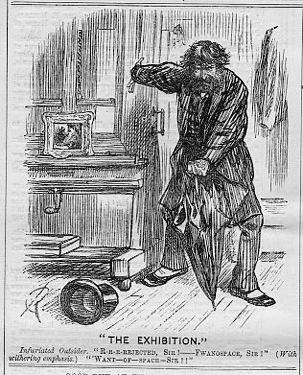
    Well, “outsider” as we  know it today in reference to the arts is definitely not what the editors of Punch magazine pursued in this cartoon for their issue of 6 May 1886.  The “infuriated outsider” was simply an artist left outside a show, whose work was not accepted for exhibition. (And from the looks of it, the small work on the huge easel, being rejected for the “want of space” might not have been the reason for the artist not making the list.)  

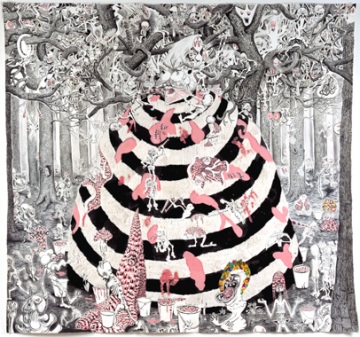
    Trenton Doyle Hancock, “AND THE BRANCHES BECAME AS STORM CLOUDS”, 2003, Mixed media on canvas. Photo courtesy James Cohan Gallery, New York and the American Folk Art Museum.

    [Henry Darger]

    This outsider was simply outside with probably-not outsider art.  Henry Darger (1892–1973), Martín Ramírez (1895–1963), Paul Gösch (1885–1940), Charles A.A. Dellschau (1830-1923), Willem Van Genk (1927–2005) and so on were Outsiders, their work being Outsider/Art Brut and also being left outside for a long time.  Far outside.  In the far-deep outsider, further and deeper outside than the more aesthete outsider varieties of “outsider” art–like Impressionist, Cubist, Dada, Constructivist, Futurist–ever got outside.  

    [Willem van Genk, detail]

    Anyway, I thought it curious to find the term stuck in the middle of a cartoon rant in an 1886 popular journal.


  • Shooting Dodos, Square Holes/Round Bits, the non-Future of Movies, and the Race Where Everyone Wins

    JF Science Books   Post 1519

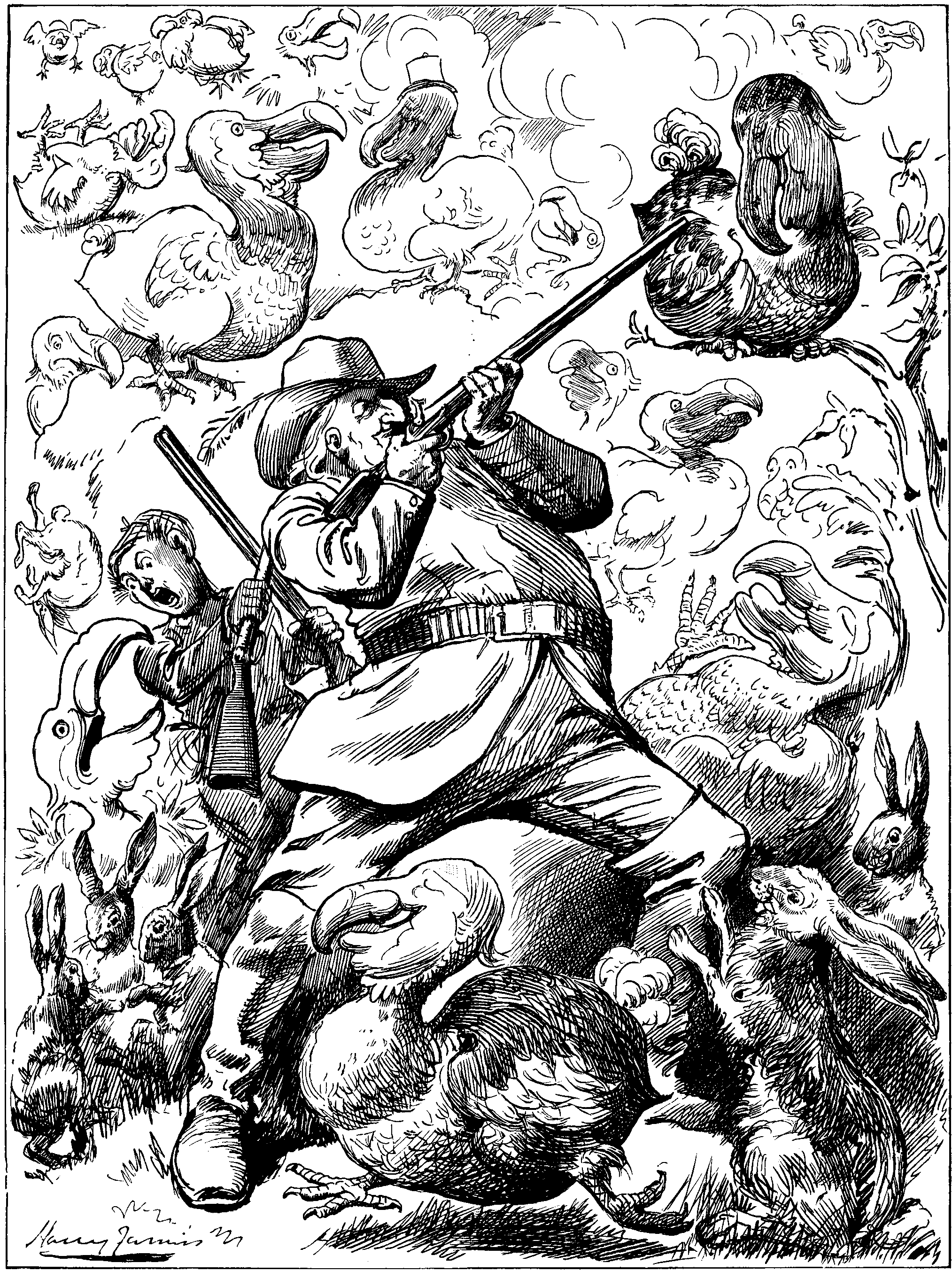
    In a world where everyone wins and no one loses, why can’t we cut a square hole with a round bit.  Or vice versa? Well, we can of course, its all just a matter of perspective.  The image (below) that started this thought thread down the rabbit hole is of a member of Great Britain’s ruling class, Sir William Houghton, appeared in Punch magazine in 1890 as an illustration in a debate over hunting rights for hares and other small critters, in what seems to have been an attempt to further control the access of the wide working class to certain freedoms.  To be honest I  haven’t looked at this debate, and I’m not sure why the liberal Sir William is shooting Dodos as rabbits, but the image–independent of what it was intended to represent–seems to be the inside-out, or the reverse-inside-out of what had been the situation with the bird. It would look “wrong” even if you didn’t know the history of the flightless and basically defenseless creature being hunted to extinction, standing in the place of the rabbit. It has an oddness to it, like a very high-pitched tone that floats above a piece of music, a slightly pungent odor coming from a nicely-executed painting. Perhaps it is the  the sense of expectation being thrown off just a bit with something like the unexpected-expected. 

    And then of course there’s the rabbit hole connection.  And Alice.  And the Dodo.


    From Report of Debate on Hares Preservation Bill, June 26.—”They (the other Members of Parliament) could not go out and kill 300 Dodos,”—but evidently he (Sir W.V. HARCOURT) could, and here he is—caught in the act…  [He reminds me of a peeing stallion–one of the most majestic poses a horse can strike]

    Lewis Carroll’s Alice gets right down to business in her adventures in Wonderland, right from chapter one (“Down the Rabbit Hole”), only a few hundred words into the story1–down she goes.  In one very memorable scene (in a book composed of memorable scenes) Alice meets a Dodo bird (which scholars say is a play on the stuttering Carroll’s real name, Dodgson, or Do-do-ogson), and <things happen> after which the Dodo suggests a “Caucus Race”, being a play on the legislative process in which the Dodo-shooting Sir William participated above. 

    File:De Alice's Abenteuer im Wunderland Carroll pic 10.jpgThe deal with the Caucus Race was that there was no set course, necessarily, for any one racer–everyone would run their own course as they chose; so in a self-defined course with no competitors and no rules, racing a race that the race liked, it would be hard to lose. Carroll writes:

    “First it marked out a race-course, in a sort of circle, (`the exact shape doesn’t matter,’ it said,) and then all the party were placed along the course, here and there. There was no `One, two, three, and away,’ but they began running when they liked, and left off when they liked, so that it was not easy to know when the race was over. However, when they had been running half an hour or so, and were quite dry again, the Dodo suddenly called out `The race is over!’ and they all crowded round it, panting, and asking, `But who has won?’

    “This question the Dodo could not answer without a great deal of thought, and it sat for a long time with one finger pressed upon its forehead (the position in which you usually see Shakespeare, in the pictures of him), while the rest waited in silence. At last the Dodo said, `EVERYBODY has won, and all must have prizes.”

    The rabbit hole was made by the cylindrically-gifted rabbit, though in Carroll’s world the rabbit could’ve been a square, a cube or cube2-something.  Or of course the rabbit could’ve made a square hole, or square-squared hole, which probably would’ve been more to Carroll’s taste, approaching a very early thought on square2.  But people in the three-dimensional world had been working on making square holes with round bits, though coming  a bit after Carroll’s time, as in this example:

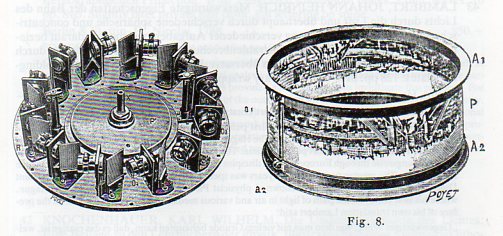
    The device at the bottom of the drill was made to follow and then restrict its cutting motion to that of a square, the device (considerably less wide than the diameter of the bit) cutting and scraping the round hole into a square.  Which in its own way reminds me of a motion picture depicted on a polygon, in a movie theatre for example, which began in a somewhat different way, filmed on a circular surface, or at least in one aspect of it. Auguste and Louis Lumiere began the new mass-medium, illustrated here from their Nouvel Appareil Photographique Panoramique Reversible le Photorama (which was printed in Lyon in 1895/6)

    Lumiere544

    The Lumieres claim for “first” as cinematographers is better understood in terms of the motion pictures being a new mass medium.  Whereas other inventors and experimenters were earlier–like chronophotography devices constructed by  Eadweard Muybridge, Étienne-Jules Marey and Ottomar Anschütz, which all produced forms of moving pictures in the decade prior to the Lumieres, but were decidedly not for public consumption.  The work of these men, as with that of Thomas Edison’s Kinetoscope (1891), was intended for scientific and academic consumption; or with the case for Edison, at least, for the amusement of the wealthy classes, as well as for educating the children of the rich. There were certainly others who worked in this area in the 1890’s, but none really fashioned an interest to their invention for the use of one-and-all as did the Lumieres.

    Which gets us back to our square rabbit hole.  Soon after the Lumiere’s introduced their fabulous new invention, they decided that there was no future whatsoever in the motion picture as a new medium, and abandoned it.  They undoubtedly felt a little bit like the square peg in the round hole of the needs of art, and moved on. 

    ___________

    Notes:

    1. “There was nothing so very remarkable in that; nor did Alice think it so very much out of the way to hear the Rabbit say to itself, `Oh dear! Oh dear! I shall be late!’ (when she thought it over afterwards, it occurred to her that she ought to have wondered at this, but at the time it all seemed quite natural); but when the Rabbit actually took a watch out of its waistcoat- pocket, and looked at it, and then hurried on, Alice started to her feet, for it flashed across her mind that she had never before seen a rabbit with either a waistcoat-pocket, or a watch to take out of it, and burning with curiosity, she ran across the field after it, and fortunately was just in time to see it pop down a large rabbit-hole under the hedge.”–Alice’s Adventures in Wonderland, Lewis Carroll.

    It is highly probable that no artist who ever depicted a Dodo actually saw one. 


  • Strange Things in the Sky Department: the Sky-borne Seat of All Wisdom in the 12th century

    JF Ptak Science Books   Post 1486

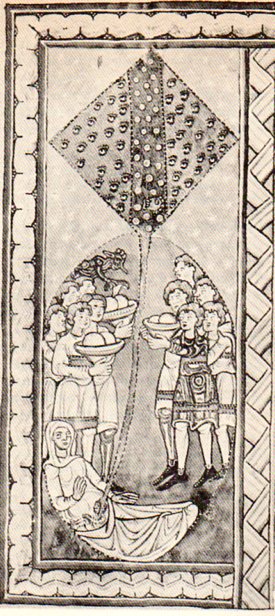
    Hildegard of Bingen (ca. 1098-1179) was a polymathic religious visionary1, composer and writer who was a well-know intellectual whose work attracted the attention of people at all levels, not the least of which were several popes  In one version of the manuscript of her 150,000-word work, Scivias (Scito vias Domini, or “Know the Ways of the Lord” ) we find the following illumination, which is basically an image of the object that contains the nameless stuff of the human soul:

    Sky strange hildegard492
    The image above—from the Wiesbaden manuscript and unfortunately only in a black-and-white, and found in Charles Singer’s From Magic to Science (1928)2–shows Hildegard’s vision of the soul entering the body. (There’s a wide range of opinion concerning how much influence Hildegard had on these images—some say that she sketched out the outlines, or directed the illuminator, or had some sort of hand in the construction of the image, all with varying levels of involvement.3)

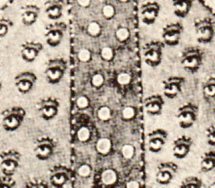
    Sky strange hildegard493

    It is an extraordinary thing, trying to represent what gives the human-ness to people as seen from a 12th-century perspective, and in Hildegard’s version/vision it is the soul, the very essence of the birth and death cycle of human nature.  It is resident as we see within a special place in the sky, the “the wisdom of god” (Singer page 226), and it passes from the vault of heaven into the fetus while still within the mother’s womb.  It is in this square, evidently, that the essential matter of the creator can be found, and within that structure can be seen the essence of the stuff of human nature that is about to pass into the developing fetus through the tube-like connection. As Singer writes, quoting (loosely?) from the manuscript: “down this [the tube] there passes into the child a bright object, described variously as ‘spherical’ and as ‘shapeless’ which ‘illuminates the whole body’ and becomes or developes into the soul.” (Singer, p. 226).

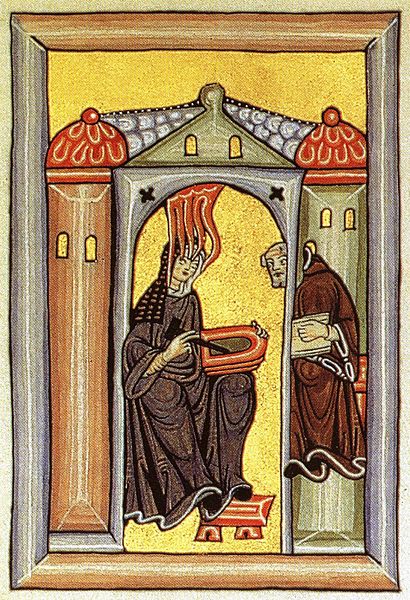
    In the frontispiece to another ms of Scivias, we see Hildegard herself sitting and making a sketch on a wax tablet (a sort of Medieval chapbook, or hornbook, or slate/charcoal sketchpad that could be reused), showing that the images she created were the product of a higher source, of light from another metaphoric vault:

    Strange sky--hildegard

    Notes

    1. Hildegard said that she had these vision,s from a very early age, beginning at about 3.

    2. This manuscript was removed from Wiesbaden during WWII and “sent to Dresden for safekeeping”, where it subsequently “disappeared”. “Destroyed” is more like it, as Dresden of course was the scene of an enormous firebombing campaign in the last days of the German involvement of WWII. There are still hopes that the ms lives somewhere in someone’s grandfather’s attic, perhaps taken in the third week of February 1945 as war booty, and then forgotten. “You guys burnt the place down, turned it into a single column of flame. More people died there in the firestorm, in that one big flame, than died in Hiroshima and Nagasaki combined.” –Kurt Vonnegut, Jr

    3. Historian of science Charles Singer and medical anomaly writer Oliver Sacks have both made strong cases for Hildegard to have been a migraine sufferer, though they do explicitly state that given that as the case it does not necessarily affect the vision that she had.

    As found in the Wikiu article on Scivias:” Some authors, such as Charles Singer, have suggested that the characteristics of the descriptions of the visions and the illustrations, such as bright lights and auras, imply they may have been caused by scintillating scotoma, a migraine condition.[25] Oliver Sacks, in his book Migraine, called her visions “indisputably migrainous,”[26] but stated that this does not invalidate her visions, because it is what one does with a psychological condition that is important.[27] The resemblance of the illuminations to typical symptoms of migraine attacks, especially in cases where it is not precisely described in the text, is one of the stronger arguments that Hildegard herself was directly involved in their creation.[28]

    It has also been suggested that the visions may have been due to hallucinogenic components present in ergot, common in that area of the Rhineland, at certain times of the year.[29]”

    The contents of Scivitas:


  • Spirit-Generated Art, 1871: Far-outside Outsider Art

    JF Ptak Science Books    Post 1402

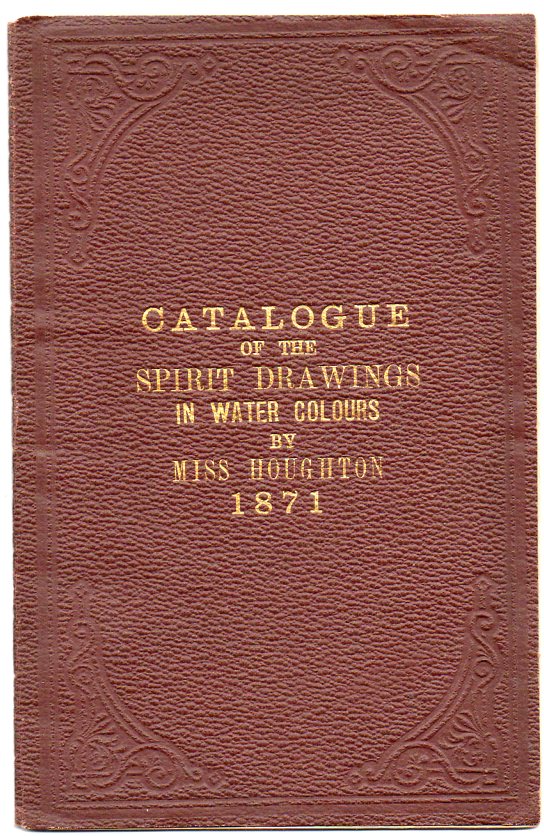
    Houghton219 This slim booklet,  Catalogue of the Spirit Drawings in Water Colours, Exhibited at the New British Gallery, Old Bond Street (London: 1871), offered descriptions of the work of  Georgiana Houghton (b. 1814), an artist who in some way communicated with the spirit world, and allowed her art to be guided by it. She writes in the very first paragraph of her catalog’s introduction, “the execution of the Drawings my hand has been entirely guided by Spirits, no idea being formed in my own mind as to what was going to be produced…”  She explains that the spirits were definitely those of dead people, and after having heard of such possibilities of communication as early as 1859 set out to “obtain mediumship”  by holding hands with her mother at a small table for some months on end waiting for contact–which of course she says happened.  Sundays worked best, “as we should then be less disturbed by evil influences”.   The spirits would communicate at first by table movement, then tapping,  and then through the alphabet by the use of a planchette. So it seems to me that given that she had abandoned her own input in the creative process (even though she had a history of formal art education or instruction), and that the inspiration she received seemed not to be her own, that Miss Houghton was an outsider-Outsider artist, pursuing the spoken artistic needs of others, and then providing her own interpretations of the forms and colors. (We offer the original copy of this catalog at our blog bookstore.)

    It seemed that Miss Houghton was inspired by the spirit drawings of a Miss Wilkinson–it was then that she sought the artistic guidance of a dead artistic sister though without success, and then from a dead brother.  It was the brother who brought her into contact with dead Henry Lenny (“a deaf and dumb artist”) who then guided her hands at first with the planchette, then with a pencil, and finally to watercolors. 

    After ten years of her own spirit drawings, Miss Houghton produced for herself a four-month show at the New British Gallery on Old Bond Street, exhibiting 155 of her works, all exhibited in rented frames for the occasion.  Her reviews seem to have been very-light and  mixed at best,  and for all of her effort and trouble, she sold only one painting,  She did however produce a catalog of the exhibition, which was a great aid to the viewer as the interpretations of the meanings of the forms and colors that Miss Houghton used were written on the backs of the artworks, which were hidden from view by the frames–many of the paintings’ meanings were annotated in the catalog.
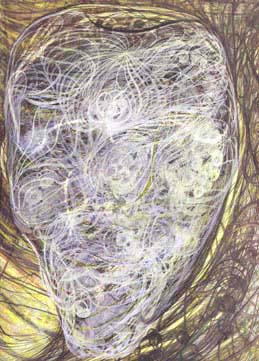
    Georgiana

    Miss Stoughton was hardly alone in this field of representing what seems to have been a very actice after-life of the dearly departed, though it seems that not as many participated in her own brand of automatic representation than other methods of spirit communication.  She did appear at the beginning of what would become a significant culture of spiritualism, with spiritual manifestation, telepathic communication from one person to another and then to the dead, thought transference and  magnetisation.  The evidence of spiritual contact was produced on high levels, not the least of which were seances in which the dead appeared as floating ghosts filled with quiet or phantasmal groans and noises, sometimes luminous, sometimes leaving the medium’s body as colored smoke, sometimes appearing as an electric spark, or an imprint on a photographic plate, or an aural shadow produced in iron filings, or an impression made in clay or other accepting materials2.  They offered possibilities for hope and belief that are no less vigorous than our own today, save for their technological limitations.  (An interesting article, “Proof Positive, the Photomatic Body in fin-de-siecle Science, by Alessandro Violi, can be seen here.)

    There is a very interesting article on Houghton and the exhibition by Rachel Oberter called  “Esoteric Art Confronting the Public Eye:  the Abstract Spirit Drawings of Georgiana Houghton” which was published in Victorian Studies 48.2 (2005) 221-232.  About the pre-Abstract abstract and proto-impressionist work, Oberter says:

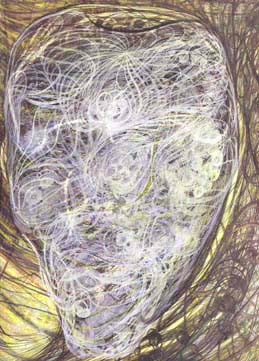
    “Given the lack of abstraction within Victorian visual culture, watercolors such as those painted by the artist Georgiana Houghton in the 1860s and 1870s seem shockingly out of place. In her work The Eye of God from 1862, we see a tangle of transparent straight, wavy, and spiraling lines flowing out of the left corner of the paper and up from the bottom edge of the page as white filaments float across the surface. No recognizable forms appear; all that is visible are lines and colors—yellow, sepia, and blue. There is an organic quality to the undulations, a sense of microscopic detail, and a feeling of being in a deep-sea world or otherwise mysterious place. The vagueness of the imagery contrasts with the specificity of the title, which evokes a dense underlying symbolism. Houghton attributed meaning to particular shapes, colors, and directions in her paintings. While her works were abstract, they remained representational.”

    “The most important tools for decoding these works are the explanations that Houghton wrote on the backs of the drawings [above] . These elaborate descriptions provide a key to the symbolism in the drawing, clarify the message of each work, and name the spirit who acted as Houghton’s guide in the creative process. Houghton believed that these explanations were written by the spirits through her hands; they are automatic writings that complement her automatic drawings. The same spirit who inspired the drawing provided the interpretation on the back—the explanations, one could say, came directly from the source.”

    The catalog does give Biblical references for every one of the works, giving at least a location in the Bible for every artwork.  There are occasional (though sparse) longer descriptions of the work, though the great majority give Biblical citations for what each of the paintings represents. 

    Also of interest is Ms. Oberter’s description of the gallery event:

    “…in 1871 she exhibited her works in a more formal venue: she organized an exhibition at the New British Gallery in Old Bond Street in London. The exhibition, entitled “Spirit Drawings in Water Colours,” lasted for four months and consisted of 155 of Houghton’s watercolors. She rented frames for the occasion and hung the watercolors against the walls of the gallery. This arrangement meant that the backs with the explanations would not have been visible. Yet it was still critical for Houghton that she convey this hidden information to her viewers. In her autobiography Houghton recalled: “The chief object aimed at in this Exhibition, was not so much to display the wondrous powers of the unseen intelligences, as to manifest unflinchingly to the world that true Spiritualism is inextricably bound up with the religion of the Sacred Scriptures” (Houghton, Evenings 2: 53). It was not enough for Houghton that the drawings serve as proof of communication between spirits and humans; it was also important that they convey the relationship between Spiritualism and Christian theology, particularly the insights that the spirits give about God and the Trinity.”


     The artwork of Miss Houghton is an interesting blip in the history of Victorian art, and I’m not exactly sure what to say about it.  It certainly occurs during the first wave of Impressionism, and is wholly different from that new art form as well as the high Victorian fashion of the time; it also is entirely non-representational, an abstract art that precedes that revolutionary phase by about forty years.  Its a little puzzling to me, especially since Miss Houghton seems to have escaped virtually any sort of lasting review or critique.  But again Mrs. Stoughton is not alone in the non-representational art field apart from the automatic spirit manifestations–for example, in addition to an enormous literary output, Victor Hugo produced some 4,000 pieces of art, some of which are exceptional examples (to my mind) of non-representational art that came in a period decades before the Kandinsky and the rest.  Here is Hugo’s “Evocation of an Island”:
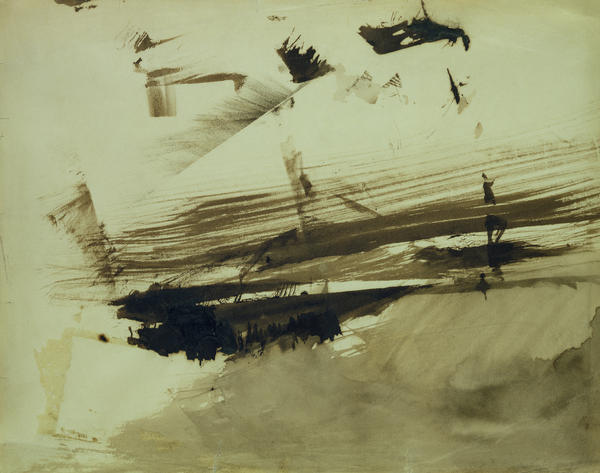
    Evocation of an island Painting  - Evocation of an island Fine Art Print

    He was certainly outside the mainstream of Victorian art, and even well outside that of Impressionism. 

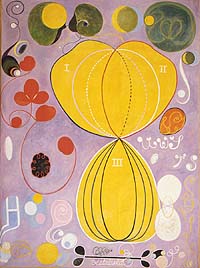
    There was also Hilma of Klint (b. 1862), a woman who like Stoughton also represented the spirit world through her art, and who began painting in non-representational and abstract ways beginning in 1897/8, an example of which is below:
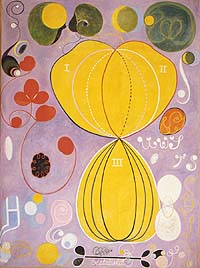
      Hilma klint


    Miss Houghton went on to improve her representation of the spirit world through photography, a very wide selection of her work being available at the Keith De Lellis Gallery, here.

    In the realm of extra-sensical belief, I’m not so sure that these brands of spiritualism would be too much different from any other belief in things that cannot be seen, or heard, or felt in any detectable way, a prayer by any other name.

    Notes:

    1. Our catalog was the property of William Crookes (with his bookplate, and with a signed inscription to him from “Miss Houghton”)  who was an eminent British chemist and physicist and a pioneer in the field of vacuum technology (and remembered now mostly for the Crookes Tubes and his superior approach to experimentation).  He was interested in spiritualism from about the year 1869, pursuing it until his death in 1919.  He was hardly alone in his interests among highly-paced British intellectual elite:  Alfred Russell Wallace, Lord Rayleigh, Oliver Lodge and William James were all extremely interested in the spiritualism phenomenon.  Curious. 

    2.
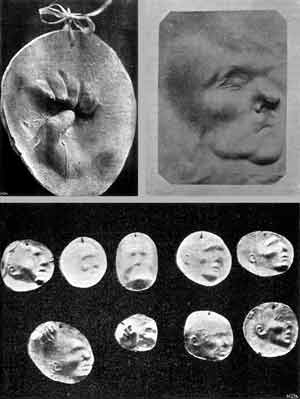
    Imprints of ghost hands and faces
    Imprints of ghost hands and faces produced by Eusapia Palladino, from Bozzano, Ipotesi spiritica, 1903, in C. Lombroso Ricerche…, 1909


    ·Posted by :

    ·in:

    — —

  • An Alphabet of Unintentionally Semi-Absurd Motivational Images, Business Publications, 1930’s

    JF Ptak Science Books   Post 1367

    Biz alphabet--e014

    This alphabet fell into place almost by itself as I wandered through this maze of business motivational pamphlets published by Men of America Inc (of Chicago), all printed in the late 1930’s to about 1941.  The design of the covers of this series is sensational (and I gulp wind as I say this) in very short and limited ways, just like it is sensational to watch a motionless penguin for a long time and then to see it suddenly turn its head to the left.  But these images served a very dedicated purpose when they were printed, and were even perhaps useful,or successful, as this publication saw at least 500 different numbers in this series.

    Perhaps more interesting–where did these models come from? 

    I think many of these covers are fantastic: charmingly naive, naively bizarre, cluttered with fantastically abandoned sentiments, and dripping with design elements all but forgotten and/or abandoned.  They are beautiful in their own special way.  And I’m not so sure that I wouldn’t want to go back in time, read them and take their lesson to heart. (All are available for purchase via our blog bookstore.)

    A is for AIM to keep workers happy and profit happier

    Biz alphabet--a007

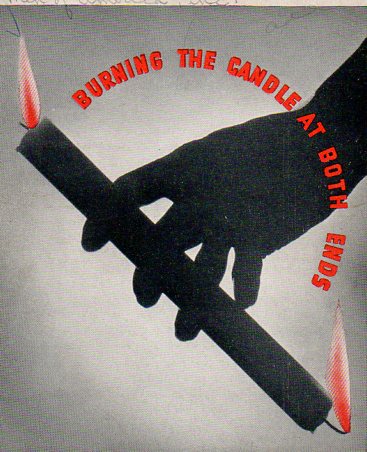
    B is for BURN and hoping for a better-built candle

    Biz alphabet--b008

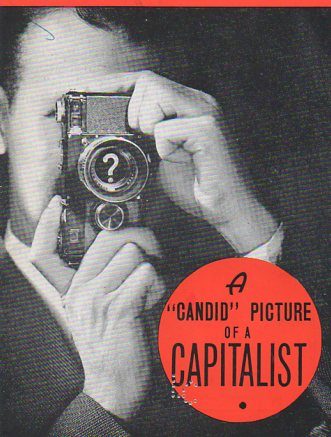
    C is for CAPITALIST, an exclamation point in a land of question marks

    Biz alphabet--c010


  • The Big Lie–Poland as an Aggressor Against the Reich, 1939

    JF Ptak Science Books  Post  1298      (This is the second post written on this pamphlet–it is a stunner to me every time I see it. The earlier post was written in September 2008 and can be found here.)

    Here’s an interesting entry from the instrumental librarians’ tool WorldCat, a massive 75 million item book database that I use with some frequency, trying to determine whether some obscure-sounding/looking pamphlet or book is actually Not Around, like not in library collections.  (When something just isn’t there, not located, it makes the work even more interesting to me.)

    Poland’s Designs on Germany has the sound and feel of a piece of propaganda, right from the start, just from the supra-obvious title page and the very feel of the production.  Looking for my proof-in-the-pudding–the printing information and source for the information–I found none.  Another strike for the propagandist.  (And another interesting point: the phrase “Poland’s designs on Germany” is a non-starter on Google, not located on the web, or in JSTOR, or in other pay-for web commercial communities.)

    Photo

    (This item is available for purchase at our blog bookstore.)

    Then of course there was the content, which is a simple, serial distribution of The Big Lie, painting Poland as an aggressor, hungry for German land and people. So far as I can tell there is nothing truthful in this work whatsoever, or at least I should say nothing that is assertive to the point of Poland being an “aggressor”. There are seven maps illustrating the points.  These are the great hallmarks of The Big Lie–a lie so vast that no one is supposed to think it possible that someone would tell a lie so fantastic, that no broadcast lie could be so incredibly big as to have been invented and told,  and so the lie must be true.  Hitler wrote about this admiringly in Mein Kampf, expressing an idolotry for the idea in print, recognizing it as a powerfull tool of subversion and propaganda, and then went ahead and followed the instructions. 

    Then comes the entry in the WorldCat–I found that the year was 1939.  It would be in September of the year that Hitler would attack Poland and the war would begin.  Who would have thought that the Nazis were acting in self defense?

    The WorldCat entry:

    Poland’s Designs on Germany as expressed since the British guarantee.  [Berlin W 62, Rauchstr. 27]  [Dt. Informationsstelle],
    1939
    23 S. : 7 gez. Kt. ; 8.
    Other Titles:     Polnische Ansprüche auf deutsches Reichsgebiet. engl.
    Locations    Library    
    Germany    BAYERISCHE STAATSBIBLIOTHEK     
    Germany    BIBLIOTHEK DES HERDER-INSTITUTS     
    Germany    DIE DEUTSCHE NATIONALBIBLIOTHEK   
    Germany    STAATSBIBLIOTHEK ZU BERLIN

    And there it is: “Dt. Infomrationnsstelle” is the Deutsche Informationnsstelle, the German Information Centre.  The  GIC exists today in name only, but during the National Socialist period leading up to the war and during WWII it was an outlet for German propoagandistic works. There are no copies of this particular work, evidently, in libraries in the United States. This is too bad, because this is a tremendously insulting document, an insistent, insinuating, unforgiving document to the ridiculous, perverted manner of thought and logic of the Nazis.


  • The Sublime Antiquarian Art of Children, Part I

    JF Ptak Science Books   Post 1224

    Children's art--3846
    Among my favorite places in Washington, D.C.–a place where I lived for 29 years–are its cemeteries; in particular Rock Creek Cemetery, but more specifically, Congressional Cemetery.  Congressional is a big place, tucked away, sort of, away in Southeast D.C.–that is if you can tuck away a 30-acre piece of land. Congressional is an odd place, filled with many interesting people; its filled with their actual remains, and also their memories. There are many folks who have been interred in spirit in the cemetery, in cenotaphs; there are also many who have been laid to rest their temporarily, in the Public Vault, until conditions (in the old days) improved to have their remians received in their final resting place. 

    Children's art--2845
    Among those in the temporary funeneral housing were JQ Adams, William Henry Harrison, Dolley Madison, and Zachary Taylor. It may be one of the great vaults in the history of our country, a small place holding great people.

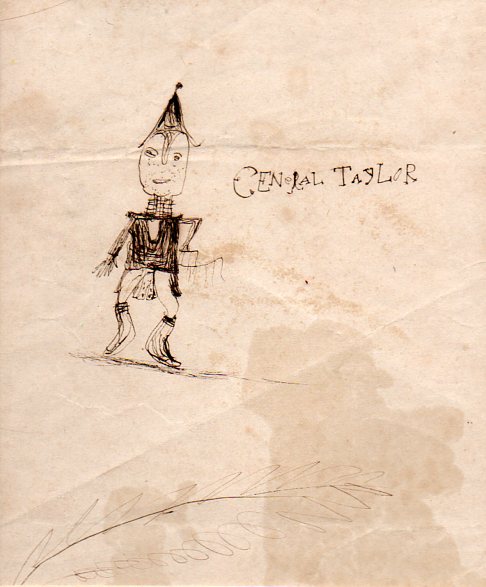
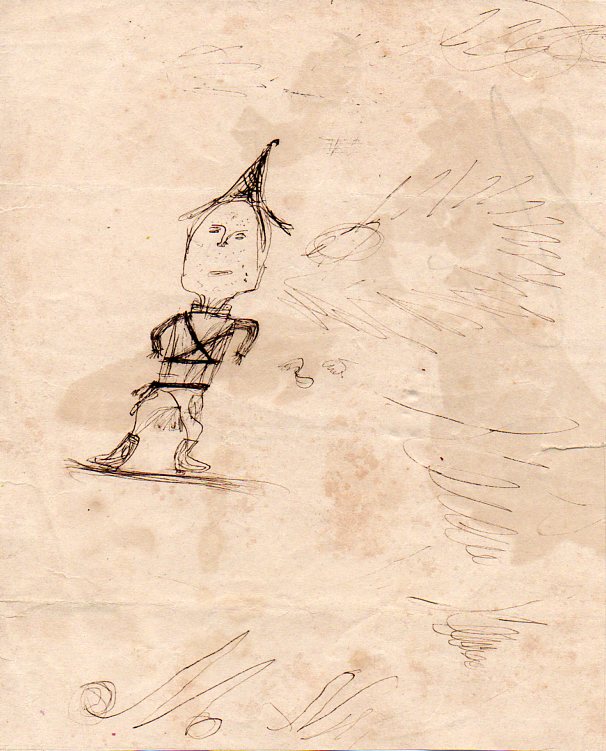
    President Taylor.  General Taylor.  That’s why I’m here right now.  He’s the subject of these magnificent efforts by an unnamed child.  The boy, or girl, drew these images on the back of a section o fmap that was printed in about 1845-1850, just about at the time that Taylor was at his greatest height–a general, a famous militaryu leader, about to become president of the United States without ever having been elected to any office.  He was a gigantic figure at the time, and no doubt occupied some piece of mind of the artist who rendered him, The General.

    I came to collecting childrens’ art in a roundabout way–not so much “collecting” per se as in “finding” them.  They’re difficult things to locate.

    First of all, materials were scarce.  Paper, pencils, ink–these were not common things for kids to own in the 19th century, especially more in the middle and early parts of the century.  These items were expensive, especially if you were a kid in a working-class family who didn’t have much of anything at all, anyway. In addition to a real crunch, a severity of absence, of the basic materials, the art that was made had to survive the artist’s own hands.  And then it needed to survive being culled from family clutter for a generation. And another. And another. And another. And four more.  150 years of parents clearing out the clutter is a lot to survive. 

    And so there doesn’t seem to be much left.

    I find them in flyleaves of old textbooks and such.  Its not as though there is are websites devoted to such things–at least not until now.

    And so I’m selling two of the three portraits of The General that I own.  I’m keeping one.  They just feel superb, to me.

    If you’re interested in owning one, visit the blog bookstore, here.  I’m developing now a site for nothing but pre-1900 kid art. 

    The artwork of children is a gorgeous thing, even when the children are not your own.  Its not that there is a sense of a certain charm, or charms–the words are just too weak. The vocabulary is more in the realms of the work being sublime, far more so than anything else.

    Children's art--1844


    ·Posted by :

    ·in:

    — —

  • Towering Classics of Lost Logic: the Japanese War Lords, Kaiser Wilhelm, U.S. State and Justice Depts as the “True Kidnappers” of the Lindbergh Baby

    JF Ptak Science Books  Post 1204  [Part of our Bad Ideas series.]

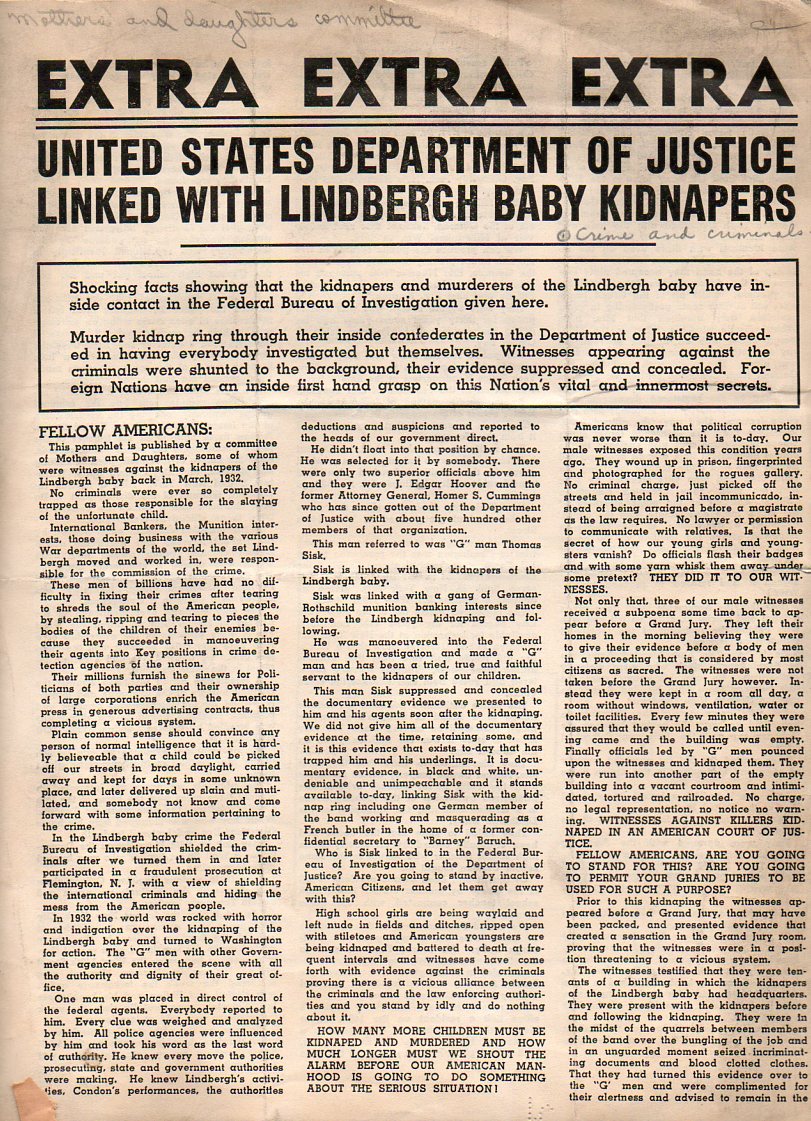
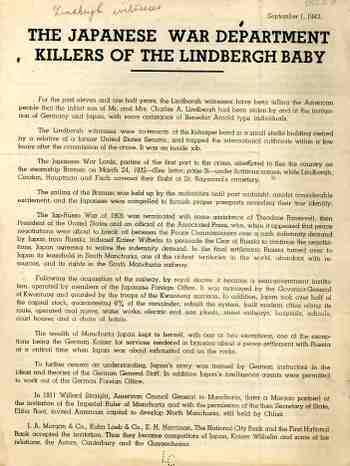
    Sometimes things aren’t what they seem, and then sometimes they’re not what they seem not to be, and then there are these things, below.  These small pamphlets are very reaching examples of finding gold or silver or muffins or whatever in a sow’s ear, finding a hope for belief where there wasn’t room for any, logically speaking.  But there’s always room for belief and faith, which takes on myraids of appearances, from believing in paper money to believing in heaven–in these cases, our writers believed in the unbelievable, creating and then believing in “innermost secrets” where there were no secrets and were no insides. 

    Lindbergh771

    Both of the examples below relate to the kidnapping of the 20-month-old son of Charles Lindburgh in 1932.  The crime was an extraordinarily national event, with seemingly everyone in the country following the case  During the two-month hunt for the baby and the subsequent trial and execution of the man who was seen as responsible for the child’s kidnapping and murder, there were fantastic numbers of claims from people who had solutions to the mystery, or had been in contact with the kidnappers, or some other sad, imaginary relationship to the event.  The examples below [both of which are available for purchase at our blog bookstore] claim to have incredible insight into the real nature of the crime, which of course goes blindingly beyond the simple matters of the case and on to include massive colusions between the U.S. State and Justice Departments, “international bankers”, F.D.R., Kaiser Wilhelm, and “the Japanese government”.  And more.

    The first example was published in 1942 by something called “The Mothers and Daughters Committee”.  This group used the address of  280 E. 21St Street, Brooklyn, New York, which today is a six storey building with 96 apartments, and I suspect that the MADC back there in ’42 was nothing more than a crank in apartment inthis building. The thinking is too confusing and the references too many amnd too busy to actually do this thing justice by de-threading it, but suffice to say it claims that the F.B.I. was shielding “the international criminals”who were truly responsible for the crime–I’m not sure how F.D.R. works his way in there but it has something to do with “international bankers”, communist conspirators, traitors in the State Department, and “needy” lawyers, all brought together in a choking confluence to do harm somehow to American society and morality.

    Lindberh_japanese168 Now our second towering example is this four page pamphlet, received by the Library of Congress (and probably nobody else) on 1 October 1943, which divines the origins of World War Two and the kidnapping of the Charles Lindbergh baby to a complex and impossible cabal of Japanese “War Lords”, Kaiser Wilhelm of Germany, the assassination of Leon Trotsky, the League of Nations, Elihu Root,  “3 cent gallon kerosene”, the South Manchurian Railway, and some sort of “historical documents of posterity countersigned by Tokyo and Berlin” in the possession of Mrs. Renee Valentine (“Secretary”) of Staten Island, New York. 
    The entire affair began with “co-tenants of the kidnappers band in small studio building owned by a relative of a former U.S. Senator” under the instigation of “Germany, Japan and certain Arnold Benedicts types” brought about by the end of the “Jap-Russo” War of 1905.

    We are told it was an “inside job”.

    Somehow Teddy Roosevelt gets involved with Kaiser Wilhelm in arranging for the Russians to pay indemnity to the Japanese in terms of a land agreement of Southern Manchuria, opening the way to exploitation of China by the Japanese.  Something else happens, the South Manchuria Railroad gets thrown in as well as four competing U.S. banks and Elihu Root and a failed League of Nations agreement which upsets a balance of power and brings “the Astors, Canterbury and the Guggenheims” into competition with the Japanese and Kaiser Wilhelm, doing something to the Treaty of Washington.

    After this incredible and unconnected and partially non-existent series of events is both untangled and entangled before our eyes, the writer reaches the lonely and very solitary conclusion that “the necessary documents to prove these charges (??) could be secured through the kidnapping of the Lindbergh baby”.  I was waiting for the  author to make a case for Lindbergh’s real-life (and long held) Nazi sympathies, but that just didn’t happen. 

    I really have no idea of what the writer is talking about, but the failure of making any connection whatsoever with any of the “facts and circumstances” is magnificently appalling, and has moved itself from the realm of being so bad that it isn’t even “bad” anymore.  It is that singular sort of “badness” that makes the printed words seep into the paper and disappear before your very eyes, and the only thing that you can say is “wow”. 


  • Extruding 3-D Shapes from 2-D Art to Create a Cubist vs. Art Deco Chess Set

    JF Ptak Science Books   Post 1129

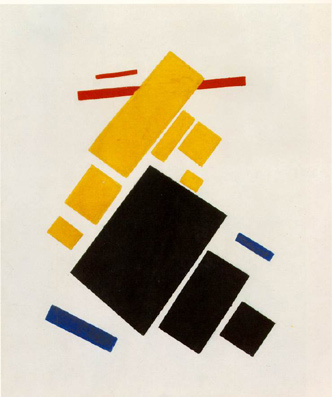
    Is there room in the history of invented art to reconstruct cubist and abstract paintings by imaging the objects that could’ve passed through the canvases to leaves their geometric footprint?  That is to say, if you took the Woolworth Building in NYC and passed it at an oblique angle through a large sheet of paper, and that paper was permeable enough and the building moving slowly enough to simply leave its “footprint” without tearing or deforming the surface of the paper, the resulting image may look a lot like figures in classic works in the history of art.

    Malevich.aeroplane-flying


    That is no revelation, really, as the Black Square or Airplanes Flying of Kasimir Malevich could’ve been made by every fourth item on your desk.  But what is interesting to me would be the reverse of this process, where you take that black square and reverse-engineer it, extruding whatever figure it was that could’ve made the black square into its three dimensional counterpart.
     
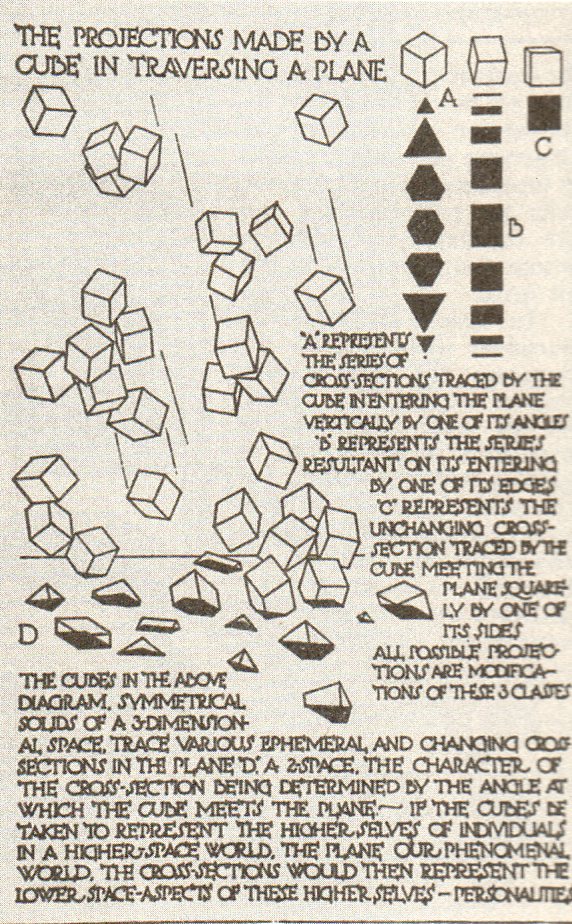
    What comes immediately to mind for me in this regard is Claude Bragdon (1866-1946),  (a New York-based architect with a long set of sleeves for writing in upper dimensional planes of Theosophy and reincarnation and other similarly squishy reaches) who wrote a few interesting books on the fourth dimension and objects and space, writing two of them at a very interesting period of t
    ime for the history of physics and art (1912 and 1913). The books are interesting enough, I guess, and seem to perhaps have had an influence on some influential artists of that time,  but what is of interest here are tow illustrations. 

    Blog--blagden 1348

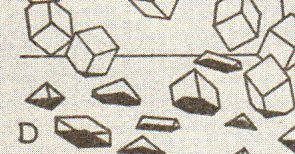
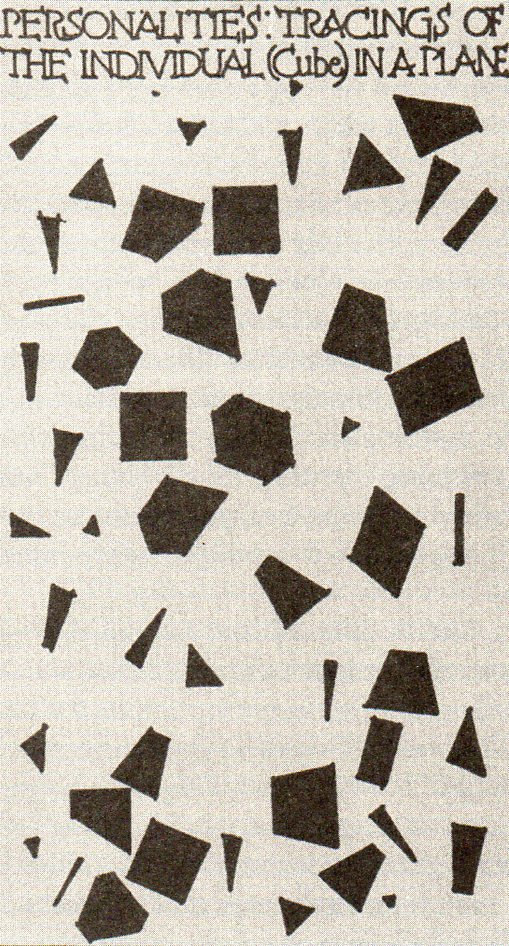
    First is “the Projections made by a Cube in traversing a Plane” from Primer1, showing the impact (at different levels) of a cube falling through a plane.  The second, “Personalities: Tracings of the Individual (Cube) in a Plane” from  Man2, shows the “shadows” of the three-dimensional figures as they lived in their two-dimensional world.  It comes close to the impact of the cubes above, but really only depicts what two-dimensional creatures would see of the three-dimensional beings inhabiting their Bragdonesque world. 

    Blog--blagden 1 det349

    I like  the tracings more as impact points than 2-D renderings of 3-D objects, and in some ways they are very similar. (I have to say that I am surprised that given Bragdon’s expanse of taste and artistic ability that he didn’t arrange these images in an artistic manner–in that sense he entirely missed the boat on adding his own bit to the newly-formed
    Cubist world. He also reminds me of Emily Vanderpoel, who in her own way completely missed the new artform that she was serendipitously creating.)    

    So when I look at something like a Malevich or Mondrian or even (but less so) at a Duchamp (Bride), I find it interesting to manufacture the base of the something that plunged itself cleanly through their canvas, pulling it out again, giving it three dimensions, and incorporating the thing as a piece in a chessboard–the chessboard being the pieces that made the shapes in the canvases resulting in the Art Deco vs. Cubist/Suprematist   Chess Set.   It would be interesting to choose two representative canvases for either style and  see if one (or a couple of ) object(s) could make all of the shapes in the two representative paintings,  populating a chessboard with sameness.

    Blog--blagden 2350

    The bottom line, then, is how different or similar would the extruded three-dimensional figures be that were responsible for this impact in a two-dimensional surface be? 

    (I am reminded too of Duchamp and John Cage sitting down to a game of chess and producing a musical composition via their moves, at  Sightssoundsystems, a festival of art and technology in Toronto, 1968. In this way too an artwork could be made with each move in a game of pieces used to make iconic shapes in the history of art.  “They did not speak. They did not sing, they remained, all of them, silent, almost determinedly silent; but from the empty air they conjured music. Everything was music…” Franz Kafka, Investigations of a Dog.)

    Notes:
       
    1..(Bragdon) A PRIMER OF HIGHER SPACE. (The Fourth Dimension). Rochester: Manas Press, 1913. 8vo, (12), 79pp, including 30 plates.Notes:

    2.. (Bragdon) MAN THE SQUARE. A Higher Space Parable. Rochester: Manas Press, 1912. 12mo, 34pp, 9 illustrations.  


  • French Visionary Architect and Creator of Bad Taste: Jean-Jacque Lequeu.

    JF Ptak  Post 1124

    The history of bad taste is like a history of bad food–you need them to tell you what’s good. — Imaginary quote of Hank Hill

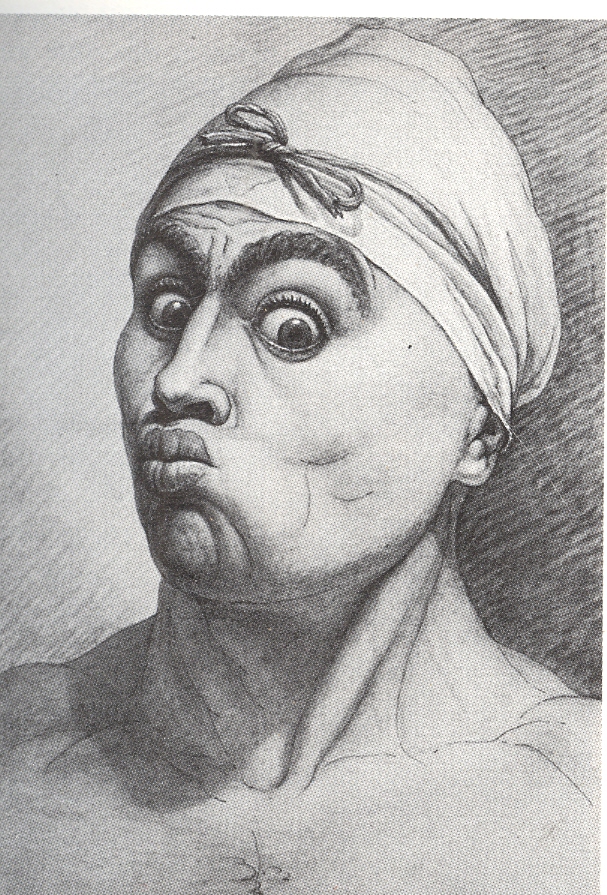
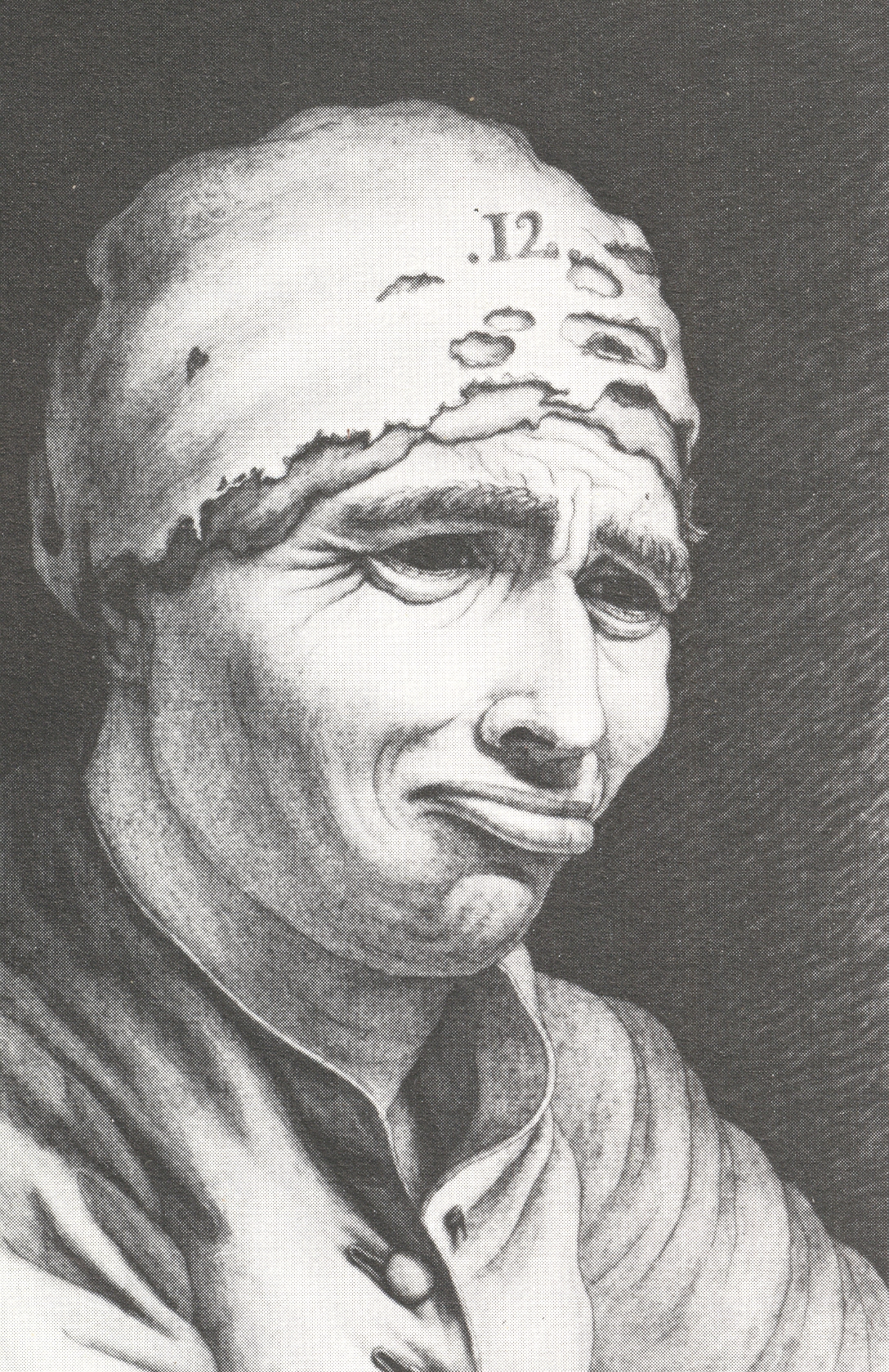
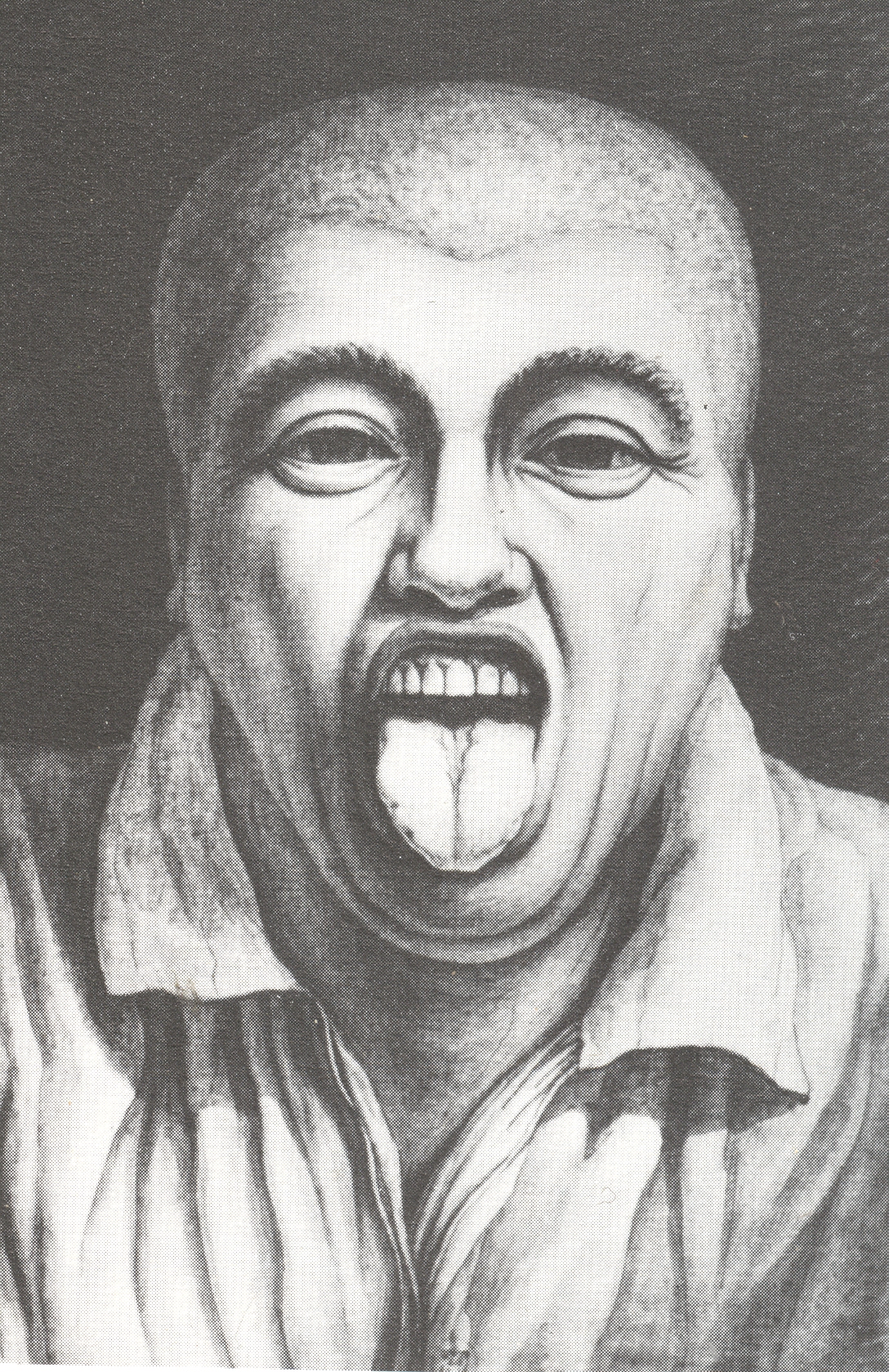
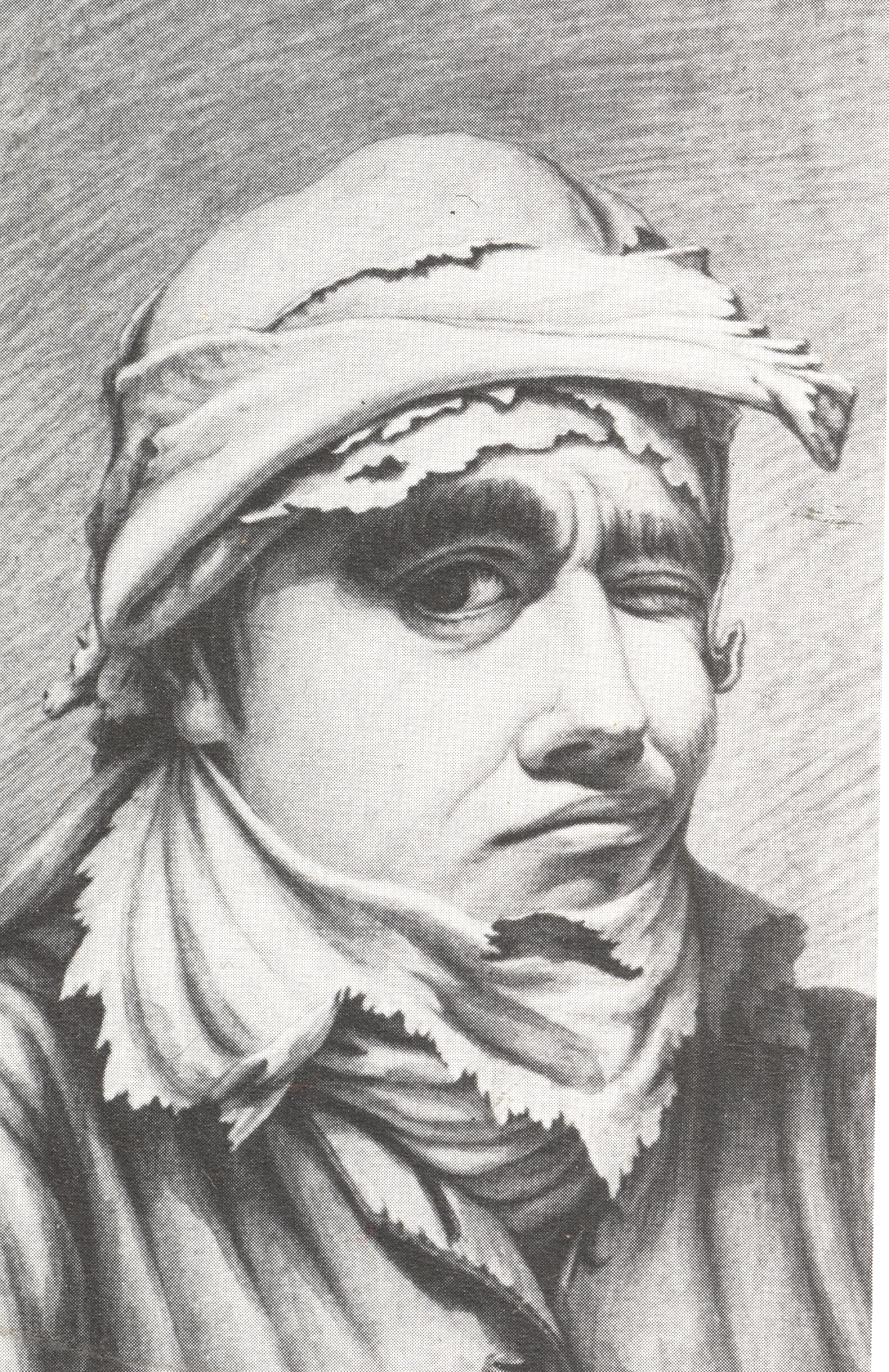
    I you look hard at some of the leading styles of architecture and design of the 1880-1920 periods, you will see elements of the work of the great visionary architect, Jean-Jacques Lequeu,  The Rouen-born and Paris-educated Lequeu’s major problem in this is that he was long dead in some forgotten place before any of this very-late recognition occurred.  Too late for accolade, too late to brand his isolation as something other than bizarre (famous people doing the same sorts of things would be “quirky”), and of course too late to get patrons or backers or clients for him to actually be able to build something.  Anything.  He had a brilliant command of fancy and imagination, coupled what extreme senses of design and composition and material, and also how to make something constructed of all of that stuff stand up. And that’s certainly the promise that he showed when he and his more public-centric work were in favor.  But that was back before the Revolution–before the end of the American Revolution.  Things happened, and Lequeu would spend four decades in high obscurity and low solitude.

     He could’ve been just about anyone after this point, after his acceptable brilliance wore off:  instead, he became a government worker/draftsman, lived in a series of small apartments, and finally wound up taking residence in a brothel room, where he created unequaled images of imaginary/inspired architecture. And between his scrambling for a government existence and creating vast Utopian cities and complexes and bizarre anthropomorphic structure, Lequeu might also have invented Bad Taste, being an early version of Charm City’s own John Waters (sorry Mr. Waters, but you know its true). By virtue of his station in life, I think, Lequeu was exposed to many sides of French impolite and exploratory society which he managed to witness, and capture, and portray in a manner vastly uncommon to almost every other artist of his day. 

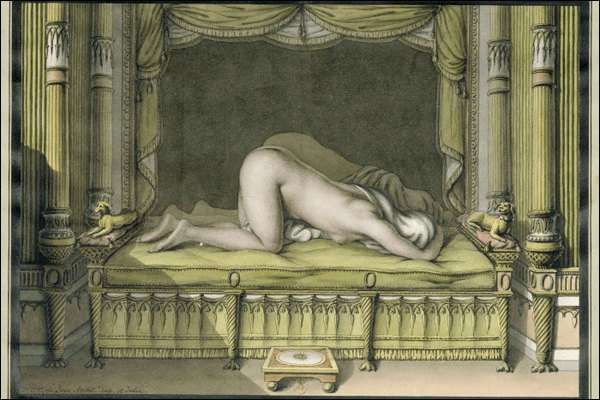
    I did want to concentrate just on Lequeu’s self-portraits here, but I feel compelled to share at least a couple of Lequeu’s fanciful and Columbian adventures into the world of Bad Taste–these are not by any means his great contribution to the history of art, nor do they come anywhere near his great architectural visions, but they are significant  For example, while others (actually, everyone else) was exploring reclining nudes in one refined way or another, Lequeu explored the image from a different angle:

    Lequeu reclining nude
    Not only is the model in an unusual position, and in front of a mirror, but her face and head are completely obscured. A lovely piece of technical gaudiness, this still was not a crowd-pleaser in 1815.  Its not the only thing that Lequeu should be remembered for by any means….but it is something.

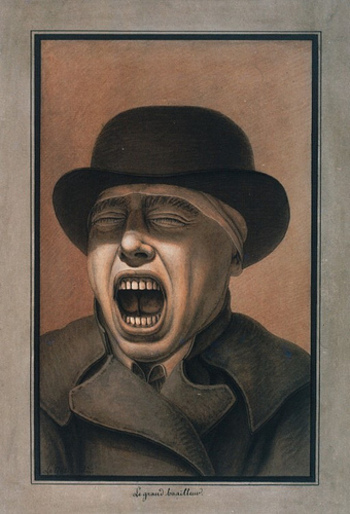
    But on to Lequeu’s fearless self-portraits:

    Lequeu 

    Lequeu 8

    Lequeu portrait 003
    Lequeu portrait 005
    Lequeu portrait 006

    Lequeu portrait 007

    I think that you’ve got to admire the guy for his out-loud living. 

    Notes and examples of Lequeu’s architecture, below: