A Daily History of Holes, Dots, Lines, Science, History, Math, Physics, Art, the Unintentional Absurd, Architecture, Maps, Data Visualization, Blank and Missing Things, and so on. |1.6 million words, 7500 images, 4.9 million hits| Press & appearances in The Times, Le Figaro, Mensa, The Economist, The Guardian, Discovery News, Slate, Le Monde, Sci American Blogs, Le Pont, and many other places… 5000+ total posts since 2008.

Category: Outsider Logic

  • A Cosmological Map of the Descending Dead (1855) & a Surprise Death-Cosmo Guest Image

    JF Ptak Science Books   Post 2234

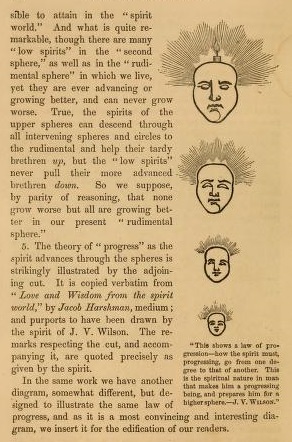
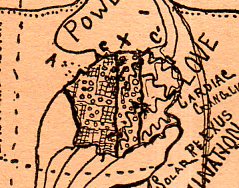
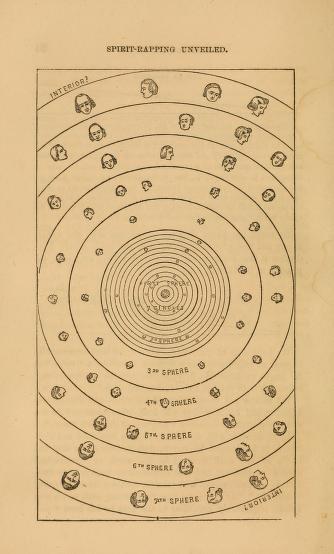
    Oh my! The book Spirit-Rapping Unveiled (1855, see below for the long and potentially boring and extensive title1) in the midst of much dizzying introductions and elucidations, refutations and condemnation, praise and pain, is this almost one-of-a-kind map, showing the descent of the dead onto the Earth. 

    Spirit wrappins universe

    [Source: https://archive.org/stream/spiritrappingunv00matt#page/n3/mode/2up]

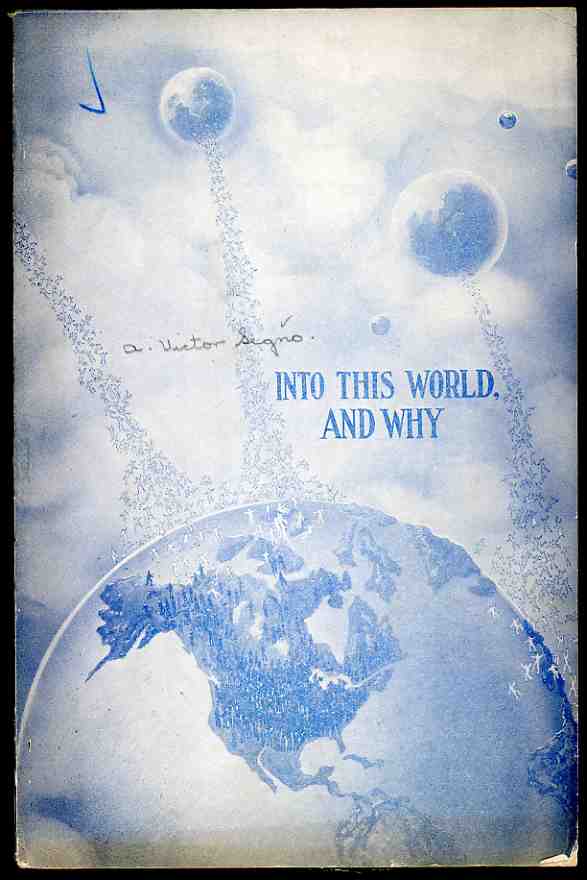
    I say “almost” because there is also this highly unlikely image-though-not-map which I wrote about in a 2008 post with the hyperbolic title “Extra-Earth Humano-Alien Souls From Outer Space Repopulate Earth-Hell!!(??), in which the title accurately tells the contents of its text and the front cover depicts the descending alien dead: 

    So there are at least two such map/images depicting Earth-bound dead descenders, and both are magnificent in their own _________  way.  

    The text of Spirit-Rapping explains the deathly cosmogram: 

    “In accordance with the theory already described and illustrated, it is assumed by our modern necromancers that the spirits of the dead descend to the earth or ” rudimental sphere” at pleasure, and thus communicate from time to time, and in various ways, with certain favored mortals called ” mediums.” At the same time they belong each to his own sphere, respectively, according to the time he has been ” progressing,” and his head is large or small according to the sphere to which he has attained. Indeed the earth, seen in the center of the cut, is a small affair compared with the heads of some of the sixth and seventh sphere progressives.” —from page 21

    WHo would/could or want to say more?  

    Spiritrappingunv00matt_0024


  • Outsider Logic and Bizarro Energy Conversion, 1926

    JF Ptak Science Books   Quick Post

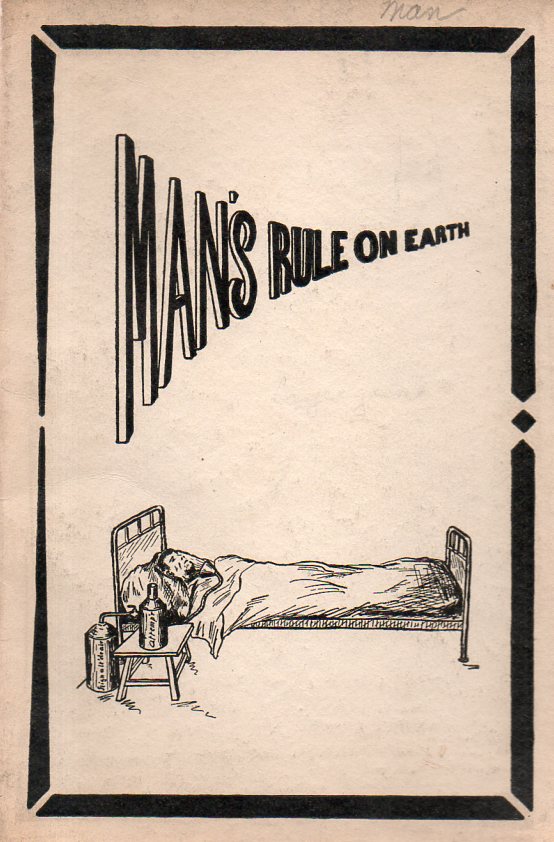
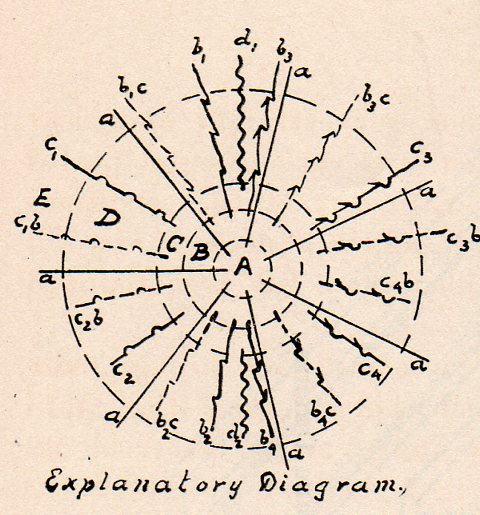
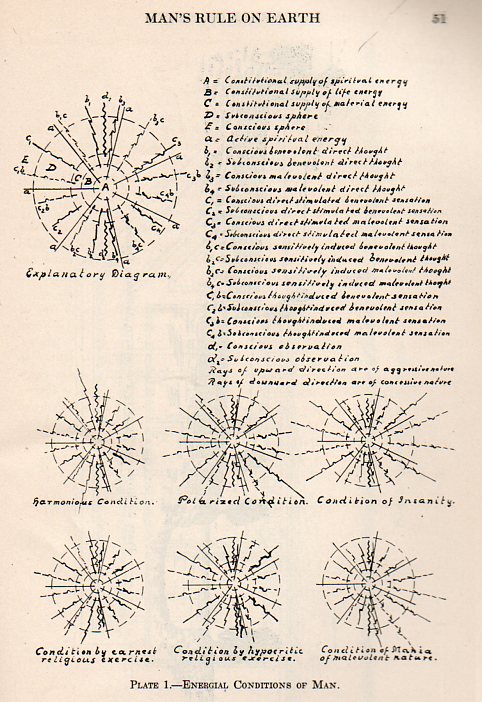
    This magnificent piece of outsider thinking by J.T. Lagergren, Man’s Rule on Earth, was published in 1926, and seeks out the secret human-powerly passions that are/were present in people and their surroundings.  Maybe “published” is too strong a word, as my copy is the copyright deposit copy, and there seems to have been no other copies, or copies that I can find, anyway.  (I can find no copies of the work in the massive library database OCLC/WorldCat, and no other works by him, although he did register a number of patents for refrigeration valves and such.)

    Mans rule050


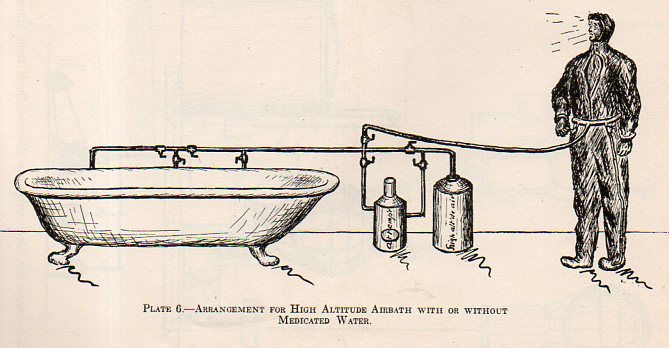
    I’m not altogether certain how the author was going to re-establish what was claimed to be the degeneracies of mankind, except that it involved removing “energial” capacities of water, and to “retrieve the energy being carried away through the rivers”. It also involved a plan to retrieve “high altitude air” and pump it into pressure suits of some sort to release hidden and lost energies, and of course much more, worthy of the pamphlet’s 56 pages, though much of it sounded better of it was done in secret and invisibly.

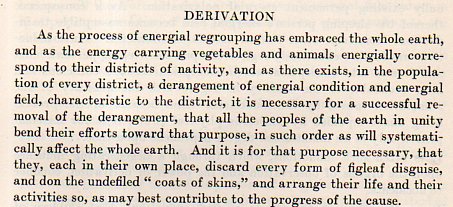
    Here’s an example of the content of the work:

    Mans rule051There are diagrams to go with this:

    Mans rule048Which is a detail from the following:

    Mans rule047

    Mans rule049

    ·Posted by :

    ·in:


  • A Beautiful, Complex Mess Illustrating the Entire Development of Human Society (1926)

    JF Ptak Science Books   Quick Post   Outsider Logic series

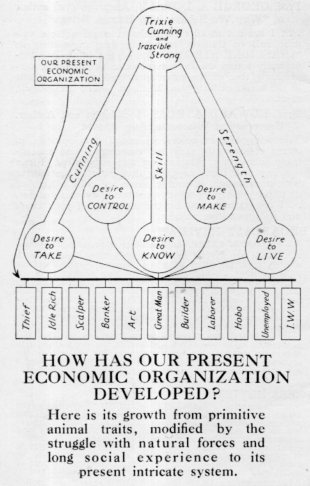
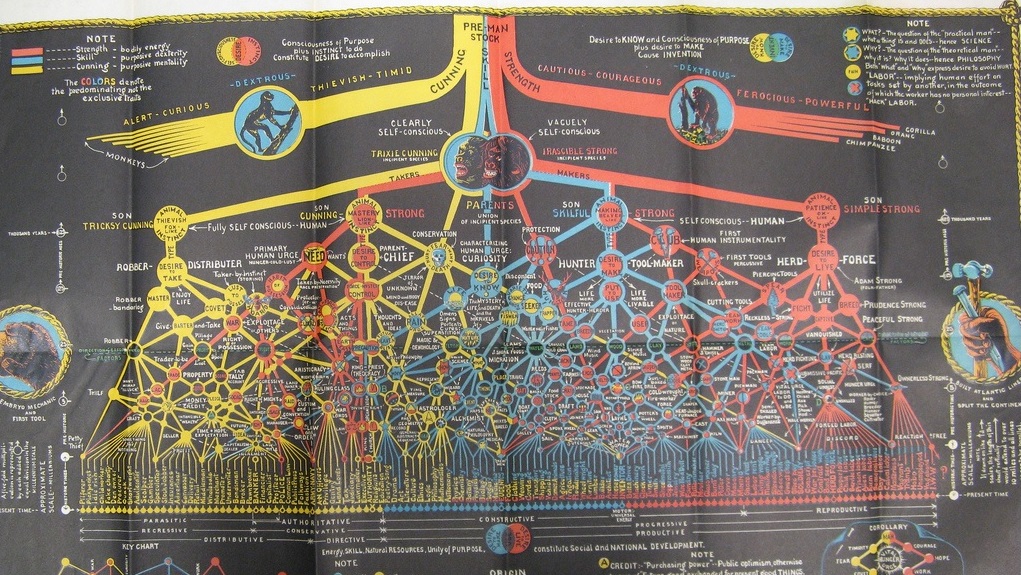
     I’m not sure what is going on or not going on in these diagrams/charts from the unusually-titled proto-outider-humorist  Concerning Irascible Strong and Trixie-Cunning, and their sons: Cunning-Strong, Skilful-Strong, Simple-Strong, Tricksy-Cunning, and their descendants, by William H. Smyth (and printed in 1926).  It is a lot of title to live up to.  Or down to.  In any event, the meaning behind it all is a mystery to me, but the mystery behind not wanting to know what it was all about is not a mystery at all–after all, isn’t a plate of spaghetti prettier as a mess than it is all straightened out? 

    Trixie chart029

     I suspect that this was intentional as an intended mess of confusion, but I really don’t need to know if this was a humorous work or not. But Mr. Smyth did produce a very involved display of something or other:

    Trixie

     [Source for graph images: here (Flickr account for Johnxlibris]


  • The Building that Toppled the Earth

    JF Ptak Science Books   Post 2145

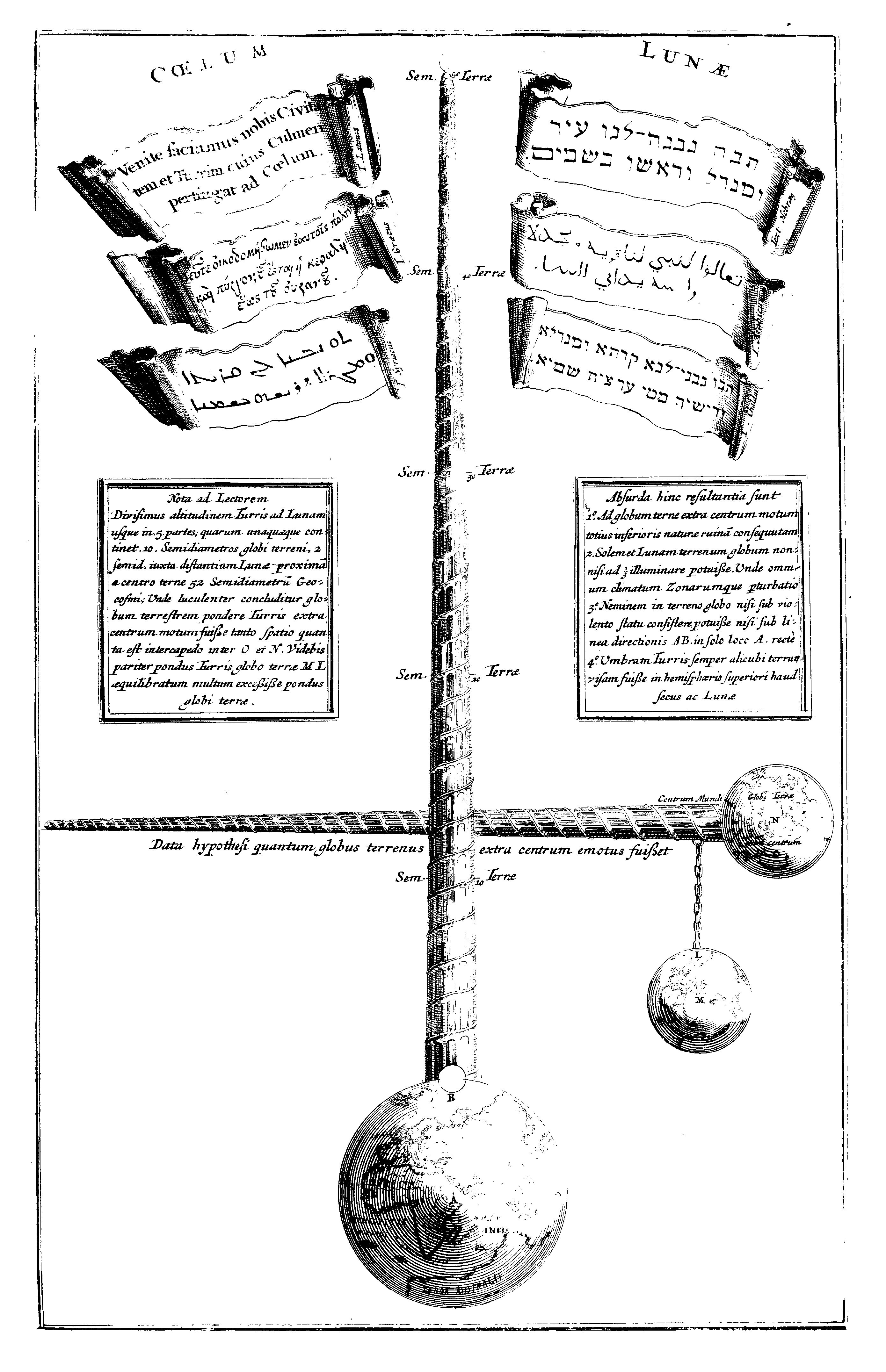
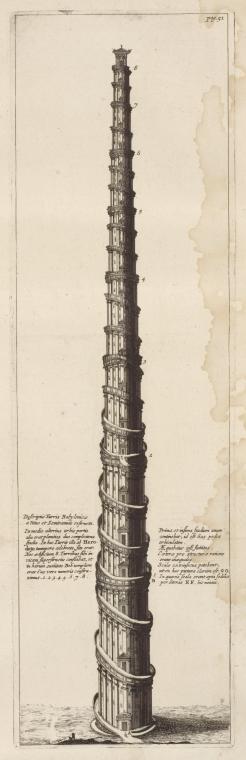
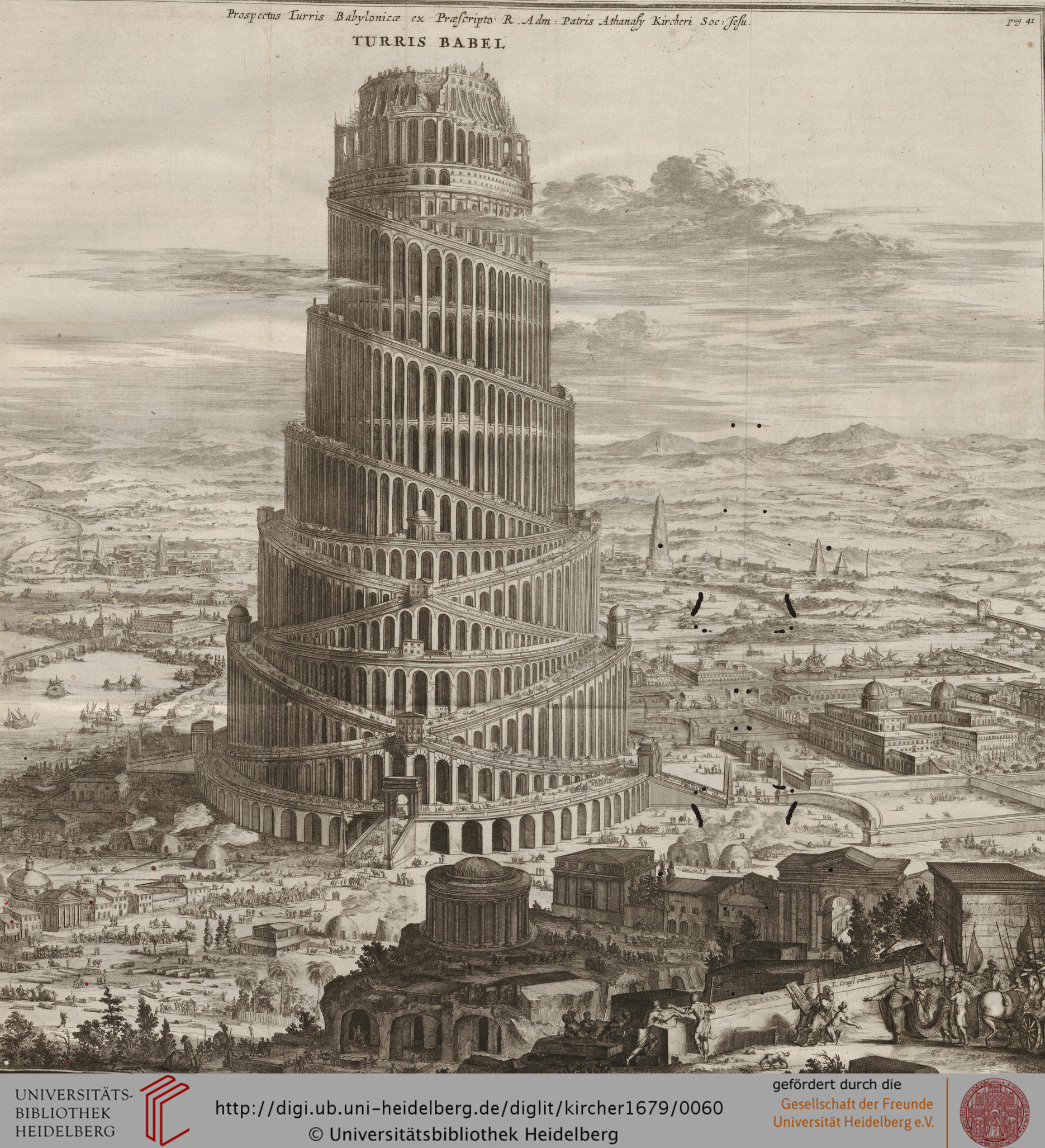
    When Nimrod set out to build his tower to the heavens (Genesis 10,11, amidst much begating and living to 207 years) he evidently did not consider the physical aspects of the structure and its impact upon its surroundings. The great and problematic Athanasius Kircher, the vastly learned and nimble and creative Jesuit scholar, did, and considered the tower of Babel in the last book printed during his lifetime, and found that there were certain problems associated with such a structure.  (The semi-mystifying polymath Kircher (1602-1680) lived for a long time and filled his life with ideas and words,  producing dozens of books during his time on Earth, some of which were never published even though written, some manuscripts lost forever. His was a massive output of extraordinary breadth, most of which was original to him, and a lot of which was original to others and not credited, as was often the case with some scholarship at this time in history.   He wasted little time what I can see, writing on a spectacular range of subjects, enlightening people, confusing people, generating great theories and some bad ideas.)

    Babel moon large image[This magnificent engraving is very expandable]

    Kircher considered the possibilities and necessaries of such a structure (in Turris Babel…, Amsterdam, 1679) and found in his investigations that the 178,000 miles-high building would be so massively heavy (3 million tons) that it would displace the Earth from its orbit:

    “to reach the Moon, the tower would have to be 178,672 miles high, comprised of over three million tons of matter. The uneven distribution of the Earth’s mass would tip the balance of the planet and move it from its position at the center of the universe, resulting in a cataclysmic disruption in the order of nature.”–nicely described on the Museum of Jurassic Technology, here.

    It was a nice piece of reasoning that didn’t extend itself to very many other stories of the Bible–Kircher was not concerned with disproving scriptural elements, just the foolishness of Nimrod to attempt such a feat, and was mostly interested in language than anything else in his short last book. 

    • The full title of the book: Turris Babel, Sive Archontologia Qua Primo Priscorum post diluvium hominum vita, mores rerumque gestarum magnitudo, Secundo Turris fabrica civitatumque exstructio, confusio linguarum, & inde gentium transmigrationis, cum principalium inde enatorum idiomatum historia, multiplici eruditione describuntur & explicantur. Amstelodami, Jansson-Waesberge 1679

    Kircher single tower babel[Source: NYPL Digital Collections, here.]

    Kircher babel perspective

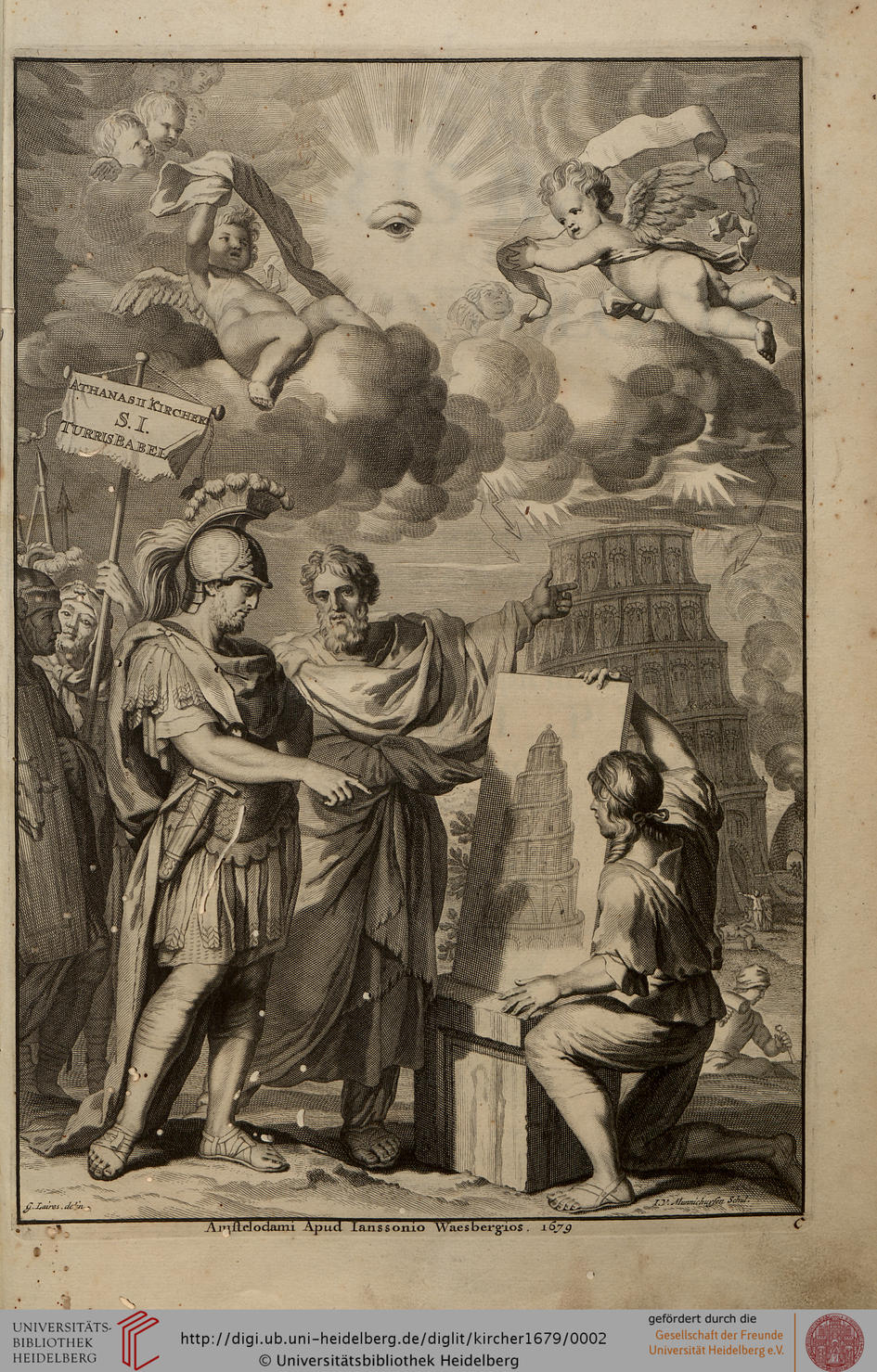
    The frontispiece (I believe, and not the title page) to the book shows the architect and supporters at work, with the Creator pretty-well present: (via University of Heidelberg Library, with the book available full-text, here):

    Turris babel title page


  • Outsider Charts of End Times and Other Biblical Imagery

    JF Ptak Science Books   Quick Post

    Larkin Failure of man

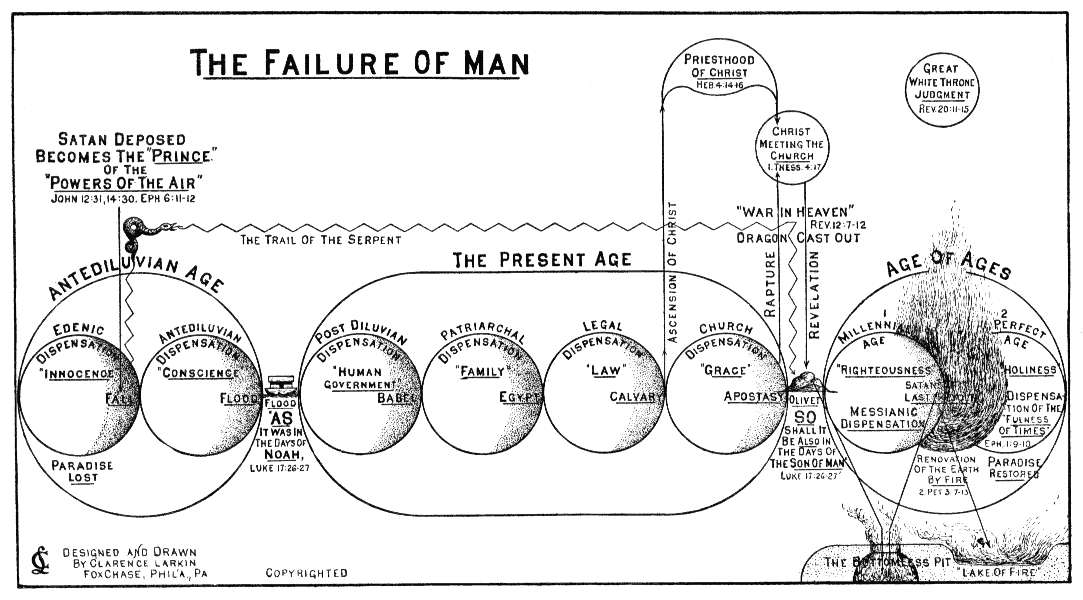
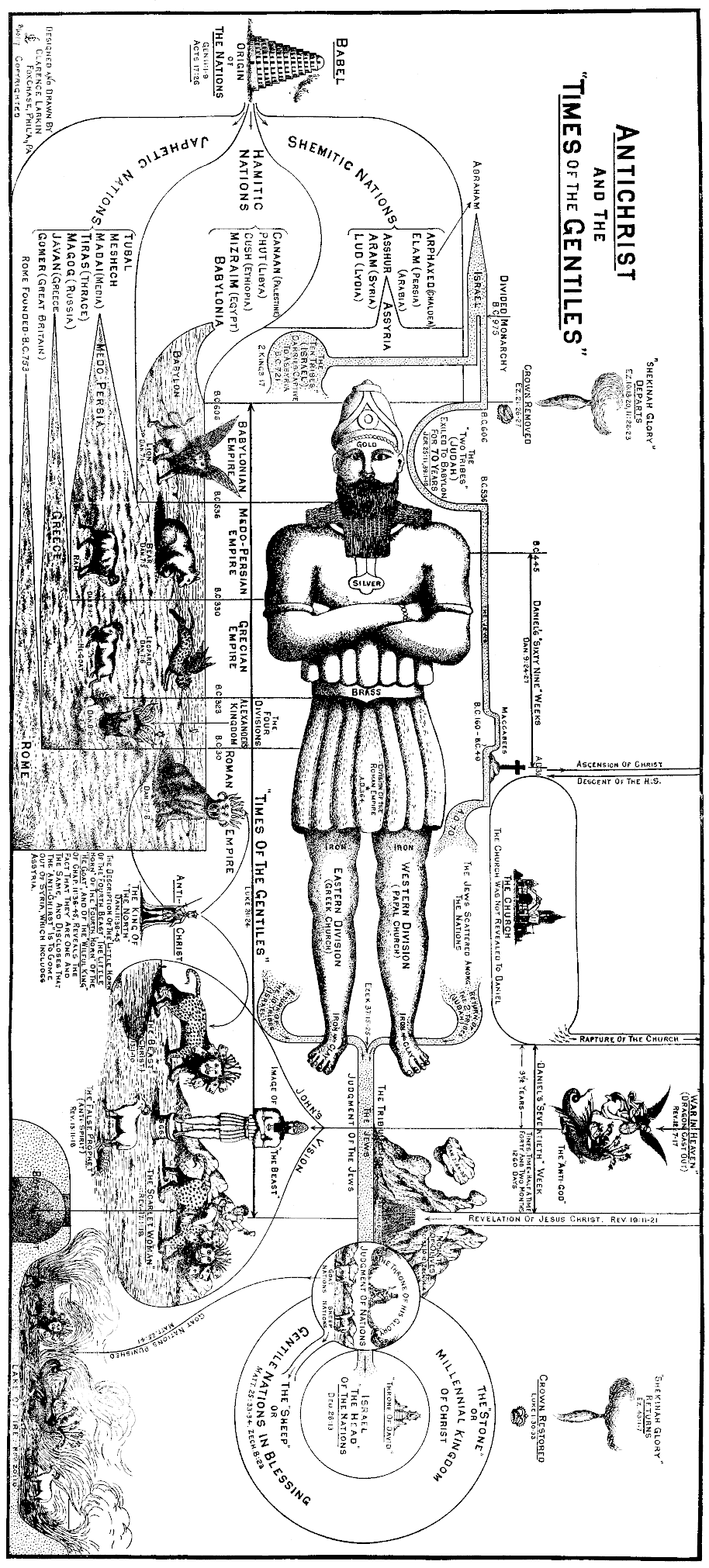
    Wow.  These are some pretty weighty images–I’m not going to pretend that I know much about the symbolism and O.T. history of them at all, and will just stay with admiring what looks to be serious audacity from the simple design and presentation perspective. 

    They appear in Frederick W. Childe’s  Prophecies of Daniel and Revelation Compared  (1927), and were “drawn and designed” by Clarence Larkin.  They have a strong sense to them, and are at the same time kind of aerodynamic and sweeping, streamlined in a way that would take on design a few years later. 

    Revelation map


    ·Posted by :

    ·in:


  • Naive-Outsider Titles–Masterpieces of Nothing

    JF Ptak Science Books 
    Follow Me on Pinterest

    In my heaping pamphlet collection there is a sub-collection of works with impossible, outsider-y, and stubbornly semi-confused titles that simply cannot be ignored–I mean the titles can’t be ignored, though most of the time their texts beg to be. 

    Scorn Not That Which You Do Not Understand

    is about as ungainly a title for a book that you could construct in eight words or less.  Then there’s

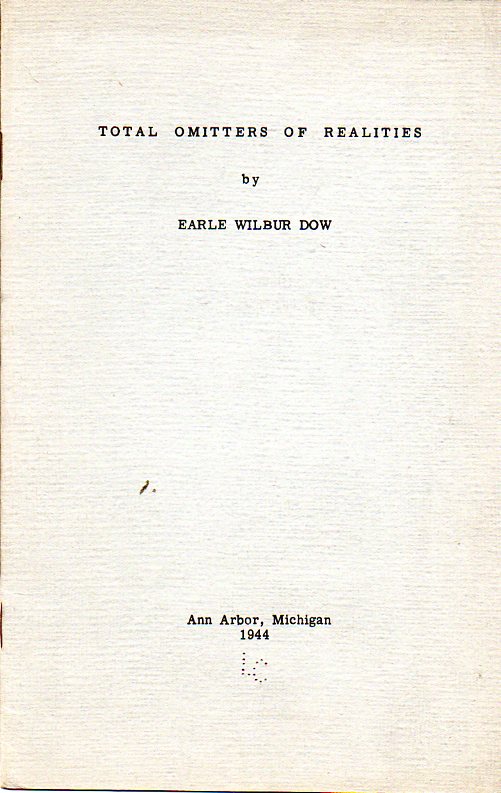
    Total Omitters of Realities

    a title which is as anti-compelling as the first but accomplishing that feat in half the words, and uses the plural of “reality” just for good measure. Creating another competing title in two words would be fairly improbable. 

    Naive Confused553
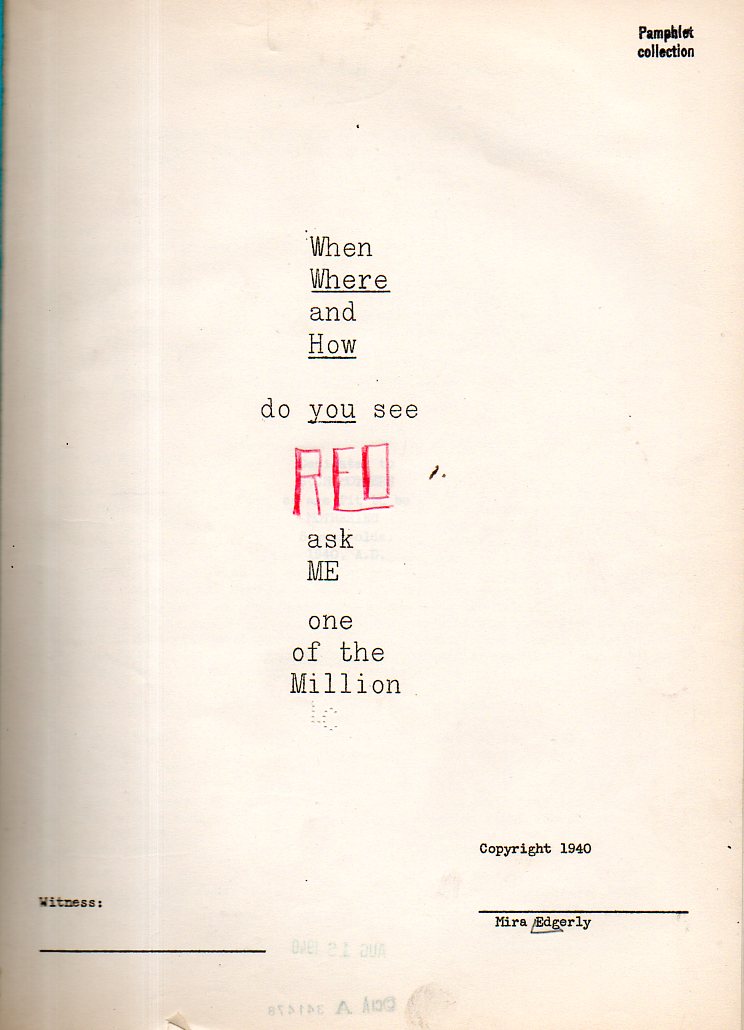
    Naive Confused552Then there are the pamphlets that have no titles on their covers, though they do have title pages, though they really don’t look like it, even though they are.  And even when they are what they seem to be not, they really aren’t even that.  Such is the case of

    When Where and How do you see RED ask me one of the Million.


    Naive Confused554


    I have no idea what this pamphlet can be about. 

    Opened to a random page, I see in heavy underline “The human knower’s point of view inside your head and mine and the power of the pen“.

    It is a mystery–it is also one of the few title pages I have seen that asks for the signature of a “witness”. 


  • Enormous Title of Visionary Work Utterly Defeats Library Cataloguer

    JF Ptak Science Books  Post 2076   Outsider Logic  Daily Dose from Dr. Odd


    Follow Me on Pinterest

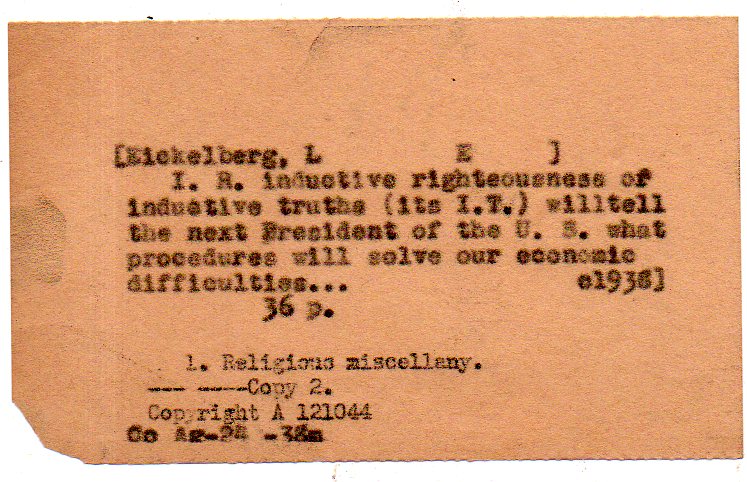
     There appeared on this blog last week a post regarding a library cataloguer who was not threatened or defeated by a work with an enormous and meandering title. The good librarian got right to it, recorded the deed, and moved on. Today’s installment of card catalog magic presents a Library of Congress librarian who decided that enough-was-enough, and that there was simply too-much-title to record, and so simply left the rest of it to dots and to the imagination.

    Title--gigantic424
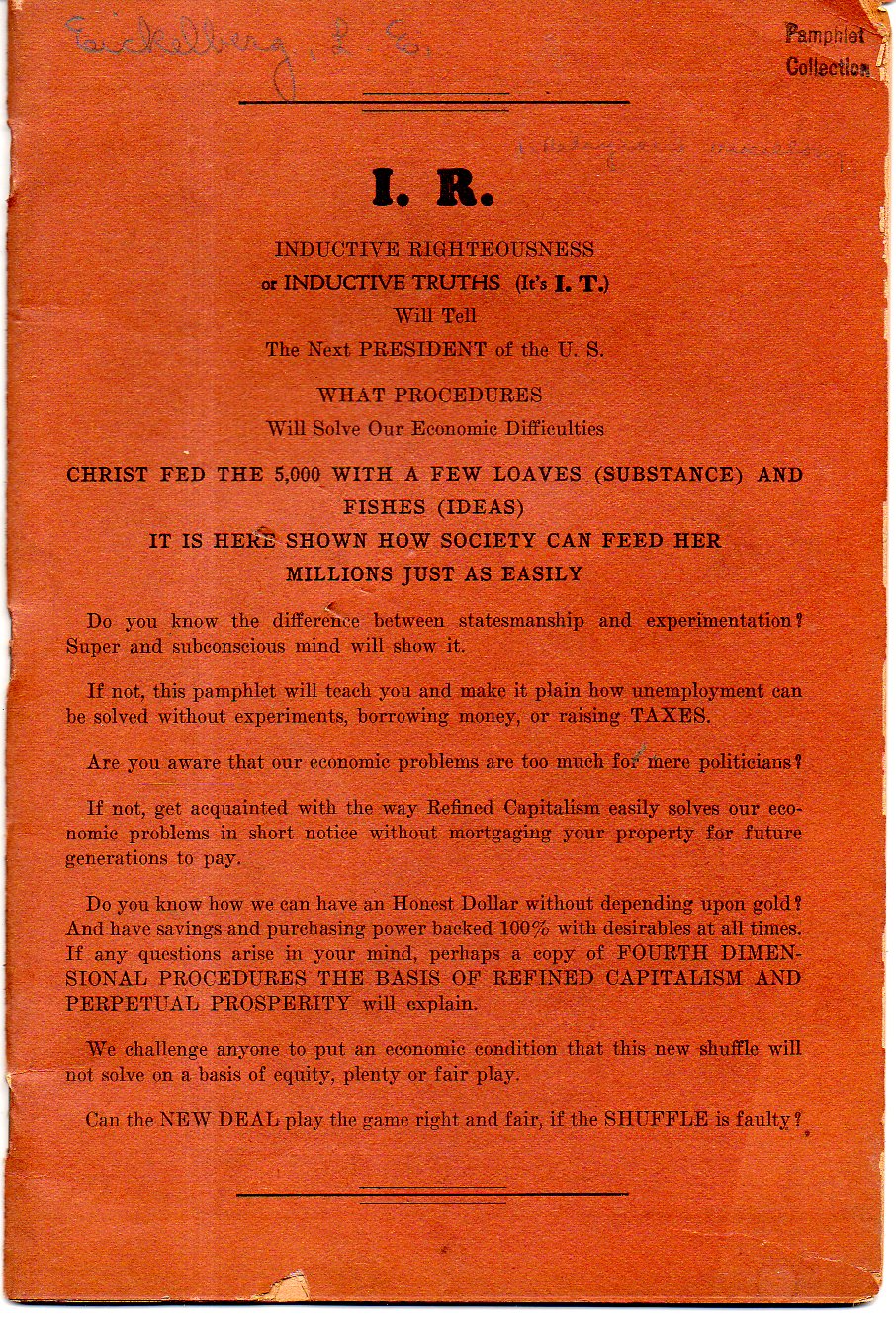
    Now for the pamphlet itself and the rest of the title:

    Title--gigantic423
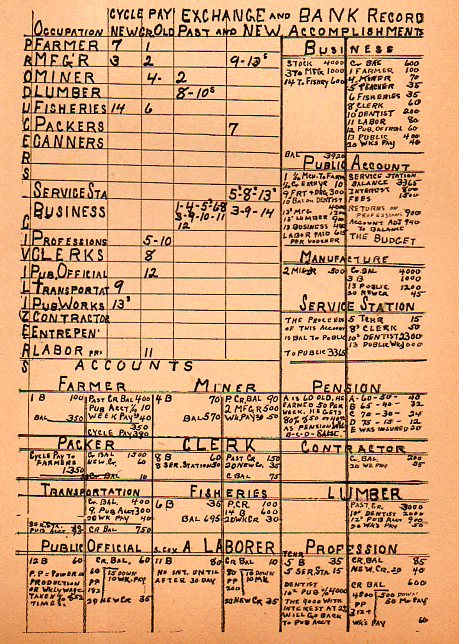
    The author of this 1938 pamphlet simply started to write on the cover and continued through the rest of the work, and ended on the back cover.  There was no title page, no chapter headings, just a collection of ideas with lots of lists and seemingly nowhere to go.  For a short work (36 pages) the author could’ve dedicated another quire to some blank space, which really doesn’t exist in the pamphlet but which is surprisingly helpful even if the message you are trying to deliver is somewhat, well, outre.  There is a lot of very compressed talk about multi-dimensional spirit and conscience and bank deposits and replacing the dollar and tax collection with “circulation of values”, and so on, deep into itself and a closed system of interpretation of the existence of the universe, harmony of spirit, and economic interpretations of “radio bulbs” and the (often misspelled) fourtth [sic] dimension.  The writing is exhausting and enumerated, and even though by its colossal subject matter and the complex brevity it should be a reliably porous document, it is fairly rigid and brittle. It is a visionary work that somehow worked its way into print, and I’m happy for that, and even it is impossible to keep up with its runaway logic it is still a good ride.

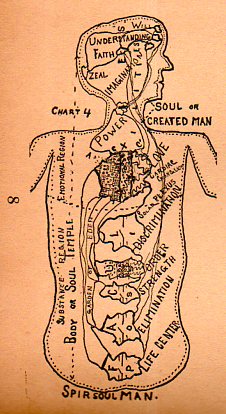
    The author’s representation of a semi-vitruvian spiritual anatomy of humans, called Spirisoulman:

    Title--gigantic426
    A detail of the fabulously-decorated heart region:

    Title--gigantic427
    And of course part of the plan for universal economics which somehow wraps up the theory of in I.R., or the Inductive Rightousness of Inductive Truths:

    Title--gigantic428
    Early on in the history of printed books there was a practice of extended title pages, where there would be the title, and then “support literature” further explaining the title to sometimes some great detail, occasionally winging its way into a title 200 words long.  But that was pretty much before the 18th century and mostly before the 17th and mostly a not-common practice.  The gigantic title in the 20th century seems to be mostly relegated to the less-traveled-road variety of public thinking.

    And the card catalog for the undefeated librarian mentioned above:


    Card catalog409 


  • The Agony and Beauty of Bad & Incredible Title Pages

    JF Ptak Science Books   Post 2022  Books with Unusual Title Pages series

    Follow Me on Pinterest


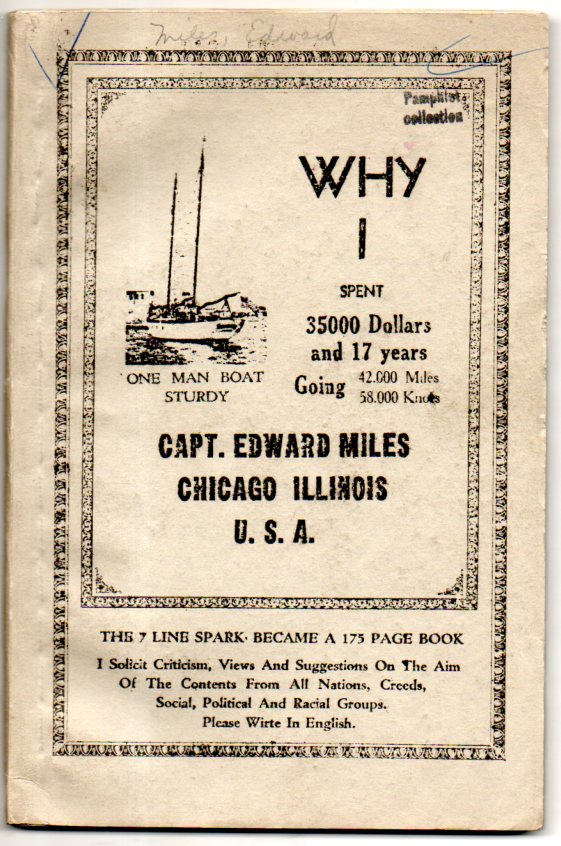
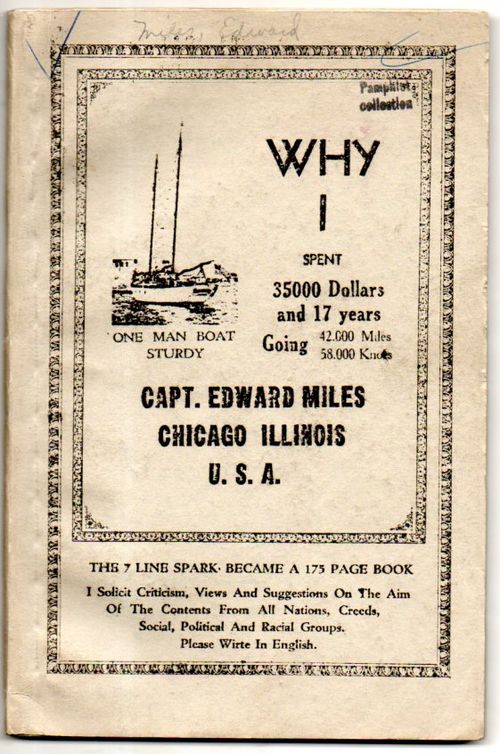
    Simply put, this is easily a first-percentile title and title-page design, the work of a man who set out to discover the world for/by himself and wound up taking a very long inner journey of Some Outsider-y Influence, and then felt the need to share it:
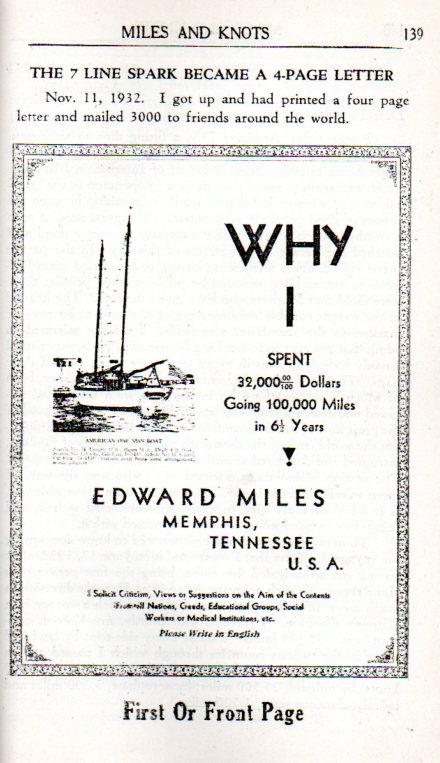
    Outsider Edward Miles257
    That is a lot of unnecessary information to share, particularly on the cover of your book.

    This is a very good example of the combination of two main threads of odd title pages that have been slowly accumulating in a series of posts on this blog (a good example of which can be seen in the post “Little Bizarredness:  Bland Hyper-oddness in Published Works”,  here) about books with “simply difficult” title pages: (a) those that are swift and contra-subtle, wispy cloudy bits that lack a cohesion and make them a little impenetrable, and (b) those that are bold and straightforward and mostly nonsensical. Here we have a composite, the elusive “(c)” category, which is a combination of a+b (where a+b=a+b, only)–both light and dense, simple and complex, all adding up to a little bit of bold almost-nothing.

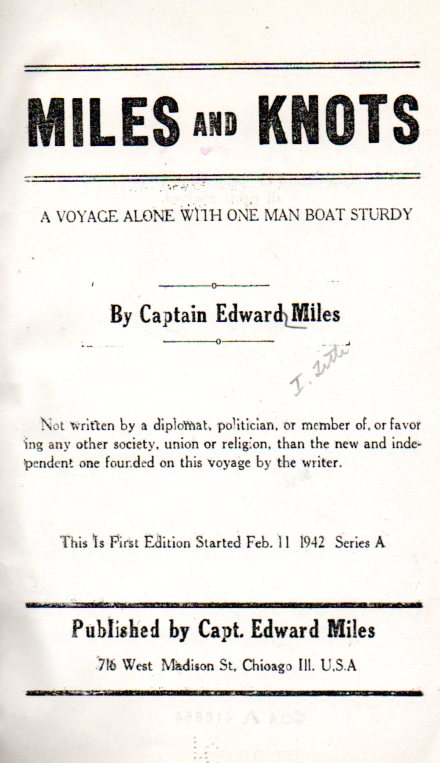
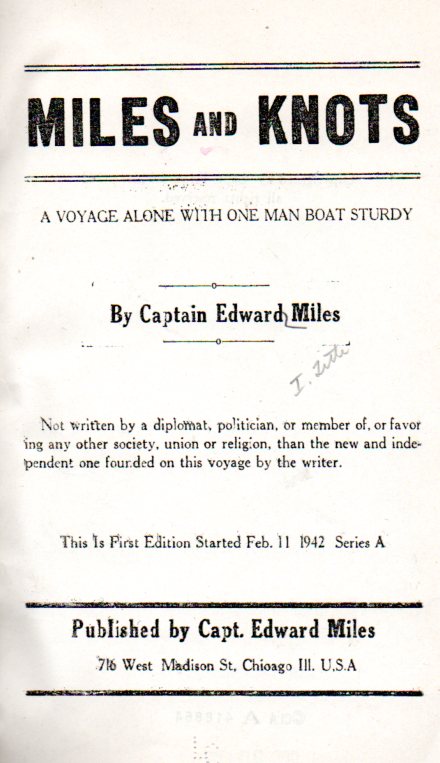
    When we open the pamphlet we see that Capt. Miles tries again with the title page of the book, changing the title on the cover but with high accomplishment is able to retain the overall largesse of mystery about what the book is about:
    Outsider Edward Miles258
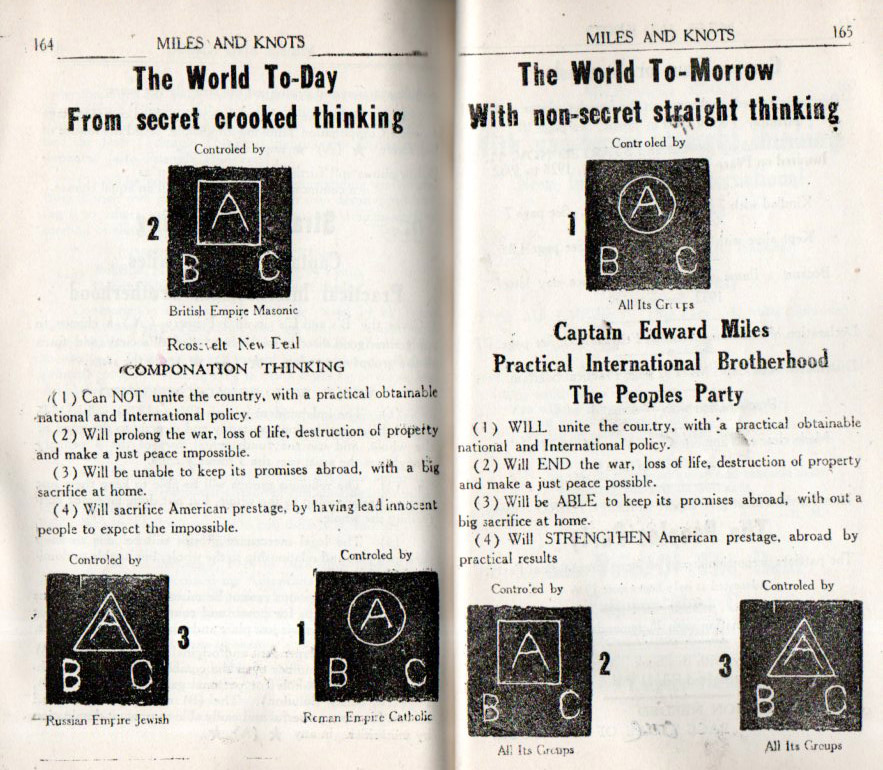
    Evidently Capt. Miles did make a grand expedition, and he was away for a long time, and he did build himself an absolutely beautiful boat–and brought back with him the idea of some sort of international straight- and not bent-thinking ferocious logical thinking political party. His was the Peoples Party (I’m not so sure why he chose this name when it was taken by several other groups already), the “patriot’s preportional [sic] part of the New International Party” (“a recorded reality”), that “with non-secret straight  thinking New Independent International Political Party the Third Party within All Nations will collectively end all empires” and so on.  He also referred to his political party by yet another name:  “Miles International Practical Brotherhood”. Its hard to take the “practical” part of this seriously, especially when Miles’ own political party gets referred to by so many different names.

    Cap’t. Miles excuses himself right at the beginning for his grammatical and spelling errors, which is a good thing because there are so very many of them, as he “had little of the artifica [sic] education (schooling)”.  He does recount his voyage but it is riddled with internal Socratic monologues that lead the reader to question many things, not the least of which is the simplest of questions:  “why?”

    In any event Cap’t Miles does drag teh reader through 175 pages of poorly written and badly spelled oddnessment.  His outre design capacity and presentation though makes this a fine example of outsider thinking. 

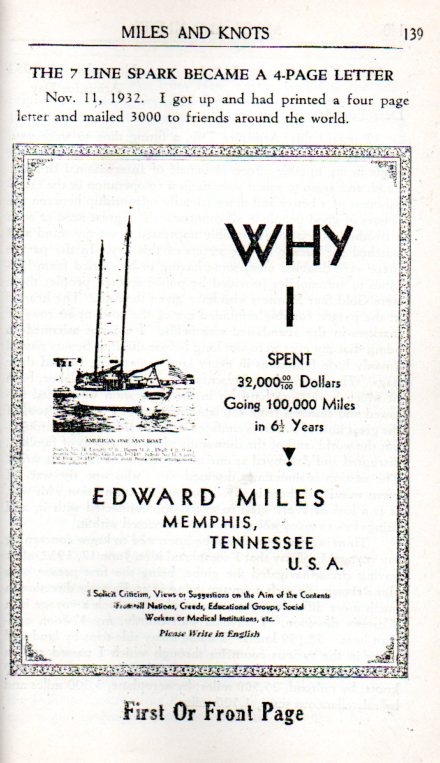
    Deep in the book Miles takes a deep breath and dips into the snipe-like “(d)” category, which is a very rare occurrence of reproducing the title page of a book deep within the text and not getting the title correct, which is a peculiarly beautiful agony:
    Outsider Edward Miles259

    Evidently there is no distinction between the ‘first” page and the ‘front” page, both of which are different, anyway.

    There are also bits like this half-page announcement laced throughout the book, looking like salty sprinkles in a foamy Guinness:

    Outsider Edward Miles261

    And just when you think that you’re through the book and its brilliant cloudiness you find this:
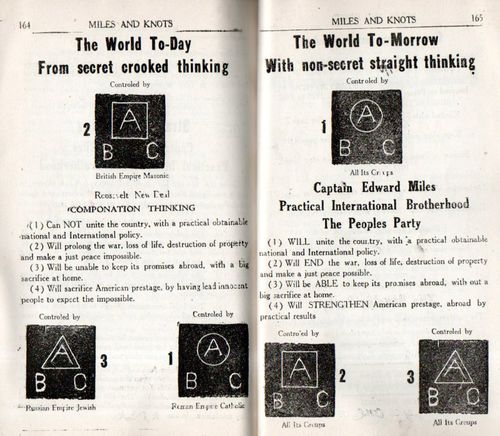
    Outsider Edward Miles260

    It is all really quite breathtaking, in a way. 

    The book–whatever its title–was written and published by Capt. Edward Miles and issued in 1942 as a first edition “Series A”–no doubt this was supposed to be the first of many such installments.  I’m trying not to imagine the disappointment that Miles must’ve felt when there was no need for more.  I guess he could’ve blamed it on the war…

    My copy is the copyright deposit copy, no doubt sent by Miles as part of the process to secure a copyright for his work in the United States.  I can find only one library in the world (via the OCLC)  with a copy of this book–the hometown Newbury, in Chicago–the record for which states that their copy was “number 105 of the first edition”. Perhaps Miles numbered the pamphlets as they went out, and perhaps the numbering was truthful. In any event, this is not the solo-lonely outcome of big and lonesome high-seas thinking, and at least one other copy exists 515 miles from here.

    I think this is one of those works that is best appreciated at a distance, and that a reading of it would only ruin things by the accumulation of painful and what looks like embarrassing detail. Looking at the large font aspect of the book is good enough to allow this work to be treated as a kind of artwork which would only be obscured by weed-prone narrative. 

    Bottom line:  the man did build a beautiful boat.

  • Visionary Map: the Earth Without Water, 1694

    JF Ptak Science Books   Post 2020  Follow Me on Pinterest

    Part of the series on the History of Blank, Empty and Missing Things

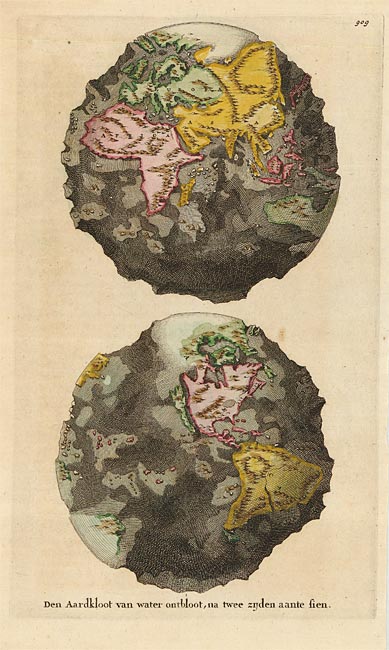
    I stumbled upon this fantastic leap into science affliction, an attempt to display the absolutely enormous idea of draining the Earth of all water revealing its ultimately rocky structure.  And this in the relatively young modern cartographic days of 1694. 

    Map world without water
    This map (“Den Aardkloot van water ontbloot, na twee zijden aante sien”, published in Amsterdam in 1694 by Wilhelm and Jan Goeree in a Dutch edition of the expansive and imaginatively suggestive cosmo-theo-geographical work, Telluris Thoeoria Sacra) reveals the half-believed idea of California being an island was we can clearly see the enormous canyon separating it from the North American mainland. On the other hand, the “opposite” (in a way) belief takes place in the north, showing a large and towering land mass at the North Pole.

    Map world no water detail N Amer_edited-1

    All-in-all, given the state of geographical knowledge for the unseen stuff of the Earth, this was an excellent attempt to reveal the structure of the globe.  Sure, the depths of the oceans are a little off, the idea and the attempt to depict it was an extraordinarily interesting display for the time, especially with limited hard data.  This is even a more-remarkable series of observations considering the theoretical framework in which all of this was taking place. 

    Burnet (1635-1715) poured out his pounding heart into the pages of his sacred history, teaching people about the structure and history of the  Earth with generally little or unsuccessful regard to science–but no matter.  (Burnet did try to figure out where all of the water came for the flood, which is  a great question.  It is impossible for it to come from a natural rain of any sort, and Burnet probably came to the conclusion this the answer for the flood couldn’t come from the surface of the Earth.  So to keep things in compliance with his faith, Burnet established that the water necessary for the flood came not from the surface of the sphere, but below it, in the hollow Earth which was actually filled with water.) This was a work of structured faith and a belief  system, and wasn’t seen as much more than that except to the initiated. But a resulting map of the structure of a waterless Earth seems to me a more powerful piece of imaging than an Earth simply covered by water. 

    [Black and white image source  Barry Lawrence Ruderman Rare Maps, here.; color version from Oldmaps.com, here]


  • The Electronic Beds of Electronic Dreams, 1945

    JF Ptak Science Books  Post 2019   (expanding an earlier post)

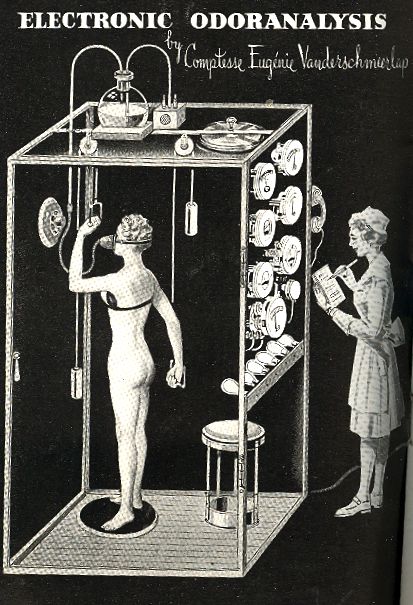
    Electronic odoranalysis

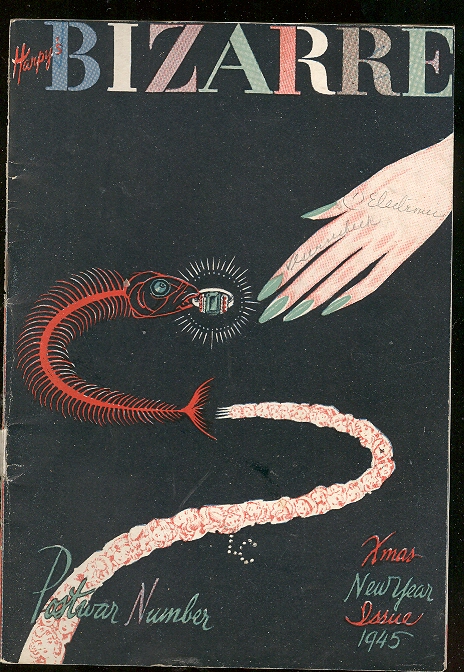
    I am very attracted to the innocence and softly bizarre category of my store’s Outsider Logic Collection, like this little pamphlet that was published in  New York in 1944.   The pamphlets in this category are odd but still understandable, and the “what the ____!” response to the subtle ones isn’t quite so high and the exclamation points not so many as in the cases of the Outsider Logic titles.  Bizarre is different from that, certainly not hiding behind any lesser or ambiguous title–it stretches the category a bit as it is intended to be a parody of the more-popular magazines and their advertising sponsors, but it is really quite a bit different from a simple humous and pun-laden trip into dead-end future visions.  It was copyright by the very far-reaching Hugo Gernsback, who in 1926 started the first magazine dedicated to the genre of science fiction (Amazing Stories) and for whom the World Science Fiction Society’s annual award for Science Fiction Achievement is named (the “Hugo”).  Gernsback evidently had a taste for cheeky parody, producing similar magazines to this called Quip, Forecast, Jolliers, Tame and Newspeep–it seems though that Bizarre may have ultimately morphed into Forecast.Blog--may 11--odd 002

    I guess that this was deeply weird for mass-production publication, and it was probably funny–now it is just weird, odd, and somewhat discomforting–a successful and intentional reach for being part of the Uninentional Outsider right from the start.

    Most of the magazine is dedicated to imaginary electronic delights–analog electronics (though it is still fairly early to be having such dreams and using the word “electronics”, as it was just barely two decades old at this point).  One of the oddest of these inventions of the near future was the Electronic Odoranalyzer, which was necessary for reasons I couldn’t discern. (I’d like to assume that odors are calculated and calibrated and a scent is chosen specifically for them, or it.)  

    The advertising was unusual as well:  there were hats you could potnetially purchase of weeping willow Platina fox tails; some hats had tanks (as with the Le Chapeau Tank hat, modeled for the magazine and “worn pugnaciously at a slant”), and other hats had simple canons (as with the French Mitrailsuese).  While wearing your tank hat you could also theoretically relax to your favorite tunes in style with a $125,000 radio–it was made for war profiteers who couldn’t find banks enough to hold their cash and was billed as too expensive to steal.Blog--may 11--odd 006

    Then there’s the EBC–the Electronic Bed Company–with their magnificent new product, an invention “by the great sage of Hackensack” so spectacular  as to make ordinary sleeping obsolete.  The bed was an air-conditioned, self-washing, self-adjusting, self covering, fiberglass-cushioned, telephone-capable, air pillowed, air conditioned masterpiece that looked like it was about ready for anything but sleep, which I guess would make it revolutionary.