A Daily History of Holes, Dots, Lines, Science, History, Math, Physics, Art, the Unintentional Absurd, Architecture, Maps, Data Visualization, Blank and Missing Things, and so on. |1.6 million words, 7500 images, 4.9 million hits| Press & appearances in The Times, Le Figaro, Mensa, The Economist, The Guardian, Discovery News, Slate, Le Monde, Sci American Blogs, Le Pont, and many other places… 5000+ total posts since 2008.

Category: Outsider Logic

  • Outsider Thinking–Space Friction, 1944

    JF Ptak Science Books   Quick Post

    Follow Me on Pinterest

    “Ist der Weltraum absolut leer, oder nicht?” (“Is outer space absolutely empty, or not?”)

    Outsider weltraume 234
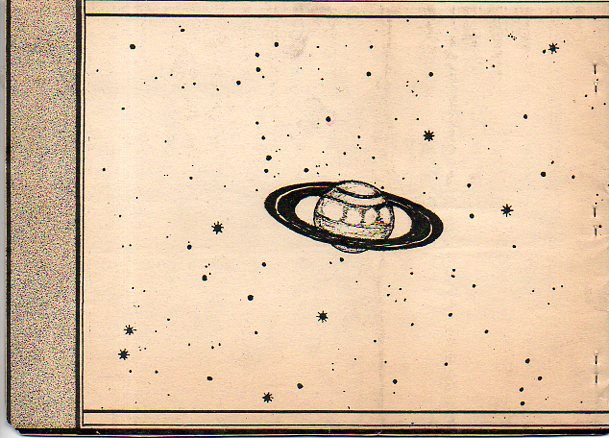
    Carl Kutter challenged Isaac Newton on the 1st law of motion.  Or at least that is what it looks like to me, the story presented in a slim but attractively designed pamphlet, published in Basel in 1944. Die Weltraumreibung presents the issue of “space friction”, and I frankly could not make my way through that much of it–not even to the point of understanding whay Halley’s Comet is illustrated on the front cover. But the design is interesting, and the issue was certainly very highly unexpected.

    Outsider weltraume 235

    This site is interesting:  http://tvtropes.org/pmwiki/pmwiki.php/Main/SpaceFriction 


  • Should Insanity be Cured? (1938)

    JF Ptak Science Books    Post 2001

    Should insanity eyes

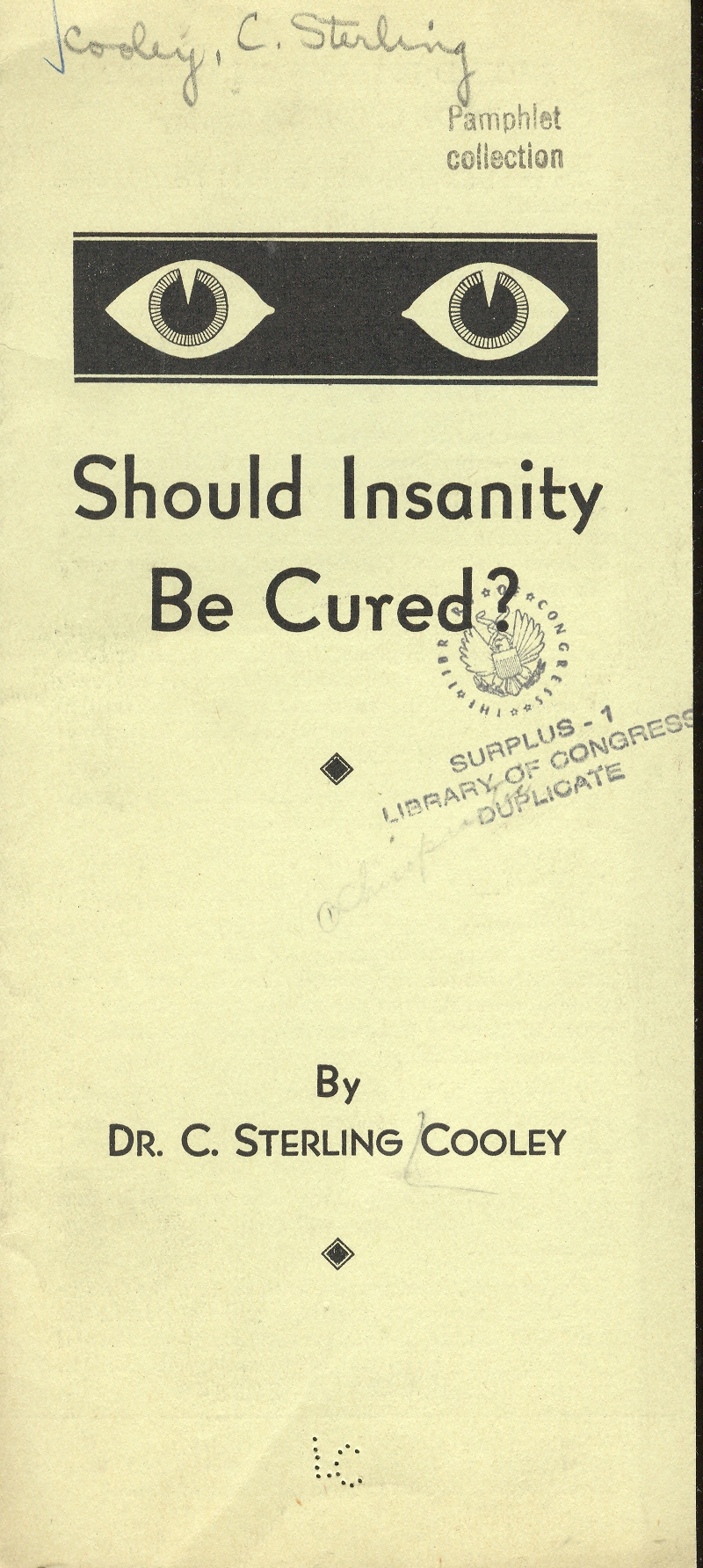
    ++00++ 9.15 insanity Dr. C. Sterling Cooly wrote an incredibly-titled pamphlet of
    slim means called Should Insanity be Cured? 
    How could anyone proceed further than this?  Dr. Cooley wasn’t a eugenic apologist, nor
    was he an accountant for a life insurance firm—he was advocating a drugless
    cure for all different sorts of “insanity”, which was a term he doesn’t really
    stop to identify and classify, which of course is deeply problematic. 

    Or it is so until you hear how one can treat the insane via
    his new drugless method: 
    chiropractic.  I didn’t see that
    one coming.  “An insane mind is a sick
    brain, a sick body is an insane body” writes Dr. Cooley with leading
    confidence, claiming that chiropractic can release “the power within…marvels of
    healing are performed not only in mental cases but in virtually ALL forms of
    disease”.  That’s a lot to live up to in
    theory, let alone in practice. 

    Dr. Cooley was evidently a deeply important founder father of modern chiropractic, with a 50-year career in the area (1908-1957), and who was also very prolific–this is one work that he probably shoud’ve edited out of the publishing phase. 

    I don’t know why the eyes are so very prominently featured–except I guess to enhance some understanding of the subject area,


  • Breaking Bad in Half: a Book to Exhaust and Maim the Reader

    JF Ptak Science Books

    “Sometimes a book is just entirely bad, and sometimes it is entirely nothing. It is impossible for a book to be both very bad and very nothing. Impossible.  Except for this book, whose badness is exceeded only by its nothingness, and vice versa“. –Oscar Wilde

    And so into this black hole of imaged Wildeian description we go, into a very real-ish book.

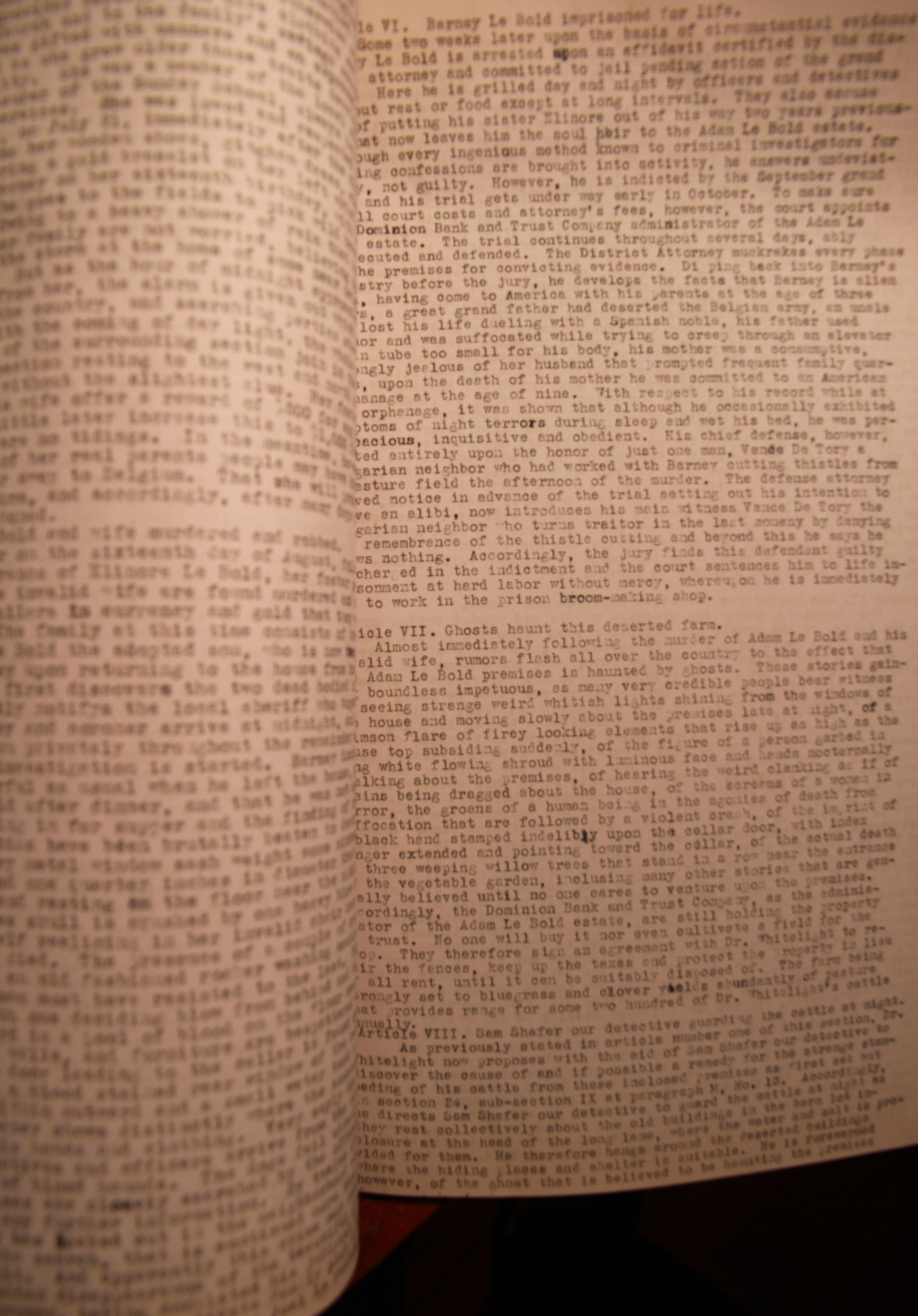
    I found a novel tonight, bought long ago and long ago mostly lost.  It was written by a doctor who worked in the District Hospital in Lima, Ohio, and written in 1934.  The Lima Hospital was the largest poured concrete structure in the world when it was built in 1915, and stayed so until the Pentagon was completed.  The hospital was established for the criminally insane, had 14″-thick walls, and reinforced steel bars laid into the walls that went “right down to bedrock”. 

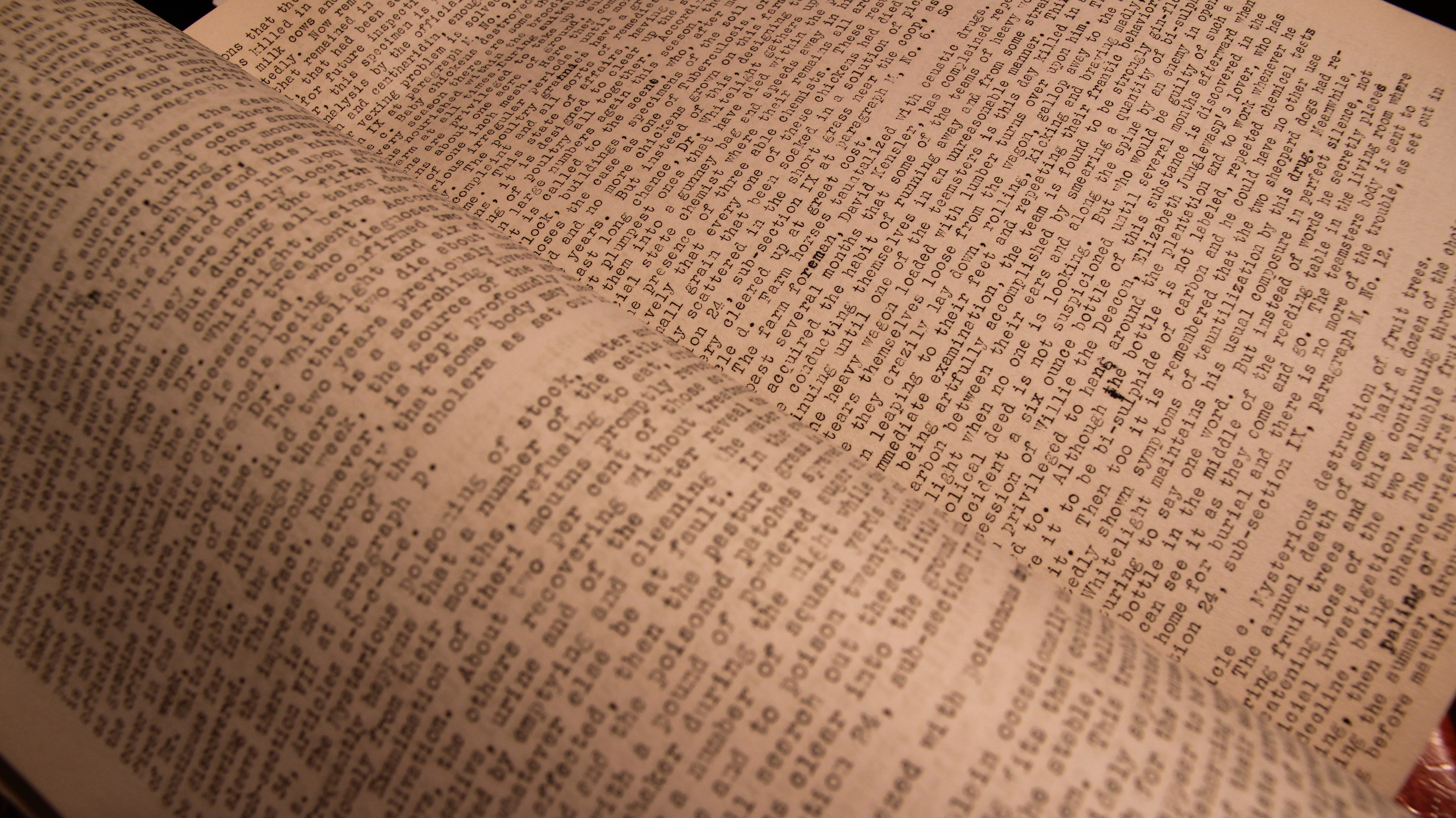
    It was somewhere in there that this doctor wrote something that was really so toweringly bad that it escapes comprehension. I own the carbon copy of the unpublished work, which is typed on 14×8.5″ sheets of paper, front and back, running 94 pages. It is a very crowded affair, with 90 lines of single-space typed lines, making the work about 115,000 words long. 

    There wasn’t enough space evidently for paragraphs, which gives the work a kind of insistent, casket-cramped cruelty.  To read it takes your breath away for its dullness–the book moves so weirdly and at the same time so very slowly that it doesn’t move at all even while moving.

    Manuscript insane one

    A few months ago I found the seven-foot-long scroll of the book’s plan–a work of crowded magnificence of nothing and confusion, being very orderly at the same time.  It went to a friend of mine who created artwork around it, and as it happens made a very noticeable appearance in a very significant yearly show in NYC last week. I was stunned to find that there was actually a text to go with the scroll-outline–it emerged from the warehouse this week, so perhaps this too will find a very celebrated life as art as well. Certainly the book would go nowhere on its own as a book, though it stood a chance at surviving on the grounds of its considerble design weirdness, which is of a complexified beauty.

    Manuscript insane two

    In the meantime, before all of the letters slide themselves off the page from sheer boredom and before the thing is resurrected as a magnificent artistic effort, I’ll share some ianges of the extra-ordinary book of reversed brilliant badness. I’ve also culled a few imaginary descriptions of the book from writers known and not:

    Potboiler scribbler:

    “He couldn’t speak.  He could barely see. Blinded by the flames ignited inside his eyeballs from the novel in his lap.  The words were like molten lead, sucked off the page by his eyes, forming a vacuum in his brain.  It was a bad book”.

    The first-time published novelist’s approach:

    “He couldn’t speak the words of the thoughts in his head, because they and all of his breath were stolen by the magic of the complete badness of the book in his lap”.

    Gertrude Stein:

    “The book was bad and bad, and bad was the book. Even the badness of the bad was bad, a whole new insight into being bad. It was the bad book by which bad books are called bad”.

    Ernset Hemingway:

    “He didn’t read the book so much as he looked through it.  It was easy–there was nothing there. As bad as it was, it could get no worse. So he shot it, and poured a drink”.

     You might wonder what this book is about.  Me too.


  • Vernacular Landscape–Found-Religious Signs, 1936

    JF Ptak Science Books   Quick Post

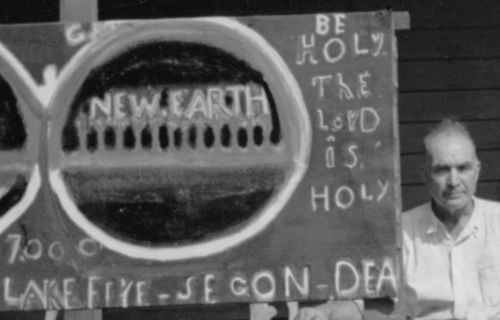
    New earth
    Which is a detail from:

    FSA--signs--religious detail

     Which itself is a detail from:

    FSA--signs--religious
    John Vachon; Religious Signs, Minnesota. 1936.

    Image, Source: digital file from intermediary roll film

     Vachon (1914-1975) was part (beginning in 1936) of one of the great groups of photographers in the history of American images: he worked for Roy Stryker in the FSA as part of the U.S. government’s attempt to record the good and ill of American poor.  That group included Esther Bubley, Marjory Collins, Mary Post Wolcott, Jack Delano, Arthur Rothstein, Walker Evans, Russell Lee, Gordon Parks, Charlotte Brooks, Carl Mydans, Dorothea Lange and Ben Shahn.  OF the many images recorded by Vachon, I liked the words in this one.


    ·Posted by :

    ·in:

    — — —

  • Bad Ideas Deparment: Scientific Finger Combs

    JF Ptak Science Books   Post 1876

    Hair fingers copy
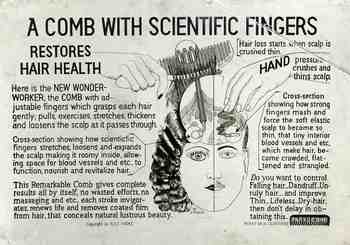
    Well. This item is of course lost on me, but the new “wonder-worker comb” somehow did an anti-crushing  something to the scalp and the hair root that promoted/restored and fictionalized hair health. The secret to understanding  it all, evidently, is that “bad scalp” is “crushed thin”.  This is brought about by “HAND pressure”, from  “strong fingers that mash and force the elastic scalp to become thin and such” causing  hair to be “more crowded, flattened”. For some reason the inventor didn’t speculate on whether other sorts of combs did this, or not; it looks as though he/she was targeting only those who combed their hair with their own non-plastic fingers, clearly elucidating this primal contest in a “wonder worker comb” vs. crushing/flattening comb fingers vocabulary.

     The comb with the adjustable fingers “pulls, exercises, stretches, thickens and loosens the scalp as it passes through” (the hair, the scalp?). It makes the scalp “roomy inside”, allowing the extra room that the hair needs “to function”. These hair restorative miracles is the result of the simple use of the comb, providing “complete results all by itself, no wasted efforts…”.

    The comb also, it seems, controls dandruff, and improves “thin, Lifeless, Dry-hair (sic)”.
    That’s a lot to ask of a piece of plastic.

    Blogcomb_hair230

    This  somewhat-scary item is a photographic postcard sent to the Library of Congress as a Copyright Deposit copy–part of the process of securing protection from intellectual theft via American copyright.  One is set to wonder about who–and why–this idea would be stolen. It would make an interesting story about Really Bad Ideas that were appropriated to no good end.


  • Wholly Mondo Bizarro: Outsider Thinking, 1888

    JF Ptak Science Books   Post 1844

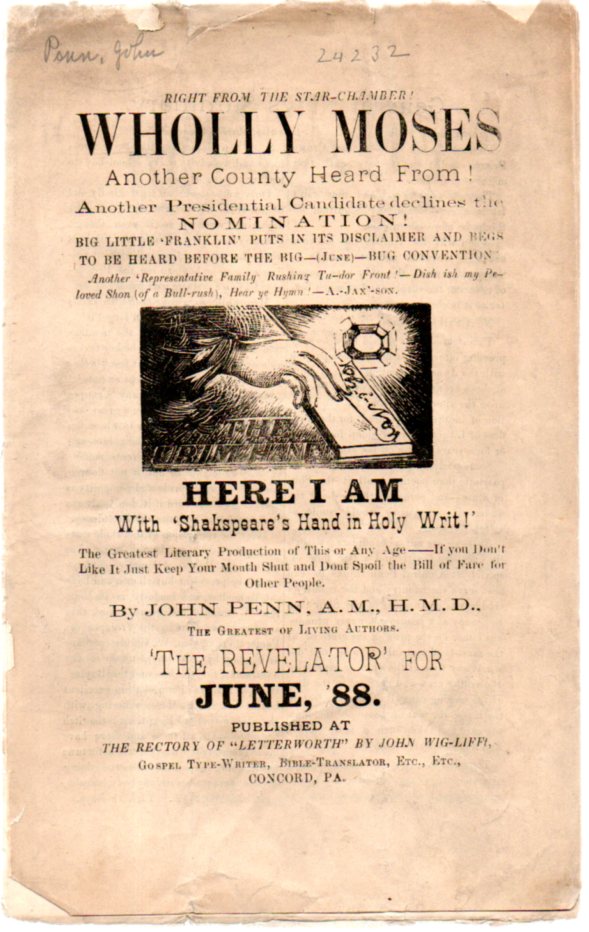
    It is difficult to lose your reader right in the very title of your text. But I do think that John Penn (“the Greatest of Living Authors” accomplishes this in his  

    Right from the Star-Chamber! Wholly Moses Another Coutnry Heard from Another Presidential Candidate declines the Nomination! Big Little Franklin Puts in its Disclaimer and Begs to be Heard Before the Big–(June)–Bug Convention... And on and on. 

    Bizarre602
    I can find nothing for Mr. Penn, who claims that this is Volume 3 Number 2 of a magazine called The Revelator (June 1888), a magazine that doesn’t seem to exist in the holdings of the massive WorldCat/OCLC.  The message of the slim and fragile pamphlet is–in the most kind appreciation possible–unclear.   There seems to be a lot of political something going on, though it is a tangled webby road. Much of the center stage seems occupied by the election of 1888, when President Cleveland was renominated in a peaceful convention, but then bested by Republican challenger Ben Harrison in the electoral college in one of those elections where most stuff seemed to be going relatively fine in the United States.  (Cleveland would come back to defeat Harrison in 1892.)  So references to something like “Big Little Franklin” might actually refer to Benjamin Franklin Jones (1826-1903) who was the chair of the RNC from 1884-188 and the force behind the failed James Blaine nomination in ’88.  Some references are obscure but solid, and some are just obscure and unsolid, and others turn the deep corner of obscure and fly into the arms of mondo bizarro.

    Perhaps it was all just theatre.  And perhaps it was the work of someone who had some money and insisted of giving a platform to his black-and-white kaleidoscope, and had the thing printed (if not published) there in Concord, Pennsylvania, in 1888 (also known here as “J.P. 6600”).

    Here’s the last page–the pamphlet is too delicate to open and scan any of the interior–perhaps this is enough:


  • Color Angels, Synesthesia and Body Building: Outsider Logic and Art, 1630-1925

    JF Ptak Science Books   Post 1829

    Vision from the inside out, or from another version of the outside-in, from the very Outside, can be very fruitful things, idea-engineers, inspirations.  They might have real insight of lasting applied value, or imaginary insight into the unexpected and imagined, with nothing of immediate or future values save for sense impressions  that might trigger thinking in unexpected ways or areas.

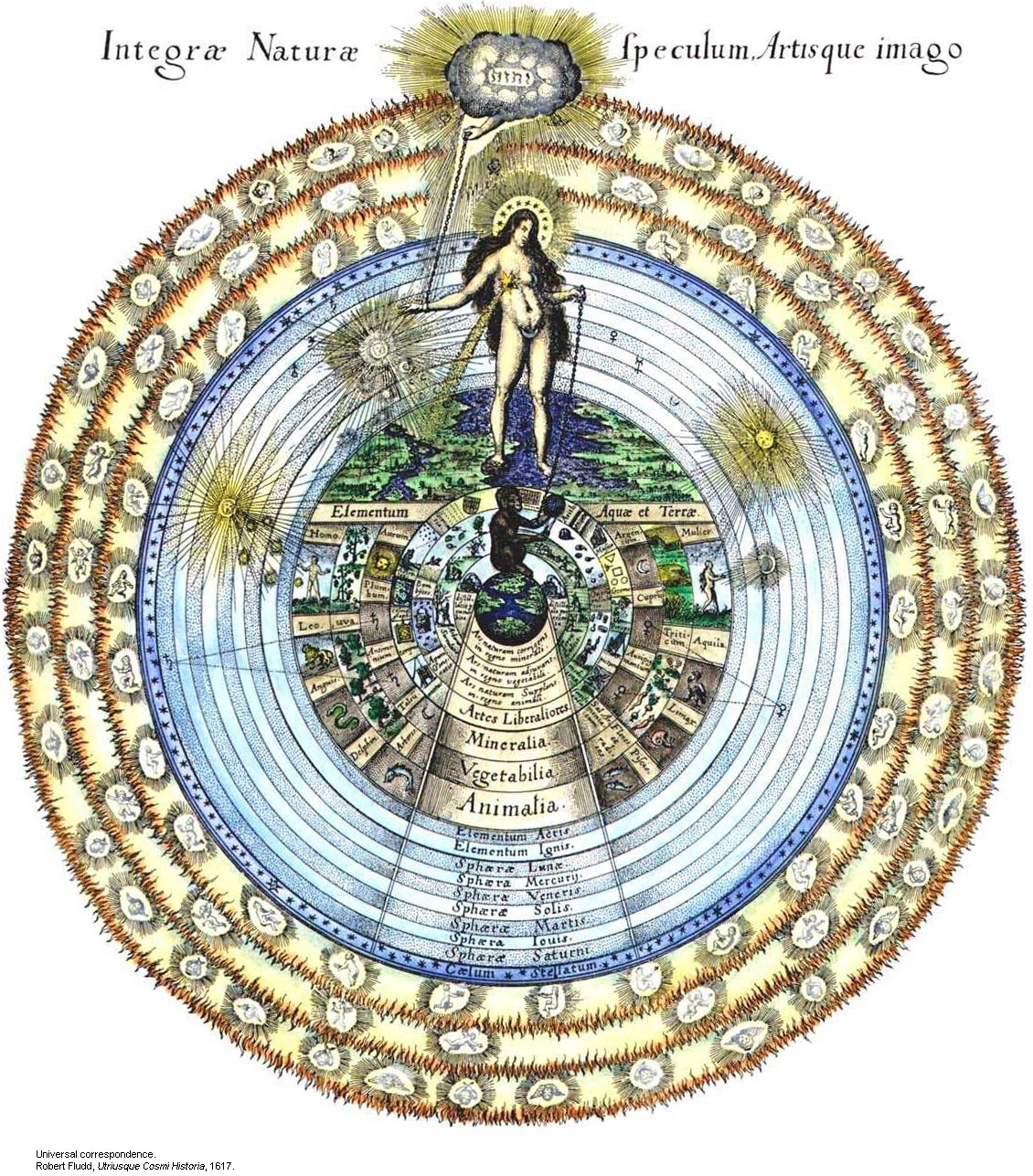
    There are occasionally great finds in mounds of experimental thinking that find a foothold in the outside world, such as in the case (further) below of Robert Fludd.  Fludd (1574-1637) was a Welsh-born, London-based (and Oxford- and Padua-educated)  astrologer, Paracelsian physician, occultist, Qabalist, hermeticist, semi-cosmologist and energetic thinker who found inspiration and solution in many ususual areas, some of which didn’t really exist. 

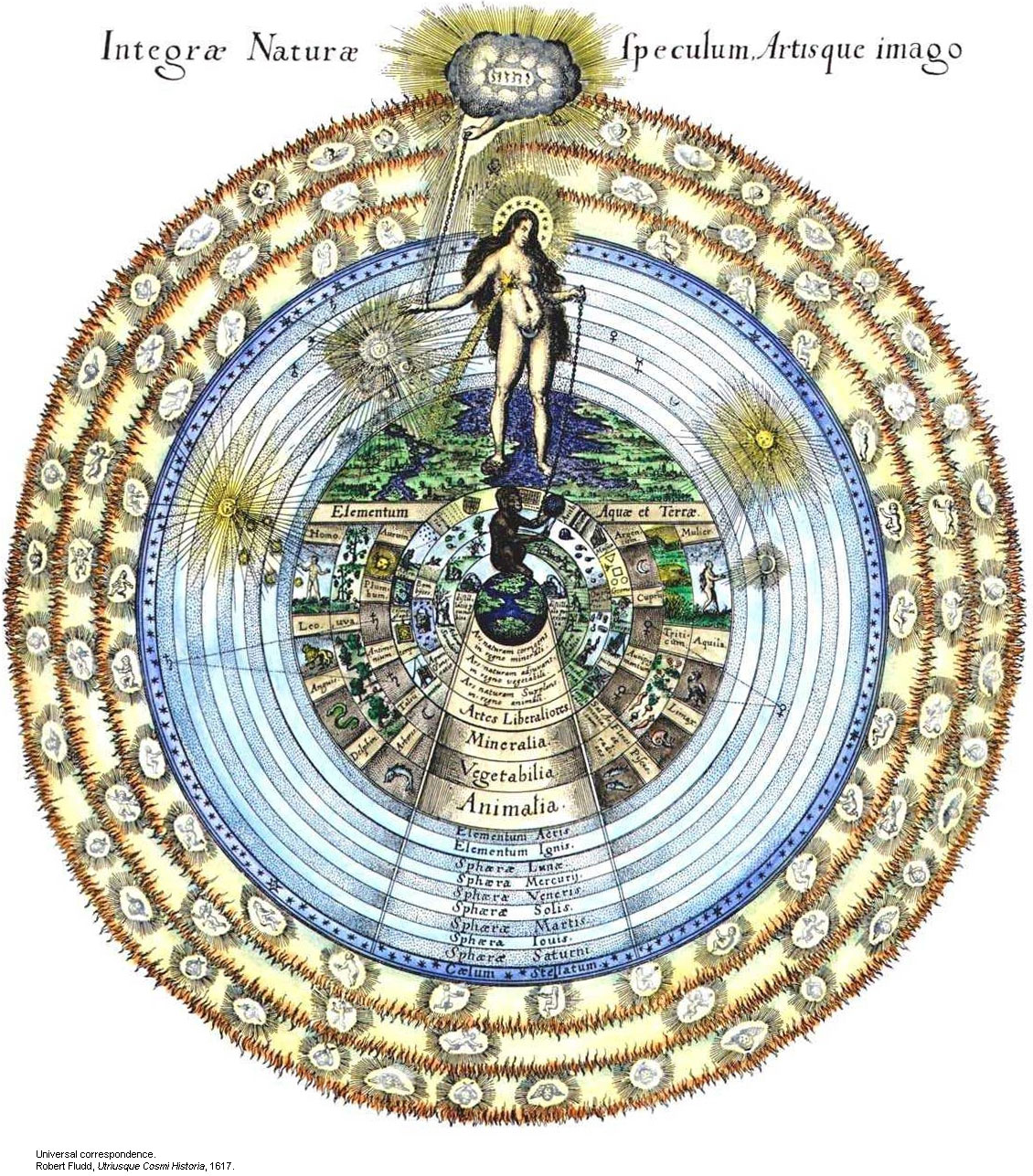
    For example,  a visionary of a different sort, as his celestial sphere will show:
    Spheres--robert fludd
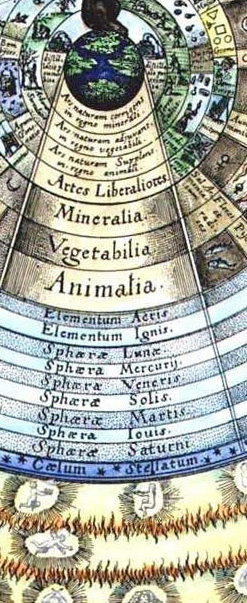
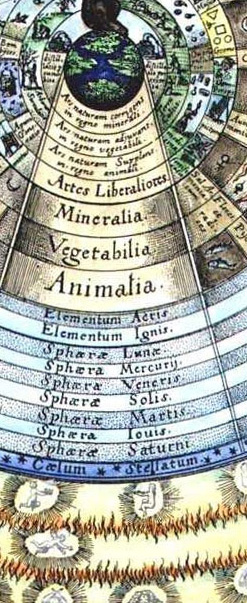
    And here in detail:

    Universal Correspondence from Fludd’s Utriusque Cosmi Historia, 1617.Rob
    Spheres--robert fludd det

    Fludd’s (1574-1637)  features a complicated astrological existence well beyond the point of Copernicus.  In addition to everything else, real and imagined, Rosicrucianism and astrology and puffy-birds, Fludd looked deeply into the real stuff of the world in this book in addition to all of the other make-believe–optics, the musical intervals, perspective drawing, hydraulic engineering, construction of lifting machines, military engineering and many other interesting, physical science topics.  But this drawing, right there on the title page, reveals Fludd’s real interests and shows what governs what he does.  Everything else, the math and and the physics, services this need.  Of course the image is beautiful, which is why it is here, but it is also a deeply personal, exploitative, cover-all for the things that Fludd *wanted* to find.

    So in the middle of all of this, Fludd wrote  his Pulsus seu nova et ARcana Pulsuum Historia e Sacro Fonte Radicaliter Extrata…(Published in Frankfurt in 1630), which was a tall but realtively skinny work on what at the time was a skinny topic:  the pulse.  In addition to discussing an listing all manner of data and observations ancient and modern on the subject, Fludd visits the newish and vastly important work of William Harvey, De Motu Cordis (1629), and gives it the first published favorable review.  This was a big deal at the time as Harvey’s epochal work was still feeling its way around for support.  And here it was, in an unlikely place, a book filled with useful and not information, its writer claiming a certain association with mystical medicine and universal knowledge and getting the whole deal with Harvey right. 
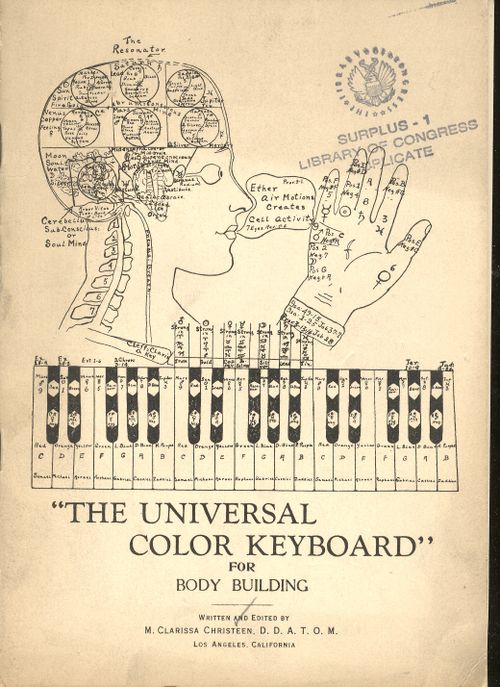
    +()+outsider coverThere are some other more recent contributions in our Outsider Logic collection that reach the limits of outside, reaching far into the aspects of knowledge that lies more or less completely hidden and inaccessible to the vast majority of readers.  Sometimes bumping into outré thinking like this is very useful because it is just so very different; and sometimes this thought process is just and only that: very different.

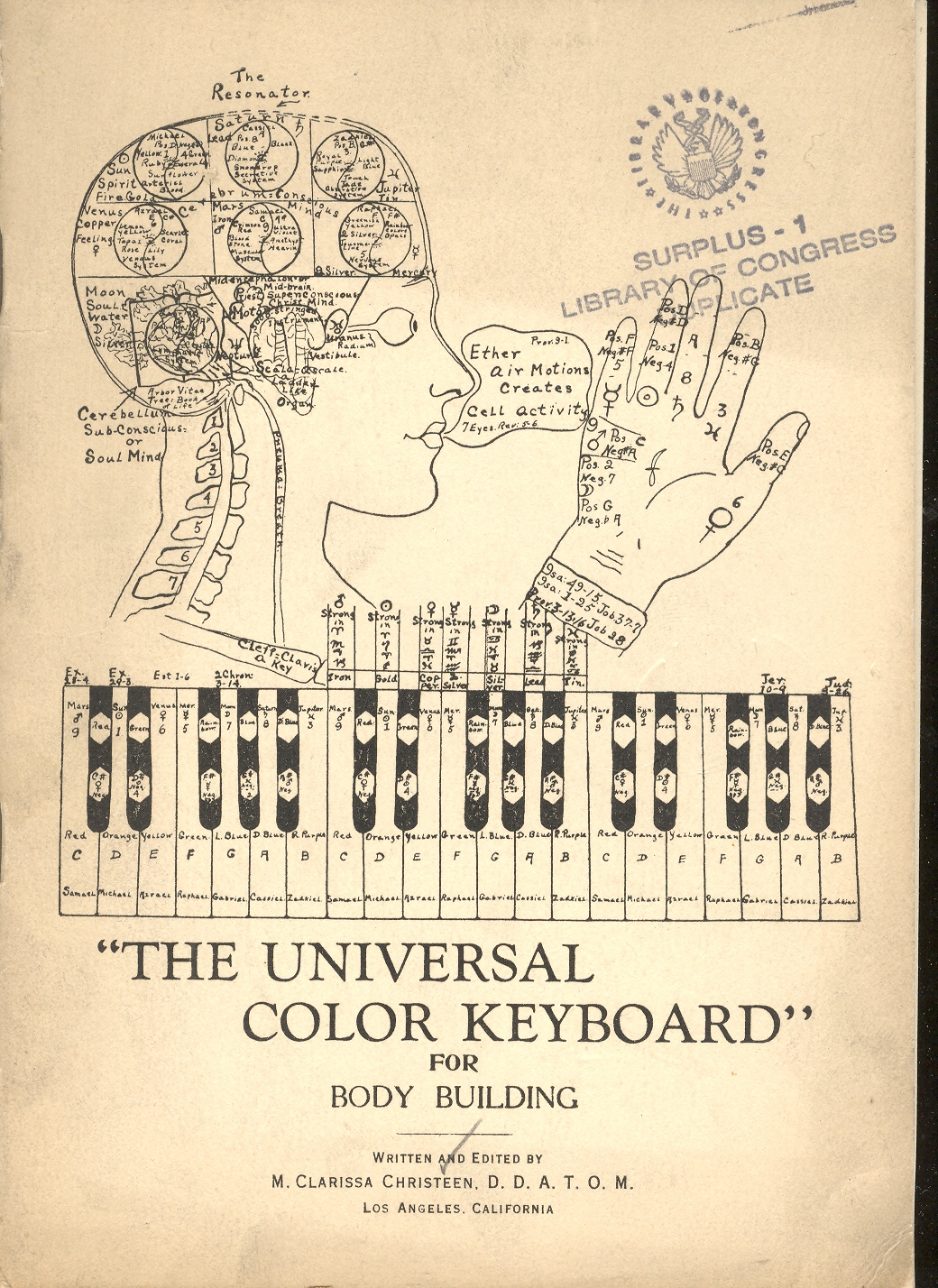
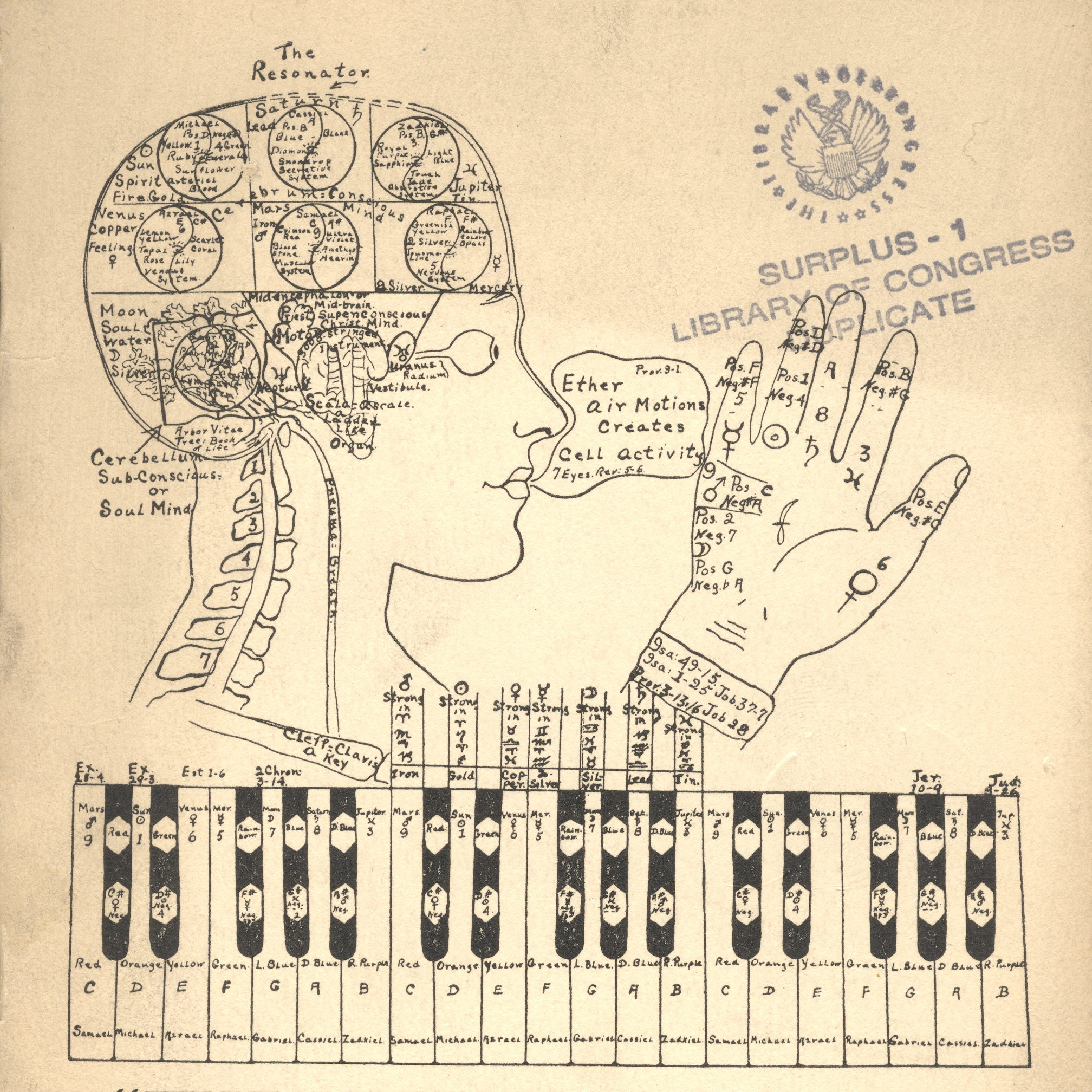
     This is last bit is probably the case for W. Clarissa Christeen’s  (“D.D.A.T.O.M.”)The Universal Color Keyboard for Body Building. But what Ms. Christeen absolutely does have going for her is her artwork, which is, in its own special way, quite sensational—I’m really sorry that the pamphlet is limited to only two pieces of her work, as I’d really like to see more.  +()+outsider cover det
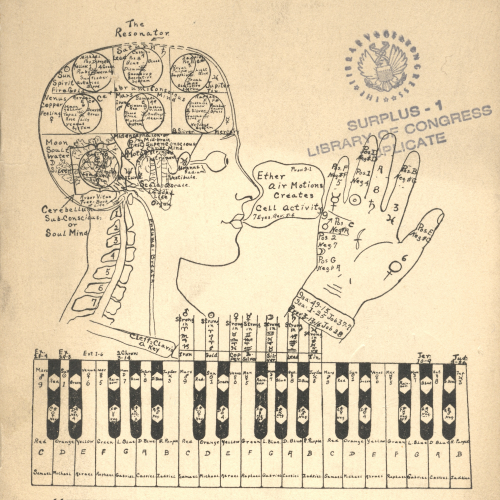
    Her philosophy is at the very least odd, though it may spring from a synesthesia.  Or not. 

    “Syn” (Greek, “together” and “Aisthesis” (“sensation”) combine to form this very interesting word and ability, being an automatic response to a stimulus by one sense when that stimulus is usually associated with another sense.  For example, there are “synesthetes” who perceive color as an auditory input, basically hearing yellow and so on; more famously are the musicians composing tone poems associating sound with color.  There are letter-color and number-color associatons, as well as taste-senses from colors and sounds and so and on.  For example in Kandinsky’s On the Spiritual in Art there is an attempt to relate color theory to touch and smell; Franz Liszt wrote color music; Isaac Newton attempted to establish the common distribution and association between color and tone frequencies; Rameau constructed a clavencin oculaire while Rimington made a color organ; Richard Feynman spoke of colored equations, and Nabokov recorded  (Speak, Memory) letter/color visions.  THese are just a few examples of some of the more well-known practicing synesthetes. 

    In any event Ms. Christeen may be of that mold, and is attempting the universal perfection of mind and body through the combination of color and music (and scent), which “is valuable in building body-tissues of a harmonized order…the music chosen for social functions, the key notes being for the planet ruling or governing the day or the hours etc..  This brings celestial and terrestrial vibrations in direct contact, without interrupted angles which produce in harmony; in other words the creative powers which produce these various waves f light and sound or color or tone, acts upon the lower octave, matter or material manifestations recreating it, transforming it, and raising the vibrations of the said matter or material manifestations, thus, refining the temperature and quality of germ or tissue, etc.”

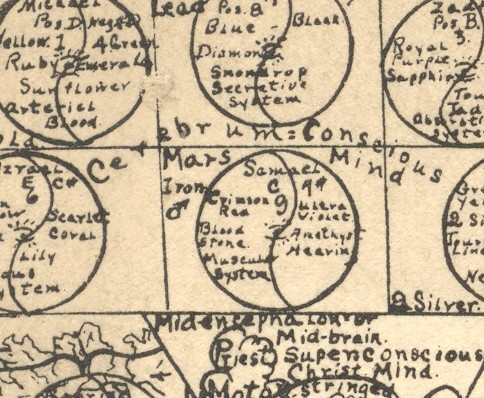
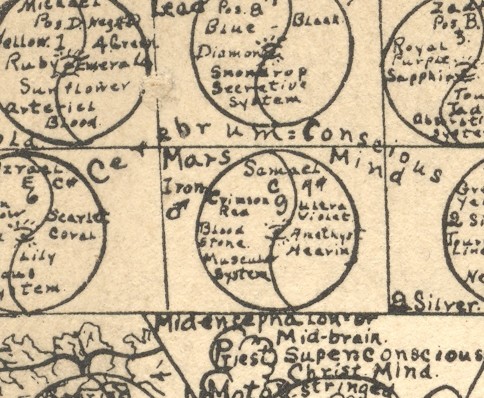
    This is a long passage, but I include it because, well, I just had no idea when an abrupt turn was going to be made in the discourse; nor did I have any idea of what the principles were of what was being discussed.  And this is still all on page one.  Sometimes passages like these are breathtaking, as in leaving you without breath, because their foundation for understanding is so elusive.  All you’re left with, sometimes, is a “wow!” reaction, like appreciating a pitcher who has just struck you out on three roughed-up-greasy-spit-laden nastiness pitches that were invisible and illegal, and didn’t matter at all.(What the figure in the cover illustration is saying. by the way, is “Ether air motions creates cell activity”, with a couple of Biblical references, somehow.)
    +()+outsider cover ultra det


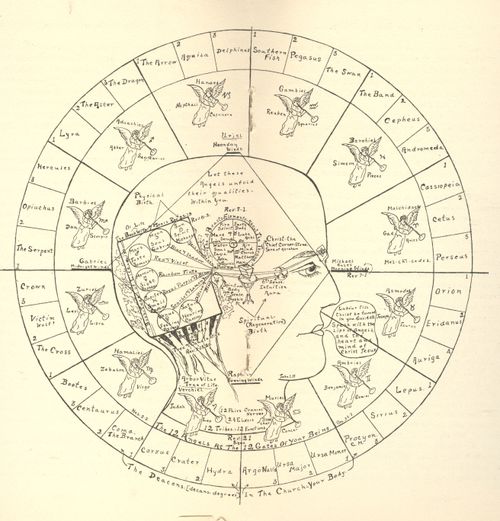
    +()+outsider inside I do know that the major divulged secret is the Universal keynote (and “keyboard”) and its control through music and fragrance of all that is, “each individual is to harmonize his or her astral colors to the universal keynote that he or she may be surrounded by a correcting aura, which sends out its streamers of light rays into the cosmos”.  Things get more deeply possessed after this, stretching into the Old Testament and astrology, which we don’t need to get into here. 
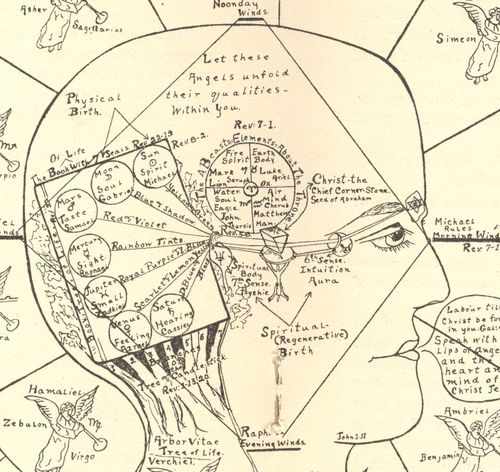
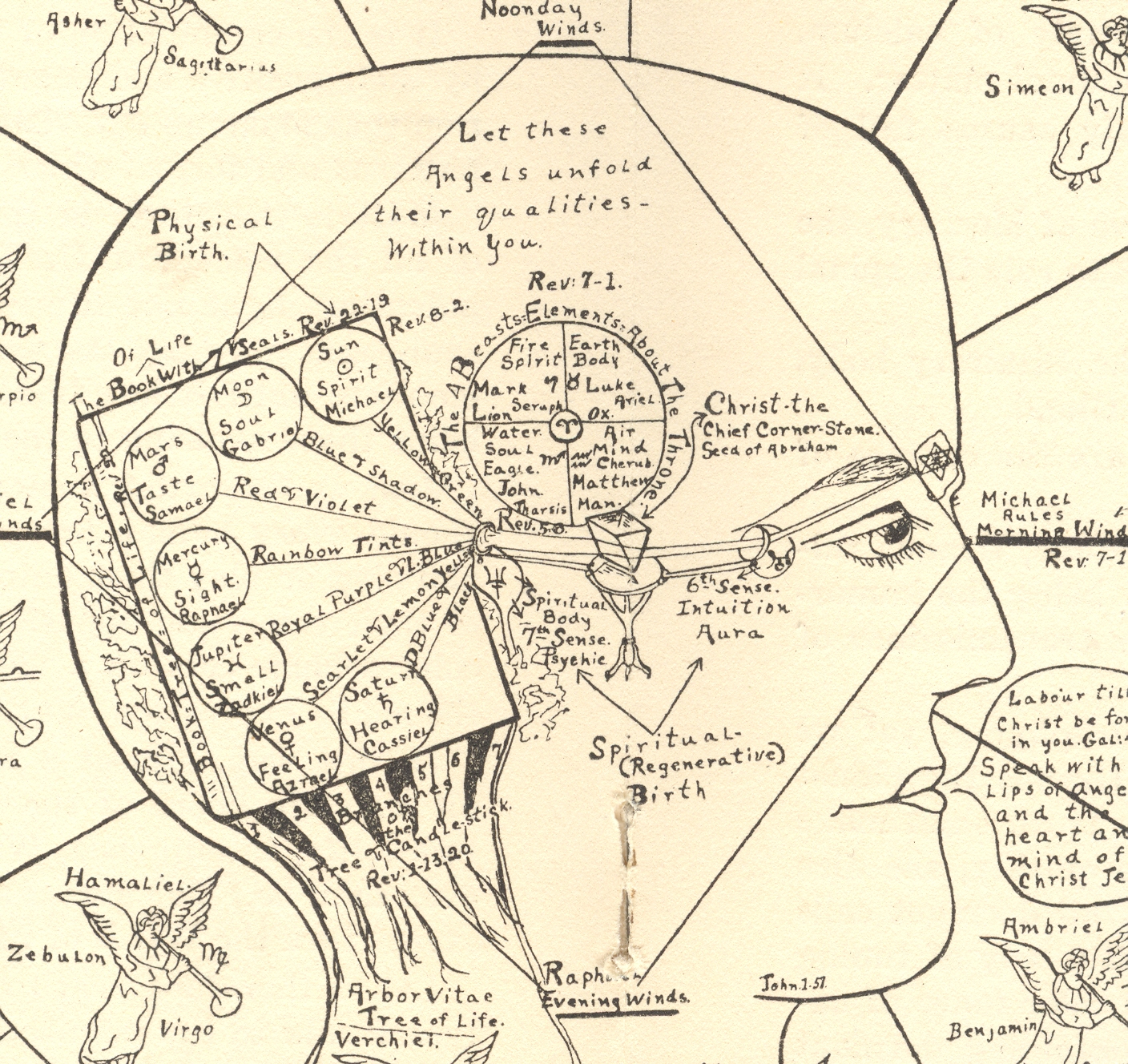
    +()+outsider insidedet As I said, perhaps Ms. Christeen was a synesthete, and perhaps multiply so.  In 1925, when this book was written, there mayn’t’ve been a place for people to go who had advanced sensibility of seeing colors in music, and perhaps colors in fragrance. Perhaps Ms. Christeen was working out there in Los Angeles completely alone, trying to figure out just what her special and very different gift actually was.  Perhaps her life was greatly enlivened by her synesthesia, and sent herself out on a mission to the world to have other people experience it, too,, with the help of her color-relational charts.  I do feel for her, though I have absolutely no connection to what she was trying to explain.  I do find the artwork fascinating—a true “outsider” contribution. 

    (By the way, I don’t think that we ever got to the “body building” part in this work.  Also, I think the “DDATOM” after Ms. Christeen’s name meant something like “Doctor of Divinity of the Atom” or something like that–it wasn’t mentioned in the text.)

     And so there you have it.  I think that I’m just making the point that the outcome of some of this very provocative work doesn’t necessarily come into play in its ultimate evaluation, and that it should all be judged by what short of thinking that it excites in its reader. 


  • Zodiacal-Sexual-Social Indicator: Astrological Prediction Tool, 1919

    JF Ptak Science Books   Quick Post

    As these things go, this mechanical device is awfully pretty in an Outsider-y kind of way, and I have no doubt that I’d want to own one if for nothing else than for its explicit implied-complexity (whatever that is).  [Source: US Patent and Trademark Office.]


  • Hobo Signs Map, 1870

    JF Ptak Science Books   Post 1750

    Bloghobo_b200

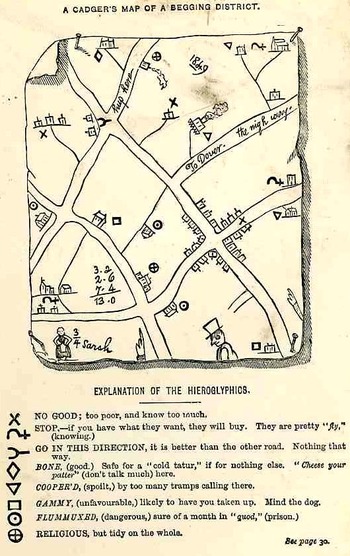
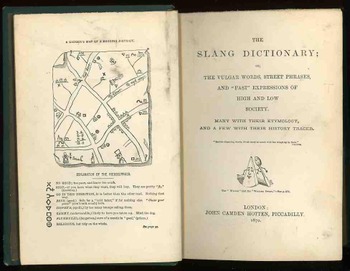
    This is the frontispiece to the delightful work with the luscious title of The Slang Dictionary; or, the Vulgar Words, Street Phrases and Fast Expression of High and Low Society… printed in London by John  Camden Hotten, in 1870.  It is a hobo or “cadger” (“a  mean or vulgar fellow who would rather live on other people than work for himself”)  map (or the map of “a tribe of vagabonds”) of Maidstone, in Kent, drawn by a “screever” (a sidewalk chalk artist who normally would draw religious images for money), and showing the various chalked and etched signs that the hoboes (“and other mendicant marks”)  would leave for one another, being a key to the town, for what was practicable, safe, dangerous, and the like.

    Recorded antiquarian hobo and tramp symbols like these are really quite rare, given their ephemeral nature to begin with; of course the need to record these obscure signs by polite society was not on a high order.  There are many indications that signs such as these existed, but not many illustrations.  For example in the book The Triumph of Wit; or, Ingenuity Display’d in its Perfection, edited by John Shirley. (1724), as well as works by Holyland and Borrow there is a description of English gypsies and their travels, and a short description of their use of boughs and sticks, set out for each other, so that a duplication of effort by different bands or families would not occur.

    (The figure of the woman, wonderfully named “3/4 Sarah”, probably connects this Sarah to a sort of popular dance.)Bloghobo_a199_2

    Hotten also published the following interesting and title-bending work in 1874:  THE ORIGINAL LISTS OF PERSONS OF QUALITY;  EMIGRANTS; RELIGIOUS EXILES; POLITICAL REBELS; SERVING MEN SOLD FOR A TERM OF YEARS; APPRENTICES; CHILDREN STOLEN; MAIDES PRESSED; AND OTHERS WHO WENT FROM GREAT BRITAIN TO THE  AMERICAN PLANTATIONS 1600-1700, WITH THEIR AGES, THE LOCALITIES WHERE THEY FORMERLY LIVED IN THE MOTHER COUNTRY, THE NAMES OF THE SHIPS IN WHICH THEY EMBARKED, AND OTHER INTERESTING PARTICULARS.


  • “Writing of the Insane”, 1876: Very Early Art Brute Images?

    JF Ptak Science Books   Post 1712

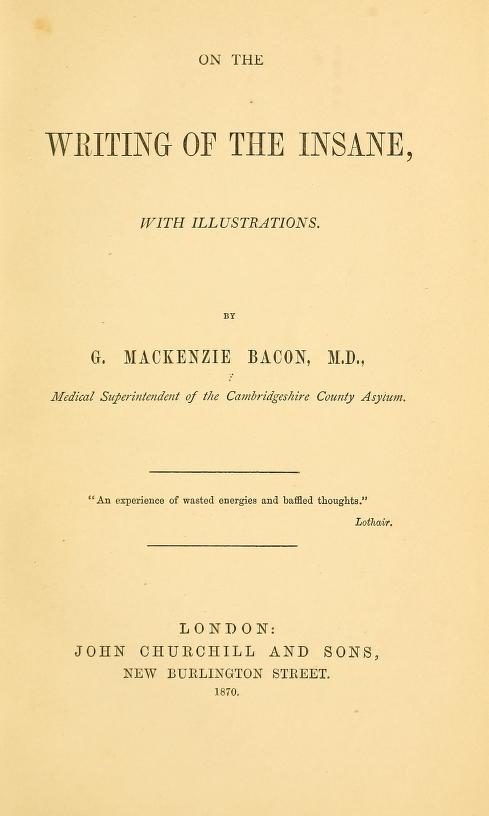
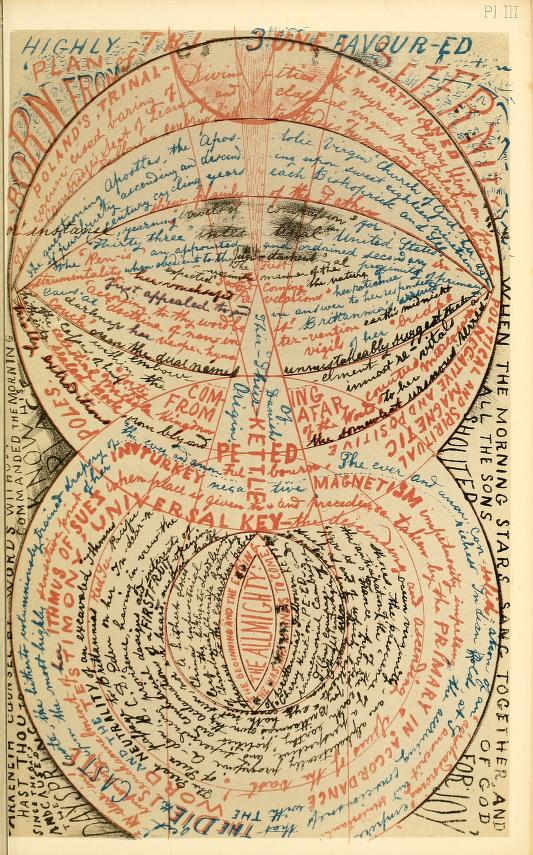
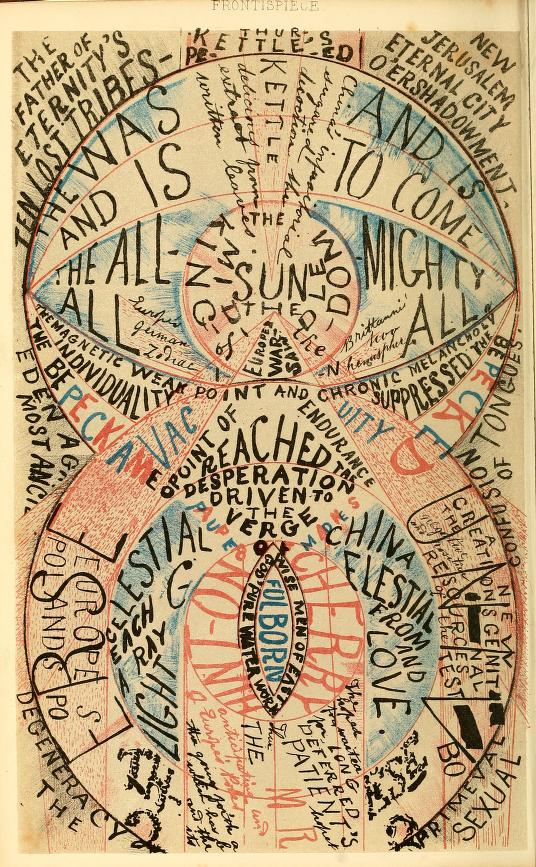
    Insane art 3 titke pageThis book–The Writing of the Insane, by George Mackenzie Brown, 1876– seems remarkable to me for the attention paid to the creative products of the insane. I am not sure when the first of these efforts occurred, but it seems to my experience that 1876 is an early production date for such an undertaking. It also seems to be a very early identification of the “special talents” of some of the observed individuals, including in the text of the book two remarkable (and remarkably “modern” looking) pieces of what today might be considered Art Brut/Outsider Art.

    The author is George Mackenzie Bacon (1836-1883), a doctor who took classes at Guys Hosptial and who had membership in the College of Surgeons in 1858.1 Bacon was the author of Primary Cancer of the Brain (1865) as well as an editing contributor of at least a dozen annual reports of the Committee of Visitors of the Cambridgeshire, Isle of Ely and Borough of Cambridge Pauper Lunatic Asylum (from 1869-1883 ro so). He definitely made improvements to the conditions of the inmates when he worked at Cambridegshire County Asylum (also known as Fulbourn Hospital, 1858-1992), where he provided those living there with more personal living space and patient-built work areas. This was certainly an interesting approach to take for the mentally ill, especially given the time and place.

    But in his (scant) published works it seems that the Writing of the Insane must be his masterwork for at least being among the earliest books to serve as an archaeology of deeply-different and illustrated thought:

    Insane art
    And this remarkable effort:

    Insane art 2

    [Source and full text, here.]

    This is certainly not a “celebration” of talent, but there are moments of recognition of such in the Writing of the Insane, which at the very least is a very early expose of the topic.  One of the earliest books written by someone who was admittedly “insane” (and this is very different from the many books written by insane, or brilliant, or misunderstood, or “complex”, or “different” author) came to us in 1846 by Green Grimes. thirty years before the Bacon work.  In  A Treatise on the Most Important Subject in the World: Simply to Say, Insanity…2 Grimes recounted his life at the Tennessee Hospital for the Insane, about which the blog Canton Asylum for Insane Indians writes:  “There are other Medical books which treat on Insanity, but comparatively few to the population, and none written by an Insane man,”

    Notes:

    1. There is scant personal information on Bacon available online. This data comes from the British Medical Journal, 3 March 1883, in an obituary on Bacon. 

    2. The full title is pretty full: A treatise on the most important subject in the world: simply to say, insanity: The only work of the kind in the United States, or, perhaps, in the known world, founded on general observation and truth. There are other medical books which treat on insanity, but comparatively few on the population, and none written by an insane man. This contains a short history of the author’s case, giving the general causes which produced the disease on him individually, manner of treatment and termination. Giving the only treatment by which a cure may be effected, the manner of detecting the disease, and the duties of sane parents towards the insane offspring of their bodies; with some general remarks upon idiotism, the jurisprudence of insanity, suicide, &c   

    The American Journal of Insanity simply states that the 94-page book is “very curious”.