A Daily History of Holes, Dots, Lines, Science, History, Math, Physics, Art, the Unintentional Absurd, Architecture, Maps, Data Visualization, Blank and Missing Things, and so on. |1.6 million words, 7500 images, 4.9 million hits| Press & appearances in The Times, Le Figaro, Mensa, The Economist, The Guardian, Discovery News, Slate, Le Monde, Sci American Blogs, Le Pont, and many other places… 5000+ total posts since 2008.

Category: Outsider Logic

  • Hieroglyphics of Leaves: the Scrutable and Inscrutable Exuda of Tea and of Language, in General

    JF Ptak Science Books LLC   Post 434  (Dedicated to Jeff Donlan)
    0 blog dec 19 tea294--detail

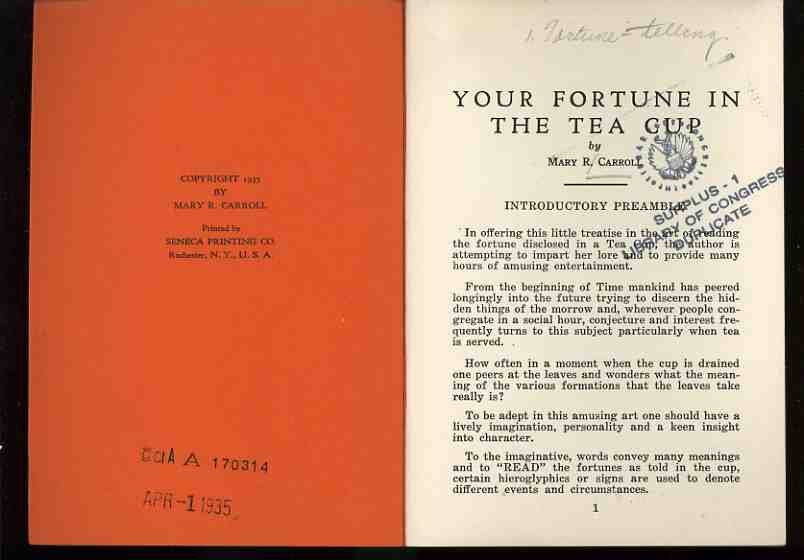
    “Words are prophetic in themselves and the tea leaves open the avenues of imaginative thought.” Your Fortune in the Tea Cup

    “This was our paradox: no course of action could be determined by a
    rule, because every course of action can be made out to accord with the
    rule. The answer was: if everything can be made out to accord with the
    rule, then it can also be made out to conflict with it. And so there
    would be neither accord nor conflict here.”–Ludwig Wittgenstein, Philosophical Investigations §201

    “Are you certain that you understand my language?” J.L. Borges, The Library of Babel, (the final query)

    “The always wandering meaning of all literary representation, according to which meaning wanders, like human tribulations, like error, from text to text,
    and within the text, from figure to figure.”  Harold Bloom,  Kabbalah and Criticism.

    **

    Written, incised and  drawn messages come to us in many forms, presented in clay, chipped into stone, painted on rock, drawn on paper, tied into chords, all to be appreciated by our sweaty eye.  These varied elements have many different uses, from telling us what is going on, to what is happening now, and also about what might happen in the future.  Sometimes the future is a tale written in letters, and sometimes in numbers, prediction rates of success varying sorta by the ratio of letters to numbers.  Or not.  Sometimes it takes the forms of sticks and lines, telling us how to move in dance (as with labanotation, below-right).
    Labanotation
    Messages can be quite clear, as in the presentation of an arithmetic progression, and can also be made to seem like nothing but gibberish.  The final bit of a lettered segment in Jules Verne’s Eight Hundred Leagues on the Amazon, for example, looks like this: “…KSPPSUVJHD”, and is preceded by 264 other letters, looking much like a page from one of the books in our friend Borges’ library at Babel.  A cryptogram whose message could determine whether the main character lives or dies.  (Even assuming a monoalphabetic substitution, its a tough little bugger to figure out–even when you start counting the appearances of the nonsense letters to try and figure what might stand for “E” and “A”, you still have to work it against whatever language the cryptogram might’ve been done for. Once you toss in the polyalphabetic possibilities in, the room gets a little spinny.)
    Sequencing
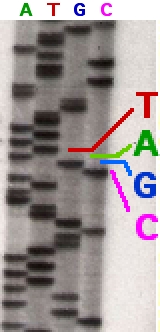
    There is of course a identification of the source code for DNA, and then further to the sequencing of those elusive bits to determine and make sense of the order of the nucleotide basis, producing what on first blush looks like a laborious repetition of four basic letters interspersed with lots of other junk. With the key to this cypher, the letters and raw glyphs look less like an automated music box cylinder and more like the music of life that it represents. 
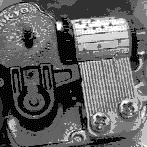
    Music box
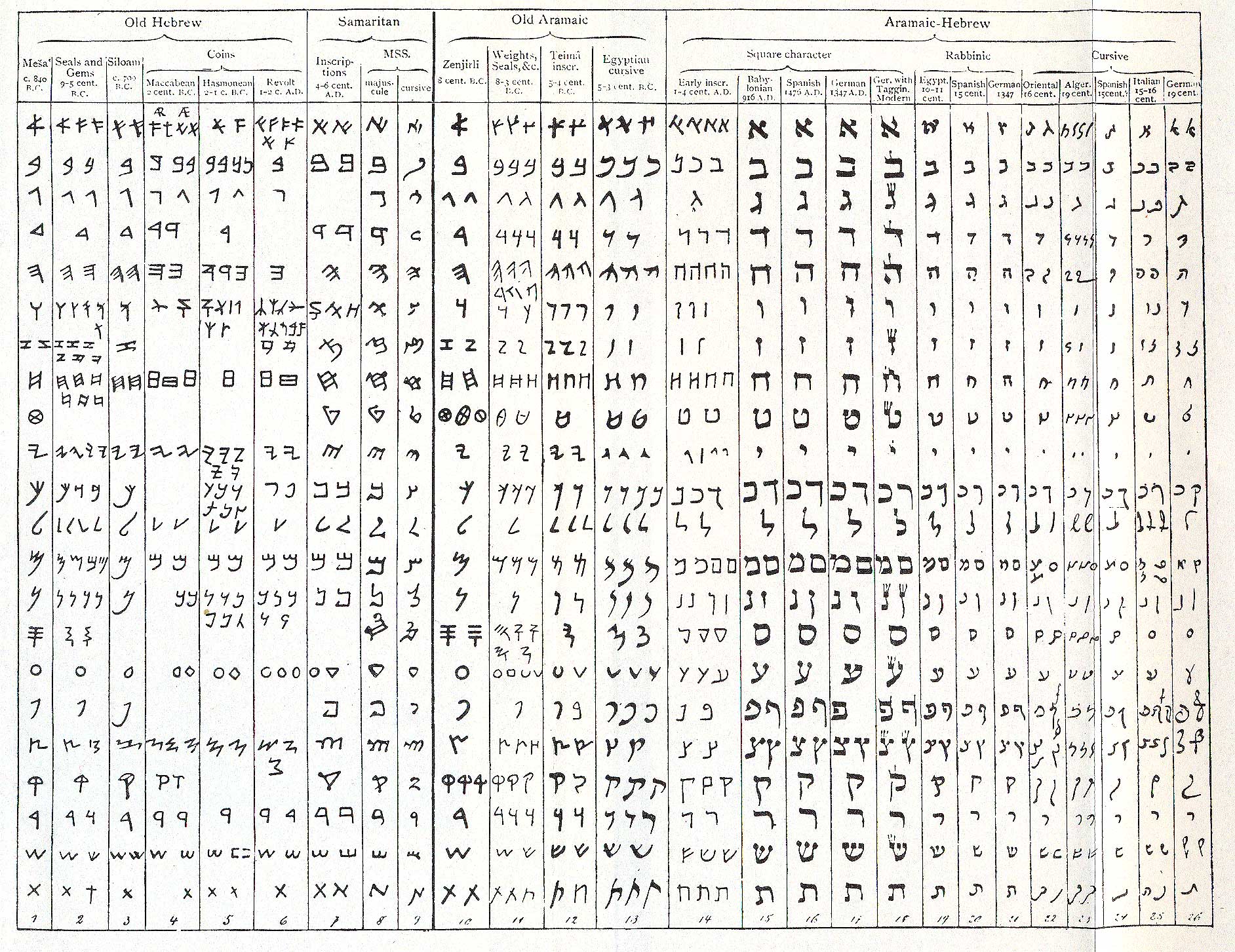
    Once you throw naturally-occurring glyphs into the fray the information pool becomes terrifically wide.  Geological strata, the course of a lightning strike, the height of a cloud, the depth of a cave, all tell us enormous, almost incomprehensible stories, while things like stellar spectra hold the key to what stuff in the universe is made of, how old it is and where it is going. 

    The world is nothing but a collection of what has been written-on, and I would be terrifically remiss if I didn’t mention the stories of animals left by their tracks, as full and interesting in their ticks and glyphs telling as striking a story as the geometrical marks scene on your monitor.
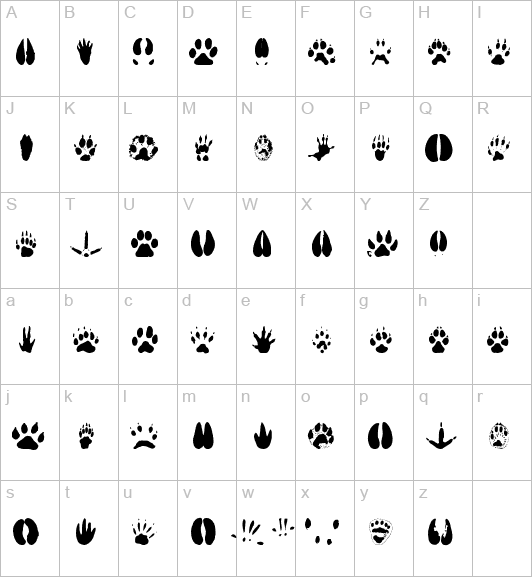
    Trqcks--animal

    Tracks--hebrew

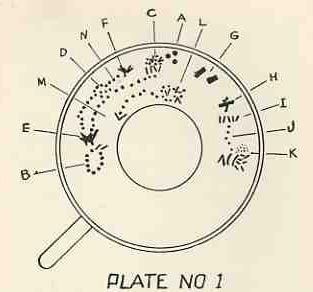
    All of this leads us to the delightful pamphlet that provided us with the semi-secret image at the top of this post.  The work engages the shadows of an ancient rite in an amused, amusing manner, not taking itself too terribly seriously, though does not abandon the possibility that fortune telling via the leavings in a tea cup is not impossible.  The image at top left, which might look like one of those Eric van Daniken drunken “alien findings”scooped out of a Mayan lintel, is the bottom of an empty teacup, the bits representing the varied exuda freed from the drunken tea. And according to this pamphlet and another 2000 years or whatever of Asian history, these bits are as much a representation of reality as the English alphabet; and according to my very quick reading of the thing, it is also open as much to interpretation as it is to creative misinterpretation, which I guess is where the poetry must be. The geography of the items of the teacup are as important it seems as the things left behind:  stalks, leaf bits, grounds are appraised for their wetness or dryness, their mobility or not, their position on the cup and their positions relative to one another, and on and on, dancing betwixt themselves in a changeable choreography of meaning and non-meaning, a closely gathered world of indefinite possibility.

    In a world filled with religions and superstitions and mythologies and hopes and dreams and fears, I have no problem at all with elevating tea-leaf-reading to a marble altar..  None whatsoever– so long as the ultimately satisfactory  Mr. Claus is received as well, or at least not bothered.

    I’ve reprinted the entire pamphlet below.  Somehow it is a very satisfying read.

    If you enjoyed this, check out the following earlier posts:

    Different Forms of Writing 2: Recording Movement. Dance Notation

    Different Forms of Writing 1: Big Writing With Light—Nollet, Citroen, Barnum and Packard

    Books
    of Shadows—Trithemius, Bacon, Porta, & Falconer vs. a Make-Believe
    Derrida on
    How to Make Something Unintelligible. Secret Writing and
    Ciphers.
    0 blog dec 19 tea291


  • Telephone Pole Art

    JF Ptak Science Books LLC  Post 417
    0--ebay---dec telephone pole201

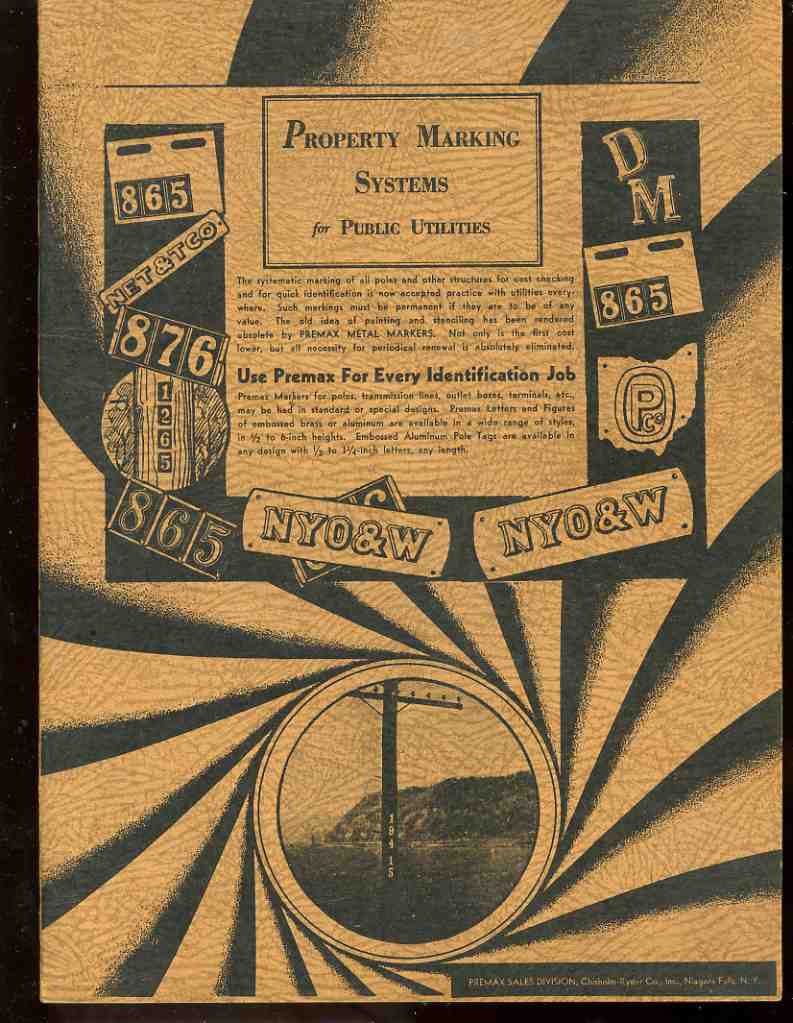
    One of my interests over the years has been the found art in electrical lines on telephone poles.  But there’s really much more to appreciate in these simple utility structures than the stuff they support.  My friend and fellow Ashevillean Marty Weil, who among other things runs the wonderful and never-lacking-a-surprise Ephemera blogsite, says that “telephone poles are dripping with ephemera”, the extra, disposable stuff seemingly unrelated to their stated purpose. He’s right: climbing spikes, the beautiful antiquarian glass insulators, alpha-numeric identifying devices, unintended art leftovers from where things have been stapled/nailed/taped to them,  and of course the geometries of the electrical lines that connect them to us, and on and on.

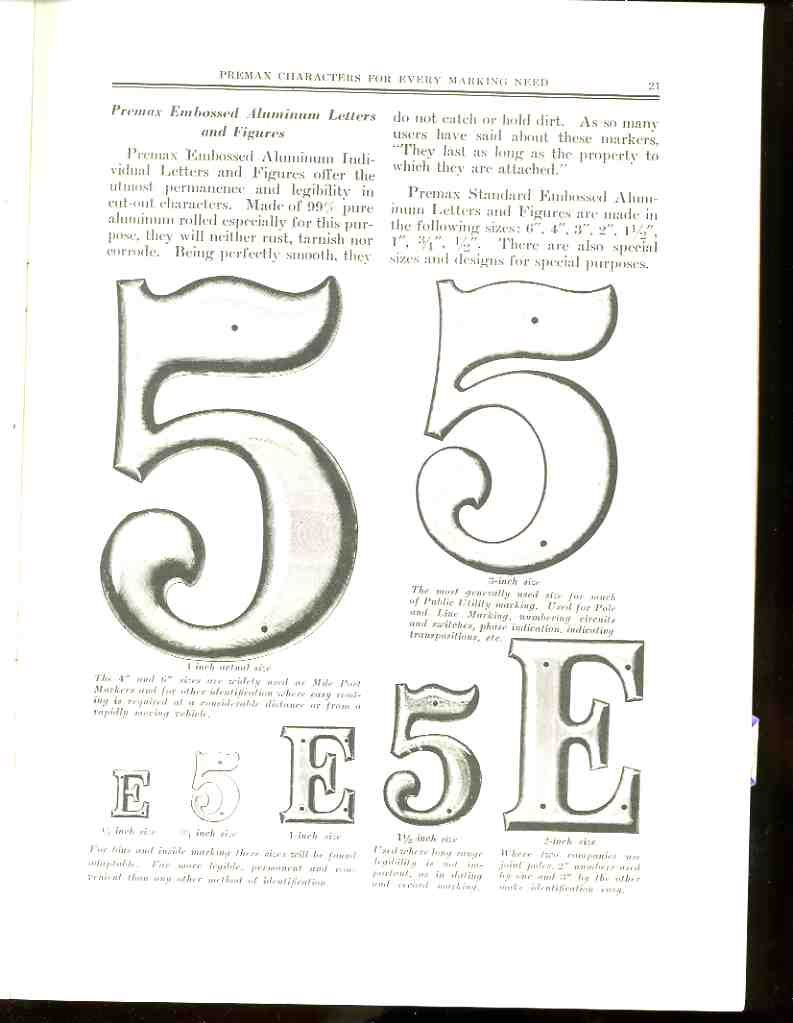
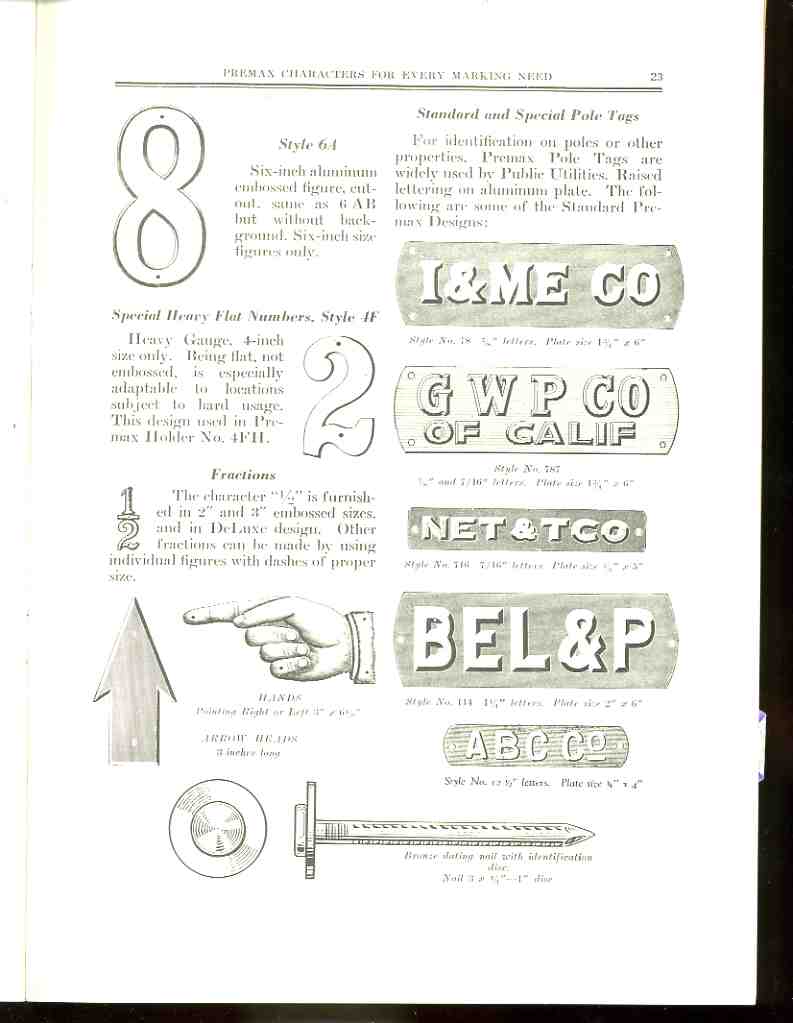
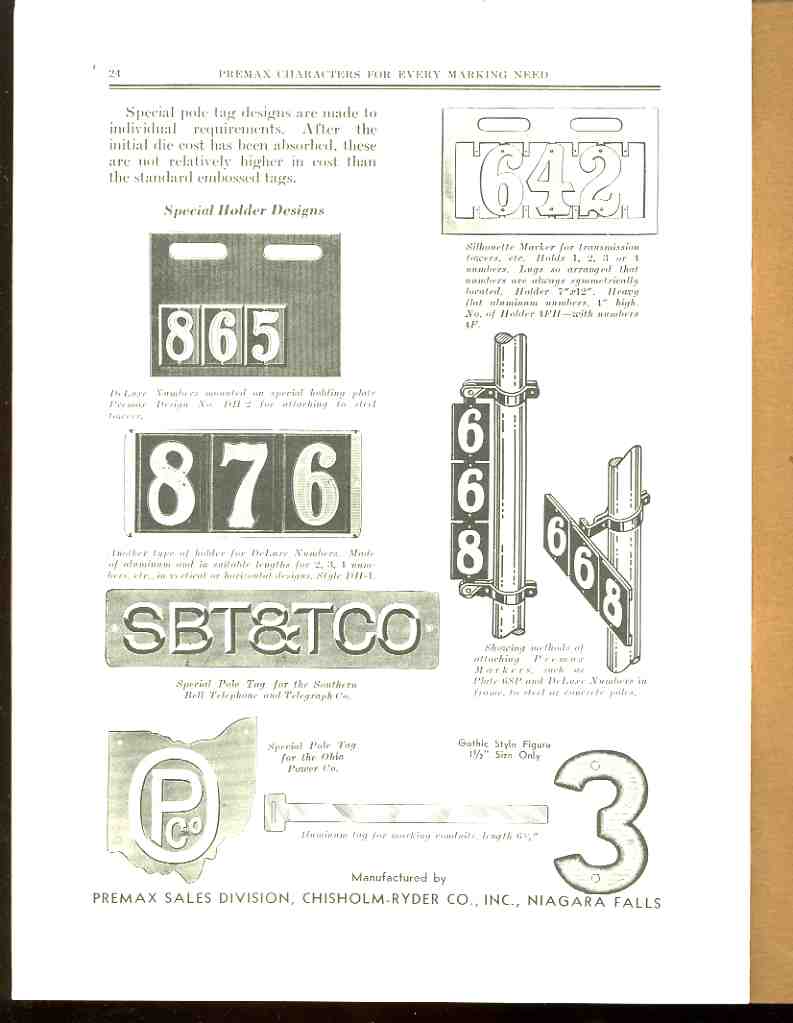
    This pamphlet, left, unimaginatively titled Property Marking Systems for Public Utilities (1938), is a near-goldmine for the stuff that hasn’t quite dripped off the poles.  As a matter of fact, it is a source for all of the material that is likely never to come off the poles until the poles come down. These are the basic elements from which all of that  numerical and alphabetical found art is made.

    0--ebay---dec telephone pole202

    00-spaceball

    0--ebay---dec telephone pole203

    0--ebay---dec telephone pole204

    ·Posted by :

    ·in:


  • Found Art: Naive, Never-Fractal Mathematical Art 1810 and a Dip into Steve Reich’s “Come Out”

      JF Ptak Science Books  Post 410

    0--ebay---dec 4 naive art181


    Perhaps the most exquisite art for me is that which is most unexpected, finding beauty without preconception, without warning; and sometimes, finding art without the reason to make it so.  And sometimes it is just the innate design, spacing, placing of elements in something that makes it beautiful, the use of unused, empty space establishing the elements of micro-perfections, the punctuations of the flow of visual chance. 

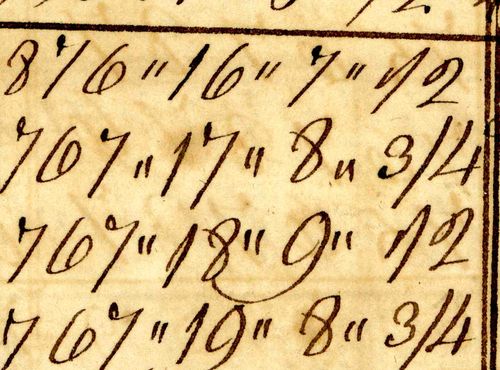
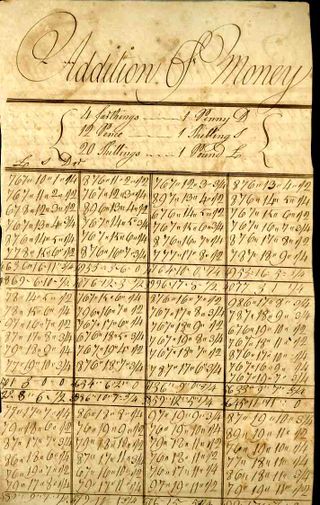
    “Additions of Money”, a page from a primer or mathematics workbook kept by a later-aged child in Pennsylvania in 1810 is filled with such found moments.  The columns of numbers are just gorgeous, and the empty spaces – gauzy with the iron from the ink that has eaten its way halfway through the paper from the other side – provide just enough found geometry to suggest mystery and depth in blank space.  Simple. Elegant. Unexpected. Beautiful.

    0--ebay---dec 4 naive art180


    Perhaps it is the aspect of self-non-similarity that is so appealing; perhaps for the fond naive art it is the rejection of sameness, of everything that something like mathematical/fractal art is not.  (A fractal just for the record is a geometric shape that can be split into  parts that is a smaller copy of the preceding whole.)
    These are images that stochastic synthesis of fractal noises is not: it is not the Peano curve, or Sierpinski gasket, or Hilbert curve, or Mandelbrot set, or Hausdorf domain, and on and on.  Perhaps it is the opposite of these things. 

    And this brings me to Steve Reich’s “Come Out” and a question:  is this music fractal? (Or Arnold Schoenberg for that matter?)  There is a panoply of repeated, self-repeating themes through the work of Reich, blending themselves into magnificent compositions.  But I wonder about what “Come Out’, an early work by Reich, is in the same category.  This composition simply uses the words “come out to show dem” (“I had to, like, open the bruise up and let some of the bruise blood come out to show them” ) in not-so-simple ways, repeating the phrase thousands of times, in the same time, but at different times, like a Zeno’s paradox of music, finding the cleverly hidden beauty in a simple phrase.  And precisely the opposite of our naive surreal mathematical art.


    0--ebay---dec 4 naive art182


  • The Future of Future Truisms: David Byrne’s Knee Plays vs the Fat Man Nuclear Warist, Herman Kahn

    JF Ptak Science Books   Post 407

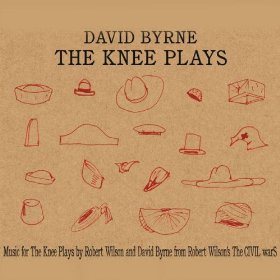
    0-blog-dec 3 byrne David Byrne, former Talking Heads member, produced a series of twelve short pieces to be used in the Philip Glass (and Robert Wilson*) Opera CIVIL warS  in 1985. (“Opera” may not be the right word for this piece, as I think it was one only in so far as the composition needed an opera house to be performed in.)   The Byrne pieces, called ”Knee Plays”, were meant to fill in the spaces, the spaces in-between,  place holders, between the sections of the day-long multimedia production..  Glass had used this idea of inter-pieces to the whole earlier in 1976 in his at-the-edge Einstein on the Beach, in which the connective elements were meant to not only join the pieces of the production together, but were also meant to stand alone, as a cohesive unit, if removed from the opera.  (Glass said they were “short connecting pieces which appear throughout the work much as prelude, interludes and post-ludes. Taken together they form a play in themselves”)

    0-blog-Dec 3 David_Byrne1991

    One of the Knee Plays, “In the Future” (Knee Play Number 12) is a slippery, stacatto brass section accompanying Byrne’s 51 sophisms about life in the future.  About thirty years earlier, “futurist” and think-tank-filler (or maybe it was “Think Tub”?) Herman Kahn (1922-1983), occupying a lot of space at the RAND and Hudson Institutes  (he was also known in many circles as the “Fat Man”), diligently recorded his myopic views of the future. He is generally regarded as a systems theory and military strategy guy, and is most remembered for (as he claims, perhaps) introducing the term “Vietnamization” which described the ultra-failed de-escalation (?) process and withdrawal for the United States from Vietnam (attention Obama administration).  Superluminarily speaking though his contribution to thought on constructing and implementing thought regarding nuclear weapons exchange (pointless to refer to this as “war”) in two books, Thinking About the Unthinkable (1962) and, On Escalation (1965), where he famously put The Bomb on the table of use possibilities.  In addition to these books—which he is busily trying to forget out there in his afterlife, somewhere, maybe in a penitential place where you are forced to think endlessly about paths-to-bad-decisions) is that 1967 peek into the future, The Year 2000.  Petroleum and oil are not issues.  Computers are of minor societal importance.  And then other things of no importance happen.

    0-blog-dec bryne kahn When you take Byrne’s Knee Play  12 and place it next to Kahn and other mis-spent prognosticators, the musician looks positively brilliant.  Some of the stuff has come to pass, some hasn’t; some will, and some won’t.  Some are open to a little interpretation, and some, a lot.  Overall, though, if you think through these little future buillets a little carefully, David Bryne looks very good.  Byrne’s lyrics/list is below.

    *Robert Wilson is a phenomenal conceptualist and theatrical designer.  On the liner notes to CIVIL warS is found the interesting note on Wilson and Byrne:  “At first, Robert Wilson asked David to compose pieces for several sections of The CIVIL warS, but on account of David’s limited time, he composed only The Knee Plays part. The CIVIL warS was supposed to be played in its complete form at the Olympic Games in Los Angeles, but if one plays every part, it takes at least eight hours. There was also a financial problem for playing every part. So only some parts of it were staged there. David himself was very interested in composing for such a play and dance and this time again he enjoyed this work very much. Last time, for The Catherine Wheel, he used recorded tape, but this time he made musicians play on the stage.”

    IN THE FUTURE (KNEE PLAY 12)

    In the future everyone will have the same haircut and the same clothes
    In the future everyone will be very fat from the starchy diet
    In the future everyone will be very thin from not having enough to eat
    In the future it will be next to impossible to tell girls from boys, even in bed
    In the future men will be ‘super-masculine’ and women will be ‘ultra-feminine’
    In the future atomic fusion will enable us to build a skyscraper with
    the energy obtained from a grain of salt
    In the future through genetic surgery there will be a race of menial
    workers, studs, ‘whores’, TV personalities and politicians
    In the future half of us will be ‘mentally ill’
    In the future there will be no religion or spiritualism of any sort
    In the future the ‘psychic arts’ will be put to practical use
    In the future we will not think that nature is beautiful
    In the future the weather will always be the same (relative to the way it is now)
    In the future no one will fight with anyone else because anyone can
    be anything he or she want to be
    In the future there will be an atomic war that will reduce the survivors to savages
    In the future water will be expensive
    In the future all material items will be free
    In the future everyone’s house will be like a little fortress
    In the future everyone will think about love all the time
    In the future TV will be so good that the printed word will function as an artform only
    In the future people with boring jobs will take pills to relieve boredom
    In the future everyone but the wealthy will be very happy
    In the future everyone but the wealthy will be very filthy
    In the future everyone but the wealthy will be very wealthy
    In the future communication/distribution systems will be so good that no
    one will live in cities
    In the future farming will be managed through a nationwide computer hookup
    In the future there will be mini-wars going on everywhere
    In the future political and other decisions will be based completely on opinion polls
    In the future only the very wealthy will be able to travel or move out their houses
    In the future individuals with soldier inclinations will go out for ‘killer’ sports
    In the future there will be machines which will produce a religious
    experience in the user
    In the future there will be a classless society, no one richer than anyone else
    In the future people will constantly be having plastic surgery, altering
    their features many times during a lifetime
    In the future there will be many mass suicides
    In the future there will be groups of wild people, living in the wilderness,
    who will rob suburbanites
    In the future there will be only paper money which will be personalized
    In the future everyone will only get to go home once a year
    In the future everyone will stay home all the time
    In the future we will not have time for leisure activities
    In the future we will only ‘work’ one day a week
    In the future our bodies will be shrivelled up but healthy and our brains will be bigger
    In the future there will be starving people everywhere
    In the future no one will be able to afford TV or newspapers, resulting in
    no one knowing what’s going on
    In the future people will live in space
    In the future only the very wealthy will have pets
    In the future the poor will be regulated by the rich
    In the future the crippled, retarded, and helpless will be killed
    In the future everyone’s house will be a total entertainment centre, with
    video, pills, dancing, sex tools, holographic movies, and game machines
    In the future everyone will have his or hers own individual style of very way-out clothes
    In the future we will all eat our favorite foods, only they will all be synthetic
    In the future we will fuck anything, anytime, anywhere
    In the future there will be so much going on that no one will be able to keep track of it


  • God’s Odds: the (Very) Fine Arithmetic of Heaven and the Infinite Population of Hell

    JF Ptak Science Books LLC  Post 436

    0 blog dec 20303

    Some years ago I purchased a rather large collection from the Library of Congress unimaginatively called “The Pamphlet Collection”.  It was not very distinguished, and for the most part, not terribly interesting on the face of it–but it was LARGE and, as it turns out, most of the material in the collection just isn’t anywhere else (for good or for ill).  After trying to make sense of the purchase–which was categorized and boxed but I couldn’t really figure out what the principle of division was–there was one pile that refused identification because the subject matter was so inescapably unusual, so unexpected, so logic-challenging, that they formed their own genre: they became the Outsider Logic collection.  There are at least 500 of them, maybe more.  They are differentiated from the Naive Surreal collection, which is associated but just happen to look incredibly odd because they are not only way out of context but also their context largely doesn’t exist anymore.  

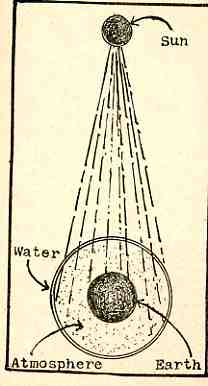
    The sample today is a religious tract of some sort–very scream-y, lots of quotation marks, exclamation points, and is thick and stubbily printed, and which really doesn’t have a title per se, the front cover simply starting  “Behold I Make All Things New. This work by  V.T. Houteff.It is too long to get an idea of what is really going on, but I happened upon this diagram, which, shall we say, is a little on the outsider side, as the author explains that the Earth “lives” in an atmosphere surrounded by a bubble wall of water.  I like the arrow pointing to “water”. 

    On the next page to this attractive image was a longish rant on the number 144,000.  It turns out that 144,000 represents the total  number of people allowed into heaven. 

    If this is so, where is everyone else?  That doesn’t leave much room for pets, or other animals, or insects.  DO plants go to heaven?  What about amoebic life?  When a person “goes” to heaven, what goes with them?  Are all life forms—microscopic and not—that are always present on a person/body given a free ride?  There’s a lot of life going on oh the surface of the skin and of course inside the body…I guess that would be a “no”, as I imagine Heaven would be ultimately clean. 

    I assume that people still have bodies because of the belief—exhibited in this pamphlet of outsider logic and by perhaps millions of other people who are adherents of other faiths and belief systems—that there are 144,000 people allowed into heaven. Wouldn’t there be infinite room for your spirit, which I would imagine to be infinitely small?  Something that has no mass and is not calculable on any level couldn’t ever fill anything up.   

    The 144,000 figure is something like 7/100’s of one percent of all people who have lived and are living, which is something like having a one-in-five million chance of getting into heaven right now—that is IF we allowed that heaven could be filled up right this instant.  If there was wiggle room involved—say if g wanted to include the possibilities that there might be a ultimate human population of 1 trillion or something like that, then, well, there are two more zeroes that would go in front of the percentage number (.0007%), to provide for the prospect of heaven not getting filled up until some point in the next 100,000 years. 

    What if there were 124,000 people already in heaven?  Suddenly competition gets gigantically fierce, allowing 20,000 places for the current 6 billion, which means that .001% of everyone living gets into heaven and then fill it up.  What would it be like to be the last person in?  Do you shut the door?  Are there people behind you on line? 

    And then how good do you have to be to get in?  Better than a baby who dies in childbirth?  That happens about 50 times an hour, worldwide, so far as I can tell.  I’d expect a person like that could get into heaven as they certainly didn’t have much of a chance to do anything to interfere with g_d or its plan.  Once you start throwing in children who die who are under the age where they could commit a foul act, say 5, and then toss in aborted fetuses (which for these cases I’m sure would be called “babies”), that figure of 50-an-hour would jump, probably, two orders of magnitude.  500 deserving babies an hour for thousands of years adds up to a heck of a lot more than 144,000.  Actually the 144,000 total would be hit in less than three weeks.  Which in the course of tens of thousands of years of human civilization and 10,000’s of thousands more to come, that would mean that 99%++++ of all babies and children who die before the age of 5 would go to not-heaven.  It is also hugely
    problematic because humans may be around on earth for another million
    years, which cuts the chances of slipping into heaven to seven (or
    twelve) places to the right of the decimal point.  Those are not good
    odds.

    That, friends, doesn’t sound very fair.

    I guess that means that hell doesn’t have a bottom line.  Hell never gets full.

    I don’t mean to stomp on any belief systems here, but, well, the numbers sorta speak for themselves.  They also mean that for all of the Jehovah’s Witnesses alive right now—a religion that distinctly shares this 144k belief—that basically none of them alive right now stand any sort of chance of going to heaven.  That is a hard sell.

    A statement in fairness to the ancients:

    Historically, speaking for the folks thinking about this 2000 or whatever years ago, 144,000 does loom larger than it looks today, of course.  Not only was the population of the world much smaller (by almost two orders of magnitude) but there was also almost no way for anyone living then to accurately guess the global population.  Given a population of 100 million, if everyone alive in the year 1 were to be considered for a filled-up heaven, then about one-tenth of one percent would make it.   Now, if you were an ancient and thinking about the population of the world in general, my best guess is that you’d be thinking in terms of maybe tens of millions. Maybe.  That means the 144k figure would be something believable, sort of, being 1% of the population.  Say we grant the 1% as a given; and that it was a given that the ancients thought in “low” numbers for populations; it is also a given, I think, that they did think in long terms of time, in the thousands of years, at least.  That means if they gave room for heaven to be :”filled up” in a thousand years, and the population of the world didn’t change, it would mean that of everyone on earth as known to the ancients that 144 people a year for a thousand years would go to heaven.  And frankly, those figures don’t look very promising either.   


  • Fat Redux, Redux: Fat Bullets, 1945

    JF Ptak Science Books LLC  Post 377

    000-ebay--Nov 8 fat025
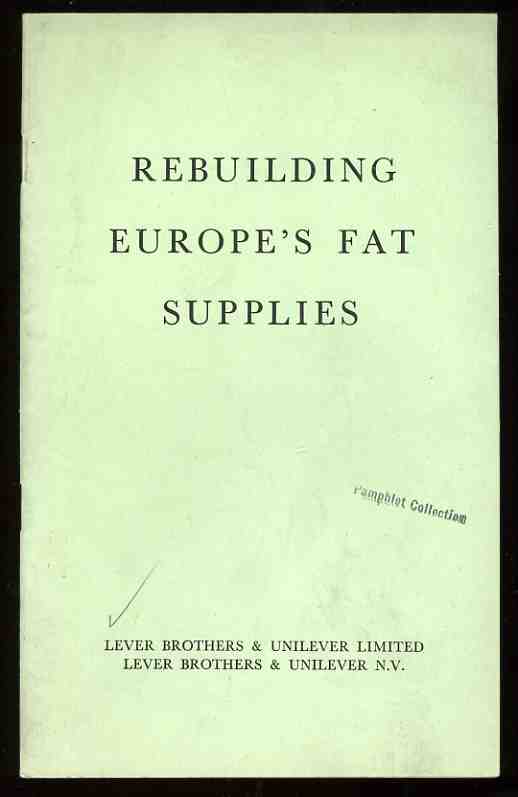
    This is the third in the stumpy but cushiony series in this blog on fat, all of the items coming from my purchase of a 90,000-item pamphlet collection from the Library of Congress.  It was unimaginatively called, and stamped, “The Pamphlet Collection”, and was organized into 2,800 or so document boxes, all of which were painstakingly categorized and alphabetized, but done so via a secret and mysterious way that I’ve never deciphered or understood.  Listen:  the pamphlets were organized indifferently in general but diffidently in particular, so an Aa-At box might’ve contained pamphlets categorized via title or author or place of publication or subject matter or publisher. The pamphlets’ placement was almost random, but not quite, as there was a thin thread of logic tying them all together, but just not in a way that it would all be sensical. 

    But back to fat:  it really is just the pamphlet’s title that’s so unexpected, as the content is all about replacing the oils and fats that had gone missing, sucked up by the war effort, that were actually pretty essential. For example, one pound of fat contained enough glycerin to make a pound of black powder, which is also enough to make six 75mm shells.  Butter, margarine, vegetable oils include: olive oil, palm oil, soybean oil, canola oil, pumpkin seed oil, corn oil, sunflower oil, safflower oil, peanut oil, grape seed oil, sesame oil, and so on, were definite parts of the diet and the economy, and, well, did actually have to be replaced.  There.  I’ve killed the humor in this title.  

    ·Posted by :

    ·in:

    —

  • Gulf Stream Wealth Predictor, 1939–Outsider Logic from the Inside

    JF Ptak Science Books  Post 320

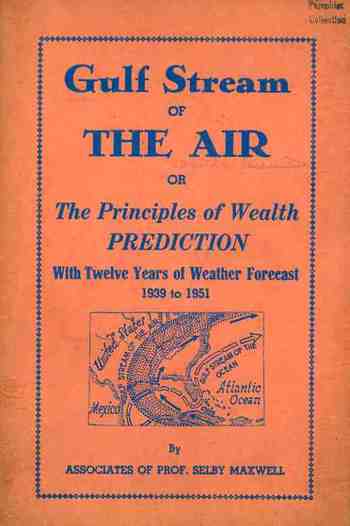
    00blogoct_15gulf_stream864 I’ve found many remarkable statements contributed by seekers and the curious whose efforts have found their way into print and then into my Naive Surreal and Outsider Logic pamphlet collections.  In the ungainly-titled Gulf Stream of the Air or the Principles of Wealth Prediction with Twelve Years of Weather Forecast 1939 to 1951 (printed in 1939), written by an unnamed group (!?) called the “associates of Prof. Selby Maxwell”, the title was good enough to guide this pamphlet to its just reward.  Just before adding it the the hoard I opened the pamphlet at random and found this sensational “what if” sentence: 
    “If the high Plateau and the Rocky Mountains did not exist there is little doubt that Mexico and our Western States would not differ appreciably…”

    Wow.

    Mr. Maxwell was indeed a real meteorologist, and perhaps this Bourbaki-like crew absconded with his good name into the bleak night of weather wealth, leaving sentence fragments like the one above in their wake.

    As bizarre as it is though this might be a fantastic way of getting the attention of a group of kids in a classroom.  Its all fine and well to classify this as “bizarre”, but what are the components that make it so?   Why is it bizarre to entertain such a thought, and how could it possibly be that it wouldn’t affect much and what would the other consequences be of not having the formation of the Rocky Mountains take place, and on and on.  It is junky in its way, thinking like this, but I’ve got to admit that I’ve  never thought about this situation before; and in its own way, the statement is fascinating in its turn-right-to-loosen-left -to-tighten way. 

    ·Posted by :

    ·in:

    —

  • Outsider Logic Series: the Humble Life vs. the Automatical Machine Age (?)

    JF Ptak Science Books LLC Post 306

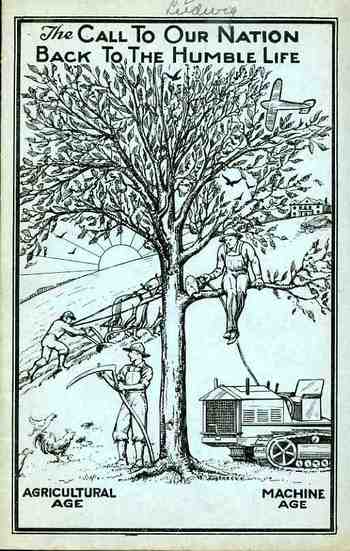
    1blog_oc_t_9_bizarree_closd798 “C. Ludwig”, the author of The Call of our Nation Back to the Humble Life a Sign in our Time of the Automatical [sic]Machine Age, published in St. Louis in 1935, has a somewhat impenetrable approach to a philosophy of development.  This of course is spotlighted quite brilliantly in the title of this work, especially –if you take quick notice–when you consider that the man in the tree with the electric saw is working at it like a cartoon character (unless the whole tree falls down and leaves him in mid-air on his special anti-gravity branch). Actually, I can’t spend the time with it, it is just too far into a personal, shadowy and self-anointing belief  system filled with paradox and the bizarre.  I’m really just after the pictures, which even though they are displayed here out of context, are indeed still out of context while in context.
    1blog_oc_t_9_bizarree_closd800

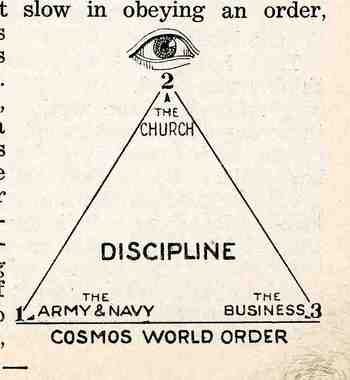
    The masonic-like all-seeing eye pyramid is another odd bit in a series of all-seeing-eye bits, none of which seem to follow the other and none of them make particular extended sense individually. There are five of them, and they seem to prove that 1+1+1+1+1 = 1.

    I could go on for some time about these singular illustrations, attempting to make graphical points for invisible reasoning in the text, but I won’t. I think that these stand quite well enough to represent the author’s straight-through-the-loop, singular, outsider-logic  reasoning.  In a way, they are of their own beauty.

    1blog_oc_t_9_bizarree_closd799

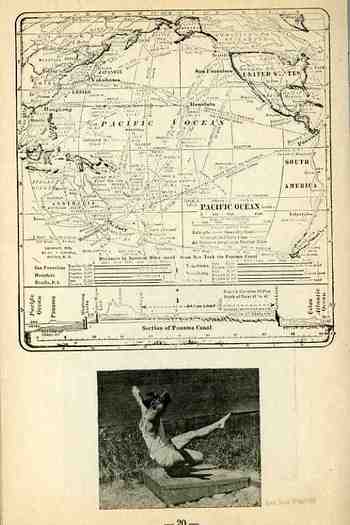
    (I just couldn’t resist this last one, featuring the Panama Canal and a balancing figure, having nothing whatsoever to do with the text or each other.)

    ·Posted by :

    ·in: