A Daily History of Holes, Dots, Lines, Science, History, Math, Physics, Art, the Unintentional Absurd, Architecture, Maps, Data Visualization, Blank and Missing Things, and so on. |1.6 million words, 7500 images, 4.9 million hits| Press & appearances in The Times, Le Figaro, Mensa, The Economist, The Guardian, Discovery News, Slate, Le Monde, Sci American Blogs, Le Pont, and many other places… 5000+ total posts since 2008.

Category: Outsider Logic

  • Outsider Logic Department: Earth Clocks, Ocean Spigots, and Mystery Exhausts

    JF Ptak Science Books LLC  Post 597

    Several years ago I purchased a very large collection of pamphlets of the Library of Congress.  It was all housed in 2400 blue document boxes, all the document boxes were labeled and neatly ordered.  The problem was that the classification scheme really didn’t relate to one thing in particular, and the judgment which set one pamphlet in a box wasn’t the same through and through—the alphabetization could have related to author or title or region or keyword or publisher.  In short, each box was an adventure—and a lovely, bizarre one at that.
    Blog--april 27-bizarre earth clock

    It may be a unique one, too.  The one thing that really did hold this thing together as a collection was that the vast majority of the pamphlets were not located in any other libraries in any part of the world.  Now for many of them it was probably okay for the work to slip into a bliblio-singularity, but for thousands and thousands of others, it was a good save.

    And here’s the larger rub:  as I classified and segregated the pamphlets into the “normal” areas of interest, I also started a pile of good-god-what-is-it pamphlets. The GGWII material was extraordinary—some had fantastic covers (and which many times was the most interesting thing about the publication), some had extreme titles, some had ludicrous subject matter, and some were just, well, bizarre.  As the GGWII pile grew into the low thousands, I started to box them for a rainy day project, because I frankly didn’t want to deal with them.  Some of the pamphlets’ covers/subject/title were rather mundane, pedestrian things when they were originally published; however, the high-winded sands of time ripped the flesh from this commonness, making them somewhat unapproachable, unknowable, and incredible–this group was called The Naïve Surreal .   A subset of this group are works that were not approachable and enveloped by their own unique needs from the day they were born; pamphlets made of the stuff of incomplete dreams and adventurous vocabulary—the Outsider Logic group. 

    The Naïve Surreal has all manner of representatives:  pamphlets with just question marks or exclamation points as the title, or histories of unknown things, or beginning with “The Story of ______ “ [mud/zippers/a stone/a bubble/etc].  You get the picture.  The Outsider Logic pamphlets are really very difficult to categorize—perhaps that is their unintended  job.

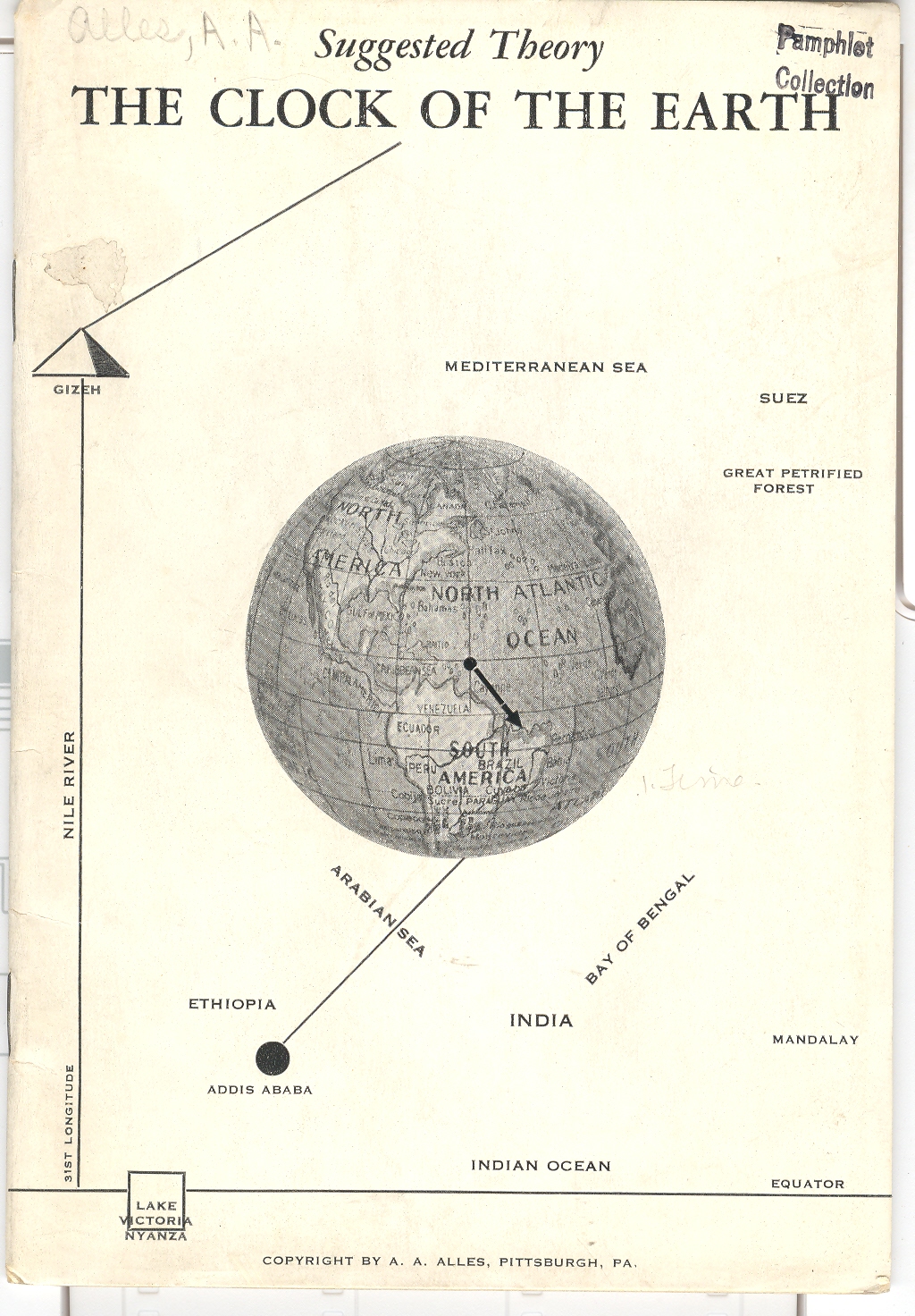
    Today’s emergent beauty from the Outsider Logic collection is .A. Alles Suggest theory The Clock of the Earth, printed in Pug, Pa., in 1935.  This pamphlet is only 18 pages long but I just couldn’t read it.

    Here’s why:  the first sentence reads:

    “The Clock of the Earth represents strange matter from inner-stellar space collected and compounded at the equator which accurately controls the revolutions of the seasons…”

    It goes on but I just can’t type it out.  Sometimes there is a benefit to reading the Outsider Logic pamphlets, and sometimes the benefit is knowing the cover.

    Mr. Alles’ cover is striking and deeply inscrutable, as you can see.  Somehow there is a system for the hour hand there at the equator, but it is mainly a secret, even though it is explained.  Why the geographic locations are printed in the white space surrounding the earth and connected to Addis Ababa, the Nile, Gizeh and the Great Petrified Forest and placed the way they are and connected to the equator clock will have to stand as art rather than explanation.

    Most of the time superior, deeply-removed art like this cover is disappointed by the textual counterpart.  Mr. Alles may not disappoint with his writing, though.  He ends the book beginning the last paragraph with this:

    “Four thousand years ago the open spigot on the equator at longitude thirty-one degrees east of Greenwich , flowing directly to the pyramids in Gizeh…. “ Then there’s something about “exhaust flow”.  Again, as I said, I just can’t penetrate this work.  I’m happy enough with the art, forever open to interpretation.

  • Things Out Of Place Department: Ledoux’s Architecture of Multiple Planets

    JF Ptak Science Books LLC   Post 592              Blog Bookstore

    A Cosmology Seeded in Salt?

    It  is, I admit, mere imagination; but how often is imagination the mother of truth?–Sherlock Holmes

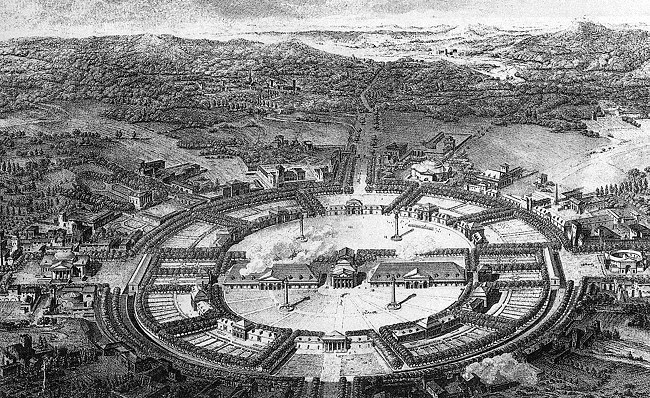
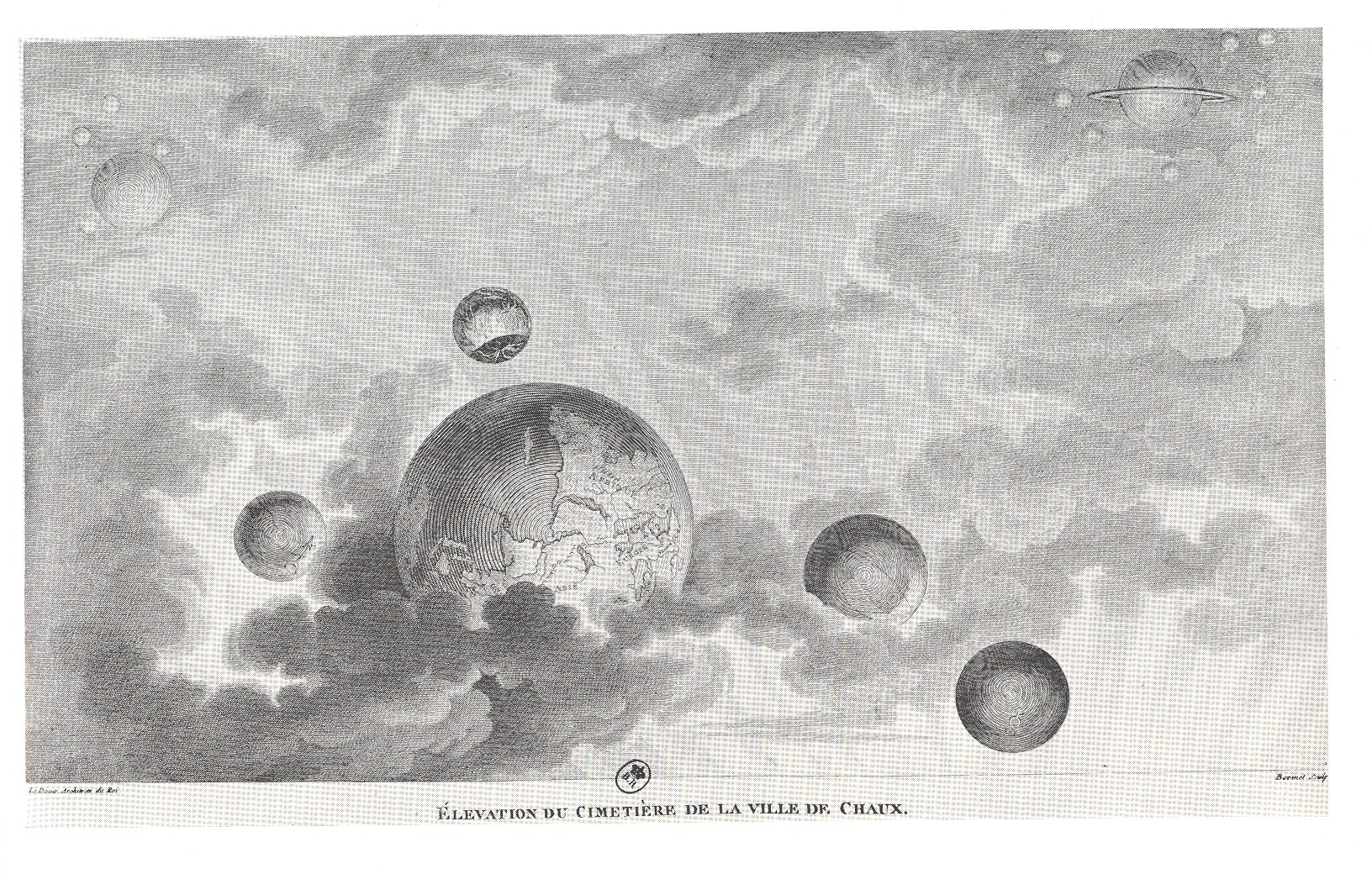
    I’ve written a little earlier in this blog about the beautiful Claude-Nicolas-Ledoux  (1736 —1806) being the 18th century Marcel Duchamp (or vice versa).  I was struck by this image by the master–a depiction of the Earth nestled in clouds amongst other  planets in exceptionally close proximity.  There was evidently very little explanation to go along with this idea, except that it was inspired by his utopian plan for the saltworks of the factory-village at Chaux. On the face of it there seems to be no physical connection between the two–it must be the philosophical connection that Ledoux was thinking about.  From my point of view the idea for the city of Chaux was of course idealistic, perfect, communal, with a vast sense of fairness and correctness, and of great sensibility.  It was a “gathering of brothers” as Ledoux wrote, a city of lodges of workers, gathered together for mutual profit.

    Blog--sphere--boullee

    Perhaps this vision of cushioned planets was a larger expression by Ledoux of heavenly gratuity?

    Anthony Vidler points out (in his book The Writing of the Walls) that Ledoux described his utopian Chaux as a “galaxy of…utopian forms” (page 101).  Since Ledoux also described the architect as the “delegate of the Creator”, perhaps he reverse-engineered a cosmology describing a mutually beneficial community of planets from a community of brotherhood gathered around the (admittedly important in 1780) production of salt. 

    Blog--ledoux--chaux

    Or perhaps not–this may just be way to simple and, well, just wrong.

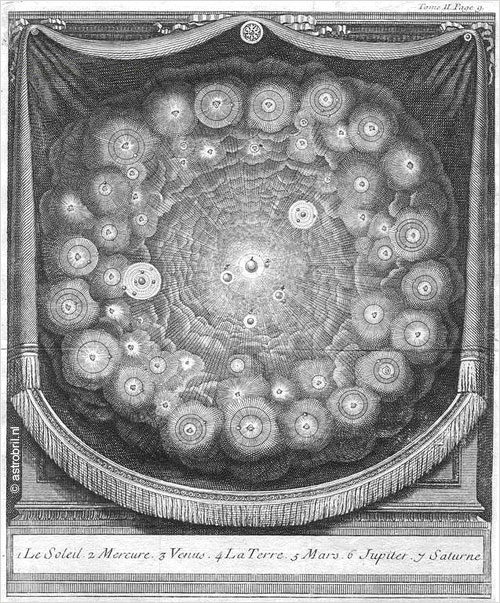
    Blog--plurality of world fontenelle NOTE:  I do just want to point out here (and discuss at another
    time) that Ledoux was by no means the first to describe multiple-world
    systems.  One of the prettiest of the earlier attempts, for example,
    belongs to Bernard le Bovier de Fontenelle who published this
    delightful rendition of an extra solar-systemic galaxy in 1682 in his Entretriens sur la pluralite des mondes.  This
    sort of thinking was somewhat well-established by the time Ledoux
    offered his idea around the time of the turn of the 18th century.  

    Should we not come to the rescue of a cosmic phenomenon  trying to reveal itself in a sea of errors?  Peter van  de Kamp (1983)


    For a beautiful romp, have a look at Ledoux’s L’Architecture considérée sous le rapport de l’art, des mœurs et de la législatio. I’ve included a short list of projects (with links) in the expanded reading section below. 


  • Lonesomeness, Anti-Humans, Vestie Davis and the Quark

    JF Ptak Science Books LLC  Post 577

    I arrived at the subject of Lonesomeness in a roundabout way–taking my first look at the lovely 3 Quarks Daily site and thinking about Muster Mark and Humphrey Earwicker and Leon Ledermann and the quark’s (pronounced “quork”, by the way, this from the master’s voice) phenomenologically-obsessed creator, Murray Gell-Mann.

    Lonely--vestie 1

    [The story of the discovery of the quark is a little tricky; Gell-Mann was the first to publish his discovery, preceding the independently-established work and findings of George Zweig.  Zweig’s quarks were called “aces”, and after publishing his results in an internal CERN document, had considerable difficulty in placing the paper in The Physical Review, so much so that he abandoned the effort, only placing the paper in print years later. The CERN paper by Zweig is beautiful, even to someone like me–his high visual thinking (as with Richard Feynman) is highly apparent.  Gell-Mann has been insistent on referring to Zweig’s work and its significance ever since its appearance in the first year of publication of the European Physics Letters in 1964.]
    It is when fast forwarding through the experimental voyage for the picturing of the quark that we meet Leon Ledermann, whose animated semi-serious reference to the discovery of the anti-quark leading was his speculation on “anti-humans”.  The idea of “anti-humans” is quite a lot to think about, and is something much deeper than simply not have humans being there.  But also something different from the anti-neutron, the anti-quark, anti-matter. Lonely--davis 2

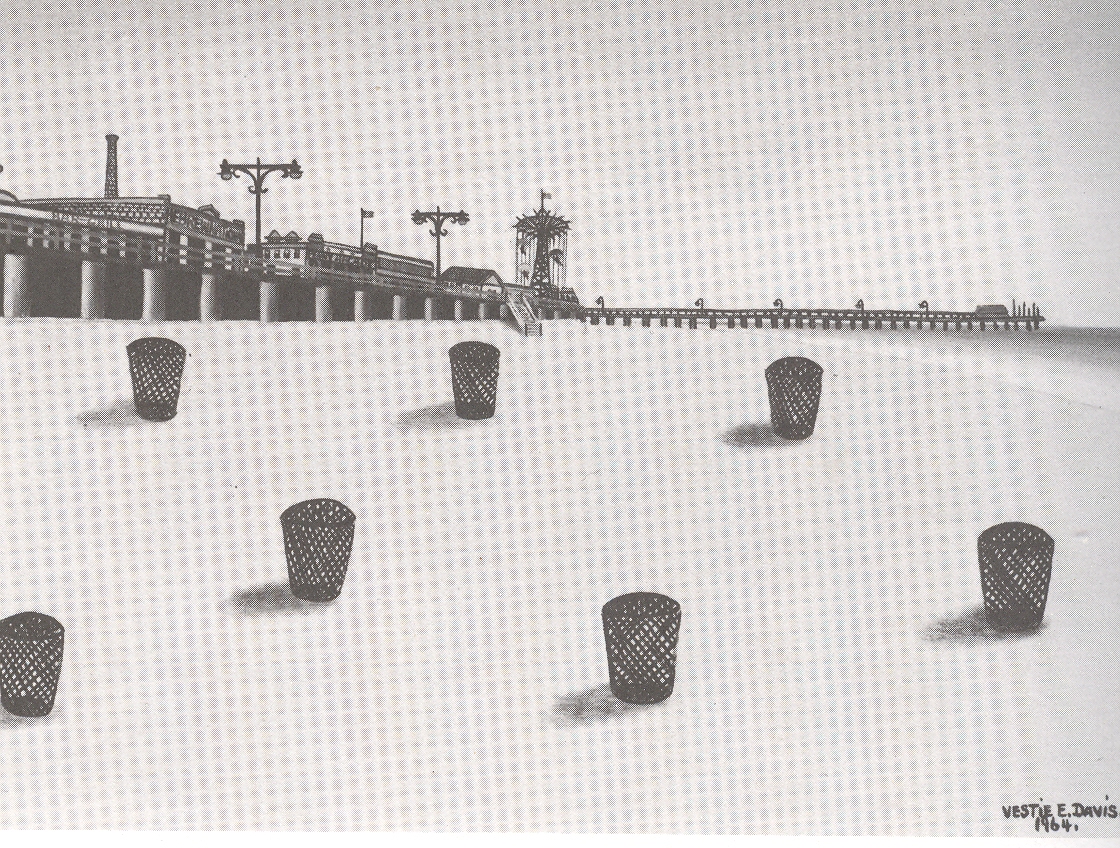
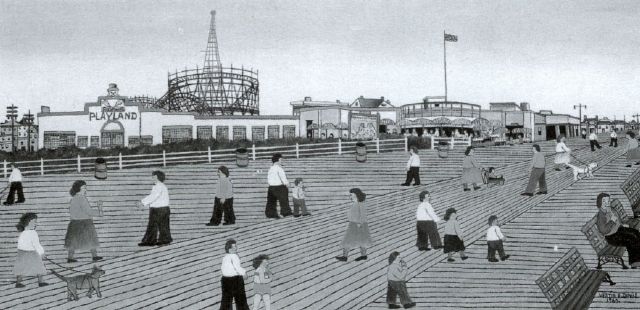
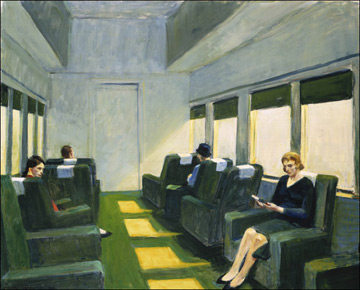
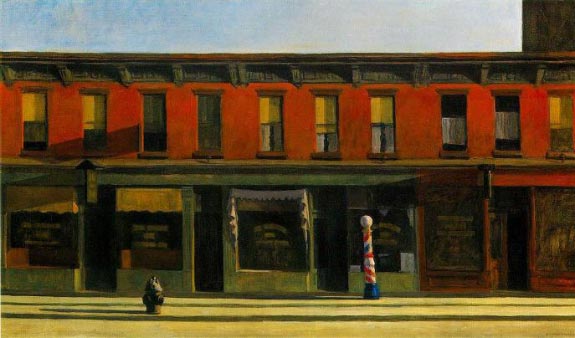
    The anti-human led me to the “not being there” part, and then to the depiction of that idea, and the idea of Lonesomeness, in art. For me the very compelling imagery of lonesomeness is found in this painting at Coney Island by “part-time undertaker, newsstand dealer, and mortuary organist” Vestie E.  Davis (1928-1978).  It is a scene desolate of interaction,  Even when Davis begins to add people into his paintings (making them “sell better”), the  populations seem as brittle as Eliot’s utterly precise diction in The Love Song of J. Alfred Prufrock.  In meek forebearance I add the artwork of Edward Hopper  Both of these men seem to give their canvases a reality that is stretched so thin

    Lonely Hopper

    that it crystalizes the singular moment, and captures the lonesomeness of it all in the instant before the fabric tears.  This is lonesomeness no matter if the seen is vacant or filled with people; Hopper and Davis introduce a finite nothingness that too me is as cold and scary as the antiquarian tombstone for the unnamed “Wife of____”, standing smaller and apart from the dead husband.

    Maybe its the colors–or rather, for me, maybe its the color white. White is largely absent in nature, at least big (excluding clouds), at least that’s what poets like Wordsworth said.  It is Goethe’s vexing color, Melville’s lonesomeizer.  White works to distance everything in the images I’m presenting here, helping to make it possible for lonesomeness to exist in a bleak landscape as well as one with lots of people. 

    And so there you have it–I’m nowhere in this post except to have it serve as a placeholder for some sort of idea about quarks and space and absence and lonesomeness.  Just an exploration. 

    Lonely hopper sunday morning

    ·Posted by :

    ·in:

    —

  • Unusual Collections Department: a Collection of Roads

    JF Ptak Science Books LLC  Post 573

    Road samples
    In my time I’ve encountered interesting people with advanced, iconic and unusual collections:  there’s one fellow with a superb collection of (better than 20,000) cds with basically nothing to play them on (but of course he knew all  of the music, and listening was almost but not quite secondary); there’s another with an audio outfit worth better than a quarter million with literally almost nothing to play on it.  Then there was the delightful fellow in the salvage business who collected cornerstones (!) and giant iron puddlers.  And of course the bee collector with dozens of thousands of specimens.  Oh yes!  And there was that time when I had a meeting with a man on something (on the day the Challenger exploded) unrelated to the spectacular collection he showed to me:  the world’s largest, privately-owned 19th century mechanical toys.  It was really just unbelievable.  So was the man, who in the course of the day, as we sat watching the Challenger story unfold, performed on of the most amazing feats I’ve ever seen in my life. 

    My friend Marty Weil chronicles the wants and needs of collectors of all manner of things, from bus passes to matchbooks to god-knows-what, in his excellent ephemera blog.  I collect dirt and antiquarian artwork by children, among other things.   Also, once upon a time I owned a very large collection of lower gastrointestinal dissections as well as gorgeously prepared wet dissections of salivary glands. 

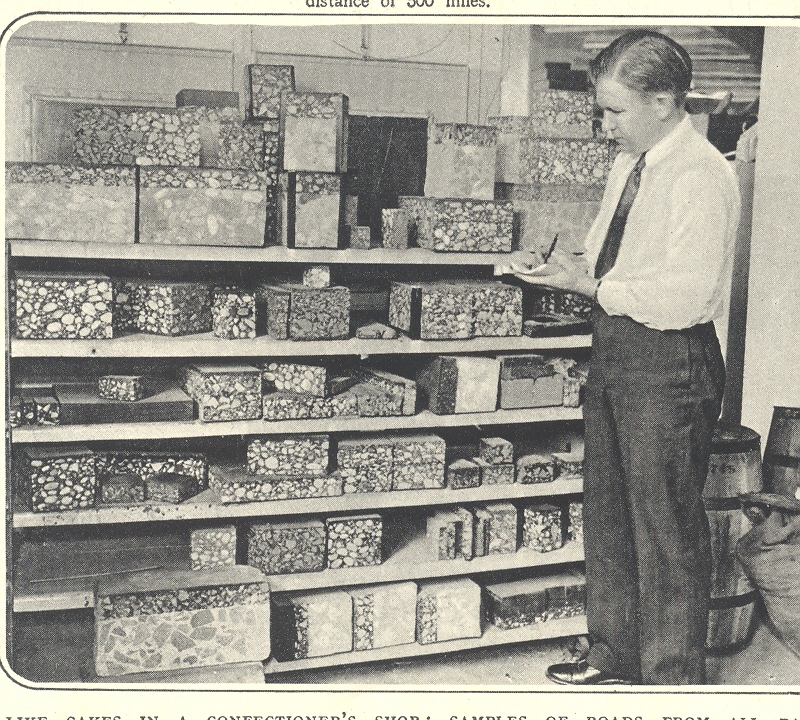
    And so it was that when I came upon this unusual image in The Illustrated London News for 21 May 1932 I felt a certain tenderness.  This is a pictre of a road collection, located somewhere in the U.S.,  and includes shelf upon shelf of cross sections of roads.  They happen to look like cubes of fat to me.  (We’ll leave the bags of eyes story for another time.)  I understand the need  for  such a collection for engineering purposes; I just happened to like the idea (and the picture) of A Road Collection, and have it undisturbed by any explanation or insight.  Just a collection of roads. 


  • Sublime Mundane: a History of High School Lunches and the Commercialization of Children’s Needs

    JF Ptak Science Books  LLC  Post 561

     blog 23 mar lunch724

    This is another in a series of posts on the Sublime Mundane–books and pamphlets whose titles are nothing if not introductions to spectacular nothingness.  Sometimes these publications are indeed about disappearing wisps of lost lint, and sometimes not; sometimes the mundane and seemingly stupifyingly “normality” of their subject matter leads to something of deep depth.  Today’s pamphlet, left, fits the second category. 
    Part of the interest in this work–outside of its momentarily arresting title that has a potential for being a cascade of boredom– is that it so quickly rights itself into an important topic.  That’s not to say that it isn’t a boring topic, as my quick and semi-feeble research reveals.  It does get interesting though when you consider that it took so long for the recognition that, since all of these children in school have been brought together, that there wasn’t some sort of federally organized effort to make sure that the weakest members of this group had at least one decent meal a day.  That said, the earliest program were for students who could afford to pay for their lunches.  Perhaps it was assumed that, around the turn of the century, there were no lunch rooms per se and that children would eat wherever they could find the space, that many children were also going home for lunch, and that they were all being fed.  (I do remember that some classmates of mine in P.S. 29 would go home for lunch, and I remember wondering exactly what that was all about.  I can recall taking my brother for special every-so-often-Friday treats at Joe & Pat’s Pizzeria for three slices and two cokes for a dollar back there in 1968.  But I digress.)  It actually took a little time before children’s lunches at school were made to be free to those who needed it. 

    Which brings us to Marion Nestle’s Food Politics (Berkeley, University
    of California Press, 2002), who discusses the early commodification of children’s food: “School meal programs
    began during the Great Depression of the 1930’s. From
    the outset, they had two purposes: to help dispose of
    surplus agricultural commodities owned by the government
    as a result of price-support agreement with farmers ,
    and to help prevent nutritional deficiencies among low-income
    schoolchildren. Because chronic disease risk factors were
    not an issue at that time, the rules specified meals that
    used surplus commodities and were higher in fat, saturated
    fat, sugar, and salt—and lower in fiber—than recommended
    in later years.”  All of which is detestable and unwholesome and immediately transparent.

    Perhaps the really interesting stuff on feeding children at school starts here, in the 1930’s, and that with the commercialization of children’s biological needs, breaking the back of an agricultural finance Vintage-space-lunch-boxproblem in the school lunch rooms.  The lunch as commodity expands from massive leftover projects into something a little more insidious in the television age, when children not only get to dress their foods in the sorts of containers that they wanted (lunch boxes), but also were being deluged with displays of foods that they could select for themselves via television.  This commercialization process gets ramped up decade by decade, until in the 1990’s and 2000’s the lunchroom has in some cases become an extension of the t.v. commercial, and that local and state governments are counting the value of sugary waters, salt, and catchup packets while plying the rest of the arrested nutritional package with prepackaged conglomerate goodness.

    And such is the value of the sublime mundane, at least for me–these items are filled with possibilities invisible to their titles. 

    Even after all of this, I must confess that I would dearly like to have a Fireball XL5 lunch box to take with me into eternity.  All systems go!

    Some interesting links with more than you need to know about school lunch history:

    The Food Museum Online Exhibit:  School Lunch History
    School Lunch Programs in the USA (according to city)
    School Lunch Programs in Europe

    ·Posted by :

    ·in:

    — —

  • The Microscopy of Boredom

    JF Ptak Science Books LLC  Post 555

    “Contrive to have as many treats
    for your mind as you can, as many things to which it can fly from itself”  
    Sam.
    Johnson.   (James Boswell, Ominous Years, pg. 287

     blog 20 point missed717
    Boredom is a powerful thing.  It is also, at least as a word if not as a
    concept, relatively young—it first appeared in Dicken’s Bleak House in 1852,
    with the word bore making an earlier appearance in 1762. (Bitter Ambrose Bierce
    redefines “bore” as a person who speaks when you wish them to listen.)  Boredom is distinct from Melancholy, which
    relates more to depression than to boredom, and is an idea and word thousands
    of years old.  Boredom is a universal
    constant, a wide acknowledged entity of enormous reach and singular acuity—and the
    fact of the matter is that you cannot translate boredom into a narrative.  You can create art depicting boredom, and you
    can tell what boredom is, but you cannot, really, cannot write a novel with a
    boredom narrative.  Unless you’re Jane
    Austen.  It is a tired pursuit of
    tireless insipidity which simply escapes capture in the form of a novel—or I
    should say, a novel that you’d like to read, or was readable.  Boredom still awaits its Quixote.  Melancholy on the other hand has many, not
    the least of which is one of the most unreadable and fascinating books in the
    canons of English lit, Burton’s
    Anatomy of Melancholy (which would be an interesting film if another Burton,
    Tim, got his hands on it.).

    I was thinking about boredom in
    terms of some of the printed material  in
    my Naïve Surreal category—those are the pamphlets where the meanings of their
    titles and subjects, once popular in their day, are now aloof and unhinged,
    floating in the present with almost no bearing on what their original logical
    intent was.  And so these titles
    sometimes take on a fantastically removed appearance, and sometimes they are
    simply simple, so simple that they can be at first blush quite boring.  But they’re boring only for a moment, until
    the brain wraps itself around the illogic of them, and then they become not
    boring—fascinating, someti blog 20 donj't716mes.  And what
    is that tiny space between the wide widths of boredom and fascination?  How microscopic are those pores between the
    two entities? And what exactly is that place where boredom and fascination meet?  

    We Think a Point Has Been Missed (published in March, 1933) is an odd example, going from boring to puzzling to incredible to disappointing to interesting all in about a minute.  It is a lovely title to be sure, flying at the heights of the sublime mundane, hiding in its own obvious nature.  Opening the booklet we find that it was published by the Columbia Broadcasting System, and at first blush it seems a fainting on miniature problems of the naiscent radio company.  But it turns out that it is actually fairly topical:  CBS wanted to make it very clear that the eight-minute radio broadcast of President Roosevelt on  March 4th 1933* was a significant and exceptional use of the new medium,  CBS points out that “Roosevelt did advertising’s most significant job…advertising ‘courage” and “conquered despair”, and that those eight minutes  over the radio “added cash value of the nation….commodity markets pulsated, dollars rose around the world, demand for department store credit rose 40 percent”.  In short, this was an early recognition of the extreme value of immediate access to a national population.  

    The Roosevelt speech, which went without quotation in this short report, was his inaugural address, the day of his taking the reigns from Herbert Hoover–the “All  we have to fear is fear itself” speech, which did indeed galvanize the nation, delivered virtually immediately via radio. (“God bless Roosevelt; god bless radio” intoned Will Rogers.)   It is one of the country’s best inaugural speeches, made at a time when the country needed one, there in the depths of the Great Depression in the late winter of 1933.  But all of this is so far down in this slender seven-page book that the speech almost smokily wisps its way through it, the main emphasis being the importance of the delivery system and not the stuff of delivery.  Its a queer little thing, all of its importances semi-hidden, made more pronounced in this particular copy since it was owned by Roosevelt.  

    The second example or boring-interesting is the ultra-under compelling Don’t, which when published in 1926 threatened directions for advising improprieties in conduct and common errors of speech.  Written by “Censor”, it dragged itself through 76 pages of nitty dialog details that are in a way interesting as a window on correct conduct during the roaring times.  Ultimately though the text doesn’t survive interest, and all we’re left with is the very unusual title. 

    Which takes us back to appearances and second-life and the intersection of boredom and the fantastic.  I suspect that if we apply the microscope to that boundary that we see exactly what we want to see.

    ·Posted by :

    ·in:

    —

  • Bizarre & Naive Surreal Book Titles: Sex, God, Food, and Clean (and Colorful) Blood

    JF Ptak Science Books LLC  Post 552

     blog 12 titles bizarre diet688
    Continuing a minor thread on bizarre and spectacularly mundane book titles comes today’s entries on the various uses of “sex” in finding high-ideal  religion and a proper waistline. Harry Haas had a very simple answer to sex (a concept that I was frankly surprised to see described in three words):”low cultural sex instincts” lead to “low cultural levels”, the reverse evidently never entering the writer’s mind.  Sex “was not a moral issue”, but an instinct “which like other instincts must be satisfied in one way or another”. It is also “Nature’s unscientific way of propagating the human races–the pre-logical and instinctive, the animal way”.  He asks the reader “why do some of us read these risque publications if they are so degrading? Tobacco Road and various other pornographic diversions, I mean “[sic]. Mr. Haas doesn’t know, but he does believe that the sex problem was vast, “a modifying agent in our personality growth” which “is responsible for an enormous amount of neurosis (and) seen to be at the bottom of the world’s greatest achievements”.  This leads of course to babies “blind, crippled and diseased and mentally hopeless–all of which find their common origin in sex troubles, feelings processes or chemical changes.  Probably nine-tenths of our anxieties, if not the major cause of world unrest, can be traced back to sex”. Mr. Haas then gets to his major and remarkably scarce question:  “could it be that the writers and interpolators o blog 12 titles bizarre diet689f the Bible were themselves unconsciously afflicted with sex troubles?”  He then takes this issue far and wide, and frankly by this point everything got so muddied and biblical that I just lost interest.  But the title is still good enough to stand firm and true, even if the the author didn’t get to an answer, except to suggest that you purchase his pamphlet on the  psychoanalysis of  the bible–it was available for one dollar, postpaid, and had something to do with Albert Einstein.  He published this booklet on his own  in Orangeburg, S.C., in 1941, while the world was hell bent on some religico-sex-fueled instinct war.

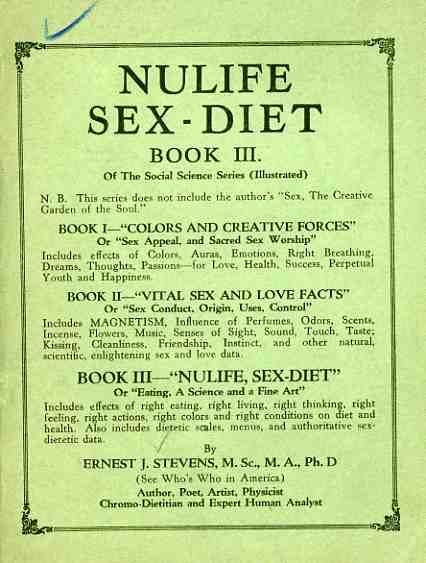
    Ernst J. Stevens (“Chromo-dietician and Expert Human Analyst”) let loose his spongy  Nulife Sex-Diet Book III of the Social Science Series (Illustrated) in 1934–it is one of that class of books that doesn’t look right, doesn’t feel right, and smells a little like it spent too long lost under the cushion of a chair in a bad place.  His book is a hopeless melange of shrinko-babble, blood coloring and therapeutic color use wrapped around dietary “laws” of dubious value.  Having dispensed with 10 chapters in 15 pages, Dr. Stevens takes on “Color, Music, Taste and Skin Odors” after having established a priority in “colors in our flesh, colors in our thoughts and colors in our foods” and their connects to color balance and blood cleansing skin beautifiers.  That sounds like a lot to deal with in 15 five-inch-tall pages, but that’s the least of it–the true metier of the book was also woven through everywhere, the messages of vim and vigor and health sense and mixing of the sexes colliding at every level with everything else.  It is a powerhouse display of some sort of need that I cannot identify.  The title, of course, is super. 


    ·Posted by :

    ·in:

    —

  • Baroque X-Ray of the Soul: Jacob Boehme’s “Psychologia”, 1632

    JF Ptak Science Books LLC  Post 546

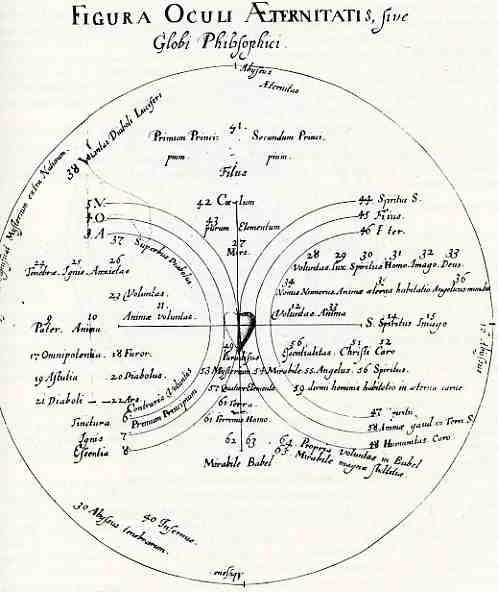
    0 abay feb 23 boehme622This solar-systemesque plan of the human soul appeared in Johannes Werdenhagen’s translation of  the expansive Jakob Boehme’s Psychologia [graece] vera I[oanni] B[oemi] T[eutonici] XL quaestionibus explicata, printed in Amsterdam in 1632.  Boehme’s (1575-1624)  original work waited for 8 years following his death to appear in print in any form, fearing during his lifetime that perhaps some retribution for his barrier bending work might find him–and it turns out to have been true, as this book (and the only one of Boehme’s subsequently published works) made its way onto the Roman Index in 1633.  Boehme was a mystical panthesist and psychic who blended the Kabbbalah,  Valentin Weigel, Paracelsus and the Bible in doses wide and narrow, finding his own advanced-Lutheran voice in works concerned with sin, evil and redemption, populated with angels and grace and on and on, in a world view far-reaching and way to complex to go into here. 

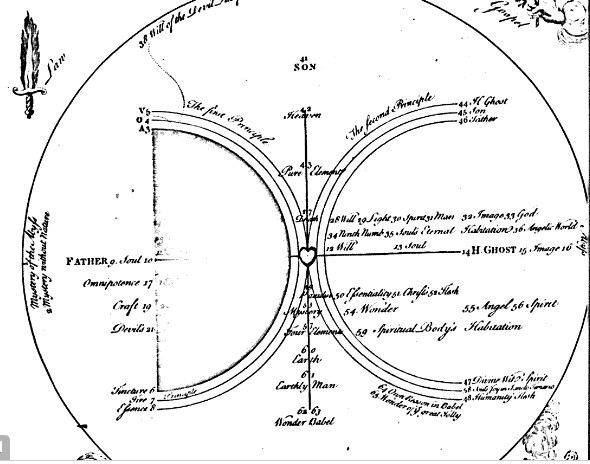
    Part of that philosophy is displayed in this map of the soul, found in Psychologia–it would’ve been fairly impenetrable to me had I not found an English translation (below) of the image, published in Forty Questions Concerning the Soule in 1655. 

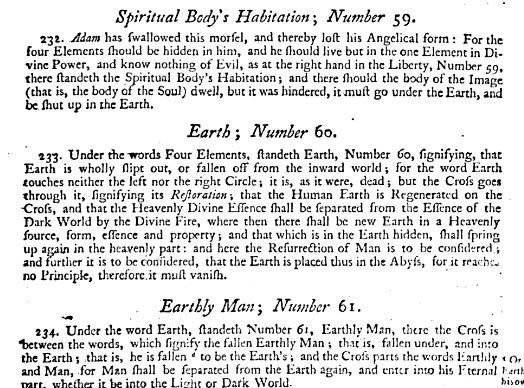
    I thought that I was going to try to make a summary of the map, but, honestly, it is too just involved and intertwined and complex to do this quickly, so I’ll just let whoever cares to have a go at it under their own steam.  I will point out that the major geographical feature here is the cross at center, which is actually Christ’s crucifix and the great delineator of the system of the soul. But this is a gross simplification of the work of an unschooled man who rose to be a cobbler before compiling his remarkable set of ideas.  I’ve included a few explanations of the 63 items incorporated in the map–it is a difficult go, particularly since this was part of only the first of the forty questions addressed in the book. 

    Zzz--boehme

    Zzz--boehme xray
     

    *Another example of Boehme’s style of writing:
    “For he that will say, I have a Will, and would willingly do Good,
    but the earthly Flesh which I carry about me, keepeth me back, so that
    I cannot; yet I shall be saved by Grace, for the Merits of Christ. I
    comfort myself with his Merit and Sufferings; who will receive me of
    mere Grace, without any Merits of my own, and forgive me my Sins
    .
    Such a one, I say, is like a Man that knoweth what Food is good for his
    Health, yet will not eat of it, but eateth Poison instead thereof, from
    whence Sickness and Death, will certainly follow


  • Naively Surreal Bad Ideas: Marriage, Women, Satan and Fleshy Ribs

    JF Ptak Science Books LLC  Post 544

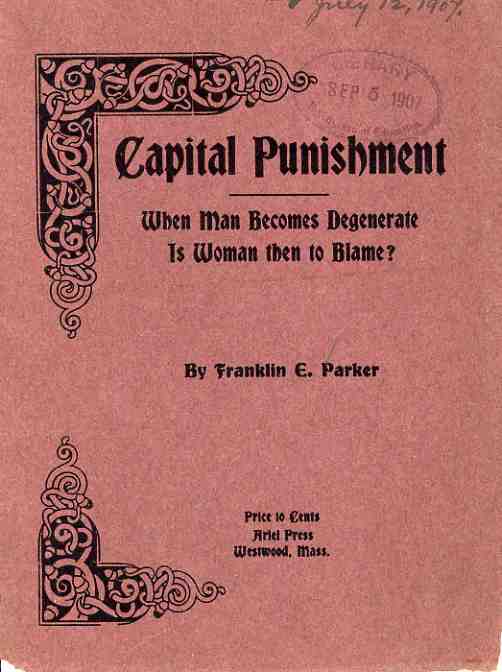
    Well.  In this tortuously ripped 1907 poetic headbanger on blame and retribution and innocence–and somehow ultimately about capital punishment–are neural squeezings that I have never se   blog 12 marriage696en or heard before, which are so loftily bad, and so logically weak, as to make a grown man puddle-up in amazement.  I don’t want to get too far into this thing, as the entire entertainment part of the work can stop right at the sub-title, because this little pamphlet is just tremendously bad, it transcends being about bad; it climbs out of badness into the so-bad-it-is-good department, and then slips instantly into the bad-good-bad-bad genre.  

    Listen:
    Since woman has been made of a rib of man, and is the “pupil of man’s schooling”,

    How then can woman obviate

    the crimson flesh of shame;
    when man becomes degenerate,
    is woman then to blame
    ?

    For woman being part of man,
    and should she cause an aching,
    how can her sins be other than
    the image of his making

    It goes on from there, of course, but we really don’t need to follow.  The answer, by the way, is “yes”.

       blog 12 marriage695 When I first saw Rev. Posey  Sr’s.1947  pamphlet I thought that it read “How to be Happy Through Marriage”.  Oops.  My mistake, though the title as it stands is infinitely more entertaining, what with the story being told in ten thrilling chapters (seeded over 28 sparse pages).  In the final installment of these prescriptions for happiness in spite of it all, we are reminded that “Satan is God’s arch enemy”, and that “IF YOU WOULD BE HAPPY KEEP SATAN OFF YOUR SHIP” and “do all to the glory of god” and MARRY IN SEASON”.  DO NOT marry a man for a “meal ticket”, or “to keep him from marrying someone else”, and DO NOT marry too soon or too late. And so on.  [Caps in original.]

    There’s much more sage advice sprinkled liberally around biblical verses, but I think you’ve already gotten enough of the  flavor to appreciate the rest of the meal (food itself sometimes getting in the way of its promise).

    ·Posted by :

    ·in:

    — —

  • Titles of The Sublime Mundane, 2: Salt and Wire

    JF Ptak Science Books LLC  Post 543

    Read last year’  March 11, 2008 entry “The X-Ray of the Imagination 2: Phrenology, Chinese Hell Scrolls, and the Beauty of the Thought Balloon”.

    The covers of this book are too far apart. (A book review, in toto, by Ambrose Bierce)

    There are books of which the backs and covers are by far the best parts. Charles Dickens

    0 a bay march 11 001
    Following yesterday’s post on the Sublime Mundane are these pamphlets, which are as perfectly and invisibly mundane as can be, if we were judging them solely by their covers.  What turns out to be the case, though, is that they are beautifully composed,  very well written, and extremely informative.  They are  drop-dead serious.
    0 a bay march 11 002

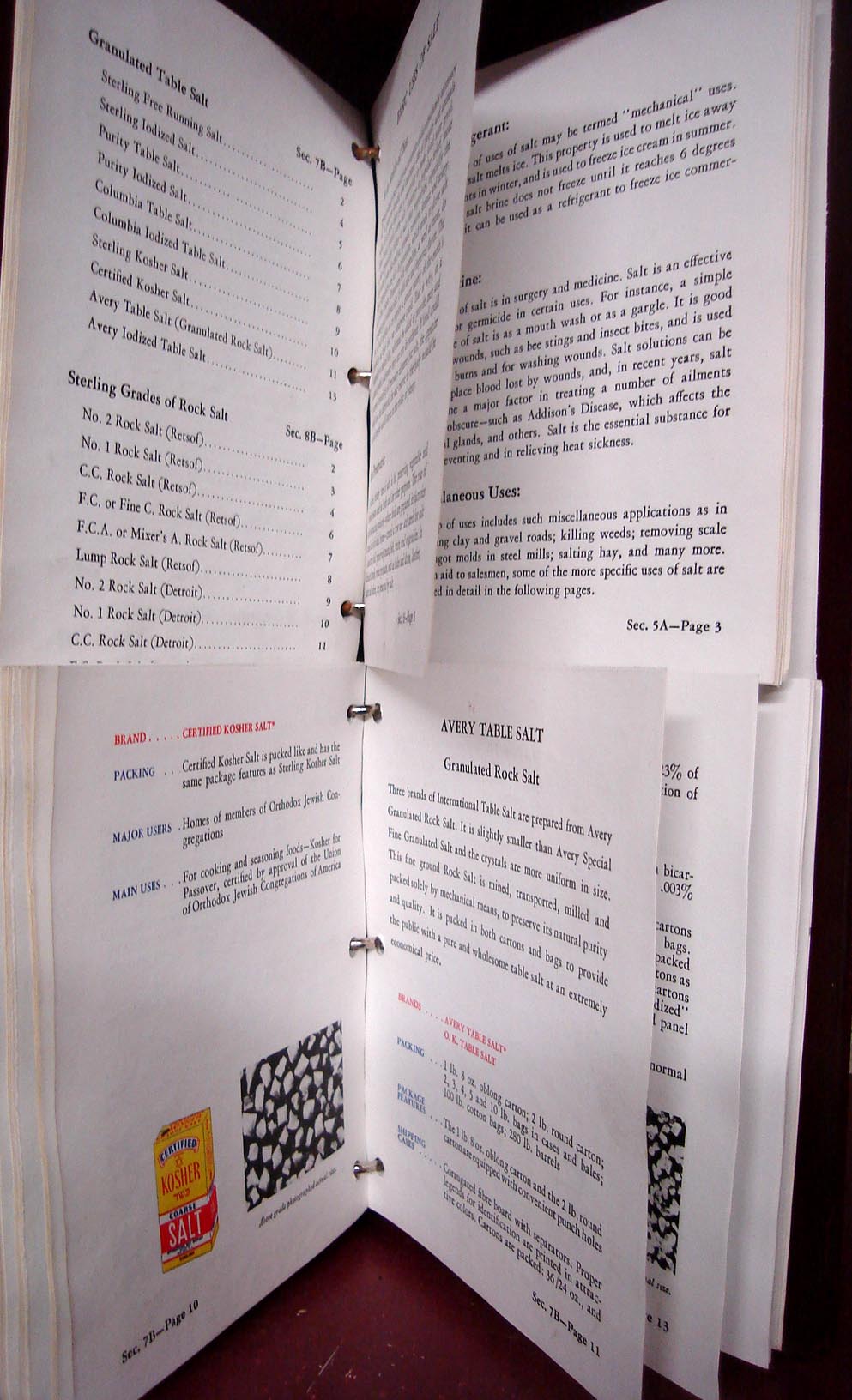
    The first is the International Salt Company’s Salesmans’ Manual for, yes, the selling of salt*.  The 12-inch tall , 6-ring binder instructional has 13 sections and is 75 pages long and strong; not only that, but most of the text is cut in two, so that there are some intricate associations that can be built between the bottom part of sec 2 page 8 and the top half of sec 4 page 2 and so on.  It is just brilliantly done,a work to be proud of!  And of course it looks like absolutely nothing and less than that, or that you’re whacking a quarter-inch brad with a 12-pound hammer.  Which may be the case, because the salesman who was familiar with all of these aspects of salt could put down just about anyone who got in between them and their salt sale.

    0 a bay march 11 003
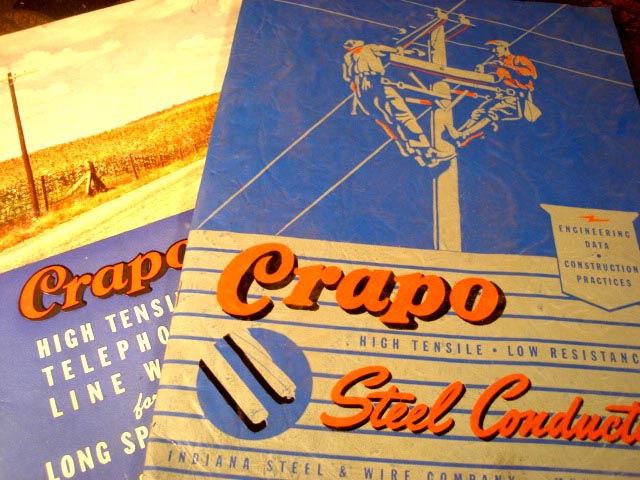
    Next are two 1945 versions of the unfortunately-named CRAPO Company’s product brochures,  makers of steel conduits, and who were evidently part of the Indiana Steel and Wire Company (of Muncie).  It turns out here, too, that these were packed with engineering data and construction practices for electrifying and improving electrical conditions in the great midwest.  The catalogs were also deftly  illustrated with elegant engineering drawings of their products.  So:  on  the outside, seeming nothingness for one book and badly-named for the other; inside, they are state-of-the-art, well written and bountiful.  They just look weird. 

    0 a bay march 11 004

    *I am in no way demeaning the importance of salt here–I just don’t want to deal with the whole overwhelming issue of its important history.  Suffice to say that stuff hasn’t been much more important than salt over the last few thousand years.

    ·Posted by :

    ·in:

    —