A Daily History of Holes, Dots, Lines, Science, History, Math, Physics, Art, the Unintentional Absurd, Architecture, Maps, Data Visualization, Blank and Missing Things, and so on. |1.6 million words, 7500 images, 4.9 million hits| Press & appearances in The Times, Le Figaro, Mensa, The Economist, The Guardian, Discovery News, Slate, Le Monde, Sci American Blogs, Le Pont, and many other places… 5000+ total posts since 2008.

Category: Outsider Logic

  • Outsider Politics & the Apotheosis of Religico-Governmental Control

    JF Ptak Science Books   Post 2513

    Compass057[Woodcut image by J.J. Grandville, [Jean-Ignace-Isodore Gerard (1803-1847)] from Bilder aus dem Leben der Thiere (“The Public and Private Life of Animals”) vol II, p. 224  =>For a good summary of Grandville’s fantastic work, which is completely unrelated to this post, see Opinionated Art, here.]

    People's Party058

    This wisp of a pamphlet (printed in 1937), set out on a task to introduce the idea of a theocracy and government according to Christian revelation, winds up in a rather odd and unexpected place.  If you were to remove the religious aspect of the proposals and the “theomendments” of The People’s Party, you wind up with an extreme form of dictatorship in which “the Government” and “Government-Nation” is a sort of totally-dominating  Socialist-Scriptural-Brutalista melange.


  • The $5,000,000 Powur Fonetic Alfabet (1890)

    JF Ptak Science Books   Quick Post

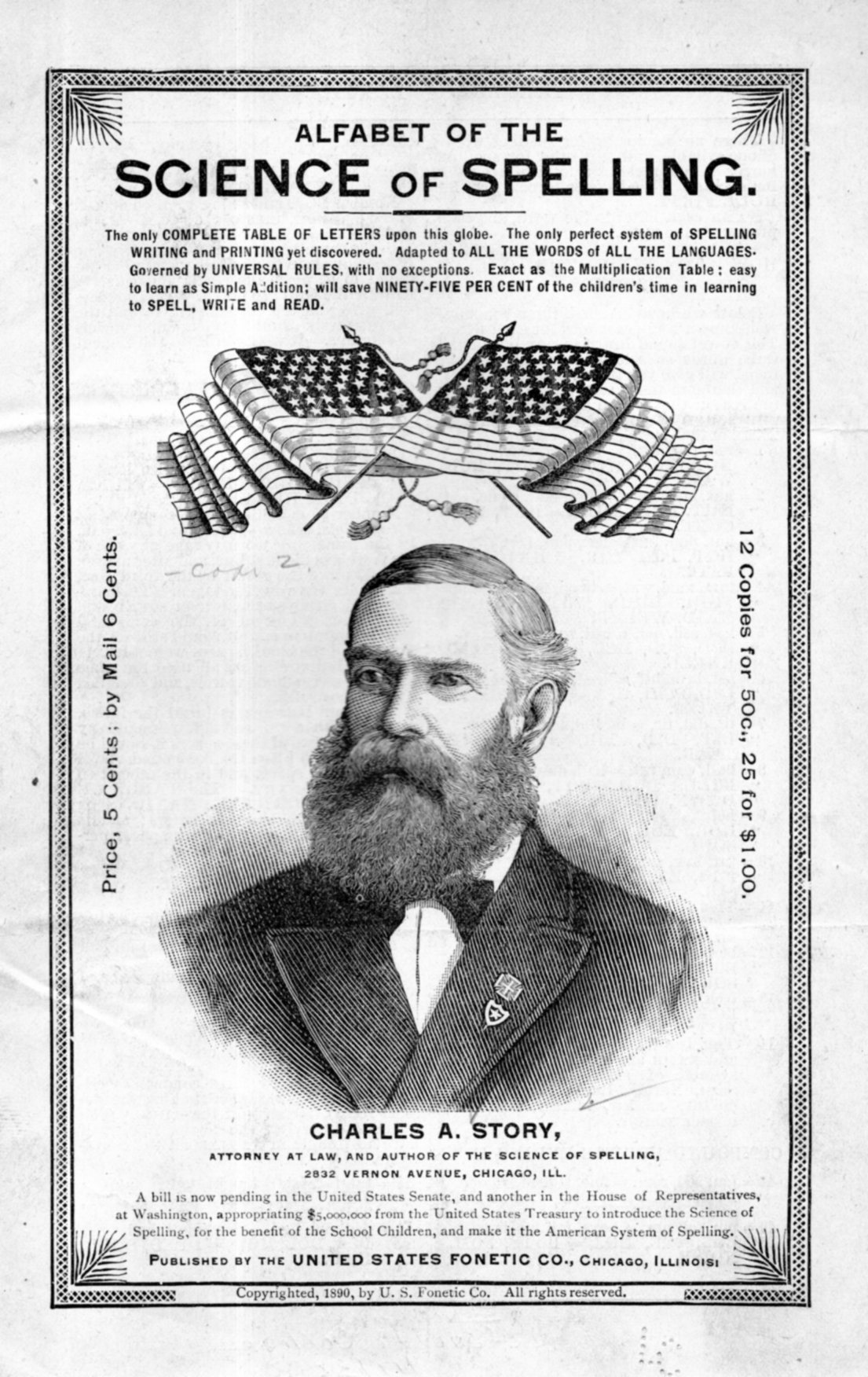
    Just two years before the 400th anniversary celebrating Columbus, and in the city celebrating it with a world’s fair (Columbian Exposition) of 1892, Charles A. Story set out on his own voyage, seeking support to change the way the United States wrote in ts native tongue. It seems high in the century for this sort of expedition, and Story was not nearly the first to get that, not even the first of 1890, as spelling reform has been a subdued meme in this country for a long time.

    Phonetic alphabet017

    What make’s Story’s story so momentarily interesting is that he sought government intervention to make his dream come true. He was preceded in this strategy by Robert Fulton (who received $300K+) and Samuel Morse ($30k), which was money well spent by  as usually very tight Congress; Story sought $5,000,000 1890’s dollars to change the alphabet, at the end of which you would get an alphabet of 66 letters of which only 45 were really necessary.  And 100 schools to teach the new alphabet. And so on.

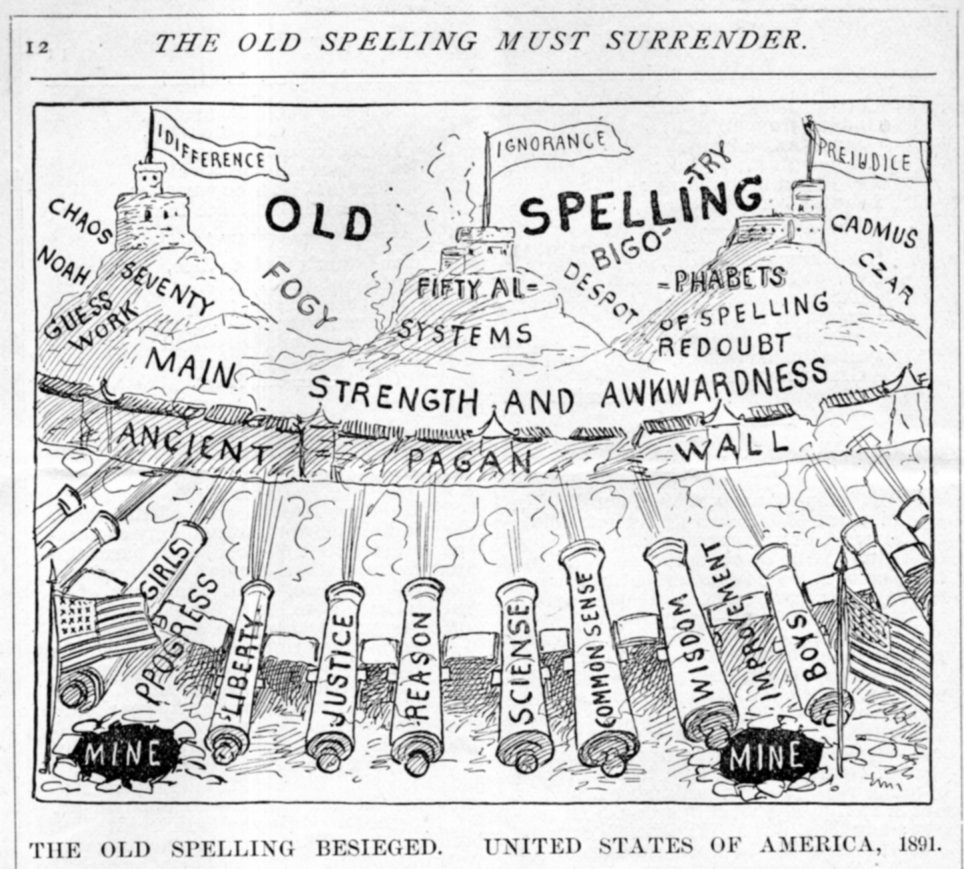
    A curious and Outsidery text illustration illustrative of some misty point:

    Phonetic alphabet016

    $5,000,000 was a h of a lot of money back then, and could have been spend of better things and maybe on some worse things (though perhaps not on the latter). 

    Mr. Story had a nicely designed cover for his plea; he didn’t do quite so nicely on the text illustrations. 

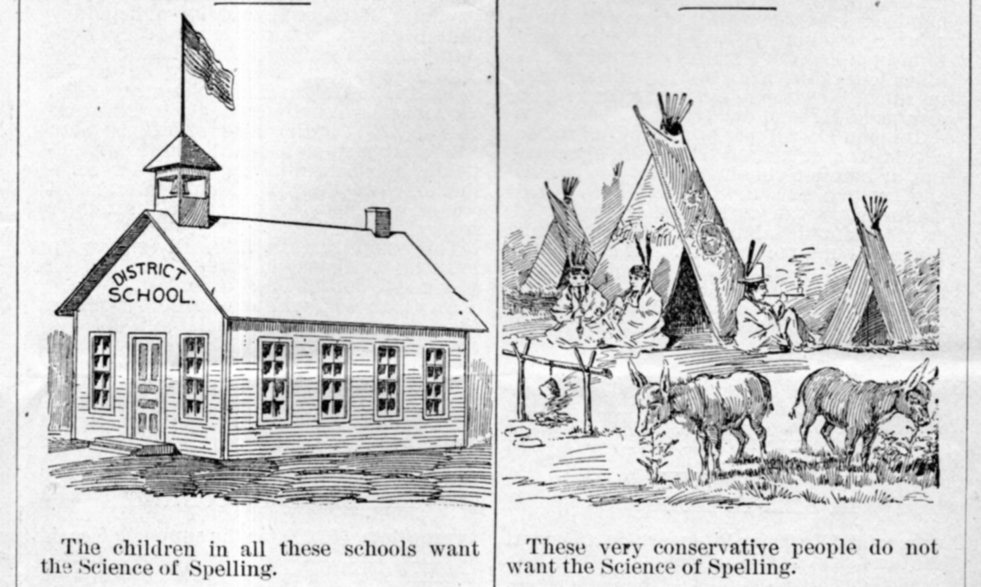
    Here’s another unfortunate text illustration; this one isn’t so much like an Outsider as it is just plain creepy:

    Phonetic alphabet018

    How this was supposed to enhance the language, or create new words, in the fine tradition of the development of the English language from the languages of the Aryan, Persian, Sanskrit, Greek, Latin, and so on, is a $500,000  mystery. 


  • Outsider Logic in the Poli-Prophecy Realm, 1940

    JF Ptak Science Books   Post 2503

    How does that saying go?  “The more things stay the same, the more they stay the same?” Something like that.  New stories are just sometimes the old stories that people forget from one generation to the next, with a societal memory that is possibly nullified or flimsy. Some stories that dictate a a particular outcome–like the example we are getting to below–are often repeated, sometimes for millennia, the same outcome retold with variations on the premise. 

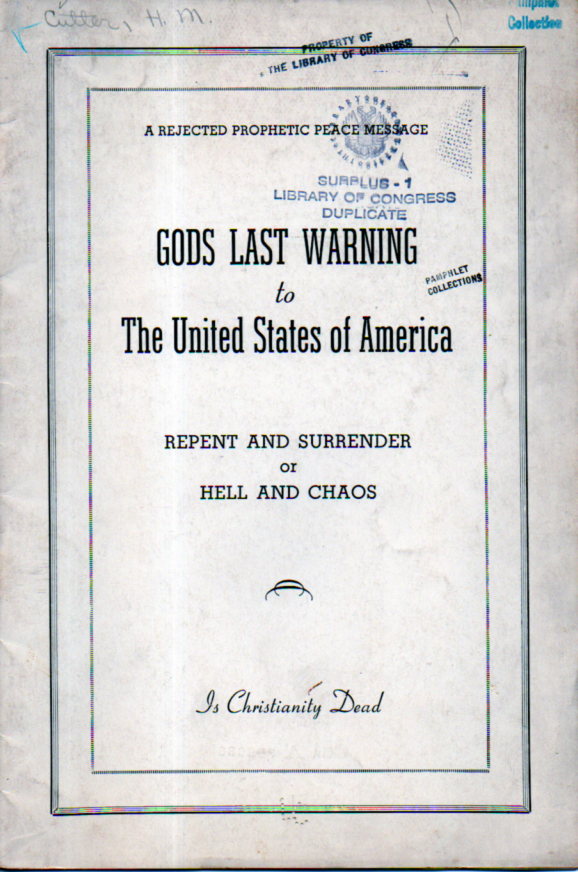
    God’s Last Warning to the United States of America, Repent and Surrender or Hell and Chaos is an example of this cyclically forgotten memory.

    Most of this short poli-prophesy tract calls upon the creator of the universe to come to Earth and establish a holy kingdom to combat a “SATANIC POVERTY CRISIS”, an “unfulfilled Prophetic Political Kingdom Message” which thee author “gives FREE to the United States of America and the WORLD”. [Note: all use of caps in quotations are found in the original; caps and the lack of them.]

    It is a prophesy that even as it is being ministered has also been rejected–and this right on the cover of the pamphlet, above the title, which makes it all seem a little too late, though the author pleas and prays the case, anyway. (He also asks the question, “Is Christianity Dead?”, though forgets the question mark. The title is a good indicator for the possibilities of the text being promisingly problematic, and it does not mislead.)

    Political Prophesy 1940014
    The author’s prose is difficult and oddly one-dimensional, floating tenses here and there, declaring tautologies, and lowering the needs of logical argument. For example , Mr. Cutter states that the ultimate message sent from the Lord of warning “will fit the conditions as they now exist. Former messages have been given that have revealed truths he wanted to make known to the World at the time they were given”, which is a fairly problematic double-statement. Mr. Cutter suggests a solution for the Depression, which he labeled as a “total collapse of our present Economic system known as Capitalism, or the Price Profit system, the writer is presenting a brief message outlining a repent surrender program by which we can get the PRINCE OF PEACE back to earth and our people prepared for His reception”.

    There is also a prediction of the Brotherhood of Man Political party (in 1940), and “a sane-sensible use of our can-be-amended National Constitution are tow keys that will unlock the door and make it possible for the Prince of Peace to establish his KINGDOM in the United States here and now…and to take over the Governmental Role of the WORLD”.

    There were evidently “wholly overlooked” parts of the Bible that would deliver us from the “Satanic depression” to allow the appropriate number of votes “will be the ordering of sufficient amendments to our National Constitution , so our lawmaker can pass the necessary Legislation in order that the Kingdom of JUSTICE can be established in the United States…”

    And so it goes.  This little tract is nothing particularly new or old to the U.S., and the title with some slight revision could have been printed today, or 150 years ago. 

    The pamphlet is 19 pages long, with the prophecy occupying 9pp of it, with the balance being reprints of letters that the author sent to the Nobel Prize Committee offering himself as a candidate for the Nobel Peace Prize of 1939.  The last three letters concern Cutter’s reprinting of the correspondence for publication, which the Nobel representative asks Cutter not to do.  Cutter then spends two pages in a response explaining why he needs to do so.  And the rest of the story, as they say, is not-history.


  • The Atomic Bomb and Satan’s Release, 1947

    JF Ptak Science Books    Quick Post   The series on Atomic and Nuclear Weapons

    • [There have been 99 posts to this blog since June 1–check out other work via the “Archive” at left]

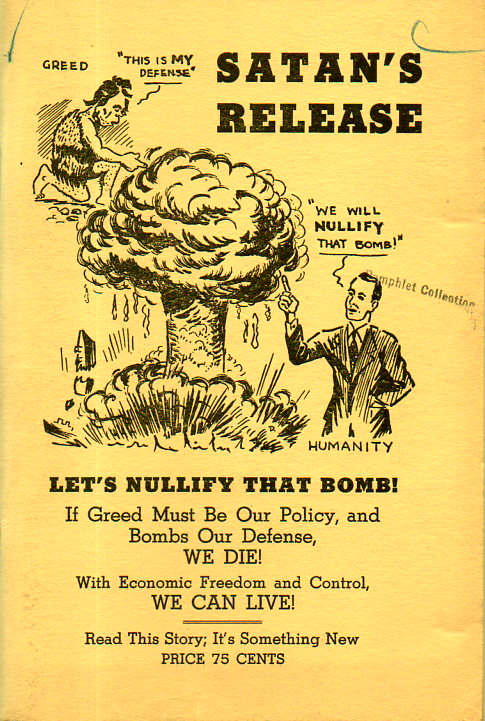
    In the 100+ or so posts in the Atomic/Nuclear Weapons history thread there are a number that address somewhat Outsider-y notions and imaginary insights into the weapons.  There are some that prophesy the advent of the bomb, and some that initiate the creator in its creation.  The pamphlet below (published in DeRidder, Louisiana, in 1947, a town of 4,000) is one such example–the atomic bomb so far as I can tell exists only allegorically, as in the greed bomb, that would destroy us all.  Still, it has a mushroom cloud on the cover, and so it qualifies as an atomic-bomb-in-popular-culture item.  

    Atomic bomb Satan's release202


  • Outsider Effort on the Gases of the Cosmos, 1883

    JF Ptak Science Books  Post 2488

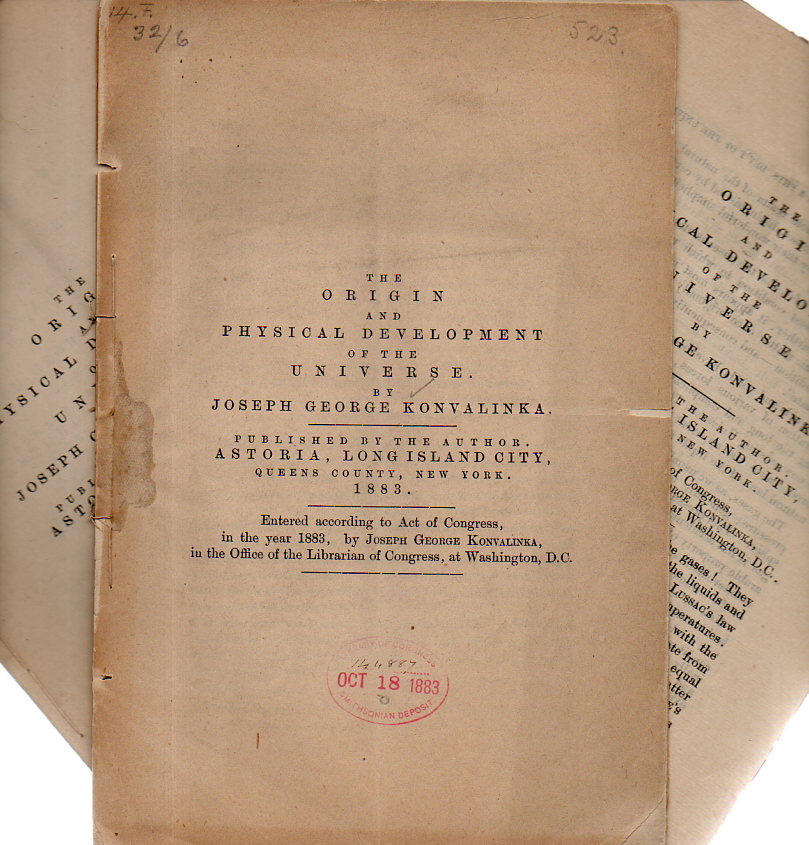
    I was researching a writer named Joseph George Konvalinka, who was the author of an Outsidery slimery called, The Origin and Physical Development of the Universe (1883). We travel through his interpretations of our physical stuff, and find that he was a curious man who seemed to be interested in his fair chunk of creation. Unfortunately his observations are not terribly clear, and he was willing to write about many of his conclusions before coming to any that were well-formed or supportable by scientific evidence. 

    Konvanlinka 3173

    For example, in section–which is actually a paragraph–on “Sun-Spots” describes the Sun as “not standing still” but “travels in a certain direction within the space of our solar system”, which is not a very scientific thing to say.  On the origin of “organic life” on Earth, the author asks himself the question and responds by not answering, but says that “all of mankind, which forms the basis of organic life, makes but a very thin cover upon the dead barren crust of Plutonic rocks” that form a “thin crust” on the surface of the Earth. And then something happens with carbon, hydrogen, oxygen, and nitrogen–which the author identifies as “all gases”–and they make vegetables and animal life.  

    And so on it goes. The interesting thing is how much ground Konvalinka covers in the fourteen pages of the pamphlet–and the curious thing is that I happen to have three copies of this semi-non-existent work, one for each eye and a spare. And for as thoughtful as he is, it seems to be almost entirely a self-contained gedankenexperiment, free from outside influence, and nearly entirely free from reference.  He wrote an earlier work in the 1860’s, and was still writing in the 1890’s (in a series referenced as his scientific memoirs), which includes a long section on aerial aviation and a proposal for a flying machine. Unfortunately he claims that flight was “a mystery” and described birds as floating in the air, which isn’t a good thing to have as a basis for understanding flight.  But he does offer several succinct and well-annotated patent-like drawings of his flying machine, which happened to be very squat, very heavy, and human powered.  

    Reading his work gives me the impression that he was an autodidact who I assume did not have the chances at an advanced education or perhaps access to the books necessary to understand physical systems that could have helped him form better foundations for his ideas. He wrote in interesting areas–and managed to have the finished efforts printed–and I can’t help but like the man because of his active mind.  


  • Outsider Cosmology and a Theory of a Firey Universe (1781)

    JF Ptak Science Books   Post 2451

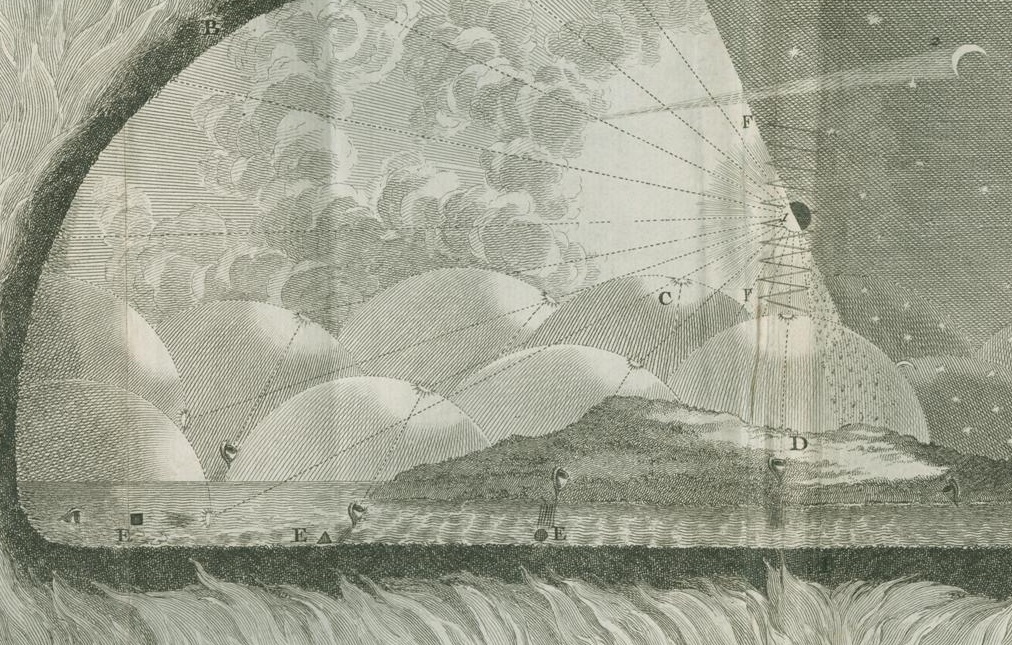
    Rabinqueau was a sort of intellectual performance artist provocateur, who made a living on his brain, writing scientific and pseudo-scientifically on a number of subjects as well as being a paid-for scientific performer. he would demonstrate to paying audiences various experiments in optics and light and electricity and magnetism, though he would sometime veer far away from the safely trodden fields of science into new scientific theories, many of which would put a considerable distance between himself and recognition from the Academie Royale des Sciences.  

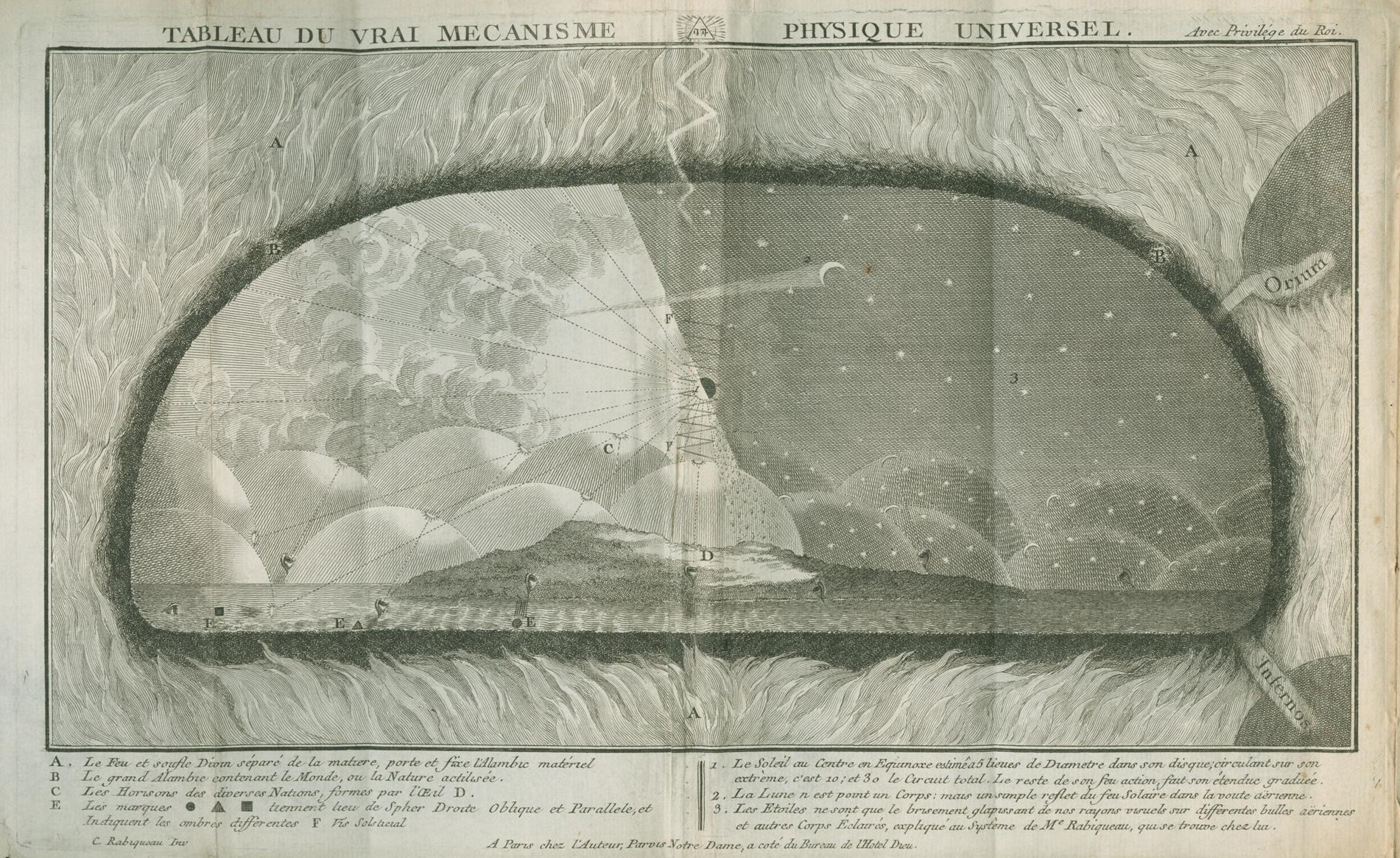
    For example, he developed a number of pseudo-magical physical ideas and astrological bits, as well as a fire-based theory of electricity in which the very substance of the universe is occupied by fire.  (See Popular Science and Public Opinion in Eighteenth-Century France, by Michael R. Lynn, p 51.)  Even though his ideas and results were far from the known science of such topics, he held a special affinity for the superiority of his own ideas, and stuck by them.  His universal fire theory at the very least resulted in an insistence for Outsidery consideration of cosmological questioning and display, as see in this beautiful engraving:

    Rabinqueau plate

    Rabinqueau


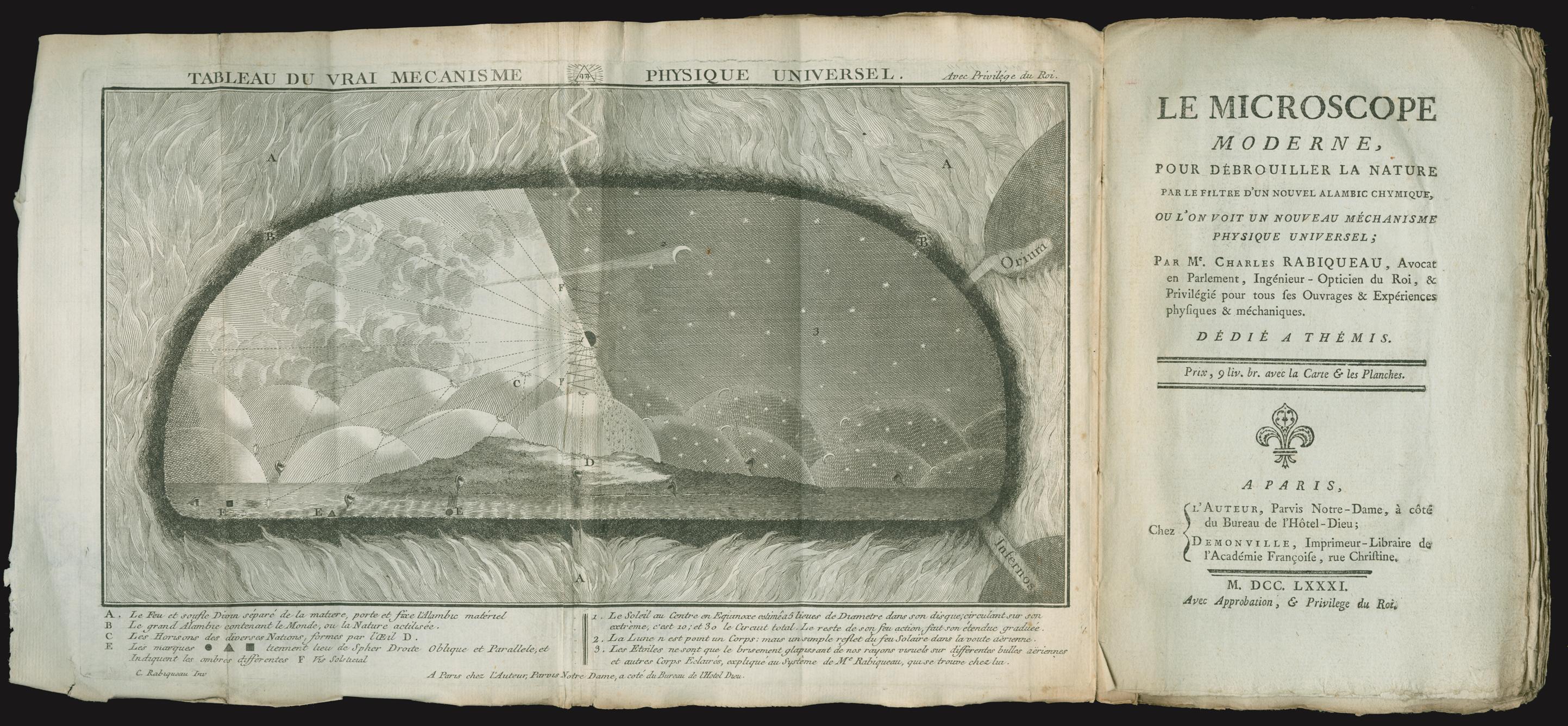
    The image appeared as the frontispiece to his Le Microscope moderne. [Treatise on cosmography], which appeared in 1781, and which seems to me to be sort of late in the game for these theories to be making an appearance. Source: Newberry Digital Library. (The image also makes an appearance with a different interpretation in Barbara Maria Stafford’s Good Looking, Essays on the Virtue of Images, p. 93.)

    And a detail:

    Rabinqueau plate detail

    Rabinqueau also developed an electrical, friction-based theory of the sexes, involving much rubbing and electrified ovaries, but this idea didn’t go very far. (See: The Psychoanalysis of Fire, by Gaston Bachelard, page 26.)


  • The Outsider’s Outsider PoliSci Insider (1910)

    JF Ptak Science Books   Post 2429     Outsider Logic series

    Outsider  classic drama859 detail

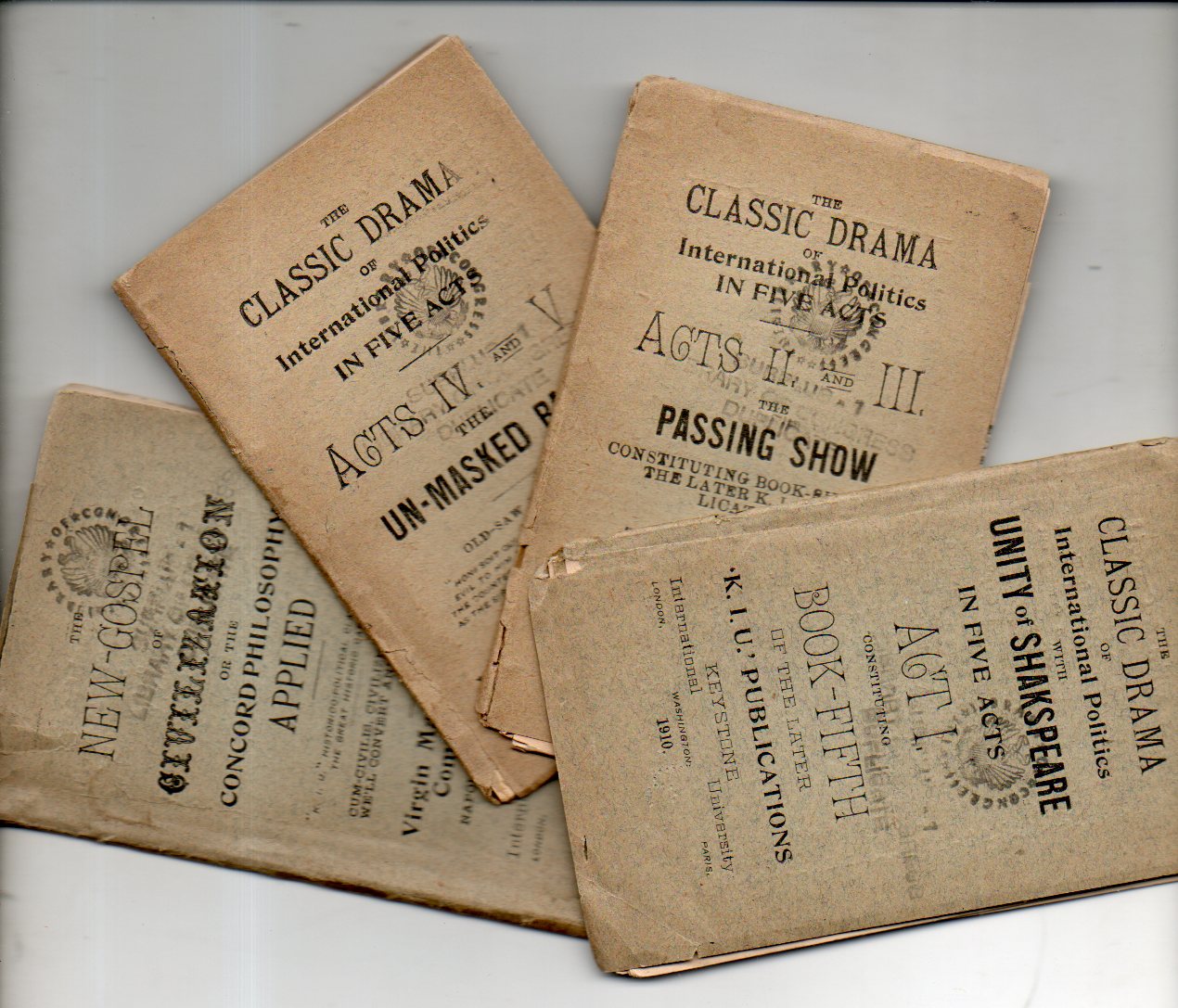
    There is a new find in my collection of Outsider Texts: The Classic Drama of International Studies with Unity of Shakespeare in Five Acts, written anonymously by the Keystone International University in 1910.  

    It is impenetrable. Well, it is impenetrable as a whole going from page to page, and maybe from sentence to sentence, but within sentences is where there is some sense and the series’ most penetrable aspects; but at the end of a “chapter” somehow the words you’ve read have all gone away into some brittle aphasic two-dimensional soup.

    The work is complete in three pamphlets covering five parts which constitute two parts (but not three) of the fifth and sixth book “of the later K.I.U. Publications”, all of this happens before we open the covers of these little five-inch-tall publications–they are packed and are already confusing, and it only gets more so from there.  Every chance interaction with the text is baffling, though it does seem to be about the Teddy Roosevelt administration/Babylon, I think, a satirical Old Testament-laden prophetic-something–in rhyme.  

    My guess is that the anonymous author of this three-part series (paginated from page 122-192) may have been the university itself (?) in spite of the proclamation of it being in London, Washington, and Paris. I can find in a not-deep investigation no evidence of the university, nor can I find any copies of these pamphlets on the web, nor is there any trace of them whatsoever in WorldCat. 

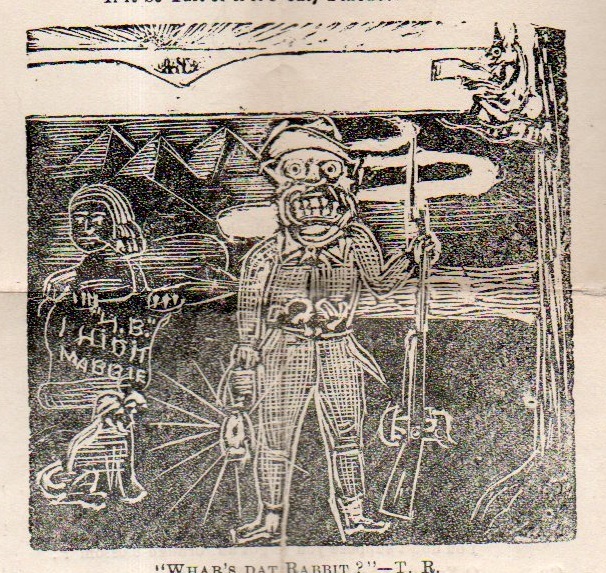
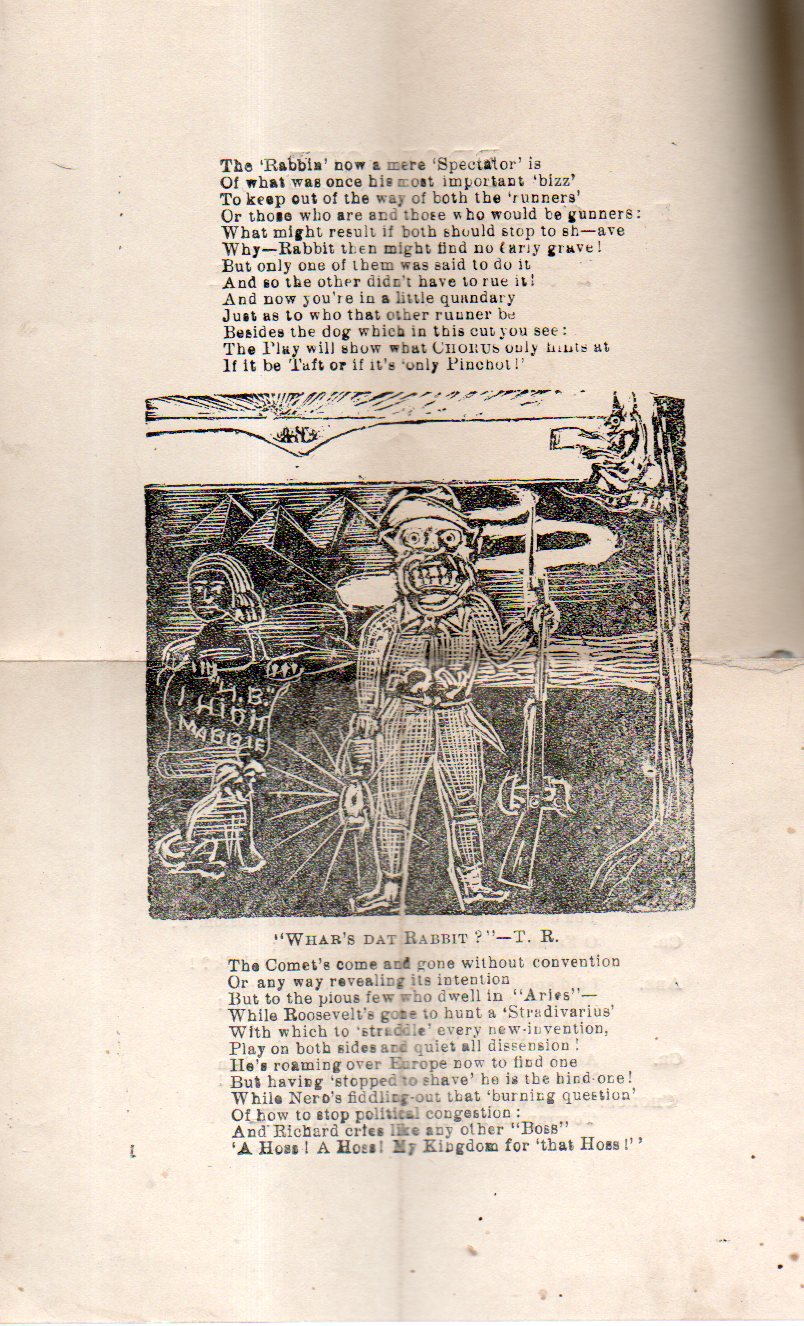
    I just like these personal logical systems–or at least I like the idea of them, even though many are just impossible to read.  There is a surprise, though, in one:  a political “cartoon” of suits, a very odd representation of Theodore Roosevelt and I-don’t-know-what-else.  

    Outsider  classic drama859

    The illustration makes everything worthwhile…or maybe it doesn’t. There is a high creep factor to it, though it was carefully prepared as a woodblock or cut of some sort.  

    I wasn’t going to spend this much time on this adventure in words and just publish the artwork, but I got sucked in a little to see if there was anything there, but the entrance is also the exit, and as soon as you’re in you’re out.  As my brother-in-law would say: “It is what it is” though maybe it wasn’t what it was.

    Outsider  classic drama861


  • “High Finance and High Treason (are) Synonymous” (1933)

    JF Ptak Science Books     Quick Post

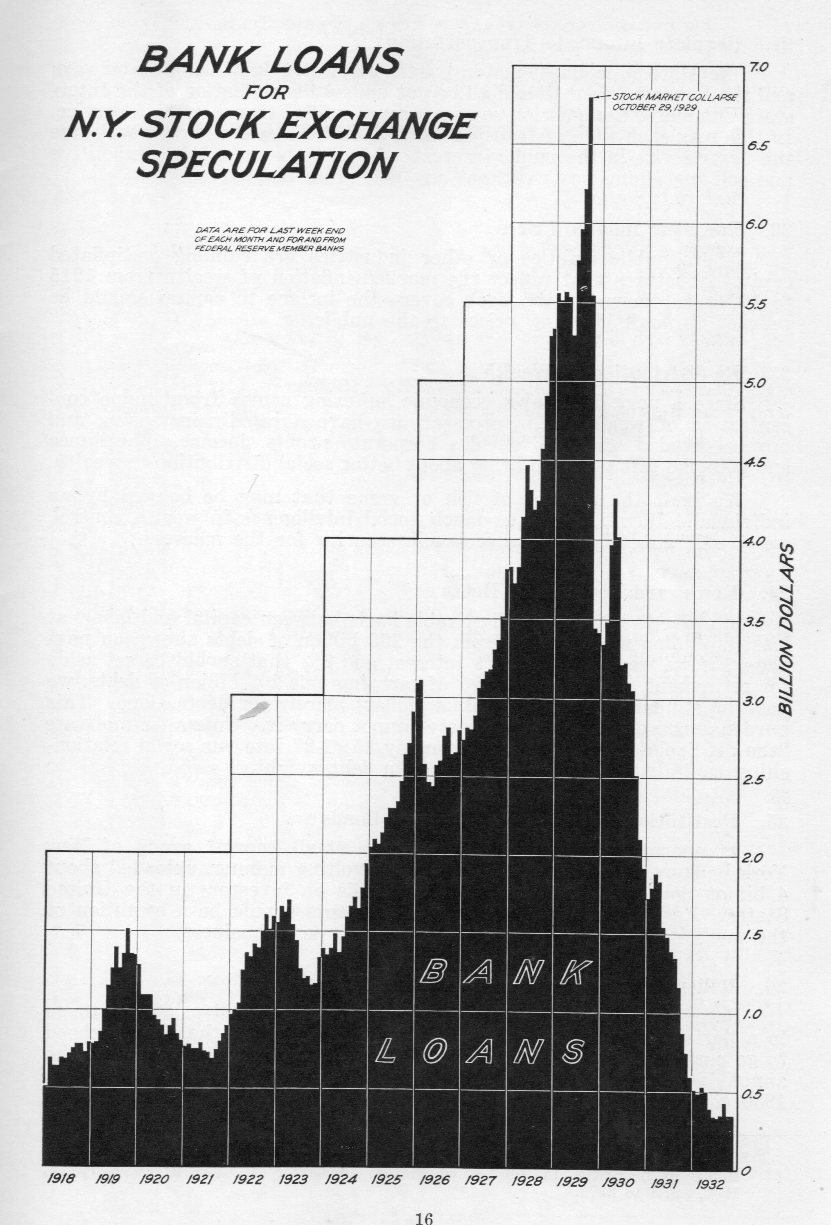
    Contributions to Way Out of Today’s Depression is a pamphlet written in a econo-engineering fashion by an engineer with some strong opinions on regulatory economics, many of which seem as far outside the normative and at the other end of the spectrum of the investing practices that necessitated such thinking. (For example, in addition to a discussion of very closely regulated federal interventions there is a statement that would make “high finace” a crime like treason, with similar punishment.) There was much flotsam amidst the jetsam and vice versa and perhaps nothing to salvage in the sinking mess, but this graph at least looked interesting: 

    Bank loans515


    And the very out-of-the-ordinary cover, which has a very definite Outsider quality to it:


  • Diagrams of Outsider Logic, with Synesthesic Angels (1925)

    JF Ptak Science Books  Post 2341  (Poster Series 5)

     [A cleaned-and-colorized 13×19″ version of this cover design is available in the new Posters section of this blog.]
    +()+outsider cover

    There are some other more recent contributions in our Outsider Logic collection that reach the limits of outside, reaching far into the aspects of knowledge that lies more or less completely hidden and inaccessible to the vast majority of readers.  Sometimes bumping into outré thinking like this is very useful because it is just so very different; and sometimes this thought process is just and only that: very different.

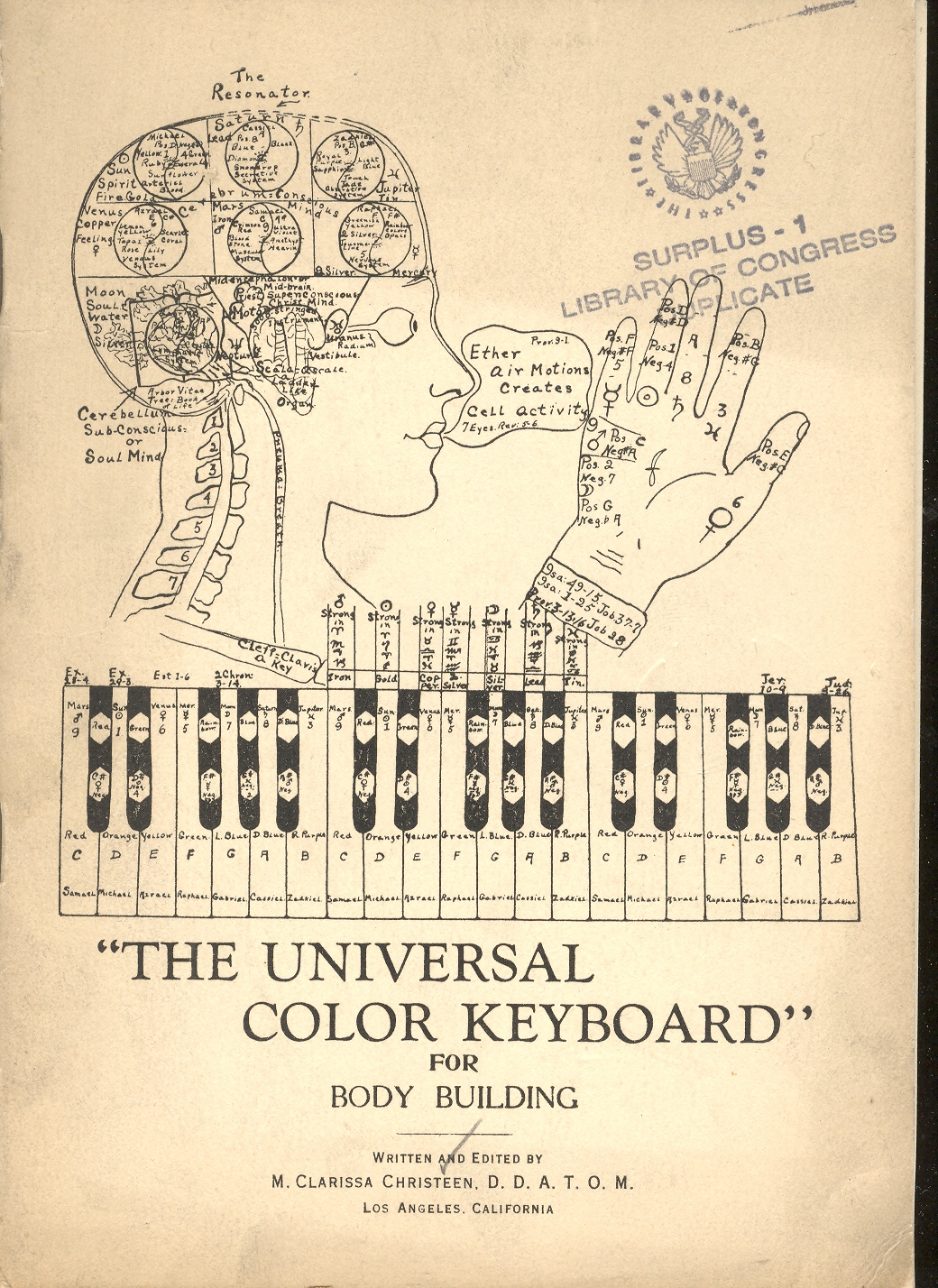
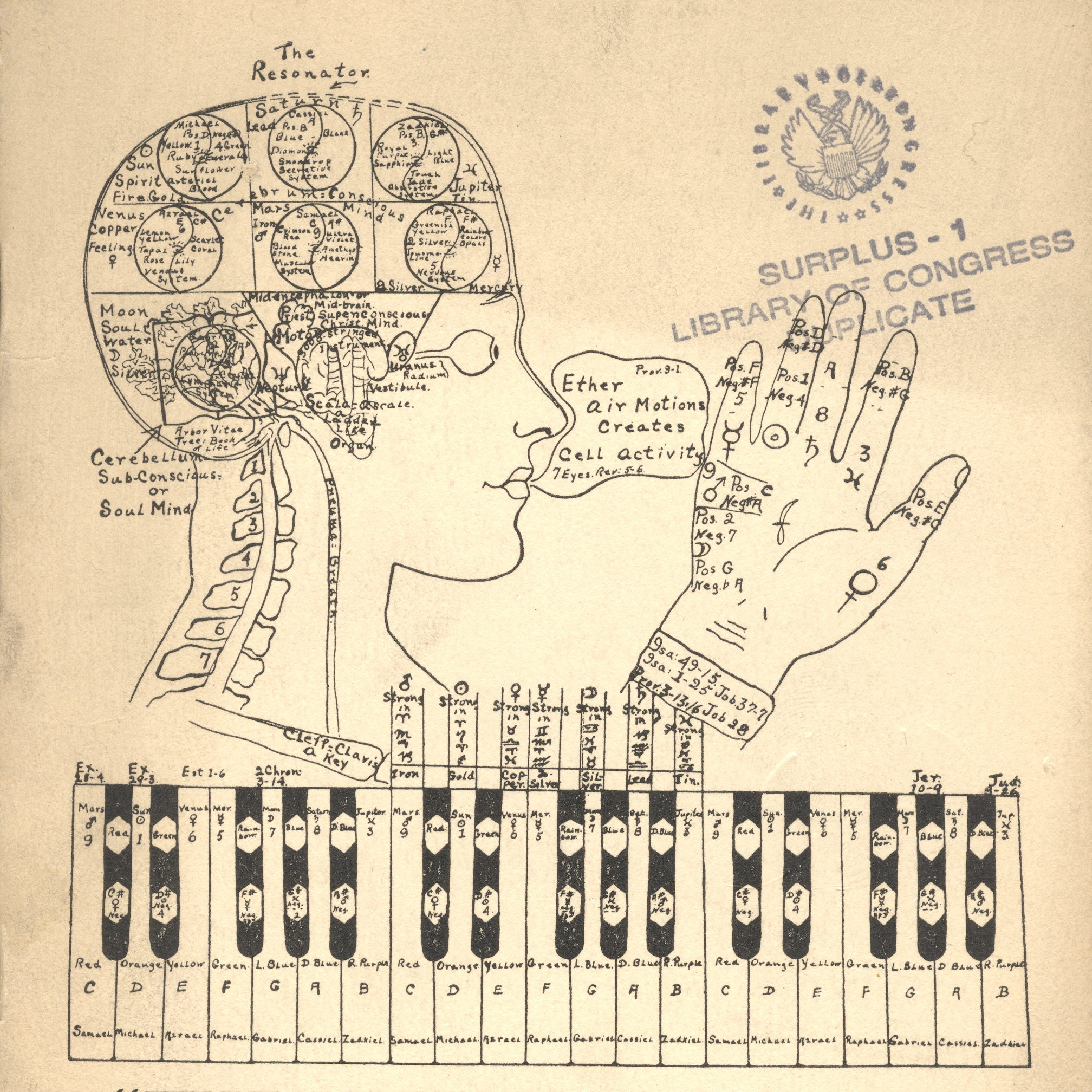
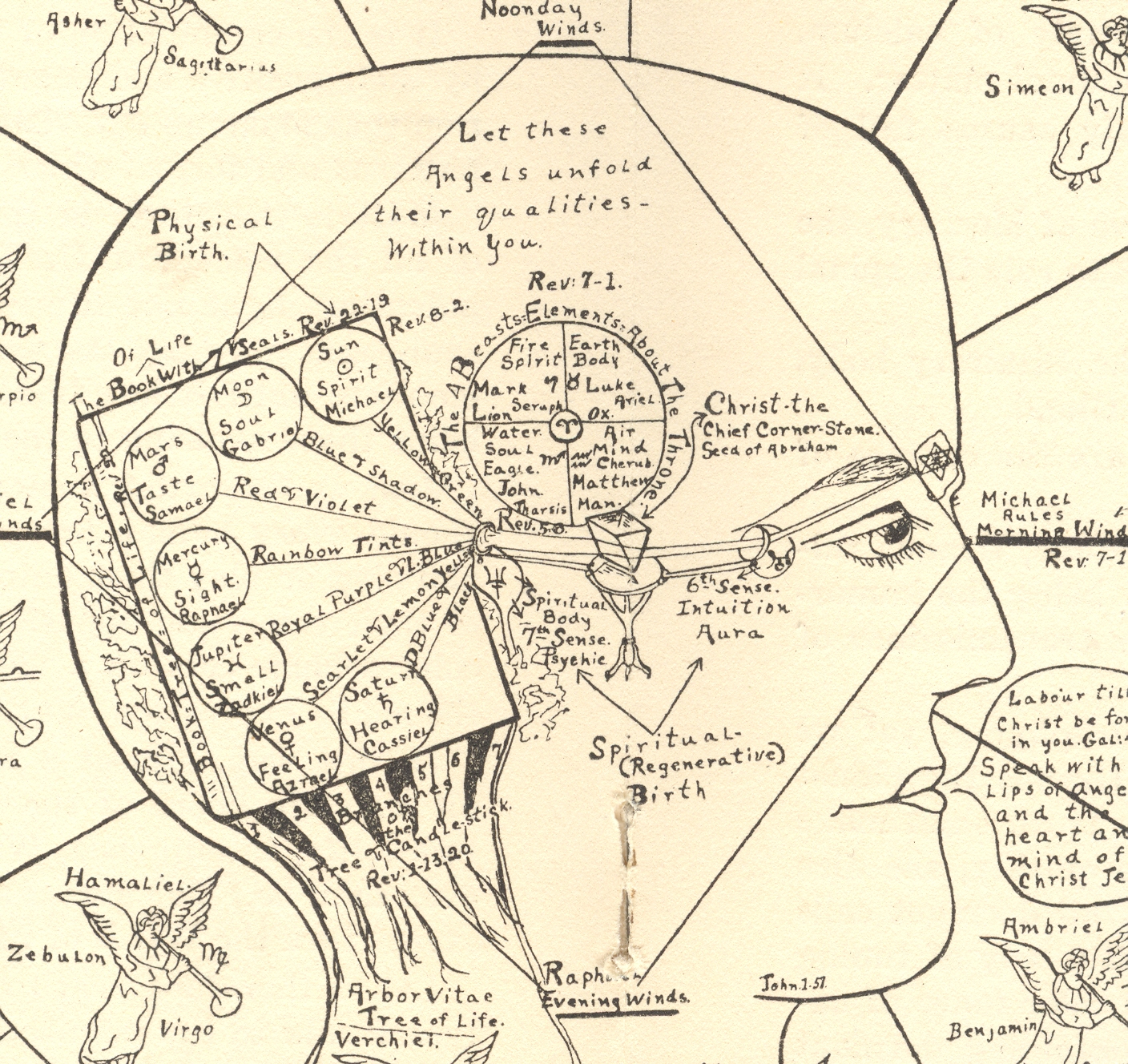
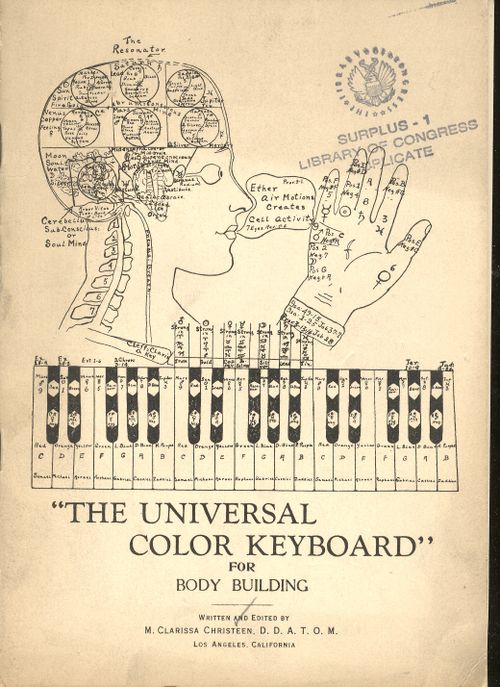
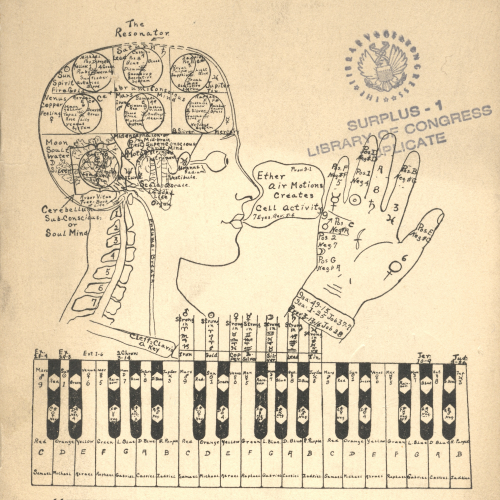
    This last bit is probably the case for W. Clarissa Christeen’s  (“D.D.A.T.O.M.”)The Universal Color Keyboard for Body Building, published in beautiful Los Angeles in 1925. In the many eyebrow-raising and vastly unexpected segments that she manages to share in her thin pamphlet she certainly strays into many unknown conclusion-processes and uniquely personal observations about the physical and spiritual world, testing the reader’s patience in many ways in 16 pages. But what Ms. Christeen absolutely does have going for her is her and which is easily appreciated is her artwork, which is, in its own special way, quite sensational—I’m really sorry that the pamphlet is limited to only two pieces of her work, as I’d really like to see more.  +()+outsider cover det
    Her philosophy is at the very least odd, though it may spring from a synesthesia.  Or not. 

    “Syn” (Greek, “together” and “Aisthesis” (“sensation”) combine to form this very interesting word and ability, being an automatic response to a stimulus by one sense when that stimulus is usually associated with another sense.  For example, there are “synesthetes” who perceive color as an auditory input, basically hearing yellow and so on; more famously are the musicians composing tone poems associating sound with color.  There are letter-color and number-color associatons, as well as taste-senses from colors and sounds and so and on.  For example in Kandinsky’s On the Spiritual in Art there is an attempt to relate color theory to touch and smell; Franz Liszt wrote color music; Isaac Newton attempted to establish the common distribution and association between color and tone frequencies; Rameau constructed a clavencin oculaire while Rimington made a color organ; Richard Feynman spoke of colored equations, and Nabokov recorded  (Speak, Memory) letter/color visions.  These are just a few examples of some of the more well-known practicing synesthetes. 

    In any event Ms. Christeen may be of that mold, and is attempting the universal perfection of mind and body through the combination of color and music (and scent), which “is valuable in building body-tissues of a harmonized order…the music chosen for social functions, the key notes being for the planet ruling or governing the day or the hours etc..  This brings celestial and terrestrial vibrations in direct contact, without interrupted angles which produce in harmony; in other words the creative powers which produce these various waves f light and sound or color or tone, acts upon the lower octave, matter or material manifestations recreating it, transforming it, and raising the vibrations of the said matter or material manifestations, thus, refining the temperature and quality of germ or tissue, etc.”

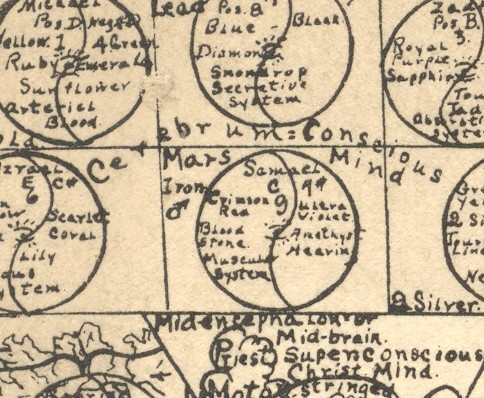
    This is a long passage, but I include it because, well, I just had no idea when an abrupt turn was going to be made in the discourse; nor did I have any idea of what the principles were of what was being discussed.  And this is still all on page one.  Sometimes passages like these are breathtaking, as in leaving you without breath, because their foundation for understanding is so elusive.  All you’re left with, sometimes, is a “wow!” reaction, like appreciating a pitcher who has just struck you out on three roughed-up-greasy-spit-laden nastiness pitches that were invisible and illegal, and didn’t matter at all.(What the figure in the cover illustration is saying. by the way, is “Ether air motions creates cell activity”, with a couple of Biblical references, somehow.)
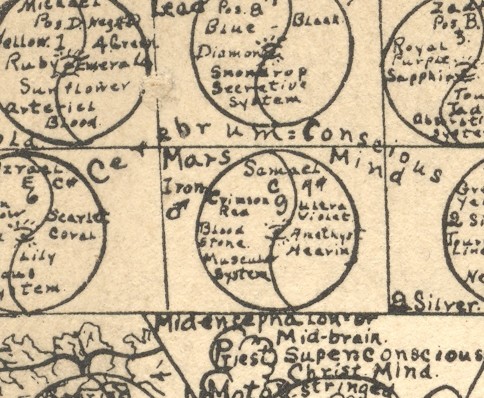
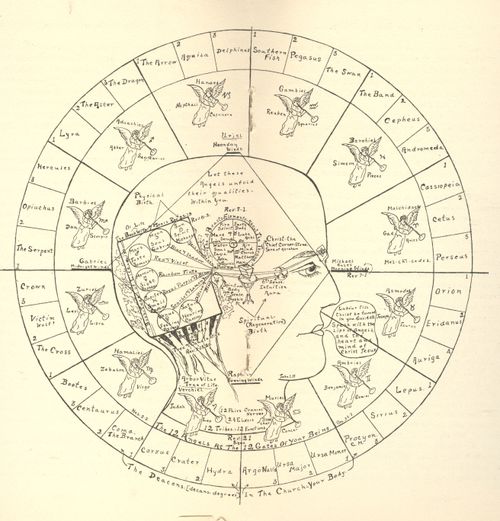
    +()+outsider cover ultra det


    +()+outsider insideI do know that the major divulged secret is the Universal keynote (and “keyboard”) and its control through music and fragrance of all that is, “each individual is to harmonize his or her astral colors to the universal keynote that he or she may be surrounded by a correcting aura, which sends out its streamers of light rays into the cosmos”.  Things get more deeply possessed after this, stretching into the Old Testament and astrology, which we don’t need to get into here.  
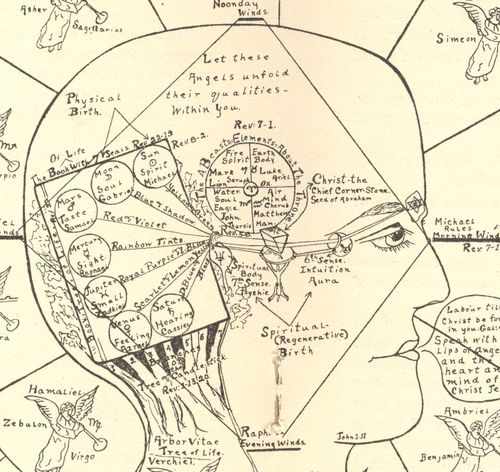
    +()+outsider insidedetAs I said, perhaps Ms. Christeen was a synesthete, and perhaps multiply so.  In 1925, when this book was written, there mayn’t’ve been a place for people to go who had advanced sensibility of seeing colors in music, and perhaps colors in fragrance. Perhaps Ms. Christeen was working out there in Los Angeles completely alone, trying to figure out just what her special and very different gift actually was.  Perhaps her life was greatly enlivened by her synesthesia, and sent herself out on a mission to the world to have other people experience it, too,, with the help of her color-relational charts.  I do feel for her, though I have absolutely no connection to what she was trying to explain.  I do find the artwork fascinating—a true “outsider” contribution. 

    (By the way, I don’t think that we ever got to the “body building” part in this work.  Also, I think the “DDATOM” after Ms. Christeen’s name meant something like “Doctor of Divinity of the Atom” or something like that–it wasn’t mentioned in the text.)

     And so there you have it.  I think that I’m just making the point that the outcome of some of this very provocative work doesn’t necessarily come into play in its ultimate evaluation, and that it should all be judged by what short of thinking that it excites in its reader. 


  • Cover Art for Munitions=Conspiracy=Death; 1944 Pamphlet

    JF Ptak Science Books   Quick Post

    Arms and the men318

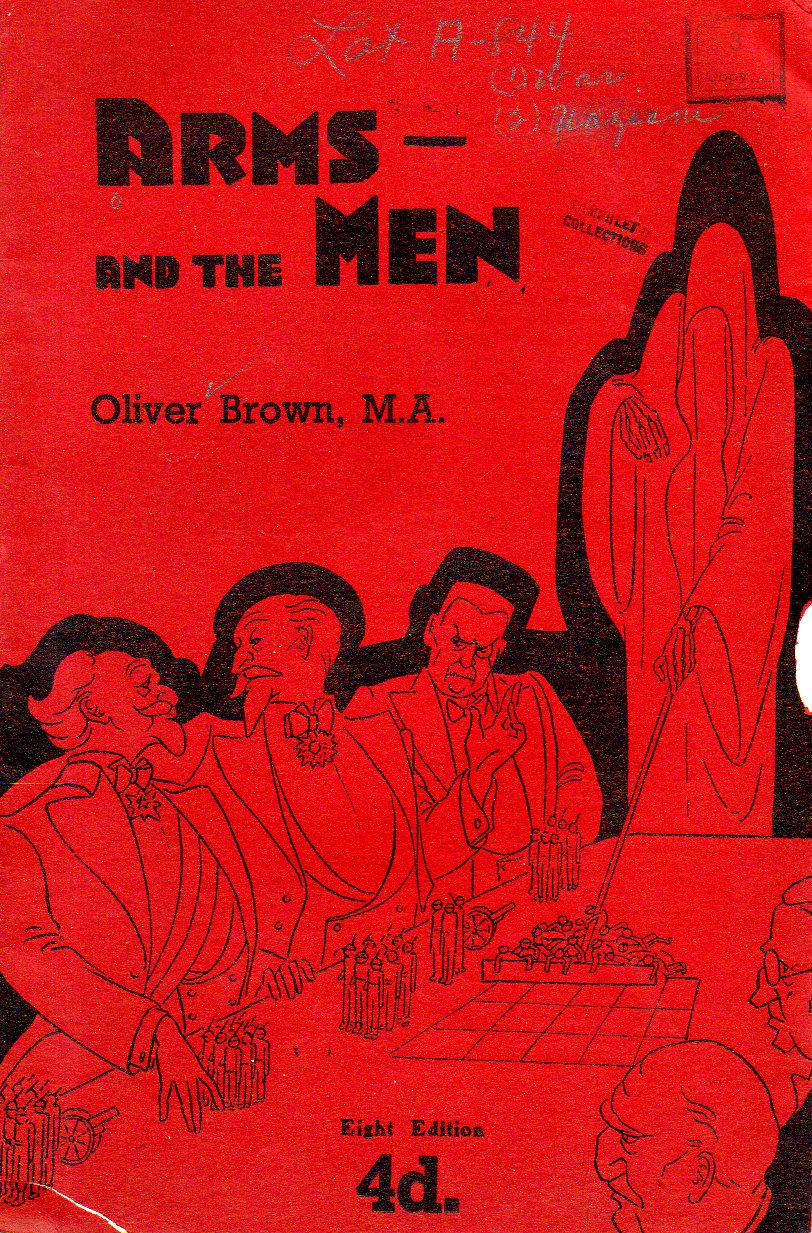
    The cover art of this semi-pacifist pamphlet may well be the most interesting part of the work, so far as I can tell. Mr. Brown didn’t so much write a manifesto about arms merchants and war as collect some bits of news on index cards and then type them up (in no particular order) and publish them, adding bold to more than a third of the text and CAPS for the important stuff. It seems as though this 8th (actually, “Eight Edition” as it says on the cover in a variety of naming editions that I have never seen before) edition was published during the war (a 10th coming in 1946), and I’d say a small fraction of the writing centers on WWII. In any event a lot of it reads like Outsider History, and I can’t spend much time on it–particularly when he drives a stake into Brits for praying for Spitfires, which would not have been a terribly popular insight in 1944.

    So, I’m posting this as an example of striking and effective cover art, and that’s it.  

    Other works by Brown have the same flavor–they also indicate a very busy writer, perhaps, except that these are all short pamphlets of a few dozen pages. Of course decades of work could go into them, but I think not. In any event, here is a sample; Hitlerism in the Highlands, 1948; Stepmother Britain, 1948; Scotland-Nation Or Desert? Second Edition 1948; War for Freedom Or Finance? 1941; Scotland, this Wealthy-and Poor-Country , 1948. Many went into numerous editions with about the same pagination–my guess is that there were small press runs, with bits and pieces added every now and then.  

    Oliver Brown shares the same name as the Brown v Board of Education Oliver Brown, but they are not the same person.  

    ·Posted by :

    ·in:

    —