A Daily History of Holes, Dots, Lines, Science, History, Math, Physics, Art, the Unintentional Absurd, Architecture, Maps, Data Visualization, Blank and Missing Things, and so on. |1.6 million words, 7500 images, 4.9 million hits| Press & appearances in The Times, Le Figaro, Mensa, The Economist, The Guardian, Discovery News, Slate, Le Monde, Sci American Blogs, Le Pont, and many othr places… 5000+ total posts since 2008.

Category: Lines, History of

  • A Tiny Peep at the African American in the Great Depression & Dust Bowl Migration, 1935

    JF Ptak Science Books  Post 2571

    The Negro Transient

    [Source: http://newdeal.feri.org/opp/opp3513.htm]

    I found this article, “The Negro Transient”, by Herbert C. Jenkins, in Opportunity, Journal of Negro Life, January 1935, while looking for support material for an F.S.A. publication on immigration of “drought sufferers” and the indigent poor.  It is an interesting account of an African-American experience of part of the Dust Bowl, with a number of interesting collections of data and stats for “travelers” in the St. Louis area in 1935.  These “travelers” of course were folks who took it hard from the Depression and from the great  and dismal drought that killed many American farms throughout the Mid-West and West, and so they hit the road looking for the opportunities that dried up and blew away at home.  The new sense of “home” would be defined as anywhere there was work or benefit, which were difficult things to find in the sixth year of the Great Depression.  

    One of the Roosevelt administration’s aid to helping this large population on the move across the country was the 1933 creation of the National Association for Travelers and Transient Service, which was an outgrowth of regional Traveler Aid societies, many of which were formed in the 19th century and focusing their attention on immigrant issues and the poor. The federal program did its level best to provide shelter, food, medical aid, education, and other services to help and even improve the state of the homeless, the poor, and the Dust Bowler–in many cases the widespread assistance to people in need was unprecedented. 

    The fascinating part of the story in Opportunity was the African American angle on population-in-motion.   The author, Herbert C. Jenkins, reports that “The November issue of the Transient, a bi-monthly publication issued by the National Association for Travelers Aid and Transient Service, states that there were 249,975 individuals under care in Federal Transient Bureaus October 15, 1934.”  And “As in every movement of nation-wide scope Negroes contribute their quota to this transient army. There are no available figures at hand to show the percentage of the number under care in various bureaus, but because of the traditional “last to be hired and first to be fired” policy which exists in industry they doubtless constitute a substantial number of these wanderers.” Jenkins proceeds to establish data that gave a peek into the African American part of the issue.
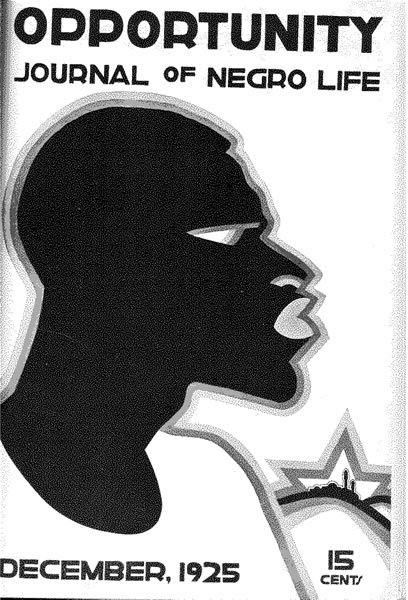
    Opportunity cover 1926 b

    http://sites.davidson.edu/littlemagazines/wp-content/uploads/2010/08/Cover1925.jpg
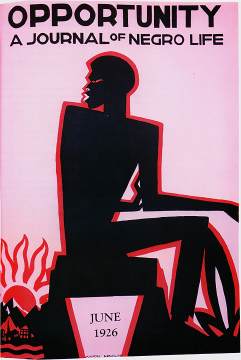
     

    Opportunity cover 1926


    ·Posted by :

    ·in:

    —

  • Artistic Optics: Beautiful Shadows

    JF Ptak Science Books   Post 2521

    “Let us leave our old friend in one of those moments of unmixed happiness, of which, if we seek them, there are ever some, to cheer our transitory existence here. There are dark shadows on the earth, but its lights are stronger in the contrast. Some men, like bats or owls, have better eyes for the darkness than for the light. We, who have no such optical powers, are better pleased to take our last parting look at the visionary companions of many solitary hours, when the brief sunshine of the world is blazing full upon them.”–Charles Dickens, Pickwick Papers, page 518.

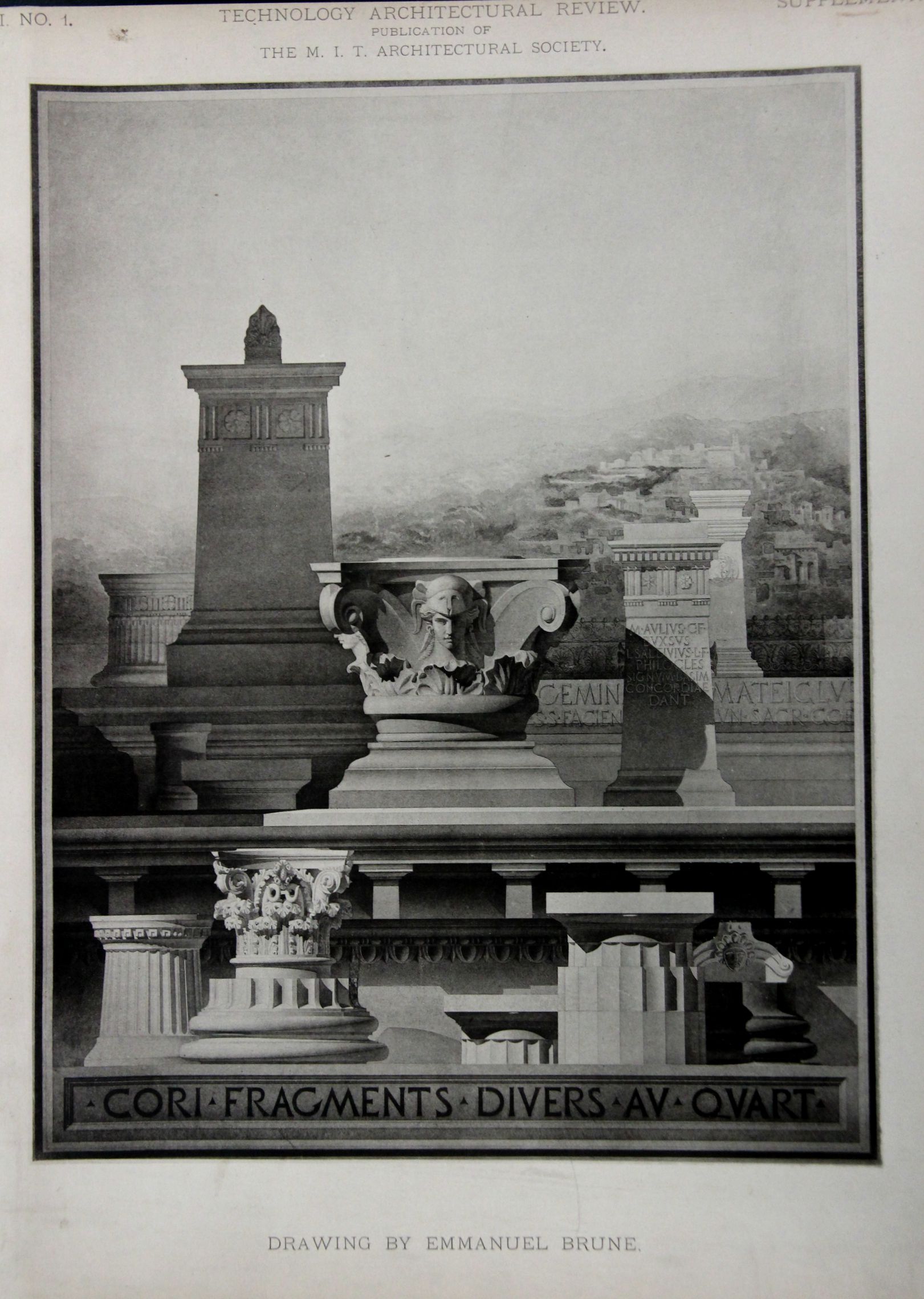
    Architecture frammenti shadows MIT

    If I were on the Moon I think I would miss the obscurity of shadows–while being partially obscuring, they also enable highlight and brilliance in the place not in shadow. This is the controlled darkness of Goethe, who also found the production of color in the intersection of light and shadow. In the sciences ennumerating the optical art of shadow there is probably no one as poetic as Goethe on this subject, at least before 1900. The great master of optics, Isaac Newton, wrote on shadows (that is a pretty good title for an essay!) with seering insight but of course with no visual-literary poetry of any kind whatsoever, as a matter of fact his “‘Enumeratio linearum tertii ordinis” (“Enumeration of lines of the third order, generation of curves by shadows, organic description of curves, and construction of equations by curves) which was originally printed as an appendix to  Optics (and then published in Opuscula) was like a black hole of poetry, anti-poetic–except of course for the staggering genius that went into it all.  

    And so these dreamy thoughts were brought out by this not-so-simple study of frammenti, found in the volume 1/1 of MIT’s first architectural journal, Technology Architectural Review, published in 1887.  These shadows are excellent–there’s a lot going on in these layers of differentiated light.  

    • Check of other bits on this blog on shadows by entering that word int eh Google search tool.  

  • How to Build a Living Flag Composed of 10,000 Sailors

    JF Ptak Science Books   Quick Post

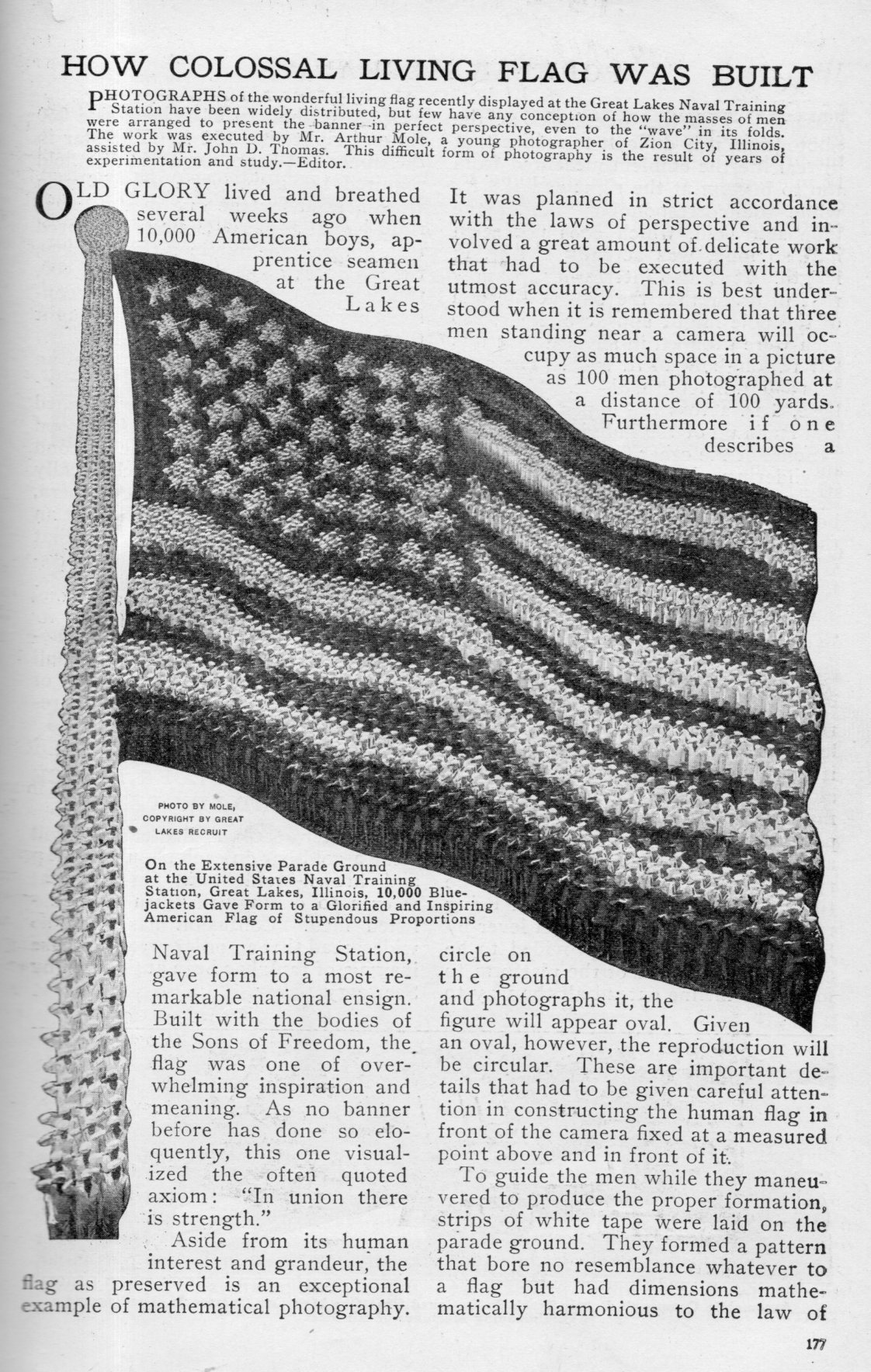
    This is an interesting display of perspective found in the article “How Colossal Living Flag was Built”, in  Popular Mechanics, volume 20, 1918, pp 177-8.  

    Measurements:

    • Staff on left: 550′ long, composed of 700 men
    • Ball on top of staff: composed of 250 men which measures 237′ x 20′ (and its widest as an oval)
    • Top of flag :293′; Bottom of flag: 73′
    • Left part of flag: 428′; right, 128′
    • Star upper left composed of 126 men; star bottom right, 12 men. 

    Flag massive958

     Oh–and according to the text, the shot took one hour to assemble.  

    Flag massive957


  • “Sabotage”, the Wobblies, and the Illusion of Property (1913)

    JF Ptak Science Books  Post 2392

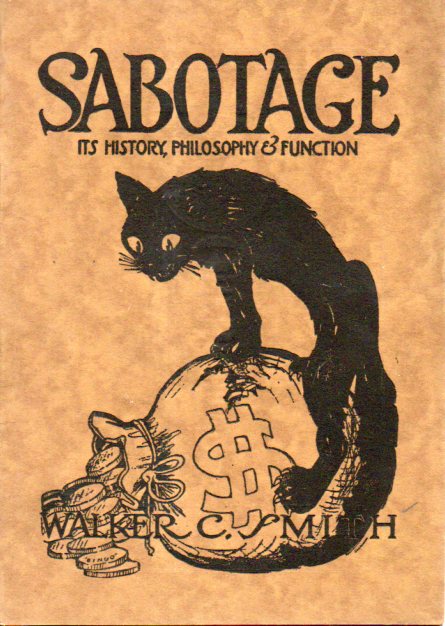
    “The object of this work is to awaken the producers  to a consciousness of their industrial power. It is dedicated, not to those who advocate but to those who use sabotage.”–Walker C. Smith, in the second of his miniature two-paragraph foreword in Sabotage (1917 edition)

    Sabotage608

    [The original pamphlet is available from this blog’s bookstore, here.]

    Walker Conger Smith (born 1885 on the same day that Babe Ruth and Elvis Pressley died in later years) was a hard line political seer, a magical agitator and writer for the Wobblies, officially known as the Industrial Workers of the World (and the I.W.W.)  He lived a busy 41 years, and in his time raised a lot of attention to the IWW’s Socialist vehemently pro-Union organizing, during a time (1910-1927 or so) when big business would respond with their won police/strikebreakers/armies to disrupt and dispel (and trounce) strikers and strikes. 

    One of Walker’s best known works was Sabotage, its History, Philosophy & Function. First published in 1913 and then widely reprinted, it made the case for poor pay for poor work, and that in the long run the wealth produced by the workers belonged to them, and so work slowdowns and then destruction of the means of production was well within the rights of the wronger worker. 

    The pamphlet certainly found a readers–on both sides of the issue. It was regularly used in legal actions against Unions as proof of their criminal syndicationism and of organized destruction of business/factory property.  

    The pamphlet ends with these very strong statements:

    “Its [Sabotage’s] advocacy and use help to destroy the property illusion”…

    “Is the machine more than its makers? Sabotage says “No!”

    “Is the product greater than the producers? Sabotage says “No!”

    “Sabotage places human life–and especially the life of the only useful class–higher than all else in the universe.”

    ….”For Sabotage or for slavery? Which?”

    The pamphlet ends with a salutation from Jack London:

    “Dear Comrade Smith:

    Just a line to tell you that I have finished reading your pamphlet SABOTAGE. I do not find a point in it on which I disagree with you. It strikes me as a straight-from-the-shoulder, clear, convincing, revolutionary statement of the meaning and significance of sabotage.

    Yours for the revolution,

    Jack London”


    Full text here.

    The IWW website identifies this printing as 1917.  http://www.iww.org/sr/history/library/WCSmith/sabotage


  • History of Lines: the Big Little Lines of Richard Feynman (1949)

    JF Ptak Science Books   Post 2333

    Perhaps the only bigger five put-together lines than Feynman diagrams may be home plate; otherwise I’m hard pressed to come up with a better thing that can be drawn in this way with this many lines.  

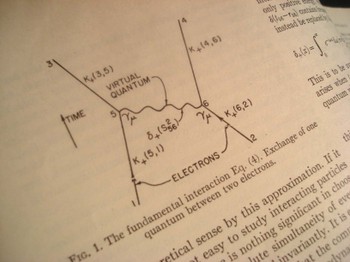
    The impossibly smart Richard Feynman (1918-1988, Nobel in 1955 for the development of quantum electrodynamics; physics of superfluidity; path integral formulation of QM, etc.) worked on a schematic that would  visualize quantum electrodynamical interactions, the scattering calculations in QFT describing interactions between particles The result is known by nearly everyone on earth as Feynman diagrams. (Murray Gell-Mann, another Nobelist and ueber diligent partner and competitor of Feynman’s, and perhaps as influential a physicist (with the Eightfold Way and etc.), refers to the diagrams as (Ernst) Stuckelberg diagrams, named for a once-obscure physicist who, among others, came up with an early schemata closely resembling Feynman diagrams.)  They are an elegant and powerful redistribution of complex arrangements that are more easily calculated when visualized.


    Dsc00016

    The images here are the first time the diagrams were published, and are found in the 15 September 1949 issue of the Physical Review after having been introduced in conference and class work (at Cornell int eh 1948/1949 QED course that Feynman taught there). They are among the top-10 prettiest pictures in physics of the 20th century.

    Their descriptive power is matched only by their crystalline simplicity—few diagrams have ever been constructed with a greater claim.

    Dsc00015


    ·Posted by :

    ·in:

    —

  • A Beautiful Idea: the Knight’s Magical Magic Square Tour (1888)

    JF Ptak Science Books  Post 2243  
    Follow Me on Pinterest

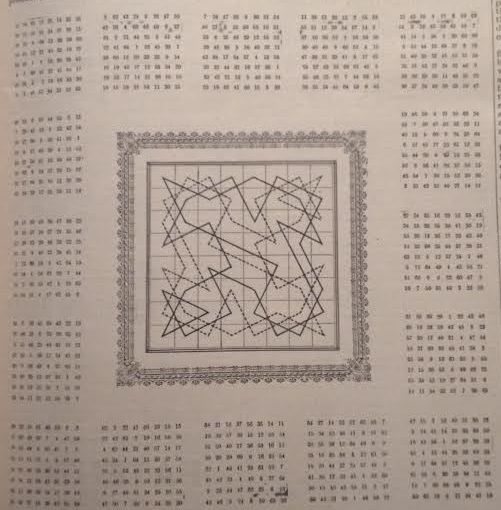
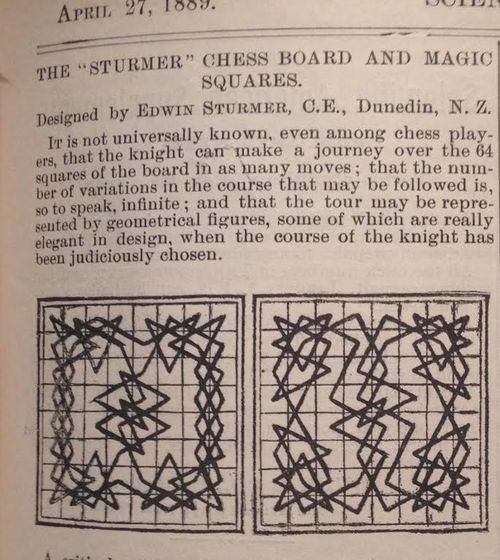
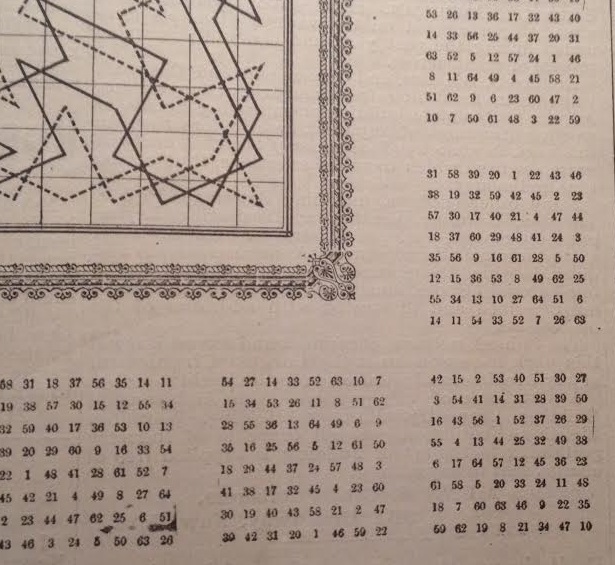
    The idea behind this extraordinary image below is the construction of an 8×8 magic square capable of describing BOTH the Knight’s tour (” a sequence of moves of a knight on a chessboard such that the knight visits every square only once…if the knight ends on a square that is one knight’s move from the beginning square) WITH the resulting moves forming a series of magic squares. It is the product of a Kiwi engineer named Sturmer, and appeared in the Scientific American Supplement for 1888.

    Sturmer2

    Eric Weinstein says in his article “There Are No Magic Knight’s Tours on the Chessboard” on Wolfram’s Mathworld site says, well, such a thing is not possible. “After 61.40 days of computation, a 150-year-old unsolved problem has finally been answered. The problem in question concerns the existence of a path that could be traversed by a knight on an empty numbered 8 x 8 chessboard.”

    Weinstein is concise: “Not surprisingly, a knight’s tour is called a magic tour if the resulting arrangement of numbers forms a magic square, and a semimagic tour if the resulting arrangement of numbers is a semimagic square. It has long been known that magic knight’s tours are not possible on n x n boards for n odd. It was also known that such tours are possible for all boards of size 4k x 4k for k > 2. However, while a number of semimagic knight’s tours were known on the usual 8 x 8 chessboard, including those illustrated above, it was not known if any fully magic tours existed on the 8 x 8 board.”

    Source:  http://mathworld.wolfram.com/news/2003-08-06/magictours/

    Sturmer


    Sturmer 3

    And this, from the British Chess Maagzine, 1888, page 278: 


  • Being in Regret–Verdun, 1916-1918

    JF Ptak Science Books  Post 2215

    IMG_6842

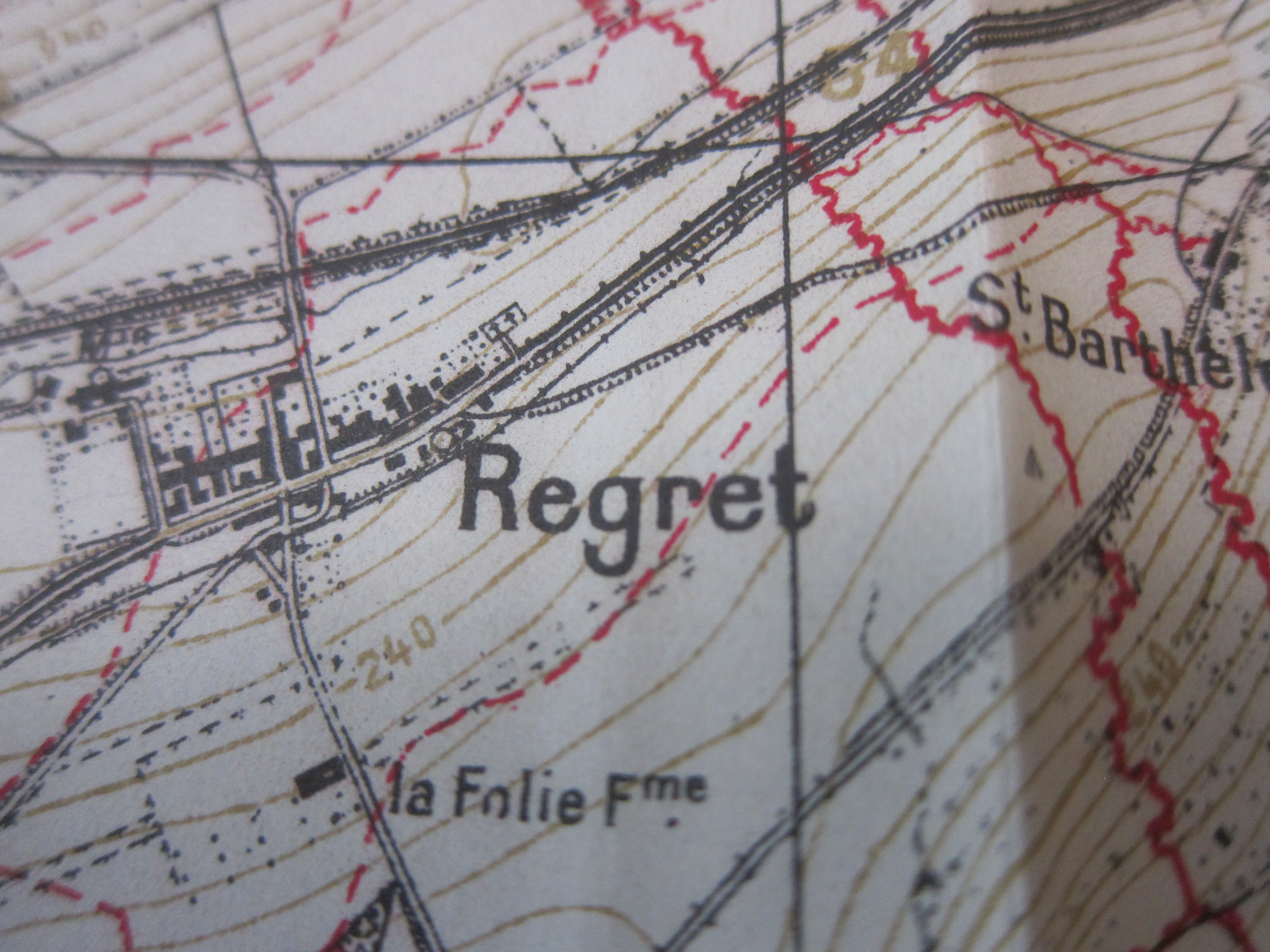
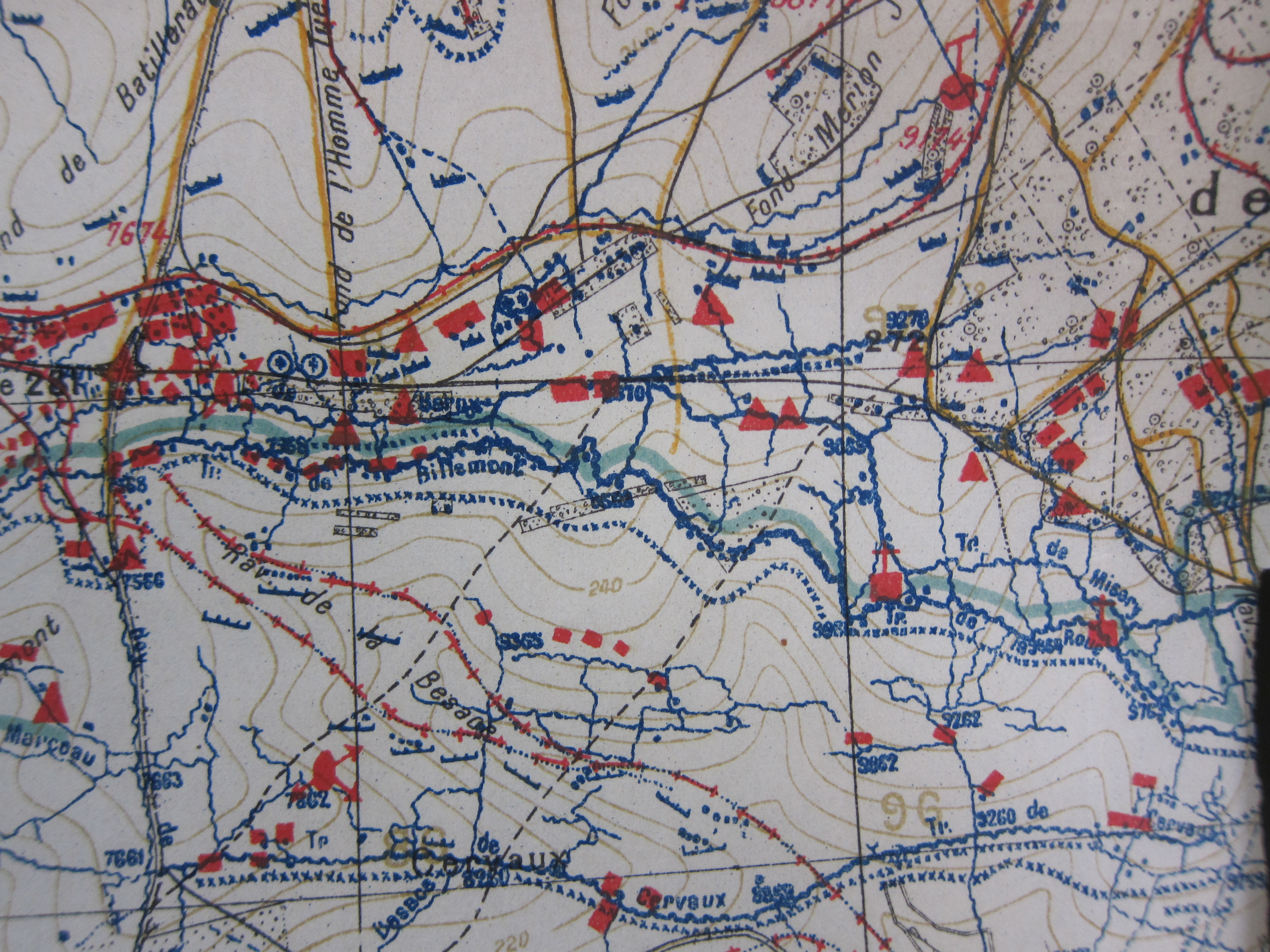
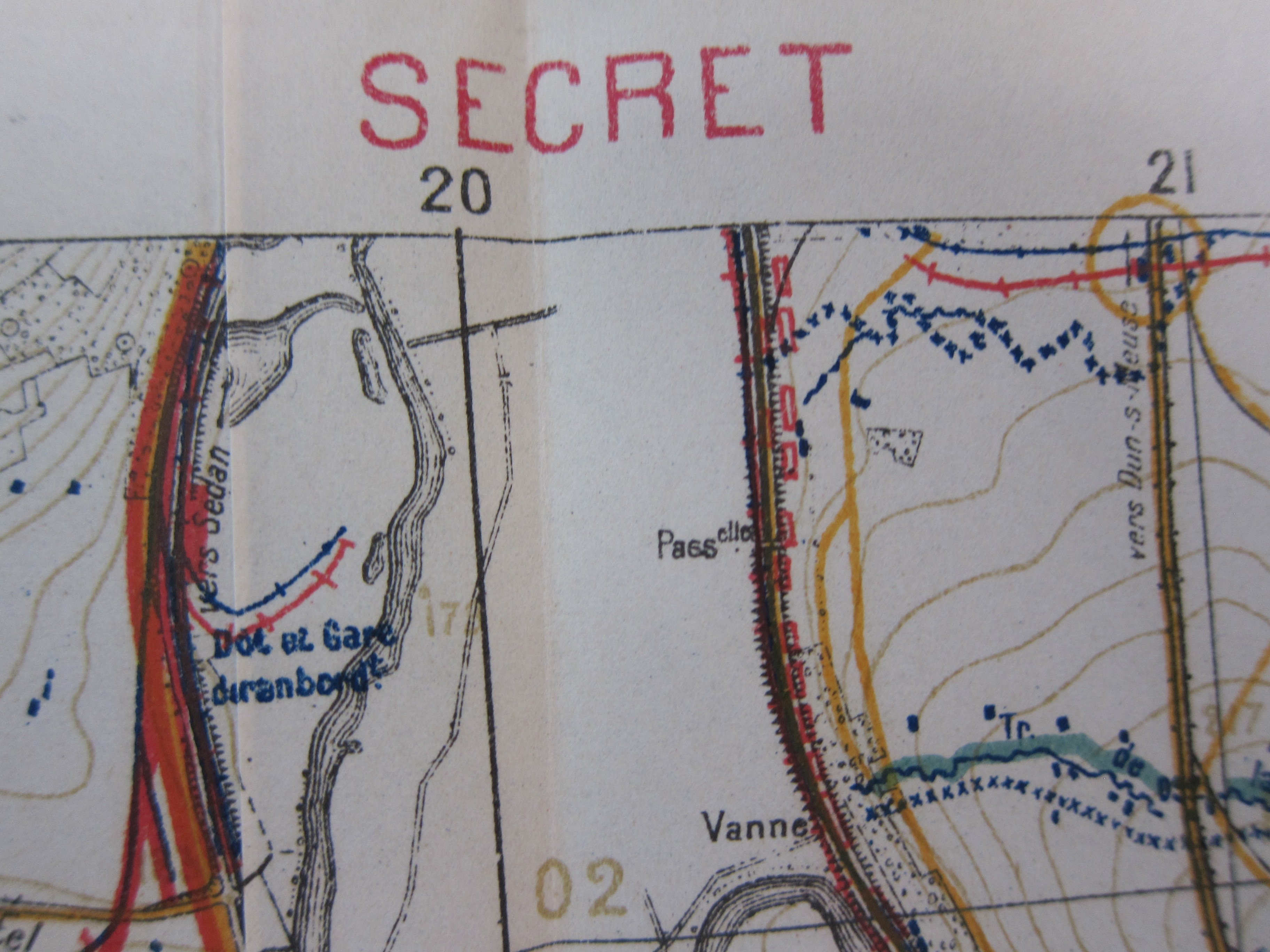
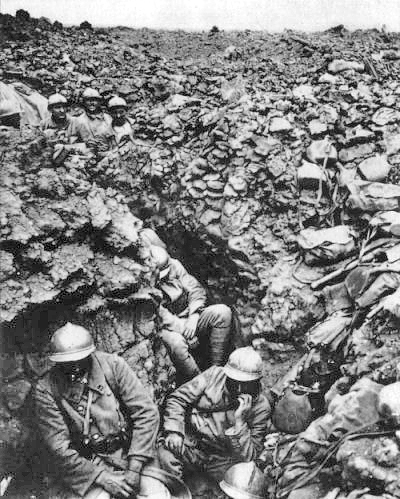
    I was looking through a very heavy volume from 1924 of Military Engineer and came upon a very large folding map1.  It was vanilla on the outside and stayed so, opening only the back of the map through one, two, three, four (!)  unfoldings,  not yet revealing itself, until it was at it full width, and then unfolded once down, which opened to the middle of the map, which was a mass of lines and shading of brown and gray.  Another unfold up, and then another down, and more of the same, so much detail that the context still was hidden. I unfolded the bottom half of the map three more times and at the bottom was the town “Regret”.  My right hand obscured the name of the much larger and antique-fortified town, which turned out to be the military-sacred city of Verdun.  When I unfolded the top of the map–making it about four feet long–I saw that it was for development of the battle and lines of communication and placement of troops and so on for part of the Autumn of 1918. And trenches.  

    (This was actually “Verdun B”, the mate of “Verdun A”, which together form a huge and wildly complex 4×4′ map. )

    IMG_6843

    This was a reprint six years later of the 34th edition of this particular map–that is a lot of editions.  But this was a lot of place, Verdun.  A fluid place of ordered killing chaos that was as dynamic as it was occasionally static, starting in a very contained space of massive fighting that took place from 21 February to 18 December, 1916. The map is of a place that was about the longest, costliest, and deadliest battles that humans have come to, so far.   Casualties were about the same on each side (370,000 French and 340,000 German) and totaled about 710,000 people, though scholars argue the point, some coming to a figure much higher, approaching a million.  That makes 70,000-100,000 per month for the battle, which was like a war in itself. 

    There were probably two million soldiers in motion here, at Verdun, in a relatively tiny area, with front lines extending about five miles or so, the battlefield being fairly narrow from point to point, perhaps totaling 20 square miles of heavily bombarded/shelled ground.  It was a terrifying place to be, and I’m certain that it must have scarred forever hundreds of thousands who survived the ordeal.  

    IMG_6844

    Unfortunately Verdun 1916 was only about the half-way point of the war, with these maps generated to show artillery targets for the American entry in the war for action that would take place just before the end of the war on the 11th hour of the 11th day of the 11th month of 1918. This was the French Fourth Army and the American First Army which attacked on a front from Moronvillers to the Meuse on 26 September 1918 through the end of September, and from which the German army began its gradual withdrawal from the area, continuing right up to Armistice Day.  

    Ultimately whenever I think of this war things usually boil down to Dalton Trumbo’s Johnny Got his Gun, which was required reading in my freshman year of high school in 1970.

     Verdun


    Notes:

    1.  Journal of the Society of Military Engineers, volume 16, 1924; the map titles are “Tranchee Francaise schematique a la date de 1er Sept 1918″ and “Carte Generale des Objectifs d’Artillery”.  


  • The Endless Immensity and Finite View of the Infinite of Thomas Wright, 1754

    JF Ptak Science Books   Post 2064
    Follow Me on Pinterest

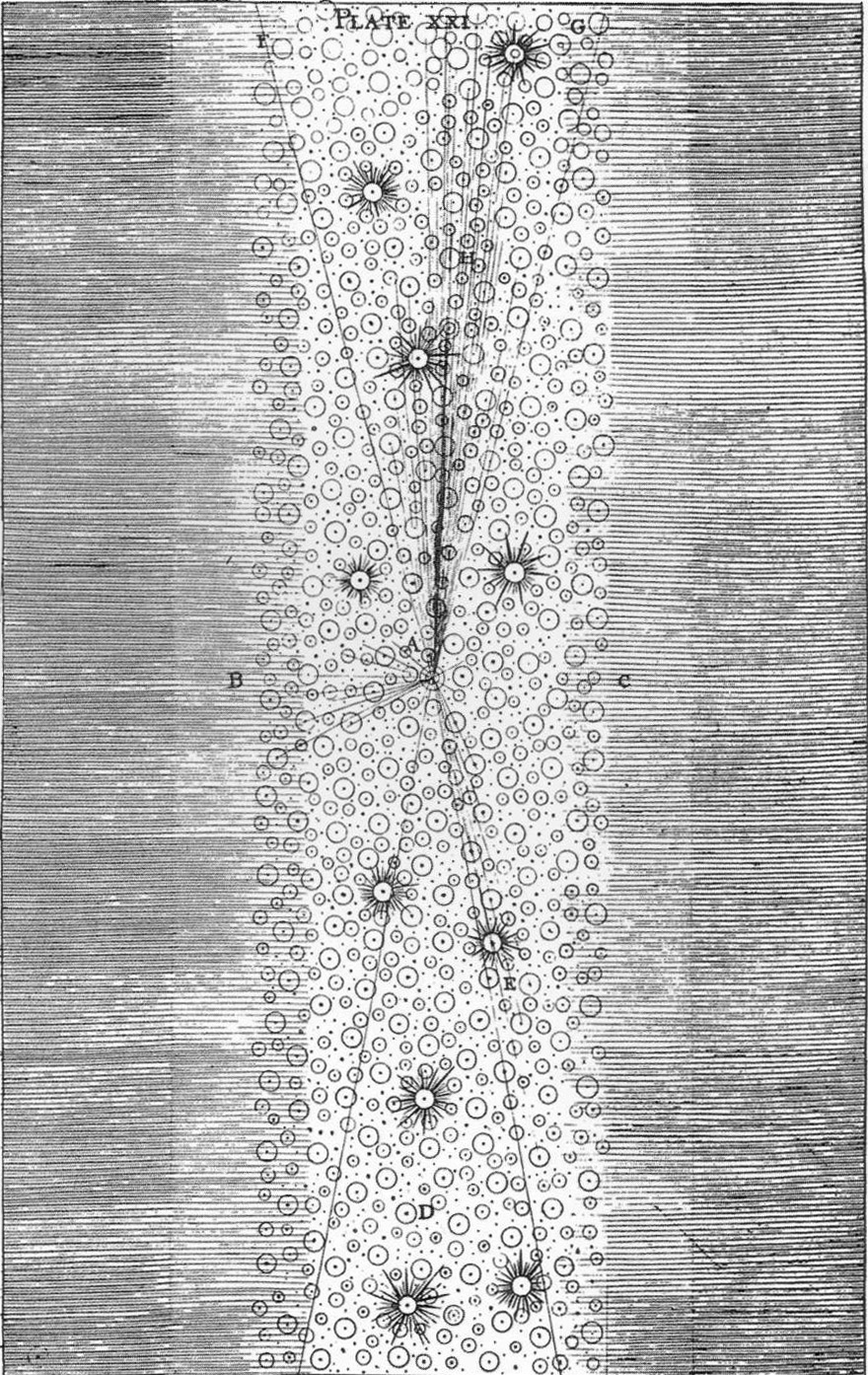
    Thomas Wright (1711-1786) saw about as deeply into the deep as just about anyone else–he looked into the night sky and pretty much saw all of it. In his book, An Original Theory or New Hypothesis of the Universe, Founded upon the Laws of Nature1, he described a version of the universe that was influential in the thinking of Kant and Herschel, finding a rectangular/squashed “finite infinity” of stars, “a vast infinite Gulph, or
    Medium, every Way extended like a Plane,
    and inclosed between two Surfaces”.

     
    Wright thomas [plate 23

    Our Milky Way, which at the time was thought to be the entire universe rather than a galaxy as it was later discovered to be–one galaxy in a seemingly endless sea of galaxies–was presciently seen by Wilkins as being but one assembly of stars in an “endless immensity” of stars:

    “And farther since without any impiety; since
    as the creation is, so is the Creator also magni-
    fied, we may conclude in consequence of an in-
    finity, and an infinite all-active power; that is
    the visible creation is supposed to be full of si-
    derial systems and planetay worlds, so on, in
    like similar manner, the endless immensity is an
    unlimited plenum of creations not unlike the
    known Universe.”–page 143. (Again, the “Universe” eferred to here is the Milky Way galaxy.)

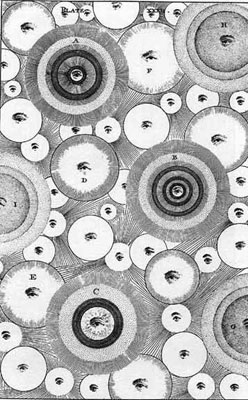
    Wright’s vision of this plethora of Universes, in which each creation is one like the Milky Way–a radical thought in 1750:


    Wright 32

    [Part of me wants to include the first Wright engraving in this blog’s series on the History of Lines, seeing as how they represent the great Something that seem to be infinitely binding the infinity of universes…]

    Wright also writes on the minuteness of the human condition, of the perfect sense of nothingness that is the Earth in a sea of infinite possibilities of other earths and earthy creations, which was definitely an outpost of thinking in 1750:

    “In this great celestial creation, the catastro-
    phe of a world, such as ours, or even the to-
    tal dissolution of a system of Worlds, may pos-
    sibly be no more to the great author of nature,
    than the most common accident in life with us,
    and in all probability such final and general
    doom-days may be as frequent there, as even
    birth-days, or mortality with us upon the Earth.
    This idea has something so cheerful in it, that
    I own I can never look upon the Stars without
    wondering why the whole world does not be-
    come Astronomers; and that men endowed with
    sense and reason, should neglect a science they
    are naturally so much interested in, and so ca-
    pable of enlarging the understanding, as next to
    a demonstration, must convince them of their
    immortality, and reconcile them to all those lit-
    tle difficulties incident to human nature, with-
    out the least anxiety.”–page 132


    Notes

    1.  The full title:  An Original Theory or New Hypothesis of the Universe, Founded upon the Laws of Nature, and solving by Mathematical Principles the General Phenomena of the Visible Creation ; and particularly the Via Lactea. Comprised in Nine Familiar Letters from the Author to his Friend. And illustrated with upwards of thirty graven and mezzo-tinted Plates by the best Masters. London, MDCCL.” Full test, here.

     2. An odd note about Thomas Wright’s personal history, from Science, 1902: “A word, in passing, about Wright. Like many another, so unfortunate as to live ere the
    times were ripe, he has been consigned to unmerited oblivion. Even the writer of the entry upon him in the ‘ Dictionary of National Biography ‘—a work so uniformly accurate — is unaware of the sources from which information could have been obtained, and so has nothing to tell, — does not even know the dates of his birth and death, or why he was called ‘of Durham.”–[Science, N. S. Vol. XIII. No. 321. 2-22-1902

    An interesting poem by Rafinesque to start of his edition of Wilkins:

    “Where ends the range and limits have been set
    To mortal eyes, there mental sight begins
    To fathom space, and worlds invisible
    Surveys, admires
    The mind must feel that space can have no bound*,
    Whatever number be of things or thoughts
    Others may be beyond—and thus behind
    The Nebulas and Belts, our Galaxies
    Of stormy clouds and oceans
    There stands the central land and throne
    Of our wide Universe, the home of Angels,
    The seat of Love Divine”
    Rafinesque, Poem on Instability, found at the beginning of Rafinesque’s 1837 American edition of Wright’s 1750 work. 


  • History of Lines–Big Lines, June 1944

    JF Ptak Science Books   Quick Post 

    DDAy lines

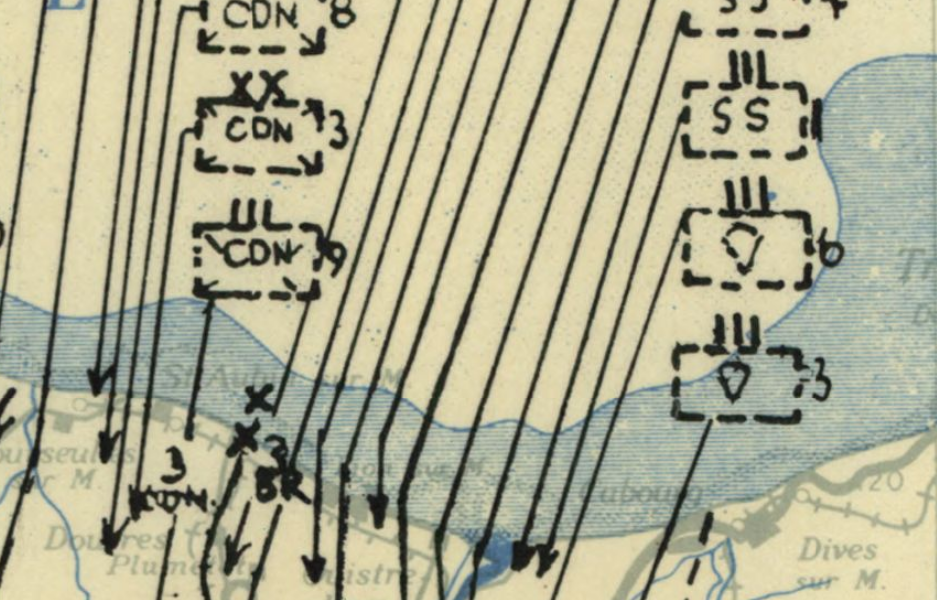
    [Source:  the Library of Congress, here.]

    The idea of being on the receiving end of these lines on 6 June 1944 is terrifying.  General Rommel pretty much figured out what was going to happen, and sort of when it was going to happen, but he was kept out of the strategy loop even though he was in charge of the German defences here, unable to convince Hitler to move men and machines southward to meet the invasion where he thought it was going to come rather than strengthen the position of defence in a place where he knew the invasion wasn’t coming, which was Pas de Calais. The pull of war by this time had destroyed the Luftwaffe, and German high command had been destroyed by Hitler–or at least communications and straegy within the command system of the German army was very highly compromised.  In any event, once the invasion had begun, there was not much hope for the Germans–it had been a complete surprise, with the huge efforts of misdirection playing themselves out beautifully. So beautifully, as a matter of fact, that once the invasion was well underway it was still a matter of no small debate as to where the “real” invasion would take place.  Even after the airborne divisions began landing some hours before the assault began, it was only the elderly and problematic General von Rundstedt who reacted appropriately, believing that the airborne assault was far too large to be a feint, and ordered two reserve panzer divisions to Normandy.  the amount of men and materiel moving onto Normandy was gigantic, impossible, overwelming, as some part of this map makes clear. 


  • The Mathematical Garden–Alexander Pope and Found Geometries

    JF Ptak Science Books (Revisiting an earlier post from 2008 with a added details).

    Blogdesirepope

    While sitting at the edge of a stream in a flowing dress and shading herself with a yellow parasol, my wife and  the jewel in the crown, the brilliant Patti Digh, wrote a superb essay on following the paths less marked. (Maybe I’m making up the parasol bit. And the stream. And flowing dress.) I’ve always been a happy observer of found geometries, and her essay heightened my awareness to them, along with the conscious efforts that we may daily make to enforce these lines or follow a new, multi-dimensional geometric path. 

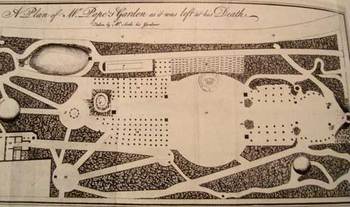
    So when I stumbled across this map of Alexander Pope’s garden and noticed the odd paths  winding their way through it, and  how much in contrast this was to the very sniffy upper  crust English garden of the 18th century, Patti’s essay  lit instantly to mind—and also because in addition to being a geometer of emotion and thought she was in a past life a U VA English Master. 

    Pope’s garden was an irregular path in an irregular garden, that garden being his leased property at Twickenham, where he came to live in 1717, along with his mother and his boyhood nurse, Mary Beach, and his dog Bounce. 

    Pope’s garden was an irregular path in an irregular garden, that garden being his leased property at Twickenham, where he came to live in 1717, along with his mother and his boyhood nurse, Mary Beach, and his dog Bounce.  (Actually that would be a series of dogs as he named them all “Bounce”.)  Pope was a poet and satirist and critic and general taste-maker-the social influence extending even to garden-making, as his was famous even during his lifetime, and not for the reasons that most English gardens were famous.
    Blogdesiregeometrical_4

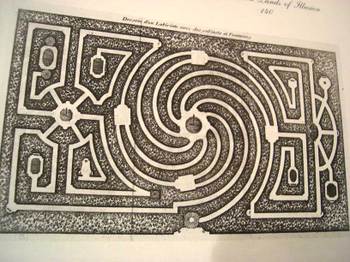
    His was not the planned regularity of the gentility (and far of course  from the suffocating, critically flawed gardens at places like Versailles,  “Is there anything more shocking than the regularity of a planned  garden?” asks Batty Langley in his New Principles of the Gardening… 1728), and were removed from the “normal”, more articulated garden.  I’ve never really understood the formal garden, especially as it relates  to the ancient analogies of gardens and paradise-the Garden of Eden, Pliny’s Garden of Venus, Lucretius’ Earthly Paradise, seem as though  they might be some sort of paradisical thing (though we won’t address  Bosch’s Garden of Earthly Delights) , but the formal gardens and its  paradise relationship seems odd, what with the removal of nature’s “chaos” and all, unless that was indeed the Master Plan.

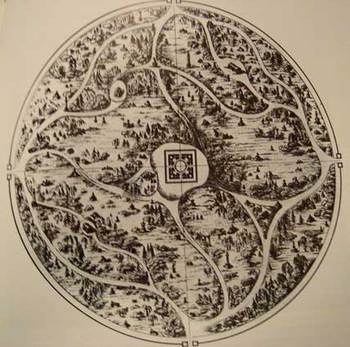
    But the mathematical garden was a desirous thing—still is—and none  other than Christopher Wren wrote that it was “naturally more beautiful than any irregular figure” (1750).  There were some critics of the math garden, like Mr. Langley, but most garden  designers wrote and argued in favor of it, coming to the similar  conclusion of John Dennis, in that the Universe, being “regular in all its parts”  would dictate that its beauty be found as regular  in other things too,  “and it  is that exact regularity that [the mathematical garden] owes its admirable beauty” (1704). 
    Pope didn’t seem to address (in print) the garden idea formally except for a few places–  Pope praised ‘the amiable simplicity of unadorned Nature’ in a famous essay, published  in The Guardian in 1713, and then again in his message to Burlinton in 1731.

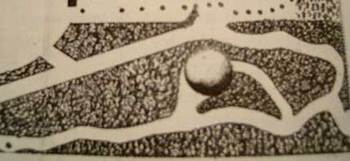
    Blogdesirepopedetail_3

    The plan of Pope’s garden was somewhat irregular, but to me the  most appealing aspect was  the irregularity of the paths that curled and snaked their way through the garden. 
    And particularly,  what about the lower part  of the path along the bottom of J. Serle’s 1725 engraving?  What was that path in Pope’s garden  leading to, or from?  Was there a particularly nice tree there, a  favorite spot, a cool shade, an odd bit of sunshine at sundown?  Or was this  wall-clinging path just the workman’s route? 

    Perhaps these weren’t Pope’s principal desire lines in the garden—in fact, the garden desire lines  weren’t the garden at all— they might’ve been under it.  Pope’s famous grotto at Twickenham  may be better known than his garden-it certainly sounds  much more interesting. Followed his  own desire line, underground, in his famous grotto, which he began to build shortly after arriving at  Twickenham, and which was still under construction at the time of his death. 

    The unseen desire lines of  Alexander Pope seem more fitting to me, more poetic, what with  Pope needing to dig out the earth in order to find what  he was looking for, rather than a more  simple wandering around his fine, rustic garden. 

    Have a look at the materials house in the grotto/cabinet of curiosity here, along with a  commendable plan of the grotto itself.

    Blogdesirecircular