A Daily History of Holes, Dots, Lines, Science, History, Math, Physics, Art, the Unintentional Absurd, Architecture, Maps, Data Visualization, Blank and Missing Things, and so on. |1.6 million words, 7500 images, 4.9 million hits| Press & appearances in The Times, Le Figaro, Mensa, The Economist, The Guardian, Discovery News, Slate, Le Monde, Sci American Blogs, Le Pont, and many other places… 5000+ total posts since 2008.

Category: Information, Quantitative Display of

  • The Dust of Imaginary Robots, the Frame of Being, and All That

    JF Ptak Science Books  Quick Post

    Books aktenstaub453

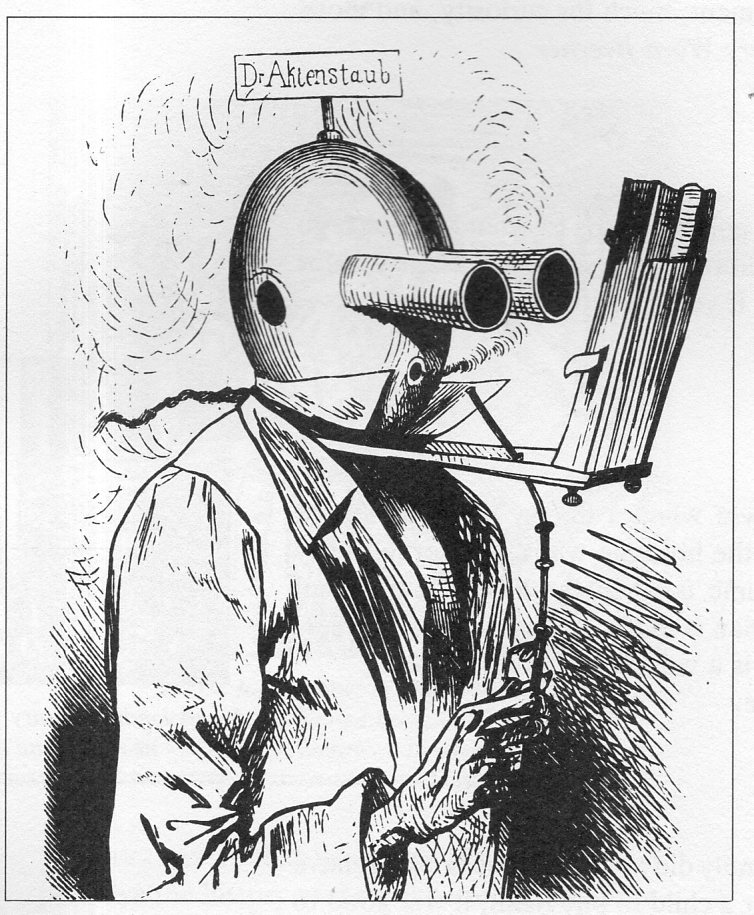
    This fine illustration with the wonderful helmet does look like some sort of 19th century robot, but seeing the little sign at the pinnacle–“Dr. Aktenstaub”–identifies this as an antiquarian antiquarian being shielded from the dust of accumulated and lonely wisdom. “Aktenstaub” is a wonderful word which identifies the smallest bits of existence: dust.  But “dust” is much more poet and involved than that, with this “aktenstaub” relating to the old dust of old books, and so the helmet protects the reader from the weight of dusty ages.  The horizon for the idea of dust is far and wide, though, as a walk through the Oxford English Dictionary attests.  Describing dust seems more varied than the description of a book itself, or the identities of snow…the dust of organ pipes being different from that of wooden floorboards or corn husks or weary dust of travel on a long duster the dust of the cosmos; it describes a condition of humiliation, cash, disturbances of different sorts, and of course the “mortal frame of man”, and seems to have a seat at a very long table of possibility, which is remarkable for such a small and unassuming word. The entry for dust is quite long and involved, and is followed by a longer list of dust-compounds, where things get really interesting.  Dust-blister, dust-core, and dust-spawn are good examples of the long road of dust-possibilities.  And so far as “aktenstaub” goes, it gives the idea of antiquarian book dust a personality as vibrant as fairy-dust, and so is perfectly fine with me–it is hard to go wrong, sometimes, with definitions of words that enrich the imagination more so than limit it. 


  • Dialing Remote Live Music–a Trip into the Future, 1892

    JF Ptak Science Books   Quick Post

    Theatrophone

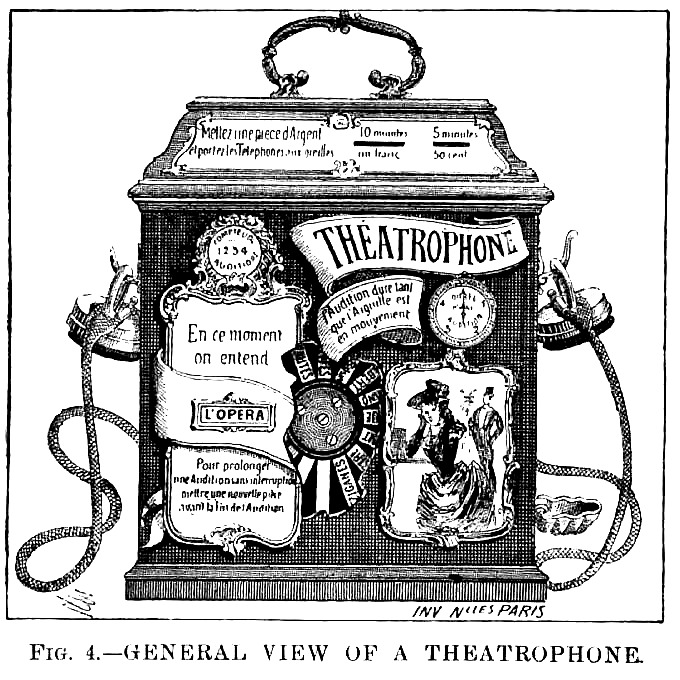
    There is a veyr interesting period in the history of thought transmission where answers were coming together–they were interesting technological answers in the steps towards mass broadcast that were fruitful for the time and capacity but which were ultimately overtaken by other events.  Such is the case in this case of early “radio” transmission, with the popular introduction of a device called the “Theatrophone”, explained in this article in the Scientific American for July 2, 1892.  The device was a telephone-like device that allowed people to listen to live performances of opera/symphony remotely–for a modest fee of one franc for ten minutes or half a franc for five minutes.  There was also a dial to select the sort of entertainment you wanted if there was a selection available, which you can see in the semi-cutaway in the image above (with “opera” being the selection).  I feel that the first exposure of this device to a general audience in 1892 would have been an astonishing next-step in the development of a new medium, like being exposed to the internet while only having known television. 

    The Theatrophone makes its big appearance in La Nature and Scientific American at a time of dynamic change in the development of radio. Elements of radio were established by Faraday (1831), Henry (1842), Maxwell (1864), Houston (1871), and Hertz (1888)–the experience in the 1890’s was different, with wireless transmission  nearly established, and with Elihu Thompson, Wm Crookes writing in 1892 about the possibility of this capacity in “Hertzian Waves” and with Tesla, FitzGerald, Lodge, Dolbear and other giant names saying in 1893 that sound transmission would soon be accomplished.  Marconi’s patent would be issued four years later in 1896, and by the end of the century and into 1902 there are reports of trans-Atlantic transmissions by Marconi and Fessenden.  But back in 1892, the Theatrophone offered a glimpse into the near-future, allowing people to listen to live entertainment, remotely. 

    • The Scientific American article is reproduced in full at the Radio History website, here: http://earlyradiohistory.us/1892the.htm

  • Window Shopping for Food and Haircuts with Berenice Abbott, 1935

    JF Ptak Science Books  Blog Bookstore

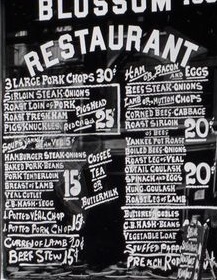
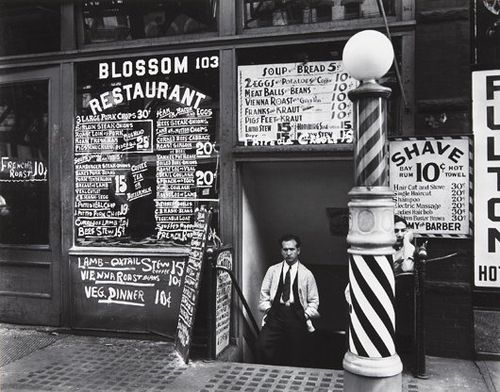
    I enjoy antiquarian window shopping, browsing photos or engravings that depict goods for sale– especially if the prices are posted. I came back to this deep-in-the-Depression-fantastic photo made in 1935 by Berenice Abbott (Springfield, Ohio, 1898-1991). Blossom Restaurant, NYC was part of Abbott’s effort funded by the WPA, this time as a part of her Changing New York Project, and captures the restaurant and neighboring barber shop at 103 Bowery.  The two businesses actually occupied the first floors and basement (respectively) of the Boston Hotel, a standard flop house in a tough and distressed part of the city that rented beds by the day, with 249 small door-less cubicles offering a decent place to spend the night for 30 cents1. 
    Abbott[Image source: New York Public Library, http://digitalcollections.nypl.org/items/510d47d9-4f80-a3d9-e040-e00a18064a99   Also a nice description of the photo and process can be found at the National Museum of American History, http://americanhistory.si.edu/collections/search/object/nmah_1321971]
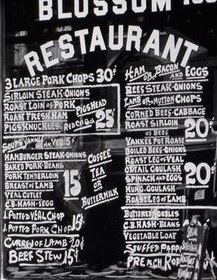
    Abbott Blossom restaurant menu detail

    30 cents seems to be the going rate for a bunch of things going on in this  picture—30 cents for a night in the hotel, 30 cents for the better offers of Morris Gordon’s restaurant. 30 cents for a haircut and shave, 30 cents for a “women’s hair bob”2 and so on.  Which seems about right—a fancy haircut and a decent better-than-average dinner for two will probably cost about the same, today. 

    If you were really on a tight budget, 30 cents would buy you three vegetarian dinners, or 6 offerings of bread and soup, or three visits to the table of meatballs and bans, or pigs feet and kraut. 

    The price of a stick-to-your-ribs meal of sirloin and potatoes and a pot of coffee also cost about the same as a gallon and a half of gasoline (which cost about 20 cents).  The same amount of gas today would get you a serving at McDonalds, or something on that order, and perhaps even a happy take-away for the kids. Perhaps the two even out. 

    30 cents might get you a loaf of bread, and wouldn’t quite get you a dozen eggs.  Now this is remarkable, because if you adjust all of this according to modest CPI measures, the average cost of a dozen eggs in 1935 was 37 cents, or (according to the US Census website generating 1935 to 2009 prices adjusting to CPI) $5.84.  The bread would cost $4.74 in 2009 dollars, which means that the staples today—milk, bread, butter, eggs, were more expensive in 1935 than today.  Ditto gasoline, which cost 19 cents a gallon, or $3 today—actually this would be much more expensive in 1935 as the mileage the cars were getting then (and the octane) was much lower, so the cost of running an automobile was considerably higher.   The cost of the car itself, though, still favors the ‘thirties for modest transportation, which came in at about 600 dollars, or just over $9000 in 2009 dollars3. 

    The 3-cent first class postage stamp of 1935 was more expensive than first class postage in 2009:  47 cents versus 44.  When you look at the increases and bitty spikes of the cost of a first class stamp over time the whole thing looks pretty flat. 

    The average salary for a family of four in 1935 was about 1500/year, which oddly enough is about the same for the poverty guideline level for 2009 established by the Department of Health and Human Services (about $23,000).  Minimum wage legislation didn’t begin until 1938, but if you take a look at one of my earlier posts here on the history of this idea you’ll see that the recent history of legislating  a meaningful level of acceptance for a base living wage is mainly disgraceful, with relatively little accomplished (in adjusted economic terms) for half a century.  (The new minimum wage brings us to about a mid-way point as the highest minimum wages paid in the 76-year history of the program.)

    Notes

    1.A fantastic website and resource for changing aspects of NYC can be found here, at Frank Levere’s Changing New York site. http://www.newyorkchanging.com/

    2. I wrote a little bit about the appearance of women-only hair salons in my post “The Staggering Beauty of Barber Shops” https://historyofideasblog.com/thesciencebookstore/2009/02/the-staggering-beauty-of-barber-shops-naive-surreal-department-22.htm

    3. Other bits of what stuff cost in 1935:

    • Flour (5 lbs)     25.3 cents
    • Bread (lb)         8.3
    • Round steak (lb)  36.0
    • Bacon (lb)        41.3
    • Butter (lb)       36.0
    • Eggs (doz.) 37.6
    • Milk (1/2 gal.)   23.4
    • Oranges (doz.)    22.0
    • Potatoes (10 lbs) 19.1
    • Coffee (lb)       25.7
    • Sugar (5 lbs)     28.2
    • Car: $580
    • Gasoline: 19 cents/gal
    • House: $6,300
    • Bread: 8 cents/loaf
    • Milk: 47 cents/gal
    • Postage Stamp: 3 cents


    And 103 Bowery, today (via Google Earth):

    103 Bowery


  • Can You Find the Ancient Death Ray of Death? Symbolism in the Garden of Mathematical Sciences (ca. 1670)

    JF Ptak Science Books   Post 2689

    Mathematical Garden Curti[Image: Metropolitan Museum of Art, http://www.metmuseum.org/collection/the-collection-online/search/359981?rpp=30&pg=1&ft=mathematics&pos=15]

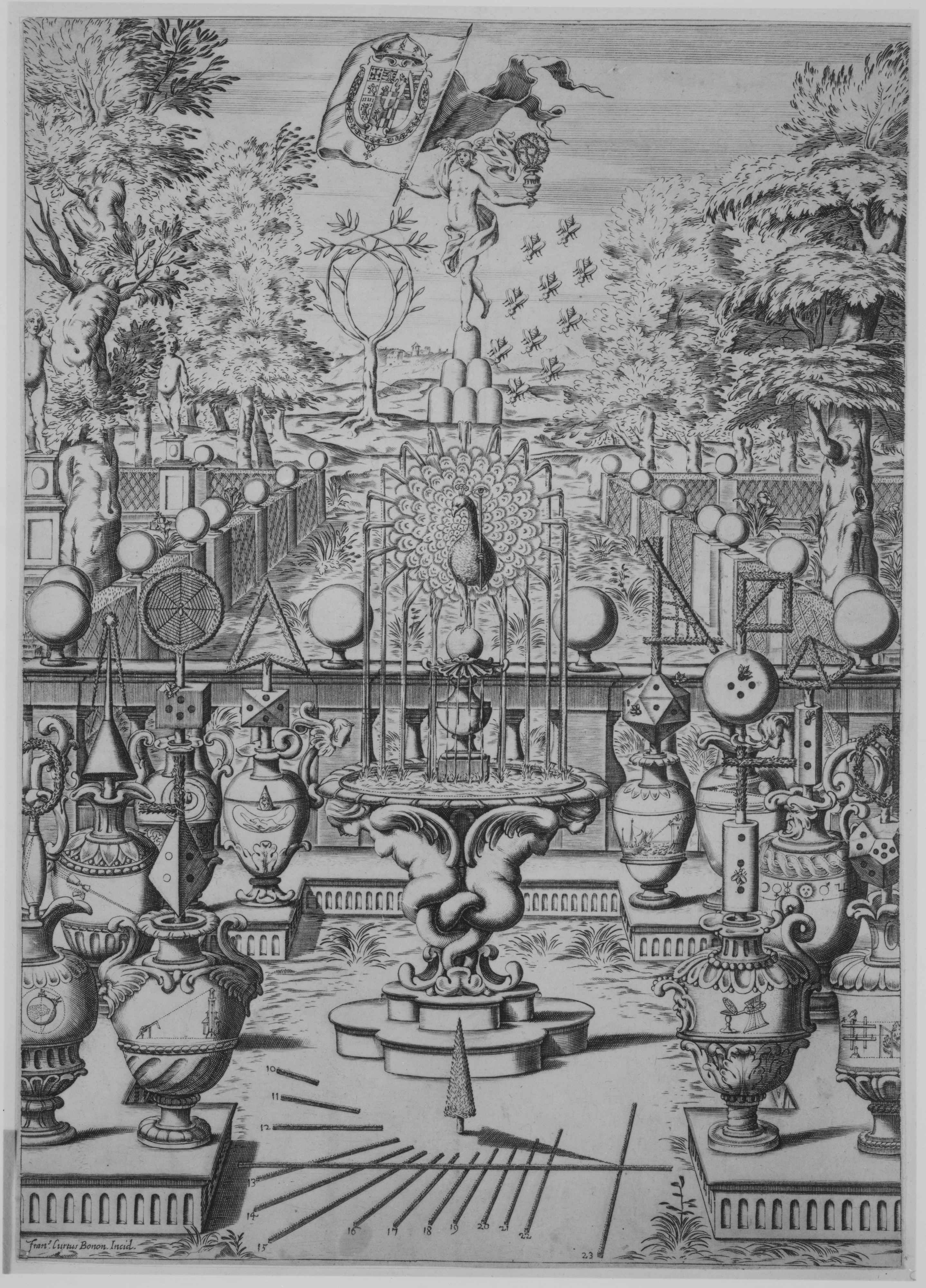
    This fine allegorical image is the creation of Francesco Curti (1603-1670), and according to the Metropolitan Museum of Art it is called “The Garden of Mathematical Sciences”, and was printed ca. 1660.  There’s a lot of objects in this print, and it seems that perhaps most of them have a scientific application.  It is an interesting exercise to identify them–I’ve found quite a few, though not all, how many can you identify? 

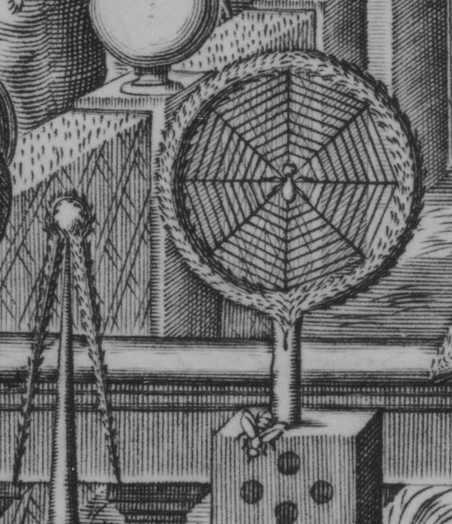
    In the garden there are a geometrical spider, bees, proportional dividers, sundials, anamorphic images, the eye of god in a peacock display, Mercury, Archimedes’ death-ray mirror, navigational instruments, and no doubt much more, displayed and semi-hidden. For example, I think this is the well-known “geometrical spider” (middle far left), as seen in Mario Bettino’s Apiarium philosophiae mathematicae (Bologna, 1645):

    MATHEMATICAL garden spider

    Then there’s this classic image of the peacock, which through the history of Christian art has come to represent the concept of activity, resurrection, immortality–it has been used as a representation of Christ (in paintings like Fra Angelico’s great circular nativity painting, for example).  In the Curti print, the peacock is holding a staff with an eye in it, which is probably that of god; the peacock stands on one leg, balanced with the eye staff, while the rest of the symbolism is filled by having an ever-flowing fountain flow from its feathers. 

    There are no doubt more to be found–there’s the timepiece in the foreground, numerous outlines of scientific instruments as garden plants, a demonstration of the optics of convex and concave lenses, and others.  Have a look!  Follow the link to the Metropolitan and open the very expandable image. (SOme answers, below)


  • A Fine Locomotive Schematic, 1928

    JF Ptak Science Books  Quick Post


    Roundhouset1 

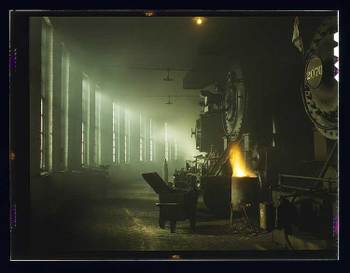
    I’ve admired this image for quite some time, finding it in the Library of Congress’ collection of the Historical Section of the Farm Security Administration (FSA) color photographs.  It is anonymous, unfortunately, but since there were really only 23 or so staff photographers for this gigantic undertaking (including Esther Bubley, Marjory Collins, Mary Post Wolcott, Arthur Rothstein, Walker Evans, Russell Lee, Jack Delano, Gordon Parks, Charlotte Brooks, John Vachon, Carl Mydans, Dorothea Lange, and Ben Shahn, ten of which are truly monumental names in the history of 20th century American photography) I think that we could guess that it was done by the hands of a master.  It seems as though less than 2% of the 163,000 or so photographs made by this section during its eight-year run (1937-1945) were made in color, and I’m glad that this was one of them. 

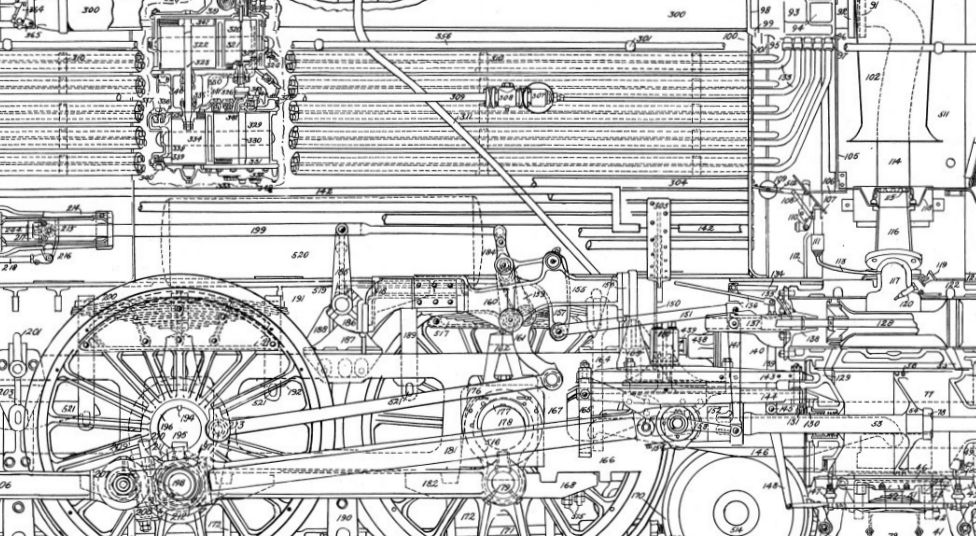
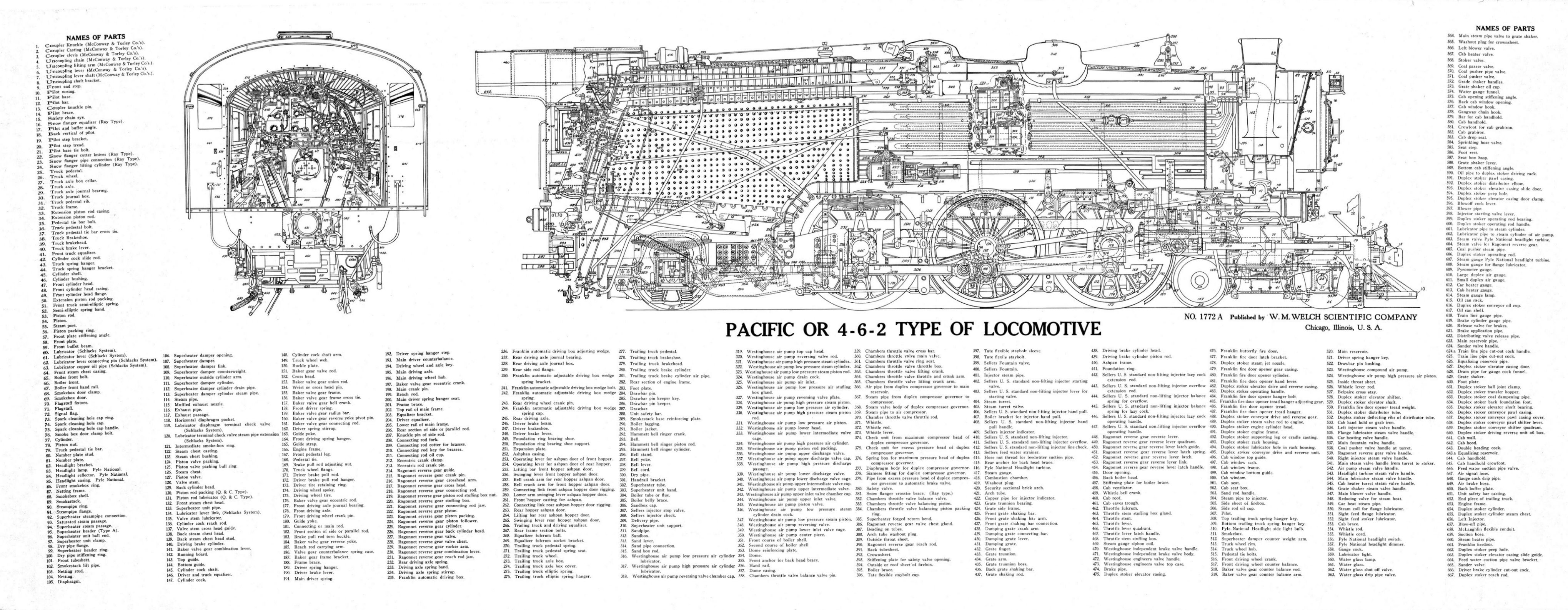
    This photo reminded me of a very detailed, three foot long locomotive schematic that I have in the studio.  It is a wonderful thing, and I’ve included some images of it below, all of which are clickable and very expandable (and clearer).  Here’s the first detail:


    Loco _2_detail

    [For info on the locomotive, see http://www.railarchive.net/alcopacifics/]

    Loco _2

    And the full locomotive, laterally, and large–I couldn’t straighten it out without loss of text, so apologies for the miscue:


  • On the Heightiest Heights of Traffic Height

    JF Ptak Science Books  Quick Post

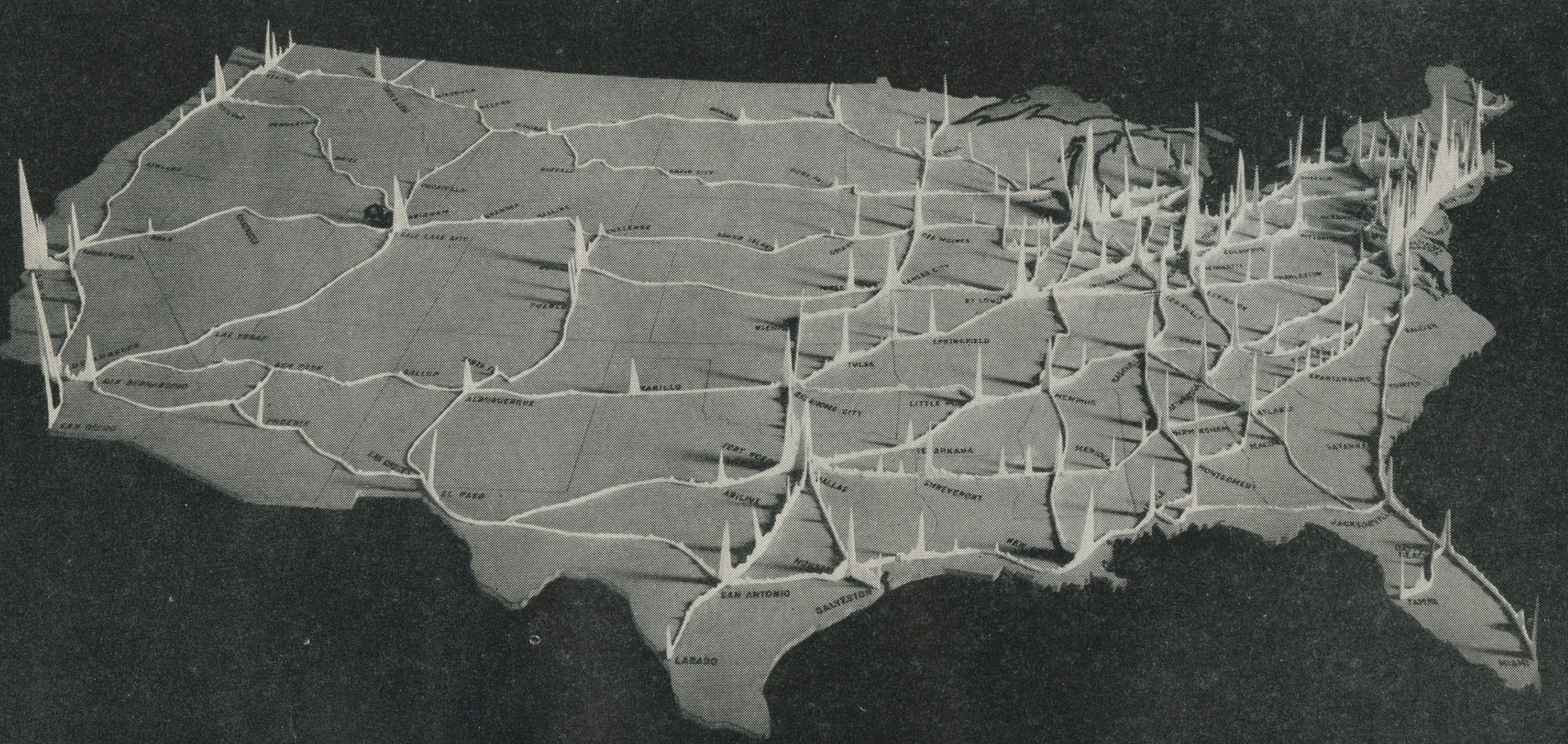
    I found this fabulous map of concentrations of U.S.A. (1944) traffic flow somewhere in the hinterlands. When I started to research its origin I found that the background and story of the map and its source is dealt splendidly by Eric Fischer in a 26-photo Flickr set here: https://www.flickr.com/photos/walkingsf/albums/72157632238833323 


    Map height of traffic

    Map height of traffic

    [Source: Interregional Highways: Message from the President of the United States Transmitting a Report of the National Interregional Highway Committee, Outlining and Recommending a National System of Interregional Highways, January 12, 1944.]


  • Away, Down the Dark Tunnel of Creation….

    JF Ptak Science Books   Quick Post

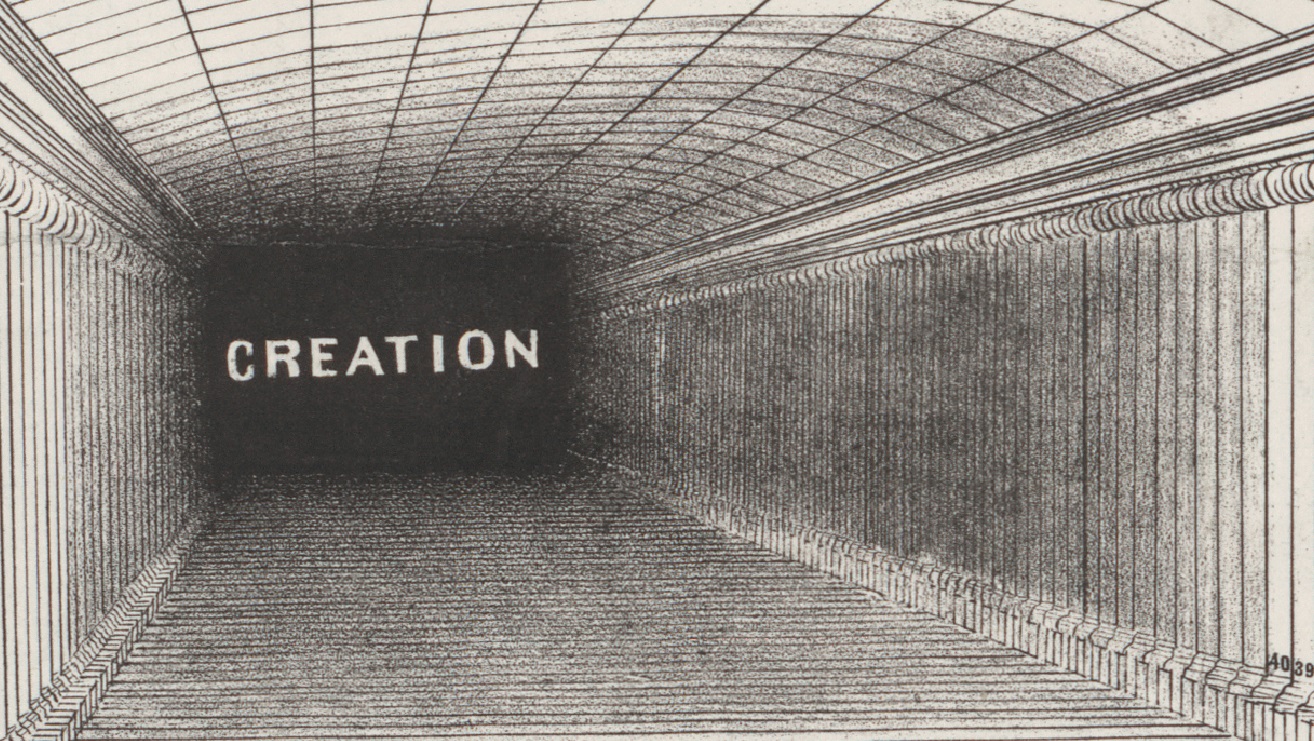
    Infographic Emma Willard detail

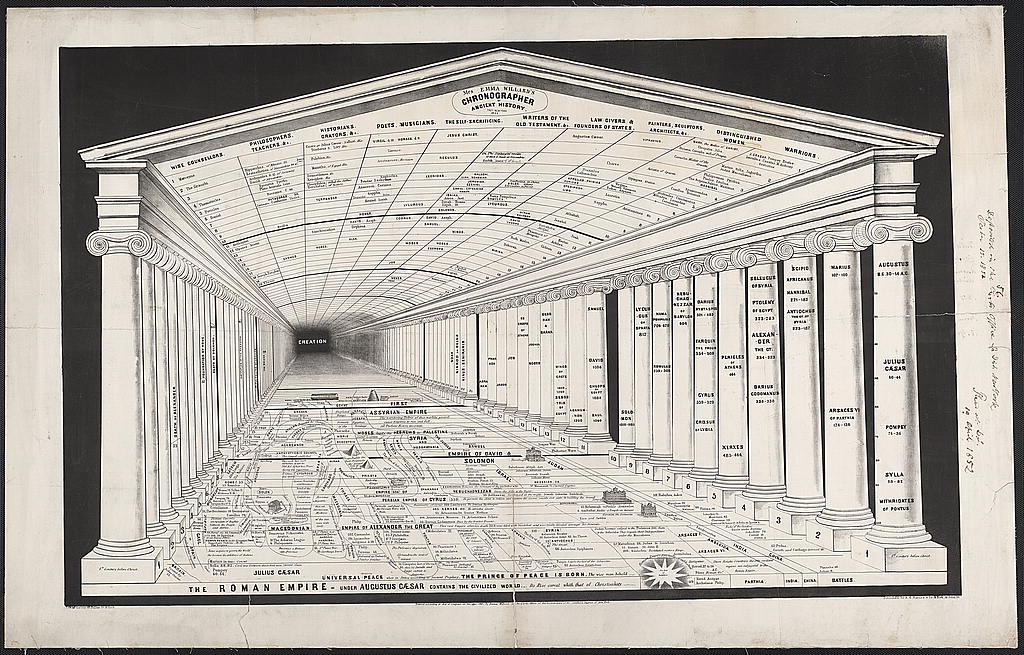
    Emma Willard (1819-1870) has been described as an “apostle” of female higher education in the U.S. She wrote some interesting texts on American history, concentrating in the telling of the story by chronology, and using some interesting visual aids to focus the readers’ attention in a condensed manner. She created several memory palaces in her imagery, making it easier and perhaps more elegant for her readers to be able to more easily record the progression of history.

    The “dark tunnel of creation” here is the background of the events of history housed by an ionic temple–in the original (from the Library of Congress) the word “Creation” is really quite small, and then surrounded by a considerable well of darkness, the millennia slipping by without index or notice, until they don’t. 

    And the full image (images via the Library of Congress, http://www.loc.gov/item/2005694445/):

    Infographic emma willard small version

    (Mrs. Emma Willard’s Chronographer of ancient history, published in Troy, New York, printed by lithography via Sarony of NYC.

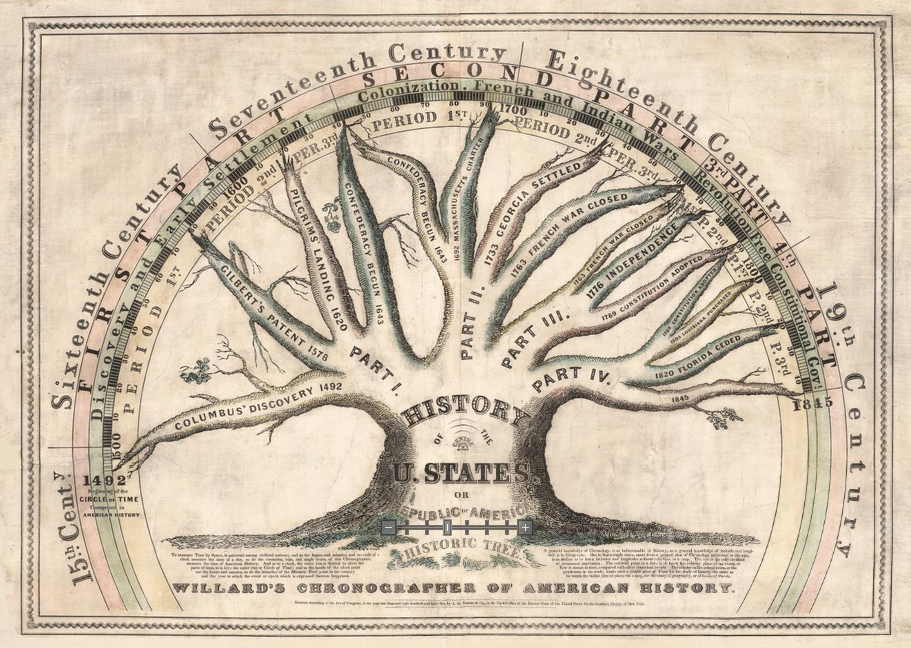
    Emma Willard also produced this beautiful chronological print, meant to be displayed no doubt on a schoolroom wall:

    Willard chronographer of american historyTree of chronology [Source: via DavidRumsey.com maps:  http://www.davidrumsey.com/luna/servlet/detail/RUMSEY~8~1~240521~5512286:Willard-s-Chronographer-of-American?utm_source=hootsuite]


  • A Peep Into the O.S.S. Library Files

    JF Ptak Science Books   Quick Post

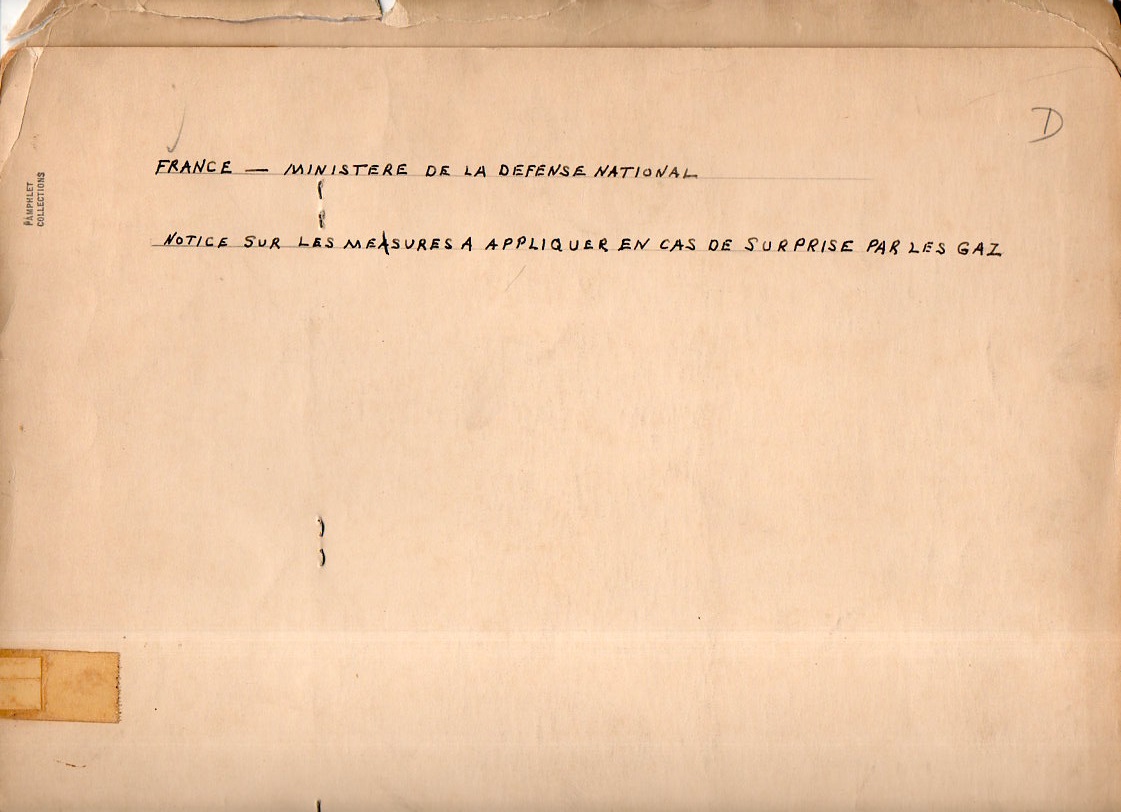
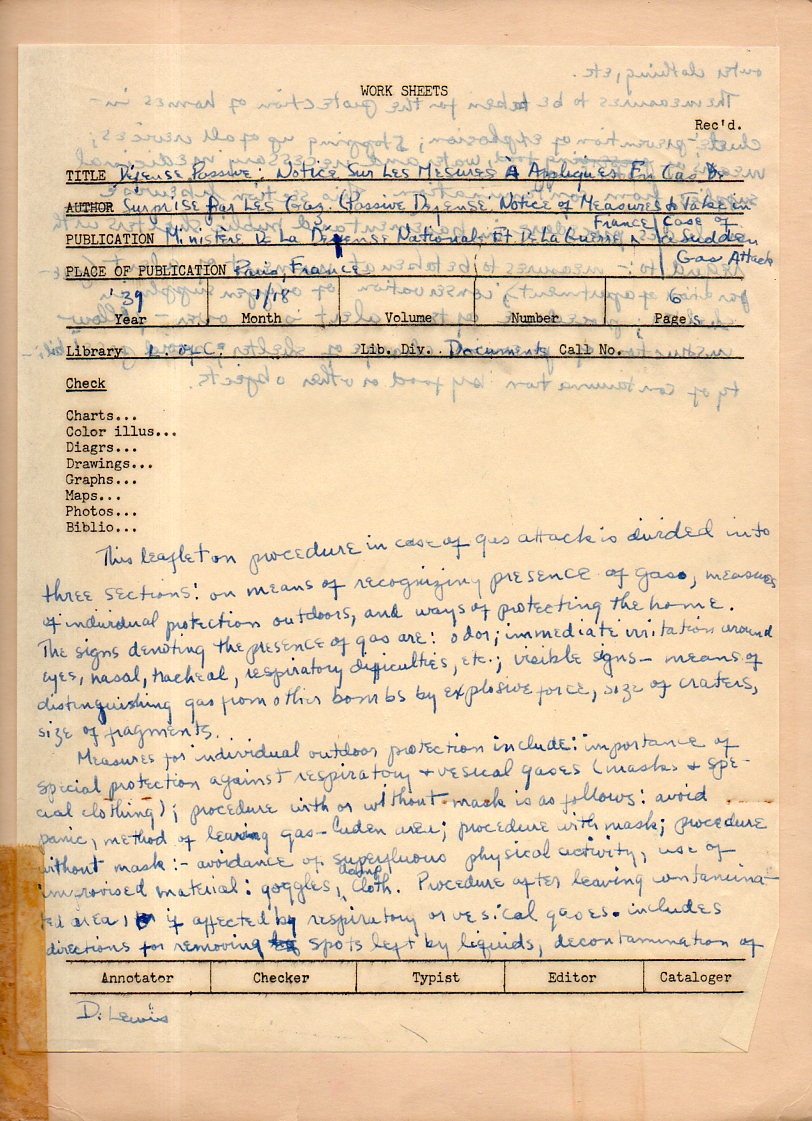
    In the widely-spaced interests of the massive Pamphlet Collection that I purchased of the Library of Congress years ago were a number of items that had once been in the library of the Office of Strategic Services (the O.S.S.), which was the predecessor to today’s Central Intelligence Agency.  Most of the pamphlets were stamped “Library/OSS” as were the foreign language pamphlets, which for my experience were housed in manila folders with internal routing slips.  The example below happens to not have that O.S.S. stamp, though I am sure that it is one among the others–this one though is from 1939, and the O.S.S. wasn’t formed until 1942.

    I’m sharing it here as an example of a small insight into the organizational capacity of the O.S.S. library–it is simply an interesting and thorough classification of ephemeral information. 

    WWII gas attack _a_358

    And inside:

    WWII gas attack _b_359


  • Non-Newtonian-Fable Apples in Astronomy (1854)

    JF Ptak Science Books  Quick Post

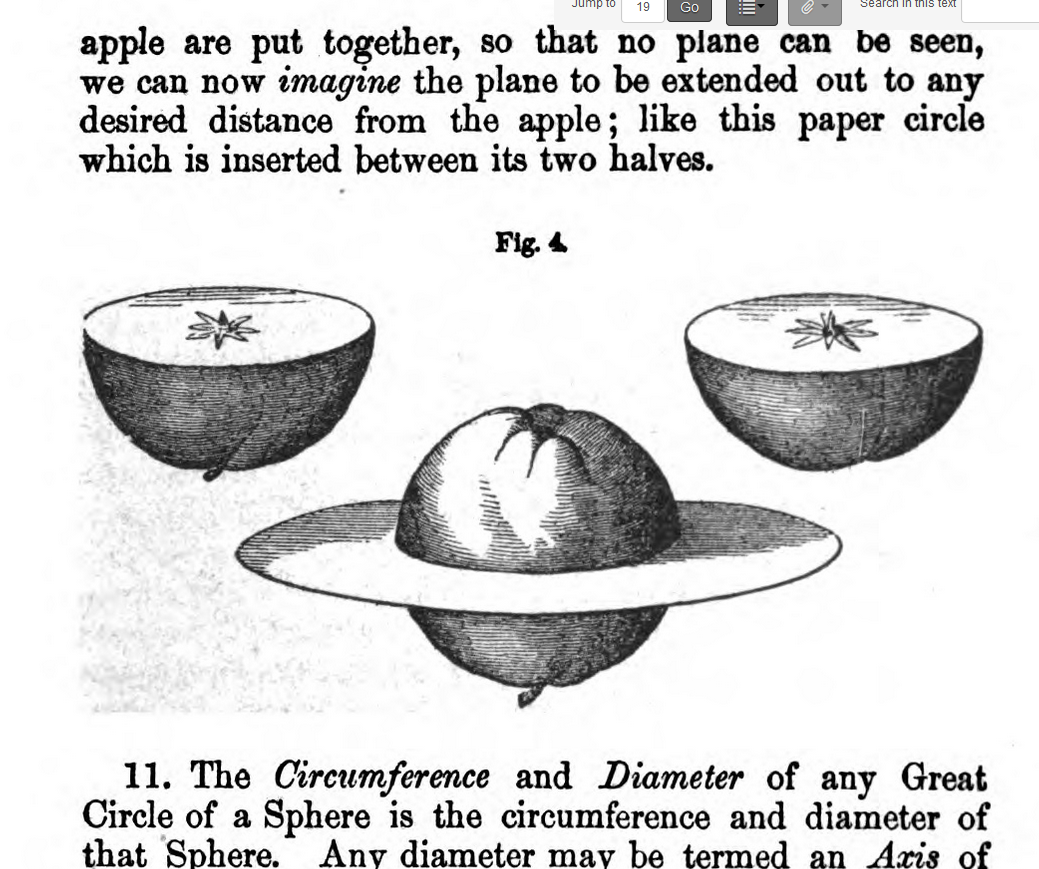
    After all of this time handling/reading/browsing books in the history of science, I believe that I’ve never seen an illustration an astronomy text utilizing an apple to demonstrate the sphere/globe—and here it is:

    Apple astronomy halves

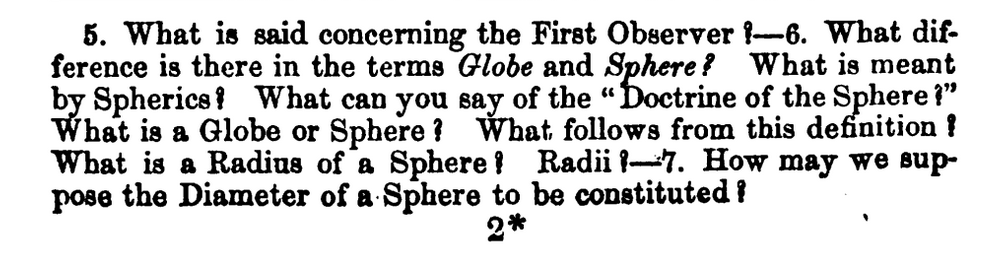
    I thought to include these footnote questions from the page preceding the woodcut because they were so good, and intended for a youthful audience:

    Apple astronomy questionsSource:  Emma Willard, Astronography, or, Astronomical geography, with the use of globes : arranged either for simultaneous reading and study in classes, or for study in the common method, 1854.  http://babel.hathitrust.org/cgi/pt?id=hvd.hnygp9;view=1up;seq=27


  • One of the Most Beautiful Scientific Books of the 19th Century

    JF Ptak Science Books  Quick Post

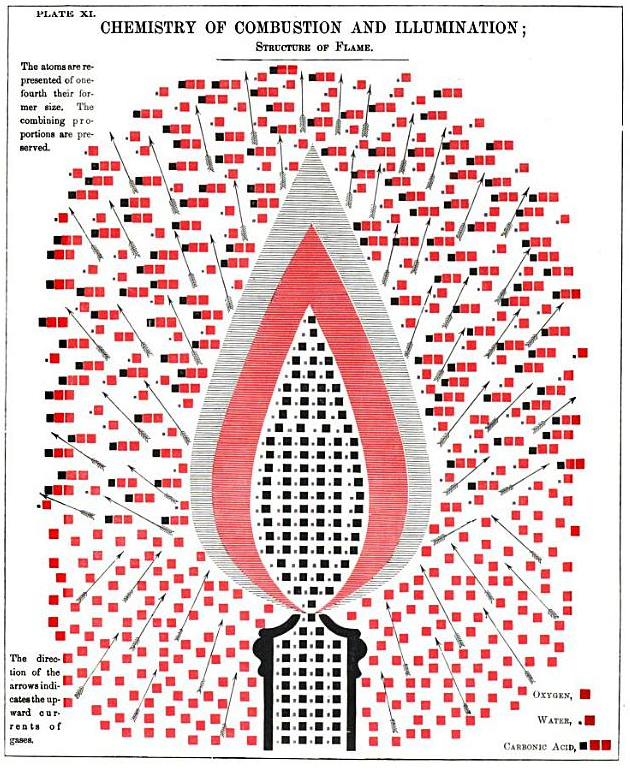
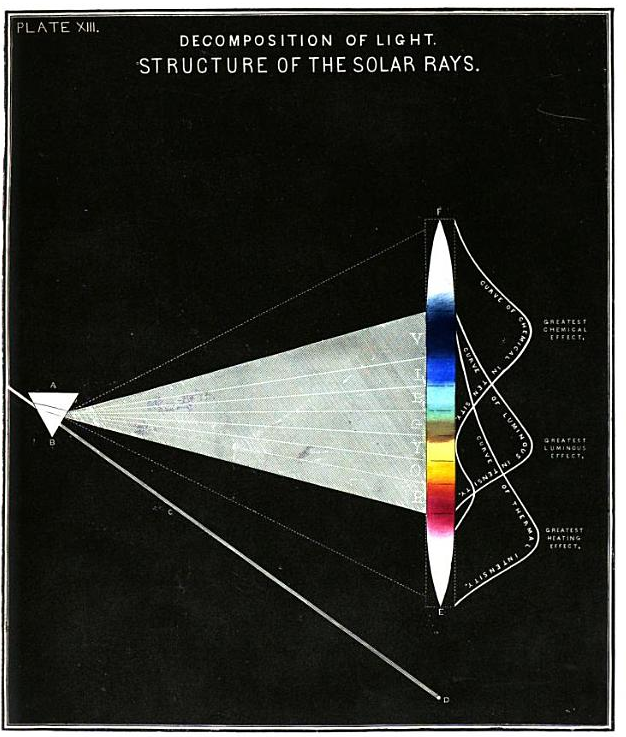
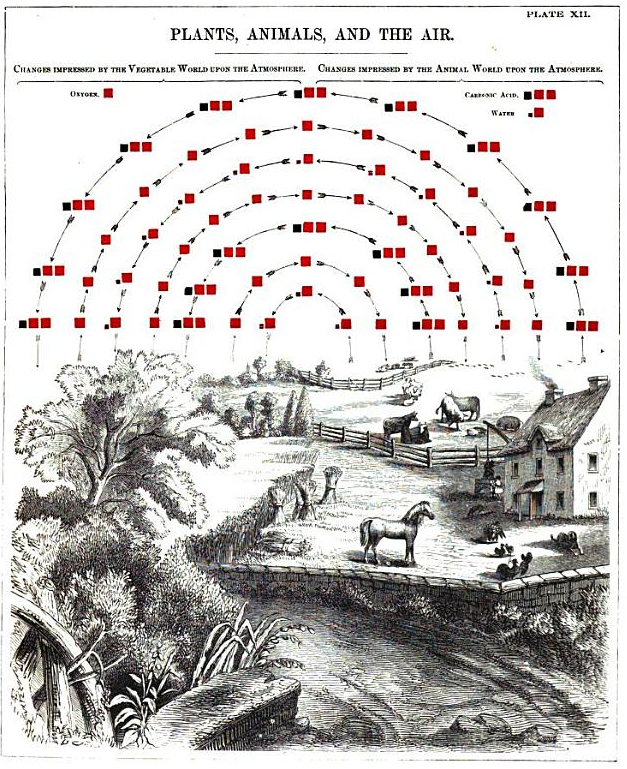
    I no longer own a copy of this book, but at least I did find a version of it at Google Books–the rather walk-about title completely conceals the fabulous stuff within it. The  Chemical atlas: or, the chemistry of familiar objects, by Edward Livingston Youmans, published in New York City by Appleton in 1856 is the sort of title that you could easily skip by if you weren’t familiar with it or its author. Youmans is certainly a man worthy of high respect, and I like him a lot: in his career as an author and editor, he was (in addition to much else) the founder of two significant scientific publications that I have long enjoyed: the International Scientific Series (1871), which was a rapid/cheap reprint of important contemporary science which also sought to fairly compensate its authors (at a time where they were even more ripped-off than they can be today); and the great Popular Science Monthly (1872), which was a very meaty sci-tech instrument before it got to be more ‘popular” than “scientific” decades after Youman’s death in 1887. 

    Youmans candle


    But it is his thin and lovely chemistry-of-stuff book from 1856 that I’d like to share right now. I do not know who was responsible for the design and the illustration of the book, which is I think exemplary and unusual for the time. Even if Youmans did not design the images, he did have the very good sense to include them in his book.  It would be nice to have this book back at some time, along with a few of the other gorgeous works of the 19th c,  like Oliver Byrne’s Elements of Euclid (1847) and Ernst Haeckel’s impossible Kunsformen der Natur (1904, but started in 1899 so it still classifies as a 19th c work), to name a pair.

    • Some good, concise, biographical info on Youmans:   https://en.wikisource.org/wiki/Appletons%27_Cyclop%C3%A6dia_of_American_Biography/Youmans,_Edward_Livingston

      Youmans light


    Youmans field


    • Source:  Google Books  https://books.google.com/books?id=SrJXAAAAYAAJ&dq=Chemistry%20of%20Combustion%20and%20Illumination&pg=PA81#v=onepage&q&f=false