A Daily History of Holes, Dots, Lines, Science, History, Math, Physics, Art, the Unintentional Absurd, Architecture, Maps, Data Visualization, Blank and Missing Things, and so on. |1.6 million words, 7500 images, 4.9 million hits| Press & appearances in The Times, Le Figaro, Mensa, The Economist, The Guardian, Discovery News, Slate, Le Monde, Sci American Blogs, Le Pont, and many other places… 5000+ total posts since 2008.

Category: Cross-Sections

  • Human Bombs, part II: the Ohka and Jinrai Butai, 1944/5

    JF Ptak Science Books   Post 1080

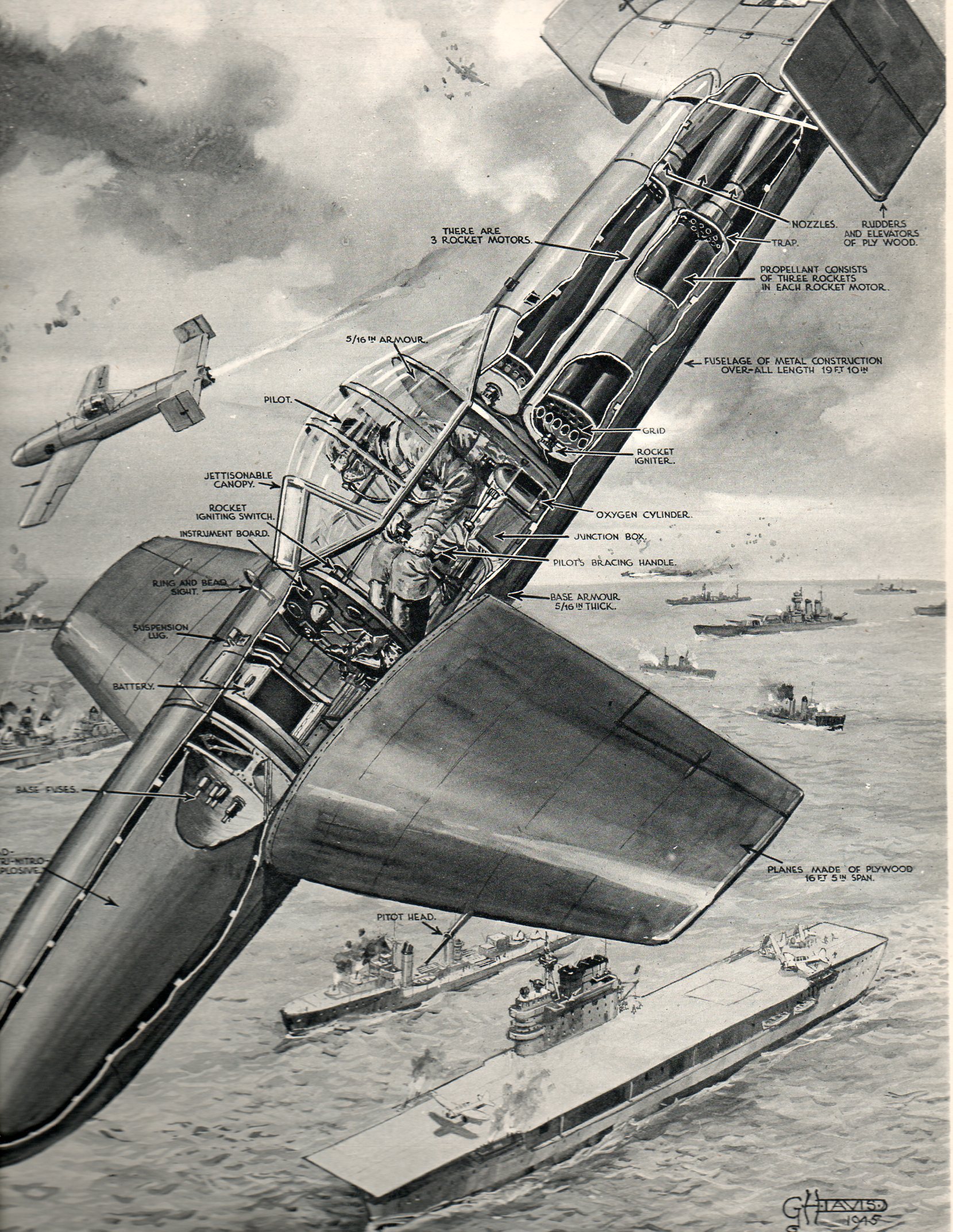
    My favorite mid-century illustrator–G.H. Davis of the Illustrated London News–has provided yet another remarkably clear and well-designed series of images on a difficult topic for a main-line popular audience.  This time (appearing as a two-page spread on 28 July 1945 in the ILN) showed the structure, strategy and deployment of one of the late war’s

    Human bomb japan202

    most feared weapons–the jet-powered human bomb of the Japanese naval air force. (In practice though the weapon didn’t produce that must damage though it did produce the fear: “the operational record  includes three ships sunk or damaged beyond repair and three other ships with significant damage; seven US ships were damaged or sunk by Ohkas throughout the war”1).  The Yokosuka MXY-7 Ohka was a purposefully designed and built rocket powered suicide rocket whose sole purpose was to attack and destroy ships. They were first produced in 1944 as unpowered glider aircraft, and then later in November 1944 the rocket propulsion system was added.  All tolled, the Yokosuka and the Kasumigaura Naval Air Arsenal together built about 850 of them–fewer than 3 dozen survived.

    It was a relatively simple construction and was easily deployed: dropped from a bomber it would glide until near it target and then the rockets would be ignited, powering the thing to a near-unstoppable 500+mph, sending it, its pilot and the 2,300 lb ammonal warhead (an explosive made up of ammonium nitrate, trinitrotoluene (TNT), and aluminum  powder) into its target, detonating on impact.
                                       

    ·Posted by :

    ·in:

    — —

  • Bad Places to Be Dept., #1:Fighting Underground in Sub-Trench Warfare, 1915

    JF Ptak Science Books  Post 922

    “Johnny, get your gun, get your gun, get your gun.

    Take it on the run, on the run, on the run.
    Hear them calling you and me,
    Every Son of Liberty.
    Hurry right away, no delay, go today.
    Make your Daddy glad to have had such a lad.
    Tell your sweetheart not to pine,
    To be proud her boy’s in line.”
    –Opening of George M. Cohan’s “Over There”

    Blog jan 29 trench bot right det

    It is difficult to think of soldiers fighting one another across hedgerows or trenches, hiding behind earth, creating a death-vacuum on the land in between–but worse yet would be fighting in these scenarios underground. 

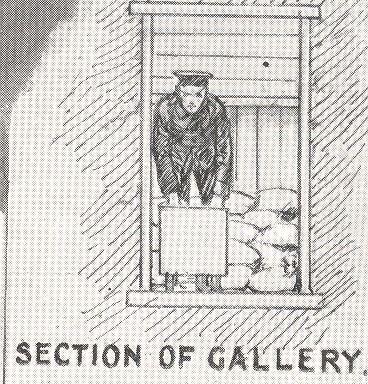
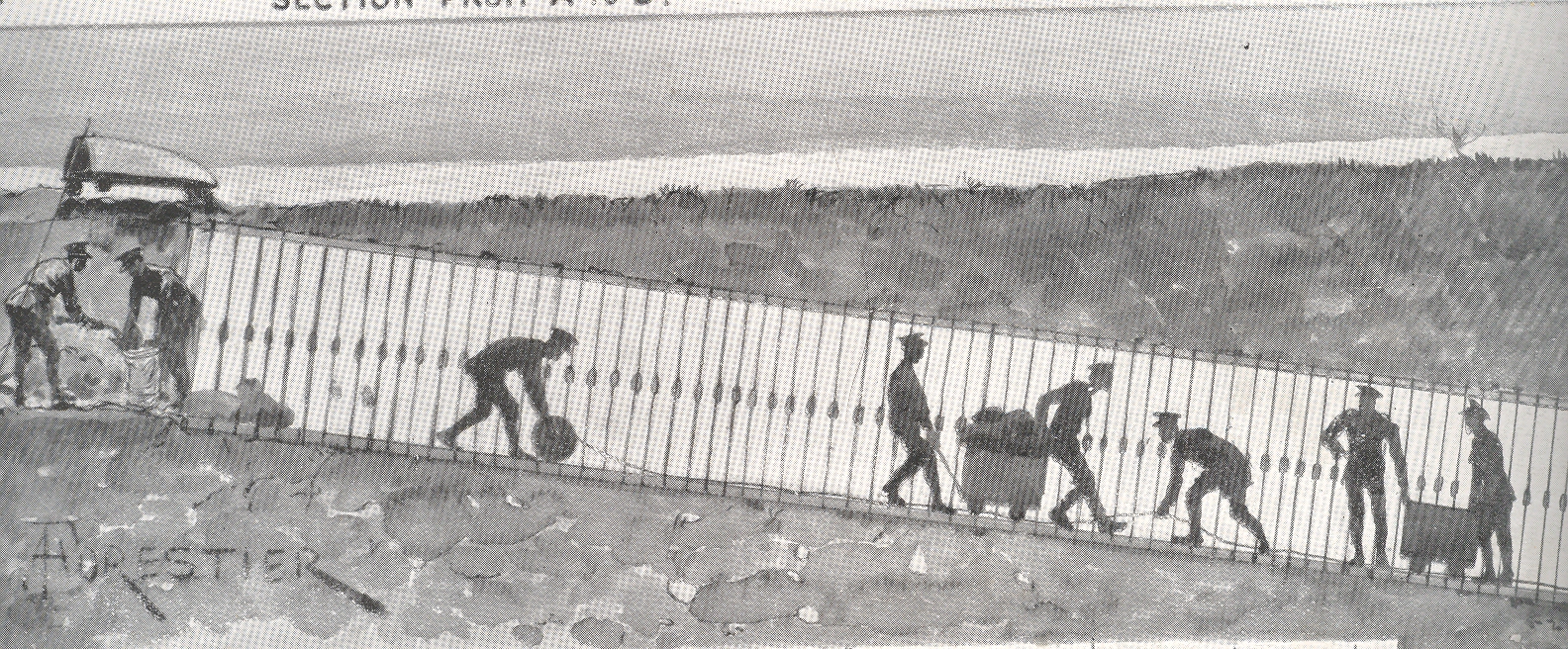
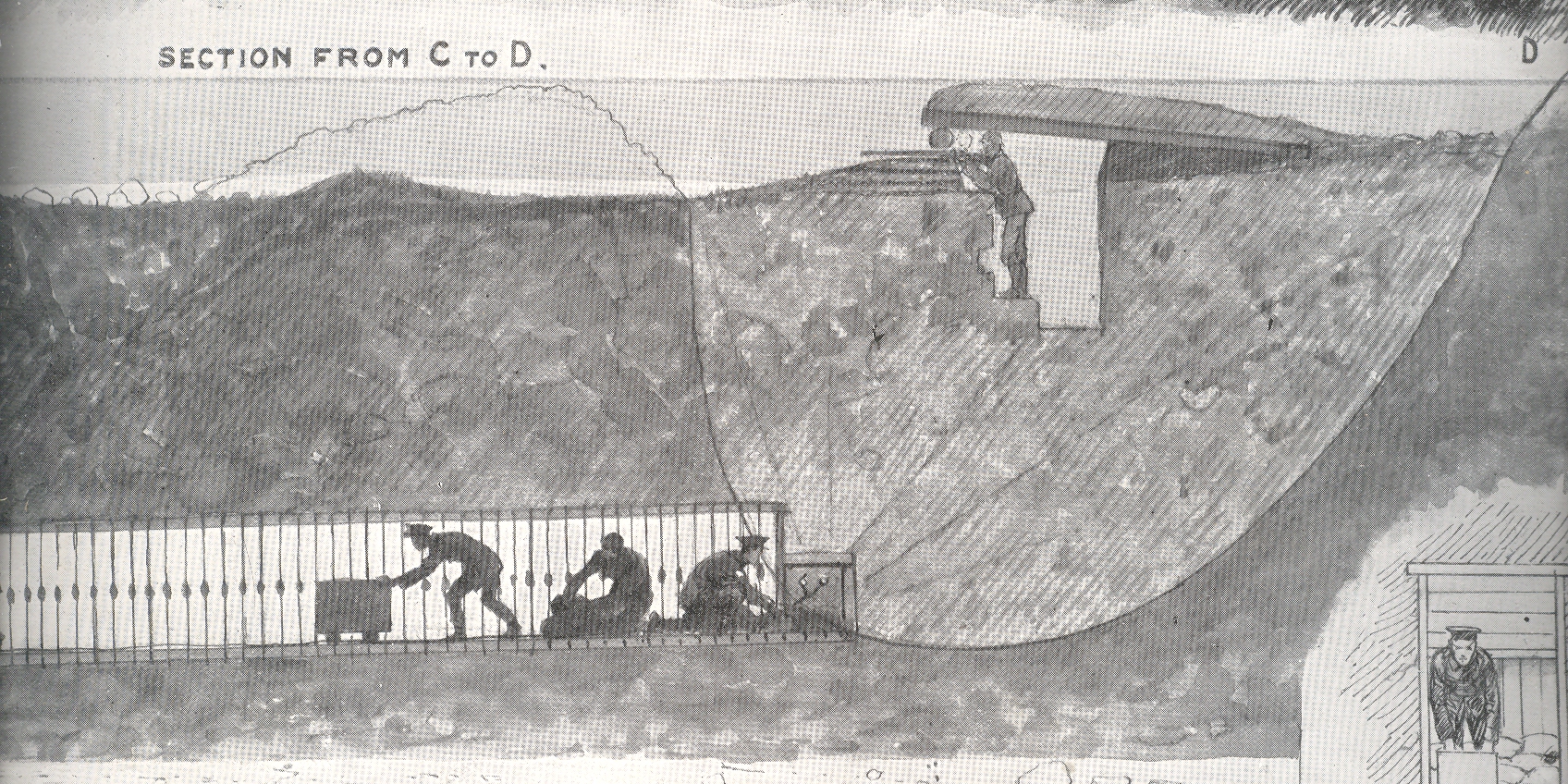
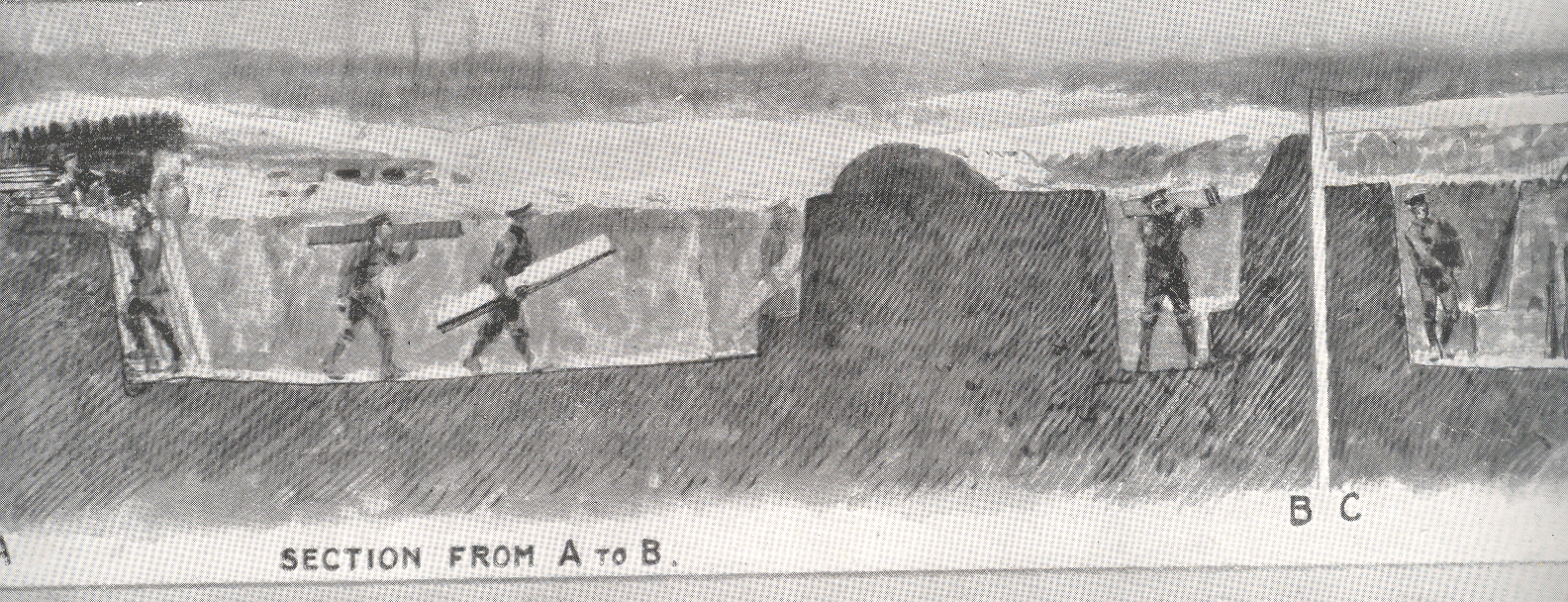
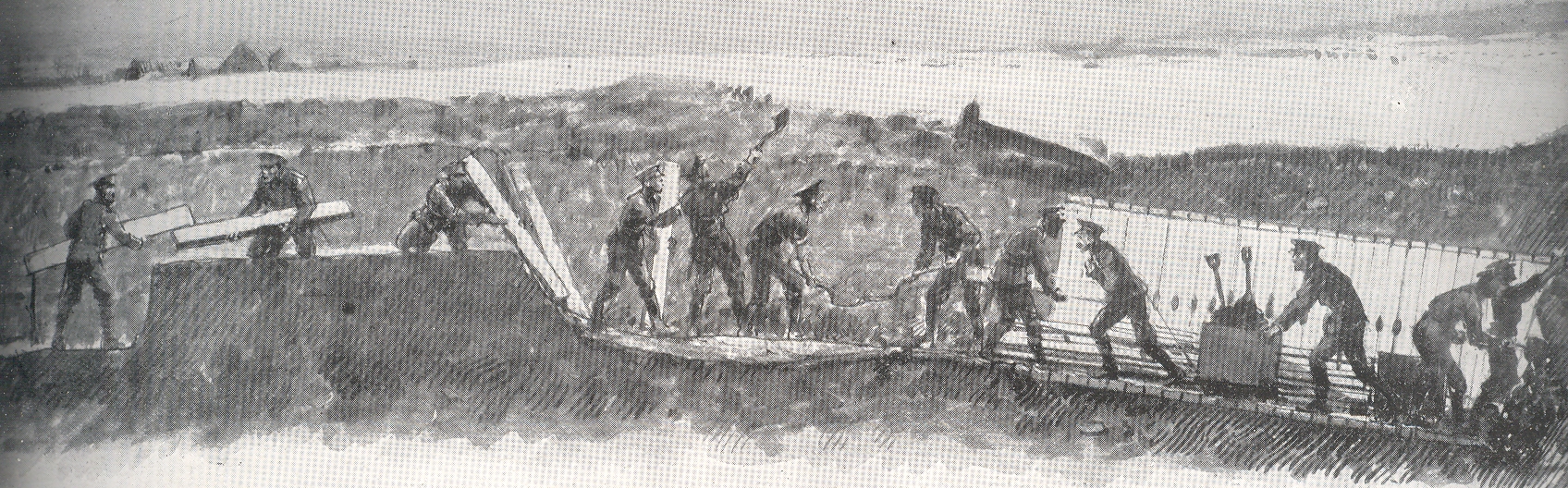
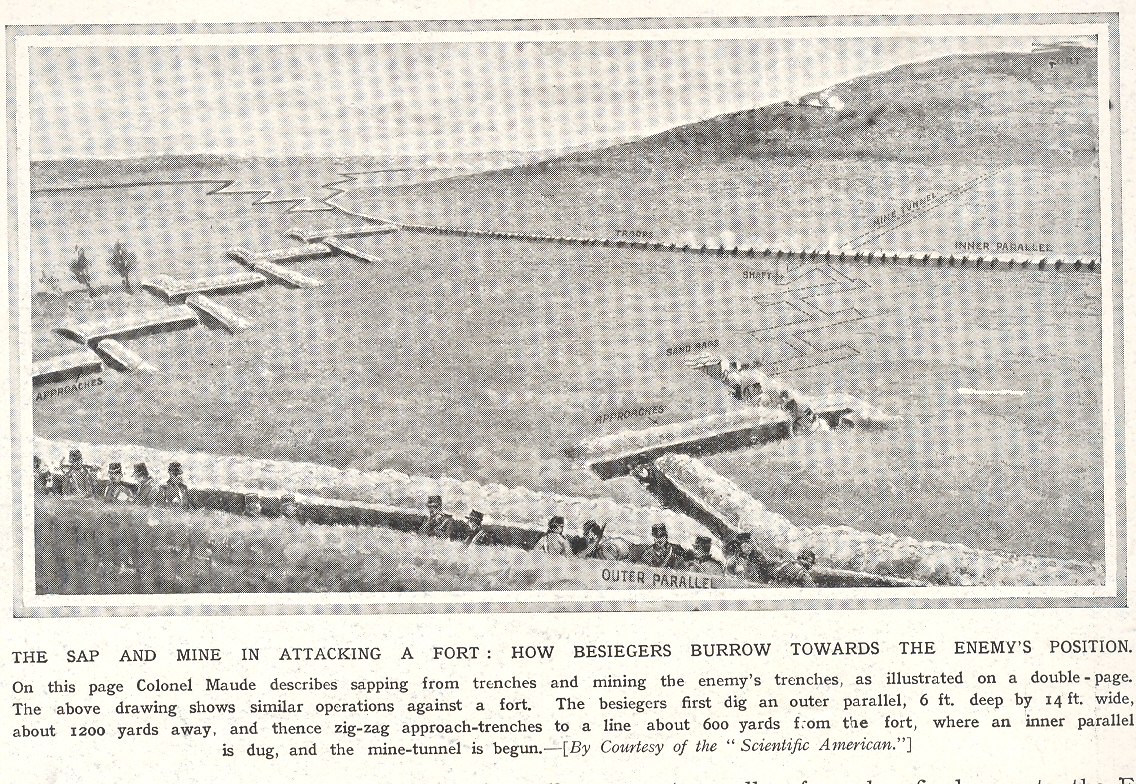
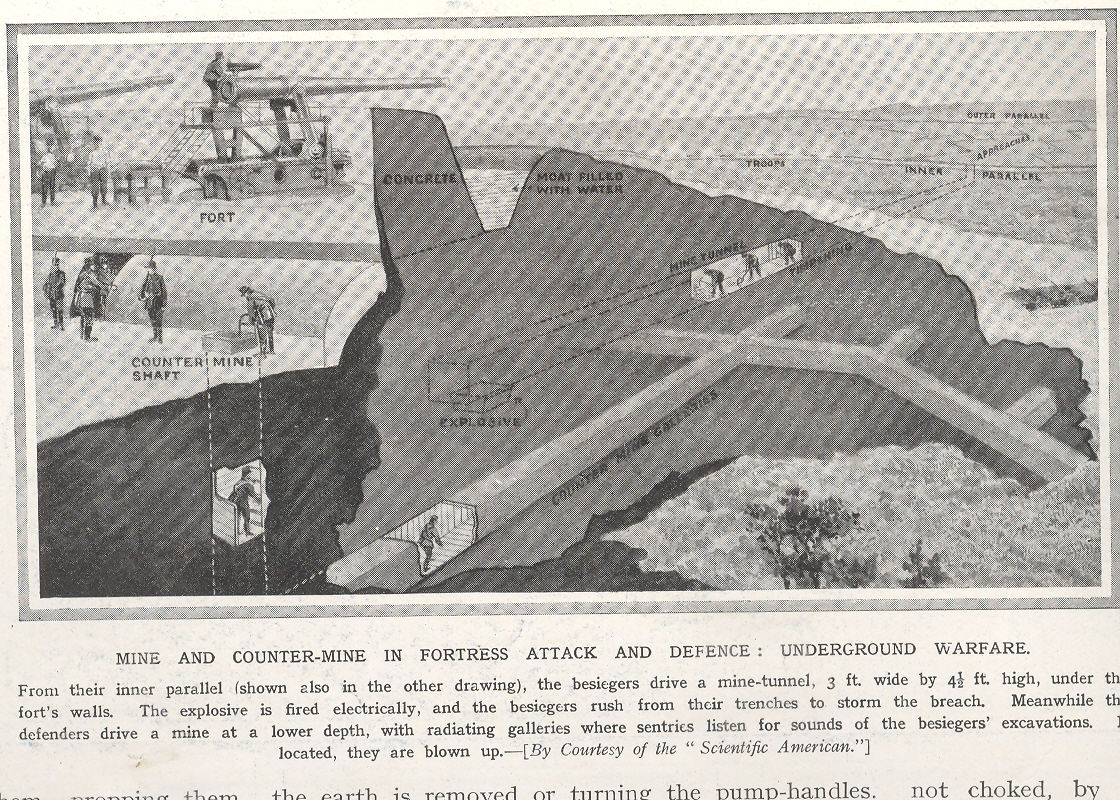
    Finding this large double-page illustration in The Illustrated London News1gave me a physical reaction like the one I get when thinking about the discarded  Dalton Trumbo’s2  anti-war novel, Johnny Got His Gun.  The novel’s main character (Joe Bonham) is virtually encased in his own mind, having lost his arms, legs and face in an explosion on a WWI battlefield—the story is told from his bedridden perspective; dark, bandaged, alone, his mind and brain functioning, and with little means of communication or control over his body. .Among other obvious things, it makes me feel a peculiar stuffy coldness.  [The two sets of four images following should be viewed as two-parts of one long image, the bottom part being on the right.]

    Blog jan 29 trench botm left


    Blog jan 29 trench bot right

    And so too when I look at these soldiers tunneling under a dead battlefield, working their way slowly—a foot an hour—towards the enemy trenches, desperately trying to blow a hole in an immovable object resistant to infantry and artillery.  The soldiers—sappers—were sent in to do a job that could no longer be accomplished above the ground.

    This sort of warfare is extremely old, though the name is not, being about 150 years old. These soldiers were forward combat engineers, and had training across a number of different areas—they were responsible for many technical chores, like building (and blowing up) bridges, laying/clearing minefields, general demolition, defense construction, and, of course, fighting.  It could be a tremendously difficult job, unimaginable.

    Blog jan 29 trench mid left 1


    Blog jan 29 trench mid right


    The “sapp” part of “sapper” comes from the French “sappe”, which refers to the other main part of their job during WWI, which was digging advancing trenches, a zigzag construction of a long horizontal half-hole which allowed an infantry force to slowly advance towards an enemy’s entrenched position. Another part was to tunnel under the enemy’s lines, and then blow them to smithereeens so that a successful attack could be launched into the weakened position.


    Here’s what I think about when I think about these men doing this job:  that two teams, British and German, start to tunnel towards each other’s lines, and somehow, in the middle of the battlefield, somehow manage to dig directly towards one another, their tunnels literally colliding.  Hand-to-hand combat through the opening connecting the two sapper tunnels, then gunfire.  Alerted, the artillery from each side zero-in on what is suspected to be the opening end of the tunnels, pummel them, destroying the access.  So now, both sets in what is now virtually one tunnel, are fighting in the dark.  Even though the topside is only two feet away, any hole would open into the killing zone, making it impossible to escape that way.  It would be a bad place to be.

    Blog jan 29 trench overview sap top Blog jan 29 trench overview sap bot

    Notes

    1. The issue is 27 Feb 1915.  The illustration is entitled “They Sent us in front with a Fuse an’ a Mine’, Sapping and Mining Under the Enemy’s Trenches”. The first half of the title is from Kipling’s “Sappers”: They send us in front with a fuse an’ a mine , To blow up the gates that are rushed by the Line…

    2. Trumbo has an interesting history, to put it mildly. An old Communist, he once gave up his old associates to the FBI at the start of WWII–an act he later thought of as being stupid and wrong.  It also had the opposite effect for him–he thought he was being patriotic, but the FBI was more interested in him than his information.  He would get eaten up by McCarthyist operatives and denied HUAC any information on any of the famous “Hollywood Ten”.  He got a year in jail and was blacklisted, booted out of LA. He came back–mostly under someone else’s name (see the link above for his screenwriting credits, which are substantial)–and acknowledged shortly before he died.


  • Big Planes: Aircraft with Dining Rooms in Their Wings

    JF Ptak Science Books  Post 906

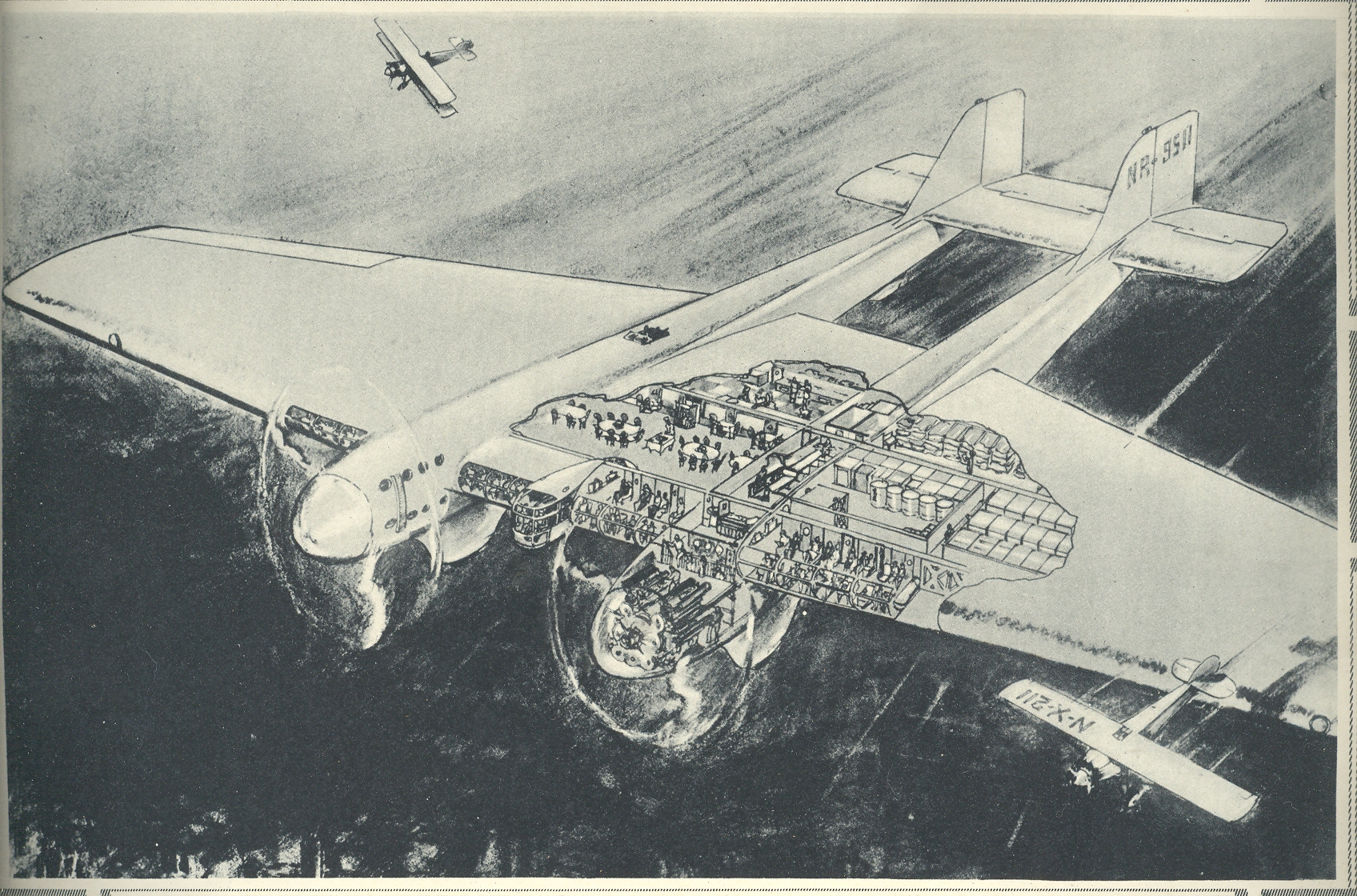
    Is it just me, or do the rest of you see Cary Grant at a teeny-tiny table when looking at this aircraft? There’s just something so horribly wonderful about the excesses washing over the passengers of high privilege in this airplane.[Source: The Illustrated London News 21 Dec 1929.] 

    Blog jan 11 big plane


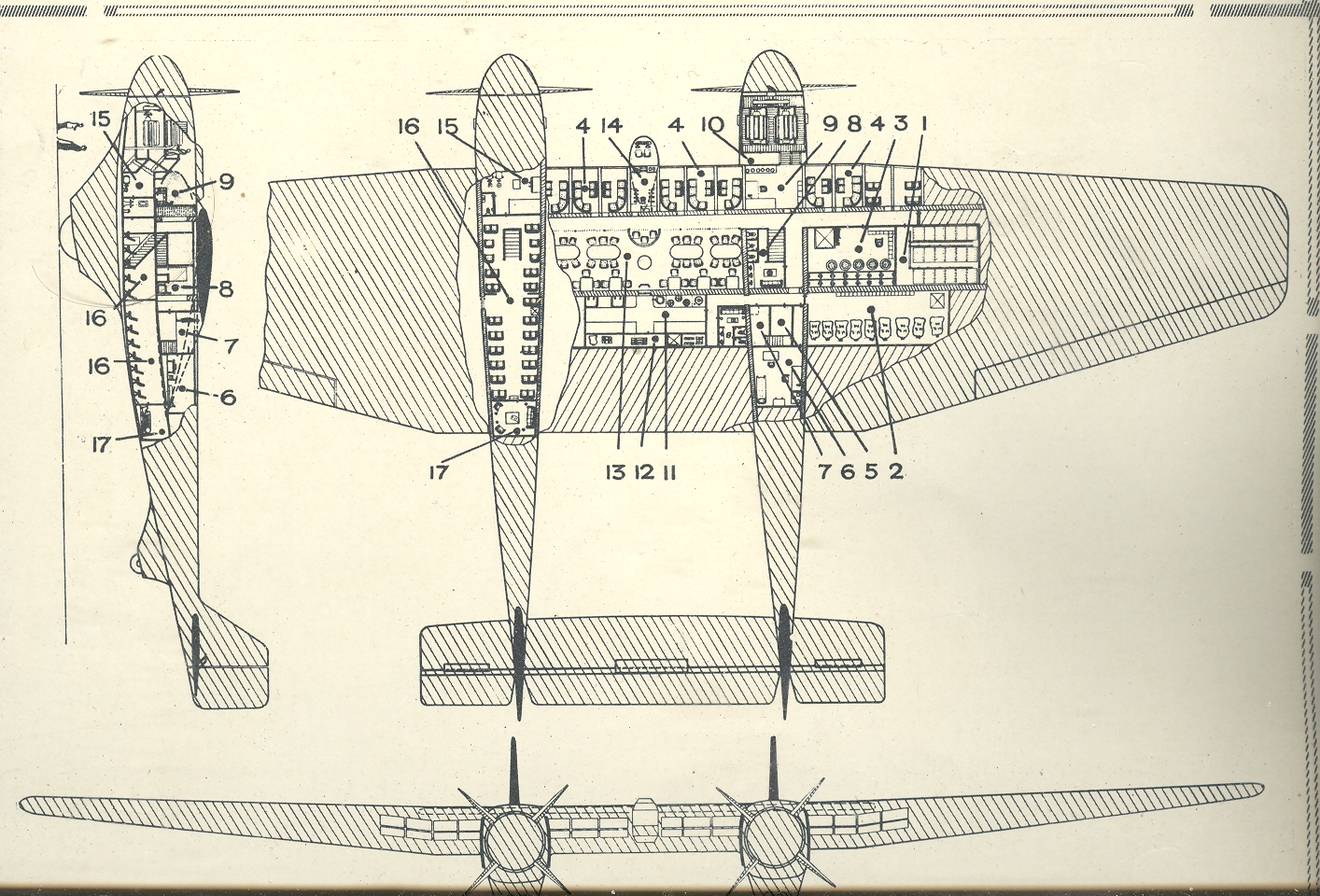
    And the airplane has a name—Christmas, named for the man who provided its inspiration, Dr. William Whitney Christmas1–and was a paper plan to produce the world’s largest airplane.


    It would’ve been so by leaps and bounds.  The Christmas was to have a 262’ wingspan and a gross weight of 142,000 pounds at the time when one of the largest planes aloft—the Patrician Keystone K-78—had a wingspan of 86’ and carried 18 passenger, 2 pilots and an engineer. It also held the world’s record for hauling the heaviest payload, which for some reason was “33 girls”.  It was bigger still than the largest thing in the air, Lufthansa’s Dornier DO.X –this was an aircraft capable of moving 60-100 passengers (serviced by a crew of 10-14), a flying boat with 12 (Curtiss Conqueror 610hp) engines on wing sections 157’ long. (Was this a mile-a-minute fuel consumer?) The Dornier plane didn’t last long in service due to operating costs (1929 was a bad year to undertake an expense like this, especially in the hyperinflated Germany) and was in an aviation museum by 19342. (This plane—one of three constructed—was destroyed in a RAF bombing raid in 1943.)

    Blog jan 11 big plane 2

    Here’s something extraordinary about the Christmas:  it had a dining room (actually, a “dining saloon”) that took up 15% of the plane’s floor plan.  There was also the spacious smoking room, the crew and officer quarters, the machinist’s shop, engine room balconies (?), and of course the staterooms that seem to run along most of the front of the plane. The side elevation shows not very much space at all allotted to what must’ve been some massive engines, seeing as how there’s only two four-blade props. (The small lateral cross section shows two people against the plane for scale—these folks must’ve been giants; I figure they should be a little more than 75% of the manikins.  I make each prop blade to be about 10 foot (?))

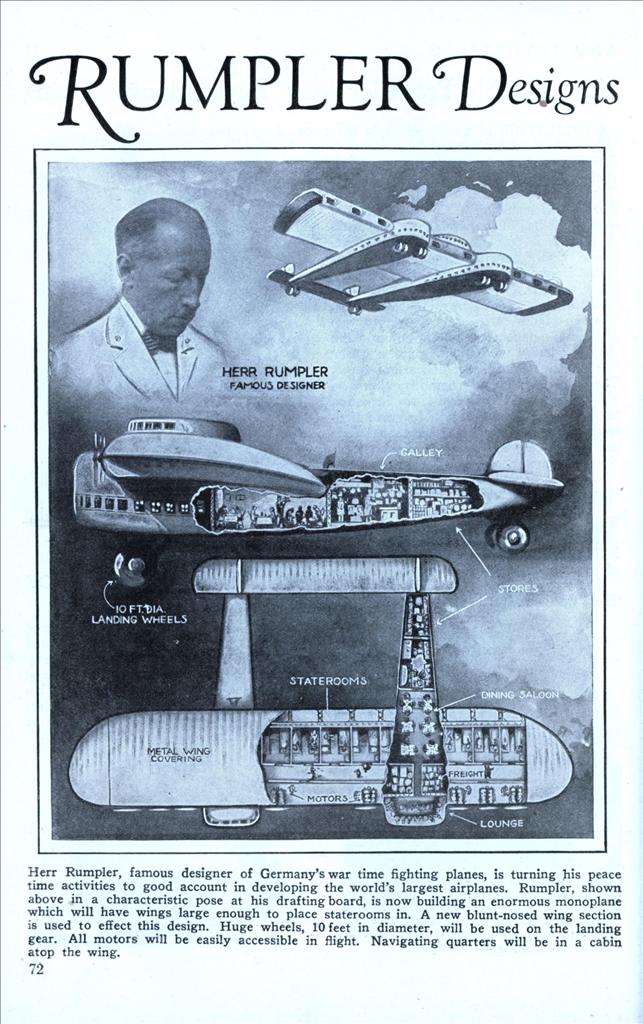
    As it turns out this aircraft looks a lot like Edmund Rumpler’s3 (1872-1940) giant.  Outfitted with a long row of staterooms along the front edge of the large wing and a huge dining room, it doesn’t seem to be equipped with an area for the engines.  Maybe this was an endemic flaw among older fast-thinkers…  

    Notes:

    1. Dr. Christmas (1865-1960) was the third American to fly and was the first to design a plane with aerilons.

    Blog jan 11 rumpler

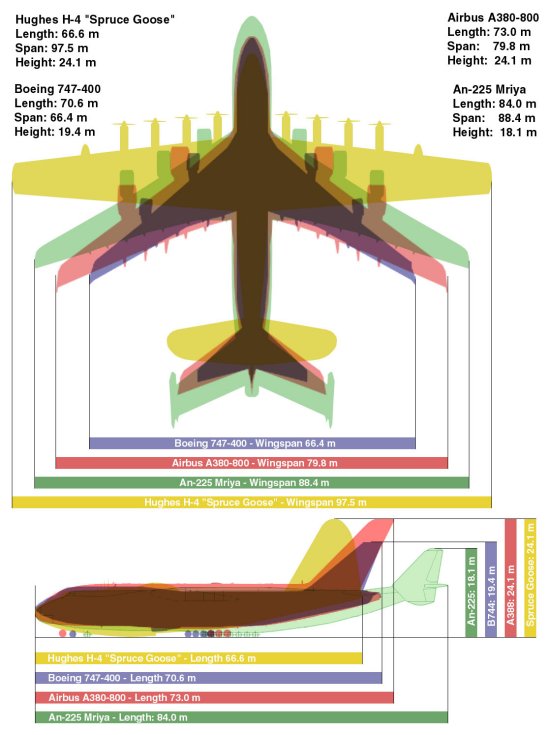
    2. Compare this to the Antev An-225, a modern very-,limited-production monster that could haul 1.3 million pounds of cargo, and the 747 (hauling up to 900,000 pounds) and the mammoth Airbus A380—all relatively the same size but with fabulous design and power.

    3.Rumpler made very significant aeronautical contributions to the German effort in WWI, as well as designed the first aerodynamic auto—his military planes though during the war were  great triumph, partially because they were also Germany’s first mass-production-possible aircraft.  This didn’t help him much when Hitler came to power—being Jewish, Rumpler was arrested, and then released by Goering who at least could find a small part of himself to save this one Jew who served Germany so well.

    4.  Source for the Rumpler image is the wonderful ModernMechanix site here.


    Interesting comparison chart for big planes: [Source]


    Blog jan 11 aircraft size-comparison


  • An X-Ray of the Earth, 1756

    JF Ptak Science Books LLC   Post 787   Blog Bookstore

    I’m not sure why there was so much included in this engraving that had
    nothing to do with its subject matter. 
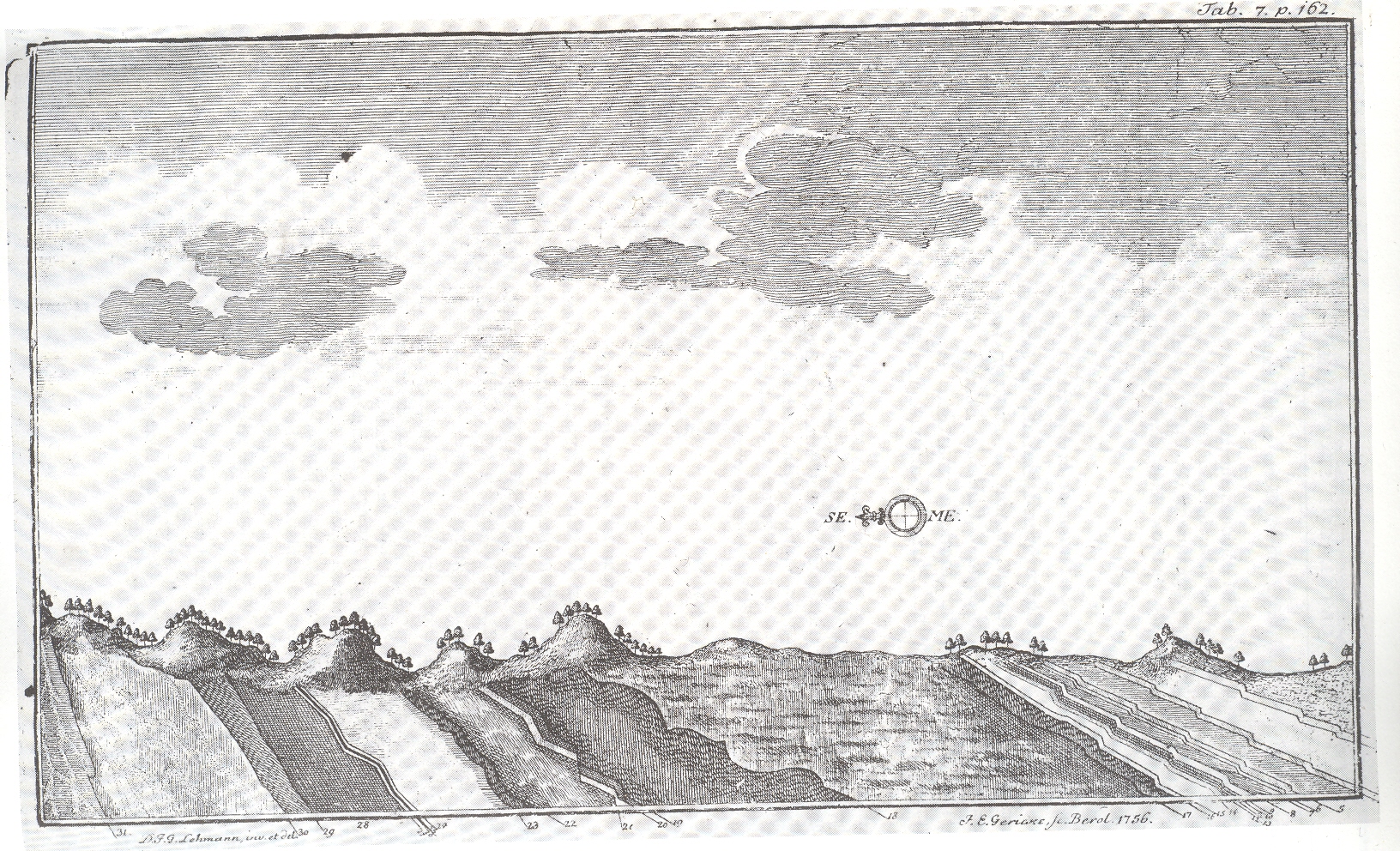
    The essential part of the image is the cross section at bottom:  the image of landforms, created by the man
    most responsible for the establishment of stratigraphy, the German
    physician/chemist/mineralogist/geologist Johann Gottlieb Lehmann (1719-1767).  What Lehmann accomplished was a sensational,
    x-ray-like interpretation of the surface of the earth, a privileged vision
    distant from the real birth of the science of geology in the work of James
    Hutton more than 50 years later. (Hutton was about the first to treat the entire
    corpus of the geology of the earth and which was also completely removed from myth
    and fable.  His work formed the basis for
    that of Charles Lyell who in turn provided some of the intellectual basis for Charles
    Darwin.)  He seems to be the first to
    create such a slice of the earth, illustrating an orderly, historical formation
    of the various layers (and not an unrelated jumble), and the first steps
    towards establishing the laws of formation of geological sequence.

    + lehmann

    Outside of the spectacular introduction to the workings of earth in this cross
    section, I’m taken by the enormous sky, and the very lonely compass, placed,
    seemingly haphazardly in a blank field, creating a very considerable blank space above the great discovery.
    The scientific greatness of the images aside (can I even say such a
    horrible thing?), the engraving looks to me like a modern surreal work. 

    Book Note:  Lehmann, Johann. Versuch einer Geschichte von Flotz-Gebuergen,…1756, printed
    in Berlin
    .  “This unpretending treatise must be
    ranked as one of the classics of geological literature”—Archibald Geike


  • Cross Sections of a Mine Disaster at Wigan

    JF Ptak Science Books LLC  Post 688  Blog Bookstore

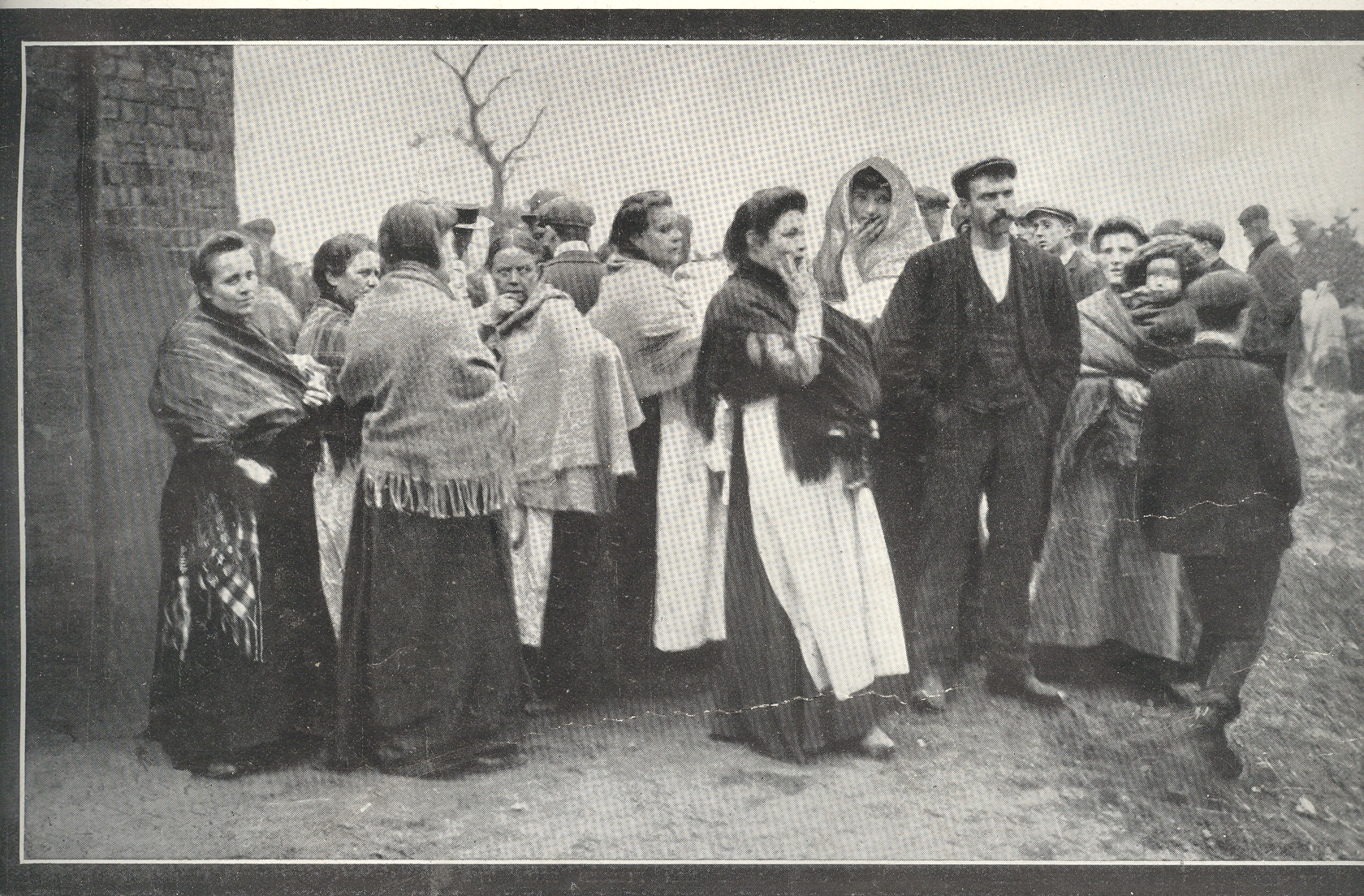
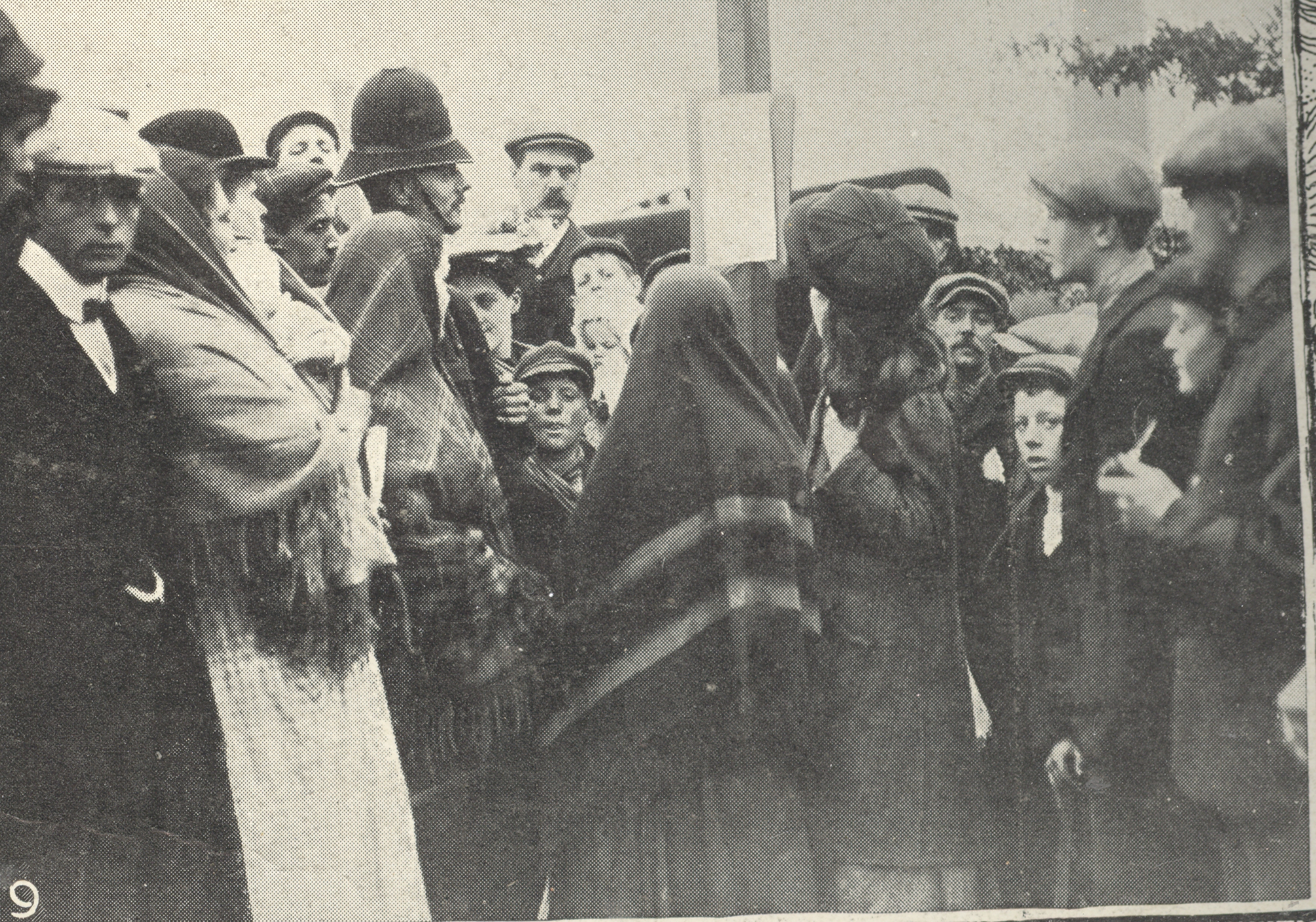
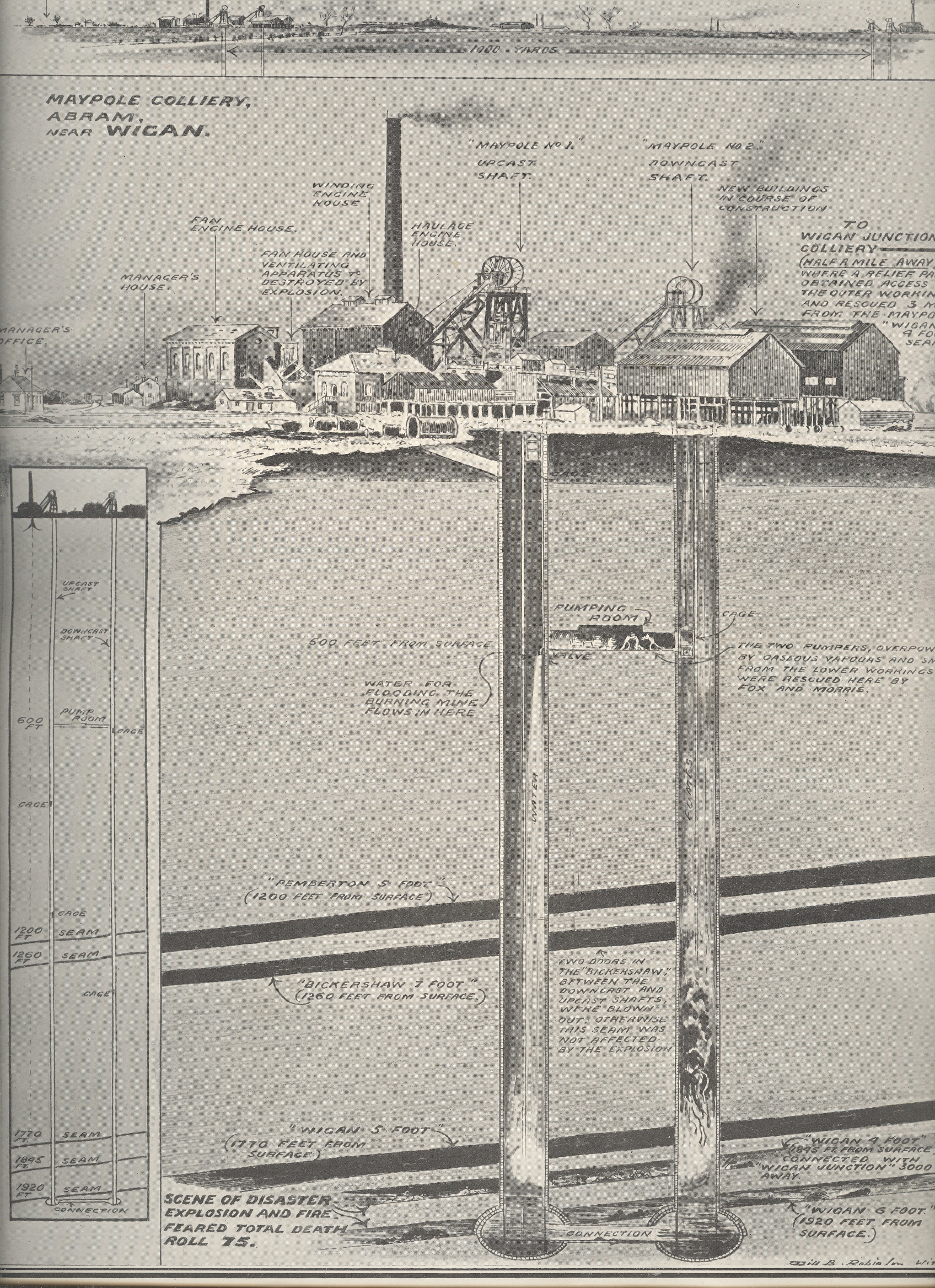
    A few minutes after five in the afternoon on 24 August 1908, a terrific fire engulfed parts of the Cannell Mine of the Maypole Pit (of Pearson and Knowles Coal and Iron Company) just outside (famous1) Wigan at Abram. It would claim the lives of 72 miners in a wicked, horrific way.    Part of the scene at the mine was covered by the great British weekly magazine The Illustrated London News (28 August 1908), and, though of course largely sympathetic, the article mentioned very little about the heroic attempts to save the lives of the trapped miners.  Perhaps the scene was just too gruesome, though not==Blog July 17==mine women so for the Liverpool Mercury (22 August 1908), which reported the situation with more full detail, with less of an eye, perhaps, to ensuring that the mine could re-open, which may have been part of the reason for the ILN’s less detailed storyline.

    I say this even though the ILN‘s story included some heart-rending images, including this (1890’s) Stieglitz-like photograph of miners’ wives waiting for word on the fate of their men.

    The Mercury painted a pretty bad image:
     
    “The explosion destroyed the ventilation drift and blew the cage, rope and other accessories away. It was officially stated that 75 men were down the pit at the time of the explosion, three were rescued alive, William DORAN, SMITH and DRAPER, thus there were 72 men in the mine immediately after the catastrophe.”

    “Men, Women and children in a seething mass waited in sorrow at the pit mouth for those, who but, an hour before had left their homes. Rescue parties were organized without delay equipped with rescue apparatus from the new rescue station at Atherton.”

    “When the rescue parties entered the mine they found it filled with gaseous fumes. Those who witnessed the awful debacle, stricken with terror at the spectacle, and their first impulse was to rush wildly in all directions, it was as if the end of the world had come.”

    ==Blog July 17==mine reading

    Evidently the rescue parties worked to 10 o’clock in the evening, reaching some 2500’ down into the mine before they were stopped by lethal gas.  Three men were found alive; 72 were found dead. 

    ==Blog July 17==mine fire xsec

    1) Wigan is a town in Great Manchester; Wigan Pier, as in the great George Orwell work The Road to Wigan Pier (about the living and working conditions of the living and working poor).

    ·Posted by :

    ·in:


  • Vision: Looking Straight Up, Down, Across and Through–1525-1905

    JF Ptak Science Books LLC  Post 679  Blog Bookstore

    “Vision:  a device that belongs to those who have it. Far-reaching and fore-shortened, it is something that works best when used closely, loosely, finely and not at all. A gift-and-a-half and a half-a-bother.”  
    The imagined Devil’s Dictionary of Ambrose Bierce

    [See also my post Perspectives: Inside Looking Out, Outside Looking In]

     
     There is a BLOG==july 9--perspective Downsmall series of posts on this blog that deal with the perspective of lookinBLOG==july 9--perspective upg at things straight-on:  straight up, straight down, straight across.  As it turns out, in my many years of looking at prints and images, view that look directly up and down are pretty uncommon.  Some of the earliest straight-on images actually offered a new vision to people who were so long accustomed to not looking at things in this way.
    BLOG==july 9--perspective Down

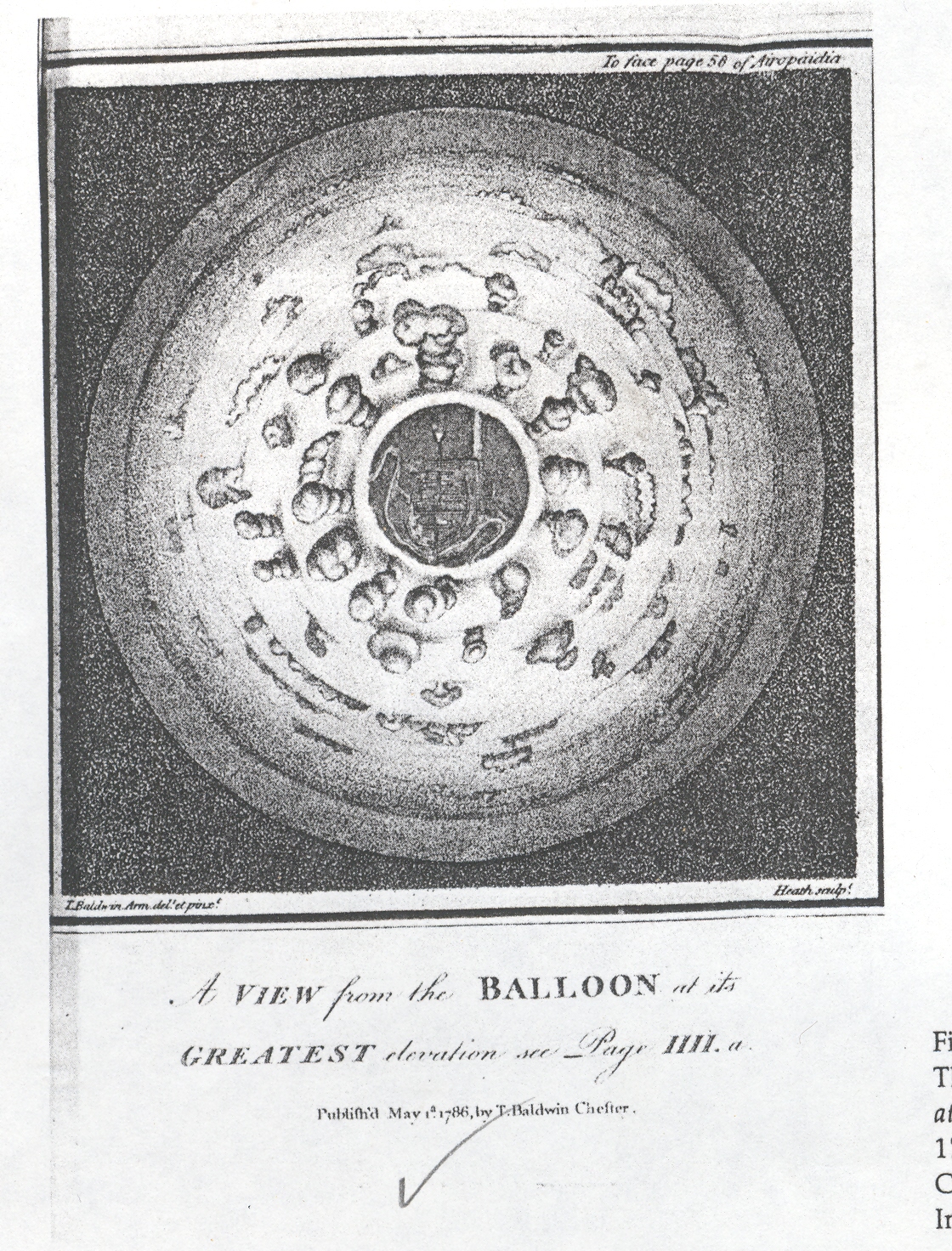
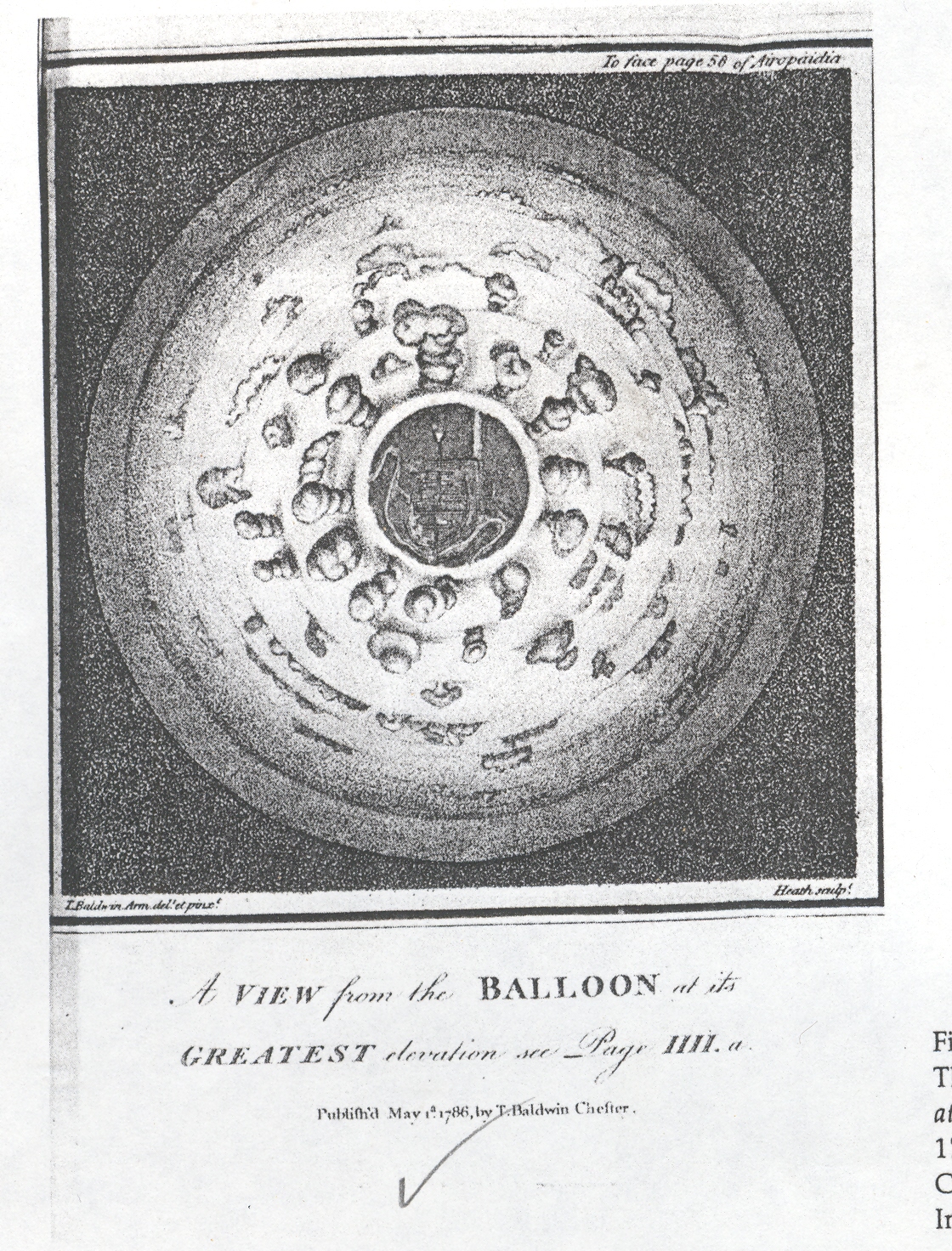
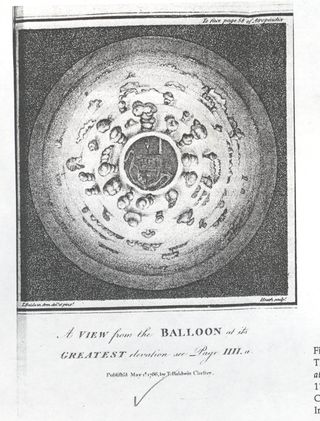
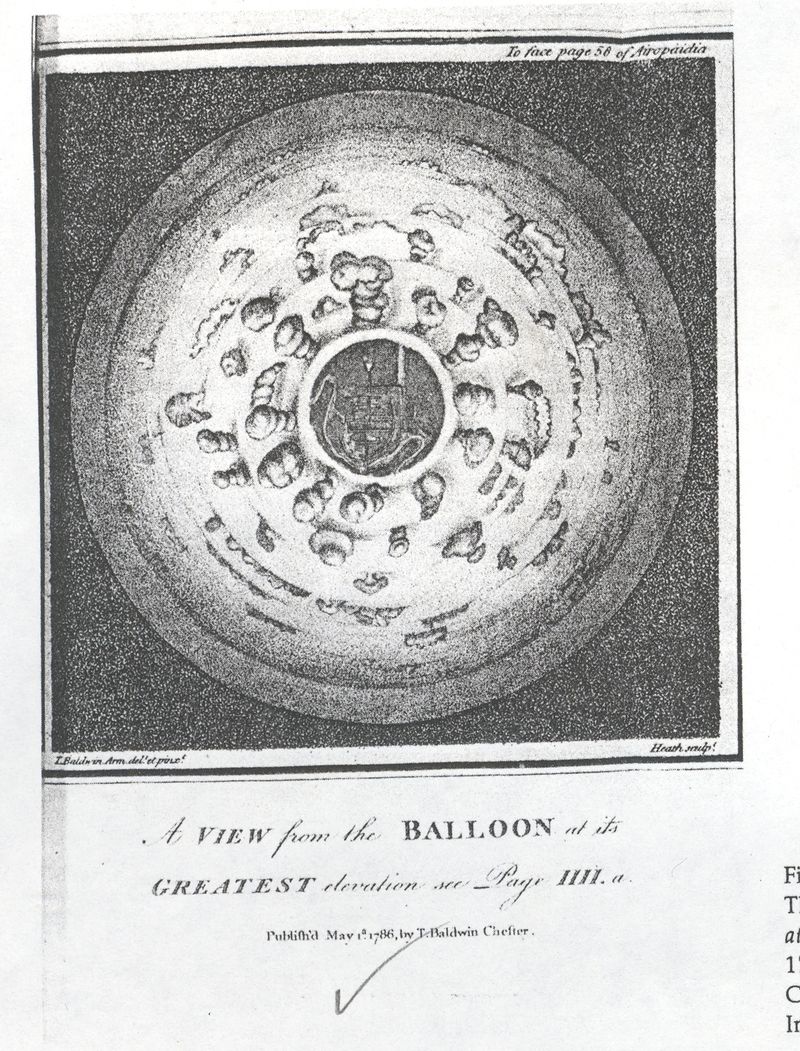
    And for a long time it was just not possible, not really, to look straight down at something from a height, or at least until the invention of flight at the hands of the Montgolfier brothers in 1783.  This first image offers a view looking straight down from a balloon through a bank of clouds and onto a town, and was drawn and published in 1786.  It must have been shocking to see this for the first time in that year, the image so unexpected and mostly not imaginable.  One of the other aspects here is that the viewer is looking obliquely down from the tops of clouds, the first time that this was ever done—so far as I can determine—with a scientific vantage point. 
    BLOG==july 9--perspective up

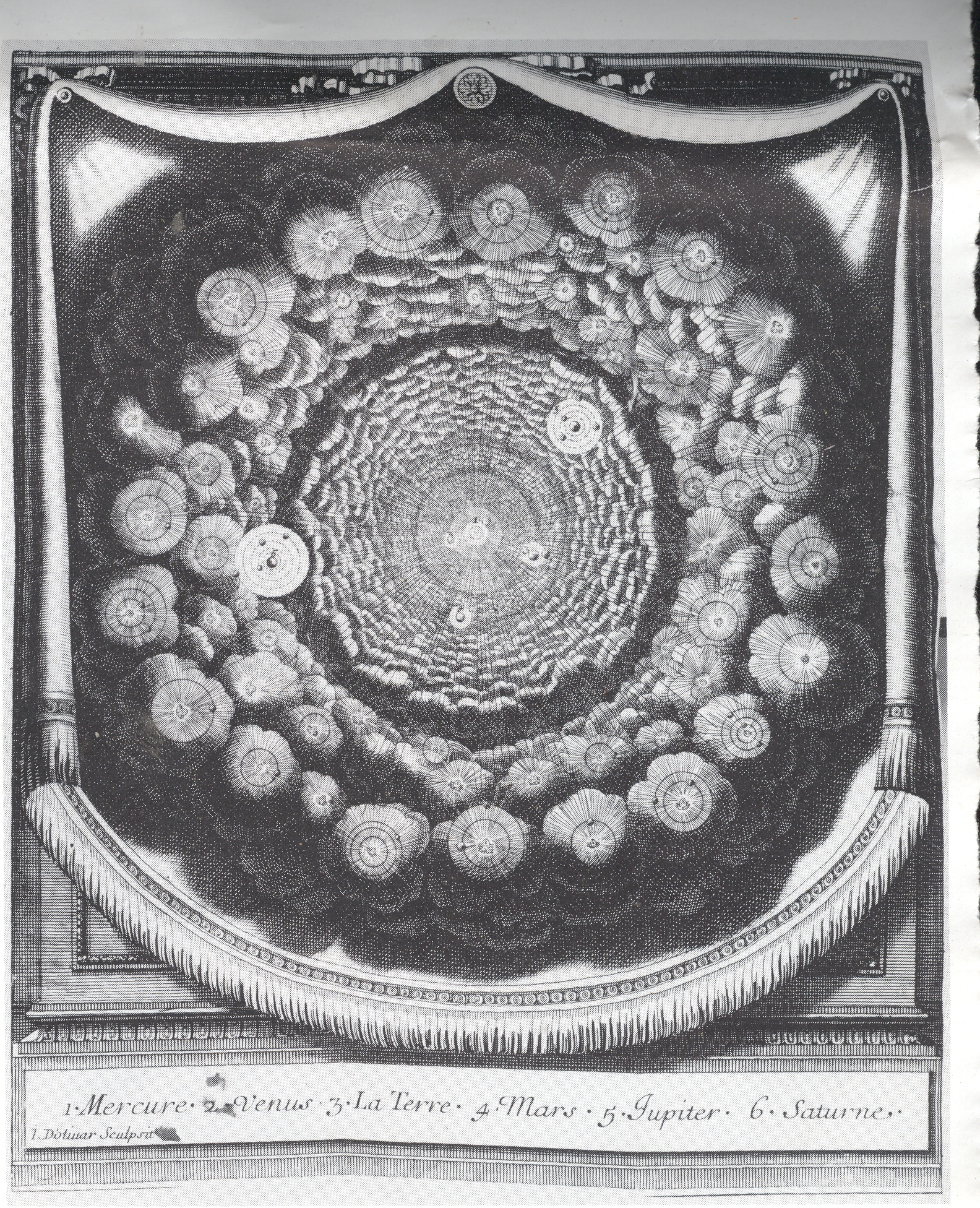
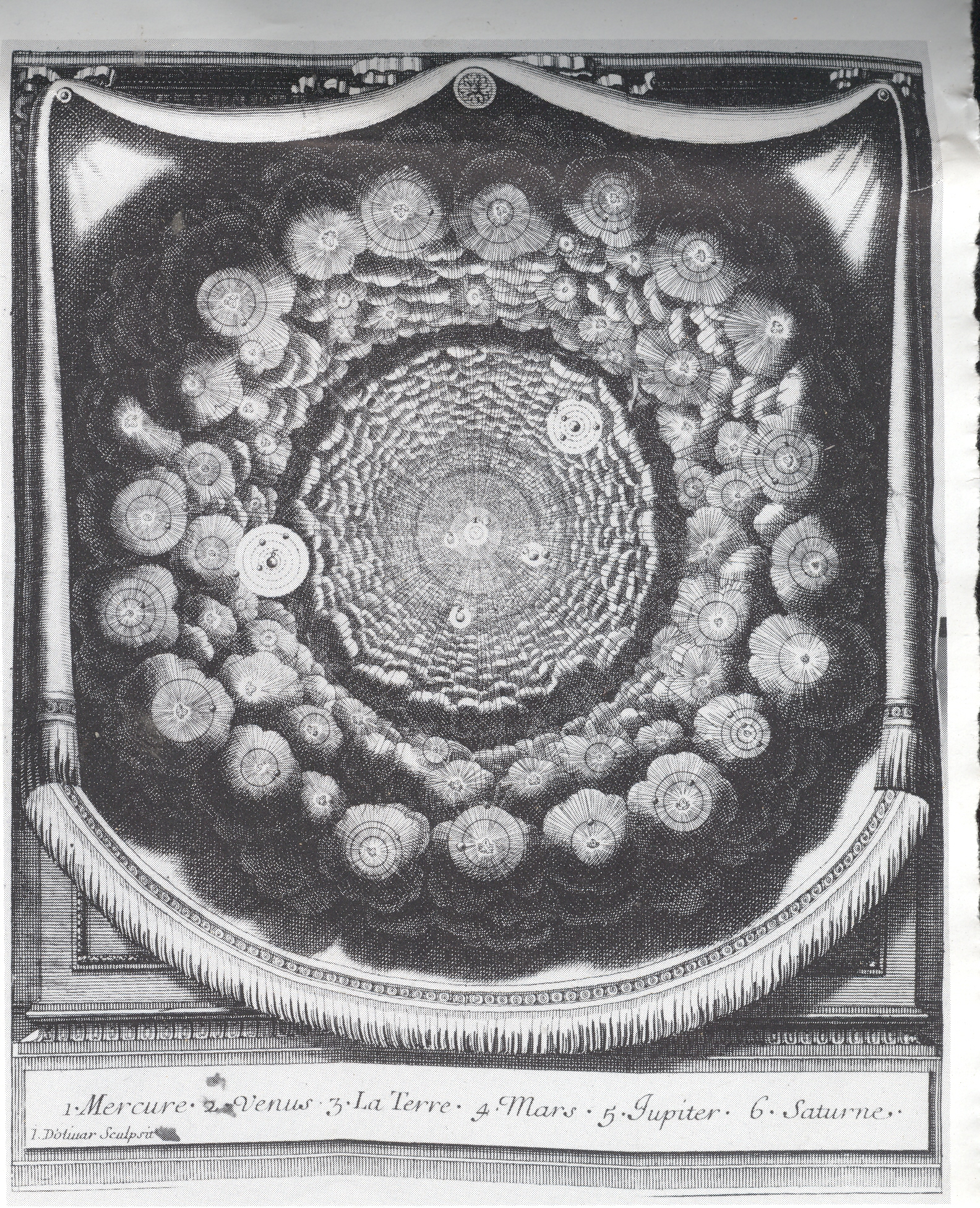
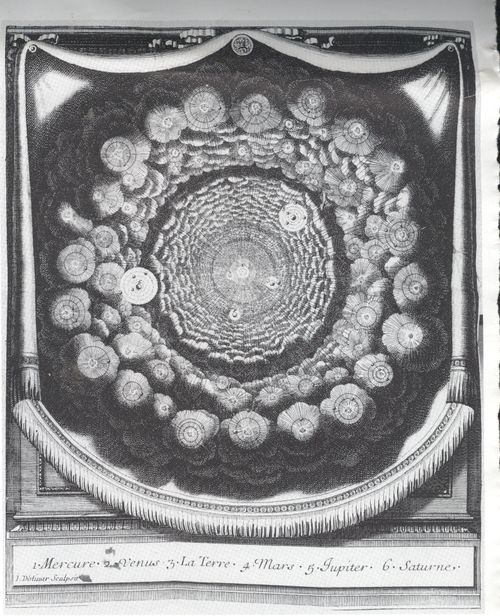
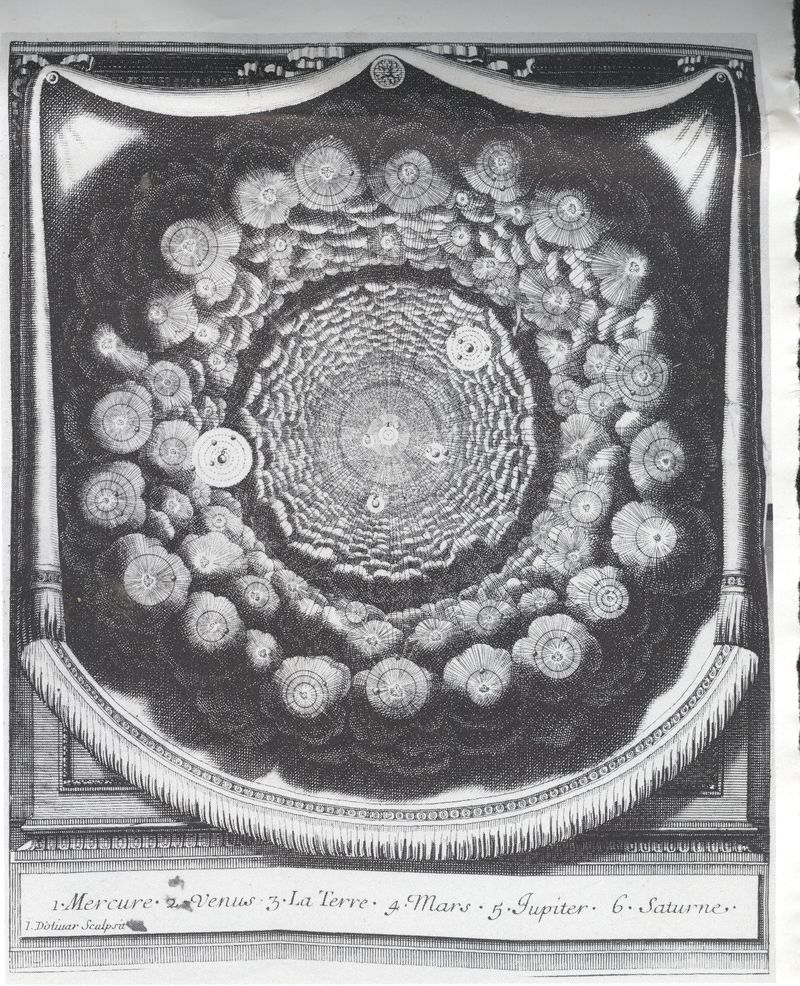
    The seeming complement to this image is from Entretiens sur la Pluralitie de Mondes (Conversations on the Plurality of Worlds), written by the great French philosophe Bernard le Bouvier de Fontenelle in 1686 (just a year before publication of perhaps the greatest work in the history of science, Newton’s Principia Mathematica). The Plurality was a best-seller by the best-selling Fontenelle. An excellent attempt by a rather restricted writer to engage the population-at-large, writing a high-pop book on what was basically the history of astronomy and cosmology of the preceding century. Copernicus was a major feature of his imaginary conversations with a muse as he wandered through a metaphorical garden of questions, with the observations of Galileo and Cassini also very prominently featured. But what interests me here is the great similarity between the two, the view from the balloon looking down, and the Fontenelle, looking up.  (Or what would pass for “up” in space.)  Except that the cloud-y looking things in Fonetenelle aren’t clouds at all, but solar systems.  This was a radical, church-pounding idea at the tiem, displacing the unique centrality of the human condition, offering the possibilities of other lives on other solar systems and other planets
    BLOG==july 9--perspective across . 

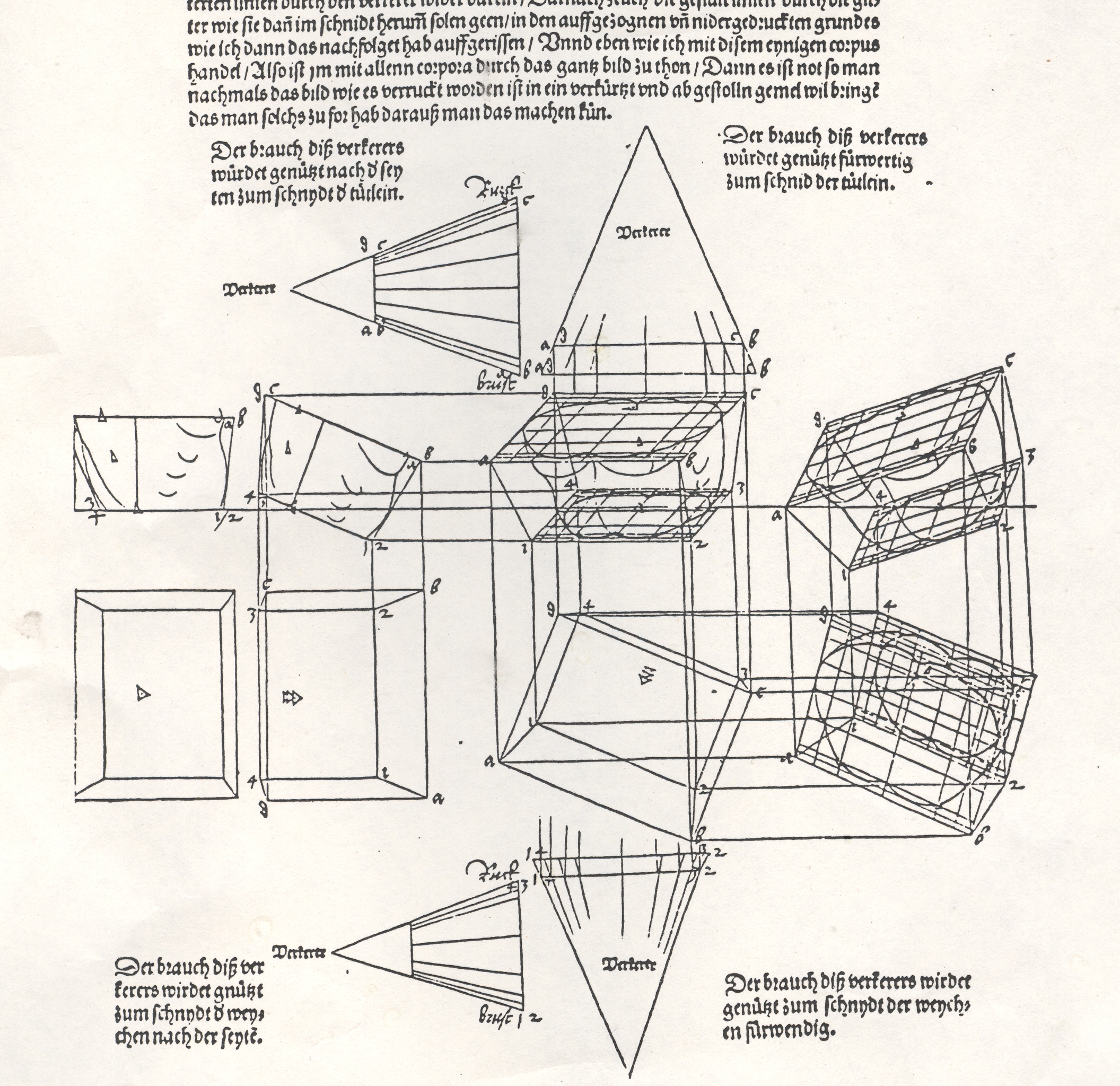
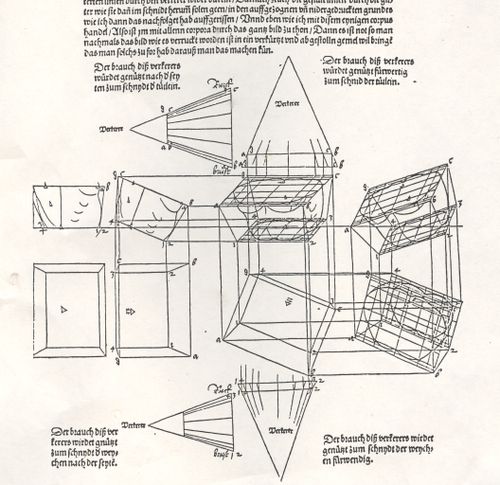
    Albrecht Durer’s (1471-1528) drawing of a geometrical man was an amazing–startling, even–object to the early 16th century consciousness. His Underwysung der Messung (“Treatise on Measuring”) written about 500 years ago (in 1525) set the stage for this next work–it is here that we find some of the most recognizable of Durer’s illustrations of the instruments that he employed to do his perspective work:   his …Symmetria partium…humanorum corporum (1537) was a masterpiece, and a key piece of revolutionary visionary thinking.  Durer–so far as I can tell–created an orthographically rotating human figures in three-dimensional trapezoids, creating incredibly human-like non-human forms.  Supra-human, perhaps; mechanized, calculated, structural. His use of stereometry, the science of measuring volume, was adapted to this study of human form and the relationship between that and movement.

    By doing this one could rotate the figures, pinch them, stretch them, and the proportions would remain exactly the same.

    They were in a sense a CAT scan.  And in this way the person in 1525, seeing this for the first time, would be experiencing something like the sensation of seeing an X-Ray for the first time in 1895 or a magnified flea in 1626.  It was a spectacular effort an a major key to understanding movement, and anatomy, and of course map making.

    This was a new way of thinking about the body, challenging the god-grace and ubiquitous church-inspired revelation of the body and how it worked.  This was not a necessarily easy time in which to picture humans in such a scientific way.  (In 1553 the physician and theological scholar Michael Severtus would be burned at the stake by John Calvin for his views on the Trinity, Nicean Creed and other related things, though his undeniably revolutionary idea of cardiopulmonary circulation was in itself a direct challenge to church teachings).

    Durer’s innovation accommodated empirical observation and allowed for proportional change.  Its importance in relational drawing, anatomical and  technical, cannot be understated, which I think trumped it as a subversive agent to orthodoxy.
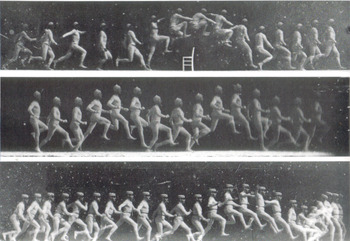
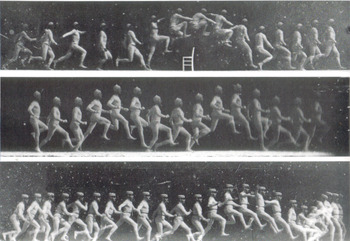
    Blog--july 9--marey Fast forwarding a bit there are the images of arrested time by Etienne Marey (who was a technoid and physician) and  who was able to capture motion of all sorts–he was able to develop a picture so to speak of the movement of blood in the body via his instrument to calculate blood pressure, and he also created a shotgun-style camera that made the world’s first high-speed photographs of movement.  And so it cane to pass that in the late 1870’s and early 1880’s people were instantly able to see what a horse looked like when it galloped or what the body did *exactly* when jumping over a chair.  When you couple this with fourth-dimension material one wonders why it took several more decades to bump into these images in the art world of the earliest part of the twentieth century.
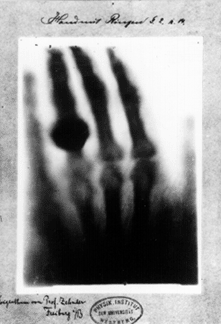
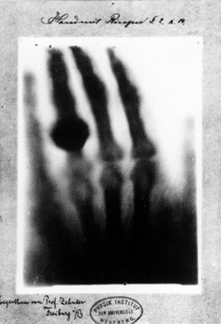
    Blog--july 9--roentgen In 1895 50-year-old Wilhelm Conrad Röntgen’s ephochal discovery was announced (“Ueber eine neue Art von Strahlen”. “On a New Type of Ray”), built upon the work of J. Plucker (1801-1868), J. W. Hittorf (1824-1914), C. F. Varley (1828-1883), E. Goldstein (1850-1931), Sir William Crookes (1832-1919), H. Hertz (1857-1894) and the horribly odious Phil Lenard (1862-1947 and who didn’t die soon enough). The experiment revealed as much to humans as did the experiments and inventions of Hooke and Leeuwenhoek on the invisible worlds revealed by their microscopes. Bertha, Roentgen’s wife, sat for 15 minutes while her husband passed his rays through her hand; she ran from the room once she saw the results, revealing her very bones and no doubt a strong sense of the fragility of life, and the strong presence of death.  Many had the a similar reaction to the Kandinsky’s shapes and Malevich’s white circles and red rectangles and Ibsen’s drama and Einstein’s dancing dust and the rogue syncopation of jazz—these newnesses were threatening to all of the established ways of looking at physics, and art, and theatre, and listening to jazz.  It was a new perspective which challenged the firmly established vision of these things, upsetting the nature of comfort and acceptance.    It is probably a very natural reaction to try and protect established memory—but memory is made all of the time, and so should be relatively flexible…at least it is mechanically healthier to allow a little bending than to be rigid and brittle. 

  • A Long, Low, Massive Circle: Circular Building, 1938

    JF Ptak Science Books LLC  Post 639  Blog Bookstore

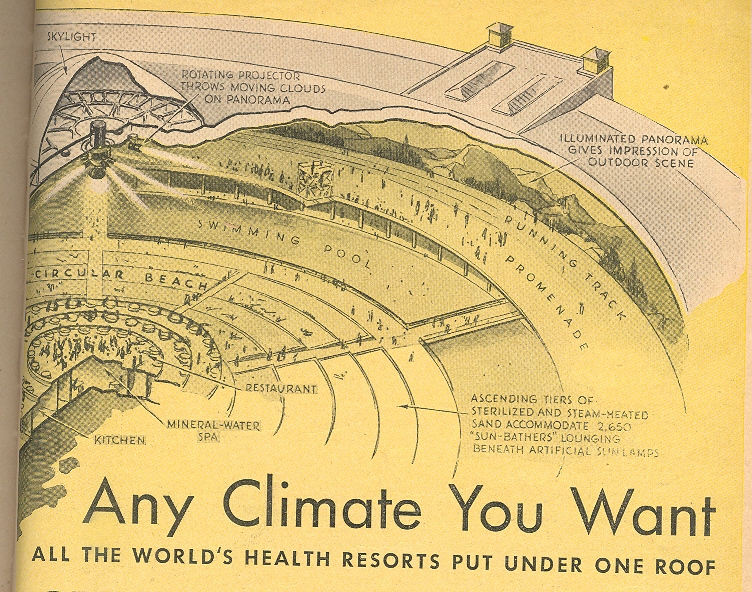
    This re-surfaced idea for a
    mega-spa was very wide, very long and very low. 
    Karl Stoldeck and J. Goldmerstein—architects and planners in Berlin—published
    a broad idea in 1928 called Thermenpalast (Thermal Palace, Spa Space, something
    like that), and although it seemed to satisfy almost everyone, the idea was
    consumed in the general economic malaise of the depression of 1929.  It looks as though the idea had a little life
    again in 1934, but there was a problem with fund raising.  The idea came back again, broader, bigger,
    and more defined, finding some idea-space in the Popular Science Monthly for
    March, 1938.

    Blog--jun 6 1

    The structure for health and
    exercise was massive—as a matter of fact, it would’ve been the most massive
    circular project in history.  The
    building had 6.5 acres under glass, which makes it 280k or so feet, giving the
    building a diameter of 1,800 feet and a circumference of something just over a
    mile.  IT looks as though the ceiling
    reached a maximum of 250’ or so; seeing that the dome would also be about 1200,
    that presents a little engineering problem. 
    But no matter:  it would never be
    built, anyway, even with Nazi dollars from home.

    The building was quite a feast
    of the body—there was a mountainside panorama around the exterior wall,
    illuminated from a  series of light sources
    from the ceiling.  In diminishing concentric
    circles: there was a mile-long running track, a promenade just inside that,
    followed by a spectacular pool which looks to be 4000’ long and 100’ wide!  Interior to the pool was a wide “beach”, a
    restaurant, park and lounging area.

    Blog--jun 6 2

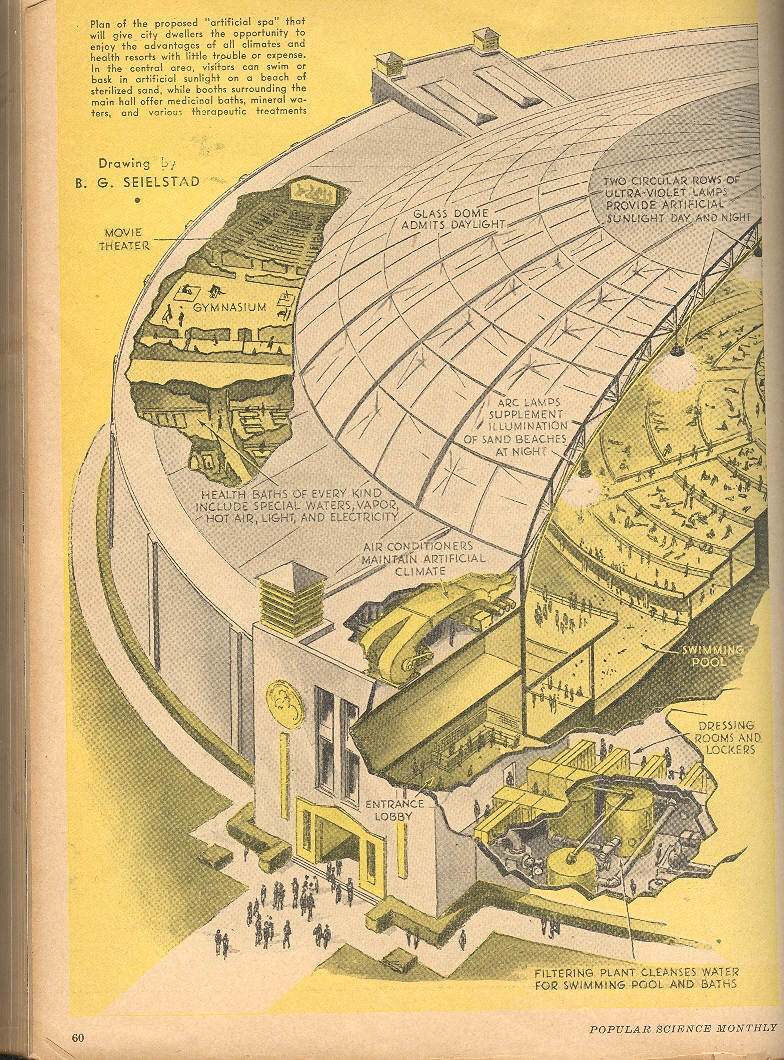
    This was also a multi-floor
    building, with gyms and restaurants and a long series of health baths.  The entire spectacle would offer many
    different climates depending on the needs of the clientele. 

    The cost:  6 million, U.S. A few years earlier the Empire State 
    building was built for $24,718,000. The
    architectural firm Foster + Partners

    released designs for a the largest building (“Crystal Island”)  ever built: 
    2.5 million square meters (8.2 million feet, or 35 times bigger than
    this 1938 idea), with a tower 1476 feet tall, all sort of circular, and to be
    built in Moscow.

    Had the thing been built in Berlin and started in
    1938, it would’ve been about ready to bombed on the day of its completion. 

    Here’s an interesting read on water parks:  Water, leisure and culture: European historical perspectives, Susan C. Anderson, Bruce H. Tabb, 2002.


  • Ships in the Skyline, Part V: Cities INSIDE of Ships

    JF Ptak Science Books  Post 308       

    1blog_oc_t10_ship_in_skyline_deta_2

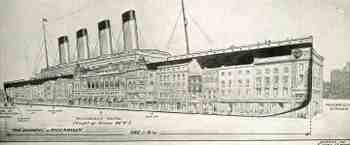
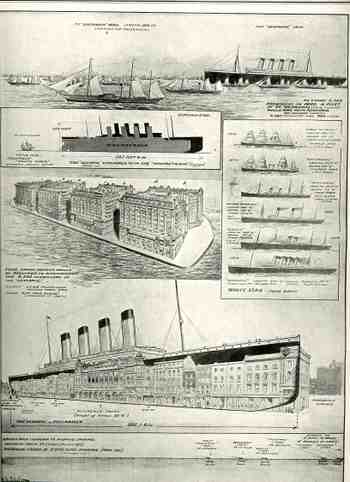
    In trailing some loose associative memories of ships being compared to skylines, and seeing he ships placed in the skylines, I was able to find four good samples.  This one is, in a way, the negative version of that, showing cities placed inside of the ships, the ship in this case being the White Star triple-screw Olympic–which at the time was the largest ship ever launched at 882′–and the image found in The Illustrated London News for 22 October 1910.  It was done in celebration of the launch of the ship from Belfast, which was also the heaviest transference of weight (27,000 tons) from land to water in history.   To illustrate the ship’s massiveness the picture editor placed a row of hotels and buildings bounded by the eastern end of Burlington House to the very edge of Piccadilly Circus, with the Piccadilly Hotel (height 77′ 6″) right there in the middle under the first three smoke stacks. 

    1blog_oc_t10_ship_in_skyline_deta_3

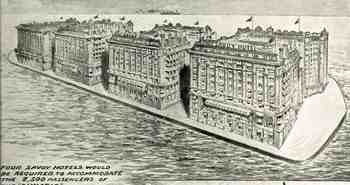
    The second image relates the passenger capacity of the Olympic to the Savoy Hotel, showing a floating platform with four of these massive hotels.  The Illustrated London News was making a real point about the Olympic and the Savoy, because at around this time smaller ships were referred to as “floating hotels”; the Olympic, on the other hand, was much more than that–it was four floating hotels, and big ones, at that, and the image captures that perfectly. 

    Truth be told, I really like the image of the floating hotels out of context and without a caption–it really makes the case for the idea of a Floating City in a Floating World. 

    1blog_oc_t10_ship_in_skyline803

    [CLick for a larger, clearer image]


  • Beautiful Technical Illustration: Heck’s “Iconographic Encyclopedia”, 1851

    JF Ptak Science Books   Post 151

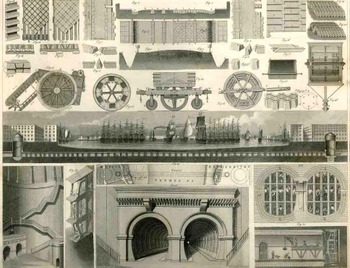
    J.G. Heck wrote and compiled a fascinating and complex work entitled The Iconographic Encyclopedia of Science, Literature and Art, and was published in America for the first time in 1851 following Spencer Baird’s translation from its original German.

    Blogtunnel_full239

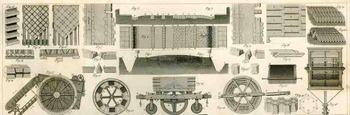
    The key to his work is the amount of data displayed on each of the 500 engraved plates illustrating this work and the way in which it is arranged.  The design and layout of the 30,000 items on these 500 plates was a work of genius, and for my money it is easily the best-presented complex means of the display of data and objects that was published in the 19th century.   

    Take for example this illustration in the technology section (a subdivision of the applied arts which is a sub division of the plastic arts) and, continuing in this complicated scheme, was Plate 1 from Section X Number A1 with a description found in the text on a dozen pages in Section 2 of Volume 2 on section pages 134-150 and overall page numbers 835-851 (!).  The plate contains 35 figures, very finely executed and rendered (many of the other of the 500 plates have 100 or more figures), and is in general related to the construction of roads and tunnels (and further, part of the “communications” section).

    This of course would be a perfect Hypertext candidate.

    Blogtunnel_top240

    The illustration itself contains an enormous amount of information.  The row along the top third or so is dedicated to street construction and paving stone, showing stones in plan and profile, as well as a cross section and ground plan of a “typical” street (including sidewalks).  It is interesting to note the detail of the cross section and the stonework that is placed beneath the horse and wagon section of the street.  There are some other beauties here as well–details of wooden paving blocks, the plan for a Laves of Hanover road, different ways of cutting stone blocks—but we won’t deal with those right now, except to point out that there are several renderings of street cleaners and road rollers (of Shettenmann and another of Schaefer) used to border the street section from the tunnel section. 

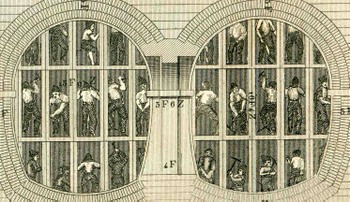
    Blogtunnel_middle241 The middle section of the engraving is of course a cross section of the Thames tunnel of the beautifully-named Isambard Kingdom Brunel (begun in 1825 and completed 1843, the tunnel 35 feet wide (11 m), 20 feet (6 m) high and 1,300 feet (396 m) long, running between Wapping and Rotherhithe at a depth of 75 feet (23 m)).  The representation here is only one inch high and ten inches long but is loaded with just fabulous detail, no the least of which are the (less than) 1mm tall workmen that can still be seen in the tunnel.
    Blogtunnelbig_detailig247
     
    The enlarged detail shows a section of the tunnel being built according to Brunel’s new specifications:  a larger, shielded tunnel being constructed around the interior construction of 12 individual tunnels (each about tall enough to allow a (short) man to stand erect. 

    In short, the engraving is a superb example of *correct* design of great artistic  ability, all accomplished while displayed heaps and gobs of interconnected, complex information. 


  • Cross Sections and City Plans: London, Berlin and NYC, 1914 and 1927

    JF Ptak Science Books LLC    Post 133
    Blogx_sectionlondon190_2
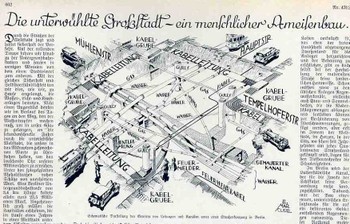
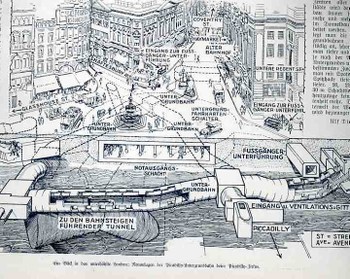
    These two images (from the Illustrirte Zeitung, Leipzig, published in November 1927)are unusual bird’s-eye view/cross sections showing two levels( above-ground and below-ground) of each city—the first showing the found vortexes of the underground utility and public works systems in Berlin at the intersection of Muhlenstrasse, Hauptstrasse and Tempelhoferstrasse, and the second showing pedestrian walkways and tube access under Piccadilly Circus in London  The point of view for each is an oblique about 50 high, looking down at about a 30-degree angle.  To my experience it is very uncommon to find all of these elements together in one image.  They’re both very clean and well designed and even though there’s quite a bit of activity in them the point that the illustrator is trying to make is abundantly obvious.
    Blogx_sectionlondon_det191
     

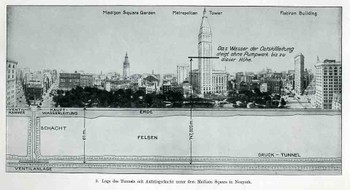
    Generally when I think of the cross sections that I’ve seen for underground and public works for cities it is almost always like the following (published, again, in the Illustrirte Zeitung, Leipzig, 23 April 1914 in the “Aus Industrie und technik section”–namely, a straight-on cross section elevation.   This image relates the depths of the tunnels delivering water to NYC from the Ashokan Reservoir (in the Catskills) to the heights of the tallest buildings.  (In this case the depth of the water delivery systems was equal to about the height of the scandalous (!!) statue atop the old Madison Square Garden building, which was about 80 meters.)
    Blogx_sectionnyc_h2o192_2