A Daily History of Holes, Dots, Lines, Science, History, Math, Physics, Art, the Unintentional Absurd, Architecture, Maps, Data Visualization, Blank and Missing Things, and so on. |1.6 million words, 7500 images, 4.9 million hits| Press & appearances in The Times, Le Figaro, Mensa, The Economist, The Guardian, Discovery News, Slate, Le Monde, Sci American Blogs, Le Pont, and many other places… 5000+ total posts since 2008.

Category: Blank and Empty Things; A History of

  • The Topography of Antiquarian Sisters

    JF Ptak Science Books    Quick Post

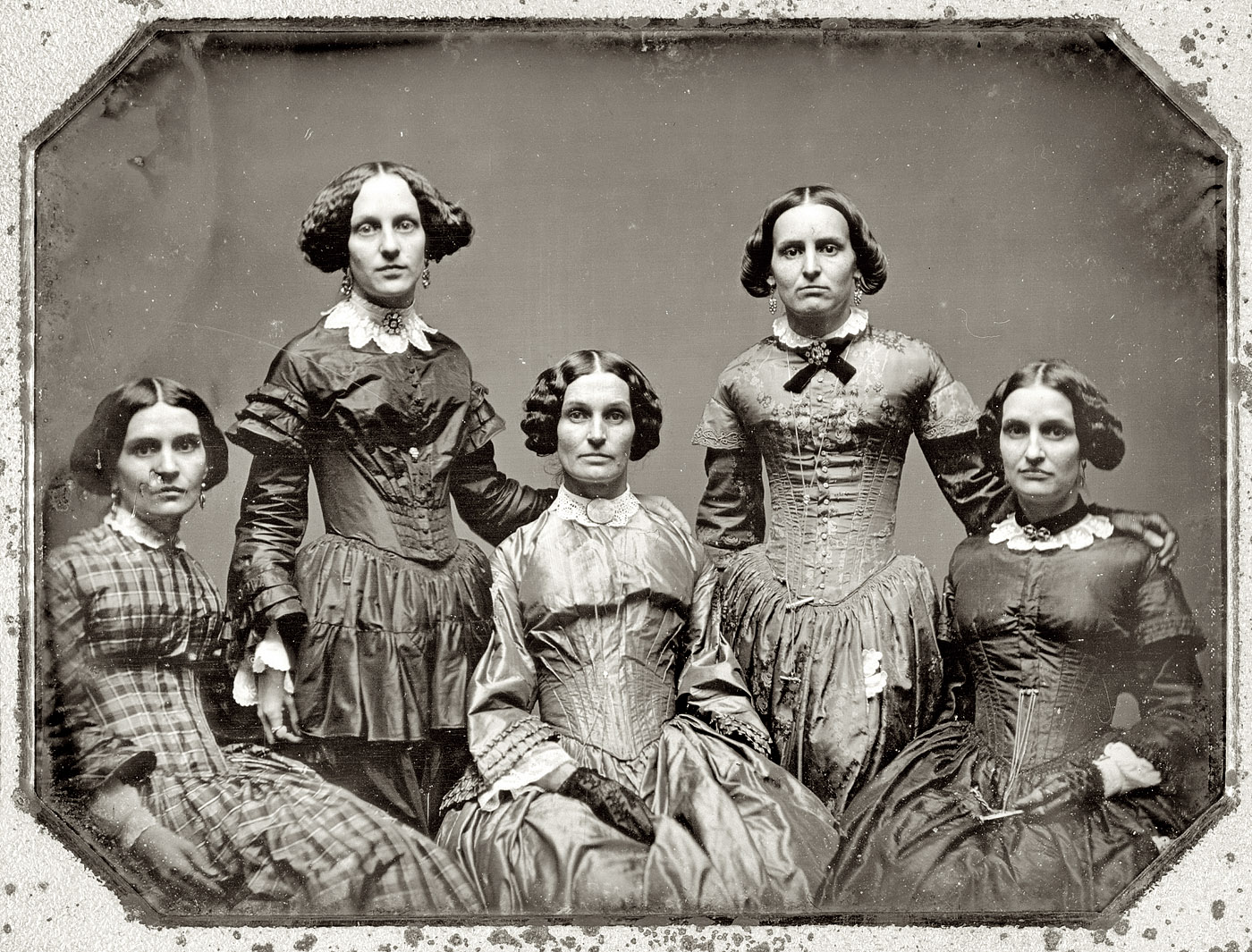
    Sisters

    Photo source: Library of Congress, via Vintage Photography, at retro-vintage-photography.blogspot.com

    This photograph–a daguerreotype, really–is both extraordinary and terribly common, at the same time, and is so in a way that is difficult to define, just that it is so.  It is the work of Frances Benjamin Johnston (whose collection resides at the Library of Congress) and was completed between 1845-1860, and shows the photographer’s aunts.  They make a formidable group.  I’d like to be able to find the data that the outline of their portraits form, because to me they look lik a graph.

    The photographer, Frances Johnston (1864-1952),  was one of America’s first successful female workers in the field of photography and photo-journalism.  She opened a studio around 1890, and went into business, no doubt helped along by her wealthy family’s social clipboard.  That it took 50 years or so and the application of a family’s small fortune to firmly establish a woman at this rank in photography, so close to the year 1900, so far into the advance of photography, is remarkable. The self-portrait, below, shows her mind:

    File:Frances Benjamin Johnston, full-length portrait, seated in front of fireplace, 1896 (altered).jpg

    she reveals herself a woman of the modern age, with her petticoats flaring and obvious, a cigarette in one hand, and a beer stein in the other, secrets no longer.

    Sisters 1


  • Blank, Empty & Missing Things: Shermanland, 40 Acres and a Mule, 1865-1870.

    JF Ptak Science Books   Post 1781  [Part of the series on the History of Blank, Empty and Missing Things.]

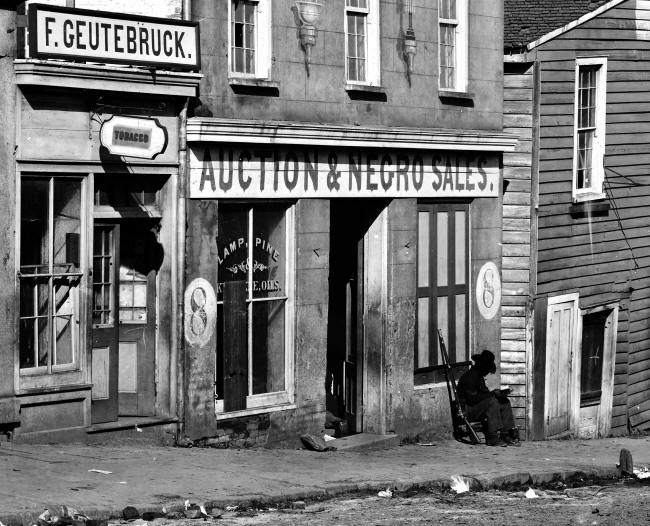
    In the history of blank, missing and empty things, few things get as missing or empty or blank as compensation to slaves.  A whole in a hole, missing bits as complements to lost pieces, a blank nothing wrapped in smoke. 

    Slave Market

    In his march through South Carolina and Georgia and on to the sea, in January of 1865, General William T. Sherman issued an order to compensate freed slaves with the abandoned properties of Southerners.  As he wrote in the field, near Savannah, on the 16th of January 1865:

    “The islands from Charleston, south, the abandoned rice fields along the rivers for thirty miles back from the sea, and the country bordering the St. Johns river, Florida, are reserved and set apart for the settlement of the negroes* now made free by the acts of war and the proclamation of the President of the United States.”

    And further:

    “…on the islands, and in the settlements hereafter to be established, no white person whatever, unless military officers and soldiers detailed for duty, will be permitted to reside; and the sole and exclusive management of affairs will be left to the freed people themselves, subject only to the United States military authority and the acts of Congress.  By the laws of war, and orders of the President of the United States, the negro is free and must be dealt with as such.”

     So it would seem that at the very least, in the wake of Sherman’s march, that the freed slaves would have some degree of economic freedom, given their forty acres so long as they kept it for a year–some would also receive a mule for plowing.  (Forty acres was considered the standard size for a sustainable farm for a family in the South at mid-century.)

    Thousands of freed slaves responded to the offer, and there was for a time some amount of relief.  The order was short-lived. Following the assassination of Abraham Lincoln in April, the questionable quiddity known as Andrew Johnson decided to rescind the Sherman order, putting all of the former slaves off the lands that they had been awarded in January.  By May there were some 40,000 people who had settled some 400,000 acres of land, all of which came to an end on 25 May 1865.  On that day Johnson declared that the new “Sherman Land” be disbanded and the lands returned to the white owners. That, along with an amnesty for the remaining Confederate soldiers who had not yet been returned to the Union–this time, though, with the Johnson amnesty, there was no requirement of an oath of allegiance. It had to have been a massively bitter experience for the freed slaves.

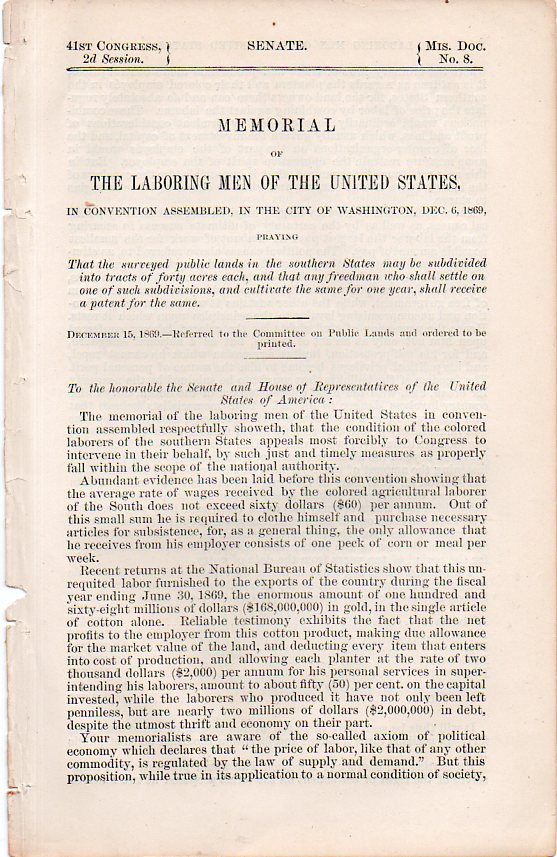
    There was another attempt to produce some sort of payment, a recompense, to the freed slaves, taken on in the 41st Congress, attempted in December 15, 1869.  The petition read as follows:  Memorial of the Laboring Men of the United States….that the surveyed public lands in the southern States may be subdivided into tracts of forty acres each, and that any freedman who shall settle on one of such subdivisions, and cultivate the same for one year, shall receive a patent for same. In this memorial, which was the work of the members of the National Labor Convention (which was also meeting in New York City at the time), it was established that the former slaves working the present estates and farms in the South managed to help produce some $168 million in revenues, while receiving negative monies for themselves–not only did they make nothing, but, as the report says, the workers were actually in debt for their efforts and labors.  They established that this alone was enough to urge for 46 million acres to be given out, parceled, to the Freedmen, 40 acres each–but not given, but sold, at cost, to the memorialists, to be paid in a five year period.

    Slave448

    This effort of course went nowhere–it failed, died, like the others. 

    These are by no means the highpoint of Reconstruction failures–they are mere examples, two among many in the gargantuan chorus of deceit, and greed, and uncaring that marked the Reconstruction period.

    Notes:

    *  I wrote a short post not long ago on the history of the capitalization of the word “Negro”, here.


  • Imaginary and Empty Space in Imaginary and Empty Maps

    JF Ptak Science Books  Post 1776  [Part of the Series on Blank, Empty and Missing Things.]                                                                                                           

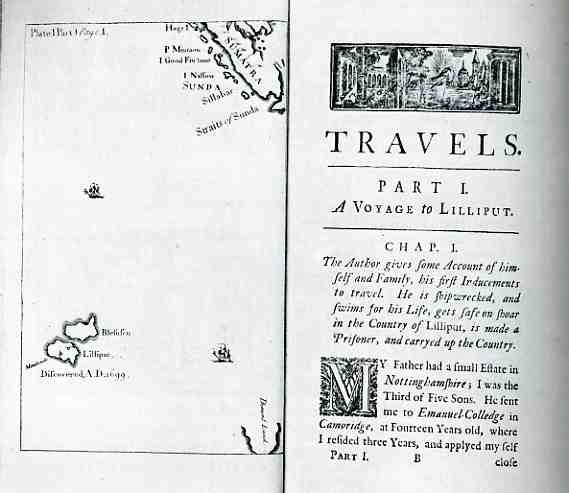
    000-ebay--Nov 4--gulliver996 Jonathan Swift’s Gulliver’s Travels (1726, amended 1735), or Travels into Several Remote Nations of the World, in Four Parts. By Lemuel Gulliver, First a Surgeon, and then a Captain of several Ships, is a great work that spills over into many different categories, being a forerunner to the modern novel, a sort-of children’s book that was for adults, as prototype of science fiction story, and of course a brilliant satire.  The satiric nature of the book is pervasive and extremely visible, but yet the whole thing works splendidly, exposing and investigating the nature of corruption (of mind/soul), perception, value, the naming of things, the nature of judgment, and, of course, the soul of political intrigue.

    Everyone remembers the voyage of Gulliver to Lilliput, but there were other voyages as well, the book including: “A Voyage to Lilliput (May 4, 1699 — April 13, 1702)”; “A Voyage to Brobdingnag (June 20, 1702 — June 3, 1706)”; “A Voyage to Laputa, Balnibarbi, Glubbdubdrib, Luggnagg and Japan  (August 5, 1706 — April 16, 1710)” and  “A Voyage to the Country of the Houyhnhnms (September 7, 1710 – December 5, 1715)”.   But what I’d like to concentrate on here is the emptiness of the space around the empty non-existent (sorry) islands of Lilliput and Blefusco, which I think fits as a subcategory in this blog’s continuing series of posts on empty and blank spaces.  The islands are well away from just about everything, being unfindable only if you’re a youngish sea captain blown off course, far to the south of remote and removed Sumatra.  

    File:Athanasius Kircher's Atlantis.gif

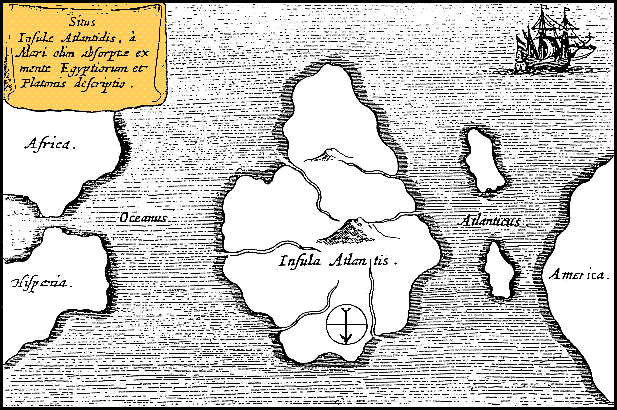
    [Map of Atlantis, from Athanaseus Kircher’s Mundus Subterraneus, 1669, with north situated at the bottom of the map, as indicated by the arrow.  It is doubtful that anyone believed Atlantis could have been the size of half of the Atlantic Ocean, as we see above; but if we look at teh relation in size of  Spain to Atlantis the possibility for that size grows brighter.]

    Even maps of Atlantis seem to make that place less removed than Lilliput, and there’s more detail to the interior of that island than Swift’s almost-entirely blank pair.  But Lilliput, as an imaginary place, looks particularly blank in a sea of blank, punctuated by two lonely little boats.  There’s just an awful lot of blank, white space in this map…  


  • Anonymous & Famous: Great Works in the History of Thinking

    JF Ptak Science Books   Post 1718

    [Part of this blog’s series on the History of Blank, Empty and Missing Things:  Names.]

    http://ebooks.adelaide.edu.au/d/darwin/charles/beagle/images/section.jpg

    There was a brief point in Charles Darwin’s publishing life when the old (then young) man got stiffed.   Darwin’s magisterial contribution to Narrative of the Surveying Voyages of her Majesty’s Ships Adventure and Beagle between the years 1S26 and 1836…, (published in 1839) appeared in the third volume,  (by far and impossibly away the “money” volume), and was issued without his name on the title page, which as it turns out was okay by the standards of the day.  The real oddness turns up in  the publisher’s ads that appeared in the later issues of those volumes in late 1839 for what would be a separately-issued volume of Darwin’s contribution (Journal of Researches into the Geology…), where again there was no mention of the author’s name.   (Captain Fitz-Roy,  the man whose name adorned those early volumes, was the Captain of the Beagle a man with problems and some very interesting and early meteorological ideas; but both would be dead to one another soon enough.)  The recognition element was dismissed very quickly though when the work was actually published—his name was in the book but not in the advertisements. 
    Anonymouspaine
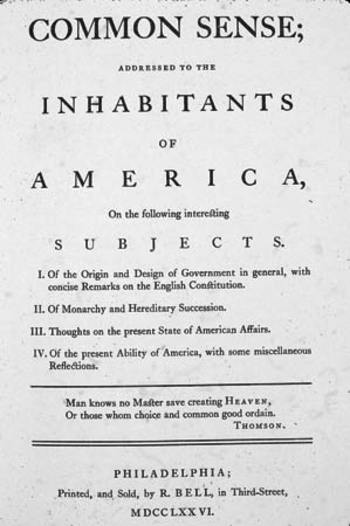
    This is really just a little fly in the ointment though in the publishing history of major scientific works–anonymous literature (or in the Darwin case, really, seemingly purposely forgotten) isn’t that deep and long in the sciences, especially when you excuse ancient and middle-Renaissance period efforts.  Certainly the sciences don’t compare with other disciplines, where works by anonymous or pseudononymous abound.  The history of world literature ancient and modern abounds in silenced or self-silenced authors—there is even a four volume encyclopedia to help you identify the unidentified. . Political and religious work are also particularly heavily laden with unattributed or disguised efforts—the U.S. Constitution and the Federalist Papers are of course both anonymous (and of necessity), as was the most beautiful work of Voltaire.  The Declaration of Independence, on the other hand, and also of necessity, was not.  What is that  they say?  Anonymity is the best defense against the tyranny of the majority”?  It still feels a little Orwellian to see the unattributed source in the newspaper or read an anonymous editorial.   On the other hand Thomas Paine’s sublime On Common Sense may not have made it into print if its author had been required to identify himself. 

    Art is perhaps the longest-lived area of anonymous work, the signed canvas being a relatively recent invention.  There are thousands of years of unknown hands and eyes represented in millions of works, but really we only get solid confirmation of the intellectual origin of a work through the invention of the ornament of the signature, and this just within the last 500 years.  And even after this defacement begins to appear there is still a relatively stout history of semi-anonymous works coming from painting studios doing work “in the manner of ____”.  Of course there were other considerations at play here, what with guilds and patrons and all—the artist was one person in a lengthy bureaucratic trail of aesthetic production.

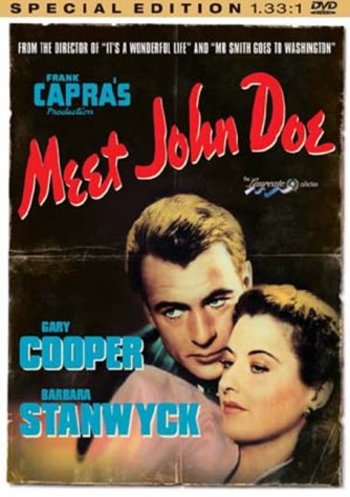
    Anonymouscooper Anonymous seems to come more into play in our present culture via the need for a place holder—when tallying and accounting the death of unknown people, for example, the name “John Doe” or “Jane Roe” is used (in the U.S.) to take up the forever empty space calling for The Departed’s name. (Our most famous “Jane Roe” is Norma McVorvey of Roe v. Wade; I think the Gary Cooper still ranks the highest for the male equivalent.)
    Something has to go there, and so it is.  The practice of using such names is actually pretty old, and is practiced worldwide.  (see HERE  for an entertaining look at multi-cross-cultural “John Doe” equivalents.)

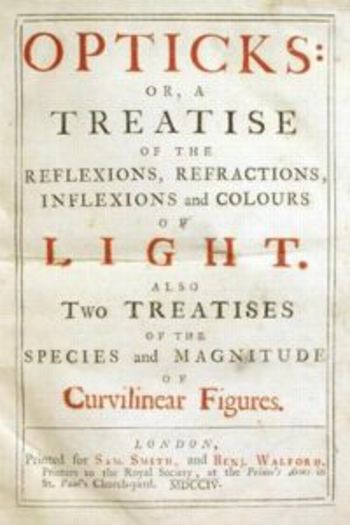
    And now that I’ve had some time to think about non-Darwins examples from the sciences, I’m a little stumped.  Robert Boyle is a good example, what with more than a dozen of his works (at least according to John Fulton’s bibliography) were published without his name carrying the title page-but these were the philosophical and political works of a great scientist, and not scientific.  Same too for Pascal, who wrote his Pensees undercover—and again, not scientific but by a scientist.  Isaac Newton published his fabulousAnnoymousopticks_2 Opticks without his name on the title and in fact only used his initials (sort of) in the preface as his personal identifiers.  He was though in 1704 when this book was published a decade’s-long acknowledged super genius, and I’ve never been very comfortable with any explanation over this unNewtonesque shyness for his big optics book.

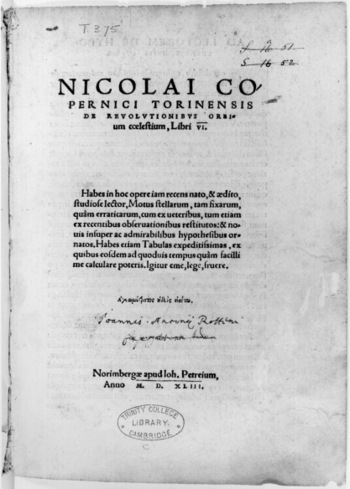
    That leads us lastly to Thomas Malthus, who really did publish the first printing of his massively important Essay on Population without his name—it would make an appearance soon after, though, in the second edition of this contentious work making the first edition of this great near-scientific work one of the most influential anonymously published science books of the last 250 years.   Laying Malthus aside though and lifting the time-veil for just a peek, the best example in this genre turns out not to be an example at all.  Copernicus was the ultimate anonymous author of a scientific work because he didn’t publish it—fearing reprisals for his horrifically challenging and revolutionary work, Nicolas waited until he was bAnnonymouscopernic asically dead to have his effort put into print.  Then, once he was safely assured of his snug bed with the worms, free from fear of all anxiety and moral espionage, did he see the work brought to public display—with his name very boldly displayed on the title page. 


  • Blank, Empty and Missing Things: Stone and Wood

    JF Ptak Science Books   Post 1742  [Part of the series on Blank, Empty and Missing Things.]

    Ogardus335
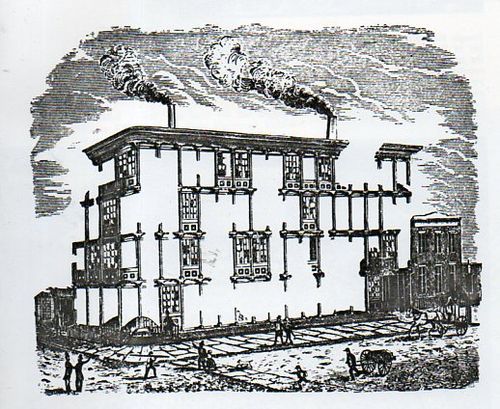
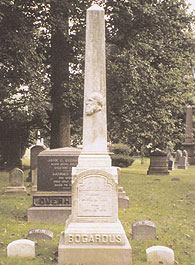
    This short post is about this remarkable illustration from a 16-page pamphlet by the inventor, architect and cast tion pioneer James Bogardus (1800-1874, Cast Iron Buildings, their Construction and Advantages, 1856 and 1858 second edition). 

    But before I get to that, I started to wonder about why it was that NYC developed up rather than out, vertically rather than horizontally? There was plenty of room for outward growth–and in mid-1850’s, the period that this post addresses, most of the city had already been laid out, or at least up to 96th street.  But in the city of about 900,000 people, there were few people living that far north (and not that many structure), with half of the population living below 42nd street.  So, the largely flat, largely unoccupied island could well have been developed northward rather than skyward.  My feeling is that the reason for vertical development was “running”.  That in the pre-telephone days and the earliest days of electrical telegraphy, that in order to conduct business rapidly messengers were used to take documents and communication back and forth. And so for the sake of speed of business, rather than have messengers traveling for 20 or 40  or 80 minutes to a more-removed uptown location, that it made more business sense to keep businesses together; and to do that on limited land, one needed to go up.  Not out.  I’ve never thought about this, ever, but this seems to make sense to me…

    Now, getting back to the Bogardus illustration: what was missing was the building, or the pieces of the building that had previously been thought of as being absolutely essential for a structure of this size to maintain itself.  But what Bogardus had done was to figure out a way of using cast iron rather than other building materials–a building tool that was stronger and with greater engineering chops than anything else that had been previously seen, which meant that there were different forces at play in structures using it, and which meant therefore that even though there were large pieces of the building’s shell that were “missing”, that this structure could and would still stand.  It was a fabulous way of communicating a new idea. 

    What happened with the Boagardus idea is that it developed into the use of steel-framed buildings, which made for very light, very strong structures, which led to skyscrapers, which led to modernity.

    The Harper Brothers building (built in 1854 at 331 Pearl Street) was an iron-facade building that was engineered by Bogardus (with the architect John B. Corlies) and was built in response–and partially as a safe, fire-proof building–following the devastating fire (and enormous liability payout) in the previous Harper building.  One thing that was certainly different in the face of this building–owing to the efficiency of the cast iron, there could be plenty of windows in place of where there used to be building materials.  And there was certainly plenty of glass in the Harper building.

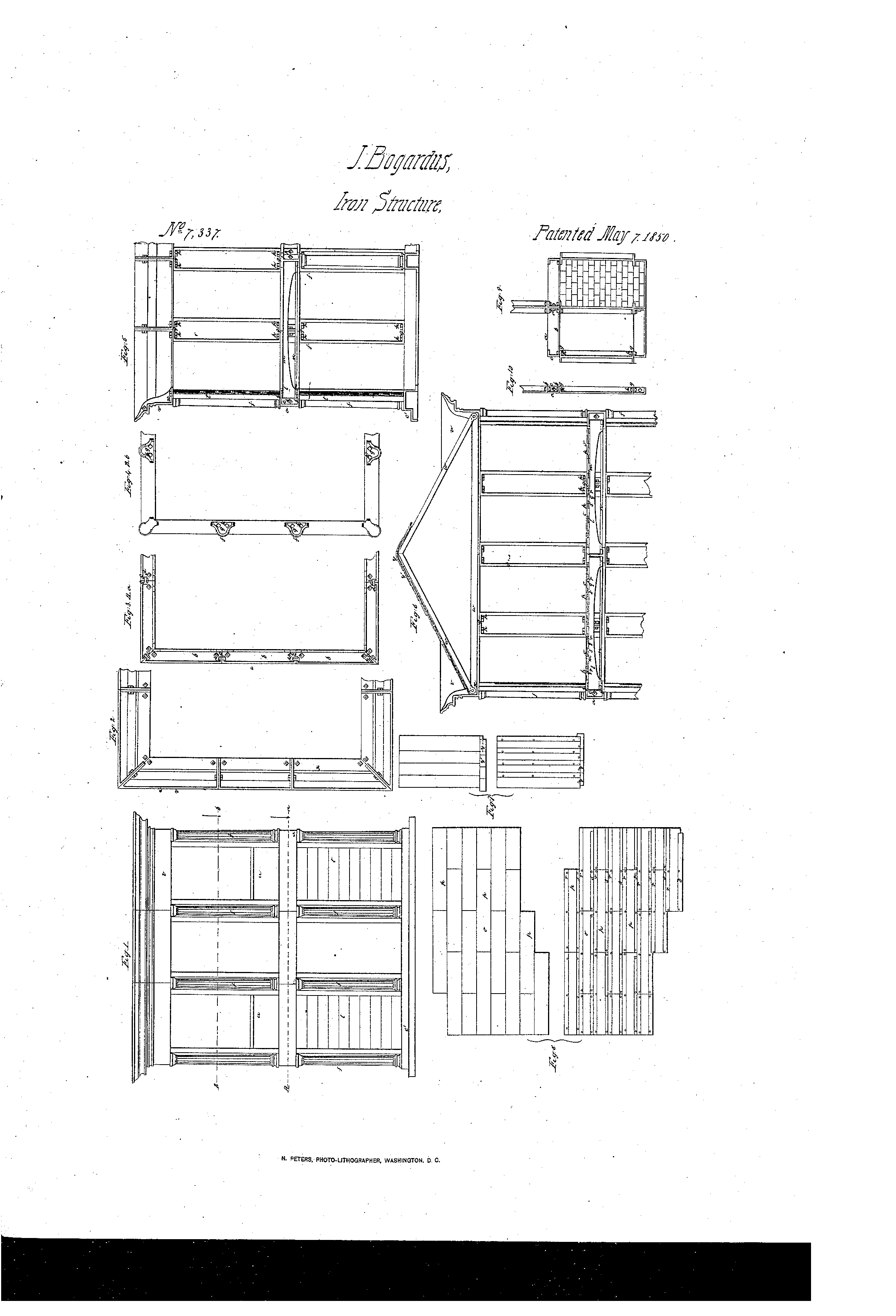
    Bogardus patent

    [Patent source: the very easily usable Google Patents, much more nimble than the UST&PO, somehow.]

    The trip to modernity didn’t necessarily start here with Bogardus of course, but he was a considerable and significant chunk in the engineering developments necessary for the construction of tall buildings…and here it is interesting to note that another big piece of that development that came into being at nearly the same time (1854) as the publication of Bogardus’ pamphlet and the construction of the Harper building was the installation of Otis’ safety elevator int eh Haughtwout (five storey) store. And of course the elevator was necessary for the creation of tall buildings, just as the invention of the braking systems was essential for the creation of the elevator. And on the story goes. 

    The Bogardus achievement (patented May 7, 1850) was certainly an important step–it was pragmatic, efficient, and strong, and also led to the possibility of mass production and pre-fabricated structural elements.  And for the mid-1850’s, this was certainly a big deal.

    One of the few remaining Bogardus structures, at 254 Canal Street, today:

    And the Bogardus monument in the famous Green-Wood Cemetery, in Brooklyn:


  • Empty Memory: Telephone Number 20080 (Warsaw), Nazi Occupied Poland and the Holocaust, 1941 (Expanded)

    JF Ptak Science Books –continuation of Post 298 from 2008

    Empty diary150
     I’ve felt that a great history lesson for school kids would be to make them keep a diary for some other kid from some other time, introduce them to the minutiae of life from another time and perhaps another place.  With some guidance they could make interesting entries in their diary for, say, 15 June 1897, writing about chores, the daily schedule, what they studied in school, how they were dressed, how they got food on the table and kept the house clean, how they would spend 25 cents, what they would see from some given vantage point, and on and on.  This could take place in their very own home town; it could be multi-generational, requiring them to talk to the scary white hairs, or it could reach far back into history and be of an entirely different place altogether.  After they were assigned a particular place in time and space, you could give the kid subtle hints, like this one (below), asking them what they thought it might mean by dialing the phone number 200 80 in Warsaw in 1941.  And what did that pair of lightning bolts mean, anyway?  I think that once they were made to figure it out for themselves, as though they might’ve been there, and then could record their feelings and observations in a diary might actually bring history to life (especially once they had their “holy crap” (and probably worse) moment at what these numbers implied). 

    1ebay_oct_3_1941_diary739_2

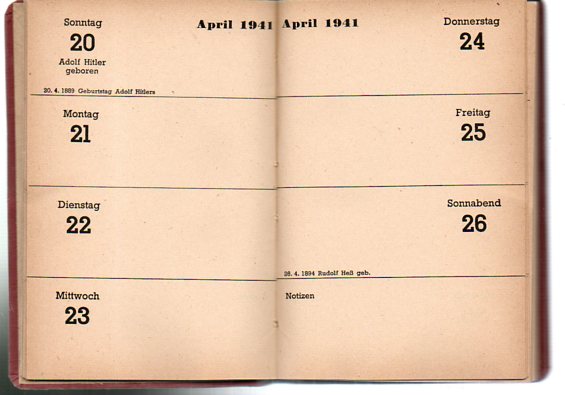
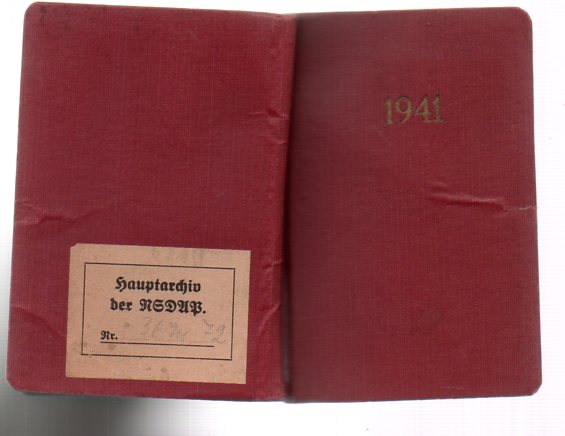
    This is one of the ideas that came home again uncovering this odd booklet, which is a Nazi diary for those stationed in the Generalgouvernement (Tascehnjahrbuch 1941 fuer den Deutschen im Generalgouvernement) ,  for the year 1941. The General Government (or more fully the Generalgouvernement für die besetzten polnischen Gebiete) was one administrative section of occupied Poland, the country being divided in 1939 after the German invasion of 3 September 1939, with the western section being retained by the Germans and the Eastern given over to occupation by the Soviets via the Non-Aggression pact between the USSR and Germany.1

    Empty diary149
    This looks like an every day diary for the period, except for the Nazi (or NSDAP) regalia and German imprint of Generalgouvernement in Krakau.  And, all of the annotated high points of the year for the most overly voracious parts of German militarism as well as for the hot points of Nazi history.  Hitler, (above) Goering, Goebbels and other leaders’ birthdays are highlighted, not to mention seminal points in the development of the Nazi party and party-adoptees (Richard Wagner has a number of entries for suggested celebrations). 

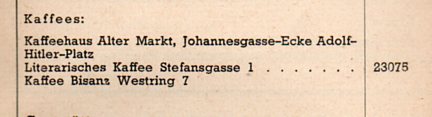
    There are also helpful directories in the back pointing to any number of cafes located in a growing number of “Adolf Hilter Platz’s” throughout Poland (including three in Radom), as well as fares for the use of the railway and postal system.

    We also see the following telephone number:  23075.  That’s for the Literarische Kaffee Stefansgasse I, Krakau. This is the location that the Reichsminister and administrator Hans Frank (about whom we’ll read in a moment) decided to hold a chess tournament in 1941, to satisfy his own need for chess while freshly in the pursuit of the murder of millions of people.

    Empty diary cafe151
    ‘Frank was extremely interested in chess. He not only possessed an extensive library of chess literature but was also a good player, and he even “received” the Ukrainian chess master Bogoljubow at the castle. On 3 November 1940 he organized a chess congress in Cracow. Six months later he announced the setting-up of a chess school under Bogoljubow and the chess master Dr Alexander Alexandrovich Alekhine, and he visited a chess tournament in October 1942 at the “Literary Café” in Cracow.”–Hans Frank (subtitle: Hitlers Kronjurist und Generalgouverneur) by Dieter Schenk (Frankfurt am Main, 2006) “and quotes a reference to chess on page 177 (given below in our translation)…”[Source: Chesshistory.com., here.]

    Continue reading here.


  • The Farm and the Boring Frontier in the Closing of the West

    JF Ptak Science Books   Post 1699  [Part of the series on Blank, Empty and Missing Things:  the Frontier, 1885.]

    Farming and the closing of the frontier–more notes on reading Larry McMurtry’s Lonesome Dove, part 4.

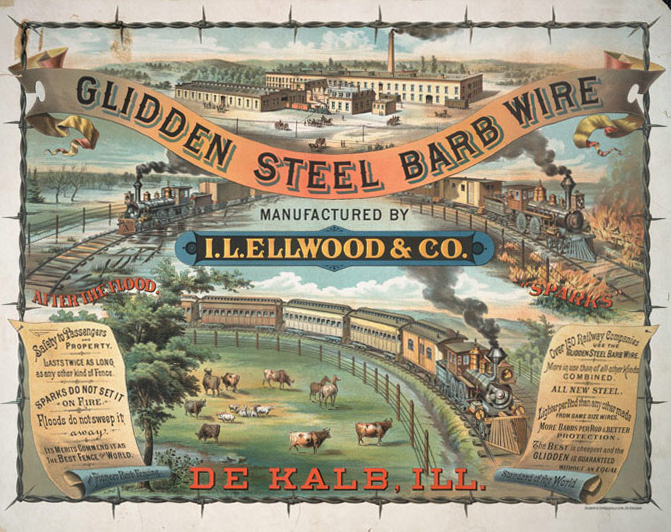
    It is difficult to underestimate the impact of the technological revolution on the development of the American West. The impact of the railroad is obvious; efficient fencing material in the form of barbed wire revolutionized land distribution and control. Less obvious is the less glamorous—the plow, harrow, windmill, silo, well drilling, and harvesting machinery. All made farming less difficult and opened the way to ever more land being farmed—the cultivation and civilization of the vast tracks on the Great Plains was made possible by these innovations.

    Barbed wire
    [The use of the railroad in this ad for the famous Glidden barbed wire is interesting because in the history of lines and the American West, it was the lines of the railroad tracks, telegraph wires and barbed wire that changed the face of the place more quickly than anyone could have imagined in the 1840’s.  Certainly if Jefferson had been able to survive to his 150th year he would have been absolutely shocked to see how fast the West had been not only explored but brought into some sort of control, a feat that he imagined would take many generations past his exploratory team of Lewis and Clark.] 

    All of the machines needed in the West—chilled-iron and steel plows, grain drills, reapers, disk harrows, straddle-row cultivators, and threshing machines—were in use before the Civil War. The appropriate improvements and modification needed for use on the Great Plains came about in the 10 years or so following the war.
    The improvements made in farm machinery from 1870-1890 had the following effects on time, effort and money saved in the production of each acre of the following:

    Crop Time Worked Labor Cost

    Hand Machine Hand Machine

    Wheat

    61 hours

    3 hours

    $3.55

    $0.66

    Corn

    39 hours

    15 hours

    3.62

    1.51

    Oats

    66 hours

    7 hours

    3.73

    1.07

    Loose Hay

    21 hours

    4 hours

    1.75

    0.42

    Baled Hay

    35 hours

    12 hours

    3.06

    1.29


    The effects of technology were staggering—in the 1870’s, a farmer knew he could only plant seven or eight acres of wheat because he knew he could only cut a certain amount during the limited harvesting season. By 1890 the same farmer could plant 135 acres knowing that he had effective means to harvest, bind and store the wheat without spoilage. These improvements meant more production from more farmers, and changed the face of the Great Plains.

    Railroads helped a great deal in bringing farmers west—sometimes covertly. The Great Northern Railroad did its fair share in structuring the land during the “Dakota Boom” of 1878-1885. It was formed in 1879 by James J. Hill, a former employee who managed to seize control of the railroad following the Panic of 1873. Its progress west was deeply planned by Hill—since the railroad had no land grants, he realized that income must come from revenue, so he brought revenue-makers with him, building communities along the railroad as he went. He advertised and brought in immigrants from Europe, established model farms, imported blooded cattle, and loaned money to farmers, homeseekers and immigrants of all persuasions. His actions were persuasive and successful.

    Its a horrible thing in some ways to identify farming as a “Boring Fronter” in the history of ” _____ Frontiers”, but it is in some ways accurate.  Not to say that all of farming is boring, not by any means, particularly in difficult places in trying times–but the presence of an easily-accessible borderland defined by a very inexpensive means of identification (as in barbed wire) meant that the property of individuals was defined, and that new property owners would have to fan out and away from existing farms and ranches, thus settling more and more territory.  And this of course meant more and more land was under control.  And “under control” means, well, under control.


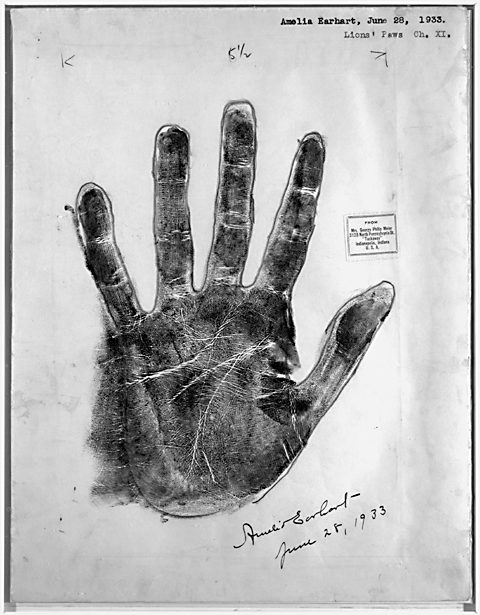
  • Amelia Earhart’s Disappearing Hand and Her Not-Disappeared Greatness

    JF Ptak Science Books 

    (I just added a few things to this post from three years ago.  The image of Ms. Earhart’s hand is fantastic–read the story here in the post Amelia Earhart: Her Physical Disappearance vs. Lindbergh’s Moral Vanishing):

    Blog--earheart


  • A “Different” Sort of Posthumous Publication–the Books of the Dead

    JF Ptak Science Books     Post 1696

    Generally a posthumous publication sees a new book come to life after the author’s death,  In the case of Dante Gabriel Rossetti, a new book from him was brought into being literally from the hands of his seven-years-dead wife, Elizabeth Siddal.

    File:John Everett Millais - Ophelia - Google Art Project.jpg

    [Elizabeth Siddal was the model for Sir John Everett Millais’s Ophelia; she posed for many of the Pre-Raphaelite Brotherhood, and very often (and later obsessively and exclusively)  for Rossetti.]

    Elizabeth (1829-1862) was the great muse of Rossetti (a leading painter and one of the founders of the Pre-Raphaelitte Brotherhood), as well as to many painters–I imagine that she is depicted in hundreds of paintings.  But she may have had a taste for certain drugs, and may have been tubercular, and may have had an intestinal something, one or two or all may have caused her death at age 33. 

    The book was literally a book from the dead, though it had nothing to do necessarily like one of the real things, the true Book of the Dead that offered assistance to the newly dead in their trip to the ancient afterlife. Evidently a great guilt weighed on Rossetti for something he had done while Elizabeth lay dying, and to help conquer that great unquiet, the painter wrapped a manuscript volume of his poetry in her hair as she held the book in her hands, laying there very dead in her coffin.  The lid was closed, the coffin lowered into the ground,  and both were sent off into infinity.

    That infinity lasted seven years, interrupted by Rossetti’s animated alcohol- and drug-induced belief that–now convinced he could no longer paint–the poems in his wife’s hands were his way towards creativity.  Convinced that his painterly powers were gone, and that his writerly powers were going, the manuscript would help him get back on track.  It was the only copy of poems he had written over the years, and he hoped that their publication would (a) reassert his furious creativity with a successful book and (b) honor his dead wife.  And so a rat’s soup of demented needs conspired and the book was taken from the hands of Elizabeth after her exhumed coffin was opened–Mr. Rossetti not being present for the late-night and dark affair, unable to convince himself of the necessity of his presence.

    [Dante Gabriel Rossetti’s Beata Beatrix, featuring his wife Elizabeth as Beatrice Portinari, the character from Dante’s La Vita Nuova, completed the year after Elizabeth’s death.]

    The deed done, Poems was published in 1870, and I’m not sure what they accomplished.  Drugs and booze and some sort of wickedness of mind and a sacking of his health made for perfect conspirators to rid Rossetti of his talents, and he died a lingering death in 1882. It was said that he never overcame his grave robbing–I imagine not.

    http://upload.wikimedia.org/wikipedia/en/c/c9/Ms_eng_769.jpg

    One of the three surviving leaves of the book of poetry Rossetti stole from his dead wife’s coffin.

    And so it goes. In the end, everyone is dead.


  • A Bloated Alphabet of Fat Cures: Strychnine Pills, Vibrators and Hope.

    JF Ptak Science Books     Post 1691      Part of the Series on Blank, Empty and Missing Things:  Promises.
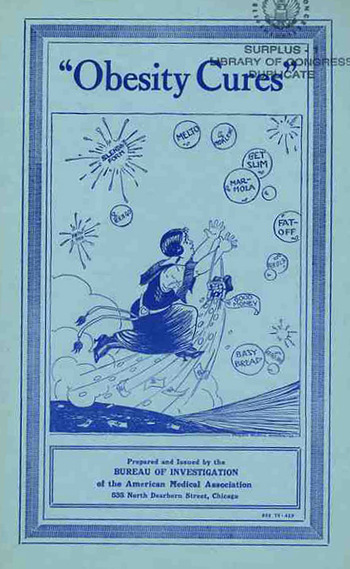
    Blogfatobesity_cures132 Quackery in general has survived in spite of itself over many fields, not the least of which is astrology and creation “science”, cults, religions, and walking-with-the-dead.  In the U.S. in the 1910-1925 period however there was a attempt at investigating the most outrageous frauds in the medical profession by the American Medical Association, and of the many sorts of quacks and frauds-liver cures, neuralgia miracles, electro-vibrator hair restorers and lump removers, anti-droopy happiness pills, cocaine nervous system remedies, and so on–what I’d like to look at right now is concerned with “flesh reduction”, or  fat cures. 


    http://media.vogue.com/files/filecheck/2012/01/12/3-Weegee_15302197753.jpg_article_gallery_slideshow_v2.jpg

    [Photograph of a neon sign, Manhattan, 1941, by Weegee from Naked City.]

    According to the AMA (in a 1934 retrospective) the chief stimulant to the obesity industry was the rise of womens’ fashions.  I think that the reasoning might wind itself around the growth of expendable money in the American rising middle class, where Americans, in general, had more money to spend on the non-essentials than any time in the history of the country.  That leads to more consumables, and that leads to more advertising, and that leads to more idealized images of what people should look like, and that leads to wanting to look like that, and that opens the door to scammers who offer a way to get to the not-actual ideal without effort and for little money.  And so in the ’20’s there was a spike in quack remedies for obesity, as there was little or no control over the content of what was being sold nor the claims about what the product did, medically speaking-there was general protection from fraud, of course, but the medical compliment for establishing what that actually was wasn’t quite yet in place. 

    There is a veritable alphabet (soup) of mondo bizarre cures that the AMA attacked and ripped apart during the 1920’s, publishing the findings of their labs on the ingredients of the cures and the possibilities of whether any of the hundreds (thousands?) of these things worked at all. 

    And what the AMA found was really pretty remarkable–lots of water, sugar, tartar,
    tinctures of useless this and that, desicated liver, seaweed, salt, lemon, and that
    sort of thing, none of which had any value for weight reduction whatsoever.  A
    major ingredient, for some reason, was focus vesiculosus, also known as
    bladderwrack, sea-wrack, kelp-ware and sea-oak–there was no indication of why this
    ingredient was so popular, especially since it was used in some farms as a pig feed
    to make the animals fat.
    Blogfat_slim_chicago133  

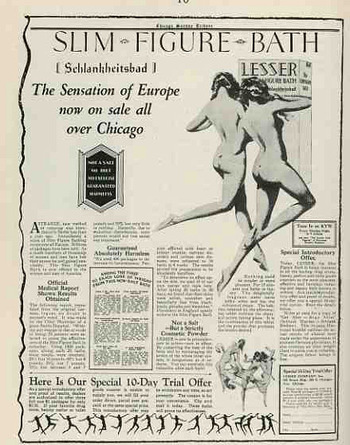
    So, aside from the pig-fattening ingredient for human “flesh reduction”, we’ll have a quick alphabetical tour of some of the outrageous (and bizarrely-named) products and their components promising hope and physical happiness to the woman of 1925. (Let’s note that the following are just locally-applied or ingested cures-there’s an entire universe of external applications and devices that were used to solve the problem of fat.  For example, the Violet Ray Machine claimed that in addition to obesity it would cure “Problems with circulation of the blood, the heart’s action, bumps of the funny-bone, germ infections, weakness, the waste of the body, congestion, impaired physical development, pains and aches, complexion and skin diseases, facial and body blemishes, hair loss, headaches, inflammation of joints, muscles, nerves, Atrophy, circulatory disorders, constipation, deafness, goitre, high blood pressure, arteriosclerosis, insomnia (sleeplessness-Brain Fag), indigestion, dyspepsia, neuritis, nervousness, hysteria, melancholia, neurasthenia, neuralgia, obesity, pain, paralysis, prostate gland problems, scalp diseases, falling hair, dandruff, asthma, anemia, bronchitis, catarrh, hay fever, rose fever, colds and other inflammations of the upper air passages, and, of course, cancer.”  This quote with thanks from the Museum of Quack Meidcal Therapy Devices

    And so to the consumable and applied quack fat cures:

    Absorbit Reducing Paste-one of my favorites.  This was a nighttime sleeping paste
    which was composed of 44% lard as well as beeswax, oil and milk.  After slathering
    yourself in this oily, waxy, milky fat cocoon (the sheets!) you were also supposed
    to ingest an accompanying night aid pill, which was 24% sulphur and 61% sugar.  So
    not only would you be oily milky waxy lardy, you’d also be stinky and, at the end of
    it all, hyper. 

    Allmans Anti Fat Anti Pon (?)).  According to its label, it was a “powerful and
    entirely harmless specific”, which the AMA revealed to be composed of citric acid,
    water and food coloring.  Sounds like Kool Aid. 

    Arbolone tablets.  These guys were made of desiccated thyroid, starch, lime and sugar.

    Basy Bread was a “anti growth” bread which turned out to be just a course wheat bread

    Clark’s Thinning Salts was almost entirely washing soda.

    Dalloff’s Time Pills were made of lavender and bearberry.

    Elfin Fat reducing Gum Drops (continuing its spectacular name by saying it was a
    product of the Pep-Giving Product Co., Inc.), was actually one of the only items
    that might have contributed to weight loss, if only for the fact that in addition to
    consuming its drops made of laxative and sugar you were supposed to adhere to a
    pretty regimented, difficult exercise routine.  Big sweat and potent laxative does
    in fact produce weight loss.  Maybe not a good weight loss, but aa weight loss
    nevertheless. 

    Elimiton (!) was a product made of caffeine and rhubarb.

    Every Woman’s Flesh Reducer promised a new figure with their mixture of Epsom salt
    and camphor.

    Fatsoff, a soap product that you washed with, was not surprisingly made of soap.
    Fayro was another soap and washing flesh reduction “package” that asserted that by
    using their secret flesh reducing salve (i.e., “soap”), you would “open your pores
    to let the blood cells sweat off fat”.  I could just about see the AMA guy who was
    writing their description of this thing slamming his pen and screaming.

    Some other F’s included Fells Reducing Tablets (which were milk), Figurroids (salty
    baking soda), Floradona (sodium thiosulphate, the photographer’s “hypo”), and Folt’s
    Reducing Soap (which was, again, soap). 

    Get Slim was a vile purgative of sugar, tartar and baking soda, plus perfumes.

    Hall’s Tablet Triturates were ginger and a big shake of chalk; Hargreaves Reducing
    Wafers (bread and liquorice).

    J.Z. Obesity tablets–were the same product as Absorbit which was the same as
    Zobeide (minus the ox mucus). 

    LaMar reducing Soap (“to wash away fat”) was soap.

    Marmola, “a thyroid-containing obesity cure” was composed of cornstalk, borax, baking
    soda and tartaric acid, with a special “constipation agent” (?), as well as a lot of
    salt. 

    Morlene would reduce goitersm neck fat, bust size and tumors, somehow, with the
    application of its cleansing elements (soap).

    Neutroid seems to have been the most lethal of the hundreds tested, contaning bad
    dollops of magnesium carbonate and iodol, and was taken internally (where external
    application could prove fatal). 

    Oil of Korein was pretty nasty stuff, containing sassafrass and about 75% petrolatum
    (a semi-solid mixture of hydrocarbons, or petroleum jelly), though it also offered
    some really good advice on foods to avoid if you didn’t want to actually gain
    weight. 

    Phy-thy-rin was a calcium and sugar coated pill of iodine and dried thyroid, with
    plenty of sugar, and liquorice. 

    Rusell’s Anti-Corpulent {reparation was a powdered added to water that would
    effectively produce orange Kool-Aid.

    Sangra Bath Salts was perhaps the most outrageously simple, being just colored bath
    salt.  Slendaform (“just gently rub it in, and watch yourself get thin”), was a
    half-pound jar of oil of turpentine, white vinegar and milk curd.  Slyphine, which
    crowded its ads with tremendous claims to be “Absolutely The Best Weight Reducer
    Ever Discovered” and other very shouty claims (by somehow “attracting surplus
    fat”), was simply borax and talc. 

    Dr. Vincent’s Anti-Stout Pills contained a pretty sounding mixture of aloes, jalap,
    cloves and bladderwrack.

    Mme. Yale’s Fertilizer Tablets-I’m not sure about the real use of “fertilizer”
    here.) was actually one of the earliest of these frauds to be attacked by the
    government, being charged with fraud by “misbranding” in 1909, as federal chemists
    could find no connection between weight loss and its sole ingredients of sugar,
    charcoal and cream of tartar. 

    Lastly, we offer Zobeude, which was just Absorbit Reducing Paste relabled for
    British consumption, though it seems to have contained an added ingredient of
    “purified ox bile”.  We are told in Bruce’s Materia Medica of 1884 that “Purified ox
    bile has the composition of fresh bile, less the mucus .”