A Daily History of Holes, Dots, Lines, Science, History, Math, Physics, Art, the Unintentional Absurd, Architecture, Maps, Data Visualization, Blank and Missing Things, and so on. |1.6 million words, 7500 images, 4.9 million hits| Press & appearances in The Times, Le Figaro, Mensa, The Economist, The Guardian, Discovery News, Slate, Le Monde, Sci American Blogs, Le Pont, and many other places… 5000+ total posts since 2008.

Category: Blank and Empty Things; A History of

  • A Short Note on Anonymous Art in the Renaissance

    JF Ptak Science Books    Quick Post  [Part of the series on Blank, Empty and Missing Things]

    There was an anonymous painter,

    in an anonymous room,

    painting an anonymous woman,

    in an anonymous gloom…--By Anonymous

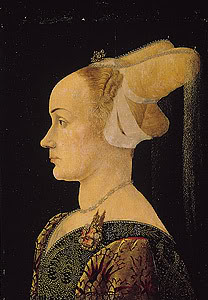
    I wondered about when it was that anonymous portraits appeared.  Not just depictions of people in large battle scenes, or some unidentified spectator of some miraculous something, or wardens of the unknown in some sort of religious icon,  but single subjects seated for a singular purpose of having their likeness rendered.  And at the end of that process, the sitter would be anonymous–not their names-lost-to-history-anonymous after having the title of the painting lost to time, but always-and-forever anonymous.  It seemed to me a luxury for a painter to paint for the sake of painting, that they would paint perhaps for pleasure or for practice, as the practice of purchasing anonymous portraits was not one of high popularity.

    File:Florentine 1475 NG of Victoria.jpg Anonymous portrait of an anonymous woman, ca. 1475


  • Blank, Empty and Missing Things: the Magic Painter, 1770

    JF Ptak Science Books   Post 1823

    In his fabulous four-volume work, Nouvelles recreations physiques et mathematicques (published from 1769-1770), Edme Gilles Guyot (1706 – 1786) writes about applied math and physics and optics and the associated over a very wide landscape and dives deep into their distracting, entertainment value–polite intellectual diversions, optical illusions, and artistic magic.  And not “magic” as in the supernatural/paranormal flavors–but performance magic, the art of magic, that employs elements of the sciences to trick the audience–and reveals its secrets to his readers.

    [Source, with full text, here.]

    This engraving, above, illustrates an object he describes called “the magic painter”, a performance trick using a good story line, nice props, and a relatively not-yet-widely-understood-or-experienced property, the magnet.   The box seen by the audience was the box (seen at top left) illustrating an artist at his easel–an artist with such great sense of anticipation that he could determine what sort of painting his customers would like to have painted.  And in this case the audience of the magician would chose what they wanted to see “painted” here from among the four scenes shown at bottom….


  • A History of Blank, Empty and Missing Things: Pain

    JF Ptak Science Books   Post 1816  Part of the History of Blank, Empty and Missing Things series

    Surgery heister563

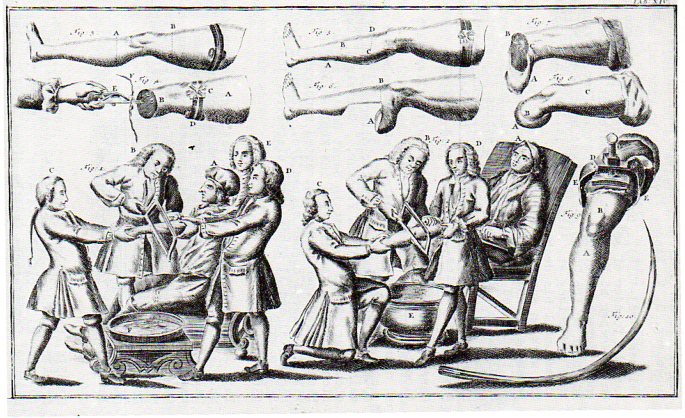
    This curious woodcut is found in Lorenz Heister’s (1683-1758) Chirurgie, in welcher alles, was zur Wundarzney gehöret, nach der neuesten und besten Art, gründlich abgehandelt, und in 38 Kupfertaf, die neuerfundene und dienlichste Instrumente, nebst den bequemsten Handgriffen der chirurgischen Operationen und Bandagen deutlich vorgestellet werden.  Hesiter was a Nuremberger anatomist and botanist, but most importantly here one of Germany’s leading surgeons–and as a matter of fact was the founder of scientific surgery in Germany as well. He studied at Giessen and then at Leyden, where he was taught by great lights such as Ruysch,  Bidloo, Albinus and Boerhaave.  His Chirurgie was first published in 1718 in German, and was soon reprinted many times, and then translated into Dutch, English Italian, Spanish, Latin and French.

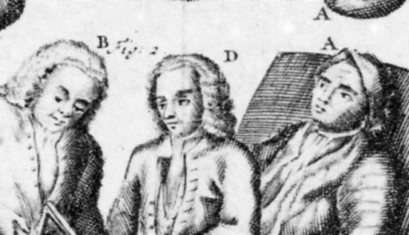
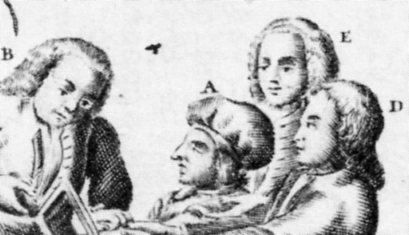
    The thing that gave me pause in the realm of pausible things, the thing that is probably the least likely to be considered “academic”, was the issue of the expression on the faces of the people undergoing amputation in the illustrations of the book.  In the pre-general anaesthesia days of Hester, the man (above in detail and below) is remarkably composed, as is the person undergoing the arm amputation.  It is all quite neat, orderly, non-chaotic and clean. And seemingly painless.

    Surgery heister560The word “anaesthesia” didn’t even exist until 1846 (Oliver Wendell Holmes Sr), when William T.G. Morton made the first successful use of it in the fabulously-named Ether Dome of Massachusetts General Hospital.   I guess the doctors could’ve dumbed these patients up with opium or other narcotics–but the sponge that was soaked in the stuff and inhaled under the nose is not in evidence.  Of course, they might’ve ingested the narcotic, or smoked it, or had it applied, but I can’t find any evidence of this in a quick look through the text.  The patients also could’ve been given diethyl ether (the general form of which is perhaps a Lullian invention of the 13th century, though the “aether” part of it came apart three decades before the Hester book with Frobenius), but again, I’m not sure.  Certainly they were given something and not riding out the operation on their own…we just don’t know that from the book, which no doubt took the high-and-unscary-road to the issue of the cutting end of the amputation. 

    Surgery heister564


  • History of Anticipation: Waiting for Everything

    JF Ptak Science Books     Quick Post   Part of the History of Anticipation series and the History of Blank, Empty and Missing Things series.

    Alchemy is far from my strong suit (or even a weak suit), but I was intrigued by this engraving found in Annibel Barlet’s Le Vray Et Methodiqve Covrs de La Physiqve Resolvtive, Vvlgairement Dite Chymie: Represent Par Figures Generales & Particulieres. Povr Connoistre La Theotechnie Ergocosmiqve, C’Est Dire, L’Art de Diev, En L’Ovvrage de L’Vnivers…, which was ostensibly a work on alchemy, the second edition (used here) published in 1657.  Taking  a quick tour through the book it looks far more applied, far more medically-oriented, than a standard work on alchemy.  (And by “medical” I’m really meaning “pharmaceutical.)  I don’t have the knowledge really to say  much about the application of the Paracelsian alchemical chemistry and how much the various human natures/humors/metals etc. come into play with the prescription–I’d say offhand that the Rxs would be necessarily a little suspect. 

    [Images courtesy of the Beinecke Library, Yale University].
    I’m visiting the book here though because of the image above, showing the hands of the Primum Mobile (or god) about to see themselves busy with the job of creating everything.  Or almost everything, as the shape of the container of All Things seems to be in place, held by the creating influence in an existence outside of the existence of existence.   Perhaps the artist was just depicting the local existence, with the hands and etc. located in the space beyond the known solar system of 1657, showing the alchemical creation of order in the vast sea of chaos.  It is curious to me how many concentric circles there are in the suggestive orb of possibilities, especially since the following image in Barlet’s book shows considerably fewer place-holders.  Perhaps this is all easily explained with a little knowledge of alchemical history, which is something that I do not possess–but for the time being, I’m very entertained by what might be an excitement in that first engraving of the things-to-come. 
    Later in the book is found this interestingdiagram bringing together some of the complicated alchemical beliefs of elemental relationships, this showing the coming-together/convergence of elements, humors and geocosmic bits
    A diagram of a square divided into four triangles within a larger circle illustrating the convergence of elements, humors, and geocosmic factors in the thinking of Paracelsian chemical physicians.
    Le vray et methodique cours de la physique resolutiue, vulgairement dite chymie by Annibal Barlet

  • The Liar in Political Winsprumerfall–a Short Episode in Blank, Empty & Missing Things

    JF Ptak Science Books     Post  1805  [Part of the History of Blank, Empty and Missing Things series.]

    Pencz, Georg: Der Verleumder
    [Source:  Zeno.org.]
    As we approach the new political season (where it is always all fours seasons,
    simultaneously, and known as “Winsprumerfall”) and where everything is good and
    bad, and decent and not, and moral and wanting, and right and wrong so far as the “wrongness” falls upon your opponent, and cloudy and clear, and all at the same time as always, everything all at once, it might serve us well to have an image of Georg Pencz’s
    (who I wrote about earlier today, here) Verleumder in mind. 
    And as we can see and guess, the wood engraving depicts the lying liar, the defamer influencing a value judgment, the slanderer of a fact known to be true and uttered false, a libeler.  A cheat of the fact.  In times like these, it is always good to listen closely and follow the logic, and then the money.  And then fact-check.

  • Found Surrealist Parabolic Art, 1905

    JF Ptak Science Books    Quick Post

    A continuation–of sorts–of “Earths Inside the Earth“, which is part of the History of Blank, Empty and Missing Things series.

    This wonderful bit of Found Surrealist artwork is part of a series of patent drawings by Sir Hiram Maxim, inventor of many things (including the Maxim Gun, which was the first portable fully automatic machine gun, but not the electric light bulb as he claimed, and many many other things) for a hollow spherical structure made to deceive, thrill and confuse the people inside the structure with parabolic mirrors. An amusement.  This is not out-of-keeping for Maxim, as he also designed a “Captive Device Flying Machine” for amusement parks that every kid today would recognize. 

    But I do like this drawing, the third of four for the patent application, and I guess it gives a pretty good approximation of what folks might see inside his amusement palace of combined optics and sensory confusion. 

    Here’s the cross-section of the structure:


    Which is a detail from the set of patent drawings for


  • Awards and Problems of Recognition: Helmholtz, Mayer, Stillman, Alpher, Herman and Beringer

    JF Ptak Science Books   Post 1785

    Cases of High Recognition, Removal of Recognition, Failed Recognition and Imaginary, Never-Should’ve-Been-There Recognition

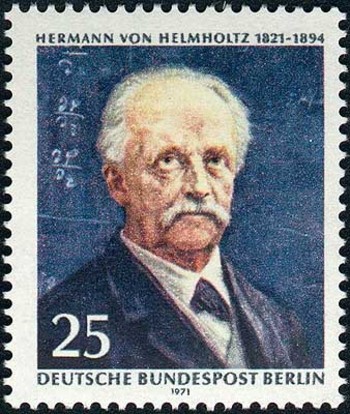
    Helmholtz2 The laws of thermodynamics have a somewhat complex parenthood, but it is the relationship of Helmholtz and Mayer in the First Law that we’re interested in here.  In short, the great three laws (in short) state: Energy can neither be created or destroyed (First Law); All spontaneous events act to increase total entropy (Second Law); Absolute zero is removal of all thermal molecular motion (Third Law).  Carnot (in a brilliant 124-page paper Reflections on the Motive Power of Fire), Joule and Helmholtz are generally associated with creating the First Law (with Clausius, Gibbs and Boltzmann for the Second and Nernst for the Third).

    It was Helmholtz who provided the mathematical proof (in 1847, in his “Ueber die Erhaltung der Kraft” “On the Conservation of Energy,” ), the basis of the law of the conservation of energy.  But even though he was the first in this particular part of the thermodynamics universe (which he later famously and incredibly declared in 1856 to be “dying”), he recognized the previous related work—which he evidently did not use or perhaps even know about—of Robert Mayer (1814 -1878) (1841, “Remarks on the Forces of Nature”), who basically stated that energy can be neither created nor destroyed, which is the sharp tooth of the law.  The paper just showed up where it shouldn’t’ve.  Helmholtz recognized its importance and later insisted on Mayer having priority in discovery—there was plenty to go around, really, and especially since it was Helmholtz who gave the law its mathematical foundation.  It is just a very fine showing of intellectual appreciation and scientific ability that Helmholtz recognized the contribution of Mayer in such a fashion. (Helmholtz, a great experimenter, theoretician and teacher, makes frequent appearances in my wife Patti’s blog–have a look!)

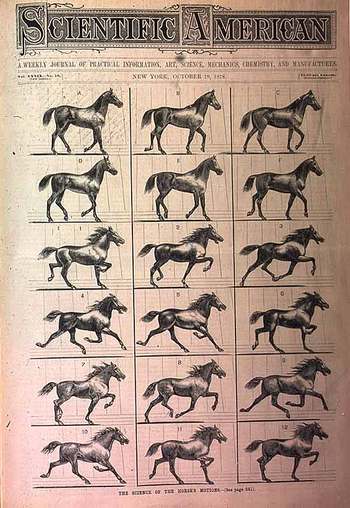
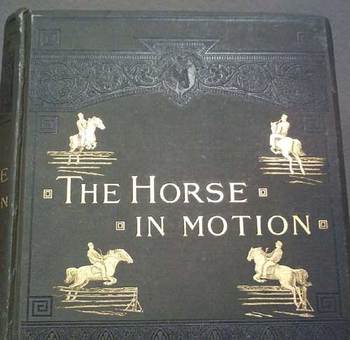
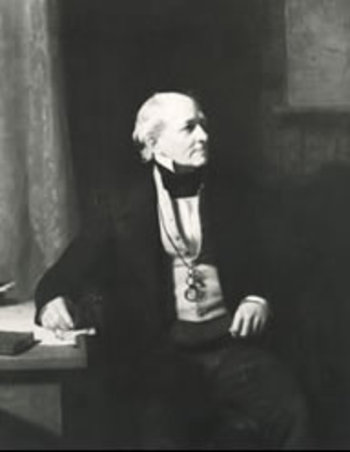
    Creditmarey Etienne Marey, who we have seen before in this blog, was inspired by Eadweard Muybridge’s photographs of motion—whom he credited of course—and who I think expanded upon and exceeded those achievements.  Marey had a multi-field career and didn’t really want for much, professionally speaking, but there is a pretty significant slight in that career that bears.  His photographs of horses in motion were stunning and shocking—being among the best photographs ever made showing the horse in all stages of motion.  But when they were expansively included (used from sources like Marey’s  “The Science of the Horse’s Motions” Scientific American, October 19, 1878)  in J.B.D. Stillman’s The Horse in Motion in 1882, they were done without attribution, which is not a nice thing, as it would have been impossible for Stillman not to have known the origin of the source of his images—impossible.  He just decided not to include Marey’s name.

    Creditstillman

    On the other hand, coming back to the non-recongition of Ralph Alpher and Robert Herman in the discovery of the background radiation of the universe—“discovered” by Penzias and Wilson at Bell Labs in Holmdel—even though their earlier papers in 1939, 1946, 1947, 1949 and 1950 pointed the way, Penzias and Wilson didn’t know of them, didn’t use them, and found the thing on their own.  By  accident.  Still, though, it would’ve been nice for them to mention Alpher and Herman in their Nobel speech.  But they didn’t.  They should’ve.

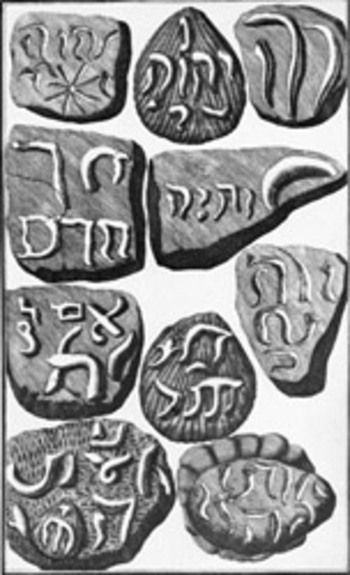
    Lastly, the Imaginary Recognition bit—this is more accurately called a “hoax”.  Perhaps one of the most famous cases—and perhaps the meanest—was in the case of Dr. Johann Bartholomew Adam Beringer (1667-1740) the Dean of the Faculty of Medicine at the University of Würzburg in Germany.  Beringer was himself a mean man, proud, ill-spirited, boasting and ponderous, and of little patience to those who disagreed with him.  So he was a public man with many enemies—a vocal, unrepenting man with enemies—and his enemies decided to have a go at him, salting a field in Beringer which he collected geological specimens with incredible, spectacular, impossible samples.  The samples spoke to his own geological-theological beliefs—in which god is never ever wrong—and the overly-excited Beringer ravenously collected/found them, and then, after a while, decided to publish a book on them.  But before the book became a reality the fossil-planter s attempted a change of heart, trying to divert Beringer’s attention away from the possibility that the stones were real, going so far as planting fossils with shooting stars, Hebrew characters, and the like.  Beringer proceeded on with publication (and his “lying stones”), and then after publication, all became revealed, basically ruining everyone.  It was a mean escapade, al the way around, and a huge waste of time.  Perhaps everyone got what they deserved. 


  • Chasing the Squamish: the Fremantle Doctor and Naming the WInd

    JF Ptak Science Books  Post 1784  [An Episode in the series The History of Blank, Empty and Missing Things.]


    Blogwind
    207 years ago Admiral Sir Francis Beaufort proved that he could record a seemingly unrecordable medium.  He was able to write on the air, basically, affixing a permanent and economical, understandable, common denominator to something that no one could actually “see” (but could see the effects of), and that everyone could feel and measure, but not capture.  He created the Beaufort wind force scale, and it has been in use as a lingua franca (with some modifications) ever since–the wind force scale.  It was a pretty important vocabulary (language, really) to establish, as there wasn’t any agreed upon terminology before his—a ‘stiff breeze” might mean one thing to a Mainer and another to someone in Santa Barbara, while a gentle breeze might mean something completely different to someone at Gibraltar than to someone else in the Kill Van Kull of Staten Island.  Beaufort fixed this problem, and fixed it good. 

    Oddly enough, Beaufort’s system was introduced at about the same exact time as  Luke Howard’s system (of 1803 versus 1805) for organizing another very fluid, gigantic, series of extraordinarily common and global occurrences that had escaped scientific classification for thousands of years—the clouds. (I wrote about this a little earlier in this blog.) 
    Blogwind2
    Classification systems for the wind have existed for a long time though they haven’t really been of a fundamental, descriptive value.  For example, reaching back into the misty Greek mythological past we find the four winds were personified as gods, called the Anemoi, including Boreas, Notos, Euros, and Zephyros) Another area of creep and crawl for wind classifications and descriptions can be found (slightly) in the Bible–blowing from the four quarters of heaven, (Jer. 49:36; Ezek. 37:9; Dan. 8:8; Zech. 2:6); parching east wind  (Ezek. 17:10; 19:12) and strong wind (Job 27:21), while the south wind was hot (Job 37:17, and so on, though they were all subject to the wants and needs of god (Ps. 18:10; 135:7), which is their greatest unifying factor (though of little use in descriptive transaction).  The named components of wind (geostrophic wind, thermal wind (not actually a wind but a wind difference between two levels), gradient and ageostropic wind) are newer and valuable additions but of course cannot compare to the overall importance of the Beaufort contribution. 

    There are many other examples from many other cultures, the discussion of the wind and winds can take up a chunk of the anthropological/theological universe.  A quicker,easier way to look at regional naming and classifying systems for the wind is to simply look at “individual” winds—winds that have certain characteristics, are particular to a location or time, and which also have a personality.  There are some highly descriptive and mysterious names among them:  for example, the Fremantle Doctor (afternoon sea breeze from the Indian Ocean which cools Perth, Western Australia during summer), and Squamish (strong, violent wind occurring in many of the fjords of British Columbia)      Again, the overall power of applying descriptions of the  Bayamo (violent wind on Cuba’s southern coast)  to the  Bora (northeasterly from eastern Europe to northeastern Italy)  to the Cape Doctor and the Passat are not terribly useful, especially if you were trying to communicate a wind system before you. 

    Beaufort supplied what was in effect Dalton’s table of the chemical elements (and the creation of the atomic theory, 1802), and did so, just as in the case with Luke Howard, incredibly, at about the same time:  Dalton in 1802, Howard in 1803, and Beaufort in 1805.  I’m just now appreciating the extraordinary organizing party that took place here over these four years:  Dalton organizing (with great prediciive powers) the unseen atomic world and the world of the elements; Howard applying scientific means to naming the greatest of the scientifically-unnamed whales of science in the clouds; and Beaufort, who performed a Luke-like task with the wind just two years later.  I’m not so sure that there was a better short period than this for naming anything in the history of science.  Ever. 

    A good modern chart of the Beaufort scale can be found here.


  • A Series of Fortuante and Unfortunate Events

    JF Ptak Science Books   Quick Post  Part of the series on the History of Blank, Empty and Missing Things.

     V. Klobassa produced a very pleasing design for this Centennial game, though it seems to me from a  reading of the patent for the board that the details of the empty years were left, well, empty.  I guess it was left to the players to add the details to the blank years, that way adding to the memorization part of the game experience.  It is unusual I think that Klobassa used white and dark stars to differentiate “good” from “bad” events, just to make sure that there was no doubt which was which. 


  • Earths inside the Earth–a Short Note on Inner Civilizations. And Maps.

    JF Ptak Science Books   Post 1782

    There should or could be an enjoyable history written on the internal living history of the Earth, or Earths-within-the-Earth, because the idea is quite old, and latches itself like a good idea on top of a bad idea inside a decent idea.  The end result though is not so great, but, given the longevity of the interior Earth idea and the people who perpetuated it over time, I would like to read a history of the thing, even if it went nowhere.  I guess the history could be fiction and come out with almost the same result, but well, some of the happened-history is stranger than fiction. 

    I was brought to think about this by a patent granted to Herbet Francis Williams-Lyouns (British, 1863-1933).  Lyouns was a painter but for some reason cooked up this idea for an international exhibition just before the year 1900.    The patented idea was for a free-standing globe/sphere with a series of stairways that would get paying folks to a lighthouse at the top.  From what I can tell the thing was to be 150 feet high or thereabouts–it is difficult to tell since there are no technical specifications in the patent itself.  There was nothing really to suggest dimension and without physical specifications I’m not sure exactly what Lyouns was patenting, except for a big globe with a lighthouse on top that could be populated with a paying crowd. 


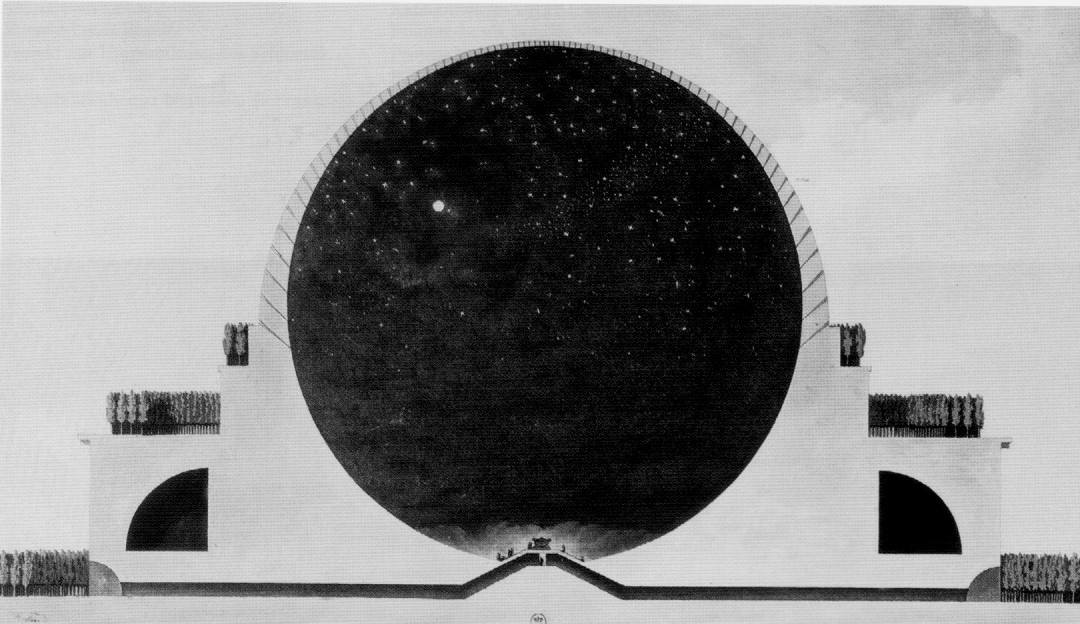
     It seems that Lyouns was patenting the idea for being able to ascend a hollow globe to a what would seem to be a redundant lighthouse (certainly there could have been some other structure a little more appropriate or crown-y) at the top, though I know I have seen several earlier visionary drawings about such a beast. One of these ideas belonged to Etienne Boullee (1728-1799), who designed a great hollow sphere for a cenotaph for Newton—Boullee however did not muck up the interior of his space with a massive stair structure, and kept it simple, with his folks milling about on the ground enjoying what was supposed to be an internal night sky.  Some of the others are pre-patent era, though I do recall one of a hollowed-globe interior for viewing a moving diorama that was definitely of the patent era–perhaps that inventor simply didn’t patent the apparatus.

    [The interior of the Lyoun globe, which I guess represent a giant winding staircase.]

    The Lyoun bit also reminds me of the Crystal Palace of 1851–rather, of a cartoon for the Crystal Palace, featuring the Palace at the top of a globe that was fully and completely, falling-off-the-sides inhabited.  Which makes it a bit different from the globe of Lyoun, which seems as though it could’ve been inhabited on the inside, only, and which steers us exactly to the opposite (?) of the Earth’s-Interior-Earth business.  After all, I started talking about other stuff and civilizations living underground, inside the Earth, possibly inside a massive hollowed out section of the Earth. 

    (Finding the top of the world was easier in 1851–at least to this illustration, showing the Crystal Palace of the Great Exhibition of 1851 sitting firmly in place above all. I can imagine that if you were sitting in Hyde Park along with the 1851-foot long building, it would be easy to think that you were indeed at the top of the food chain.  The structure was the crowning achievement of the  Exhibition:  it was almost one million feet under iron and wood and glass, and could hold tens of thousands of people who could view the enormous gardens housed there.)

    I’m talking about Jules Verne and his journey to the center of the Earth, and H.G. Well’s Morlocks, and a dim memory of Superman’s Mole Men, and E.R. Burrough’s Pellucidar sitting at some great depth below the Earth, and on and on, back into the misty past, past hollow Earth theories of even some great men like Edmond Halley, and back into mythological and anthropological stories of great antiquity.  But those stories will have to wait for a later tell.
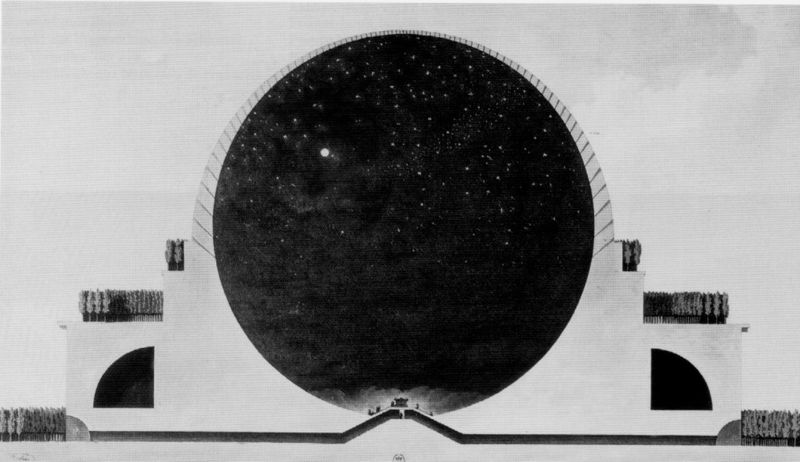
    Boulle newton

    [Boullee’s cenotaph for Newton.]

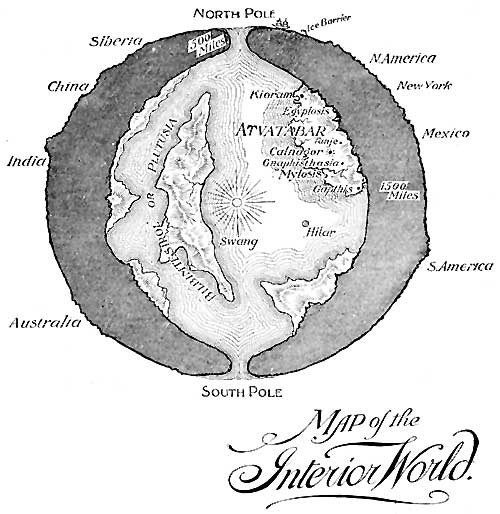
    One bit I’d like to point out is this extraordinary leap of imagination, an actual map of the interior civilization of the Earth provided by William R. Bradshaw to the readers of his Goddess of Atvatabar, which was published in 1892.  The story itself seems terribly purple and looks like a very difficult read–but the pictures are interesting in their own rippling ways.  And then there’s the case of the map–one of the very few I can think of that depict a civilization inside our own homey Earth. (I’d mention others but I can’t think of any straight away.)
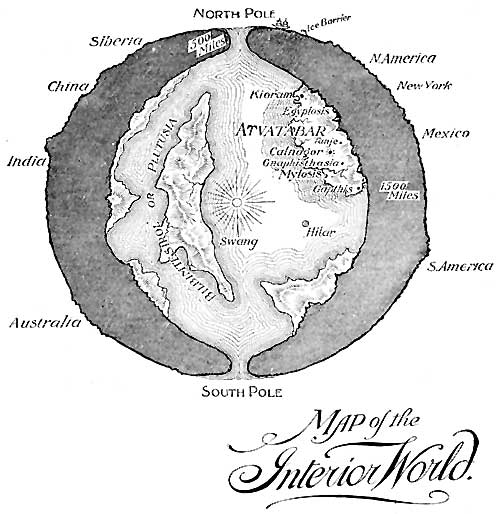
      Earth Interior William BRadshaw

    [Map of the Interior World, William Bradshaw. Source: Project Gutenberg, here: http://www.gutenberg.org/files/32825/32825-h/32825-h.htm]

    Another example of a map of interior Earths was brought to my attention by Rebekah Higgitt (of the excellent Teleskopos blog ), who sent me to the Petri Dish blog (of Katherine Pandora, and her post “Hollow Heads, Science, Fantasy, and What’s as Plain as the Earth Beneath our Feet”) and the internal Earth of WIlliam Reed (in 1906, illustrating his Phantom of the Poles):

    Reed's Hollow Earth

    And yet a third example, making my way through the Petri Dish article and found at the website of Engines of our Ingenuity by John Lienhard (from his post 2180, “Hollow Earth”):

    Americus Symmes' Hollow Earth

    [Symmes’ Hollow Earth published long after his death by his son, Americus Symmes.]

    And then another example, this from Marshall B. Gardiner, A Journey to Earth’s Center. 1920, which also shows the interior “central sun”:

    And a cross-section of the Earth from Gardiner:
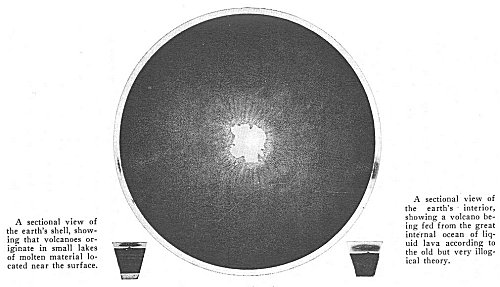
    http://www.sacred-texts.com/earth/jei/img/36400.jpg

    The literature of this hollow Earth business is very wide and long and not very deep, and includes a fair amount of scientific-y whoo whoo.  The sci-fi part of it looks mor eintereting, though from the little that I have read now most of it is very tight-fisted in the good-writing department.


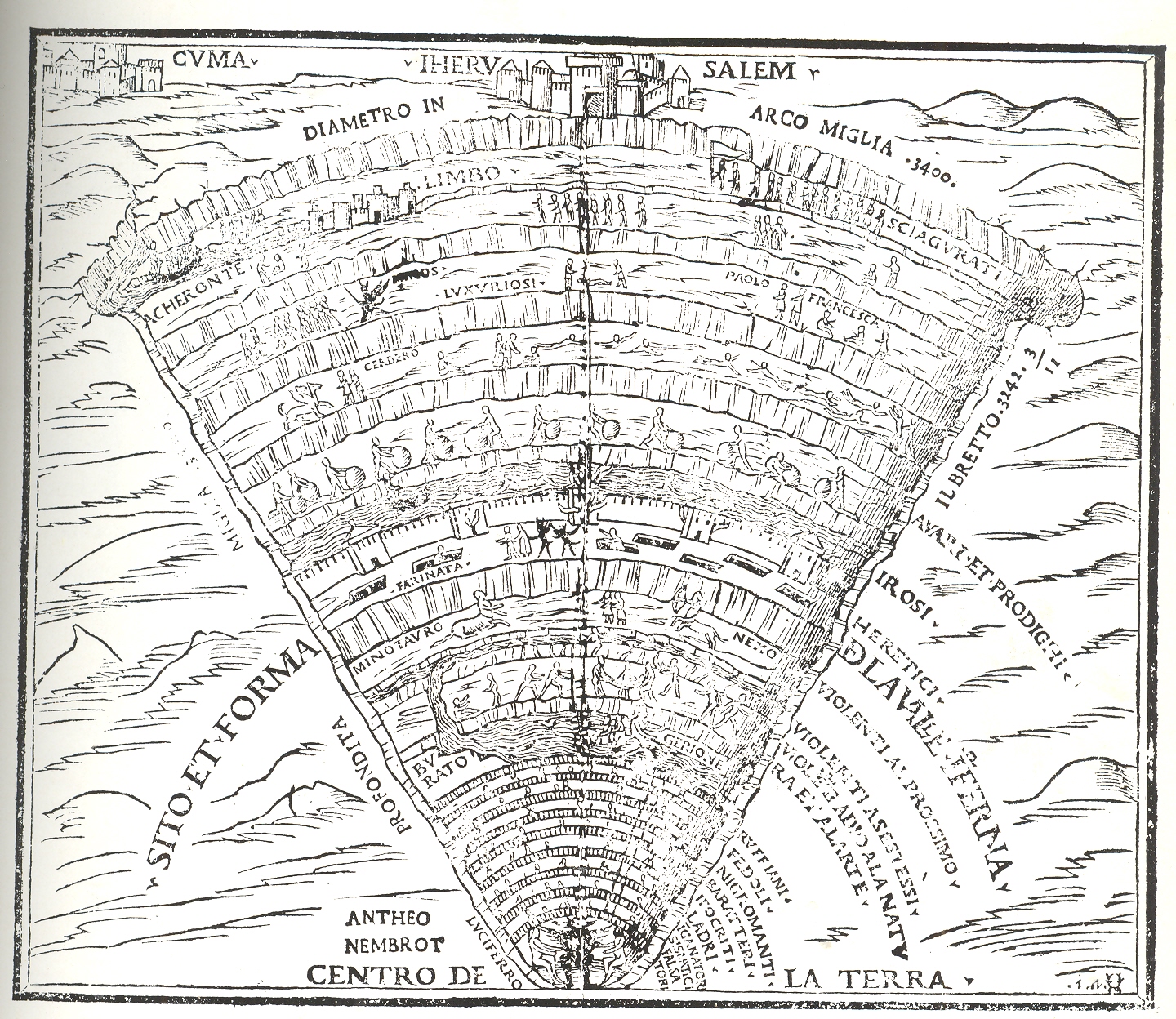
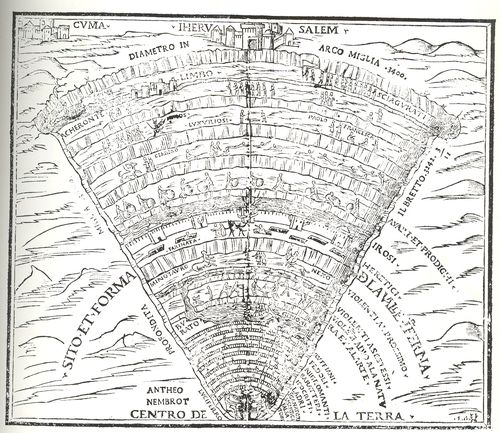
    This maps talk excludes Inferno maps like the following, for example–obviously–as there are many:
    Blog--feb 9--dante

    The classic sort of image may be something like this fantastic depiction of the Inferno of Dante (shown here in the Comedia published in Venice by Gregorio de Gregoriis in 1515.

    I should guess that there’s ample room for a collection of inner-Earth civilizations, and perhaps that will come to pass.

    A few more of the patent images for the Lyouns patent: