A Daily History of Holes, Dots, Lines, Science, History, Math, Physics, Art, the Unintentional Absurd, Architecture, Maps, Data Visualization, Blank and Missing Things, and so on. |1.6 million words, 7500 images, 4.9 million hits| Press & appearances in The Times, Le Figaro, Mensa, The Economist, The Guardian, Discovery News, Slate, Le Monde, Sci American Blogs, Le Pont, and many other places… 5000+ total posts since 2008.
“it is conceivable that the nucleus breaks up into several large fragments, which would of course be isotopes of known elements but would not be neighbors of the irradiated element.“–Ida Noddack, 1934
Sometimes events and conspire to almost come together, to be very-nearly-there but not so, just this shy of complete, just a little short of being whole–save for inspiration, or insight, or genius. Such I think is the case of Ida Noddack (and just about everyone else) in the non-discovery of fission in 1934.
Just for the record, fission is properly discovered by Hahn/Strassmann/Meitner and announced in Naturwissenschaften beginning in 1935 (with “Ueber die kuensrtliche Umwandlunbg des Urans durch Neutronen” in 1935 and culminating in the epochal papers of 1939)–and this the result of a long series of necessary discoveries made by Becquerel, Einstein, Curie, Joliot, Bohr, Chadwick, Compton, Fermi, Frisch, Rosbaud, Wheeler, Alvarez and others.
Noddack published her paper–“Uber das Element 93” in Angewandte Chemie (vol 47, pp 653-655) in 1934 (and published in Berlin) which correctly pointed out errors in Fermi’s important two-page 1934 paper on neutron bombardment experiments “Possible Production of Elements of Atomic Number Higher than 92”, published in Nature 133 (3372), pp 898-899. She identified as inconclusive Fermi’s identification of transuranic products of neutron bombardment, and stated that the presence of all of the lower elements needed to eliminated along with the heavy radioactive elements. Noddack (1896-1978) was nominated three times for the Nobel (chemistry) but was passed by–she received recognition for her work, of course, but at the time- (1934) her paper was generally ignored, as it ran counter to some of the basic ideas of physics Noddack didn’t offer any theoretical help in her observations, and the paper slid almost instantly into obscurity. The breakthrough work on this issue would begin int he next year and ultimately the unthought-of concept of fission would be announced five years later.
JF Ptak Science Books Post 1688 (Part of the series on the History of Blank, Empty and Missing Things–Upper Atmosphere Monsters.)
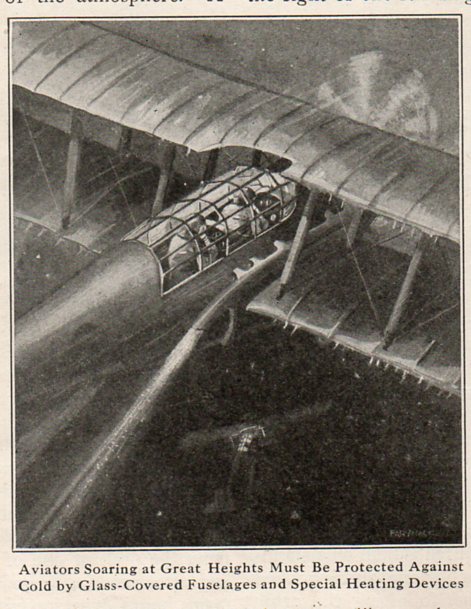
Illustrated World for July-August 1920 asks the question “Will Man Soar to Unknown Heights” and indeed, they answered in the affirmative, saying that the “heights of space instead if the depths of the seas or the distant poles are to beckon the adventurous, according to scientists who are making a specialty of the atmosphere”. In what must seem to the modern reader to be an enormous and naive statement of the obvious, the future aviators would fly in “glass enclosed fuselages” in order to gain great heights.
There would however be no monsters–except for lack of oxygen and the cold. he editors did mention a Conan Doyle story in which monsters lived at high altitudes, monsters that were form-changers, much like the clouds they lived above. This was his “The Horror of the Heights”(1913), a short story about a flyer named Joyce-Armstrong who longed for great heights–and for the “something else” that was up there, something dark and sinister that lived in the stuff that we breathe, as the story is told through the pages of a recovered, blood-stained notebook found in a field. We learn that Joyce-Armstrong was a dreaming pragmatist, longing for the ethereal of great heights but loathe of it also, aware of a danger so great that he carried a shotgun along with him in flight. We read in the flight book that the aviator had an experience at 40,000 feet, meeting a new air-jungle world of semi-formed gelatinous creatures, one of which has a more solid form with tentacles and a beak, and does battle with them, surviving, returning to the ground. He vows to go back, at which point we assume he met his doom.
In 1913, an altitude of 40,000 feet was extreme, the record at the time being about 9,000′, and that reached in a Wright biplane–quite an achievement I think for such an aircraft, By the time this article appeared in 1920, the record altitude was 33,000′, which at least got a lot closer than the 9k’ of 1913. The aircraft for this record–the LUSAC-11 (Lepère United States Army Combat) was much more considerable than the Wright plane, though it seems to me a work of fantastic skill/effort/courage to take such a thing so high.
At the beginning of it all, the Titanic started out as a space in a dry dock, a line of horse carts, and a big puddle; Disneyland a flat piece of not-desirable land in California; the Sydney Opera House a nice spit of land jutting into the harbor, and the Pentagon a very large swath of semi-swampy land near a river. It is interesting to look at these images and image the massive things that would soon fill the “empty” space.
[Source, with entire series of images, from the Retronaut, here.]
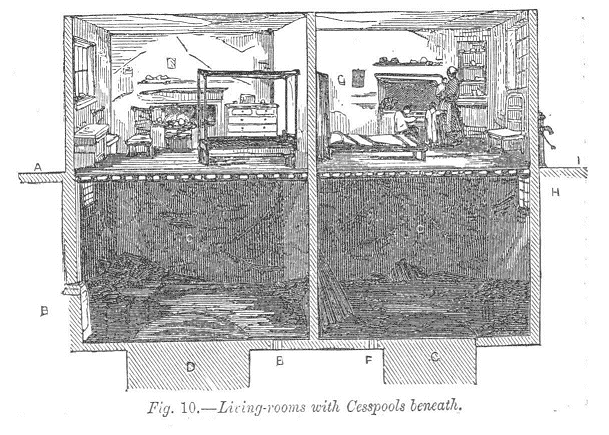
Reading Dickens now and stopping for a view of socially-conscious England via the excellent Victorian London website in the work of George Godwin’s 79-page critical exposition London Shadows, a Glance at the “Homes” of the Thousands (1854). The images are awakening and abrupt–all the bitter observation of George Orwell, only told much more quickly, like a person trying to describe a raging house fire before the thing burned itself out. Its a powerful work, and I can’t help but think that those reading it in 1854 must have been appalled not only by the deep visualization of the state of the working poor, but also by its scope, and the possible revelation of England’s basic bedrock.
There are any more works to chose from at Victorian London–I decided to pry out the images from the Godwin work along with his commentary on them. It is truly a stunning work.
“When every man is his own end, all things will come to a bad end.” COLERIDGE.
“….there must be a point beyond which there may be no abridgement of civil liberties and we feel that whatever the emergency, that persons must be judged, so long as we have a Bill of Rights, because of what they do as persons. We feel that treating persons, because they are members of a race, constitutes illegal discrimination, which is forbidden by the fourteenth amendment whether we are at war or peace.”–– A. L. Wirin, Counsel for the Southern California Branch of the American Civil Liberties Union, speaking on the internment of Japanese-Americans, 1942
“We make these statements, not because we fear evacuation, but because we believe, to the bottom of our hearts, that the best interests of the United States, our nation are to be served by being permitted to stay, work, fight, and die for our country if necessary here where we belong.“–Response by the Japanese American Citizens League to Internment Camps, 1942
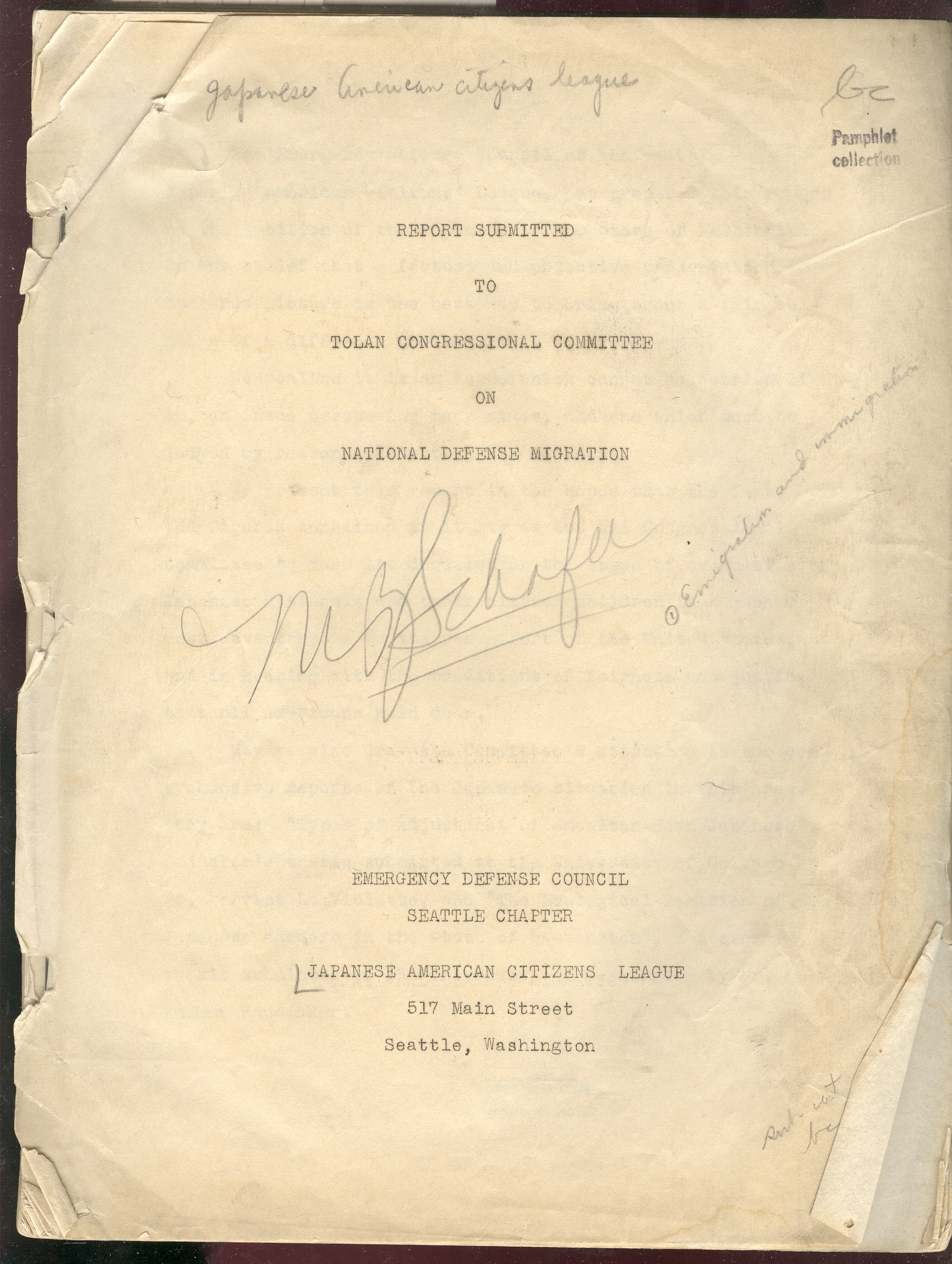
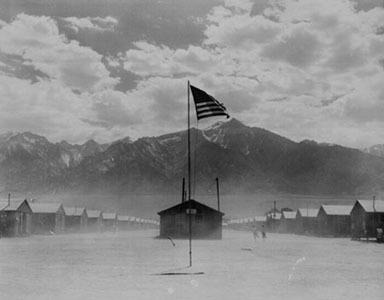
This excruciating, heart-rending 1942 document was submitted by the Japanese American Citizens League (of Seattle, Washington) to the Tolan Congressional Committee with recommendations, proposals and requests in the event of the removal of Japanese citizens from “sensitive” areas in western America It is an exceptional report, a well-reasoned response to the developing and calamitous American fear of Japanese fellow-citizens; a fear which was swiftly leading itself to xenophobic actions the result of which was the internment of 120,000 American citizens in internment camps.
The Roosevelt administration’s Executive Order 9066 was the legal bombshell that gave the War Department the authority to authorize the removal of the Japanese (19 February 1942) and theoretically prevent those people from engaging in sub rosa and fifth column activities asd wartime terrorists fighting for Imperial Japan. The Tolan Committee was that of Congressman John H. Tolan (CA), chair of the House Select Committee Investigating National Defense Migration (!), undertaken at the request of Carey McWilliams (chief of the California Division of Immigration and Housing) who was trying to prevent or at least delay the coming removal of the Japanese. Needless to say, the operation backfired
The document is “heart rending” because Executive Order 9066–at its base terribly wrong, a weakness exhibited, a moral embarrassment of the highest order–was addressed by its authors in a logical, clarifying and accommodating fashion in a noble and valiant attempt to negotiate an untenable situation while making every effort to appease the aggressor without judgment and offense. It was an attempt at maintaining dignity and some sense of Constitutional freedoms for a group of people in a situation in which their dignity and freedoms were being withdrawn….at least their freedom was.
In the introduction to the document (titled Report submitted to Tolan Congressional Committee on National Defense Migration Emergency Defense Council Seattle Chapter Japanese American Citizens League, and published April, 1942) we read that people are willing to go and abide 9066, but that one of their main issues was where exactly it was that they were going, where they were being taken. That hadn’t been established yet, and it makes me shake my head to think of the government establishing this order without a clear indication of any (?) of its consequences.
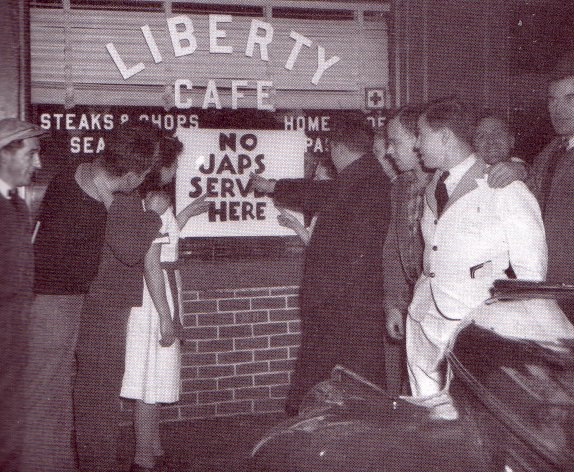
“[Introduction] A large number of people have remarked that they will go where the government orders them to go, willingly, if it will help the national defense effort. But the biggest problem in their minds is where to go. The first unofficial evacuation announcement pointed out that the government did not concern itself with where evacuees went, just so they left prohibited areas. Obviously, this was no solution to the question, for immediately, from Yakima, Idaho, Montana, Colorado and elsewhere authoritative voices shouted: “No Japs wanted here!””
“[Resettlement] What will the government’s policy be? Will communities be shifted as units to other sections? Will the Japanese be re-settled as family units? Will men and women be segregated and families split up? Will Japanese be scattered at random in the interior? These are questions that are arising in the Japanese communities in this area.”
Already thinking of the future and the end of the war, the authors wondered about the prospects for the return of the Japanese people to their former residences:
“[Return] “It is necessary to think of the future, of the day when this war will be over. Could the Japanese people, once evacuated, return to their homes? There is the great possibility that once the Jap-haters and outspoken opponents of the resident Japanese were successful in driving the Japanese out of this area, they would never permit them to return. A post-war campaign of hate and vilification when resident Japanese tried to get back to their homes and investments here, is a definite possibility should these elements score an initial victory.”
The idea for a “model city” was proposed, or at least opened for discussion, as a possible place for the interned Japanese to go:
“[Model City] This is an ambitious plan entailing the creation of an all-Japanese city somewhere in the interior of the country, able to sustain itself as a self-sufficient unit. It would be financed originally partially by the Japanese themselves, partially by the government. Some important defense industry would be set up to give employment to Japanese labor, preferably one calling for skill and efficiency which Japanese workmen possess. The city would be governed by American citizens, who would elect a mayor and council, just as other American cities, and the Japanese, both American citizens and aliens, would be given an opportunity to practice the American ideals of democratic government which they have learned.”
“After the initial investment, the city could be expected to become self-sufficient and a center for the hinterland. It is altogether likely that such a city, as an experiment in democracy would be so progressive and would provide such advantages that friends of the Japanese would desire to share its benefits.”
“This would be a long-range project, to be continued in perpetuity. The objection of the time required to set it up would be overbalanced by the permanent nature of the project.”
After 38 pages of questions and planning, the authors of the report declare that the Japanese Americans affected by 9066 would comply (“to the best of our ability”) with whatever was demanded of them. They felt very strongly though that they could do more for their country by staying in their homes and fighting Japan just like any other American.
“[Conclusions] If it is for the greater good that evacuation be decreed, we shall obey to the best of our ability. But we are convinced that here in our homes and in our community is where we belong, where we can lend every ounce of our strength, and every cent of our resources, in creating the sinews of war so necessary to total victory. We are Americans. We want to do our duty where we can serve best. We make these statements, not because we fear evacuation, but because we believe, to the bottom of our hearts, that the best interests of the United States, our nation are to be served by being permitted to stay, work, fight, and die for our country if necessary here where we belong.”
[This document is for sale in our bookstore, here.]
JF Ptak Science Books Post 1680 Part of a new series on the History of Fear
Perhaps you become scared of what is taught you or is available to you, or made available, or dreampt. Perhaps you can dream not-so-terrible things unless you have been exposed to them in one form or another, already. I can certainly recall from my childhood things that made me feel fear, and they weren’t very fearful–not really–at all, though they were at the time, because there was no way for me to process the weird adaptations to my imagination.
Certain things are taught to children as a matter of course, I guess, certain fearful things, like for example the oldish child’s prayer ruminating on a sleeping death, or some exacerbating tale from the brothers Grimm–how else are children to come up with the ideas of not waking up or being boiled alive or eaten by a witch?
And so I wonder about the fear factor imaged and implied in these early wonder/sci-fi magazines, meant for distribution to high-adolescents and adults. They simply do not look so terrifying, though I guess it is because the true business end of FearSell USA Inc had not yet been prioritized in the national economy–and certainly it was orders of magnitude away from approaching anything that we have today. Even the constant state of storm/terror available to us in a relentless flow from a simple avenue like The Weather Channel must be a testament to the dept of our fear depravity.
The stories–or the ideas of the stories, anyway–seem scarier to me now than the images of them on the covers of these magazines. It would be an interesting thing to make a timeline of fearful images to see how these things changed over the decades. Or centuries.
People have been worrying about the end of the world for as long as they have realized that the world could have an end. The more-modern concerns for world-ending collisions with asteroids is relatively recent and does have a lot of truth to it; likewise the ending of large lifeforms on the planet via nuclear holocaust, which came very close to being in a number of situations over the last 55 years or so. Less convincing arguments have been made through biblical interpretations and resurrections of ancient myths about the coming end-of-times because of of confluence of floating numbers which are after all is said and done just numbers and not actually attached to very much. There have been untold numbers of predictions and world-end scares, but reality was not at all accommodated. (An interesting end of the world date prediction timeline appears here.)
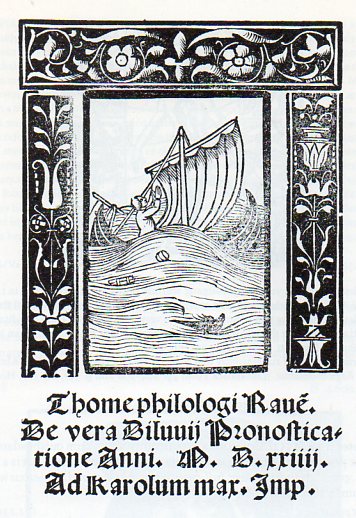
One of the earliest printed menaces scaring people into believing that the world was coming to an end appeared in 1524, when a conjunction of the planets in the constellation Pisces was supposed to be similar to that which appeared in the times of Noah and in the sign of Aquarius. The conjunction plus the bits about Pisces and Aquarius evidently lead to the belief among some that there would be a great flood. There were over one hundred pamphlets published on this topic in the early 1520’s, though to be fair the bit about Noaic deluge was evidently an outrigger–most of them it seems (at least to Lynn Thorndike) were argumentative over one principle or another of astrologic practice.
Of the many people who addressed this topic–including Machiavelli, Luther, Apian, Rabelais and Vives, among many others–was Tommaso Gianotti (Rangoni) (1497-1577), who gave his predictions this fantastic woodblock visual life in his work De vera diluvii prognostications (and printed in 1522). It was 16 pages long, and was one of many such slim pamphlets–his, though, did have this marvelous illustration. I think the blank sky helps set the sunken world and the collapsing boat of mankind into stark contrast on what lay ahead. (Gianotti led a long and distinguished career teaching logic (Padua) and astronomy (under the direction of Pope Leo X) as well as astrology (Bologna), and managed to outlive his many dire predicitons by half a century.)
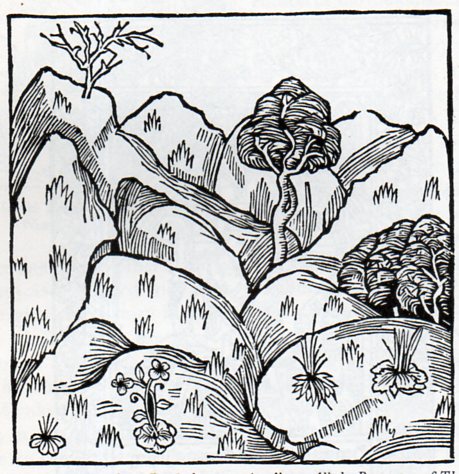
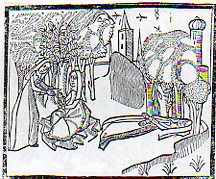
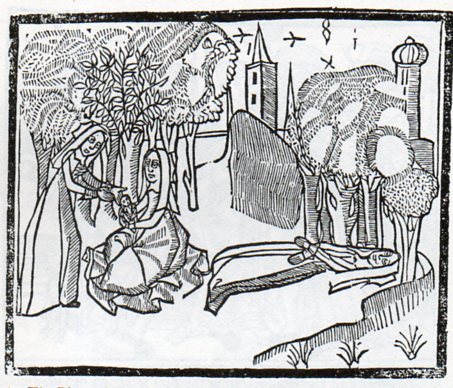
Sir Thomas Mallory (c. 1405 – 14 March 1471), translated and compiled a collection of mostly 14th century romances regarding King Arthur known and published as the Le Morte Darthur/Le Morte d’Arthur. It was first published by the great William Caxton in 14851and became quite popular, being reprinted with additions and corrections in 1498 by William Claxton and then again by Wynkyn de Worde (in 1529). It is, in its way, beautifully illustrated, or at least interestingly illustrated–I can’t really say for sure if the woodcuts were done with great care or not. But their effect is significant, and, whether naive or not or careless or not or simply at the artistic limit of its executor or not, the images do have their own peculiar beauty. One that struck me in particular was this,
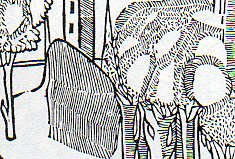
the “floating river”, an out-of-perspective element of a very stationary world, a controlled chaos-ness in a static landscape. I’m not sure what is going on with the trees, if the blankness is a part of reflected light, or if it is a representation of spaciousness between the limbs, or if they are simple wormholes in the woodblock. Everything in the image seems to have its own sphere, locked into their own environment, existing apart from everything else.
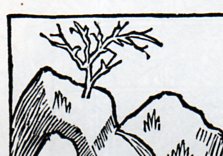
I see the same issue with many other such works, bits dropped into place in a scene or landscape, all making their way into the viewer’s mind on their own, not really a part of a cohesive whole. This may have been the intent, or again it may have rubbed up against the outer limit of what the artist (and their tools, and medium, etc.) was able to actually produce. Here’s another example:
Its another lovely, lonesome image of separates from the beautifully-named book by Bartholomaeus Anglicus All the Properytees of Thyings, which was published in Westminster in 1495 (and also known as De proprietatibus rerum, also translated as On the nature of things, or On the properties of things), and which was originally written around 1225). The book was a bestiary, a marvelous encyclopedia, a collection of all things as known in the 13th century–it would be interesting to represent all that is know today and compact it into a workable, logical, usable (printed !) book of a thousand pages. The question of organization of knowledge would be the key, of course, and how to make one flow to another complementarily as practicable…it would be an interesting project (for someone else) to try and arrange the basis of human knowledge in a finite space like that. The author of the book above organized his work as follows, in 19 books: “god, angels, (including demons), the human mind, or soul, physiology, of ages (family and domestic life), medicine, the universe and celestial bodies, time, form and matter (elements), air and its forms, water and its forms, earth and its forms including geography, gems, minerals, and metals, animals, and color, odor, taste and liquids.” The 2012 variety of categories would be somewhat different.
Notes:
1. This period, from say 1494 to 1525, was one of great creativity. For example: 1494, Pacioli: Everything About Arithmetic, Geometry and Proportion; 1498, Leonardo da Vinci: Last Supper; 1500, Michelangelo, Pieta; 1504, Michelangelo: David and Bosch Garden of Earthly Delights; 1505, Leonardo Mona Lisa; 1506, work begun on St. Peter’s Basilica; 1508-1512 Michelangelo paints the Sistine Chapel; 1511, Erasmus, Praise of Folly; 1512: Erasmus, De Copia; 1513, Machiavelli The Prince; 1516, More, Utopia; 1517, Start of the Reformation.
[I wrote earlier in this blog on maps of the Garden of Eden, here.]
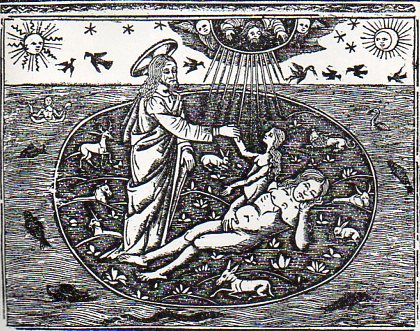
This island is Island Earth, the chuchified beginnings of humanity, showing the creation of Woman from the rib of a sleeping Adam. I’m not referring to the 500-odd place names in the U.S. identified as “Eden”: there are cities, towns, and villages named “Eden”, plus valleys, creeks, lakes, schools, shopping centers, malls, plazas, forests, and cemeteries–though I must say the though of an “Eden Cemetery” does sound appealing. I’m talking about the Eden of Genesis–though Eden hardly makes an appearance anywhere else in the Bible. Nor for that matter does the Fall of Man. I’m also not talking about earlier references to Eden-like places, like Heden of the Persians, or the “Islands of the Blessed”/Elysium of the Greeks, or any of the other earlier versions of a paradise (some complete with a tree of knowledge/life guarded by a serpent/dragon) from which the Genesis version must surely have drawn. This is strictly Old Testament, here.
It is interesting that this image is a suggestion of the anatomical event, because Adam is shown whole and unmolested–I’ve seen many versions of this image showing Eve actually emerging from an opening in Adam’s side, but the artist here is content enough with the suggestion of the bio-event.
[Source: Jac. Phil. Foresti Bergomensis, SUpplementum supplementi chronicarum ab ipso mundi exordio…printed in VEnice, by G. de Rusconibus, 1510. See the full image in the continue reading section.]
Eden seems set adrift in the sea of everything, floating there while the big change comes over Adam. (It is also fun to note that the hallow of the creator is given a three-dimensional affectation–perhaps later we’ll deal with the various shapes of hallos.) Eden is supposed the perfect circle, held afloat by the great waters.
Here’s another version, keeping somewhat within the Island Earth concept, but showing Eve emerging from a dourly distracted Adam–definitely this time connected to Adam in some way, though without any open cut. (This image is from the great Bible of Anton Koberger, 1493. Picture source, here.)
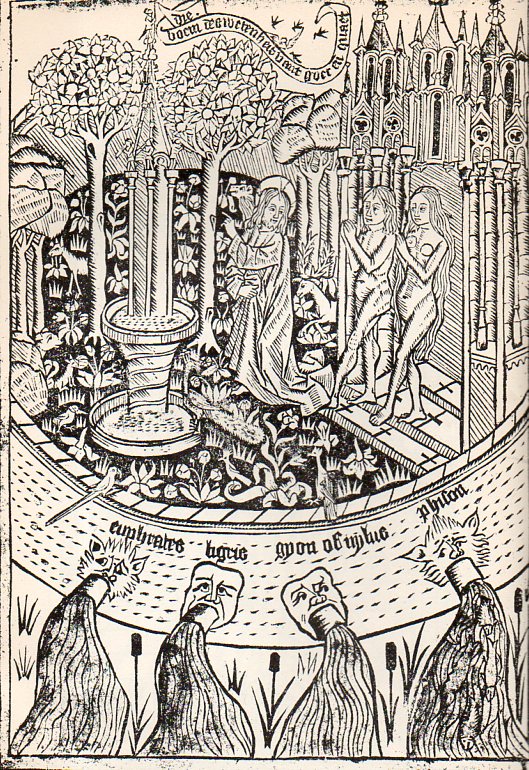
Here’s nother image of the Garden of Eden as rondo, from Ludolphus de Saxonia (a Dominican for many years and a 14th c figure), Thoeck vanden leven ons heern ihesu christi (1487), which was I think the greatest Dutch achievement in the making of books in their history of early printing, century, and in general one of the most beautiful woodblock books ever printed:
Eden is again fortified, this time in stone, with the ornamental drainspouts of the four rivers making their exit in the foreground. The glory of Eden abounds, but it is temptation that is presented them.
Another version of Eden, this time in a rectangular configuration, is seen in this 17th c engraving, finding Eden on the map on lower Mesopotamia.
There are other versions of Round THings that abound in Renaissance images, and we’ll get to them later, along with the depictions of caves, islands, and roads/paths meandering into infinity–those will come in just a little bit.
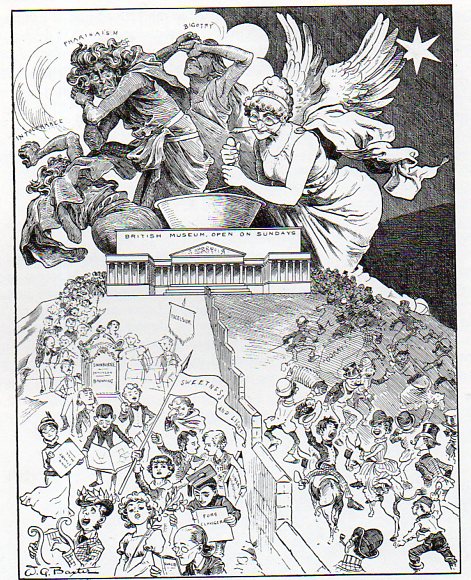
People, working people, the so-called “vulgar classes”, sailors, unescorted women, married women with babies, people who worked with their hands, people who worked (in general), all began their assault on the previously-just-for-the-“correct”-classes knowledge base of England–the British Museum–in the first third of the 19th century. It was a failed attempt, really, because the powers-that-be of the Museum were repulsed by the idea of the underclasses coming in to the place were the proper people came to learn, fearful that they would be repelled by their lowered and unfortunate brethren.
[“A Dream of the Future”–the Sunday Opening, from Judy, 1885. Source: Lynn Barber, The Heyday of Natural History, Doubleday, 1980, page 166.]
The Museum wasn’t open very much at all–only three days a week, receiving people between the hours of 10 and 4, restricting access to women with children, to women in general, as there weren’t any restrooms for females. I’m not sure when the first women’s facilities came into being at the Museum, but it took them until 1879 before the place was opened daily. And “daily” means every day, every day but Sunday, Sunday being a day not only of various religious obligations (which I think was the least of it), but also a day in which the greater percentage of the working class was not working ( which I think was the root of the issue). That privilege of opening the Museum to the great unwashed, opening the place on Sunday, didn’t occur until 1896. I imagine even then that there was resistance to the innovation of reaching out to working people.
The odd thing, now, is that many museums and libraries have been limiting their public hours, closing on Sundays, the day on which most people today find themselves not at work, restricting themselves to availability to a population of people who may mot be working a 5/6 day workweek. Plus ca change, plus c’est la meme chose.


 :
: