A Daily History of Holes, Dots, Lines, Science, History, Math, Physics, Art, the Unintentional Absurd, Architecture, Maps, Data Visualization, Blank and Missing Things, and so on. |1.6 million words, 7500 images, 4.9 million hits| Press & appearances in The Times, Le Figaro, Mensa, The Economist, The Guardian, Discovery News, Slate, Le Monde, Sci American Blogs, Le Pont, and many other places… 5000+ total posts since 2008.

Category: Blank and Empty Things; A History of

  • Extending Manhattan: Filling in the East River & Part of NYC Harbor

    JF Ptak Science Books   Extending Post 1470 
    Follow Me on Pinterest 

    A while ago I wrote a post on  Herman Soergel’s  plan for extending the landmass of the countries around the Mediterranean Sea by damming the straits of Gibraltar, lowering the sea and irrigating the Sahara–an original, interesting but not very good idea, filled with briney cultivation and racial politics. In the past on this blog I’ve written about other city plans–and in particular, for New York City–that have involved floating Manhattan into the harbor, or filling up large chunks of the Narrows, or floating the city on an enormous anti-gravity platform, and so on. Some of those plans were real, some science fiction, and some were plainly beyond both.  The plan presented above is another monster, but at least this one could work, if not for the doing of it, and the expense. And the will.
    NYC Really Big
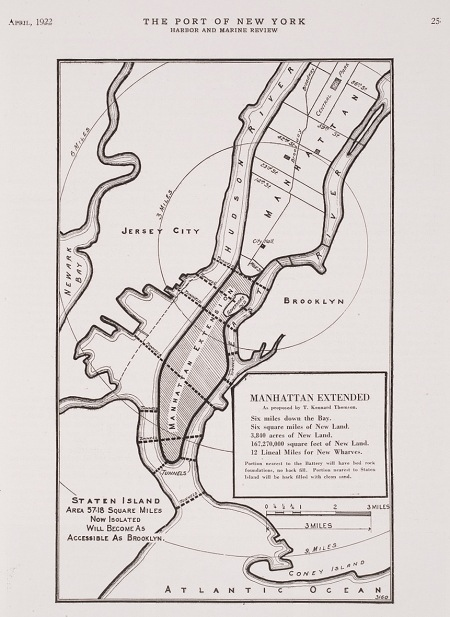
    But the bottom line, according to the engineer doing the thinking on this project, Kennard Thomson, would supposedly net the city a cool billion dollars after everything was said and done, and that would be 1916 dollars–that was equal to about 5% of the American GDP (!) in 1916, which would be about $400 billion in terms of 2010 GDP.  I’m not sure how Thomson came up with this very big/very round number, though it must have been done for effect–I can just imagine him standing before a smokey room filled with civil engineers talking about his massive plan for enlarging NYC and throwing out the billion-dollar figure, watching the cigars glow red in exhaled disbelief.
    NYC really big
    [Source: Popular Science, 1916.]

    Thomson did know what he was talking about–he was a busy (and “leading” according to the NYT) Manhattan civil engineer of stature, working on the Canal Barge and being the principal engineer for the Municipal and Singer buildings, for example–and his project seems to be well within the scope of possibility.  Their sensical aspects however are, well, questionable. 

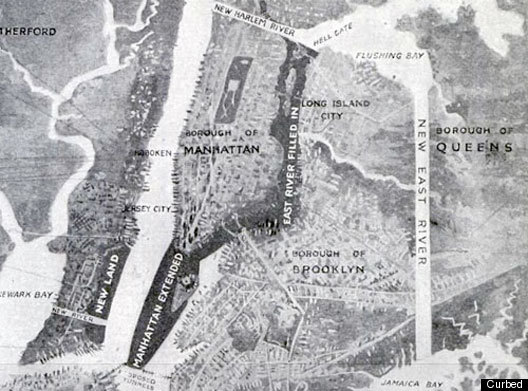
    Here’s the story–around 1911, while examining proposals to repair and extend New York’s wharves, Thomson came upon the idea–a magnificent, fabulous idea–of adding new wharves by adding new lands to the city.  In short, the overall plan was to fill in the East River (!!) and reclaim the new land for city living,  dam Hell Gate,  construct a New East River (from Flushing to Jamaica Bay),  extend the tip of Manhattan Island from the Battery to within a quarter-mile of Staten Island (!), create a new 40-square-mile island between Sandy Hook and Staten Island, extend the Jersey shoreline, add two new Manhattan-sized appendages to the east shore of Staten Island, and more.  All of this would be connected by various new bridges and roads and tunnels, as well as a 6-track elevated railway that would circumnavigate the city.  The purpose of all of this would be to add 100 miles of new docks, an enormous amount (“50 square miles of reclaimed land”) of new land and the capacity for NYC to house 20+ million people, all of which would be worth a billion dollars. 

    Thomson really meant “really” in the title for the proposal. There have been reclamation projects undertaken in New York Bay since then of course, and I think that virtually all of what Thomson talked about could be done.  I think it would be a very interesting project for a class of some sort to undertake an estimation of what such a thing would cost today (and I would guess to duplicate the idea in real terms now would take up a sizable chunk of the GDP).  Maybe all of this will make sense at some more future point. 

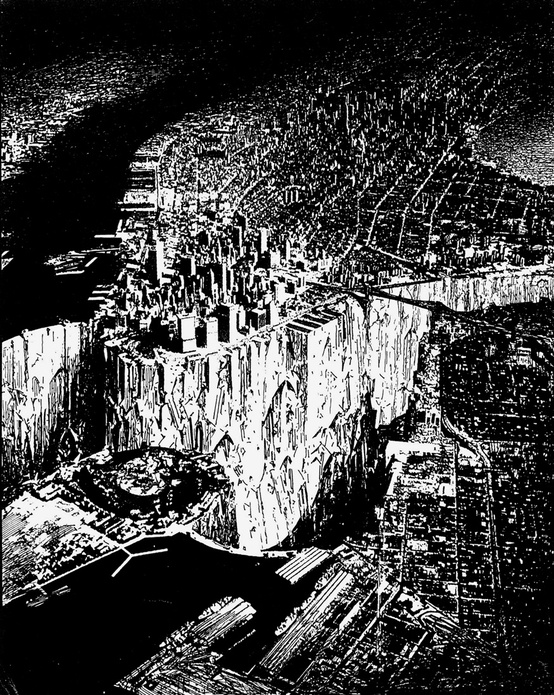
    And along this line of thinking I include a very interesting drawing made by architect Lebbeus Woods, showing the bedrock part of Manhattan. He empties the East River and damns (?) the Hudson, and also builds some new port extending from Staten Island or out from Jersey…but the effect of the dry river bed between Manhattan and Brooklyn.  Andthen some–he empties the river, and then deepens/excavates, heightening the depths (?!) of Manhattan Canyon. The depth of the river where we can see it in the drawing is maybe 100 feet, and certainly (judging the depth against the heights of the structures in the lower island) the canyon is deeper than that–maybe an order of magnitude deeper.
    NYC woods
    [Source: Lebbeus Woods, here.]

    Notes:

    –A good read on Thomson and Woods can be found here, at Telemachus Untitled. 

    –A contemporary NY Times article on the Plan can be seen here and another (with illustrations) from 1913 here (“Plan to Fill in East River to Solve Port Problems”).

    –Another treatment of the whole idea can be seen at Frank Jacob’s great Strange Maps blog, here.


  • Requiem for a Hankie–Golden Directory of Missing Apparel Manufacturers, NYC, 1939

    JF Ptak Science Books   Post 1937 (Part of the series on the History of Blank, Empty and Missing Things)

    Follow Me on Pinterest

    Apparel905
    Tony Soprano may have been a murdering and lecherous crook, but the man was always on hand with a handkerchief if a sobbing woman needed one.  They were washed and ironed and folded by the wife he would cheat on, and he’d dab his brow from murderous sweat with it, but, well, he had one when it was needed.  Few people carry one around, nowadays, and very few people manufacture them, at least here in the U.S., let alone in NYC, the place opposite Tony’s Exit 13.

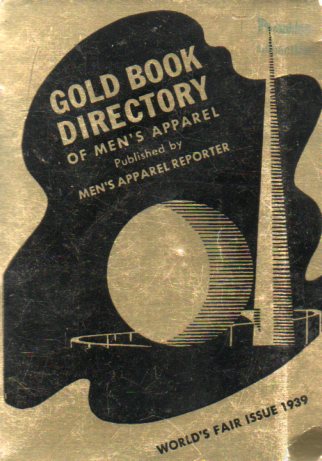
    Apparel904The Gold Book Directory of Men’s Apparel (“published by Men’s Apparel reporter”) was issued for the World’s Fair in 1939–it is a stubby, 320-page, 5-inch-tall and designed booklet, and it is pretty much a mausoleum-y reminder of what once was.  New York had been a center of clothing manufacturing for  a long time, and this pamphlet reminds us of that–and I’m not getting too rosey and sentimental about a tough trade that had its share of abuse of the unprotected,   as there were generations of immigrants who passed through those sweat-box meat grinders choking out pants and shirts for the lower- and middle-class while making pennies-per-piece. The shirt-pocket-sized golden book does remind us of industry that once was, and now moved overseas to perhaps even more vast abusing sweatboxes to produce cheap goods at clothing prices lower than they were (CPI-adjusted) in 1939. 

    It is striking to see the tabbed division headings:  “New York Hat and Cap Manufacturers” (listing 100+ businesses), “New York Handkerchief Makers”(60+!), robes (60), shirts (300), underwear (250), robes (90), evening dress (100), waistcoat (50), cumberbunds (24), label makers (woven (!)75), and of course New York Pajama Manufacturers, weighing in (with a line of pj’s called “Mr. Stubb” for “the short man”) with more than 120 manufacturers.  It is really enough to make the modern reader misty for lost  times.  Now, these categories were not mutually exclusive, and the Zenith Underwear Company could also produce handkerchiefs, but there is ample evidence here of vastly lost and different times–not only in the loss of domestic manufacturing, but also in the disappearance of the need for evening dresses, cumberbunds, waistcoats and (almost-but-not-quite) handkerchiefs. 

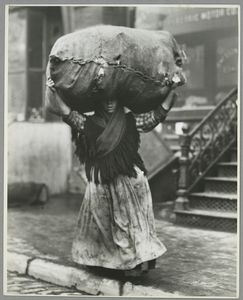
    Here’s a bit that appeared on this blog a little while ago on the grim part of the garment manufacturing industry in NYC (called Ancient Myths Modern: the Other Statue of Liberty, 1911, here):

    A tenement gleaner, New York C... Digital ID: 416509. New York Public Library


  • Blank and Missing Things: Life. An Example in the Discovery of the Obvious

    JF Ptak Science Books    Post 1934

    An entry in the series on the History of Blank, Empty and Missing Things.

    Anatomy--before and after
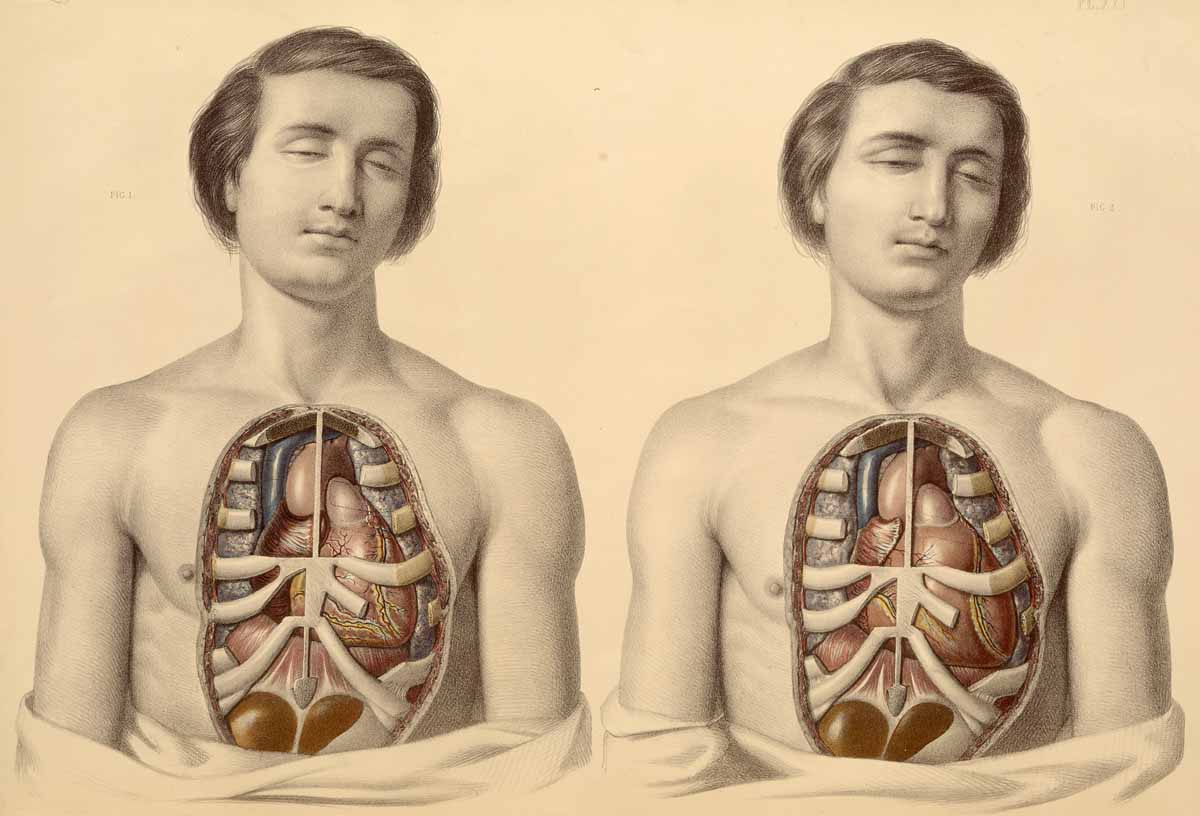
    This is fascinating–the anatomist Francis Sibson (1814-1876) in his Medical Anatomy  (London, 1869) provided descriptive/illustrative examples of what the body’s internal organs look like in cadavers and in living patients.  Offhand I am not aware of such a comparison being done before this date, and as he clearly demonstrates (and which you can see more clearly by expanding the above example) there is of course a huge difference in the anatomy of the living and the deceased. 

    This is an enormous observation that seems as though it should have been made earlier, but perhaps it wasn’t–though it must be admitted that “the obvious” isn’t until it is.  For example, Etienne Durand was the first architect to include examples of plans of different buildings on the same scale side-by-side, and that wasn’t until the mid-19th century–clearly this would be pro forma for just about describing two elements of anything, but it just simply wasn’t done until 160 years ago or so.  This also applies in a way (though there are more complexities involved as to why this is different) to the antisepsis practices of Joseph Lister who in simply washing surgical tools between use on different patients (and hand-washing and the use of surgical masks and so on) increased the chances of surviving surgery by at least 50% (though I think that number is much bigger than that), and these practices weren’t begun until the mid-19th century. 

    So the business of identifying “the obvious” is very tricky, because, well, something isn’t obvious if it hasn’t been done/seen before.  Or, if it has been seen, it hasn’t been seen seen.  As in clouds–as present as they have been for the whole of human history they basically escaped classification by the great human natural history classifiers until the very early 19th century. 

    And when I looked at the history of the word “obvious” it seems to have made its first appearance in print in 1603, so I went naturally to William Shakespeare for a quote using the new word.  Evidently, the great wordweaver never used “obvious”. (See here for an index of all the words of Shakespeare.)

    [Image printed by chromolithography after the artwork of William Fairland, 1869. Source: the National Library of Medicine.]


  • Blank, Empty and Missing Things Series: Identify the Shadow.

    JF Ptak Science Books  Quick Post   Part of the Series on Blank, Empty and Missing Things.

    Do you know who’s missing? Can you identify the shadow?

    Missing EInstein cropped_edited-1

    Missing EInstein

    Answer here.


  • The Invention of Satirical Photography (1840)

    JF Ptak Science Books    Post 1911

    “Nothing is falser than people’s preconceptions and ready-made opinions; nothing is sillier than their sham morality…”
    (atribued to) Petronius,

    The Satyricon

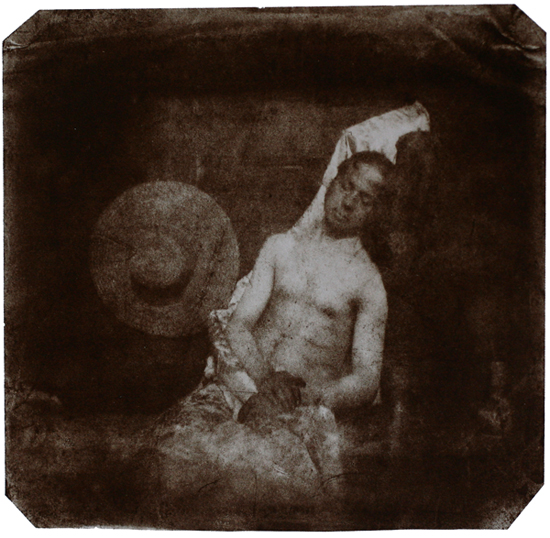
    Bayard, Hippolyte(Image source, Gerry Badger blog, who also has some interesting things to say about the work as
    momento mori.)

    The road in determining who was the first person to what discovery is sometime a bit rocky–so with the invention of the computer (ask Mr. Atanatsoff), and the telephone (ditto Mr. Gray) and the television (and so to with Dr. Korn).  This is also the case with photography, the rights for the discovery of the process contested in the first year following the announcement of the process. 

    The response to rejected claims for priority in discovery are almost (?) never recorded visually, but in he case of photography the rejected party did make a visual response, which I think was a prosimentrum of sorts, a photographic novella, and the appearance of the first use of satire in photography.

    Louis Daguerre’s epochal publication in the Comptes Rendus in 1839 would bring about the general recognition of the birth of photography–his process was described in that article and was immediately set to use by hundreds of adventurers people even in the first few weeks after publication. IT may well be that there are legitimate claimants working on the “photogenic” science before this time but it is Mr. Daguerre who published his findings first.

    Among the many “firsts” in the first year of photography (reckoned as PD or post Daguerre

    http://upload.wikimedia.org/wikipedia/commons/1/12/First_portrait_photo_Daguerre_Huet.jpg

    [Source here.]

    Generally though the first photographic portrait has been recognized as being the work of Robert Cornelius, who was among the earliest practioners of the new science of the Daguerreotype.  This is his work, dated 1839, made in his father’s gas light importing business on Chestnut Street, Philadelphia:

    The First Portrait Photograph Ever Made firstportrait

    (Both subjects have interesting hair issues.)

    is is fine and remarkable, though the images simply record the bodies of the humans that are pictured.  The first human portrait with an edge, with a political or social axe too grind and point to make, an  image bent on a decisive end, belongs to a man who mildly and then hotly contested Daguerere’s claim to the birth  of photography–Hippolyte Bayard. 

    Bayard (1807-1887) experimented in the photographic science before the publication of Daguerre’s paper and had shared some of his successes at this early date with members of the French Academy of Sciences (the publishers of  the esteemed Comptes Rendus, the vehicle for Daguerre’s paper). He was even in communication with Francois Arago, who as it turns out was the champion of Daguerre, and who introduced the paper to the world.  After the appearance of Daguerre’s paper Bayard–no doubt somewhat envious of the attention and money/funding that Daguerre was receiving) petitioned for help from Arago to establish his own claim and a chance for the experimenter’s lament (funding). He was told in no uncertain terms by Arago to cease the attention, as it would hurt the chances of Daguerre to establish his priority and have the honor of the invention of photography to stay in France.  It is a longer story than this, obviously, but suffice to say, Bayard’s interests were mostly ignored, his priority claims relinquished.  (He was later able to collect a few thousand francs for his scientific work, but the larger prizes eluded him.

    And so in 1840, full of his own defeat and thoroughly impressed by Daguerre’s success, Bayard composed the (above) portrait of himself as a drowned and dead man.  On the reverse he wote:

    “The corpse which you see here is that of M. Bayard, inventor of the
    process that has just been shown to you. As far as I know this
    indefatigable experimenter has been occupied for about three years with
    his discovery. The Government which has been only too generous to
    Monsieur Daguerre, has said it can do nothing for Monsieur Bayard, and
    the poor wretch has drowned himself. Oh the vagaries of human life….!
    … He has been at the morgue for several days, and no-one has
    recognized or claimed him. Ladies and gentlemen, you’d better pass along
    for fear of offending your sense of smell, for as you can observe, the
    face and hands of the gentleman are beginning to decay.”  
    (From Helmut Gernsheim, A Concise History of Photography, with Alison Gernsheim, London: Thames & Hudson, 1965)

    It seems that the use of satire in photography was not common in the first few decades following 1839, which makes Bayard’s first use of he genre in 1840 even more remarkable.  Satire in general has been aroudn for thousands of years, mostly in the form of drama and literature, and then in (Western, at least) painting in the Renaissance), right up through the Brueghels and Hogarth and Chaplin’s Great Dictator and Dr. Strangelove. But it seems to me that the first photographic use of the genre came with the overtaken Bayard, who at least deserves this honor of “firstness”. 

    Note:

    I just wanted to remark on the hands and head of Bayard in his self-portrait–I believe that the man is just sunburned.  It si common to see in 19th century photographs of working people that–when their hat is removed and so on–we see a big sun/tan line ont heir forehead.  This is particularly the case in the work of Solomon Butcher, who recorded the lives of families on the SOdbuster Fronter in the 1880’s and 1890’s in Nebraska. 

    Harve Andrews and family by the grave of "Willie," photographed by Solomon Butcher, Victoria Creek Canyon, Custer County, 1887. NSHS RG2608-2360

    (Source, Nebraska State Historical Society.)


  • Daily Dose from Dr. Odd: Hermits, Putridity & Long Life Spans in “The Bible”, 1826.

    JF Ptak Science Books   Quick Post

    [Les Ages de l’homme (The Ages of Man)  by D de Vosthem, late 16th century, source here.]

    Increasing nothingness and putridness can possible lead to longer life spans, at least this is an hypothesis posed by John Blake in his Geographical Atlas…, published in New York in 1826:

    ” Rare examples however of extreme longevity of a life of more than 150 years seem to he common to all countries without distinction. If England the salubrity of which is so highly extolled has furnished thrice or four examples of men arriving at the age of from 150 to 169 years. Hungary which generally speaking is not a very healthy country has scen the celebrated Pierre Czartou prolong his life to the 185th year and John Uovin at the age of 172 had a wife of 164 and a younger son of 117. It is in the Bannat of Temeswar a very marshy district and subject to the putrid fever that these examples of longevity and many others have been observed A mode of life which is soher and unruffled by tumultuous passions singularly contributes to longevity…”

    “According to the author of a very curious little work called the Apology for Youth* 152 hermits taken in all ages and under every climate produce a sum total of 11,589 years of life and consequently an average of 70 years and a little mare than thrice months for each whereas the same number of Academicians the one half belonging to the Academy of Sciences and the other to that of Belles Lettres gives only 10,511 years of life consequently 69 years and a little more than two months for the mortal career of each. It is therefore not improbable that in the ages of patriarchal innocence the period of 150 or even 200 years was much more commonly attained than it is in our times…”

    Notes:


  • Beautiful Book Cover Design and Defending Something Coming from Nothing

    JF Ptak Science Books   Post 1907   [Part of the series The History of Blank, Empty and Missing Things]

    • Coming shortly:  The Other Great Work of The Principia Year of 1687  AND  “Where Light is Declared to be not Similar”, Newton’s First Published Work 1671

    Universe

      I should feel pleased were this study to be looked upon as the
    entrance of the temple in which lie hidden the mys- terious splendors of
    Nature, and if it were the means of in- spiring some with a desire to
    penetrate into the sanctuary itself, and uplift the veil which conceals
    them, my labors will bear good fruit.
    — Pouchet, from his Introduction

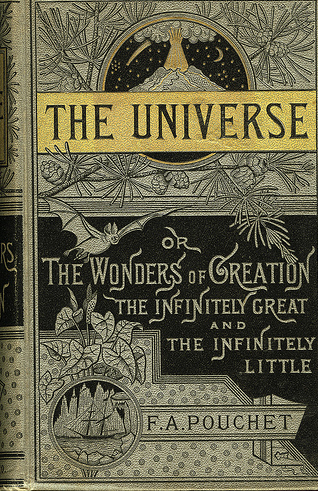
    Felix-Archimede Pouchet (1800-1874) was a serious academic and professor of anatomy, a skilled medical man with a long history at university.  Late in his life, nearly very well at its end, he published a general popular history of science with a probably-unique title, The Universe, or the Wonders of Creation, the Infinitely Great and the Infinitely Little.  It was a wrist-bender, going through at least 12 editions before 1900 (a best-seller) and weighing in at just over 1000 pages.

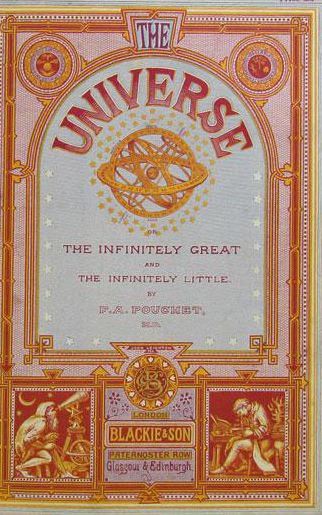
    The title is lovely, and the artists responsible for the design of the publisher’s binding, the front cover, for the book did an absolutely excellent job. (The title page for the 1882 edition appears below, looking much like the covers of the book.)

    Universe1871As it turns out, it seems as though there have been a thousand or two books published over  the 400 years between 1500 and 1900 using the word “universe” in the title–at least according to a quick browse through the WorldCat catalogue.  It seems actually to be a little common, which was a surprising to me. (Some of the titles were remarkable, as the one below by Herman Moll1, though the Pouchet title seems to be of high elegance compared to the lot I’ve seen.)

    Pouchet does have some disappointments in the book, some classic beliefs that went afoul of experimentation and discovery.  He has a towering time with Louis Pasteur, whose theory of airborne organisms causing all manner of changes in the state of biological systems ran directly against Pouchet’s belief system of spontaneous generation, and of things being borne of nothingness.  It was a bitter time Pouchet had with the great man, and a long and fruitless argument that would come to no good end for the man railing against what he called “pansperma”.

    His book in general was interesting, and ran the full gamnut of interest, establishing itself as a versatile and popular encyclopedia of sorts, in spite of his very obvious problem with being on the wrong side of the argument with Pasteur.  Still, the title is great, and having it worked into the cover design of the book was brilliant. 


  • Hidden Stories in Prints–Renaissance Ladders in the Brooklyn Bridge, 1876

    JF Ptak Science Books   Post 1904

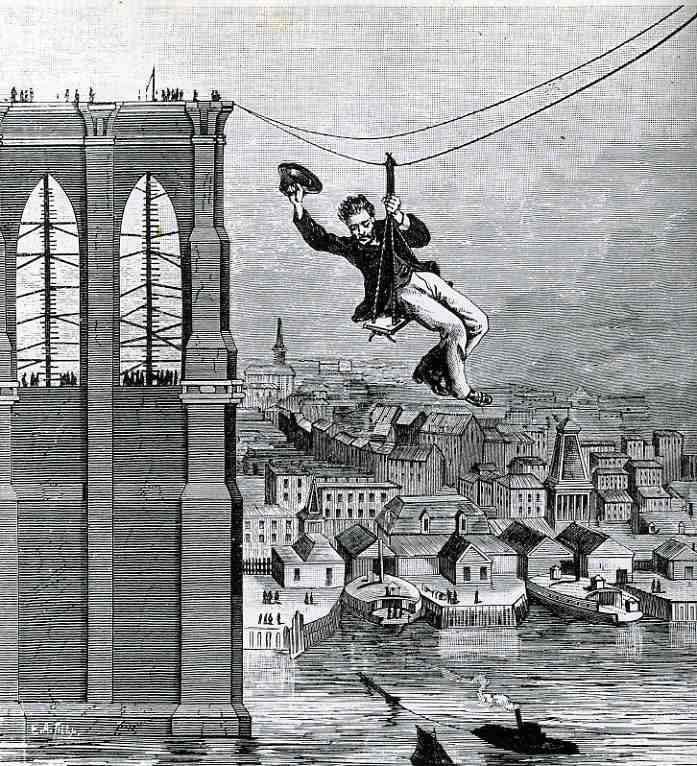
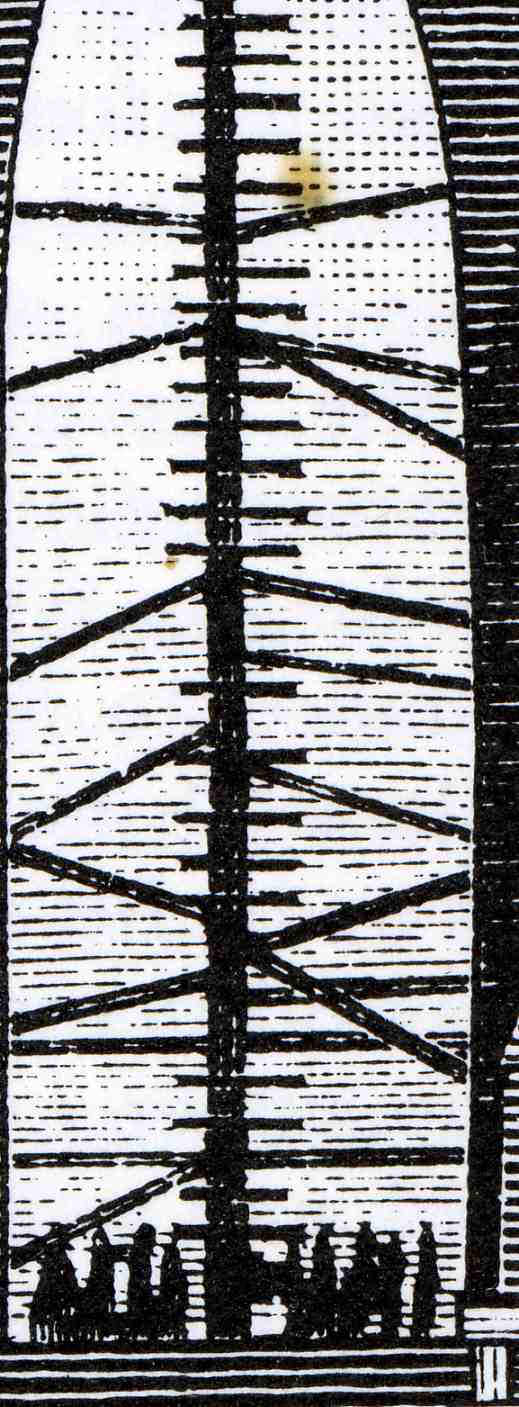
     blog 18 brooklyn bridge big707I’ve long been interested in the hidden, or the obscure, or the secondary, or the non-essential backgrounds and foreground in prints–more so at times than the subject of the print itself.  This thinking certainly applies for me nowadays when looking at another engraving of Winchester or another view of Rome or another prosaic cityscape–the main focus of the images are of course beautiful, but since I’ve seen this stuff so much my eye started wandering around to the small and inconsequential bits in the scene, and found that this is where odd richness might be.  blog 18 brooklyn bridge ladder708

    And so on to what is in my mind, at least, an iconic wood engraving
    of the half-completed* Brooklyn Bridge, showing master mechanic and chief engineer of the project E.F. (Frank) Farrington making his slidy way as the first person to cross between the two spans (on 26 August 1876). 

    What we see in the background of this print, on the Brooklyn-side tower, is a group of people watching Farrington, and in their midst, two gigantic, ramshackle ladders, straight out of the Renaissance.  Farrington was supposed to be showing how safe everything thing was for the workers–27 men died in the construction of the bridge, which given the times and difficulties is tragic but actually not too  bad–but I think he simply couldn’t resist the impulse of making the dangerous, wind-swept way across the river to the Manhattan side.  The ladders don’t seem to speak much to security and safety, but I guess that they worked

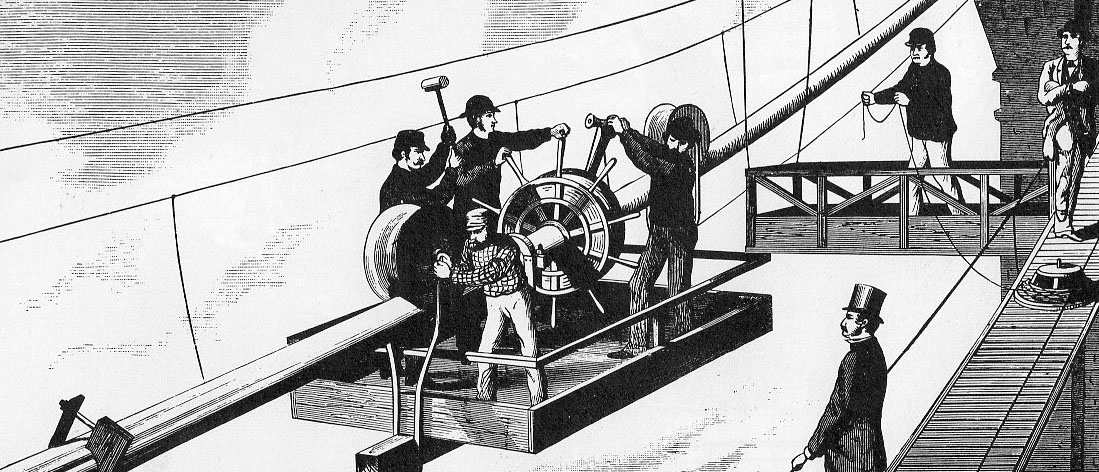
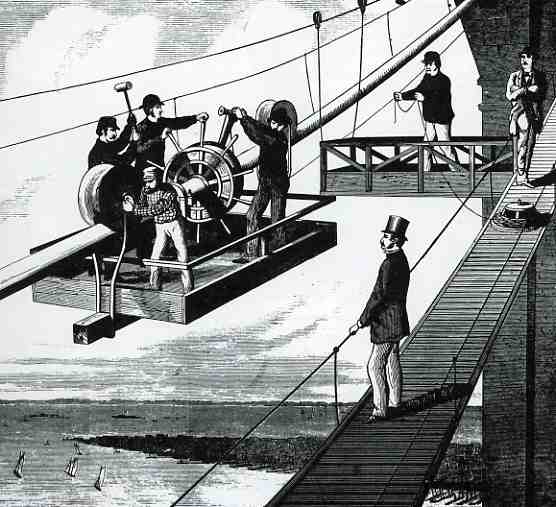
     Another interesting peep into the times is seen in this wood engraving from 1877, showing a crew working on the cables.  As much as eyewitnesses claimed that Farrington performed his stunt to exhibit the safety of the cables, looking closely at this print shows the relative danger faced by the workers.  The railing around the support car here looks more like a hindrance than a help, seemingly making it easier for a worker to trip on it, and fall into the water 300+ feet below.  

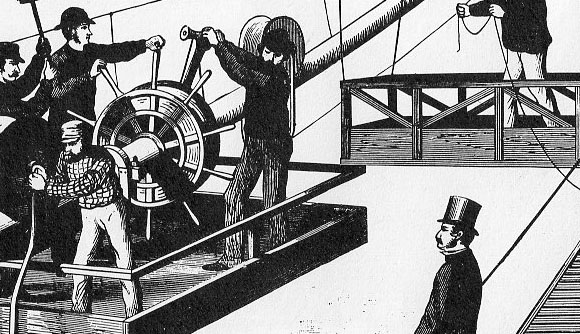
    Below-knee-level barricades surely does not make for a safety fence–it is very probably anti-safety.  That said, if you look closely at the man on the extreme right, he seems to be sitting on the safety cable, leg up, nonchalant, watching the application of the cable. Tempting fate.


    Banner brooklyn const805

    And the detail:

    Banner brooklyn cons editedt805_edited-1

    I guess though that the most hidden aspect of the building of the Brooklyn Bridge was the identity of the chief and overriding builder:  Mrs. Emily Roebling.

    It turns out that the original designer for the bridge, John Roebling, was killed early on in an explosion and was replaced by his son, Washington, who in turn (in 1871) was terrifically incapacitated; Washington was ‘aided” by his wife Emily (1843-1903), who became the most recognizable spokesperson and sub rosa engineer of record.  She was supposed to be assisting Washington, but it was far more so than that.  Probably it was an inappropriate time for society in general to believe that a woman was capable of supervising the construction of the world’s longest suspension bridge.

    “The work which is most likely to become our most durable monument, and
    to convey some knowledge of us to the most remote posterity, is a work
    of bare utility; not a shrine, not a fortress, not a palace, but a
    bridge.” Emily_roebling– Harper’s Weekly (1883) 

    *The bridge was about half-way done, following the construction beginning in 1870 and its opening in 1883.


  • Exercise in Irony: the Usually-Invisible Chinese Rail Worker and the Highly Visible Photographer, 1869

    JF Ptak Science Books   Post 1903   Part of the series on the History of Blank, Empty and Missing Things:  Chinese Rail Workers, 1869. 

    Chinese promontory

    One thing that you seldom see so juxtaposed in the photographic history of the American West are the people who were so important to it placed in proximity to those who were no well disposed to recording their existence. 

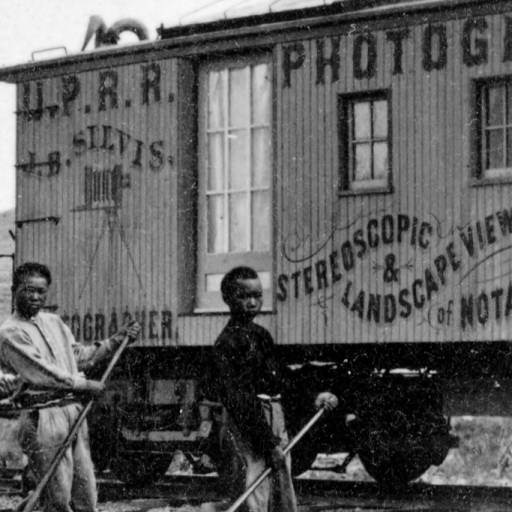
    For example:  this image by J.B. Silvis, “China Section Gang Promontory”, a photograph published as a stereocard between  1869 and 1870, shows a small group of Chinese workers setting two rails in Utah–they are the ubiquitously missing elements in historical images of transcontinental railroad construction. There were many thousands of these workers who were set to notoriously difficult tasks in bad situations and under time constraints with little liberty or pay (and not well-afforded much protection under the law), and in the history of documenting the expansion of the railroad across the West these workers are very seldom seen.

    They are set incongruously in front of a photography car that so often saw through or around them.   The  car was labeled  “U.P.R.R. Photograph J.B. Silvis Stereoscopic & Landscape Views of Notable Points on line of Pacific R.R. Always on Hand”, and I found it tempting to try to see in the photograph that it was made solely for the photographer’s advertisement, but the central placement of the workers makes a good argument against this.  On the other hand, when you look at some of the other work of Silvis documenting his railway car (see here), there are a number of group images where he gathers cowboys or Indians  or makes a photo with his car in an unusual place, he is definitely using those people and locales to establish the idea of remoteness and wildness of the places in which he was working. It seems to me that in the end, he was using the Chinese laborers as a piece of his advertising ensemble more than documenting them. Again, this is very speculative.

    It is a very unusual image which I think is knee-deep in irony. 

    I should also like to point out that most of the workers have taken care to sew  large leather patches on their breeches–that to help their thighs when pulling that heavy metal lever across their bodies while setting and moving track. 

    [All images via Denver Public Library, here.]


  • Children in the Workforce, 1880

    JF Ptak Science Books  Quick Post

    (On discovering and photographically documenting children at work in the 1920’s and ’30’s, see here.)

    Here’s an interesting bit I just slipped into while looking for something else.

    Children at work.

    10-15 years of age. 

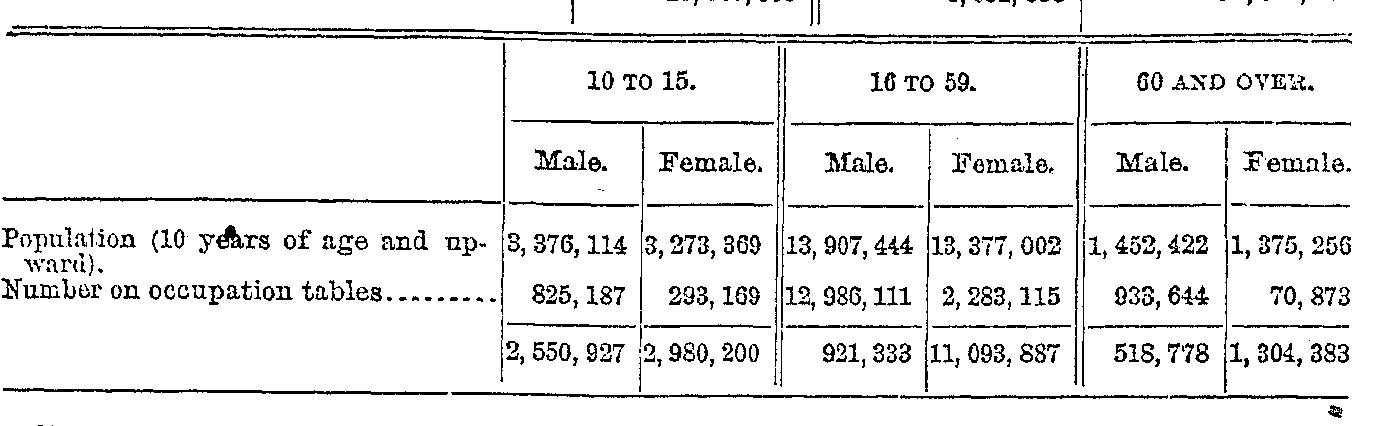
    In 1880, half of the population was 10+ years old. There were 17 million people at work, and of these 1.1 million were children, making about 6% of the entire workforce.  And that’s about as truthful as we’ll ever know about that statistic–given the relatively primitive way in which these numbers were corralled, my guess is that there were considerably more children at work than this.        


    And it looks like of the total population of male children aged 10-15 (3.37 million) that 1.1 million of them–about 29%–were working, mostly it seems in the fields.